EP4382487A1 - Matériau actif d'électrode positive, son procédé de préparation, électrode positive le comprenant et batterie secondaire au lithium - Google Patents
Matériau actif d'électrode positive, son procédé de préparation, électrode positive le comprenant et batterie secondaire au lithium Download PDFInfo
- Publication number
- EP4382487A1 EP4382487A1 EP22867737.3A EP22867737A EP4382487A1 EP 4382487 A1 EP4382487 A1 EP 4382487A1 EP 22867737 A EP22867737 A EP 22867737A EP 4382487 A1 EP4382487 A1 EP 4382487A1
- Authority
- EP
- European Patent Office
- Prior art keywords
- positive electrode
- lithium
- active material
- electrode active
- nickel
- Prior art date
- Legal status (The legal status is an assumption and is not a legal conclusion. Google has not performed a legal analysis and makes no representation as to the accuracy of the status listed.)
- Pending
Links
Images


Classifications
-
- H—ELECTRICITY
- H01—ELECTRIC ELEMENTS
- H01M—PROCESSES OR MEANS, e.g. BATTERIES, FOR THE DIRECT CONVERSION OF CHEMICAL ENERGY INTO ELECTRICAL ENERGY
- H01M4/00—Electrodes
- H01M4/02—Electrodes composed of, or comprising, active material
- H01M4/36—Selection of substances as active materials, active masses, active liquids
- H01M4/48—Selection of substances as active materials, active masses, active liquids of inorganic oxides or hydroxides
- H01M4/52—Selection of substances as active materials, active masses, active liquids of inorganic oxides or hydroxides of nickel, cobalt or iron
- H01M4/525—Selection of substances as active materials, active masses, active liquids of inorganic oxides or hydroxides of nickel, cobalt or iron of mixed oxides or hydroxides containing iron, cobalt or nickel for inserting or intercalating light metals, e.g. LiNiO2, LiCoO2 or LiCoOxFy
-
- C—CHEMISTRY; METALLURGY
- C01—INORGANIC CHEMISTRY
- C01G—COMPOUNDS CONTAINING METALS NOT COVERED BY SUBCLASSES C01D OR C01F
- C01G53/00—Compounds of nickel
- C01G53/40—Complex oxides containing nickel and at least one other metal element
- C01G53/42—Complex oxides containing nickel and at least one other metal element containing alkali metals, e.g. LiNiO2
- C01G53/44—Complex oxides containing nickel and at least one other metal element containing alkali metals, e.g. LiNiO2 containing manganese
- C01G53/50—Complex oxides containing nickel and at least one other metal element containing alkali metals, e.g. LiNiO2 containing manganese of the type (MnO2)n-, e.g. Li(NixMn1-x)O2 or Li(MyNixMn1-x-y)O2
- C01G53/502—Complex oxides containing nickel and at least one other metal element containing alkali metals, e.g. LiNiO2 containing manganese of the type (MnO2)n-, e.g. Li(NixMn1-x)O2 or Li(MyNixMn1-x-y)O2 containing lithium and cobalt
- C01G53/504—Complex oxides containing nickel and at least one other metal element containing alkali metals, e.g. LiNiO2 containing manganese of the type (MnO2)n-, e.g. Li(NixMn1-x)O2 or Li(MyNixMn1-x-y)O2 containing lithium and cobalt with the molar ratio of nickel with respect to all the metals other than alkali metals higher than or equal to 0.5, e.g. Li(MzNixCoyMn1-x-y-z)O2 with x ≥ 0.5
- C01G53/506—Complex oxides containing nickel and at least one other metal element containing alkali metals, e.g. LiNiO2 containing manganese of the type (MnO2)n-, e.g. Li(NixMn1-x)O2 or Li(MyNixMn1-x-y)O2 containing lithium and cobalt with the molar ratio of nickel with respect to all the metals other than alkali metals higher than or equal to 0.5, e.g. Li(MzNixCoyMn1-x-y-z)O2 with x ≥ 0.5 with the molar ratio of nickel with respect to all the metals other than alkali metals higher than or equal to 0.8, e.g. Li(MzNixCoyMn1-x-y-z)O2 with x ≥ 0.8
-
- C—CHEMISTRY; METALLURGY
- C01—INORGANIC CHEMISTRY
- C01G—COMPOUNDS CONTAINING METALS NOT COVERED BY SUBCLASSES C01D OR C01F
- C01G53/00—Compounds of nickel
- C01G53/40—Complex oxides containing nickel and at least one other metal element
- C01G53/42—Complex oxides containing nickel and at least one other metal element containing alkali metals, e.g. LiNiO2
- C01G53/44—Complex oxides containing nickel and at least one other metal element containing alkali metals, e.g. LiNiO2 containing manganese
- C01G53/50—Complex oxides containing nickel and at least one other metal element containing alkali metals, e.g. LiNiO2 containing manganese of the type (MnO2)n-, e.g. Li(NixMn1-x)O2 or Li(MyNixMn1-x-y)O2
-
- C—CHEMISTRY; METALLURGY
- C01—INORGANIC CHEMISTRY
- C01G—COMPOUNDS CONTAINING METALS NOT COVERED BY SUBCLASSES C01D OR C01F
- C01G53/00—Compounds of nickel
- C01G53/80—Compounds containing nickel, with or without oxygen or hydrogen, and containing one or more other elements
- C01G53/82—Compounds containing nickel, with or without oxygen or hydrogen, and containing two or more other elements
-
- H—ELECTRICITY
- H01—ELECTRIC ELEMENTS
- H01M—PROCESSES OR MEANS, e.g. BATTERIES, FOR THE DIRECT CONVERSION OF CHEMICAL ENERGY INTO ELECTRICAL ENERGY
- H01M10/00—Secondary cells; Manufacture thereof
- H01M10/05—Accumulators with non-aqueous electrolyte
- H01M10/052—Li-accumulators
-
- H—ELECTRICITY
- H01—ELECTRIC ELEMENTS
- H01M—PROCESSES OR MEANS, e.g. BATTERIES, FOR THE DIRECT CONVERSION OF CHEMICAL ENERGY INTO ELECTRICAL ENERGY
- H01M10/00—Secondary cells; Manufacture thereof
- H01M10/05—Accumulators with non-aqueous electrolyte
- H01M10/052—Li-accumulators
- H01M10/0525—Rocking-chair batteries, i.e. batteries with lithium insertion or intercalation in both electrodes; Lithium-ion batteries
-
- H—ELECTRICITY
- H01—ELECTRIC ELEMENTS
- H01M—PROCESSES OR MEANS, e.g. BATTERIES, FOR THE DIRECT CONVERSION OF CHEMICAL ENERGY INTO ELECTRICAL ENERGY
- H01M4/00—Electrodes
- H01M4/02—Electrodes composed of, or comprising, active material
- H01M4/13—Electrodes for accumulators with non-aqueous electrolyte, e.g. for lithium-accumulators; Processes of manufacture thereof
- H01M4/131—Electrodes based on mixed oxides or hydroxides, or on mixtures of oxides or hydroxides, e.g. LiCoOx
-
- H—ELECTRICITY
- H01—ELECTRIC ELEMENTS
- H01M—PROCESSES OR MEANS, e.g. BATTERIES, FOR THE DIRECT CONVERSION OF CHEMICAL ENERGY INTO ELECTRICAL ENERGY
- H01M4/00—Electrodes
- H01M4/02—Electrodes composed of, or comprising, active material
- H01M4/36—Selection of substances as active materials, active masses, active liquids
-
- H—ELECTRICITY
- H01—ELECTRIC ELEMENTS
- H01M—PROCESSES OR MEANS, e.g. BATTERIES, FOR THE DIRECT CONVERSION OF CHEMICAL ENERGY INTO ELECTRICAL ENERGY
- H01M4/00—Electrodes
- H01M4/02—Electrodes composed of, or comprising, active material
- H01M4/36—Selection of substances as active materials, active masses, active liquids
- H01M4/48—Selection of substances as active materials, active masses, active liquids of inorganic oxides or hydroxides
- H01M4/50—Selection of substances as active materials, active masses, active liquids of inorganic oxides or hydroxides of manganese
- H01M4/505—Selection of substances as active materials, active masses, active liquids of inorganic oxides or hydroxides of manganese of mixed oxides or hydroxides containing manganese for inserting or intercalating light metals, e.g. LiMn2O4 or LiMn2OxFy
-
- C—CHEMISTRY; METALLURGY
- C01—INORGANIC CHEMISTRY
- C01P—INDEXING SCHEME RELATING TO STRUCTURAL AND PHYSICAL ASPECTS OF SOLID INORGANIC COMPOUNDS
- C01P2002/00—Crystal-structural characteristics
- C01P2002/50—Solid solutions
-
- C—CHEMISTRY; METALLURGY
- C01—INORGANIC CHEMISTRY
- C01P—INDEXING SCHEME RELATING TO STRUCTURAL AND PHYSICAL ASPECTS OF SOLID INORGANIC COMPOUNDS
- C01P2002/00—Crystal-structural characteristics
- C01P2002/60—Compounds characterised by their crystallite size
-
- C—CHEMISTRY; METALLURGY
- C01—INORGANIC CHEMISTRY
- C01P—INDEXING SCHEME RELATING TO STRUCTURAL AND PHYSICAL ASPECTS OF SOLID INORGANIC COMPOUNDS
- C01P2004/00—Particle morphology
- C01P2004/01—Particle morphology depicted by an image
- C01P2004/03—Particle morphology depicted by an image obtained by SEM
-
- C—CHEMISTRY; METALLURGY
- C01—INORGANIC CHEMISTRY
- C01P—INDEXING SCHEME RELATING TO STRUCTURAL AND PHYSICAL ASPECTS OF SOLID INORGANIC COMPOUNDS
- C01P2004/00—Particle morphology
- C01P2004/01—Particle morphology depicted by an image
- C01P2004/04—Particle morphology depicted by an image obtained by TEM, STEM, STM or AFM
-
- C—CHEMISTRY; METALLURGY
- C01—INORGANIC CHEMISTRY
- C01P—INDEXING SCHEME RELATING TO STRUCTURAL AND PHYSICAL ASPECTS OF SOLID INORGANIC COMPOUNDS
- C01P2004/00—Particle morphology
- C01P2004/50—Agglomerated particles
-
- C—CHEMISTRY; METALLURGY
- C01—INORGANIC CHEMISTRY
- C01P—INDEXING SCHEME RELATING TO STRUCTURAL AND PHYSICAL ASPECTS OF SOLID INORGANIC COMPOUNDS
- C01P2004/00—Particle morphology
- C01P2004/60—Particles characterised by their size
- C01P2004/61—Micrometer sized, i.e. from 1-100 micrometer
-
- C—CHEMISTRY; METALLURGY
- C01—INORGANIC CHEMISTRY
- C01P—INDEXING SCHEME RELATING TO STRUCTURAL AND PHYSICAL ASPECTS OF SOLID INORGANIC COMPOUNDS
- C01P2004/00—Particle morphology
- C01P2004/60—Particles characterised by their size
- C01P2004/62—Submicrometer sized, i.e. from 0.1-1 micrometer
-
- C—CHEMISTRY; METALLURGY
- C01—INORGANIC CHEMISTRY
- C01P—INDEXING SCHEME RELATING TO STRUCTURAL AND PHYSICAL ASPECTS OF SOLID INORGANIC COMPOUNDS
- C01P2006/00—Physical properties of inorganic compounds
- C01P2006/40—Electric properties
-
- C—CHEMISTRY; METALLURGY
- C01—INORGANIC CHEMISTRY
- C01P—INDEXING SCHEME RELATING TO STRUCTURAL AND PHYSICAL ASPECTS OF SOLID INORGANIC COMPOUNDS
- C01P2006/00—Physical properties of inorganic compounds
- C01P2006/80—Compositional purity
-
- H—ELECTRICITY
- H01—ELECTRIC ELEMENTS
- H01M—PROCESSES OR MEANS, e.g. BATTERIES, FOR THE DIRECT CONVERSION OF CHEMICAL ENERGY INTO ELECTRICAL ENERGY
- H01M4/00—Electrodes
- H01M4/02—Electrodes composed of, or comprising, active material
- H01M2004/021—Physical characteristics, e.g. porosity, surface area
-
- H—ELECTRICITY
- H01—ELECTRIC ELEMENTS
- H01M—PROCESSES OR MEANS, e.g. BATTERIES, FOR THE DIRECT CONVERSION OF CHEMICAL ENERGY INTO ELECTRICAL ENERGY
- H01M4/00—Electrodes
- H01M4/02—Electrodes composed of, or comprising, active material
- H01M2004/026—Electrodes composed of, or comprising, active material characterised by the polarity
- H01M2004/028—Positive electrodes
-
- Y—GENERAL TAGGING OF NEW TECHNOLOGICAL DEVELOPMENTS; GENERAL TAGGING OF CROSS-SECTIONAL TECHNOLOGIES SPANNING OVER SEVERAL SECTIONS OF THE IPC; TECHNICAL SUBJECTS COVERED BY FORMER USPC CROSS-REFERENCE ART COLLECTIONS [XRACs] AND DIGESTS
- Y02—TECHNOLOGIES OR APPLICATIONS FOR MITIGATION OR ADAPTATION AGAINST CLIMATE CHANGE
- Y02E—REDUCTION OF GREENHOUSE GAS [GHG] EMISSIONS, RELATED TO ENERGY GENERATION, TRANSMISSION OR DISTRIBUTION
- Y02E60/00—Enabling technologies; Technologies with a potential or indirect contribution to GHG emissions mitigation
- Y02E60/10—Energy storage using batteries
Definitions
- the present invention relates to a positive electrode active material, a method for producing the same, and a positive electrode and a lithium secondary battery both including the positive electrode active material, and more specifically, to a positive electrode active material in the form of at least one of single particles and pseudo-single particles with improved resistance properties, a method for producing the same, and a positive electrode and a lithium secondary battery both including the positive electrode active material.
- a lithium secondary battery is generally composed of a positive electrode, a negative electrode, a separator, and an electrolyte, and the positive electrode and the negative electrode include active materials capable of intercalation and de-intercalation of lithium ions.
- a lithium cobalt oxide (LiCoO 2 ), a lithium nickel oxide (LiNiO 2 ), a lithium manganese oxide (LiMnO 2 , LiMnO 4 , or the like), a lithium iron phosphate compound (LiFePO 4 ), and the like have been used.
- the lithium cobalt oxide is advantageous in that the driving voltage is high and the capacity properties are excellent, but since the price of cobalt, which is a raw material, is high, and the supply thereof is unstable, so that it is difficult to commercially apply the lithium cobalt oxide to a large-capacity battery.
- the lithium nickel oxide has poor structural stability, so that it is difficult to implement sufficient lifespan properties.
- the lithium manganese oxide has excellent stability, but has a problem in that the capacity properties thereof are poor. Therefore, in order to compensate for problems of lithium transition metal oxides including Ni, Co, or Mn alone, lithium composite transition metal oxides including two or more transition metals have been developed, and among them, a lithium nickel cobalt manganese oxide including Ni, Co, and Mn is widely used in the field of electric vehicle batteries.
- a typical lithium nickel cobalt manganese oxide is generally in the form of a spherical secondary particle in which tens to hundreds of primary particles are aggregated.
- a lithium nickel cobalt manganese oxide in the form of a secondary particle in which a large number of primary particles are aggregated particle breakage easily occurs wherein primary particles are broken off during a roll-pressing process when manufacturing a positive electrode, and there is a problem in that cracks are generated inside particles during a charging and discharging process.
- the nickel content in the positive electrode active material increases, initial capacity properties are improved, but when charging and discharging are repeated, the structure of the positive electrode active material collapses, which causes the deterioration rate of the positive electrode active material to increase, resulting in degraded lifespan properties and degraded battery safety.
- a technique for producing a positive electrode active material in the form of single particles rather than a secondary particle by increasing a sintering temperature when preparing a lithium nickel cobalt manganese oxide has been proposed.
- a positive electrode active material in the form of single particles has a smaller contact area with an electrolyte solution compared to a typical positive electrode active material in the form of a secondary particle, and thus, has fewer side reactions with the electrolyte solution, and has excellent particle strength, so that there is less particle breakage when manufacturing an electrode. Therefore, when a positive electrode active material in the form of single particles is applied, there are advantages in terms of gas generation and lifespan properties.
- the present invention provides a method for producing a positive electrode active material in the form of at least one of single particles and pseudo-single particles, the method capable of effectively removing lithium by-products while suppressing an increase in resistance, and a positive electrode active material produced thereby.
- the present invention provides a positive electrode including the positive electrode active material, and a lithium secondary battery including the positive electrode, thereby having a small amount of gas generated during high-temperature storage and having excellent resistance properties at a low SOC.
- a method for producing a positive electrode active material including (A) sintering a mixture of a transition metal precursor and a lithium raw material to prepare a lithium-nickel-based oxide in the form of at least one of single particles and pseudo-single particles, wherein each single particle consists of one nodule and wherein each pseudo-single particle is a composite of 30 or fewer nodules,(B) milling the lithium-nickel-based oxide, and (C)then sintering the lithium-nickel-based oxide at a temperature of 600°C to 900°C.
- a positive electrode active material including a lithium-nickel-based oxide in the form of at least one of single particles and pseudo-single particles, wherein each single particle consists of one nodule and wherein each pseudo-single particle is a composite of 30 or fewer nodules, wherein on the surface of the lithium-nickel-based oxide, a number of nickel ions having an oxidation number of +3 or higher is greater than a number of nickel ions having an oxidation number less than +3.
- a positive electrode including a positive electrode active material layer having a positive electrode active material according to the present invention, and a lithium secondary battery including the positive electrode.
- the method comprises: (A)sintering a mixture of a transition metal precursor and a lithium raw material to prepare a lithium-nickel-based oxide in the form of at least one of single particles or pseudo-single particles,(B) milling the lithium-nickel-based oxide, and (C) then sintering the lithium-nickel-based oxide at a temperature of 600°C to 900°C, so that residual lithium may be effectively removed without performing a process of washing with water.
- a positive electrode active material in the form of a secondary particle since resistance is not high, there is no big problem even if the resistance is slightly increased through a process of washing with water.
- a positive electrode active material in the form of single particles and/or pseudo-single particles has high resistance, so that when there is an additional increase in resistance through a process of washing with water, there is a problem in that output properties are significantly degraded.
- discharge end resistance in a low SOC region (e.g., a region with SOC 10% or less) is significantly increased, so that it is difficult to apply the positive electrode active material in the form of single particles and/or pseudo-single particles to batteries for electric vehicles which require high-power in a low SOC region.
- a low SOC region e.g., a region with SOC 10% or less
- a positive electrode active material of the present invention produced through the above-described method includes a lithium-nickel-based oxide in the form of single particles and/or pseudo-single particles, wherein on the surface of the lithium-nickel-based oxide, a number of nickel ions having an oxidation number of +3 or higher is greater than nickel ions having an oxidation number less than +3.
- the positive electrode active material of the present invention has low resistance properties since the number of nickel ions having an oxidation number of +3 or higher, which are electrically active, are greater on the surface of the lithium-nickel-based oxide.
- the positive electrode active material according to the present invention includes a lithium-nickel-based oxide in the form of single particles and/or pseudo-single particles with high particle strength, and thus, has less particle breakage during electrode manufacturing and charging and discharging, and the positive electrode active material has a small amount of residual lithium, which suppresses the generation of side reactions with an electrolyte solution, and thus, when applied to a secondary battery, has a small amount of gas generated and excellent high-temperature lifespan properties.
- single particle is a particle consisting of a single nodule.
- a “pseudo-single particle” refers to a particle which is a composite formed of 30 or less nodules.
- a “nodule” according to the present invention refers to particle unit body constituting a single particle and a pseudo-single particle.
- the nodule may be a single crystal lacking any crystalline grain boundary, or alternatively that may be a polycrystal in which grain boundaries do not appear when observed in a field of view of 5000x to 20000x using a scanning electron microscope (SEM).
- SEM scanning electron microscope
- a "secondary particle” refers to a particle formed by agglomeration of a plurality several tens to several hundreds of primary particles. More specifically, a secondary particle is an agglomerate of 40 primary particles or more.
- any one or all of a single particle, a pseudo-single particle, a primary particle, a nodule, and a secondary particle may be encompassed.
- the term "average particle diameter D 50" refers to a particle size based on 50% of a volume cumulative particle size distribution of positive electrode active material powder , and when a lithium composite transition metal oxide is a secondary particle, the average particle diameter refers to an average diameter of secondary particles, and when the lithium composite transition metal oxide is a combination of single particles and pseudo-single particles, the average particle diameter refers to an average diameter of a particle in the combination.
- the average particle diameter D 50 may be measured by a laser diffraction method.
- positive electrode active material powder is dispersed in a dispersion medium, and then introduced into a commercially available laser diffraction particle size measurement device (e.g., Microtrac MT 3000) to be irradiated with an ultrasonic wave of about 28 kHz to an output of 60W. Thereafter, the average particle diameter may be measured by obtaining a volume cumulative particle size distribution graph, and then obtaining a particle size corresponding to 50% of a volume cumulative amount.
- a laser diffraction particle size measurement device e.g., Microtrac MT 3000
- an "average crystalline grain size" is measured by analyzing XRD data, which is obtained by performing X-ray diffraction analysis on positive electrode active material powder, by the Rietveld refinement method.
- the Rietveld refinement was performed in consideration of charge (+3 for metals at transition metal sites, +2 for Ni at Li sites) and cation mixing at each site.
- FPA Fundamental Parameter Approach
- FP First Principle
- Electron Energy Loss Spectroscopy measurement was performed through the following method.
- a positive electrode active material to be measured was milled to a thickness of about 80 nm using a Focused Ion Beam (FIB) device, and then the spectrum was obtained for 30 minutes under the 200 kV acceleration voltage condition.
- FIB Focused Ion Beam
- the method for producing a positive electrode active material according to the present invention includes (A) sintering a mixture of a transition metal precursor and a lithium raw material to prepare a lithium-nickel-based oxide in the form of at least one of single particles and pseudo-single particle, wherein each single particle consists of one nodule and wherein each pseudo-single particle is a composite of 30 or fewer nodules,(B) milling the lithium-nickel-based oxide, and (C) then sintering the lithium-nickel-based oxide at a temperature of 600°C to 900°C.
- a transition metal precursor and a lithium raw material are mixed, and then the mixture is subjected to sintering to prepare a lithium-nickel-based oxide in the form of at least one of single particles and pseudo-single particles.
- the transition metal precursor may be a commercially available precursor, such as a nickel-cobalt-manganese-based hydroxide or the like, purchased and used, or may be prepared according to a method for preparing a precursor, the method known in the art.
- the transition metal precursor used in the present invention may be a transition metal hydroxide including nickel and cobalt and having a Ni content of 80 mol% or greater in all transition metals, and more preferably, may be a nickel-cobalt-manganese hydroxide having a Ni content of 80 mol% or greater.
- the content of nickel in the transition metal precursor satisfies the above range, high capacity properties may be implemented.
- the transition metal precursor may be represented by Formula 2 below.
- Formula 2 Ni x Co y M 1 z M 2 w (OH) 2
- M 1 is Mn, Al, or a combination thereof, and preferably, Mn, or a combination of Mn and Al.
- M 2 is one or more selected from the group consisting of Zr, W, Y, Ba, Ca, Ti, Mg, Ta, and Nb, and preferably, may be one or more selected from the group consisting of Zr, Y, Mg, and Ti, and more preferably, may be Zr, Y, or a combination thereof.
- x represents the molar ratio of nickel in all metals in the precursor, wherein the x may satisfy 0.8 ⁇ x ⁇ 1, 0.82 ⁇ x ⁇ 1, or 0.83 ⁇ x ⁇ 1.
- the molar ratio of nickel satisfies the above range, high energy density is exhibited to implement high capacity.
- y represents the molar ratio of cobalt in all metals in the precursor, wherein the y may satisfy 0 ⁇ y ⁇ 0.2, 0 ⁇ y ⁇ 0.18, or 0.01 ⁇ y ⁇ 0.17.
- the molar ratio of cobalt satisfies the above range, good resistance properties and output properties may be implemented.
- z represents the molar ratio of an M 1 element in all metals in the precursor, wherein the z may satisfy 0 ⁇ z ⁇ 0.2, 0 ⁇ z ⁇ 0.18, or 0.01 ⁇ z ⁇ 0.17.
- the structural stability of a positive electrode active material is exhibited to be excellent.
- w represents the molar ratio of an M 2 element in all metals in the precursor, wherein the w may satisfy 0 ⁇ w ⁇ 0.1, or 0 ⁇ w ⁇ 0.05.
- the transition metal precursor may be prepared by performing a co-precipitation reaction while introducing a transition metal aqueous solution, an ammonium cation complex forming agent, and a basic compound to a reactor, followed by stirring the mixture.
- the transition metal aqueous solution may be prepared by dissolving a transition metal-containing raw material in a solvent such as water, and for example, may be prepared by dissolving a nickel-containing raw material and a cobalt-containing raw material in water.
- the transition metal aqueous solution may further include an M 1 -containing raw material and/or an M 2 -containing raw material.
- the transition metal-containing raw material may be an acetate, a carbonate, a nitrate, a sulfate, a halide, a sulfide, an oxide, or the like of a transition metal.
- the nickel-containing raw material may be, for example, NiO, NiCO 3 ⁇ 2Ni(OH) 2 ⁇ 4H 2 O, NiC 2 O 2 ⁇ 2H 2 O, Ni(NO 3 ) 2 ⁇ 6H 2 O, NiSO 4 , NiSO 4 ⁇ 6H 2 O, a nickel halide, or a combination thereof.
- the cobalt-containing raw material may be, for example, CoSO 4 , Co(OCOCH 3 ) 2 ⁇ 4H 2 O, Co(NO 3 ) 2 ⁇ 6H 2 O, CoSO 4 ⁇ 7H 2 O, or a combination thereof.
- the M 1 -containing raw material may be a manganese-containing raw material and/or an aluminum-containing raw material.
- the manganese-containing raw material may be, for example, Mn 2 O 3 , MnO 2 , Mn 3 O 4 , MnCO 3 , Mn(NO 3 ) 2 , MnSO 4 ⁇ H 2 O, a manganese acetate, a manganese halide, or a combination thereof
- the aluminum-containing raw material may be, for example, Al 2 O 3 , Al(OH) 3 , Al(NO 3 ) 3 , Al 2 (SO 4 ) 3 , (HO) 2 AlCH 3 CO 2 , HOAl(CH 3 CO 2 ) 2 , Al(CH 3 CO 2 ) 3 , an aluminum halide, or a combination thereof.
- the Al is not added to a transition metal aqueous solution, and may be introduced together with a lithium raw material in a sintering step to be described later.
- the M 2 -containing raw material may be an acetate, a carbonate, a nitrate, a sulfate, a halide, a sulfide, an oxide, or the like of an M 2 metal.
- the input amount of each transition metal-containing raw material may be determined in consideration of the molar ratio of a transition metal in a positive electrode active material to be finally produced.
- the ammonium cation complex forming agent may include at least one compound selected from the group consisting of NH 4 OH, (NH 4 ) 2 SO 4 , NH 4 NO 3 , NH 4 Cl, CH 3 COONH 4 , and NH 4 CO 3 , and the compound may be introduced into a reactor in the form of a solution in which the compound is dissolved in a solvent.
- the solvent may be water, or a mixture of an organic solvent (for example, an alcohol, etc.) which may be uniformly mixed with water and water.
- the basic compound may be at least one compound selected from the group consisting of NaOH, KOH, and Ca(OH) 2 , and the compound may be introduced into a reactor in the form of a solution in which the compound is dissolved in a solvent.
- a solvent water, or a mixture of an organic solvent (for example, an alcohol, etc.) which may be uniformly mixed with water and water may be used.
- transition metal aqueous solution When the transition metal aqueous solution, the ammonium cation complex forming agent, and the basic compound are introduced into a reactor and stirred as described above, transition metals in the transition metal aqueous solution are co-precipitated to generate precursor particles in the form of transition metal hydroxides.
- the transition metal aqueous solution, the ammonium cation complex forming agent, and the basic compound are introduced in an amount such that the pH of a reaction solution is within a desired range.
- the precursor particles are formed by the method described above, particles are separated from the reaction solution to obtain a transition metal precursor.
- the precursor particles are separated from the reaction solution by filtering the reaction solution, and then the separated precursor particles may be washed with water and dried to obtain a transition metal precursor.
- a process such as pulverization and/or classification may be performed.
- the transition metal precursor and a lithium raw material are mixed, and then the mixture is subjected to primary sintering to prepare a lithium-nickel-based oxide in the form of at least one of single particles and pseudo-single particles.
- the M 1 -containing raw material and/or the M 2 -containing raw material may be mixed together and then sintered, and specific examples of the M 1 -containing raw material and/or the M 2 -containing raw material are the same as described above.
- a lithium-containing sulfate, nitrate, acetate, carbonate, oxalate, citrate, halide, hydroxide, or oxyhydroxide may be used, and for example, Li 2 CO 3 , LiNO 3 , LiNO 2 , LiOH, LiOH ⁇ H 2 O, LiH, LiF, LiCl, LiBr, LiI, CH 3 COOLi, Li 2 O, Li 2 SO 4 , CH 3 COOLi, Li 3 C 6 H 5 O 7 , or a mixture thereof may be used.
- the lithium raw material and a positive electrode active material precursor may be mixed such that the molar ratio of Li : all metals in the precursor is 1 : 1 to 1.1 : 1, preferably 1.02 : 1 to 1.05 : 1.
- the mixing ratio of the lithium raw material and the metals in the positive electrode active material precursor satisfies the above range, a layered crystal structure of a positive electrode active material is well developed, so that the positive electrode active material having excellent capacity properties and structural stability may be produced.
- the sintering is performed at a temperature at which single particles and/or pseudo-single particles may be formed.
- sintering should be performed at a temperature higher than the temperature at which a typical lithium-nickel-based oxide in the form of a secondary particle is prepared, and for example, when the composition of precursor is the same, the sintering should be performed at a temperature about 30°C to 100°C higher than the temperature at which the typical lithium-nickel-based oxide in the form of a secondary particle is prepared.
- the sintering temperature for the formation of single particles and/or pseudo-single particles may vary depending on a metal composition in a precursor.
- the temperature for primary sintering may be about 800°C to 1000°C, preferably 800°C to 950°C, and more preferably 800°C to 900°C.
- a lithium-nickel-based oxide in the form of single particles and/or pseudo-single particles having excellent electrochemical properties may be prepared.
- sintering temperature is lower than 800°C, a positive electrode active material in the form of a secondary particle is prepared, and when higher than 1000°C, due to excessive sintering, a layered crystal structure is not formed properly, so that the electrochemical properties are degraded.
- the sintering may be performed under an oxygen atmosphere for 6 hours to 35 hours, preferably 6 hours to 20 hours, and more preferably 6 hours to 12 hours.
- a lithium-nickel-based oxide in the form of a single particles and/or a pseudo-single particle may be formed.
- the primary sintering duration is as short as less than 6 hours, particle growth is insufficient to form a lithium-nickel-based oxide in the form of a secondary particle.
- the sintering duration is too long, the electrochemical properties of the active material may be deteriorated due to generation of rock salt phase.
- the oxygen atmosphere means an atmosphere in which oxygen in an amount sufficient for sintering is included, including an atmospheric atmosphere. Particularly, it is preferable that the sintering is performed in an atmosphere in which the oxygen partial pressure is higher than that of the atmospheric atmosphere.
- the lithium-nickel-based oxide prepared through the sintering as described above is in the form of single particles consisting of one nodule and/or in the form of pseudo-single particles, which is a composite of 30 or fewer, preferably 2 to 20, and more preferably 2 to 10 nodules.
- the lithium-nickel-based oxide particle may have a composition in which the content of nickel in all metals except lithium is 80 mol% or greater, preferably 82 mol% or greater, and more preferably 83 mol% or greater, and specifically, the lithium-nickel-based oxide may be a lithium-nickel-cobalt-manganese-based oxide having a content of nickel in all metals except lithium of 80 mol% or greater, preferably 82 mol% or greater, and more preferably 83 mol% or greater.
- high energy density may be implemented.
- the lithium-nickel-based oxide particle may have a composition represented by Formula 1 below.
- Formula 1 Li a Ni b Co c M 1 d M 2 e O 2
- M 1 may be Mn, Al, or a combination thereof, and preferably, Mn, or Mn and Al.
- M 2 is one or more selected from the group consisting of Zr, W, Y, Ba, Ca, Ti, Mg, Ta, and Nb, and preferably, may be one or more selected from the group consisting of Zr, Y, Mg, and Ti, and more preferably, may be Zr, Y, or a combination thereof.
- An M 2 element is not necessarily included, but when included in an appropriate amount, the M 2 element may serve to promote grain growth during sintering or improve crystal structure stability.
- 'a' represents the molar ratio of lithium in the lithium-nickel-based oxide, wherein the a may satisfy 0.8 ⁇ a ⁇ 1.2, 0.85 ⁇ a ⁇ 1.15, or 0.9 ⁇ a ⁇ 1.2.
- the crystal structure of the lithium-nickel-based oxide may be stably formed.
- ⁇ b' represents the molar ratio of nickel in all metals except lithium in the lithium-nickel-based oxide, wherein the b may satisfy 0.8 ⁇ b ⁇ 1, 0.82 ⁇ b ⁇ 1, or 0.83 ⁇ b ⁇ 1.
- 'c' represents the molar ratio of cobalt in all metals except lithium in the lithium-nickel-based oxide, wherein the c may satisfy 0 ⁇ c ⁇ 0.2, 0 ⁇ c ⁇ 0.18, or 0.01 ⁇ c ⁇ 0.17.
- 'd' represents the molar ratio of an M 1 element in all metals except lithium in the lithium-nickel-based oxide, wherein the d may satisfy 0 ⁇ d ⁇ 0.2, 0 ⁇ d ⁇ 0.18, or 0.01 ⁇ d ⁇ 0.17.
- the structural stability of a positive electrode active material is exhibited to be excellent.
- 'e' represents the molar ratio of an M 2 element in all metals except lithium in the lithium-nickel-based oxide, wherein the e may satisfy 0 ⁇ e ⁇ 0.1, or 0 ⁇ e ⁇ 0.05.
- step (A) the lithium-nickel-based oxide is subjected to milling.
- the milling is to remove large particles and obtain a desired average particle size.
- agglomeration and/or cohesion between adjacent particles may occur to generate large particles, which leads to deterioration of rolling properties. Therefore, in the present invention, by performing the milling process, it is possible to remove the large particles and finally to form a lithium nickel-based oxide having a desired average particle diameter.
- the secondary sintering is performed without a milling process, the effect of removing lithium by-products cannot be obtained.
- the milling may be performed by a general milling method known in the art, for example, a jet-mill method.
- the milling may be performed under the conditions of a crushing pressure 1 to 2 bar, a Classifier speed 500 ⁇ 3000rpm, and the feed rate 2000 ⁇ 6000g / hr.
- the milling may be performed under a low moisture atmosphere, for example, dry air (dry air) atmosphere.
- a low moisture atmosphere for example, dry air (dry air) atmosphere.
- dry air dry air
- the lithium-nickel-based oxide in the form of single particles and/or pseudo-single particles prepared through the sintering in step (A) and milling in step (B) is subjected to secondary sintering.
- the secondary sintering temperature may be about 600°C to 900°C, preferably 600°C to 800°C, and more preferably 650°C to 750°C.
- the secondary sintering temperature satisfies the above range, lithium by-products may be effectively removed while minimizing an increase in initial resistance.
- the secondary sintering temperature is lower than 600°C, lithium by-products are not sufficiently removed, and when higher than 900°C, the crystal structure of the lithium-nickel-based oxide is changed by the secondary sintering, so that electrochemical properties may be degraded.
- the secondary sintering temperature is 800°C or lower. This is because when the secondary sintering temperature is higher than 800°C, the formation of a rock salt phase on a surface may increase, so that the effect of improving resistance properties may be reduced.
- the secondary sintering may be performed under an oxygen atmosphere for 2 hours to 10 hours, preferably for 4 hours to 6 hours.
- the secondary sintering duration increases, the formation of a rock salt phase on the surface increases, so that the effect of improving resistance properties may be reduced.
- lithium by-products remaining on the surface of the lithium-nickel-based oxide are decomposed by heat and are diffused into the lithium-nickel-based oxide, so that the amount of lithium remaining on the surface is reduced, and lithium ions and the surface of the lithium-nickel-based oxide react, thereby forming a stable layered structure, so that the surface structure of the lithium-nickel-based oxide is stabilized.
- the method for producing a positive electrode active material according to the present invention does not include a process of washing with water.
- a process of washing with water it has been common to perform a process of washing with water after sintering in order to reduce the content of lithium by-products.
- the positive electrode active material according to the present invention includes a lithium-nickel-based oxide in the form of single particles and/or a pseudo-single particles, and is characterized in that on the surface of the lithium-nickel-based oxide, a number of nickel ions having an oxidation number of +3 or higher are greater than a number of nickel ions having an oxidation number less than +3.
- the positive electrode active material according to the present invention may be produced according to the above-described production method of the present invention.
- the lithium-nickel-based oxide particle is single particles consisting of one nodule and/or pseudo-single particles, which are composites of 30 or fewer, preferably 2 to 20, and more preferably 2 to 10 nodules.
- the lithium-nickel-based oxide particle in the form of single particles and/or pseudo-single particles has higher particle strength than a typical lithium-nickel-based oxide in the form of a secondary particle in which tens to hundreds of primary particles are aggregated, and thus, there is less particle breakage during roll-pressing.
- the lithium-nickel-based oxide in the form of single particles and/or pseudo-single particles according to the present invention has a small number of nodules constituting the particle, so that there is not much of a change due to volume expansion and contraction of the nodules during charging and discharging, and accordingly, the generation of cracks inside the particles is also significantly reduced.
- the lithium-nickel-based oxide particle may have a composition in which the content of nickel in all metals except lithium is 80 mol% or greater, preferably 82 mol% or greater, and more preferably 83 mol% or greater, and specifically, the lithium-nickel-based oxide may be a lithium-nickel-cobalt-manganese-based oxide having a content of nickel in all metals except lithium of 80 mol% or greater, preferably 82 mol% or greater, and more preferably 83 mol% or greater.
- high energy density may be implemented.
- the lithium-nickel-based oxide particle may have a composition represented by Formula 1 below.
- Formula 1 Li a Ni b Co c M 1 d M 2 e O 2
- M 1 may be Mn, Al, or a combination thereof, and preferably, Mn, or Mn and Al.
- M 2 is one or more selected from the group consisting of Zr, W, Y, Ba, Ca, Ti, Mg, Ta, and Nb, and preferably, may be one or more selected from the group consisting of Zr, Y, Mg, and Ti, and more preferably, may be Zr, Y, or a combination thereof.
- An M 2 element is not necessarily included, but when included in an appropriate amount, the M 2 element may serve to promote grain growth during sintering or improve crystal structure stability.
- 'a' represents the molar ratio of lithium in the lithium-nickel-based oxide, wherein the a may satisfy 0.8 ⁇ a ⁇ 1.2, 0.85 ⁇ a ⁇ 1.15, or 0.9 ⁇ a ⁇ 1.2.
- the crystal structure of the lithium-nickel-based oxide may be stably formed.
- 'b' represents the molar ratio of nickel in all metals except lithium in the lithium-nickel-based oxide, wherein the b may satisfy 0.8 ⁇ b ⁇ 1, 0.82 ⁇ b ⁇ 1, or 0.83 ⁇ b ⁇ 1.
- the molar ratio of nickel satisfies the above range, high energy density is exhibited to implement high capacity.
- 'c' represents the molar ratio of cobalt in all metals except lithium in the lithium-nickel-based oxide, wherein the c may satisfy 0 ⁇ c ⁇ 0.2, 0 ⁇ c ⁇ 0.18, or 0.01 ⁇ c ⁇ 0.17.
- 'd' represents the molar ratio of an M 1 element in all metals except lithium in the lithium-nickel-based oxide, wherein the d may satisfy 0 ⁇ d ⁇ 0.2, 0 ⁇ d ⁇ 0.18, or 0.01 ⁇ d ⁇ 0.17.
- the structural stability of a positive electrode active material is exhibited to be excellent.
- 'e' represents the molar ratio of an M 2 element in all metals except lithium in the lithium-nickel-based oxide, wherein the e may satisfy 0 ⁇ e ⁇ 0.1, or 0 ⁇ e ⁇ 0.05.
- the lithium-nickel-based oxide of the present invention prepared by performing secondary sintering without performing a process of washing with water has a small amount of Ni +2 , which is electrically inactive, on the surface thereof.
- a number of nickel ions having an oxidation number of +3 or higher is great than a number of nickel ions having an oxidation number less than +3, and as a result, excellent resistance properties are exhibited.
- the oxidation number on the surface of the lithium-nickel-based oxide may be confirmed through Electron Energy Loss Spectroscopy.
- the positive electrode active material according to the present invention has a small amount of residual lithium.
- the positive electrode active material according to the present invention may have an amount of residual lithium of 0.5 wt% or less, preferably 0.01 to 0.5 wt%, and more preferably 0.01 to 0.4 wt%. Since the amount of residual lithium is small, the occurrence of a phenomenon in which residual lithium reacts with an electrolyte solution during charging and discharging and/or at high temperatures, thereby generating a gas may be minimized, and accordingly, excellent lifespan properties may be implemented.
- the positive electrode active material according to the present invention may have an average particle diameter of nodules of 0.5 um to 3 um, preferably 0.8 um to 2.5 ⁇ m, and more preferably 0.8 um to 1.5 um.
- the average particle diameter of nodules satisfies the above range, a positive electrode active material in the form of single particles and/or pseudo-single particles having excellent electrochemical properties may be formed.
- the positive electrode active material may have an average particle diameter D 50 of 2 um to 6 um, preferably 2 um to 5 ⁇ m, and more preferably 3 um to 5 um.
- D 50 of the positive electrode active material is too small, it is difficult to form an active material layer when manufacturing an electrode, and electrolyte solution wettability is lowered, thereby degrading electrochemical properties, and when the D 50 is too large, there is a problem in that resistance increases and output properties are degraded.
- the positive electrode active material may have an average crystallite size of 150 nm to 300 nm, 200 nm to 280 nm, or 200 nm to 250 nm.
- the average crystallite size satisfies the above range, the generation of a rock salt phase is reduced when preparing a lithium nickel-based oxide, so that a positive electrode active material in the form of single particles and/or pseudo-single particles having excellent resistance properties may be produced.
- a positive electrode active material in the form of single particles and/or pseudo-single particles is produced by increasing a sintering temperature, thereby increasing the size of a nodule, but when only the size of the nodule is increased whereas the size of a crystallite remains small, there is a problem in that a rock salt phase is formed on the surface of the nodule, so that resistance increases.
- the average crystallite size and the average particle diameter of the nodule are increased together, it is possible to obtain effects of minimizing the formation of a rock salt phase and suppressing the resistance increase.
- the positive electrode according to the present invention includes a positive electrode active material layer having the positive electrode active material according to the present invention.
- the positive electrode includes a positive electrode current collector and a positive electrode active material layer formed on the positive electrode current collector and including the positive electrode active material.
- the positive electrode current collector is not particularly limited as long as it has conductivity without causing a chemical change in a battery.
- stainless steel, aluminum, nickel, titanium, fired carbon, or aluminum or stainless steel that is surface-treated with one of carbon, nickel, titanium, silver, and the like may be used.
- the positive electrode current collector may typically have a thickness of 3 to 500 ⁇ m, and microscopic irregularities may be formed on the surface of the positive electrode current collector to improve the adhesion of the positive electrode active material.
- the positive electrode current collector may be used in various forms such as a film, a sheet, a foil, a net, a porous body, a foam, and a non-woven body.
- the positive electrode active material layer may include a conductive material and a binder, together with the positive electrode active material described above.
- the conductive material is used to impart conductivity to an electrode, and any conductive material may be used without particular limitation as long as it has electron conductivity without causing a chemical change in a battery to be constituted. Specific examples thereof may include graphite such as natural graphite or artificial graphite; a carbon-based material such as carbon black, acetylene black, Ketjen black, channel black, furnace black, lamp black, thermal black, carbon fiber, and a carbon nanotube; metal powder or metal fiber of such as copper, nickel, aluminum, and silver; a conductive whisker such as a zinc oxide whisker and a potassium titanate whisker; a conductive metal oxide such as a titanium oxide; or a conductive polymer such as a polyphenylene derivative, and any one thereof or a mixture of two or more thereof may be used.
- the conductive material may be typically included in an amount of 1 to 30 wt%, preferably 1 to 20 wt%, and more preferably 1 to 10 wt% based on the total weight of a
- the binder serves to improve the bonding between positive electrode active material particles and the adhesion between the positive electrode active material and the positive electrode current collector.
- Specific examples thereof may include polyvinylidene fluoride (PVDF), a polyvinylidene fluoride-hexafluoropropylene copolymer (PVDF-co-HFP), polyvinyl alcohol, polyacrylonitrile, carboxymethyl cellulose (CMC), starch, hydroxypropyl cellulose, regenerated cellulose, polyvinylpyrrolidone, polytetrafluoroethylene, polyethylene, polypropylene, an ethylene-propylene-diene monomer (EPDM), a sulfonated EPDM, styrene-butadiene rubber (SBR), fluorine rubber, or various copolymers thereof, and any one thereof or a mixture of two or more thereof may be used.
- the binder may be included in an amount of 1 to 30 wt%, preferably 1 to 20 w
- the positive electrode may be manufactured according to a typical method for manufacturing a positive electrode.
- the positive electrode may be manufactured by mixing a positive electrode active material, a binder, and/or a conductive material in a solvent to prepare a positive electrode slurry, and applying the positive electrode slurry on a positive electrode current collector, followed by drying and roll-pressing.
- the solvent may be a solvent commonly used in the art, and may be dimethyl sulfoxide (DMSO), isopropyl alcohol, N-methylpyrrolidone (NMP), acetone, water, or the like. Any one thereof or a mixture of two or more thereof may be used.
- the solvent may be used in an amount sufficient to dissolve or disperse the positive electrode active material, the conductive material, and the binder in consideration of the application thickness and preparation yield of the slurry, and to allow the slurry to have a viscosity which may exhibit excellent thickness uniformity when applied for the manufacturing of a positive electrode layer.
- the positive electrode may be manufactured by casting the positive electrode slurry on a separate support and then laminating a film peeled off from the support on a positive electrode current collector.
- the lithium secondary battery of the present invention includes the positive electrode according to of the present invention.
- the lithium secondary battery includes a positive electrode, a negative electrode positioned opposing the positive electrode, a separator interposed between the positive electrode and the negative electrode, and an electrolyte, wherein the positive electrode is the same as described above.
- the lithium secondary battery may selectively further include a battery case for accommodating an electrode assembly composed of the positive electrode, the negative electrode, and the separator, and a sealing member for sealing the battery case.
- the negative electrode includes a negative electrode current collector and a negative electrode active material layer disposed on the negative electrode current collector.
- the negative electrode current collector is not particularly limited as long as it has a high conductivity without causing a chemical change in a battery.
- copper, stainless steel, aluminum, nickel, titanium, fired carbon, copper or stainless steel that is surface-treated with one of carbon, nickel, titanium, silver, and the like, an aluminum-cadmium alloy, and the like may be used.
- the negative electrode current collector may typically have a thickness of 3-500 ⁇ m, and as in the case of the positive electrode current collector, microscopic irregularities may be formed on the surface of the negative electrode current collector to improve the adhesion of a negative electrode active material.
- the negative electrode current collector may be used in various forms such as a film, a sheet, a foil, a net, a porous body, a foam, a non-woven body, and the like.
- the negative electrode active material layer selectively includes a binder and a conductive material in addition to the negative electrode active material.
- the negative electrode active material a compound capable of reversible intercalation and de-intercalation of lithium may be used.
- the negative electrode active material may include a carbonaceous material such as artificial graphite, natural graphite, graphitized carbon fiber, and amorphous carbon; a metallic material alloyable with lithium such as Si, Al, Sn, Pb, Zn, Bi, In, Mg, Ga, Cd, an Si alloy, an Sn alloy, or an Al alloy; a metal oxide which may be doped and undoped with lithium such as SiO ⁇ (0 ⁇ 2), SnO 2 , a vanadium oxide, and a lithium vanadium oxide; or a composite including the metallic material and the carbonaceous material such as an Si-C composite or an Sn-C composite, and any one thereof or a mixture of two or more thereof may be used.
- a metal lithium thin film may be used as the negative electrode active material.
- low crystalline carbon, high crystalline carbon and the like may all be used as a carbon material.
- Representative examples of the low crystalline carbon may include soft carbon and hard carbon
- representative examples of the high crystalline carbon may include irregular, planar, flaky, spherical, or fibrous natural graphite or artificial graphite, Kish graphite, pyrolytic carbon, mesophase pitch-based carbon fiber, meso-carbon microbeads, mesophase pitches, and high-temperature sintered carbon such as petroleum or coal tar pitch derived cokes.
- the conductive material is used to impart conductivity to an electrode, and any conductive material may be used without particular limitation as long as it has electron conductivity without causing a chemical change in a battery to be constituted. Specific examples thereof may include graphite such as natural graphite or artificial graphite; a carbon-based material such as carbon black, acetylene black, Ketjen black, channel black, furnace black, lamp black, thermal black, carbon fiber, and a carbon nanotube; metal powder or metal fiber of such as copper, nickel, aluminum, and silver; a conductive whisker such as a zinc oxide whisker and a potassium titanate whisker; a conductive metal oxide such as a titanium oxide; or a conductive polymer such as a polyphenylene derivative, and any one thereof or a mixture of two or more thereof may be used.
- the conductive material may be typically included in an amount of 1 to 30 wt%, preferably 1 to 20 wt%, and more preferably 1 to 10 wt% based on the total weight of a
- the binder serves to improve the bonding between negative electrode active material particles and the adhesion between the negative electrode active material and the negative electrode current collector.
- Specific examples thereof may include polyvinylidene fluoride (PVDF), a polyvinylidene fluoride-hexafluoropropylene copolymer (PVDF-co-HFP), polyvinyl alcohol, polyacrylonitrile, carboxymethyl cellulose (CMC), starch, hydroxypropyl cellulose, regenerated cellulose, polyvinylpyrrolidone, polytetrafluoroethylene, polyethylene, polypropylene, an ethylene-propylene-diene monomer (EPDM), a sulfonated EPDM, styrene-butadiene rubber (SBR), fluorine rubber, or various copolymers thereof, and any one thereof or a mixture of two or more thereof may be used.
- the binder may be included in an amount of 1 to 30 wt%, preferably 1 to 20 w
- the negative electrode active material layer may be prepared by applying a negative electrode slurry including a negative electrode active material, and selectively a binder and a conductive material on a negative electrode current collector, following by drying, or may be prepared by casting the negative electrode slurry on a separate support, and then laminating a film peeled off from the support on a negative electrode current collector.
- a separator is to separate the negative electrode and the positive electrode and to provide a movement path for lithium ions.
- Any separator may be used without particular limitation as long as it is typically used as a separator in a lithium secondary battery.
- a separator having high moisture-retention ability for an electrolyte as well as low resistance to the movement of electrolyte ions is preferable.
- a porous polymer film for example, a porous polymer film manufactured using a polyolefin-based polymer such as an ethylene homopolymer, a propylene homopolymer, an ethylene/butene copolymer, an ethylene/hexene copolymer, and an ethylene/methacrylate copolymer, or a laminated structure having two or more layers thereof may be used.
- a typical porous non-woven fabric for example, a non-woven fabric formed of glass fiber having a high melting point, polyethylene terephthalate fiber, or the like may be used.
- a coated separator including a ceramic component or a polymer material may be used to secure heat resistance or mechanical strength, and may selectively be used in a single-layered or multi-layered structure.
- the electrolyte used in the present invention may be an organic liquid electrolyte, an inorganic liquid electrolyte, a solid polymer electrolyte, a gel-type polymer electrolyte, a solid inorganic electrolyte, a molten-type inorganic electrolyte, and the like, all of which may be used in the manufacturing of a lithium secondary battery, but is not limited thereto.
- the electrolyte may include an organic solvent and a lithium salt.
- any organic solvent may be used as the organic solvent without particular limitation as long as it may serve as a medium through which ions involved in an electrochemical reaction of the battery may move.
- an ester-based solvent such as methyl acetate, ethyl acetate, ⁇ -butyrolactone, and ⁇ -caprolactone
- an ether-based solvent such as dibutyl ether or tetrahydrofuran
- a ketone-based solvent such as cyclohexanone
- an aromatic hydrocarbon-based solvent such as benzene and fluorobenzene
- a carbonate-based solvent such as dimethyl carbonate (DMC), diethyl carbonate (DEC), methylethyl carbonate (MEC), ethylmethyl carbonate (EMC), ethylene carbonate (EC), and propylene carbonate (PC)
- an alcohol-based solvent such as ethyl alcohol and isopropyl alcohol
- nitriles such as R-CN (where R is
- a carbonate-based solvent is preferable, and a mixture of a cyclic carbonate (e.g., ethylene carbonate or propylene carbonate) having high ionic conductivity and high dielectric constant, which may increase charging/discharging performance of the battery, and a low-viscosity linear carbonate-based compound (e.g., ethylmethyl carbonate, dimethyl carbonate, or diethyl carbonate) is more preferable.
- a cyclic carbonate e.g., ethylene carbonate or propylene carbonate
- a low-viscosity linear carbonate-based compound e.g., ethylmethyl carbonate, dimethyl carbonate, or diethyl carbonate
- any compound may be used as the lithium salt without particular limitation as long as it may provide lithium ions used in a lithium secondary battery.
- LiPF 6 , LiClO 4 , LiAsF 6 , LiBF 4 , LiSbF 6 , LiAlO 4 , LiAlCl 4 , LiCF 3 SO 3 , LiC 4 F 9 SO 3 , LiN(C 2 F 5 SO 3 ) 2 , LiN(C 2 F 5 SO 2 ) 2 , LiN(CF 3 SO 2 ) 2 , LiCl, LiI, or LiB(C 2 O 4 ) 2 may be used as the lithium salt.
- the lithium salt may be used in a concentration range of 0.1 to 5.0 M, preferably 0.1 M to 3.0 M. When the concentration of the lithium salt is in the above range, the electrolyte has suitable conductivity and viscosity, thereby exhibiting excellent performance, and lithium ions may effectively move.
- the electrolyte may additionally include an additive in addition to the above electrolyte components.
- an additive such as difluoroethylene carbonate or the like, pyridine, triethylphosphite, triethanolamine, cyclic ether, ethylene diamine, n-glyme, hexamethylphosphate triamide, a nitrobenzene derivative, sulfur, a quinone imine dye, N-substituted oxazolidinone, N,N-substituted imidazolidine, ethylene glycol dialkyl ether, ammonium salt, pyrrole, 2-methoxy ethanol, aluminum trichloride, or the like may be used alone or in combination, but the additive is not limited thereto.
- the additive may be included in an amount of 0.1 to 10 wt%,
- the lithium secondary battery including the positive electrode active material according to the present invention as described above not only has an excellent initial capacity and lifespan properties, but also has low discharge end resistance measured in a region with low SOC, particularly with SOC 10% or less, and thus, may be usefully used in the field of electric vehicles.
- a transition metal precursor Ni 0.83 Co 0.11 Mn 0.06 (OH) 2 and LiOH ⁇ H 2 O were mixed such that the molar ratio of a transition metal (Ni+Co+Mn) : Li was 1 : 1.05, and the mixture was heated to 850°C at a temperature increase rate of 5°C/min, maintained at 850°C for 10 hours, and cooled to room temperature at a temperature reduction rate of 5°C/min to prepare a lithium-nickel-based oxide(step (A)). Then, the lithium-nickel-based oxide was milled for 30minutes under the conditions of a grinding pressure of 1.5bar, a classification speed of 1500rpm and feed rate of 3000g/hour(step (B)).
- the lithium nickel-based oxide was heated to 700°C at a temperature increase rate of 5°C/min, maintained at 700°C for 5 hours, and cooled to room temperature at a temperature reduction rate of 5°C/min to prepare a positive electrode active material(step (C)).
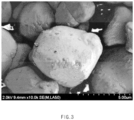
- FIG. 3 is a scanning electron microscope image of the positive electrode active material prepared by the above method.
- FIG. 3 shows that the positive electrode active material prepared in Example 1 has a form of single particle.
- a positive electrode active material was produced in the same manner as in Example 1 except that the heating was performed to 850°C in step (C).
- the positive electrode active material has a form of single particle.
- a positive electrode active material was produced in the same manner as in Example 1 except that step (c) was not performed.
- the positive electrode active material has a form of single particle.
- a positive electrode active material was produced in the same manner as in Example 1 except that washing process was performed instead of step (c), and wherein the washing process performed that lithium nickel-based oxide mixed with water such that a weight ratio of lithium nickel-based oxide: water was 1:1, and the mixture was stirred to be washed with water, filtered, and then dried.
- the prepared positive electrode active material has a form of single particle.
- a positive electrode active material was produced in the same manner as in Example 1 except that the mixture was heated to 850°C, maintained at 850°C for 15 hours in step (A) and step (c) was not performed.
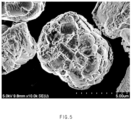
- FIG. 4 is a scanning electron microscope image of the positive electrode active material prepared by the above method.
- FIG. 4 shows that the positive electrode active material prepared in Comparative Example 3 has a form of pseudo-single particle in which about 15 to 30 nodules are complexed.
- a positive electrode active material was produced in the same manner as in Example 1 except that temperature maintenance time after heating to 850°C was 5hours in step (A) and that temperature maintenance time after heating to 700°C was 10hours in step (C).
- FIG. 5 is a scanning electron microscope image of the positive electrode active material prepared by the above method.
- FIG. 5 shows that the positive electrode active material prepared in Comparative Example 4 has a form of a secondary particle in which 40 or more of primary particles are aggregated.
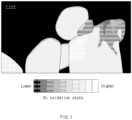
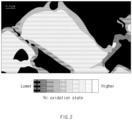
- the surface of the positive electrode active material produced in each of Example 1 and Comparative Example 2 was analyzed with TEM-EELS to confirm the oxidation number distribution of Ni on the surface.
- FIG. 1 illustrates the TEM-EELS analysis results showing the oxidation number distribution of Ni on the surface of the positive electrode active material of Example 1
- FIG. 2 illustrates the TEM-EELS analysis results showing the oxidation number distribution of Ni on the surface of the positive electrode active material produced according to Comparative Example 2.
- the positive electrode active materials of Examples 1 and 2 produced according to the method of the present invention have a significantly smaller amount of residual lithium than the positive electrode active material of Comparative Example 1, and even without a process of washing with water, have a smaller amount of residual lithium than that of Comparative Example 2 in which the process of washing with water was performed. Meanwhile, in the case of the positive active material of Comparative Example 3 in which primary sintering was performed for a long time without the secondary sintering, the amount of residual lithium was rather increased. In the case of the positive active material of Comparative Example 4, the amount of residual lithium was similar to that of Example 1, but as shown in Experimental Example 4 below, the amount of gas generation increased.
- the positive electrode active material produced in each of Examples 1 and 2 and Comparative Examples 1 to 4, a conductive material (carbon black, Denka), and a PVdF binder were mixed at a weight ratio of 96:2:2 in N-methylpyrrolidone to prepare a positive electrode slurry.
- the positive electrode slurry was applied on one surface of an aluminum current collector, dried at 130°C, and then roll-pressed to manufacture a positive electrode.
- a lithium metal electrode was used as a negative electrode.
- a separator was interposed between the positive electrode and the negative electrode to manufacture an electrode assembly, and the electrode assembly was placed inside a battery case, followed by injecting an electrolyte solution into the case to manufacture a coin-type half cell.
- the electrolyte solution was prepared by dissolving LiPF 6 with a 1 M concentration in a mixed organic solvent in which ethylene carbonate/dimethyl carbonate/diethyl carbonate were mixed in a volume ratio of 1:2:1, and then adding 2 wt% of vinylene carbonate (VC) thereto.
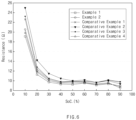
- the coin-half cells manufactured using the positive electrode active materials of Examples 1 and 2 and Comparative Examples 1 to 4 were charged and discharged once at 2.5 to 4.25 V under the condition of 0.1 C/0.1 C, and then charged again to 4.25 V and discharged to SOC 10 by 10% of the cell discharge capacity while measuring the resistance (unit: ⁇ ) according to SOC. At this time, the resistance was measured through changes in the voltage when a current of 2.5 C was applied for 10 seconds at each SOC. The measurement results are shown in FIG. 6 .
- the cells to which the positive electrode active materials of Examples 1 and 2 produced according to the method of the present invention were applied have excellent resistance properties compared to the cells to which the positive electrode active materials of Comparative Examples 1 ⁇ 3 were applied.
- the discharge end resistance properties are superior to the cell to which the positive electrode active material of Comparative Example 4, which is in form of secondary particle, was applied.
- the cell to which the positive electrode active material of Example 2 in which the secondary sintering temperature was higher than 800°C was applied exhibited excellent resistance properties compared to the cells to which the positive electrode active materials of Comparative Examples 1 ⁇ 3 were applied, but exhibited poor resistance properties compared to the cell to which the positive electrode active materials of Example 1 or Comparative Example 4 was applied. It is determined that this is because the formation of a rock salt phase on the surface of lithium nickel-based oxide increases as the secondary sintering temperature increases, and as a result, the effect of improving surface resistance is slightly degraded.
- Each of the lithium secondary batteries manufactured above was charged to 4.25 V with 1 C in a CC-CV mode, and then the secondary battery was dissembled to separate the positive electrode. Then, 400 mg of the positive electrode and 15 ⁇ L of an electrolyte were put into a pouch-type battery case, and the battery case was sealed to manufacture a cell, and the cell was stored at 60°C for 8 weeks to measure a change in the cell volume ( ⁇ Cell volume, unit: ⁇ mL) before and after the high-temperature storage. The cell volume change was measured by placing the cell in water and then measuring the volume change of the water. The measurement results are shown in FIG. 7 .
- the cells to which the positive electrode active materials of Examples 1 and 2 produced through the high-temperature secondary sintering without washing with water were applied exhibited significantly less volume change compared to the cells to which the positive electrode active materials of Comparative Examples 1 ⁇ 4 were applied.
- the amount of residual lithium in the positive active material was high, and the initial gas generation within 2 weeks after high-temperature storage was high.
- the initial amount of gas generation was relatively small, but it was found that the amount of gas generation increased rapidly as the storage time increased.
Landscapes
- Chemical & Material Sciences (AREA)
- Chemical Kinetics & Catalysis (AREA)
- Electrochemistry (AREA)
- General Chemical & Material Sciences (AREA)
- Inorganic Chemistry (AREA)
- Organic Chemistry (AREA)
- Engineering & Computer Science (AREA)
- Manufacturing & Machinery (AREA)
- Materials Engineering (AREA)
- Battery Electrode And Active Subsutance (AREA)
- Inorganic Compounds Of Heavy Metals (AREA)
Applications Claiming Priority (3)
| Application Number | Priority Date | Filing Date | Title |
|---|---|---|---|
| KR20210121308 | 2021-09-10 | ||
| KR20210186563 | 2021-12-23 | ||
| PCT/KR2022/013553 WO2023038469A1 (fr) | 2021-09-10 | 2022-09-08 | Matériau actif d'électrode positive, son procédé de préparation, électrode positive le comprenant et batterie secondaire au lithium |
Publications (2)
| Publication Number | Publication Date |
|---|---|
| EP4382487A1 true EP4382487A1 (fr) | 2024-06-12 |
| EP4382487A4 EP4382487A4 (fr) | 2025-04-30 |
Family
ID=85478553
Family Applications (1)
| Application Number | Title | Priority Date | Filing Date |
|---|---|---|---|
| EP22867737.3A Pending EP4382487A4 (fr) | 2021-09-10 | 2022-09-08 | Matériau actif d'électrode positive, son procédé de préparation, électrode positive le comprenant et batterie secondaire au lithium |
Country Status (5)
| Country | Link |
|---|---|
| US (1) | US20230083736A1 (fr) |
| EP (1) | EP4382487A4 (fr) |
| JP (1) | JP7754577B2 (fr) |
| KR (1) | KR20230038123A (fr) |
| WO (1) | WO2023038469A1 (fr) |
Families Citing this family (9)
| Publication number | Priority date | Publication date | Assignee | Title |
|---|---|---|---|---|
| KR102803128B1 (ko) * | 2023-04-28 | 2025-05-02 | (주)포스코퓨처엠 | 양극 활물질의 제조 방법, 이를 이용하여 제조된 양극 활물질 및 리튬 이차 전지 |
| EP4734180A1 (fr) * | 2023-07-26 | 2026-04-29 | LG Chem, Ltd. | Matériau actif de cathode, cathode comprenant celui-ci et batterie secondaire au lithium |
| KR102861806B1 (ko) * | 2023-08-11 | 2025-09-18 | 주식회사 엘지에너지솔루션 | 양극 활물질, 이의 제조 방법 및 이를 포함하는 양극 및 리튬 이차 전지 |
| KR102847785B1 (ko) * | 2023-09-15 | 2025-08-19 | 주식회사 엘지에너지솔루션 | 양극 활물질 및 이의 제조 방법 |
| CN121794797A (zh) * | 2023-09-15 | 2026-04-03 | 株式会社Lg新能源 | 混合正极材料及其制备方法 |
| WO2025058415A1 (fr) * | 2023-09-15 | 2025-03-20 | 주식회사 엘지에너지솔루션 | Matériau actif d'électrode positive et son procédé de préparation |
| CN117239275A (zh) * | 2023-11-01 | 2023-12-15 | 昆明理工大学 | 一种采用真空裂解法实现废旧正极材料单晶化再生的方法 |
| KR20250158888A (ko) * | 2024-04-30 | 2025-11-07 | (주)포스코퓨처엠 | 리튬 이차 전지용 양극 활물질 및 이를 포함하는 리튬 이차 전지 |
| WO2026084305A1 (fr) * | 2024-10-17 | 2026-04-23 | 포스코홀딩스 주식회사 | Matériau actif d'électrode positive pour batterie secondaire au lithium, et son procédé de préparation |
Family Cites Families (17)
| Publication number | Priority date | Publication date | Assignee | Title |
|---|---|---|---|---|
| WO2010101395A2 (fr) * | 2009-03-03 | 2010-09-10 | 주식회사 엘지화학 | Pile secondaire au lithium contenant des matériaux d'électrode positive à haute densité d'énergie et une membrane de séparation microporeuse composite organique/inorganique |
| CN108137347B (zh) * | 2015-10-09 | 2020-07-28 | 住友金属矿山株式会社 | 含锂镍的复合氧化物及其制造方法、非水系电解质二次电池 |
| KR102026918B1 (ko) * | 2016-07-04 | 2019-09-30 | 주식회사 엘지화학 | 이차전지용 양극활물질의 제조방법 및 이에 따라 제조된 이차전지용 양극활물질 |
| KR20180027261A (ko) * | 2016-09-06 | 2018-03-14 | 삼성에스디아이 주식회사 | 리튬 이차 전지용 양극 활물질, 이의 제조 방법 및 이를 포함하는 리튬 이차 전지 |
| KR102462060B1 (ko) * | 2016-11-08 | 2022-11-01 | 혼다 기켄 고교 가부시키가이샤 | 비수계 전해질 2차 전지용 전극 및 이것을 구비하는 비수계 전해질 2차 전지 |
| CN110300780A (zh) | 2017-03-06 | 2019-10-01 | 迪睿合株式会社 | 树脂组合物、树脂组合物的制备方法和结构体 |
| KR102174720B1 (ko) * | 2017-11-23 | 2020-11-05 | 주식회사 에코프로비엠 | 리튬복합산화물 및 이의 제조 방법 |
| KR102288291B1 (ko) | 2018-04-12 | 2021-08-10 | 주식회사 엘지화학 | 양극 활물질의 제조방법 |
| KR20190131842A (ko) * | 2018-05-17 | 2019-11-27 | 주식회사 엘지화학 | 이차전지용 양극 활물질, 그 제조방법 및 이를 포함하는 리튬 이차전지 |
| JP7308462B2 (ja) | 2018-12-28 | 2023-07-14 | パナソニックIpマネジメント株式会社 | 非水電解質二次電池用正極活物質、及び非水電解質二次電池 |
| KR102195186B1 (ko) * | 2019-02-18 | 2020-12-28 | 주식회사 에스엠랩 | 양극활물질, 이의 제조방법 및 이를 포함하는 양극을 포함한 리튬이차전지 |
| KR102255905B1 (ko) * | 2019-08-02 | 2021-05-24 | 삼성에스디아이 주식회사 | 리튬 이차 전지용 양극 활물질, 이의 제조 방법, 이를 포함하는 양극 및 리튬 이차 전지 |
| KR102644802B1 (ko) | 2019-08-08 | 2024-03-08 | 주식회사 엘지에너지솔루션 | 이차전지용 양극 활물질의 제조방법 |
| CN120709289A (zh) * | 2019-12-02 | 2025-09-26 | 宁德时代新能源科技股份有限公司 | 二次电池、电池模块、电池包和装置 |
| KR102938713B1 (ko) | 2020-10-31 | 2026-03-12 | 컨템포러리 엠퍼렉스 테크놀로지 (홍콩) 리미티드 | 양극 활성재료 및 이의 제조방법, 이차 전지, 전지 모듈, 전지팩과 장치 |
| CN112479267B (zh) * | 2020-11-27 | 2022-10-18 | 广东邦普循环科技有限公司 | 一种三元正极材料及其制备方法和应用 |
| CN117941095A (zh) | 2021-09-10 | 2024-04-26 | 株式会社Lg新能源 | 正极活性材料、包含其的正极和锂二次电池 |
-
2022
- 2022-09-08 KR KR1020220114303A patent/KR20230038123A/ko active Pending
- 2022-09-08 WO PCT/KR2022/013553 patent/WO2023038469A1/fr not_active Ceased
- 2022-09-08 JP JP2024514553A patent/JP7754577B2/ja active Active
- 2022-09-08 EP EP22867737.3A patent/EP4382487A4/fr active Pending
- 2022-09-09 US US17/941,284 patent/US20230083736A1/en active Pending
Also Published As
| Publication number | Publication date |
|---|---|
| JP2024531582A (ja) | 2024-08-29 |
| JP7754577B2 (ja) | 2025-10-15 |
| KR20230038123A (ko) | 2023-03-17 |
| EP4382487A4 (fr) | 2025-04-30 |
| WO2023038469A1 (fr) | 2023-03-16 |
| US20230083736A1 (en) | 2023-03-16 |
Similar Documents
| Publication | Publication Date | Title |
|---|---|---|
| EP4425611A1 (fr) | Matériau actif d'électrode positive, ainsi qu'électrode positive et batterie secondaire au lithium le comprenant | |
| KR102667603B1 (ko) | 리튬 이차 전지용 양극 활물질의 제조방법 | |
| EP4379857A1 (fr) | Matériau actif de cathode, et cathode et batterie secondaire au lithium le comprenant | |
| EP4220772B1 (fr) | Matériau actif d'électrode positive pour batterie secondaire au lithium, son procédé de préparation, et batterie secondaire au lithium le comprenant | |
| EP4382487A1 (fr) | Matériau actif d'électrode positive, son procédé de préparation, électrode positive le comprenant et batterie secondaire au lithium | |
| EP4250398B1 (fr) | Matériau actif d'électrode positive pour batterie secondaire au lithium et batterie secondaire au lithium le comprenant | |
| EP3984960B1 (fr) | Copolymère pour électrolyte polymère, électrolyte polymère en gel le comprenant et batterie secondaire au lithium | |
| KR102729341B1 (ko) | 리튬 이차 전지용 양극 활물질의 제조방법 | |
| US20250062323A1 (en) | Positive Electrode Active Material, Preparation Method Thereof, and Positive Electrode and Lithium Secondary Battery Which Include the Positive Electrode Active Material | |
| KR102660455B1 (ko) | 리튬 이차 전지용 양극 활물질, 그 제조방법, 이를 포함하는 양극 및 리튬 이차 전지 | |
| US20240282928A1 (en) | Method of Preparing Positive Electrode Active Material for Lithium Secondary Battery and Positive Electrode Active Material Prepared Thereby | |
| US20240079584A1 (en) | Positive Electrode Active Material For Lithium Secondary Battery, Method For Preparing Same, And Lithium Secondary Battery Comprising Same | |
| US20250070134A1 (en) | Positive Electrode Active Material, Positive Electrode Including the Same, and Lithium Secondary Battery | |
| EP4607618A1 (fr) | Matériau actif d'électrode positive, électrode positive le comprenant, et batterie secondaire au lithium | |
| US20250260000A1 (en) | Positive Electrode Material, Positive Electrode Including the Same, and Lithium Secondary Battery | |
| KR102876291B1 (ko) | 리튬 이차 전지용 양극 활물질, 이의 제조방법 및 이를 포함하는 리튬 이차 전지 | |
| US20260011724A1 (en) | Positive Electrode Active Material, Method for Preparing the Same, Positive Electrode Including the Same, and Lithium Secondary Battery | |
| US20230416113A1 (en) | Positive Electrode Active Material for Lithium Secondary Battery, Method for Preparing the Same and Lithium Secondary Battery Comprising the Same | |
| CN117916202A (zh) | 正极活性材料、其制备方法以及包含其的正极和锂二次电池 | |
| KR20250094089A (ko) | 리튬 이차 전지용 양극 활물질, 이의 제조방법 및 이를 포함하는 리튬 이차 전지 | |
| KR20250050613A (ko) | 양극 활물질 및 양극 활물질의 제조 방법 | |
| KR20250094090A (ko) | 리튬 이차 전지용 양극 활물질, 이의 제조방법 및 이를 포함하는 리튬 이차 전지 | |
| KR20260046842A (ko) | 리튬 이차 전지용 양극 활물질, 이의 제조방법 및 이를 포함하는 리튬 이차 전지 | |
| KR20250094287A (ko) | 리튬 이차 전지용 양극 활물질, 이의 제조방법 및 이를 포함하는 리튬 이차 전지 | |
| KR20250093944A (ko) | 리튬 이차 전지용 양극 활물질, 이의 제조방법 및 이를 포함하는 리튬 이차 전지 |
Legal Events
| Date | Code | Title | Description |
|---|---|---|---|
| STAA | Information on the status of an ep patent application or granted ep patent |
Free format text: STATUS: THE INTERNATIONAL PUBLICATION HAS BEEN MADE |
|
| PUAI | Public reference made under article 153(3) epc to a published international application that has entered the european phase |
Free format text: ORIGINAL CODE: 0009012 |
|
| STAA | Information on the status of an ep patent application or granted ep patent |
Free format text: STATUS: REQUEST FOR EXAMINATION WAS MADE |
|
| 17P | Request for examination filed |
Effective date: 20240306 |
|
| AK | Designated contracting states |
Kind code of ref document: A1 Designated state(s): AL AT BE BG CH CY CZ DE DK EE ES FI FR GB GR HR HU IE IS IT LI LT LU LV MC MK MT NL NO PL PT RO RS SE SI SK SM TR |
|
| DAV | Request for validation of the european patent (deleted) | ||
| DAX | Request for extension of the european patent (deleted) | ||
| REG | Reference to a national code |
Ref country code: DE Ref legal event code: R079 Free format text: PREVIOUS MAIN CLASS: C01G0053000000 Ipc: H01M0004360000 |
|
| A4 | Supplementary search report drawn up and despatched |
Effective date: 20250327 |
|
| RIC1 | Information provided on ipc code assigned before grant |
Ipc: C01G 53/506 20250101ALI20250321BHEP Ipc: C01G 53/42 20250101ALI20250321BHEP Ipc: H01M 4/02 20060101ALI20250321BHEP Ipc: H01M 10/052 20100101ALI20250321BHEP Ipc: C01G 53/00 20060101ALI20250321BHEP Ipc: H01M 4/62 20060101ALI20250321BHEP Ipc: H01M 4/505 20100101ALI20250321BHEP Ipc: H01M 4/525 20100101ALI20250321BHEP Ipc: H01M 4/36 20060101AFI20250321BHEP |
|
| STAA | Information on the status of an ep patent application or granted ep patent |
Free format text: STATUS: EXAMINATION IS IN PROGRESS |
|
| 17Q | First examination report despatched |
Effective date: 20260114 |