EP4382870A1 - Inkrementelle antibeschlagskalen für optische codierer und herstellungsverfahren dafür - Google Patents
Inkrementelle antibeschlagskalen für optische codierer und herstellungsverfahren dafür Download PDFInfo
- Publication number
- EP4382870A1 EP4382870A1 EP22212120.4A EP22212120A EP4382870A1 EP 4382870 A1 EP4382870 A1 EP 4382870A1 EP 22212120 A EP22212120 A EP 22212120A EP 4382870 A1 EP4382870 A1 EP 4382870A1
- Authority
- EP
- European Patent Office
- Prior art keywords
- fogging
- scales
- range
- optical
- layer
- Prior art date
- Legal status (The legal status is an assumption and is not a legal conclusion. Google has not performed a legal analysis and makes no representation as to the accuracy of the status listed.)
- Pending
Links
- 238000000034 method Methods 0.000 title claims abstract description 33
- 230000003287 optical effect Effects 0.000 title claims abstract description 30
- 238000004519 manufacturing process Methods 0.000 title claims abstract description 16
- 238000000576 coating method Methods 0.000 claims abstract description 34
- 239000011521 glass Substances 0.000 claims abstract description 26
- 239000011248 coating agent Substances 0.000 claims abstract description 23
- 238000000151 deposition Methods 0.000 claims abstract description 11
- 229910052799 carbon Inorganic materials 0.000 claims abstract description 8
- 238000002834 transmittance Methods 0.000 claims abstract description 6
- 239000011651 chromium Substances 0.000 claims description 25
- 239000000758 substrate Substances 0.000 claims description 23
- 239000005329 float glass Substances 0.000 claims description 20
- 239000010410 layer Substances 0.000 claims description 18
- 229910052782 aluminium Inorganic materials 0.000 claims description 11
- 239000011241 protective layer Substances 0.000 claims description 10
- XAGFODPZIPBFFR-UHFFFAOYSA-N aluminium Chemical compound [Al] XAGFODPZIPBFFR-UHFFFAOYSA-N 0.000 claims description 9
- VYPSYNLAJGMNEJ-UHFFFAOYSA-N Silicium dioxide Chemical compound O=[Si]=O VYPSYNLAJGMNEJ-UHFFFAOYSA-N 0.000 claims description 8
- 229910052804 chromium Inorganic materials 0.000 claims description 7
- 229910052757 nitrogen Inorganic materials 0.000 claims description 7
- VYZAMTAEIAYCRO-UHFFFAOYSA-N Chromium Chemical compound [Cr] VYZAMTAEIAYCRO-UHFFFAOYSA-N 0.000 claims description 6
- 229910052796 boron Inorganic materials 0.000 claims description 6
- 230000008021 deposition Effects 0.000 claims description 6
- PXHVJJICTQNCMI-UHFFFAOYSA-N Nickel Chemical compound [Ni] PXHVJJICTQNCMI-UHFFFAOYSA-N 0.000 claims description 4
- 229910052698 phosphorus Inorganic materials 0.000 claims description 4
- 239000000377 silicon dioxide Substances 0.000 claims description 4
- 229910052681 coesite Inorganic materials 0.000 claims description 3
- 229910052906 cristobalite Inorganic materials 0.000 claims description 3
- 238000000059 patterning Methods 0.000 claims description 3
- 229910052682 stishovite Inorganic materials 0.000 claims description 3
- 229910052905 tridymite Inorganic materials 0.000 claims description 3
- RYGMFSIKBFXOCR-UHFFFAOYSA-N Copper Chemical compound [Cu] RYGMFSIKBFXOCR-UHFFFAOYSA-N 0.000 claims description 2
- BQCADISMDOOEFD-UHFFFAOYSA-N Silver Chemical compound [Ag] BQCADISMDOOEFD-UHFFFAOYSA-N 0.000 claims description 2
- -1 and preferably Chemical compound 0.000 claims description 2
- 229910052802 copper Inorganic materials 0.000 claims description 2
- 239000010949 copper Substances 0.000 claims description 2
- PCHJSUWPFVWCPO-UHFFFAOYSA-N gold Chemical compound [Au] PCHJSUWPFVWCPO-UHFFFAOYSA-N 0.000 claims description 2
- 229910052737 gold Inorganic materials 0.000 claims description 2
- 239000010931 gold Substances 0.000 claims description 2
- 125000004435 hydrogen atom Chemical group [H]* 0.000 claims description 2
- 239000012535 impurity Substances 0.000 claims description 2
- 229910052759 nickel Inorganic materials 0.000 claims description 2
- 229910052710 silicon Inorganic materials 0.000 claims description 2
- 229910052709 silver Inorganic materials 0.000 claims description 2
- 239000004332 silver Substances 0.000 claims description 2
- 230000008569 process Effects 0.000 abstract description 11
- 238000001020 plasma etching Methods 0.000 abstract description 7
- 230000001965 increasing effect Effects 0.000 abstract description 6
- 230000001939 inductive effect Effects 0.000 abstract description 5
- 238000006073 displacement reaction Methods 0.000 abstract description 4
- 238000010884 ion-beam technique Methods 0.000 abstract description 3
- 230000005855 radiation Effects 0.000 abstract description 3
- 239000010408 film Substances 0.000 description 21
- 238000010894 electron beam technology Methods 0.000 description 16
- TXEYQDLBPFQVAA-UHFFFAOYSA-N tetrafluoromethane Chemical compound FC(F)(F)F TXEYQDLBPFQVAA-UHFFFAOYSA-N 0.000 description 8
- 238000009616 inductively coupled plasma Methods 0.000 description 7
- XMPZTFVPEKAKFH-UHFFFAOYSA-P ceric ammonium nitrate Chemical compound [NH4+].[NH4+].[Ce+4].[O-][N+]([O-])=O.[O-][N+]([O-])=O.[O-][N+]([O-])=O.[O-][N+]([O-])=O.[O-][N+]([O-])=O.[O-][N+]([O-])=O XMPZTFVPEKAKFH-UHFFFAOYSA-P 0.000 description 6
- 238000001704 evaporation Methods 0.000 description 6
- 230000008020 evaporation Effects 0.000 description 6
- 239000002105 nanoparticle Substances 0.000 description 6
- XLYOFNOQVPJJNP-UHFFFAOYSA-N water Substances O XLYOFNOQVPJJNP-UHFFFAOYSA-N 0.000 description 6
- IJGRMHOSHXDMSA-UHFFFAOYSA-N Atomic nitrogen Chemical compound N#N IJGRMHOSHXDMSA-UHFFFAOYSA-N 0.000 description 5
- GWEVSGVZZGPLCZ-UHFFFAOYSA-N Titan oxide Chemical compound O=[Ti]=O GWEVSGVZZGPLCZ-UHFFFAOYSA-N 0.000 description 5
- 238000005259 measurement Methods 0.000 description 5
- 239000002086 nanomaterial Substances 0.000 description 5
- 238000005530 etching Methods 0.000 description 4
- 230000002093 peripheral effect Effects 0.000 description 4
- CURLTUGMZLYLDI-UHFFFAOYSA-N Carbon dioxide Chemical compound O=C=O CURLTUGMZLYLDI-UHFFFAOYSA-N 0.000 description 3
- KWYUFKZDYYNOTN-UHFFFAOYSA-M Potassium hydroxide Chemical compound [OH-].[K+] KWYUFKZDYYNOTN-UHFFFAOYSA-M 0.000 description 3
- 229910052581 Si3N4 Inorganic materials 0.000 description 3
- HEMHJVSKTPXQMS-UHFFFAOYSA-M Sodium hydroxide Chemical compound [OH-].[Na+] HEMHJVSKTPXQMS-UHFFFAOYSA-M 0.000 description 3
- QVGXLLKOCUKJST-UHFFFAOYSA-N atomic oxygen Chemical compound [O] QVGXLLKOCUKJST-UHFFFAOYSA-N 0.000 description 3
- 229910002092 carbon dioxide Inorganic materials 0.000 description 3
- 239000008367 deionised water Substances 0.000 description 3
- 229910021641 deionized water Inorganic materials 0.000 description 3
- 238000001514 detection method Methods 0.000 description 3
- 238000011161 development Methods 0.000 description 3
- 239000002019 doping agent Substances 0.000 description 3
- 230000000694 effects Effects 0.000 description 3
- 230000005661 hydrophobic surface Effects 0.000 description 3
- 239000007788 liquid Substances 0.000 description 3
- 229910052751 metal Inorganic materials 0.000 description 3
- 239000002184 metal Substances 0.000 description 3
- 229910052760 oxygen Inorganic materials 0.000 description 3
- 239000001301 oxygen Substances 0.000 description 3
- 229920002120 photoresistant polymer Polymers 0.000 description 3
- 239000010409 thin film Substances 0.000 description 3
- CSCPPACGZOOCGX-UHFFFAOYSA-N Acetone Chemical compound CC(C)=O CSCPPACGZOOCGX-UHFFFAOYSA-N 0.000 description 2
- NTIZESTWPVYFNL-UHFFFAOYSA-N Methyl isobutyl ketone Chemical compound CC(C)CC(C)=O NTIZESTWPVYFNL-UHFFFAOYSA-N 0.000 description 2
- 229910004014 SiF4 Inorganic materials 0.000 description 2
- 230000005540 biological transmission Effects 0.000 description 2
- IYRWEQXVUNLMAY-UHFFFAOYSA-N carbonyl fluoride Chemical compound FC(F)=O IYRWEQXVUNLMAY-UHFFFAOYSA-N 0.000 description 2
- 238000003486 chemical etching Methods 0.000 description 2
- 238000009833 condensation Methods 0.000 description 2
- 239000013078 crystal Substances 0.000 description 2
- 238000013461 design Methods 0.000 description 2
- 150000002500 ions Chemical class 0.000 description 2
- KFZMGEQAYNKOFK-UHFFFAOYSA-N isopropyl alcohol Natural products CC(C)O KFZMGEQAYNKOFK-UHFFFAOYSA-N 0.000 description 2
- 238000003801 milling Methods 0.000 description 2
- 239000000203 mixture Substances 0.000 description 2
- RVTZCBVAJQQJTK-UHFFFAOYSA-N oxygen(2-);zirconium(4+) Chemical compound [O-2].[O-2].[Zr+4] RVTZCBVAJQQJTK-UHFFFAOYSA-N 0.000 description 2
- 239000002245 particle Substances 0.000 description 2
- 229920006254 polymer film Polymers 0.000 description 2
- 235000012239 silicon dioxide Nutrition 0.000 description 2
- HQVNEWCFYHHQES-UHFFFAOYSA-N silicon nitride Chemical compound N12[Si]34N5[Si]62N3[Si]51N64 HQVNEWCFYHHQES-UHFFFAOYSA-N 0.000 description 2
- ABTOQLMXBSRXSM-UHFFFAOYSA-N silicon tetrafluoride Chemical compound F[Si](F)(F)F ABTOQLMXBSRXSM-UHFFFAOYSA-N 0.000 description 2
- 230000003746 surface roughness Effects 0.000 description 2
- WGTYBPLFGIVFAS-UHFFFAOYSA-M tetramethylammonium hydroxide Chemical compound [OH-].C[N+](C)(C)C WGTYBPLFGIVFAS-UHFFFAOYSA-M 0.000 description 2
- 229910001928 zirconium oxide Inorganic materials 0.000 description 2
- ZOXJGFHDIHLPTG-UHFFFAOYSA-N Boron Chemical compound [B] ZOXJGFHDIHLPTG-UHFFFAOYSA-N 0.000 description 1
- UIHCLUNTQKBZGK-UHFFFAOYSA-N Methyl isobutyl ketone Natural products CCC(C)C(C)=O UIHCLUNTQKBZGK-UHFFFAOYSA-N 0.000 description 1
- XUIMIQQOPSSXEZ-UHFFFAOYSA-N Silicon Chemical compound [Si] XUIMIQQOPSSXEZ-UHFFFAOYSA-N 0.000 description 1
- 230000004913 activation Effects 0.000 description 1
- 239000000853 adhesive Substances 0.000 description 1
- 230000001070 adhesive effect Effects 0.000 description 1
- 229910021417 amorphous silicon Inorganic materials 0.000 description 1
- 238000000137 annealing Methods 0.000 description 1
- 238000013459 approach Methods 0.000 description 1
- 125000004429 atom Chemical group 0.000 description 1
- 239000001569 carbon dioxide Substances 0.000 description 1
- 229910002091 carbon monoxide Inorganic materials 0.000 description 1
- 238000006243 chemical reaction Methods 0.000 description 1
- 238000005229 chemical vapour deposition Methods 0.000 description 1
- 150000001875 compounds Chemical class 0.000 description 1
- 238000011109 contamination Methods 0.000 description 1
- PMHQVHHXPFUNSP-UHFFFAOYSA-M copper(1+);methylsulfanylmethane;bromide Chemical compound Br[Cu].CSC PMHQVHHXPFUNSP-UHFFFAOYSA-M 0.000 description 1
- 230000008878 coupling Effects 0.000 description 1
- 238000010168 coupling process Methods 0.000 description 1
- 238000005859 coupling reaction Methods 0.000 description 1
- 230000003247 decreasing effect Effects 0.000 description 1
- 230000002542 deteriorative effect Effects 0.000 description 1
- 229910001882 dioxygen Inorganic materials 0.000 description 1
- 230000005684 electric field Effects 0.000 description 1
- 238000005566 electron beam evaporation Methods 0.000 description 1
- 238000005516 engineering process Methods 0.000 description 1
- 238000009472 formulation Methods 0.000 description 1
- 239000007789 gas Substances 0.000 description 1
- 238000011065 in-situ storage Methods 0.000 description 1
- 238000007737 ion beam deposition Methods 0.000 description 1
- 125000001449 isopropyl group Chemical group [H]C([H])([H])C([H])(*)C([H])([H])[H] 0.000 description 1
- 238000000608 laser ablation Methods 0.000 description 1
- 238000001459 lithography Methods 0.000 description 1
- 230000007774 longterm Effects 0.000 description 1
- 238000001755 magnetron sputter deposition Methods 0.000 description 1
- 239000000463 material Substances 0.000 description 1
- 229910021645 metal ion Inorganic materials 0.000 description 1
- 150000002739 metals Chemical class 0.000 description 1
- 229940043265 methyl isobutyl ketone Drugs 0.000 description 1
- 238000005329 nanolithography Methods 0.000 description 1
- QJGQUHMNIGDVPM-UHFFFAOYSA-N nitrogen group Chemical group [N] QJGQUHMNIGDVPM-UHFFFAOYSA-N 0.000 description 1
- TWNQGVIAIRXVLR-UHFFFAOYSA-N oxo(oxoalumanyloxy)alumane Chemical compound O=[Al]O[Al]=O TWNQGVIAIRXVLR-UHFFFAOYSA-N 0.000 description 1
- 230000000737 periodic effect Effects 0.000 description 1
- 239000011574 phosphorus Substances 0.000 description 1
- 108091008695 photoreceptors Proteins 0.000 description 1
- 238000005240 physical vapour deposition Methods 0.000 description 1
- 229920000642 polymer Polymers 0.000 description 1
- 238000006116 polymerization reaction Methods 0.000 description 1
- 238000003672 processing method Methods 0.000 description 1
- 230000001681 protective effect Effects 0.000 description 1
- 239000010453 quartz Substances 0.000 description 1
- 229920006395 saturated elastomer Polymers 0.000 description 1
- 230000003678 scratch resistant effect Effects 0.000 description 1
- 239000010703 silicon Substances 0.000 description 1
- 125000006850 spacer group Chemical group 0.000 description 1
- 238000004528 spin coating Methods 0.000 description 1
- 230000003075 superhydrophobic effect Effects 0.000 description 1
- 238000000427 thin-film deposition Methods 0.000 description 1
- 239000004408 titanium dioxide Substances 0.000 description 1
- 230000007704 transition Effects 0.000 description 1
- ZVWKZXLXHLZXLS-UHFFFAOYSA-N zirconium nitride Chemical compound [Zr]#N ZVWKZXLXHLZXLS-UHFFFAOYSA-N 0.000 description 1
Images
Classifications
-
- G—PHYSICS
- G01—MEASURING; TESTING
- G01D—MEASURING NOT SPECIALLY ADAPTED FOR A SPECIFIC VARIABLE; ARRANGEMENTS FOR MEASURING TWO OR MORE VARIABLES NOT COVERED IN A SINGLE OTHER SUBCLASS; TARIFF METERING APPARATUS; MEASURING OR TESTING NOT OTHERWISE PROVIDED FOR
- G01D5/00—Mechanical means for transferring the output of a sensing member; Means for converting the output of a sensing member to another variable where the form or nature of the sensing member does not constrain the means for converting; Transducers not specially adapted for a specific variable
- G01D5/26—Mechanical means for transferring the output of a sensing member; Means for converting the output of a sensing member to another variable where the form or nature of the sensing member does not constrain the means for converting; Transducers not specially adapted for a specific variable characterised by optical transfer means, i.e. using infrared, visible, or ultraviolet light
- G01D5/32—Mechanical means for transferring the output of a sensing member; Means for converting the output of a sensing member to another variable where the form or nature of the sensing member does not constrain the means for converting; Transducers not specially adapted for a specific variable characterised by optical transfer means, i.e. using infrared, visible, or ultraviolet light with attenuation or whole or partial obturation of beams of light
- G01D5/34—Mechanical means for transferring the output of a sensing member; Means for converting the output of a sensing member to another variable where the form or nature of the sensing member does not constrain the means for converting; Transducers not specially adapted for a specific variable characterised by optical transfer means, i.e. using infrared, visible, or ultraviolet light with attenuation or whole or partial obturation of beams of light the beams of light being detected by photocells
- G01D5/347—Mechanical means for transferring the output of a sensing member; Means for converting the output of a sensing member to another variable where the form or nature of the sensing member does not constrain the means for converting; Transducers not specially adapted for a specific variable characterised by optical transfer means, i.e. using infrared, visible, or ultraviolet light with attenuation or whole or partial obturation of beams of light the beams of light being detected by photocells using displacement encoding scales
- G01D5/34707—Scales; Discs, e.g. fixation, fabrication, compensation
-
- G—PHYSICS
- G02—OPTICS
- G02B—OPTICAL ELEMENTS, SYSTEMS OR APPARATUS
- G02B1/00—Optical elements characterised by the material of which they are made; Optical coatings for optical elements
- G02B1/10—Optical coatings produced by application to, or surface treatment of, optical elements
- G02B1/18—Coatings for keeping optical surfaces clean, e.g. hydrophobic or photo-catalytic films
-
- G—PHYSICS
- G02—OPTICS
- G02B—OPTICAL ELEMENTS, SYSTEMS OR APPARATUS
- G02B27/00—Optical systems or apparatus not provided for by any of the groups G02B1/00 - G02B26/00, G02B30/00
- G02B27/0006—Optical systems or apparatus not provided for by any of the groups G02B1/00 - G02B26/00, G02B30/00 with means to keep optical surfaces clean, e.g. by preventing or removing dirt, stains, contamination, condensation
-
- G—PHYSICS
- G02—OPTICS
- G02B—OPTICAL ELEMENTS, SYSTEMS OR APPARATUS
- G02B1/00—Optical elements characterised by the material of which they are made; Optical coatings for optical elements
- G02B1/002—Optical elements characterised by the material of which they are made; Optical coatings for optical elements made of materials engineered to provide properties not available in nature, e.g. metamaterials
Definitions
- the present invention relates to measurements, optical measurements, and devices thereof. More specifically, the invention discloses a fabrication method of anti-fogging incremental optical scales for rotary and linear displacement encoders, and the anti-fogging scales device enables the use the displacement encoders in dew-point environments and conditions.
- Fogging of windows, glasses, screens, and other surfaces of various devices is a highly undesirable phenomenon that significantly affects optical transmission when a cold surface comes into contact with warm and humid air.
- the fogging problem is also very relevant for optical encoders operating on the principle of photoelectric scanning. Cr gratings from a few to tens of micrometers wide, with transparent slits between them, are fabricated on the surface of the encoder glass scales, and the changes in the intensity of light passing through the scale are converted into a periodic electrical signal. If the scale surface becomes fogged, the encoder stops working.
- the U.S. patent No. US 6,750,445 describes the design of an optical encoder for measuring the rotational speed and rotational position of a rotary slit disc.
- This encoder has a special slit structure for preventing position precision at the high-speed operation from deteriorating.
- a fixed slit is used between the rotary slit disc and the light-receiving device.
- Light-receiving windows of the fixed slit are arranged at positions different in a radial direction of the rotary slit disc and have mutually different phases.
- the lengths of the light-receiving windows in the radial direction of the rotary slit disc are greater from the inner peripheral side toward the outer peripheral side so that the opening area of the light-receiving window on the inner peripheral side may be equal to that on the outer peripheral side. Therefore, the amount of light that the light-receiving elements receive can be made the same regardless of the position of the rotary disk. Accordingly, it is possible to prevent an increase in high-speed flutter arising due to fluctuations of the difference in the phase at high-speed operation or when performing multiplication using a bridging circuit. Also, even in a case where the rotational position is converted to digital signals by analog-digital conversion, it is possible to provide an encoder that enables better rotational precision over a wide range. However, the patented design does not provide any protection against fogging of the optical encoder.
- the European patent application No. 94111237.7 discloses an encoding principle and apparatus which can yield a digital absolute angular or linear position reading without the need for a large number of parallel tracks.
- the apparatus to convert the absolute angular or linear position to digital information utilizes a rotating disk with a single track subdivided into several sectors. Multiple stationary sensors are placed at essentially equal intervals along the track. Extending the number of sensors, thus encoders with higher resolutions are possible.
- the output from the group of sensors is converted to binary format by combinatorial logic.
- the sensors may be mechanical contacts, optical, magnetic, or capacitive, and may distinguish two or more levels each.
- This encoder is the ability to encode the information on a single track, thus reducing the size of an embodiment utilizing the inventive approach.
- Another unique feature is the fact that the method preserves the Gray code property, i.e. only one bit of the digital value changes between the readings corresponding to two adjacent locations. When cooled below the dew point, the rotating disk can fog up and the measurements may be disturbed if optical sensors are used in this encoder.
- European patent No. EP2902750 B1 describes a linear encoder, the entire size of which can be reduced by reducing the transverse lengths of a scale and a detection head without decreasing the measurement accuracy of the encoder.
- the detection head includes a movable member, such as a roller bearing, which ensures a smooth movement of the head along the longitudinal direction of the scale and also functions as a spacer to maintain a distance between the scale and the detection head.
- the roller bearing does not make contact with the scale graduations even if the path of the bearing and the graduations are arranged close to each other, as the graduations are formed on a surface on one side of the scale, while the bearing abuts against a surface on the other side of the scale so that the scale can serve as a plate member.
- This makes it possible to overlap the path of the bearing and the graduations without damaging them. Since the scale serves as a plate member, it is possible to avoid adding a new member as well as to reduce the transverse lengths of the scale and the head in the linear encoder. The effect of humidity and fogging on the measurements is not covered in this patent.
- Superhydrophilic Nanostructure describes a superhydrophilic nanostructure that includes nanoparticles. Nanoparticles form porous clusters and aggregates on three different scales (individual particles, clusters, and aggregates), which dramatically increase the contact area of water. The result is superhydrophobic behaviour, where a cold surface brought into a warm and humid environment forms a continuous water film instead of fogging, i.e., anti-fogging behaviour.
- the patent also claims the manufacturing process, an embodiment of which involves depositing chemically or physically produced nanoparticles on a substrate and annealing, which forms said porous nanoparticle clusters and aggregates.
- An embodiment involves TiO 2 nanoparticles, which, as claimed, do not require light activation to provide superhydrophilic qualities.
- the claimed technology exhibits high optical transmittance over the range from UV to IR, very fast transition time (160 ms following the droplet deposition), and repeatability over more than 20 cycles.
- Our proposed texturing method differs in that superhydrophilic nanostructures are formed directly onto the glass surface using lithography and/or ion beam and/or plasmochemical treatment, i.e., no nanoparticles are required.
- the Chinese patent CN105798363B "Processing method of hydrophilic micro patterns with controllable adhesive force” describes a micro-milling method to form hydrophilic patterns on an otherwise hydrophobic surface to achieve directional transportation, droplet pump-free transmission, and the like.
- the technique involves a CAM milling machine that mills structures into a hydrophobic surface that are >50 um in diameter and >10 um in depth. These contrasting structures force liquid droplets to adhere to them and never the surrounding hydrophobic surface, therefore it allows to achieve the control and transportation of liquid droplets as they will follow the milled structure.
- the structures formed by this method are relatively large and not suitable for the glass surface.
- Patent US5464721A describes an amorphous silicon photoreceptor that was coated with a DLC coating doped with nitrogen, oxygen, or any of the elements of Group III or Group V (e.g., B, Al, P, and N).
- the patent states that such a surface does not fog.
- the coating was intended to prevent supply voltage fluctuations and wear on the metal parts of the device, not to protect the optical scales from fogging.
- the US patent US7033649B2 discloses, that scratch-resistant hydrophilic anti-fogging coating can be fabricated by doping DLC with at least one polar inducing dopant(s) such as boron (B) and/or nitrogen (N).
- a polar-inducing dopant causes DLC to become more graphitic.
- polar-inducing dopants tend to cause the DLC inclusive layer to be more polar, which in turn increases surface energy and thus provides for a more hydrophilic coating.
- the DLC hydrophilicity was increased due to UV exposure. According to the patent, in such a way, a superhydrophilic DLC film can be fabricated.
- the present invention solves the encoder scales fogging problem by employing new features and a new method for the production of incremental optical scales, where this method combines surface-texturing and high-surface-energy coatings, such as diamond-like-carbon (DLC) coatings.
- DLC diamond-like-carbon
- the invention discloses the anti-fogging incremental optical scales used in rotary and linear displacement encoders.
- the proposed method of fabricating incremental optical scales solves the problem of fogging by forming a superhydrophilic surface where the microdroplets coalesce to form a single thin layer of liquid that provides sufficient optical transmittance to operate the encoder.
- the essence of the invention is that a new complex method for the production of incremental optical scales is proposed, which combines float-glass surface texturing and high-surface-energy DLC coatings. This method ensures that the produced scales and the encoder can operate in a dew-point environment.
- the surface of a float-glass substrate (which is used for scale fabrication) is textured in a way that maintains optical transmittance and at the same induces superhydrophilicity by ensuring high-surface energy.
- the float-glass surface can be textured using a parallel plate or ICP reactive ion etching process in CF 4 / O 2 plasma.
- the float glass surface can be maskless or with an aluminum mask, patterned using the electron beam nano-lithography or other nano-patterning techniques and methods.
- the average roughness of the textured glass surface R a can vary in the range from 2 to 20 nm, and the difference in height between the highest peak and the deepest valley on the surface Rt can be in the range from 10 to 100 nm.
- the next stage of scale fabrication is the deposition of the reflective thin film (preferably, made of chromium (Cr)) on the textured floated-glass surface.
- the electron beam evaporation technique with the quartz-crystal thickness controller is used to deposit the Cr film with a thickness of 80 - 120 nm.
- the float glass substrate is heated (to 100 °C) in a vacuum chamber to improve the adhesion of the Cr film to the float glass.
- the patterning process of a Cr-thin-film on the floated-glass substrate comprises the following steps: spin coating of the photoresist, photomask alignment, UV exposure, alkaline development, Cr chemical etching, deionized water rinse, and removal of the remaining resist film.
- the predetermined Cr patterns are fabricated onto the textured floated-glass substrate.
- Other metals, such as silver, aluminum, gold, copper, nickel, etc., can also be used instead of Cr, to produce the light-reflective surface of the scales.
- the optical scale is coated with a hydrophilic, transparent diamond-like-carbon (DLC) coating.
- DLC diamond-like-carbon
- Other hard and transparent anti-fogging coatings can be used instead of DLC, as suitable alternatives.
- the anti-fogging incremental scales is a device comprising known incremental scales for optical encoders, where the scales further comprise a surface specifically processed to reduce the fogging effect.
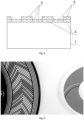
- One structural feature of the device is that the surface of the scale device has a nano-dimensional roughness texture (2).
- the cross-section of the layered structure of the device is presented in Figure 4 .
- the first layer (1) is the floated-glass layer, the surface of which is etched for nano-roughness texture, but the etched glass still preserves the transparency of the light.
- the reflecting layer (3) or its gratings (4) as partial reflecting areas of the scales covers the etched glass (1) surface, still preserving the nano-roughness and also providing the reflecting layer patterned for the encoder application.
- the protective layer (5) is coated on top of the glass (1) surface and the patterned reflecting layer (4). The protective layer (5) also preserves the nano-roughness texture on its surface. Therefore, the scales device comprises its surface nano-roughness in combination with a hard and transparent protective layer, where this combination provides the encoder scales wear-resistant and ant-fogging effect.
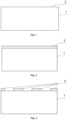
- the first step in the fabrication of anti-fogging incremental scales is texturing the surface of a float glass substrate (1), to induce hydrophilicity.
- a nanostructure-textured superhydrophilic surface (2) with a water contact angle of less than 5 degrees can be fabricated in several ways:
- the second step in the fabrication of anti-fogging incremental scales is the deposition of the light-reflecting material (preferably, and in this example, chromium, Cr) thin film (3) onto the textured float glass substrate (1).
- This step is carried out using the EB evaporation technique.
- EB evaporation is a physical vapour deposition process that employs a magnet to focus on accelerated electrons to form a high kinetic energy electron beam (EB).
- EB is directed to a crucible that contains Cr ingots. Cr is melted, and then it begins to evaporate.
- Metal vapours coat the float glass substrate (1).
- the thickness of the deposited film 80 - 120 nm) is measured in situ by a quartz crystal controller.
- the float glass substrate (1) in the vacuum chamber is heated to 100°C to improve the adhesion of the Cr-film (3) to the textured surface (2) of the float glass substrate (1).
- the EB evaporation allows precise control of the thickness, structure, and morphology of the Cr-film (3).
- the EB evaporation process forms a dense coating with a low level of contamination.
- a photomask alignment and exposure system are used to pattern the thin Cr film (3).
- a highly-collimated light source provides near-UV (i-line, 365 nm) radiation.
- the resist-coated float glass substrate (1) is brought into physical contact with a glass photomask with a scale pattern.
- the positive photoresist becomes soluble in an alkaline developer after exposure. Development can be done in a spinner or a bath.
- Metal-ion-free developers such as tetramethylammonium hydroxide, or metal-ion-containing developers, such as potassium hydroxide or sodium hydroxide, can be used, depending on the photoresist formulation.
- Cr film (3) is etched after development using a ceric ammonium nitrate-based etchant with an etch rate of 4 nm/sec at room temperature, followed by a deionized water rinse. The remaining resist film is removed to obtain predetermined Cr patterns (4).
- the final step in the fabrication of anti-fogging incremental scales is the deposition of the non-fogging, transparent, hydrophilic, and resistant to scratches and wear DLC coating (5) with a thickness of 80 - 120 nm.
- the DLC coating (5) may comprise only diamond-like-carbon and graphite-like-carbon atoms, in other embodiments, it may also contain hydrogen atoms.
- the hydrophilicity of the DLC coating (5) can be increased by doping the DLC film with increasing surface polarity impurities (N, B, P, ao.).
- the hydrophilicity of the DLC-coating (5) can also be increased by doping with Si, SiO 2 , or SiNs.
- DLC coating (5) can be grown by a variety of plasma-activated deposition techniques, including plasma-activated chemical vapour deposition, ion beam deposition, magnetron sputtering, arc evaporation, or laser ablation.
- the hydrophilicity of the DLC coating (5) can be further increased by exposing the surface to oxygen or nitrogen-containing plasma, ion beam, or UV radiation.
Landscapes
- Physics & Mathematics (AREA)
- General Physics & Mathematics (AREA)
- Optics & Photonics (AREA)
- Chemical & Material Sciences (AREA)
- Chemical Kinetics & Catalysis (AREA)
- Optical Transform (AREA)
Priority Applications (1)
| Application Number | Priority Date | Filing Date | Title |
|---|---|---|---|
| EP22212120.4A EP4382870A1 (de) | 2022-12-08 | 2022-12-08 | Inkrementelle antibeschlagskalen für optische codierer und herstellungsverfahren dafür |
Applications Claiming Priority (1)
| Application Number | Priority Date | Filing Date | Title |
|---|---|---|---|
| EP22212120.4A EP4382870A1 (de) | 2022-12-08 | 2022-12-08 | Inkrementelle antibeschlagskalen für optische codierer und herstellungsverfahren dafür |
Publications (1)
| Publication Number | Publication Date |
|---|---|
| EP4382870A1 true EP4382870A1 (de) | 2024-06-12 |
Family
ID=84463025
Family Applications (1)
| Application Number | Title | Priority Date | Filing Date |
|---|---|---|---|
| EP22212120.4A Pending EP4382870A1 (de) | 2022-12-08 | 2022-12-08 | Inkrementelle antibeschlagskalen für optische codierer und herstellungsverfahren dafür |
Country Status (1)
| Country | Link |
|---|---|
| EP (1) | EP4382870A1 (de) |
Citations (20)
| Publication number | Priority date | Publication date | Assignee | Title |
|---|---|---|---|---|
| EP0635700A1 (de) | 1993-07-22 | 1995-01-25 | Marco Dr. Brandestini | Absoluter digitaler Lagekodierer |
| US5464721A (en) | 1992-09-02 | 1995-11-07 | Fuji Xerox Co., Ltd. | Amorphous silicon photoreceptor and electrophotographic process using the same |
| US6303225B1 (en) | 2000-05-24 | 2001-10-16 | Guardian Industries Corporation | Hydrophilic coating including DLC on substrate |
| US6750445B1 (en) | 1997-12-19 | 2004-06-15 | Kabushiki Kaisha Yaskawa Denki | Encoder |
| DE20320576U1 (de) * | 2002-07-19 | 2004-11-18 | Optolab Licensing Gmbh | Optisches Geberelement zur Positions- oder Längenbestimmung |
| US7033649B2 (en) | 2000-05-24 | 2006-04-25 | Guardian Industries Corp. | Hydrophilic DLC on substrate with UV exposure |
| WO2010129807A1 (en) | 2009-05-08 | 2010-11-11 | The Regents Of The University Of California | Superhydrophilic nanostructure |
| WO2014034161A1 (ja) * | 2012-08-28 | 2014-03-06 | 株式会社ニコン | 基板支持装置、及び露光装置 |
| CN105798363A (zh) | 2016-03-21 | 2016-07-27 | 大连理工大学 | 一种粘附力可控亲水微图案加工方法 |
| US9670092B2 (en) | 2010-02-26 | 2017-06-06 | Guardian Industries Corp. | Articles including anticondensation and/or low-E coatings and/or methods of making the same |
| CN106835043A (zh) | 2017-02-03 | 2017-06-13 | 国家纳米科学中心 | 一种透明超疏水薄膜、其制备方法及用途 |
| US20180113297A1 (en) | 2016-10-21 | 2018-04-26 | Tanner Research, Inc. | Active droplet transport defogging |
| CN108717213A (zh) | 2018-03-10 | 2018-10-30 | 曹伟 | 增加亲水性防雾涂层和亲水性自洁涂层、疏水性自洁涂层表面硬度的方法 |
| FR3067970A1 (fr) | 2017-06-27 | 2018-12-28 | Valeo Vision | Revetement anti-condensation pour element optique |
| CN109135487A (zh) | 2018-07-19 | 2019-01-04 | 重庆大学 | 有机硅改性丙烯酸树脂超亲水防雾涂料及其制作方法 |
| EP3444641A1 (de) | 2017-08-16 | 2019-02-20 | Honeywell International Inc. | Beschlaghemmende und antireflektierende bifunktionale beschichtung für optische artikel |
| EP3508889A1 (de) | 2018-01-09 | 2019-07-10 | Danmarks Tekniske Universitet | Beschlagverhindernde transparente oberfläche |
| US20190218327A1 (en) | 2018-01-15 | 2019-07-18 | University Of Georgia Research Foundation, Inc. | Surfaces having antifogging characteristics, coating compositions having antifogging characteristics, and methods of making antifogging surfaces |
| US20190324341A1 (en) | 2018-04-19 | 2019-10-24 | Gentex Corporation | Plastic coatings for improved solvent resistance |
| EP2902750B1 (de) | 2014-02-04 | 2021-04-07 | Mitutoyo Corporation | Linearkodierer |
-
2022
- 2022-12-08 EP EP22212120.4A patent/EP4382870A1/de active Pending
Patent Citations (20)
| Publication number | Priority date | Publication date | Assignee | Title |
|---|---|---|---|---|
| US5464721A (en) | 1992-09-02 | 1995-11-07 | Fuji Xerox Co., Ltd. | Amorphous silicon photoreceptor and electrophotographic process using the same |
| EP0635700A1 (de) | 1993-07-22 | 1995-01-25 | Marco Dr. Brandestini | Absoluter digitaler Lagekodierer |
| US6750445B1 (en) | 1997-12-19 | 2004-06-15 | Kabushiki Kaisha Yaskawa Denki | Encoder |
| US6303225B1 (en) | 2000-05-24 | 2001-10-16 | Guardian Industries Corporation | Hydrophilic coating including DLC on substrate |
| US7033649B2 (en) | 2000-05-24 | 2006-04-25 | Guardian Industries Corp. | Hydrophilic DLC on substrate with UV exposure |
| DE20320576U1 (de) * | 2002-07-19 | 2004-11-18 | Optolab Licensing Gmbh | Optisches Geberelement zur Positions- oder Längenbestimmung |
| WO2010129807A1 (en) | 2009-05-08 | 2010-11-11 | The Regents Of The University Of California | Superhydrophilic nanostructure |
| US9670092B2 (en) | 2010-02-26 | 2017-06-06 | Guardian Industries Corp. | Articles including anticondensation and/or low-E coatings and/or methods of making the same |
| WO2014034161A1 (ja) * | 2012-08-28 | 2014-03-06 | 株式会社ニコン | 基板支持装置、及び露光装置 |
| EP2902750B1 (de) | 2014-02-04 | 2021-04-07 | Mitutoyo Corporation | Linearkodierer |
| CN105798363A (zh) | 2016-03-21 | 2016-07-27 | 大连理工大学 | 一种粘附力可控亲水微图案加工方法 |
| US20180113297A1 (en) | 2016-10-21 | 2018-04-26 | Tanner Research, Inc. | Active droplet transport defogging |
| CN106835043A (zh) | 2017-02-03 | 2017-06-13 | 国家纳米科学中心 | 一种透明超疏水薄膜、其制备方法及用途 |
| FR3067970A1 (fr) | 2017-06-27 | 2018-12-28 | Valeo Vision | Revetement anti-condensation pour element optique |
| EP3444641A1 (de) | 2017-08-16 | 2019-02-20 | Honeywell International Inc. | Beschlaghemmende und antireflektierende bifunktionale beschichtung für optische artikel |
| EP3508889A1 (de) | 2018-01-09 | 2019-07-10 | Danmarks Tekniske Universitet | Beschlagverhindernde transparente oberfläche |
| US20190218327A1 (en) | 2018-01-15 | 2019-07-18 | University Of Georgia Research Foundation, Inc. | Surfaces having antifogging characteristics, coating compositions having antifogging characteristics, and methods of making antifogging surfaces |
| CN108717213A (zh) | 2018-03-10 | 2018-10-30 | 曹伟 | 增加亲水性防雾涂层和亲水性自洁涂层、疏水性自洁涂层表面硬度的方法 |
| US20190324341A1 (en) | 2018-04-19 | 2019-10-24 | Gentex Corporation | Plastic coatings for improved solvent resistance |
| CN109135487A (zh) | 2018-07-19 | 2019-01-04 | 重庆大学 | 有机硅改性丙烯酸树脂超亲水防雾涂料及其制作方法 |
Non-Patent Citations (2)
| Title |
|---|
| SHANHONG WAN ET AL: "Super-hydrophilic properties of TiODLC nanocomposite films fabricated by the simple electrochemical process", APPLIED SURFACE SCIENCE, ELSEVIER, AMSTERDAM , NL, vol. 257, no. 23, 23 June 2011 (2011-06-23), pages 10000 - 10004, XP028264720, ISSN: 0169-4332, [retrieved on 20110702], DOI: 10.1016/J.APSUSC.2011.06.127 * |
| WU WENJUN ET AL: "New in situ superlow-friction method for nitrogen-containing diamond-like carbon coatings using dielectric barrier discharge treatment in ambient air", TRIBOLOGY INTERNATIONAL, vol. 174, October 2022 (2022-10-01), AMSTERDAM, NL, pages 107749, XP093041763, ISSN: 0301-679X, DOI: 10.1016/j.triboint.2022.107749 * |
Similar Documents
| Publication | Publication Date | Title |
|---|---|---|
| US8956787B2 (en) | Reflective mask blank for EUV lithography and process for producing the same | |
| JP5040996B2 (ja) | Euvリソグラフィ用反射型マスクブランク | |
| US8227152B2 (en) | Reflective mask blank for EUV lithography | |
| US20090253055A1 (en) | Reflective mask blank for euv lithography, and substrate with functional film for the mask blank | |
| TW200829710A (en) | Sputtering target used for production of reflective mask blank for EUV lithography | |
| IE60072B1 (en) | Etched glass process of manufacturing same | |
| US20020142230A1 (en) | Extreme ultraviolet mask with improved absorber | |
| JP2004062135A (ja) | ハーフトーン型位相シフトマスクブランクの製造方法、ハーフトーン型位相シフトマスクブランク及びハーフトーン型位相シフトマスク | |
| KR102688948B1 (ko) | 마스크 블랭크, 전사용 마스크, 및 반도체 디바이스의 제조 방법 | |
| KR102675335B1 (ko) | 반사형 마스크 블랭크, 그의 제조 방법 및 반사형 마스크 | |
| KR20180083893A (ko) | 레지스트층을 구비한 마스크 블랭크, 레지스트층을 구비한 마스크 블랭크의 제조 방법 및 전사용 마스크의 제조 방법 | |
| CN104326440A (zh) | 一种精确控制深度的微纳米结构的制作方法 | |
| EP4382870A1 (de) | Inkrementelle antibeschlagskalen für optische codierer und herstellungsverfahren dafür | |
| TWI909059B (zh) | 遮罩基底、反射型遮罩及半導體元件之製造方法 | |
| KR101166317B1 (ko) | 무반사 코팅막을 가지는 광학식 로터리 엔코더 및 그 제조방법 | |
| US6998350B2 (en) | Method for forming micro groove structure | |
| CN215984589U (zh) | 一种反射式编码器标志板 | |
| KR102954532B1 (ko) | 반사형 마스크 블랭크 및 반사형 마스크 | |
| EP4459237B1 (de) | Beschlagfreie optische skalen und abtastraster mit hydrophilen diamantartigen kohlenstoffschichten | |
| KR100869546B1 (ko) | 원자 힘 현미경 리소그래피 기술을 이용한 박막 패턴 제작방법 | |
| KR20260053494A (ko) | 반사형 마스크 블랭크 및 반사형 마스크 | |
| JP6469983B2 (ja) | レジスト膜付きマスクブランクおよびその製造方法ならびに転写用マスクの製造方法 | |
| KR102955665B1 (ko) | Euv 리소그래피용 반사형 마스크 블랭크, euv 리소그래피용 반사형 마스크 및 그것들의 제조 방법 | |
| JP6621947B2 (ja) | レジスト膜付きマスクブランクおよびその製造方法ならびに転写用マスクの製造方法 | |
| JP2012038786A (ja) | 擬似位相欠陥を有する反射型マスクブランクスの製造方法、および擬似位相欠陥を有する反射型マスクの製造方法 |
Legal Events
| Date | Code | Title | Description |
|---|---|---|---|
| PUAI | Public reference made under article 153(3) epc to a published international application that has entered the european phase |
Free format text: ORIGINAL CODE: 0009012 |
|
| STAA | Information on the status of an ep patent application or granted ep patent |
Free format text: STATUS: THE APPLICATION HAS BEEN PUBLISHED |
|
| AK | Designated contracting states |
Kind code of ref document: A1 Designated state(s): AL AT BE BG CH CY CZ DE DK EE ES FI FR GB GR HR HU IE IS IT LI LT LU LV MC ME MK MT NL NO PL PT RO RS SE SI SK SM TR |
|
| STAA | Information on the status of an ep patent application or granted ep patent |
Free format text: STATUS: REQUEST FOR EXAMINATION WAS MADE |
|
| 17P | Request for examination filed |
Effective date: 20241125 |
|
| RBV | Designated contracting states (corrected) |
Designated state(s): AL AT BE BG CH CY CZ DE DK EE ES FI FR GB GR HR HU IE IS IT LI LT LU LV MC ME MK MT NL NO PL PT RO RS SE SI SK SM TR |