EP4382948A1 - Nachrichtencodierung zur positionierung - Google Patents
Nachrichtencodierung zur positionierung Download PDFInfo
- Publication number
- EP4382948A1 EP4382948A1 EP23214720.7A EP23214720A EP4382948A1 EP 4382948 A1 EP4382948 A1 EP 4382948A1 EP 23214720 A EP23214720 A EP 23214720A EP 4382948 A1 EP4382948 A1 EP 4382948A1
- Authority
- EP
- European Patent Office
- Prior art keywords
- sample measurement
- identifier information
- encoded
- signal strength
- information
- Prior art date
- Legal status (The legal status is an assumption and is not a legal conclusion. Google has not performed a legal analysis and makes no representation as to the accuracy of the status listed.)
- Pending
Links
Images



Classifications
-
- G—PHYSICS
- G01—MEASURING; TESTING
- G01S—RADIO DIRECTION-FINDING; RADIO NAVIGATION; DETERMINING DISTANCE OR VELOCITY BY USE OF RADIO WAVES; LOCATING OR PRESENCE-DETECTING BY USE OF THE REFLECTION OR RERADIATION OF RADIO WAVES; ANALOGOUS ARRANGEMENTS USING OTHER WAVES
- G01S5/00—Position-fixing by co-ordinating two or more direction or position line determinations; Position-fixing by co-ordinating two or more distance determinations
- G01S5/02—Position-fixing by co-ordinating two or more direction or position line determinations; Position-fixing by co-ordinating two or more distance determinations using radio waves
- G01S5/0252—Radio frequency fingerprinting
- G01S5/02521—Radio frequency fingerprinting using a radio-map
- G01S5/02524—Creating or updating the radio-map
- G01S5/02525—Gathering the radio frequency fingerprints
-
- G—PHYSICS
- G01—MEASURING; TESTING
- G01S—RADIO DIRECTION-FINDING; RADIO NAVIGATION; DETERMINING DISTANCE OR VELOCITY BY USE OF RADIO WAVES; LOCATING OR PRESENCE-DETECTING BY USE OF THE REFLECTION OR RERADIATION OF RADIO WAVES; ANALOGOUS ARRANGEMENTS USING OTHER WAVES
- G01S5/00—Position-fixing by co-ordinating two or more direction or position line determinations; Position-fixing by co-ordinating two or more distance determinations
- G01S5/0009—Transmission of position information to remote stations
- G01S5/0072—Transmission between mobile stations, e.g. anti-collision systems
-
- H—ELECTRICITY
- H04—ELECTRIC COMMUNICATION TECHNIQUE
- H04B—TRANSMISSION
- H04B17/00—Monitoring; Testing
- H04B17/30—Monitoring; Testing of propagation channels
- H04B17/309—Measuring or estimating channel quality parameters
- H04B17/318—Received signal strength
-
- H—ELECTRICITY
- H04—ELECTRIC COMMUNICATION TECHNIQUE
- H04W—WIRELESS COMMUNICATION NETWORKS
- H04W64/00—Locating users or terminals or network equipment for network management purposes, e.g. mobility management
- H04W64/006—Locating users or terminals or network equipment for network management purposes, e.g. mobility management with additional information processing, e.g. for direction or speed determination
Definitions
- the following disclosure relates to the field of positioning, or more particularly relates to systems, apparatuses, and methods for optimizing a message format for respectively message encoding as utilizable for (e.g. Wi-Fi) positioning of electronic devices, such as Internet-of-Things (IoT) devices.
- Wi-Fi wireless fidelity
- IoT Internet-of-Things
- Low-Power Wide-Area Network (LPWAN) technologies are popular connectivity options especially for some loT solutions due to low cost and battery consumption.
- one of the challenges is limited network bandwidth limiting the amount of data that can be transferred between the respective device(s) and the backend server.
- the bandwidth limitations to message sizes can heavily reduce the positioning accuracy and availability, and in some cases can also rule out the use of certain technologies due to lack of crucial piece of data.
- a concrete example of an existing implementation is the Sigfox Atlas positioning service as provided as a service by Sigfox, e.g. its message protocol for data communication e.g. allowing a standard positioning message that supports (e.g. only) reporting of two nearby pieces of identifier information (e.g. Medium Access Control (MAC) addresses) without signal strength measurements (e.g. Received Signal Strength (RSS)).
- MAC Medium Access Control
- RSS Received Signal Strength
- the lack of RSS measurements rules out the possibility of using much more accurate positioning, such as e.g. Wi-Fi and/or indoor positioning methods.
- the two MAC addresses are encoded in their entirety into a byte array of 6 bytes (respectively octets) each, to give one example of their size.
- the inventors realized it might be useful to enable a solution for a case in which a lossy encoding may be used in order to enable including more information in such messages.
- a method comprising:
- This method may for instance be performed and/or controlled by an apparatus, for instance an electronic device, e.g. a mobile terminal, mobile device, user equipment (UE), user device, a smartphone, tablet, portable navigation device, IoT (Internet of Things) device, IIoT (Industrial !oT) device, or a combination thereof.
- this apparatus is also referred to as first apparatus.
- the method may for instance be performed and/or controlled by a radio node, e.g. Wi-Fi Access point, beacon device, or a combination thereof.
- the method may be performed and/or controlled by using at least one processor of the electronic device and/or the radio node.
- One or more of the aforementioned entities may for instance be comprised (e.g. installed and/or located) in a venue.
- a method comprising:
- This method may for instance be performed and/or controlled by an apparatus, for instance a server.
- this apparatus is also referred to as second apparatus.
- this method may be performed and/or controlled by more than one apparatus, for instance a server cloud comprising at least two servers.
- the method may be performed and/or controlled by using at least one processor of the server or server cloud.
- the second apparatus may for instance be represented by a server cloud.
- the server, or the server cloud may for instance be configured to provide one or more radio maps, and/or indoor positioning and/or floor detection services (e.g. in the venue).
- the method of the first exemplary aspect and/or of the second exemplary aspect may allow to use a lossy encoding in order to enable e.g. including more pieces of identifier information (e.g. MAC addresses or MACs) with one or more pieces of received signal strength information (e.g. RSS Indicator (RSSI) measurements) to such positioning messages transmitted over low bandwidth radio protocols, e.g. Sigfox protocol.
- Identifier information e.g. MAC addresses or MACs
- RSS Indicator (RSSI) measurements e.g. RSS Indicator (RSSI) measurements
- LPWAN Low-power wide area network
- Sigfox has respectively enables very low power requirement respective very low power consumption, a long range and indoor capabilities compared to such other LPWANs.
- full-resolution radio scans may not be possible with Sigfox, in mobile communication use cases, in particular in IoT mobile communication, the afore mentioned benefits make Sigfox a well-suited choice.
- a computer program when executed by a processor causing an apparatus, for instance a server, to perform and/or control the actions of the method according to the first and/or second exemplary aspect.
- the computer program may be stored on computer-readable storage medium, in particular a tangible and/or non-transitory medium.
- the computer readable storage medium could for example be a disk or a memory or the like.
- the computer program could be stored in the computer readable storage medium in the form of instructions encoding the computer-readable storage medium.
- the computer readable storage medium may be intended for taking part in the operation of a device, like an internal or external memory, for instance a Read-Only Memory (ROM) or hard disk of a computer, or be intended for distribution of the program, like an optical disc.
- ROM Read-Only Memory
- an apparatus configured to perform and/or control or comprising respective means for performing and/or controlling the method according to the first and/or second exemplary aspect.
- the means of the apparatus can be implemented in hardware and/or software. They may comprise for instance at least one processor for executing computer program code for performing the required functions, at least one memory storing the program code, or both. Alternatively, they could comprise for instance circuitry that is designed to implement the required functions, for instance implemented in a chipset or a chip, like an integrated circuit. In general, the means may comprise for instance one or more processing means or processors.
- an apparatus comprising at least one processor and at least one memory including computer program code, the at least one memory and the computer program code configured to, with the at least one processor, cause an apparatus, for instance the apparatus, at least to perform and/or to control the method according to the first and/or second exemplary aspect.
- the above-disclosed apparatus according to any aspect may be a module or a component for a device, for example a chip.
- the disclosed apparatus according to any aspect may be a device, for instance a server or server cloud.
- the disclosed apparatus according to any aspect may comprise only the disclosed components, for instance means, processor, memory, or may further comprise one or more additional components.
- a system comprising: at least one apparatus according to the first exemplary aspect as disclosed above, and at least one apparatus according to the second exemplary aspect as disclosed above.
- any disclosure herein relating to any exemplary aspect is to be understood to be equally disclosed with respect to any subject-matter according to the respective exemplary aspect, e.g. relating to an apparatus, a method, a computer program, and a computer-readable medium.
- the disclosure of a method step shall also be considered as a disclosure of means for performing and/or configured to perform the respective method step.
- the disclosure of means for performing and/or configured to perform a method step shall also be considered as a disclosure of the method step itself.
- the first apparatus may for instance be an IoT device, as disclosed above.
- Such an IoT device may for instance comprise or be connectable to a transmitter, e.g. according to wireless local area network (WLAN), to Bluetooth (BT) or to Bluetooth Low Energy (BLE) or LPWAN communication standard.
- a transmitter e.g. according to wireless local area network (WLAN), to Bluetooth (BT) or to Bluetooth Low Energy (BLE) or LPWAN communication standard.
- Such an IoT device may for instance observe (e.g. obtain) and/or provide (e.g. transmit) (e.g. standard) signals in order to be aware of and/or advertise their presence.
- Such an IoT device may for instance be of low capability (also referred to as low-capability device), e.g. not comprising or being connectable to a user input device (e.g. keypad, touchpad, or the like to name but a few non-limiting examples), and/or a display, e.g. for displaying information,
- the first apparatus may for instance be portable (e.g. weigh less than 5, 4, 3, 2, or 1 kg).
- the first apparatus may for instance comprise or be connectable a display for displaying a route that is guided/navigated to a user.
- the first apparatus may for instance comprise or be connectable to means for outputting sound, e.g. in form of spoken commands or information.
- the first apparatus may for instance comprise or be connectable to one or more sensor for determining the devices position, such as for instance a Global Navigation Satellite System (GNSS) receiver, e.g. in the form of a Global Positioning System (GPS) receiver.
- GNSS Global Navigation Satellite System
- GPS Global Positioning System
- the first apparatus may for instance comprise or be connectable to one or more sensors, e.g.
- the first apparatus may for instance comprise or be connectable a receiver and/or a transmitter (e.g. a transceiver) for receiving and/or sending information, e.g. broadcasted by a radio node (e.g. Wi-Fi access point).
- a radio node e.g. Wi-Fi access point
- a (e.g. simple) Wi-Fi signal detector/scanner without transmission capabilities would also suffice for gathering the at least one sample measurement (e.g. by picking up Wi-Fi MAC addresses (e.g. represented by respective one or more pieces of identifier information) and additionally or alternatively RSS readings (e.g. represented by one or more pieces received signal strength information), and which is connectable to the first apparatus.
- the at least one position of the first apparatus e.g. from that apparatus the broadcast information is obtained (e.g. received)
- the first apparatus may for instance be suitable for outdoor and/or for indoor navigation respectively positioning.
- the one or more radio nodes may for instance be comprised by a venue, e.g. by an infrastructure of the venue (e.g. a building).
- a radio node may for instance be used for indoor positioning and/or floor detection, e.g. according to BT- (Bluetooth), BLE- (Bluetooth Low Energy) , or may for instance be a Wi-Fi Access Point for indoor positioning and/or floor detection, e.g. according to the WLAN (Wireless Local Area Network) specification.
- BT- Bluetooth
- BLE- Bluetooth Low Energy
- Such a radio node may be according to Sigfox standard. It is mentioned that since cells in which one or more signals of such (a) radio node(s) according to Sigfox standard are observable may be quite large (e.g.
- the one or more radio nodes may advertise in this way availability to electronic devices (e.g. one or more first apparatuses) seeking a connection, e.g. via broadcasting signals.
- the signals may convey such information in the form of packets of pre-defined format, and additionally or alternatively such information may include at least an identifier information of the respective radio node.
- the respective radio node may be visible to any loT device (e.g. first apparatus) with suitable radio interface, regardless of whether or not they are known to the loT device.
- Such a radio node of the one or more radio nodes may for instance comprise or be connectable to a transceiver, e.g. according to the BT-, BLE, Sigfox and/or WLAN-specification to provide wireless-based communication.
- a respective radio node of the one or more radio nodes, e.g. of the venue may for instance use such a transceiver for transmitting and/or broadcasting one or more signals, e.g. comprising one or more information.
- the first apparatus may gather at least one sample measurement based on one or more signals sent by one or more radio nodes according to Wi-Fi/BT/BLE communication standard, and then may provide (e.g. transmit) the respective encoded at least one sample measurement via the Sigfox communication standard.
- the first apparatus e.g. a tracker
- the first apparatus may have multiple (e.g. at least two) data connection options (e.g. can transmit and/or receive one or more signals via different communication standards)
- the first apparatus may choose what communication standard to use, e.g. depending upon data transfer needs, power consumption constraints, or the like, to name but a few non-liming examples.
- the first apparatus - when gathering the at least one sample measurement - may also gather (e.g. observe and/or measure) one or more Global Navigation Satellite Signal (GNSS) signals.
- GNSS Global Navigation Satellite Signal
- this position may be provided (e.g. transmitted), e.g. also via Sigfox communication standard, e.g. to the second apparatus.
- a respective message to be provided via Sigfox communication standard may be able to carry 12 bytes, which is sufficient to carry a respective position (e.g. latitude/longitude coordinates) of a GNSS position.
- the venue may for instance be a building, shopping mall, office complex, public accessible location (e.g. station, airport, university or the like), to name but a few non-limiting examples.
- the one or more signals may for instance be observable by the first apparatus.
- the first apparatus gathers (e.g. measures) the at least one sample measurement.
- the at least sample measurement is gathered, e.g. by obtaining an identifier information of at least one respective radio node device that transmitted the respective one or more signals, and optionally gathering (e.g. measuring) the received signal strength (e.g. as a value, e.g. RSS or RSSI value) of the signal, e.g. as a respective received signal strength information.
- the received signal strength e.g. as a value, e.g. RSS or RSSI value
- a respective identifier information may for instance enable one of the one or more radio nodes to be identified.
- the one or more pieces of identifier information of the one or more radio nodes may for instance be determined, e.g. by receiving the one or more pieces of identifier information from the one or more radio nodes. Additionally or alternatively, the one or more pieces of identifier information of the one or more radio nodes may for instance be determined by extracting the one or more pieces of identifier information out of the received one or more signals of the one or more radio nodes, e.g. including at least one of the one or more pieces of identifier information of the respective radio node of the one or more radio nodes.
- a respective identifier information may for instance be a Medium Access Control (MAC) address of a respective radio node.
- MAC Medium Access Control
- a respective signal strength information may comprise or be represented by a respective RSS value.
- RSS values may for instance be gathered by measuring the one or more signal strength values based on sent signals of the one or more radio nodes.
- Such a respective signal strength information may for instance represent the power of a received radio signal (e.g. as observable at a location of the first apparatus), wherein such a radio signal may for instance be sent (e.g. periodically) from a respective radio node of the one or more radio nodes.
- An example of a received signal strength parameter, as comprisable by a respective signal strength information is a RSS) or a representation of a physical receiving power level value (e.g. a Rx power level value), e.g. in dBm.
- a respective signal strength information may for instance represent a signal strength measurement of the observable signal strength at the location of the measurement.
- the at least one sample measurement may comprise at least one of a respective identifier information or a respective signal strength information.
- the at least one sample measurement may comprise both (a respective identifier information and a respective signal strength information) of one or more radio nodes as observable at a respective location at which the first apparatus gathers the at least one sample measurement.
- the at least one sample measurement may comprise at least one of a respective identifier information or a respective signal strength information of a plurality (e.g. at least two) of radio nodes.
- the gathered at least one sample measurement may comprise five, six, seven, eight, nine, ten or more, pieces of identifier information, and optionally pieces of received signal strength information of a corresponding number of radio nodes, e.g. five pieces of identifier information and optionally five pieces of received signal strength information in case signals of five different radio nodes are gathered.
- the at least one sample measurement and/or a respective message to be provided in addition or in the alternative to providing the at least one sample measurement may be encoded based on one or more of the following conditions:
- partial identifier information is used.
- identifier information and "full identifier information” are herewith used as synonyms.
- the encoded at least one sample measurement (and/or the respective message) is provided, e.g. by sending or transmitting the at least one encoded sample measurement.
- the at least one encoded sample measurement may be provided e.g. to an entity that is different from the first apparatus, e.g. to the second apparatus, to name but one non-limiting example. Additionally or alternatively, the at least one encoded sample measurement may be provided to a respective radio node of the plurality or one or more radio nodes, which may then forward the at least one encoded sample measurement to the second apparatus, to name but one further and non-limiting example.
- a respective full identifier information is represented by six octets
- a respective partial identifier information is represented by one octet, and is a part of the respective full identifier information, e.g. a last octet of the respective gathered identifier information.
- a respective partial identifier information may be represented by at least a first, second, third, fourth, fifth, or sixth (e.g. last) octet/byte of the respective (full) identifier information, or a combination thereof.
- a respective full identifier information of a respective radio node may be a certain MAC address consisting of six bytes.
- a respective partial identifier information of this full identifier information may be represented by the last byte of the six bytes of the full identifier information (e.g. only).
- the at least one signal strength information of the encoded at least one sample measurement is represented by four bits (e.g. half a byte, respectively half an octet).
- a respective signal strength information of the encoded at least one sample measurement can be represented by four bits, and not more than four bits, the respective signal strength information may be encoded.
- a respective signal strength information may be gathered (e.g. measured) as a value of a logarithmic scale. To encode such values, the gathered signal strength information may be encoded (e.g. converted or compressed) into e.g. a linear value. A respective linear value may be based on a respective signal strength information that is encoded (e.g. converted or compressed).
- the encoded at least one sample measurement may comprise (e.g. include) more than one identifier information (e.g. MAC addresses), optionally with more than one signal strength information (e.g. RSSI measurements), e.g. to positioning messages transmitted over low bandwidth radio protocols.
- more than one identifier information e.g. MAC addresses
- signal strength information e.g. RSSI measurements
- two or more pieces of identifier information and optionally, two or more pieces of received signal strength information may be comprised by a gathered sample measurement.
- the respective sample measurement may (e.g. then) be encoded so that the encoded sample measurement comprises two pieces of full identifier information (e.g. respective MAC addresses, six octets/bytes each).
- the sample measurement may be encoded to comprise (e.g. only) a last octet byte of additional (e.g. all) identifier information of the gathered sample measurement, e.g. as respective partial identifier information.
- the second apparatus that is provided with the encoded sample measurement may (e.g. then) be responsible for resolving the full identifier information based on the e.g. last octet/byte as represented by a respective partial identifier information of the encoded sample measurement.
- the encoded sample measurement may comprise two pieces of full identifier information and a remaining number of pieces of partial identifier information from (e.g. all) identifier information (e.g. MAC addresses) of the plurality of radio nodes e.g. in the close (thus, where respective signals are observable) proximity of the radio nodes identified with the two pieces of full identifier information.
- the sample measurement may be encoded to comprise such lossy encoded one or more pieces of signal strength information.
- the usable range for received signal strength information in e.g. indoor positioning use case(s) is from -40 dBm to -80 dBm. Since the received signal strength value (as measurable by the first apparatus) decreases on logarithmic scale when the distance to the radio emitter (e.g. transmitter of a respective radio node) increases, received signal strength values larger than -40 dBm may normally not be measured while received signal strength values smaller than - 80 dBm may not be (e.g. that) relevant for improving positioning accuracy.
- received signal strength information e.g. RSS value
- the measurements may be limited to a/the given range from -40 dBm to -80 dBm, and 2) received signal strength values may be emphasized in a high range (i.e. maintain higher resolution for large(r) received signal strength values than the small received signal strength values).
- This may allow to encode the received signal strength information (e.g. as comprised by the gathered (e.g. measured) sample measurement) in sufficient accuracy e.g. into four bits (half byte). Such a half byte allows to store 16 unique (e.g. linear) signal strength values.
- the at least one signal strength information of the at least one encoded sample measurement is converted into a linear value, wherein the conversion is based on at least one of pre-defined signal strength values or pre-defined signal strength ranges of the gathered (e.g. measured) signal strength information mapped to the respective linear values (e.g. as comprised by a look-up table).
- Such a linear value representing a gathered (e.g. measured) signal strength information may be a value between 1 to 40. These values may correspond to a pre-defined integer value since these values between 1 to 40 dBm are of low relevance, as disclosed above.
- the received signal strength values above 40 dBm may correspond to pre-defined, more quantized integer values.
- the converted received signal strength values to the logarithmic scale may be encoded into (e.g. expanded to) a full range of integer values 0 to 15, as shown in the table 1 below: Table 1 dBm (negative) conv Binary 1-40 0 0000 41 1 0001 42 2 0010 43 3 0011 44 4 0100 45 5 0101 46 6 0110 47 7 0111 48 8 1000 49-50 9 1001 51-53 10 1010 54-56 11 1011 57-61 12 1100 62-67 13 1101 68-75 14 1110 76- 15 1111
- the (e.g. encoded) at least one sample measurement is allowed to comprise up to five converted (e.g. see table above) signal strength information.
- the method according to the first exemplary aspect may enable to include e.g. three additional pieces of identifier information (e.g. MAC addresses) and received signal strength information (e.g.
- RSS values respectively measurements of all five radio nodes (e.g. Wi-Fi access points), e.g. by increasing the size of the payload data of a respective message with which the encoded at least one sample measurement is provided by (e.g. only) six bytes.
- the (e.g. provided and encoded) at least one sample measurement is provided (or obtained) in a single message (e.g. which size may be limited to e.g. 18 bytes or more bytes, to name but one non-limiting example).
- a single message e.g. which size may be limited to e.g. 18 bytes or more bytes, to name but one non-limiting example.
- the e.g. encoded at least one sample measurement may be provided in a single message.
- the encoded at least one sample measurement is provided via a single message, e.g. up to five pieces of identifier information and/or up to five pieces of received signal strength information can be provided.
- the at least one encoded sample measurement may (e.g. only) comprise one full identifier information, which may be carried by a single message having a limited size of e.g. 12 bytes (e.g. for carrying such payload).
- the (e.g. encoded) at least one sample measurement is provided (or obtained) as two or more discreet messages.
- the two or more discreet messages may be provided (e.g. transmitted or sent) via the Sigfox communication standard for data communication, to name but one non-limiting example.
- the encoded at least one sample measurement is provided via two or more discreet messages, e.g. up to six, seven, eight, nine, ten or more pieces of identifier information and/or up to six, seven, eight, nine, ten or more pieces of received signal strength information in case of the at least one sample measurement being encoded into at least two (thus, two or more than two) discreet messages.
- a first discreet message of the two discreet messages comprises one of the maximum of two full identifier information of the respective radio nodes, is allowed to comprise at a maximum the three partial identifier information and is allowed to comprise the respective signal strength information of the respective radio nodes whose identifier information, or a part of it, is comprised by the first discreet message.
- a second discreet message of the two discreet messages comprises another one of the maximum of two full identifier information of the respective radio nodes, is allowed to comprise at a maximum three further pieces of partial identifier information not comprised by the first discreet message, and is allowed to comprise the respective signal strength information of the respective radio nodes whose identifier information, or a part of it, is comprised by the second discreet message.
- first discreet message and second discreet message do not specify the order in which the first discreet message and the second discreet message may be provided by the first apparatus (respectively be received e.g. by the second apparatus). This may be handled e.g. by the protocol used for transmitting the first discreet message and the second discreet message. However, the respective bytes of the first discreet message and the second discreet message must be received or - after receiving - be brought in/into the correct order so that the respective messages respective their content (e.g. payload, e.g. the encoded at least one sample measurement) can be interpreted the correctly.
- the first discreet message may be provided first, and the second discreet message may be provided afterwards, or vice versa.
- the first discreet message and the second discreet message may be interchangeable in this regard.
- the respective discreet message that is received after another discreet message may point (e.g. via a comprised Cyclic Redundancy Check (CRC) checksum) to the first received discreet message, i.e. the second discreet message e.g. including a CRC8 checksum e.g. pointing to the first discreet message.
- CRC Cyclic Redundancy Check
- the first discreet message points (e.g. via a comprised CRC checksum) to the second discreet message, e.g. since a last octet of the total size of a respective first discreet message may be available for comprising such a CRC checksum.
- the at least one (e.g. encoded) sample measurement may be split to more than two messages, e.g. if there is a need to report even more than e.g. eight pieces of identifier information and/or eight pieces of received signal strength information (e.g. eight Wi-Fi samples).
- Indicating intent to provide (e.g. send) additional messages may be beneficial, since e.g. the backend service (e.g. as provided/hosted by the second apparatus) that may combine the respective messages may need to know if it's necessary to wait for subsequent messages, e.g. in order to avoid additional latency in positioning.
- the Wi-Fi scan e.g. the gathered at least one sample measurement
- the first apparatus may still provide the encoded at least one sample measurement in/by two messages. This may allow to rotate the full identifier information (e.g. full MACs or MAC addresses) in order to improve the probability of resolving the respective partial identifier information (e.g. partial MACs).
- full identifier information e.g. full MACs or MAC addresses
- one byte of the single message may be used to signal a number of subsequent messages (0 if the last byte is omitted), if any. For this, e.g. a last byte of such a single message may be used.
- the second discreet message is allowed to comprise a checksum (e.g. a CRC8 checksum, e.g. represented by one byte) of the first discreet message.
- a checksum e.g. a CRC8 checksum, e.g. represented by one byte
- the first discreet message is allowed to comprise a checksum (e.g. a CRC8 checksum, e.g. represented by 1 byte) of the second discreet message.
- a checksum e.g. a CRC8 checksum, e.g. represented by 1 byte
- joining respectively combining the first discreet message and the second discreet message may be enabled based on the first discreet message or the second discreet message having the respective CRC8 code.
- the respective checksum e.g. CRC8 code
- CRC8 code can be in either message, it just needs to point to the other discreet message.
- the encoded at least one sample measurement provided as more than two discreet messages is enabled based on the same principle, e.g. by the total number of discreet messages minus one comprise a respective checksum so that in total it is pointed to all discreet messages so that combining the discreet messages is enabled.
- the second discreet message and the third discreet message may comprise a respective checksum.
- the checksum of the third discreet message may point to the second discreet message, and the checksum of the second discreet message may point to the first discreet message.
- An implementation at a backend server may receive the first discreet message and already know which message to wait for in order to combine them, instead of having to look back on the previously received messages to find the right one, to name but one further non-limiting example.
- the method further comprises:
- the position information may be indicative of a location, e.g. determined (e.g. estimated) based, at least in part, on the provided encoded at least one sample measurement.
- the position information may e.g. be represented by coordinates, e.g. latitude, longitude, and optionally altitude values, to name but one non-limiting example.
- the position information may be obtained, e.g. by receiving the position information from a backend server (e.g. second apparatus).
- a backend server e.g. second apparatus.
- the method further comprises:
- the position request may be provided, e.g. from the first apparatus to the second apparatus.
- the position request may be provided prior to the obtaining of the position information, as disclosed above.
- the second apparatus may obtain the encoded at least one sample measurement.
- the second apparatus obtains (e.g. receives) the encoded at least one sample measurement as two discreet messages, even the first discreet message alone could be sufficient for positioning purposes, thus, determining the position information (e.g. by the second apparatus), e.g. although there is a higher risk of positioning failing due to the full identifier information (e.g. MAC addresses of certain radio nodes) being unavailable in a radio model database.
- the second apparatus may be able to still resolve if e.g. a previous position of the first apparatus was known. For instance, if a respective full identifier information may not be found e.g.
- the second apparatus may still search respective radio model(s) based on the partial identifier information. This may result in lots of hits.
- the second apparatus may examine these radio model locations e.g. to find a cluster, but this might still be inconclusive. Now, if the second apparatus knows/has a sufficiently fresh (e.g. not older than e.g. 1, 2 3, 4, 5, 10 min or more) last-known-location of the first apparatus may benefit to determine (e.g. identify) correct model(s) based on just the respective partial identifier information.
- the method further comprises:
- Sigfox specification as of now defines that e.g. up to 140 messages per day are transmittable.
- this or such a limitation may be taken into account for splitting (e.g. by the first apparatus) and combining (e.g. by the second apparatus) discreet messages with which the encoded at least one sample measurement is transmitted, or even changing modes (e.g. from using a single message, or using two discreet messages to transmit the encoded at least one sample measurement).
- the second apparatus obtains at least one encoded sample measurement, e.g. by receiving the at least one encoded sample measurement from the first apparatus that provides the at least one encoded sample measurement.
- the at least one encoded sample measurement that is obtained by the second apparatus may be the at least one encoded sample measurement provided by the first apparatus.
- the at least one encoded sample measurement or a respective message to be provided may comprise:
- a respective message may carry, how many pieces of full identifier information (e.g. represented by six octets/bytes) of respective radio nodes; and/or how many pieces of partial identifier information of respective radio nodes, and/or how many pieces of signal strength information may be variable.
- the respective partial identifier information is resolved.
- the respective partial identifier information may be resolved in case the obtained at least one encoded sample measurement comprises one or more respective partial identifier information.
- the method further comprises:
- the method further comprises:
- the position request may for instance be obtained by receiving the request from an entity, e.g. a server or an IoT device (e.g. the first apparatus).
- entity e.g. a server or an IoT device (e.g. the first apparatus).
- the method further comprises:
- the at least one encoded sample measurement may be obtained as a single message.
- the at least one encoded sample measurement may be obtained as two or more discreet messages.
- such a first discreet message and a second discreet message may be combined, e.g. by joining the first discreet message and the second discreet message, and optionally additional discreet message(s) in case more than two discreet messages are obtained.
- the combining may be done based, at least in part, on a checksum (e.g. CRC checksum) information that is comprised by at least one of the two or more discreet messages.
- a checksum e.g. CRC checksum
- the first discreet message and the second discreet message are combined based on a checksum comprised by the second discreet message.
- the method further comprises:
- the one or more signal strength values may for instance be the same as described above with respect to the one or more signal strength values as used by exemplary embodiments of the method according to the first exemplary aspect of the present invention.
- the resolving of a respective signal strength information may be performed and/or controlled, based on a conversion of a four bit (e.g. binary) value as comprised by the obtained at least one encoded sample measurement, into an integer value, and then into a dBm (negative) value.
- a four bit (e.g. binary) value as comprised by the obtained at least one encoded sample measurement
- dBm (negative) value may be converted as disclosed above showing the table having the columns with the headlines: dBm (negative), conv, Binary.
- the position estimate is determined based on a maximum of five pieces of full identifier information (e.g. a part may be resolved based on partial identifier information) of the respective radio nodes with their corresponding signal strength information (e.g. case in which the at least one encoded sample measurement is obtained as a single (e.g. discreet) message).
- the position estimate is determined based on a maximum of eight pieces of full identifier information (e.g. a part may be resolved based on partial identifier information) of the respective radio nodes with their corresponding signal strength information (e.g. case in which the at least one encoded sample measurement is obtained as a single (e.g. discreet) message).
- the method further comprising:
- the first apparatus may obtain (e.g. receive) the configuration from the second apparatus. Then, the first apparatus may apply the configuration, so that when the first apparatus encodes at least one gathered sample measurement, this encoding may be performed and/or controlled based, at least in part, on the configuration.
- the number of messages into which the at least one sample measurement is encoded may be set by the configuration in such a way that the respective transport protocol (e.g. Sigfox) is able to transmit the encoded sample measurement, e.g. from the first apparatus to the second apparatus.
- the respective transport protocol e.g. Sigfox
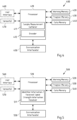
- Fig. 1 is a schematic high-level block diagram showing a system 100 according to all exemplary aspects.
- System 100 comprises a plurality of radio nodes 130-1 to 130-5, an IoT device 140 (e.g. a first apparatus, e.g. configured to perform and/or control a method according to the first exemplary aspect), a server cloud (also referred to as backend server) 110 (e.g. a second apparatus, e.g. configured to perform and/or control a method according to the second exemplary aspect), and an optional positioning service server cloud 120-1, and an optional radio model database 120-2.
- the optional positioning service server cloud 120-1, and an optional radio model database 120-2 may be comprised by or be connectable to the server cloud 110.
- Server cloud 110 may be a part of or host a tracking service.
- communication e.g. wireless or wired communication between the entities may occur.
- the IoT device 140 may gather (e.g. measure) at least one sample measurement comprising at least one of an identifier information or signal strength information of the plurality of radio nodes 130-1 to 130-5.
- One or more signals are sent by the respective radio nodes 130-1 to 130-5 are observable at a location where the loT device 140 performs the gathering (e.g. measuring) of the at least one sample measurement.
- Such one or more signals of the respective radio nodes 130-1 to 130-5 may comprise or be indicative of a respective identifier information (e.g. MAC address) of the respective radio node of the plurality of radio nodes 130-1 to 130-5. Additionally or alternatively, such one or more signals of the respective radio nodes 130-1 to 130-5 may comprise or be indicative of a respective received signal strength information (e.g. RSS value or RSSI) of the respective radio node of the plurality of radio nodes 130-1 to 130-5.
- a respective identifier information e.g. MAC address
- RSS value or RSSI received signal strength information
- the radio node 130-1 may provide (e.g. sent or transmit) one or more signals comprising or being indicative of the identifier information (e.g. MAC address) "m11:m12:m13:m14:m15:m16", thus, a respective identifier information having six octets or being represented by six bytes. Further, the radio node 130-1 may provide (e.g. sent or transmit) one or more signals comprising or being indicative of the received signal strength information (e.g. RSS value), in Fig. 1 referred to as "r1".
- the received signal strength information e.g. RSS value
- radio node 130-2 may provide one or more signals comprising the following:
- Radio node 130-3 may provide one or more signals comprising the following:
- Radio node 130-4 may provide one or more signals comprising the following:
- Radio node 130-5 may provide one or more signals comprising the following:
- the loT device 140 - if located in such a location at which (e.g. all) of the one or more signals sent by the respective radio nodes 130-1 to 130-5 are observable, gathers (e.g. measures) a sample measurement comprising the respective identifier information of (e.g. all of) the radio nodes 130-1 to 130-5, and optionally (e.g. all of) the respective received signal strength information.
- This gathered at least one sample measurement may be (e.g. lossy) encoded by the loT device 140 measurement based on the following conditions:
- the gathered at least one sample measurement may be encoded in such a way that the information comprised by the gathered at least one sample measurement can fit in a message, e.g. of 18 bytes.
- the encoded sample measurement may comprise the following information, as illustrated by the table shown in Fig. 1 : Table 2 1 st octet 2 nd octet 3 rd octet 4 th octet 5 th octet 6 th octet m11 m12 m13 m14 m15 m16 m21 m22 m23 m24 m25 m26 m36 m46 m56 log (r1) log (r3) log (r5) log (r2) log (r4)
- the encoded sample measurement comprises the following information:
- the gathered at least one sample measurement may be encoded in such a way that the information comprised by the gathered at least one sample measurement can fit in a message, e.g. of 12 bytes.
- the encoded sample measurement may comprise one full identifier information and three pieces of partial identifier information and e.g. up to four pieces of respective received signal strength information associated with the one full identifier information and the three pieces of partial identifier information.
- the encoded sample measurement may comprise the following information: Table 3 1 st octet 2 nd octet 3 rd octet 4 th octet 5 th octet 6 th octet m11 m12 m13 m14 m15 m16 m26 m36 m46 log (r1) log (r3) Optional indicator if this is the (e.g. only) message or not log (r2) log (r4)
- the respective encoding of the gathered at least one sample measurement may (e.g. also) be applied for future low bandwidth protocols or as a space efficient method even if a respective message with which the at least one encoded sample measurement is to be provided is capable of carrying more than e.g. 18 bytes, such as e.g. LoRa of Long Range Wide Area Network (LoRaWAN).
- LoRa supports a respective message or respective messages that may carry up to 256 bytes.
- a single small message carrying the at least one encoded sample measurement may be beneficial e.g. if 238 bytes (in case the at least one encoded sample measurement has 18 bytes in this example) are still available for communicating a more complex observation, (e.g. more than just e.g. a temperature), to name but one non-limiting example.
- the respective encoded sample measurement is then provided, e.g. to the server cloud 110.
- the server cloud 110 obtains (e.g. receives) the at least one encoded sample measurement comprising:
- the server cloud resolves the respective partial identifier information of the maximum of three partial identifier information of respective radio nodes, here of the radio nodes 130-3 to 130-5 to determine their respective full identifier information.
- the server cloud may provide (e.g. send) a request to the radio model database 120-2, e.g. by the request being a find Nearby/Matching APs request so that the respective partial identifier information can be resolved.
- a request may not (e.g. only) comprise the respective partial identifier information, but also the respective (e.g. two) full identifier information so that a look up for nearby radio nodes being in the vicinity of the respective radio nodes for which the server cloud 110 obtained the respective full identifier information (e.g.
- the respective full identifier information enables identification of the respective radio nodes, and the likelihood that then based on the e.g. last octet of a respective identifier information as represented by the respective partial identifier information is enough to identify the correct respective radio node is sufficient (e.g. error being below 1% of (e.g. all of) the requests)).
- the server cloud 110 may also resolve the respective received signal strength information. More details are disclosed below.
- the server cloud may provide (e.g. sent) a position request e.g. to the positioning service server cloud 120-1.
- the server cloud 110 may have obtained (e.g. received) such a position request from the IoT device 140.
- the position request may comprise or be accompanied by the respective identifier information (e.g. including the resolved partial identifier information, thus, the respective full identifier information), and optionally the received signal strength information (e.g. including the resolved received signal strength information).
- the positioning service server cloud 120-1 may determine (e.g. estimate) a position information based on the respective identifier information and/or the received signal strength information and provide (e.g. sent) the determined position information e.g. back to the server cloud 110.
- the server cloud 110 may provide (e.g. sent, relay or forward) the position information to the IoT device 140.
- Some IoT communication protocols e.g. Sigfox
- Sigfox can be constrained to very short message sizes, e.g. 12 or 18 bytes.
- the respective message may be divided into two or more discreet messages. This data flow may be implemented as follows:
- the first message alone could be sufficient for positioning purposes (e.g. determining a position information), although there is a higher risk of positioning failing due to the full MAC (e.g. identifier information) being unavailable in the radio model (e.g. database 120-2).
- the full MAC e.g. identifier information
- Fig. 2 is a flowchart 200 showing an example embodiment of a method according to the first exemplary aspect. This flowchart 200 may for instance be performed by an IoT device (e.g. first apparatus), e.g. IoT device 140 of Fig. 1 .
- an IoT device e.g. first apparatus
- IoT device 140 of Fig. 1 e.g. IoT device 140 of Fig. 1 .
- a first step 201 at least one sample measurement is gathered.
- the at least one sample measurement is gathered (e.g. measured) based on one or more signals sent (e.g. emitted) by a plurality of radio nodes, e.g. the radio nodes 130-1 to 130-5 of Fig. 1 .
- the at least one sample measurement is encoded.
- the at least one sample measurement based on certain one or more conditions, as disclosed above in the summary section. This may allow to reduce a size of the encoded at least one sample measurement enhancing the providing (e.g. transmission) of a message comprising the at least one sample measurement.
- the encoded at least one sample measurement is provided, e.g. by sending the encoded at least one sample measurement.
- the encoded at least one sample measurement may be provided to a server cloud (e.g. second apparatus), e.g. server cloud 110 of Fig. 1 .
- the encoded at least one sample measurement may be provided to an entity that is different from the server cloud, e.g. to another entity of a communication network (e.g. not shown in Fig. 1 ), which may then forward respectively relay the encoded at least one sample measurement to the server cloud.
- a position request is provided, e.g. by sending the position request to a server cloud (e.g. second apparatus).
- the server cloud may be the same to which in step 203 the encoded at least one sample measurement is provided.
- the apparatus performing and/or controlling the flowchart 200 may request its location respectively the location at which the apparatus has gathered the at least one sample measurement in step 201 to be determined (e.g. estimated).
- a position information is obtained, e.g. from an entity to which in optional step 204 the position request was provided (e.g. sent).
- the position information may be indicative of a location at which the apparatus performing and/or controlling the flowchart 200 has gathered the at least one sample measurement (see step 201).
- step 206 the position information (e.g. of step 205) is overlayed on a map user interface (UI).
- UI map user interface
- the position information is used for a navigation, e.g. for navigating a user of the apparatus performing and/or controlling the flowchart 200 (e.g. tracker 140 of Fig. 1 ) along a route, e.g. to a destination (which may be input), and/or from a location to a location as represented by the position information, to name but a few non-limiting examples.
- a navigation e.g. for navigating a user of the apparatus performing and/or controlling the flowchart 200 (e.g. tracker 140 of Fig. 1 ) along a route, e.g. to a destination (which may be input), and/or from a location to a location as represented by the position information, to name but a few non-limiting examples.
- a notification may be triggered, e.g. that the apparatus performing and/or controlling the flowchart 200 (e.g. tracker 140 of Fig. 1 ) has arrived to a certain location X, is on the move, cannot be found, calculating a route to the apparatus' performing and/or controlling the flowchart 200 (e.g. tracker 140 of Fig. 1 ) location, to name but a few non-limiting examples.
- any of the steps 206 to 208 may be performed and/or controlled prior to, in parallel to, and/or subsequent to any of the steps 201 to 205.
- Fig. 3 is a flowchart 300 showing an example embodiment of a method according to the second exemplary aspect.
- This flowchart 300 may for instance be performed by a server cloud (e.g. second apparatus), e.g. server cloud 110 of Fig. 1 .
- server cloud e.g. second apparatus
- server cloud 110 of Fig. 1 e.g. server cloud 110 of Fig. 1 .
- a first step 301 at least one encoded sample measurement is obtained.
- the at least one encoded sample measurement is obtained by receiving the at least one encoded sample measurement e.g. from an IoT device (e.g. first apparatus), e.g. IoT device 140, which may represent the apparatus performing and/or controlling the flowchart 200 of Fig. 2 .
- an IoT device e.g. first apparatus
- IoT device 140 which may represent the apparatus performing and/or controlling the flowchart 200 of Fig. 2 .
- the at least one encoded sample measurement is combined, e.g. in case the at least one encoded sample measurement is obtained in step 301 as two or more discreet messages.
- a checksum information as comprised by a first discreet message or a second discreet message forming the at least one encoded sample measurement obtained in step 301 may point (e.g. via a checksum information) to the respective discreet message with which the respective discreet message comprising the checksum information is to be combined (e.g. joined).
- a respective partial identifier information of the maximum of three pieces of partial identifier information of respective radio nodes and as comprised by the at least one encoded sample measurement of step 301 is resolved. This may allow to determine or obtain the respective full identifier information instead of the partial identifier information.
- the apparatus performing and/or controlling the flowchart 300 may retrieve further information (e.g. a look-up table having a structure as disclosed in the summary section) from a memory, e.g. a database comprised by or connectable to said apparatus.
- a position request is obtained, e.g. by receiving such a position request.
- the position request may be obtained from the apparatus performing and/or controlling the flowchart 200 of Fig. 2 .
- the apparatus performing and/or controlling the flowchart 200 of Fig. 2 may request its location respectively the location at which this apparatus has gathered at least one sample measurement (see step 201 of Fig. 2 ) to be determined (e.g. estimated).
- a position information is determined.
- the position information may be determined in response to obtaining a position request (see step 304).
- the position information may be determined based, at least in part, on the at least one encoded sample measurement, or more precisely, based on the one or more pieces of full and/or partial identifier information, and/or the one or more pieces of received signal strength information as comprised by the at least one encoded sample measurement.
- the position information is provided, e.g. by sending the position information (e.g. as determined in step 305), e.g. to the entity form which in step 304 the position request may have been obtained, e.g. the apparatus performing and/or controlling the flowchart 200 of Fig. 2 .
- a route e.g. to or from a location as represented by the position information is determined (e.g. calculated).
- the route (e.g. of step 307) may be provided, e.g. by transmitting the route e.g. to an apparatus performing and/or controlling the flowchart 200 of Fig. 2 .
- any of the steps 307 to 308 may be performed and/or controlled prior to, in parallel to, and/or subsequent to any of the steps 301 to 306.
- Fig. 4 is a schematic block diagram of an apparatus 400 according to an exemplary aspect, which may for instance represent the IoT device 140 of Fig. 1 .
- Apparatus 400 comprises a processor 410, working memory 420, program memory 430, data memory 440, communication interface(s) 450, an optional user interface 460 and an optional sensor(s) 470.
- Apparatus 400 may for instance be configured to perform and/or control or comprise respective means (at least one of 410 to 470) for performing and/or controlling the method according to the first exemplary aspect.
- Apparatus 400 may as well constitute an apparatus comprising at least one processor (410) and at least one memory (420) including computer program code, the at least one memory and the computer program code configured to, with the at least one processor, cause an apparatus, e.g. apparatus 400 at least to perform and/or control the method according to first exemplary aspect.
- Processor 410 may for instance comprise a sample measurement gatherer 411 as a functional and/or structural unit.
- Sample measurement gatherer 411 may for instance gather (e.g. measure) one or more pieces of identifier information and/or one or more pieces of received signal strength information, e.g. based on one or more signals emitted by radio nodes, e.g. radio nodes 130-1 to 130-5 f Fig. 1 .
- Processor 410 may for instance comprise an encoder 412 as a functional and/or structural unit. Encoder 412 may for instance encode a gathered sample measurement.
- Processor 410 may for instance further control the memories 420 to 440, the communication interface(s) 450, the optional user interface 460 and the optional sensor(s) 470.
- Processor 410 may for instance execute computer program code stored in program memory 430, which may for instance represent a computer readable storage medium comprising program code that, when executed by processor 410, causes the processor 410 to perform the method according to the first exemplary aspect.
- Processor 410 may be a processor of any suitable type.
- Processor 410 may comprise but is not limited to one or more microprocessor(s), one or more processor(s) with accompanying one or more digital signal processor(s), one or more processor(s) without accompanying digital signal processor(s), one or more special-purpose computer chips, one or more field-programmable gate array(s) (FPGA(s)), one or more controller(s), one or more application-specific integrated circuit(s) (ASIC(s)), or one or more computer(s).
- FPGA field-programmable gate array
- ASIC application-specific integrated circuit
- Processor 410 may for instance be an application processor that runs an operating system.
- Program memory 430 may also be included into processor 410. This memory may for instance be fixedly connected to processor 410, or be at least partially removable from processor 410, for instance in the form of a memory card or stick. Program memory 430 may for instance be non-volatile memory. It may for instance be a FLASH memory (or a part thereof), any of a ROM, PROM, EPROM and EEPROM memory (or a part thereof) or a hard disc (or a part thereof), to name but a few examples. Program memory 430 may also comprise an operating system for processor 410. Program memory 430 may also comprise a firmware for apparatus 400.
- Apparatus 400 comprises a working memory 420, for instance in the form of a volatile memory. It may for instance be a Random Access Memory (RAM) or Dynamic RAM (DRAM), to give but a few non-limiting examples. It may for instance be used by processor 410 when executing an operating system and/or computer program.
- RAM Random Access Memory
- DRAM Dynamic RAM
- Data memory 440 may for instance be a non-volatile memory. It may for instance be a FLASH memory (or a part thereof), any of a ROM, PROM, EPROM and EEPROM memory (or a part thereof) or a hard disc (or a part thereof), to name but a few examples. Data memory 440 may for instance store one or more pieces of sample measurements, one or more pieces of identifier information, one or more pieces of partial identifier information, one or more pieces of received signal strength information, one or more pieces of encoded sample measurements, one or more messages, one or more discreet messages, one or more position requests, one or more pieces of position information, or a combination thereof.
- Communication interface(s) 450 enable apparatus 400 to communicate with other entities, e.g. with server cloud 110 of Fig. 1 .
- the communication interface(s) 450 may for instance comprise a wireless interface, e.g. a cellular radio communication interface and/or a WLAN interface) and/or wire-bound interface, e.g. an IP-based interface, for instance to communicate with entities via the Internet.
- Communication interface(s) may enable apparatus 400 to communicate with other entities, for instance with one or more of the radio nodes 130-1 to 130-5 of Fig. 1 .
- User interface 460 is optional and may comprise a display for displaying information to a user and/or an input device (e.g. a keyboard, keypad, touchpad, mouse, etc.) for receiving information from a user.
- an input device e.g. a keyboard, keypad, touchpad, mouse, etc.
- Sensor(s) 470 are optional and may for instance comprise a barometric sensor, e.g. to gather pressure information.
- Some or all of the components of the apparatus 400 may for instance be connected via a bus. Some or all of the components of the apparatus 400 may for instance be combined into one or more modules.
- Fig. 5 is a schematic block diagram of an apparatus 500 according to an exemplary aspect, which may for instance represent the server cloud 110 of Fig. 1 .
- Apparatus 500 comprises a processor 510, working memory 520, program memory 530, data memory 540, communication interface(s) 550, and an optional user interface 560.
- Apparatus 500 may for instance be configured to perform and/or control or comprise respective means (at least one of 510 to 560) for performing and/or controlling the method according to the second exemplary aspect.
- Apparatus 500 may as well constitute an apparatus comprising at least one processor (510) and at least one memory (520) including computer program code, the at least one memory and the computer program code configured to, with the at least one processor, cause an apparatus, e.g. apparatus 500 at least to perform and/or control the method according to second exemplary aspect.
- Processor 510 may for instance comprise an identifier information and/or received signal strength information resolver 511 as a functional and/or structural unit.
- Identifier information and/or received signal strength information resolver 511 may for instance resolve one or more pieces of partial identifier information into full identifier information, and/or one or more pieces of signal strength information into dBm values.
- Processor 510 may for instance further control the memories 520 to 540, the communication interface(s) 550, and the optional user interface 560.
- Processor 510 may for instance execute computer program code stored in program memory 530, which may for instance represent a computer readable storage medium comprising program code that, when executed by processor 510, causes the processor 510 to perform the method according to the second exemplary aspect.
- Processor 510 may be a processor of any suitable type.
- Processor 510 may comprise but is not limited to one or more microprocessor(s), one or more processor(s) with accompanying one or more digital signal processor(s), one or more processor(s) without accompanying digital signal processor(s), one or more special-purpose computer chips, one or more field-programmable gate array(s) (FPGA(s)), one or more controller(s), one or more application-specific integrated circuit(s) (ASIC(s)), or one or more computer(s).
- FPGA field-programmable gate array
- ASIC application-specific integrated circuit
- Processor 510 may for instance be an application processor that runs an operating system.
- Program memory 530 may also be included into processor 510. This memory may for instance be fixedly connected to processor 510, or be at least partially removable from processor 510, for instance in the form of a memory card or stick. Program memory 530 may for instance be non-volatile memory. It may for instance be a FLASH memory (or a part thereof), any of a ROM, PROM, EPROM and EEPROM memory (or a part thereof) or a hard disc (or a part thereof), to name but a few examples. Program memory 530 may also comprise an operating system for processor 510. Program memory 530 may also comprise a firmware for apparatus 500.
- Apparatus 500 comprises a working memory 520, for instance in the form of a volatile memory. It may for instance be a Random Access Memory (RAM) or Dynamic RAM (DRAM), to give but a few non-limiting examples. It may for instance be used by processor 510 when executing an operating system and/or computer program.
- RAM Random Access Memory
- DRAM Dynamic RAM
- Data memory 540 may for instance be a non-volatile memory. It may for instance be a FLASH memory (or a part thereof), any of a ROM, PROM, EPROM and EEPROM memory (or a part thereof) or a hard disc (or a part thereof), to name but a few examples. Data memory 540 may for instance store one or more pieces of sample measurements, one or more pieces of identifier information, one or more pieces of partial identifier information, one or more pieces of received signal strength information, one or more pieces of encoded sample measurements, one or more messages, one or more discreet messages, one or more position requests, one or more pieces of position information, or a combination thereof.
- Communication interface(s) 550 enable apparatus 500 to communicate with other entities, e.g. with radio nodes 130-1 to 130-5 of Fig. 1 .
- the communication interface(s) 550 may for instance comprise a wireless interface, e.g. a cellular radio communication interface and/or a WLAN interface) and/or wire-bound interface, e.g. an IP-based interface, for instance to communicate with entities via the Internet.
- Communication interface(s) may enable apparatus 500 to communicate with other entities, for instance with one or more of the IoT device 140 of Fig. 1 .
- User interface 560 is optional and may comprise a display for displaying information to a user and/or an input device (e.g. a keyboard, keypad, touchpad, mouse, etc.) for receiving information from a user.
- an input device e.g. a keyboard, keypad, touchpad, mouse, etc.
- Some or all of the components of the apparatus 500 may for instance be connected via a bus. Some or all of the components of the apparatus 500 may for instance be combined into one or more modules.
- Fig. 6 is a schematic illustration of examples of tangible and non-transitory computer-readable storage media according to the present invention that may for instance be used to implement program and/or main or working or program or data memory 420, 430, 440, 520, 530, 540 of the apparatus 400, and/or 500 of Fig. 4 or Fig. 5 .
- Fig. 6 shows a flash memory 600, which may for instance be soldered or bonded to a printed circuit board, a solid-state drive 601 comprising a plurality of memory chips (e.g. Flash memory chips), a magnetic hard drive 602, a Secure Digital (SD) card 603, a Universal Serial Bus (USB) memory stick 604, an optical storage medium 605 (such as for instance a CD-ROM or DVD) and a magnetic storage medium 606.
- SD Secure Digital
- USB Universal Serial Bus
- a method comprising:
- a respective full identifier information is represented by six octets
- a respective partial identifier information is represented by one octet
- the part of the respective full identifier information is a last octet of the respective obtained identifier information.
- the at least one signal strength information of the encoded at least one sample measurement is converted into a linear value, wherein the conversion is based on at least one of pre-defined signal strength values or pre-defined signal strength ranges of the gathered signal strength information mapped to the respective linear values.
- a first discreet message of the two discreet messages comprises one of the maximum of two full identifier information of the respective radio nodes, is allowed to comprise at a maximum the three partial identifier information and is allowed to comprise the respective signal strength information of the respective radio nodes whose identifier information, or a part of it, is comprised by the first discreet message.
- a second discreet message of the two discreet messages comprises another one of the maximum of two full identifier information of the respective radio nodes, is allowed to comprise at a maximum three further partial identifier information not comprised by the first discreet message, and is allowed to comprise the respective signal strength information of the respective radio nodes whose identifier information, or a part of it, is comprised by the second discreet message.
- a method comprising:
- a respective full identifier information is represented by six octets
- a respective partial identifier information is represented by one octet
- the part of the respective full identifier information is a last octet of the respective obtained identifier information.
- a first discreet message of the two discreet messages comprises one of the maximum of two full identifier information of the respective radio nodes, is allowed to comprise at a maximum the three partial identifier information and is allowed to comprise the respective signal strength information of the respective radio nodes whose identifier information, or a part of it, is comprised by the first discreet message.
- a second discreet message of the two discreet messages comprises another one of the maximum of two full identifier information of the respective radio nodes, is allowed to comprise at a maximum three further partial identifier information not comprised by the first discreet message, and is allowed to comprise the respective signal strength information of the respective radio nodes whose identifier information, or a part of it, is comprised by the second discreet message.
- An apparatus comprising respective means for performing the method of any of embodiments 1 to 13.
- An apparatus comprising at least one processor and at least one memory storing instructions that, when executed by the at least one processor, cause an apparatus at least to perform and/or control the method according any of embodiments 1 to 13.
- An apparatus comprising respective means for performing the method of any of embodiments 14 to 30.
- An apparatus comprising at least one processor and at least one memory storing instructions that, when executed by the at least one processor, cause an apparatus at least to perform and/or control the method according any of embodiments 14 to 30.
- a computer program when executed by a processor causing an apparatus, e.g. the apparatus according to any of embodiments 31 to 32, to perform and/or control the actions and/or steps of the method of any of embodiments 1 to 13.
- a computer program product comprising a computer program according to embodiment 35.
- a computer program when executed by a processor causing an apparatus, e.g. the apparatus according to any of embodiments 33 to 34, to perform and/or control the actions and/or steps of the method of any of embodiments 14 to 30.
- a computer program product comprising a computer program according to embodiment 37.
- a system comprising:
- any presented connection in the described embodiments is to be understood in a way that the involved components are operationally coupled.
- the connections can be direct or indirect with any number or combination of intervening elements, and there may be merely a functional relationship between the components.
- any of the methods, processes and actions described or illustrated herein may be implemented using executable instructions in a general-purpose or special-purpose processor and stored on a computer-readable storage medium (e.g., disk, memory, or the like) to be executed by such a processor.
- a computer-readable storage medium e.g., disk, memory, or the like
- References to a 'computer-readable storage medium' should be understood to encompass specialized circuits such as FPGAs, ASICs, signal processing devices, and other devices.
- a and/or B is considered to comprise any one of the following three scenarios: (i) A, (ii) B, (iii) A and B. Having the same meaning as the expression “A and/or B", the expression “at least one of A or B” may be used herein. Furthermore, the article “a” is not to be understood as “one”, i.e. use of the expression “an element” does not preclude that also further elements are present. The term “comprising” is to be understood in an open sense, i.e. in a way that an object that "comprises an element A” may also comprise further elements in addition to element A.
- the statement of a feature comprises at least one of the subsequently enumerated features is not mandatory in the way that the feature comprises all subsequently enumerated features, or at least one feature of the plurality of the subsequently enumerated features. Also, a selection of the enumerated features in any combination or a selection of only one of the enumerated features is possible. The specific combination of all subsequently enumerated features may as well be considered. Also, a plurality of only one of the enumerated features may be possible.
Landscapes
- Engineering & Computer Science (AREA)
- Physics & Mathematics (AREA)
- Computer Networks & Wireless Communication (AREA)
- Signal Processing (AREA)
- General Physics & Mathematics (AREA)
- Radar, Positioning & Navigation (AREA)
- Remote Sensing (AREA)
- Quality & Reliability (AREA)
- Electromagnetism (AREA)
- Mobile Radio Communication Systems (AREA)
- Position Fixing By Use Of Radio Waves (AREA)
Applications Claiming Priority (1)
| Application Number | Priority Date | Filing Date | Title |
|---|---|---|---|
| US18/077,787 US20240192303A1 (en) | 2022-12-08 | 2022-12-08 | Message encoding for positioning |
Publications (1)
| Publication Number | Publication Date |
|---|---|
| EP4382948A1 true EP4382948A1 (de) | 2024-06-12 |
Family
ID=89121920
Family Applications (1)
| Application Number | Title | Priority Date | Filing Date |
|---|---|---|---|
| EP23214720.7A Pending EP4382948A1 (de) | 2022-12-08 | 2023-12-06 | Nachrichtencodierung zur positionierung |
Country Status (3)
| Country | Link |
|---|---|
| US (1) | US20240192303A1 (de) |
| EP (1) | EP4382948A1 (de) |
| JP (1) | JP7763825B2 (de) |
Citations (3)
| Publication number | Priority date | Publication date | Assignee | Title |
|---|---|---|---|---|
| US20120126943A1 (en) * | 2010-11-19 | 2012-05-24 | Gm Global Technology Operations, Inc. | Passive Approach Detection System and Method Using a Unidirectional FOB |
| EP3860280A1 (de) * | 2010-06-04 | 2021-08-04 | Board of Regents, The University of Texas System | Drahtlose verfahren und kommunikationssystem |
| WO2021173497A1 (en) * | 2020-02-24 | 2021-09-02 | Qualcomm Incorporated | Compressed measurement feedback using an encoder neural network |
Family Cites Families (10)
| Publication number | Priority date | Publication date | Assignee | Title |
|---|---|---|---|---|
| JP4002481B2 (ja) * | 2002-07-29 | 2007-10-31 | 日本電気株式会社 | 移動体通信システム、及びそれに用いる通信装置とその通信プロトコル整合性管理方法 |
| EP2979108B1 (de) * | 2013-03-26 | 2018-07-25 | Nokia Technologies OY | Verwendung verkürzter derivate von identifikatoren von einheiten von kommunikationssystemen zum abrufen von ortungsinformationen |
| US11792605B2 (en) * | 2014-06-10 | 2023-10-17 | PB, Inc. | Tracking device systems |
| EP3721253A1 (de) * | 2017-12-07 | 2020-10-14 | HERE Global B.V. | Unterstützte positionierung für innenraumpositionierungsdienste |
| EP3732923B1 (de) * | 2017-12-25 | 2023-09-27 | Panasonic Intellectual Property Corporation of America | Kommunikationsvorrichtung für schnelle intelligente abtastung mit niedriger leistung |
| WO2019179601A1 (en) * | 2018-03-20 | 2019-09-26 | Here Global B.V. | Positioning of low power devices |
| WO2019193538A1 (en) * | 2018-04-05 | 2019-10-10 | Telefonaktiebolaget Lm Ericsson (Publ) | Paging optimization using truncated ue identifiers |
| US11304169B2 (en) * | 2018-12-19 | 2022-04-12 | Qualcomm Incorporated | Differential round trip time based positioning |
| JP7253703B2 (ja) * | 2019-03-12 | 2023-04-07 | パナソニックIpマネジメント株式会社 | 位置推定装置および位置推定システム |
| US20240196201A1 (en) * | 2022-12-08 | 2024-06-13 | Here Global B.V. | Message decoding for positioning |
-
2022
- 2022-12-08 US US18/077,787 patent/US20240192303A1/en active Pending
-
2023
- 2023-12-06 EP EP23214720.7A patent/EP4382948A1/de active Pending
- 2023-12-08 JP JP2023207810A patent/JP7763825B2/ja active Active
Patent Citations (3)
| Publication number | Priority date | Publication date | Assignee | Title |
|---|---|---|---|---|
| EP3860280A1 (de) * | 2010-06-04 | 2021-08-04 | Board of Regents, The University of Texas System | Drahtlose verfahren und kommunikationssystem |
| US20120126943A1 (en) * | 2010-11-19 | 2012-05-24 | Gm Global Technology Operations, Inc. | Passive Approach Detection System and Method Using a Unidirectional FOB |
| WO2021173497A1 (en) * | 2020-02-24 | 2021-09-02 | Qualcomm Incorporated | Compressed measurement feedback using an encoder neural network |
Also Published As
| Publication number | Publication date |
|---|---|
| JP7763825B2 (ja) | 2025-11-04 |
| US20240192303A1 (en) | 2024-06-13 |
| JP2024083308A (ja) | 2024-06-20 |
Similar Documents
| Publication | Publication Date | Title |
|---|---|---|
| CN103547938B (zh) | 无线网络环境中的测量和信息搜集 | |
| CN102257402B (zh) | 对无线位置确定的部署后校准 | |
| JP6141532B2 (ja) | 支援データを形成するためのアクセスポイントからのブロードキャスト位置および送信電力の使用 | |
| KR101521006B1 (ko) | 왕복 시간 측정을 위한 디바이스 | |
| US9432815B2 (en) | Location support using a device identification conveyed by a positioning protocol | |
| CN107850659A (zh) | 支持由移动装置定位该移动装置 | |
| US11531081B2 (en) | Assisted positioning for indoor positioning services | |
| JP2017503148A (ja) | 現場におけるロケーションベースのサービスを提供するための方法、システム、およびデバイス | |
| EP4382949A1 (de) | Decodierung von nachrichten zur positionierung | |
| US11313940B2 (en) | Advertising ambient pressure information | |
| EP4382948A1 (de) | Nachrichtencodierung zur positionierung | |
| EP3149509A1 (de) | Standortunterstützung unter verwendung einer durch ein positionierungprotokoll weitergeleiteten vorrichtungsidentifizierung | |
| JP2024083309A5 (de) | ||
| US20200163041A1 (en) | Trustworthiness of location estimates | |
| CN117715178A (zh) | 卫星定位方法和相关产品 | |
| US20150350847A1 (en) | Phone based context engine for positioning | |
| US20210112519A1 (en) | Radio node localization and clustering for improved device localization | |
| CN103038663B (zh) | 用于往返时间测量的设备 |
Legal Events
| Date | Code | Title | Description |
|---|---|---|---|
| PUAI | Public reference made under article 153(3) epc to a published international application that has entered the european phase |
Free format text: ORIGINAL CODE: 0009012 |
|
| STAA | Information on the status of an ep patent application or granted ep patent |
Free format text: STATUS: THE APPLICATION HAS BEEN PUBLISHED |
|
| AK | Designated contracting states |
Kind code of ref document: A1 Designated state(s): AL AT BE BG CH CY CZ DE DK EE ES FI FR GB GR HR HU IE IS IT LI LT LU LV MC ME MK MT NL NO PL PT RO RS SE SI SK SM TR |
|
| P01 | Opt-out of the competence of the unified patent court (upc) registered |
Free format text: CASE NUMBER: APP_44534/2024 Effective date: 20240731 |
|
| STAA | Information on the status of an ep patent application or granted ep patent |
Free format text: STATUS: REQUEST FOR EXAMINATION WAS MADE |
|
| 17P | Request for examination filed |
Effective date: 20241205 |