EP4383074A1 - Procédé et appareil de traitement de service, serveur, support de stockage et produit de programme informatique - Google Patents
Procédé et appareil de traitement de service, serveur, support de stockage et produit de programme informatique Download PDFInfo
- Publication number
- EP4383074A1 EP4383074A1 EP22851871.8A EP22851871A EP4383074A1 EP 4383074 A1 EP4383074 A1 EP 4383074A1 EP 22851871 A EP22851871 A EP 22851871A EP 4383074 A1 EP4383074 A1 EP 4383074A1
- Authority
- EP
- European Patent Office
- Prior art keywords
- edge
- computation resources
- offline task
- server
- edge server
- Prior art date
- Legal status (The legal status is an assumption and is not a legal conclusion. Google has not performed a legal analysis and makes no representation as to the accuracy of the status listed.)
- Pending
Links
Images


Classifications
-
- G—PHYSICS
- G06—COMPUTING OR CALCULATING; COUNTING
- G06F—ELECTRIC DIGITAL DATA PROCESSING
- G06F9/00—Arrangements for program control, e.g. control units
- G06F9/06—Arrangements for program control, e.g. control units using stored programs, i.e. using an internal store of processing equipment to receive or retain programs
- G06F9/46—Multiprogramming arrangements
- G06F9/48—Program initiating; Program switching, e.g. by interrupt
- G06F9/4806—Task transfer initiation or dispatching
- G06F9/4843—Task transfer initiation or dispatching by program, e.g. task dispatcher, supervisor, operating system
- G06F9/4881—Scheduling strategies for dispatcher, e.g. round robin, multi-level priority queues
- G06F9/4893—Scheduling strategies for dispatcher, e.g. round robin, multi-level priority queues taking into account power or heat criteria
-
- G—PHYSICS
- G06—COMPUTING OR CALCULATING; COUNTING
- G06F—ELECTRIC DIGITAL DATA PROCESSING
- G06F9/00—Arrangements for program control, e.g. control units
- G06F9/06—Arrangements for program control, e.g. control units using stored programs, i.e. using an internal store of processing equipment to receive or retain programs
- G06F9/46—Multiprogramming arrangements
- G06F9/50—Allocation of resources, e.g. of the central processing unit [CPU]
- G06F9/5061—Partitioning or combining of resources
- G06F9/5066—Algorithms for mapping a plurality of inter-dependent sub-tasks onto a plurality of physical CPUs
-
- G—PHYSICS
- G06—COMPUTING OR CALCULATING; COUNTING
- G06F—ELECTRIC DIGITAL DATA PROCESSING
- G06F9/00—Arrangements for program control, e.g. control units
- G06F9/06—Arrangements for program control, e.g. control units using stored programs, i.e. using an internal store of processing equipment to receive or retain programs
- G06F9/46—Multiprogramming arrangements
- G06F9/50—Allocation of resources, e.g. of the central processing unit [CPU]
- G06F9/5005—Allocation of resources, e.g. of the central processing unit [CPU] to service a request
- G06F9/5027—Allocation of resources, e.g. of the central processing unit [CPU] to service a request the resource being a machine, e.g. CPUs, Servers, Terminals
- G06F9/5055—Allocation of resources, e.g. of the central processing unit [CPU] to service a request the resource being a machine, e.g. CPUs, Servers, Terminals considering software capabilities, i.e. software resources associated or available to the machine
-
- G—PHYSICS
- G06—COMPUTING OR CALCULATING; COUNTING
- G06F—ELECTRIC DIGITAL DATA PROCESSING
- G06F9/00—Arrangements for program control, e.g. control units
- G06F9/06—Arrangements for program control, e.g. control units using stored programs, i.e. using an internal store of processing equipment to receive or retain programs
- G06F9/30—Arrangements for executing machine instructions, e.g. instruction decode
- G06F9/38—Concurrent instruction execution, e.g. pipeline or look ahead
- G06F9/3877—Concurrent instruction execution, e.g. pipeline or look ahead using a secondary processor, e.g. coprocessor
-
- G—PHYSICS
- G06—COMPUTING OR CALCULATING; COUNTING
- G06F—ELECTRIC DIGITAL DATA PROCESSING
- G06F9/00—Arrangements for program control, e.g. control units
- G06F9/06—Arrangements for program control, e.g. control units using stored programs, i.e. using an internal store of processing equipment to receive or retain programs
- G06F9/46—Multiprogramming arrangements
- G06F9/50—Allocation of resources, e.g. of the central processing unit [CPU]
- G06F9/5005—Allocation of resources, e.g. of the central processing unit [CPU] to service a request
- G06F9/5027—Allocation of resources, e.g. of the central processing unit [CPU] to service a request the resource being a machine, e.g. CPUs, Servers, Terminals
- G06F9/505—Allocation of resources, e.g. of the central processing unit [CPU] to service a request the resource being a machine, e.g. CPUs, Servers, Terminals considering the load
-
- G—PHYSICS
- G06—COMPUTING OR CALCULATING; COUNTING
- G06F—ELECTRIC DIGITAL DATA PROCESSING
- G06F9/00—Arrangements for program control, e.g. control units
- G06F9/06—Arrangements for program control, e.g. control units using stored programs, i.e. using an internal store of processing equipment to receive or retain programs
- G06F9/46—Multiprogramming arrangements
- G06F9/50—Allocation of resources, e.g. of the central processing unit [CPU]
- G06F9/5061—Partitioning or combining of resources
- G06F9/5072—Grid computing
-
- G—PHYSICS
- G06—COMPUTING OR CALCULATING; COUNTING
- G06F—ELECTRIC DIGITAL DATA PROCESSING
- G06F2209/00—Indexing scheme relating to G06F9/00
- G06F2209/50—Indexing scheme relating to G06F9/50
- G06F2209/501—Performance criteria
-
- G—PHYSICS
- G06—COMPUTING OR CALCULATING; COUNTING
- G06F—ELECTRIC DIGITAL DATA PROCESSING
- G06F2209/00—Indexing scheme relating to G06F9/00
- G06F2209/50—Indexing scheme relating to G06F9/50
- G06F2209/5017—Task decomposition
-
- G—PHYSICS
- G06—COMPUTING OR CALCULATING; COUNTING
- G06F—ELECTRIC DIGITAL DATA PROCESSING
- G06F2209/00—Indexing scheme relating to G06F9/00
- G06F2209/50—Indexing scheme relating to G06F9/50
- G06F2209/503—Resource availability
Definitions
- the present disclosure relates to the field of computer technology, and in particular, to a method and an apparatus for processing a service, a server, a storage medium, and a computer program product.
- a cloud application refers to a novel application which transforms local installation and location computation in usage of conventional software into a service having instant applicability, and connects and controls a remote server cluster through the Internet or a local area network to execute logic or computing tasks.
- the cloud application means that a cloud server is responsible for operation and computation of a certain application while a terminal is only responsible for display.
- cloud gaming means that a game runs on a remote server based on cloud computing technology, need not be downloaded or installed on a terminal, and does not depend on a performance of the terminal. A problem that the performance of the terminal is too low to execute demanding games is thus well addressed.
- a method and an apparatus for processing a service, a server, a storage medium, and a computer program product are provided according to various embodiments of the present disclosure.
- a method for processing a service comprising: determining first computation resources for executing an offline task; determining one or more edge servers, of which a quantity is N, for executing the offline task, where a cloud application runs on the one or more edge servers, a quantity of idle computation resources of the one or more edge servers is greater than a quantity of the first computation resources, and the idle computation resources of the one or more edge servers is a sum of respective idle computation resources of all edge servers in the one or more edge servers; and distributing the offline task among the one or more edge servers through scheduling to enable all of the one or more edge servers to execute the offline task using the respective idle computation resources while ensuring normal operation of the cloud application.
- the method is executable by an edge server among one or more edge servers, of which a quantity is N, for executing an offline task, and a cloud application runs on the one or more edge servers.
- the method comprises: receiving an allocated offline task, which is distributed by a management server through scheduling, where the allocated offline task comprises the offline task received by the management server, or the allocated offline task comprises a subtask which corresponds to the edge server among N subtasks, and the N subtasks are obtained by dividing the offline task based on idle computation resources of each edge server in the one or more edge servers; and executing the allocated offline task using the idle computation resources of the edge server while ensuring normal operation of the cloud application.
- An apparatus for processing a service comprising: a determining unit, configured to determine first computation resources for executing an offline task, and further configured to determine one or more edge servers, of which a quantity is N, for executing the offline task, where a cloud application runs on the one or more edge servers, a quantity of idle computation resources of the one or more edge servers is greater than a quantity of the first computation resources, and the idle computation resources of the one or more edge servers is a sum of respective idle computation resources of all edge servers in the one or more edge servers; and a scheduling unit, configured to distribute the offline task among the one or more edge servers through scheduling to enable all of the one or more edge servers to execute the offline task using the respective idle computation resources while ensuring normal operation of the cloud application.
- Another apparatus for processing a service comprising: a receiving unit, configured to receive an allocated offline task, which is distributed by a management server through scheduling, where the allocated offline task comprises an offline task received by the management server, or the allocated offline task comprises a subtask which corresponds to an edge server among N subtasks, the N subtasks are obtained by dividing the offline task based on idle computation resources of each edge server in one or more edge servers, of which a quantity is N, for executing the offline task, and a cloud application runs on the one or more edge servers; and an executing unit, configured to execute the allocated offline task using the idle computation resources of the edge server while ensuring normal operation of the cloud application.
- a server comprising a processor configured to execute one or more computer-readable instructions, and a computer-readable storage medium storing the one or more computer-readable instructions, where the one or more computer-readable instructions when executed by the processor are configured to perform: determining first computation resources for executing an offline task; determining one or more edge servers, of which a quantity is N, for executing the offline task, where a cloud application runs on the one or more edge servers, a quantity of idle computation resources of the one or more edge servers is greater than a quantity of the first computation resources, and the idle computation resources of the one or more edge servers is a sum of respective idle computation resources of all edge servers in the one or more edge servers; and distributing the offline task among the one or more edge servers through scheduling to enable all of the one or more edge servers to execute the offline task using the respective idle computation resources while ensuring normal operation of the cloud application.
- Another server comprising a processor configured to execute one or more computer-readable instructions, and a computer-readable storage medium storing the one or more computer-readable instructions, where the one or more computer-readable instructions when executed by the processor are configured to perform: receiving an allocated offline task, which is distributed by a management server through scheduling, where the allocated offline task comprises an offline task received by the management server, or the allocated offline task comprises a subtask which corresponds to an edge server among N subtasks, and the N subtasks are obtained by dividing the offline task based on idle computation resources of each edge server in one or more edge servers of which a quantity is N; and executing the allocated offline task using the idle computation resources of the edge server while ensuring normal operation of the cloud application.
- a computer storage medium storing computer-readable instructions is provided.
- the computer-readable instructions when executed by a processor are configured to perform: determining first computation resources for executing an offline task; determining one or more edge servers, of which a quantity is N, for executing the offline task, where a cloud application runs on the one or more edge servers, a quantity of idle computation resources of the one or more edge servers is greater than a quantity of the first computation resources, and the idle computation resources of the one or more edge servers is a sum of respective idle computation resources of all edge servers in the one or more edge servers; and distributing the offline task among the one or more edge servers through scheduling to enable all of the one or more edge servers to execute the offline task using the respective idle computation resources while ensuring normal operation of the cloud application.
- the computer-readable instructions when executed by the processor are configured to perform: receiving an allocated offline task, which is distributed by a management server through scheduling, where the allocated offline task comprises an offline task received by the management server, or the allocated offline task comprises a subtask which corresponds to an edge server among N subtasks, and the N subtasks are obtained by dividing the offline task based on idle computation resources of each edge server in one or more edge servers of which a quantity is N; and executing the allocated offline task using the idle computation resources of the edge server while ensuring normal operation of the cloud application.
- a computer program product or computer-readable instructions comprises the computer-readable instructions, and the computer-readable instructions are stored in a computer storage medium.
- a processor of a server reads the computer-readable instructions from the computer storage medium, and the processor executes the computer-readable instructions to enable the server to perform: determining first computation resources for executing an offline task; determining one or more edge servers, of which a quantity is N, for executing the offline task, where a cloud application runs on the one or more edge servers, a quantity of idle computation resources of the one or more edge servers is greater than a quantity of the first computation resources, and the idle computation resources of the one or more edge servers is a sum of respective idle computation resources of all edge servers in the one or more edge servers; and distributing the offline task among the one or more edge servers through scheduling to enable all of the one or more edge servers to execute the offline task using the respective idle computation resources while ensuring normal operation of the cloud application.
- the processor of the server reads the computer-readable instructions from the computer storage medium, and the processor executes the computer-readable instructions to enable the server to perform: receiving an allocated offline task, which is distributed by a management server through scheduling, where the allocated offline task comprises an offline task received by the management server, or the allocated offline task comprises a subtask which corresponds to an edge server among N subtasks, and the N subtasks are obtained by dividing the offline task based on idle computation resources of each edge server in one or more edge servers of which a quantity is N; and executing the allocated offline task using the idle computation resources of the edge server while ensuring normal operation of the cloud application.
- a solution for processing a service is provided according to embodiments of the present disclosure.
- the solution can exploit of resources of edge servers thoroughly, improve a utilization rate of the resources, and reduce a cost of operating the edge servers for cloud applications.
- a management server may first evaluate first computation resources for executing the offline task, and then determines N edge server(s) for executing the offline task.
- a quantity of idle computation resources of the N edge server(s) is greater than a quantity of the first computation resources.
- the management server distributes the offline task among the N edge server(s) through scheduling, so that the N edge server(s) use the respective idle computation resources to execute the offline task while ensuring normal operation of a cloud application (i.e., maintaining the cloud application having a higher priority than the offline task in consuming computation resources).
- N may be greater than or equal to 1.
- distributing through the scheduling refers to allocating the offline task to an edge server for independent execution.
- distributing through the scheduling refers to allocating the offline task to multiple edge servers for collective execution.
- the offline task may be divided into multiple subtasks, and each edge server is responsible for executing one subtask.
- the offline task may be allocated to each edge server separately, and each of the multiple edge servers executes the same offline task, which can improve an execution speed of the offline task.
- the offline task can be executed using the idle computation resource in each edge server while ensuring normal operation of the cloud application, regardless of peak or off-peak hours.
- FIG. 1 is a schematic structural diagram of a system for managing a cloud application according to an embodiment of the present disclosure.
- the system as shown in Figure 1 comprises at least one edge server 101, which may be configured to run a cloud application.
- the at least one edge server 101 may run the same cloud application or run different cloud application.
- Common cloud applications include cloud gaming, cloud education, cloud conferencing, and cloud social networking, etc.
- the at least one edge server 101 may be deployed among multiple edge computing nodes.
- the edge computing node may be regarded as a node for edge computing.
- the edge computing may refer to using an open platform, in which core capabilities such as network, computing, storage, and application are integrated, to provide a service at a side close to an object or a data source according to a principle of proximity.
- An application program for the edge computing is initiated at an "edge" to render a response of a network service faster, and hence basic industrial requirements on real-time services, application intelligence, security and privacy protection, and the like are met.
- One or more edge servers having a capability of graphics processing run at each edge computing node, and each edge server may be called a computing node.
- edge computing node 1 comprises four edge servers, and edge computing node 2 may also comprise four edge servers.
- the system as shown in Figure 1 may further comprise a cloud application server 102.
- the cloud application server 102 is connected to the at least one edge server 101.
- the cloud application server 102 may provide execution data for the cloud application(s) to each edge server 101, so that each edge server 101 is capable to run the cloud application(s) based on the execution data provided by the cloud application server.
- the system as shown in Figure 1 may further comprise a terminal 103.
- the terminal 103 may be connected to the at least one edge server 101.
- the terminal 103 is configured to receive and display an image, which is generated by the edge server 101 performing rendering on the cloud application.
- the terminal 103 displays a game picture generated through rendering of the edge server 101.
- the terminal 103 may be a mobile intelligent terminal, which is a device having various manners of human-computer interaction, having an Internet accessing capability, usually equipped with various operating systems, and having a strong processing capability.
- the terminal 103 may include a smartphone, a tablet computer, a notebook computer, a desktop computer, a smart loudspeaker, a smartwatch, a vehicle-mounted terminal, and a smart TV, etc.
- the system as shown in Figure 1 may further comprise a management server 104.
- the management server 104 is connected to the terminal 103 and the at least one edge server 101.
- the management server 104 may be configured to manage and schedule the at least one edge server 101. For example, when monitoring that any cloud application is activated in any terminal, the management server 104 may select one or more suitable edge servers to execute the cloud application activated in the terminal according to a current load and a current status of an idle computation resource at each edge server 101.
- the management server 104 determines to schedule the offline task to one or more edge servers 101 according to a status of the idle computation resource at each edge server, and the one or more edge servers 101 to which the offline task is allocated use the respective idle computation resource(s) to execute the offline task while ensuring the normal operation of the cloud application(s).
- the normal operation of the cloud application(s) is ensured, and the idle computation resources when running the cloud application(s) are prevented from being wasted.
- a utilization rate of resources at each edge server is improved, and hence a cost of operating the edge servers is reduced.
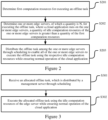
- FIG. 2 is a schematic flowchart of a method for processing a service according to an embodiment of the present disclosure.
- the method as shown in Figure 2 is executable by a management server, especially, by a processor of the management server.
- the method as shown in Figure 2 may comprise following steps S201 to S203.
- step S201 first computation resources for executing an offline task are determined.
- the offline task refers to a task that does not need to be executed online in real time. For example, it may be rendering a video with a special effect offline, or training an artificial intelligence model offline.
- the computation resources of a quantity of the first computation resources are different when a main load of executing the offline task has different types.
- the first computation resources may include one or more of: a network bandwidth, an internal memory, floating-point operations per second (FLOPS) of the GPU, operations per second (OPS) of the GPU, and a throughput.
- FLOPS floating-point operations per second
- OPS operations per second
- the first computation resources may include one or more of: an internal memory, a network bandwidth, FLOPS of the CPU, and OPS of the CPU.
- the main load of executing the offline task is of a mixed type, that is, the load generated by executing the offline task is on both the CPU and the GPU, the first computation resources is a combination of those of both foregoing types.
- the FLOPS may be measured as half-precision FLOPS, single-precision FLOPS, and double-precision FLOPS.
- FLOPS of the GPU it is necessary to calculate the half-precision FLOPS of the GPU, the single-precision FLOPS of the GPU, and the double-precision FLOPS of the GPU, respectively.
- FLOPS of the CPU it is also necessary to calculate the half-precision FLOPS of the CPU, the single-precision FLOPS of the CPU, and the double-precision FLOPS of the CPU, respectively.
- standard measurement on a computing capability under FLOPS generally includes tera FLOPS (TFLOPS), giga FLOPS (GFLOPS), mega FLOPS (MFLOPS), peta FLOPS (PFLOPS), and the like.
- OPS optical photoelectron spectroscopy
- the first computation resources for executing the offline task may be estimated based on computation resources consumed for executing a history offline task similar to the offline task.
- determining the first computation resources for executing the offline task may comprises following steps. A degree of computation complexity corresponding to a type of the offline task is determined based on a correspondence between the types of the offline task and degrees of the computation complexity. History offline tasks are searched for at least one matching task according to the determined degree of computation complexity, where a degree of computation complexity of each matching task matches the determined degree of computation complexity. The first computation resources for executing the offline task are estimated based on computation resources consumed for executing each matching task.
- a task may be categorized according to its content. For example, content of a task is rendering an offline video, and the type of the task may be "video rendering". As another example, content of a task is to training a model, and the type of the task may be "model training”. Computation complexity may also be called algorithm complexity.
- the algorithm complexity represents resources for executing an algorithm which is compiled as an executable program, and the resources include time resources and internal-memory resources. The time resources may be measured through the FLOPS and the OPS.
- executing the offline task is essentially executing an executable program complied for the offline task.
- the correspondence between the types of the offline task and the degrees of computation complexity may be determined based on the degree of computation complexity for executing the history offline tasks, for example, the degree of computation complexity corresponding to executing a task of model training and the degree of computation complexity corresponding to executing a task of video rendering.
- the degree of computation complexity corresponding to a certain type of a task may represent an order of magnitude of computation complexity for executing the task type.
- searching the history offline tasks for the at least one matching task according to the determined degree of computation complexity may comprise following steps. All history offline tasks are searched for a history offline task of which the degree of computation complexity matches the determined degree of computation complexity, and the history offline task is determined to serve as the matching task.
- a degree of computation complexity matching another degree of computation complexity refers to that a difference between the two degrees of computation complexity is less than a designated value.
- the history offline tasks that have been executed not only a history offline task of the same type as the offline task has the degree of computation complexity matching that of the offline task, but also a history offline task of a different type from the offline task may have a degree of computation complexity matching that of the offline task.
- the matching task when determining the matching task(s), the matching task is not selected according to the degree of computation complexity corresponding to the offline task, instead of the type of the offline task. In such manner, more matching tasks can be obtained from the history offline tasks. Since the computation resources required by the offline task are estimated based on the computation resources consumed by the matching tasks, the first computation resources can be estimated with more accuracy.
- the matching tasks may be flexibly selected according to an actual requirement, which is not specifically limited herein.
- the first computation resources may include any one or more of a GPU computation resource, a CPU computation resource, an internal memory, a network bandwidth, and a network throughput.
- Estimating the first computation resources for executing the offline task based on the computation resources consumed for executing each matching task may comprise a following step.
- Each type of computation resources for executing the offline task is estimated based on such type of computation resources consumed for executing each matching task.
- the GPU computation resource required for executing the offline task is estimated based on the GPU computation resource consumed for executing each matching historical task.
- the internal memory required for executing the offline task is estimated based on the internal memory consumed for executing each matching historical task.
- estimating the first computation resources for executing the offline task based on the computation resources consumed for executing each matching task may comprise a following step. Quantities of the computation resources consumed for executing all matching tasks, respectively, are averaged to obtain a quantity of the first computation resources for executing the offline task.
- estimating the first computation resources for executing the offline task based on the computation resources consumed for executing each matching task may comprise following steps.
- a weight is assigned to each matching task according to a relationship between the type of each matching task and the type of the offline task.
- a weighted average of quantities of all matching tasks are calculated based on the weight of each matching task to obtain a quantity of the first computation resources for executing the offline task. For example, a larger weight may be assigned to the matching task having the same type as the offline task, while a smaller weight may be assigned to the matching task having a different type from the offline task.
- the offline task may correspond to a threshold of execution duration
- the first computation resources for executing the offline task refers to the computation resources required for completing the offline task in such threshold.
- Different thresholds of execution duration may lead to different quantities of the first computation resources.
- step S202 one or more edge servers, of which a quantity is N, for executing the offline task are determined, where a cloud application runs on the one or more edge servers, and a quantity of idle computation resources of the one or more edge servers is greater than a quantity of the first computation resources.
- the cloud application is deployed to run on M edge servers to run, that is, M edge servers participate in operation of the cloud application.
- the N edge server(s) are selected from the M edge servers.
- the N edge server(s) for executing the offline task may be selected from the M edge servers based on idle computation resources of each edge server among the M edge servers and the first computation resources.
- the idle computation resources of each edge server may be determined based on second computation resources required for operating the cloud application in such edge server and total computation resources of such edge server.
- the second computation resources required for operating the cloud application in each edge server may be estimated by the management server based on computation resources consumed for operating the cloud application in history.
- the management server may obtain quantities of the computation resources consumed in multiple history operations, respectively, of the cloud application, and then average these quantities to estimate the second computation resources required by the edge server for operating the cloud application.
- the computation resources may have various types. Quantities of the computation resources of each type, which are required in all history operations of the cloud application, are averaged to obtain a quantity of computation resources of such type required by the edge server for a current operation of the cloud application.
- N is an integer greater than or equal to 1.
- any edge server, of which a quantity of the idle computation resources is greater than a quantity of the first computation resources may be selected from the M edge servers as the edge server for executing the offline task.
- N is greater than 1, and determining the N servers configured to execute the offline task comprises following steps.
- the idle computation resources of each edge server among the M edge servers are compared with the first computation resources.
- the N edge servers, each of which a quantity of the idle computation resources is greater than the quantity of the first computation resources, are determined as the N edge servers for executing the offline task.
- the idle computation resources of each edge server may be determined based on total computation resources of such edge server and the second computation resources required for operating the cloud application. For example, the idle computation resources of each edge server is obtained by subtracting the second computation resources of such edge server from the total computation resources of such edge server.
- the idle computation resources of each edge server is obtained through: first adding reserved computing resources to the second computation resources required by such edge server for operating the cloud application, and then subtracting a sum of the two from the total computation resources of such edge server.
- a purpose of such solution is to reserve some computation resources for the operation of the cloud application.
- a manner for determining the N edge servers for executing the offline task are determining each edge server, of which a quantity of idle computation resources is greater than a quantity of the first computation resources, among the M edge servers as the N edge servers.
- the idle computation resources of each of the N edge servers are sufficient for operating the offline task independently, herein the offline task may be distributed among the N edge servers through scheduling for collective execution. Thereby, a burden of the first computation resources for executing the offline task can be shared among different edge servers, and each edge server can reserve some computation resources.
- the edge server can allocate the reserved computation resources to the cloud application in time while ensuring that the execution of the offline task is not suspended.
- determining the N edge servers for executing the offline task comprises following steps.
- the idle computation resources of each edge server in M edge servers are compared with the first computation resources.
- multiple combinations are obtained among the M edge servers.
- Each combination comprises at least two edge servers.
- a quantity of total idle computation resources of each combination are calculated, and edge servers comprised in a combination, of which the quantity of total idle computation resources is greater than the quantity of the first computation resources, are determined to serve as the N edge servers for executing the offline task.
- a sum of quantities of the idle computation resources of the selected N edge servers is greater than the quantity of the first computation resources.
- the M edge servers may be allocated to P edge computing nodes, and each edge computing node comprises one or more edge servers.
- the P edge computing nodes comprises edge computing node 1 and edge computing node 2
- edge computing node 1 may comprises 5 edge servers
- edge computing node 2 may comprises M-5 edge server(s).
- L edge computing node(s) may be determined from the P edge computing nodes, where a quantity of idle computation resources of the Ledge computing nodes are greater than the quantity of the first computing power sources. Then, the N edge servers are selected from the determined L edge computing nodes.
- determining the N edge servers for executing the offline task comprises following steps S1 to S3.
- step S1 the L edge computing nodes are selected from the P edge computing nodes, where a quantity of idle computation resources of the L edge computing nodes is greater than the quantity of the first computation resources.
- the idle computation resources of the L edge computing nodes are a sum of respective idle computation resources of all edge computing nodes among the L edge computing nodes.
- the quantity of the node idle computation resources of the L edge computing nodes being greater than the quantity of the first computation resources may include any of following cases. In a first case, a quantity of the idle computation resources of each edge computing node among the L edge computing nodes is greater than the quantity of the first computation resources. In a second case, a quantity of idle computation resources of each edge computer node, among a part of the L edge computing nodes, is greater than the quantity of the first computation resources, and a quantity of total idle computation resources of the remaining part of the L edge computing nodes is greater than the quantity of the first computation resource.
- a quantity of idle computation resources of each edge computing node among the L edge computing nodes is smaller than the quantity of the first computation resources, and a quantity of total idle computation resources of the L edge computing nodes is greater than the quantity of the first computation resources.
- edge computing nodes when selecting the L edge computing nodes from the P edge computing nodes, only edge computing node(s) each of which a quantity of idle computation resources is greater than the quantity of the first computation resources may be selected.
- the edge computing node(s) each of which the quantity of idle computation resources is greater than the quantity of the first computation resources may be selected, and other edge computing nodes of which a quantity of total node idle computation resources is greater than the quantity of the first computation resources may be further selected.
- multiple computing nodes of which a quantity of total idle computation resources is greater than the quantity of the first computation resources have to be selected.
- the idle computation resources of each edge computing node is determined based on the idle computation resources of each edge server comprised in such edge computing node. For example, quantities of the idle computation resources of multiple edge servers comprised in an edge computing node are added to obtain a quantity of the idle computation resources of the edge computing node. As another example, quantities of the idle computation resources of multiple edge servers comprised in an edge computing node are averaged to obtain a quantity representing the idle computation resources of the edge computing node.
- the foregoing two manners of calculating the idle computation resources of the node are merely exemplary, and the idle computation resources of the node may be calculated in other manner based on an actual requirement, which is not limited herein.
- step S2 at least one candidate edge server is determined from edge servers comprised in the L edge computing nodes based on an attribute of each edge server comprised in the L edge computing nodes.
- the attribute of each edge server may include an operating state of such edge server.
- the operating state may be an idle state or a busy state.
- the operating state of the edge server is determined to be the busy state when a load on an edge server exceeds an upper limit.
- the operating state of the edge server is determined to be the idle state when the load on the edge server is less than the upper load limit.
- the edge server in the busy state would not be scheduled for executing the offline task, and the edge server in the idle state can be scheduled for executing the offline task. Therefore, determining multiple candidate edge servers from the edge servers comprised in the L edge computing nodes based on the attribute of each edge server comprised in the L edge computing nodes comprises a following step.
- the edge servers, each of which the operating state is the idle state are determined from the L edge computing nodes as the candidate edge servers.
- the attribute of each edge server includes a server-type group to which such edge server belongs.
- the server-type group includes a preset whitelist group and an ordinary group.
- Edge server(s) in the preset whitelist group are configured to run real-time cloud applications that have a high priority and should not be interrupted, and hence such edge server(s) would not be scheduled for executing the offline task.
- Edge server(s) in the ordinary group can be scheduled for executing the offline task.
- the edge server(s) in the preset whitelist group changes dynamically. In a case that an edge server in the preset whitelist group no longer executes a real-time task that has a high priority and should not be interrupted, such edge server is removed from the preset whitelist group and may be added into the ordinary group.
- t determining multiple candidate edge servers from the edge servers comprised in the L edge computing nodes based on the attribute of each edge server comprised in the L edge computing nodes comprises a following step.
- the edge servers, each of which belongs to the ordinary group, are determined from the L edge computing nodes as the candidate edge servers.
- step S3 the N edge server(s) are determined from the at least one candidate edge server according to the idle computation resources of each edge server in the at least one candidate edge server and the first computation resources.
- the N edge servers are selected from the at least one candidate edge server.
- the idle computation resources of each candidate edge server may be compared with the first computation resources.
- the edge server(s), each of which a quantity of idle computation resources is greater than the quantity of the first computation resources, are determined as the N edge server(s).
- the edge server(s) each of which a quantity of idle computation resources is greater than the quantity of the first computation resources, as well as multiple edge servers of which a quantity of total idle computation resources is greater than the quantity of the first computation resources are determined to serve as the N edge servers.
- the at least one candidate edge server comprises edge server 1, edge server 2, and edge server 3.
- the quantity of idle computation resources of edge server 1 is greater than the quantity of the first computation resources
- the quantities of idle computation resources of edge server 2 and of the edge server 3 each is not greater than the quantity of the first computation resource
- a quantity of total idle computation resources of edge server 2 and edge server 3 is greater than the quantity of the first computation resources.
- edge server 1, edge server 2, and edge server 3 are determined to serve as the N edge servers for executing the offline task.
- edge server there is no edge server of which a quantity of idle computation resources is greater than the quantity of the first computation resources among all edge servers, multiple edge servers of which a quantity of total idle computation resources is greater than the quantity of the first computation resources are determined to serve as the N edge servers.
- the first computation resources may comprise one or both of the CPU computation resources or the GPU computation resources.
- the idle computation resources of each edge server comprise one or more of: the CPU computation resource, the GPU computation resource, the network bandwidth, the throughput, and the internal memory.
- the comparison, the addition, and the averaging between or among the computation resources are performed on computation resources of the same type.
- the first computation resources comprises the GPU computation resources
- the GPU computation resource comprises half-precision FLOPS of the GPU, single-precision FLOPS of the GPU, and double-precision FLOPS of the GPU.
- the idle computation resource of each edge server comprises the GPU computation resources, and the GPU computation resources also comprises half-precision FLOPS of the GPU, single-precision FLOPS of the GPU, and double-precision FLOPS of the GPU.
- Specific comparison between the idle computation resources of an edge server and the first computation resources refer to comparing magnitude of two values of the half-precision FLOPS, magnitude of two values of the single-precision FLOPS, and magnitude of two values of the double-precision FLOPS.
- step S203 the offline task is distributed among the one or more edge servers through scheduling, such that all of the one or more edge servers is capable to execute the offline task using the respective idle computation resources while ensuring normal operation of the cloud application.
- distributing the offline task among the N edge servers through the scheduling may comprise following steps.
- the offline task is divided into N subtasks based on the idle computation resources of each edge server among the N edge servers.
- Each of the N subtasks corresponds to one edge server, and a quantity of idle computation resources of the edge server corresponding to each subtask is greater than a quantity of computation resources for executing such subtask.
- Each subtask is allocated to the edge server corresponding to such subtask, such that the edge server is capable to execute such subtask.
- a quantity of idle computation resource of each edge server of the N edge servers is greater than the quantity of the first computation resources
- dividing the offline task into the N subtasks based on the idle computation resources of each edge server comprises following steps.
- the offline task is evenly divided into N subtasks.
- a quantity of computation resources for executing each subtask is equal to an N th of the quantity of the first computation resources.
- the quantity of the first computation resources is x
- the offline task is evenly divided into 5 subtasks
- hence the computation resources for executing each subtask is equal to x/5.
- the N subtasks are allocated to the N edge servers, respectively.
- each subtask may correspond to an arbitrary one of the N edge servers when establishing the one-to-one correspondence between the subtasks and the edge servers.
- dividing the offline task into the N subtasks based on the idle computation resources of each edge server comprises following steps.
- a subtask is allocated to each edge server, and a quantity of computation resources for executing the subtask is smaller than the quantity of idle computation resources of such edge server.
- Each subtask corresponds to a certain edge server.
- the N edge servers comprise edge server 1, edge server 2, and edge server 3.
- the idle computation resources of edge server 1 is equal to x1, the idle computation resources of edge server 2 is equal to x2, and the idle computation resources of edge server 3 is equal to x3.
- the offline task is divided into 3 subtasks.
- Subtask 1 corresponds to edge server 1, and a quantity of computation resources for executing subtask 1 is less than or equal to x1.
- Subtask 2 corresponds to edge server 2, and a quantity of computation resources for executing subtask 2 is less than or equal to x2.
- Subtask 3 corresponds to edge server 3, and a quantity of computation resources for executing subtask 3 is less than or equal to x3.
- the N edge servers comprises a first part of edge servers, each of which a quantity of idle computation resources is greater than the quantity of the first computation resources, and further comprises a second part of edge servers, each of which a quantity of idle computation resources is not greater than the quantity of the first computation resources.
- dividing the offline task into the N subtasks based on the idle computation resources of each edge server may comprises following steps. A part of the offline task is further divided into multiple subtasks, each of which corresponding to each edge server in the second part of edge servers, according to the idle computation resources of each edge server in the second part of edge servers. Then, the remaining part of the offline task is evenly divided into multiple subtasks, and these subtasks are allocated to edge servers, respectively, in the first part of edge servers.
- the management server may monitor execution of the corresponding subtask at each edge server. In response to detecting an abnormity in the execution of the corresponding subtask at any edge server among the N edge servers, another edge server is selected for executing the subtask of corresponding to such edge server. In one embodiment, the management server monitors the execution of the corresponding subtask at each edge server based on an execution state reported by such edge server.
- the abnormity in the execution of the corresponding subtask at any edge server among the N edge servers may comprises a following case. The execution state reported by an edge server to the management server indicates that an abnormity occurs when such edge server executes of the corresponding subtask, or the management server does not receive the execution state reported by such edge server in long duration.
- the offline task corresponds to the threshold of execution duration
- the N edge servers need to complete the offline task within such threshold. Since the offline task is divided into the N subtasks, each subtask also corresponds to a new threshold of execution duration, which may be equal to the threshold corresponding to the offline task.
- each edge server is required to report overtime prompt to the management server when determining that it cannot complete the subtask within the threshold corresponding to the subtask.
- the overtime prompt is configured to instruct the management server to schedule another edge server to execute the subtask corresponding to the edge server that reports the overtime prompt.
- the first computation resources for executing the offline task may be estimated first, and then the N edge server(s) for executing the offline task are obtained.
- the quantity of the idle computation resources of the N edge server(s) is greater than the quantity of the first computation resources, and the idle computation resources of the N edge servers refer to a sum of respective idle computation resources of all of the N edge servers.
- the offline task is distributed among the N edge server(s) through scheduling, so that the N edge server(s) use the respective idle computation resources to execute the offline task while ensuring normal operation of a cloud application. Thereby, the offline task can be executed using the idle computation resource in each edge server while ensuring normal operation of the cloud application, regardless of peak or off-peak hours.
- N may be equal to or greater than 1.
- N may be equal to 1
- centralized execution of the offline task can be ensured, which facilitates management on execution of the offline task.
- N is greater than 1
- distributed execution of the offline task is implemented, which can not only ensure a progress of executing the offline task but also distribute a load on all edge servers. Hence, the cloud application is ensured to operate normally at each edge server.
- FIG. 3 is a schematic flowchart of another method for processing a service according to an embodiment of the present disclosure.
- the method as shown in Figure 3 may be executed by an edge server among N edge server(s), especially by a processor of the edge server.
- the edge server may be any of the N edge server(s) on which a cloud applications runs.
- the method as shown in Figure 3 may comprise following steps S301 and S302.
- step S301 an allocated offline task, which is distributed by a management server through scheduling, is received.
- the allocated offline task may be an offline task received by the management server, or may be any subtask of N subtasks into which an offline task is divided.
- a quantity of idle computation resources of the edge server is greater than a quantity of computation resources for executing the allocated offline task.
- the N subtasks are obtained through dividing the offline task based on idle computation resources of each edge server among the N edge servers for executing the offline task.
- a specific manner of division may refer to description concerning the step S203 as shown in Figure 2 , and details are not repeated herein.
- the edge server may acquire the quantity of idle computation resources thereof and report such quantity to the management server.
- the idle computation resources of the edge server may be determined based on total computation resources of the edge server and second computation resources required for operating the cloud application in the edge server.
- the second computation resources of the edge server are subtracted from the total computation resources of the edge server, and a result of the subtraction may serve as the idle computation resources of the edge server. That is, the idle computation resources of the edge server may refer to computation resources remaining in the edge server after the second computation resources for operating the cloud application are consumed.
- some computation resources may be reserved.
- the reserved computation resources and the second computation resources required for operating the cloud application are subtracted from the total computation resources of the edge server, and the remaining computation resources serve as the idle computation resources of the edge server.
- the cloud application may use the reserved computation resources when computation resources required for operating the cloud application increases suddenly, and it is not necessary to suspend execution of the allocated offline task.
- the second computation resources may include any one or more of: the CPU computation resources, the GPU computation resources, the internal memory, the network bandwidth, and the throughput.
- the CPU computation resource generally comprises one or both the FLOPS of the CPU and the OPS of the CPU
- the GPU computation resource may comprise one or both of the FLOPS of the GPU and the OPS of the GPU. Since a single edge server and an edge computing node to which the edge server belongs both affect the idle computation resources, the network bandwidth is determined based on an internal network bandwidth and an external network bandwidth. In an embodiment, a smaller one between the internal network bandwidth and the external network bandwidth serves as the network bandwidth of the edge server.
- step S302 the allocated offline task is executed using the idle computation resources of the edge server while ensuring normal operation of the cloud application.
- executing the allocated offline task using the idle computation resources of the edge server comprises following steps. Duration required for completing execution of the allocated offline task is determined based on the idle computation resources of the edge server. The allocated offline task is executed using the idle computation resources of the edge server in response to the duration being less than the threshold of execution duration corresponding to the allocated offline task.
- the idle computation resources of each edge server may refer to the computation resources remaining in the edge server when the second computation resources required for operating the cloud application are consumed.
- the edge server may detect that a quantity of computation resources required for operating the cloud application at the edge server increases suddenly and becomes greater than a quantity of the second computation resources. In such case, the edge server may need to release computation resources in order to ensure the normal operation of the cloud application.
- dwelling duration of the allocated offline task in the edge server may be obtained, and computation-resource release is performed according to a relationship between the dwelling duration and the threshold of execution duration corresponding to the allocated offline task.
- a difference between the dwelling duration and the threshold of execution duration being greater than a threshold of time difference indicates that there is still enough time to execute the allocated offline task.
- the computation-resource release may comprise suspending execution of the allocated offline task, and the execution of the allocated offline task may be continued in response to the quantity of the computation resources required for operating the cloud application becoming less than or equal to the quantity of the second computation resources.
- the difference between the dwelling duration and the threshold of execution duration being less than the threshold of time difference indicates that there is not much time left for executing the allocated offline task. In such case, it may be impossible to wait for the edge server to regain adequate idle computation resources and then continue executing the allocated offline task.
- the execution of the allocated offline task may be terminated, and the management server is prompted to select another edge server, which has adequate idle computation resources, for executing the allocated offline task. Therefore, when the difference between the dwelling duration and the threshold of execution duration is less than the threshold of time difference, the computation-resource release may comprise terminating execution of the allocated offline task.
- the computation-resource release is suspending the execution of the allocated offline task.
- the edge server may detect the idle computation resources of the edge server periodically after the computation-resource release. In response to detecting that a quantity of the idle computation resources of the edge server is greater than the quantity of the first computation resources, the execution of the allocated offline task is continued. In response to the quantity of the idle computation resources of the edge server being less than the quantity of the first computation resources, and the difference between the dwelling duration of the allocated offline task of the edge server and the threshold of execution duration being less than the threshold of time difference, the execution of the allocated offline task is terminated.
- the edge server when detecting the idle computation resources of the edge server, the edge server may be aware of that the idle computation resources of the edge server is insufficient for executing the allocated offline task, and there is not much time before reaching the threshold of execution duration. In such case, the edge server can only abandon continuing the allocated offline task and prompt the management server to schedule the allocated offline task to another edge server for execution.
- the edge server when executing the allocated offline task, transmits the overtime prompt to the management server in response to predicting that the edge server cannot complete the allocated offline task within the threshold of execution duration.
- the overtime prompt is configured to inform that time consumed by the edge server for completing execution of the allocated offline task would exceed the threshold of execution duration corresponding to the allocated offline task, and the management server needs to schedule another edge server for executing the allocated offline task.
- the edge server receives the allocated offline task distributed by the management server through scheduling.
- the allocated offline task may be the offline task received by the management server, or the subtask corresponding to the edge server among the N subtasks.
- the N subtasks may be obtained by dividing the offline task based on the idle computation resources of the N edge servers, respectively, for executing the offline task.
- the allocated offline task is executed using the idle computation resources of the edge server while ensuring normal operation of the cloud application. Thereby, the offline task can be executed using the idle computation resource in each edge server while ensuring normal operation of the cloud application, regardless of peak or off-peak hours. Hence, a waste of computation resources is prevented in each edge server, a utilization rate of computation resources is improved, and a cost of operating the edge servers is reduced.
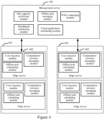
- FIG. 4 is a schematic structural diagram of a system for processing a service according to an embodiment of the present disclosure.
- the system as shown in Figure 4 may comprise a management server 401 configured to manage edge computing nodes, and at least one edge server 402.
- the at least one edge server 402 is allocated to P edge computing nodes 403.
- Each edge computing node 403 comprises one or more edge servers.
- the each edge server 402 comprises a core-function module.
- the core-function module is mainly configured to implement a core function of the cloud application.
- the core-function module for cloud gaming is configured to perform rendering, logic computation, and other functions of the game.
- a requirement of such module on computation resources is of the highest priority. That is, no matter what offline task is executed in the edge server, sufficient computation resources would be allocated to such module as long as the module requires additional computation resources.
- each edge server 402 may further comprise a computation-resource managing module.
- the computation-resource managing module is configured to manage the computation resources of the edge server, so as to ensure that a requirement of all local real-time online tasks does not exceed an upper limit of physical computation resources.
- Main functions of the computation-resource managing module may comprise following aspects.
- the edge server 402 may further comprise the offline-task scheduling module.
- the offline-task scheduling module is mainly configured to further schedule an offline task, which has been distributed by the management server to the edge server through scheduling. Its main functions may comprise following aspect.
- the management server 401 may include an idle-capacity predicting module.
- the idle-capacity predicting module is mainly configured to calculate a quantity of the idle computation resources of each edge server and a quantity of idle computation resources of each edge computing node according to computation-resource data reported by each edge server.
- the edge server 401 may further comprise an offline-task managing module.
- Main functions of the offline-task managing module may comprise following aspects.
- the management server 401 further comprises a policy managing module.
- Main functions of the policy managing module may comprise following aspects.
- the management server 401 may further comprise the distributed-scheduling module.
- Main functions of the distributed-scheduling module may include following aspects.
- the management server 401 may further comprise a cloud-application scheduling module, which configured to allocate the cloud applications dynamically according to the computation resources of each edge server and the computation resources of each edge computing node. Overloading on a single edge server is prevented.
- the management server when receiving the offline task to be executed, the management server first estimates a quantity of computation resources for executing the offline task, and then determines the N edge servers for executing the offline task.
- a quantity of the idle computation resources of the N edge servers is greater than a quantity of the first computation resources.
- the idle computation resources of the N edge servers refer to a sum of respective idle computation resources of edge servers.
- the offline task is distributed among the N edge servers through scheduling.
- the offline task is executed using the idle computation resources of the edge server while ensuring normal operation of the cloud application.
- the offline task can be executed using the idle computation resource in each edge server while ensuring normal operation of the cloud application, regardless of peak or off-peak hours.
- a waste of computation resources is prevented in each edge server, a utilization rate of computation resources is improved, and a cost of operating the edge servers is reduced.
- N may be equal to or greater than 1.
- N When N is equal to 1, centralized execution of the offline task can be ensured, which facilitates management on execution of the offline task.
- N When N is greater than 1, distributed execution of the offline task is implemented, which can not only ensure a progress of executing the offline task but also distribute a load on all edge servers. Hence, the cloud application is ensured to operate normally at each edge server.
- steps in the foregoing embodiment are depicted sequentially according to a direction of arrows in the flowcharts, these steps are not necessarily performed in the sequence as indicated by the arrows. Unless otherwise explicitly specified, a sequence of executing the steps is not strictly limited, and the steps may be performed in another sequence. Moreover, at least some of the steps in each embodiment may comprise multiple sub-steps or multiple stages. The sub-steps or the stages are not necessarily performed simultaneously, but may be performed at different moments. The sub-steps or the stages are not necessarily sequentially performed, but may be performed alternately, or may be interleaved, with other steps or with at least a part of sub-steps or stages in the other steps.
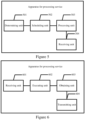
- FIG. 5 is a schematic structural diagram of an apparatus for processing a service according to an embodiment of the present disclosure.
- the apparatus as shown in Figure 5 may comprise a determining unit 501 and a scheduling unit 502.
- the determining unit 501 is configured to determine first computation resources for executing an offline task.
- the determining unit 501 is further configured to determine one or more edge servers, of which a quantity is N, for executing the offline task, where a cloud application runs on the one or more edge servers, a quantity of idle computation resources of the one or more edge servers is greater than a quantity of the first computation resources, and the idle computation resources of the one or more edge servers is a sum of respective idle computation resources of all edge servers in the one or more edge servers.
- the scheduling unit 502 is configured to distribute the offline task among the one or more edge servers through scheduling to enable all of the one or more edge servers to execute the offline task using the respective idle computation resources while ensuring normal operation of the cloud application.
- the scheduling unit 502 when distributing the offline task among the N edge servers through the scheduling, is configured to: divide the offline task into N subtasks based on idle computation resources of each of the N edge servers, where the N subtasks and the N edge servers are in a one-to-one correspondence, and a quantity of the idle computation resources of each of the N edge servers is greater than a quantity of computation resources for executing the corresponding subtask; and allocate each of the N subtasks to the corresponding edge server to enable the corresponding edge server to execute said subtask.
- the cloud application is deployed to one or more edge servers, of which a quantity is M, for execution, the one or more edge servers are allocated to one or more edge computing nodes, of which a quantity is P, and each of the one or more edge computing node has at least one of the one or more edge servers, where M and P each is an integer greater than or equal to 1.
- the determining unit 501 is configured to: select at least one edge computing node, of which a quantity is L, from the one or more edge computing nodes, where a quantity of idle computation resources of the at least one edge computing node is greater than the quantity of the first computation resources, the idle computation resources of the at least one edge computing node is a sum of respective idle computation resources of all of the at least one edge computing node, and the idle computation resources of each of the one or more edge computing nodes is determined according to the respective idle computation resources of the at least one edge server deployed in said edge computing node; determine at least one candidate edge server from the at least one edge computing node based on an attribute of each edge server in the at least one edge computing nodes; and determine the one or more edge servers from the at least one candidate edge server according to idle computation resources of each of the at least one candidate edge server and the first computation resources.
- the attribute of each edge server comprises an operating state of said edge server, where the operating state indicates said edge server being idle or busy.
- the determining unit 501 is configured to: determine, from the at least one edge computing node, an edge server of which the operating state indicates being idle as one of the at least one candidate edge server.
- the attribute of each edge server comprises a server-type group to which said edge server belongs, where the server-type group indicates whether said server is in a whitelist.
- the determining unit 501 is configured to: determine, from the at least one edge computing node, an edge server of which the server-type group indicates the edge server not in the whitelist as one of the at least one candidate edge server.
- the apparatus further comprises a processing unit 503.
- the processing unit is configured to: monitor, when each of the N edge servers executes the corresponding subtask, execution of the corresponding subtask at said edge server, and reselect another edge server for executing the corresponding subtask in response to monitoring an abnormity in the execution of the corresponding subtask at such edge server.
- each of the N subtasks corresponds to a threshold of execution duration.
- the apparatus further comprises a receiving unit 504.
- the receiving unit is configured to: receive, when each of the N edge servers executes the corresponding subtask, an overtime prompt reported by an edge server among the N edge servers, where the overtime prompt indicates that duration required for executing the corresponding subtask by the edge server is greater than the threshold corresponding to the corresponding subtask, and another edge server is required to be determined for executing the corresponding subtask.
- the first computation resources comprise one or more of: GPU computation resources, CPU computation resources, an internal memory, a network bandwidth, and a network throughput.
- the GPU computation resources comprise one or both of FLOPS of a GPU and OPS of the GPU.
- the CPU computation resources comprise one or both of FLOPS of a CPU and OPS of the CPU.
- the determining unit 501 when determining the first computation resources for executing the offline task, is configured to: determine a degree of computation complexity corresponding to a type of the offline task according to correspondence between types of tasks and degrees of computation complexity; search history offline tasks for at least one matching task, where a computation complexity corresponding to each of the at least one matching task matches the determined computation complexity; and estimate the first computation resources based on computation resources consumed for executing each matching task.
- steps involved in the method as shown in Figure 2 may be executed by units in the apparatus as shown in Figure 5 .
- the steps S201 and S202 in Figure 2 may be executed by the determining unit 501 in Figure 5
- the step S203 may be executed by the scheduling unit 502 as shown in Figure 5 .
- the units as shown in Figure 5 may be respectively replaced or wholly integrated into one or more other units, or one or more units as shown in Figure 5 may be further split into multiple units each having fewer functions, which can implement the same operations without affecting a technical effect of the corresponding embodiment.
- the foregoing units are delimited based on logical functions.
- a function of a unit may be implemented by multiple units, or functions of multiple units are implemented by one unit.
- the apparatus may further comprise another unit.
- the foregoing functions may be implemented with coordination of another unit, or may be implemented by multiple coordinating units.
- computer-readable instructions capable of performing each step in the method as shown in Figure 2 may be executed on a general-purpose computing device, such as a computer, which comprises a processing element and a storage element, for example, comprises a CPU, a random access memory (RAM), and a read-only memory (ROM), in order to construct the apparatus as shown in Figure 5 , and/or implement the method for processing the service according to embodiments of the present disclosure.
- the computer-readable instructions may be recorded in, for example, a computer storage medium, and may be loaded and executed in the foregoing node device through the computer storage medium.
- the first computation resources for executing the offline task may be estimated first, and then the N edge server(s) for executing the offline task are obtained.
- the quantity of the idle computation resources of the N edge server(s) is greater than the quantity of the first computation resources, and the idle computation resources of the N edge servers refer to a sum of respective idle computation resources of all of the N edge servers.
- the offline task is distributed among the N edge server(s) through scheduling, so that the N edge server(s) use the respective idle computation resources to execute the offline task while ensuring normal operation of a cloud application. Thereby, the offline task can be executed using the idle computation resource in each edge server while ensuring normal operation of the cloud application, regardless of peak or off-peak hours.
- N may be equal to or greater than 1.
- N may be equal to 1
- centralized execution of the offline task can be ensured, which facilitates management on execution of the offline task.
- N is greater than 1
- distributed execution of the offline task is implemented, which can not only ensure a progress of executing the offline task but also distribute a load on all edge servers. Hence, the cloud application is ensured to operate normally at each edge server.
- FIG. 6 is a schematic structural diagram of another apparatus for processing a service according to an embodiment of the present disclosure.
- the apparatus as shown in Figure 5 may comprise a receiving unit 601 and an executing unit 602.
- the receiving unit 601 is configured to receive an allocated offline task, which is distributed by a management server through scheduling, where the allocated offline task comprises an offline task received by the management server, or the allocated offline task comprises a subtask which corresponds to an edge server among N subtasks, the N subtasks are obtained by dividing the offline task based on idle computation resources of each edge server in one or more edge servers, of which a quantity is N, for executing the offline task, and a cloud application runs on the one or more edge servers.
- the executing unit 602 is configured to execute the allocated offline task using the idle computation resources of the edge server while ensuring normal operation of the cloud application.
- the allocated offline task corresponds to a threshold of execution duration.
- the execution unit 602 is configured to: determine duration required for completing execution of the allocated offline task based on idle computation resources of the edge server; and execute the allocated offline task using the idle computation resources of the edge server in response to the required duration being less than the threshold.
- the idle computation resources of the edge server are computation resources remaining in the edge server when second computation resources required for operating the cloud application are consumed in the edge server.
- the apparatus further comprises an obtaining unit 603.
- the obtaining unit 603 is configured to obtain, when the allocated offline task is being executed, dwelling duration of the allocated offline task in the edge server in response to detecting that a quantity of current computation resources required for operating the cloud application in the edge server is greater than a quantity of the second computation resources.
- the execution unit 602 is configured to perform computation-resource release according to a relationship between the dwelling duration and the threshold of execution duration, where the computation-resource release comprises suspending execution of the allocated offline task or terminating the execution of the allocated offline task, the computation-resource release comprises suspending the execution of the allocated offline task in response to a difference between the dwelling duration and the threshold of execution duration being greater than a threshold of time difference, and the computation-resource release comprises terminating the execution of the allocated offline task in response to the difference being less than the threshold of time difference.
- the computation-resource release comprises suspending the execution of the allocated offline task
- the execution unit 602 is further configured to: detect the idle computation resources of the edge server periodically; continue the execution of the allocated offline task in response to the quantity of the idle computation resources of the edge server is greater than the quantity of the first computation resources; and terminate the execution of the allocated offline task in response to the quantity of the idle computation resources of the edge server being less than the quantity of the first computation resources and the difference being less than the threshold of time difference.
- the apparatus further comprises a transmitting unit 604.
- the transmitting unit 604 is configured to transmit, when the edge server executes the allocated offline task, an overtime prompt to the management server in response to determining that duration required for executing the allocated offline task by the edge server is greater than the threshold of execution duration, where the overtime prompt indicates that the duration required for executing the allocated offline task by the edge server is greater than the threshold of execution duration to enable the management server to determine another edge server to execute the allocated offline task.
- steps involved in the method as shown in Figure 3 may be executed by units in the apparatus as shown in Figure 6 .
- the step S301 in Figure 3 may be executed by the determining unit 601 in Figure 6
- the step S302 may be executed by the scheduling unit 602 as shown in Figure 6 .
- the units as shown in Figure 6 may be respectively replaced or wholly integrated into one or more other units, or one or more units as shown in Figure 6 may be further split into multiple units each having fewer functions, which can implement the same operations without affecting a technical effect of the corresponding embodiment.
- the foregoing units are delimited based on logical functions.
- a function of a unit may be implemented by multiple units, or functions of multiple units are implemented by one unit.
- the apparatus may further comprise another unit.
- the foregoing functions may be implemented with coordination of another unit, or may be implemented by multiple coordinating units.
- computer-readable instructions capable of performing each step in the method as shown in Figure 3 may be executed on a general-purpose computing device, such as a computer, which comprises a processing element and a storage element, for example, comprises a CPU, a random access memory (RAM), and a read-only memory (ROM), in order to construct the apparatus as shown in Figure 6 , and/or implement the method for processing the service according to embodiments of the present disclosure.
- the computer-readable instructions may be recorded in, for example, a computer storage medium, and may be loaded and executed in the foregoing node device through the computer storage medium.
- the edge server receives the allocated offline task distributed by the management server through scheduling.
- the allocated offline task may be the offline task received by the management server, or the subtask corresponding to the edge server among the N subtasks.
- the N subtasks may be obtained by dividing the offline task based on the idle computation resources of the N edge servers, respectively, for executing the offline task.
- the allocated offline task is executed using the idle computation resources of the edge server while ensuring normal operation of the cloud application. Thereby, the offline task can be executed using the idle computation resource in each edge server while ensuring normal operation of the cloud application, regardless of peak or off-peak hours. Hence, a waste of computation resources is prevented in each edge server, a utilization rate of computation resources is improved, and a cost of operating the edge servers is reduced.
- a server is provided according to an embodiment of the present disclosure.
- Reference is made to Figure 7 which is a schematic structural diagram of a server according to an embodiment of the present disclosure.
- the server as shown in Figure 7 may correspond to the afore-mentioned management server.
- the server as shown in Figure 7 may comprise a processor 701, an input interface 702, an output interface 703, and a computer storage medium 704.
- the processor 701, the input interface 702, the output interface 703, and the computer storage medium 704 may be connected via a bus or in another manner.
- the computer storage medium 704 may be stored in a memory of the server.
- the computer storage medium 704 is configured to store computer-readable instructions
- the processor 701 is configured to execute the computer-readable instructions stored in the computer storage medium 704.
- the processor 701 (or called central processing unit, CPU) is a core of computation and control of the server, and is capable to execute one or more computer-readable instructions to perform following operations.
- First computation resources for executing an offline task are determined.
- One or more edge servers, of which a quantity is N, for executing the offline task are determined, where a cloud application runs on the one or more edge servers, a quantity of idle computation resources of the one or more edge servers is greater than a quantity of the first computation resources, and the idle computation resources of the one or more edge servers is a sum of respective idle computation resources of all edge servers in the one or more edge servers.
- the offline task are distributed among the one or more edge servers through scheduling to enable all of the one or more edge servers to execute the offline task using the respective idle computation resources while ensuring normal operation of the cloud application.
- the first computation resources for executing the offline task may be estimated first, and then the N edge server(s) for executing the offline task are obtained.
- the quantity of the idle computation resources of the N edge server(s) is greater than the quantity of the first computation resources, and the idle computation resources of the N edge servers refer to a sum of respective idle computation resources of all of the N edge servers.
- the offline task is distributed among the N edge server(s) through scheduling, so that the N edge server(s) use the respective idle computation resources to execute the offline task while ensuring normal operation of a cloud application. Thereby, the offline task can be executed using the idle computation resource in each edge server while ensuring normal operation of the cloud application, regardless of peak or off-peak hours.
- N may be equal to or greater than 1.
- N may be equal to 1
- centralized execution of the offline task can be ensured, which facilitates management on execution of the offline task.
- N is greater than 1
- distributed execution of the offline task is implemented, which can not only ensure a progress of executing the offline task but also distribute a load on all edge servers. Hence, the cloud application is ensured to operate normally at each edge server.
- FIG. 8 is a schematic structural diagram of another server according to an embodiment of the present disclosure.
- the server as shown in Figure 8 may correspond to the afore-mentioned edge server.
- the server as shown in Figure 8 may comprise a processor 801, an input interface 802, an output interface 803, and a computer storage medium 804.
- the processor 801, the input interface 802, the output interface 803, and the computer storage medium 804 may be connected via a bus or in another manner.
- the computer storage medium 804 may be stored in a memory of the server.
- the computer storage medium 804 is configured to store computer-readable instructions
- the processor 801 is configured to execute the computer-readable instructions stored in the computer storage medium 804.
- the processor 801 (or called central processing unit, CPU) is a core of computation and control of the server, and is capable to execute one or more computer-readable instructions to perform following operations.
- An allocated offline task which is distributed by a management server through scheduling, is received, where the allocated offline task comprises an offline task received by the management server, or the allocated offline task comprises a subtask which corresponds to an edge server among N subtasks, and the N subtasks are obtained by dividing the offline task based on idle computation resources of each edge server in the one or more edge servers.
- the allocated offline task is executed using the idle computation resources of the edge server while ensuring normal operation of the cloud application.
- the edge server receives the allocated offline task distributed by the management server through scheduling.
- the allocated offline task may be the offline task received by the management server, or the subtask corresponding to the edge server among the N subtasks.
- the N subtasks may be obtained by dividing the offline task based on the idle computation resources of the N edge servers, respectively, for executing the offline task.
- the allocated offline task is executed using the idle computation resources of the edge server while ensuring normal operation of the cloud application. Thereby, the offline task can be executed using the idle computation resource in each edge server while ensuring normal operation of the cloud application, regardless of peak or off-peak hours. Hence, a waste of computation resources is prevented in each edge server, a utilization rate of computation resources is improved, and a cost of operating the edge servers is reduced.
- a computer storage medium is further provided according to embodiments of the present disclosure.
- the computer storage medium is a memory device of a server and is configure to store a program and data.
- the computer storage medium may include an internal storage medium of the server, and may include an expanded storage medium supported by the server.
- the computer storage medium provides a storage space in which an operating system of the server is stored.
- computer-readable instructions configured to be loaded and executed by the processor 701 or the processor 801 is further stored in the storage space.
- the computer storage medium may be a high-speed RAM memory, or a non-volatile memory, for example, at least one magnetic disk memory.
- the computer storage medium may be at least one computer storage medium which is distant from the processor.
- the computer-readable instructions stored in the computer storage medium can be loaded by the processor 701 to perform following operations.
- First computation resources for executing an offline task are determined.
- One or more edge servers, of which a quantity is N, for executing the offline task are determined, where a cloud application runs on the one or more edge servers, a quantity of idle computation resources of the one or more edge servers is greater than a quantity of the first computation resources, and the idle computation resources of the one or more edge servers is a sum of respective idle computation resources of all edge servers in the one or more edge servers.
- the offline task are distributed among the one or more edge servers through scheduling to enable all of the one or more edge servers to execute the offline task using the respective idle computation resources while ensuring normal operation of the cloud application.
- the processor 701 when distributing the offline task among the N edge servers through the scheduling, the processor 701 performs following operations.
- the offline task is divided into N subtasks based on idle computation resources of each of the N edge servers, where the N subtasks and the N edge servers are in a one-to-one correspondence, and a quantity of the idle computation resources of each of the N edge servers is greater than a quantity of computation resources for executing the corresponding subtask.
- Each of the N subtasks is allocated to the corresponding edge server to enable the corresponding edge server to execute said subtask.
- the cloud application is deployed to one or more edge servers, of which a quantity is M, for execution, the one or more edge servers are allocated to one or more edge computing nodes, of which a quantity is P, and each of the one or more edge computing node has at least one of the one or more edge servers, where M and P each is an integer greater than or equal to 1.
- the processor 801 performs following operations.
- At least one edge computing node of which a quantity is L, is selected from the one or more edge computing nodes, where a quantity of idle computation resources of the at least one edge computing node is greater than the quantity of the first computation resources, the idle computation resources of the at least one edge computing node is a sum of respective idle computation resources of all of the at least one edge computing node, and the idle computation resources of each of the one or more edge computing nodes is determined according to the respective idle computation resources of the at least one edge server deployed in said edge computing node.
- At least one candidate edge server is determined from the at least one edge computing node based on an attribute of each edge server in the at least one edge computing nodes.
- the one or more edge servers are determined from the at least one candidate edge server according to idle computation resources of each of the at least one candidate edge server and the first computation resources.
- the attribute of each edge server comprises an operating state of said edge server, where the operating state indicates said edge server being idle or busy.
- the processor 801 performs a following operation. An edge server of which the operating state indicates being idle determine is determined from the at least one edge computing node as one of the at least one candidate edge server.
- the attribute of each edge server comprises a server-type group to which said edge server belongs, where the server-type group indicates whether said server is in a whitelist.
- the processor 801 performs a following step. An edge server of which the server-type group indicates the edge server not in the whitelist is determined from the at least one edge computing node as one of the at least one candidate edge server.
- the processor 701 is further configured to: monitor, when each of the N edge servers executes the corresponding subtask, execution of the corresponding subtask at said edge server, and reselect another edge server for executing the corresponding subtask in response to monitoring an abnormity in the execution of the corresponding subtask at such edge server.
- each of the N subtasks corresponds to a threshold of execution duration.
- the processor 701 is further configured to: receive, when each of the N edge servers executes the corresponding subtask, an overtime prompt reported by an edge server among the N edge servers, where the overtime prompt indicates that duration required for executing the corresponding subtask by the edge server is greater than the threshold corresponding to the corresponding subtask, and another edge server is required to be determined for executing the corresponding subtask.
- the first computation resources comprise one or more of: GPU computation resources, CPU computation resources, an internal memory, a network bandwidth, and a network throughput.
- the GPU computation resources comprise one or both of FLOPS of a GPU and OPS of the GPU.
- the CPU computation resources comprise one or both of FLOPS of a CPU and OPS of the CPU.
- the processor 701 when determining the first computation resources for executing the offline task, performs following steps.
- a degree of computation complexity corresponding to a type of the offline task is determined according to correspondence between types of tasks and degrees of computation complexity.
- History offline tasks are searched for at least one matching task, where a computation complexity corresponding to each of the at least one matching task matches the determined computation complexity.
- the first computation resources are estimated based on computation resources consumed for executing each matching task.
- the first computation resources for executing the offline task may be estimated first, and then the N edge server(s) for executing the offline task are obtained.
- the quantity of the idle computation resources of the N edge server(s) is greater than the quantity of the first computation resources, and the idle computation resources of the N edge servers refer to a sum of respective idle computation resources of all of the N edge servers.
- the offline task is distributed among the N edge server(s) through scheduling, so that the N edge server(s) use the respective idle computation resources to execute the offline task while ensuring normal operation of a cloud application. Thereby, the offline task can be executed using the idle computation resource in each edge server while ensuring normal operation of the cloud application, regardless of peak or off-peak hours.
- N may be equal to or greater than 1.
- N may be equal to 1
- centralized execution of the offline task can be ensured, which facilitates management on execution of the offline task.
- N is greater than 1
- distributed execution of the offline task is implemented, which can not only ensure a progress of executing the offline task but also distribute a load on all edge servers. Hence, the cloud application is ensured to operate normally at each edge server.
- the computer-readable instructions stored in the computer storage medium may be loaded by the processor 801 to perform following operations.
- An allocated offline task which is distributed by a management server through scheduling, is received, where the allocated offline task comprises an offline task received by the management server, or the allocated offline task comprises a subtask which corresponds to an edge server among N subtasks, the N subtasks are obtained by dividing the offline task based on idle computation resources of each edge server in one or more edge servers, of which a quantity is N, for executing the offline task, and a cloud application runs on the one or more edge servers.
- the allocated offline task is executed using the idle computation resources of the edge server while ensuring normal operation of the cloud application.
- the allocated offline task corresponds to a threshold of execution duration.
- the processor 801 When executing the allocated offline task using the idle computation resources of the edge server, the processor 801 performs following operations.
- Duration required for completing execution of the allocated offline task is determined based on idle computation resources of the edge server.
- the allocated offline task is executed using the idle computation resources of the edge server in response to the required duration being less than the threshold.
- the idle computation resources of the edge server are computation resources remaining in the edge server when second computation resources required for operating the cloud application are consumed in the edge server.
- the processor 801 is further configured to perform following operations.
- dwelling duration of the allocated offline task in the edge server is obtained, in response to detecting that a quantity of current computation resources required for operating the cloud application in the edge server is greater than a quantity of the second computation resources.
- Computation-resource release is performed according to a relationship between the dwelling duration and the threshold of execution duration, where the computation-resource release comprises suspending execution of the allocated offline task or terminating the execution of the allocated offline task, the computation-resource release comprises suspending the execution of the allocated offline task in response to a difference between the dwelling duration and the threshold of execution duration being greater than a threshold of time difference, and the computation-resource release comprises terminating the execution of the allocated offline task in response to the difference being less than the threshold of time difference.
- the computation-resource release comprises suspending the execution of the allocated offline task, and after the computation-resource release, the processor 901 is further configured to perform following operations.
- the idle computation resources of the edge server are detected periodically.
- the execution of the allocated offline task is continued in response to the quantity of the idle computation resources of the edge server is greater than the quantity of the first computation resources.
- the execution of the allocated offline task is terminated, in response to the quantity of the idle computation resources of the edge server being less than the quantity of the first computation resources and the difference being less than the threshold of time difference.
- the processor 801 is further configured to transmit, when the edge server executes the allocated offline task, an overtime prompt to the management server in response to determining that duration required for executing the allocated offline task by the edge server is greater than the threshold of execution duration, where the overtime prompt indicates that the duration required for executing the allocated offline task by the edge server is greater than the threshold of execution duration to enable the management server to determine another edge server to execute the allocated offline task.
- the edge server receives the allocated offline task distributed by the management server through scheduling.
- the allocated offline task may be the offline task received by the management server, or the subtask corresponding to the edge server among the N subtasks.
- the N subtasks may be obtained by dividing the offline task based on the idle computation resources of the N edge servers, respectively, for executing the offline task.
- the allocated offline task is executed using the idle computation resources of the edge server while ensuring normal operation of the cloud application. Thereby, the offline task can be executed using the idle computation resource in each edge server while ensuring normal operation of the cloud application, regardless of peak or off-peak hours. Hence, a waste of computation resources is prevented in each edge server, a utilization rate of computation resources is improved, and a cost of operating the edge servers is reduced.
- a computer program product comprises computer-readable instructions stored in a computer storage medium.
- the processor 701 reads the computer-readable instructions from the computer storage medium, so that the server loads the computer-readable instructions to perform following operations.
- First computation resources for executing an offline task are determined.
- One or more edge servers, of which a quantity is N, for executing the offline task are determined, where a cloud application runs on the one or more edge servers, a quantity of idle computation resources of the one or more edge servers is greater than a quantity of the first computation resources, and the idle computation resources of the one or more edge servers is a sum of respective idle computation resources of all edge servers in the one or more edge servers.
- the offline task are distributed among the one or more edge servers through scheduling to enable all of the one or more edge servers to execute the offline task using the respective idle computation resources while ensuring normal operation of the cloud application.
- the first computation resources for executing the offline task may be estimated first, and then the N edge server(s) for executing the offline task are obtained.
- the quantity of the idle computation resources of the N edge server(s) is greater than the quantity of the first computation resources, and the idle computation resources of the N edge servers refer to a sum of respective idle computation resources of all of the N edge servers.
- the offline task is distributed among the N edge server(s) through scheduling, so that the N edge server(s) use the respective idle computation resources to execute the offline task while ensuring normal operation of a cloud application. Thereby, the offline task can be executed using the idle computation resource in each edge server while ensuring normal operation of the cloud application, regardless of peak or off-peak hours.
- N may be equal to or greater than 1.
- N may be equal to 1
- centralized execution of the offline task can be ensured, which facilitates management on execution of the offline task.
- N is greater than 1
- distributed execution of the offline task is implemented, which can not only ensure a progress of executing the offline task but also distribute a load on all edge servers. Hence, the cloud application is ensured to operate normally at each edge server.
- the processor 801 reads the computer-readable instruction from the computer storage medium, and the processor 901 executes the computer-readable instructions to enable the server to perform following operations.
- An allocated offline task which is distributed by a management server through scheduling, is received, where the allocated offline task comprises an offline task received by the management server, or the allocated offline task comprises a subtask which corresponds to an edge server among N subtasks, the N subtasks are obtained by dividing the offline task based on idle computation resources of each edge server in one or more edge servers, of which a quantity is N, for executing the offline task, and a cloud application runs on the one or more edge servers.
- the allocated offline task is executed using the idle computation resources of the edge server while ensuring normal operation of the cloud application.
- the edge server receives the allocated offline task distributed by the management server through scheduling.
- the allocated offline task may be the offline task received by the management server, or the subtask corresponding to the edge server among the N subtasks.
- the N subtasks may be obtained by dividing the offline task based on the idle computation resources of the N edge servers, respectively, for executing the offline task.
- the allocated offline task is executed using the idle computation resources of the edge server while ensuring normal operation of the cloud application. Thereby, the offline task can be executed using the idle computation resource in each edge server while ensuring normal operation of the cloud application, regardless of peak or off-peak hours. Hence, a waste of computation resources is prevented in each edge server, a utilization rate of computation resources is improved, and a cost of operating the edge servers is reduced.
Landscapes
- Engineering & Computer Science (AREA)
- Software Systems (AREA)
- Theoretical Computer Science (AREA)
- Physics & Mathematics (AREA)
- General Engineering & Computer Science (AREA)
- General Physics & Mathematics (AREA)
- Mathematical Physics (AREA)
- Power Sources (AREA)
- Hardware Redundancy (AREA)
Applications Claiming Priority (2)
| Application Number | Priority Date | Filing Date | Title |
|---|---|---|---|
| CN202110884435.7A CN113608871B (zh) | 2021-08-02 | 2021-08-02 | 业务处理方法及装置 |
| PCT/CN2022/106367 WO2023011157A1 (fr) | 2021-08-02 | 2022-07-19 | Procédé et appareil de traitement de service, serveur, support de stockage et produit de programme informatique |
Publications (2)
| Publication Number | Publication Date |
|---|---|
| EP4383074A1 true EP4383074A1 (fr) | 2024-06-12 |
| EP4383074A4 EP4383074A4 (fr) | 2024-08-14 |
Family
ID=78306580
Family Applications (1)
| Application Number | Title | Priority Date | Filing Date |
|---|---|---|---|
| EP22851871.8A Pending EP4383074A4 (fr) | 2021-08-02 | 2022-07-19 | Procédé et appareil de traitement de service, serveur, support de stockage et produit de programme informatique |
Country Status (4)
| Country | Link |
|---|---|
| US (1) | US20230418670A1 (fr) |
| EP (1) | EP4383074A4 (fr) |
| CN (1) | CN113608871B (fr) |
| WO (1) | WO2023011157A1 (fr) |
Families Citing this family (13)
| Publication number | Priority date | Publication date | Assignee | Title |
|---|---|---|---|---|
| CN113608871B (zh) * | 2021-08-02 | 2025-09-09 | 腾讯科技(深圳)有限公司 | 业务处理方法及装置 |
| CN115269198B (zh) * | 2022-08-10 | 2024-10-11 | 抖音视界有限公司 | 基于服务器集群的访问请求处理方法及相关设备 |
| CN116248676A (zh) * | 2022-12-23 | 2023-06-09 | 中国电信股份有限公司 | 边缘云节点组合确定方法及装置 |
| CN116232878A (zh) * | 2023-01-06 | 2023-06-06 | 中国联合网络通信集团有限公司 | 算力网络配置方法、装置、设备及存储介质 |
| CN117032911A (zh) * | 2023-04-23 | 2023-11-10 | 北京远舢智能科技有限公司 | 一种基于分布式调度引擎的任务调度方法及装置 |
| CN116566696B (zh) * | 2023-05-22 | 2024-03-29 | 深圳市众志天成科技有限公司 | 一种基于云计算的安全性评估系统及方法 |
| CN116560849B (zh) * | 2023-05-23 | 2026-01-30 | 东南大学 | 一种最大化资源利用率的在离线任务调度方法 |
| CN116680086B (zh) * | 2023-07-25 | 2024-04-02 | 联通沃音乐文化有限公司 | 一种基于离线渲染引擎的调度管理系统 |
| CN116665423B (zh) * | 2023-07-27 | 2023-10-31 | 国网山东省电力公司滨州市滨城区供电公司 | 一种电缆通道施工监测预警系统及方法 |
| CN116955342B (zh) * | 2023-09-20 | 2023-12-15 | 彩讯科技股份有限公司 | 业务数据一致率校验方法和装置 |
| CN118118531B (zh) * | 2024-04-30 | 2024-07-16 | 山东浪潮智慧建筑科技有限公司 | 一种建筑智能化物联网控制方法及系统 |
| CN118364410B (zh) * | 2024-06-17 | 2024-08-23 | 湖南绿禾环保科技有限公司 | 基于多传感器的催化燃烧异常数据处理方法 |
| CN119415272B (zh) * | 2025-01-07 | 2025-03-25 | 四川边缘算力科技有限公司 | 提高gpu资源利用率的分配方法、系统、介质和程序产品 |
Family Cites Families (14)
| Publication number | Priority date | Publication date | Assignee | Title |
|---|---|---|---|---|
| US8381015B2 (en) * | 2010-06-30 | 2013-02-19 | International Business Machines Corporation | Fault tolerance for map/reduce computing |
| US9015708B2 (en) * | 2011-07-28 | 2015-04-21 | International Business Machines Corporation | System for improving the performance of high performance computing applications on cloud using integrated load balancing |
| IN2013MU02180A (fr) * | 2013-06-27 | 2015-06-12 | Tata Consultancy Services Ltd | |
| US10761900B1 (en) * | 2015-04-30 | 2020-09-01 | V2Com S.A. | System and method for secure distributed processing across networks of heterogeneous processing nodes |
| TWI620075B (zh) * | 2016-11-23 | 2018-04-01 | 財團法人資訊工業策進會 | 用於雲端巨量資料運算架構之伺服器及其雲端運算資源最佳化方法 |
| CN109947565B (zh) * | 2019-03-08 | 2021-10-15 | 北京百度网讯科技有限公司 | 用于分配计算任务的方法和装置 |
| CN110362410A (zh) * | 2019-07-24 | 2019-10-22 | 江苏满运软件科技有限公司 | 基于离线应用的资源控制方法、系统、设备及存储介质 |
| US11630706B2 (en) * | 2020-09-22 | 2023-04-18 | Intel Corporation | Adaptive limited-duration edge resource management |
| CN112272239B (zh) * | 2020-10-30 | 2022-09-02 | 深圳市雷鸟网络传媒有限公司 | 边缘计算方法、装置、智能终端及计算机可读存储介质 |
| CN112559182B (zh) * | 2020-12-16 | 2024-04-09 | 北京百度网讯科技有限公司 | 资源分配方法、装置、设备及存储介质 |
| CN112799789B (zh) * | 2021-03-22 | 2023-08-11 | 腾讯科技(深圳)有限公司 | 一种节点集群管理方法、装置、设备及存储介质 |
| CN113018871A (zh) * | 2021-04-19 | 2021-06-25 | 腾讯科技(深圳)有限公司 | 业务处理方法、装置及存储介质 |
| CN113157418B (zh) * | 2021-04-25 | 2023-08-25 | 腾讯科技(深圳)有限公司 | 服务器资源分配方法和装置、存储介质及电子设备 |
| CN113608871B (zh) * | 2021-08-02 | 2025-09-09 | 腾讯科技(深圳)有限公司 | 业务处理方法及装置 |
-
2021
- 2021-08-02 CN CN202110884435.7A patent/CN113608871B/zh active Active
-
2022
- 2022-07-19 WO PCT/CN2022/106367 patent/WO2023011157A1/fr not_active Ceased
- 2022-07-19 EP EP22851871.8A patent/EP4383074A4/fr active Pending
-
2023
- 2023-09-06 US US18/462,164 patent/US20230418670A1/en active Pending
Also Published As
| Publication number | Publication date |
|---|---|
| CN113608871A (zh) | 2021-11-05 |
| US20230418670A1 (en) | 2023-12-28 |
| EP4383074A4 (fr) | 2024-08-14 |
| CN113608871B (zh) | 2025-09-09 |
| WO2023011157A1 (fr) | 2023-02-09 |
Similar Documents
| Publication | Publication Date | Title |
|---|---|---|
| EP4383074A1 (fr) | Procédé et appareil de traitement de service, serveur, support de stockage et produit de programme informatique | |
| Amini et al. | A Dynamic SLA Aware Heuristic Solution For IaaS Cloud Placement Problem Without Migration | |
| Rajguru et al. | A comparative performance analysis of load balancing algorithms in distributed system using qualitative parameters | |
| CN110221920B (zh) | 部署方法、装置、存储介质及系统 | |
| EP3376379A1 (fr) | Procédés et système de gestion de tâches, et support de stockage informatique | |
| US11119563B2 (en) | Dynamic power capping of multi-server nodes in a chassis based on real-time resource utilization | |
| CN102096602A (zh) | 一种任务调度方法及其系统和设备 | |
| CN105912401A (zh) | 一种分布式数据批处理系统和方法 | |
| CN105320570B (zh) | 资源管理方法和系统 | |
| CN102081554A (zh) | 云计算操作系统及其内核控制系统及方法 | |
| EP4172721A1 (fr) | Plafonnement dynamique de puissance de systèmes informatiques et de sous-systèmes contenus dans ceux-ci | |
| CN116991585A (zh) | 一种ai算力自动调度方法、装置及介质 | |
| CN117632414A (zh) | 集群资源弹性调度方法、系统、电子设备及存储介质 | |
| CN119537027B (zh) | 基于智算集群的资源分配方法、装置、设备及存储介质 | |
| CN109936471B (zh) | 一种多集群的资源分配方法和装置 | |
| CN119363753B (zh) | 边缘节点调度系统、边缘节点调度方法及边缘节点 | |
| WO2016018321A1 (fr) | Propositions d'affectation de ressources d'un réseau | |
| Mogouie et al. | A novel approach for optimization auto-scaling in cloud computing environment | |
| CN111209098A (zh) | 一种智能渲染调度方法、服务器、管理节点及存储介质 | |
| CN110806918A (zh) | 基于深度学习神经网络的虚拟机运行方法和装置 | |
| CN117149382A (zh) | 虚拟机调度方法、装置、计算机设备和存储介质 | |
| Mazrekaj et al. | Distributed resource allocation in cloud computing using multi-agent systems | |
| WO2022177455A1 (fr) | Procédé et système pour optimiser la gestion de ressources et de trafic d'un environnement d'exécution d'ordinateur dans un vran | |
| CN111949399B (zh) | 资源调度方法及装置 | |
| CN114675973B (zh) | 资源管理方法、设备、存储介质及程序产品 |
Legal Events
| Date | Code | Title | Description |
|---|---|---|---|
| STAA | Information on the status of an ep patent application or granted ep patent |
Free format text: STATUS: THE INTERNATIONAL PUBLICATION HAS BEEN MADE |
|
| PUAI | Public reference made under article 153(3) epc to a published international application that has entered the european phase |
Free format text: ORIGINAL CODE: 0009012 |
|
| STAA | Information on the status of an ep patent application or granted ep patent |
Free format text: STATUS: REQUEST FOR EXAMINATION WAS MADE |
|
| 17P | Request for examination filed |
Effective date: 20240304 |
|
| AK | Designated contracting states |
Kind code of ref document: A1 Designated state(s): AL AT BE BG CH CY CZ DE DK EE ES FI FR GB GR HR HU IE IS IT LI LT LU LV MC MK MT NL NO PL PT RO RS SE SI SK SM TR |
|
| A4 | Supplementary search report drawn up and despatched |
Effective date: 20240715 |
|
| RIC1 | Information provided on ipc code assigned before grant |
Ipc: G06F 9/50 20060101AFI20240709BHEP |
|
| DAV | Request for validation of the european patent (deleted) | ||
| DAX | Request for extension of the european patent (deleted) |