EP4383094A1 - Computerimplementiertes verfahren zur bereitstellung von mindestens einem maschinenlernmodell, insbesondere für intelligente anwendungen der erweiterten realität - Google Patents
Computerimplementiertes verfahren zur bereitstellung von mindestens einem maschinenlernmodell, insbesondere für intelligente anwendungen der erweiterten realität Download PDFInfo
- Publication number
- EP4383094A1 EP4383094A1 EP22211395.3A EP22211395A EP4383094A1 EP 4383094 A1 EP4383094 A1 EP 4383094A1 EP 22211395 A EP22211395 A EP 22211395A EP 4383094 A1 EP4383094 A1 EP 4383094A1
- Authority
- EP
- European Patent Office
- Prior art keywords
- data
- information
- machine learning
- annotation
- image
- Prior art date
- Legal status (The legal status is an assumption and is not a legal conclusion. Google has not performed a legal analysis and makes no representation as to the accuracy of the status listed.)
- Pending
Links
Images


Classifications
-
- G—PHYSICS
- G06—COMPUTING OR CALCULATING; COUNTING
- G06F—ELECTRIC DIGITAL DATA PROCESSING
- G06F16/00—Information retrieval; Database structures therefor; File system structures therefor
- G06F16/70—Information retrieval; Database structures therefor; File system structures therefor of video data
- G06F16/78—Retrieval characterised by using metadata, e.g. metadata not derived from the content or metadata generated manually
-
- G—PHYSICS
- G06—COMPUTING OR CALCULATING; COUNTING
- G06N—COMPUTING ARRANGEMENTS BASED ON SPECIFIC COMPUTATIONAL MODELS
- G06N3/00—Computing arrangements based on biological models
- G06N3/02—Neural networks
- G06N3/08—Learning methods
-
- G—PHYSICS
- G02—OPTICS
- G02B—OPTICAL ELEMENTS, SYSTEMS OR APPARATUS
- G02B27/00—Optical systems or apparatus not provided for by any of the groups G02B1/00 - G02B26/00, G02B30/00
- G02B27/0093—Optical systems or apparatus not provided for by any of the groups G02B1/00 - G02B26/00, G02B30/00 with means for monitoring data relating to the user, e.g. head-tracking, eye-tracking
-
- G—PHYSICS
- G02—OPTICS
- G02B—OPTICAL ELEMENTS, SYSTEMS OR APPARATUS
- G02B27/00—Optical systems or apparatus not provided for by any of the groups G02B1/00 - G02B26/00, G02B30/00
- G02B27/01—Head-up displays
- G02B27/017—Head mounted
-
- G—PHYSICS
- G06—COMPUTING OR CALCULATING; COUNTING
- G06F—ELECTRIC DIGITAL DATA PROCESSING
- G06F3/00—Input arrangements for transferring data to be processed into a form capable of being handled by the computer; Output arrangements for transferring data from processing unit to output unit, e.g. interface arrangements
- G06F3/01—Input arrangements or combined input and output arrangements for interaction between user and computer
- G06F3/011—Arrangements for interaction with the human body, e.g. for user immersion in virtual reality
- G06F3/013—Eye tracking input arrangements
-
- G—PHYSICS
- G06—COMPUTING OR CALCULATING; COUNTING
- G06N—COMPUTING ARRANGEMENTS BASED ON SPECIFIC COMPUTATIONAL MODELS
- G06N3/00—Computing arrangements based on biological models
- G06N3/02—Neural networks
- G06N3/08—Learning methods
- G06N3/091—Active learning
-
- G—PHYSICS
- G06—COMPUTING OR CALCULATING; COUNTING
- G06T—IMAGE DATA PROCESSING OR GENERATION, IN GENERAL
- G06T19/00—Manipulating three-dimensional [3D] models or images for computer graphics
- G06T19/006—Mixed reality
-
- G—PHYSICS
- G06—COMPUTING OR CALCULATING; COUNTING
- G06T—IMAGE DATA PROCESSING OR GENERATION, IN GENERAL
- G06T5/00—Image enhancement or restoration
- G06T5/70—Denoising; Smoothing
-
- G—PHYSICS
- G06—COMPUTING OR CALCULATING; COUNTING
- G06T—IMAGE DATA PROCESSING OR GENERATION, IN GENERAL
- G06T5/00—Image enhancement or restoration
- G06T5/73—Deblurring; Sharpening
- G06T5/75—Unsharp masking
-
- G—PHYSICS
- G06—COMPUTING OR CALCULATING; COUNTING
- G06V—IMAGE OR VIDEO RECOGNITION OR UNDERSTANDING
- G06V10/00—Arrangements for image or video recognition or understanding
- G06V10/70—Arrangements for image or video recognition or understanding using pattern recognition or machine learning
-
- G—PHYSICS
- G06—COMPUTING OR CALCULATING; COUNTING
- G06V—IMAGE OR VIDEO RECOGNITION OR UNDERSTANDING
- G06V10/00—Arrangements for image or video recognition or understanding
- G06V10/70—Arrangements for image or video recognition or understanding using pattern recognition or machine learning
- G06V10/764—Arrangements for image or video recognition or understanding using pattern recognition or machine learning using classification, e.g. of video objects
-
- G—PHYSICS
- G06—COMPUTING OR CALCULATING; COUNTING
- G06V—IMAGE OR VIDEO RECOGNITION OR UNDERSTANDING
- G06V10/00—Arrangements for image or video recognition or understanding
- G06V10/70—Arrangements for image or video recognition or understanding using pattern recognition or machine learning
- G06V10/82—Arrangements for image or video recognition or understanding using pattern recognition or machine learning using neural networks
-
- G—PHYSICS
- G06—COMPUTING OR CALCULATING; COUNTING
- G06V—IMAGE OR VIDEO RECOGNITION OR UNDERSTANDING
- G06V20/00—Scenes; Scene-specific elements
- G06V20/20—Scenes; Scene-specific elements in augmented reality scenes
-
- G—PHYSICS
- G06—COMPUTING OR CALCULATING; COUNTING
- G06V—IMAGE OR VIDEO RECOGNITION OR UNDERSTANDING
- G06V20/00—Scenes; Scene-specific elements
- G06V20/40—Scenes; Scene-specific elements in video content
- G06V20/41—Higher-level, semantic clustering, classification or understanding of video scenes, e.g. detection, labelling or Markovian modelling of sport events or news items
-
- G—PHYSICS
- G06—COMPUTING OR CALCULATING; COUNTING
- G06V—IMAGE OR VIDEO RECOGNITION OR UNDERSTANDING
- G06V20/00—Scenes; Scene-specific elements
- G06V20/70—Labelling scene content, e.g. deriving syntactic or semantic representations
-
- H—ELECTRICITY
- H04—ELECTRIC COMMUNICATION TECHNIQUE
- H04N—PICTORIAL COMMUNICATION, e.g. TELEVISION
- H04N13/00—Stereoscopic video systems; Multi-view video systems; Details thereof
- H04N13/10—Processing, recording or transmission of stereoscopic or multi-view image signals
- H04N13/106—Processing image signals
- H04N13/172—Processing image signals image signals comprising non-image signal components, e.g. headers or format information
- H04N13/178—Metadata, e.g. disparity information
-
- H—ELECTRICITY
- H04—ELECTRIC COMMUNICATION TECHNIQUE
- H04N—PICTORIAL COMMUNICATION, e.g. TELEVISION
- H04N13/00—Stereoscopic video systems; Multi-view video systems; Details thereof
- H04N13/30—Image reproducers
- H04N13/332—Displays for viewing with the aid of special glasses or head-mounted displays [HMD]
-
- G—PHYSICS
- G06—COMPUTING OR CALCULATING; COUNTING
- G06F—ELECTRIC DIGITAL DATA PROCESSING
- G06F2203/00—Indexing scheme relating to G06F3/00 - G06F3/048
- G06F2203/038—Indexing scheme relating to G06F3/038
- G06F2203/0381—Multimodal input, i.e. interface arrangements enabling the user to issue commands by simultaneous use of input devices of different nature, e.g. voice plus gesture on digitizer
-
- G—PHYSICS
- G06—COMPUTING OR CALCULATING; COUNTING
- G06N—COMPUTING ARRANGEMENTS BASED ON SPECIFIC COMPUTATIONAL MODELS
- G06N20/00—Machine learning
Definitions
- the present disclosure relates to a computer-implemented method of providing at least one machine learning model, in particular in the form of a data pipeline for intelligent Augmented Reality applications, and a corresponding computer program.
- Intelligent wearables of the future are planned to make Augmented Reality (AR) and Virtual Reality (VR) ubiquitous in daily life.
- AR Augmented Reality
- VR Virtual Reality
- Such devices contain advanced imaging and sensing technologies enabling users to interact with virtual and real worlds in real-time as computer-generated content, images, videos, holograms, audio, etc. are laid over users' real-world scenes from their point of view to enhance their natural surroundings.
- face- or head-mounted sensors like video camera, scan and capture natural scenes from the user's real environment, e.g., image and sound, as well as the user's movement and attention.
- the device subsequently scans and analyzes the captured scene to determine where to superimpose or play the pre-programmed virtual elements relative to the real environment. Next, it calls up the virtual elements, superimposing or playing them on/with the real-world scene in real-time.
- next-generation smart glasses For example, by leveraging Al technology, these devices promise to recognize everything in their field of vision and connect those objects and/or movements to knowledge gathered earlier or retrieved online via the Internet. Situationally relevant information can then be displayed in the right location in a user's field of view (or played out loud) to warn the user of potential hazards or to reduce the risk of potential misunderstandings. See, for example, HEIN, D. & RAUSCHNABEL, P., Augmented Reality Smart Glasses and Knowledge Management: A Conceptual Framework for Enterprise Social Networks. January 2016. 10.1007/978-3-658-12652-0_5 at Page 85 .
- intelligent AR technology has not yet reached sufficient operational maturity and progress is currently inhibited.
- advanced "egocentric" or first-person perception i.e., from the viewpoint of the user, is the preferred basis of intelligent AR, but this requires algorithms to automatically solve a plethora of detection, segmentation, and classification tasks. With the state of technology constantly evolving, these tasks cannot be fully specified in advance.
- Increasingly sophisticated hardware is enabling the deployment of more complex machine learning models and architectural improvements can enhance the prediction performance, but both require extensive adaptations in model creation.
- model creation there is currently no one approach for model creation and because training data is situational and task-specific, deployment of models is reactive and sluggish.
- egocentric training data comprised of single, or preferably multiple sensor modalities, e.g., image sensing involving one or a multitude of different sensors (such as RGB camera, IR, LIDAR, geolocation (GPS), eye-gaze, and inertial measurement unit (IMU)).
- RGB camera IR
- LIDAR geolocation
- IMU inertial measurement unit
- obstacles include issues with sensor variations, file type dissimilarity, privacy law compliance, quality, analysis, versioning, and storage of data.
- WO 2019/245618 A and US 2022/107652 A1 disclose a data pipeline and deep learning system for autonomous driving, in which an image captured using a sensor on a vehicle is received and decomposed into a plurality of component images. Each component image of the plurality of component images is provided as a different input to a different layer of a plurality of layers of an artificial neural network to determine a result. The result of the artificial neural network is used to at least in part autonomously operate the vehicle.
- US 10 691 943 B1 discloses annotating images based on multi-modal sensor data. Imaging data or other data captured using a camera may be classified based on data captured using another sensor such as a thermal camera, a radiographic camera or an ultraviolet camera, and such sensors capture data simultaneously from a scene, the respectively captured data may be processed to detect one or more objects therein. A probability that data depicts one or more objects of interest may be enhanced based on data captured from calibrated sensors operating in different modalities. Where an object of interest is detected to a sufficient degree of confidence, annotated data from which the object was detected may be used to train one or more classifiers to recognize the object, or similar objects, or for any other purpose.
- US 2021/390702 A1 discloses systems and methods for triggering machine learning (ML) annotation model retraining.
- the method includes an annotation model accepting raw data images with undefined variations of a first shape with a coarse boundary surrounding a first shape.
- the annotation model creates an annotated image with annotation marks forming a refined boundary surrounding the first shape.
- An agent user interface (Ul) modifies the refined boundaries to supply corrected images.
- a mediation software application compares the annotated images to corresponding corrected images and supplies an annotation model retraining resource analysis for the first shape in response to comparing the annotated images to the corrected images.
- the present disclosure relates to a computer-implemented method and computer program according to the appended claims. Embodiments are disclosed in the dependent claims.
- a computer-implemented method of providing at least one machine learning model for use in a process which uses at least one machine learning algorithm comprising:
- aspects of the invention may act as a software assembly line or model factory for analysis techniques, enabling the rapid development and adaptation of various model architectures and targeted specific annotation tasks.
- the data pipeline can expedite, semi-automate, and scale the processing required to ingest, standardize, de-identify, transform, version, enrich, and send sensor egocentric data to downstream Al training, tuning, and inference.
- volume, variety, and velocity requirements for egocentric data it will become increasingly vital for intelligent AR developers to find a data pipeline solution that can scale, both geographically and performance wise, inside of cloud, hybrid cloud and edge computing environments. See, for example, SCHMARZO, BILL: Evolution of Intelligent Data Pipelines. MIT Technology Review Online. December 6, 2021, Accessed on 25 November 2022 from https://www.technologyreview.com/2021/12/06/1040716/evolution-of-intelligent-data-pipelines/ .
- an enhanced functionality of the invention is achieved by the combination and interplay of the processing modules.
- the invention is a collection of processing modules, whereby each one performs a specific operation or sequence of operations on data that goes through it.
- the modules are organized in series, e.g., a first module receives the raw data stream, processes it, and then makes its output available to the following module in the sequence. See, for example, US 2005/0154696 A1 , in particular Col. 1 at [003].
- the process may also be iterative with one or several feedback loops. Together, the processing modules cut down on data processing times and errors for machine learning model generation.
- the invention may be applicable to other fields of use beyond Augmented Reality, such as, autonomous driving. According to embodiments, in addition to the challenges described above, it may address the following challenges in connection with processing egocentric data for machine learning training:
- the at least one machine learning model is configured to be used by one or more processes of an augmented reality application
- the sensor data include egocentric sensor data collected from the perspective of a user of a wearable computing device.
- the sensor data are multisensor data provided by one or more sensors.
- data may be collected by a wearable hardware device (such as "Tobii Pro Smart Glasses") without an AR application.
- a wearable hardware device such as "Tobii Pro Smart Glasses”
- an AR application running off a wearable hardware device may simultaneously provide an AR experience whilst collecting egocentric sensor data to insert into the data pipeline.
- the sensor data include one or more of the following data: one or more images; one or more video streams; geographic positional data; audio data; infrared data; collector eye-gaze data (in particular, corneal reflection, stereo geometry, eye orientation and/or movement); and inertial measurement data (in particular, accelerometer, gyroscope and/or magnetometer data).
- the at least one machine learning model is configured to be used by one or more processes of an augmented reality application and the data is captured by one or more respective sensors worn by a user of an augmented reality application.
- associating at least some of the standardized data items with meta data information comprises assigning a respective meta data container to at least some of the standardized data items containing one or more of the following: a media property, in particular a video or image property, location information, schema and version information, and one or more additional data channels for different sensor input modalities or connected information.
- connected information may be any information that might not be necessarily sensor information from a device or annotation information, such as data check logs, legal meta data, or any accompanying data not necessarily from the device.
- the first module comprises obfuscation of specific data categories, in particular blurring of data-subject faces, license plates and/or voice-audio filtering, in accordance with at least one regulatory scheme.
- associating at least some of the standardized data items with meta data information comprises assigning additional meta data information to the standardized data items comprising meta data regarding situation, event, objects of interest and/or location tags.
- the first module comprises manual verification of data collected against task requirements, including at least one of functional and legal tasks, and automatic tasks verification via object categories in view.
- task requirements/verification could be more than just functional check (e.g., where automatic check for face instances is performed and compared to number of legal consents).
- the third module comprises one or more processes for manually refining one or more of the annotations including instance segmentation according to which object instances as returned by a machine learning model are used as a starting point for manual revision and corrections.
- the third module comprises one or more processes for manually refining one or more of the annotations including categorization according to which one or more object instances is assigned one or more putative categories that originate from the machine learning model output and are used to display annotation suggestions to the human annotator.
- annotation is further extended by providing guiding signals, such as annotation suggestions, annotation correction suggestions, salient object highlighting, and/or putative error markings.
- the third module comprises a validation step during human annotation to ensure quality is high, which can be executed manually (4-eye principle) or automatically.
- validation is often considered part of a QA Review (see below), it may also be instructive during human annotation to help improve quality.
- the third module comprises at least one manual refinement process with guidance to highlight image frames or frame regions with high likelihood of annotation errors.
- identifying at least one image keyframe per standardized data item comprises excluding image frames that contain little to no contrast or unsharp objects and promoting image frames with rich context.
- identifying at least one image keyframe per standardized data item comprises parsing additional sensor information from one or more of gaze tracking, location sensing, inertial measurement data, and context information.
- associating at least some of the standardized data items with meta data information comprises assigning standardized time stamps to the respective sensor data, in particular creation datetime and/or modification datetimes.
- time stamps are preferable in the context of synchronizing sensor data (e.g., video frame with eye gaze).
- a computer program comprising instructions which, when the program is executed by at least one computer, cause the at least one computer to carry out a method according to the invention, as described herein.
- Machine Learning as used herein is understood as a term which is commonly known in the art.
- the technique involved with ML is sometimes also designated as Deep Learning (DL), Artificial Intelligence (Al), etc.
- ML is used as a term which describes all the different forms of algorithms which are based on machine learning or deep learning. This could be Image Classification, Object Detection, or other ways of interpreting sensor, task and/or process data.
- deep learning analysis is performed using a machine learning model such as an artificial neural network.
- a machine learning model is understood as being a model ready to be used by an Al or ML algorithm and is, for example, an artificial neural network.
- Context or context information is used herein as a collection of information which is indicative of the situation, use case, environment and/or intention associated with the ML process in order to create an appropriate machine learning model.
- a frame is a common term known in the art used for a single still image.
- a keyframe is a frame, for example having one or more properties such as contrast exceeding a particular threshold, which is suitable to be selected among a plurality of frames for the further procedure according to aspects of the invention as described herein.
- keyframe(s) of a video for example typically aim to be the frame or smallest set of frames that provide an accurate or most accurate representation of the video.
- Annotation or annotated data refers to data which has a configuration such that it can be used for generating ML-based processes or components of such processes.
- annotations or annotated data comprises machine readable information about the data, e.g., used for training a machine learning model.
- it comprises a description (annotation) of the captured data in a format which can be further processed by a machine.
- the computing device 1 and/or some of the data sources (like one or more sensors, generally referred to in Fig. 1 as data source) 10 may be implemented in software and/or hardware, in discrete or distributed manner, in any appropriate processing device, such as in one or more microprocessors of a local device, e.g., of a mobile or wearable computer system and/or of one or more server computers accessible through local network and/or the internet.
- a component such as a processor or a memory or storage device described as being configured to perform a task may be implemented as a general component that is temporarily configured to perform the task at a given time or a specific component that is manufactured to perform the task.
- the terms processor, processing device or computing device respectively refer to one or more devices, circuits, microprocessors, servers and/or processing cores configured to process data, such as computer program instructions.
- the method according to aspects of the invention which is implemented by at least one computing device or computer system or computer apparatus (schematically indicated at 1), involves receiving, by the at least one computing device 1, sensor data from one or more sensors 10, according to embodiments from more than one sensor (also called multisensor data), including receiving at least one image captured by an image sensor which is included in the at least one sensor 10 illustrated in Fig. 1 , as also described in more detail below.
- the one or more computing devices 1 perform a sequence of processing modules in series, or in an iterative process with one or more feedback loops, from a first to a fifth module of the processing modules, as shown according to embodiments in the Figures and described in more detail below.
- the first module M1 comprises receiving the sensor data, determining a respective incoming source of the sensor data, parsing source information including meta data information, converting the sensor data into a plurality of standardized data items, associating at least some of the standardized data items with meta data information, and ingesting at least some of the standardized data items with associated meta data information in a data warehouse which is adapted for remote access.
- the first module M1 receives raw sensor data 11 from data sources 10 (step 1.1) which includes, for example, images and video streams, GPS sensing, audio, infrared, collector eye-gaze (e.g., corneal reflection, stereo geometry, eye orientation, and/or movement), and/or IMU (such as accelerometer, gyroscope, and/or magnetometer) data.
- data sources 10 step 1.1
- data sources 10 includes, for example, images and video streams, GPS sensing, audio, infrared, collector eye-gaze (e.g., corneal reflection, stereo geometry, eye orientation, and/or movement), and/or IMU (such as accelerometer, gyroscope, and/or magnetometer) data.
- IMU such as accelerometer, gyroscope, and/or magnetometer
- the data may be captured by equipping a human data collector, for example, with a head-mounted sensor rig (e.g., smart glasses) known in the art.
- the sensor data 11 may come from numerous sources or input streams, such as directly from the respective sensors, or via inhouse collections, open-source public datasets, or third-party proprietary datasets.
- the data incoming from these different streams typically comprise numerous data files in varying formats that might not be correlated or standardized.
- pre-processing may involve the following standardization and transformation actions:
- Assigning standardized time stamps to all the different sensor streams e.g., by transforming absolute datetimes to timestamps relative to source datetime.
- source datetime e.g., imported data from sensor rig
- creation datetime e.g., internal intake date
- modification datetimes which log internal processing actions.
- step 1.4 Further optional steps may be obfuscation of specific data categories (step 1.4), e.g., blurring of data-subject faces and license plates and/or voice-audio filtering, in accordance with the GDPR and/or other privacy regulatory schemes.
- Assigning additional meta data information to the data items e.g., situation, event, objects of interest and/or location tags.
- Further optional steps may be manual verification of data collected against task requirements (e.g., legal and/or functional tasks) and automatic tasks verification via object categories in view.
- task requirements e.g., legal and/or functional tasks
- a result of the transformation activities are standardized data items with meta data containers 14. These can be bundled into datasets or collection of datasets serving a specific purpose (e.g., covering egocentric, open-world scenarios).
- step 1.4 the data is ingested into a data warehouse 20 that allows for findability and distributed access for visualization, annotation, and proofreading.
- Storage may use a combination of cloud native approaches based on multiple database architectures for specific requirements. All data and model storage components may support encryption-at-rest technologies and access control. Storage is globally distributable. In addition to encryption-at-rest and in transit, individual client-side encryption might be used.
- the data warehouse 20 also stores data generated or derived through the pipeline, including augmented and analyzed data items, thereby enabling referencing and further iterations as well as comparison and improvements of the pipeline outcome (see Figure 1 , Data Warehouse).
- Sensor data 21, such as video or image, in addition to further sensor data under consideration of the extraction and transformation steps described above, can be added to the data warehouse 20 based on defined criteria (such as, user feedback on satisfaction with results or confidence of detections) and stored for further enablement of model training.
- the second module M2 comprises accessing the data warehouse and identifying at least one image keyframe per standardized data item of the data warehouse, and associating additional information indicative of the at least one image keyframe with the respective standardized data item.
- the meta data in preparation for using schematized data for training and proofreading, the meta data will be extended with additional parameters.
- the additional parameters contain information about keyframes, which are identified by, e.g., excluding frames that contain little to no contrast or unsharp objects (e.g., through fast head movements) and promoting frames with rich context (see Fig. 3 - described in more detail below). Further information can be considered such as additional sensor information from gaze tracking, location sensors, IMUs or context information.
- the extracted media properties may be used to propel proofreading by presenting only keyframes for manual refinement, or to weight samples presented during training by their content.
- the IMU data can be used to filter frames that are less informative for the annotation process. For example, it can be determined that significant head movement will lead to motion blur and thus those frames will be excluded. Furthermore, very little movement in above Application 1 could result in determining a pause and excluding those sections. Selecting such keyframes builds the basis for efficient annotation in that only keyframes are annotated, saving significant time and resources.
- Gaze data e.g., attention markers
- Gaze data can be used to determine saliency of objects in the scene, which enables increased focus and prioritization of regions during proofreading. This mechanism allows to filter objects that are not relevant in the current context, e.g., objects that are in the background or only partially visible due to occlusions.
- An optional step towards a valid training dataset is the generation of recommendations for the proofreading steps due to initial inference tasks on the datasets. This can be used to further prioritize a selection of keyframes to be presented during proofreading.
- the data items are provided (2.1) to one or more foundation models (22) in order to obtain initial annotations (2.2) for each image frame, stored as a collection of frames 23.
- the image frames are filtered by detecting keyframes (2.3-2.4) and the resulting keyframe information is used to extend the frame collection (2.5).
- the initial annotations provided by the one or more foundation models may also be provided after keyframe filtering in case compute cost outweighs additional information for the filtering.
- the third module M3 comprises presenting the at least one image keyframe and associated additional information of the respective data item via a human machine interface, such as a display of a computer device, to a human annotator for annotation accompanied by one or more initial annotations automatically generated by one or more foundation models, receiving an annotation from the annotator via the human machine interface and augmenting the at least one image keyframe with corresponding annotation information to at least one annotated dataset.
- a human machine interface such as a display of a computer device
- curating data for annotation and annotation quality are top challenges for companies preparing data for training models. Failure to annotate data at high quality often leads to poor model performance.
- a starting point of annotation re the detected keyframes in the collection of frames 23 supplied in step 2.6, which may be accompanied by initial annotations, of which each is manually annotated through an annotation framework that presents the image data and required annotation tools depending on the target task.
- Such tasks may cover the pixel-level annotation of individual object masks, the categorization and attribute determination of existing object masks or the labeling of scene properties.
- foundation models are trained on a large pool of diverse datasets and refer here to models outputting instances of objects that are categorized into a set of general, high-level categories (e.g., person, food, furniture, floor, sky, etc.).
- the annotation process may further be extended by guiding signals (step 6.2) such as annotation correction suggestions, salient object highlighting, and/or putative error markings (see Fig. 1 , guidance system 60).
- category suggestions can be implemented as an online-learning system that is updated with recent manual annotations to propose object categories in near real-time.
- the data are provided to the guidance system 60 through step 6.1 from the annotated dataset 33.
- the guidance system 60 may be implemented as a bundle of optional improvement processes, like oversegmentation or other improvement processes.
- the guidance system 60 may also include some processes like correction suggestions and refinement help regarding potential errors.
- Each workout exercise is covered by keyframes and annotations which target the different body parts of the athletes (legs, arms, head, torso, ...) and exercise equipment such as barbells, kettlebells, and machines.
- Manual annotations are supported by two foundation models, of which one outputs per-person masks (foundation model) and the other an oversegmentation (improvement process) providing suggestions of the different body parts within person-masks.
- the oversegmentation partitions the frame into coherent regions and is more biased by similar texture than the foundation model. For example, shirt, shorts, arms, and legs are independent regions in the oversegmentation, but they all belong to the same person-mask.
- Each body-part region is then corrected by the human annotator and labeled with the corresponding category.
- Category suggestions are optimized through an online-learning approach that considers per-object statistics and matches unlabeled objects with previously categorized objects.
- the fourth module M4 comprises at least one of generating and updating at least one machine learning model using the at least one annotated dataset.
- the annotated data of the annotated dataset 33 (updated in step 3.3) can be used to create a task-specialized model from scratch or to update an existing model and finetune it for the target task (step 4.1).
- the task-specific model 41 may subsequently be applied to the rest of the data elements (step. 4.2).
- Updating an existing model with newly annotated data can be done incrementally and iteratively in small steps: After the annotation of a first, minimal set of videos (e.g., more than 100 frames), the image-annotation pairs are used to finetune the starting model to output a task-specific object instance segmentation (shape identification) and object categories (categorization), which in turn provide a more detailed starting point for the human proofreading than what would be available with the original foundation models. The fine-tuned model is subsequently applied to the rest of the elements with more detail than what would be available with the original foundation models.
- the proofread, annotated dataset can further be used to update the original foundation models to provide more accurate initial predictions on the next dataset.
- the task-specific and detailed categories are mapped back to a coarse level in order to provide general applicability.
- the foundation model as starting point for Applications 1 and 4 would benefit from additional training data provided by Application 2 (object masks for kitchen utensils, food, person, ).
- the foundation models 22 as well as the task-specialized models 41 generate object masks and category predictions (step 4.2).
- the fifth module M5 comprises uploading the at least one machine learning model as a task-specific machine learning model to a storage device, such as the data warehouse 20, for access by one or more processes which use at least one machine learning algorithm.
- a storage device such as the data warehouse 20
- the foundation models 22 as well as the task-specialized models 41 may generate object masks and category predictions (step 4.2).
- the model execution is performed in parallel using distributed cloud computing.
- the dataset 33 may be split into multiple chunks (pieces of the dataset split into smaller units to ease processing) which are processed by temporary compute nodes, which includes preprocessing to serve the machine learning model inputs (in particular, adjusting images of the dataset to a format (size/resolution) required by the model), the actual inference and uploading of a final data output after postprocessing to the data warehouse 20.
- Inference may occur in temporary compute nodes in the cloud hosting environment, whereby nodes can be allocated on demand for inference tasks.
- the inference may leverage output statistics to inform about uncertain model predictions for review guidance and model ensembling (multiple model variations) together with test-time augmentations to generate robust predictions.
- inference involves applying the machine learning model to a fresh dataset (i.e., one not previously used for training) and generating an output or "prediction". Such process is typically also referred to as “operationalizing an ML model” or "putting an ML model into production.”
- the inference system accepts new inputs from a content provider (e.g., a third-party company requesting annotations for its datasets as a service), processes the data, feeds it into the ML model, and serves outputs back to the provider to gain datasets annotated with object masks and category predictions.
- a content provider e.g., a third-party company requesting annotations for its datasets as a service
- output "object masks” represent pixel-wise object detection and can be visualized as colored filters on top of objects in an image.
- semantic segmentation results in "category” predictions (for example: “background” vs. "street” vs. "object”).
- Instance segmentation results in individual instance predictions (for example: three instances of the same object).
- Panoptic segmentation includes detecting both object instances and object categories.
- unseen datasets are annotated with instance and category masks/labels. Sometimes the inference results or predictions are wrong or "off", such as that the masks do not align with actual object boundaries.
- Model ensembling is mixing models, whereby base model predictions are aggregated resulting in one final prediction for the unseen data. Test-time augmentations involve changing the input image in some way (distorting it, cutting it, or flipping it, for example) to run through the model again and improve predictions.
- aspects of the invention focus on automating the processing modules M1 to M5 implementing respective method steps, as described above, thus reducing errors, and reducing the time required to annotate egocentric video and image data.
- egocentric data ingesting, processing, proofreading, annotating and model training activities have been difficult, error prone, and time consuming.
- the disclosed data pipeline bundles data standardization, annotation, and model refinement, and it also highly integrates automated annotations along with guidance signals to turn the manual annotation process into a guided proofreading process with minimized time requirements.
- One remarkable component is the flexible training environment that enables the rapid modification of an existing foundation model or creation to solve a given task with increased accuracy.
- the model outputs may be integrated into visualization and annotation tools to provide human annotators with initial, accurate annotations for enrichments and final corrections.
- model outputs and guidance signals for category annotations leverages a lexical database to embed predicted model categories into a hierarchical taxonomy that allows fine-grained suggestions to be displayed for human annotators. This ultimately enables fast model building for specialized objects categories.
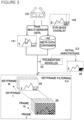
- Fig. 3 shows an exemplary scenario in an exemplary use case of a method according to an embodiment of the present disclosure. It illustrates schematized data for training and proofreading as applied on a cycling use case, in which sensor data are provided by a head-mounted sensor rig 101 which includes semi-transparent glasses and at least one camera for capturing images or a stream of images (video) of the real environment, and further sensors like audio and eye gaze detection sensors and/or IMU.
- sensor data are provided by a head-mounted sensor rig 101 which includes semi-transparent glasses and at least one camera for capturing images or a stream of images (video) of the real environment, and further sensors like audio and eye gaze detection sensors and/or IMU.
- media properties e.g., video or image
- other information like location information, eye gaze (illustrated in Fig. 3 in an eye-gaze overlay image 143), schema and version information.
- One of the keyframes 26 presented by the annotation tool 31 to the annotators (or proofreaders) 32 are accompanied by automatically generated initial annotations (step 2.2), which were generated by the foundation models 22. Keyframes 26 are filtered from image frames 25, as described above.
- the IMU data can be used to filter frames from the initial frames 25 (frames 1 to n) that are less informative for the annotation process. For example, it can be determined that significant head movement, detected by the IMU, will lead to motion blur and thus those frames will be excluded to gain a reduced set of filtered keyframes 26 (keyframes 1 to m).
Landscapes
- Engineering & Computer Science (AREA)
- Theoretical Computer Science (AREA)
- Physics & Mathematics (AREA)
- General Physics & Mathematics (AREA)
- Multimedia (AREA)
- General Engineering & Computer Science (AREA)
- Software Systems (AREA)
- Evolutionary Computation (AREA)
- Computing Systems (AREA)
- Artificial Intelligence (AREA)
- Health & Medical Sciences (AREA)
- General Health & Medical Sciences (AREA)
- Computational Linguistics (AREA)
- Data Mining & Analysis (AREA)
- Databases & Information Systems (AREA)
- Signal Processing (AREA)
- Medical Informatics (AREA)
- Computer Vision & Pattern Recognition (AREA)
- Library & Information Science (AREA)
- Mathematical Physics (AREA)
- Optics & Photonics (AREA)
- Biophysics (AREA)
- Life Sciences & Earth Sciences (AREA)
- Molecular Biology (AREA)
- Biomedical Technology (AREA)
- Human Computer Interaction (AREA)
- Computer Graphics (AREA)
- Computer Hardware Design (AREA)
- Image Analysis (AREA)
- Processing Or Creating Images (AREA)
Priority Applications (5)
| Application Number | Priority Date | Filing Date | Title |
|---|---|---|---|
| EP22211395.3A EP4383094A1 (de) | 2022-12-05 | 2022-12-05 | Computerimplementiertes verfahren zur bereitstellung von mindestens einem maschinenlernmodell, insbesondere für intelligente anwendungen der erweiterten realität |
| KR1020230172110A KR20240083836A (ko) | 2022-12-05 | 2023-12-01 | 특히 지능형 증강 현실 애플리케이션을 위해 적어도 하나의 머신러닝 모델을 제공하는 컴퓨터 구현 방법 |
| JP2023204931A JP2024081154A (ja) | 2022-12-05 | 2023-12-04 | とりわけ、インテリジェント拡張現実アプリケーションのための、少なくとも1つのマシン・ラーニング・モデルを提供するコンピュータ実施方法 |
| CN202311655422.8A CN118153706A (zh) | 2022-12-05 | 2023-12-05 | 提供至少一个机器学习模型的计算机实现的方法 |
| US18/529,760 US12554772B2 (en) | 2022-12-05 | 2023-12-05 | Computer-implemented method of providing at least one machine learning model, in particular for intelligent augmented reality applications |
Applications Claiming Priority (1)
| Application Number | Priority Date | Filing Date | Title |
|---|---|---|---|
| EP22211395.3A EP4383094A1 (de) | 2022-12-05 | 2022-12-05 | Computerimplementiertes verfahren zur bereitstellung von mindestens einem maschinenlernmodell, insbesondere für intelligente anwendungen der erweiterten realität |
Publications (1)
| Publication Number | Publication Date |
|---|---|
| EP4383094A1 true EP4383094A1 (de) | 2024-06-12 |
Family
ID=84389327
Family Applications (1)
| Application Number | Title | Priority Date | Filing Date |
|---|---|---|---|
| EP22211395.3A Pending EP4383094A1 (de) | 2022-12-05 | 2022-12-05 | Computerimplementiertes verfahren zur bereitstellung von mindestens einem maschinenlernmodell, insbesondere für intelligente anwendungen der erweiterten realität |
Country Status (5)
| Country | Link |
|---|---|
| US (1) | US12554772B2 (de) |
| EP (1) | EP4383094A1 (de) |
| JP (1) | JP2024081154A (de) |
| KR (1) | KR20240083836A (de) |
| CN (1) | CN118153706A (de) |
Families Citing this family (2)
| Publication number | Priority date | Publication date | Assignee | Title |
|---|---|---|---|---|
| US12518397B2 (en) * | 2021-04-01 | 2026-01-06 | Exer Labs, Inc. | Automated determination of a base assessment for a pose or movement |
| CN113592981B (zh) * | 2021-07-01 | 2022-10-11 | 北京百度网讯科技有限公司 | 图片标注方法、装置、电子设备和存储介质 |
Citations (6)
| Publication number | Priority date | Publication date | Assignee | Title |
|---|---|---|---|---|
| US20050154696A1 (en) | 2004-01-12 | 2005-07-14 | Hitachi Global Storage Technologies | Pipeline architecture for data summarization |
| WO2018217008A1 (en) * | 2017-05-23 | 2018-11-29 | Samsung Electronics Co., Ltd. | Augmented reality |
| WO2019245618A1 (en) | 2018-06-20 | 2019-12-26 | Tesla, Inc. | Data pipeline and deep learning system for autonomous driving |
| US10691943B1 (en) | 2018-01-31 | 2020-06-23 | Amazon Technologies, Inc. | Annotating images based on multi-modal sensor data |
| US20210390702A1 (en) | 2020-06-12 | 2021-12-16 | Samasource Impact Sourcing, Inc. | System and Method for Triggering Machine Learning (ML) Annotation Model Retraining |
| WO2022195306A1 (en) * | 2021-03-19 | 2022-09-22 | Digital Surgery Limited | Detection of surgical states and instruments |
Family Cites Families (5)
| Publication number | Priority date | Publication date | Assignee | Title |
|---|---|---|---|---|
| US11069036B1 (en) * | 2020-01-03 | 2021-07-20 | GE Precision Healthcare LLC | Method and system for real-time and offline de-identification of facial regions from regular and occluded color video streams obtained during diagnostic medical procedures |
| US20210312227A1 (en) * | 2020-04-02 | 2021-10-07 | Samsung Electronics Co., Ltd. | System and method for detecting annotation errors |
| US20240325088A1 (en) * | 2021-07-12 | 2024-10-03 | The Medical College Of Wisconsin, Inc. | Augmented Reality-Driven Guidance for Interventional Procedures |
| US12008792B1 (en) * | 2021-12-10 | 2024-06-11 | Amazon Technologies, Inc. | Independently determining adjustments to bounding shapes for detected objects in image data |
| US12307674B2 (en) * | 2022-02-03 | 2025-05-20 | GE Precision Healthcare LLC | Low latency interactive segmentation of medical images within a web-based deployment architecture |
-
2022
- 2022-12-05 EP EP22211395.3A patent/EP4383094A1/de active Pending
-
2023
- 2023-12-01 KR KR1020230172110A patent/KR20240083836A/ko active Pending
- 2023-12-04 JP JP2023204931A patent/JP2024081154A/ja active Pending
- 2023-12-05 US US18/529,760 patent/US12554772B2/en active Active
- 2023-12-05 CN CN202311655422.8A patent/CN118153706A/zh active Pending
Patent Citations (7)
| Publication number | Priority date | Publication date | Assignee | Title |
|---|---|---|---|---|
| US20050154696A1 (en) | 2004-01-12 | 2005-07-14 | Hitachi Global Storage Technologies | Pipeline architecture for data summarization |
| WO2018217008A1 (en) * | 2017-05-23 | 2018-11-29 | Samsung Electronics Co., Ltd. | Augmented reality |
| US10691943B1 (en) | 2018-01-31 | 2020-06-23 | Amazon Technologies, Inc. | Annotating images based on multi-modal sensor data |
| WO2019245618A1 (en) | 2018-06-20 | 2019-12-26 | Tesla, Inc. | Data pipeline and deep learning system for autonomous driving |
| US20220107652A1 (en) | 2018-06-20 | 2022-04-07 | Tesla, Inc. | Data pipeline and deep learning system for autonomous driving |
| US20210390702A1 (en) | 2020-06-12 | 2021-12-16 | Samasource Impact Sourcing, Inc. | System and Method for Triggering Machine Learning (ML) Annotation Model Retraining |
| WO2022195306A1 (en) * | 2021-03-19 | 2022-09-22 | Digital Surgery Limited | Detection of surgical states and instruments |
Non-Patent Citations (5)
| Title |
|---|
| ANONYMOUS: "Data store - Wikipedia article", 17 June 2011 (2011-06-17), pages 1 - 2, XP055048209, Retrieved from the Internet <URL:http://en.wikipedia.org/w/index.php?title=Data_store&oldid=434847058> [retrieved on 20121218] * |
| DOHERTY AIDEN R ET AL: "Investigating keyframe selection methods in the novel domain of passively captured visual lifelogs", PROCEEDINGS OF THE 2008 INTERNATIONAL CONFERENCE ON CONTENT-BASED IMAGE AND VIDEO RETRIEVAL, 7 July 2008 (2008-07-07) - 9 July 2008 (2008-07-09), pages 259 - 268, XP093348525, Retrieved from the Internet <URL:https://dl.acm.org/doi/pdf/10.1145/1386352.1386389> [retrieved on 20081217] * |
| HEIN, DRAUSCHNABEL, P., AUGMENTED REALITY SMART GLASSES AND KNOWLEDGE MANAGEMENT: A CONCEPTUAL FRAMEWORK FOR ENTERPRISE SOCIAL NETWORKS, January 2016 (2016-01-01), pages 85 |
| SCHMARZO, BILL: "Evolution of Intelligent Data Pipelines", MIT TECHNOLOGY REVIEW ONLINE, 25 November 2022 (2022-11-25), Retrieved from the Internet <URL:https://www.technologyreview.com/2021/12/06/1040716/evolution-of-intelligent-data-pipelines> |
| ZIN ZIN THI THI THI THI ET AL: "Big Data Analysis and Deep Learning Applications", vol. 744, 1 January 2018 (2018-01-01), Singapore, pages 342 - 345, XP093045041, ISSN: 2194-5357, ISBN: 978-981-1308-68-0, Retrieved from the Internet <URL:https://meral.edu.mm/record/7428/file_preview/Key%20Frame%20Extraciton%20Techniques(ICBDL2018).pdf?allow_aggs=False> DOI: 10.1007/978-981-13-0869-7_38 * |
Also Published As
| Publication number | Publication date |
|---|---|
| JP2024081154A (ja) | 2024-06-17 |
| CN118153706A (zh) | 2024-06-07 |
| KR20240083836A (ko) | 2024-06-12 |
| US12554772B2 (en) | 2026-02-17 |
| US20240185544A1 (en) | 2024-06-06 |
Similar Documents
| Publication | Publication Date | Title |
|---|---|---|
| Babaei et al. | Generative artificial intelligence and the evolving challenge of deepfake detection: A systematic analysis | |
| McCarthy et al. | Towards generalist robot learning from internet video: A survey | |
| Jin et al. | Tod3cap: Towards 3d dense captioning in outdoor scenes | |
| US12554772B2 (en) | Computer-implemented method of providing at least one machine learning model, in particular for intelligent augmented reality applications | |
| US20170308800A1 (en) | Interchangeable Artificial Intelligence Perception Systems and Methods | |
| US12266065B1 (en) | Visual indicators of generative model response details | |
| Lei et al. | Prompt learning in computer vision: a survey | |
| EP3623998B1 (de) | Zeichenerkennung | |
| US9727992B2 (en) | Unifying augmented reality and big data | |
| CN113811884A (zh) | 认知视频和音频的检索聚合 | |
| CN101379512A (zh) | 用于图像标记的设备和方法 | |
| US20250190503A1 (en) | Video Query Contextualization | |
| EP2887259A1 (de) | Verfahren zur Annotation eines Objekts in Multimedia-Assets | |
| Fernandes et al. | Enhancing image annotation with object tracking and image retrieval: A systematic review | |
| Zhang et al. | Leader360V: A Large-scale, Real-world 360 Video Dataset for Multi-task Learning in Diverse Environment | |
| Jan et al. | Text-to-video generators: a comprehensive survey | |
| US20260030905A1 (en) | Vision-Language-Model-Based System for Assessing the Consistency Between Images and Their Textual Description | |
| US20260064772A1 (en) | Smart frame selection via activity-based ranking and optimization | |
| US20240192972A1 (en) | Methods and systems for object-aware fuzzy processing based on analogies | |
| Yarrarapu et al. | Efficient video summarization through MobileNetSSD: a robust deep learning-based framework for efficient video summarization focused on objects of interest | |
| KR20230051995A (ko) | 실감형 확장현실 콘텐츠 관리 플랫폼 | |
| Abreu et al. | An extensible architecture for recognizing sensory effects in 360° images | |
| CN113704545A (zh) | 视频标签的挖掘方法、装置、电子设备及存储介质 | |
| US20260105573A1 (en) | Automatic tests for visual validation of generated images and videos | |
| Xu | Understanding and Facilitating Human-AI Teaming for Real-World Computer Vision Tasks |
Legal Events
| Date | Code | Title | Description |
|---|---|---|---|
| PUAI | Public reference made under article 153(3) epc to a published international application that has entered the european phase |
Free format text: ORIGINAL CODE: 0009012 |
|
| STAA | Information on the status of an ep patent application or granted ep patent |
Free format text: STATUS: THE APPLICATION HAS BEEN PUBLISHED |
|
| AK | Designated contracting states |
Kind code of ref document: A1 Designated state(s): AL AT BE BG CH CY CZ DE DK EE ES FI FR GB GR HR HU IE IS IT LI LT LU LV MC ME MK MT NL NO PL PT RO RS SE SI SK SM TR |
|
| STAA | Information on the status of an ep patent application or granted ep patent |
Free format text: STATUS: REQUEST FOR EXAMINATION WAS MADE |
|
| 17P | Request for examination filed |
Effective date: 20241210 |
|
| STAA | Information on the status of an ep patent application or granted ep patent |
Free format text: STATUS: EXAMINATION IS IN PROGRESS |
|
| 17Q | First examination report despatched |
Effective date: 20250324 |