EP4383275A1 - Dispositif d'estimation de risque de créatinine, procédé d'estimation de risque de créatinine et programme - Google Patents
Dispositif d'estimation de risque de créatinine, procédé d'estimation de risque de créatinine et programme Download PDFInfo
- Publication number
- EP4383275A1 EP4383275A1 EP22852596.0A EP22852596A EP4383275A1 EP 4383275 A1 EP4383275 A1 EP 4383275A1 EP 22852596 A EP22852596 A EP 22852596A EP 4383275 A1 EP4383275 A1 EP 4383275A1
- Authority
- EP
- European Patent Office
- Prior art keywords
- creatinine
- risk
- biological information
- risk estimation
- training data
- Prior art date
- Legal status (The legal status is an assumption and is not a legal conclusion. Google has not performed a legal analysis and makes no representation as to the accuracy of the status listed.)
- Pending
Links
Images





Classifications
-
- G—PHYSICS
- G16—INFORMATION AND COMMUNICATION TECHNOLOGY [ICT] SPECIALLY ADAPTED FOR SPECIFIC APPLICATION FIELDS
- G16H—HEALTHCARE INFORMATICS, i.e. INFORMATION AND COMMUNICATION TECHNOLOGY [ICT] SPECIALLY ADAPTED FOR THE HANDLING OR PROCESSING OF MEDICAL OR HEALTHCARE DATA
- G16H50/00—ICT specially adapted for medical diagnosis, medical simulation or medical data mining; ICT specially adapted for detecting, monitoring or modelling epidemics or pandemics
- G16H50/30—ICT specially adapted for medical diagnosis, medical simulation or medical data mining; ICT specially adapted for detecting, monitoring or modelling epidemics or pandemics for calculating health indices; for individual health risk assessment
-
- G—PHYSICS
- G16—INFORMATION AND COMMUNICATION TECHNOLOGY [ICT] SPECIALLY ADAPTED FOR SPECIFIC APPLICATION FIELDS
- G16H—HEALTHCARE INFORMATICS, i.e. INFORMATION AND COMMUNICATION TECHNOLOGY [ICT] SPECIALLY ADAPTED FOR THE HANDLING OR PROCESSING OF MEDICAL OR HEALTHCARE DATA
- G16H10/00—ICT specially adapted for the handling or processing of patient-related medical or healthcare data
- G16H10/60—ICT specially adapted for the handling or processing of patient-related medical or healthcare data for patient-specific data, e.g. for electronic patient records
-
- G—PHYSICS
- G16—INFORMATION AND COMMUNICATION TECHNOLOGY [ICT] SPECIALLY ADAPTED FOR SPECIFIC APPLICATION FIELDS
- G16H—HEALTHCARE INFORMATICS, i.e. INFORMATION AND COMMUNICATION TECHNOLOGY [ICT] SPECIALLY ADAPTED FOR THE HANDLING OR PROCESSING OF MEDICAL OR HEALTHCARE DATA
- G16H50/00—ICT specially adapted for medical diagnosis, medical simulation or medical data mining; ICT specially adapted for detecting, monitoring or modelling epidemics or pandemics
- G16H50/20—ICT specially adapted for medical diagnosis, medical simulation or medical data mining; ICT specially adapted for detecting, monitoring or modelling epidemics or pandemics for computer-aided diagnosis, e.g. based on medical expert systems
-
- G—PHYSICS
- G01—MEASURING; TESTING
- G01N—INVESTIGATING OR ANALYSING MATERIALS BY DETERMINING THEIR CHEMICAL OR PHYSICAL PROPERTIES
- G01N33/00—Investigating or analysing materials by specific methods not covered by groups G01N1/00 - G01N31/00
- G01N33/48—Biological material, e.g. blood, urine; Haemocytometers
- G01N33/50—Chemical analysis of biological material, e.g. blood, urine; Testing involving biospecific ligand binding methods; Immunological testing
- G01N33/70—Chemical analysis of biological material, e.g. blood, urine; Testing involving biospecific ligand binding methods; Immunological testing involving creatine or creatinine
Definitions
- the present invention relates to a creatinine risk estimation device, a creatinine risk estimation method, and a computer program.
- Creatinine is a metabolic product of creatinine phosphate, which is the source of energy supply to muscle. Typically, creatinine is discharged from muscle tissue to blood, filtrated through the glomerulus of the kidney, and then discharged into urine. Thus, the amount of creatinine in blood is utilized as an indicator for evaluation of the kidney function.
- Patent Literature 1 discloses a technology of non-invasively measuring the level of creatinine concentration in blood by a laser sensor system on-chip.
- Patent Literature 1 discloses no specific method of measuring creatinine.
- the present invention has been made in view of the above-described situation and is intended to provide a creatinine risk estimation device, a creatinine risk estimation method, and a computer program that are capable of extremely accurately and swiftly estimating creatinine risk on health based on non-invasive biological information without blood or urine collection.
- the creatinine risk estimation device further includes a training data storage unit configured to store a training data set, and a learning processing unit configured to generate the creatinine risk estimation model by machine learning based on the training data set.
- the training data set includes attribute information, non-invasive biological information, and a blood-measured creatinine measured value of a subject.
- the learning processing unit generates a first creatinine risk estimation model and a second creatinine risk estimation model by machine learning based on each of training data sets of different kinds, and the estimation processing unit calculates the creatinine risk estimated value of the predetermined user by using the first creatinine risk estimation model and the second creatinine risk estimation model.
- Pulse pressure systolic blood pressure ⁇ diastolic blood pressure
- the biological impedance includes any one or a combination of the body fat amount (kg), the body fat amount (%), the lean body weight, the lean body rate, the muscle mass, the total moisture content (kg), the total moisture content (%), the intercellular moisture content (%), the cardiac output, 1 forehead left-side - 2 left hand/SCR A, 1 forehead left-side - 2 left hand/delta SCR C-SCR A, 5 left hand - 6 left foot/SCR C, 5 left hand - 6 left foot/delta SCR C-SCR A, 7 right hand - 8 right foot/SCR C, 7 right hand - 8 right foot/SCR A, 13 left foot - 14 right foot/SCR C, 13 left foot - 14 right foot/SCR A, 15 right hand - 16 forehead left-side /delta SCR C-SCR A, 15 right hand - 16 forehead left-side SCR C, 15 right hand - 16 forehead left-side SCR A, 19 right foot - 20 left hand/delta SCR C-
- the value "1 forehead left-side - 2 left hand/SCR A” is conductance (or conductivity) measured through a path when current flows with “1 forehead left-side” at the cathode and "2 left hand” at the anode
- the value “5 left hand - 6 left foot/delta SCR C-SCR A” is the difference between conductance values measured when conduction is made with “5 left hand” and “6 left foot” at the anode and the cathode and at the cathode and the anode.
- the BMI and the blood pressure can be measured by a height-weight meter and a blood pressure meter.
- the non-invasive biological information may include an oxygen transport amount calculated based on SpO2 and the cardiac output.
- the measured non-invasive biological information is output to the creatinine risk estimation device 30 through a wired or wireless communication network.
- the biological information measurement device 20 may be a fixed measurement device or a portable measurement device such as a wearable terminal.
- the user data storage unit 33 stores the attribute information and the non-invasive biological information of the user, which are acquired from the first acquisition unit 31 and the second acquisition unit 32.
- the training data storage unit 34 stores, as training data sets for machine learning, a plurality of training data sets each consisting of the attribute information and the non-invasive biological information of a plurality of subjects, which are acquired in advance and sample examination information, such as the creatinine, which is obtained through a blood examination.
- sample examination information may further include examination information obtained from blood, urine, stool, or the like.
- the estimation model storage unit 36 stores the creatinine risk estimation model generated by the learning processing unit 35.
- the non-invasive biological information includes any one or a combination of the BMI, the blood pressure, the pulse wave data, the electrocardiogram data, and the biological impedance.
- the oxygen saturation (SpO2) is included as necessary.
- the estimation processing unit 37 estimates the creatinine risk of the predetermined user based on the attribute information and/or the non-invasive biological information of the user by using the estimation model generated by the learning processing unit 35. Then, the creatinine risk estimated value is stored in the estimation data storage unit 38.
- the display device 39 can display the creatinine risk estimated value together with the attribute information and the non-invasive biological information of the user. Note that these pieces of data may be displayed on the terminal device 10 possessed by the user.
- FIG 3 is a hardware configuration diagram of the creatinine risk estimation device 30.
- the creatinine risk estimation device 30 is configured as a computer 300 including one or a plurality of processors 301, a memory 302, a storage 303, an input-output port 304, and a communication port 305.
- Each processor 301 performs processing related to creatinine estimation according to the present embodiment by executing a computer program.
- the memory 302 temporarily stores a computer program and a calculation result of the computer program.
- the storage 303 stores a computer program configured to execute processing by the creatinine risk estimation device 30.
- the storage 303 may be any computer-readable storage and may be, for example, various kinds of recording media such as a magnetic disk, an optical disk, a random-access memory, a flash memory, and a read-only memory.
- the input-output port 304 performs inputting of information from the terminal device 10 and the biological information measurement device 20 and outputting of a creatinine estimated value to the display device 39.
- the communication port 305 transmits and receives data to and from a non-illustrated information terminal such as another computer. Communication may be performed by wireless and wired communication methods.
- the creatinine risk estimation device 30 may be implemented by a commercially available desktop PC or notebook PC, and a time taken for calculation of a creatinine risk estimated value using an estimation model is several seconds.
- the first acquisition unit 31, the second acquisition unit 32, the learning processing unit 35, the estimation processing unit 37, and the like described above function at the processors 301 of the creatinine risk estimation device 30 when operating.
- Figure 4 is a flowchart illustrating an execution procedure of generation of a creatinine risk estimation model by machine learning.
- the learning processing unit 35 performs preprocessing of input data. Specifically, for creatinine obtained through a blood examination, the learning processing unit 35 converts the creatinine equal to or lower than 1.00 mg/dL into "0" (no risk is present) and the creatinine equal to or higher than 1.01 mg/dL into "1" (risk is present) in a case of male, and converts the creatinine equal to or lower than 0.70 mg/dL into "0" (no risk is present) and the creatinine equal to or higher than 0.71 mg/dL into "1" (risk is present) in a case of female.
- the learning processing unit 35 may apply SMOTE (Chawla, NV. et al. 2002) to learning data to artificially generate training samples.
- the learning processing unit 35 performs machine learning by the logistic regression and the neural network (NN).
- NN_1 represents a neural network used as a male creatinine risk estimation model
- NN_2 represents a neural network used as the female creatinine risk estimation model. Either neural network is used in accordance with sex.
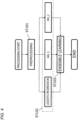
- Figure 5 illustrates the structure of the neural network (NN_1) used as the male creatinine risk estimation model.
- D represents the number of examination items.
- the NN structure converts data in the order of D dimensions, 64 dimensions, 64 dimensions, 64 dimensions, and one dimension through four layer groups (Compile A1, Compile A2, Compile A3, and Compile B1).
- Compile A1, A2, and A3 each include a full connection layer “Linear” that performs full connection processing, a "Kernel Regularizer” that performs regularization, and a "ReLU” layer that performs ReLU processing
- the layer group Compile B1 includes a full connection layer “Linear” that performs full connection processing and an "Adagrad” layer that performs optimization processing.
- An input unit of the full connection layer of the layer group Compile A1 corresponds to an input layer
- an output unit of the layer group Compile B1 corresponds to an output layer
- each unit therebetween corresponds to an intermediate layer (hidden layer).
- the intermediate layer includes a Dropout layer that limits some input values to zero and prevents overfitting.
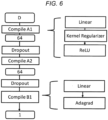
- Figure 6 illustrates the structure of the neural network (NN_2) used as the female creatinine risk estimation model.
- a rectangle represents a layer group that performs data conversion, and a rounded rectangle represents input-output data.
- "D” represents the number of examination items.
- the NN structure converts data in the order of D dimensions, 64 dimensions, 64 dimensions, and one dimension through three layer groups (Compile A1, Compile A2, and Compile B1).
- Compile A1 and A2 each include a full connection layer “Linear” that performs full connection processing, a "Kernel Regularizer” that performs regularization, and a "ReLU” layer that performs ReLU processing
- the layer group Compile B1 includes a full connection layer “Linear” that performs full connection processing and an "Adagrad” layer that performs optimization processing.
- An input unit of the full connection layer of the layer group Compile A1 corresponds to an input layer
- an output unit of the layer group Compile B1 corresponds to an output layer
- each unit therebetween corresponds to an intermediate layer (hidden layer).
- the intermediate layer includes a Dropout layer that limits some input values to zero and prevents overfitting.
- Logistic Regression provided in a Python open-source machine learning library Scikit-learn may be used in the machine learning by logistic regression.
- the number of dimensions may be reduced by primary component analysis as necessary.
- the creatinine risk obtained through a blood examination was compared with the creatinine risk estimated value obtained by machine learning, and parameters (C, regularization method, max_iter, and solber) of Logistic Regression were adjusted to obtain the maximum f1 score.
- the parameter "C” is a tradeoff parameter that determines the strength of regularization, and the strength of regularization is weaker as the value of the parameter is larger.
- the parameter "regularization method” means L1 regularization or L2 regularization to be selected.
- the parameter "max iter” is the maximum number of iterations of learning.
- the parameter "solber” selects a convergence method (for example, the L-BFGS method, the Newton CG method, liblinear, sag, or saga) that minimizes the cross-entropy loss.
- a convergence method for example, the L-BFGS method, the Newton CG method, liblinear, sag, or saga.
- the learning processing unit 35 stores the creatinine risk estimation model generated by the above-described learning processing in the estimation model storage unit 36.
- the first acquisition unit 31 of the creatinine risk estimation device 30 acquires the attribute information of the user from the terminal device 10.
- the second acquisition unit 32 of the creatinine risk estimation device 30 acquires the non-invasive biological information of the user.
- the attribute information and the non-invasive biological information of the user are stored in the user data storage unit 33.
- the estimation processing unit 37 calculates probability that the user belongs to class 0 (no risk is present) or class 1 (risk is present), in other words, a creatinine risk estimated value by using the creatinine risk estimation model stored in the estimation model storage unit 36.
- the calculated creatinine risk estimated value is stored in the estimation data storage unit 38.
- the creatinine risk estimated value is output to an external terminal such as the display device 39 and displayed.
- the attribute information includes any one or a combination of ID, full name, age, and sex
- the non-invasive biological information includes any one or a combination of the BMI, the blood pressure, the pulse wave data, the electrocardiogram data, the biological impedance, and the oxygen saturation (SpO2).
- Height and weight as calculation references of the BMI were measured by a height meter and a weight meter, respectively, and the blood pressure was measured by a blood pressure meter.
- the pulse wave data, the electrocardiogram data, the biological impedance, and the oxygen saturation (SpO2) were measured by ES-TECK BC-3 (Ryobi Systems Co., Ltd.).
- a pulse wave meter an electrocardiogram meter, an impedance measurement device, and a pulse oximeter that are commercially available may be used in combination in place of ES-TECK BC-3.
- the above-described non-invasive biological information may be acquired by using a predetermined wearable terminal.
- the biological impedance was measured by generating small current flow between two electrodes among electrodes at the six sites of the feet, the hands, and the right and left foreheads. Voltage and current were 1.28 V and 200 ⁇ A, and the conductance was measured for 32 milliseconds per second. Current was caused to flow between two of the electrodes at the six sites to measure (1) anode/cathode conductance ( ⁇ S), (2) cathode/anode conductance ( ⁇ S), (3) the difference (delta SCRA-SCRC) between the conductance measured in (1) above and the conductance measured in (2) above, and (4) electric conductivity ( ⁇ S/m).
- ⁇ S anode/cathode conductance
- ⁇ S cathode/anode conductance
- delta SCRA-SCRC electric conductivity
- the muscle mass, the body fat amount, the total moisture content, the phase angle, and the resistance value were measured, and the dielectric constant ( ⁇ Si) was measured for cases of conduction between the right hand and the left hand and between the right forehead and the left forehead.
- the pulse wave data, the electrocardiogram data, the biological impedance, and the oxygen saturation (SpO2) were measured for two minutes by using ES-TECK BC-3 for each subject.
- a device having functions of an electrocardiogram, a pulse wave meter, and a pulse oximeter was mounted on the left hand forefinger of each subject, two electrodes were mounted on the forehead, and the hands and feet were placed on electrode plates while the subject was seated on a chair.
- a learning model 1 as illustrated in Figure 4 , machine learning by the logistic regression and the neural network (NN_1 or NN_2) was performed, and ensemble learning by stacking was performed with results of the learning to produce a creatinine risk estimation model.
- the attribute information was selected and used as the attribute information and the non-invasive biological data.
- the attribute information sex
- the non-invasive biological data the BMI, the blood pressure, the pulse pressure, pulse wave data, d/a, electrocardiogram data, the breathing rate, the biological impedance, 1 forehead left-side - 2 left hand/delta SCR C-SCR A, 5 left hand - 6 left foot/SCR C, 7 right hand - 8 right foot/SCR A, 15 right hand - 16 forehead left-side SCRA, ESG 2+4+15+17 ( ⁇ S/m), ESG 6+8+19+21 ( ⁇ S/m), ESG 9+10 (%), and R ( ⁇ ), where ESG 9+10 is the average of impedance values measured at the sites illustrated in Figure 2 .
- the unit [ ⁇ S/m] is the unit of a measured average
- the unit [%] is a value obtained by scaling the measured average into the range of normally measured values.
- the cardiac output included in the biological impedance and the oxygen transport amount estimated from the oxygen saturation (SpO2) are included in the non-invasive biological data.
- the non-invasive biological data includes the singe-output amount obtained by dividing the cardiac output by the heart rate, and the oxygen transport amount estimated based on the cardiac output and the oxygen saturation (SpO2) included in the biological impedance.
- Example 1 the creatinine risk estimation model was generated through machine learning of the above-described learning model 1 by using (1) the attribute information, (2) the non-invasive biological information measured by a height-weight meter, a blood pressure meter, and ES-TECK BC-3, and (3) a training data set of creatinine obtained through a blood examination performed on the same day as the non-invasive biological information measurement for a total of 468 male subjects.
- Example 2 the creatinine risk estimation model was generated through machine learning of the above-described learning model 2 by using (1) the attribute information, (2) the non-invasive biological information measured by a height-weight meter, a blood pressure meter, and ES-TECK BC-3, and (3) a training data set of creatinine obtained through a blood examination performed on the same day as the non-invasive biological information measurement for a total of 244 female subjects.
- the creatinine risk is estimated by using the learning model 1 or the learning model 2, but the creatinine risk may be estimated by using a plurality of learning models.
- the creatinine risk can be estimated at higher accuracy than the creatinine risk is estimated by using one learning model.
- the estimation accuracy improves in some cases when the BMI is used for a learning model data set, and thus a functional component configured to estimate the BMI may be provided in a creatinine risk estimation device.
- the BMI is typically not acquired by a wearable terminal nor the like but is calculated based on a height and a weight input by the user.
- the above-described creatinine risk can be acquired by only acquiring biological information, which improves convenience for the user.
- the BMI estimation is not limited to a particular method, but for example, it is known that the BMI is correlated with inclination of the abdominal region (predetermined position) of the user.
- a predetermined acceleration sensor may be provided on the abdominal region of the user (or a wrist-band wearable terminal or the like including an acceleration sensor may be placed on the abdominal region), and the BMI may be estimated by calculating the inclination of the abdominal region based on data output from the acceleration sensor.
- the pulse wave data or the oxygen saturation may be estimated by using a wrist-band wearable terminal or the like including a pulse wave sensor or a blood oxygen level sensor.
- the blood pressure may be estimated by using a wrist-band wearable terminal or the like. Since it is known that the blood pressure is correlated with the speed of a pulse wave transferred through an artery by heartbeat, the blood pressure may be estimated by using a predetermined sensor configured to measure the speed of a pulse wave transferred through an artery by heartbeat.
- the electrocardiogram data may be estimated by using a wrist-band wearable terminal or the like.
- the electrocardiogram data may be estimated based on data obtained from an electrode provided on a surface on a side opposite a display surface of a wrist-band wearable terminal and an electrode provided on the display surface side.
- the electrocardiogram data may be estimated based on data obtained when the wrist of a hand (for example, the left hand) on which the wrist-band wearable terminal is mounted contacts the electrode provided on the opposite surface and a fingertip of a hand (for example, the right hand) opposite to the mounted hand contacts the electrode provided on the display surface side.
- the biological impedance may be estimated by using a wrist-band wearable terminal or the like including various electrodes.
- the biological impedance may be estimated based on biological information obtained from the thoracic region and a wrist by using a wrist-band wearable terminal or the like.
- estimation target biological information (at least one piece or more of biological information among the BMI, the blood pressure, the pulse wave data, the electrocardiogram data, the biological impedance, and the oxygen saturation) may be estimated by using a classifier generated by using various kinds of machine learning algorithms with, as teacher data, biological information that is acquirable by a wearable terminal and the above-described estimation target biological information.
- the above-described second acquisition unit may acquire the estimated biological information.
- the series of above-described processing may be executed by hardware or software.
- the above-described functional configurations are merely exemplary and not particularly limited. Specifically, it suffices that the functionality of executing the entire series of above-described processing is provided at an information processing system, and which functional blocks are used to achieve the functionality is not particularly limited to the above-described example. Places at which functional blocks exist are not particularly limited to those in Figure 1 but may be optional.
- functional blocks of a server may be transferred to another terminal or device.
- Functional blocks of another terminal or device may be transferred to a server or the like.
- Each functional block may be configured by hardware only, by software only, or by combination thereof.
- the computer may be a computer incorporated in dedicated hardware.
- the computer may be a computer capable of executing various functions with various computer programs installed thereon, such as a server or a general-purpose smartphone or personal computer.
- a recording medium including such computer programs is not only configured as a non-illustrated removable media distributed separately from the device body to provide the computer programs to a user or the like, but also configured as, for example, a recording medium incorporated in the device body in advance and provided to the user or the like.
- the computer programs can be distributed through a network, and thus the recording medium may be mounted on or accessible from a computer connected or connectable to the network.
- steps representing the computer programs recorded in the recording medium include not only processing performed in a temporally sequential manner in accordance with an order but also processing not necessarily processed in a temporally sequential manner but executed in parallel or individually.
- system terms mean those of an overall device including a plurality of devices, a plurality of units, or the like.
Landscapes
- Engineering & Computer Science (AREA)
- Health & Medical Sciences (AREA)
- Medical Informatics (AREA)
- Public Health (AREA)
- General Health & Medical Sciences (AREA)
- Primary Health Care (AREA)
- Epidemiology (AREA)
- Biomedical Technology (AREA)
- Data Mining & Analysis (AREA)
- Databases & Information Systems (AREA)
- Pathology (AREA)
- Measurement Of The Respiration, Hearing Ability, Form, And Blood Characteristics Of Living Organisms (AREA)
- Measuring Pulse, Heart Rate, Blood Pressure Or Blood Flow (AREA)
Applications Claiming Priority (3)
| Application Number | Priority Date | Filing Date | Title |
|---|---|---|---|
| JP2021130216 | 2021-08-06 | ||
| JP2022040639A JP2023024259A (ja) | 2021-08-06 | 2022-03-15 | クレアチニンリスク推定装置、クレアチニンリスク推定方法及びプログラム |
| PCT/JP2022/015104 WO2023013167A1 (fr) | 2021-08-06 | 2022-03-28 | Dispositif d'estimation de risque de créatinine, procédé d'estimation de risque de créatinine et programme |
Publications (2)
| Publication Number | Publication Date |
|---|---|
| EP4383275A1 true EP4383275A1 (fr) | 2024-06-12 |
| EP4383275A4 EP4383275A4 (fr) | 2025-06-18 |
Family
ID=85154180
Family Applications (1)
| Application Number | Title | Priority Date | Filing Date |
|---|---|---|---|
| EP22852596.0A Pending EP4383275A4 (fr) | 2021-08-06 | 2022-03-28 | Dispositif d'estimation de risque de créatinine, procédé d'estimation de risque de créatinine et programme |
Country Status (4)
| Country | Link |
|---|---|
| US (1) | US20250079010A1 (fr) |
| EP (1) | EP4383275A4 (fr) |
| TW (1) | TW202306536A (fr) |
| WO (1) | WO2023013167A1 (fr) |
Family Cites Families (5)
| Publication number | Priority date | Publication date | Assignee | Title |
|---|---|---|---|---|
| WO2011047358A1 (fr) * | 2009-10-15 | 2011-04-21 | Crescendo Bioscience | Biomarqueurs et procédés de mesure et de surveillance de l'activité d'une maladie inflammatoire |
| EP3752060A4 (fr) * | 2018-02-17 | 2021-11-24 | Trilinear BioVentures, LLC | Système et méthode d'obtention de données de santé à, l'aide d'un réseau neuronal |
| WO2020183609A1 (fr) * | 2019-03-12 | 2020-09-17 | 三菱電機株式会社 | Dispositif de commande de corps mobile et procédé de commande de corps mobile |
| JP7517668B2 (ja) * | 2019-03-29 | 2024-07-17 | 株式会社タニタ | 健康情報提供システム及び健康情報提供プログラム |
| JP7497653B2 (ja) * | 2019-10-28 | 2024-06-11 | 株式会社デンソー | 情報処理装置、統合モデル生成方法、及び統合モデル生成プログラム |
-
2022
- 2022-03-25 TW TW111111238A patent/TW202306536A/zh unknown
- 2022-03-28 EP EP22852596.0A patent/EP4383275A4/fr active Pending
- 2022-03-28 WO PCT/JP2022/015104 patent/WO2023013167A1/fr not_active Ceased
- 2022-03-28 US US18/041,910 patent/US20250079010A1/en active Pending
Also Published As
| Publication number | Publication date |
|---|---|
| EP4383275A4 (fr) | 2025-06-18 |
| US20250079010A1 (en) | 2025-03-06 |
| WO2023013167A1 (fr) | 2023-02-09 |
| TW202306536A (zh) | 2023-02-16 |
Similar Documents
| Publication | Publication Date | Title |
|---|---|---|
| US20230309866A1 (en) | Blood sugar level estimation device, blood sugar level estimation method, and computer program | |
| JP2022153288A (ja) | 血糖値推定装置、血糖値推定方法及びプログラム | |
| EP4383274A1 (fr) | Dispositif d'estimation de risque de hba1c, procédé d'estimation de risque de hba1c et programme | |
| EP4383275A1 (fr) | Dispositif d'estimation de risque de créatinine, procédé d'estimation de risque de créatinine et programme | |
| EP4383264A1 (fr) | DISPOSITIF D'ESTIMATION DE yGT, PROCÉDÉ D'ESTIMATION DE yGT ET PROGRAMME | |
| US20230317218A1 (en) | Uric acid level estimation device, uric acid level estimation method, and computer program | |
| US20240008814A1 (en) | Blood neutral fat estimation device, blood neutral fat estimation method, and computer program | |
| EP4362045A1 (fr) | Dispositif d'estimation de risque de cholestérol, procédé d'estimation de risque de cholestérol et programme | |
| JP2023024259A (ja) | クレアチニンリスク推定装置、クレアチニンリスク推定方法及びプログラム | |
| JP2023024258A (ja) | 尿酸値推定装置、尿酸値推定方法及びプログラム | |
| JP2023024256A (ja) | HbA1cリスク推定装置、HbA1cリスク推定方法及びプログラム | |
| JP2023002453A (ja) | コレステロールリスク推定装置、コレステロールリスク推定方法及びプログラム | |
| JP2023024257A (ja) | γGT推定装置、γGT推定方法及びプログラム | |
| CN117677849A (zh) | 肌酐风险推定装置、肌酐风险推定方法以及程序 | |
| HK40102847A (zh) | 肌酐风险推定装置、肌酐风险推定方法以及程序 | |
| JP2023002452A (ja) | 血中中性脂肪推定装置、血中中性脂肪推定方法及びプログラム | |
| HK40102718A (zh) | 尿酸值推定装置、尿酸值推定方法以及程序 | |
| HK40083288A (en) | Cholesterol risk estimation device, cholesterol risk estimation method, and program | |
| HK40083296A (en) | Blood sugar level estimation device, blood sugar level estimation method and program | |
| CN117678033A (zh) | 尿酸值推定装置、尿酸值推定方法以及程序 | |
| HK40102707A (zh) | Hba1c风险推定装置、hba1c风险推定方法以及程序 | |
| HK40083287A (en) | Blood neutral fat estimation device, blood neutral fat estimation method, and program | |
| CN117693313A (zh) | HbA1c风险推定装置、HbA1c风险推定方法以及程序 | |
| HK40102120A (zh) | γGT推定装置、γGT推定方法以及程序 | |
| CN117678032A (zh) | γGT推定装置、γGT推定方法以及程序 |
Legal Events
| Date | Code | Title | Description |
|---|---|---|---|
| STAA | Information on the status of an ep patent application or granted ep patent |
Free format text: STATUS: THE INTERNATIONAL PUBLICATION HAS BEEN MADE |
|
| PUAI | Public reference made under article 153(3) epc to a published international application that has entered the european phase |
Free format text: ORIGINAL CODE: 0009012 |
|
| STAA | Information on the status of an ep patent application or granted ep patent |
Free format text: STATUS: REQUEST FOR EXAMINATION WAS MADE |
|
| 17P | Request for examination filed |
Effective date: 20230215 |
|
| AK | Designated contracting states |
Kind code of ref document: A1 Designated state(s): AL AT BE BG CH CY CZ DE DK EE ES FI FR GB GR HR HU IE IS IT LI LT LU LV MC MK MT NL NO PL PT RO RS SE SI SK SM TR |
|
| DAV | Request for validation of the european patent (deleted) | ||
| DAX | Request for extension of the european patent (deleted) | ||
| A4 | Supplementary search report drawn up and despatched |
Effective date: 20250515 |
|
| RIC1 | Information provided on ipc code assigned before grant |
Ipc: G01N 33/70 20060101ALI20250509BHEP Ipc: G16H 50/30 20180101AFI20250509BHEP |