EP4383616A1 - Verfahren, benutzergerät, verarbeitungsvorrichtung und speichermedium zur übertragung von harq-ack-informationen sowie verfahren und basisstation zum empfangen von harq-ack-informationen - Google Patents
Verfahren, benutzergerät, verarbeitungsvorrichtung und speichermedium zur übertragung von harq-ack-informationen sowie verfahren und basisstation zum empfangen von harq-ack-informationen Download PDFInfo
- Publication number
- EP4383616A1 EP4383616A1 EP22853575.3A EP22853575A EP4383616A1 EP 4383616 A1 EP4383616 A1 EP 4383616A1 EP 22853575 A EP22853575 A EP 22853575A EP 4383616 A1 EP4383616 A1 EP 4383616A1
- Authority
- EP
- European Patent Office
- Prior art keywords
- pdsch
- harq
- ack
- occasions
- information
- Prior art date
- Legal status (The legal status is an assumption and is not a legal conclusion. Google has not performed a legal analysis and makes no representation as to the accuracy of the status listed.)
- Pending
Links
Images




Classifications
-
- H—ELECTRICITY
- H04—ELECTRIC COMMUNICATION TECHNIQUE
- H04L—TRANSMISSION OF DIGITAL INFORMATION, e.g. TELEGRAPHIC COMMUNICATION
- H04L1/00—Arrangements for detecting or preventing errors in the information received
- H04L1/12—Arrangements for detecting or preventing errors in the information received by using return channel
- H04L1/16—Arrangements for detecting or preventing errors in the information received by using return channel in which the return channel carries supervisory signals, e.g. repetition request signals
- H04L1/18—Automatic repetition systems, e.g. Van Duuren systems
- H04L1/1829—Arrangements specially adapted for the receiver end
- H04L1/1854—Scheduling and prioritising arrangements
-
- H—ELECTRICITY
- H04—ELECTRIC COMMUNICATION TECHNIQUE
- H04L—TRANSMISSION OF DIGITAL INFORMATION, e.g. TELEGRAPHIC COMMUNICATION
- H04L1/00—Arrangements for detecting or preventing errors in the information received
- H04L1/12—Arrangements for detecting or preventing errors in the information received by using return channel
- H04L1/16—Arrangements for detecting or preventing errors in the information received by using return channel in which the return channel carries supervisory signals, e.g. repetition request signals
- H04L1/18—Automatic repetition systems, e.g. Van Duuren systems
- H04L1/1829—Arrangements specially adapted for the receiver end
- H04L1/1861—Physical mapping arrangements
-
- H—ELECTRICITY
- H04—ELECTRIC COMMUNICATION TECHNIQUE
- H04L—TRANSMISSION OF DIGITAL INFORMATION, e.g. TELEGRAPHIC COMMUNICATION
- H04L1/00—Arrangements for detecting or preventing errors in the information received
- H04L1/12—Arrangements for detecting or preventing errors in the information received by using return channel
- H04L1/16—Arrangements for detecting or preventing errors in the information received by using return channel in which the return channel carries supervisory signals, e.g. repetition request signals
- H04L1/18—Automatic repetition systems, e.g. Van Duuren systems
- H04L1/1829—Arrangements specially adapted for the receiver end
- H04L1/1864—ARQ related signaling
-
- H—ELECTRICITY
- H04—ELECTRIC COMMUNICATION TECHNIQUE
- H04L—TRANSMISSION OF DIGITAL INFORMATION, e.g. TELEGRAPHIC COMMUNICATION
- H04L1/00—Arrangements for detecting or preventing errors in the information received
- H04L1/12—Arrangements for detecting or preventing errors in the information received by using return channel
- H04L1/16—Arrangements for detecting or preventing errors in the information received by using return channel in which the return channel carries supervisory signals, e.g. repetition request signals
- H04L1/18—Automatic repetition systems, e.g. Van Duuren systems
- H04L1/1867—Arrangements specially adapted for the transmitter end
- H04L1/1896—ARQ related signaling
-
- H—ELECTRICITY
- H04—ELECTRIC COMMUNICATION TECHNIQUE
- H04L—TRANSMISSION OF DIGITAL INFORMATION, e.g. TELEGRAPHIC COMMUNICATION
- H04L5/00—Arrangements affording multiple use of the transmission path
- H04L5/003—Arrangements for allocating sub-channels of the transmission path
- H04L5/0053—Allocation of signalling, i.e. of overhead other than pilot signals
- H04L5/0055—Physical resource allocation for ACK/NACK
-
- H—ELECTRICITY
- H04—ELECTRIC COMMUNICATION TECHNIQUE
- H04L—TRANSMISSION OF DIGITAL INFORMATION, e.g. TELEGRAPHIC COMMUNICATION
- H04L5/00—Arrangements affording multiple use of the transmission path
- H04L5/0091—Signalling for the administration of the divided path, e.g. signalling of configuration information
- H04L5/0092—Indication of how the channel is divided
-
- H—ELECTRICITY
- H04—ELECTRIC COMMUNICATION TECHNIQUE
- H04W—WIRELESS COMMUNICATION NETWORKS
- H04W72/00—Local resource management
- H04W72/20—Control channels or signalling for resource management
- H04W72/23—Control channels or signalling for resource management in the downlink direction of a wireless link, i.e. towards a terminal
Definitions
- the present disclosure relates to a wireless communication system.
- M2M machine-to-machine
- MTC machine type communication
- PCs personal computers
- MIMO multiple input multiple output
- BS multi-base station
- eMBB enhanced mobile broadband
- RAT legacy radio access technology
- massive machine type communication for providing various services at anytime and anywhere by connecting a plurality of devices and objects to each other is one main issue to be considered in next-generation communication.
- the number of UEs to which a BS should provide services in a prescribed resource region is increasing and the volume of data and control information that the BS transmits/receives to/from the UEs to which the BS provides services is also increasing. Since the amount of resources available to the BS for communication with the UE(s) is limited, a new method for the BS to efficiently receive/transmit uplink/downlink data and/or uplink/downlink control information from/to the UE(s) using the limited radio resources is needed. In other words, due to increase in the density of nodes and/or the density of UEs, a method for efficiently using high-density nodes or high-density UEs for communication is needed.
- a method to efficiently support various services with different requirements in a wireless communication system is also needed.
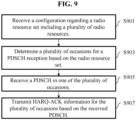
- a method of transmitting hybrid automatic repeat request (HARQ) acknowledgement (ACK) (HARQ-ACK) information by a user equipment (UE) in a wireless communication system may include: receiving a configuration regarding a radio resource set including a plurality of radio resources; determining a plurality of physical downlink shared channel (PDSCH) occasions based on the radio resource set; receiving a PDSCH in one PDSCH occasion in the plurality of PDSCH occasions; determining a time resource for transmission of HARQ-ACK information for the PDSCH; and transmitting a HARQ-ACK codebook including the HARQ-ACK information on the time resource.
- the time resource may be determined based on a predetermined PDSCH occasion among the plurality of PDSCH occasions.
- a user equipment for transmitting hybrid automatic repeat request (HARQ) acknowledgement (ACK) (HARQ-ACK) information in a wireless communication system.
- the UE includes: at least one transceiver; at least one processor; and at least one computer memory operably connectable to the at least one processor and configured to store instructions that, when executed, cause the at least one processor to perform operations.
- the operations may include: receiving a configuration regarding a radio resource set including a plurality of radio resources; determining a plurality of physical downlink shared channel (PDSCH) occasions based on the radio resource set; receiving a PDSCH in one PDSCH occasion in the plurality of PDSCH occasions; determining a time resource for transmission of HARQ-ACK information for the PDSCH; and transmitting a HARQ-ACK codebook including the HARQ-ACK information on the time resource.
- the time resource may be determined based on a predetermined PDSCH occasion among the plurality of PDSCH occasions.
- the processing device includes: at least one processor; and at least one computer memory operably connectable to the at least one processor and configured to store instructions that, when executed, cause the at least one processor to perform operations.
- the operations may include: receiving a configuration regarding a radio resource set including a plurality of radio resources; determining a plurality of physical downlink shared channel (PDSCH) occasions based on the radio resource set; receiving a PDSCH in one PDSCH occasion in the plurality of PDSCH occasions; determining a time resource for transmission of hybrid automatic repeat request (HARQ) acknowledgement (ACK) (HARQ-ACK) information for the PDSCH; and transmitting a HARQ-ACK codebook including the HARQ-ACK information on the time resource.
- the time resource may be determined based on a predetermined PDSCH occasion among the plurality of PDSCH occasions.
- the computer-readable storage medium stores at least one program code including instructions that, when executed, cause at least one processor to perform operations.
- the operations may include: receiving a configuration regarding a radio resource set including a plurality of radio resources; determining a plurality of physical downlink shared channel (PDSCH) occasions based on the radio resource set; receiving a PDSCH in one PDSCH occasion in the plurality of PDSCH occasions; determining a time resource for transmission of hybrid automatic repeat request (HARQ) acknowledgement (ACK) (HARQ-ACK) information for the PDSCH; and transmitting a HARQ-ACK codebook including the HARQ-ACK information on the time resource.
- the time resource may be determined based on a predetermined PDSCH occasion among the plurality of PDSCH occasions.
- a computer program stored in a computer-readable storage medium.
- the computer program includes at least one program code including instructions that, when executed, cause at least one processor to perform operations.
- the operations may include: receiving a configuration regarding a radio resource set including a plurality of radio resources; determining a plurality of physical downlink shared channel (PDSCH) occasions based on the radio resource set; receiving a PDSCH in one PDSCH occasion in the plurality of PDSCH occasions; determining a time resource for transmission of hybrid automatic repeat request (HARQ) acknowledgement (ACK) (HARQ-ACK) information for the PDSCH; and transmitting a HARQ-ACK codebook including the HARQ-ACK information on the time resource.
- the time resource may be determined based on a predetermined PDSCH occasion among the plurality of PDSCH occasions.
- a method of receiving hybrid automatic repeat request (HARQ) acknowledgement (ACK) (HARQ-ACK) information by a base station (BS) from a user equipment (UE) in a wireless communication system may include: transmitting a configuration regarding a radio resource set including a plurality of radio resources; determining a plurality of physical downlink shared channel (PDSCH) occasions based on the radio resource set; transmitting a PDSCH in one PDSCH occasion in the plurality of PDSCH occasions; determining a time resource for reception of HARQ-ACK information for the PDSCH; and receiving a HARQ-ACK codebook including the HARQ-ACK information on the time resource.
- the time resource may be determined based on a predetermined PDSCH occasion among the plurality of PDSCH occasions.
- a base station for receiving hybrid automatic repeat request (HARQ) acknowledgement (ACK) (HARQ-ACK) information in a wireless communication system.
- the BS includes at least one transceiver; at least one processor; and at least one computer memory operably connectable to the at least one processor and configured to store instructions that, when executed, cause the at least one processor to perform operations.
- the operations may include transmitting a configuration regarding a radio resource set including a plurality of radio resources; determining a plurality of physical downlink shared channel (PDSCH) occasions based on the radio resource set; transmitting a PDSCH in one PDSCH occasion in the plurality of PDSCH occasions; determining a time resource for reception of HARQ-ACK information for the PDSCH; and receiving a HARQ-ACK codebook including the HARQ-ACK information on the time resource, and wherein the time resource is determined based on a predetermined PDSCH occasion among the plurality of PDSCH occasions.
- PDSCH physical downlink shared channel
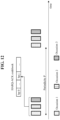
- the configuration may include information regarding a periodicity P.
- the radio resource set may occur repeatedly at the periodicity P.
- the HARQ-ACK information may relate to the plurality of PDSCH occasions included in one period
- the PDSCH may be received or transmitted only in the one PDSCH occasion among the plurality of PDSCHs.
- a last PDSCH occasion among the PDSCH occasions may be used as the predetermined PDSCH occasion, based on the HARQ-ACK information for the PDSCH being ACK.
- the one PDSCH occasion in which the PDSCH is received among the PDSCH occasions may be used as the predetermined PDSCH occasion, based on the HARQ-ACK information for the PDSCH being NACK.
- the HARQ-ACK codebook may include one HARQ-ACK bit for the plurality of PDSCH occasions, based on the PDSCH including one transport block.
- a wireless communication signal may be efficiently transmitted/received. Accordingly, the total throughput of a wireless communication system may be raised.
- various services with different requirements may be efficiently supported in a wireless communication system.
- delay/latency generated during radio communication between communication devices may be reduced.
- a plurality of radio resources may be allocated to a UE, and the UE may transmit/receive a HARQ-ACK response at a determined location when UL transmission or DL reception is capable of being selectively performed on any one of the radio resources.
- a BS since the UE transmits a HARQ-ACK response on a PUCCH at a determined location and receives the HARQ-ACK response at the determined position, a BS does not need to reserve a UL/DL time-frequency radio resource for other transmission possibilities by the UE, and thus efficiency of resource utilization may be raised.
- the multiple access systems may include, for example, a code division multiple access (CDMA) system, a frequency division multiple access (FDMA) system, a time division multiple access (TDMA) system, an orthogonal frequency division multiple access (OFDMA) system, a single-carrier frequency division multiple access (SC-FDMA) system, a multi-carrier frequency division multiple access (MC-FDMA) system, etc.
- CDMA may be implemented by radio technology such as universal terrestrial radio access (UTRA) or CDMA2000.
- TDMA may be implemented by radio technology such as global system for mobile communications (GSM), general packet radio service (GPRS), enhanced data rates for GSM evolution (EDGE) (i.e., GERAN), etc.
- OFDMA may be implemented by radio technology such as institute of electrical and electronics engineers (IEEE) 802.11 (Wi-Fi), IEEE 802.16 (WiMAX), IEEE 802.20, evolved-UTRA (E-UTRA), etc.
- IEEE institute of electrical and electronics engineers
- Wi-Fi Wi-Fi
- WiMAX IEEE 802.16
- E-UTRA evolved-UTRA
- UTRA is part of universal mobile telecommunications system (UMTS) and 3rd generation partnership project (3GPP) long-term evolution (LTE) is part of E-UMTS using E-UTRA.
- 3GPP LTE adopts OFDMA on downlink (DL) and adopts SC-FDMA on uplink (UL).
- LTE-advanced (LTE-A) is an evolved version of 3GPP LTE.
- 3GPP based standard specifications for example, 3GPP TS 36.211, 3GPP TS 36.212, 3GPP TS 36.213, 3GPP TS 36.321, 3GPP TS 36.300, 3GPP TS 36.331, 3GPP TS 37.213, 3GPP TS 38.211, 3GPP TS 38.212, 3GPP TS 38.213, 3GPP TS 38.214, 3GPP TS 38.300, 3GPP TS 38.321, 3GPP TS 38.331, etc.
- a channel transmission entity transmits a channel in compliance with the corresponding "assumption”.
- a channel reception entity receives or decodes the channel in the form of conforming to the "assumption” on the premise that the channel has been transmitted in compliance with the "assumption”.
- a user equipment may be fixed or mobile.
- Each of various devices that transmit and/or receive user data and/or control information by communicating with a base station (BS) may be the UE.
- the term UE may be referred to as terminal equipment, mobile station (MS), mobile terminal (MT), user terminal (UT), subscriber station (SS), wireless device, personal digital assistant (PDA), wireless modem, handheld device, etc.
- a BS refers to a fixed station that communicates with a UE and/or another BS and exchanges data and control information with a UE and another BS.
- the term BS may be referred to as advanced base station (ABS), Node-B (NB), evolved Node-B (eNB), base transceiver system (BTS), access point (AP), processing server (PS), etc.
- ABS advanced base station
- NB Node-B
- eNB evolved Node-B
- BTS base transceiver system
- AP access point
- PS processing server
- a BS of a universal terrestrial radio access (UTRAN) is referred to as an NB
- a BS of an evolved-UTRAN (E-UTRAN) is referred to as an eNB
- a BS of new radio access technology network is referred to as a gNB.
- the NB, eNB, or gNB will be referred to as a BS regardless of the type or version of communication technology.
- a node refers to a fixed point capable of transmitting/receiving a radio signal to/from a UE by communication with the UE.
- Various types of BSs may be used as nodes regardless of the names thereof.
- a BS, NB, eNB, pico-cell eNB (PeNB), home eNB (HeNB), relay, repeater, etc. may be a node.
- a node may not be a BS.
- a radio remote head (RRH) or a radio remote unit (RRU) may be a node.
- the RRH and RRU have power levels lower than that of the BS.
- RRH/RRU Since the RRH or RRU (hereinafter, RRH/RRU) is connected to the BS through a dedicated line such as an optical cable in general, cooperative communication according to the RRH/RRU and the BS may be smoothly performed relative to cooperative communication according to BSs connected through a wireless link.
- At least one antenna is installed per node.
- An antenna may refer to a physical antenna port or refer to a virtual antenna or an antenna group.
- the node may also be called a point.
- a cell refers to a specific geographical area in which one or more nodes provide communication services. Accordingly, in the present disclosure, communication with a specific cell may mean communication with a BS or a node providing communication services to the specific cell.
- a DL/UL signal of the specific cell refers to a DL/UL signal from/to the BS or the node providing communication services to the specific cell.
- a cell providing UL/DL communication services to a UE is especially called a serving cell.
- channel status/quality of the specific cell refers to channel status/quality of a channel or a communication link generated between the BS or the node providing communication services to the specific cell and the UE.
- the UE may measure a DL channel state from a specific node using cell-specific reference signal(s) (CRS(s)) transmitted on a CRS resource and/or channel state information reference signal(s) (CSI-RS(s)) transmitted on a CSI-RS resource, allocated to the specific node by antenna port(s) of the specific node.
- CRS cell-specific reference signal
- CSI-RS channel state information reference signal
- a 3GPP-based communication system uses the concept of a cell in order to manage radio resources, and a cell related with the radio resources is distinguished from a cell of a geographic area.
- the "cell” of the geographic area may be understood as coverage within which a node may provide services using a carrier, and the "cell” of the radio resources is associated with bandwidth (BW), which is a frequency range configured by the carrier. Since DL coverage, which is a range within which the node is capable of transmitting a valid signal, and UL coverage, which is a range within which the node is capable of receiving the valid signal from the UE, depend upon a carrier carrying the signal, coverage of the node may also be associated with coverage of the "cell" of radio resources used by the node. Accordingly, the term "cell” may be used to indicate service coverage by the node sometimes, radio resources at other times, or a range that a signal using the radio resources may reach with valid strength at other times.
- BW bandwidth
- the concept of the cell is used in order to manage radio resources.
- the "cell" associated with the radio resources is defined by a combination of DL resources and UL resources, that is, a combination of a DL component carrier (CC) and a UL CC.
- the cell may be configured by the DL resources only or by the combination of the DL resources and the UL resources.
- linkage between a carrier frequency of the DL resources (or DL CC) and a carrier frequency of the UL resources (or UL CC) may be indicated by system information.
- the combination of the DL resources and the UL resources may be indicated by system information block type 2 (SIB2) linkage.
- SIB2 system information block type 2
- the carrier frequency may be equal to or different from a center frequency of each cell or CC.
- CA carrier aggregation
- the UE has only one radio resource control (RRC) connection with a network.
- RRC radio resource control
- one serving cell provides non-access stratum (NAS) mobility information.
- NAS non-access stratum
- RRC connection re-establishment/handover one serving cell provides security input.
- This cell is referred to as a primary cell (Pcell).
- the Pcell refers to a cell operating on a primary frequency on which the UE performs an initial connection establishment procedure or initiates a connection re-establishment procedure.
- secondary cells may be configured to form a set of serving cells together with the Pcell.
- the Scell may be configured after completion of RRC connection establishment and used to provide additional radio resources in addition to resources of a specific cell (SpCell).
- a carrier corresponding to the Pcell on DL is referred to as a downlink primary CC (DL PCC)
- DL PCC downlink primary CC
- UL PCC uplink primary CC
- a carrier corresponding to the Scell on DL is referred to as a downlink secondary CC (DL SCC)
- a carrier corresponding to the Scell on UL is referred to as an uplink secondary CC (UL SCC).
- the term special cell refers to a Pcell of a master cell group (MCG) or a primary secondary cell (PSCell) of a secondary cell group (SCG).
- MCG master cell group
- PSCell primary secondary cell
- SCG secondary cell group
- the SpCell supports PUCCH transmission and contention-based random access and is always activated.
- the MCG is a group of service cells associated with a master node (e.g., BS) and includes the SpCell (Pcell) and optionally one or more Scells.
- the SCG is a subset of serving cells associated with a secondary node and includes the PSCell and 0 or more Scells.
- the PSCell is a primary Scell of the SCG.
- serving cells For a UE in RRC_CONNECTED state, that is not configured with CA or DC, only one serving cell including only the Pcell is present.
- serving cells For a UE in RRC_CONNECTED state, that is configured with CA or DC, the term serving cells refers to a set of cells including SpCell(s) and all Scell(s).
- two medium access control (MAC) entities i.e., one MAC entity for the MCG and one MAC entity for the SCG, are configured for the UE.
- a Pcell PUCCH group (also called a primary PUCCH group) including the Pcell and 0 or more Scells and an Scell PUCCH group (also called a secondary PUCCH group) including only Scell(s) may be configured.
- a PUCCH cell an Scell on which a PUCCH associated with the corresponding cell is transmitted (hereinafter, a PUCCH cell) may be configured.
- An Scell for which a PUCCH Scell is indicated belongs to the Scell PUCCH group (i.e., the secondary PUCCH group) and PUCCH transmission of related uplink control information (UCI) is performed on the PUCCH Scell.
- UCI uplink control information
- the Scell belongs to the Pcell PUCCH group (i.e., the primary PUCCH group) and PUCCH transmission of related UCI is performed on the Pcell.
- the primary cell may refer to the PSCell of the SCG.
- the primary cell may refer to the PUCCH Scell of the secondary PUCCH group.
- the UE receives information on DL from the BS and the UE transmits information on UL to the BS.
- the information that the BS and UE transmit and/or receive includes data and a variety of control information and there are various physical channels according to types/usage of the information that the UE and the BS transmit and/or receive.
- the 3GPP-based communication standards define DL physical channels corresponding to resource elements carrying information originating from a higher layer and DL physical signals corresponding to resource elements which are used by the physical layer but do not carry the information originating from the higher layer.
- a physical downlink shared channel (PDSCH), a physical broadcast channel (PBCH), a physical multicast channel (PMCH), a physical control format indicator channel (PCFICH), a physical downlink control channel (PDCCH), etc. are defined as the DL physical channels
- a reference signal (RS) and a synchronization signal (SS) are defined as the DL physical signals.
- the RS which is also referred to as a pilot, represents a signal with a predefined special waveform known to both the BS and the UE.
- a demodulation reference signal (DMRS), a channel state information RS (CSI-RS), etc. are defined as DL RSs.
- the 3GPP-based communication standards define UL physical channels corresponding to resource elements carrying information originating from the higher layer and UL physical signals corresponding to resource elements which are used by the physical layer but do not carry the information originating from the higher layer.
- a physical uplink shared channel (PUSCH), a physical uplink control channel (PUCCH), and a physical random access channel (PRACH) are defined as the UL physical channels
- a DMRS for a UL control/data signal, a sounding reference signal (SRS) used for UL channel measurement, etc. are defined.
- a PDCCH refers to a set of time-frequency resources (e.g., resource elements (REs)) carrying downlink control information (DCI), and a PDSCH refers to a set of time-frequency resources carrying DL data.
- a PUCCH, a PUSCH, and a PRACH refer to a set of time-frequency resources carrying UCI, a set of time-frequency resources carrying UL data, and a set of time-frequency resources carrying random access signals, respectively.
- the UE transmits/receives a PUCCH/PUSCH/PRACH is used as the same meaning that the UE transmits/receives the UCI/UL data/random access signals on or through the PUCCH/PUSCH/PRACH, respectively.
- the BS transmits/receives a PBCH/PDCCH/PDSCH is used as the same meaning that the BS transmits the broadcast information/DCI/DL data on or through a PBCH/PDCCH/PDSCH, respectively.
- a radio resource (e.g., a time-frequency resource) scheduled or configured to the UE by the BS for transmission or reception of the PUCCH/PUSCH/PDSCH may be referred to as a PUCCH/PUSCH/PDSCH resource.
- a communication device may not select and receive radio signals including only a specific physical channel or a specific physical signal through a radio frequency (RF) receiver, or may not select and receive radio signals without a specific physical channel or a specific physical signal through the RF receiver.
- RF radio frequency
- the communication device receives radio signals on the cell via the RF receiver, converts the radio signals, which are RF band signals, into baseband signals, and then decodes physical signals and/or physical channels in the baseband signals using one or more processors.
- reception of physical signals and/or physical channels may mean that a communication device does not attempt to restore the physical signals and/or physical channels from radio signals, for example, does not attempt to decode the physical signals and/or physical channels, rather than that the communication device does not actually receive the radio signals including the corresponding physical signals and/or physical channels.
- next-generation RAT is being discussed in consideration of eMBB communication, massive MTC, ultra-reliable and low-latency communication (URLLC), and the like.
- URLLC ultra-reliable and low-latency communication
- 3GPP a study on the next-generation mobile communication systems after EPC is being conducted.
- the corresponding technology is referred to as a new RAT (NR) or fifth-generation (5G) RAT, and a system using NR or supporting NR is referred to as an NR system.
- NR new RAT
- 5G fifth-generation
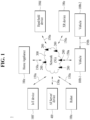
- FIG. 1 illustrates an example of a communication system 1 to which implementations of the present disclosure are applied.
- the communication system 1 applied to the present disclosure includes wireless devices, BSs, and a network.
- the wireless devices represent devices performing communication using RAT (e.g., 5G NR or LTE (e.g., E-UTRA)) and may be referred to as communication/radio/SG devices.
- the wireless devices may include, without being limited to, a robot 100a, vehicles 100b-1 and 100b-2, an extended reality (XR) device 100c, a hand-held device 100d, a home appliance 100e, an Internet of Things (IoT) device 100f, and an artificial intelligence (AI) device/server 400.
- RAT e.g., 5G NR or LTE (e.g., E-UTRA
- the wireless devices may include, without being limited to, a robot 100a, vehicles 100b-1 and 100b-2, an extended reality (XR) device 100c, a hand-held device 100d
- the vehicles may include a vehicle having a wireless communication function, an autonomous driving vehicle, and a vehicle capable of performing vehicle-to-vehicle communication.
- the vehicles may include an unmanned aerial vehicle (UAV) (e.g., a drone).
- UAV unmanned aerial vehicle
- the XR device may include an augmented reality (AR)/virtual reality (VR)/mixed reality (MR) device and may be implemented in the form of a head-mounted device (HMD), a head-up display (HUD) mounted in a vehicle, a television, a smartphone, a computer, a wearable device, a home appliance device, a digital signage, a vehicle, a robot, etc.
- AR augmented reality
- VR virtual reality
- MR mixeded reality
- HMD head-mounted device
- HUD head-up display
- the hand-held device may include a smartphone, a smartpad, a wearable device (e.g., a smartwatch or smartglasses), and a computer (e.g., a notebook).
- the home appliance may include a TV, a refrigerator, and a washing machine.
- the IoT device may include a sensor and a smartmeter.
- the BSs and the network may also be implemented as wireless devices and a specific wireless device may operate as a BS/network node with respect to another wireless device.
- the wireless devices 100a to 100f may be connected to a network 300 via BSs 200.
- AI technology may be applied to the wireless devices 100a to 100f and the wireless devices 100a to 100f may be connected to the AI server 400 via the network 300.
- the network 300 may be configured using a 3G network, a 4G (e.g., LTE) network, or a 5G (e.g., NR) network.
- the wireless devices 100a to 100f may communicate with each other through the BSs 200/network 300, the wireless devices 100a to 100f may perform direct communication (e.g., sidelink communication) with each other without passing through the BSs/network.
- the vehicles 100b-1 and 100b-2 may perform direct communication (e.g., vehicle-to-vehicle (V2V)/Vehicle-to-everything (V2X) communication).
- the IoT device e.g., a sensor
- the IoT device may perform direct communication with other IoT devices (e.g., sensors) or other wireless devices 100a to 100f.
- Wireless communication/connections 150a and 150b may be established between the wireless devices 100a to 100f and the BSs 200 and between the wireless devices 100a to 100f).
- the wireless communication/connections such as UL/DL communication 150a and sidelink communication 150b (or, device-to-device (D2D) communication) may be established by various RATs (e.g., 5G NR).
- the wireless devices and the BSs/wireless devices may transmit/receive radio signals to/from each other through the wireless communication/connections 150a and 150b.
- various configuration information configuring processes various signal processing processes (e.g., channel encoding/decoding, modulation/demodulation, and resource mapping/demapping), and resource allocating processes, for transmitting/receiving radio signals, may be performed based on the various proposals of the present disclosure.
- various signal processing processes e.g., channel encoding/decoding, modulation/demodulation, and resource mapping/demapping
- resource allocating processes for transmitting/receiving radio signals
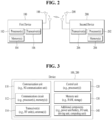
- FIG. 2 is a block diagram illustrating examples of communication devices capable of performing a method according to the present disclosure.
- a first wireless device 100 and a second wireless device 200 may transmit and/or receive radio signals through a variety of RATs (e.g., LTE and NR).
- RATs e.g., LTE and NR
- ⁇ the first wireless device 100 and the second wireless device 200 ⁇ may correspond to ⁇ the wireless device 100x and the BS 200 ⁇ and/or ⁇ the wireless device 100x and the wireless device 100x ⁇ of FIG. 1 .
- the first wireless device 100 may include one or more processors 102 and one or more memories 104 and additionally further include one or more transceivers 106 and/or one or more antennas 108.
- the processor(s) 102 may control the memory(s) 104 and/or the transceiver(s) 106 and may be configured to implement the below-described /proposed functions, procedures, and/or methods.
- the processor(s) 102 may process information within the memory(s) 104 to generate first information/signals and then transmit radio signals including the first information/signals through the transceiver(s) 106.
- the processor(s) 102 may receive radio signals including second information/signals through the transceiver(s) 106 and then store information obtained by processing the second information/signals in the memory(s) 104.
- the memory(s) 104 may be connected to the processor(s) 102 and may store a variety of information related to operations of the processor(s) 102.
- the memory(s) 104 may perform a part or all of processes controlled by the processor(s) 102 or store software code including instructions for performing the below-described/proposed procedures and/or methods.
- the processor(s) 102 and the memory(s) 104 may be a part of a communication modem/circuit/chip designed to implement RAT (e.g., LTE or NR).
- RAT e.g., LTE or NR
- the transceiver(s) 106 may be connected to the processor(s) 102 and transmit and/or receive radio signals through one or more antennas 108. Each of the transceiver(s) 106 may include a transmitter and/or a receiver. The transceiver(s) 106 is used interchangeably with radio frequency (RF) unit(s). In the present disclosure, the wireless device may represent the communication modem/circuit/chip.
- RF radio frequency
- the second wireless device 200 may include one or more processors 202 and one or more memories 204 and additionally further include one or more transceivers 206 and/or one or more antennas 208.
- the processor(s) 202 may control the memory(s) 204 and/or the transceiver(s) 206 and may be configured to implement the below-described/proposed functions, procedures, and/or methods.
- the processor(s) 202 may process information within the memory(s) 204 to generate third information/signals and then transmit radio signals including the third information/signals through the transceiver(s) 206.
- the processor(s) 202 may receive radio signals including fourth information/signals through the transceiver(s) 106 and then store information obtained by processing the fourth information/signals in the memory(s) 204.
- the memory(s) 204 may be connected to the processor(s) 202 and may store a variety of information related to operations of the processor(s) 202. For example, the memory(s) 204 may perform a part or all of processes controlled by the processor(s) 202 or store software code including instructions for performing the below-described/proposed procedures and/or methods.
- the processor(s) 202 and the memory(s) 204 may be a part of a communication modem/circuit/chip designed to implement RAT (e.g., LTE or NR).
- RAT e.g., LTE or NR
- the transceiver(s) 206 may be connected to the processor(s) 202 and transmit and/or receive radio signals through one or more antennas 208. Each of the transceiver(s) 206 may include a transmitter and/or a receiver. The transceiver(s) 206 is used interchangeably with RF unit(s). In the present disclosure, the wireless device may represent the communication modem/circuit/chip.
- the wireless communication technology implemented in the wireless devices 100 and 200 of the present disclosure may include narrowband Internet of things for low-power communication as well as LTE, NR, and 6G.
- the NB-IoT technology may be an example of low-power wide-area network (LPWAN) technologies and implemented in standards such as LTE Cat NB1 and/or LTE Cat NB2.
- LPWAN low-power wide-area network
- the wireless communication technology implemented in the wireless devices XXX and YYY of the present disclosure may perform communication based on the LTE-M technology.
- the LTE-M technology may be an example of LPWAN technologies and called by various names including enhanced machine type communication (eMTC).
- eMTC enhanced machine type communication
- the LTE-M technology may be implemented in at least one of the following various standards: 1) LTE CAT 0, 2) LTE Cat M1, 3) LTE Cat M2, 4) LTE non-Bandwidth Limited (non-BL), 5) LTE-MTC, 6) LTE Machine Type Communication, and/or 7) LTE M, etc., but the LTE-M technology is not limited to the above names.
- the wireless communication technology implemented in the wireless devices XXX and YYY of the present disclosure may include at least one of ZigBee, Bluetooth, and LPWAN in consideration of low-power communication, but the wireless communication technology is not limited to the above names.
- the ZigBee technology may create a personal area network (PAN) related to small/low-power digital communication based on various standards such as IEEE 802.15.4 and so on, and the ZigBee technology may be called by various names.
- PAN personal area network
- One or more protocol layers may be implemented by, without being limited to, one or more processors 102 and 202.
- the one or more processors 102 and 202 may implement one or more layers (e.g., functional layers such as a physical (PHY) layer, medium access control (MAC) layer, a radio link control (RLC) layer, a packet data convergence protocol (PDCP) layer, radio resource control (RRC) layer, and a service data adaptation protocol (SDAP) layer).
- layers e.g., functional layers such as a physical (PHY) layer, medium access control (MAC) layer, a radio link control (RLC) layer, a packet data convergence protocol (PDCP) layer, radio resource control (RRC) layer, and a service data adaptation protocol (SDAP) layer).
- PHY physical
- MAC medium access control
- RLC radio link control
- PDCP packet data convergence protocol
- RRC radio resource control
- SDAP service data adaptation protocol
- the one or more processors 102 and 202 may generate one or more protocol data units (PDUs) and/or one or more service data units (SDUs) according to the functions, procedures, proposals, and/or methods disclosed in the present disclosure.
- the one or more processors 102 and 202 may generate messages, control information, data, or information according to the functions, procedures, proposals, and/or methods disclosed in the present disclosure.
- the one or more processors 102 and 202 may generate signals (e.g., baseband signals) including PDUs, SDUs, messages, control information, data, or information according to the functions, procedures, proposals, and/or methods disclosed in the present disclosure and provide the generated signals to the one or more transceivers 106 and 206.
- the one or more processors 102 and 202 may receive the signals (e.g., baseband signals) from the one or more transceivers 106 and 206 and acquire the PDUs, SDUs, messages, control information, data, or information according to the functions, procedures, proposals, and/or methods disclosed in the present disclosure.
- signals e.g., baseband signals
- the one or more processors 102 and 202 may be referred to as controllers, microcontrollers, microprocessors, or microcomputers.
- the one or more processors 102 and 202 may be implemented by hardware, firmware, software, or a combination thereof.
- ASICs application specific integrated circuits
- DSPs digital signal processors
- DSPDs digital signal processing devices
- PLDs programmable logic devices
- FPGAs field programmable gate arrays
- the functions, procedures, proposals, and/or methods disclosed in the present disclosure may be implemented using firmware or software, and the firmware or software may be configured to include the modules, procedures, or functions.
- Firmware or software configured to perform the functions, procedures, proposals, and/or methods disclosed in the present disclosure may be included in the one or more processors 102 and 202 or stored in the one or more memories 104 and 204 so as to be driven by the one or more processors 102 and 202.
- the functions, procedures, proposals, and/or methods disclosed in the present disclosure may be implemented using firmware or software in the form of code, commands, and/or a set of commands.
- the one or more memories 104 and 204 may be connected to the one or more processors 102 and 202 and store various types of data, signals, messages, information, programs, code, commands, and/or instructions.
- the one or more memories 104 and 204 may be configured by read-only memories (ROMs), random access memories (RAMs), electrically erasable programmable read-only memories (EPROMs), flash memories, hard drives, registers, cash memories, computer-readable storage media, and/or combinations thereof.
- the one or more memories 104 and 204 may be located at the interior and/or exterior of the one or more processors 102 and 202.
- the one or more memories 104 and 204 may be connected to the one or more processors 102 and 202 through various technologies such as wired or wireless connection.
- the one or more transceivers 106 and 206 may transmit user data, control information, and/or radio signals/channels, mentioned in the methods and/or operational flowcharts of the present disclosure, to one or more other devices.
- the one or more transceivers 106 and 206 may receive user data, control information, and/or radio signals/channels, mentioned in the functions, procedures, proposals, methods, and/or operational flowcharts disclosed in the present disclosure, from one or more other devices.
- the one or more transceivers 106 and 206 may be connected to the one or more processors 102 and 202 and transmit and receive radio signals.
- the one or more processors 102 and 202 may perform control so that the one or more transceivers 106 and 206 may transmit user data, control information, or radio signals to one or more other devices.
- the one or more processors 102 and 202 may perform control so that the one or more transceivers 106 and 206 may receive user data, control information, or radio signals from one or more other devices.
- the one or more transceivers 106 and 206 may be connected to the one or more antennas 108 and 208.
- the one or more transceivers 106 and 206 may be configured to transmit and receive user data, control information, and/or radio signals/channels, mentioned in the functions, procedures, proposals, methods, and/or operational flowcharts disclosed in the present disclosure, through the one or more antennas 108 and 208.
- the one or more antennas may be a plurality of physical antennas or a plurality of logical antennas (e.g., antenna ports).
- the one or more transceivers 106 and 206 may convert received radio signals/channels etc. from RF band signals into baseband signals in order to process received user data, control information, radio signals/channels, etc. using the one or more processors 102 and 202.
- the one or more transceivers 106 and 206 may convert the user data, control information, radio signals/channels, etc. processed using the one or more processors 102 and 202 from the base band signals into the RF band signals. To this end, the one or more transceivers 106 and 206 may include (analog) oscillators and/or filters.
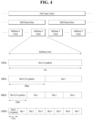
- FIG. 3 illustrates another example of a wireless device capable of performing implementation(s) of the present disclosure.
- wireless devices 100 and 200 may correspond to the wireless devices 100 and 200 of FIG. 2 and may be configured by various elements, components, units/portions, and/or modules.
- each of the wireless devices 100 and 200 may include a communication unit 110, a control unit 120, a memory unit 130, and additional components 140.
- the communication unit may include a communication circuit 112 and transceiver(s) 114.
- the communication circuit 112 may include the one or more processors 102 and 202 and/or the one or more memories 104 and 204 of FIG. 2 .
- the transceiver(s) 114 may include the one or more transceivers 106 and 206 and/or the one or more antennas 108 and 208 of FIG. 2 .
- the control unit 120 is electrically connected to the communication unit 110, the memory 130, and the additional components 140 and controls overall operation of the wireless devices.
- the control unit 120 may control an electric/mechanical operation of the wireless device based on programs/code/commands/information stored in the memory unit 130.
- the control unit 120 may transmit the information stored in the memory unit 130 to the exterior (e.g., other communication devices) via the communication unit 110 through a wireless/wired interface or store, in the memory unit 130, information received through the wireless/wired interface from the exterior (e.g., other communication devices) via the communication unit 110.
- the additional components 140 may be variously configured according to types of wireless devices.
- the additional components 140 may include at least one of a power unit/battery, input/output (I/O) unit, a driving unit, and a computing unit.
- the wireless device may be implemented in the form of, without being limited to, the robot (100a of FIG. 1 ), the vehicles (100b-1 and 100b-2 of FIG. 1 ), the XR device (100c of FIG. 1 ), the hand-held device (100d of FIG. 1 ), the home appliance (100e of FIG. 1 ), the IoT device (100f of FIG.
- the wireless device may be used in a mobile or fixed place according to a use-case/service.
- the entirety of the various elements, components, units/portions, and/or modules in the wireless devices 100 and 200 may be connected to each other through a wired interface or at least a part thereof may be wirelessly connected through the communication unit 110.
- the control unit 120 and the communication unit 110 may be connected by wire and the control unit 120 and first units (e.g., 130 and 140) may be wirelessly connected through the communication unit 110.
- Each element, component, unit/portion, and/or module within the wireless devices 100 and 200 may further include one or more elements.
- the control unit 120 may be configured by a set of one or more processors.
- control unit 120 may be configured by a set of a communication control processor, an application processor, an electronic control unit (ECU), a graphical processing unit, and a memory control processor.
- memory 130 may be configured by a random access memory (RAM), a dynamic RAM (DRAM), a read-only memory (ROM)), a flash memory, a volatile memory, a non-volatile memory, and/or a combination thereof.
- the at least one memory may store instructions or programs, and the instructions or programs may cause, when executed, at least one processor operably connected to the at least one memory to perform operations according to some embodiments or implementations of the present disclosure.
- a computer readable (non-transitory) storage medium may store at least one instruction or program, and the at least one instruction or program may cause, when executed by at least one processor, the at least one processor to perform operations according to some embodiments or implementations of the present disclosure.
- a processing device or apparatus may include at least one processor, and at least one computer memory operably connected to the at least one processor.
- the at least one computer memory may store instructions or programs, and the instructions or programs may cause, when executed, the at least one processor operably connected to the at least one memory to perform operations according to some embodiments or implementations of the present disclosure.
- a computer program may include program code stored on at least one computer-readable (non-volatile) storage medium and, when executed, configured to perform operations according to some implementations of the present disclosure or cause at least one processor to perform the operations according to some implementations of the present disclosure.
- the computer program may be provided in the form of a computer program product.
- the computer program product may include at least one computer-readable (non-volatile) storage medium.
- a communication device of the present disclosure includes at least one processor; and at least one computer memory operably connected to the at least one processor and configured to store instructions for causing, when executed, the at least one processor to perform operations according to example(s) of the present disclosure described later.
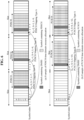
- FIG. 4 illustrates an example of a frame structure used in a 3GPP-based wireless communication system.
- the frame structure of FIG. 4 is purely exemplary and the number of subframes, the number of slots, and the number of symbols, in a frame, may be variously changed.
- different OFDM numerologies e.g., subcarrier spacings (SCSs)
- SCSs subcarrier spacings
- the (absolute time) duration of a time resource including the same number of symbols e.g., a subframe, a slot, or a transmission time interval (TTI)
- TTI transmission time interval
- the symbol may include an OFDM symbol (or cyclic prefix - OFDM (CP-OFDM) symbol) and an SC-FDMA symbol (or discrete Fourier transform-spread-OFDM (DFT-s-OFDM) symbol).
- OFDM symbol or cyclic prefix - OFDM (CP-OFDM) symbol
- SC-FDMA symbol or discrete Fourier transform-spread-OFDM (DFT-s-OFDM) symbol.
- DFT-s-OFDM discrete Fourier transform-spread-OFDM
- Each half-frame includes 5 subframes and a duration T sf of a single subframe is 1 ms.
- Subframes are further divided into slots and the number of slots in a subframe depends on a subcarrier spacing.
- Each slot includes 14 or 12 OFDM symbols based on a cyclic prefix. In a normal CP, each slot includes 14 OFDM symbols and, in an extended CP, each slot includes 12 OFDM symbols.
- the table below shows the number of OFDM symbols ( N slot symb ) per slot, the number of slots ( N frame,u slot ) per frame, and the number of slots ( N subframe,u slot ) per subframe.
- Table 1 u N slot symb N frame,u slot N subframe,u slot 0 14 10 1 1 14 20 2 2 14 40 4 3 14 80 8 4 14 160 16
- slots may be indexed within a subframe in ascending order as follows: n u s ⁇ ⁇ 0, ..., n subframe,u slot - 1 ⁇ and indexed within a frame in ascending order as follows: n u s,f ⁇ ⁇ 0, ..., n frame,u slot - 1 ⁇ .
- FIG. 5 illustrates a resource grid of a slot.
- the slot includes multiple (e.g., 14 or 12) symbols in the time domain.
- a resource grid of N slze,u grid,x * N RB sc subcarriers and N subframe,u symb OFDM symbols is defined, starting at a common resource block (CRB) N start,u grid indicated by higher layer signaling (e.g. RRC signaling), where N size,u grid,x is the number of resource blocks (RBs) in the resource grid and the subscript x is DL for downlink and UL for uplink.
- N RB sc is the number of subcarriers per RB.
- N RB sc is typically 12.
- the carrier bandwidth N size,u grid for the subcarrier spacing configuration u is given to the UE by a higher layer parameter (e.g. RRC parameter).
- Each element in the resource grid for the antenna port p and the subcarrier spacing configuration u is referred to as a resource element (RE) and one complex symbol may be mapped to each RE.
- Each RE in the resource grid is uniquely identified by an index k in the frequency domain and an index l representing a symbol location relative to a reference point in the time domain.
- an RB is defined by 12 consecutive subcarriers in the frequency domain.
- RBs are classified into CRBs and physical resource blocks (PRBs).
- the CRBs are numbered from 0 upwards in the frequency domain for the subcarrier spacing configuration u .
- the center of subcarrier 0 of CRB 0 for the subcarrier spacing configuration u is equal to 'Point A' which serves as a common reference point for RB grids.
- the PRBs for subcarrier spacing configuration u are defined within a bandwidth part (BWP) and numbered from 0 to N size,u BWP,i -1, where i is a number of the BWP.
- BWP bandwidth part
- n u PRB n u CRB + N size,u BWP,i , where N size BWP,i is a CRB in which the BWP starts relative to CRB 0.
- the BWP includes a plurality of consecutive RBs in the frequency domain.
- the BWP may be a subset of contiguous CRBs defined for a given numerology u i in the BWP i on a given carrier.
- a carrier may include a maximum of N (e.g., 5) BWPs.
- the UE may be configured to have one or more BWPs on a given component carrier. Data communication is performed through an activated BWP and only a predetermined number of BWPs (e.g., one BWP) among BWPs configured for the UE may be active on the component carrier.
- the network may configure at least an initial DL BWP and one (if the serving cell is configured with uplink) or two (if supplementary uplink is used) initial UL BWPs.
- the network may configure additional UL and DL BWPs.
- VRBs Virtual resource blocks
- the VRBs may be mapped to PRBs according to non-interleaved mapping.
- VRB n may be mapped to PRB n for non-interleaved VRB-to-PRB mapping.
- the UE for which carrier aggregation is configured may be configured to use one or more cells. If the UE is configured with a plurality of serving cells, the UE may be configured with one or multiple cell groups. The UE may also be configured with a plurality of cell groups associated with different BSs. Alternatively, the UE may be configured with a plurality of cell groups associated with a single BS. Each cell group of the UE includes one or more serving cells and includes a single PUCCH cell for which PUCCH resources are configured. The PUCCH cell may be a Pcell or an Scell configured as the PUCCH cell among Scells of a corresponding cell group. Each serving cell of the UE belongs to one of cell groups of the UE and does not belong to a plurality of cells.
- NR frequency bands are defined as two types of frequency ranges, i.e., FR1 and FR2.
- FR2 is also referred to as millimeter wave (mmW).
- mmW millimeter wave
- Table 3 Frequency Range designation Corresponding frequency range Subcarrier Spacing FR1 410MHz - 7125MHz 15, 30, 60kHz FR2 24250MHz - 52600MHz 60, 120, 240kHz
- a PDCCH carries DCI.
- the PDCCH i.e., DCI
- DL-SCH downlink shared channel
- UL-SCH uplink shared channel
- PCH paging information about a paging channel
- system information about the DL-SCH information about resource allocation for a control message, such as a random access response (RAR) transmitted on a PDSCH, of a layer (hereinafter, higher layer) positioned higher than a physical layer among protocol stacks of the UE/BS, a transmit power control command, information about activation/deactivation of configured scheduling (CS), etc.
- RAR random access response
- DCI including resource allocation information on the DL-SCH is called PDSCH scheduling DCI
- DCI including resource allocation information on the UL-SCH is called PUSCH scheduling DCI.
- the DCI includes a cyclic redundancy check (CRC).
- the CRC is masked/scrambled with various identifiers (e.g., radio network temporary identifier (RNTI)) according to an owner or usage of the PDCCH. For example, if the PDCCH is for a specific UE, the CRS is masked with a UE identifier (e.g., cell-RNTI (C-RNTI)).
- C-RNTI cell-RNTI
- the CRC is masked with a paging RNTI (P-RNTI). If the PDCCH is for system information (e.g., system information block (SIB)), the CRC is masked with a system information RNTI (SI-RNTI). If the PDCCH is for a random access response, the CRC is masked with a random access-RNTI (RA-RNTI).
- SIB system information block
- RA-RNTI random access-RNTI
- Cross-carrier scheduling with a carrier indicator field may allow a PDCCH on a serving cell to schedule resources on another serving cell.
- a PDSCH on a serving cell schedules a PDSCH or a PUSCH on the serving cell, it is referred to as self-carrier scheduling.
- the BS may provide information about a cell scheduling the cell to the UE. For example, the BS may inform the UE whether a serving cell is scheduled by a PDCCH on another (scheduling) cell or scheduled by the serving cell.
- the BS may inform the UE which cell signals DL assignments and UL grants for the serving cell.
- a cell carrying a PDCCH is referred to as a scheduling cell
- a cell where transmission of a PUSCH or a PDSCH is scheduled by DCI included in the PDCCH, that is, a cell carrying the PUSCH or PDSCH scheduled by the PDCCH is referred to as a scheduled cell.
- a PDSCH is a physical layer UL channel for UL data transport.
- the PDSCH carries DL data (e.g., DL-SCH transport block) and is subjected to modulation such as quadrature phase shift keying (QPSK), 16 quadrature amplitude modulation (QAM), 64 QAM, 256 QAM, etc.
- a codeword is generated by encoding a transport block (TB).
- the PDSCH may carry a maximum of two codewords. Scrambling and modulation mapping per codeword may be performed and modulation symbols generated from each codeword may be mapped to one or more layers. Each layer is mapped to a radio resource together with a DMRS and generated as an OFDM symbol signal. Then, the OFDM symbol signal is transmitted through a corresponding antenna port.
- a PUCCH is a physical layer UL channel for uplink control information (UCI) transmission.
- the PUCCH carries UCI.
- UCI types transmitted on the PUCCH include hybrid automatic repeat request acknowledgement (HARQ-ACK) information, a scheduling request (SR), and channel state information (CSI).
- UCI bits include HARQ-ACK information bits if present, SR information bits if present, link recovery request (LRR) information bits if present, and CSI bits if present.
- HARQ-ACK information bits correspond to a HARQ-ACK codebook.
- a bit sequence in which HARQ-ACK information bits are arranged according to a predetermined rule is called a HARQ-ACK codebook.
- PUCCH resources configured/indicated for/to the UE by the BS for HARQ-ACK, SR, and CSI transmission are referred to as a HARQ-ACK PUCCH resource, an SR PUCCH resource, and a CSI PUCCH resource, respectively.
- PUCCH formats may be defined as follows according to UCI payload sizes and/or transmission lengths (e.g., the number of symbols included in PUCCH resources). In regard to the PUCCH formats, reference may also be made to Table 4.
- a PUCCH resource may be determined according to a UCI type (e.g., A/N, SR, or CSI).
- a PUCCH resource used for UCI transmission may be determined based on a UCI (payload) size.
- the BS may configure a plurality of PUCCH resource sets for the UE, and the UE may select a specific PUCCH resource set corresponding to a specific range according to the range of the UCI (payload) size (e.g., numbers of UCI bits).
- the UE may select one of the following PUCCH resource sets according to the number of UCI bits, N UCI.
- K represents the number of PUCCH resource sets (K>1) and N i represents a maximum number of UCI bits supported by PUCCH resource set #i.
- PUCCH resource set #1 may include resources of PUCCH formats 0 to 1
- the other PUCCH resource sets may include resources of PUCCH formats 2 to 4 (see Table 4).
- Configuration for each PUCCH resource includes a PUCCH resource index, a start PRB index, and configuration for one of PUCCH format 0 to PUCCH format 4.
- the UE is configured with a code rate for multiplexing HARQ-ACK, SR, and CSI report(s) within PUCCH transmission using PUCCH format 2, PUCCH format 3, or PUCCH format 4, by the BS through a higher layer parameter maxCodeRate.
- the higher layer parameter maxCodeRate is used to determine how to feed back the UCI on PUCCH resources for PUCCH format 2, 3, or 4.
- a PUCCH resource to be used for UCI transmission in a PUCCH resource set may be configured for the UE through higher layer signaling (e.g., RRC signaling).
- the UCI type is HARQ-ACK for a semi-persistent scheduling (SPS) PDSCH
- the PUCCH resource to be used for UCI transmission in the PUCCH resource set may be configured for the UE through higher layer signaling (e.g., RRC signaling).
- the UCI type is HARQ-ACK for a PDSCH scheduled by DCI
- the PUCCH resource to be used for UCI transmission in the PUCCH resource set may be scheduled by the DCI.
- the BS may transmit the DCI to the UE on a PDCCH and indicate a PUCCH resource to be used for UCI transmission in a specific PUCCH resource set by an ACK/NACK resource indicator (ARI) in the DCI.
- the ARI may be used to indicate a PUCCH resource for ACK/NACK transmission and also be referred to as a PUCCH resource indicator (PRI).
- the DCI may be used for PDSCH scheduling and the UCI may include HARQ-ACK for a PDSCH.
- the BS may configure a PUCCH resource set including a larger number of PUCCH resources than states representable by the ARI by (UE-specific) higher layer (e.g., RRC) signaling for the UE.
- the ARI may indicate a PUCCH resource subset of the PUCCH resource set and which PUCCH resource in the indicated PUCCH resource subset is to be used may be determined according to an implicit rule based on transmission resource information about the PDCCH (e.g., the starting CCE index of the PDCCH).
- the UE For UL-SCH data transmission, the UE should include UL resources available for the UE and, for DL-SCH data reception, the UE should include DL resources available for the UE.
- the UL resources and the DL resources are assigned to the UE by the BS through resource allocation.
- Resource allocation may include time domain resource allocation (TDRA) and frequency domain resource allocation (FDRA).
- TDRA time domain resource allocation
- FDRA frequency domain resource allocation
- UL resource allocation is also referred to as a UL grant and DL resource allocation is referred to as DL assignment.
- the UL grant is dynamically received by the UE on the PDCCH or in RAR or semi-persistently configured for the UE by the BS through RRC signaling.
- DL assignment is dynamically received by the UE on the PDCCH or semi-persistently configured for the UE by the BS through RRC signaling.
- the BS may dynamically allocate UL resources to the UE through PDCCH(s) addressed to a cell radio network temporary Identifier (C-RNTI).
- C-RNTI cell radio network temporary Identifier
- the UE monitors the PDCCH(s) in order to discover possible UL grant(s) for UL transmission.
- the BS may allocate the UL resources using a configured grant to the UE.
- Two types of configured grants, Type 1 and Type 2 may be used.
- the BS directly provides the configured UL grant (including periodicity) through RRC signaling.
- the BS may configure a periodicity of an RRC-configured UL grant through RRC signaling and signal, activate, or deactivate the configured UL grant through the PDCCH addressed to a configured scheduling RNTI (CS-RNTI).
- CS-RNTI configured scheduling RNTI
- the PDCCH addressed to the CS-RNTI indicates that the corresponding UL grant may be implicitly reused according to the configured periodicity through RRC signaling until
- the BS may dynamically allocate DL resources to the UE through PDCCH(s) addressed to the C-RNTI.
- the UE monitors the PDCCH(s) in order to discover possible DL grant(s).
- the BS may allocate the DL resources to the UE using SPS.
- the BS may configure a periodicity of configured DL assignment through RRC signaling and signal, activate, or deactivate the configured DL assignment through the PDCCH addressed to the CS-RNTI.
- the PDCCH addressed to the CS-RNTI indicates that the corresponding DL assignment may be implicitly reused according to the configured periodicity through RRC signaling until deactivation.
- the PDCCH may be used to schedule DL transmission on the PDSCH and UL transmission on the PUSCH.
- DCI on the PDCCH for scheduling DL transmission may include DL resource assignment that at least includes a modulation and coding format (e.g., modulation and coding scheme (MCS)) index I MCS ), resource allocation, and HARQ information, associated with a DL-SCH.
- DCI on the PDCCH for scheduling UL transmission may include a UL scheduling grant that at least includes a modulation and coding format, resource allocation, and HARQ information, associated with a UL-SCH.
- MCS modulation and coding scheme
- HARQ information on a DL-SCH or UL-SCH may include a new information indicator (NDI), transport block size (TBS), redundancy version (RV), and HARQ process ID (i.e., HARQ process number).
- NDI new information indicator
- TBS transport block size
- RV redundancy version
- HARQ process ID i.e., HARQ process number.
- the size and usage of the DCI carried by one PDCCH differs according to a DCI format. For example, DCI format 0_0, DCI format 0_1, or DCI format 0_2 may be used to schedule the PUSCH, and DCI format 1_0, DCI format 1_1, or DCI format 1_2 may be used to schedule the PDSCH.
- DCI format 0_2 and DCI format 1_2 may be used to schedule transmission having higher transmission reliability and lower latency requirements than transmission reliability and latency requirement guaranteed by DCI format 0_0, DCI format 0_1, DCI format 1_0, or DCI format 1_1.
- Some implementations of the present disclosure may be applied to UL data transmission based on DCL format 0_2.
- Some implementations of the present disclosure may be applied to DL data reception based on DCI format 1_2.
- FIG. 7 illustrates an example of PDSCH TDRA caused by a PDCCH and an example of PUSCH TDRA caused by the PDCCH.
- DCI carried by the PDCCH in order to schedule a PDSCH or a PUSCH includes a TDRA field.
- the TDRA field provides a value m for a row index m +1 to an allocation table for the PDSCH or the PUSCH.
- Predefined default PDSCH time domain allocation is applied as the allocation table for the PDSCH or a PDSCH TDRA table that the BS configures through RRC signaled pdsch-TimeDomainAllocationList is applied as the allocation table for the PDSCH.
- Predefined default PUSCH time domain allocation is applied as the allocation table for the PUSCH or a PUSCH TDRA table that the BS configures through RRC signaled pusch-TimeDomainAllocationList is applied as the allocation table for the PUSCH.
- the PDSCH TDRA table to be applied and/or the PUSCH TDRA table to be applied may be determined according a fixed/predefined rule (e.g., refer to 3GPP TS 38.214).
- each indexed row defines a DL assignment-to-PDSCH slot offset K 0 , a start and length indicator value SLIV (or directly, a start position (e.g., start symbol index S ) and an allocation length (e.g., the number of symbols, L ) of the PDSCH in a slot), and a PDSCH mapping type.
- each indexed row defines a UL grant-to-PUSCH slot offset K 2 , a start position (e.g., start symbol index S ) and an allocation length (e.g., the number of symbols, L ) of the PUSCH in a slot, and a PUSCH mapping type.
- K 0 for the PDSCH and K 2 for the PUSCH indicate the difference between the slot with the PDCCH and the slot with the PDSCH or PUSCH corresponding to the PDCCH.
- SLIV denotes a joint indicator of the start symbol S relative to the start of the slot with the PDSCH or PUSCH and the number of consecutive symbols, L, counting from the symbol S .
- One or two of the symbols of the PDSCH/PUSCH resource may be used as DMRS symbol(s) according to other DMRS parameters.
- the DMRS is located in the third symbol (symbol #2) or the fourth symbol (symbol #3) in the slot according to RRC signaling.
- PDSCH/PUSCH mapping type B a DMRS is mapped with respect to the first OFDM symbol of a PDSCH/PUSCH resource.
- One or two symbols from the first symbol of the PDSCH/PUSCH resource may be used as DMRS symbol(s) according to other DMRS parameters.
- the DMRS is located at the first symbol allocated for the PDSCH/PUSCH.
- the PDSCH/PUSCH mapping type may be referred to as a mapping type or a DMRS mapping type.
- PUSCH mapping type A may be referred to as mapping type A or DMRS mapping type A
- PUSCH mapping type B may be referred to as mapping type B or DMRS mapping type B.
- the scheduling DCI includes an FDRA field that provides assignment information about RBs used for the PDSCH or the PUSCH.
- the FDRA field provides information about a cell for PDSCH or PUSCH transmission to the UE, information about a BWP for PDSCH or PUSCH transmission, and/or information about RBs for PDSCH or PUSCH transmission.
- configured grant Type 1 there are two types of transmission without dynamic grant: configured grant Type 1 and configured grant Type 2.
- configured grant Type 1 a UL grant is provided by RRC and stored as a configured UL grant.
- configured grant Type 2 the UL grant is provided by the PDCCH and stored or cleared as the configured UL grant based on L1 signaling indicating configured UL grant activation or deactivation.
- Type 1 and Type 2 may be configured by RRC per serving cell and per BWP. Multiple configurations may be active simultaneously on different serving cells.
- the UE When configured grant Type 1 is configured, the UE may be provided with the following parameters through RRC signaling:
- the UE Upon configuration of configured grant Type 1 for a serving cell by RRC, the UE stores the UL grant provided by RRC as a configured UL grant for an indicated serving cell and initializes or re-initializes the configured UL grant to start in a symbol according to timeDomainOffset and S (derived from SLIV ) and to recur with periodicity.
- the UE may be provided with the following parameters by the BS through RRC signaling:
- An actual UL grant is provided to the UE by the PDCCH (addressed to the CS-RNTI).
- a parameter harq-ProcID-Offset and/or a parameter harq-ProcID-Offset2 used to derive HARQ process IDs for configured UL grants may be further provided by the BS to the UE.
- harq-ProcID-Offset is an offset of a HARQ process for a configured grant for operation with shared spectrum channel access
- harq-ProcID-Offset2 is an offset of a HARQ process for a configured grant.
- cg-RetransmissionTimer is a duration after (re)transmission based on a configured grant in which the UE should not autonomously perform retransmission based on the HARQ process of the (re)transmission.
- cg-RetransmissionTimer may be provided to the UE by the BS when retransmission on a configured UL grant is configured.
- the UE may select a HARQ process ID from among HARQ process IDs available for the configured grant configuration.
- the UE may be configured with semi-persistent scheduling (SPS) per serving cell and per BWP by RRC signaling from the BS.
- SPS semi-persistent scheduling
- For DL SPS DL assignment is provided to the UE by the PDCCH and stored or cleared based on L1 signaling indicating SPS activation or deactivation.
- the UE When SPS is configured, the UE may be provided with the following parameters by the BS through RRC signaling (e.g., SPS configuration) used to configure a semi-persistent transmission:
- Multiple DL SPS configurations may be configured within the BWP of a serving cell.
- a parameter harq-ProcID-Offset used to derive HARQ process IDs for configured DL assignments may be further provided by the BS to the UE.
- harq-ProcID-Offset is an offset of a HARQ process for SPS.
- the UE validates, for scheduling activation or scheduling release, a DL SPS assignment PDCCH or a configured UL grant Type 2 PDCCH.
- Validation of the DCI format is achieved if all fields for the DCI format are set according to Table 5 and Table 6.
- Table 5 shows an example of special fields for DL SPS and UL grant Type 2 scheduling activation PDCCH validation
- Table 6 shows an example of special fields for DL SPS and UL grant Type 2 scheduling release PDCCH validation.
- Table 5 DCI format 0_0/0_1 DCI format 1_0 DCI format 1_1 HARQ process number set to all '0's set to all '0's set to all '0's Redundancy version set to '00' set to '00'
- Table 6 DCI format 0_0 DCI format 1_0 HARQ process number set to all '0's set to all '0's Redundancy version set to '00' set to '00' Modulation and coding scheme set to all '1's set to all '1's Resource block assignment set to all '1's set to all '1's
- Actual DL assignment and UL grant for DL SPS or UL grant Type 2 and a corresponding MCS are provided by resource assignment fields (e.g., a TDRA field providing a TDRA value m, an FDRA field providing frequency resource block assignment, and/or an MCS field) in the DCI format carried by a corresponding DL SPS or UL grant Type 2 scheduling activation PDCCH. If validation is achieved, the UE considers information in the DCI format as valid activation or valid release of DL SPS or configured UL grant Type 2.
- a PDSCH based on DL SPS may be referred to as an SPS PDSCH
- a PUSCH based on a UL configured grant (CG) may be referred to as a CG PUSCH
- a PDSCH dynamically scheduled by DCI carried on a PDCCH may be referred to as a dynamic grant (DG) PDSCH
- DG dynamic grant
- a PUSCH dynamically scheduled by DCI carried by on a PDCCH may be referred to as a DG PUSCH.
- FIG. 7 illustrates a HARQ-ACK transmission/reception procedure.
- the UE may detect a PDCCH in a slot n. Next, the UE may receive a PDSCH in a slot n+K0 according to scheduling information received through the PDCCH in the slot n and then transmit UCI through a PUCCH in a slot n+K1. In this case, the UCI includes a HARQ-ACK response for the PDSCH.
- the DCI (e.g., DCI format 1_0 or DCI format 1_1) carried by the PDCCH for scheduling the PDSCH may include the following information.
- a HARQ-ACK response may consist of one bit. If the PDSCH is configured to transmit a maximum of 2 TBs, the HARQ-ACK response may consist of 2 bits when spatial bundling is not configured and one bit when spatial bundling is configured.
- a HARQ-ACK transmission timing for a plurality of PDSCHs is designated as slot n+K1
- UCI transmitted in slot n+K1 includes a HARQ-ACK response for the plural PDSCHs.
- a HARQ-ACK payload consisting of HARQ-ACK bit(s) for one or plural PDSCHs may be referred to as a HARQ-ACK codebook.
- the HARQ-ACK codebook may be categorized as i) a semi-static HARQ-ACK codebook, ii) a dynamic HARQ-ACK codebook and iii) HARQ process based HARQ-ACK codebook, according to a HARQ-ACK payload determination scheme.
- parameters related to a HARQ-ACK payload size that the UE is to report are semi-statically determined by a (UE-specific) higher layer (e.g., RRC) signal.
- the HARQ-ACK payload size of the semi-static HARQ-ACK codebook e.g., the (maximum) HARQ-ACK payload (size) transmitted through one PUCCH in one slot, may be determined based on the number of HARQ-ACK bits corresponding to a combination (hereinafter, bundling window) of all DL carriers (i.e., DL serving cells) configured for the UE and all DL scheduling slots (or PDSCH transmission slots or PDCCH monitoring slots) for which the HARQ-ACK transmission timing may be indicated.
- bundling window a combination of all DL carriers (i.e., DL serving cells) configured for the UE and all DL scheduling slots (or PDSCH transmission slots or PDCCH monitoring slots) for which the HARQ-ACK transmission timing may be indicated.
- DL grant DCI includes PDSCH-to-HARQ-ACK timing information
- the PDSCH-to-HARQ-ACK timing information may have one (e.g., k) of a plurality of values.
- the HARQ-ACK information for the PDSCH may be transmitted in slot #(m+k).
- the HARQ-ACK information may include possible maximum HARQ-ACK based on the bundling window. That is, HARQ-ACK information of slot #n may include HARQ-ACK corresponding to slot #(n-k). For example, when k ⁇ ⁇ 1, 2, 3, 4, 5, 6, 7, 8 ⁇ , the HARQ-ACK information of slot #n may include HARQ-ACK corresponding to slot #(n-8) to slot #(n-1) regardless of actual DL data reception (i.e., HARQ-ACK of a maximum number).
- the HARQ-ACK information may be replaced with a HARQ-ACK codebook or a HARQ-ACK payload.
- a slot may be understood/replaced as/with a candidate occasion for DL data reception.
- the bundling window may be determined based on the PDSCH-to-HARQ-ACK timing based on a HARQ-ACK slot, and a PDSCH-to-HARQ-ACK timing set may have predefined values (e.g., ⁇ 1, 2, 3, 4, 5, 6, 7, 8 ⁇ ) or may be configured by higher layer (RRC) signaling.
- the semi-static HARQ-ACK codebook is referred to as a Type-1 HARQ-ACK codebook.
- the Type-1 HARQ-ACK codebook the number of bits to be transmitted in a HARQ-ACK report is fixed and may be potentially large. If many cells are configured but only few cells are scheduled, the Type-1 HARQ-ACK codebook may be inefficient.
- the HARQ-ACK payload size that the UE is to report may be dynamically changed by the DCI etc.
- the dynamic HARQ-ACK codebook is referred to as a Type-2 HARQ-ACK codebook.
- the Type-2 HARQ-ACK codebook may be considered as optimized HARQ-ACK feedback because the UE sends feedback only for scheduled serving cells. However, in poor channel conditions, the UE may erroneously determine the number of scheduled serving cells. To solve this problem, a downlink assignment index (DAI) may be included as a part of DCI.
- DAI downlink assignment index
- DL scheduling DCI may include a counter-DAI (i.e., c-DAI) and/or a total-DAI (i.e., t-DAI).
- the DAI indicates a downlink assignment index and is used for the BS to inform the UE of transmitted or scheduled PDSCH(s) for which HARQ-ACK(s) are to be included in one HARQ-ACK transmission.
- the c-DAI is an index indicating order between PDCCHs carrying DL scheduling DCI (hereinafter, DL scheduling PDCCHs), and t-DAI is an index indicating the total number of DL scheduling PDCCHs up to a current slot in which a PDCCH with the t-DAI is present.
- the HARQ-ACK payload is determined based on all HARQ processes of all configured (or activated) serving cells in a PUCCH group. For example, the size of the HARQ-ACK payload to be reported by the UE using the HARQ-ACK codebook based on HARQ processes may be determined based on the number of all configured or activated serving cells in the PUCCH group configured for the UE and the number of HARQ processes for the serving cells.
- the HARQ-ACK codebook based on HARQ processes is also referred to as a Type-3 HARQ-ACK codebook.
- the type-3 HARQ-ACK codebook may be applied to one-shot feedback.
- FIG. 8 illustrates a discontinuous reception (DRX) operation applicable to implementation(s) of the present disclosure.
- the UE may perform the DRX operation while performing processes and/or methods according to implementation(s) of the present disclosure.
- the UE configured with DRX may reduce power consumption by discontinuously receiving a DL signal.
- DRX may be performed in an RRC_IDLE state, an RRC_INACTIVE state, and an RRC_CONNECTED state. In the RRC_IDLE state and the RRC_INACTIVE state, DRX is used by the UE to discontinuously receive a paging signal.
- RRC_CONNECTED DRX DRX performed in the RRC _CONNECTED state (RRC_CONNECTED DRX) will be described.
- FIG. 8 illustrates a DRX cycle for the UE in the RRC_CONNECTED state.
- a DRX cycle includes an On Duration and an Opportunity for DRX.
- the DRX cycle defines a time interval between periodic repetitions of the On Duration.
- the On Duration is a time period during which the UE monitors a PDCCH.
- the UE performs PDCCH monitoring during the On Duration.
- the UE successfully detects a PDCCH during the PDCCH monitoring, the UE starts an inactivity timer and is kept awake.
- the UE fails in detecting any PDCCH during the PDCCH monitoring, the UE transitions to a sleep state after the On Duration.
- the UE may perform PDCCH monitoring/reception discontinuously in the time domain in the procedure and/or method according to implementation(s) of the present disclosure.
- PDCCH reception occasions e.g., slots with PDCCH search spaces
- the UE may perform PDCCH monitoring/reception continuously in the time domain in the procedure and/or method according to implementation(s) of the present disclosure.
- PDCCH reception occasions e.g., slots with PDCCH search spaces
- PDCCH monitoring may be restricted during a time period configured as a measurement gap.
- DRX configuration information is received by higher-layer signaling (e.g., RRC signaling), and DRX ON/OFF is controlled by a DRX command from the MAC layer.
- RRC signaling e.g., RRC signaling
- the UE may perform PDCCH monitoring discontinuously, as illustrated in FIG. 8 .
- Table 7 Type of signals UE procedure 1st step RRC signalling (MAC-CellGroupConfig) - Receive DRX configuration information 2nd Step MAC CE ((Long) DRX command MAC CE) - Receive DRX command 3rd Step - - Monitor a PDCCH during an on-duration of a DRX cycle
- MAC-CellGroupConfig includes configuration information required to configure MAC parameters for a cell group.
- MAC-CellGroupConfig may also include DRX configuration information.
- MAC-CellGroupConfig may include the following information in defining DRX.
- any one of drx-OnDurationTimer, drx-InactivityTimer, drx-HARQ-RTT-TimerDL, and drx-HARQ-RTT-TimerDL is running, the UE remains awake and performs PDCCH monitoring at every PDCCH occasion.
- a time when any one of drx-OnDurationTimer, drx-InactivityTimer, drx-HARQ-RTT-TimerDL, and drx-HARQ-RTT-TimerDL is running is called an active time.
- the UE configured with DRX may perform PDCCH monitoring during the active time.
- the UE configured with DRX does not perform PDCCH monitoring during an inactive time.
- Extended reality is an ultra-realistic technology and service that provides users with an environment in which the users are capable of communicating and living without restrictions on time and space in a virtual space similar to reality by utilizing virtual reality (VR), augmented reality (AR), mixed reality (MR), holography, etc.
- XR is one of major services to be introduced in an NR wireless communication system.
- XR is typically characterized by specific traffic with one or more DL video streams which are closely synchronized with frequent UL pose/control updates.
- XR has a high data rate and a stringent packet delay budget (PDB).
- PDB stringent packet delay budget
- a video stream is the most important flow for XR use cases.
- a video is divided into separate frames before transmission.
- a data packet representing a video frame may be transmitted wirelessly.
- An average inter-arrival time of packets is the reciprocal of a frame rate in frames per second.
- a successful implementation of XR requires support from a wireless system.
- a 3GPP-based wireless communication system for example, in an NR wireless communication system, utilizing preconfigured resources such as SPS/CG is being considered to support XR.
- the BS may provide an SPS/CG configuration to the UE in consideration of an average inter-arrival time of packets.
- the actual inter-arrival time of packets is random due to jitter. Jitter refers to a deviation of time that undesirably occurs in a signal having a periodicity.
- Jitter refers to a deviation of time that undesirably occurs in a signal having a periodicity.
- the UE since the amount of information per frame is different, a time required to process frames before transmitting the frames is different, resulting in jitter. Therefore, even if SPS/CG resources that occur periodically are configured for the UE, the UE may fail to perform PDSCH reception/PUSCH transmission in a PDSCH occasion/PUSCH occasion due to
- one or more SPS PDSCHs or CG PUSCHs may be configured for the UE for periodic transmission and reception or a low delay time and PDCCH overhead.
- a corresponding configured/indicated resource may be repeated in the time domain with a periodicity according to each SPS/CG configuration.
- first configured/indicated resource allocation may be repeated at a configured periodicity by the SPS/CG configuration, and the UE may perform DL reception/UL transmission on a corresponding resource without a separate PDCCH reception process.
- the BS allocates resources to a location sufficiently far away in time from an expected traffic occurrence time point in consideration of jitter at a data occurrence time point, availability of resources may be guaranteed, but a delay time may occur. Conversely, if an SPS/CG resource with a fixed periodicity is allocated at an expected data occurrence time point, a greater delay time may occur due to a waiting time to the next available resource during occurrence of jitter.
- skipping method(s) in which a network allocates a sufficiently large number of resources at a short periodicity in preparation for occurrence of data, and the UE or BS selectively uses some of these resources and does not actually use other resource(s) may be considered.
- the UE and BS needs to carefully consider a response signal for determining whether to perform reception and/or transmission between the UE and the BS.
- the BS should always prepare for resources on which the UE is to transmit the response signal.
- the skipping method is based on configuring a sufficiently large number of resources within radio resources, configuring resources so that the UE may transmit the response signal even for transmission that the UE has not received may act as significant UL burden.
- these resources may be multiplexed between UEs, the burden of UL resources should be considered more important.
- implementations of the present disclosure are described based on DL SPS and UL CG radio resources, which are semi-statically configured, the implementations of the present disclosure are not limited thereto and may be extensively applied to radio resources allocated through dynamic scheduling received by the UE.
- the implementation(s) of the present disclosure in which the UE determines one HARQ-ACK timing for a plurality of DL radio resources allocated thereto may be applied regardless of an SPS PDSCH and a PDSCH which is indicated by dynamic scheduling.
- the implementations of the present disclosure may be applied.
- the implementations of the present disclosure may be applied to all types of transmission/reception methods expected by the BS and the UE even if there is no separate explanation.
- SPS semi-statically configured radio resources
- a transmission occasion may refer to a radio resource configured for SPS/CG (e.g., an SPS PDSCH or a CG PUSCH).
- An entity performing transmission in a TO e.g., a BS on DL or a UE on UL
- a receiver e.g., a UE on DL or a BS on UL
- the implementations of the present disclosure will be described based on the NR system, the implementations of the present disclosure are not limited to the transmission/reception of NR. Additionally, while, in the present disclosure, the implementations of the present disclosure are described using characteristics and structures of the XR service as an example, the implementations of the present disclosure are not limited to support of the XR service. The implementations of the present disclosure may be applied to all wireless communication transmission/reception structures and services even without separate description.
- the present disclosure describes implementations in which the UE and the BS selectively use some of a plurality of SPS/CG resources configured therebetween and simplify and transmit a response to the used SPS/CG resources at a predetermined location.
- the implementations of the present disclosure may include a method of allocating SPS/CG radio resource(s) by the BS to the UE and a method of receiving and transmitting the SPS/CG resources.
- Some implementations of the present disclosure may include a method of transmitting a HARQ-ACK PUCCH response to an SPS PDSCH reception result by the UE and a method of receiving retransmission DCI of the BS through a PDCCH after transmitting a CG PUSCH.
- the UE may transmit signals and channels for announcing capabilities thereof and/or service requirements, and the BS may receive the signals and channels.
- Some implementations of the present disclosure may be selectively applied in part. Some implementations of the present disclosure may be performed independently without combination with other implementations, or one or more implementations may be combined and performed in an associated form. Some terms, symbols, sequences, etc. used in the present disclosure may be replaced with other terms, symbols, sequences, etc. as long as the principle of implementations of the present disclosure is maintained.
- FIG. 9 illustrates an operation flow of a UE according to some implementations of the present disclosure.
- the UE may receive a configuration regarding a radio resource set including a plurality of radio resources (S901) and determine a plurality of occasions for receiving a PDSCH based on the radio resource set (S903).
- the UE may attempt to receive the PDSCH in the plurality of occasions and may receive the PDSCH in one of the plurality of occasions (S905).
- the UE may transmit HARQ-ACK information for the plurality of occasions based on the received PDSCH (S907).
- the UE may expect to receive the PDSCH in at most one of the plurality of occasions and may not expect to receive the PDSCH in the remaining occasions.
- the UE may not attempt to receive the PDSCH in the remaining occasion(s). For example, upon detecting the PDSCH in one of the plurality of occasions, the UE may not attempt to decode the PDSCH in the remaining occasion(s). In some implementations of the present disclosure, the UE may determine one or two HARQ-ACK value(s) based on the received PDSCH.
- the UE may transmit one HAR-ACK bit as the HARQ-ACK information for the plurality of occasions, and when the maximum number of scheduled codewords is 2, the UE may transmit two HARQ-ACK bits as the HARQ-ACK information for the plurality of occasions.
- the maximum number of scheduled code block groups (CBGs) per TB configured for a cell or BWP for which the radio resource set is configured, is N
- the UE may transmit N CBG-based HAR-ACK bits per TB as the HARQ-ACK information for the plurality of occasions.
- FIG. 10 illustrates an operation flow of a BS according to some implementations of the present disclosure.
- the BS may transmit a configuration regarding a radio resource set including a plurality of radio resources (S1001) and determine a plurality of occasions for transmitting a PDSCH based on the radio resource set (S1003).
- the BS may transmit the PDSCH in one of the plurality of occasions (S 1005).
- the BS may transmit the PDSCH in at most one of the plurality of occasions and may not transmit the PDSCH in the remaining occasions.
- the BS may expect to receive one or two HARQ-ACK value(s) from the UE for the plurality of occasions.
- the BS may expect to receive one HARQ-ACK bit as the HAR-ACK information for the plurality of occasions, and when the maximum number of scheduled codewords is 2, the BS may expect to receive two HARQ-ACK bits as the HAR-ACK information for the plurality of occasions.
- FIG. 11 illustrates radio resources constituting a radio resource set according to some implementations of the present disclosure.
- the BS when the BS configures and activates periodic radio resources (e.g., SPS or configured grant (CG)) for the UE, the BS may perform configuration/allocation for/to the UE so that a plurality of radio resources appears within one period. For example, referring to FIG. 11 , in some implementations of the present disclosure, a radio resource set including a plurality of radio resources is configured, and the radio resource set may be periodically repeated.
- periodic radio resources e.g., SPS or configured grant (CG)
- CG configured grant
- the radio resource set may consist of radio resources obtained by equally repeating time/frequency resource allocation (e.g., TDRA or FDRA) in a slot at regular intervals (e.g., one slot or one subslot).
- the radio resource set may consist of radio resources obtained by successively repeating radio resources each having the same length in symbols consecutive to the first radio resource. While FIG. 11 illustrates an example in which the number N of radio resources in the radio resource set is 3, in some implementations of the present disclosure, the number N of radio resources may be determined by L1 signaling and/or higher layer signaling.
- the BS/UE may perform transmission using one or a part of a plurality of SPS/CG radio resources within one period according to periodicity. For example, the BS/UE may select the fastest radio resource on which TB(s) including user data are capable of being transmitted, in consideration of an occurrence time point of user data in the BS/UE. In some implementations, the BS or UE may repeatedly transmit the TB using a plurality of radio resources in order to increase transmission reliability. In this case, the number K of times of repeated transmission may be determined by L1 signaling (e.g., DCI) by the BS and/or higher layer signaling.
- L1 signaling e.g., DCI
- Scheduling information indicating the plurality of radio resources may be delivered through a TDRA field of the DCI and (each) row of a TDRA table associated with the field.
- the TDRA field included in the DCI may indicate a row index of the TDRA table configured through higher layer signaling.
- One row of the TDRA table may include i) an interval between received scheduling DCI and the first radio resource (e.g., delay K2 from a UE grant to a PUSCH), ii) a PUSCH mapping type of a plurality of radio resources, and iii) a start symbol and a symbol length.
- the PUSCH mapping type is information used to determine the position of a DM-RS symbol of PUSCH transmission and may mean a PUSCH mapping type defined in Section 6.1.2.1 of 3GPP TS 38.214.
- the UE is allocated a radio resource set S including a plurality of radio resources from the BS for a certain time or in a certain period, and the UE or the BS selectively randomly perform transmission in the radio resource set S based on traffic arrival at the UE or the BS.
- a time point at which a response to transmission is transmitted may be determined based on the last TO in the radio resource set.
- the UE may determine a HARQ-ACK response time point by applying a PDSCH-to-HARQ_feedback timing based on a specific TO within the radio resource set.
- the PDSCH-to-HARQ_feedback timing may be information indicated through a PDSCH-to-HARQ_feedback timing indicator field of a DCI for activating the radio resource set or retransmission DCI.
- the UE when the UE transmits a PUSCH using one or more TOs in the radio resource set, the UE may have a DRX on-duration using a DRX timer so that the UE may receive a UL grant for retransmission based on a PUSCH transmission time point transmitted using a specific TO.
- the radio resource set S including the plurality of radio resources may be at least one of the following.
- the specific transmission timing which is a reference for applying the PDSCH-to-HARQ feedback timing value, may be predefined or determined through L1 signaling and/or higher layer signaling.
- the specific transmission timing may be determined to be one of the following.
- the UE is allocated a radio resource set S including a plurality of radio resources from the BS for a certain time or in a certain period.
- the BS/UE may selectively perform transmission within the radio resource set S (e.g., by selecting a TO within the radio resource set), and the UE/BS may perform transmission.
- the UE that has received transmission from the BS in a selected TO may transmit a HARQ-ACK response to corresponding PDSCH reception, and the BS that has received transmission from the UE in a selected TO may transmit a HARQ-ACK response to corresponding PUSCH transmission if necessary.
- the receiver may fail to correctly predict an actually used TO.
- the receiver estimates whether actual transmission has occurred in a TO through DM-RS detection or energy detection
- the UE/BS may fail to accurately estimate actual first transmission of the BS/UE.
- the UE/BS determines last transmission in the same method as in first transmission or estimates last transmission based on first transmission, i.e., the UE/BS performs last transmission and first transmission without special distinction, it is difficult for the UE/BS to determine where last transmission of the BS/UE has actually been performed in the radio resource set S including a plurality of radio resources.
- the UE when the UE performs two repeated transmissions on resources B and C based on a CG configuration including four resources A, B, C, and D in one period, and when the BS succeeds in performing reception only on the resource C and fails to perform reception on the other resources, it is difficult for the BS to determine whether transmission from the UE performed on the resource C is first transmission or second transmission of the UE.
- last transmission of the same TB serves as a reference for a time point at which the receiver transmits a response to a reception result.
- the UE determines a HARQ-ACK response time point based on the last PDSCH occasion.
- the UE may have a DRX on-duration by operating a DRX timer so as to receive a UL grant for retransmission based on the last PUSCH transmission time point. Therefore, if the last transmission actually performed in the radio resource set is not accurately estimated, a time point at which the receiver of corresponding transmission transmits a reception result response may be ambiguous between the receiver and the transmitter.
- the BS/UE receiving transmission determines a HARQ-ACK response occasion based on a specific TO regardless of the location of a radio resource actually used for transmission within the radio resource set. Accordingly, the BS/UE may always respond at the same location, and the above-mentioned problems that a response timing of the receiver to transmission that the transmitter has performed is ambiguous between the receiver and a receiver may be solved.
- a time point at which the UE transmits a response to transmission may be limited to the case in which the response to transmission is ACK based on the specific TO within the radio resource set.
- the receiver fails to receive transmission performed by the transmitter, the receiver determines a HARQ-ACK response time point based on a TO in which it is determined that the receiver has failed to receive transmission (e.g., a TO in which the receiver determines that there is transmission performed by the transmitter but fails to decode a signal received in the corresponding TO). Therefore, the receiver may perform a fast HARQ-ACK response and the transmitter may perform fast retransmission based on the fast HARQ-ACK response, so that a low delay time for data transmission may be secured.
- Method 1-1 HARQ-ACK response per group of PDSCH occasions
- FIG. 12 illustrates a HARQ-ACK response according to some implementations of the present disclosure.
- "bp" represents a bit position, and one bit position may have a length of one bit or multiple bits depending on some implementations of the present disclosure.
- Method 1 when the UE and BS configure a HARQ-ACK response or HARQ-ACK codebook for a PDSCH capable of being received in a radio resource set S including a plurality of radio resources, the following may be considered.
- the number of TBs that the UE or the BS transmits or the maximum number of TBs that the UE or the BS may transmit, in the radio resource set S including the plurality of radio resources may be configured for the UE through higher layer signaling of the BS.
- the BS may configure, for the UE, the number of different TBs that may be transmitted or received on a plurality of radio resources within a period according to periodicity within an SPS or CG configuration.
- the BS may indicate, to the UE, the number of TBs to be received or transmitted through a PDSCH or PUSCH scheduling message indicating a plurality of radio resources and may also indicate a radio resource set to be used by each TB.
- the BS may schedule a PDSCH or a PUSCH for the UE through a scheduling message including a start and length indicator value (SLIV) set including a plurality of SLIV values, and each SLIV set may be used to receive or transmit one TB.
- SLIV start and length indicator value
- the UE or BS may transmit a response to PDSCH reception or PUSCH transmission performed on each radio resource in the set S. If the number of TBs of PDSCH reception or PUSCH transmission performed on radio resource(s) is (or is considered to be) greater than a representable bit length corresponding to the bit position, the UE/BS may use the following methods.
- this operation may be dynamically indicated by L1 signaling of the BS.
- the BS when the BS transmits a PDSCH scheduling message indicating a radio resource set S including a plurality of radio resources to the UE through a PDCCH, the BS may also indicate a HARQ-ACK response transmission method of the radio resource set S, and the UE may receive the PDSCH scheduling message to perform a PDSCH reception. In this case, the UE may determine whether to use Method 1 and/or Method 1-1 based on the HARQ-ACK response transmission method included in the PDSCH scheduling message.
- the BS may indicate, to the UE through DCI field(s) included in the scheduling message, whether to transmit respective HARQ-ACK responses for received TBs without using Method 1-1 or transmit one HARQ-ACK response for all received TBs using Method 1-1, with respect to one or more PDSCH reception results.
- such an operation may limit, to a certain level or less, the length of bits of HARA-ACK information added due to a message for scheduling a plurality of radio resources for a HARQ-ACK codebook (e.g., type-2 HARQ-ACK codebook) for dynamically determining the configuration of the HARQ-ACK codebook upon receipt of each scheduling message.
- a HARQ-ACK codebook e.g., type-2 HARQ-ACK codebook
- the UE may perform HARQ-ACK response transmission by applying the HARQ-ACK response transmission method received from the BS during at least one of the following periods.
- a HARQ-ACK response may be received/transmitted at a determined location.
- the BS since the UE transmits a HARQ-ACK response on a PUCCH at the determined location, the BS does not need to reserve UL time-frequency radio resource(s) separately for other transmission possibilities by the UE, and thus resource efficiency may be improved.
- the UE may perform operations according to some implementations of the present disclosure in association with transmission of HARQ-ACK information.
- the UE may include at least one transceiver; at least one processor; and at least one computer memory operably connectable to the at least one processor and storing instructions that, when executed, cause the at least one processor to perform operations according to some implementations of the present disclosure.
- a processing device for a UE may include at least one processor; and at least one computer memory operably connectable to the at least one processor and storing instructions that, when executed, cause the at least one processor to perform operations according to some implementations of the present disclosure.
- a computer readable (non-volatile) storage medium may store at least one computer program including instructions that, when executed by at least one processor, cause the at least one processor to perform operations according to some implementations of the present disclosure.
- a computer program or a computer program product may include instructions recorded in at least one computer readable (non-volatile) storage medium and causing, when executed, (at least one processor) to perform operations according to some implementations of the present disclosure.
- the computer program or the computer program product may be recorded in at least one computer-readable (non-volatile) storage medium and may include instructions that, when executed, cause (at least one processor) to perform operations according to some implementations of the present disclosure.
- the operations include: receiving a configuration regarding a radio resource set including a plurality of radio resources; determining a plurality of PDSCH occasions based on the radio resource set; receiving a PDSCH in one PDSCH occasion in the plurality of PDSCH occasions; determining a time resource for transmission of HARQ-ACK information for the PDSCH; and transmitting a HARQ-ACK codebook including the HARQ-ACK information on the time resource.
- the time resource is determined based on a predetermined PDSCH occasion among the plurality of PDSCH occasions.
- the configuration may include information regarding a periodicity P, and the radio resource set may occur repeatedly at the periodicity P.
- the HARQ-ACK information may relate to the plurality of PDSCH occasions included in one period according to the periodicity P.
- the PDSCH may be received only in the one PDSCH occasion among the plurality of PDSCHs.
- a last PDSCH occasion among the PDSCH occasions is used as the predetermined PDSCH occasion, based on the HARQ-ACK information for the PDSCH being ACK.
- the one PDSCH occasion in which the PDSCH is received among the PDSCH occasions is used as the predetermined PDSCH occasion, based on the HARQ-ACK information for the PDSCH being NACK.
- the HARQ-ACK codebook includes one HARQ-ACK bit for the plurality of PDSCH occasions, based on the PDSCH including one TB.
- the BS may perform operations according to some implementations of the present disclosure in association with reception of HARQ-ACK information.
- the BS may include at least one transceiver; at least one processor; and at least one computer memory operably connectable to the at least one processor and storing instructions that, when executed, cause the at least one processor to perform operations according to some implementations of the present disclosure.
- a processing device for a BS may include at least one processor; and at least one computer memory operably connectable to the at least one processor and storing instructions that, when executed, cause the at least one processor to perform operations according to some implementations of the present disclosure.
- a computer readable (non-volatile) storage medium may store at least one computer program including instructions that, when executed by at least one processor, cause the at least one processor to perform operations according to some implementations of the present disclosure.
- a computer program or a computer program product may include instructions recorded in at least one computer readable (non-volatile) storage medium and causing, when executed, (at least one processor) to perform operations according to some implementations of the present disclosure.
- the operations include: transmitting a configuration regarding a radio resource set including a plurality of radio resources to a UE; determining a plurality of PDSCH occasions based on the radio resource set; transmitting a PDSCH in one PDSCH occasion in the plurality of PDSCH occasions to the UE; determining a time resource for reception of HARQ-ACK information for the PDSCH; and receiving a HARQ-ACK codebook including the HARQ-ACK information on the time resource.
- the time resource is determined based on a predetermined PDSCH occasion among the plurality of PDSCH occasions.
- the configuration may include information regarding a periodicity P, and the radio resource set may occur repeatedly at the periodicity P.
- the HARQ-ACK information may relate to the plurality of PDSCH occasions included in one period according to the periodicity P.
- the PDSCH may be transmitted only in the one PDSCH occasion among the plurality of PDSCHs.
- the BS may determine the HARQ-ACK information for the PDSCH to be ACK, based on the time resource being related to a time resource determined based on a last PDSCH occasion among the PDSCH occasions.
- the BS may determine the HARA-ACK information for the PDSCH to be NACK, based on the time resource being related to a time resource determined based on the one PDSCH occasion in which the PDSCH is transmitted among the PDSCH occasions.
- the HARQ-ACK codebook includes one HARQ-ACK bit for the plurality of PDSCH occasions, based on the PDSCH including one TB.
- the implementations of the present disclosure may be used in a BS, a UE, or other equipment in a wireless communication system.
Landscapes
- Engineering & Computer Science (AREA)
- Signal Processing (AREA)
- Computer Networks & Wireless Communication (AREA)
- Mobile Radio Communication Systems (AREA)
Applications Claiming Priority (2)
| Application Number | Priority Date | Filing Date | Title |
|---|---|---|---|
| KR20210103959 | 2021-08-06 | ||
| PCT/KR2022/011744 WO2023014200A1 (ko) | 2021-08-06 | 2022-08-08 | Harq-ack 정보를 전송하는 방법, 사용자기기, 프로세싱 장치, 및 저장 매체, 그리고 harq-ack 정보를 수신하는 방법 및 기지국 |
Publications (2)
| Publication Number | Publication Date |
|---|---|
| EP4383616A1 true EP4383616A1 (de) | 2024-06-12 |
| EP4383616A4 EP4383616A4 (de) | 2025-04-23 |
Family
ID=85154645
Family Applications (1)
| Application Number | Title | Priority Date | Filing Date |
|---|---|---|---|
| EP22853575.3A Pending EP4383616A4 (de) | 2021-08-06 | 2022-08-08 | Verfahren, benutzergerät, verarbeitungsvorrichtung und speichermedium zur übertragung von harq-ack-informationen sowie verfahren und basisstation zum empfangen von harq-ack-informationen |
Country Status (2)
| Country | Link |
|---|---|
| EP (1) | EP4383616A4 (de) |
| WO (1) | WO2023014200A1 (de) |
Families Citing this family (2)
| Publication number | Priority date | Publication date | Assignee | Title |
|---|---|---|---|---|
| CN118573335A (zh) * | 2023-02-28 | 2024-08-30 | 维沃移动通信有限公司 | Harq进程id的确定方法、终端及网络侧设备 |
| WO2024207518A1 (zh) * | 2023-04-07 | 2024-10-10 | 北京小米移动软件有限公司 | 混合自动重传请求进程号的确定方法和装置 |
Family Cites Families (6)
| Publication number | Priority date | Publication date | Assignee | Title |
|---|---|---|---|---|
| CN110460413B (zh) * | 2018-01-26 | 2020-11-20 | 华为技术有限公司 | 一种通信方法及设备 |
| KR102102658B1 (ko) * | 2018-02-27 | 2020-04-21 | 엘지전자 주식회사 | Harq-ack 신호를 송수신하는 방법 및 이를 위한 장치 |
| US10999761B2 (en) * | 2018-05-11 | 2021-05-04 | Apple Inc. | Methods to determine a hybrid automatic repeat request acknowledgement (HARQ-ACK) codebook in new radio (NR) systems |
| CN110505040B (zh) * | 2018-05-18 | 2020-05-26 | 维沃移动通信有限公司 | 信息传输方法、终端及网络设备 |
| US12550140B2 (en) * | 2019-03-30 | 2026-02-10 | Lg Electronics Inc. | Method for transmitting HARQ-ACK codebook, user equipment, device and storage medium, method for receiving HARQ-ACK codebook, and base station |
| EP4637237A3 (de) * | 2019-05-17 | 2025-12-24 | Samsung Electronics Co., Ltd. | Verfahren und vorrichtung zum senden und empfangen von daten in einem drahtlosen kommunikationssystem |
-
2022
- 2022-08-08 EP EP22853575.3A patent/EP4383616A4/de active Pending
- 2022-08-08 WO PCT/KR2022/011744 patent/WO2023014200A1/ko not_active Ceased
Also Published As
| Publication number | Publication date |
|---|---|
| WO2023014200A1 (ko) | 2023-02-09 |
| EP4383616A4 (de) | 2025-04-23 |
Similar Documents
| Publication | Publication Date | Title |
|---|---|---|
| EP3911095B1 (de) | Verfahren, benutzergerät, vorrichtung und speichermedium zur durchführung von uplink-übertragung sowie verfahren und basisstation zur durchführung eines uplink-empfangs | |
| EP4131818B1 (de) | Harq-ack-übertragungsverfahren, benutzergerät und speichermedium sowie harq-ack-empfangsverfahren und basisstation | |
| US11737119B2 (en) | Method and base station for transmitting downlink control information, and user equipment, apparatus, and storage medium for receiving downlink control information | |
| EP4124142B1 (de) | Verfahren, benutzergerät, verarbeitungsvorrichtung, speichermedium und computerprogramm zum empfangen eines downlink-kanals sowie verfahren und basisstation zum senden eines downlink-kanals | |
| EP4057750A1 (de) | Verfahren, benutzergerät, vorrichtung und computerlesbares speichermedium für pusch-übertragung und verfahren und basisstation für pusch-empfang | |
| US12301361B2 (en) | Method, user equipment, apparatus and computer-readable storage medium for transmitting HARQ-ACK codebook, and method and base station for receiving HARQ-ACK codebook | |
| US20210345370A1 (en) | Method and communication apparatus for transmitting scheduling request information | |
| EP4195841A1 (de) | Verfahren, benutzergerät, verarbeitungsvorrichtung, speichermedium und computerprogramm zum senden eines uplink-kanals sowie verfahren und basisstation zum empfangen eines uplink-kanals | |
| EP4322665A1 (de) | Verfahren, benutzergerät, verarbeitungsvorrichtung, speichermedium und computerprogramm zur übertragung von harq-ack-informationen sowie verfahren und basisstation zum empfangen von harq-ack-informationen | |
| US20230036564A1 (en) | Harq-ack information transmission method, user equipment, and storage medium, and harq-ack information reception method and base station | |
| EP4236138A1 (de) | Verfahren, benutzergerät, verarbeitungsvorrichtung, speichermedium und computerprogramm zum empfangen eines downlink-kanals sowie verfahren und basisstation zum senden eines downlink-kanals | |
| EP4195844A1 (de) | Verfahren, benutzergerät, verarbeitungsvorrichtung, speichermedium und computerprogramm zum senden eines uplink-kanals sowie verfahren und basisstation zum empfangen eines uplink-kanals | |
| EP4280502A2 (de) | Verfahren, benutzergerät, verarbeitungsvorrichtung, speichermedium und computerprogramm zum empfangen eines downlink-kanals sowie verfahren und basisstation zum senden eines downlink-kanals | |
| EP4380086A1 (de) | Verfahren, benutzergerät, verarbeitungsvorrichtung und speichermedium zur übertragung von harq-ack-informationen sowie verfahren und basisstation zum empfangen von harq-ack-informationen | |
| US20230300829A1 (en) | Method, user equipment, processing device, storage medium, and computer program for transmitting pusch, and method and base station for receiving pusch | |
| EP4429144A2 (de) | Harq-ack-informationsübertragungsverfahren, benutzergerät, verarbeitungsvorrichtung, speichermedium und computerprogramm sowie harq-ack-informationsempfangsverfahren und basisstation | |
| EP4340262A1 (de) | Verfahren zur übertragung von kanalstatusinformationsberichten, benutzergerät, verarbeitungsvorrichtung und speichermedium sowie verfahren zum empfangen von kanalstatusinformationsberichten und basisstation | |
| EP4329230A1 (de) | Verfahren, benutzergerät, verarbeitungsvorrichtung und speichermedium zur übertragung von harq-ack-informationen sowie verfahren und basisstation zum empfangen von harq-ack-informationen | |
| EP4280493A1 (de) | Verfahren, benutzergerät, verarbeitungsvorrichtung, speichermedium und computerprogramm zur übertragung von csi-berichten sowie verfahren und basisstation zum empfangen von csi-berichten | |
| EP4383616A1 (de) | Verfahren, benutzergerät, verarbeitungsvorrichtung und speichermedium zur übertragung von harq-ack-informationen sowie verfahren und basisstation zum empfangen von harq-ack-informationen | |
| EP4383602A1 (de) | Verfahren, benutzervorrichtung, verarbeitungsvorrichtung und speichermedium zur übertragung von kanalstatusinformationsberichten | |
| EP4518519A1 (de) | Verfahren, benutzergerät und verarbeitungsvorrichtung zum empfangen eines downlink-signals, speichermedium und verfahren und basisstation zum senden eines downlink-signals | |
| EP4518542A1 (de) | Verfahren, benutzervorrichtung, verarbeitungsvorrichtung und speichermedium zur uplink-signalübertragung sowie verfahren und basisstation zum uplink-signalempfang | |
| US20260046067A1 (en) | Method, user equipment, and processing device for transmitting uplink signal, storage medium, and method and base station for receiving uplink signal | |
| EP4280505A1 (de) | Harq-ack-informationsübertragungsverfahren, benutzergerät, verarbeitungsvorrichtung, speichermedium und computerprogramm sowie harq-ack-informationsempfangsverfahren und basisstation |
Legal Events
| Date | Code | Title | Description |
|---|---|---|---|
| STAA | Information on the status of an ep patent application or granted ep patent |
Free format text: STATUS: THE INTERNATIONAL PUBLICATION HAS BEEN MADE |
|
| PUAI | Public reference made under article 153(3) epc to a published international application that has entered the european phase |
Free format text: ORIGINAL CODE: 0009012 |
|
| STAA | Information on the status of an ep patent application or granted ep patent |
Free format text: STATUS: REQUEST FOR EXAMINATION WAS MADE |
|
| 17P | Request for examination filed |
Effective date: 20240223 |
|
| AK | Designated contracting states |
Kind code of ref document: A1 Designated state(s): AL AT BE BG CH CY CZ DE DK EE ES FI FR GB GR HR HU IE IS IT LI LT LU LV MC MK MT NL NO PL PT RO RS SE SI SK SM TR |
|
| XX | Miscellaneous (additional remarks) |
Free format text: IN ACCORDANCE WITH ARTICLE 14(2), SECOND SENTENCE EPC THE APPLICANT HAS FILED A TEXT WITH WHICH IT IS INTENDED TO BRING THE TRANSLATION INTO CONFORMITY WITH THE ORIGINAL TEXT OF THE APPLICATION. |
|
| DAV | Request for validation of the european patent (deleted) | ||
| DAX | Request for extension of the european patent (deleted) | ||
| REG | Reference to a national code |
Ref country code: DE Ref legal event code: R079 Free format text: PREVIOUS MAIN CLASS: H04L0001180000 Ipc: H04L0001182900 |
|
| A4 | Supplementary search report drawn up and despatched |
Effective date: 20250326 |
|
| RIC1 | Information provided on ipc code assigned before grant |
Ipc: H04W 72/23 20230101ALN20250320BHEP Ipc: H04L 5/00 20060101ALI20250320BHEP Ipc: H04L 1/1867 20230101ALI20250320BHEP Ipc: H04L 1/18 20230101ALI20250320BHEP Ipc: H04L 1/1829 20230101AFI20250320BHEP |