EP4383748B1 - Ausrüstung mit einem akustischen gehäuse mit mindestens einem verstärker - Google Patents
Ausrüstung mit einem akustischen gehäuse mit mindestens einem verstärker Download PDFInfo
- Publication number
- EP4383748B1 EP4383748B1 EP23211128.6A EP23211128A EP4383748B1 EP 4383748 B1 EP4383748 B1 EP 4383748B1 EP 23211128 A EP23211128 A EP 23211128A EP 4383748 B1 EP4383748 B1 EP 4383748B1
- Authority
- EP
- European Patent Office
- Prior art keywords
- box
- loudspeaker
- equipment
- main
- board
- Prior art date
- Legal status (The legal status is an assumption and is not a legal conclusion. Google has not performed a legal analysis and makes no representation as to the accuracy of the status listed.)
- Active
Links
Images






Classifications
-
- D—TEXTILES; PAPER
- D04—BRAIDING; LACE-MAKING; KNITTING; TRIMMINGS; NON-WOVEN FABRICS
- D04B—KNITTING
- D04B9/00—Circular knitting machines with independently-movable needles
- D04B9/26—Circular knitting machines with independently-movable needles for producing patterned fabrics
- D04B9/28—Circular knitting machines with independently-movable needles for producing patterned fabrics with colour patterns
- D04B9/30—Circular knitting machines with independently-movable needles for producing patterned fabrics with colour patterns by striping
-
- H—ELECTRICITY
- H04—ELECTRIC COMMUNICATION TECHNIQUE
- H04R—LOUDSPEAKERS, MICROPHONES, GRAMOPHONE PICK-UPS OR LIKE ACOUSTIC ELECTROMECHANICAL TRANSDUCERS; ELECTRIC HEARING AIDS; PUBLIC ADDRESS SYSTEMS
- H04R1/00—Details of transducers, loudspeakers or microphones
- H04R1/02—Casings; Cabinets ; Supports therefor; Mountings therein
-
- H—ELECTRICITY
- H04—ELECTRIC COMMUNICATION TECHNIQUE
- H04R—LOUDSPEAKERS, MICROPHONES, GRAMOPHONE PICK-UPS OR LIKE ACOUSTIC ELECTROMECHANICAL TRANSDUCERS; ELECTRIC HEARING AIDS; PUBLIC ADDRESS SYSTEMS
- H04R1/00—Details of transducers, loudspeakers or microphones
- H04R1/02—Casings; Cabinets ; Supports therefor; Mountings therein
- H04R1/025—Arrangements for fixing loudspeaker transducers, e.g. in a box, furniture
-
- H—ELECTRICITY
- H04—ELECTRIC COMMUNICATION TECHNIQUE
- H04R—LOUDSPEAKERS, MICROPHONES, GRAMOPHONE PICK-UPS OR LIKE ACOUSTIC ELECTROMECHANICAL TRANSDUCERS; ELECTRIC HEARING AIDS; PUBLIC ADDRESS SYSTEMS
- H04R1/00—Details of transducers, loudspeakers or microphones
- H04R1/08—Mouthpieces; Microphones; Attachments therefor
-
- H—ELECTRICITY
- H04—ELECTRIC COMMUNICATION TECHNIQUE
- H04R—LOUDSPEAKERS, MICROPHONES, GRAMOPHONE PICK-UPS OR LIKE ACOUSTIC ELECTROMECHANICAL TRANSDUCERS; ELECTRIC HEARING AIDS; PUBLIC ADDRESS SYSTEMS
- H04R9/00—Transducers of moving-coil, moving-strip, or moving-wire type
- H04R9/02—Details
- H04R9/025—Magnetic circuit
-
- H—ELECTRICITY
- H04—ELECTRIC COMMUNICATION TECHNIQUE
- H04R—LOUDSPEAKERS, MICROPHONES, GRAMOPHONE PICK-UPS OR LIKE ACOUSTIC ELECTROMECHANICAL TRANSDUCERS; ELECTRIC HEARING AIDS; PUBLIC ADDRESS SYSTEMS
- H04R9/00—Transducers of moving-coil, moving-strip, or moving-wire type
- H04R9/06—Loudspeakers
-
- H—ELECTRICITY
- H05—ELECTRIC TECHNIQUES NOT OTHERWISE PROVIDED FOR
- H05K—PRINTED CIRCUITS; CASINGS OR CONSTRUCTIONAL DETAILS OF ELECTRIC APPARATUS; MANUFACTURE OF ASSEMBLAGES OF ELECTRICAL COMPONENTS
- H05K5/00—Casings, cabinets or drawers for electric apparatus
- H05K5/02—Details
- H05K5/0209—Thermal insulation, e.g. for fire protection or for fire containment or for high temperature environments
-
- H—ELECTRICITY
- H04—ELECTRIC COMMUNICATION TECHNIQUE
- H04R—LOUDSPEAKERS, MICROPHONES, GRAMOPHONE PICK-UPS OR LIKE ACOUSTIC ELECTROMECHANICAL TRANSDUCERS; ELECTRIC HEARING AIDS; PUBLIC ADDRESS SYSTEMS
- H04R1/00—Details of transducers, loudspeakers or microphones
- H04R1/02—Casings; Cabinets ; Supports therefor; Mountings therein
- H04R1/023—Screens for loudspeakers
-
- H—ELECTRICITY
- H04—ELECTRIC COMMUNICATION TECHNIQUE
- H04R—LOUDSPEAKERS, MICROPHONES, GRAMOPHONE PICK-UPS OR LIKE ACOUSTIC ELECTROMECHANICAL TRANSDUCERS; ELECTRIC HEARING AIDS; PUBLIC ADDRESS SYSTEMS
- H04R1/00—Details of transducers, loudspeakers or microphones
- H04R1/02—Casings; Cabinets ; Supports therefor; Mountings therein
- H04R1/028—Casings; Cabinets ; Supports therefor; Mountings therein associated with devices performing functions other than acoustics, e.g. electric candles
-
- H—ELECTRICITY
- H04—ELECTRIC COMMUNICATION TECHNIQUE
- H04R—LOUDSPEAKERS, MICROPHONES, GRAMOPHONE PICK-UPS OR LIKE ACOUSTIC ELECTROMECHANICAL TRANSDUCERS; ELECTRIC HEARING AIDS; PUBLIC ADDRESS SYSTEMS
- H04R1/00—Details of transducers, loudspeakers or microphones
- H04R1/20—Arrangements for obtaining desired frequency or directional characteristics
- H04R1/22—Arrangements for obtaining desired frequency or directional characteristics for obtaining desired frequency characteristic only
- H04R1/24—Structural combinations of separate transducers or of two parts of the same transducer and responsive respectively to two or more frequency ranges
-
- H—ELECTRICITY
- H04—ELECTRIC COMMUNICATION TECHNIQUE
- H04R—LOUDSPEAKERS, MICROPHONES, GRAMOPHONE PICK-UPS OR LIKE ACOUSTIC ELECTROMECHANICAL TRANSDUCERS; ELECTRIC HEARING AIDS; PUBLIC ADDRESS SYSTEMS
- H04R1/00—Details of transducers, loudspeakers or microphones
- H04R1/20—Arrangements for obtaining desired frequency or directional characteristics
- H04R1/32—Arrangements for obtaining desired frequency or directional characteristics for obtaining desired directional characteristic only
- H04R1/40—Arrangements for obtaining desired frequency or directional characteristics for obtaining desired directional characteristic only by combining a number of identical transducers
- H04R1/406—Arrangements for obtaining desired frequency or directional characteristics for obtaining desired directional characteristic only by combining a number of identical transducers microphones
-
- H—ELECTRICITY
- H04—ELECTRIC COMMUNICATION TECHNIQUE
- H04R—LOUDSPEAKERS, MICROPHONES, GRAMOPHONE PICK-UPS OR LIKE ACOUSTIC ELECTROMECHANICAL TRANSDUCERS; ELECTRIC HEARING AIDS; PUBLIC ADDRESS SYSTEMS
- H04R2201/00—Details of transducers, loudspeakers or microphones covered by H04R1/00 but not provided for in any of its subgroups
- H04R2201/02—Details casings, cabinets or mounting therein for transducers covered by H04R1/02 but not provided for in any of its subgroups
- H04R2201/028—Structural combinations of loudspeakers with built-in power amplifiers, e.g. in the same acoustic enclosure
-
- H—ELECTRICITY
- H04—ELECTRIC COMMUNICATION TECHNIQUE
- H04R—LOUDSPEAKERS, MICROPHONES, GRAMOPHONE PICK-UPS OR LIKE ACOUSTIC ELECTROMECHANICAL TRANSDUCERS; ELECTRIC HEARING AIDS; PUBLIC ADDRESS SYSTEMS
- H04R2201/00—Details of transducers, loudspeakers or microphones covered by H04R1/00 but not provided for in any of its subgroups
- H04R2201/40—Details of arrangements for obtaining desired directional characteristic by combining a number of identical transducers covered by H04R1/40 but not provided for in any of its subgroups
- H04R2201/401—2D or 3D arrays of transducers
-
- H—ELECTRICITY
- H04—ELECTRIC COMMUNICATION TECHNIQUE
- H04R—LOUDSPEAKERS, MICROPHONES, GRAMOPHONE PICK-UPS OR LIKE ACOUSTIC ELECTROMECHANICAL TRANSDUCERS; ELECTRIC HEARING AIDS; PUBLIC ADDRESS SYSTEMS
- H04R2201/00—Details of transducers, loudspeakers or microphones covered by H04R1/00 but not provided for in any of its subgroups
- H04R2201/40—Details of arrangements for obtaining desired directional characteristic by combining a number of identical transducers covered by H04R1/40 but not provided for in any of its subgroups
- H04R2201/405—Non-uniform arrays of transducers or a plurality of uniform arrays with different transducer spacing
-
- H—ELECTRICITY
- H04—ELECTRIC COMMUNICATION TECHNIQUE
- H04R—LOUDSPEAKERS, MICROPHONES, GRAMOPHONE PICK-UPS OR LIKE ACOUSTIC ELECTROMECHANICAL TRANSDUCERS; ELECTRIC HEARING AIDS; PUBLIC ADDRESS SYSTEMS
- H04R2205/00—Details of stereophonic arrangements covered by H04R5/00 but not provided for in any of its subgroups
- H04R2205/024—Positioning of loudspeaker enclosures for spatial sound reproduction
-
- H—ELECTRICITY
- H04—ELECTRIC COMMUNICATION TECHNIQUE
- H04R—LOUDSPEAKERS, MICROPHONES, GRAMOPHONE PICK-UPS OR LIKE ACOUSTIC ELECTROMECHANICAL TRANSDUCERS; ELECTRIC HEARING AIDS; PUBLIC ADDRESS SYSTEMS
- H04R2205/00—Details of stereophonic arrangements covered by H04R5/00 but not provided for in any of its subgroups
- H04R2205/026—Single (sub)woofer with two or more satellite loudspeakers for mid- and high-frequency band reproduction driven via the (sub)woofer
-
- H—ELECTRICITY
- H04—ELECTRIC COMMUNICATION TECHNIQUE
- H04R—LOUDSPEAKERS, MICROPHONES, GRAMOPHONE PICK-UPS OR LIKE ACOUSTIC ELECTROMECHANICAL TRANSDUCERS; ELECTRIC HEARING AIDS; PUBLIC ADDRESS SYSTEMS
- H04R2400/00—Loudspeakers
- H04R2400/11—Aspects regarding the frame of loudspeaker transducers
-
- H—ELECTRICITY
- H04—ELECTRIC COMMUNICATION TECHNIQUE
- H04R—LOUDSPEAKERS, MICROPHONES, GRAMOPHONE PICK-UPS OR LIKE ACOUSTIC ELECTROMECHANICAL TRANSDUCERS; ELECTRIC HEARING AIDS; PUBLIC ADDRESS SYSTEMS
- H04R2420/00—Details of connection covered by H04R, not provided for in its groups
- H04R2420/09—Applications of special connectors, e.g. USB, XLR, in loudspeakers, microphones or headphones
-
- H—ELECTRICITY
- H04—ELECTRIC COMMUNICATION TECHNIQUE
- H04R—LOUDSPEAKERS, MICROPHONES, GRAMOPHONE PICK-UPS OR LIKE ACOUSTIC ELECTROMECHANICAL TRANSDUCERS; ELECTRIC HEARING AIDS; PUBLIC ADDRESS SYSTEMS
- H04R5/00—Stereophonic arrangements
- H04R5/02—Spatial or constructional arrangements of loudspeakers
-
- H—ELECTRICITY
- H04—ELECTRIC COMMUNICATION TECHNIQUE
- H04R—LOUDSPEAKERS, MICROPHONES, GRAMOPHONE PICK-UPS OR LIKE ACOUSTIC ELECTROMECHANICAL TRANSDUCERS; ELECTRIC HEARING AIDS; PUBLIC ADDRESS SYSTEMS
- H04R9/00—Transducers of moving-coil, moving-strip, or moving-wire type
- H04R9/02—Details
- H04R9/022—Cooling arrangements
Definitions
- the present invention relates to the field of equipment comprising a housing containing a box and having at least a first loudspeaker arranged inside the box to diffuse sounds towards the outside of the housing.
- Such equipment integrates into a box containing electronic cards, a subwoofer having particular acoustic qualities, this equipment thus being particularly compact (because the subwoofer is integrated into the box, this subwoofer not being an external speaker to the box) and of improved sound quality since on the one hand the acoustic characteristics offered by the subwoofer are directly present in the box and since on the other hand the first loudspeaker receives an audio signal which is directly generated in the box for the first loudspeaker which is also in the box.
- the heating of certain electronic components can be detrimental to their performance.
- An object of the invention is to provide equipment comprising a housing in which there is a box, a first loudspeaker arranged inside the box and a main electronic card placed in the housing, outside the box, the equipment making it possible to resolve or at least mitigate all or part of the aforementioned drawbacks of the prior art.
- the enclosure of the equipment according to the invention is an acoustic enclosure containing at least a first loudspeaker, this enclosure thus being intended for the diffusion of sounds from the first loudspeaker towards the outside of the enclosure and more particularly towards the outside of the housing of the equipment.
- the first amplifier and the first loudspeaker are located in the enclosure, away from the main electronic board and away from the power supply module which are, in the housing, but outside the enclosure.
- the first amplifier is less subject to the thermal effects generated at the level of the main electronic card (the power supply module generates heat), and reciprocally, the main electronic card is less subject to thermal effects generated at the first amplifier.
- the invention makes it possible to minimize the need to limit the amplification gain of the first amplifier during its operation to avoid overheating.
- the need to limit the sound power delivered by the first loudspeaker to avoid overheating is largely minimized by the invention.
- the invention makes it possible to minimize the distance between the first amplifier and the first loudspeaker, which limits the level of electromagnetic interference emitted or received at the connection between the first connected amplifier and the first loudspeaker.
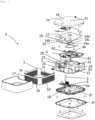
- the secondary electronic card 6 is electrically connected to the main electronic card 4 via the connection device 5 so that the first amplifier 6a is supplied by the first voltage. power supply.
- the amplifier 6a (as well as the second amplifier 6b which will be presented later) is placed in the box 2, at a distance from the main electronic card 4 which is a “hot card” (i.e. a card whose components have significant thermal emission) carrying the power supply module 4.
- a “hot card” i.e. a card whose components have significant thermal emission
- the first loudspeaker 3a which is here a bass loudspeaker (typically a loudspeaker intended to reproduce frequencies below 1kHz, for example frequencies below 500Hz).
- a bass loudspeaker typically a loudspeaker intended to reproduce frequencies below 1kHz, for example frequencies below 500Hz.
- the amplifiers are better cooled and less impacted by the heat release from other components, it is possible to operate them at higher power and it is also possible to choose amplifiers with higher power but lower efficiency (therefore having greater heat release for the same audio power output).
- the main electronic card 4 carries at least one processor 4b having a decoder function, memories, a power supply module 41 for generating at least a first supply voltage and an audio module 42.
- connection device 5 comprises an intermediate card 5 carrying a first plurality of electrical conductors 50 for supplying the first amplifier 6a with the first supply voltage.
- the intermediate card 5 and the electrical conductors 50 pass through an opening 20 formed through the wall 2a of the box 2.
- Such an intermediate card 5 (preferably of the printed circuit board type) is more advantageous than a sheet of electrical conductors, because the card 5 is rigid and makes it possible to increase the cross-section of the electrical conductors 50 to obtain a better current flow capacity.
- the assembly of an intermediate card 5, “rigid” relative to a ribbon cable is easier to carry out in an automated manner than the assembly of a “flexible” ribbon cable, which requires human intervention.
- the main electronic card 4 carries a first mechanical connector 40 and the secondary electronic card 6 carries a second mechanical connector 60.
- the connectors 51 and 52 of the intermediate card 5 are produced by simple electrical tracks formed on portions of terminal ends of the intermediate card 5, these connectors 51, 52 here being of the male type.
- connectors 51 and 52 are simple tracks here, they could also be made with other more complex types of connector comprising additional parts with interlocking and/or foolproofing devices.
- the intermediate card 5 is rigid, its connection to the second mechanical connector 60 carried by the secondary card 6 makes it possible to spatially position the first mechanical connector 51 of the intermediate card 5 relative to the main electronic card 4.
- the electrical connection between the main electronic card 4 and the secondary electronic card 6 is particularly easy to implement in an automated manner.
- one of the first mechanical connectors 51 is a male type connector fitted into the other of said first mechanical connectors 40 which is a female type connector.
- first mechanical connectors 40, 51 are here connected to each other so as to present a first clearance authorizing relative movement between these first mechanical connectors 40, 51.
- one of the second mechanical connectors 52 is a male type connector nested in the other of said second mechanical connectors 60 which is a female type connector.
- These second mechanical connectors 52, 60 are here connected to each other so as to present a second clearance authorizing relative movement between these second mechanical connectors 52, 60.
- the intermediate card 5 extends in length and width in a plane of the intermediate card 5 which is on the one hand perpendicular to a main plane of the main card 4 and on the other hand perpendicular to a front face 1b of the housing 1.
- the 90° orientation of the intermediate card 5 relative to the front face 1b of the housing 1 contributes to the resistance of the equipment 0 to falls.
- Rigid card 5 can also contribute to the robustness of the equipment in the event of a fall, by preventing cards 4 and 6 from possibly coming together during an impact.
- the intermediate card 5 is preferably of asymmetrical shape so that the electrical connection between the main electronic card 4 and the secondary electronic card 6 via the first plurality of electrical conductors 50 carried by the intermediate card 5 is possible in a single position/orientation of the intermediate card 5 relative to the main 4 and secondary 6 electronic cards.
- the asymmetrical shape of the intermediate card 5 allows electrical connection between the cards only when the intermediate card is in its single position.
- This asymmetrical shape prevents the intermediate card 5 from being positioned in any other position/orientation than said single position visible in the figures.
- This asymmetrical shape of the intermediate card 5 allows mechanical keying which facilitates the assembly of the intermediate card while making it possible to assign to each electrical conductor 50 a unique function in the electrical connection between the main 4 and secondary 6 cards.
- each electrical conductor 50 can be specifically developed/sized to carry a given current/signal/voltage dedicated to it.
- the asymmetry of the intermediate card 5 is obtained by an axial offset Dx between the two longitudinal ends of the intermediate card 5 (see for example the figure 8 ).
- the wall of the box is shaped to abut against the portion cut at 45° when the intermediate card 5 is in a position other than said single position illustrated in the figures.
- a compressible seal 7, visible on the Figures 7a And 4 is arranged to oppose the passage of air between the inside and the outside of the box 2 via the opening 20 formed through the wall of the box 2.
- This seal 7 ensures acoustic sealing of the box 2 at the level of the opening 20 through which the intermediate card 5 passes.
- this seal 7 rests against the main electronic card 4, the latter thus “closing” the acoustic volume of the box 2.
- This seal 7 is preferably an annular seal which extends here around the first mechanical connector 40 carried by the main electronic card 4.
- This seal 7 here comprises first and second faces formed on either side of the seal.
- the first face of the seal bears against an annular bearing surface carried by the main electronic card 4 and the second face of the seal bears against an annular bearing surface carried by the wall 2a of the box 2.
- the compression of the seal 7 between the annular support surface carried by the main electronic card and the annular support surface carried by the wall 2a of the box also makes it possible to absorb vibrations/slight movements of the main electronic card and the box 2.
- an elastically deformable element 8 preferably made of foam, extends all around a longitudinal portion of the intermediate card 5, inside the opening 20 formed through the wall 2a of the box 2.
- This elastically deformable element 8 makes it possible to oppose contact between the intermediate card 5 and the wall of the box 2.
- the elastically deformable element 8 (here a foam sleeve) surrounds a longitudinal portion of the intermediate card 5 to allow alignment of the intermediate card 5 relative to the opening 20.
- This sleeve 8 thus makes it possible to absorb/dissipate vibrations and also makes it possible to prevent the passage of air along the intermediate card, via the opening 20.
- the audio module 42 is placed in the housing 1, outside the box 2, and is arranged to produce a primary audio signal.
- the audio module 42 is mounted on the main electronic card 4 and is powered by said power supply module 41 via an electrical connection connecting the power supply module 41 to the audio module 42.
- the audio module 42 is also connected to the secondary electronic card 6 so that when the primary audio signal is applied to the input of the first amplifier 6a and the first amplifier 6a is powered by said first voltage, the first amplifier 6a produces, from the primary audio signal, a first amplified audio signal intended for the first loudspeaker 3a.
- the sounds broadcast by the first loudspeaker 3a are thus a function of the first amplified audio signal, this amplification being carried out in the box 2, as close as possible to the first loudspeaker 3a and at a distance from the main electronic card 4.
- the audio module 42 is electrically connected to the secondary electronic card 6 via the connection device 5 so that the primary audio signal is transmitted from the audio module 42 to the first amplifier 6a via the connection device 5.
- the audio module 42 is electrically connected to the secondary electronic card 6 by means of audio electrical conductors carried by the intermediate card 5 so that said primary audio signal is transmitted from the audio module 42 to the first 6a amplifier via specific audio electrical conductors.
- Said first loudspeaker 3a is here a loudspeaker of the bass loudspeaker type (the bass sounds being mainly located between 20 and 500 Hz) arranged in a central interior chamber 20a of the box 2 arranged between the right and left interior chambers 20d, 20e of the box 2.
- the central interior chamber 20a is open on the upper face 2a of the box, in the direction of the main electronic card 4.
- the airflow generated by the sounds of the first speaker 3a thus contributes to the cooling of the main electronic card 4.
- the right, left, front and central inner chambers 20a, 20b, 20d, 20e of the box are sealed relative to each other.
- each chamber has an internal volume adapted to the main frequencies of the loudspeaker it contains.
- the sealing between the chambers promotes the separation of sounds generated by the different speakers.
- the main sound axis Ax of the front loudspeaker 3b extends in a plane perpendicular to the support plane Px where it optionally forms a frontal angle A relative to the support plane Px.
- This angle is between 2 and 40° of angle, for example between 2 and 15° of angle, preferably it is 3° of angle.
- the main sound axis of the left loudspeaker 3rd extends in said second plane perpendicular to the support plane Px where it optionally forms a left lateral angle relative to the support plane Px which is between 2 and 50° angle, for example between 2 and 15° angle, preferably 3° angle.
- the right side angle and the left side angle have the same angle value.
- the equipment according to the invention is intended to be positioned at the foot of the television screen, the equipment is most often in a fairly low position (between 50 and 80 cm high) relative to the head of the user watching the television screen.
- This positive vertical angle A partially compensates for the height difference.
- lateral angles significantly greater than angle A in order to improve the spatial restitution of the sounds emitted by the loudspeakers 3d and 3e (for example by taking advantage of sound reflections on the walls and ceiling of the room) while maintaining a direct sound path between the front loudspeaker 3b and the listener.
- the loudspeakers 3d and 3e have an angle between their main sound axis and the support plane Px, while the front loudspeaker 3b does not have an angle between its main sound axis and the support plane Px which are parallel to each other.
- the angle of the 3d and 3e speakers could for example be between 15 and 90° (relative to the Px plane) while the angle of the front speaker 3b could for example be between 0 and 20° (relative to the Px plane).
- the flat portions of the right, left side faces and the front face of the wall of the box on which the right, left and front loudspeakers are respectively fixed are inclined relative to the bottom plane 2f of the box, which makes it possible to simply obtain the vertical inclination of each of the loudspeakers while bringing it closer to the inside of the box.
- This particular embodiment allows for slightly upward-firing sounds while maximizing the internal volume of the enclosure.
- This embodiment is particularly economical since it does not require a custom adaptation of each given loudspeaker nor the use of an inclined spacer between the cabinet and each given loudspeaker.
- a second amplifier 6b is mounted on the secondary electronic card 6 and is connected to at least one of said right, left, front loudspeakers, said second amplifier 6b being electrically connected to said power supply module 41 via the connection device 5 (in this case via the card 5), so that the second amplifier 6b is electrically powered by the power supply module 41 mounted on the main electronic card 4.
- the electrical power supply of the second amplifier 6b passes through electrical conductors 50 carried by the intermediate card 5 and by each of said mechanical connectors 40, 51, 52, 60.
- the audio module 42 is preferably arranged to produce a secondary audio signal.
- the secondary card 6 carries at least one energy reserve capacitor 6d (also called a power capacitor) electrically powered by the power supply module 41 via the connection device 5 passing through the wall 2a of the box 2.
- energy reserve capacitor 6d also called a power capacitor
- the secondary card carries two amplifiers 6a, 6b
- the equipment 0 comprises at least one other energy reserve capacitor also mounted on the secondary card 6 and electrically powered by the power supply module via the connection device.
- This other reserve capacitor can be electrically connected to at least one of said first and/or second amplifiers 6a, 6b to provide energy to these amplifiers.
- Each of the energy reserve capacitors mounted on the secondary card makes it possible to store electrical energy coming from the power supply module 41 carried by the main electronic card and, in the event of a call for electrical power by at least one of the amplifiers, to punctually supply directly available energy, in the box, at the level of the secondary card 6, as close as possible to the amplifiers and the loudspeakers.
- the 6d reserve capacitors are capacitors placed as close as possible to the amplifiers to respond to significant peak consumption, during current calls by the amplifiers.
- capacitors/capacitors are highly dimensioned (for example 2*2200uF instead of 2*400uF required in “stable” mode), in order to reduce the current draws on said at least one power supply module 41.
- the equipment 0 mainly constitutes a “Set Top Box” (literally “set top box”) intended to receive external signals containing audio and video components, to decode these signals and broadcast the audio component via the speakers contained in the box and the video component via display means external to the equipment.
- Set Top Box (literally “set top box”) intended to receive external signals containing audio and video components, to decode these signals and broadcast the audio component via the speakers contained in the box and the video component via display means external to the equipment.
- the equipment 0 comprises a decoder placed in the housing 1, outside the box 2, mounted on the main electronic card 4 or on another electronic card remote from the main card 4, this decoder possibly being integrated into a component grouping together several functions (for example a component of the “SoC - System on Chip” type).
- Said at least one input connector 43 is for example an optical input for receiving an optical signal, transmitted via an optical fiber and coming from an internet server and/or an Ethernet/RJ45 type input for receiving an electrical signal coming from an internet server and/or a coaxial input for receiving an electrical signal coming from a satellite receiver.
- the output connection 44 of the video signal is for example an HDMI output which can be connected to an external display device such as a television or a video projector or any other type of connection suitable for broadcasting a video stream.
- the audio module 42 is arranged to generate said primary audio signal as a function of the decoded signal.
- audio decoding and the application of audio processing can be carried out by the same electronic component (typically a DSP) or by several separate electronic components.
- the audio module 42 may or may not be integrated into the main processor 4b (here an SoC).
- the functions performed by the decoder and the audio module 42 may, depending on the case, be performed on the same electronic component or be distributed over several electronic components distinct from each other.
- the input and output connectors 43, 44 of the decoder are each accessible from outside the housing 1 via connection openings made through the wall of the housing 1.
- each input or output connector 43, 44 is fixed on a rear edge of the main electronic card 4 and the connection openings are formed through the rear portion 18 of the upper cover 19 of the housing 1.
- the input 43 and output 44 connectors are also positioned relative to the housing 1.
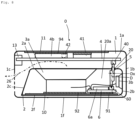
- This heat sink 10 is here a bottom 2f of the box 2.
- the upper face of this heat sink 10 comprises at least one localized boss 2f1 which is in contact against the first block of heat exchange material 91.
- This boss 2f1 sometimes called a recess, makes it possible to bring the bottom 1f of the box 2 as close as possible to the area of the secondary electronic card 6 from which we want to evacuate heat.
- the heat sink 10 attached to the box 2 is arranged to evacuate heat from the inside to the outside of the box 2.
- the second block of heat exchanger material 92 in addition to its function of transmitting heat from the first loudspeaker 3a to the heat sink 10, also makes it possible to improve the rigidity of the assembly between the first loudspeaker 3a and the box 2.
- the chassis/salad bowl of the loudspeaker 3a forms an annular collar which widens from a first edge of collar which is attached to a permanent magnet to a second edge of collars on which is attached a membrane of the loudspeaker 3a.
- loudspeaker performance is generally degraded from 60°C or 80°C, and sound distortions may then appear.
- the good cooling of the components / first speaker arranged in the box 2 allows to maintain an optimal audio quality, even at high sound power, while preserving the electronic components.
- Each block of heat exchange material 91, 92 preferably has the shape of a mat (PAD) but it can also be made of thermal paste molded at the time of assembly against the heat sink fixed to the box.
- the heat sink 10 fixed to the box 2 can be constituted by the bottom 2f of the box 2 or by a plate assembled on the bottom of the box.
- this sink may be made of a polymer material, metal (for example aluminum or copper) or any combination of these materials.
- Each boss 2f1, 2f2, 2f3 is formed to locally bring the bottom of the box closer to a block of heat exchanger material 91, 92 which corresponds to it.
- the bottom 2f comprises three bosses/recesses 2f1, 2f2, 2f3, one facing a lower face of the first loudspeaker 3a and the other two facing a lower face of the secondary electronic card 6 (one at the level of the installation of the first amplifier 6a and the other at the level of the installation of the second amplifier 6b mounted on the secondary electronic card 6).
- the equipment is also equipped with microphones which are for example useful for capturing sounds in the environment of the equipment to generate a spatial sound image useful for configuring the operation of the speakers and/or for capturing commands issued by a user (the equipment being able to have voice recognition and a voice assistant function).
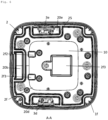
- a first pair of microphones 14a, 14b is mounted on the same first layer of electrical conductors 15 and a second pair of microphones 14c, 14d is mounted on the same second layer of electrical conductors 16.
- the second layer 16 is electrically connected to said first layer 15.
- the first sheet 15 extends along a first sheet axis and the second sheet extends along a second sheet axis 16 which is oriented at 90° relative to the first sheet axis.
- the plurality of microphones 14a, 14b, 14, 14d is connected to the main electronic card 4 via a single microphone connection, which is particularly economical (simplification of assembly).
- the microphone connection is on the underside of the main board 4 and is not visible in the figures.
- the first pair of microphones 14a, 14b is spatially positioned relative to the second pair of microphones 14c, 14d.
- the microphones of the first microphone pair 14a, 14b make it possible to pick up and differentiate sounds coming from the right or the left of the housing while the microphones of the second microphone pair 14c, 14d make it possible to pick up and differentiate sounds coming from the front or the rear of the housing.
- the first and second sheets 15, 16 which carry the two pairs of microphones are mounted on the main heat sink 11 (presented above) and which allows heat to be evacuated from the main electronic card 4.
- the microphones are placed closer to the top cover 19 of the equipment, which improves the quality of sound capture.
- Each microphone is preferably placed above the main heat exchanger 11, that is to say between the main heat exchanger 11 and the cover 1a of the housing 1.
- each microphone is placed facing a perforation 21 which corresponds to it and which passes through the cover 19.
- the second sheet 16 is removably connected to the first sheet 15, possibly via a connector.
- the second sheet 16 is connected to the first sheet 15 by a fixed connection, for example by welding.
- the second layer 16 and the microphones that it carries may be optional depending on whether we want a variation of the equipment 0 comprising only a first pair of microphones 14a, 14b or a variation comprising two pairs of microphones 14a, 14b, 14c, 14d.
- the microphones of the first pair of microphones are spaced from each other by at least 50 mm, preferably 70 mm.
- the equipment also includes an electronic communication card 12 placed in the housing 1 outside the box 2.
- This communication card 12 is electrically connected to the main electronic card 4 via a secondary connection device (here a deformable ribbon cable not shown and comprising a plurality of deformable electrical conductors), so as to electrically supply at least one electronic communication element mounted on the communication card 12.
- a secondary connection device here a deformable ribbon cable not shown and comprising a plurality of deformable electrical conductors
- cooling of the electronic communication card 12 (“cold card”) is improved.
- these electronic communication elements are not subject to the main electronic card 4, they can be positioned in different locations in the housing 1 without having to move or adapt the main electronic card 4.
- the communication card 12 is mounted in a recess 25 of the external wall of the box 2 and against an external area of the wall of the box.
- each optical passage 17 corresponds to only one of the electronic communication elements and integrates an optical lens forming an optical flow guide through the front wall 1b of the housing.
- the electronic communication card 12 extends in a plane perpendicular to the main plane of the main electronic card 4 and the electronic communication elements are mounted on a flat main face of the electronic communication card 12 which facilitates the positioning and assembly of these electronic elements.
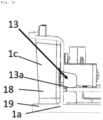
- ribs 13 supported by a rear face 1c of the housing 1 extend inside the housing 1, these ribs 13 each comprising at least one notch 13a.
- a rear edge of the main electronic card penetrates inside these notches so as to wedge the main electronic card by wedging its rear edge in these notches 13a.
- an elastically compressible foam to be arranged between the rear edge of the main electronic card and at least some of the notches 13a or the bottom of the case so as to simplify the adjustment of the main card in the ribs 13 while making it possible to dissipate vibrations in the foam.
- the rear face 1c of the housing 1 is here partly constituted by a rear portion 18 of the upper cover 19 which extends perpendicularly relative to a flat main face of the upper cover 19.
- the ribs 13 supported by the rear face 1c of the housing 1 are here carried by this rear portion 18 of the cover 19.
- this embodiment allows for upward diffusion of sounds to direct the sound to a level higher than the box where the user's head is located.
- each given side wall of the housing in which the box is located is parallel to a main plane defined by one of said loudspeakers carried by the box opposite this given side wall of the housing.
- This embodiment is advantageous for limiting the distortion of sound diffused by the loudspeakers through perforations made in the wall of the housing.
Landscapes
- Engineering & Computer Science (AREA)
- Physics & Mathematics (AREA)
- Acoustics & Sound (AREA)
- Signal Processing (AREA)
- Microelectronics & Electronic Packaging (AREA)
- Textile Engineering (AREA)
- Details Of Audible-Bandwidth Transducers (AREA)
- Telephone Set Structure (AREA)
Claims (16)
- Ausrüstung (0) enthaltend ein Gehäuse (1), in welchem sich Folgendes befindet:- ein Korpus (2);- ein erster Lautsprecher (3a), der im Inneren des Korpus (2) angeordnet und an einer Wand (2a) des Korpus (2) angebracht ist, wobei der erste Lautsprecher (3a) derart angeordnet ist, dass er Töne von dem Gehäuse (1) nach außen hin abgibt;- eine Haupt-Elektronikkarte (4), die in dem Gehäuse (1) außerhalb des Korpus (2) angeordnet ist und auf welcher zumindest ein Stromversorgungsmodul (41) aufmontiert ist, das derart beschaffen ist, dass es eine erste Versorgungsspannung erzeugt;- eine Verbindungsvorrichtung (5), welche sich durch die Korpuswand (2a) hindurch erstreckt;- eine sekundäre Elektronikkarte (6), die im Inneren des Korpus (2) angeordnet ist und auf welcher zumindest ein erster Verstärker (6a) montiert ist, der mit dem ersten Lautsprecher (3a) verbunden ist, wobei die sekundäre Elektronikkarte (6) über die Verbindungsvorrichtung (5) derart mit der Haupt-Elektronikkarte (4) elektrisch verbunden ist, dass der erste Verstärker (6a) mit der ersten Versorgungsspannung versorgt wird, dadurch gekennzeichnet, dass die Verbindungsvorrichtung (5) eine Zwischenkarte (5) mit einer ersten Mehrzahl von elektrischen Leitern (50) enthält, um den ersten Verstärker (6a) mit der ersten Versorgungsspannung zu versorgen, wobei die Zwischenkarte (5) und die elektrischen Leiter (50) aus der ersten Mehrzahl von elektrischen Leitern durch eine in der Wand des Korpus (2) ausgebildete Öffnung (20) hindurchgeführt sind.
- Ausrüstung (0) nach Anspruch 1, wobei die Haupt-Elektronikkarte (4) einen ersten mechanischen Verbinder (40) trägt und die sekundäre Elektronikkarte (6) einen zweiten mechanischen Verbinder (60) trägt, wobei die Zwischenkarte (5) einerseits einen ersten mechanischen Verbinder (51) der Zwischenkarte (5) trägt, der mit dem ersten, von der Haupt-Elektronikkarte (4) getragenen mechanischen Verbinder (40) lösbar verbunden ist, und andererseits einen zweiten mechanischen Verbinder (52) der Zwischenkarte (5) trägt, der mit dem zweiten, von der sekundären Elektronikkarte (6) getragenen mechanischen Verbinder (60) lösbar verbunden ist, sodass die erste Versorgungsspannung über den ersten, von der Haupt-Elektronikkarte (4) getragenen mechanischen Verbinder (40), über den ersten und den zweiten, von der Zwischenkarte (5) getragenen mechanischen Verbinder, und über den zweiten, von der sekundären Elektronikkarte (6) getragenen mechanischen Verbinder (60) an den ersten Verstärker (6a) übertragen wird.
- Ausrüstung (0) nach Anspruch 2, wobei:- es sich bei einem von den ersten mechanischen Verbindern, nämlich dem Verbinder (51), um einen Steckverbinder handelt, der in den anderen von den ersten mechanischen Verbindern, nämlich den Verbinder (40), bei dem es sich um einen Buchsenverbinder handelt, eingesteckt ist, wobei die beiden ersten mechanischen Verbinder (40, 51) derart miteinander verbunden sind, dass sie ein erstes Spiel aufweisen, welches eine Relativbewegung zwischen diesen ersten mechanischen Verbindern (40, 51) ermöglicht; und- es sich bei einem von den zweiten mechanischen Verbindern, nämlich dem Verbinder (52), ebenfalls um einen Steckverbinder handelt, der in den anderen von den zweiten mechanischen Verbindern, nämlich den Verbinder (60), bei dem es sich um einen Buchsenverbinder handelt, eingesteckt ist, wobei die beiden zweiten mechanischen Verbinder (52, 60) derart miteinander verbunden sind, dass sie ein zweites Spiel aufweisen, welches eine Relativbewegung zwischen diesen zweiten mechanischen Verbindern (52, 60) ermöglicht.
- Ausrüstung (0) nach einem der Ansprüche 2 oder 3, wobei sich die Zwischenkarte (5) in der Länge und in der Breite in einer Ebene der Zwischenkarte (5) erstreckt, die einerseits senkrecht zu einer Hauptebene der Haupt-Elektronikkarte (4) und andererseits senkrecht zu einer Vorderseite (1b) des Gehäuses (1) liegt.
- Ausrüstung (0) nach einem der Ansprüche 2 bis 4, wobei der erste und der zweite mechanische Verbinder (51, 52), die von der Zwischenkarte (5) getragen werden, untereinander identisch sind und wobei der erste und der zweite mechanische Verbinder (40, 60), die jeweils von der Haupt-Elektronikkarte (4) bzw. von der sekundären Elektronikkarte (6) getragen werden, ebenfalls untereinander identisch sind.
- Ausrüstung (0) nach einem der Ansprüche 1 bis 5, wobei die Zwischenkarte (5) unsymmetrisch ausgestaltet ist, sodass die elektrische Verbindung zwischen der Haupt-Elektronikkarte (4) und der sekundären Elektronikkarte (6) über die erste Mehrzahl von elektrischen Leitern (50), die von der Zwischenkarte (5) getragen werden, in nur einer Position der Zwischenkarte (5) in Bezug auf die Haupt-Elektronikkarte (4) und die sekundäre Elektronikkarte (6) erfolgen kann.
- Ausrüstung (0) nach einem der Ansprüche 1 bis 6, wobei eine komprimierbare Dichtung (7) derart angeordnet ist, dass sie ein Hindurchtreten von Luft zwischen dem Korpusinneren und dem Außenbereich des Korpus über die durch die Wand des Korpus (2) hindurch ausgebildete Öffnung (20) unterbindet.
- Ausrüstung (0) nach einem der Ansprüche 1 bis 7, wobei sich ein vorzugsweise aus Schaumstoff bestehendes, elastisch verformbares Element (8) im Inneren der durch die Wand (2a) des Korpus (2) hindurch ausgebildeten Öffnung (20) zur Gänze um einen Längsabschnitt der Zwischenkarte (5) herum erstreckt, um den Kontakt zwischen der Zwischenkarte (5) und der Wand des Korpus (2) zu unterbinden.
- Ausrüstung (0) nach einem der Ansprüche 1 bis 8, ferner enthaltend ein Audiomodul (42), das außerhalb des Korpus (2) in dem Gehäuse (1) angeordnet und dazu eingerichtet ist, ein primäres Audiosignal zu erzeugen, wobei das Audiomodul (42) derart mit der sekundären Elektronikkarte (6) verbunden ist, dass, wenn das primäre Audiosignal an den Eingang des ersten Verstärkers (6a) angelegt wird und der erste Verstärker (6a) mit der ersten Spannung versorgt wird, der erste Verstärker (6a) ein erstes, verstärktes Audiosignal zur Bereitstellung an den ersten Lautsprecher (3a) erzeugt.
- Ausrüstung (0) nach Anspruch 9, wobei das Audiomodul (42) über die Verbindungsvorrichtung (5) derart mit der sekundären Elektronikkarte (6) elektrisch verbunden ist, dass das primäre Audiosignal von dem Audiomodul (42) über die Verbindungsvorrichtung (5) an den ersten Verstärker (6a) übertragen wird.
- Ausrüstung (0) nach einem der Ansprüche 9 oder 10, wobei das Audiomodul (42) auf der Haupt-Elektronikkarte (4) aufmontiert ist.
- Vorrichtung (0) nach einem der Ansprüche 1 bis 11, ferner enthaltend:- einen rechten Lautsprecher (3d), der in einer rechten Innenkammer (20d) des Korpus (2) angeordnet ist, welche zu einer rechten Seitenfläche (2d) der Wand des Korpus (2) hin offen ist;- einen linken Lautsprecher (3e), der in einer linken Innenkammer (20e) des Korpus (2) angeordnet ist, welche zu einer linken Seitenfläche (2e) der Wand des Korpus (2) hin offen ist; und gegebenenfalls- einen stirnseitigen Lautsprecher (3b), der in einer stirnseitigen Innenkammer (20b) des Korpus (2) angeordnet ist, welche zu einer Vorderseite (2b) der Wand des Gehäuses (2) hin offen ist;
wobei es sich bei dem ersten Lautsprecher (3a) der Art nach um einen Tieftonlautsprecher handelt, der in einer mittleren, zwischen der rechten und der linken Innenkammer (20d, 20e) des Korpus (2) angeordneten Innenkammer (20a) des Korpus (2) angeordnet ist, wobei die mittlere Innenkammer (20a) des Korpus zu einer Oberseite (2a) des Korpus hin offen ist, wobei die rechte, die linke, die stirnseitige und die mittlere Innenkammer (20a, 20b, 20d, 20e) des Korpus gegeneinander abgedichtet sind, und wobei der rechte Lautsprecher (3d) eine ihm eigene Hauptschallachse aufweist, entlang derer die von ihm erzeugten Töne überwiegend abgegeben werden;- wobei der linke Lautsprecher (3e) eine ihm eigene Hauptschallachse aufweist, entlang derer die von ihm erzeugten Töne überwiegend abgegeben werden;- wobei der stirnseitige Lautsprecher (3b) eine ihm eigene Hauptschallachse (Ax) aufweist, entlang derer die von ihm erzeugten Töne überwiegend abgegeben werden;- wobei das Gehäuse (1) einen Gehäuseboden (1f) enthält, der eine Auflageebene (Px) des Gehäuses definiert; undwobei zumindest eine von den Hauptschallachsen des rechten, des linken und des stirnseitigen Lautsprechers in Bezug auf die Auflageebene (Px) derart ausgerichtet ist, dass sich der überwiegend entlang der zumindest einen Schallachse (Ax) abgegebene Ton zunehmend von der Auflageebene (Px) entfernt. - Ausrüstung (0) nach Anspruch 12, wobei sich die Hauptschallachse (Ax) des stirnseitigen Lautsprechers (3b) in einer Ebene senkrecht zu der Auflageebene (Px) erstreckt, auf welcher sie einen stirnseitigen Winkel (A) von 2 bis 40 Winkelgraden, vorzugsweise von 3 Winkelgraden, in Bezug auf die Auflageebene (Px) bildet.
- Ausrüstung nach einem der Ansprüche 1 bis 13, wobei die sekundäre Elektronikkarte zumindest einen Energiereservekondensator (6d) trägt, der von dem Versorgungsmodul (41) über die durch die Wand (2a) des Korpus (2) hindurchgehende Verbindungsvorrichtung (5) mit Strom versorgt wird, wobei der zumindest eine Kondensator (6d) außerdem mit dem zumindest einen ersten Verstärker (6a) elektrisch verbunden ist, um den zumindest einen ersten Verstärker mit Energie zu versorgen.
- Ausrüstung nach einem der Ansprüche 1 bis 14, wobei eine Mehrzahl von Mikrofonen (14a, 14b, 14c, 14d) innerhalb des Gehäuses angeordnet ist und über nur einen Mikrofonanschluss derart mit der Haupt-Elektronikkarte (4) verbunden ist, dass diese einerseits die Mehrzahl von Mikrofonen mit Strom versorgt und andererseits Mikrofonsignale an ein von der Haupt-Elektronikkarte (4) getragenes Mikrofonmodul sendet, welche Töne darstellen, die von den Mikrofonen aufgenommen worden sind, wobei ein erstes Paar von Mikrofonen (14a, 14b) auf ein und derselben ersten Bahn elektrischer Leiter (15) montiert ist und ein zweites Paar von Mikrofonen (14c, 14d) auf ein und derselben zweiten Bahn elektrischer Leiter (16) montiert ist, wobei die zweite Bahn (16) mit der ersten Bahn (15) elektrisch verbunden ist, wobei sich die erste Bahn entlang einer Achse der ersten Bahn erstreckt und wobei sich die zweite Bahn entlang einer Achse der zweiten Bahn erstreckt, die in einem Winkel von 90° in Bezug auf die Achse der ersten Bahn ausgerichtet ist.
- Ausrüstung nach Anspruch 15, wobei die zweite Bahn (16) mit der ersten Bahn (15) lösbar verbunden ist.
Applications Claiming Priority (1)
| Application Number | Priority Date | Filing Date | Title |
|---|---|---|---|
| FR2212833A FR3139405A1 (fr) | 2022-12-06 | 2022-12-06 | Equipement comportant un caisson acoustique doté d’au moins un amplificateur |
Publications (2)
| Publication Number | Publication Date |
|---|---|
| EP4383748A1 EP4383748A1 (de) | 2024-06-12 |
| EP4383748B1 true EP4383748B1 (de) | 2025-01-01 |
Family
ID=85278076
Family Applications (1)
| Application Number | Title | Priority Date | Filing Date |
|---|---|---|---|
| EP23211128.6A Active EP4383748B1 (de) | 2022-12-06 | 2023-11-21 | Ausrüstung mit einem akustischen gehäuse mit mindestens einem verstärker |
Country Status (5)
| Country | Link |
|---|---|
| US (1) | US12342479B2 (de) |
| EP (1) | EP4383748B1 (de) |
| CN (1) | CN118158600A (de) |
| FR (1) | FR3139405A1 (de) |
| IL (1) | IL308995B2 (de) |
Families Citing this family (1)
| Publication number | Priority date | Publication date | Assignee | Title |
|---|---|---|---|---|
| FR3147897B1 (fr) * | 2023-04-17 | 2025-05-30 | Sagemcom Broadband Sas | Enceinte acoustique de hauteur réduite |
Family Cites Families (13)
| Publication number | Priority date | Publication date | Assignee | Title |
|---|---|---|---|---|
| WO2009131658A2 (en) * | 2008-04-21 | 2009-10-29 | Snap Networks, Inc. | An electrical system for a speaker and its control |
| FR2995753B1 (fr) * | 2012-09-20 | 2014-09-19 | Paul-Edouard Blanchard | Enceinte acoustique comprenant des moyens de connexion d'entree et de sortie relies entre eux de facon a transmettre entre autres des signaux electroniques |
| US20140355806A1 (en) * | 2013-06-03 | 2014-12-04 | Allen T. Graff | Portable Loudspeaker |
| TWM490712U (en) * | 2014-07-08 | 2014-11-21 | Firstchair Acoustics Co Ltd | Improved speaker structure |
| US9267675B2 (en) * | 2014-07-11 | 2016-02-23 | Well Shin Technology Co., Ltd. | Light-emitting diode bulb with loudspeaker function |
| USRE49437E1 (en) * | 2014-09-30 | 2023-02-28 | Apple Inc. | Audio driver and power supply unit architecture |
| US11178486B2 (en) * | 2015-11-19 | 2021-11-16 | The Lovesac Company | Modular furniture speaker assembly with reconfigurable transverse members |
| CN106231453A (zh) * | 2016-09-28 | 2016-12-14 | 朱幕松 | 高品质插卡音箱 |
| US11159865B1 (en) * | 2019-08-30 | 2021-10-26 | Joshua David Johnson | Media-source-integrated speaker and system for custom stereo installation |
| CN211406453U (zh) * | 2019-12-26 | 2020-09-01 | 深圳市他山石电子有限公司 | 一种红外触显pcb连接结构 |
| CN115211144A (zh) * | 2020-01-03 | 2022-10-18 | 奥康科技有限公司 | 助听器系统和方法 |
| FR3110799B1 (fr) * | 2020-05-25 | 2023-06-23 | Sagemcom Broadband Sas | Enceinte acoustique générique |
| FR3110797B1 (fr) * | 2020-05-25 | 2023-06-30 | Sagemcom Broadband Sas | Pavillon acoustique pour enceinte générique |
-
2022
- 2022-12-06 FR FR2212833A patent/FR3139405A1/fr not_active Ceased
-
2023
- 2023-11-21 EP EP23211128.6A patent/EP4383748B1/de active Active
- 2023-11-30 IL IL308995A patent/IL308995B2/en unknown
- 2023-12-06 CN CN202311665772.2A patent/CN118158600A/zh active Pending
- 2023-12-06 US US18/531,215 patent/US12342479B2/en active Active
Also Published As
| Publication number | Publication date |
|---|---|
| IL308995B2 (en) | 2026-03-01 |
| IL308995B1 (en) | 2025-11-01 |
| IL308995A (en) | 2024-07-01 |
| CN118158600A (zh) | 2024-06-07 |
| US20240188235A1 (en) | 2024-06-06 |
| US12342479B2 (en) | 2025-06-24 |
| EP4383748A1 (de) | 2024-06-12 |
| FR3139405A1 (fr) | 2024-03-08 |
Similar Documents
| Publication | Publication Date | Title |
|---|---|---|
| FR3067131B1 (fr) | Dispositif optique pour vehicule comprenant un element de chauffage | |
| BE1025707B1 (fr) | Poteau de lampadaire pourvu d’un module fonctionnel sur mat a monture | |
| CA1278878C (fr) | Procede et dispositif de refroidissement d'un boitier de circuit integre | |
| EP1417859B1 (de) | Lautsprecher mit direktemission und optimierter abstrahlung | |
| FR2538985A1 (fr) | Agencement de haut-parleurs a une ou plusieurs membranes plates | |
| EP3551501B1 (de) | Wärmeableitungsvorrichtung für eine multimedia-steuereinheit | |
| EP3547001A1 (de) | Optische vorrichtung für fahrzeug, die mit einem heizelement ausgestattet ist | |
| EP4383748B1 (de) | Ausrüstung mit einem akustischen gehäuse mit mindestens einem verstärker | |
| EP2781826A1 (de) | Vorrichtung zur Beleuchtung und/oder Signalisierung für Kraftfahrzeuge | |
| FR3085247A1 (fr) | Dispositif de sonorisation d'un ecran video par reflexion | |
| EP2730837A1 (de) | Beleuchtungsmodul mit verschiedenen Wärmesenken montiert auf einer gemeinsamen Platine | |
| EP3502546A1 (de) | Leuchtmodul für fahrzeug, das eine belüftungsvorrichtung zwischen zwei wärmeableitungsvorrichtungen umfasst | |
| EP1700476A2 (de) | Kommunikationsendgerät mit einer multidirektionalen kamera | |
| EP2339232A1 (de) | Lampe für Scheinwerfer und Scheinwerfer mit einer solchen Lampe | |
| EP4451700B1 (de) | Dekodergehäuse mit reduzierter höhe | |
| FR3065135A1 (fr) | Enceinte acoustique | |
| WO2008132320A2 (fr) | Ensemble de reproduction visuelle et sonore | |
| FR3067130B1 (fr) | Dispositif optique pour vehicule | |
| FR2816393A1 (fr) | Dispositif d'eclairage comportant un element de rayonnement de la chaleur degagee par une lampe a decharge et un module de circuit | |
| BE1025517A1 (fr) | Poteau de lampadaire a modules fonctionnels | |
| FR3139695A1 (fr) | Event dissipateur thermique | |
| WO2015144877A1 (fr) | Coque de protection monobloc d'un boitier d'ordinateur personnel | |
| FR3119288A1 (fr) | Enceinte acoustique | |
| BE1025515B1 (fr) | Poteau de lampadaire a modules fonctionnels | |
| EP3108665A1 (de) | Halterung für audiosystem und audioausrüstung mit solch einer halterung |
Legal Events
| Date | Code | Title | Description |
|---|---|---|---|
| PUAI | Public reference made under article 153(3) epc to a published international application that has entered the european phase |
Free format text: ORIGINAL CODE: 0009012 |
|
| STAA | Information on the status of an ep patent application or granted ep patent |
Free format text: STATUS: REQUEST FOR EXAMINATION WAS MADE |
|
| 17P | Request for examination filed |
Effective date: 20231121 |
|
| AK | Designated contracting states |
Kind code of ref document: A1 Designated state(s): AL AT BE BG CH CY CZ DE DK EE ES FI FR GB GR HR HU IE IS IT LI LT LU LV MC ME MK MT NL NO PL PT RO RS SE SI SK SM TR |
|
| GRAP | Despatch of communication of intention to grant a patent |
Free format text: ORIGINAL CODE: EPIDOSNIGR1 |
|
| STAA | Information on the status of an ep patent application or granted ep patent |
Free format text: STATUS: GRANT OF PATENT IS INTENDED |
|
| RIC1 | Information provided on ipc code assigned before grant |
Ipc: H04R 1/40 20060101ALN20240723BHEP Ipc: H04R 9/02 20060101ALN20240723BHEP Ipc: H04R 5/02 20060101ALN20240723BHEP Ipc: H04R 1/24 20060101ALN20240723BHEP Ipc: H05K 7/20 20060101ALN20240723BHEP Ipc: H04R 1/02 20060101AFI20240723BHEP |
|
| INTG | Intention to grant announced |
Effective date: 20240813 |
|
| RBV | Designated contracting states (corrected) |
Designated state(s): AL AT BE BG CH CY CZ DE DK EE ES FI FR GB GR HR HU IE IS IT LI LT LU LV MC ME MK MT NL NO PL PT RO RS SE SI SK SM TR |
|
| GRAS | Grant fee paid |
Free format text: ORIGINAL CODE: EPIDOSNIGR3 |
|
| GRAA | (expected) grant |
Free format text: ORIGINAL CODE: 0009210 |
|
| STAA | Information on the status of an ep patent application or granted ep patent |
Free format text: STATUS: THE PATENT HAS BEEN GRANTED |
|
| AK | Designated contracting states |
Kind code of ref document: B1 Designated state(s): AL AT BE BG CH CY CZ DE DK EE ES FI FR GB GR HR HU IE IS IT LI LT LU LV MC ME MK MT NL NO PL PT RO RS SE SI SK SM TR |
|
| REG | Reference to a national code |
Ref country code: GB Ref legal event code: FG4D Free format text: NOT ENGLISH |
|
| REG | Reference to a national code |
Ref country code: CH Ref legal event code: EP |
|
| REG | Reference to a national code |
Ref country code: DE Ref legal event code: R096 Ref document number: 602023001593 Country of ref document: DE |
|
| REG | Reference to a national code |
Ref country code: IE Ref legal event code: FG4D Free format text: LANGUAGE OF EP DOCUMENT: FRENCH |
|
| REG | Reference to a national code |
Ref country code: LT Ref legal event code: MG9D |
|
| REG | Reference to a national code |
Ref country code: NL Ref legal event code: MP Effective date: 20250101 |
|
| REG | Reference to a national code |
Ref country code: AT Ref legal event code: MK05 Ref document number: 1757527 Country of ref document: AT Kind code of ref document: T Effective date: 20250101 |
|
| PG25 | Lapsed in a contracting state [announced via postgrant information from national office to epo] |
Ref country code: NL Free format text: LAPSE BECAUSE OF FAILURE TO SUBMIT A TRANSLATION OF THE DESCRIPTION OR TO PAY THE FEE WITHIN THE PRESCRIBED TIME-LIMIT Effective date: 20250101 |
|
| PG25 | Lapsed in a contracting state [announced via postgrant information from national office to epo] |
Ref country code: FI Free format text: LAPSE BECAUSE OF FAILURE TO SUBMIT A TRANSLATION OF THE DESCRIPTION OR TO PAY THE FEE WITHIN THE PRESCRIBED TIME-LIMIT Effective date: 20250101 |
|
| PG25 | Lapsed in a contracting state [announced via postgrant information from national office to epo] |
Ref country code: PL Free format text: LAPSE BECAUSE OF FAILURE TO SUBMIT A TRANSLATION OF THE DESCRIPTION OR TO PAY THE FEE WITHIN THE PRESCRIBED TIME-LIMIT Effective date: 20250101 |
|
| PG25 | Lapsed in a contracting state [announced via postgrant information from national office to epo] |
Ref country code: ES Free format text: LAPSE BECAUSE OF FAILURE TO SUBMIT A TRANSLATION OF THE DESCRIPTION OR TO PAY THE FEE WITHIN THE PRESCRIBED TIME-LIMIT Effective date: 20250101 |
|
| PG25 | Lapsed in a contracting state [announced via postgrant information from national office to epo] |
Ref country code: IS Free format text: LAPSE BECAUSE OF FAILURE TO SUBMIT A TRANSLATION OF THE DESCRIPTION OR TO PAY THE FEE WITHIN THE PRESCRIBED TIME-LIMIT Effective date: 20250501 Ref country code: NO Free format text: LAPSE BECAUSE OF FAILURE TO SUBMIT A TRANSLATION OF THE DESCRIPTION OR TO PAY THE FEE WITHIN THE PRESCRIBED TIME-LIMIT Effective date: 20250401 |
|
| PG25 | Lapsed in a contracting state [announced via postgrant information from national office to epo] |
Ref country code: HR Free format text: LAPSE BECAUSE OF FAILURE TO SUBMIT A TRANSLATION OF THE DESCRIPTION OR TO PAY THE FEE WITHIN THE PRESCRIBED TIME-LIMIT Effective date: 20250101 |
|
| PG25 | Lapsed in a contracting state [announced via postgrant information from national office to epo] |
Ref country code: LV Free format text: LAPSE BECAUSE OF FAILURE TO SUBMIT A TRANSLATION OF THE DESCRIPTION OR TO PAY THE FEE WITHIN THE PRESCRIBED TIME-LIMIT Effective date: 20250101 Ref country code: PT Free format text: LAPSE BECAUSE OF FAILURE TO SUBMIT A TRANSLATION OF THE DESCRIPTION OR TO PAY THE FEE WITHIN THE PRESCRIBED TIME-LIMIT Effective date: 20250502 |
|
| PG25 | Lapsed in a contracting state [announced via postgrant information from national office to epo] |
Ref country code: BG Free format text: LAPSE BECAUSE OF FAILURE TO SUBMIT A TRANSLATION OF THE DESCRIPTION OR TO PAY THE FEE WITHIN THE PRESCRIBED TIME-LIMIT Effective date: 20250101 Ref country code: GR Free format text: LAPSE BECAUSE OF FAILURE TO SUBMIT A TRANSLATION OF THE DESCRIPTION OR TO PAY THE FEE WITHIN THE PRESCRIBED TIME-LIMIT Effective date: 20250402 |
|
| PG25 | Lapsed in a contracting state [announced via postgrant information from national office to epo] |
Ref country code: AT Free format text: LAPSE BECAUSE OF FAILURE TO SUBMIT A TRANSLATION OF THE DESCRIPTION OR TO PAY THE FEE WITHIN THE PRESCRIBED TIME-LIMIT Effective date: 20250101 |
|
| PG25 | Lapsed in a contracting state [announced via postgrant information from national office to epo] |
Ref country code: CZ Free format text: LAPSE BECAUSE OF FAILURE TO SUBMIT A TRANSLATION OF THE DESCRIPTION OR TO PAY THE FEE WITHIN THE PRESCRIBED TIME-LIMIT Effective date: 20250101 |
|
| PG25 | Lapsed in a contracting state [announced via postgrant information from national office to epo] |
Ref country code: SE Free format text: LAPSE BECAUSE OF FAILURE TO SUBMIT A TRANSLATION OF THE DESCRIPTION OR TO PAY THE FEE WITHIN THE PRESCRIBED TIME-LIMIT Effective date: 20250101 |
|
| REG | Reference to a national code |
Ref country code: DE Ref legal event code: R097 Ref document number: 602023001593 Country of ref document: DE |
|
| PG25 | Lapsed in a contracting state [announced via postgrant information from national office to epo] |
Ref country code: SM Free format text: LAPSE BECAUSE OF FAILURE TO SUBMIT A TRANSLATION OF THE DESCRIPTION OR TO PAY THE FEE WITHIN THE PRESCRIBED TIME-LIMIT Effective date: 20250101 |
|
| PG25 | Lapsed in a contracting state [announced via postgrant information from national office to epo] |
Ref country code: DK Free format text: LAPSE BECAUSE OF FAILURE TO SUBMIT A TRANSLATION OF THE DESCRIPTION OR TO PAY THE FEE WITHIN THE PRESCRIBED TIME-LIMIT Effective date: 20250101 |
|
| PG25 | Lapsed in a contracting state [announced via postgrant information from national office to epo] |
Ref country code: IT Free format text: LAPSE BECAUSE OF FAILURE TO SUBMIT A TRANSLATION OF THE DESCRIPTION OR TO PAY THE FEE WITHIN THE PRESCRIBED TIME-LIMIT Effective date: 20250101 |
|
| PG25 | Lapsed in a contracting state [announced via postgrant information from national office to epo] |
Ref country code: EE Free format text: LAPSE BECAUSE OF FAILURE TO SUBMIT A TRANSLATION OF THE DESCRIPTION OR TO PAY THE FEE WITHIN THE PRESCRIBED TIME-LIMIT Effective date: 20250101 |
|
| PG25 | Lapsed in a contracting state [announced via postgrant information from national office to epo] |
Ref country code: RO Free format text: LAPSE BECAUSE OF FAILURE TO SUBMIT A TRANSLATION OF THE DESCRIPTION OR TO PAY THE FEE WITHIN THE PRESCRIBED TIME-LIMIT Effective date: 20250101 |
|
| PG25 | Lapsed in a contracting state [announced via postgrant information from national office to epo] |
Ref country code: SK Free format text: LAPSE BECAUSE OF FAILURE TO SUBMIT A TRANSLATION OF THE DESCRIPTION OR TO PAY THE FEE WITHIN THE PRESCRIBED TIME-LIMIT Effective date: 20250101 |
|
| PLBE | No opposition filed within time limit |
Free format text: ORIGINAL CODE: 0009261 |
|
| STAA | Information on the status of an ep patent application or granted ep patent |
Free format text: STATUS: NO OPPOSITION FILED WITHIN TIME LIMIT |
|
| 26N | No opposition filed |
Effective date: 20251002 |
|
| PGFP | Annual fee paid to national office [announced via postgrant information from national office to epo] |
Ref country code: DE Payment date: 20251022 Year of fee payment: 3 |
|
| PGFP | Annual fee paid to national office [announced via postgrant information from national office to epo] |
Ref country code: FR Payment date: 20251022 Year of fee payment: 3 |