EP4385545A2 - Verrouillage pour système d'organisation modulaire - Google Patents
Verrouillage pour système d'organisation modulaire Download PDFInfo
- Publication number
- EP4385545A2 EP4385545A2 EP24173532.3A EP24173532A EP4385545A2 EP 4385545 A2 EP4385545 A2 EP 4385545A2 EP 24173532 A EP24173532 A EP 24173532A EP 4385545 A2 EP4385545 A2 EP 4385545A2
- Authority
- EP
- European Patent Office
- Prior art keywords
- ordering
- housing part
- organization
- modular
- modules
- Prior art date
- Legal status (The legal status is an assumption and is not a legal conclusion. Google has not performed a legal analysis and makes no representation as to the accuracy of the status listed.)
- Pending
Links
Images




Classifications
-
- A—HUMAN NECESSITIES
- A61—MEDICAL OR VETERINARY SCIENCE; HYGIENE
- A61M—DEVICES FOR INTRODUCING MEDIA INTO, OR ONTO, THE BODY; DEVICES FOR TRANSDUCING BODY MEDIA OR FOR TAKING MEDIA FROM THE BODY; DEVICES FOR PRODUCING OR ENDING SLEEP OR STUPOR
- A61M5/00—Devices for bringing media into the body in a subcutaneous, intra-vascular or intramuscular way; Accessories therefor, e.g. filling or cleaning devices, arm-rests
- A61M5/14—Infusion devices, e.g. infusing by gravity; Blood infusion; Accessories therefor
- A61M5/1413—Modular systems comprising interconnecting elements
-
- A—HUMAN NECESSITIES
- A61—MEDICAL OR VETERINARY SCIENCE; HYGIENE
- A61M—DEVICES FOR INTRODUCING MEDIA INTO, OR ONTO, THE BODY; DEVICES FOR TRANSDUCING BODY MEDIA OR FOR TAKING MEDIA FROM THE BODY; DEVICES FOR PRODUCING OR ENDING SLEEP OR STUPOR
- A61M5/00—Devices for bringing media into the body in a subcutaneous, intra-vascular or intramuscular way; Accessories therefor, e.g. filling or cleaning devices, arm-rests
- A61M5/14—Infusion devices, e.g. infusing by gravity; Blood infusion; Accessories therefor
- A61M5/1407—Infusion of two or more substances
- A61M5/1408—Infusion of two or more substances in parallel, e.g. manifolds, sequencing valves
-
- A—HUMAN NECESSITIES
- A61—MEDICAL OR VETERINARY SCIENCE; HYGIENE
- A61M—DEVICES FOR INTRODUCING MEDIA INTO, OR ONTO, THE BODY; DEVICES FOR TRANSDUCING BODY MEDIA OR FOR TAKING MEDIA FROM THE BODY; DEVICES FOR PRODUCING OR ENDING SLEEP OR STUPOR
- A61M5/00—Devices for bringing media into the body in a subcutaneous, intra-vascular or intramuscular way; Accessories therefor, e.g. filling or cleaning devices, arm-rests
- A61M5/14—Infusion devices, e.g. infusing by gravity; Blood infusion; Accessories therefor
- A61M5/1407—Infusion of two or more substances
-
- A—HUMAN NECESSITIES
- A61—MEDICAL OR VETERINARY SCIENCE; HYGIENE
- A61M—DEVICES FOR INTRODUCING MEDIA INTO, OR ONTO, THE BODY; DEVICES FOR TRANSDUCING BODY MEDIA OR FOR TAKING MEDIA FROM THE BODY; DEVICES FOR PRODUCING OR ENDING SLEEP OR STUPOR
- A61M5/00—Devices for bringing media into the body in a subcutaneous, intra-vascular or intramuscular way; Accessories therefor, e.g. filling or cleaning devices, arm-rests
- A61M5/14—Infusion devices, e.g. infusing by gravity; Blood infusion; Accessories therefor
- A61M5/168—Means for controlling media flow to the body or for metering media to the body, e.g. drip meters, counters ; Monitoring media flow to the body
- A61M5/16804—Flow controllers
- A61M5/16827—Flow controllers controlling delivery of multiple fluids, e.g. sequencing, mixing or via separate flow-paths
-
- A—HUMAN NECESSITIES
- A61—MEDICAL OR VETERINARY SCIENCE; HYGIENE
- A61M—DEVICES FOR INTRODUCING MEDIA INTO, OR ONTO, THE BODY; DEVICES FOR TRANSDUCING BODY MEDIA OR FOR TAKING MEDIA FROM THE BODY; DEVICES FOR PRODUCING OR ENDING SLEEP OR STUPOR
- A61M5/00—Devices for bringing media into the body in a subcutaneous, intra-vascular or intramuscular way; Accessories therefor, e.g. filling or cleaning devices, arm-rests
- A61M5/50—Devices for bringing media into the body in a subcutaneous, intra-vascular or intramuscular way; Accessories therefor, e.g. filling or cleaning devices, arm-rests having means for preventing re-use, or for indicating if defective, used, tampered with or unsterile
Definitions
- the present invention relates to a modular organization system for organizing medical devices and to a medical device with a housing which forms the modular organization system, with at least two organization modules which can be mechanically connected to one another, wherein a first organization module has a first housing part on which a first coupling structure is provided on at least two diametrically opposite sides, and a second organization module has a second housing part which is adapted to be mounted/coupled on, below or laterally to the first housing part of the first organization module, and which has a latch which is rotatably and/or displaceably mounted in the second housing part for locking the complementary housing parts.
- infusion pumps for the intravenous administration of medication or nutrients, which have become indispensable in areas such as operating rooms, intensive care units, oncology, pain therapy, clinical nutrition, etc.
- Both individual infusion pumps and systems consisting of several interconnected infusion pumps can be used, which can be set up for the infusion of different substances and dosages and specifically for different infusion therapies.
- the present disclosure relates to modular Organizing systems designed to mechanically couple medical devices, particularly infusion pumps.
- the EP 0 780 134 A1 It is known to stack several infusion systems directly on top of each other. Two modules are hooked into each other on a first side in such a way that the hooking connection acts as a hinge around which the modules can be pivoted in relation to each other. They are then locked on a second side opposite. In order to connect two modules to each other, they must be placed carefully and therefore time-consuming.
- the locking structure is relatively complex and also has an integrated electrical connection, which is why cleaning the components is complex.
- Part of the locking on the second side also consists of a hook, which, due to the complex design of the locking, can take up little space and is very narrow. The resulting locking is thus almost point-like and limited to one corner of the pump, which limits the stability of the connection. It can also happen that two modules are placed on top of each other but it is forgotten to lock them, making the stack unstable, which can endanger the safe performance of a therapy or operation and can also lead to injuries to the operating staff.
- the CN 203 677 636 U Stackable medical pumps are known, where the feet of a first pump form rails into which a bar on the top of a second pump is pushed, thereby pushing away a spring-loaded latch which is arranged between the pumps and which snaps into place when the stacking position is reached, thus providing automatic security. Nevertheless, it can happen that the pumps are not stacked correctly without being noticed, the latch does not snap into place and the stacking is therefore unstable. Furthermore, the feet can easily get jammed in the rails, or at least cannot be pushed in and out evenly and smoothly.
- the latch When the connection is released, the latch has to be pushed down again and the pumps have to be moved against each other at the same time, which is awkward because the latch is arranged between the pumps and is not easily accessible, and there is a risk that staff could get their hands caught between the pumps.
- the inward-facing rails provided on the underside of a pump may be difficult to access, making them difficult to clean.
- the problem to be solved compared to the prior art is therefore to provide an organization system for medical devices to be connected to one another, in particular infusion pumps, which avoids the disadvantages described above.
- an organization system is to be provided which makes it possible to mechanically couple several organization modules or devices to one another quickly, easily, intuitively, safely and in a space-saving manner.
- a modular organization system for organizing medical devices, in particular infusion pumps, with at least two organization modules that can be mechanically connected to one another.
- a first organization module has a first housing part, on which a first coupling structure is provided on at least two diametrically opposite sides.
- a second organization module has a second housing part, which is adapted to be mounted on, below or to the side of the first housing part of the first organization module, and which has a rotatable and/or displaceable in the second housing part mounted latch/yoke for locking the complementary housing parts.
- the latch is designed in such a way that it engages in the first coupling structure on at least two diametrically opposite sides of the first housing part of the first ordering module, preferably simultaneously, by means of an undercut, through a singular actuation.
- singular actuation means that only a single handling or movement is required to operate the latch with one hand.
- the one-handed movement carried out is a single, connected movement and not a sequence of movements.
- the organization modules of the organization system according to the invention can therefore be locked easily and intuitively.
- the organization system can be a rack or a shelf structure by means of which a number of medical devices can be mechanically and, if necessary, electrically coupled, advantageously as a space-saving, ergonomically accessible device tower made up of vertically stacked and locked devices.
- Each organization module can be viewed as a compartment into which one or more devices can be inserted and connected. It is advantageous if each organization module serves as a docking station for the device inserted in it, into which the device can be easily inserted and the relevant contacts are made when inserted in a defined position without further connections having to be made manually.
- this organization system makes it possible to prepare a specific combination of devices for various applications and to transport them easily and safely, whereby the walls of the organization system can also serve as protection for the devices inserted in it.
- this organization system also allows individual pumps to be exchanged in the prepared device tower, for example in the case of a Defect, for maintenance purposes, or to refill or replace any existing containers.
- the organization modules can be connected directly to the devices to be coupled. This means that the housing parts of the organization modules are simultaneously part of the housings of the devices to be coupled, or alternatively they are adapted to be attached to the devices, so that removing a device from the device tower is only possible if the entire associated organization module is removed.
- Holders or compartments for accessories, such as medication bags or measuring devices, for the devices to be coupled or coupled can be provided on individual or all of the organization modules.
- the organization modules can be identical to one another or can be specially designed with regard to specific functions, as long as the coupling sides on which the two organization modules are or are connected to one another are compatible with one another.
- mutually compatible electronic interfaces for data and/or energy transmission can be provided on the coupling sides of the modules.
- the first coupling structure of one organization module is intended to come into undercutting engagement with the latch of the other organization module.
- the first coupling structure is designed as a projection or several projections such as hooks or ribs or by a recess or several recesses such as grooves, gaps or holes.
- the latch engages behind the first coupling structure, with a contact surface of the latch coming into contact with a contact surface of the coupling structure. This prevents the two organization modules from moving away from each other in a locked state, at least in a direction perpendicular to the contact surfaces that are in contact with each other.
- the locking is configured to prevent the individual organization modules from moving away from each other in a vertical direction.
- the latch can be moved both by pivoting about an axis of rotation and by moving in a Locking direction or by a combined swivel-linear movement into a locking position.
- the latch can be designed, for example, as one or more bolts, bars or hooks coupled together. Alternatively or additionally, the latch can be manually operated in one direction and operated in the other direction by a spring force.
- the latch engages the first coupling structure on at least two diametrically opposed sides of the first housing part.
- Diametrically opposed are two positions of an ordering module which are opposite each other across its axis of symmetry or planes, and in the case of a rectangular module, in particular two or four corners or side centers which are opposite each other across its axis of symmetry.
- the positions can be on the coupling side or more directly next to the coupling side on adjoining side surfaces of the ordering modules.
- the dead weight of the upper organization module preferably helps to join them together.
- the housing parts can have complementary structures that interlock when joined/assembled, which prevent a relative movement of the organization modules in directions other than that in which the locking mechanism acts (i.e., in the example of the equipment tower, in lateral directions), which is also favored by the dead weight of the upper module.
- each of the at least two organization modules has both the first and the second housing part and each organization module can be coupled to any other organization module.
- the organization modules can be stacked in any order and in almost unlimited numbers.
- the first coupling structure has a grid of first projections and the latch has a second coupling structure with a complementary grid of second projections adapted to engage the first projections in an undercut manner.
- the coupling structures are evenly distributed over the available area, in particular the first coupling structure along two side edges of the coupling side of the first ordering module and the second coupling structure along two side edges of the latch, which enables an almost ideally distributed transmission of force and moment (in particular the tilting moment).
- the individual projections do not have to protrude far and the latch does not have to be excessively thick in the vertical direction in order to achieve the required stability.
- the locking of the two ordering modules can thus withstand high mechanical forces.
- the latch can be made of a metal, e.g. stainless steel, or a possibly glass fiber reinforced technical plastic, e.g. POM or PEI, which has the strength and resistance to cleaning and disinfectants required for the application. Due to the simple geometry of the latch, it is easy to manufacture and clean.
- the first projections are preferably arranged next to each other, ie in at least one row on at least two diametrically opposite sides of the coupling side. Accordingly, the second projections in this case are also arranged next to each other in at least one row at positions that match the first projections.
- the first and second projections have a specific maximum width and a specific minimum distance from each other in their arrangement direction.
- the first and second coupling structure is therefore essentially comb-like. This maximum width and this minimum distance correspond to each other and determine a specific grid dimension on which the grid is based.
- the latch which is further preferably U-shaped, can be moved linearly by a certain distance, for example between 3 and 10 mm, preferably by 5 mm, with the grid or grid dimension of the first and second projections determining the certain distance.
- the first coupling structure is located on a U-shaped or O-shaped frame arranged on the coupling side of the first ordering module and the second coupling structure is located on a U-shaped or O-shaped latch, which are inserted into one another and, in the case of U-shaped frames and latches, are preferably arranged opposite one another.
- the frame can also fulfill a protective function for the data and/or energy transmission units if these are arranged within the U-shape or O-shape.
- the latch is mounted in such a way that the specific distance is a maximum displacement distance that corresponds to the grid dimension. If the latch is displaced or unlocked by the specific distance starting from a locking position in which the first and second projections are aligned with one another, the first and second projections are displaced into a position offset from one another, which corresponds to an unlocking position. In this position, the first and second projections can be moved through one another like a comb and the two ordering modules can thus be separated from one another in a direction perpendicular to the coupling side and to the locking or unlocking direction.
- the first projections of the first coupling structure of the frame have first ramps facing in an unlocking direction of the latch.
- the second projections of the second coupling structure of the latch can have second ramps facing in a locking direction of the latch.
- the ramps are located on the sides of the first and second coupling structures facing each other, meaning that when the bolt moves in the locking direction, they may meet each other, slide along each other and thus ensure that the bolt does not hit the side of the first coupling structure and become blocked or jammed there.
- This also draws the two ordering modules towards each other. This is particularly important with regard to any possible existing electronic interfaces is important, as this closes them.
- a particular advantage is that with the coupling according to this embodiment, the two ordering modules are only moved relative to each other in a direction perpendicular to the coupling side and are not pivoted or twisted, as would be the case with a hinge-like arrangement, for example. In this way, interfaces can also be used which are sensitive to misalignment when plugging in.
- the latch has a stop in its locking direction and/or unlocking direction (displacement directions) which is adapted to come into contact with an associated stop of the second housing part.
- This can be designed, for example, in the form of a projection or a pocket, the ends of which serve as one of the stops in the direction of displacement. In this way, displacement of the latch can be limited so that, for example, it cannot be moved beyond the locking or unlocking position and/or cannot fall out of the second organization module.
- a portion of the latch having a marking is exposed when the two organization modules are in an unlocked state to provide conspicuous visual feedback regarding the state. Further preferably, the portion of the latch having the marking is covered by the second housing part when the two organization modules are in a locked state.
- one end of the latch protrudes from the housing in the unlocked state, e.g. from a slot provided therein, and the corresponding end is marked in color, preferably a signal color.
- the top and bottom of the latch can be completely colored, or the material of the latch itself can be selected as colored plastic. It is only important that a surface of the latch which is in the In the unlocked state, the marking is visible and is located in a place that is conspicuous for operating personnel in order to generate a signaling effect and to immediately catch the eye if the organization modules have been forgotten to be locked. In the locked state, the part of the latch with the marking is covered accordingly or pushed into the organization module and thus does not generate a signaling effect.
- the marking in the present invention is to be distinguished from a simple label.
- a label is present, for example, in a case in which a button provided with an arrow or the like is moved from a display labeled "open” to a display marked "closed", which cannot generate a signaling effect in accordance with the marking.
- an exposed bolt lock rotatably mounted in the second housing part is provided for operating the bolt.
- the axis of rotation of the bolt lock can be perpendicular to a housing wall of the second organization module, on which the bolt lock is accessible to a user.
- a rotatable bolt lock advantageously requires little space and is easy to operate.
- the bolt lock can be operated by the operating personnel using only a simple tool such as a coin, a screwdriver or an insertable lever. Alternatively, however, a permanently attached actuating element such as a lever or button can also be provided.
- the bolt lock has a forward and/or backward facing stop in each direction of rotation of the bolt lock, which is adapted to come into contact with an associated stop of the second housing part.
- the bolt lock preferably engages in a guide groove of the bolt, wherein the guide groove is shaped in such a way that a rotary movement of the bolt lock via this guide groove is converted into a linear movement of the bolt. Due to the simple geometry of the bolt lock, it is easy to manufacture and clean.
- the rotary movement of the bolt lock can be converted into a pivoting or sliding movement of the bolt, for example, via contact with a suitably shaped guide groove or support surface of the bolt.
- a lever system is also conceivable.
- the stops of the deadbolt lock can be provided alternatively or in addition to the stops provided on the bolt in order to limit a rotary movement of the deadbolt lock and thus a locking and unlocking movement of the bolt.
- the stops ensure that the deadbolt lock does not over-rotate and that this contact between the bolt and the deadbolt lock is thereby released (e.g. that the pin does not slip out of the guide groove or from the support surface).
- a portion of the latch lock having a marking is exposed when the two organization modules are in an unlocked state to provide conspicuous visual feedback regarding the state.
- the marking is provided at the end of the latch, which makes it possible to dispense with protruding parts which may protrude and on which operators may become entangled, but which can also be less conspicuous and may be easily hidden from the field of view of a careless operator.
- a medical device in particular an infusion pump, with a housing which forms the modular organization system described above, wherein preferably the first organization module is a housing cover and the second organization module is a housing base
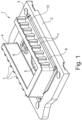
- Fig.1 shows a perspective view of a first housing part 1, which in this embodiment is an upper housing part or cover. In principle, however, it can also be a lower housing part. It has a horizontal base plate 2 extending parallel to an xy plane marked by a coordinate system, which has through holes 3 in order to Screw connection to be mounted on a base housing of an associated first order module O1.
- a screw connection other fastening variants such as a clip, weld or a door-like connection, in which the base plate is hinged to the base housing on one side and locked on the other side, are also conceivable.
- a U-shaped frame 4 is formed integrally with the base plate 2 and extends vertically from the base plate 2 upwards, in the z-direction.
- a base of the U-shape (U-base) of the frame 4 runs in a y-direction and legs of the U-shape (U-legs) of the frame 4 run in an x-direction.
- the U-shape of the frame 4 extends almost over the entire width and length of the base plate 2, which is why the two free ends of the U-shape of the frame 4 and the ends which are each connected to the U-base of the frame 4 are essentially diametrically opposite one another on the base plate 2.
- the terms “inside” or “inward facing” and “outside” or “outward facing” in the context of the U-shape always refer to the inside or the outside of the U-shape, i.e. the space between the U-legs or the space outside the U-legs and the U-base, respectively.
- the frame 4 surrounds the data and/or energy transmission units 5 and protrudes beyond them, thereby acting as a protective structure.
- Outer surfaces, at least in the x-direction and possibly also in the y-direction, of the frame 4 rest against complementary inner surfaces of a second housing part 6, described later, attached to a second ordering module O2 and in this way determine the position of the two housing parts 2, 6 relative to one another at least in the x-direction when the two ordering modules O1, O2 are mounted on one another.
- outer and inner surfaces can be bevelled complementarily to one another, so that an upper edge of the outer surfaces is further away from an outer edge of the base plate 2 than a lower edge of the outer surfaces when looking at the first housing part 1 from above.
- the outer and inner surfaces can be used as Centering elements are used to facilitate the placement and precise arrangement of the two housing parts 2, 6.
- a first coupling structure 7 is provided on the outside of the U-shaped frame 4.
- This first coupling structure 7 has a number of first projections or ribs which are preferably evenly distributed along the U-legs of the frame 4 in a specific grid with a specific grid dimension.
- the grid dimension is defined by a width and a distance of the projections in the x-direction.
- a gap 8 is formed along the U-legs of the frame 4, which gap serves to accommodate a latch 9 which is mounted in the second housing part 6.
- the latch 9 can be displaced in the x-direction by a certain distance D (displacement distance) with respect to both housing parts 1, 6, wherein the displacement in the positive x-direction, i.e. towards the side of the U-base of the frame 4, corresponds to a locking direction and the displacement in the negative x-direction, i.e. towards the side of the free ends of the U-legs of the frame 4, corresponds to an unlocking direction.
- the displacement distance D of the latch 9 between a locking position and an unlocking position corresponds to the grid dimension of the first coupling structure 7 described above.
- the base plate 2 Around the U-shaped frame 4, in particular along the U-legs of the frame 4, the base plate 2 has a flat elevation 10 formed integrally therewith, on which the latch 9 slides. In this way, the size of the surface that needs to be reworked to ensure smooth sliding of the latch 9 can be limited, thus saving manufacturing costs.
- Fig.2 shows a perspective view of the bolt 9.
- This also has a U-shape with a U-base running in the y-direction and two U-legs running in the x-direction, which U-shape is slightly wider than the U-shape of the frame 4, so that the bolt 9 can be pushed over the frame 4.
- a second coupling structure 11 is formed that is complementary to the first coupling structure 7 and has a number of second projections or ribs evenly distributed along these U-legs, the width and Distance is determined by the grid or grid dimension of the first coupling structure 7 described above.
- the distance between inward-facing flanks of the U-legs of the bolt 9 or the second coupling structure 11 formed thereon essentially corresponds to the distance from outward-facing flanks of the U-legs of the frame 4 at the level of the gap 8.
- the bolt and the frame 4 can also be adapted such that the second coupling structure is provided on the outside of the bolt and the first coupling structure is provided on the inside of the frame 4.
- the free ends of the U-shape of the latch 9 have slanted surfaces 12 or are slanted inwards in such a way that the distance between the inner flanks of the U-legs of the latch 9 increases outwards along the slanted surfaces 12.
- a pocket (notch) 13 is formed, which provides a stop in the positive x-direction and a stop in the negative x-direction.
- the stops formed by the pocket 13 are intended to come into contact with associated stops formed on the second housing part 6, for example by a projection, and thereby limit a movement of the latch 9 in the x-direction with respect to the second housing part 6.
- an opening (breakthrough) extending in the z-direction is formed, which serves as a guide groove/gate 14.
- the guide groove 14 runs along an S-curve in the latch surface. This means that a first end of the guide groove is closer to an outer edge of the U-base of the latch 9 and initially runs parallel to the outer edge of the U-base (in the y-direction), then follows a curve away from the outer edge of the U-base and then follows a curve in the opposite direction, so that the guide groove 14 finally runs in the y-direction again at its second end, but is at a greater distance from the outer edge of the U-base than at its first end.
- the guide groove 14 can be positioned in the y-direction at any point on the U-base of the latch 9, but it is advantageous if it is arranged centrally, as in the present embodiment, in order to avoid jamming.
- the surface of the U-base of the latch 9 and an opposite, lower surface of the U-base have a conspicuous colored marking 15 or are advantageously completely colored.
- the entire latch can be colored.
- the latch protrudes from a slot 16 in the second housing part 6 in its unlocked position, whereby the marking 15 is conspicuously visible to operating personnel.
- a simple indication such as a pointer pointing to an "open” or "closed” symbol, could not have such a signaling effect, since only one position of a component that looks the same in every state changes.
- the conspicuous marking 15 in signal colors which is only exposed in the open state, is not just a simple indication, but also represents an attention-grabbing warning that is difficult for operating personnel to miss, even if they do not pay special attention to it.
- Fig.3 shows a perspective view of a bolt lock 17 ( Fig. 3A , left) and a second perspective view of the bolt lock 17 from another side ( Fig. 3B , right).
- the bolt lock 17 is rotatably mounted in the second housing part 6.
- the deadbolt lock 17 has a cylindrical lock body 18 on the front of which a tool holder 19 is provided for operating the deadbolt lock 17.
- the tool holder 19 is a slot that can be operated using a coin or similar, but it can alternatively be adapted for any type of tool such as a screwdriver.
- the lock can also have a handle that can be operated by hand instead of a tool holder.
- the advantage of an embodiment with a simple tool holder is that the lock does not protrude outwards and thus you cannot get caught on it and injure yourself, knock the device over or possibly even accidentally operate the lock.
- a groove is provided with a O-ring 20 is provided.
- the O-ring 20 serves on the one hand to seal between the bolt lock 17 and the second housing part 6 and on the other hand it creates an increased frictional resistance therebetween, whereby the bolt lock 17 is held in its position relative to the second housing part 6 if it is not actuated against the frictional resistance.
- an actuating pin 21 is provided on the outer surface of the lock body 18, which extends outwards from the outer surface in a radial direction of the lock body 18.
- the actuating pin 21 engages in the guide groove 14 of the bolt 9.
- the actuating pin 21 slides along flanks of the S-shaped guide groove 14, whereby the rotary movement of the bolt lock 17 is converted into a linear movement of the bolt 9.
- an eccentrically arranged nipple/pin 22 is formed on a rear side of the lock body 18 opposite the tool holder 19, which has an essentially trapezoidal shape with two stop surfaces 23 when viewed from above along a central axis of the lock body 18.
- the nipple 22 can also be designed in the form of a circular section or triangular, for example.
- the planes in which the two stop surfaces 23 lie are arranged facing inwards with respect to the cylinder base surface of the lock body 18, while a possibly curved base side of the trapezoidal shape faces outwards.
- the planes of the stop surfaces 23 can intersect in the central axis of the lock body 18, but they can also have different angles to one another.
- the stop surfaces 23 of the bolt lock 17 are adapted to come into contact with the corresponding stop surfaces 24 of the second housing part 6 and in this way to limit a rotary movement of the bolt lock 17 to a certain angle, for example between 70° and 100°, advantageously 85° to 90°.
- This effect is also achieved by the Fig.2 described pocket 13 on the latch 9 provided stops, which on the one hand provides double security against the actuating pin 21 slipping out of the guide groove 14 and, on the other hand, any load applied to the latch 9, e.g. an impact caused by striking the opened latch 9 protruding from the second housing part 6, is not absorbed by the more sensitive actuating pin 21 but by the stops of the latch 9, which is more stable due to its geometry and choice of material.
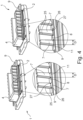
- Fig.4 shows a position of the latch 9 and the first housing part 1 relative to each other in the locking position (left) and in the unlocking position (right) with enlarged detailed views of the coupling structures 7, 11.
- the latch 9 lies in the gap 8 of the first housing part 1.
- the first and second coupling structures 7, 11 are to be described on the basis of this Fig.4 be explained in more detail.
- flanks 25 of the individual first projections or ribs of the first coupling structure 7 are wedge-shaped. This means that the individual first projections do not run exactly vertically upwards in the z-direction, but have a small angle to one another, preferably between 3° and 30°, so that gaps between the first projections widen slightly upwards.
- the second projections of the second coupling structure 11 arranged on the latch 9 and complementary to the first coupling structure 7 slide through the gaps between the first projections into the gap 8 between the first coupling structure 7 and the base plate 2, with the second projections possibly sliding along the flanks 25 of the first projections.
- the slightly inclined flanks 25 of the first projections serve as centering aids or insertion aids for the second projections of the second coupling structure 11 of the latch 9.
- a width of the first projections in the x-direction essentially corresponds to the distance between two of the first projections, ie the width of the gap between them, which in turn corresponds to the grid or grid dimension.
- second projections of the second coupling structure 11 of the latch 9 are provided with second ramps 26 pointing in the locking direction (i.e. facing the free ends of the U-legs of the latch 9) on a side facing the first coupling structure 7 (top side).
- first ramps 27 pointing in the unlocking direction are provided on a side of the first projections facing the second coupling structure 11 or the gap 8 (bottom side).
- the second ramps 26 of the second projections of the latch 9 meet the first ramps 27 of the first projections of the frame 4, slide along them and in this way help to ensure that the latch 9 does not tilt but slides under the first projections by sliding.
- a force acting in the z-direction is also generated between the two housing parts 1, 6 due to the ramps 26, 27, which pulls them together. This helps to reliably connect the data and/or energy transmission units 5.
- Fig.5 shows a perspective view of the second housing part 6 from below, according to the embodiment, which in this embodiment has a lower Housing part or base. In principle, however, it can also be an upper housing part. It is clearly visible that a recess 28 is formed in this second housing part 6, which provides the inner surfaces of the second housing part 6 that serve as centering aids and serves to accommodate the frame 4. Furthermore, data and/or energy transmission units 29 complementary to the data and/or energy transmission units 5 of the first housing part 1 are arranged in the recess 28. Outside the recess 28, through holes 30 are provided on the second housing part 6, which serve to attach the same, for example by screwing, to the second ordering module O2.
- the bolt 9 is mounted so that it can be moved in the x-direction and the bolt lock 17 is mounted so that it can rotate.
- the bolt lock 17 is exposed with its tool holder 19 on one side of the second housing part 6 so that it is accessible to operating personnel.
- a label 31 is provided in the side of the second housing part 6 next to the tool holder 19, which indicates a locking or unlocking position of the bolt lock 17 depending on the angular position of the slot-shaped tool holder 19.
- the slot 16 is provided in the side of the second housing part 6 next to the tool holder 19, in which the U-base of the bolt 9 with the marking 15 in the Fig.5 is recessed in the locking position shown and protrudes noticeably in the unlocking position.
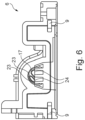
- Fig.6 shows a section through the second housing part 6, in which the bolt 9 and the bolt lock 17 are installed, along a cutting plane which runs perpendicular to the x-direction in such a way as to enable a direct top view from within the recess 28 onto the bolt lock 17.
- one of the stop surfaces 23 of the nipple 22 is in contact with one of the associated stop surfaces 24 of the second housing part 6 and the bolt lock is thus in an end position, ie the bolt 9 is either completely locked or unlocked.
- Fig.7 illustrates an assembly process of the two ordering modules O1, O2 according to the embodiment.
- Fig. 7A shows the first (lower) and the second (upper) order modules O1, O2, which are being placed on top of one another, as shown by arrows.
- the locking lock 17 is turned into an unlocking position marked by the label 31, as highlighted in the enlarged section on the right.
- the locking bolt 9 with the marking 15 protrudes from the slot 16 and thus draws attention to the unlocked state in a conspicuous manner.
- the coupling structures 7, 11 are pushed into one another as described above.
- Fig. 7B centrally the two organization modules O1, O2 are placed on top of one another and centered so that they are flush with one another, but are not yet locked, as indicated by the label 31 and the marking 15. Accordingly, they can still be moved away from one another in the x-direction and separated. In this position the latch 9 lies in the gap 8, but the second projections of the second coupling structure 11 are not located under the first projections of the first coupling structure 7, but are offset from them and do not overlap them.
- a tool shown as a coin by way of example, is inserted into the tool holder 19 in order to operate the latch lock 17 and thus the latch 9.
- Fig. 7C shows the locked state of the two organization modules O1, O2, which is characterized in that, on the one hand, the tool holder 19 of the latch lock 17 refers to the corresponding label and, in particular, the U-base of the latch 9, which has the marking 15, does not protrude from the slot 16 and thus does not emit a warning signal.
Landscapes
- Health & Medical Sciences (AREA)
- Vascular Medicine (AREA)
- Engineering & Computer Science (AREA)
- Anesthesiology (AREA)
- Biomedical Technology (AREA)
- Heart & Thoracic Surgery (AREA)
- Hematology (AREA)
- Life Sciences & Earth Sciences (AREA)
- Animal Behavior & Ethology (AREA)
- General Health & Medical Sciences (AREA)
- Public Health (AREA)
- Veterinary Medicine (AREA)
- Infusion, Injection, And Reservoir Apparatuses (AREA)
Applications Claiming Priority (3)
| Application Number | Priority Date | Filing Date | Title |
|---|---|---|---|
| DE102018122994.1A DE102018122994A1 (de) | 2018-09-19 | 2018-09-19 | Verriegelung für ein modulares Ordnungssystem |
| EP19778889.6A EP3852838B1 (fr) | 2018-09-19 | 2019-09-19 | Dispositif de verrouillage pour un système de rangement modulaire |
| PCT/EP2019/075217 WO2020058428A1 (fr) | 2018-09-19 | 2019-09-19 | Dispositif de verrouillage pour un système de rangement modulaire |
Related Parent Applications (1)
| Application Number | Title | Priority Date | Filing Date |
|---|---|---|---|
| EP19778889.6A Division EP3852838B1 (fr) | 2018-09-19 | 2019-09-19 | Dispositif de verrouillage pour un système de rangement modulaire |
Publications (2)
| Publication Number | Publication Date |
|---|---|
| EP4385545A2 true EP4385545A2 (fr) | 2024-06-19 |
| EP4385545A3 EP4385545A3 (fr) | 2024-08-21 |
Family
ID=68072340
Family Applications (2)
| Application Number | Title | Priority Date | Filing Date |
|---|---|---|---|
| EP19778889.6A Active EP3852838B1 (fr) | 2018-09-19 | 2019-09-19 | Dispositif de verrouillage pour un système de rangement modulaire |
| EP24173532.3A Pending EP4385545A3 (fr) | 2018-09-19 | 2019-09-19 | Verrouillage pour système d'organisation modulaire |
Family Applications Before (1)
| Application Number | Title | Priority Date | Filing Date |
|---|---|---|---|
| EP19778889.6A Active EP3852838B1 (fr) | 2018-09-19 | 2019-09-19 | Dispositif de verrouillage pour un système de rangement modulaire |
Country Status (6)
| Country | Link |
|---|---|
| US (1) | US12186527B2 (fr) |
| EP (2) | EP3852838B1 (fr) |
| CN (1) | CN112739394B (fr) |
| DE (1) | DE102018122994A1 (fr) |
| PL (1) | PL3852838T3 (fr) |
| WO (1) | WO2020058428A1 (fr) |
Citations (3)
| Publication number | Priority date | Publication date | Assignee | Title |
|---|---|---|---|---|
| US4756706A (en) | 1985-01-23 | 1988-07-12 | American Hospital Supply Corporation | Centrally managed modular infusion pump system |
| EP0780134A1 (fr) | 1995-12-19 | 1997-06-25 | Becton, Dickinson and Company | Système modulaire, en particulier pour application médicale, unité et système de communication correspondante |
| CN203677636U (zh) | 2013-12-16 | 2014-07-02 | 上海力申科学仪器有限公司 | 输液泵叠加结构 |
Family Cites Families (12)
| Publication number | Priority date | Publication date | Assignee | Title |
|---|---|---|---|---|
| US5941846A (en) * | 1995-03-13 | 1999-08-24 | Alaris Medical Systems, Inc. | Method and apparatus for power connection in a modular patient care system |
| US7074205B1 (en) * | 1995-03-13 | 2006-07-11 | Cardinal Health 303, Inc. | Method and apparatus for power connection in a modular patient care system |
| US5836910A (en) * | 1995-03-13 | 1998-11-17 | Alaris Medical Systems, Inc. | Method and apparatus for logical addressing in a modular patient care system |
| ES2281724T3 (es) | 1999-11-19 | 2007-10-01 | Cardinal Health 303, Inc. | Sistema de interfaz para dispositivo medico. |
| US20090177142A1 (en) * | 2008-01-09 | 2009-07-09 | Smiths Medical Md, Inc | Insulin pump with add-on modules |
| US9744300B2 (en) * | 2011-12-21 | 2017-08-29 | Deka Products Limited Partnership | Syringe pump and related method |
| EP2670459B1 (fr) * | 2011-01-31 | 2016-11-09 | SHL Group AB | Disposition d'accouplement |
| US10039898B2 (en) * | 2013-01-08 | 2018-08-07 | Biosense Webster (Israel) Ltd. | Catheter sheath introducer with directional retention damper |
| AU2015218864B2 (en) * | 2014-02-21 | 2019-10-03 | Deka Products Limited Partnership | Syringe pump having a pressure sensor assembly |
| US10912884B2 (en) * | 2015-07-22 | 2021-02-09 | ViCentra B.V | Infusion set |
| DE102015117581A1 (de) * | 2015-10-15 | 2017-04-20 | Eugen Kagan | Modulares Intensivtherapiegerät |
| US10426879B2 (en) * | 2015-12-14 | 2019-10-01 | Heartware, Inc. | Blood pump with restart lockout |
-
2018
- 2018-09-19 DE DE102018122994.1A patent/DE102018122994A1/de active Pending
-
2019
- 2019-09-19 EP EP19778889.6A patent/EP3852838B1/fr active Active
- 2019-09-19 US US17/274,322 patent/US12186527B2/en active Active
- 2019-09-19 WO PCT/EP2019/075217 patent/WO2020058428A1/fr not_active Ceased
- 2019-09-19 PL PL19778889.6T patent/PL3852838T3/pl unknown
- 2019-09-19 CN CN201980061546.9A patent/CN112739394B/zh active Active
- 2019-09-19 EP EP24173532.3A patent/EP4385545A3/fr active Pending
Patent Citations (3)
| Publication number | Priority date | Publication date | Assignee | Title |
|---|---|---|---|---|
| US4756706A (en) | 1985-01-23 | 1988-07-12 | American Hospital Supply Corporation | Centrally managed modular infusion pump system |
| EP0780134A1 (fr) | 1995-12-19 | 1997-06-25 | Becton, Dickinson and Company | Système modulaire, en particulier pour application médicale, unité et système de communication correspondante |
| CN203677636U (zh) | 2013-12-16 | 2014-07-02 | 上海力申科学仪器有限公司 | 输液泵叠加结构 |
Also Published As
| Publication number | Publication date |
|---|---|
| EP4385545A3 (fr) | 2024-08-21 |
| US20210322673A1 (en) | 2021-10-21 |
| EP3852838B1 (fr) | 2024-05-01 |
| EP3852838A1 (fr) | 2021-07-28 |
| WO2020058428A1 (fr) | 2020-03-26 |
| CN112739394A (zh) | 2021-04-30 |
| CN112739394B (zh) | 2022-08-23 |
| PL3852838T3 (pl) | 2024-09-09 |
| US12186527B2 (en) | 2025-01-07 |
| DE102018122994A1 (de) | 2020-03-19 |
Similar Documents
| Publication | Publication Date | Title |
|---|---|---|
| DE60309100T2 (de) | Vorrichtung zur Lagesicherung eines Verbinders | |
| EP2514041B1 (fr) | Élément connecteur comprenant un mécanisme de verrouillage | |
| DE102014017537B4 (de) | Verbindungsstruktur zum Verbinden eines Filtergehäuses mit einer Filtergehäusehaltestruktur, Reinigungssystem und Verfahren zum Verbinden eines Filtergehäusedeckels mit einer Filtergehäusehaltestruktur | |
| EP2559628B1 (fr) | Récipient empilable ainsi qu'agencement de récipients avec plusieurs récipients de ce type | |
| DE60110954T2 (de) | Kassetten und Schublade für Schubladenschränke | |
| EP2561739B1 (fr) | Système de guidage d'air | |
| DE102008051480A1 (de) | Verbinder, welcher mit einer Rückhalteeinrichtung vereinigt ist und Ausbildungsverfahren hierfür | |
| DE19535836C2 (de) | Rasteinrichtung, insbesondere für elektrische Steckverbindergehäuse | |
| DE202009003250U1 (de) | Aus mehreren Kennzeichnungsvorrichtungen zusammenstellbare Kennzeichnungs-Reihenanordnung | |
| DE9218990U1 (de) | Steckanschlußsystem für eine elektronische Baugruppe | |
| EP3852838B1 (fr) | Dispositif de verrouillage pour un système de rangement modulaire | |
| DE102007059204A1 (de) | Schaltschrank oder Rack | |
| EP0653598B1 (fr) | Réfrigérateur | |
| DE60100223T2 (de) | Elektrische Steckeranordnung mit einer Bajonettverschlussverbindung | |
| EP2762899B1 (fr) | Compteur électrique avec éléments de boîtier enclenchés les uns dans les autres | |
| EP3189749A1 (fr) | Guidage télescopique pour une partie de meuble mobile | |
| EP2486349B1 (fr) | Compartiment intérieur d'appareil de réfrigération | |
| DE9204373U1 (de) | Steckverbinder | |
| DE102005058969B4 (de) | Verriegelungsvorrichtung für Steckerteil und Grundleiste eines elektrischen Steckverbinders | |
| EP2690017A2 (fr) | Dispositif de fixation pour un objet d'équipement sur un rail de fixation | |
| EP1471183B1 (fr) | Dispositif avec d'une plaque support et une balise fixée à elle | |
| DE10135662A1 (de) | Gerätebecherrahmen für Unterfluranwendungen | |
| DE60301408T2 (de) | Mobiltelefongehäuse mit abnehmbaren Gehäuseschalen | |
| DE102012103251A1 (de) | Berührungsschutzabdeckung für elektrische Anlagen | |
| EP1657554A1 (fr) | Compteur d'électricité éléctrique |
Legal Events
| Date | Code | Title | Description |
|---|---|---|---|
| PUAI | Public reference made under article 153(3) epc to a published international application that has entered the european phase |
Free format text: ORIGINAL CODE: 0009012 |
|
| STAA | Information on the status of an ep patent application or granted ep patent |
Free format text: STATUS: THE APPLICATION HAS BEEN PUBLISHED |
|
| AC | Divisional application: reference to earlier application |
Ref document number: 3852838 Country of ref document: EP Kind code of ref document: P |
|
| AK | Designated contracting states |
Kind code of ref document: A2 Designated state(s): AL AT BE BG CH CY CZ DE DK EE ES FI FR GB GR HR HU IE IS IT LI LT LU LV MC MK MT NL NO PL PT RO RS SE SI SK SM TR |
|
| REG | Reference to a national code |
Ref country code: DE Ref legal event code: R079 Free format text: PREVIOUS MAIN CLASS: A61M0005500000 Ipc: A61M0005140000 |
|
| PUAL | Search report despatched |
Free format text: ORIGINAL CODE: 0009013 |
|
| AK | Designated contracting states |
Kind code of ref document: A3 Designated state(s): AL AT BE BG CH CY CZ DE DK EE ES FI FR GB GR HR HU IE IS IT LI LT LU LV MC MK MT NL NO PL PT RO RS SE SI SK SM TR |
|
| RIC1 | Information provided on ipc code assigned before grant |
Ipc: A61M 5/50 20060101ALI20240717BHEP Ipc: A61M 5/14 20060101AFI20240717BHEP |
|
| STAA | Information on the status of an ep patent application or granted ep patent |
Free format text: STATUS: REQUEST FOR EXAMINATION WAS MADE |
|
| 17P | Request for examination filed |
Effective date: 20250218 |
|
| GRAP | Despatch of communication of intention to grant a patent |
Free format text: ORIGINAL CODE: EPIDOSNIGR1 |
|
| STAA | Information on the status of an ep patent application or granted ep patent |
Free format text: STATUS: GRANT OF PATENT IS INTENDED |
|
| RIC1 | Information provided on ipc code assigned before grant |
Ipc: A61M 5/14 20060101AFI20260310BHEP Ipc: A61M 5/50 20060101ALI20260310BHEP |
|
| INTG | Intention to grant announced |
Effective date: 20260327 |