EP4385699A1 - Préforme en pi et ses joints collés - Google Patents
Préforme en pi et ses joints collés Download PDFInfo
- Publication number
- EP4385699A1 EP4385699A1 EP23209546.3A EP23209546A EP4385699A1 EP 4385699 A1 EP4385699 A1 EP 4385699A1 EP 23209546 A EP23209546 A EP 23209546A EP 4385699 A1 EP4385699 A1 EP 4385699A1
- Authority
- EP
- European Patent Office
- Prior art keywords
- shaped
- prepreg
- component
- shaped component
- plies
- Prior art date
- Legal status (The legal status is an assumption and is not a legal conclusion. Google has not performed a legal analysis and makes no representation as to the accuracy of the status listed.)
- Granted
Links
Images


Classifications
-
- B—PERFORMING OPERATIONS; TRANSPORTING
- B29—WORKING OF PLASTICS; WORKING OF SUBSTANCES IN A PLASTIC STATE IN GENERAL
- B29B—PREPARATION OR PRETREATMENT OF THE MATERIAL TO BE SHAPED; MAKING GRANULES OR PREFORMS; RECOVERY OF PLASTICS OR OTHER CONSTITUENTS OF WASTE MATERIAL CONTAINING PLASTICS
- B29B11/00—Making preforms
- B29B11/14—Making preforms characterised by structure or composition
- B29B11/16—Making preforms characterised by structure or composition comprising fillers or reinforcement
-
- B—PERFORMING OPERATIONS; TRANSPORTING
- B32—LAYERED PRODUCTS
- B32B—LAYERED PRODUCTS, i.e. PRODUCTS BUILT-UP OF STRATA OF FLAT OR NON-FLAT, e.g. CELLULAR OR HONEYCOMB, FORM
- B32B5/00—Layered products characterised by the non- homogeneity or physical structure, i.e. comprising a fibrous, filamentary, particulate or foam layer; Layered products characterised by having a layer differing constitutionally or physically in different parts
- B32B5/02—Layered products characterised by the non- homogeneity or physical structure, i.e. comprising a fibrous, filamentary, particulate or foam layer; Layered products characterised by having a layer differing constitutionally or physically in different parts characterised by structural features of a fibrous or filamentary layer
- B32B5/12—Layered products characterised by the non- homogeneity or physical structure, i.e. comprising a fibrous, filamentary, particulate or foam layer; Layered products characterised by having a layer differing constitutionally or physically in different parts characterised by structural features of a fibrous or filamentary layer characterised by the relative arrangement of fibres or filaments of different layers, e.g. the fibres or filaments being parallel or perpendicular to each other
-
- B—PERFORMING OPERATIONS; TRANSPORTING
- B29—WORKING OF PLASTICS; WORKING OF SUBSTANCES IN A PLASTIC STATE IN GENERAL
- B29C—SHAPING OR JOINING OF PLASTICS; SHAPING OF MATERIAL IN A PLASTIC STATE, NOT OTHERWISE PROVIDED FOR; AFTER-TREATMENT OF THE SHAPED PRODUCTS, e.g. REPAIRING
- B29C51/00—Shaping by thermoforming, i.e. shaping sheets or sheet like preforms after heating, e.g. shaping sheets in matched moulds or by deep-drawing; Apparatus therefor
- B29C51/002—Shaping by thermoforming, i.e. shaping sheets or sheet like preforms after heating, e.g. shaping sheets in matched moulds or by deep-drawing; Apparatus therefor characterised by the choice of material
-
- B—PERFORMING OPERATIONS; TRANSPORTING
- B29—WORKING OF PLASTICS; WORKING OF SUBSTANCES IN A PLASTIC STATE IN GENERAL
- B29C—SHAPING OR JOINING OF PLASTICS; SHAPING OF MATERIAL IN A PLASTIC STATE, NOT OTHERWISE PROVIDED FOR; AFTER-TREATMENT OF THE SHAPED PRODUCTS, e.g. REPAIRING
- B29C65/00—Joining or sealing of preformed parts, e.g. welding of plastics materials; Apparatus therefor
- B29C65/48—Joining or sealing of preformed parts, e.g. welding of plastics materials; Apparatus therefor using adhesives, i.e. using supplementary joining material; solvent bonding
-
- B—PERFORMING OPERATIONS; TRANSPORTING
- B29—WORKING OF PLASTICS; WORKING OF SUBSTANCES IN A PLASTIC STATE IN GENERAL
- B29C—SHAPING OR JOINING OF PLASTICS; SHAPING OF MATERIAL IN A PLASTIC STATE, NOT OTHERWISE PROVIDED FOR; AFTER-TREATMENT OF THE SHAPED PRODUCTS, e.g. REPAIRING
- B29C70/00—Shaping composites, i.e. plastics material comprising reinforcements, fillers or preformed parts, e.g. inserts
- B29C70/04—Shaping composites, i.e. plastics material comprising reinforcements, fillers or preformed parts, e.g. inserts comprising reinforcements only, e.g. self-reinforcing plastics
- B29C70/06—Fibrous reinforcements only
- B29C70/10—Fibrous reinforcements only characterised by the structure of fibrous reinforcements, e.g. hollow fibres
- B29C70/16—Fibrous reinforcements only characterised by the structure of fibrous reinforcements, e.g. hollow fibres using fibres of substantial or continuous length
- B29C70/20—Fibrous reinforcements only characterised by the structure of fibrous reinforcements, e.g. hollow fibres using fibres of substantial or continuous length oriented in a single direction, e.g. roofing or other parallel fibres
- B29C70/205—Fibrous reinforcements only characterised by the structure of fibrous reinforcements, e.g. hollow fibres using fibres of substantial or continuous length oriented in a single direction, e.g. roofing or other parallel fibres the structure being shaped to form a three-dimensional configuration
-
- B—PERFORMING OPERATIONS; TRANSPORTING
- B29—WORKING OF PLASTICS; WORKING OF SUBSTANCES IN A PLASTIC STATE IN GENERAL
- B29C—SHAPING OR JOINING OF PLASTICS; SHAPING OF MATERIAL IN A PLASTIC STATE, NOT OTHERWISE PROVIDED FOR; AFTER-TREATMENT OF THE SHAPED PRODUCTS, e.g. REPAIRING
- B29C70/00—Shaping composites, i.e. plastics material comprising reinforcements, fillers or preformed parts, e.g. inserts
- B29C70/04—Shaping composites, i.e. plastics material comprising reinforcements, fillers or preformed parts, e.g. inserts comprising reinforcements only, e.g. self-reinforcing plastics
- B29C70/06—Fibrous reinforcements only
- B29C70/10—Fibrous reinforcements only characterised by the structure of fibrous reinforcements, e.g. hollow fibres
- B29C70/16—Fibrous reinforcements only characterised by the structure of fibrous reinforcements, e.g. hollow fibres using fibres of substantial or continuous length
- B29C70/22—Fibrous reinforcements only characterised by the structure of fibrous reinforcements, e.g. hollow fibres using fibres of substantial or continuous length oriented in at least two directions forming a two-dimensional [2D] structure
- B29C70/222—Fibrous reinforcements only characterised by the structure of fibrous reinforcements, e.g. hollow fibres using fibres of substantial or continuous length oriented in at least two directions forming a two-dimensional [2D] structure the structure being shaped to form a three dimensional configuration
-
- B—PERFORMING OPERATIONS; TRANSPORTING
- B32—LAYERED PRODUCTS
- B32B—LAYERED PRODUCTS, i.e. PRODUCTS BUILT-UP OF STRATA OF FLAT OR NON-FLAT, e.g. CELLULAR OR HONEYCOMB, FORM
- B32B3/00—Layered products comprising a layer with external or internal discontinuities or unevennesses, or a layer of non-planar shape; Layered products comprising a layer having particular features of form
- B32B3/26—Layered products comprising a layer with external or internal discontinuities or unevennesses, or a layer of non-planar shape; Layered products comprising a layer having particular features of form characterised by a particular shape of the outline of the cross-section of a continuous layer; characterised by a layer with cavities or internal voids ; characterised by an apertured layer
- B32B3/28—Layered products comprising a layer with external or internal discontinuities or unevennesses, or a layer of non-planar shape; Layered products comprising a layer having particular features of form characterised by a particular shape of the outline of the cross-section of a continuous layer; characterised by a layer with cavities or internal voids ; characterised by an apertured layer characterised by a layer comprising a deformed thin sheet, i.e. the layer having its entire thickness deformed out of the plane, e.g. corrugated, crumpled
-
- B—PERFORMING OPERATIONS; TRANSPORTING
- B32—LAYERED PRODUCTS
- B32B—LAYERED PRODUCTS, i.e. PRODUCTS BUILT-UP OF STRATA OF FLAT OR NON-FLAT, e.g. CELLULAR OR HONEYCOMB, FORM
- B32B5/00—Layered products characterised by the non- homogeneity or physical structure, i.e. comprising a fibrous, filamentary, particulate or foam layer; Layered products characterised by having a layer differing constitutionally or physically in different parts
- B32B5/02—Layered products characterised by the non- homogeneity or physical structure, i.e. comprising a fibrous, filamentary, particulate or foam layer; Layered products characterised by having a layer differing constitutionally or physically in different parts characterised by structural features of a fibrous or filamentary layer
- B32B5/024—Woven fabric
-
- B—PERFORMING OPERATIONS; TRANSPORTING
- B32—LAYERED PRODUCTS
- B32B—LAYERED PRODUCTS, i.e. PRODUCTS BUILT-UP OF STRATA OF FLAT OR NON-FLAT, e.g. CELLULAR OR HONEYCOMB, FORM
- B32B5/00—Layered products characterised by the non- homogeneity or physical structure, i.e. comprising a fibrous, filamentary, particulate or foam layer; Layered products characterised by having a layer differing constitutionally or physically in different parts
- B32B5/02—Layered products characterised by the non- homogeneity or physical structure, i.e. comprising a fibrous, filamentary, particulate or foam layer; Layered products characterised by having a layer differing constitutionally or physically in different parts characterised by structural features of a fibrous or filamentary layer
- B32B5/026—Knitted fabric
-
- B—PERFORMING OPERATIONS; TRANSPORTING
- B32—LAYERED PRODUCTS
- B32B—LAYERED PRODUCTS, i.e. PRODUCTS BUILT-UP OF STRATA OF FLAT OR NON-FLAT, e.g. CELLULAR OR HONEYCOMB, FORM
- B32B7/00—Layered products characterised by the relation between layers; Layered products characterised by the relative orientation of features between layers, or by the relative values of a measurable parameter between layers, i.e. products comprising layers having different physical, chemical or physicochemical properties; Layered products characterised by the interconnection of layers
- B32B7/04—Interconnection of layers
- B32B7/12—Interconnection of layers using interposed adhesives or interposed materials with bonding properties
-
- B—PERFORMING OPERATIONS; TRANSPORTING
- B29—WORKING OF PLASTICS; WORKING OF SUBSTANCES IN A PLASTIC STATE IN GENERAL
- B29C—SHAPING OR JOINING OF PLASTICS; SHAPING OF MATERIAL IN A PLASTIC STATE, NOT OTHERWISE PROVIDED FOR; AFTER-TREATMENT OF THE SHAPED PRODUCTS, e.g. REPAIRING
- B29C70/00—Shaping composites, i.e. plastics material comprising reinforcements, fillers or preformed parts, e.g. inserts
- B29C70/04—Shaping composites, i.e. plastics material comprising reinforcements, fillers or preformed parts, e.g. inserts comprising reinforcements only, e.g. self-reinforcing plastics
- B29C70/28—Shaping operations therefor
- B29C70/30—Shaping by lay-up, i.e. applying fibres, tape or broadsheet on a mould, former or core; Shaping by spray-up, i.e. spraying of fibres on a mould, former or core
- B29C70/34—Shaping by lay-up, i.e. applying fibres, tape or broadsheet on a mould, former or core; Shaping by spray-up, i.e. spraying of fibres on a mould, former or core and shaping or impregnating by compression, i.e. combined with compressing after the lay-up operation
-
- B—PERFORMING OPERATIONS; TRANSPORTING
- B29—WORKING OF PLASTICS; WORKING OF SUBSTANCES IN A PLASTIC STATE IN GENERAL
- B29C—SHAPING OR JOINING OF PLASTICS; SHAPING OF MATERIAL IN A PLASTIC STATE, NOT OTHERWISE PROVIDED FOR; AFTER-TREATMENT OF THE SHAPED PRODUCTS, e.g. REPAIRING
- B29C70/00—Shaping composites, i.e. plastics material comprising reinforcements, fillers or preformed parts, e.g. inserts
- B29C70/68—Shaping composites, i.e. plastics material comprising reinforcements, fillers or preformed parts, e.g. inserts by incorporating or moulding on preformed parts, e.g. inserts or layers, e.g. foam blocks
- B29C70/70—Completely encapsulating inserts
-
- B—PERFORMING OPERATIONS; TRANSPORTING
- B29—WORKING OF PLASTICS; WORKING OF SUBSTANCES IN A PLASTIC STATE IN GENERAL
- B29K—INDEXING SCHEME ASSOCIATED WITH SUBCLASSES B29B, B29C OR B29D, RELATING TO MOULDING MATERIALS OR TO MATERIALS FOR MOULDS, REINFORCEMENTS, FILLERS OR PREFORMED PARTS, e.g. INSERTS
- B29K2105/00—Condition, form or state of moulded material or of the material to be shaped
- B29K2105/06—Condition, form or state of moulded material or of the material to be shaped containing reinforcements, fillers or inserts
- B29K2105/08—Condition, form or state of moulded material or of the material to be shaped containing reinforcements, fillers or inserts of continuous length, e.g. cords, rovings, mats, fabrics, strands or yarns
- B29K2105/0872—Prepregs
-
- B—PERFORMING OPERATIONS; TRANSPORTING
- B29—WORKING OF PLASTICS; WORKING OF SUBSTANCES IN A PLASTIC STATE IN GENERAL
- B29L—INDEXING SCHEME ASSOCIATED WITH SUBCLASS B29C, RELATING TO PARTICULAR ARTICLES
- B29L2031/00—Other particular articles
- B29L2031/001—Profiled members, e.g. beams, sections
- B29L2031/003—Profiled members, e.g. beams, sections having a profiled transverse cross-section
-
- B—PERFORMING OPERATIONS; TRANSPORTING
- B29—WORKING OF PLASTICS; WORKING OF SUBSTANCES IN A PLASTIC STATE IN GENERAL
- B29L—INDEXING SCHEME ASSOCIATED WITH SUBCLASS B29C, RELATING TO PARTICULAR ARTICLES
- B29L2031/00—Other particular articles
- B29L2031/30—Vehicles, e.g. ships or aircraft, or body parts thereof
- B29L2031/3076—Aircrafts
-
- B—PERFORMING OPERATIONS; TRANSPORTING
- B32—LAYERED PRODUCTS
- B32B—LAYERED PRODUCTS, i.e. PRODUCTS BUILT-UP OF STRATA OF FLAT OR NON-FLAT, e.g. CELLULAR OR HONEYCOMB, FORM
- B32B2250/00—Layers arrangement
- B32B2250/05—5 or more layers
-
- B—PERFORMING OPERATIONS; TRANSPORTING
- B32—LAYERED PRODUCTS
- B32B—LAYERED PRODUCTS, i.e. PRODUCTS BUILT-UP OF STRATA OF FLAT OR NON-FLAT, e.g. CELLULAR OR HONEYCOMB, FORM
- B32B2250/00—Layers arrangement
- B32B2250/20—All layers being fibrous or filamentary
-
- B—PERFORMING OPERATIONS; TRANSPORTING
- B32—LAYERED PRODUCTS
- B32B—LAYERED PRODUCTS, i.e. PRODUCTS BUILT-UP OF STRATA OF FLAT OR NON-FLAT, e.g. CELLULAR OR HONEYCOMB, FORM
- B32B2260/00—Layered product comprising an impregnated, embedded, or bonded layer wherein the layer comprises an impregnation, embedding, or binder material
- B32B2260/02—Composition of the impregnated, bonded or embedded layer
- B32B2260/021—Fibrous or filamentary layer
- B32B2260/023—Two or more layers
-
- B—PERFORMING OPERATIONS; TRANSPORTING
- B32—LAYERED PRODUCTS
- B32B—LAYERED PRODUCTS, i.e. PRODUCTS BUILT-UP OF STRATA OF FLAT OR NON-FLAT, e.g. CELLULAR OR HONEYCOMB, FORM
- B32B2260/00—Layered product comprising an impregnated, embedded, or bonded layer wherein the layer comprises an impregnation, embedding, or binder material
- B32B2260/04—Impregnation, embedding, or binder material
- B32B2260/046—Synthetic resin
-
- B—PERFORMING OPERATIONS; TRANSPORTING
- B32—LAYERED PRODUCTS
- B32B—LAYERED PRODUCTS, i.e. PRODUCTS BUILT-UP OF STRATA OF FLAT OR NON-FLAT, e.g. CELLULAR OR HONEYCOMB, FORM
- B32B2262/00—Composition or structural features of fibres which form a fibrous or filamentary layer or are present as additives
- B32B2262/02—Synthetic macromolecular fibres
- B32B2262/0261—Polyamide fibres
- B32B2262/0269—Aromatic polyamide fibres
-
- B—PERFORMING OPERATIONS; TRANSPORTING
- B32—LAYERED PRODUCTS
- B32B—LAYERED PRODUCTS, i.e. PRODUCTS BUILT-UP OF STRATA OF FLAT OR NON-FLAT, e.g. CELLULAR OR HONEYCOMB, FORM
- B32B2262/00—Composition or structural features of fibres which form a fibrous or filamentary layer or are present as additives
- B32B2262/10—Inorganic fibres
- B32B2262/101—Glass fibres
-
- B—PERFORMING OPERATIONS; TRANSPORTING
- B32—LAYERED PRODUCTS
- B32B—LAYERED PRODUCTS, i.e. PRODUCTS BUILT-UP OF STRATA OF FLAT OR NON-FLAT, e.g. CELLULAR OR HONEYCOMB, FORM
- B32B2262/00—Composition or structural features of fibres which form a fibrous or filamentary layer or are present as additives
- B32B2262/10—Inorganic fibres
- B32B2262/103—Metal fibres
-
- B—PERFORMING OPERATIONS; TRANSPORTING
- B32—LAYERED PRODUCTS
- B32B—LAYERED PRODUCTS, i.e. PRODUCTS BUILT-UP OF STRATA OF FLAT OR NON-FLAT, e.g. CELLULAR OR HONEYCOMB, FORM
- B32B2262/00—Composition or structural features of fibres which form a fibrous or filamentary layer or are present as additives
- B32B2262/10—Inorganic fibres
- B32B2262/106—Carbon fibres, e.g. graphite fibres
-
- B—PERFORMING OPERATIONS; TRANSPORTING
- B32—LAYERED PRODUCTS
- B32B—LAYERED PRODUCTS, i.e. PRODUCTS BUILT-UP OF STRATA OF FLAT OR NON-FLAT, e.g. CELLULAR OR HONEYCOMB, FORM
- B32B2307/00—Properties of the layers or laminate
- B32B2307/50—Properties of the layers or laminate having particular mechanical properties
- B32B2307/542—Shear strength
-
- B—PERFORMING OPERATIONS; TRANSPORTING
- B32—LAYERED PRODUCTS
- B32B—LAYERED PRODUCTS, i.e. PRODUCTS BUILT-UP OF STRATA OF FLAT OR NON-FLAT, e.g. CELLULAR OR HONEYCOMB, FORM
- B32B2307/00—Properties of the layers or laminate
- B32B2307/70—Other properties
- B32B2307/748—Releasability
-
- B—PERFORMING OPERATIONS; TRANSPORTING
- B32—LAYERED PRODUCTS
- B32B—LAYERED PRODUCTS, i.e. PRODUCTS BUILT-UP OF STRATA OF FLAT OR NON-FLAT, e.g. CELLULAR OR HONEYCOMB, FORM
- B32B2605/00—Vehicles
- B32B2605/18—Aircraft
Definitions
- This disclosure relates in general to structural supports that join similar or dissimilar materials, and more particularly to pi-shaped preforms and bonded joints thereof.
- 3D woven pi-preforms currently provide a baseline method for achieving robust adhesively bonded joints in composite aircraft structures that achieve an acceptable level of mechanical performance in shear and pull-off strength.
- the cost of 3D woven pi-preforms is prohibitive for numerous applications that would benefit from high performance adhesive joints.
- the systems and methods of the present disclosure provide several technical advantages over previous pi-shaped preform technology, which include (i) reduced manufacturing cost compared to 3D woven pi-preforms; (ii) improved shear strength (e.g., embodiments of the pi-shaped preform provided herein demonstrated -220% shear strength of the baseline 3D pi-preforms); and (iii) flexible configuration and excellent formability caused, in part, by the discontinuous, aligned fibers in the prepreg that allow for creation of complex shaping of the pi-shaped preforms from individual components with desired layups while maintaining mechanical properties (e.g., improved shear strength and comparative pull-off strength).
- improved shear strength e.g., embodiments of the pi-shaped preform provided herein demonstrated -220% shear strength of the baseline 3D pi-preforms
- flexible configuration and excellent formability caused, in part, by the discontinuous, aligned fibers in the prepreg that allow for creation of complex shaping of the pi-shaped preforms from individual components with desired layup
- pi-shaped composite preform The formation of a pi-shaped composite preform is difficult to achieve due to the abrupt geometric features inherent in its design. 3D woven pi-preforms have been used in their manufacture and have demonstrated desired combinations of shear and pull-off strength performance. The cost to manufacture the 3D woven pi-preforms using state-of-the-art automated weaving and/or braiding technologies has remained high in spite of extensive studies.
- the present disclosure provides pi-shaped preforms comprising of discontinuous, aligned fibers that allow for the complex geometry of the pi preform to be achieved. Further, mechanical performance is maintained, or improved, due to the discontinuous, aligned nature of the fibers and the ability to tailor the ply sequence for the mechanical properties desired.
- the present disclosure provides a pi-shaped preform comprising a base component and a pair of axially elongated legs coupled to the base component to define a channel between the axially elongated legs.
- the pair of axially elongated legs comprising plies of prepreg oriented in a ply stack, and wherein at least a portion of the prepreg comprises discontinuous, aligned fibers.
- the present disclosure provides a pi-joint assembly comprising a base component and a pair of axially elongated legs coupled to the base component to define a channel between the axially elongated legs.
- the pair of axially elongated legs comprises plies of prepreg oriented in a ply stack, where at least a portion of the prepreg comprises discontinuous, aligned fibers.
- the pi-joint comprises a first material coupled to the base component and a second material coupled to an inner surface of the channel between the axially elongated legs.
- the present disclosure provides a method of manufacturing a pi-shaped preform.
- the method comprises laying plies of prepreg for a base component and a pair of axially elongated legs, where at least a portion of the prepreg comprises discontinuous, aligned fibers.
- the method further comprises thermal forming the plies of prepreg in a shape of the base component and the pair of axially elongated legs and bonding the pair of axially elongated legs to the base component to form the pi-shaped preform.
- 3D woven pi-preforms are currently used for achieving adhesively bonded joints in composite aircraft structures.
- the cost of 3D woven pi preforms is prohibitive for a number of applications that would benefit from high performance adhesive joints.
- the disclosed embodiments provide a pi-shaped preform that is a low-cost alternative to 3D woven pi-preforms, with minimal to no performance sacrifice or even higher performance.
- the provided pi-shaped preforms of the present disclosure therefore allow the use of pi-joint configurations on a broader range of applications within composite designs.
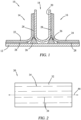
- FIGURE 1 is a schematic illustration of a pi-shaped preform element or "preform" 10 according to an embodiment of the present disclosure.
- the preform 10 When viewed in cross-section, the preform 10 resembles an inverted Greek letter ⁇ or "pi" having a base component 12 and a pair of axially extending legs 14, 16 coupled to the base component 12.
- the pair of axially extending legs 14, 16 may be perpendicular to the base component 12 or angled to fit the structure.
- a channel 18 is defined between the axially elongated legs 14, 16. In some embodiments, the channel 18 is a clevis joint.
- the pi-shaped preform 10 is a composite material that may be formed by various components.
- the axially elongated legs 14, 16 may be formed by coupling a U-shaped component 20 to a first L-shaped component 22 and a second L-shaped component 24 positioned opposite the first L-shaped component 22.
- a filler 26 is positioned in a first space formed between the U-shaped component 20 and the first L-shaped component 22, and the filler 26 is positioned a second space formed between the U-shaped component 20 and the second L-shaped component 24.
- an optional adhesive 28 is positioned between the various components to directly or indirectly couple them together.
- the adhesive 28 may be positioned between: (i) the U-shaped component 20 and the first L-shaped component 22; (ii) the U-shaped component 20 and the second L-shaped component; (iii) the first L-shaped component 22 and the base component 12; and (iv) the second L-shaped component and the base component 12 to couple the respective components together.
- the adhesive 28 may also be positioned between the U-shaped component 20 and the filler 26.
- the pi-shaped preform 10 includes plies of prepreg 30 oriented in a ply stack.
- FIGURE 2 is a schematic illustration of an individual ply of prepreg 30, and
- FIGURE 3 is a schematic illustration of plies of prepreg 30 oriented in a ply stack.
- the base component 12 and the pair of axially elongated legs 14, 16 each include plies of prepreg 30.
- the U-shaped component 20, the first L-shaped component 22, and the second L-shaped component 24 in the axially elongated legs 14, 16 may each include plies of prepreg 30 arranged in a respective ply stack 36.
- the ply orientations and volumes can be easily and cost effectively tailored to meet the mechanical requirements of each bond application.
- Current 3D woven Pi preforms cannot be quickly or cost effectively altered to meet specific mechanical requirements.
- the plies of prepreg 30 comprise a polymeric matrix 32.
- the prepreg 30 comprises from 10% to 60% (w/w) of a polymeric matrix 32, based on the total weight of the prepreg 30.
- the prepreg 30 comprises at least 10%, at least 20%, at least 25%, at least 30% to less than 35%, less than 40%, less than 45%, less than 50%, less than 55%, or less than 60% (w/w), based on the total weight of the prepreg 30.
- the polymeric matrix 32 comprises a thermoplastic resin, a thermoset resin, or combinations thereof.
- thermoplastic resins include, but are not limited to, polyacrylic acid, polyacrylic ester, poly(methyl methacrylate), acrylonitrile butadiene styrene polymer, polyamide, polylactic acid, polybenzimidazole, polycarbonate, polyether sulfone, polyoxymethylene, polyether ether ketone, polyaryletherketone, polyetherimide, polyethylene, polyphenylene oxide, polyphenylene sulfide, polypropylene, polystyrene, polyvinyl chloride, polyvinylidene fluoride, polytetrafluoroethylene, or combinations thereof.
- the thermoplastic is a commercial polymer or an oligomer having a lower molecular weight than a commercial polymer.
- thermoset resins include, but are not limited to, polyester, polyurethane, polyurea, vulcanized rubber, phenol-formaldehyde polymers, melamine polymer, bismaleimide polymer (BMI resin), polyepoxide (epoxy resin), polybenzoxazine, polyimide, polycyanurate, polyfuran, polysilicone, polyphenol, polyvinyl ester, polythiolyte, or combinations thereof.
- the thermoset is a commercial polymer or an oligomer having a lower molecular weight than a commercial polymer.
- the prepreg 30 includes a hardener. In some embodiments, the prepreg 30 includes from 0.1% to 15% (w/w) of a hardener or crosslinker agent, based on the total weight of the prepreg 30. In some embodiments, the prepreg 30 includes at least 0.1% of the hardener, or at least 1%, at least 2%, at least 3%, at least 4%, or at least 5% to less than 10%, less than 11%, less than 12%, less than 13%, less than 14%, or less than 15% (w/w) of the hardener, based on the total weight of the prepreg 30.
- Suitable hardeners include, but are not limited to, polyethylene tetraamine, dicyandiamide, phenylene diamine (particularly the meta-isomer), bis(4-amino-3,5-dimethylphenyl)-1,4-diisopropylbenzene,bis(4-amino-phenyl)1,4-diiospropylbenzene, diethyl toluene diamine, methylene dianiline, mixtures of methylene dianiline and polymethylene polyaniline compounds, diaminodiphenylsulfone, phenolic hardeners, or combinations thereof.
- the prepreg 30 includes an additive. In some embodiments, the prepreg 30 comprises from 0.1% to 50% (w/w) of an additive, based on a total weight of the prepreg 30. In some embodiments, the prepreg 30 includes at least 0.1% (w/w) of the additive, or at least 1%, at least 2%, at least 3%, at least 4%, or at least 5% to less than 10%, less than 15%, less than 20%, less than 25%, less than 30%, less than 40%, or less than 50% (w/w) of the additive, based on the total weight of the prepreg 30.
- Exemplary additives include fillers, accelerators, or combinations thereof.
- Suitable fillers include, but are not limited to, calcium carbonate, kaolin, magnesium hydroxide, wollastonite, silica, carbon black, fly ash, nanofillers (e.g., carbon nanotubes, graphene), polymer foam beads, carboxylated rubbers or combinations thereof.
- Suitable accelerators include, but are not limited to, 3-phenyl-1,1-dimethyl urea, 3-(3-chlorophenyl)-1,1,-dimethyl urea, 3-(3,4-dichlorophenyl)-1,1-dimethyl urea, 2,4-toluene bisdimethyl urea, 2,6-toluene bisdimethyl urea, or combinations thereof.
- the prepreg 30 includes discontinuous, aligned fibers 34 embedded therein.
- discontinuous refers to fibers 34 in the prepreg 30 that include at least one gap or interval as the fiber 34 extends along an axis 44 in the prepreg 30.
- the fibers 34 are aligned at an angle of less than 5 degrees from the axis 44 in the individual prepreg 30, or at an angle of less than 4 degrees, less than 3 degrees, less than 2 degrees, less than 1 degree, or less than 0.5 degrees from the axis 44 in the individual prepreg 30.
- the prepreg 30 comprises from 30% to 85% (w/w) of discontinuous, aligned fibers 34, based on the total weight of the prepreg 30. In some embodiments, the prepreg 30 comprises at least 30% (w/w) of discontinuous, aligned fibers 34, or at least 35%, at least 40%, at least 45%, at least 50%, at least 55% to less than 60%, less than 65%, less than 70%, less than 75%, less than 80%, or less than 85% (w/w) of the discontinuous, aligned fibers 34.
- Suitable discontinuous, aligned fibers 34 include, but are not limited to, carbon fibers, glass fibers, aramid fibers, graphite fibers, boron fibers, or combinations thereof.
- the discontinuous, aligned fibers 34 have a nominal fiber length of at least 0.25 inches, at least 0.5 inches, at least 1 inch, at least 1.5 inches, at least 2 inches to less than 2.5 inches, less than 3 inches, less than 3.5 inches, or less than 4 inches.
- the discontinuous, aligned fibers 34 have about the same nominal fiber length (e.g., nominal fiber length for each of the discontinuous, aligned is within 0.1% to 10% of the nominal fiber length).
- the plies of prepreg 30 may be arranged in a ply stack 36.
- the ply stack 36 includes a layup of individual plies of prepreg 30.
- the plies of prepreg 30 may be stacked such that the orientation of the discontinuous, aligned fibers 34 differs between adjacent plies of prepreg 30 in the ply stack 36.
- discontinuous, aligned fibers 34 in a first prepreg 38 may be aligned along a first axis 40
- the discontinuous, aligned fibers 34 in a second prepreg 42 adjacent to the first prepreg 38 may be aligned along a second axis 44.
- the second axis 44 may be positioned at an angle 46 to the first axis 40.
- the angle 46 may be any angle, but in some exemplary embodiments, the angle 46 is ⁇ 30 degrees, ⁇ 45 degrees, ⁇ 60 degrees, or ⁇ 90 degrees.
- the plies of prepreg 30 are arranged in a ply sequence within the ply stack 36.
- the term "ply sequence" refers to a stack arrangement for the plies of prepreg 30 that is repeated throughout at least a portion of the ply stack 36 or throughout the entire ply stack 36.
- the ply sequence may be selected based on the desired structural properties of the pi-shaped preform 10.
- the plies of prepreg 30 for base component 12 or the axially elongated legs 14, 16 may be arranged in a ply sequence selected from [45/0/-45/90]s or [0/45/-45/0/-45/45/90/45/-45/0/-45/45/0]t, where 0 refers to discontinuous, aligned fibers 34 that are oriented to align with the first axis 40.
- the ability to tailor the ply sequence, in this way, to achieve desired anisotropic performance in the overall pi-shaped preform 10 provides superior mechanical performance as compared to current 3D woven pi-preforms.
- each of the individual plies of prepreg 30 in the ply stack 36 comprise discontinuous, aligned fibers 34.
- at least a portion of the individual plies of prepreg 30 in the ply stack 36 may include continuous, aligned fibers.
- the term "continuous" refers to a fiber 34 that extends the entire length of the prepreg 30 without gaps or intervals, or fibers 34 that extend at least 90%, or at least 95%, or at least 99% the length of the prepreg 30 without gaps or intervals.
- individual plies of prepreg 30 oriented in the ply stack 36 at an angle of 0 degrees, 90 degrees, or 180 degrees relative to the first axis 40 comprise continuous, aligned fibers
- individual plies of prepreg 30 oriented in the ply stack at an angle other than 0 degrees, 90 degrees, or 180 degrees relative to the first axis 40 comprise discontinuous, aligned fibers 34.
- FIGURE 4 illustrates a pi-joint assembly 48 according to some embodiments of the present disclosure.
- the pi-joint assembly 48 includes a pi-shaped preform 10 having the same components as described in FIGURES 1-3 .
- the pi-shaped preform 10 may be used to join a first material 50 to a second material 52.
- the first material 50 is a skin of an aircraft and the second material 52 is a web of an aircraft.
- the first and second material 50, 52 may be metallic or composite materials.
- the first material 50 may be coupled to the base component 12 of the pi-shaped preform 10, and the second material 52 may be coupled to an inner surface 54 of the channel 18 between the axially elongated legs 14, 16.
- an optional adhesive 28 (not shown in FIG. 4 ) couples the first material 50 to the base component 12 and the second material 52 to the axially elongated legs 14, 16.
- the first material 50 is a thermoset composite material, where the thermoset composite material may be uncured, partially cured or fully cured.
- the second material 52 is a thermoset composite material, where the thermoset composite material may be uncured, partially cured or fully cured.
- the first material 50 is a thermoset composite material and the second material 52 is a thermoset composite material comprising the same or different resin and the same or different fiber from those of the first material, whereas one or both the thermoset composite materials may be uncured, partially cured or fully cured. At the fully cured state the thermoset composite materials may reach maximum glass transition temperatures.
- FIGURE 5 illustrates a method 100 for manufacturing a pi-shaped preform 10.
- the method 100 may begin at operation 102 which includes laying plies of prepreg 30 in a ply stack 36 for the base component 12 and the pair of axially elongated legs 14, 16.
- operation 102 may also include laying plies of prepreg 30 in a ply stack for the U-shaped component 20, the first L-shaped component 22, and the second L-shaped component 24. Materials used to form the filler 26 are cut to size.
- the method 100 includes consolidation and thermal forming the plies of prepreg 30 in a shape of the base component 12 and the pair of axially elongated legs 14, 16.
- operation 104 may include thermal forming the plies of prepreg 30 in a shape of the U-shaped component 20, the first L-shaped component 22, and the second L-shaped component 24.
- Thermal forming may include heating the plies of prepreg 30 to a thermal profile suitable for shearing the polymeric matrix 32 to create structural shapes and may advance chemical bonds that integrally link the plies of prepreg 30 together.
- Boundary tooling e.g., molded shapes of silicone rubber, metal, or other materials
- Operation 104 may further include placing the plies of prepreg 30 under pressure or vacuum to conform the plies of prepreg 30 to the shape of the boundary tooling.
- Specialized tooling is used to consolidate the ply stack and achieve sharp corners without the formation of wrinkles in the final preform.
- Operation 104 may include forming of the filler 26 in a shape as shown in FIG. 1 using thermal forming and tooling.
- the method 100 includes bonding the pair of axially elongated legs 14, 16 to the base component 12 to form the pi-shaped preform 10.
- operation 106 may include positioning a filler 26 in a first space between the pair of axially elongated legs 14, 16 and the base component.
- operation 106 may include positioning the filler 26 in a first space between the U-shaped component 20 and the first L-shaped component 22, and a filler 26 in a second space between the U-shaped component 20 and the second L-shaped component 24.
- Operation 106 may further include bonding the first L-shaped component 22, the U-shaped component 20, the second L-shaped component 24, and the base component 12 to form the pi-shaped preform 10.
- the method 100 further includes manufacturing a pi-joint assembly 48 by bonding the first material 50 to the base component 12, and the second material 52 to an inner surface 54 of the channel 18.
- Bonding may include curing composite or specifically an adhesive that is positioned between the aforementioned components. Curing the composite or the adhesive may be performed through any curing method, such as light curing or heat curing.
- Torayca Prepreg T800/3900-2 in discontinuous ET-40 form was used to make a base component, a first L-shaped component, the second L-shaped component, and a U-shaped component.
- the base component included thirteen plies of prepreg arranged in a [0/45/-45/0/-45/45/90/45/-45/0/-45/45/0]t ply sequence.
- the first and second L-shaped component included eight plies of prepreg arranged in a [45/0/- 45/90]s ply sequence.
- the U shaped component included eight plies of prepreg arranged in a [45/0/-45/90]s.
- Sub-component stack plies widths were reduced every two plies to create a tapered edge.
- the filler is composed of an axially aligned ply of T800/3900-2 prepreg, cut to width to form the proper volume, rolled, and formed to the shape of filler with round tools on a flat plate at approximately 60 degrees centigrade.
- the first space positioned between the first L-shaped component and the U-shaped component includes the filler, and the second space positioned between the second L-shaped component and the U-shaped component includes the filler.
- the sub-assembly is centered on a base, tooling is inserted into the channel and outside the L-shaped components, bagged and de-bulked and final formed into the pi-joint assembly.
- a pi-joint assembly was assembled using the pi-shaped preform along with a composite skin and web laminate composed of Solvay IM7-977-3 epoxy resin prepreg that was assembled and cured.
- the 0.193 inch thick, fabric reinforced web panel and the 0.266 inch thick, uni-tape with fabric outer ply reinforced skin utilized a quasi-isotropic prepreg stack sequence with outer peel plies of glass fabric/ 977-3 epoxy.
- Cured panels were cut to 7" wide and 37 inch length (web) and 36 inch length (skin). The web edge to be bonded was rounded slightly to better match the clevis geometry of the pi-shaped preform.
- the second strip of AF191 adhesive is folded in half and wrapped around the peeled web before insertion into the clevis of the pi-shaped preform.
- the webs are attached to vertical, articulating tool bars which maintain 90 degree orientation to the skin panel and has force application threaded fasteners to pull the web into the tight clevis.
- Composite shims equal to the estimated stack-up height of the skin, adhesives and joint stacks of the base and legs of the pi-shaped preform are inserted under the excess web length and the tool pull fasteners used to pull them tight establishing proper joint geometry and per ply thickness.
- the assembled "T" panel joint component is bagged using industry standard materials and silicone over-presses to maintain formed geometry during cure. Teflon film inserts are used to prevent bonding in "T" panel areas which will be removed for shear coupon machining.
- the joint was cured for 2 hrs. at 180 degrees centigrade and 90 psi.
- a 3D woven pi-preform was fabricated using a IM7 3D woven preform (LMdrwg #LMA-MB0031, style A1111). The 3D woven pi-preform was infiltrated with Solvay 977-3 epoxy resin. A pi-joint assembly was assembled using the 3D woven pi-preform along with a composite skin and web laminate composed of Solvay IM7-977-3 epoxy resin prepreg that was assembled and cured. The 0.166 inch thick, fabric reinforced web panel and the 0.266 inch thick, uni-tape with fabric outer ply reinforced skin utilized a quasi-isotropic prepreg stack sequence with outer peel plies of glass fabric/ 977-3 epoxy.
- Cured panels were cut to 7" wide and 37 inch length (web) and 36 inch length (skin).
- the web edge to be bonded was rounded slightly to better match the clevis geometry.
- Four inch by 36 inch strips of 3M AF191 0.08 pound/square foot adhesive with a knitted carrier were cut to cover the interior clevis and bottom base surfaces with excess width to supply excess adhesive to the joint end of part areas.
- the 3D woven pi-preform is built up with the skin panel centered on the flat cure tool, the peel ply is removed from the center 4.5 inch width to expose highly bondable epoxy surface and one strip of AF191 is applied to the center of peeled section.
- the pi-joint assembly is centered on the AF191 and pressed to adhere.
- the first 2.5 inch of the web panel to be bonded into the pi-joint is peeled on both faces for adhesive application.
- the second strip of AF191 adhesive is folded in half and wrapped around the peeled web before insertion into the clevis of the 3D woven pi-preform.
- the webs are attached to vertical, articulating tool bars which maintain 90 degree orientation to the skin panel and has force application threaded fasteners to pull the web into the tight clevis.
- Composite shims equal to the estimated stack-up height of the skin, adhesives and joint stacks of the base and legs of the 3D woven pi-preform are inserted under the excess web length and the tool pull fasteners used to pull them tight establishing proper joint geometry and per ply thickness.
- the assembled "T” panel joint component is bagged using industry standard materials and silicone over-presses to maintain formed geometry during cure. Teflon film inserts are used to prevent bonding in "T" panel areas which will be removed for shear coupon machining.
- the joint was cured for 2 hrs. at 180 degrees centigrade and 90 psi.
- Shear strength testing is performed with Example 1 and Comparative Sample A. Shear strength testing is performed by pulling the web panel out of the bonded pi-joint along the axial length of the joint. The test fixture maintains alignment, coupling the test coupon to the test frame grips. Ultimate strength and load vs strength are recorded. Example 1 exhibited exceedingly high shear strength. Specifically, Example 1 exhibited -220% shear strength compared to Comparative Sample A.
- Pull-off strength testing is performed with Example 1 and Comparative Sample A. Pull-off strength testing is performed by pulling the web normally out of the joint with test frame gripping the web and the skin supported by rods. Ultimate strength and load vs strength are recorded. Example 1 exhibited comparable pull-off strength compared to Comparative Sample A. Specifically, Example 1 exhibited -85% pull-off strength compared to Comparative Sample A.
- Example 1 Despite being a low cost alternative compared to Comparative Sample A, Example 1 provides improved shear strength and comparable pull-off performance.
- an apparatus or system or a component of an apparatus or system being adapted to, arranged to, capable of, configured to, enabled to, operable to, or operative to perform a particular function encompasses that apparatus, system, component, whether or not it or that particular function is activated, turned on, or unlocked, as long as that apparatus, system, or component is so adapted, arranged, capable, configured, enabled, operable, or operative.
Landscapes
- Engineering & Computer Science (AREA)
- Mechanical Engineering (AREA)
- Textile Engineering (AREA)
- Chemical & Material Sciences (AREA)
- Composite Materials (AREA)
- Moulding By Coating Moulds (AREA)
- Reinforced Plastic Materials (AREA)
Applications Claiming Priority (1)
| Application Number | Priority Date | Filing Date | Title |
|---|---|---|---|
| US18/065,850 US20240198625A1 (en) | 2022-12-14 | 2022-12-14 | Pi-shaped preform and bonded joints thereof |
Publications (2)
| Publication Number | Publication Date |
|---|---|
| EP4385699A1 true EP4385699A1 (fr) | 2024-06-19 |
| EP4385699B1 EP4385699B1 (fr) | 2025-03-26 |
Family
ID=88833578
Family Applications (1)
| Application Number | Title | Priority Date | Filing Date |
|---|---|---|---|
| EP23209546.3A Active EP4385699B1 (fr) | 2022-12-14 | 2023-11-13 | Préforme en pi et ses joints collés |
Country Status (6)
| Country | Link |
|---|---|
| US (1) | US20240198625A1 (fr) |
| EP (1) | EP4385699B1 (fr) |
| JP (1) | JP2024085401A (fr) |
| KR (1) | KR20240092595A (fr) |
| AU (1) | AU2023263505A1 (fr) |
| ES (1) | ES3021265T3 (fr) |
Citations (3)
| Publication number | Priority date | Publication date | Assignee | Title |
|---|---|---|---|---|
| CA922473A (en) * | 1970-05-08 | 1973-03-13 | F. Blumentritt Bruce | Fabrication of composite articles |
| US7905975B2 (en) * | 2006-03-15 | 2011-03-15 | Toray Industries, Inc. | Process for manufacturing preform and apparatus therefor |
| US20140184044A1 (en) * | 2012-12-28 | 2014-07-03 | Paul Gwin | Chassis for a computing device |
Family Cites Families (8)
| Publication number | Priority date | Publication date | Assignee | Title |
|---|---|---|---|---|
| US6712099B2 (en) * | 2001-06-15 | 2004-03-30 | Lockheed Martin Corporation | Three-dimensional weave architecture |
| US6676882B2 (en) * | 2001-08-28 | 2004-01-13 | Lockheed Martin Corporation | Methods of hot-melt resin impregnation of 3-D, woven, textile preforms |
| US9415858B2 (en) * | 2012-08-28 | 2016-08-16 | The Boeing Company | Bonded and tailorable composite assembly |
| US10329030B2 (en) * | 2016-03-04 | 2019-06-25 | The Boeing Company | Conductive radius filler system and method |
| US20170348876A1 (en) * | 2016-05-31 | 2017-12-07 | General Electric Company | Thin ply high temperature composites |
| US10352273B2 (en) * | 2016-11-08 | 2019-07-16 | Rohr, Inc. | Track beam with composite lug |
| EP3708346A4 (fr) * | 2017-11-07 | 2020-12-02 | LG Hausys, Ltd. | Procédé pour la préparation d'un matériau composite renforcé par des fibres discontinues alignées de manière unidirectionnelle, matériau composite renforcé par des fibres discontinues alignées de manière unidirectionnelle et structure en sandwich |
| EP3997159A1 (fr) * | 2019-07-10 | 2022-05-18 | Boston Materials, Inc. | Systèmes et procédés de formation de films à fibres courtes, composites comprenant des matières thermodurcies, et autres composites |
-
2022
- 2022-12-14 US US18/065,850 patent/US20240198625A1/en active Pending
-
2023
- 2023-11-09 AU AU2023263505A patent/AU2023263505A1/en active Pending
- 2023-11-13 EP EP23209546.3A patent/EP4385699B1/fr active Active
- 2023-11-13 ES ES23209546T patent/ES3021265T3/es active Active
- 2023-12-11 KR KR1020230178267A patent/KR20240092595A/ko active Pending
- 2023-12-12 JP JP2023209243A patent/JP2024085401A/ja active Pending
Patent Citations (3)
| Publication number | Priority date | Publication date | Assignee | Title |
|---|---|---|---|---|
| CA922473A (en) * | 1970-05-08 | 1973-03-13 | F. Blumentritt Bruce | Fabrication of composite articles |
| US7905975B2 (en) * | 2006-03-15 | 2011-03-15 | Toray Industries, Inc. | Process for manufacturing preform and apparatus therefor |
| US20140184044A1 (en) * | 2012-12-28 | 2014-07-03 | Paul Gwin | Chassis for a computing device |
Also Published As
| Publication number | Publication date |
|---|---|
| KR20240092595A (ko) | 2024-06-24 |
| JP2024085401A (ja) | 2024-06-26 |
| ES3021265T3 (en) | 2025-05-26 |
| AU2023263505A1 (en) | 2024-07-04 |
| EP4385699B1 (fr) | 2025-03-26 |
| US20240198625A1 (en) | 2024-06-20 |
Similar Documents
| Publication | Publication Date | Title |
|---|---|---|
| AU2020201610B2 (en) | Fabrication of composite laminates using temporarily stitched preforms | |
| EP1546274B1 (fr) | Joint de fermeture comprenant des broches en z et son procede d'asssemblage | |
| JP6273804B2 (ja) | 繊維強化プラスチック成形体の製造方法 | |
| US10710327B2 (en) | Methods for making composite parts from stacked partially cured sublaminate units | |
| CN112277341B (zh) | 用于湿复合材料铺设的半径填料 | |
| US10167379B1 (en) | Hybrid fiber layup and fiber-reinforced polymeric composites produced therefrom | |
| JP2010540294A (ja) | 被成形材の成形方法 | |
| US10913223B2 (en) | Fibre reinforced composites | |
| WO2014070323A1 (fr) | Exposition de fibres dans des stratifiés composites | |
| US11655018B2 (en) | Permeable radius filler for composite structure | |
| CA3082813C (fr) | Structure composite ayant un remplissage de rayon thermoplastique | |
| US20200406600A1 (en) | Method for joining by bonding of parts, in particular composite parts having fibrous reinforcement | |
| EP2368697B1 (fr) | Pièce composite renforcée composée d'un ensemble d'au moins deux éléments composites différents | |
| EP4385699A1 (fr) | Préforme en pi et ses joints collés | |
| EP4316793B1 (fr) | Élément léger plat et procédé pour la production de celui-ci | |
| CN119486863A (zh) | 复合夹层结构及其制造方法 | |
| CN202952560U (zh) | 纤维复合材料开孔制件和热塑性复合材料开孔制件的补强片 | |
| US20250001647A1 (en) | Resin infused pi-shaped preform and joints thereof | |
| JPH04244839A (ja) | 炭素繊維強化複合材料の作製方法 |
Legal Events
| Date | Code | Title | Description |
|---|---|---|---|
| PUAI | Public reference made under article 153(3) epc to a published international application that has entered the european phase |
Free format text: ORIGINAL CODE: 0009012 |
|
| STAA | Information on the status of an ep patent application or granted ep patent |
Free format text: STATUS: THE APPLICATION HAS BEEN PUBLISHED |
|
| AK | Designated contracting states |
Kind code of ref document: A1 Designated state(s): AL AT BE BG CH CY CZ DE DK EE ES FI FR GB GR HR HU IE IS IT LI LT LU LV MC ME MK MT NL NO PL PT RO RS SE SI SK SM TR |
|
| STAA | Information on the status of an ep patent application or granted ep patent |
Free format text: STATUS: REQUEST FOR EXAMINATION WAS MADE |
|
| 17P | Request for examination filed |
Effective date: 20240822 |
|
| RBV | Designated contracting states (corrected) |
Designated state(s): AL AT BE BG CH CY CZ DE DK EE ES FI FR GB GR HR HU IE IS IT LI LT LU LV MC ME MK MT NL NO PL PT RO RS SE SI SK SM TR |
|
| GRAP | Despatch of communication of intention to grant a patent |
Free format text: ORIGINAL CODE: EPIDOSNIGR1 |
|
| STAA | Information on the status of an ep patent application or granted ep patent |
Free format text: STATUS: GRANT OF PATENT IS INTENDED |
|
| INTG | Intention to grant announced |
Effective date: 20250107 |
|
| GRAS | Grant fee paid |
Free format text: ORIGINAL CODE: EPIDOSNIGR3 |
|
| GRAA | (expected) grant |
Free format text: ORIGINAL CODE: 0009210 |
|
| STAA | Information on the status of an ep patent application or granted ep patent |
Free format text: STATUS: THE PATENT HAS BEEN GRANTED |
|
| P01 | Opt-out of the competence of the unified patent court (upc) registered |
Free format text: CASE NUMBER: APP_5516/2025 Effective date: 20250203 |
|
| AK | Designated contracting states |
Kind code of ref document: B1 Designated state(s): AL AT BE BG CH CY CZ DE DK EE ES FI FR GB GR HR HU IE IS IT LI LT LU LV MC ME MK MT NL NO PL PT RO RS SE SI SK SM TR |
|
| REG | Reference to a national code |
Ref country code: GB Ref legal event code: FG4D |
|
| REG | Reference to a national code |
Ref country code: CH Ref legal event code: EP |
|
| REG | Reference to a national code |
Ref country code: DE Ref legal event code: R096 Ref document number: 602023002603 Country of ref document: DE |
|
| REG | Reference to a national code |
Ref country code: IE Ref legal event code: FG4D |
|
| REG | Reference to a national code |
Ref country code: ES Ref legal event code: FG2A Ref document number: 3021265 Country of ref document: ES Kind code of ref document: T3 Effective date: 20250526 |
|
| PG25 | Lapsed in a contracting state [announced via postgrant information from national office to epo] |
Ref country code: RS Free format text: LAPSE BECAUSE OF FAILURE TO SUBMIT A TRANSLATION OF THE DESCRIPTION OR TO PAY THE FEE WITHIN THE PRESCRIBED TIME-LIMIT Effective date: 20250626 |
|
| PG25 | Lapsed in a contracting state [announced via postgrant information from national office to epo] |
Ref country code: FI Free format text: LAPSE BECAUSE OF FAILURE TO SUBMIT A TRANSLATION OF THE DESCRIPTION OR TO PAY THE FEE WITHIN THE PRESCRIBED TIME-LIMIT Effective date: 20250326 |
|
| REG | Reference to a national code |
Ref country code: LT Ref legal event code: MG9D |
|
| PG25 | Lapsed in a contracting state [announced via postgrant information from national office to epo] |
Ref country code: NO Free format text: LAPSE BECAUSE OF FAILURE TO SUBMIT A TRANSLATION OF THE DESCRIPTION OR TO PAY THE FEE WITHIN THE PRESCRIBED TIME-LIMIT Effective date: 20250626 |
|
| PG25 | Lapsed in a contracting state [announced via postgrant information from national office to epo] |
Ref country code: HR Free format text: LAPSE BECAUSE OF FAILURE TO SUBMIT A TRANSLATION OF THE DESCRIPTION OR TO PAY THE FEE WITHIN THE PRESCRIBED TIME-LIMIT Effective date: 20250326 |
|
| PG25 | Lapsed in a contracting state [announced via postgrant information from national office to epo] |
Ref country code: LV Free format text: LAPSE BECAUSE OF FAILURE TO SUBMIT A TRANSLATION OF THE DESCRIPTION OR TO PAY THE FEE WITHIN THE PRESCRIBED TIME-LIMIT Effective date: 20250326 |
|
| PG25 | Lapsed in a contracting state [announced via postgrant information from national office to epo] |
Ref country code: BG Free format text: LAPSE BECAUSE OF FAILURE TO SUBMIT A TRANSLATION OF THE DESCRIPTION OR TO PAY THE FEE WITHIN THE PRESCRIBED TIME-LIMIT Effective date: 20250326 Ref country code: GR Free format text: LAPSE BECAUSE OF FAILURE TO SUBMIT A TRANSLATION OF THE DESCRIPTION OR TO PAY THE FEE WITHIN THE PRESCRIBED TIME-LIMIT Effective date: 20250627 |
|
| REG | Reference to a national code |
Ref country code: NL Ref legal event code: MP Effective date: 20250326 |
|
| PG25 | Lapsed in a contracting state [announced via postgrant information from national office to epo] |
Ref country code: NL Free format text: LAPSE BECAUSE OF FAILURE TO SUBMIT A TRANSLATION OF THE DESCRIPTION OR TO PAY THE FEE WITHIN THE PRESCRIBED TIME-LIMIT Effective date: 20250326 |
|
| PG25 | Lapsed in a contracting state [announced via postgrant information from national office to epo] |
Ref country code: SE Free format text: LAPSE BECAUSE OF FAILURE TO SUBMIT A TRANSLATION OF THE DESCRIPTION OR TO PAY THE FEE WITHIN THE PRESCRIBED TIME-LIMIT Effective date: 20250326 |
|
| REG | Reference to a national code |
Ref country code: AT Ref legal event code: MK05 Ref document number: 1778617 Country of ref document: AT Kind code of ref document: T Effective date: 20250326 |
|
| PG25 | Lapsed in a contracting state [announced via postgrant information from national office to epo] |
Ref country code: SM Free format text: LAPSE BECAUSE OF FAILURE TO SUBMIT A TRANSLATION OF THE DESCRIPTION OR TO PAY THE FEE WITHIN THE PRESCRIBED TIME-LIMIT Effective date: 20250326 |
|
| PG25 | Lapsed in a contracting state [announced via postgrant information from national office to epo] |
Ref country code: PT Free format text: LAPSE BECAUSE OF FAILURE TO SUBMIT A TRANSLATION OF THE DESCRIPTION OR TO PAY THE FEE WITHIN THE PRESCRIBED TIME-LIMIT Effective date: 20250728 |
|
| PG25 | Lapsed in a contracting state [announced via postgrant information from national office to epo] |
Ref country code: PL Free format text: LAPSE BECAUSE OF FAILURE TO SUBMIT A TRANSLATION OF THE DESCRIPTION OR TO PAY THE FEE WITHIN THE PRESCRIBED TIME-LIMIT Effective date: 20250326 |
|
| PG25 | Lapsed in a contracting state [announced via postgrant information from national office to epo] |
Ref country code: AT Free format text: LAPSE BECAUSE OF FAILURE TO SUBMIT A TRANSLATION OF THE DESCRIPTION OR TO PAY THE FEE WITHIN THE PRESCRIBED TIME-LIMIT Effective date: 20250326 |
|
| PG25 | Lapsed in a contracting state [announced via postgrant information from national office to epo] |
Ref country code: EE Free format text: LAPSE BECAUSE OF FAILURE TO SUBMIT A TRANSLATION OF THE DESCRIPTION OR TO PAY THE FEE WITHIN THE PRESCRIBED TIME-LIMIT Effective date: 20250326 |
|
| PG25 | Lapsed in a contracting state [announced via postgrant information from national office to epo] |
Ref country code: RO Free format text: LAPSE BECAUSE OF FAILURE TO SUBMIT A TRANSLATION OF THE DESCRIPTION OR TO PAY THE FEE WITHIN THE PRESCRIBED TIME-LIMIT Effective date: 20250326 |
|
| PG25 | Lapsed in a contracting state [announced via postgrant information from national office to epo] |
Ref country code: SK Free format text: LAPSE BECAUSE OF FAILURE TO SUBMIT A TRANSLATION OF THE DESCRIPTION OR TO PAY THE FEE WITHIN THE PRESCRIBED TIME-LIMIT Effective date: 20250326 |
|
| PG25 | Lapsed in a contracting state [announced via postgrant information from national office to epo] |
Ref country code: IS Free format text: LAPSE BECAUSE OF FAILURE TO SUBMIT A TRANSLATION OF THE DESCRIPTION OR TO PAY THE FEE WITHIN THE PRESCRIBED TIME-LIMIT Effective date: 20250726 |
|
| REG | Reference to a national code |
Ref country code: DE Ref legal event code: R097 Ref document number: 602023002603 Country of ref document: DE |
|
| PGFP | Annual fee paid to national office [announced via postgrant information from national office to epo] |
Ref country code: DE Payment date: 20251128 Year of fee payment: 3 |
|
| PG25 | Lapsed in a contracting state [announced via postgrant information from national office to epo] |
Ref country code: DK Free format text: LAPSE BECAUSE OF FAILURE TO SUBMIT A TRANSLATION OF THE DESCRIPTION OR TO PAY THE FEE WITHIN THE PRESCRIBED TIME-LIMIT Effective date: 20250326 |
|
| PGFP | Annual fee paid to national office [announced via postgrant information from national office to epo] |
Ref country code: IT Payment date: 20251201 Year of fee payment: 3 |
|
| PGFP | Annual fee paid to national office [announced via postgrant information from national office to epo] |
Ref country code: FR Payment date: 20251125 Year of fee payment: 3 |
|
| PG25 | Lapsed in a contracting state [announced via postgrant information from national office to epo] |
Ref country code: CZ Free format text: LAPSE BECAUSE OF FAILURE TO SUBMIT A TRANSLATION OF THE DESCRIPTION OR TO PAY THE FEE WITHIN THE PRESCRIBED TIME-LIMIT Effective date: 20250326 |
|
| PGFP | Annual fee paid to national office [announced via postgrant information from national office to epo] |
Ref country code: ES Payment date: 20251201 Year of fee payment: 3 |
|
| PLBE | No opposition filed within time limit |
Free format text: ORIGINAL CODE: 0009261 |
|
| STAA | Information on the status of an ep patent application or granted ep patent |
Free format text: STATUS: NO OPPOSITION FILED WITHIN TIME LIMIT |
|
| REG | Reference to a national code |
Ref country code: CH Ref legal event code: L10 Free format text: ST27 STATUS EVENT CODE: U-0-0-L10-L00 (AS PROVIDED BY THE NATIONAL OFFICE) Effective date: 20260211 |
|
| 26N | No opposition filed |
Effective date: 20260105 |