EP4386103A1 - Tôle d'acier haute résistance laminée à chaud présentant une excellente aptitude au formage, et procédé de fabrication associé - Google Patents
Tôle d'acier haute résistance laminée à chaud présentant une excellente aptitude au formage, et procédé de fabrication associé Download PDFInfo
- Publication number
- EP4386103A1 EP4386103A1 EP22856080.1A EP22856080A EP4386103A1 EP 4386103 A1 EP4386103 A1 EP 4386103A1 EP 22856080 A EP22856080 A EP 22856080A EP 4386103 A1 EP4386103 A1 EP 4386103A1
- Authority
- EP
- European Patent Office
- Prior art keywords
- steel sheet
- hot
- rolled steel
- cooling
- temperature
- Prior art date
- Legal status (The legal status is an assumption and is not a legal conclusion. Google has not performed a legal analysis and makes no representation as to the accuracy of the status listed.)
- Pending
Links
Images

Classifications
-
- C—CHEMISTRY; METALLURGY
- C21—METALLURGY OF IRON
- C21D—MODIFYING THE PHYSICAL STRUCTURE OF FERROUS METALS; GENERAL DEVICES FOR HEAT TREATMENT OF FERROUS OR NON-FERROUS METALS OR ALLOYS; MAKING METAL MALLEABLE, e.g. BY DECARBURISATION OR TEMPERING
- C21D9/00—Heat treatment, e.g. annealing, hardening, quenching or tempering, adapted for particular articles; Furnaces therefor
- C21D9/46—Heat treatment, e.g. annealing, hardening, quenching or tempering, adapted for particular articles; Furnaces therefor for sheet metals
-
- B—PERFORMING OPERATIONS; TRANSPORTING
- B21—MECHANICAL METAL-WORKING WITHOUT ESSENTIALLY REMOVING MATERIAL; PUNCHING METAL
- B21C—MANUFACTURE OF METAL SHEETS, WIRE, RODS, TUBES, PROFILES OR LIKE SEMI-MANUFACTURED PRODUCTS OTHERWISE THAN BY ROLLING; AUXILIARY OPERATIONS USED IN CONNECTION WITH METAL-WORKING WITHOUT ESSENTIALLY REMOVING MATERIAL
- B21C47/00—Winding-up, coiling or winding-off metal wire, metal band or other flexible metal material characterised by features relevant to metal processing only
- B21C47/02—Winding-up or coiling
-
- C—CHEMISTRY; METALLURGY
- C21—METALLURGY OF IRON
- C21D—MODIFYING THE PHYSICAL STRUCTURE OF FERROUS METALS; GENERAL DEVICES FOR HEAT TREATMENT OF FERROUS OR NON-FERROUS METALS OR ALLOYS; MAKING METAL MALLEABLE, e.g. BY DECARBURISATION OR TEMPERING
- C21D1/00—General methods or devices for heat treatment, e.g. annealing, hardening, quenching or tempering
- C21D1/18—Hardening; Quenching with or without subsequent tempering
-
- C—CHEMISTRY; METALLURGY
- C21—METALLURGY OF IRON
- C21D—MODIFYING THE PHYSICAL STRUCTURE OF FERROUS METALS; GENERAL DEVICES FOR HEAT TREATMENT OF FERROUS OR NON-FERROUS METALS OR ALLOYS; MAKING METAL MALLEABLE, e.g. BY DECARBURISATION OR TEMPERING
- C21D6/00—Heat treatment of ferrous alloys
- C21D6/002—Heat treatment of ferrous alloys containing Cr
-
- C—CHEMISTRY; METALLURGY
- C21—METALLURGY OF IRON
- C21D—MODIFYING THE PHYSICAL STRUCTURE OF FERROUS METALS; GENERAL DEVICES FOR HEAT TREATMENT OF FERROUS OR NON-FERROUS METALS OR ALLOYS; MAKING METAL MALLEABLE, e.g. BY DECARBURISATION OR TEMPERING
- C21D6/00—Heat treatment of ferrous alloys
- C21D6/005—Heat treatment of ferrous alloys containing Mn
-
- C—CHEMISTRY; METALLURGY
- C21—METALLURGY OF IRON
- C21D—MODIFYING THE PHYSICAL STRUCTURE OF FERROUS METALS; GENERAL DEVICES FOR HEAT TREATMENT OF FERROUS OR NON-FERROUS METALS OR ALLOYS; MAKING METAL MALLEABLE, e.g. BY DECARBURISATION OR TEMPERING
- C21D6/00—Heat treatment of ferrous alloys
- C21D6/008—Heat treatment of ferrous alloys containing Si
-
- C—CHEMISTRY; METALLURGY
- C21—METALLURGY OF IRON
- C21D—MODIFYING THE PHYSICAL STRUCTURE OF FERROUS METALS; GENERAL DEVICES FOR HEAT TREATMENT OF FERROUS OR NON-FERROUS METALS OR ALLOYS; MAKING METAL MALLEABLE, e.g. BY DECARBURISATION OR TEMPERING
- C21D8/00—Modifying the physical properties of ferrous metals or ferrous alloys by deformation combined with, or followed by, heat treatment
- C21D8/02—Modifying the physical properties of ferrous metals or ferrous alloys by deformation combined with, or followed by, heat treatment during manufacturing of plates or strips
-
- C—CHEMISTRY; METALLURGY
- C21—METALLURGY OF IRON
- C21D—MODIFYING THE PHYSICAL STRUCTURE OF FERROUS METALS; GENERAL DEVICES FOR HEAT TREATMENT OF FERROUS OR NON-FERROUS METALS OR ALLOYS; MAKING METAL MALLEABLE, e.g. BY DECARBURISATION OR TEMPERING
- C21D8/00—Modifying the physical properties of ferrous metals or ferrous alloys by deformation combined with, or followed by, heat treatment
- C21D8/02—Modifying the physical properties of ferrous metals or ferrous alloys by deformation combined with, or followed by, heat treatment during manufacturing of plates or strips
- C21D8/0221—Modifying the physical properties of ferrous metals or ferrous alloys by deformation combined with, or followed by, heat treatment during manufacturing of plates or strips characterised by the working steps
- C21D8/0226—Hot rolling
-
- C—CHEMISTRY; METALLURGY
- C21—METALLURGY OF IRON
- C21D—MODIFYING THE PHYSICAL STRUCTURE OF FERROUS METALS; GENERAL DEVICES FOR HEAT TREATMENT OF FERROUS OR NON-FERROUS METALS OR ALLOYS; MAKING METAL MALLEABLE, e.g. BY DECARBURISATION OR TEMPERING
- C21D8/00—Modifying the physical properties of ferrous metals or ferrous alloys by deformation combined with, or followed by, heat treatment
- C21D8/02—Modifying the physical properties of ferrous metals or ferrous alloys by deformation combined with, or followed by, heat treatment during manufacturing of plates or strips
- C21D8/0247—Modifying the physical properties of ferrous metals or ferrous alloys by deformation combined with, or followed by, heat treatment during manufacturing of plates or strips characterised by the heat treatment
- C21D8/0263—Modifying the physical properties of ferrous metals or ferrous alloys by deformation combined with, or followed by, heat treatment during manufacturing of plates or strips characterised by the heat treatment following hot rolling
-
- C—CHEMISTRY; METALLURGY
- C21—METALLURGY OF IRON
- C21D—MODIFYING THE PHYSICAL STRUCTURE OF FERROUS METALS; GENERAL DEVICES FOR HEAT TREATMENT OF FERROUS OR NON-FERROUS METALS OR ALLOYS; MAKING METAL MALLEABLE, e.g. BY DECARBURISATION OR TEMPERING
- C21D8/00—Modifying the physical properties of ferrous metals or ferrous alloys by deformation combined with, or followed by, heat treatment
- C21D8/02—Modifying the physical properties of ferrous metals or ferrous alloys by deformation combined with, or followed by, heat treatment during manufacturing of plates or strips
- C21D8/0278—Modifying the physical properties of ferrous metals or ferrous alloys by deformation combined with, or followed by, heat treatment during manufacturing of plates or strips involving a particular surface treatment
-
- C—CHEMISTRY; METALLURGY
- C22—METALLURGY; FERROUS OR NON-FERROUS ALLOYS; TREATMENT OF ALLOYS OR NON-FERROUS METALS
- C22C—ALLOYS
- C22C38/00—Ferrous alloys, e.g. steel alloys
- C22C38/001—Ferrous alloys, e.g. steel alloys containing N
-
- C—CHEMISTRY; METALLURGY
- C22—METALLURGY; FERROUS OR NON-FERROUS ALLOYS; TREATMENT OF ALLOYS OR NON-FERROUS METALS
- C22C—ALLOYS
- C22C38/00—Ferrous alloys, e.g. steel alloys
- C22C38/002—Ferrous alloys, e.g. steel alloys containing In, Mg, or other elements not provided for in one single group C22C38/001 - C22C38/60
-
- C—CHEMISTRY; METALLURGY
- C22—METALLURGY; FERROUS OR NON-FERROUS ALLOYS; TREATMENT OF ALLOYS OR NON-FERROUS METALS
- C22C—ALLOYS
- C22C38/00—Ferrous alloys, e.g. steel alloys
- C22C38/02—Ferrous alloys, e.g. steel alloys containing silicon
-
- C—CHEMISTRY; METALLURGY
- C22—METALLURGY; FERROUS OR NON-FERROUS ALLOYS; TREATMENT OF ALLOYS OR NON-FERROUS METALS
- C22C—ALLOYS
- C22C38/00—Ferrous alloys, e.g. steel alloys
- C22C38/04—Ferrous alloys, e.g. steel alloys containing manganese
-
- C—CHEMISTRY; METALLURGY
- C22—METALLURGY; FERROUS OR NON-FERROUS ALLOYS; TREATMENT OF ALLOYS OR NON-FERROUS METALS
- C22C—ALLOYS
- C22C38/00—Ferrous alloys, e.g. steel alloys
- C22C38/06—Ferrous alloys, e.g. steel alloys containing aluminium
-
- C—CHEMISTRY; METALLURGY
- C22—METALLURGY; FERROUS OR NON-FERROUS ALLOYS; TREATMENT OF ALLOYS OR NON-FERROUS METALS
- C22C—ALLOYS
- C22C38/00—Ferrous alloys, e.g. steel alloys
- C22C38/12—Ferrous alloys, e.g. steel alloys containing tungsten, tantalum, molybdenum, vanadium, or niobium
-
- C—CHEMISTRY; METALLURGY
- C22—METALLURGY; FERROUS OR NON-FERROUS ALLOYS; TREATMENT OF ALLOYS OR NON-FERROUS METALS
- C22C—ALLOYS
- C22C38/00—Ferrous alloys, e.g. steel alloys
- C22C38/14—Ferrous alloys, e.g. steel alloys containing titanium or zirconium
-
- C—CHEMISTRY; METALLURGY
- C22—METALLURGY; FERROUS OR NON-FERROUS ALLOYS; TREATMENT OF ALLOYS OR NON-FERROUS METALS
- C22C—ALLOYS
- C22C38/00—Ferrous alloys, e.g. steel alloys
- C22C38/18—Ferrous alloys, e.g. steel alloys containing chromium
- C22C38/22—Ferrous alloys, e.g. steel alloys containing chromium with molybdenum or tungsten
-
- C—CHEMISTRY; METALLURGY
- C22—METALLURGY; FERROUS OR NON-FERROUS ALLOYS; TREATMENT OF ALLOYS OR NON-FERROUS METALS
- C22C—ALLOYS
- C22C38/00—Ferrous alloys, e.g. steel alloys
- C22C38/18—Ferrous alloys, e.g. steel alloys containing chromium
- C22C38/26—Ferrous alloys, e.g. steel alloys containing chromium with niobium or tantalum
-
- C—CHEMISTRY; METALLURGY
- C22—METALLURGY; FERROUS OR NON-FERROUS ALLOYS; TREATMENT OF ALLOYS OR NON-FERROUS METALS
- C22C—ALLOYS
- C22C38/00—Ferrous alloys, e.g. steel alloys
- C22C38/18—Ferrous alloys, e.g. steel alloys containing chromium
- C22C38/28—Ferrous alloys, e.g. steel alloys containing chromium with titanium or zirconium
-
- C—CHEMISTRY; METALLURGY
- C22—METALLURGY; FERROUS OR NON-FERROUS ALLOYS; TREATMENT OF ALLOYS OR NON-FERROUS METALS
- C22C—ALLOYS
- C22C38/00—Ferrous alloys, e.g. steel alloys
- C22C38/18—Ferrous alloys, e.g. steel alloys containing chromium
- C22C38/32—Ferrous alloys, e.g. steel alloys containing chromium with boron
-
- C—CHEMISTRY; METALLURGY
- C22—METALLURGY; FERROUS OR NON-FERROUS ALLOYS; TREATMENT OF ALLOYS OR NON-FERROUS METALS
- C22C—ALLOYS
- C22C38/00—Ferrous alloys, e.g. steel alloys
- C22C38/18—Ferrous alloys, e.g. steel alloys containing chromium
- C22C38/38—Ferrous alloys, e.g. steel alloys containing chromium with more than 1.5% by weight of manganese
-
- C—CHEMISTRY; METALLURGY
- C22—METALLURGY; FERROUS OR NON-FERROUS ALLOYS; TREATMENT OF ALLOYS OR NON-FERROUS METALS
- C22C—ALLOYS
- C22C38/00—Ferrous alloys, e.g. steel alloys
- C22C38/60—Ferrous alloys, e.g. steel alloys containing lead, selenium, tellurium, or antimony, or more than 0.04% by weight of sulfur
-
- C—CHEMISTRY; METALLURGY
- C23—COATING METALLIC MATERIAL; COATING MATERIAL WITH METALLIC MATERIAL; CHEMICAL SURFACE TREATMENT; DIFFUSION TREATMENT OF METALLIC MATERIAL; COATING BY VACUUM EVAPORATION, BY SPUTTERING, BY ION IMPLANTATION OR BY CHEMICAL VAPOUR DEPOSITION, IN GENERAL; INHIBITING CORROSION OF METALLIC MATERIAL OR INCRUSTATION IN GENERAL
- C23G—CLEANING OR DE-GREASING OF METALLIC MATERIAL BY CHEMICAL METHODS OTHER THAN ELECTROLYSIS
- C23G1/00—Cleaning or pickling metallic material with solutions or molten salts
- C23G1/02—Cleaning or pickling metallic material with solutions or molten salts with acid solutions
-
- C—CHEMISTRY; METALLURGY
- C21—METALLURGY OF IRON
- C21D—MODIFYING THE PHYSICAL STRUCTURE OF FERROUS METALS; GENERAL DEVICES FOR HEAT TREATMENT OF FERROUS OR NON-FERROUS METALS OR ALLOYS; MAKING METAL MALLEABLE, e.g. BY DECARBURISATION OR TEMPERING
- C21D2211/00—Microstructure comprising significant phases
- C21D2211/001—Austenite
-
- C—CHEMISTRY; METALLURGY
- C21—METALLURGY OF IRON
- C21D—MODIFYING THE PHYSICAL STRUCTURE OF FERROUS METALS; GENERAL DEVICES FOR HEAT TREATMENT OF FERROUS OR NON-FERROUS METALS OR ALLOYS; MAKING METAL MALLEABLE, e.g. BY DECARBURISATION OR TEMPERING
- C21D2211/00—Microstructure comprising significant phases
- C21D2211/002—Bainite
-
- C—CHEMISTRY; METALLURGY
- C21—METALLURGY OF IRON
- C21D—MODIFYING THE PHYSICAL STRUCTURE OF FERROUS METALS; GENERAL DEVICES FOR HEAT TREATMENT OF FERROUS OR NON-FERROUS METALS OR ALLOYS; MAKING METAL MALLEABLE, e.g. BY DECARBURISATION OR TEMPERING
- C21D2211/00—Microstructure comprising significant phases
- C21D2211/005—Ferrite
-
- C—CHEMISTRY; METALLURGY
- C21—METALLURGY OF IRON
- C21D—MODIFYING THE PHYSICAL STRUCTURE OF FERROUS METALS; GENERAL DEVICES FOR HEAT TREATMENT OF FERROUS OR NON-FERROUS METALS OR ALLOYS; MAKING METAL MALLEABLE, e.g. BY DECARBURISATION OR TEMPERING
- C21D2211/00—Microstructure comprising significant phases
- C21D2211/008—Martensite
-
- C—CHEMISTRY; METALLURGY
- C23—COATING METALLIC MATERIAL; COATING MATERIAL WITH METALLIC MATERIAL; CHEMICAL SURFACE TREATMENT; DIFFUSION TREATMENT OF METALLIC MATERIAL; COATING BY VACUUM EVAPORATION, BY SPUTTERING, BY ION IMPLANTATION OR BY CHEMICAL VAPOUR DEPOSITION, IN GENERAL; INHIBITING CORROSION OF METALLIC MATERIAL OR INCRUSTATION IN GENERAL
- C23C—COATING METALLIC MATERIAL; COATING MATERIAL WITH METALLIC MATERIAL; SURFACE TREATMENT OF METALLIC MATERIAL BY DIFFUSION INTO THE SURFACE, BY CHEMICAL CONVERSION OR SUBSTITUTION; COATING BY VACUUM EVAPORATION, BY SPUTTERING, BY ION IMPLANTATION OR BY CHEMICAL VAPOUR DEPOSITION, IN GENERAL
- C23C2/00—Hot-dipping or immersion processes for applying the coating material in the molten state without affecting the shape; Apparatus therefor
- C23C2/04—Hot-dipping or immersion processes for applying the coating material in the molten state without affecting the shape; Apparatus therefor characterised by the coating material
- C23C2/06—Zinc or cadmium or alloys based thereon
Definitions
- the present disclosure relates to a hot-rolled steel sheet, which can be suitably applied to an automobile chassis structural member and the like, and, more specifically, to a high-strength hot-rolled steel sheet having excellent formability, and a manufacturing method therefor.
- chassis parts of a vehicle serve to support a vehicle body and are an important part in ensuring ride comfort and driving stability by absorbing vibrations and shocks from a road surface while driving.
- a fatigue load applied to the chassis parts increases, so steel materials applied to chassis parts such as electric vehicles, or the like, are required to have excellent fatigue strength.
- the steel material used for chassis parts such as electric vehicles, or the like is required to improve the tensile strength and yield strength.
- chassis parts are manufactured by press molding, it is required to secure formability such as elongation and hole expandability, suitable for press molding, in addition to improving tensile strength and yield strength to improve fatigue strength.
- Patent Document 1 discloses a method of forming a microstructure of steel comprising 90% or more of bainitic ferrite, and a fraction of martensite and bainite is controlled to 5% or less, respectively, to improve hole expandability.
- the tensile strength of a hot- rolled steel sheet may be secured at 980 MPa or more and the hole expandability can be secured at 70% or more, but it does not disclose improvement in elongation required for press forming.
- Patent Document 1 Japanese Patent Publication No. 2008-255484
- An aspect of the present disclosure is to provide a hot-rolled steel sheet with high strength and excellent fatigue performance as well as excellent formability and a method for manufacturing the same.
- a high-strength hot-rolled steel sheet having excellent formability, the hot-rolled steel sheet including, by weight: carbon (C): 0.05 to 0.17%, silicon (Si): 0.01 to 1.5%, manganese (Mn): 1.5 to 3.0%, aluminum (Al): 0.01 to 0.1%, chromium (Cr): 2.0% or less (including 0%), molybdenum (Mo): 2.0% or less (including 0%), titanium (Ti): 0.01 to 0.15%, phosphorus (P): 0.001 to 0.05%, sulfur (S): 0.0001 to 0.05%, nitrogen (N): 0.0001 to 0.02%, with a balance of Fe and other unavoidable impurities, wherein the following Relational Expression 1 is satisfied, wherein a microstructure comprises 70 to 90% of acicular ferrite or bainitic ferrite by area faction, as a matrix structure, and one or more second phases among low-temperature bainite
- each element refers to a weight content.
- a manufacturing method for a high-strength hot-rolled steel sheet having excellent formability including operations of: reheating a steel slab satisfying the above-described alloy composition and Relational Expression 1, to a temperature within a range of 1100 to 1350°C; hot rolling the reheated steel slab to manufacture a hot-rolled steel sheet; primarily cooling the hot-rolled steel sheet to a temperature of Bs or lower at a cooling rate of 70°C/s or more; secondarily cooling the steel sheet to a temperature of (Bs+Ms)/2 or higher at a cooling rate of 20 °C/s or less after the primary cooling; tertiarily cooling the steel sheet to a temperature range of Ms-20°C to 500°C at a cooling rate of 30°C/s or more after the secondary cooling; and winding the steel sheet in the tertiarily-cooled temperature range, wherein finish hot rolling is performed to satisfy the following Relational Expression 2 within a temperature range of 750
- a steel sheet having high strength and excellent formability may be provided.
- the steel material of the present disclosure is suitable for automobile chassis structural members, or the like.
- a high-strength hot-rolled steel sheet applied to conventional chassis parts, or the like, has been widely used as precipitation-strengthened steel, having excellent yield strength, elongation, and hole expandability, at the same time, by adding a large amount of carbonitrides forming elements such as Ti, Nb, and V, and winding the same in a high-temperature region around 600°C and inducing precipitation of fine carbonitrides within a ferrite matrix structure.
- the inventors of the present disclosure conducted in-depth research to develop a composite hot-rolled steel sheet having high strength even during the winding process at a low- temperature by utilizing a low-temperature transformation structure.
- a low-temperature transformation structure is a term referring to a microstructure created by displacive phase transformation, and as a representative phase, the low-temperature transformation structure includes bainite and martensite.
- Bainite can be defined as a composite structure composed of bainitic ferrite formed through displacive phase transformation without diffusion, and a secondary product created by subsequent diffusion of an interstitial alloying element such as carbon.
- an interstitial alloying element such as carbon.
- Bainite can be defined as a composite structure composed of bainitic ferrite formed through displacive phase transformation without diffusion, and a secondary product created by subsequent diffusion of an interstitial alloying element such as carbon.
- an interstitial alloying element such as carbon.
- the secondary product may be present in a form of carbides, pearlite, martensite-austenite composite phase (MA phase), etc., depending on the temperature of bainite formation and the type of alloying element.
- the strength and formability of the steel may vary.
- finely dispersed iron carbide it is known that it increases the strength of steel without deteriorating hole expandability, but pearlite deteriorates both the strength and hole expandability of steel.
- MA phase has an excellent effect of improving the strength of steel, if it is excessively present in the steel, it deteriorates hole expandability.
- a steel sheet having not only high strength but also excellent formability may be provided by optimizing an alloy composition range of the steel sheet and process conditions such as hot rolling and cooling, to control a matrix structure of a microstructure and a type and fraction of a secondary phase, thereby completing the present disclosure.
- a high-strength hot-rolled steel sheet having excellent formability may include by weight: carbon (C): 0.05 to 0.17%, silicon (Si): 0.01 to 1.5%, manganese (Mn): 1.5 to 3.0%, aluminum (Al): 0.01 to 0.1%, chromium (Cr): 2.0% or less (including 0%), molybdenum (Mo): 2.0% or less (including 0%), titanium (Ti): 0.01 to 0.15%, phosphorus (P): 0.001 to 0.05%, sulfur (S): 0.0001 to 0.05%, and nitrogen (N): 0.0001 to 0.02%.
- Carbon (C) is the most economical and effective element in strengthening steel, and as a C content increases, formation of ferrite is suppressed during cooling.
- C diffuses into austenite during bainite transformation and stabilize austenite, thereby being transformed into a second phase, which is low-temperature bainite, tempered martensite, and martensite-austenite composite phase (MA phase) during a subsequent cooling process, so it is effective in improving tensile strength and yield strength of steel.
- a second phase which is low-temperature bainite, tempered martensite, and martensite-austenite composite phase (MA phase) during a subsequent cooling process
- the C content is less than 0.05%, a fraction of the above-described second phase decreases, making it difficult to secure a high strength. On the other hand, if the C content exceeds 0.17%, formation of pearlite is promoted, making it impossible to secure strength, and there is a problem in that formability and weldability are poor.
- C may be included in an amount of 0.05 to 0.17%, and more advantageously, C may be included in an amount of 0.06% or more and 0.15% or less.
- Silicon (Si) is an element improving hardenability of steel, and serves to improve strength through a solid solution strengthening effect.
- a second phase is formed into low-temperature bainite, tempered martensite, and a MA phase, the strength is improved.
- the Si content is less than 0.01%, carbides are formed and a fraction of the MA phase is relatively low, making it difficult to secure tensile strength.
- the Si content exceeds 1.5%, a Fe-Si composite oxide is formed on a surface of a slab when the slab is reheated, which not only deteriorates surface quality of the steel sheet, but also reduces weldability.
- Si may be included in an amount of 0.01 to 1.5%, more advantageously 0.1% or more, and even more advantageously 0.3% or more. In addition, it would be effective to include Si in an amount of 1.3% or less.
- Manganese (Mn) is an element improving hardenability of steel, and prevents formation of ferrite during cooling after finish rolling, thereby facilitating formation of a low-temperature transformation structure.
- a Mn content is less than 1.5%, hardenability is insufficient so that there is a problem in that a fraction of ferrite increases excessively.
- the Mn content exceeds 3.0%, the hardenability increases significantly and bainite transformation does not occur smoothly in a cooling zone, so a holing time to sufficiently form acicular ferrite or bainitic ferrite, to be obtained as a matrix structure in the present disclosure, is excessively increased, and an elongation rate is reduced.
- Mn may be included in an amount of 1.5 to 3.0%, and more advantageously, may be included in an amount of 1.8% or more and 2.4% or less.
- Aluminum (Al) is an element added to deoxidize molten steel, and a portion thereof is present in steel after deoxidation.
- Al content exceeds 0.1%, oxide and nitride-based inclusions increase in the steel, deteriorating formability of the steel sheet.
- the Al content is excessively reduced to less than 0.01%, it may be economically disadvantageous as it causes an unnecessary increase in refining costs.
- Al may be included in 0.01 to 0.1%.
- Chromium is an element of improving hardenability of steel, and suppresses formation of ferrite during cooling after finish rolling.
- chromium has excellent affinity with carbon, so Cr slows down a diffusion rate of carbon and prevents over-concentration of carbon into untransformed austenite after winding, thereby suppressing formation of pearlite and inducing a second phase to become a low-temperature transformation phase, and contributes to improve yield strength and tensile strength.
- Cr may be included in an amount of 2.0% or less, and more advantageously, may be included in an amount of 1.5% or less.
- Molybdenum is an element improving hardenability of steel, and serves to improve strength through a solid solution strengthening effect, and suppresses formation of ferrite during cooling after finish rolling.
- Mo suppresses formation of pearlite by slowing down a diffusion rate of carbon and preventing carbon overconcentration into untransformed austenite after winding, and improves yield strength and tensile strength by allowing a second phase to become a low-temperature transformation phase.
- Mo may be included in an amount of 2.0% or less, more advantageously in an amount of 1.0% or less, and even more advantageously in an amount of 0.5% or less.
- Titanium (Ti) is an element of forming carbonitrides in steel, and is widely used to secure strength of steel by inducing formation of precipitates as described above. However, in the present disclosure, Ti is added to obtain an effect of preventing formation of pearlite by slowing a diffusion rate of carbon.
- Ti in an amount of 0.01% or more. However, if a Ti content exceeds 0.15%, a fraction of a MA phase constituting a second phase becomes excessive, resulting in poor hole expandability.
- Ti may be included in an amount of 0.01 to 0.15%, and more advantageously, Ti may be included in an amount of 0.05% or more and 0.10% or less.
- Phosphorus (P) is an impurity inevitably contained in steel, and is an element which is a main cause of impairing workability of steel due to segregation. Therefore, it is desirable to control a P content as low as possible.
- S Sulfur
- a S content it is advantageous to limit a S content to 0%, but since excessive manufacturing costs are required to control the S content to less than 0.0001%, a lower limit thereof can be set to 0.0001%. However, if the S content exceeds 0.05%, there may be a risk that workability may deteriorate, so an upper limit of the S content may be limited to 0.05%.
- N Nitrogen
- N content it is advantageous to limit the N content to 0%, but since excessive manufacturing costs are required to control the N content to less than 0.0001%, a lower limit thereof can be set to 0.0001%. However, if the N content exceeds 0.02%, there may be a risk that workability may deteriorate, so an upper limit of the N content may be limited to 0.02%.
- the hot-rolled steel sheet of the present disclosure may further include one or more of niobium (Nb) and boron (B).
- Niobium similar to Ti, has an effect of preventing formation of pearlite by slowing a diffusion rate of carbon. However, since recrystallization is delayed during hot rolling compared to Ti, an effect of refining austenite grains is significant, and if a Ni content exceeds 0.1%, a fraction of a MA phase, which is a second phase, is excessively formed, resulting in inferior hole expandability.
- Nb is added in an amount of 0.01% or more.
- B Boron
- B is an element of significantly improving hardenability of steel by delaying formation of nucleation of ferrite by being segregated at austenite grain boundaries.
- the addition of B has an excellent effect of the formation of ferrite during cooling after hot rolling.
- the present inventors found that, in addition to the already well-known effect of adding B, a transformation rate of bainite was also delayed upon addition of B. That is, the addition of B affects a fraction of acicular ferrite or bainitic ferrite generated during cooling after hot rolling (preferably during secondary cooling), so in the present disclosure, by adding B, secondary cooling conditions may be easily adjusted.
- the steel of the present disclosure may include remaining iron (Fe) and unavoidable impurities in addition to the above-described composition. Since unavoidable impurities may be unintentionally incorporated in a common manufacturing process, the component may not be excluded. Since these impurities are known to any person skilled in the common manufacturing process, the entire contents thereof are not particularly mentioned in the present specification.
- each element means a weight content.
- a low-temperature transformation phase should be formed as intended, which should suppress formation of pearlite after winding the hot-rolled steel sheet. Since driving force for the formation of pearlite increases as the content of carbon concentrated in untransformed austenite increases, it is necessary to prevent overconcentration of carbon by adding an element that slows a diffusion rate of carbon.
- Cr or Mo is added along with Ti as an element that slows the diffusion rate of carbon, and it was confirmed that the formation of pearlite was delayed by preventing overconcentration of untransformed austenite therefrom.
- Si has a low solubility in iron carbides constituting pearlite, so Si serves to prevent formation of carbides, and as a result, prevents formation of pearlite, similarly to the elements described above.
- a ratio of a sum of Si, Cr, Mo, and Ti, which prevents the formation of pearlite, and a ratio of C, which promotes the formation of pearlite is controlled as shown in Relational Expression 1 above, by preventing the formation of pearlite and securing a second phase as a low-temperature transformation phase, yield strength and tensile strength can be improved.
- the hot-rolled steel sheet of the present disclosure satisfying the above-described alloy composition and component relational expression may have a microstructure containing acicular ferrite or bainitic ferrite as a matrix structure, and it is preferable that the matrix structure include, by area fraction, 70 to 90% of acicular ferrite or bainitic ferrite.
- Steel of the present disclosure is cooled to a temperature below Bs (bainite transformation start temperature) to avoid ferrite phase transformation during primary cooling after hot rolling, and then bainite transformation proceeds by slow cooling during subsequent secondary cooling.
- Bs bainite transformation start temperature
- bainitic transformation occurs in a high-temperature bainitic transformation zone, so bainitic ferrite is formed and carbon diffuses into untransformed austenite, and carbides are not formed inside bainitic ferrite.
- the dislocation density is reduced to an appropriate level by a recovery phenomenon after secondary cooling and subsequent winding, which has the effect of improving the elongation of the steel sheet.
- the bainitic ferrite generated below the Bs temperature is similar in shape and properties to the acicular ferrite generated when supercooled in ultra-low carbon steel, in the present disclosure, it should be noted that the bainitic ferrite is managed by a total fraction of the bainitic ferrite and acicular ferrite.
- the total fraction of the matrix structure acicular ferrite or bainitic ferrite, is less than 70%, there is a problem in that it is difficult to secure elongation.
- the total fraction of the matrix structure exceeds 90%, there is a problem in that it is difficult to secure a low-temperature transformation structure, serving to improve the strength.
- the hot-rolled steel sheet of the present disclosure a second phase, in addition to the matrix structure described above, wherein the second phase may include a low-temperature transformation structure, preferably at least one of low-temperature bainite, tempered martensite, and MA phase, and has an area fraction of 10 to 30%.
- a low-temperature transformation structure preferably at least one of low-temperature bainite, tempered martensite, and MA phase, and has an area fraction of 10 to 30%.
- carbon diffusion to untransformed austenite proceeds with the formation of bainitic ferrite during secondary cooling during cooling after hot rolling, and the untransformed austenite is transformed into low-temperature bainite, tempered martensite, and MA phase, which is a second phase during an additional cooling process after the secondary cooling (e.g., cooling process after winding).
- a size of the untransformed austenite distributed within the structure varies depending on the location, and the type of the second phase also changes.
- the relatively large-sized untransformed austenite has a low carbon content and can be transformed into low-temperature bainite during subsequent cooling to a winding temperature, and austenite having the smaller size is transformed into martensite at a lower temperature. Since the martensite is transformed in a relatively high temperature zone, a tempering phenomenon occurs after the martensite transformation, and a final structure becomes tempered martensite.
- the low-temperature bainite and tempered martensite commonly contain iron carbides at grain boundaries and within a lath structure, and are therefore managed by the total fraction.
- the small-sized austenite since the small-sized austenite has the highest carbon concentration during secondary cooling, transformation of the austenite into low-temperature bainite or martensite immediately after winding does not proceed, and when the austenite is transformed into martensite during a final cooling step, or is not transformed into martensite, it may remain as austenite.
- martensite with a high carbon content has a characteristic of having a plate-type martensite rather than a lath shape, and an internal twin structure is not clearly observed during Nital etching, so it can be clearly distinguished from low-temperature bainite and tempered martensite.
- This MA phase is effective in improving yield strength and tensile strength, but a difference in hardness between bainitic ferrite (or acicular ferrite), which is a matrix structure and a phase, is high, making hole expandability inferior.
- the present disclosure it is preferable to include 10% or more of the second phase, by area fraction in terms of securing yield strength and tensile strength, and it is preferable to limit the second phase to 30% or less to secure elongation at the same time.
- a ratio of the MA phase in the second phase is controlled, and the MA phase is included in the ratio of less than 30% of the total area fraction of the second phase.
- the hot-rolled steel sheet of the present disclosure may include one or more of ferrite and carbide as other structures in addition to the matrix structure and second phase described above, but these are preferably controlled to be less than 5%, by area fraction.
- ferrite means granular ferrite.
- Ferrite formed during cooling after hot rolling is typically formed through diffusion transformation and therefore has low strength.
- the ferrite when the ferrite is formed in an amount of less than 5%, the previous formed ferrite undergoes shear strain to accommodate particle strain generated when the remaining austenite is transformed into bainite and martensite after ferrite is formed, so that it was confirmed that the dislocation density inside the ferrite is maintained at a high level, so strength of steel does not decrease significantly.
- the fraction is 5% or more, it is not desirable because the strength of the steel decreases.
- iron carbides may be generated, along with carbon diffusion into austenite.
- the formation of iron carbides may cause a decrease in the fraction of the second phase.
- excessive generation of iron carbides inhibits a strengthening effect targeted by the present disclosure.
- alloy carbonitrides may be formed, and in this case, an additional strengthening effect may be expected by grain refinement.
- coarse carbides inhibit toughness of the steel, so in the present disclosure, it is preferable that the carbides present in the hot-rolled steel sheet of the present disclosure is less than 5%.
- the hot-rolled steel sheet of the present disclosure having the above-described alloy composition and microstructure has high strength with a yield strength of 750 MPa or more and a tensile strength of 980 MPa or more, and have excellent formability with an elongation of 9% or more and a hole expansion rate of 30% or more.
- the hot-rolled steel sheet according to the present disclosure may be manufactured by performing a series of process of [reheating, hot rolling, cooling, and winding] on a steel slab satisfying the alloy composition, and Relational Expression 1 proposed in the present disclosure.
- the reheating may be performed in a temperature range of 1100 to 1350°C.
- the temperature during reheating of the steel slab is less than 1100°C, there may be a problem in that homogenization of alloy elements is not sufficient. On the other hand, if the temperature exceeds 1350°C, there may be a risk that the surface quality of the steel sheet may deteriorate due to excessive formation of oxides on a surface of the slab.
- the reheated steel slab may be hot rolled to manufacture a hot-rolled steel sheet.
- the hot rolling is performed in a temperature range of 750 to 1150°C, and it is preferable that a total reduction amount of two final passes is controlled to 10 to 40%.
- hot rolling is performed in multiple stages to reduce the rolling load and precisely control a thickness thereof.
- a total reduction ratio of two final passes exceeds 40%, there may be a problem that the rolling load of the two final passes becomes excessive and workability is deteriorated.
- the total reduction ratio of the two final passes is less than 10%, the temperature of the steel sheet reduces rapidly, causing shape defects.
- a grain size of austenite after hot rolling is affected by an alloy composition, rolling end temperature, and reduction amount, which affects ferrite and bainite formation behavior and final microstructure in a subsequent cooling process.
- a fraction of a MA phase in a second phase, which is a main constituent phase, is greatly affected by the austenite grains after hot rolling.
- the size (grain size) of this second phase is affected by nucleation generation behavior in bainite transformation, but due to a nature of displacive phase transformation, the size of the second phase cannot be larger than the size of austenite before transformation, so in order to control the size of the second phase, it is advantageous to control the grain size of austenite after hot rolling.
- an effective grain size of austenite after hot rolling is derived as a relationship between a rolling end temperature FDT and a specific alloy composition, and is specifically defined by the following relational expression 2. If a value of Du according to the following relational expression 2 is 800 or more, a MA phase may be appropriately formed and a hole expansion rate can be secured at 30% or more. On the other hand, if the value exceeds 1106, an austenite grain size becomes excessively coarse, to delay bainite transformation, causing a problem that elongation is inferior. 800 ⁇ Du ⁇ 1106
- a hot-rolled steel sheet manufactured as described above is cooled, and it is preferable to perform the processes in stages according to a cooling temperature.
- the hot-rolled steel sheet is primarily cooled at a cooling rate of 70°C/s or more to a temperature of Bs or lower, and then secondarily cooled at a cooling rate of 20°C/s or less to a temperature of (Bs+Ms)/2 or higher, and then tertiarily cooled at a cooling rate of 30°C/s or more to a temperature range of Ms-20°C to 500°C.
- the hot-rolled steel sheet manufactured according to the above may be rapidly cooled below a temperature at which bainite starts to form (Bs) to suppress formation of ferrite (granular ferrite), and then may be gradually cooled to an intermediate temperature between the bainite start temperature (Bs) and the martensite start temperature (Ms), or a temperature thereabove, so that acicular ferrite or bainitic ferrite may be secured as a matrix structure.
- an upper limit of a primary cooling rate is not particularly limited, but when a steel sheet is cooled too excessively, there may be a risk that a shape of the sheet may be distorted, so the upper limit thereof may be limited to 200°C/s or less.
- a lower limit of a cooling end temperature during the primary cooling is not particularly limited, but when it is excessively lowered, there may be a risk that a cooling time during subsequent secondary cooling may not be sufficient, so it has been revealed that the lower limit thereof may be limited to Bs-100°C.
- quenching may be terminated, and secondary cooling may be performed at a cooling rate of 20°C/s or less and a temperature of (Bs+Ms)/2 or higher.
- the primarily-cooled hot-rolled steel sheet is cooled from a temperature, which is primarily cooled, to a target temperature for secondary cooling, growth of bainitic ferrite and diffusion of carbon into untransformed austenite occur.
- the secondary cooling is maintained for a time (ts, seconds) satisfying the following Relational Expression 3.
- k(T) is an indicator of a growth rate of bainitic ferrite, and is affected not only by an alloy composition of steel but also by a phase transformation temperature and grain size after hot rolling. Accordingly, if a value of Relational Expression 3, that is, a relationship between k(T) and holding time (exp(-k(T) ⁇ (ts) 2 )) is less than 0.1, a fraction of the matrix structure becomes excessive, elongation may be excellent, but a target strength may not be secured. On the other hand, if the value exceeds 0.3, there is a problem of deterioration of elongation. 0.1 ⁇ exp ⁇ k T ⁇ ts 2 ⁇ 0.3
- the k(T) is expressed by the following Relational Expression, and each element is a weight content.
- T1 represents a primary cooling end temperature (°C)
- T2 represents a secondary cooling end temperature (°C).
- k T 20 0.049 Du ⁇ 34.2 exp ⁇ T 1 + T 2 / 2 ⁇ 557 + 320 C + 35 Si + 90 Mn + 70 Cr + 120 Mo + 7800 B 112 1.92
- a temperature of the steel sheet may increase due to transformation heat generation due to bainite phase transformation.
- a cooling rate during secondary cooling may be controlled to 20°C/s or less to minimize an increase in the temperature of the steel sheet due to transformation heat generation. If the cooling rate exceeds 20°C/s, there may be a risk that a shape of the sheet may be distorted.
- the secondary cooling also includes an air cooling process.
- the hot-rolled steel sheet that has secondarily cooled as described above is tertiary cooled at a cooling rate of 30°C/s or more to a temperature range of Ms-20°C to 500°C, and then wound at the temperature.
- the tertiary cooling end temperature that is, a winding temperature may be applied to be lower than Ms, and is a fraction of bainitic ferrite is formed at 70% or more, cooling may be performed up to a temperature of Ms-20°C.
- a cooling rate during the tertiary cooling is not particularly limited, but cooling may be performed at a cooling rate of 100°C or less to prevent distortion of the plate shape.
- Bs and Ms may be may be derived by the formula below, and each element means a weight content.
- Bs(°C) 830 - (320 ⁇ [C]) - (90 ⁇ [Mn]) - (35 ⁇ [Si]) - (70 ⁇ [Cr]) - (120 ⁇ [Mo])
- Ms(°C) 550 - (330 ⁇ [C]) - (41 ⁇ [Mn]) - (20 ⁇ [Si]) - (20 ⁇ [Cr]) - (10 ⁇ [Mo]) + (30 ⁇ [Al])
- a target hot-rolled steel sheet can be obtained by final cooling.
- final cooling may be completed by air cooling to room temperature.
- the hot-rolled steel sheet of the present disclosure obtained by completing final cooling as described above may be additionally pickled and oiled.
- a hot-dip galvanizing process may be performed by heating the pickled and oiled hot-rolled steel sheet to a temperature range of 450 to 740°C.
- the hot-dip galvanizing process may be performed using a zinc-based plating bath, and there is no particular limitation on an alloy composition in the zinc-based plating bath.
- a steel slab having the composition shown in Table 1 below was prepared, and in this case, remaining components of each steel slab were Fe and unavoidable impurities.
- Each prepared steel slab was reheated at 1200°C, and then hot-rolled, cooled, wound, and finally cooled (air-cooled) under the conditions disclosed in Table 2 below to prepare a hot-rolled steel sheet having a thickness of 2.5 mm.
- a total reduction rate of two final passes was equally applied at 25%, and a cooling rate during tertiary cooling was uniformly applied at 35°C/s.
- yield strength, tensile strength, and elongation were measured at room temperature using a universal tensile tester after collecting JIS-5 standard test specimens in a direction, perpendicular to a rolling direction.
- the yield strength, tensile strength, and elongation were expressed as 0.2% off-set yield strength, maximum tensile strength, and elongation at break, respectively.
- hole expandability was measured according to the ISO TS16630 standard method on the same specimen as during a tensile test.
- FIG. 1 is a graph illustrating classification of a phase type of a second phase according to a size of the second phase of each hot-rolled steel sheet.
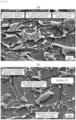
- FIG. 2 is a photograph of the microstructure of Inventive Example 4 and Comparative Example 3 observed with a scanning microscope.
Landscapes
- Chemical & Material Sciences (AREA)
- Engineering & Computer Science (AREA)
- Mechanical Engineering (AREA)
- Materials Engineering (AREA)
- Metallurgy (AREA)
- Organic Chemistry (AREA)
- Physics & Mathematics (AREA)
- Thermal Sciences (AREA)
- Crystallography & Structural Chemistry (AREA)
- Chemical Kinetics & Catalysis (AREA)
- General Chemical & Material Sciences (AREA)
- Heat Treatment Of Sheet Steel (AREA)
Applications Claiming Priority (2)
| Application Number | Priority Date | Filing Date | Title |
|---|---|---|---|
| KR1020210104554A KR20230023097A (ko) | 2021-08-09 | 2021-08-09 | 성형성이 우수한 고강도 열연강판 및 이의 제조방법 |
| PCT/KR2022/011282 WO2023018081A1 (fr) | 2021-08-09 | 2022-08-01 | Tôle d'acier haute résistance laminée à chaud présentant une excellente aptitude au formage, et procédé de fabrication associé |
Publications (2)
| Publication Number | Publication Date |
|---|---|
| EP4386103A1 true EP4386103A1 (fr) | 2024-06-19 |
| EP4386103A4 EP4386103A4 (fr) | 2025-06-11 |
Family
ID=85200292
Family Applications (1)
| Application Number | Title | Priority Date | Filing Date |
|---|---|---|---|
| EP22856080.1A Pending EP4386103A4 (fr) | 2021-08-09 | 2022-08-01 | Tôle d'acier haute résistance laminée à chaud présentant une excellente aptitude au formage, et procédé de fabrication associé |
Country Status (6)
| Country | Link |
|---|---|
| US (1) | US20240254585A1 (fr) |
| EP (1) | EP4386103A4 (fr) |
| JP (1) | JP7751074B2 (fr) |
| KR (1) | KR20230023097A (fr) |
| CN (1) | CN117795118A (fr) |
| WO (1) | WO2023018081A1 (fr) |
Families Citing this family (3)
| Publication number | Priority date | Publication date | Assignee | Title |
|---|---|---|---|---|
| KR20230077777A (ko) * | 2021-11-25 | 2023-06-02 | 주식회사 포스코 | 성형성이 우수한 초고강도 열연 강판 및 이의 제조 방법 |
| CN117265376A (zh) * | 2022-06-14 | 2023-12-22 | 宝山钢铁股份有限公司 | 一种1000MPa级高扩孔热轧复相钢钢板及其制造方法 |
| US12266160B2 (en) * | 2022-07-27 | 2025-04-01 | Meta Platforms, Inc. | Masked autoencoders for computer vision |
Family Cites Families (13)
| Publication number | Priority date | Publication date | Assignee | Title |
|---|---|---|---|---|
| JP3602350B2 (ja) * | 1998-11-06 | 2004-12-15 | 株式会社神戸製鋼所 | 伸びフランジ性に優れた高強度熱延鋼板及びその製造方法 |
| JP4272541B2 (ja) * | 2004-01-13 | 2009-06-03 | 株式会社神戸製鋼所 | 加工性の良い超高強度熱延鋼板 |
| CN101265553B (zh) * | 2007-03-15 | 2011-01-19 | 株式会社神户制钢所 | 挤压加工性优异的高强度热轧钢板及其制造方法 |
| WO2009072753A1 (fr) * | 2007-12-04 | 2009-06-11 | Posco | Tôle d'acier à haute résistance avec une excellente ténacité à basse température et procédé de fabrication de celle-ci |
| JP5194857B2 (ja) * | 2008-02-08 | 2013-05-08 | Jfeスチール株式会社 | 高強度熱延鋼板およびその製造方法 |
| JP5056771B2 (ja) * | 2008-04-21 | 2012-10-24 | Jfeスチール株式会社 | 780MPa以上の引張強度を有する高強度熱延鋼板の製造方法 |
| CN104520449B (zh) * | 2012-08-03 | 2016-12-14 | 塔塔钢铁艾默伊登有限责任公司 | 一种用于生产热轧钢带的方法以及由此生产的钢带 |
| US20160068937A1 (en) * | 2013-04-15 | 2016-03-10 | Jfe Steel Corporation | High-strength hot-rolled steel sheet and method for producing the same (as amended) |
| KR20150112490A (ko) * | 2014-03-28 | 2015-10-07 | 현대제철 주식회사 | 강재 및 그 제조 방법 |
| MX2018001082A (es) * | 2015-07-27 | 2018-06-06 | Jfe Steel Corp | Lamina de acero laminada en caliente de alta resistencia y metodo para la fabricacion de la misma. |
| WO2017168436A1 (fr) * | 2016-03-30 | 2017-10-05 | Tata Steel Limited | Produit d'acier haute résistance laminé à chaud (hrhss) ayant une résistance à la traction de 1000 à 1200 mpa et un allongement total de 16 % à 17 % |
| CN109023036B (zh) * | 2017-06-12 | 2020-03-31 | 鞍钢股份有限公司 | 一种超高强热轧复相钢板及生产方法 |
| EP3867417A1 (fr) * | 2018-10-19 | 2021-08-25 | Tata Steel Nederland Technology B.V. | Tôle d'acier laminée à chaud à ultra-haute résistance et ayant une aptitude au façonnage améliorée et son procédé de production |
-
2021
- 2021-08-09 KR KR1020210104554A patent/KR20230023097A/ko active Pending
-
2022
- 2022-08-01 WO PCT/KR2022/011282 patent/WO2023018081A1/fr not_active Ceased
- 2022-08-01 CN CN202280054897.9A patent/CN117795118A/zh active Pending
- 2022-08-01 EP EP22856080.1A patent/EP4386103A4/fr active Pending
- 2022-08-01 JP JP2024507911A patent/JP7751074B2/ja active Active
- 2022-08-01 US US18/293,772 patent/US20240254585A1/en active Pending
Also Published As
| Publication number | Publication date |
|---|---|
| CN117795118A (zh) | 2024-03-29 |
| US20240254585A1 (en) | 2024-08-01 |
| KR20230023097A (ko) | 2023-02-17 |
| JP2024530038A (ja) | 2024-08-14 |
| EP4386103A4 (fr) | 2025-06-11 |
| JP7751074B2 (ja) | 2025-10-07 |
| WO2023018081A1 (fr) | 2023-02-16 |
Similar Documents
| Publication | Publication Date | Title |
|---|---|---|
| US12435383B2 (en) | High strength multi-phase steel having excellent burring properties at low temperature, and method for producing same | |
| EP4386103A1 (fr) | Tôle d'acier haute résistance laminée à chaud présentant une excellente aptitude au formage, et procédé de fabrication associé | |
| EP3828301B1 (fr) | Tôle d'acier à haute résistance présentant une excellente propriété de résistance aux chocs et son procédé de fabrication | |
| JP7508469B2 (ja) | せん断加工性に優れた超高強度鋼板及びその製造方法 | |
| KR20190001226A (ko) | 핫 스탬핑 강 및 그 제조방법 | |
| US20260015683A1 (en) | Hot-rolled steel sheet and manufacturing method therefor | |
| EP3901312B1 (fr) | Feuille d'acier laminée à chaud à haute résistance présentant une excellente aptitude au façonnage, et son procédé de fabrication | |
| EP4640897A1 (fr) | Feuille d'acier laminée à chaud et son procédé de fabrication | |
| EP4438761A1 (fr) | Tôle d'acier laminée à chaud et son procédé de fabrication | |
| KR102747790B1 (ko) | 냉연 강판 및 그 제조방법 | |
| KR102451005B1 (ko) | 열적 안정성이 우수한 고강도 강판 및 이의 제조방법 | |
| KR20240087906A (ko) | 강판 및 그 제조방법 | |
| JPS63145745A (ja) | 強度、延性、靭性及び疲労特性に優れた熱延高張力鋼板の製造方法 | |
| KR101130013B1 (ko) | 고장력 열연강판 및 그 제조방법 | |
| EP4640894A1 (fr) | Tôle d'acier laminée à froid et son procédé de fabrication | |
| EP4438762A1 (fr) | Tôle d'acier laminée à chaud à ultra-haute résistance ayant une excellente aptitude au formage et son procédé de fabrication | |
| KR101736602B1 (ko) | 충격인성이 우수한 선재 및 이의 제조방법 | |
| KR101455469B1 (ko) | 후판 및 그 제조 방법 | |
| KR101467026B1 (ko) | 강판 및 그 제조 방법 | |
| US20250320590A1 (en) | High-yield ratio high-strength steel plate having excellent impact resistance after cold forming and manufacturing method thereof | |
| KR100273948B1 (ko) | 항복강도가 우수한 고강도 고연성 열연변태 유기소성강 제조방법 | |
| CN117966037A (zh) | 各方向的材质偏差少的析出硬化型钢板及其制造方法 | |
| KR20240087898A (ko) | 용융아연도금강판 및 그 제조방법 | |
| KR101736601B1 (ko) | 충격인성이 우수한 선재 및 이의 제조방법 | |
| KR20250094788A (ko) | 열연강판 및 이의 제조방법 |
Legal Events
| Date | Code | Title | Description |
|---|---|---|---|
| STAA | Information on the status of an ep patent application or granted ep patent |
Free format text: STATUS: THE INTERNATIONAL PUBLICATION HAS BEEN MADE |
|
| PUAI | Public reference made under article 153(3) epc to a published international application that has entered the european phase |
Free format text: ORIGINAL CODE: 0009012 |
|
| STAA | Information on the status of an ep patent application or granted ep patent |
Free format text: STATUS: REQUEST FOR EXAMINATION WAS MADE |
|
| 17P | Request for examination filed |
Effective date: 20240130 |
|
| AK | Designated contracting states |
Kind code of ref document: A1 Designated state(s): AL AT BE BG CH CY CZ DE DK EE ES FI FR GB GR HR HU IE IS IT LI LT LU LV MC MK MT NL NO PL PT RO RS SE SI SK SM TR |
|
| DAV | Request for validation of the european patent (deleted) | ||
| DAX | Request for extension of the european patent (deleted) | ||
| REG | Reference to a national code |
Ref country code: DE Ref legal event code: R079 Free format text: PREVIOUS MAIN CLASS: C22C0038380000 Ipc: C21D0008020000 |
|
| A4 | Supplementary search report drawn up and despatched |
Effective date: 20250509 |
|
| RIC1 | Information provided on ipc code assigned before grant |
Ipc: C23C 2/06 20060101ALI20250502BHEP Ipc: C21D 9/46 20060101ALI20250502BHEP Ipc: C22C 38/38 20060101ALI20250502BHEP Ipc: C22C 38/32 20060101ALI20250502BHEP Ipc: C22C 38/28 20060101ALI20250502BHEP Ipc: C22C 38/26 20060101ALI20250502BHEP Ipc: C22C 38/22 20060101ALI20250502BHEP Ipc: C22C 38/14 20060101ALI20250502BHEP Ipc: C22C 38/12 20060101ALI20250502BHEP Ipc: C22C 38/06 20060101ALI20250502BHEP Ipc: C22C 38/04 20060101ALI20250502BHEP Ipc: C22C 38/02 20060101ALI20250502BHEP Ipc: C22C 38/00 20060101ALI20250502BHEP Ipc: C21D 8/02 20060101AFI20250502BHEP |