EP4386338A1 - Optimierte echtzeit-audiowiedergabe - Google Patents
Optimierte echtzeit-audiowiedergabe Download PDFInfo
- Publication number
- EP4386338A1 EP4386338A1 EP23215807.1A EP23215807A EP4386338A1 EP 4386338 A1 EP4386338 A1 EP 4386338A1 EP 23215807 A EP23215807 A EP 23215807A EP 4386338 A1 EP4386338 A1 EP 4386338A1
- Authority
- EP
- European Patent Office
- Prior art keywords
- audio
- uwb
- user
- sound source
- walls
- Prior art date
- Legal status (The legal status is an assumption and is not a legal conclusion. Google has not performed a legal analysis and makes no representation as to the accuracy of the status listed.)
- Granted
Links
Images


Classifications
-
- G—PHYSICS
- G01—MEASURING; TESTING
- G01H—MEASUREMENT OF MECHANICAL VIBRATIONS OR ULTRASONIC, SONIC OR INFRASONIC WAVES
- G01H7/00—Measuring reverberation time ; room acoustic measurements
-
- H—ELECTRICITY
- H04—ELECTRIC COMMUNICATION TECHNIQUE
- H04S—STEREOPHONIC SYSTEMS
- H04S7/00—Indicating arrangements; Control arrangements, e.g. balance control
- H04S7/30—Control circuits for electronic adaptation of the sound field
- H04S7/302—Electronic adaptation of stereophonic sound system to listener position or orientation
- H04S7/303—Tracking of listener position or orientation
-
- G—PHYSICS
- G10—MUSICAL INSTRUMENTS; ACOUSTICS
- G10K—SOUND-PRODUCING DEVICES; METHODS OR DEVICES FOR PROTECTING AGAINST, OR FOR DAMPING, NOISE OR OTHER ACOUSTIC WAVES IN GENERAL; ACOUSTICS NOT OTHERWISE PROVIDED FOR
- G10K15/00—Acoustics not otherwise provided for
- G10K15/08—Arrangements for producing a reverberation or echo sound
-
- H—ELECTRICITY
- H04—ELECTRIC COMMUNICATION TECHNIQUE
- H04S—STEREOPHONIC SYSTEMS
- H04S7/00—Indicating arrangements; Control arrangements, e.g. balance control
- H04S7/30—Control circuits for electronic adaptation of the sound field
- H04S7/305—Electronic adaptation of stereophonic audio signals to reverberation of the listening space
Definitions
- the invention relates to the field of audio reproduction systems.
- speakers notably connected speakers, or smart speakers
- soundbars notably connected speakers, or smart speakers
- televisions notably voice assistants, smartphones, etc.
- decoder boxes or STB, for Set-Top Box
- the audio parameters make it possible to optimize the audio reproduction in the reference position only, and it is therefore necessary repeat the calibration phase each time the user moves.
- the object of the invention is, in a room in which one or more sound sources are positioned, to optimize the audio reproduction as a function of the current position of a user, without repeating a calibration phase.
- the simulation carried out during the preliminary phase, therefore makes it possible to obtain reference audio parameters associated with reference positions which can be distributed throughout the room.
- the master equipment determines the current position of the user and causes the sound sources to apply current audio parameters, which depend on the current position and which are obtained from the reference audio parameters.
- the audio reproduction is therefore optimized in real time, whatever the position of the user in the room, without it being necessary to repeat the preliminary phase (unless the position of the sound sources and/or the materials of the walls are significantly modified).
- the acoustic characteristics of the walls include, for each wall, values for different frequencies of an absorption coefficient of a material of the wall or of a category of materials including said material.
- the reference audio parameters include, for each reference position and for each sound source, gain and phase shift values for different frequencies, associated with said source. sound.
- At least one of the master equipment comprises a first UWB module, and in which the production of the card and/or the detection of the current position of the user are implemented using the first UWB module.
- At least one sound source includes a UWB tag , the master equipment being arranged to determine the position of said sound source using a UWB geolocation technique carried out using the first UWB module and the UWB tag .
- master equipment comprising a first UWB module arranged to carry out geolocation, and a processing unit arranged to implement the audio restitution method as previously described.
- a computer-readable recording medium is provided on which the program is recorded. computer as previously described.
- a set-top box 1 In reference to the figure 1 , a set-top box 1, a television 2 and two speakers 3a, 3b are located in a room.
- the decoder box 1 is connected to the television 2, for example by an HDMI type cable (for High-Definition Multimedia Interface ).
- the decoder box 1 comprises components 4 conventionally present in a decoder box 1, and in particular components arranged to acquire an audio-video stream coming from any source (satellite television network, Internet connection, BlueRay player, etc. .) and comprising an audio signal and a video signal, and to process and transmit to the equipment to which it is connected (here the television 2 and the speakers 3a, 3b) the audio signal and the video signal for their restitution.
- the decoder box 1 further comprises two speakers 5, as well as an audio module 6 arranged to acquire, process, amplify audio signals, and transmit them to the speakers 5.
- the decoder box 1 also comprises a processing unit 7.
- the processing unit 7 comprises at least one processing component 8 (electronic and/or software), which is for example a "general" processor, a processor specialized in processing signal (or DSP, for Digital Signal Processor ), a microcontroller, or a programmable logic circuit such as an FPGA (for Field Programmable Gate Arrays ) or an ASIC (for Application Specifies Integrated circuit ) .
- the processing unit 7 also includes one or more memories 9 (and in particular one or more non-volatile memories), connected to or integrated into the processing component 8. At least one of these memories 9 forms a storage medium.
- computer-readable recording on which is recorded at least one computer program comprising instructions which lead the processing component 8 to execute at least some of the steps of the audio restitution process which will be described below.
- the decoder box 1 further comprises a first UWB module 10 (for Ultra Wide Band, or Ultra Wide Band), which comprises a UWB communication component 11, a set of at least one UWB antenna 12 and a microcontroller 13.
- the microcontroller 13 is connected to the processing unit 7 (via a serial link for example).
- the microcontroller 13 communicates with the UWB communication component 11 and with the processing unit 7.
- the assembly of at least one UWB antenna 12 here comprises two UWB antennas which are connected to the UWB communication component 11.
- the first UWB module 10 can thus measure not only the distance between external equipment which itself transmits and receives UWB signals, but also the angle of arrival of the UWB signals emitted by said external equipment.
- the microcontroller 13 provides the processing unit 7 in particular with location information produced by the first UWB module 10.
- the audio restitution process is implemented by one or more master devices.
- the audio restitution process is implemented entirely by the processing unit 7 of the decoder box 1 (which is therefore the master equipment).
- the room in which the system which has just been described is located belongs to the home of a user 20.
- the user 20 is provided with mobile equipment 21, a smartphone in this case, which integrates a second UWB module 22.
- the second UWB module 22 comprises a UWB communication component 23, a set of at least one UWB antenna 24 and a microcontroller 25.
- the purpose of the audio restitution process is to optimize the audio reproduction produced by the decoder box 1 and the speakers 3a, 3b as a function of the position of the user 20 in the room.
- the audio restitution process includes a preliminary phase and an operational phase.
- the preliminary phase can be compared to a calibration phase.
- the operational phase corresponds to the normal, habitual use of its equipment by the user 20.
- the audio restitution process optimizes the acoustic experience of the user 20 in real time, depending on his position (and whatever it may be).
- the preliminary phase first includes a mapping step, which consists of creating a map of the room.
- This map includes at least the position of each sound source, that is to say in this case of the decoder box 1 and the two speakers 3a, 3b, and a position of the walls 26 of the room.
- walls we mean all the elements of the room which extend vertically and which delimit the room surface: walls, windows, bay windows, furniture (such as cabinets), etc.
- mapping step A first embodiment of this mapping step is described.
- the processing unit 7 of the decoder box 1 first sends a first message to the user 20 to ask the user to take a route along the walls 26 at most near these.
- the processing unit 7 determines the real-time position of the user 20 when he carries out said route (this is more precisely the position of the smartphone 21), and thus determines the position of the walls 26 in the room from this position in real time.
- the processing unit 7 therefore assimilates the layout of the route made by the user 20 at the base of the walls 26.
- the determination of the real-time position of the user 20 is carried out by a UWB geolocation technique using the first UWB module 10 (of the decoder box 1) and the second UWB module 22 (of the smartphone 21).
- the first UWB module 10 precisely locates the smartphone 21 based on UWB signals emitted by it.
- the processing unit 7 sends a second message to the user 20 to ask the latter to position the smartphone 21 in the immediate vicinity of the sound source. For example, the user places the smartphone 21 on or against the sound source, or positions himself right next to the sound source. The position of said sound source is then assimilated to the position of the smartphone 21, which is determined by a UWB geolocation technique using the first UWB module 10 and the second UWB module 22.
- the processing unit 7 then acquires acoustic characteristics of the walls 26.
- the acoustic characteristics of the walls 26 include, for each wall 26, values for different frequencies of an absorption coefficient of a material of the wall 26.
- a material of the wall we mean either a material with which is manufactured the wall, either a material of a covering covering the internal wall (room side) of the wall, or a material of any element positioned on or against the wall (a curtain for example).
- the user uses, for example, an application loaded into his smartphone 21 to enter the type of material of the walls 26 of the room (concrete, glass, curtain, parquet, carpet, etc.).
- This information is transmitted to the processing unit 7 via any communication channel between the smartphone 21 and the decoder box 1 (for example via Wi-Fi, Bluetooth, etc.).
- the processing unit 7 uses a table 27 stored in one of the memories 9 (non-volatile). Table 27 associates an absorption coefficient for each frequency with each material.
- table 27 associates, for each general category of materials and for several frequencies, an absorption coefficient associated with said general category and with said frequency.
- sound absorption coefficient of the material General category of materials 125Hz 250Hz 500Hz 1kHz 2kHz 4kHz Windows - untreated floor/wall 0.10 0.10 0.10 0.10 0.10 0.10 0.10 Hangings - curtains - carpet 0.10 0.20 0.40 0.50 0.65 0.60 Absorbent treatment 0.20 0.55 0.60 0.70 0.80 0.90
- the processing unit 7 then carries out a simulation, using the map and the acoustic characteristics of the walls 26, to simulate propagation in the room of sounds emitted by the sound sources
- the simulation uses a ray tracing technique. This technique makes it possible to define the acoustic impact of the room on the acoustic propagation of sound waves generated by the sound sources: decoder box 1 and speakers 3a, 3b.
- This technique consists of shooting rays from a sound source towards the measurement point by taking into account the paths with reflections from the walls, and summing the contributions of each ray.
- This simulation therefore reproduces, for each reference position of a plurality of reference positions, the path of the sound rays between each sound source and said reference position, taking into account the reflections on the walls and the ceiling.
- ⁇ 0.5.
- the level of the reflected sound wave is then equal to the level of the incident sound wave divided by 2 (i.e. an attenuation of 6 dB).
- Calculating ray tracing is equivalent to positioning a room microphone via its physical measurement. All necessary data is calculated, as for a microphone calibration. All the attenuation data of the listening point in relation to the different speakers are thus calculated. Data for immersive sound processing is calculated to compensate for distances and reflections.
- the processing unit 7 produces, for each reference position of the plurality of reference positions, and for each sound source, reference audio parameters making it possible to optimize audio reproduction of said source. sound in said reference position.
- the reference audio parameters include, for each reference position and for each sound source, gain and phase shift values for different frequencies, associated with said sound source.
- the reference positions of the plurality of reference positions are here nodes of a mesh having a mesh of predefined length.
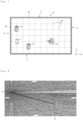
- a card 31 was produced by the decoder box 1.
- the decoder box 1 and the speakers 3a, 3b are located in a parallelepiped living room of 6 mx 10 m.
- the mesh 32 is defined on this map 31.
- the mesh is for example equal to 1m.
- a virtual listener 33 which, of course, does not actually appear on the map 31.
- the virtual listener is positioned on one of the nodes 34 of the mesh 32.
- Enclosure 3a is positioned on one of the nodes of the mesh.
- the reference positions correspond to the mesh nodes.
- N and S are not acoustically treated, so that they have an average absorption coefficient ⁇ equal to 0.1 to 1 kHz (see table above) .
- results of the ray tracing simulation give, for a given frequency, an amplification of the sound level at the level of the virtual listener 33 of +10.1 dB compared to the signal in the free field.
- This amplification must be compensated, at the given frequency (here 1 kHz), by a gain value of -10.1 dB.
- This gain value is one of the reference audio parameters associated with the given frequency and the reference position in the room corresponding to the position of the virtual listener 33.
- this calculation can be refined by integrating the directivity of the sound source speaker according to the frequencies.
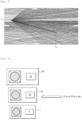
- the results of this new simulation are visible on the Figure 9 .
- the simulation makes it possible to obtain, for each reference position, that is to say for each node 34 of the grid 32, and for each sound source, a transfer function defining a gain (function of the frequency) and a phase shift (function of frequency).
- a loudspeaker is considered to form a sound source. Consequently, multi-way speakers comprising a plurality of speakers are considered as so many sound sources positioned in the same place (and possibly with the same orientation).
- the reference audio parameters are recorded in one of the memories 9 (non-volatile) of the processing unit 7.
- the operational phase can begin.
- the processing unit 7 of the decoder box 1 determines in real time the current position of the user 20 in the room when he listens to an audio signal reproduced by the decoder box 1 and the speakers 3a , 3b.
- the determination of the current position of the user 20 is carried out by a UWB geolocation technique carried out using the first UWB module 10 and the second UWB module 22.
- the processing unit 7 then restores the audio signal by the sound sources by applying current audio parameters obtained from the reference audio parameters and which depend on the current position.
- the current audio parameters which are applied are the reference audio parameters of a node 34 closest to the current position of the user 20.
- the current audio parameters which are applied are obtained by averaging reference audio parameters of several nodes 34 closest to the current position of the user 20. Averaging makes it possible to avoid too abrupt transitions when the user 20 moves.
- the processing unit 7 of the decoder box 1 transmits in real time the current audio parameters (F1 (x, y), F2 (x, y), etc.), associated with the current position of the user 20, at audio module 6 of the decoder box 1 and to the audio module 35 of each speaker 3a, 3b.
- the current audio parameters F1 (x, y), F2 (x, y), etc.
- the audio module 6, 35 of each sound source acquires the current audio parameters which are assigned to said sound source, carries out processing to apply said current audio parameters, and restores the audio signal.
- the processing unit 7 therefore controls the sound sources so that they reproduce the audio signal by applying the current audio parameters.
- UWB modules could include different components than those described here.
- the microcontroller and/or the UWB communication component of the first UWB module could for example be integrated into the processing unit.
- Determining the position of the walls, used to produce the room map could be done in a different way.
- the user's smartphone or any other mobile equipment
- includes a LiDAR sensor for Light Detection And Ranging, which can be translated as detection and estimation of the distance by light
- UWB radar technology can also be used to map the room.
- the decoder box can thus integrate a UWB radar.
- the UWB radar positions echoes in the room in polar coordinates.
- the echoes are then analyzed to form a model of the room and to define the position of the walls, the angles between them, etc.
- the radar method also makes it possible to analyze the movement of a person, who can, as previously, move through the room, in synchronization with their smartphone (or other mobile equipment) and the specific application in order to carry out the calibration part of the room (route around the perimeter of the room, position of sound sources). Via the smartphone application, surface reflection data can also be entered, to return to the calibration of the room described above.
- the user's current position could also be determined by the set-top box using UWB radar technology.
- determining the position of sound sources could be carried out differently.
- a speaker could, for example, be equipped with a UWB tag (or UWB label).
- the decoder box can then determine the position of said sound source using a UWB geolocation technique carried out using the first UWB module and the UWB tag .
- the invention could be implemented in other master equipment, for example in a connected speaker, or in the user's smartphone.
- the invention can perfectly be implemented in a single master piece of equipment, as is also described here, in particular when the processing unit integrates a processing component powerful enough to carry out the simulation (DSP type).
- the set-top box could carry out the mapping step (alone or in cooperation with other equipment, such as a smartphone, as described here), and transmit the map or its constituent elements to a server of the cloud on which the simulation is carried out.
- the decoder box then recovers the reference audio parameters and controls the operational phase.
Landscapes
- Physics & Mathematics (AREA)
- Engineering & Computer Science (AREA)
- Acoustics & Sound (AREA)
- Signal Processing (AREA)
- General Physics & Mathematics (AREA)
- Stereophonic System (AREA)
Applications Claiming Priority (1)
| Application Number | Priority Date | Filing Date | Title |
|---|---|---|---|
| FR2213266A FR3143171B1 (fr) | 2022-12-13 | 2022-12-13 | Restitution audio optimisée en temps réel |
Publications (2)
| Publication Number | Publication Date |
|---|---|
| EP4386338A1 true EP4386338A1 (de) | 2024-06-19 |
| EP4386338B1 EP4386338B1 (de) | 2025-08-13 |
Family
ID=86604119
Family Applications (1)
| Application Number | Title | Priority Date | Filing Date |
|---|---|---|---|
| EP23215807.1A Active EP4386338B1 (de) | 2022-12-13 | 2023-12-12 | Optimierte echtzeit-audiowiedergabe |
Country Status (3)
| Country | Link |
|---|---|
| US (1) | US20240196154A1 (de) |
| EP (1) | EP4386338B1 (de) |
| FR (1) | FR3143171B1 (de) |
Families Citing this family (1)
| Publication number | Priority date | Publication date | Assignee | Title |
|---|---|---|---|---|
| US12273690B2 (en) * | 2022-12-13 | 2025-04-08 | Motorola Mobility Llc | Speaker type for audio output |
Citations (2)
| Publication number | Priority date | Publication date | Assignee | Title |
|---|---|---|---|---|
| EP3840422A1 (de) * | 2019-12-17 | 2021-06-23 | Sagemcom Broadband Sas | Verfahren zum abgleich von audio-kanälen mithilfe von uwb-geolokalisierung |
| WO2022231338A1 (en) * | 2021-04-28 | 2022-11-03 | Samsung Electronics Co., Ltd. | A portable receiving device of calibrating device configurations using room geometry and a system including the same |
Family Cites Families (12)
| Publication number | Priority date | Publication date | Assignee | Title |
|---|---|---|---|---|
| US7962150B2 (en) * | 2004-04-28 | 2011-06-14 | Lawrence Livermore National Security, Llc | Ultra-wideband radios for time-of-flight-ranging and network position estimation |
| US9432790B2 (en) * | 2009-10-05 | 2016-08-30 | Microsoft Technology Licensing, Llc | Real-time sound propagation for dynamic sources |
| US8908875B2 (en) * | 2012-02-02 | 2014-12-09 | King's College London | Electronic device with digital reverberator and method |
| US20140180629A1 (en) * | 2012-12-22 | 2014-06-26 | Ecole Polytechnique Federale De Lausanne Epfl | Method and a system for determining the geometry and/or the localization of an object |
| EP2838084A1 (de) * | 2013-08-13 | 2015-02-18 | Thomson Licensing | Verfahren und Vorrichtung zur Bestimmung der Ausbreitung akustischer Wellen in einem modellierten 3D-Raum |
| US9288597B2 (en) * | 2014-01-20 | 2016-03-15 | Sony Corporation | Distributed wireless speaker system with automatic configuration determination when new speakers are added |
| US9402145B2 (en) * | 2014-01-24 | 2016-07-26 | Sony Corporation | Wireless speaker system with distributed low (bass) frequency |
| US9964409B1 (en) * | 2014-05-27 | 2018-05-08 | Apple Inc. | Localized map generation |
| US20170086202A1 (en) * | 2015-09-21 | 2017-03-23 | Qualcomm Incorporated | Wi-fi indoor radar |
| US10708701B2 (en) * | 2015-10-28 | 2020-07-07 | Music Tribe Global Brands Ltd. | Sound level estimation |
| US11197119B1 (en) * | 2017-05-31 | 2021-12-07 | Apple Inc. | Acoustically effective room volume |
| US10794986B2 (en) * | 2017-06-02 | 2020-10-06 | Apple Inc. | Extending a radio map |
-
2022
- 2022-12-13 FR FR2213266A patent/FR3143171B1/fr active Active
-
2023
- 2023-12-12 EP EP23215807.1A patent/EP4386338B1/de active Active
- 2023-12-13 US US18/538,437 patent/US20240196154A1/en active Pending
Patent Citations (2)
| Publication number | Priority date | Publication date | Assignee | Title |
|---|---|---|---|---|
| EP3840422A1 (de) * | 2019-12-17 | 2021-06-23 | Sagemcom Broadband Sas | Verfahren zum abgleich von audio-kanälen mithilfe von uwb-geolokalisierung |
| WO2022231338A1 (en) * | 2021-04-28 | 2022-11-03 | Samsung Electronics Co., Ltd. | A portable receiving device of calibrating device configurations using room geometry and a system including the same |
Also Published As
| Publication number | Publication date |
|---|---|
| FR3143171B1 (fr) | 2025-02-14 |
| EP4386338B1 (de) | 2025-08-13 |
| FR3143171A1 (fr) | 2024-06-14 |
| US20240196154A1 (en) | 2024-06-13 |
Similar Documents
| Publication | Publication Date | Title |
|---|---|---|
| JP5637661B2 (ja) | 時変性の指向特性を有する音源を録音および再生する方法 | |
| EP3262853B1 (de) | Computerprogramm und verfahren zur bestimmung einer personalisierten kopfbezogenen übertragungsfunktion und interaurale zeitdifferenzfunktion | |
| US9602940B2 (en) | Audio playback system monitoring | |
| CN102893175B (zh) | 使用声音信号的距离估计 | |
| US20190208345A1 (en) | Methods and Systems for Generating Spatialized Audio | |
| CN102325298A (zh) | 音频信号处理装置和音频信号处理方法 | |
| US9100767B2 (en) | Converter and method for converting an audio signal | |
| CH702399A2 (fr) | Appareil et procédé pour la saisie et le traitement de la voix. | |
| US20210058731A1 (en) | Acoustic program, acoustic device, and acoustic system | |
| EP1586220B1 (de) | Verfahren und einrichtung zur steuerung einer wiedergabeeinheitdurch verwendung eines mehrkanalsignals | |
| US20220070604A1 (en) | Audio equalization metadata | |
| EP4386338B1 (de) | Optimierte echtzeit-audiowiedergabe | |
| FR2836571A1 (fr) | Procede et dispositif de pilotage d'un ensemble de restitution d'un champ acoustique | |
| EP3642957B1 (de) | Verarbeitung von audiosignalen | |
| CN102969003A (zh) | 摄像声音提取方法及装置 | |
| EP3381204A1 (de) | Verfahren und vorrichtung zur schätzung von schallwiderhall | |
| EP3025514B1 (de) | Klangverräumlichung mit raumwirkung | |
| EP3840422B1 (de) | Verfahren zum abgleich von audio-kanälen mithilfe von uwb-geolokalisierung | |
| JP2024545571A (ja) | 分散型オーディオデバイスダッキング | |
| GB2637751A (en) | Virtual environment | |
| FR3112017A1 (fr) | Equipement électronique comprenant un simulateur de distorsion | |
| JP2016045389A (ja) | データ構造、データ生成装置、データ生成方法、およびプログラム | |
| CN116320908A (zh) | 一种虚拟立体声的生成方法及电子设备 | |
| EP4064725B1 (de) | Dynamisches auswahlverfahren von mikrofonen | |
| JP6594840B2 (ja) | 音響品質評価装置、音響品質評価方法、データ構造、およびプログラム |
Legal Events
| Date | Code | Title | Description |
|---|---|---|---|
| PUAI | Public reference made under article 153(3) epc to a published international application that has entered the european phase |
Free format text: ORIGINAL CODE: 0009012 |
|
| STAA | Information on the status of an ep patent application or granted ep patent |
Free format text: STATUS: EXAMINATION IS IN PROGRESS |
|
| 17P | Request for examination filed |
Effective date: 20231212 |
|
| AK | Designated contracting states |
Kind code of ref document: A1 Designated state(s): AL AT BE BG CH CY CZ DE DK EE ES FI FR GB GR HR HU IE IS IT LI LT LU LV MC ME MK MT NL NO PL PT RO RS SE SI SK SM TR |
|
| GRAP | Despatch of communication of intention to grant a patent |
Free format text: ORIGINAL CODE: EPIDOSNIGR1 |
|
| STAA | Information on the status of an ep patent application or granted ep patent |
Free format text: STATUS: GRANT OF PATENT IS INTENDED |
|
| RIC1 | Information provided on ipc code assigned before grant |
Ipc: G10K 15/08 20060101ALN20250220BHEP Ipc: H04S 7/00 20060101ALI20250220BHEP Ipc: G01H 7/00 20060101AFI20250220BHEP |
|
| RIC1 | Information provided on ipc code assigned before grant |
Ipc: G10K 15/08 20060101ALN20250303BHEP Ipc: H04S 7/00 20060101ALI20250303BHEP Ipc: G01H 7/00 20060101AFI20250303BHEP |
|
| INTG | Intention to grant announced |
Effective date: 20250314 |
|
| RIN1 | Information on inventor provided before grant (corrected) |
Inventor name: BOURGOIN, GILLES Inventor name: SABATIER, PIERRE |
|
| GRAS | Grant fee paid |
Free format text: ORIGINAL CODE: EPIDOSNIGR3 |
|
| GRAA | (expected) grant |
Free format text: ORIGINAL CODE: 0009210 |
|
| STAA | Information on the status of an ep patent application or granted ep patent |
Free format text: STATUS: THE PATENT HAS BEEN GRANTED |
|
| AK | Designated contracting states |
Kind code of ref document: B1 Designated state(s): AL AT BE BG CH CY CZ DE DK EE ES FI FR GB GR HR HU IE IS IT LI LT LU LV MC ME MK MT NL NO PL PT RO RS SE SI SK SM TR |
|
| REG | Reference to a national code |
Ref country code: GB Ref legal event code: FG4D Free format text: NOT ENGLISH |
|
| REG | Reference to a national code |
Ref country code: CH Ref legal event code: EP |
|
| REG | Reference to a national code |
Ref country code: DE Ref legal event code: R096 Ref document number: 602023005703 Country of ref document: DE |
|
| REG | Reference to a national code |
Ref country code: IE Ref legal event code: FG4D Free format text: LANGUAGE OF EP DOCUMENT: FRENCH |
|
| REG | Reference to a national code |
Ref country code: NL Ref legal event code: MP Effective date: 20250813 |
|
| PG25 | Lapsed in a contracting state [announced via postgrant information from national office to epo] |
Ref country code: IS Free format text: LAPSE BECAUSE OF FAILURE TO SUBMIT A TRANSLATION OF THE DESCRIPTION OR TO PAY THE FEE WITHIN THE PRESCRIBED TIME-LIMIT Effective date: 20251213 |
|
| PGFP | Annual fee paid to national office [announced via postgrant information from national office to epo] |
Ref country code: DE Payment date: 20251126 Year of fee payment: 3 |
|
| PG25 | Lapsed in a contracting state [announced via postgrant information from national office to epo] |
Ref country code: NO Free format text: LAPSE BECAUSE OF FAILURE TO SUBMIT A TRANSLATION OF THE DESCRIPTION OR TO PAY THE FEE WITHIN THE PRESCRIBED TIME-LIMIT Effective date: 20251113 |
|
| REG | Reference to a national code |
Ref country code: LT Ref legal event code: MG9D |
|
| PG25 | Lapsed in a contracting state [announced via postgrant information from national office to epo] |
Ref country code: PT Free format text: LAPSE BECAUSE OF FAILURE TO SUBMIT A TRANSLATION OF THE DESCRIPTION OR TO PAY THE FEE WITHIN THE PRESCRIBED TIME-LIMIT Effective date: 20251215 |
|
| PG25 | Lapsed in a contracting state [announced via postgrant information from national office to epo] |
Ref country code: FI Free format text: LAPSE BECAUSE OF FAILURE TO SUBMIT A TRANSLATION OF THE DESCRIPTION OR TO PAY THE FEE WITHIN THE PRESCRIBED TIME-LIMIT Effective date: 20250813 |
|
| PG25 | Lapsed in a contracting state [announced via postgrant information from national office to epo] |
Ref country code: HR Free format text: LAPSE BECAUSE OF FAILURE TO SUBMIT A TRANSLATION OF THE DESCRIPTION OR TO PAY THE FEE WITHIN THE PRESCRIBED TIME-LIMIT Effective date: 20250813 Ref country code: NL Free format text: LAPSE BECAUSE OF FAILURE TO SUBMIT A TRANSLATION OF THE DESCRIPTION OR TO PAY THE FEE WITHIN THE PRESCRIBED TIME-LIMIT Effective date: 20250813 |
|
| PGFP | Annual fee paid to national office [announced via postgrant information from national office to epo] |
Ref country code: FR Payment date: 20251120 Year of fee payment: 3 |
|
| PG25 | Lapsed in a contracting state [announced via postgrant information from national office to epo] |
Ref country code: GR Free format text: LAPSE BECAUSE OF FAILURE TO SUBMIT A TRANSLATION OF THE DESCRIPTION OR TO PAY THE FEE WITHIN THE PRESCRIBED TIME-LIMIT Effective date: 20251114 |
|
| PG25 | Lapsed in a contracting state [announced via postgrant information from national office to epo] |
Ref country code: SE Free format text: LAPSE BECAUSE OF FAILURE TO SUBMIT A TRANSLATION OF THE DESCRIPTION OR TO PAY THE FEE WITHIN THE PRESCRIBED TIME-LIMIT Effective date: 20250813 |
|
| PG25 | Lapsed in a contracting state [announced via postgrant information from national office to epo] |
Ref country code: LV Free format text: LAPSE BECAUSE OF FAILURE TO SUBMIT A TRANSLATION OF THE DESCRIPTION OR TO PAY THE FEE WITHIN THE PRESCRIBED TIME-LIMIT Effective date: 20250813 |
|
| PG25 | Lapsed in a contracting state [announced via postgrant information from national office to epo] |
Ref country code: BG Free format text: LAPSE BECAUSE OF FAILURE TO SUBMIT A TRANSLATION OF THE DESCRIPTION OR TO PAY THE FEE WITHIN THE PRESCRIBED TIME-LIMIT Effective date: 20250813 Ref country code: PL Free format text: LAPSE BECAUSE OF FAILURE TO SUBMIT A TRANSLATION OF THE DESCRIPTION OR TO PAY THE FEE WITHIN THE PRESCRIBED TIME-LIMIT Effective date: 20250813 |
|
| PG25 | Lapsed in a contracting state [announced via postgrant information from national office to epo] |
Ref country code: RS Free format text: LAPSE BECAUSE OF FAILURE TO SUBMIT A TRANSLATION OF THE DESCRIPTION OR TO PAY THE FEE WITHIN THE PRESCRIBED TIME-LIMIT Effective date: 20251113 |
|
| PG25 | Lapsed in a contracting state [announced via postgrant information from national office to epo] |
Ref country code: ES Free format text: LAPSE BECAUSE OF FAILURE TO SUBMIT A TRANSLATION OF THE DESCRIPTION OR TO PAY THE FEE WITHIN THE PRESCRIBED TIME-LIMIT Effective date: 20250813 |
|
| REG | Reference to a national code |
Ref country code: AT Ref legal event code: MK05 Ref document number: 1825110 Country of ref document: AT Kind code of ref document: T Effective date: 20250813 |
|
| PG25 | Lapsed in a contracting state [announced via postgrant information from national office to epo] |
Ref country code: RO Free format text: LAPSE BECAUSE OF FAILURE TO SUBMIT A TRANSLATION OF THE DESCRIPTION OR TO PAY THE FEE WITHIN THE PRESCRIBED TIME-LIMIT Effective date: 20250813 |
|
| PG25 | Lapsed in a contracting state [announced via postgrant information from national office to epo] |
Ref country code: SM Free format text: LAPSE BECAUSE OF FAILURE TO SUBMIT A TRANSLATION OF THE DESCRIPTION OR TO PAY THE FEE WITHIN THE PRESCRIBED TIME-LIMIT Effective date: 20250813 |
|
| PG25 | Lapsed in a contracting state [announced via postgrant information from national office to epo] |
Ref country code: DK Free format text: LAPSE BECAUSE OF FAILURE TO SUBMIT A TRANSLATION OF THE DESCRIPTION OR TO PAY THE FEE WITHIN THE PRESCRIBED TIME-LIMIT Effective date: 20250813 |
|
| PG25 | Lapsed in a contracting state [announced via postgrant information from national office to epo] |
Ref country code: AT Free format text: LAPSE BECAUSE OF FAILURE TO SUBMIT A TRANSLATION OF THE DESCRIPTION OR TO PAY THE FEE WITHIN THE PRESCRIBED TIME-LIMIT Effective date: 20250813 |
|
| PG25 | Lapsed in a contracting state [announced via postgrant information from national office to epo] |
Ref country code: IT Free format text: LAPSE BECAUSE OF FAILURE TO SUBMIT A TRANSLATION OF THE DESCRIPTION OR TO PAY THE FEE WITHIN THE PRESCRIBED TIME-LIMIT Effective date: 20250813 |
|
| PG25 | Lapsed in a contracting state [announced via postgrant information from national office to epo] |
Ref country code: CZ Free format text: LAPSE BECAUSE OF FAILURE TO SUBMIT A TRANSLATION OF THE DESCRIPTION OR TO PAY THE FEE WITHIN THE PRESCRIBED TIME-LIMIT Effective date: 20250813 |
|
| PG25 | Lapsed in a contracting state [announced via postgrant information from national office to epo] |
Ref country code: EE Free format text: LAPSE BECAUSE OF FAILURE TO SUBMIT A TRANSLATION OF THE DESCRIPTION OR TO PAY THE FEE WITHIN THE PRESCRIBED TIME-LIMIT Effective date: 20250813 Ref country code: SK Free format text: LAPSE BECAUSE OF FAILURE TO SUBMIT A TRANSLATION OF THE DESCRIPTION OR TO PAY THE FEE WITHIN THE PRESCRIBED TIME-LIMIT Effective date: 20250813 |