EP4386576A1 - Moteur d'interrogation unifiée pour données graphiques et relationnelles - Google Patents
Moteur d'interrogation unifiée pour données graphiques et relationnelles Download PDFInfo
- Publication number
- EP4386576A1 EP4386576A1 EP22306926.1A EP22306926A EP4386576A1 EP 4386576 A1 EP4386576 A1 EP 4386576A1 EP 22306926 A EP22306926 A EP 22306926A EP 4386576 A1 EP4386576 A1 EP 4386576A1
- Authority
- EP
- European Patent Office
- Prior art keywords
- query
- join
- sql
- predicate
- sparql
- Prior art date
- Legal status (The legal status is an assumption and is not a legal conclusion. Google has not performed a legal analysis and makes no representation as to the accuracy of the status listed.)
- Pending
Links
Images




Classifications
-
- G—PHYSICS
- G06—COMPUTING OR CALCULATING; COUNTING
- G06F—ELECTRIC DIGITAL DATA PROCESSING
- G06F16/00—Information retrieval; Database structures therefor; File system structures therefor
- G06F16/20—Information retrieval; Database structures therefor; File system structures therefor of structured data, e.g. relational data
- G06F16/24—Querying
- G06F16/245—Query processing
- G06F16/2452—Query translation
-
- G—PHYSICS
- G06—COMPUTING OR CALCULATING; COUNTING
- G06F—ELECTRIC DIGITAL DATA PROCESSING
- G06F16/00—Information retrieval; Database structures therefor; File system structures therefor
- G06F16/20—Information retrieval; Database structures therefor; File system structures therefor of structured data, e.g. relational data
- G06F16/24—Querying
- G06F16/245—Query processing
- G06F16/2453—Query optimisation
- G06F16/24534—Query rewriting; Transformation
- G06F16/24537—Query rewriting; Transformation of operators
-
- G—PHYSICS
- G06—COMPUTING OR CALCULATING; COUNTING
- G06F—ELECTRIC DIGITAL DATA PROCESSING
- G06F16/00—Information retrieval; Database structures therefor; File system structures therefor
- G06F16/90—Details of database functions independent of the retrieved data types
- G06F16/901—Indexing; Data structures therefor; Storage structures
- G06F16/9024—Graphs; Linked lists
-
- G—PHYSICS
- G06—COMPUTING OR CALCULATING; COUNTING
- G06F—ELECTRIC DIGITAL DATA PROCESSING
- G06F16/00—Information retrieval; Database structures therefor; File system structures therefor
- G06F16/20—Information retrieval; Database structures therefor; File system structures therefor of structured data, e.g. relational data
- G06F16/24—Querying
- G06F16/245—Query processing
- G06F16/2453—Query optimisation
- G06F16/24534—Query rewriting; Transformation
- G06F16/24539—Query rewriting; Transformation using cached or materialised query results
-
- G—PHYSICS
- G06—COMPUTING OR CALCULATING; COUNTING
- G06F—ELECTRIC DIGITAL DATA PROCESSING
- G06F16/00—Information retrieval; Database structures therefor; File system structures therefor
- G06F16/90—Details of database functions independent of the retrieved data types
- G06F16/903—Querying
- G06F16/90335—Query processing
-
- G—PHYSICS
- G06—COMPUTING OR CALCULATING; COUNTING
- G06N—COMPUTING ARRANGEMENTS BASED ON SPECIFIC COMPUTATIONAL MODELS
- G06N5/00—Computing arrangements using knowledge-based models
- G06N5/01—Dynamic search techniques; Heuristics; Dynamic trees; Branch-and-bound
Definitions
- the disclosure relates to the field of computer programs and systems, and more specifically to a method, system and program for querying by a query engine on a database comprising relational data and graph data.
- CAD Computer-Aided Design
- CAE Computer-Aided Engineering
- CAM Computer-Aided Manufacturing
- the graphical user interface plays an important role as regards the efficiency of the technique.
- PLM refers to a business strategy that helps companies to share product data, apply common processes, and leverage corporate knowledge for the development of products from conception to the end of their life, across the concept of extended enterprise.
- the PLM solutions provided by Dassault Systèmes (under the trademarks CATIA, ENOVIA and DELMIA) provide an Engineering Hub, which organizes product engineering knowledge, a Manufacturing Hub, which manages manufacturing engineering knowledge, and an Enterprise Hub which enables enterprise integrations and connections into both the Engineering and Manufacturing Hubs. All together the system delivers an open object model linking products, processes, resources to enable dynamic, knowledge-based product creation and decision support that drives optimized product definition, manufacturing preparation, production and service.
- DBMSs database management systems
- RDBMSs relational database management systems
- GDBMSs graph database management systems
- RDBMSs and GDBMSs have complementary capabilities that may appeal to users.
- the relational model is not restricted to binary relationships and easily models n-ary relationships between entities.
- the relational model requires strict schematization of the data, while graph models are often semi-structured and provide more flexibility data modeling and data storage (e.g., storing sparse data).
- SQL is very suitable to express standard data analytics tasks
- the languages of GDBMSs contain specialized syntaxes for expression expressing queries with recursive joins.
- Graph model furthermore have better performance on graph workloads that contain many recursive and many-to-many join.
- GrainDB A Relational-core Graph-Relational DBMS.
- CIDR '22 Innovative Data Systems Research
- GrainDB modifies the internals of DuckDB to provide a set of fast join capabilities, such as predefined pointer-based joins that use system-level record IDs (RID) and adjacency list-like RID indices, to make DuckDB more efficient on graph workloads.
- RID system-level record IDs
- RID adjacency list-like RID indices
- RDFox https://www.oxfordsemantic.tech/ disclose a main-memory, scalable, centralized data store that allows users to manage graph-structured data represented according to the RDF data model and query that data using the SPARQL 1.1 query language.
- RDFox can connect to external sources such as PostgreSQL or ODBC (https://en.wikipedia.org/wiki/Open Database Connectivity).
- a computer-implemented method for querying by a query engine on a database comprising relational data and graph data.
- the method comprises receiving a query by the query engine, the query being in a language compatible with a first order logic paradigm.
- the method further comprises generating an intermediate representation (IR), the IR being compatible with a first order logic paradigm.
- the method then comprises using the intermediate representation of the query for executing the query on the relational data and the graph data of the database.
- the method may comprise one or more of the following:
- the received query may have at least one JOIN clause in SPARQL or in SQL, the generated intermediate representation being described with the Backus-Naur Form (BNF) grammar of the type:
- the received query may have a FROM clause in SPARQL or in SQL, the generated intermediate representation being described with the BNF grammar of the type:
- the FROM clause may comprise an AS clause, the generated intermediate representation being described with the BNF grammar of the type:
- the received query may have a WHERE clause in SPARQL or in SQL, the generated intermediate representation being described with the BNF grammar of the type:
- a system comprising a processor coupled to a memory and, the memory having recorded thereon the computer program.
- a computer-implemented method for querying by a query engine on a database comprising relational data and graph data, the method comprising receiving a query by the query engine, generating an intermediate representation (IR), and using the intermediate representation of the query for executing the query on the relational data and the graph data of the database.
- the query is in a language compatible with a first order logic paradigm and the IR is compatible with a first order logic paradigm.
- the method may additionally comprise providing (i.e., obtaining) the database comprising relational data and graph data.
- the method may obtain said database using an online cloud, downloading the database from a remote server, or accessing a database on a persistent memory.
- Such a method provides an improved solution which can perform queries on a database comprising both type of relational and graph data.
- the method is able to receive a query in a first order logic compatible language and produces a respective IR from this query which is executed on both relational and graph data part.
- the method provides a solution for polyglot databases, i.e., databases which support several languages.
- the provided solution by the method does not need to duplicate the code, and as it is based on any conversion to a lower-level syntax different optimization techniques may be applied on (e.g., on join on indexes coming from dictionary encoding). Moreover, in such solutions each of graph data and relational data may be presented in their native format.
- the method does not emulate it avoids the drawbacks of emulation, i.e., hard-to-achieve semantic compatibility and additional constraints of the underlying model.
- the method provides a great flexibility on the data format as it is not dependent on the schema, thereby the method can query efficiently unstructured data.
- a query e.g., the received query
- a read query e.g., SELECT
- database any collection of data (i.e., information) organized for search and retrieval (e.g., a graph-oriented database).
- the database may be distributed or not distributed.
- a graph-oriented database is an object-oriented database using graph theory, therefore with nodes and arcs, allowing data to be represented and stored.
- the graph relates the data items in the store to a collection of nodes and edges, the edges representing the relationships between the nodes. The relationships allow data in the store to be linked together directly and, in many cases, retrieved with one operation.
- Graph databases hold the relationships between data as a priority; contrarily to other database models (e.g., relational databases) that link the data by implicit connections.
- a memory e.g., a persistent memory
- graph databases are structured to for fast retrieval, modification, and deletion of relationships in conjunction with various data-processing operations.
- Graph-oriented database are also referred to as graph database; the expressions "graph-oriented database” and “graph database” are synonymous.
- the graph database may be an RDF graph database.
- RDF graphs are a traditional data model used for the storage and the retrieving of graphs.
- RDF graph is a directed, labeled graph data format. Such format is widely used for representing information in the Web.
- a standard specification has been published by W3C to specify RDF representation of information as graphs, see for example "RDF 1.1 Concepts and Abstract Syntax", W3C Recommendation 25 February 2014 (or additionally the draft version RDF-star).
- An RDF graph database may have billions of tuples; for example the Uniprot dataset is a resource of protein sequence and functional information.
- the core structure of the abstract syntax used is a set of tuples, each comprising a predicate.
- a set of such RDF tuples is called an RDF graph.
- an RDF tuple may comprise three or four elements comprising nodes and edges.
- each RDF tuple (or elements of each RDF tuple) may be a triple comprising a subject, a predicate, and an object.
- an RDF graph may be visualized as a node and a directed-arc diagram, in which each triple is represented as a node-arc-node link.
- an RDF triple may be visualized by two nodes, which are the subject and the object and an arc connecting them, which is the predicate.
- the RDF tuple may be an RDF quad.
- An RDF quad may be obtained by adding a graph label to an RDF triple.
- an RDF tuple includes the RDF graph.
- a standard specification has been published by W3C to specify RDF Quads (also referred to as N-Quads), see for example "RDF 1.1 N-Quads, A line-based syntax for RDF datasets", W3C Recommendation 25 February 2014.
- An RDF quad may be obtained by adding a graph name to an RDF triple.
- a graph name may be either empty (i.e., for a default or unnamed graph) or an IRI (i.e., a graph IRI.
- a predicate of the graph may have a same IRI as the graph IRI.
- the graph name of each quad is the graph that the quad is part of in a respective RDF dataset.
- An RDF dataset as known per se (e.g., see https://www.w3.org/TR/rdf-sparql-query/#rdfDataset) represents a collection of graphs.
- RDF tuple or tuple indifferently refers to an RDF triple or an RDF quad, unless the use of one or the other is explicitly mentioned.
- OWA Open-world assumption
- Semantic Web is a vision of a computer-understandable web which is distributed knowledge and data in a reusable form and RDF, the W3C recommendation for the Semantic Web, follows the Open World Assumption. It allows a greater flexibility in data modeling and data storage. Yet the constraints of a Closed World Assumption, as in the relational model with SQL, are useful for query optimizations since they provide more information on how the data is stored.
- the query is a SPARQL query.
- SPARQL is the W3C recommendation for querying RDF data and is a graph-matching language built on top of patterns of RDF tuples.
- a read query can be SELECT, ASK, DESCRIBE, CONSTRUCT (see https://www.w3.org/TR/sparql11-query/#QueryForms).
- a pattern of RDF tuples it is meant a pattern/template formed by an RDF graph.
- a pattern of RDF tuples is an RDF graph (i.e., a set of RDF triples) where subject, predicate, object, or label of the graph can be replaced by a variable (for a query).
- SPARQL is a query language for RDF data able to express queries across diverse data sources, whether the data is stored natively as RDF or viewed as RDF via middleware.
- SPARQL is mainly based on graph homomorphism.
- a graph homomorphism is a mapping between two graphs that respects their structure. More concretely, it is a function between the vertex sets of two graphs that maps adjacent vertices to adjacent vertices.
- SPARQL contains capabilities for querying required and optional graph patterns along with their conjunctions and disjunctions. SPARQL also supports aggregation, subqueries, negation, creating values by expressions, extensible value testing, and constraining queries by source RDF graph. This means SPARQL queries needs to answer to eight different triple patterns possible in the SPARQL. Such eight triple patterns include (S,P,O), (S,?P,O), (S,P,?O), (S,?P,?O), (?S,P,O), (?S,?P,O), (?S,P,?O), and (?S,?P,?O) in which variables are preceded in the pattern, by the symbol ?.
- Variables are the output of triple patterns and may be the output of the SPARQL query.
- variables may be the output of a SELECT query.
- the output of a SPARQL query may be built using the variables (e.g., aggregators like summation).
- Variables in a query may be used to build a graph homomorphism (i.e., intermediary nodes necessary to get the result of the query).
- variables in a query may be neither used for output nor intermediary result.
- a Basic Graph Pattern (BGP) may be one of the eight triple patterns explained above. Additionally, a BGP may be a quad pattern with additionally having the label of the graph as the query variable.
- subject and object may be queried on one adjacency matrix.
- the BGPs may be any of (S,O), (S,?O), (?S,O), and (?S,?O).
- SPARQL may build more complex queries by joining the result of several BGPs and possibly other operators.
- competitive SPARQL engines require, at least, fast triple pattern solution and efficient join methods.
- query optimizers are required to build efficient execution plans that minimize the number of intermediate results to be joined in the BGP.
- the graph database has an existing triple store.
- a triple store (also referred to as RDF store) is a purpose-built database for the storage and retrieval of triples through semantic queries, as known in the art.
- a triple store can at least answer to the eight basic triple patterns of SPARQL described above. It may also answer to filtering constraints (e.g. "x> 5") along with the triples pattern.
- Such a triple store is considered to be the storage engine on which a SPARQL query is executed by a query engine.
- a storage engine (also called “database engine”) is an underlying software component that a database management system (DBMS) uses to Create, Read, Update and Delete (CRUD) data from a database, as known in the art.
- DBMS database management system
- a relational database is a database based on the relational model of data.
- a relational model organizes data into one or more tables (or “relations") of columns and rows, with a unique key identifying each row.
- SQL is the de facto language for relational databases.
- SQL-92 standard https://en.wikipedia.org/wiki/SQL-92
- Most of the industry incorporate relations, and there is an implicit schema in tabular relations that complicates the transition (or conversion) from tables of a relational database to graphs of a graph database..
- First order logic composes the relational calculus (and then SQL) but without recursion.
- the method comprises receiving a query by the query engine where the query in a language compatible with a first order logic paradigm.
- the method may receive the query according to any known method.
- a language compatible with a first order logic paradigm it is meant a language which its syntax can be rewritten using first order logic predicates.
- first order logic also known as first-order predicate calculus or first-order functional calculus
- first-order logic is symbolized reasoning in which each sentence, or statement, is broken down into predicates that assert a relationship among certain elements.
- the predicate can modify or define the properties of a subject.
- the syntax of first-order logic is defined relative to a signature which consists of a set of constant symbols, a set of function symbols and a set of predicate symbols.
- the query may be in SQL or SPARQL languages.
- IR intermediate representation
- DAG Direct Acyclic Graph
- Such a DAG of operators itself corresponds to a query plan of the query.
- the operator DAG is a graph of operators whose nodes, called “operators”, represent basic operations of the executor.
- a “query plan” or “query execution plan” it is meant a sequence of steps used to access data in a (relational or graph) database management system.
- the graph of operators comprises nodes (i.e., vertices) and edges, each node corresponds to an operator in the sequence of the operator and each edge defines the relation between two operators connected by said edge.
- the operator DAG may have a single root (i.e., the beginning of the graph), and a single leaf (i.e., the end of the graph). The single leaf is an emit operator.
- each of other nodes in the graph of operators i.e., each operator
- the words DAG and graph may be used interchangeably when applied to operators.
- a graph of operators is generated and executable by the query engine.
- the execution is generally multi-threaded.
- the tuple buffers i.e., produced streams of tuples by each of the operators grouped in batches may be consumed immediately by the next operator, or queued for execution later on, and may also be "stolen” (i.e., taken over) by another idle thread which then execute the corresponding operators.
- the operators in the DAG of operators correspond to basic elements of query execution, i.e., each operator produces tuple buffers, i.e., streams of tuples, generally grouped in batches called buffers. The buffers of each operator are then consumed by the next operator(s) in the DAG.
- Operator executions correspond to calls to the underlying triple store, general computations on RDF Terms (i.e. arithmetic, string transformation, etc.)
- RDF Terms are presented in RDF 1.1 Semantics, W3C recommendation of 25 February 2014. SQL predefined datatypes, see https://en.wikipedia.org/wiki/SQL#Predefined_data_types.
- the Intermediate Representation may, in addition to the DAG discussed above, comprise a constant table containing all the constant values and indices contained in the IR, so that the IR may refer to them by a simple integer. This avoids storing values several times in the IR DAG itself which may be computationally costly.
- the generated IR is compatible with a first order logic paradigm. In other words, the generated IR can be rewritten using first order logic syntax.
- the generating of the IR may in particular comprise a parsing step over the query plan.
- the method uses the intermediate representation of the query for executing the query on the relational data and the graph data of the database.
- the method may execute each of the basic operators of the DAG by the query engine.
- Each basic operator may be executed upon one or more calls by the query engine and consequently may produce streams of tuples, generally grouped in batches called buffers.
- the buffers may be then consumed by the next operators in the DAG.
- the generated intermediate representation may be translated into a predicate calculus of a first order logic of the SPARQL query.
- the generated intermediate representation may be written (i.e., translated) into a predicate calculus of a first order logic of the SQL query.
- the method may parse the received SPARQL/SQL query and then may generate the IR using operators of first order logic.
- the first order syntax is a common foundation for both SQL and SPARQL.
- the relational data of the database may comprise one or more tables and the graph data of the database may comprise one or more adjacency matrices, for example upon a vertical partitioning.
- the graph data of the database may comprise the graph data which are not in the form of adjacency matrices. This constitutes an improved solution in unifying a querying over the relational and graph data as enables handling each respective part (i.e., relational and graph) database in their native form.
- the method may use the generated IR to execute the query on the relational data (e.g., in form of tables) and graph data (in form of adjacency matrices or graph) without using any conversion or emulation.
- the (received) query may be a first SQL query
- the using of the intermediate representation of the query for executing the query on the graph data of the database may comprise executing a SPARQL SELECT query on the graph data of the database thereby outputting tuples.
- the method then may create a materialized view of the executed query, and execute the first SQL query on the created materialized view.
- the method forms a table of materialized view from results of SPARQL query on said database.
- the creating of the materialized view comprises creating a table, wherein rows of said table are associated to the (outputted) tuples, and columns of said table are associated to respective variables of the query.
- the method according to above examples may further comprise receiving a second SQL query wherein the executing of the second SQL query is based on the created materialized view of the first SQL query.
- the method may use the created materialized view for several SQL queries. This improves the performance of the query engine in particular when an interaction in real-time between a user and the database should be guaranteed. Such an improvement is particularly important in handling such interaction with large databases. A use case example of such interactions is disused later.
- an SQL query received by the method may be executed by an IR developed for a SPARQL SELECT query;
- examples of SELECT statement in SQL is now discussed.
- a common IR may execute both SQL and SPARQL queries.
- the logical processing order of the select statement is the following: FROM, ON, JOIN, WHERE, GROUP BY, HAVING, SELECT(which applies the select variable list clause of the query), DISTINCT, ORDER BY.
- the received query may have at least one JOIN clause in SPARQL or in SQL.
- the generated intermediate representation may be described with the Backus-Naur Form (BNF) grammar of the type:
- the received query may have a FROM clause in SPARQL or in SQL.
- the generated intermediate representation being described with the BNF grammar of the type:
- the FROM clause may comprise an AS clause where the generated intermediate representation may be described with the BNF grammar of the type:
- the received query may have a WHERE clause in SPARQL or in SQL and the generated intermediate representation may be described with the BNF grammar of the type:
- the generated intermediate representation being described with the Backus-Naur Form (BNF) grammar
- BNF Backus-Naur Form
- the IR may be generated by the method from said BNF grammar (which is an SQL grammar).
- the generated IR by the method is common first order logic between SQL and SPARQL, thereby it is able to execute either SQL or SPARQL queries once generated.
- the generated intermediate representation may comprise at least one first FIND operator with at least an input.
- the method may further comprise updating the generated intermediate representation by replacing the first find operator with a second find operator.
- the second find operator may be configured to return undefined value when said input is null.
- An input for a FIND operator may form a filter (i.e., condition) on the output of the FIND operator. This improves the unification of SQL and SPARQL standard. As discussed in more detail later below a value in SQL can be null while this is not the case for SPARQL queries.
- the method may either require a NOT NULL constraint and treats both NULL and not existing output as UNDEF, or modify the FIND operators with the input to output UNDEF is the respective input is UNDEF.
- the method is computer-implemented. This means that steps (or substantially all the steps) of the method are executed by at least one computer, or any system alike. Thus, steps of the method are performed by the computer, possibly fully automatically, or, semi-automatically. In examples, the triggering of at least some of the steps of the method may be performed through user-computer interaction.
- the level of user-computer interaction required may depend on the level of automatism foreseen and put in balance with the need to implement user's wishes. In examples, this level may be user-defined and/or pre-defined.
- a typical example of computer-implementation of a method is to perform the method with a system adapted for this purpose.
- the system may comprise a processor coupled to a memory and a graphical user interface (GUI), the memory having recorded thereon a computer program comprising instructions for performing the method.
- GUI graphical user interface
- the memory may also store a database.
- the memory is any hardware adapted for such storage, possibly comprising several physical distinct parts (e.g. one for the program, and possibly one for the database).
- FIG. 2 shows an example of the system, wherein the system is a client computer system, e.g. a workstation of a user.
- the system is a client computer system, e.g. a workstation of a user.
- the client computer of the example comprises a central processing unit (CPU) 1010 connected to an internal communication BUS 1000, a random-access memory (RAM) 1070 also connected to the BUS.
- the client computer is further provided with a graphical processing unit (GPU) 1110 which is associated with a video random access memory 1100 connected to the BUS.
- Video RAM 1100 is also known in the art as frame buffer.
- a mass storage device controller 1020 manages accesses to a mass memory device, such as hard drive 1030.
- Mass memory devices suitable for tangibly embodying computer program instructions and data include all forms of nonvolatile memory, including by way of example semiconductor memory devices, such as EPROM, EEPROM, and flash memory devices; magnetic disks such as internal hard disks and removable disks; magneto-optical disks.
- a network adapter 1050 manages accesses to a network 1060.
- the client computer may also include a haptic device 1090 such as cursor control device, a keyboard or the like.
- a cursor control device is used in the client computer to permit the user to selectively position a cursor at any desired location on display 1080.
- the cursor control device allows the user to select various commands, and input control signals.
- the cursor control device includes a number of signal generation devices for input control signals to system.
- a cursor control device may be a mouse, the button of the mouse being used to generate the signals.
- the client computer system may comprise a sensitive pad, and/or a sensitive screen.
- the computer program may comprise instructions executable by a computer, the instructions comprising means for causing the above system to perform the method.
- the program may be recordable on any data storage medium, including the memory of the system.
- the program may for example be implemented in digital electronic circuitry, or in computer hardware, firmware, software, or in combinations of them.
- the program may be implemented as an apparatus, for example a product tangibly embodied in a machine-readable storage device for execution by a programmable processor. Method steps may be performed by a programmable processor executing a program of instructions to perform functions of the method by operating on input data and generating output.
- the processor may thus be programmable and coupled to receive data and instructions from, and to transmit data and instructions to, a data storage system, at least one input device, and at least one output device.
- the application program may be implemented in a high-level procedural or object-oriented programming language, or in assembly or machine language if desired. In any case, the language may be a compiled or interpreted language.
- the program may be a full installation program or an update program. Application of the program on the system results in any case in instructions for performing the method.
- the computer program may alternatively be stored and executed on a server of a cloud computing environment, the server being in communication across a network with one or more clients. In such a case a processing unit executes the instructions comprised by the program, thereby causing the method to be performed on the cloud computing environment.
- the implementations are related to how to query relational and graph data inside a same database. Thereby the implementations serve the need to query structured (e.g., relational) and unstructured data (e.g. graph), from one database.
- the implementations in particular is related to a solution for polyglot databases regarding their general technical challenges in the prior art, i.e., data conversion cost, query execution time overhead, high complexity in translated queries, and lack of support for unstructured data.
- the implementations enable to query both graph and relational data inside a single query engine, without data conversion or emulation, while providing the support for both structured and unstructured data.
- the implementations may be particularly related to a read query, e.g., SELECT query.
- the database comprises data structures for unstructured data (e.g., in form of adjacency matrices) and for structured data (e.g., in form of tables).
- Both relational and graph data are represented using their native data structures (no conversion or emulation).
- the query engine is unified using an intermediate representation understandable by both paradigms, thus avoiding complex query translation from SQL to SPARQL (or vice-versa) or emulation.
- the relational model can be defined as an approach to manage data using a structure and language consistent with first-order predicate logic where all data is represented in terms of tuples, grouped into relations.
- a database organized in terms of the relational model is a relational database.
- the purpose of the relational model is to provide a declarative method for specifying data and queries. In other words, where users directly state what information the database contains and what information they want from it (see https://en.wikipedia.org/wiki/Relational model).
- Datalog is a declarative logic programming language that syntactically is a subset of Prolog. It is often used as a query language for deductive databases. Datalog queries on finite sets are guaranteed to terminate. Query evaluation with Datalog is based on first-order logic, and is thus sound and complete.
- Subject, predicate and object can also all be variables (and even the graph).
- This quantifier is the foundation of the query engine according to the implementations . This quantified is equivalently called hereinafter as Find. Therefore, the above sentence becomes: Find in a graph G a triple of subject S with object O for predicate P.
- This Find quantifier is also the basic operator of the Intermediate Representation (IR) generated from the abstract syntax tree (AST) of the query. Drawing a parallel with the "there exists" quantifier of the first-order predicate logic, it is a common foundation to both relational model and graph model. This enables the implementations to query both relational data and graph data in the same query engine.
- IR Intermediate Representation
- AST abstract syntax tree
- the implementations do not do "SPARQL-to-SQL” or "SQL-to-SPARQL” translation (as in (https://www.w3.org/TR/rdb-direct-mapping/ ), but rather the expression of both in a common representation, implemented by the IR.
- Relational data are represented as tables and graph data as adjacency matrices. They are both first citizen and can be compressed with the same dictionary encoding. Being in the same database, if a table is created from the results of a SPARQL query, a modification of the graph data in the adjacency matrices can be easily propagated to the tabular data.
- the implementations can create a table inside the graph database and query it is using the same query engine used for graph queries. Consequently, it is possible to do a query joining graph data and tabular data with good performances. Contrary to the discussed methods in the art, tabular data must not be fetched each time from an external data and can benefit from in-database optimizations (e.g. dictionary encoding) and data freshness.
- in-database optimizations e.g. dictionary encoding
- the implementations provide solutions for unified query engine for graph and tabular data with duplication of code, possible optimizations like e.g. join on indexes coming from dictionary encoding (in the same spirit of hash joins https://en.wikipedia.org/wiki/Hash_join except that the hash table is a built-in from the database). These solutions are further advantageous as tabular data are not emulated and do not come with limitations when used for pagination. Furthermore, tabular data according to the implementations are not converted nor duplicated into graph data, which implies less storage used compared to a solution e.g. with mapping translation. The implementations also enable creating materialized views from graph query results which consequently can be queried within the graph database
- bag it is meant a multiset, i.e., a set that potentially contains multiple copies of the same tuple depending on the schema (see for example http://www.cs.rpi.edu/ ⁇ sibel/csci4380/spring2016/course notes/logic bagsemanti
- the implementations use the fact that the first order logic, or, in other words, non-recursive safe Datalog with negation is a founding theoretical ground for both SPARQL and SQL. Thereby, the implementations address both SPARQL and SQL by expressing the execution of a query in first-order logic.
- the fundamental predicate in the meaning of first-order logic, not RDF meaning is, in both SQL and SPARQL languages is the existential identifier (i.e., 3) of equivalently a Find operator in IR.
- the existential identifier i.e., 3
- the Find fundamental predicate in SPARQL is called a basic graph pattern (see https://www.w3.org/TR/sparql11-query/#BasicGraphPatterns) as discussed above.
- SQL it is: Find in a table T a row indexed by a primary key K with value V for column A.
- a query engine according to the implementations is very flexible to the data format since there is no schema in RDF.
- the "Find” operator described above is the basic unit for fetching data in such a query engine. Upon having the "Find” operator, the rest of the execution is a logical processing of a graph of operator.
- SPARQL and SQL have the same expressive power as discussed above, they have a common logical processing.
- the implementations, as discussed in detail hereinbelow, can execute SPARQL queries as well as SQL queries using an IR the query engine developed for SPARQL.
- the implementations may be adopted by a query engine which supports at least the standard SQL-92 (see https://en.wikipedia.org/wiki/SQL-92). This low requirement makes the implementations have wider applications as not all SQL query engines support the latest standard (the latest is 2016) for example, PostgreSQL: https://www.postgresql.org/docs/current/features.html).
- SQL i.e., implicit schemes
- implicit schema it means that the schema is implicit in a query, mainly with the use of the wildcard ⁇ . In other words, getting all columns of a table and other similar requests are answered by keeping these metadata inside the database.
- a value in SQL can be null.
- a null value in SQL is not considered as a real value. This means that for the following Table 1, having C1 as primary key, the answer to the question: Find in a table T0 a row indexed by a primary key 20 with value V for column C2 is null, while there is no answer to the question: Find in a table T0 a row indexed by a primary key 42 with value V for column C2. Table 1 T0 C1 C2 10 AA 20 null
- the IR manages null propagation, meaning that the fact that a variable is « null » is propagated in all the DAG of operators by the IR.
- the implementations further incorporate a SQL parser and SQL Abstract Syntax Tree (AST) in the query engine. This may be done according to the known methods in the art, for example https://github.com/postgres/postgres/blob/master/src/backend/parser.
- AST SQL Abstract Syntax Tree
- a very basic SQL statement is a query that fetches all rows from the table and returns them to the user.
- This query simply fetches all rows from table T1.
- the query engine starts by asking to the storage all the column names of the table T1 and gets back ⁇ C1, C2 ⁇ . It asks also for the column corresponding to the primary key, which is C1 here. SELECT and FROM clauses are discussed later hereinbelow.
- the implementations use the quantifier described above : Find in a table T a row indexed by a primary key K with value V for attribute.
- FIG. 3 presents the SQL query which using the IR notation.
- FIG. 3 does not describe the execution itself but rather the IR, i.e., the flow of operators that will be executed.
- the (Op#1) is an optional identifier for the IR operator and for the matter of reference. In other words, it does not imply any order of execution.
- the wildcard * represents the variables generated by the operator and their name is given in the output [i0, i1] which are not the variables of the SELECT clause, but rather column indices.
- column indices are presented by i prefix and v is used to refer to the values.
- the constant of the query i.e. not the variables/column indices
- FIG. 4 presents an operator needed to fetch the values in column C2.
- the operator (Op#2) takes the variable i0 as input which represents the primary key of the rows and is needed to group together all the values of a given row. Up to this step only indices are used.
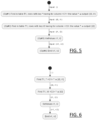
- FIG. 5 presents getting the actual values and emit them to create the resulted records. This completes the flow of execution.
- the implementations execute the flow of execution according to the following.
- the operator (Op#1) has no input and output the keys and the values in column C1 for the two rows according to Table 3: Table 3 i0 i1 10 10 20 20
- GetValue The role of the (Op#3) GetValue is to convert the indices to values. In this example as the indices are considered to be the same as the values, GetValue is a no-op.
- the last operator (Op#4) is here to emit the values to the post processor which creates the records and gives them to the calling application code.
- FIG. 6 presents another version of the IR presented in FIG. 5 using a simplified notation.
- the simplified notation is used hereinafter.
- any Find can produce undef values. Since a Find cannot have an undef as input, the implementations replace any Find having inputs by an optional Find with an if undef condition. In other words, an optional Find to manage the case where no values are found (i.e., the null case since null and undef are considered equal), and an if undef condition to filter out the undef inputs.
- FIG. 7 shows an IR graph.
- the implementations replace the IR graph of FIG. 7 by the corresponding one in FIG. 8 .
- the IR according to these implementations is replaced so to output undef if the input to the Find operator is undef.
- the "FindOptional" operator in FIG. 8 may be same as a "Find" operator.
- FIG.s 9A-B show a simplification of the IR graph by introducing in the IR a new node "FindlfDef” that optimizes the DAG of operators.
- Such an optimized DAG of operators may have fewer nodes in the IR. Therefore, the implementation may replace any "Find” operator that has inputs by a FindlfDef if the column used is not created with the NOT NULL constraint.
- each of such "Find” operators should also be interpreted as a "FindlfDef”. This does not change the semantic of the IR graphs.
- "i0 is undef” is an operator called “FilterBound” in the IR.
- a table expression is either a base table (i.e., physically stored in the database), a materialized view (which is more generally called “view” in SQL), or a virtual table given as output from another clause (e.g., a join).
- a table expression in the BNF grammar is:
- each clause in the expression above acts as an operator that takes input and produces output (As known per se, for example see Melton and Simon, "Understanding the new SQL: a complete guide", Morgan Kaufmann, 1993 ).
- Each clause produces a virtual table and the input of the FROM clause is one or more tables (e.g., base tables or views).
- This table reference is either a JOIN expression (as discussed later), a table name, or a table expression in parentheses.
- the table reference may optionally also include an AS clause.
- the table reference must include an AS clause. For example, for FROM T AS MYTABLE, the BNF is:
- the AS clause is syntactic sugar (i.e., syntactically optional) and may be omitted.
- This AS clause introduces a range variable.
- the standard uses correlation names, but range variable is the orthodox term and means a variable in the sense of logic. By the sense of the logic it means that it is not the usual programming language sense - that ranges over the set of tuples in some relation (or the set of rows in some table, in SQL terms).
- This range variable can be implicitly declared, as in the example above, where it ranges over all the rows of the table.
- the scope of this variable is important to define the variable decisiveness in the IR.
- a decisive variable is a variable that is read by a triple pattern later in the query.
- this variable is defined as following: if the table reference represents a FROM clause operand, the scope is the select-expression that immediately contains that FROM clause (i.e., the SELECT clause, the FROM clause itself, the WHERE clause if any, the GROUP BY clause if any, and the HAVING clause if any) - excluding any select-expression or join expression that is nested anywhere within the original select-expression in which another range variable is introduced with the same name.
- the implementations compute the scopes to decide IR variable decisiveness (i.e., to determine which variables in IR are decisive) and to filter table names according to existing tables from the storage, as in SPARQL.
- join table expression represents an explicit join of some kind between two tables, each of which is represented by a table reference (see [8] Date and Darwen, "A Guide to the SQL Standard”. New York: Addison-Wesley, third edition, 1993 ). More precisely, a join expression is either a cross join, or a join involving an explicit or implicit join type.
- the first and simplest join is the cross join, which is just another term for Cartesian product.
- the expression A CROSS JOIN B evaluates to a table consisting of all possible rows ab such that ab is the concatenation of a row a from A and a row b from B. It is semantically identical to:
- the Cross Join algorithm takes all the rows of both tables and does the Cartesian Product, or in other words, takes all the tuples of both relations and do the Cartesian Product.
- This can be rephrased as: for each table, for each column of the table, find all the rows; and the we need to do the Cartesian product of the output of each table.
- FIG. 10 presents an example using the IR convention, for table T1 and T2 with columns ⁇ C11, ..., C1n ⁇ and ⁇ C21, ..., C2n ⁇ .
- the Synchronize Cartesian operator waits until all the other threads to be finished before merging their outputs in a cartesian manager. All these other threads are buffering their results, hence the Bufferize operators.
- the CreateBuffer operator is here to declare the flag f0 on which the synchronization between Bufferize and Synchronize will be made. These three operators are more complex versions of Synchronize and Bufferize for the SPARQL OPTIONAL pattern and the implementations may need to add these three in the IR.
- the flag created by CreateBuffer has a semantic slightly different from the one used by OPTIONAL in SPARQL. In the implementations it means buffering all results before doing the synchronize Cartesian step.
- Bufferize Using a Bufferize operator in the IR is coherent with the SQL philosophy of representing all intermediate results as virtual tables as Bufferize creates an intermediate virtual table. The implementations may efficiently Implement this operator.
- the implementations may not keep in memory all the intermediary results memory for both tables which are needed to the Cartesian product. As the execution of the IR is multithreaded, the implementations may use a synchronization mechanism between the two streams of results. In a variation of the implementations, there can be SPARQL queries similar to Cartesian product such as:
- Volcano model implementation in the field of computer science, see for example https://justinjaffray.com/query-engines-push-vs.-pull/
- a vectorized implementation based on IR optimize such implementations by executing the secund pattern (corresponding to a Find operator) once by input buffer.
- the intermediary results needed to the cartesian product are not kept in the memory, but the cost paid is that the secund operator is executed many times.
- the two algorithms are possible, with the usual trade-off between CPU, memory and synchronization. In other words, the Volcano implementations need less memory and synchronization, but more CPU cost. On the hands, the vectorized implementations require more memory for less CPU cost, while need additional synchronization effort.
- the natural join according to the implementations output the matching rows based on all common columns while the columns with the same name will appear only once.
- the implementations may translate this to IR, by fetching beforehand all column names for both tables and compute the intersection. Then the implementations fetch all rows for the common column on T1, intersect it with the rows of T2 on the common columns, then fetch the values for the remaining columns with the selected rows.
- FIG. 11 presents an IR for the above example according to the implementations and using the Find operator.
- Op#1 fetches all the primary keys and values of T1 for column C1, that is according to Table 7 below Table 7 i1 i2 10 10
- implementations may employ natural join to qualify some of other join types as: inner, outer and union.
- the implementations may use an ON clause to specify the column on which join the tables apply, instead of doing it implicitly like in the natural join.
- join operations discussed up to now are also known as inner joins.
- the keyword inner join can replace the join one in the previous examples as syntactic sugar.
- each row in the input (Table 5) in a left outer join is included in the result table.
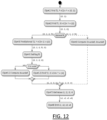
- FIG. 12 presents an IR for the above example according to the implementations.
- the dashed line corresponds to Optional fa's second child.
- the next operator is an optional operator which creates a flag f0: if it is never set, the dashed line will be executed. In this case, the operator Op#6 is used and sets to undef all the i3 and i4 columns. Otherwise Op#3 is used to do the actual join: to get all rows from T2.C3 with the same values as T1.C1. These values have been computed by Op#1 as i1.
- the result is Table 15 below: Table 15 i0 i1 i2 i3 10 10 15 10 20 20 25 undef
- Outer joins are not associative, and the right outer join is the symmetric of the left outer join.
- the full outer join is the combination of left and right outer join, therefore with the same tables T1, and T2 as Table 5; the result of:
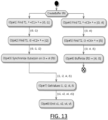
- FIG. 13 presents the IR translation of the above query which is a mix between left/outer join and cross join.
- the Synchronize OuterJoin on search condition is a new node that needs to be added in the IR. It uses the same CreateBuffer and Bufferize nodes that were already introduced by the cross join. Two pieces of information should be known about this Bufferize node: when it can be used and when can be deleted. That is why it seems a generalization of the flag in the actual IR implementation.
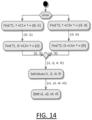
- Union join works in a manner similar to the full outer join as discussed above, with the difference that it cannot specify a column matching. Instead, a union join does the following:
- FIG. 14 presents the IR translation of the full outer join can then be simplified for union join as a simple buffer concatenation.
- the scope of the range variables is the join expression that immediately contains that join, excluding any select expression or join expression that is nested anywhere within the original join expression in which another range variable is introduced with the same name. Every column must have a name, and a name can be assigned if needed.
- the WHERE clause is a mean to retrieve certain rows that meet a set of conditions. It requires a search condition, i.e. one or more predicates (in the predicate logic meaning, not the RDF meaning) combined with AND, OR and NOT.
- the between predicate is a variant of the comparison predicate with the forms:
- the IR generates byte code for these operations and compares RDF terms.
- W3C W3C recommendation " A Direct Mapping of Relational Data to RDF", (see https://www.w3.org/TR/rdb-direct-mapping /) which uses " R2RML: RDB to RDF Mapping Language” (see https://www.w3.org/TR/2012/REC-r2rml-20120927 /)
- R2RML: RDB to RDF Mapping Language see https://www.w3.org/TR/2012/REC-r2rml-20120927 /
- the implementations have natural mapping (see https://www.w3.org/TR/2012/REC-r2rml-20120927/#natural-mapping) of SQL values:
- Table 23 SQL datatype RDF datatype Lexical transformation (informative) BINARY, BINARY VARYING, BINARY LARGE OBJECT xsd:hexBinary xsd:hexBinary lexical mapping NUMERIC, DECIMAL xsd:decimal none required SMALLINT, INTEGER, BIGINT xsd:integer none required FLOAT, REAL, DOUBLE PRECISION xsd:double none required BOOLEAN xsd:boolean ensure lowercase (true, false) DATE xsd:date none required TIME xsd:time none required TIMESTAMP xsd:dateTime replace space character with "T" INTERVAL undefined undefined undefined
- the database according to the implementations has the implementation-defined for numeric values based on xsd:numeric.
- the precision of many SQL datatypes is not fixed, but left implementation defined. Therefore, the mapping to XML Schema datatypes must rely on arbitrary-precision types such as xsd:decimal, xsd:integer and xsd:dateTime. Implementers of the mapping may wish to set upper limits for the supported precision of these XSD types.
- the XML Schema specification allows such partial implementations of infinite datatypes XMLSCHEMA2, and defines specific minimum requirements.
- An RDF term can have a datatype, a lexical form and a canonical form.
- the rules are the following:
- the natural RDF datatype corresponding to a SQL datatype is the value of the RDF datatype column in the row corresponding to the SQL datatype in the Table 23 above.
- the natural RDF lexical form corresponding to a SQL data value is the lexical form of its corresponding natural RDF literal, with the additional constraint that the canonical lexical representation XMLSCHEMA2 SHOULD be chosen.
- the canonical RDF lexical form corresponding to a SQL data value is the lexical form of its corresponding natural RDF literal, with the additional constraint that the canonical lexical representation XMLSCHEMA2 MUST be chosen.
- the input table is partitioned into one or more groups; the number of groups is the minimum such that, for each grouping column reference, no two rows of any group have different values for that grouping column. That is, for any group in the resulting grouped table, every row in the group has the same value for the grouping column.
- the grammar is:
- COLLATE clause can be used to specify a collation used for ordering (for example SQL_Latin1_General_CP1_CS_AS). This is not supported in the IR.
- the implementations support GROUP BY without a collation for the sake of simplicity.
- the having clause is another filter applied to the grouped table resulting from the preceding clause, i.e., the result of the group by if there is any, otherwise the one resulting from the where clause (or the from clause if there is no WHERE clause the FROM is mandatory).
- the input is treated as a grouped table with exactly one group.
- the only columns of the input table that the having clause can reference are the grouping columns, unless the columns are used in a set function (e.g., count, max, avg, etc., see dedicated section). This is the same behavior as in SPARQL.
- the grammar is:
- the SELECT statement gives a query specification which starts by a select list.
- This list can be preceded by a set quantifier: ALL means do not eliminate duplicates while DISTINCT means eliminate redundant duplicates.
- the select list can either be an asterisk for all the columns that are part of the table corresponding to the table expression, or an explicit select-sublist can be used.
- a select sublist can be either a derived column or a qualifier (as seen previously, a qualifier is either a table name or a correlation name ( ranged variable ) that identifies a table in a particular scope) followed by a period and an asterisk: t.*.
- a derived column is a value expression (e.g., a column name) optionally followed by the keyword AS and a column name.
- a value expression can have no explicit name (e.g., "price/2"), in that case the standard explicitly requests that implementation must assign a name.
- DISTINCT and ORDERBY are also the same in SPARQL and in SQL.
- the implementations may be related to an interaction with a large database, e.g., a large tabular data.
- a large database e.g., a large tabular data.
- the implementations may serve an interaction scroll of a large table of instances of a Bill of Material (BOM) (e.g., a web table of order of one million), with several columns for each line.
- BOM Bill of Material
- the BOM is described using a semantic graph (e.g., RDF).
- RDF semantic graph
- a user may see a limited number of lines (e.g., one hundred) on the screen at a given time instant, so the use seeks to scroll interactively on the list.
- results of a SPARQL query are also tuples (https://www.w3.org/TR/rdf-sparql-query/#docResultDesc) that can be seen as rows in a table.
- traditional approached of GDBMSs cannot store these results as a table nor can query a table natively in SPARQL using a graph query language. As a general rule interactivity is considered around up to 300ms for response time and computing such a query may be too slow to be considered interactive.
- the result of the SELECT query is a table of tuples.
- the implementations create a table from these tuples where the columns of the table are the output variables of the SELECT and the rows are the tuples.
- the implementations keep the tuples as indexes and not values to cost less storage.
- an interaction e.g., scrolling by a user
- limit/offset e.g., the creation of the view takes around 3 seconds
- a pagination query takes around 100ms.
Landscapes
- Engineering & Computer Science (AREA)
- Theoretical Computer Science (AREA)
- Databases & Information Systems (AREA)
- General Physics & Mathematics (AREA)
- Physics & Mathematics (AREA)
- General Engineering & Computer Science (AREA)
- Data Mining & Analysis (AREA)
- Computational Linguistics (AREA)
- Software Systems (AREA)
- Artificial Intelligence (AREA)
- Evolutionary Computation (AREA)
- Computing Systems (AREA)
- Mathematical Physics (AREA)
- Information Retrieval, Db Structures And Fs Structures Therefor (AREA)
Priority Applications (4)
| Application Number | Priority Date | Filing Date | Title |
|---|---|---|---|
| EP22306926.1A EP4386576A1 (fr) | 2022-12-16 | 2022-12-16 | Moteur d'interrogation unifiée pour données graphiques et relationnelles |
| JP2023212808A JP2024086707A (ja) | 2022-12-16 | 2023-12-18 | グラフおよびリレーショナルデータのための統一されたクエリエンジン |
| US18/544,175 US12481653B2 (en) | 2022-12-16 | 2023-12-18 | Unified query engine for graph and relational data |
| CN202311741197.XA CN118210951A (zh) | 2022-12-16 | 2023-12-18 | 图形和关系数据的统一查询引擎 |
Applications Claiming Priority (1)
| Application Number | Priority Date | Filing Date | Title |
|---|---|---|---|
| EP22306926.1A EP4386576A1 (fr) | 2022-12-16 | 2022-12-16 | Moteur d'interrogation unifiée pour données graphiques et relationnelles |
Publications (1)
| Publication Number | Publication Date |
|---|---|
| EP4386576A1 true EP4386576A1 (fr) | 2024-06-19 |
Family
ID=85150542
Family Applications (1)
| Application Number | Title | Priority Date | Filing Date |
|---|---|---|---|
| EP22306926.1A Pending EP4386576A1 (fr) | 2022-12-16 | 2022-12-16 | Moteur d'interrogation unifiée pour données graphiques et relationnelles |
Country Status (4)
| Country | Link |
|---|---|
| US (1) | US12481653B2 (fr) |
| EP (1) | EP4386576A1 (fr) |
| JP (1) | JP2024086707A (fr) |
| CN (1) | CN118210951A (fr) |
Families Citing this family (1)
| Publication number | Priority date | Publication date | Assignee | Title |
|---|---|---|---|---|
| CN120256450B (zh) * | 2025-06-05 | 2025-10-10 | 中兴通讯股份有限公司 | 数据处理方法、系统、电子设备及可读存储介质 |
Family Cites Families (6)
| Publication number | Priority date | Publication date | Assignee | Title |
|---|---|---|---|---|
| WO2010151759A2 (fr) * | 2009-06-25 | 2010-12-29 | Cornell University | Evaluation d'interrogation incrémentielle |
| WO2013012469A1 (fr) * | 2011-07-20 | 2013-01-24 | Exxonmobil Upstream Research Company | Reconnaissance de faciès sismiques à l'aide de graphes relationnels attribués |
| US11113293B2 (en) * | 2019-01-18 | 2021-09-07 | Adobe Inc. | Latent network summarization |
| US11868716B2 (en) * | 2021-08-31 | 2024-01-09 | International Business Machines Corporation | Knowledge base question answering |
| EP4195065A1 (fr) | 2021-12-12 | 2023-06-14 | Dassault Systèmes | Traitement de règles logiques dans un moteur de requête sparql |
| EP4198763A1 (fr) | 2021-12-17 | 2023-06-21 | Dassault Systèmes | Optimisation de requêtes sparql dans une base de données graphique distribuée |
-
2022
- 2022-12-16 EP EP22306926.1A patent/EP4386576A1/fr active Pending
-
2023
- 2023-12-18 CN CN202311741197.XA patent/CN118210951A/zh active Pending
- 2023-12-18 US US18/544,175 patent/US12481653B2/en active Active
- 2023-12-18 JP JP2023212808A patent/JP2024086707A/ja active Pending
Non-Patent Citations (12)
| Title |
|---|
| ABITEBOUL ET AL.: "Foundations of databases", 1995, ADDISON-WESLEY |
| ANGLESGUTIERREZ, THE EXPRESSIVE POWER OF SPARQL |
| ANGLESGUTIERREZ: "International Semantic Web Conference", 2008, SPRINGER, article "The expressive power of SPARQL.", pages: 114 - 129 |
| DEWITT ET AL.: "Split query processing in polybase", PROCEEDINGS OF THE 2013 ACM SIGMOD INTERNATIONAL CONFERENCE ON MANAGEMENT OF DATA, 2013, pages 1255 - 1266 |
| FRANCK MICHEL: "INTEGRATING HETEROGENEOUS DATA SOURCES IN THE WEB OF DATA", 3 March 2017 (2017-03-03), XP055506546, Retrieved from the Internet <URL:https://tel.archives-ouvertes.fr/tel-01508602v3/document> [retrieved on 20180912] * |
| FREDDY PRIYATNA ET AL: "Formalisation and experiences of R2RML-based SPARQL to SQL query translation using morph", WORLD WIDE WEB, INTERNATIONAL WORLD WIDE WEB CONFERENCES STEERING COMMITTEE, REPUBLIC AND CANTON OF GENEVA SWITZERLAND, 7 April 2014 (2014-04-07), pages 479 - 490, XP058047090, ISBN: 978-1-4503-2744-2, DOI: 10.1145/2566486.2567981 * |
| GRULICH ET AL.: "Babelfish: efficient execution of polyglot queries", PROCEEDINGS OF THE VLDB ENDOWMENT, vol. 15, no. 2, 2021, pages 196 - 210 |
| JIN ET AL.: "GrainDB: A Relational-core Graph-Relational DBMS", PROCEEDINGS OF THE 12H ANNUAL CONFERENCE ON INNOVATIVE DATA SYSTEMS RESEARCH (CIDR '22 |
| JYOTHSNA RACHAPALLI ET AL: "RETRO: A Framework for Semantics Preserving SQL-to-SPARQL Translation", 18 September 2011 (2011-09-18), XP055737294, Retrieved from the Internet <URL:http://iswc2011.semanticweb.org/fileadmin/iswc/Papers/Workshops/EvoDyn/evodyn_3.pdf> [retrieved on 20201006] * |
| MELTONSIMON: "Understanding the new SQL: a complete guide", 1993, MORGAN KAUFMANN |
| SEQUEDA JUAN F ED - LEE SEONG-WHAN ET AL: "Integrating Relational Databases with the Semantic Web: A Reflection", 10 June 2017, SAT 2015 18TH INTERNATIONAL CONFERENCE, AUSTIN, TX, USA, SEPTEMBER 24-27, 2015; [LECTURE NOTES IN COMPUTER SCIENCE; LECT.NOTES COMPUTER], SPRINGER, BERLIN, HEIDELBERG, PAGE(S) 68 - 120, ISBN: 978-3-540-74549-5, XP047450097 * |
| XIAO GUOHUI ET AL: "The Virtual Knowledge Graph System Ontop", 2 November 2020, 16TH EUROPEAN CONFERENCE - COMPUTER VISION - ECCV 2020, CORNELL UNIVERSITY LIBRARY, 201 OLIN LIBRARY CORNELL UNIVERSITY ITHACA, NY 14853, PAGE(S) 259 - 277, XP047568484 * |
Also Published As
| Publication number | Publication date |
|---|---|
| US12481653B2 (en) | 2025-11-25 |
| US20240202191A1 (en) | 2024-06-20 |
| JP2024086707A (ja) | 2024-06-27 |
| CN118210951A (zh) | 2024-06-18 |
Similar Documents
| Publication | Publication Date | Title |
|---|---|---|
| KR101411083B1 (ko) | 점진적 뷰 관리를 갖는 매핑 아키텍처 | |
| US7647298B2 (en) | Generation of query and update views for object relational mapping | |
| US11693856B2 (en) | Query processing in a polystore | |
| US9223827B2 (en) | Database query language transformation method, transformation apparatus and database query system | |
| CN103299303B (zh) | 可扩展的rdf数据库 | |
| US8458164B2 (en) | Query model tool and method for visually grouping and ungrouping predicates | |
| JP6720641B2 (ja) | 多言語データティアのデータ制約 | |
| US20080288465A1 (en) | Model content provider with reusable components for supporting a plurality of gui api's | |
| US20150039587A1 (en) | Generic sql enhancement to query any semi-structured data and techniques to efficiently support such enhancements | |
| Munir et al. | Ontology-driven relational query formulation using the semantic and assertional capabilities of OWL-DL | |
| EP2743838B1 (fr) | Langue de requête commerciale avancée | |
| CN107515887A (zh) | 一种适用于多种大数据管理系统的交互式查询方法 | |
| US12591572B2 (en) | Optimizing SPARQL queries in a distributed graph database | |
| US11010383B2 (en) | Hierarchy rearrange operator | |
| Pokorný | Integration of relational and graph databases functionally | |
| Wang et al. | Formal semantics and high performance in declarative machine learning using Datalog | |
| US12481653B2 (en) | Unified query engine for graph and relational data | |
| US10162603B2 (en) | Loading data for iterative evaluation through SIMD registers | |
| EP3293645A1 (fr) | Évaluation itérative de données au moyen de registres de processeur simd | |
| US9875289B2 (en) | Remote knowledge server apparatus and method thereof | |
| Gatterbauer et al. | Database Research needs an Abstract Relational Query Language | |
| Borkar et al. | A Common Compiler Framework for Big Data Languages: Motivation, Opportunities, and Benefits. | |
| US20250378074A1 (en) | Query language representations of constraints useable to cause query failure | |
| Benedikt et al. | Databases | |
| Soussi et al. | Query migration from object oriented world to semantic world |
Legal Events
| Date | Code | Title | Description |
|---|---|---|---|
| PUAI | Public reference made under article 153(3) epc to a published international application that has entered the european phase |
Free format text: ORIGINAL CODE: 0009012 |
|
| STAA | Information on the status of an ep patent application or granted ep patent |
Free format text: STATUS: THE APPLICATION HAS BEEN PUBLISHED |
|
| AK | Designated contracting states |
Kind code of ref document: A1 Designated state(s): AL AT BE BG CH CY CZ DE DK EE ES FI FR GB GR HR HU IE IS IT LI LT LU LV MC ME MK MT NL NO PL PT RO RS SE SI SK SM TR |
|
| STAA | Information on the status of an ep patent application or granted ep patent |
Free format text: STATUS: REQUEST FOR EXAMINATION WAS MADE |
|
| 17P | Request for examination filed |
Effective date: 20241219 |