EP4386579A1 - Verfahren und vorrichtung zum trainieren eines wiederauffindungsmodells, wiederauffindungsverfahren und -vorrichtung, vorrichtung und medium - Google Patents
Verfahren und vorrichtung zum trainieren eines wiederauffindungsmodells, wiederauffindungsverfahren und -vorrichtung, vorrichtung und medium Download PDFInfo
- Publication number
- EP4386579A1 EP4386579A1 EP22857527.0A EP22857527A EP4386579A1 EP 4386579 A1 EP4386579 A1 EP 4386579A1 EP 22857527 A EP22857527 A EP 22857527A EP 4386579 A1 EP4386579 A1 EP 4386579A1
- Authority
- EP
- European Patent Office
- Prior art keywords
- sample
- network
- training
- triplet
- quantization index
- Prior art date
- Legal status (The legal status is an assumption and is not a legal conclusion. Google has not performed a legal analysis and makes no representation as to the accuracy of the status listed.)
- Granted
Links
Images




Classifications
-
- G—PHYSICS
- G06—COMPUTING OR CALCULATING; COUNTING
- G06F—ELECTRIC DIGITAL DATA PROCESSING
- G06F16/00—Information retrieval; Database structures therefor; File system structures therefor
- G06F16/50—Information retrieval; Database structures therefor; File system structures therefor of still image data
- G06F16/53—Querying
-
- G—PHYSICS
- G06—COMPUTING OR CALCULATING; COUNTING
- G06F—ELECTRIC DIGITAL DATA PROCESSING
- G06F16/00—Information retrieval; Database structures therefor; File system structures therefor
- G06F16/50—Information retrieval; Database structures therefor; File system structures therefor of still image data
- G06F16/58—Retrieval characterised by using metadata, e.g. metadata not derived from the content or metadata generated manually
- G06F16/583—Retrieval characterised by using metadata, e.g. metadata not derived from the content or metadata generated manually using metadata automatically derived from the content
-
- G—PHYSICS
- G06—COMPUTING OR CALCULATING; COUNTING
- G06F—ELECTRIC DIGITAL DATA PROCESSING
- G06F16/00—Information retrieval; Database structures therefor; File system structures therefor
- G06F16/50—Information retrieval; Database structures therefor; File system structures therefor of still image data
- G06F16/51—Indexing; Data structures therefor; Storage structures
-
- G—PHYSICS
- G06—COMPUTING OR CALCULATING; COUNTING
- G06F—ELECTRIC DIGITAL DATA PROCESSING
- G06F16/00—Information retrieval; Database structures therefor; File system structures therefor
- G06F16/60—Information retrieval; Database structures therefor; File system structures therefor of audio data
- G06F16/68—Retrieval characterised by using metadata, e.g. metadata not derived from the content or metadata generated manually
- G06F16/683—Retrieval characterised by using metadata, e.g. metadata not derived from the content or metadata generated manually using metadata automatically derived from the content
-
- G—PHYSICS
- G06—COMPUTING OR CALCULATING; COUNTING
- G06F—ELECTRIC DIGITAL DATA PROCESSING
- G06F16/00—Information retrieval; Database structures therefor; File system structures therefor
- G06F16/70—Information retrieval; Database structures therefor; File system structures therefor of video data
- G06F16/78—Retrieval characterised by using metadata, e.g. metadata not derived from the content or metadata generated manually
- G06F16/783—Retrieval characterised by using metadata, e.g. metadata not derived from the content or metadata generated manually using metadata automatically derived from the content
-
- G—PHYSICS
- G06—COMPUTING OR CALCULATING; COUNTING
- G06N—COMPUTING ARRANGEMENTS BASED ON SPECIFIC COMPUTATIONAL MODELS
- G06N3/00—Computing arrangements based on biological models
- G06N3/02—Neural networks
- G06N3/04—Architecture, e.g. interconnection topology
-
- G—PHYSICS
- G06—COMPUTING OR CALCULATING; COUNTING
- G06N—COMPUTING ARRANGEMENTS BASED ON SPECIFIC COMPUTATIONAL MODELS
- G06N3/00—Computing arrangements based on biological models
- G06N3/02—Neural networks
- G06N3/08—Learning methods
Definitions
- This application relates to the field of artificial intelligence, particularly to a method and apparatus for training a retrieval model, a retrieval method and apparatus, a device and a medium.
- a candidate image with a high confidence is often selected as a retrieval result by recalling a plurality of candidate images for sorting.
- a feature vector of the query image is often obtained by using an embedding vector network.
- a quantization index is obtained by performing product quantization (PQ) on the feature vector; m feature vectors matching the quantization index are found from a quantization codebook; m candidate images corresponding to the m feature vectors are recalled; and top candidate images are selected as final recalled images according to the sorting results of distances between the feature vectors of the m candidate images and the feature vector of the query image.
- PQ product quantization
- a value of each dimension of the feature vector is divided into a plurality of segments by the PQ, and segments are represented by different numerical codes (a quantization method, for example, if a bit value is a floating point number between 0 and 1, it may be divided into 10 segments, including 0.1,... 0.9 and 1.0, and segments are represented by numbers from 1 to 10 respectively).
- a quantization method for example, if a bit value is a floating point number between 0 and 1, it may be divided into 10 segments, including 0.1,... 0.9 and 1.0, and segments are represented by numbers from 1 to 10 respectively.
- the PQ method easily causes that similar features are split into two adjacent segments, so that critical samples are easily missed to be recalled or repeatedly recalled (e.g., the critical samples of segment 1 and segment 2 may be similar to segment 1 or segment 2, and recalling any segment alone will result in a missed recall and recalling two segments will increase the number of false recalls).
- a method for training a retrieval model is provided.
- the method is executable by a computer device.
- the retrieval model includes an embedding vector network and a quantization index network.
- the embedding vector network is used for obtaining a feature vector of a retrieval object.
- the quantization index network is used for extracting a quantization index of the retrieval object.
- the method includes:
- an object retrieval method is provided.
- the method is executable by a computer device, and includes:
- an apparatus for training a retrieval model includes an embedding vector network and a quantization index network.
- the embedding vector network is used for obtaining a feature vector of a retrieval object.
- the quantization index network is used for extracting a quantization index of the retrieval object.
- the apparatus includes:
- an object retrieval apparatus including:
- a computer device including: a processor and a memory, the memory storing a computer program, and the computer program being loaded and executed by the processor to implement the above method for training a retrieval model, and/or, the above object retrieval method.
- a computer-readable storage medium storing a computer program, and the computer program being loaded and executed by a processor to implement the above method for training a retrieval model, and/or, the above object retrieval method.
- a computer program product or a computer program includes computer instructions stored in a computer-readable storage medium.
- a processor of a computer device reads the computer instructions from the computer-readable storage medium and executes the computer instructions, causing the computer device to implement the above method for training a retrieval model, and/or, the above object retrieval method.
- the beneficial effects of the technical solutions provided by the embodiments of this application at least include:
- the embedding vector network and the quantization index network are trained by using the sample triplets, so that the first sample triplet set screened out by using the embedding vector network is used as the sample triplets for training the quantization index network, and the second sample triplet set screened out by using the quantization index network is used as the sample triplets for training the embedding vector network.
- Different networks have different noise recognition capabilities.
- the embedding vector network and the quantization index network can remove noise from the sample triplets by means of screening processing.
- the first sample triplet set is used to train the quantization index network, so that the quantization index network can learn the noise recognition capability of the embedding vector network; and the second sample triplet set is used to train the embedding vector network, so that the embedding vector network can learn the noise recognition capability of the quantization index network, thereby promoting mutual improvement of the noise recognition capabilities of the embedding vector network and the quantization index network. Therefore, the above method for training a retrieval model eliminates the influence of noise sample triplets among the sample triplets, and makes a prediction effect of the quantization index network on the positive and negative samples similar to a prediction effect of the embedding vector network on the positive and negative samples. Two branches predict the noise sample triplets, and the two branches learn high-performance sample triplets from each other, so that denoising learning is achieved, and the two branches have similar prediction effects.
- N training samples In a training stage, referring to FIG. 1 , for N training samples, assuming that a sample dimension is 128, which is divided into four subspaces, a dimension of each subspace is 32. In each subspace, a feature vector is clustered by k-means (a clustering algorithm) ( FIG. 1 shows 256 clustering centers), and a codebook is obtained for each subspace. Furthermore, each sub-segment of each training sample can be approximated by the clustering centers of the subspaces, and corresponding codes are values of the clustering centers. The finally obtained N training samples constitute an index codebook.
- k-means a clustering algorithm
- To-be-quantized samples are divided in the same way, and then the clustering centers closest to the samples are found in the various subspaces one by one, and then the values of the clustering centers are used to represent each sub-segment, that is, index vectors of the to-be-quantized samples are completed.
- a feature vector of a query image is divided into four sub-segments.
- distances from the sub-segments to all the clustering centers in the subspace are calculated, so that 4*256 distances can be obtained, and these calculated distances form a distance table.
- the distances corresponding to the various sub-segments are respectively extracted from the distance table. For example, for a sub-segment with a code of 124, the distance No. 124 is extracted from among the 256 distances calculated for the first time.
- the distances corresponding to all the sub-segments are summed to obtain an asymmetric distance between the sample to the query sample. After all the distances are calculated, the samples with the distances sorted at the front.
- Deep symbol quantization network First, for D-dimension feature vectors of N training samples, a value range of each dimension after vector normalization is a floating point number from -1 to 1, and the D-dimension feature vectors are compressed to binary codes with specified digit values of 0 and 1. This is symbolic quantization. For example, (-1, 1, 0.5, -0.2) are obtained after normalization of 4-dimension feature vectors, and quantization indexes (0, 1, 1, 0) are obtained after symbolic quantization.
- CV Computer vision
- the CV is a science that studies how to use a machine to "see”, and furthermore, that uses a camera and a computer to replace human eyes to perform machine vision such as recognition, tracking, and measurement on a target, and further perform graphic processing, so that the computer processes the target into an image more suitable for human eyes to observe, or an image transmitted to an instrument for detection.
- machine vision such as recognition, tracking, and measurement on a target
- graphic processing so that the computer processes the target into an image more suitable for human eyes to observe, or an image transmitted to an instrument for detection.
- the CV studies related theories and technologies and attempts to establish an AI system that can obtain information from images or multidimensional data.
- the CV usually includes image processing, image recognition, image semantic understanding, image retrieval, Optical Character Recognition (OCR), video processing, video semantic understanding, video content/behavior recognition, 3-dimension (3D) object reconstruction, 3D technology, virtual reality, augmented reality, synchronous positioning, map construction and other technologies, as well as common face recognition, fingerprint recognition and other biometric feature recognition technologies.
- OCR Optical Character Recognition
- 3D 3-dimension
- AIaaS Artificial intelligence cloud service
- AIaaS Artificial intelligence cloud service
- An AIaaS platform will split several types of common artificial intelligence (AI) services and provide independent or packaged services in a cloud.
- This service mode is similar to opening an AI theme mall: All developers can access and use one or more AI services provided by the platform through an Application Programming Interface (API); and some senior developers can also use an AI framework and AI infrastructure provided by the platform to deploy, operate and maintain own dedicated cloud AI services.
- API Application Programming Interface
- Information including but not limited to user equipment information, user personal information, and the like
- data including but not limited to data for analysis, stored data, displayed data and the like
- signals involved in this application are all authorized by a user or fully authorized by all parties, and the collection, use and processing of the relevant data need to comply with the relevant laws, regulations and standards of the relevant countries and regions. For example, retrieval objects involved in this application are all obtained under full authorization.
- FIG. 2 shows a method for training and using a retrieval model and a computer system 200 in which the method is used according to one exemplary embodiment of this application.
- a terminal 220 can be configured to train and/or use a retrieval model
- a server 240 can be configured to train and/or use the retrieval model.
- a client that supports retrieval objects is installed and run on the terminal 220.
- the client can be any one of an application program, a webpage and a mini program that supports retrieval objects.
- a retrieved object includes but is not limited to at least one of an image, a video, an audio and a text.
- the terminal 220 can train and/or use the retrieval model.
- the client installed on the terminal 220 is a client on an operating system platform (Android or IOS).
- the terminal 220 can refer to one of a plurality of terminals in general. The terminal 220 is only taken for example in this embodiment.
- a device type of the terminal 220 includes: at least one of a smart phone, a smart watch, a smart television, a tablet, an e-book reader, an MP3 player, an MP4 player, a laptop computer and a desktop computer.
- a quantity of the terminal can be more or fewer. For example, there may be one terminal or dozens of or hundreds of terminals, or more. This embodiment of this application will not make restrictions on the quantity and device type of the terminal.
- the terminal 220 is connected to the server 240 by using a wired network or wireless network.
- the server 240 includes at least one of one server, multiple servers, a cloud computing platform, and a virtualization center.
- the server 240 includes a processor 244 and a memory 242.
- the memory 242 includes a receiving module 2421, a control module 2422 and a sending module 2423.
- the receiving module 2421 is configured to receive a request sent by the client, such as training and using the retrieval model.
- the control module 2422 is configured to control the training and use of the retrieval model.
- the sending module 2423 is configured to send a response to the terminal, such as returning a retrieved object to the client, or returning a trained retrieval model.
- the server 240 is configured to provide background services for object retrieval and/or retrieval model training.
- the server 240 undertakes main computing work, and the terminal 220 undertakes secondary computing work.
- the server 240 undertakes secondary computing work, and the terminal 220 and a second terminal 160 undertake primary computing work.
- the server 240 and the terminal 220 adopt a distributed computing architecture for collaborative computation.
- the method for training a retrieval model and a retrieval method can be implemented by a computer device.
- the computer device can be a terminal or a server.
- This application does not limit an executive body for the method for training a retrieval model and the retrieval method.
- FIG. 3 is a flow chart of a method for training a retrieval model according to one exemplary embodiment of this application. This embodiment is illustrated by taking an example in which the method is performed by the computer device shown in FIG. 2 .
- the retrieval model includes an embedding vector network and a quantization index network.
- the embedding vector network is used for obtaining a feature vector of a retrieval object
- the quantization index network is used for extracting a quantization index of the retrieval object.
- the method includes: Step 320. Obtain n sample triplets used for training the retrieval model.
- Each of the n sample triplets includes a training sample, a positive sample that constitutes a similar sample pair with the training sample, and a negative sample without the similar sample pair with the training sample (i.e., the negative sample that does not constitute the similar sample pair with the training sample), and n being a positive integer greater than 1.
- the positive sample and the training sample constitute a similar sample pair, which refers to that the similarity between the positive sample and the training sample is greater than or equal to a preset threshold, or refers to that the positive sample and the training sample are same.
- the negative sample and the training sample does not constitute a similar sample pair, which refers to that the similarity between the negative sample and the training sample is smaller than the preset threshold.
- a similar sample pair includes a target image as the training sample and an image as the positive sample
- the positive sample and the training sample constitute a similar sample pair, which refers to that the similarity between the target image and the image is greater than or equal to a preset threshold, or refers to that the target image and the image are same.
- two adjacent frames of images in a video can construct a similar sample pair.
- a similar sample pair in a case that a similar sample pair includes a target video as the training sample and a video as the positive sample, the positive sample and the training sample constitute a similar sample pair, which refers to that the similarity between the target video and the video is greater than or equal to a preset threshold, or refers to that the target video and the video are same.
- the positive sample and the training sample in a case that a similar sample pair includes a target audio as the training sample and an audio as the positive sample, the positive sample and the training sample constitute a similar sample pair, which refers to that the similarity between the target audio and the audio is greater than or equal to a preset threshold, or refers to that the target audio and the audio are same.
- adjacent two-second audios can construct a similar sample pair.
- a quantization index is obtained by using a feature vector of a query image; m feature vectors matching the quantization index are then found from a quantization codebook; distances between the m feature vectors and the feature vector of the query image, and images corresponding to the distances sorted at the top are selected as finally screened-out images; and m is a positive integer.
- Audio retrieval A quantization index is obtained by using a feature vector of a query audio; a feature vectors matching the quantization index are then found from a quantization codebook; distances between the feature vectors and the feature vector of the query audio, and audios corresponding to the distances sorted at the top are selected as finally screened-out audios; and a is a positive integer.
- a quantization index is obtained by using a feature vector of a query video; b feature vectors matching the quantization index are then found from a quantization codebook; distances between the b feature vectors and the feature vector of the query video, and videos corresponding to the distances sorted at the top are selected as finally screened-out videos; and b is a positive integer.
- Quantization index It refers to an index obtained by quantization and used for retrieving the retrieval object.
- an image is taken as an example.
- One quantization index corresponds to one type of images.
- the image categories of all sample images include: a person character and an animal character, and there is one quantization index corresponding to the person category and another quantization index corresponding to the animal category.
- the sample images include a dog image and a cat image.
- a quantization index of the dog image is (1, 0, 1)
- a quantization index of the cat image is (1, 1, 1). If a quantization index of a retrieval image is (1, 0, 1), the retrieval image can be determined to the dog image by using the quantization index.
- Quantization index network It refers to a neural network used for extracting a quantization index of a retrieval object.
- Embedding feature network It refers to a neural network used for obtaining a feature vector of a retrieval object.
- the embedding feature network codes an input basic feature vector twice to obtain a triplet feature vector.
- a size of the input basic feature vector is 1 ⁇ 2048
- the embedding feature network codes the input basic feature vector twice to reduce the size of the basic feature vector, thereby obtaining the triplet feature vector.
- a size of the triplet feature vector is 1 ⁇ 64.
- the retrieval object includes but is not limited to at least one of an image, a video and an audio.
- description is made by using an example in which the retrieval object is an image.
- the sample triplets are often used to train the retrieval model.
- Step 340 Input basic feature vectors of the n sample triplets to the embedding vector network, and screen out, according to errors of feature vectors output by the embedding vector network, a first sample triplet set used for training the quantization index network.
- Basic feature vector It refers to a vector of a basic image feature in a sample triplet.
- the basic image feature includes but is not limited to a color feature, a texture feature, a shape feature and a spatial relationship feature.
- the embedding vector network generates n groups of triplet feature vectors from the basic feature vectors of the n sample triplets, and screens out, on the basis of the n groups of triplet feature vectors, a first sample triplet set used for training the quantization index network.
- Step 360 Input the basic feature vectors of the n sample triplets to the quantization index network, and screen out, according to errors of quantization indexes output by the quantization index network, a second sample triplet set used for training the embedding vector network.
- the quantization index network generates n groups of triplet quantization indexes from the basic feature vectors of the n sample triplets, and screens out a second sample triplet set used for training the embedding vector network.
- Step 381. Train the quantization index network on the basis of the first sample triplet set.
- Step 382. Train the embedding vector network on the basis of the second sample triplet set.
- the first sample triplet set is input to the quantization index network to obtain n 1 third error losses, and the quantization index network is trained on the basis of the n 1 third error losses, where n 1 is a positive integer less than n.
- the second sample triplet set is input to the embedding vector network to obtain n 2 fourth error losses, and the embedding vector network is trained on the basis of the n 2 fourth error losses, where n 2 is a positive integer less than n.
- the embedding vector network and the quantization index network are trained by using the sample triplets, so that the first sample triplet set screened out by using the embedding vector network is used as the sample triplets for training the quantization index network, and the second sample triplet set screened out by using the quantization index network is used as the sample triplets for training the embedding vector network.
- the above method for training a retrieval model eliminates the influence of noise sample triplets among the sample triplets, and makes a prediction effect of the quantization index network on the positive and negative samples similar to a prediction effect of the embedding vector network on the positive and negative samples.
- Two branches predict the noise sample triplets, and the two branches learn high-performance sample triplets from each other, so that denoising learning is achieved, and the two branches have similar prediction effects.
- FIG. 4 is a system for training a retrieval model according to one exemplary embodiment of this application.
- the system for training a retrieval model can include an embedding vector network 401 and a quantization index network 402.
- the embedding vector network 401 is used for generating n groups of triplet feature vectors from basic feature vectors of n sample triplets.
- the triplet feature vectors can be used for calculating similarity distances between training samples, positive samples and negative samples in the sample triplets.
- the quantization index network 402 is used for generating n groups of triplet quantization indexes from the basic feature vectors of n sample triplets.
- the triplet quantization indexes are used for quantizing the sample triplets.
- sample triplets are constructed by samples, and the constructed n sample triplets are input to the embedding vector network 401 and the quantization index network 402 respectively.
- the sample triplets are then screened.
- a loss function of the quantization index network is calculated by using the first sample triplet set obtained by screening by the embedding vector network 401, and the quantization index network 402 is trained on the basis of the loss function.
- a loss function of the embedding vector network is calculated by using the second sample triplet set obtained by screening by the quantization index network 402, and the embedding vector network 401 is trained on the basis of a value of the loss function
- a noise sample triplet (a sample triplet in which the negative sample and the training sample constitute a positive sample pair) does not necessarily have consistent performance in the embedding vector network 401 and the quantization index network 402.
- the negative sample and the training sample in the noise sample triplet are considered to constitute a positive sample pair by using the embedding vector network 401, that is, to generate a high value of the loss function.
- the negative sample and the training sample in the noise sample triplet are considered to constitute a negative sample pair by using the quantization index network 402, that is, to generate a low value of the loss function value.
- the embedding vector network 401 and the quantization index network 402 can be better trained.
- Step 320 Obtain n sample triplets used for training the retrieval model.
- sample triplets are constructed by using several similar sample pairs.
- a similar sample pair includes a target image, and a positive sample that is extremely similar to or the same as the target image.
- two adjacent frames of images in a video can construct a similar sample pair.
- a similar sample pair includes a target video, and a positive sample that is extremely similar to or the same as the target video.
- a similar sample pair includes a target audio, and a positive sample that is extremely similar to or the same as the target audio. For example, adjacent two-second audios can construct a similar sample pair.
- Sample triplet In the retrieval model of this application, in order to generate the n sample triplets, among R similar sample pairs of each batch for training, for the training samples in each similar sample pair, one image is randomly selected from each of the remaining (R-1) similar sample pairs, and distances between feature vectors of the (R-1) images and a feature vector of the training sample; the (R-1) distances are sorted from small to large; and images corresponding to the first n distances and the similar sample pair including the training sample are selected to constitute the n sample triplets. That is, the n sample triplets used for training the retrieval model are obtained.
- the method for constructing sample triplets can be as follows: 26 similar sample pairs include (A, A'), (B, B'), (C, C'), (D, D'),..., (Z, Z').
- A is a training sample (anchor)
- A' is a positive sample.
- One image is randomly selected from each of the remaining similar sample pairs (B, B'), (C, C'), (D, D'),..., (Z, Z'), for example, B, C', D, E', ..., and Z are selected, to separately calculate distances between feature vectors of B, C', D, E', ..., and Z and a feature vector of the training sample A to obtain 25 distances.
- the 25 distances are sorted from small to large, and images corresponding to the first 20 distances and the similar sample pair (A, A') where the training sample A is located are selected to constitute 20 sample triplets. That is, the 20 sample triplets used for training the retrieval model are obtained.
- the above method achieves the construction of the n sample triplets from the similar sample pairs, so that the obtained n sample triplets can be used for the training the retrieval model provided by this application.
- FIG. 5 shows a flow chart of a method for training a retrieval model according to another exemplary embodiment of this application. Applying the method to the computer device shown in FIG. 2 is taken as an example for illustration. Step 320, Step 360, Step 381 and Step 382 are all consistent with those shown in FIG. 3 .
- Step 340 Input basic feature vectors of the n sample triplets to the embedding vector network, and screen out, according to errors of feature vectors output by the embedding vector network, a first sample triplet set used for training the quantization index network.
- Step 340 may include the following steps: Step 341. Obtain n groups of triplet feature vectors output by the embedding vector network for the n sample triplets.
- the n sample triplets are input to the embedding vector network 401, and the embedding vector network 401 outputs the n groups of triplet feature vectors.
- Step 342. Calculate n first error losses corresponding to the n groups of triplet feature vectors.
- the step of calculating n first error losses corresponding to the n groups of triplet feature vectors includes: calculating, for each group of the triplet feature vectors, a first distance between a feature vector of the training sample and a feature vector of the positive sample; calculating, for each group of the triplet feature vectors, a second distance between the feature vector of the training sample and a feature vector of the negative sample; and calculating a first error loss between a difference value of the first distance and the second distance and a first distance threshold, the first distance threshold being a threshold of a difference value between a distance from the training sample to the positive sample and a distance from the training sample to the negative sample.
- a anchor
- p positive
- n negative
- a value of ⁇ is 4, which indicates that the distance from the feature vector of the training sample to the feature vector of the negative sample is greater than the distance from the feature vector of the training sample to the feature vector of the positive sample by 4.
- L2 normalization is to make a feature space of the triplet samples within a range of 0 to 1, and to avoid that a too large feature space is not conductive to optimizing the training of the retrieval model.
- Step 343. Screen out, from a sorting result of the n first error losses from small to large, sample triplets corresponding to n 1 first error losses falling within a first selection range, and add the sample triplets to the first sample triplet set used for training the quantization index network.
- the n first error losses can be obtained.
- the n first error losses are sorted from small to large, and the sample triplets corresponding to the n 1 first error losses falling within the first selection range are screened out and are added to the first sample triplet set used for training the quantization index network, where n 1 is a positive integer less than n.
- the sample triplets corresponding to the top x% n 1 first error losses can be screened out according to a preset x value from the sorting result of the n first error losses from small to large, and be added to the first sample triplet set used for training the quantization index network.
- the x value is set on the basis of a ratio of noise sample triplets to the n sample triplets.
- the ratio is obtained on the basis of prediction or calibration.
- the x value is slightly greater than the ratio of the noise sample triplets to the n sample triplets, and x is a positive number.
- the sorting result of the n first error losses constitutes Lem_list, and the n 1 sample triplets corresponding to the n 1 first error losses sorted in the top 85% are selected from Lem_list as the first sample triplet set.
- the n 1 sample triplets corresponding to the n 1 first error losses sorted in the top 85% are selected from Lem_list as the first sample triplet set.
- Lem_list the first sample triplet set.
- the above method calculates the values of the loss function of the n groups of triplet feature vectors of the n sample triads, screens, on the basis of the values of the loss function, the first sample triplet set used for training the quantization index network, and further uses cleaner sample triplets to optimize the quantization effect of the quantization index network.
- FIG. 6 shows a flow chart of a method for training a retrieval model according to another exemplary embodiment of this application. Applying the method to the computer device shown in FIG. 2 is taken as an example for illustration. Step 320, Step 340, Step 381 and Step 382 are all consistent with those shown in FIG. 3 .
- Step 360 Input the basic feature vectors of the n sample triplets to the quantization index network, and screen out, according to errors of quantization indexes output by the quantization index network, a second sample triplet set used for training the embedding vector network.
- Step 360 may include the following steps:
- the step of calculating n second error losses corresponding to the n groups of triplet quantization indexes includes: calculating, for each group of triplet quantization indexes, a first triplet loss of the triplet quantization indexes; calculating, for each group of triplet quantization indexes, a first quantization error loss of the triplet quantization indexes; and performing weighted summation on the first triplet loss and the first quantization error loss to obtain the second error loss.
- the triplet quantization indexes are activated by using an activation function, and then the first triplet loss of the quantization indexes is then calculated.
- a distance between the training sample and the negative sample of the sample triplet needs to be large enough.
- margin ( ⁇ in formula (1)) is set to be 160.
- a calculation manner of the first triplet loss is similar to that of the first error loss mentioned above, and will not be repeated. The difference here is that a dimension of the triplet quantization index is inconsistent with that of the triplet feature vector.
- the triplet quantization index has 256 dimensions. Each dimension is converted to a value of (-1, 1) by using the activation function, and symbolic quantization is then performed to finally obtain the 256-dimension triplet quantization index.
- u i is a value of each dimension of the triplet quantization index without symbol quantization (a value less than 0 is quantized to be 0, and a value greater than 0 is quantized to be 1);
- a range of u i is (-1, 1);
- b i is a value (-1 or 1) of each dimension of the triplet quantization index after conversion.
- L coding is the first quantization error loss
- the above activation function can be set to be a Tanh function or sgn function.
- the sgn function is not derivable at position 0 (+0 and -0), that is, it is impossible to perform gradient calculation (which cannot be used in deep learning based on sgd gradient backhaul).
- the Tanh activation is derivable and can be mapped to be between -1 and 1.
- the activation function can also use sigmoid (which is activated between 0 and 1), and then use 0 and 1 (instead of -1 and 1) as quantization targets.
- a training effect is better because tanh can obtain (-1, 1) faster.
- Values of w 21 and w 22 above are not fixed, as long as it is ensured that the value of w 22 is less than that of w 21 .
- Step 363. Screen out, from a sorting result of the n second error losses from small to large, sample triplets corresponding to n 2 second error losses falling within a second selection range, and add the sample triplets to the second sample triplet set used for training the embedding vector network.
- the n second error losses can be obtained.
- the n second error losses are sorted from small to large, and the sample triplets corresponding to the n 2 second error losses falling within the second selection range are screened out and are added to the second sample triplet set used for training the quantization index network.
- the sample triplets corresponding to the top y% n 2 second error losses can be screened out according to a preset y value from the sorting result of the n second error losses from small to large, and be added to the second sample triplet set used for training the embedding vector network.
- the y value is set on the basis of a ratio of noise sample triplets to the n sample triplets.
- the ratio is obtained on the basis of prediction or calibration.
- the y value is slightly greater than the ratio of the noise sample triplets to the n sample triplets, and y is a positive number.
- the sorting result of the n second error losses constitutes Lq_list, and the n 2 sample triplets corresponding to the n 2 second error losses sorted in the top 85% are selected from Lq_list as the second sample triplet set, where n 2 is a positive integer less than n.
- the n 2 sample triplets corresponding to the n 2 second error losses sorted in the top 85% are selected from Lq_list as the second sample triplet set.
- Lq_list the second sample triplet set.
- the above method calculates the values of the loss function of the n groups of triplet quantization indexes of the n sample triads, screens, on the basis of the values of the loss function, the second sample triplet set used for training the embedding vector network, and further uses cleaner sample triplets to optimize the calculation effect of the embedding vector network.
- FIG. 7 shows a flow chart of a method for training a retrieval model according to another exemplary embodiment of this application. Applying the method to the computer device shown in FIG. 2 is taken as an example for illustration. Step 320, Step 340 and Step 360 are all consistent with those shown in FIG. 3 .
- Step 381. Train the quantization index network on the basis of the first sample triplet set, which includes: Step 381-1. Input the first sample triplet set is input to the quantization index network to obtain n 1 third error losses.
- the first sample triplet set includes n 1 sample triplets.
- First sample triplets are obtained by sorting the first error losses of the n groups of triplet feature vectors output by the embedding vector network 401, specifically refer to the "For Step 340" above.
- the step of inputting the first sample triplet set to the quantization index network to obtain n 1 third error losses includes: calculating, for each sample triplet of the first sample triplet set, a second triplet loss of the triplet feature vector by using the quantization index network, the triplet feature vector being a feature vector output by the embedding vector network; calculating, for each sample triplet of the first sample triplet set, a second quantization error loss of the triplet feature vector by using the quantization index network; and performing weighted summation on the second triplet loss and the second quantization error loss to obtain the third error loss.
- the method of calculating the n 1 third error losses is similar to the manner of calculating the n second error losses in Step 362 above, and will not be repeated.
- the manner of calculating the second triplet loss of the triplet feature vector is similar to the manner of calculating the first triplet loss of the triplet quantization indexes
- the manner of calculating the second quantization error loss of the triplet feature vector is similar to the manner of calculating the first quantization error loss of the triplet quantization indexes
- the manner of performing weighted summation on the second triplet loss and the second quantization error loss to obtain the third error loss is similar to the manner of performing weighted summation on the first triplet loss and the first quantization error loss to obtain the second error loss.
- Step 381-2 Train the quantization index network on the basis of the n 1 third error losses.
- the computer device trains the quantization index network on the basis of the n 1 third error losses.
- the n 1 third error losses do not meet a preset condition for ending the training of the quantization index network, one or more parameter of the quantization index network is adjusted; in a case that the n 1 third error losses meet the preset condition, the training of the quantization index network is ended.
- Step 382 Train the embedding vector network on the basis of the second sample triplet set, which includes: Step 382-1. Input the second sample triplet set to the embedding vector network to obtain n 2 fourth error losses.
- the second sample triplet set includes n 2 sample triplets.
- the second sample triplets are obtained by sorting the second error losses of the n groups of triplet quantization indexes output by the quantization index network 402, specifically refer to the "For Step 360" above.
- the step of inputting the second sample triplet set to the embedding vector network to obtain n 2 fourth error losses includes:
- the method of calculating the n 2 fourth error losses is similar to the manner of calculating the n first error losses in Step 342 above, and will not be repeated.
- Step 382-2 Train the embedding vector network on the basis of the n 2 fourth error losses.
- the computer device trains the embedding vector network on the basis of the n 2 fourth error losses.
- n 2 fourth error losses do not meet a preset condition for ending the training of the embedding vector network
- one or more parameter of the embedding vector network is adjusted; in a case that the n 2 fourth error losses meet the preset condition, the training of the embedding vector network is ended.
- the quantization index network is quantized using the first sample triplet set, and the embedding vector network is trained using the second sample triplet, so that the quantization effect of the quantization index network and the feature vector calculation effect of the embedding vector network are optimized.
- FIG. 8 shows a system for training a retrieval model according to one exemplary embodiment of this application, which additionally includes a basic feature network 403 when compared to the system for training a retrieval model shown in FIG. 4 .
- the method for training a retrieval model shown in FIG. 3 further includes, between Step 320 and Step 340: obtaining basic feature vectors of the n sample triplets by using the basic feature network.
- the basic feature vector 403 is used for extracting a basic image feature of an input sample triplet.
- the basic feature includes but is not limited to a color feature, a texture feature, a shape feature and a spatial relationship feature.
- FIG. 9 shows a schematic diagram of a method for training a retrieval model according to another exemplary embodiment of this application. Applying the method to the computer device shown in FIG. 2 is taken as an example for illustration. The method includes: Step 320. Obtain n sample triplets used for training the retrieval model.
- the computer device obtains the n sample triplets used for training the retrieval model.
- Step 320 may refer to "For Step 320" above.
- Step 330 Obtain basic feature vectors of the n sample triplets by using the basic feature network.
- the computer device obtains the basic feature vectors of the n sample triplets by using the basic feature network.
- Step 341. Obtain n groups of triplet feature vectors output by the embedding vector network for the n sample triplets.
- the computer device obtains the n groups of triplet feature vectors output by the embedding vector network for the n sample triplets.
- Step 342. Calculate n first error losses corresponding to the n groups of triplet feature vectors.
- the computer device calculates n first error losses corresponding to the n groups of triplet feature vectors.
- Step 343. Screen out, from a sorting result of the n first error losses from small to large, sample triplets corresponding to n 1 first error losses falling within a first selection range, and add the sample triplets to the first sample triplet set used for training the quantization index network.
- the computer device screens out, from a sorting result of the n first error losses from small to large, sample triplets corresponding to n 1 first error losses falling within a first selection range, and adds the sample triplets to the first sample triplet set used for training the quantization index network.
- Step 341, Step 342 and Step 343 may refer to the embodiment shown in FIG. 5 .
- Step 381-1 Input the first sample triplet set is input to the quantization index network to obtain m third error losses.
- the computer device inputs the first sample triplet set to the quantization index network to obtain the n 1 third error losses.
- the step of inputting the first sample triplet set to the quantization index network to obtain n 1 third error losses includes: The computer device calculates, for each sample triplet of the first sample triplet set, a second triplet loss of the triplet feature vector.
- the computer device calculates, for each sample triplet of the first sample triplet set, a second quantization error loss of the triplet feature vector.
- the computer device performs weighted summation on the second triplet loss and the second quantization error loss to obtain the third error loss.
- Step 381-2 Train the quantization index network on the basis of the n 1 third error losses.
- the computer device trains the quantization index network on the basis of the n 1 third error losses.
- Step 361. Obtain n groups of triplet quantization indexes output by the quantization index network for the n sample triplets.
- the computer device inputs the basic feature vectors of the n sample triplets to the quantization index network, to output the n groups of triplet quantization indexes.
- Step 362. Calculate n second error losses corresponding to the n groups of triplet quantization indexes.
- the computer device calculates n second error losses corresponding to the n groups of triplet quantization indexes in the following way: The computer device calculates, for each group of triplet quantization indexes, a first triplet loss of the triplet quantization indexes. The computer device calculates, for each group of triplet quantization indexes, a first quantization error loss of the triplet quantization indexes. The computer device performs weighted summation on the first triplet loss and the first quantization error loss to obtain the second error loss.
- Step 363. Screen out, from a sorting result of the n second error losses from small to large, sample triplets corresponding to n 2 second error losses falling within a second selection range, and add the sample triplets to the second sample triplet set used for training the embedding vector network.
- the computer device screens out the sample triplets corresponding to the top y% n 2 second error losses according to a preset y value from the sorting result of the n second error losses from small to large, and adds the sample triplets to the second sample triplet set used for training the quantization index network.
- Step 361, Step 362 and Step 363 may refer to the embodiment shown in FIG. 6 .
- Step 382-1 Input the second sample triplet set to the embedding vector network to obtain n 2 fourth error losses.
- the computer device inputs the second sample triplet set to the embedding vector network to obtain n 2 fourth error losses.
- Step 382-2 Train the embedding vector network on the basis of the n 2 fourth error losses.
- the computer device trains the embedding vector network on the basis of the n 2 fourth error losses.
- Step 381-1, Step 381-2, Step 382-1 and Step 382-2 may refer to the embodiment shown in FIG. 7 .
- the embedding vector network and the quantization index network are trained by using the sample triplets, so that the first sample triplet set screened out by using the embedding vector network is used as the sample triplets for training the quantization index network, and the second sample triplet set screened out by using the quantization index network is used as the sample triplets for training the embedding vector network.
- the embedding vector network supports calculating distances between feature vectors of m candidate images and a feature vector of a query image, and a quantization index of the query image obtained by the quantization index network is more accurate.
- the above method for training a retrieval model eliminates noise sample triplets, and makes a prediction effect of the quantization index network on the positive and negative samples similar to a prediction effect of the embedding vector network on the positive and negative samples.
- Two branches predict the noise sample triplets, and the two branches learn high-performance sample triplets from each other, so that denoising learning is achieved, and the two branches have similar prediction effects.
- the basic feature network is a resnet101 network (a convolutional neural network). That is, the basic feature network can be trained using the resnet101 network, and specific parameters are shown in Table 1 below.
- the Conv1 to Conv5 of the basic feature network uses parameters of ResNet101 pre-trained on an ImageNet data set (a large universal object recognition open-source data set).
- the basic feature network can also use a resnet18CNN network.
- Table 1 Name of network layer Size of output ResNet-101 Network layer Conv1 300 ⁇ 500 7 ⁇ 7, 64, step length 2 Network layer Conv2_x 150 ⁇ 250 3 ⁇ 3 max pool, step length 2 1 ⁇ 1, 64 ⁇ 3 block 3 ⁇ 3, 64 1 ⁇ 1, 256 Network layer Conv3_x 76 ⁇ 126 1 ⁇ 1, 128 ⁇ 4 block 3 ⁇ 3, 128 1 ⁇ 1, 512 Network layer Conv4_x 38 ⁇ 63 1 ⁇ 1, 256 ⁇ 3 block 3 ⁇ 3, 256 1 ⁇ 1, 1024 Network layer Conv5_x 19 ⁇ 32 1 ⁇ 1, 512 ⁇ 3 block 3 ⁇ 3, 512 1 ⁇ 1, 2048 Network layer Pool 1 ⁇ 2048 Max pool
- the embedding vector network is trained using the parameters in Table 2 below.
- the embedding vector network can also be referred to as Embedding network.
- the embedding vector network is initialized using Gaussian distribution with a variance of 0.01 and a mean of 0.
- the embedding vector network can also use multi-layer Fc.
- the embedding vector network outputs a 64-dimension vector. Table 2 Name of network layer Size of output Network layer Embedding vector network (Embedding) 1 ⁇ 64 Full connection
- the quantization index network is trained using the parameters as shown in Table 3 below.
- the quantization index network is initialized using Gaussian distribution with a variance of 0.01 and a mean of 0. Table 3 Name of network layer Size of output Network layer Quantization index network 1 ⁇ 256 Full connection
- Set learning parameters When the retrieval model is updated, bottom-layer basic features need to be updated in the first stage of training the embedding vector network.
- the set learning parameters are as shown in Table 1 and Table 2. It is not necessary to update the basic feature network and the embedding vector network in the second stage of training the quantization index network.
- a stochastic gradient descent (SGD) method is used to perform gradient backward calculation on the values of the loss function obtained from the previous batch to obtain updated values of the parameters of the embedding vector network and the quantization index network, thus updating the network.
- SGD stochastic gradient descent
- the object retrieval includes the following steps: 1. Obtain a basic feature vector of a query object. 2. Input the basic feature vector to the quantization index network and the embedding vector network. 3. Obtain a quantization index of the query object by using the quantization index network, and obtain a feature vector of the query object by using the embedding vector network. 4. Obtain feature vectors of m candidate objects from indexes in a quantization codebook on the basis of the quantization index, the quantization codebook storing mapping relationships between the quantization index and the feature vectors of the m candidate objects, and m being a positive integer. 5.
- FIG. 10 is a flow diagram of an image retrieval method according to one exemplary embodiment of this application. In this embodiment, an example in which the method is implemented by the computer device in FIG. 2 is used for description. The method includes: Step 1001. Obtain a basic feature vector of a query image.
- the query image is an image used for image retrieval.
- the retrieval model also includes a basic feature network.
- Basic feature vectors of n sample triplets are obtained by using the basic feature network.
- FIG. 11 shows a schematic diagram of a system for using a retrieval model according to one exemplary embodiment of this application.
- the basic feature vector of the query image 1101 can be obtained by inputting the query image 1101 to the basic feature network 403.
- Step 1002 Input the basic feature vector to the quantization index network and the embedding vector network.
- the basic feature vector of the query image 1101 is input to the quantization index network 402 and the embedding vector network 401.
- Step 1003. Obtain a quantization index of the query image by using the quantization index network, and obtain a feature vector of the query image by using the embedding vector network.
- the quantization index (1, 0, 0) of the query image 1101 is obtained by using the quantization index network 402, and the feature vector (0.2, 0.8, 0.3, 0.3) of the query image 1101 is obtained by using the embedding vector network 401.
- Step 1004. Obtain feature vectors of m candidate images from indexes in a quantization codebook on the basis of the quantization index.
- the quantization codebook stores mapping relationships between the quantization index and the feature vectors of the m candidate images, and m being a positive integer.
- the feature vectors of three candidate images are obtained from the indexes in the quantization codebook on the basis of the quantization index (1, 0, 0): (0.2, 0.7, 0.3, 0.3), (0.1, 0.5, 0.2, 0.2) and (0.2, 0.4, 0.2, 0.3).
- FIG. 11 further shows a process of constructing the quantization codebook according to one exemplary embodiment of this application.
- Features of all images in an image library are extracted to obtain quantization indexes and feature vectors.
- the quantization codebook can be constructed by the following steps:
- the list Lindex of the quantization indexes, the mapping table Linvert of q and the list T together form one quantization codebook.
- the step of obtaining feature vectors of m candidate images from indexes in a quantization codebook on the basis of the quantization index can include: calculating the quantization index of the query image, determining, from the list Lindex, several quantization indexes at Hamming distances, less than a threshold, from the quantization index of the query image, determining, from the mapping table Linvert, the m candidate images corresponding to the several quantization indexes, and determining the feature vectors of the m candidate images from the mapping table T.
- Step 1005. Calculate fifth distances between the feature vectors of the m candidate images and the feature vector of the query image respectively to obtain m fifth distances.
- the fifth distances between the feature vector (0.2, 0.8, 0.3, 0.3) of the query image 1101 and the feature vectors of the three candidate images are calculated respectively: (0.2, 0.7, 0.3, 0.3), (0.1, 0.5, 0.2, 0.2) and (0.2, 0.4, 0.2, 0.3), to obtain three fifth distances.
- the fifth distance is a European distance.
- Step 1006 Screen out, according to a preset z value from a sorting result of the m fifth distances from small to large, candidate images corresponding to top z% fifth distances.
- the candidate images corresponding to the top z% fifth distances are screened out according to the preset z value from the sorting result of the three fifth distances from small to large, where z% can be obtained by pre-configuring the retrieval model.
- the z value can be reasonably set according to retrieval requirements, so that the screened-out candidate images meet a retrieval expectation of the retrieval model, z is a positive number.
- the computer device can also send the screened-out candidate images to a client on which an image retrieval function is run.
- the above method can sort the distances between the query image and the m candidate images and screen out the top-sorted images by using the retrieval model including the basic feature network, the embedding vector network and the quantization index network.
- the above method not only realizes that the screened-out images are closer to the query image, but also avoids loss or additional addition of candidate images during the determination of the m candidate images.
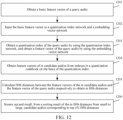
- FIG. 12 is a flow diagram of an audio retrieval method according to one exemplary embodiment of this application.
- the method can include: Step 1201. Obtain a basic feature vector of a query audio.
- the query audio is an audio for audio retrieval.
- the retrieval model further includes a basic feature network, and basic feature vectors of the n sample triplets are obtained by using the basic feature network.
- Step 1202. Input the basic feature vector to the quantization index network and the embedding vector network.
- the basic feature vector of the query audio is input to the quantization index network and the embedding vector network.
- Step 1203. Obtain a quantization index of the query audio by using the quantization index network, and obtain a feature vector of the query audio by using the embedding vector network.
- the quantization index (1, 0, 0) of the query audio is obtained by using the quantization index network
- the feature vector (0.2, 0.8, 0.3, 0.3) of the query audio is obtained by using the embedding vector network.
- Step 1204. Obtain feature vectors of m candidate audios from indexes in a quantization codebook on the basis of the quantization index.
- the quantization codebook stores mapping relationships between the quantization index and the feature vectors of the m candidate audios, and m being a positive integer.
- the feature vectors of three candidate audios are obtained from the indexes in the quantization codebook on the basis of the quantization index (1, 0, 0): (0.2, 0.7, 0.3, 0.3), (0.1, 0.5, 0.2, 0.2) and (0.2, 0.4, 0.2, 0.3).
- the quantization codebook can be constructed by the following steps:
- the list Lindex of the quantization indexes, the mapping table Linvert of q and the list T together form one quantization codebook.
- the step of obtaining feature vectors of m candidate audios from indexes in a quantization codebook on the basis of the quantization index can include: calculating the quantization index of the query audio, determining, from the list Lindex, several quantization indexes at Hamming distances, less than a threshold, from the quantization index of the query audio, determining, from the mapping table Linvert, the m candidate audios corresponding to the several quantization indexes, and determining the feature vectors of the m candidate audios from the mapping table T.
- Step 1205. Calculate fifth distances between the feature vectors of the m candidate audios and the feature vector of the query audio respectively to obtain m fifth distances.
- the fifth distances between the feature vector (0.2, 0.8, 0.3, 0.3) of the query audio 1101 and the feature vectors of the three candidate audios are calculated respectively: (0.2, 0.7, 0.3, 0.3), (0.1, 0.5, 0.2, 0.2) and (0.2, 0.4, 0.2, 0.3), to obtain three fifth distances.
- the fifth distance is a European distance.
- Step 1206 Screen out, according to a preset z value from a sorting result of the m fifth distances from small to large, candidate audios corresponding to top z% fifth distances.
- the candidate audios corresponding to the top z% fifth distances are screened out according to the preset z value from the sorting result of the three fifth distances from small to large, where z% can be obtained by pre-configuring the retrieval model.
- the z value can be reasonably set according to retrieval requirements, so that the screened-out candidate audios meet a retrieval expectation of the retrieval model, z is a positive number.
- the computer device can also send the screened-out candidate audios to a client on which an image retrieval function is run.
- the above method can sort the distances between the query audio and the m candidate audios and screen out the top-sorted audios by using the retrieval model including the basic feature network, the embedding vector network and the quantization index network.
- the above method not only realizes that the screened-out audios are closer to the query audio, but also avoids loss or additional addition of candidate audios during the determination of the m candidate audios.
- FIG. 13 is a flow diagram of a video retrieval method according to one exemplary embodiment of this application.
- the method includes: Step 1301. Obtain a basic feature vector of a query video.
- the query video is a video for video retrieval.
- the retrieval model can further include a basic feature network, and basic feature vectors of the n sample triplets are obtained by using the basic feature network.
- Step 1302. Input the basic feature vector to the quantization index network and the embedding vector network.
- the basic feature vector of the query video is input to the quantization index network and the embedding vector network.
- Step 1303. Obtain a quantization index of the query video by using the quantization index network, and obtain a feature vector of the query video by using the embedding vector network.
- the quantization index (1, 0, 0) of the query video is obtained by using the quantization index network
- the feature vector (0.2, 0.8, 0.3, 0.3) of the query video is obtained by using the embedding vector network.
- Step 1304. Obtain feature vectors of m candidate videos from indexes in a quantization codebook on the basis of the quantization index.
- the quantization codebook stores mapping relationships between the quantization index and the feature vectors of the m candidate videos, and m being a positive integer.
- the feature vectors of three candidate videos are obtained from the indexes in the quantization codebook on the basis of the quantization index (1, 0, 0): (0.2, 0.7, 0.3, 0.3), (0.1, 0.5, 0.2, 0.2) and (0.2, 0.4, 0.2, 0.3).
- the quantization codebook can be constructed by the following steps: First, input any video i in the video library to the above retrieval model, where a feature vector e can be obtained by the embedding vector network 401, and a quantization index q can be obtained by the quantization index network 402 (q is a vector with each dimension of 0 or 1 obtained by a symbol function).
- a mapping table T [i: e] for the video i and the embedding vector network 401 is recorded (where i is a serial number of the video, and e is the feature vector output by the embedding vector network for the video i).
- the list Lindex of the quantization indexes, the mapping table Linvert of q and the list T together form one quantization codebook.
- the step of obtaining feature vectors of m candidate videos from indexes in a quantization codebook on the basis of the quantization index can include: calculating the quantization index of the query video, determining, from the list Lindex, several quantization indexes at Hamming distances, less than a threshold, from the quantization index of the query video, determining, from the mapping table Linvert, the m candidate videos corresponding to the several quantization indexes, and determining the feature vectors of the m candidate videos from the mapping table T.
- Step 1305. Calculate fifth distances between the feature vectors of the m candidate videos and the feature vector of the query video respectively to obtain m fifth distances.
- the fifth distances between the feature vector (0.2, 0.8, 0.3, 0.3) of the query video 1101 and the feature vectors of the three candidate videos are calculated respectively: (0.2, 0.7, 0.3, 0.3), (0.1, 0.5, 0.2, 0.2) and (0.2, 0.4, 0.2, 0.3), to obtain three fifth distances.
- the fifth distance is a European distance.
- Step 1306 Screen out, according to a preset z value from a sorting result of the m fifth distances from small to large, candidate videos corresponding to top z% fifth distances.
- the candidate videos corresponding to the top z% fifth distances are screened out according to the preset z value from the sorting result of the three fifth distances from small to large, where z% can be obtained by pre-configuring the retrieval model.
- the z value can be reasonably set according to retrieval requirements, so that the screened-out candidate videos meet a retrieval expectation of the retrieval model, z is a positive number.
- the computer device can also send the screened-out candidate videos to a client on which an image retrieval function is run.
- the above method can sort the distances between the query video and the m candidate videos and screen out the top-sorted videos by using the retrieval model including the basic feature network, the embedding vector network and the quantization index network.
- the above method not only realizes that the screened-out videos are closer to the query video, but also avoids loss or additional addition of candidate videos during the determination of the m candidate videos.
- FIG. 14 is a structural block diagram of an apparatus for training a retrieval model according to one exemplary embodiment of this application.
- the retrieval model includes an embedding vector network and a quantization index network.
- the embedding vector network is used for obtaining a feature vector of an image
- the quantization index network is used for extracting a quantization index of the image.
- the apparatus for training a retrieval model can include:
- the screening module 1402 can be further configured to obtain n groups of triplet feature vectors output by the embedding vector network for the n sample triplets.
- the screening module 1402 can be further configured to calculate n first error losses corresponding to the n groups of triplet feature vectors.
- the screening module 1402 can be further configured to: screen out, from a sorting result of the n first error losses from small to large, sample triplets corresponding to n 1 first error losses falling within a first selection range, and add the sample triplets to the first sample triplet set used for training the quantization index network.
- the screening module 1402 can be further configured to calculate, for each group of the triplet feature vectors, a first distance between a feature vector of the training sample and a feature vector of the positive sample.
- the screening module 1402 can be further configured to calculate, for each group of the triplet feature vectors, a second distance between the feature vector of the training sample and a feature vector of the negative sample.
- the screening module 1402 can be further configured to calculate a first error loss between a difference value of the first distance and the second distance and a first distance threshold, the first distance threshold being a threshold of a difference value between a distance from the training sample to the positive sample and a distance from the training sample to the negative sample.
- the screening module 1402 can be further configured to screen out, according to a preset x value from the sorting result of the n first error losses from small to large, the sample triplets corresponding to the top x% n 1 first error losses, and add the sample triplets to the first sample triplet set used for training the quantization index network, n 1 being a positive integer less than n.
- x is a positive number.
- the screening module 1402 can be further configured to obtain n groups of triplet quantization indexes output by the quantization index network for the n sample triplets.
- the screening module 1402 can be further configured to calculate n second error losses corresponding to the n groups of triplet quantization indexes.
- the screening module 1402 can be further configured to: screen out, from a sorting result of the n second error losses from small to large, sample triplets corresponding to n 2 second error losses falling within a second selection range, and add the sample triplets to the second sample triplet set used for training the embedding vector network, n 2 being a positive integer less than n.
- the screening module 1402 can be further configured to calculate, for each group of triplet quantization indexes, a first triplet loss of the triplet quantization indexes.
- the screening module 1402 can be further configured to calculate, for each group of triplet quantization indexes, a first quantization error loss of the triplet quantization indexes.
- the screening module 1402 can be further configured to perform weighted summation on the first triplet loss and the first quantization error loss to obtain the second error loss.
- the screening module 1402 can be further configured to: screen out, according to a preset y value from the sorting result of the n second error losses from small to large, the sample triplets corresponding to the top y% n 2 second error losses are screened out, and add the sample triplets to the second sample triplet set used for training the quantization index network.
- y is a positive number.
- the training module 1403 can be further configured to input the first sample triplet set is input to the quantization index network to obtain n 1 third error losses.
- the training module 1403 can be further configured to train the quantization index network on the basis of the n 1 third error losses.
- the training module 1403 can be further configured to calculate, for each sample triplet of the first sample triplet set, a second triplet loss of the triplet feature vector.
- the training module 1403 can be further configured to calculate, for each sample triplet of the first sample triplet set, a second quantization error loss of the triplet feature vector.
- the training module 1403 can be further configured to perform weighted summation on the second triplet loss and the second quantization error loss to obtain the third error loss.
- the training module 1403 can be further configured to input the second sample triplet set to the embedding vector network to obtain n 2 fourth error losses.
- the training module 1403 can be further configured to train the embedding vector network on the basis of the n 2 fourth error losses.
- the training module 1403 can be further configured to calculate, for each sample triplet of the second sample triplet set, a third distance between a feature vector of the training sample and a feature vector of the positive sample.
- the training module 1403 can be further configured to calculating, for each sample triplet of the second sample triplet set, a fourth distance between the feature vector of the training sample and a feature vector of the negative sample.
- the training module 1403 can be further configured to calculate a fourth error loss between a difference value of the third distance and the fourth distance and a second distance threshold, the second distance threshold being a threshold of a difference value between a distance from the training sample to the positive sample and a distance from the training sample to the negative sample.
- the retrieval model can further include a basic feature network.
- the obtaining module 1401 can be further configured to obtain basic feature vectors of the n sample triplets by using the basic feature network.
- the embedding vector network and the quantization index network are trained by using the sample triplets, so that the first sample triplet set screened out by using the embedding vector network is used as the sample triplets for training the quantization index network, and the second sample triplet set screened out by using the quantization index network is used as the sample triplets for training the embedding vector network.
- the above apparatus for training a retrieval model eliminates the influence of noise sample triplets among the sample triplets, and makes a prediction effect of the quantization index network on the positive and negative samples similar to a prediction effect of the embedding vector network on the positive and negative samples. Two branches predict the noise sample triplets, and the two branches learn high-performance sample triplets from each other, so that denoising learning is achieved, and the two branches have similar prediction effects.
- FIG. 15 shows a structural block diagram of an object retrieval apparatus according to one exemplary embodiment of this application.
- the object retrieval apparatus can include:
- the obtaining module 1501 can be further configured to generate a basic feature vector of a query image by using the basic feature network of the retrieval model.
- the above retrieval apparatus can sort the distances between the query object and the m candidate objects and screen out the top-sorted objects by using the retrieval model including the basic feature network, the embedding vector network and the quantization index network.
- the above object retrieval apparatus not only realizes that the screened-out objects are closer to the query object, but also avoids loss or additional addition of candidate objects during the determination of the m candidate objects.
- the apparatus for training object retrieval and the object retrieval apparatus provided by the above embodiments are only illustrated by dividing the functional modules.
- the foregoing functions may be allocated to and completed by different functional modules as required, that is, an inner structure of a device is divided into different functional modules, so as to complete all or some of the functions described above.
- the apparatus for training a retrieval model provided in the foregoing embodiment belongs to the same concept as the embodiment of the method for training a retrieval model, and for the specific implementation process of the apparatus, refer to the method embodiment, and details are not described herein again.
- FIG. 16 shows a structural block diagram of a computer device 1600 according to one exemplary embodiment of this application.
- the computer device can be a terminal or a server.
- it can be simply described as a terminal training a retrieval model alone and/or a terminal using a retrieval model alone, or a server training a retrieval model alone and/or a server using a retrieval model alone, or a terminal and a server training a retrieval model together and/or a terminal and a server using a retrieval model together.
- the computer device 1600 can include: a processor 1601 and a memory 1602.
- the processor 1601 may include one or more processing cores, for example, a 4-core processor or an 8-core processor.
- the processor 1601 may be implemented in at least one hardware form of a digital signal processor (DSP), a field-programmable gate array (FPGA), and a programmable logic array (PLA).
- the processor 1601 may also include a main processor and a coprocessor.
- the main processor is a processor configured to process data in an awake state, and is also referred to as a central processing unit (CPU).
- the coprocessor is a low power consumption processor configured to process the data in a standby state.
- the processor 1601 may be integrated with a graphics processing unit (GPU).
- the GPU is configured to render and draw content that needs to be displayed on a display screen.
- the processor 1601 may further include an AI processor.
- the AI processor is configured to process computing operations related to machine learning.
- the memory 1602 may include one or more computer-readable storage media.
- the computer-readable storage medium may be non-transient.
- the memory 1602 may further include a high-speed random access memory and a nonvolatile memory, for example, one or more disk storage devices or flash storage devices.
- the non-transitory computer-readable storage medium in the memory 1602 is configured to store at least one instruction, the at least one instruction being configured to be executed by the processor 1601 to implement the method for training a retrieval model or the image retrieval method provided by the method embodiments in this application.
- the computer device 1600 can optically include: a peripheral interface 1603 and at least one peripheral.
- the processor 1601, the memory 1602, and the peripheral interface 1603 may be connected through a bus or a signal cable.
- Each peripheral may be connected to the peripheral interface 1603 through a bus, a signal cable, or a circuit board.
- the peripheral includes: at least one of a radio frequency circuit 1604, a display screen 1605, a camera component 1606, an audio circuit 1607, a positioning component 1608, and a power supply 1609.
- the peripheral interface 1603 may be configured to connect the at least one peripheral related to input/output (I/O) to the processor 1601 and the memory 1602.
- the processor 1601, the memory 1602 and the peripheral interface 1603 are integrated on the same chip or circuit board.
- any one or two of the processor 1601, the memory 1602 and the peripheral device interface 1603 can be implemented on a single chip or circuit board. This is not limited in this embodiment.
- the radio frequency circuit 1604 is configured to receive and transmit a radio frequency (RF) signal, also referred to as an electromagnetic signal.
- RF radio frequency
- the display screen 1605 is configured to display a user interface (UI).
- UI user interface
- the camera component 1606 is configured to capture images or videos.
- the audio circuit 1607 may include a microphone and a speaker.
- the power supply 1609 is configured to supply power to the various components in the computer device 1600.
- the computer device 1600 can further include one or more sensors 1610.
- the one or more sensors 1610 include but are not limited to: an acceleration sensor 1611, a gyroscope sensor 1612, a pressure sensor 1613, a fingerprint sensor 1614, an optical sensor 1615, and a proximity sensor 1616.
- FIG. 16 constitutes no limitation on the computer device 1600, and the computer device may include more or fewer components than those shown in the figure, or some components may be combined, or a different component deployment may be used.
- This application further provides a computer-readable storage medium, which stores at least one instruction, at least one program, a code set or an instruction set.
- the at least one instruction, the at least one program, the code set, or the instruction set is loaded or executed by a processor to implement the method for training a retrieval model or the object retrieval method according to the above method embodiment.
- This application further provides a computer program product or a computer program, the computer program product or the computer program including computer instructions stored in a computer-readable memory.
- a processor of a computer device reads the computer instructions from the computer-readable storage medium and executes the computer instructions, causing the computer device to implement the method for training a retrieval model or the object retrieval method provided by the above method embodiment.
- the sample triplet, the basic feature vectors output by the basic feature network, the feature vectors output by the embedding vector network, and the quantization indexes output by the quantization index network can be stored in nodes of a data sharing system.
- the data sharing system 1700 is a system for data sharing between nodes.
- the data sharing system include a plurality of nodes 1701.
- the plurality of nodes 1701 may refer to various clients in the data sharing system.
- Each node 1701 may receive input information during normal work, and maintain shared data in the data sharing system on the basis of the received input information.
- information connection may exist between each node in the data sharing system, and information can be transmitted between the nodes by using the above information connection. For example, when any node in the data sharing system receives input information, other nodes in the data sharing system obtain the input information according to a consensus algorithm, and store the input information as shared data, so that data stored on all nodes in the data sharing system is consistent.
- Each node in the data sharing system has its corresponding node identifier, and each node in the data sharing system can store the node identifiers of other nodes in the data sharing system, so that generated blocks can be broadcast to other nodes in the data sharing system according to the node identifiers of other nodes.
- Each node can maintain a node identifier list as shown in the following table, and correspondingly store node names and the node identifiers to the node identifier list.
- a node identifier may be an Internet protocol (IP, a protocol for interconnection between networks) address or any other type of information capable of identifying the node. Only an IP address is taken as an example for illustration in Table 4.
- IP Internet protocol
- Table 4 Node name Node identifier Node 1 117.114.151.174 Node 2 117.116.189.145 ... ... Node N 119.123.789.258
- Each node in the data sharing system stores an identical blockchain.
- the blockchain is composed of a plurality of blocks, as shown in FIG. 18 .
- the blockchain is composed of a plurality of blocks.
- An originator block includes a block header and a block main body.
- the block header stores a feature value, a version number, a timestamp and a difficulty value of the input information
- the block main body stores the input information.
- a next block of the originator block takes the originator block as a parent block.
- the next block also includes a block header and a block main body.
- the block header stores a feature value of the input information of the current block, and the feature value, the version number, the timestamp and the difficulty value of the block header of the parent block, and the rest can be done in the same manner, so that block data stored in each block in the blockchain is associated with block data stored in the parent block, which ensures the security of the input information in the blocks.
- the node checks the input information. After the verification, the node stores the input information to an internal memory pool and updates its hash tree used for recording the input information.
- the node updates the timestamp to time of receiving the input information, and tries different random numbers to calculate feature values for several times, so that the calculated feature values can satisfy the following formula: SHA 256 SHA 256 version + prev _ hash + merkle _ root + ntime + nbits + x ⁇ TARGET
- SHA256 is a feature value algorithm used for calculating a feature value
- version (version number) is version information of relevant block protocols in the blockchain
- prev_Hash is the feature value of the block header of the parent block of the current block
- merkle_Root is the feature value of the input information
- ntime is the update time for updating the timestamp
- nbits is a current difficulty, which is a fixed value for a period of time, and will be determined again after exceeding the fixed period of time
- x is a random number
- TARGET is a feature value threshold, which can be determined according to nbits.
- the information can be stored correspondingly, to generate the block header and the block main body and obtain the current block.
- the node where the blockchain is located sends the newly generated block to other nodes in the data sharing system according to the node identifiers of other nodes in the data sharing system.
- Other nodes verify the newly generated block, and add, after the verification is completed, the newly generated block to blockchains stored in the nodes.
Landscapes
- Engineering & Computer Science (AREA)
- Theoretical Computer Science (AREA)
- Physics & Mathematics (AREA)
- Data Mining & Analysis (AREA)
- General Engineering & Computer Science (AREA)
- General Physics & Mathematics (AREA)
- Library & Information Science (AREA)
- Databases & Information Systems (AREA)
- Software Systems (AREA)
- Health & Medical Sciences (AREA)
- Evolutionary Computation (AREA)
- Life Sciences & Earth Sciences (AREA)
- Artificial Intelligence (AREA)
- Biomedical Technology (AREA)
- Biophysics (AREA)
- Computational Linguistics (AREA)
- Multimedia (AREA)
- General Health & Medical Sciences (AREA)
- Molecular Biology (AREA)
- Computing Systems (AREA)
- Mathematical Physics (AREA)
- Information Retrieval, Db Structures And Fs Structures Therefor (AREA)
- Image Analysis (AREA)
Applications Claiming Priority (2)
| Application Number | Priority Date | Filing Date | Title |
|---|---|---|---|
| CN202110945262.5A CN114282035B (zh) | 2021-08-17 | 2021-08-17 | 图像检索模型的训练和检索方法、装置、设备及介质 |
| PCT/CN2022/107973 WO2023020214A1 (zh) | 2021-08-17 | 2022-07-26 | 检索模型的训练和检索方法、装置、设备及介质 |
Publications (3)
| Publication Number | Publication Date |
|---|---|
| EP4386579A1 true EP4386579A1 (de) | 2024-06-19 |
| EP4386579A4 EP4386579A4 (de) | 2024-11-20 |
| EP4386579B1 EP4386579B1 (de) | 2026-04-22 |
Family
ID=80868404
Family Applications (1)
| Application Number | Title | Priority Date | Filing Date |
|---|---|---|---|
| EP22857527.0A Active EP4386579B1 (de) | 2021-08-17 | 2022-07-26 | Verfahren und vorrichtung zum trainieren eines wiederauffindungsmodells, wiederauffindungsverfahren und -vorrichtung, vorrichtung und medium |
Country Status (4)
| Country | Link |
|---|---|
| US (1) | US12493649B2 (de) |
| EP (1) | EP4386579B1 (de) |
| CN (1) | CN114282035B (de) |
| WO (1) | WO2023020214A1 (de) |
Families Citing this family (11)
| Publication number | Priority date | Publication date | Assignee | Title |
|---|---|---|---|---|
| US10425353B1 (en) | 2017-01-27 | 2019-09-24 | Triangle Ip, Inc. | Machine learning temporal allocator |
| CN114282035B (zh) * | 2021-08-17 | 2024-12-31 | 腾讯科技(深圳)有限公司 | 图像检索模型的训练和检索方法、装置、设备及介质 |
| CN113889146B (zh) * | 2021-09-22 | 2025-05-27 | 北京小米移动软件有限公司 | 音频识别方法、装置、电子设备和存储介质 |
| US12579411B2 (en) * | 2021-12-29 | 2026-03-17 | International Business Machines Corporation | Resonator network based neural network |
| CN117152464A (zh) * | 2022-05-18 | 2023-12-01 | 广州视源电子科技股份有限公司 | 图像检索模型的训练方法、图像检索方法和相关设备 |
| CN115795078B (zh) * | 2022-12-08 | 2026-04-14 | 北京沃东天骏信息技术有限公司 | 图像检索模型的训练方法、图像检索方法及装置 |
| CN116259328B (zh) * | 2023-02-24 | 2025-10-31 | 思必驰科技股份有限公司 | 用于音频降噪的后训练量化方法、装置和存储介质 |
| CN116975086A (zh) * | 2023-06-30 | 2023-10-31 | 华为技术有限公司 | 检索方法、介质以及电子设备 |
| CN117133031A (zh) * | 2023-07-24 | 2023-11-28 | 厦门真景科技有限公司 | 一种姿态鲁棒的人脸识别方法和装置以及设备 |
| CN117113292A (zh) * | 2023-08-30 | 2023-11-24 | 中国电信股份有限公司 | 特征量化方法、装置、非易失性存储介质及电子设备 |
| CN116912535B (zh) * | 2023-09-08 | 2023-11-28 | 中国海洋大学 | 一种基于相似筛选的无监督目标重识别方法、装置及介质 |
Family Cites Families (14)
| Publication number | Priority date | Publication date | Assignee | Title |
|---|---|---|---|---|
| EP3371712A1 (de) * | 2015-11-06 | 2018-09-12 | Thomson Licensing | Verfahren und vorrichtung zur erzeugung von codebüchern für effiziente suche |
| CN106021364B (zh) * | 2016-05-10 | 2017-12-12 | 百度在线网络技术(北京)有限公司 | 图片搜索相关性预测模型的建立、图片搜索方法和装置 |
| CN106909625A (zh) * | 2017-01-20 | 2017-06-30 | 清华大学 | 一种基于Siamese网络的图像检索方法及系统 |
| CN106980641B (zh) * | 2017-02-09 | 2020-01-21 | 上海媒智科技有限公司 | 基于卷积神经网络的无监督哈希快速图片检索系统及方法 |
| CN107423376B (zh) * | 2017-07-10 | 2019-12-27 | 上海媒智科技有限公司 | 一种有监督深度哈希快速图片检索方法及系统 |
| CN109815355A (zh) * | 2019-01-28 | 2019-05-28 | 网易(杭州)网络有限公司 | 图像搜索方法及装置、存储介质、电子设备 |
| CN111177435B (zh) * | 2019-12-31 | 2023-03-31 | 重庆邮电大学 | 一种基于改进pq算法的cbir方法 |
| CN111782834A (zh) | 2020-06-28 | 2020-10-16 | 北京百度网讯科技有限公司 | 图像检索的方法、装置、设备及计算机可读存储介质 |
| CN113127672B (zh) * | 2021-04-21 | 2024-06-25 | 鹏城实验室 | 量化图像检索模型的生成方法、检索方法、介质及终端 |
| CN113254687B (zh) * | 2021-06-28 | 2021-09-17 | 腾讯科技(深圳)有限公司 | 图像检索、图像量化模型训练方法、装置和存储介质 |
| CN114282035B (zh) * | 2021-08-17 | 2024-12-31 | 腾讯科技(深圳)有限公司 | 图像检索模型的训练和检索方法、装置、设备及介质 |
| CN116051917B (zh) * | 2021-10-28 | 2024-10-18 | 腾讯科技(深圳)有限公司 | 一种训练图像量化模型的方法、检索图像的方法及装置 |
| CN116527863A (zh) * | 2022-04-28 | 2023-08-01 | 腾讯科技(深圳)有限公司 | 基于虚拟现实的视频生成方法、装置、设备及介质 |
| CN118037956A (zh) * | 2024-02-07 | 2024-05-14 | 北京清影机器视觉技术有限公司 | 固定空间内三维虚拟实景生成方法及系统 |
-
2021
- 2021-08-17 CN CN202110945262.5A patent/CN114282035B/zh active Active
-
2022
- 2022-07-26 WO PCT/CN2022/107973 patent/WO2023020214A1/zh not_active Ceased
- 2022-07-26 EP EP22857527.0A patent/EP4386579B1/de active Active
-
2023
- 2023-04-13 US US18/134,447 patent/US12493649B2/en active Active
Also Published As
| Publication number | Publication date |
|---|---|
| EP4386579A4 (de) | 2024-11-20 |
| CN114282035B (zh) | 2024-12-31 |
| CN114282035A (zh) | 2022-04-05 |
| WO2023020214A1 (zh) | 2023-02-23 |
| US20230252070A1 (en) | 2023-08-10 |
| EP4386579B1 (de) | 2026-04-22 |
| US12493649B2 (en) | 2025-12-09 |
Similar Documents
| Publication | Publication Date | Title |
|---|---|---|
| EP4386579B1 (de) | Verfahren und vorrichtung zum trainieren eines wiederauffindungsmodells, wiederauffindungsverfahren und -vorrichtung, vorrichtung und medium | |
| CN113095370B (zh) | 图像识别方法、装置、电子设备及存储介质 | |
| EP4664416A1 (de) | Trainingsverfahren und -vorrichtung für ein lebenderkennungsmodell sowie medium, elektronische vorrichtung und produkt | |
| WO2019191203A1 (en) | Risky transaction identification method and apparatus, server, and storage medium | |
| CN113191479B (zh) | 联合学习的方法、系统、节点及存储介质 | |
| CN111046027A (zh) | 时间序列数据的缺失值填充方法和装置 | |
| CN109993026B (zh) | 亲属识别网络模型的训练方法及装置 | |
| CN111709473B (zh) | 对象特征的聚类方法及装置 | |
| CN112200173B (zh) | 多网络模型训练方法、图像标注方法和人脸图像识别方法 | |
| CN110636445A (zh) | 基于wifi的室内定位方法、装置、设备及介质 | |
| CN114359769A (zh) | 视频表征学习方法、视频处理方法、装置、介质及设备 | |
| CN115761397B (zh) | 模型训练方法、图像分类方法、装置、设备及存储介质 | |
| CN110135428A (zh) | 图像分割处理方法和装置 | |
| WO2024016830A1 (zh) | 数据处理方法、装置、设备及存储介质 | |
| CN118823160A (zh) | 一种模型处理方法、装置、设备、介质及产品 | |
| CN114756425B (zh) | 智能监控方法、装置、电子设备及计算机可读存储介质 | |
| CN111523639A (zh) | 用于训练超网络的方法和装置 | |
| CN115082574B (zh) | 网络模型训练方法和脏器超声切面编码生成方法、装置 | |
| CN111783711B (zh) | 基于身体部件层面的骨架行为识别方法及装置 | |
| CN117172339A (zh) | 基于通信辅助感知的联邦学习方法及系统 | |
| CN117152449A (zh) | 一种异常识别的方法、装置和设备及计算机存储介质 | |
| CN115587297A (zh) | 构建图像识别模型和图像识别的方法、装置、设备及介质 | |
| WO2022143505A1 (zh) | 群组类型识别方法、装置、计算机设备及介质 | |
| CN120470541B (zh) | 基于最优传输算法的多源数据融合方法及系统 | |
| CN110688508A (zh) | 图文数据扩充方法、装置及电子设备 |
Legal Events
| Date | Code | Title | Description |
|---|---|---|---|
| STAA | Information on the status of an ep patent application or granted ep patent |
Free format text: STATUS: THE INTERNATIONAL PUBLICATION HAS BEEN MADE |
|
| PUAI | Public reference made under article 153(3) epc to a published international application that has entered the european phase |
Free format text: ORIGINAL CODE: 0009012 |
|
| STAA | Information on the status of an ep patent application or granted ep patent |
Free format text: STATUS: REQUEST FOR EXAMINATION WAS MADE |
|
| 17P | Request for examination filed |
Effective date: 20240312 |
|
| AK | Designated contracting states |
Kind code of ref document: A1 Designated state(s): AL AT BE BG CH CY CZ DE DK EE ES FI FR GB GR HR HU IE IS IT LI LT LU LV MC MK MT NL NO PL PT RO RS SE SI SK SM TR |
|
| A4 | Supplementary search report drawn up and despatched |
Effective date: 20241022 |
|
| DAV | Request for validation of the european patent (deleted) | ||
| DAX | Request for extension of the european patent (deleted) | ||
| RIC1 | Information provided on ipc code assigned before grant |
Ipc: G06N 3/08 20230101ALI20241016BHEP Ipc: G06N 3/04 20230101ALI20241016BHEP Ipc: G06F 16/783 20190101ALI20241016BHEP Ipc: G06F 16/683 20190101ALI20241016BHEP Ipc: G06F 16/583 20190101AFI20241016BHEP |
|
| GRAP | Despatch of communication of intention to grant a patent |
Free format text: ORIGINAL CODE: EPIDOSNIGR1 |
|
| STAA | Information on the status of an ep patent application or granted ep patent |
Free format text: STATUS: GRANT OF PATENT IS INTENDED |
|
| INTG | Intention to grant announced |
Effective date: 20260210 |
|
| GRAS | Grant fee paid |
Free format text: ORIGINAL CODE: EPIDOSNIGR3 |
|
| GRAA | (expected) grant |
Free format text: ORIGINAL CODE: 0009210 |
|
| STAA | Information on the status of an ep patent application or granted ep patent |
Free format text: STATUS: THE PATENT HAS BEEN GRANTED |
|
| AK | Designated contracting states |
Kind code of ref document: B1 Designated state(s): AL AT BE BG CH CY CZ DE DK EE ES FI FR GB GR HR HU IE IS IT LI LT LU LV MC MK MT NL NO PL PT RO RS SE SI SK SM TR |
|
| REG | Reference to a national code |
Ref country code: CH Ref legal event code: F10 Free format text: ST27 STATUS EVENT CODE: U-0-0-F10-F00 (AS PROVIDED BY THE NATIONAL OFFICE) Effective date: 20260422 Ref country code: GB Ref legal event code: FG4D |