EP4386624A2 - Navigation d'environnement à l'aide d'un apprentissage par renforcement - Google Patents
Navigation d'environnement à l'aide d'un apprentissage par renforcement Download PDFInfo
- Publication number
- EP4386624A2 EP4386624A2 EP24173836.8A EP24173836A EP4386624A2 EP 4386624 A2 EP4386624 A2 EP 4386624A2 EP 24173836 A EP24173836 A EP 24173836A EP 4386624 A2 EP4386624 A2 EP 4386624A2
- Authority
- EP
- European Patent Office
- Prior art keywords
- neural network
- action selection
- environment
- agent
- selection policy
- Prior art date
- Legal status (The legal status is an assumption and is not a legal conclusion. Google has not performed a legal analysis and makes no representation as to the accuracy of the status listed.)
- Pending
Links
Images


Classifications
-
- G—PHYSICS
- G06—COMPUTING OR CALCULATING; COUNTING
- G06F—ELECTRIC DIGITAL DATA PROCESSING
- G06F18/00—Pattern recognition
- G06F18/20—Analysing
- G06F18/21—Design or setup of recognition systems or techniques; Extraction of features in feature space; Blind source separation
- G06F18/217—Validation; Performance evaluation; Active pattern learning techniques
-
- G—PHYSICS
- G06—COMPUTING OR CALCULATING; COUNTING
- G06N—COMPUTING ARRANGEMENTS BASED ON SPECIFIC COMPUTATIONAL MODELS
- G06N3/00—Computing arrangements based on biological models
- G06N3/004—Artificial life, i.e. computing arrangements simulating life
- G06N3/006—Artificial life, i.e. computing arrangements simulating life based on simulated virtual individual or collective life forms, e.g. social simulations or particle swarm optimisation [PSO]
-
- G—PHYSICS
- G06—COMPUTING OR CALCULATING; COUNTING
- G06N—COMPUTING ARRANGEMENTS BASED ON SPECIFIC COMPUTATIONAL MODELS
- G06N3/00—Computing arrangements based on biological models
- G06N3/02—Neural networks
- G06N3/04—Architecture, e.g. interconnection topology
- G06N3/044—Recurrent networks, e.g. Hopfield networks
-
- G—PHYSICS
- G06—COMPUTING OR CALCULATING; COUNTING
- G06N—COMPUTING ARRANGEMENTS BASED ON SPECIFIC COMPUTATIONAL MODELS
- G06N3/00—Computing arrangements based on biological models
- G06N3/02—Neural networks
- G06N3/04—Architecture, e.g. interconnection topology
- G06N3/044—Recurrent networks, e.g. Hopfield networks
- G06N3/0442—Recurrent networks, e.g. Hopfield networks characterised by memory or gating, e.g. long short-term memory [LSTM] or gated recurrent units [GRU]
-
- G—PHYSICS
- G06—COMPUTING OR CALCULATING; COUNTING
- G06N—COMPUTING ARRANGEMENTS BASED ON SPECIFIC COMPUTATIONAL MODELS
- G06N3/00—Computing arrangements based on biological models
- G06N3/02—Neural networks
- G06N3/04—Architecture, e.g. interconnection topology
- G06N3/045—Combinations of networks
-
- G—PHYSICS
- G06—COMPUTING OR CALCULATING; COUNTING
- G06N—COMPUTING ARRANGEMENTS BASED ON SPECIFIC COMPUTATIONAL MODELS
- G06N3/00—Computing arrangements based on biological models
- G06N3/02—Neural networks
- G06N3/04—Architecture, e.g. interconnection topology
- G06N3/045—Combinations of networks
- G06N3/0455—Auto-encoder networks; Encoder-decoder networks
-
- G—PHYSICS
- G06—COMPUTING OR CALCULATING; COUNTING
- G06N—COMPUTING ARRANGEMENTS BASED ON SPECIFIC COMPUTATIONAL MODELS
- G06N3/00—Computing arrangements based on biological models
- G06N3/02—Neural networks
- G06N3/04—Architecture, e.g. interconnection topology
- G06N3/0464—Convolutional networks [CNN, ConvNet]
-
- G—PHYSICS
- G06—COMPUTING OR CALCULATING; COUNTING
- G06N—COMPUTING ARRANGEMENTS BASED ON SPECIFIC COMPUTATIONAL MODELS
- G06N3/00—Computing arrangements based on biological models
- G06N3/02—Neural networks
- G06N3/08—Learning methods
- G06N3/084—Backpropagation, e.g. using gradient descent
-
- G—PHYSICS
- G06—COMPUTING OR CALCULATING; COUNTING
- G06N—COMPUTING ARRANGEMENTS BASED ON SPECIFIC COMPUTATIONAL MODELS
- G06N3/00—Computing arrangements based on biological models
- G06N3/02—Neural networks
- G06N3/08—Learning methods
- G06N3/092—Reinforcement learning
-
- G—PHYSICS
- G06—COMPUTING OR CALCULATING; COUNTING
- G06T—IMAGE DATA PROCESSING OR GENERATION, IN GENERAL
- G06T2207/00—Indexing scheme for image analysis or image enhancement
- G06T2207/20—Special algorithmic details
- G06T2207/20076—Probabilistic image processing
-
- G—PHYSICS
- G06—COMPUTING OR CALCULATING; COUNTING
- G06T—IMAGE DATA PROCESSING OR GENERATION, IN GENERAL
- G06T2207/00—Indexing scheme for image analysis or image enhancement
- G06T2207/20—Special algorithmic details
- G06T2207/20081—Training; Learning
-
- G—PHYSICS
- G06—COMPUTING OR CALCULATING; COUNTING
- G06T—IMAGE DATA PROCESSING OR GENERATION, IN GENERAL
- G06T2207/00—Indexing scheme for image analysis or image enhancement
- G06T2207/20—Special algorithmic details
- G06T2207/20084—Artificial neural networks [ANN]
-
- G—PHYSICS
- G06—COMPUTING OR CALCULATING; COUNTING
- G06T—IMAGE DATA PROCESSING OR GENERATION, IN GENERAL
- G06T2207/00—Indexing scheme for image analysis or image enhancement
- G06T2207/30—Subject of image; Context of image processing
- G06T2207/30248—Vehicle exterior or interior
-
- G—PHYSICS
- G06—COMPUTING OR CALCULATING; COUNTING
- G06T—IMAGE DATA PROCESSING OR GENERATION, IN GENERAL
- G06T7/00—Image analysis
- G06T7/50—Depth or shape recovery
-
- G—PHYSICS
- G06—COMPUTING OR CALCULATING; COUNTING
- G06T—IMAGE DATA PROCESSING OR GENERATION, IN GENERAL
- G06T7/00—Image analysis
- G06T7/70—Determining position or orientation of objects or cameras
Definitions
- This specification relates to reinforcement learning.
- an agent interacts with an environment by performing actions that are selected by the reinforcement learning system in response to receiving observations that characterize the current state of the environment.
- Some reinforcement learning systems select the action to be performed by the agent in response to receiving a given observation in accordance with an output of a neural network.
- Neural networks are machine learning models that employ one or more layers of nonlinear units to predict an output for a received input.
- Some neural networks are deep neural networks that include one or more hidden layers in addition to an output layer. The output of each hidden layer is used as input to the next layer in the network, i.e., the next hidden layer or the output layer.
- Each layer of the network generates an output from a received input in accordance with current values of a respective set of parameters.
- This specification describes a reinforcement learning system implemented as computer programs on one or more computers in one or more locations that selects actions to be performed by an agent interacting with an environment.
- the system uses an action selection policy neural network in selecting actions to be performed in response to observations of the environment.
- a training engine trains (i) a geometry prediction neural network, (ii) a loop closure prediction neural network, or both, that receive as inputs respective intermediate outputs of the action selection policy neural network.
- the method comprises: receiving an observation image characterizing a current state of the environment; processing, using the action selection policy neural network and in accordance with current values of the network parameters, an input comprising the observation image to generate an action selection output; processing, using a geometry-prediction neural network, an intermediate output generated by the action selection policy neural network to predict a value of a feature of a geometry of the environment when in the current state; and determining a gradient of a geometry-based auxiliary loss that is based on an actual value of the feature and the predicted value of the feature; and backpropagating the gradient of the geometry-based auxiliary loss into the action selection policy neural network to determine a geometry-based auxiliary update for the current values of the network parameters.
- the predicted value of the feature of the geometry is a predicted depth of the environment as characterized by the observation image and the actual value of the feature of the geometry is an actual depth of the environment as characterized by the observation image.
- the auxiliary loss is used for training the system but the predicted value of the feature of the geometry need not be otherwise used.
- the action selection policy neural network comprises: a convolutional encoder neural network that generates an encoded representation of the input, an intermediate neural network that processes the encoded representation of the input to generate an intermediate representation; and an output neural network that processes the intermediate representation to generate the action selection output.
- the intermediate output comprises the encoded representation.
- the intermediate output comprises the intermediate representation.
- the method further comprises: processing the intermediate representation using a loop closure prediction neural network that is configured to generate a score that represents a predicted likelihood that, when the environment is in the current state, the agent has returned to a location in the environment that the agent has already visited; determining a gradient of a loop closure auxiliary loss that is based on an actual similarity of the current state to earlier states of the environment and the predicted likelihood; and backpropagating the gradient of the loop closure auxiliary loss into the action selection policy neural network to determine a loop closure auxiliary update for the current values of the network parameters.
- the intermediate neural network is a recurrent neural network.
- the intermediate neural network is a feedforward neural network.
- the method further comprises: selecting an action to be performed by the agent when the environment is in the current state using the action selection output; receiving a reward that is based on progress toward accomplishing the one or more goals; and determining a main update for the network parameters based at least in part on the reward.
- the method further comprises: using the geometry-based auxiliary update and the main update to update the current values of the network parameters.
- the method further comprises: updating the current values of the network parameters using the geometry-based auxiliary update to generate updated parameter values; and using the action selection policy neural network to select an action to be performed by the agent in accordance with the updated parameter values.
- the reinforcement learning system described in this specification can augment the feedback signals received during the training of the action selection policy neural network to improve training.
- training the geometry prediction neural network or loop closure prediction neural network tunes the values of the action selection policy neural network parameters, causing them to generate more useful representations of observed data and ultimately determine more effective policy outputs to maximize cumulative reward, even when rewards received by the reinforcement learning system are sparse, e.g., are only rarely non-zero.
- training the geometry prediction neural network tunes the values of the action selection policy neural network parameters to encourage the learning of representations that aid in obstacle avoidance and short-term trajectory planning.
- training the loop closure prediction neural network tunes the values of the action selection policy neural network parameters to encourage efficient exploration of an environment and spatial reasoning.
- the reinforcement learning system described in this specification trains the action selection policy neural network faster than conventional reinforcement learning systems that do not include geometry prediction neural networks and loop closure prediction neural networks. Therefore, the reinforcement learning system described in this specification allows more efficient use of computational resources in training. Moreover, the reinforcement learning system described in this specification achieves superior performance to conventional reinforcement learning systems, i.e., allows an agent to more effectively navigate through an environment.
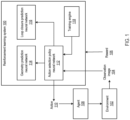
- FIG. 1 shows an example reinforcement learning system 100.
- the reinforcement learning system 100 is an example of a system implemented as computer programs on one or more computers in one or more locations in which the systems, components, and techniques described below are implemented.
- the reinforcement learning system 100 selects actions 110 to be performed by an agent 108 interacting with an environment 102 at each of multiple time steps.
- the system 100 receives an observation image 104 characterizing the current state of the environment 102 and selects an action 110 to be performed by the agent 108 in response to the received observation image 104.
- the environment 102 is a simulated environment and the agent 108 is implemented as one or more computer programs interacting with the simulated environment by navigating through the simulated environment.
- the simulated environment may be a video game and the agent 108 may be a simulated user playing the video game by navigating through the simulated environment.
- the simulated environment may be a motion simulation environment, e.g., a driving simulation or a flight simulation, and the agent 108 is a simulated vehicle navigating through the motion simulation environment.
- the actions 110 may be control inputs to control the simulated user or simulated vehicle.
- the environment 102 is a real-world environment and the agent 108 is a mechanical agent interacting with the real-world environment.
- the agent 108 may be an autonomous or semi-autonomous vehicle navigating through the environment.
- the actions 110 may be control inputs to control the robot or the autonomous vehicle.
- the observation images 104 may be generated by or derived from sensors of the agent 108.
- the observation images 104 may be RGB images captured by a camera of the agent 108.
- the observation images 104 may be derived from data captured from a laser sensor of the agent 108.
- the observation images may be hyperspectral images captured by a hyperspectral sensor of the agent 108.
- the system 100 receives a reward 106 based on the current state of the environment 102 and the action 110 of the agent 108 at the time step. For example, the system 100 may receive a reward 106 for a given time step based on progress toward the agent 108 accomplishing one or more goals. For example, a goal of the agent may be to navigate to a goal location in the environment 102.
- the system 100 uses an action selection policy neural network 112 in selecting actions to be performed by the agent 108 in response to observation images 104 at each time step.
- the action selection policy neural network 112 is configured to receive an input including an observation image 104 and to process the input in accordance with a set of parameters of the action selection policy neural network to generate a policy output that the system 100 uses to determine an action 110 to be performed by the agent 108 at the time step.
- the action selection policy neural network 112 is configured to receive additional inputs, including one or more of: agent-relative lateral, rotational velocity, the action performed by the agent at the previous time step, i.e. the time step before the current time step, or the reward received by the system at the previous time step.
- agent-relative lateral velocity refers to the forward and sideways velocity of the agent as defined in the egocentric reference frame of the agent.
- the angular velocity refers to the rotational velocity of the agent about the vertical axis.
- the policy output is a probability distribution over the set of possible actions.
- the policy output may be a Q-value that is an estimate of the long-term time-discounted reward that would be received if the agent 108 performs a particular action in response to the observation.
- the policy output may identify a particular action that is predicted to yield the highest long-term time-discounted reward if performed by the agent in response to the observation.
- the policy output is a combination of the previously described policy outputs.
- the action selection policy neural network 112 includes a convolutional encoder neural network that generates an encoded representation of the input observation image 104, an intermediate neural network that processes the encoded representation of the input observation image to generate an intermediate representation, and an output neural network that processes the intermediate representation to generate the policy output.
- the intermediate neural network is a feedforward neural network.
- the intermediate neural network may be a multi-layer perceptron (MLP).
- MLP multi-layer perceptron
- the intermediate neural network is a recurrent neural network.
- the intermediate neural network may be a long short-term memory (LSTM) network, or a stack of LSTM networks.
- a stack of LSTM networks is an ordered set of multiple LSTM networks, where the first LSTM network processes the encoded representation, and each subsequent LSTM network processes the output of the previous LSTM network.
- the stack of LSTM networks may include skip-connections providing the encoded representation to LSTM networks after the first LSTM network.
- the output neural network is a feedforward neural network.
- the output neural network may be a MLP.
- the additional inputs may be provided as input to the encoder neural network or the intermediate neural network of the action selection policy neural network 112.
- the encoded representation of the input observation image and the reward may be provided to a first layer of the intermediate neural network and the additional inputs may be provided to a second layer of the intermediate neural network which also has an input from an output of the first layer. In this way the first layer may make associations between a visual observation and a reward, which are provided to the second layer from which the policy is computed.
- a training engine 118 trains the action selection policy neural network 112 to generate policy outputs that maximize the expected cumulative reward received by the system 100, e.g. a long-term time-discounted sum of rewards received by the system 100, by using a reinforcement learning technique to iteratively adjust the values of the set of parameters of the action selection policy neural network.
- a reinforcement learning technique is described in Volodymyr Mnih et. al., "Asynchronous methods for deep reinforcement learning," Proceedings of the 33rd International Conference on Machine Learning, 2016 .
- the training engine 118 may train the action selection policy neural network 112 by additionally training a geometry prediction neural network 114 that receives as input an intermediate output of the action selection policy neural network 112. Training the geometry prediction neural network 114 tunes the values of the set of parameters of the action selection policy neural network 112 to cause the action selecting policy neural network 112 to generate more useful representations of observations 104 which aid in obstacle avoidance and short-term trajectory planning and cause the action selection policy neural network 112 to determine more effective policy outputs to maximize expected cumulative reward, even when non-zero rewards are only rarely received.
- the geometry prediction neural network 114 receives as input an intermediate output of the action selection policy neural network 112 when processing a given observation image, and processes the input in accordance with the values of a set of parameters of the geometry prediction neural network, to generate as output a predicted value of a feature of a geometry of the environment in the current state.
- the feature of the geometry of the environment in the current state is the depth of the environment as characterized by the given observation image, i.e. depth values corresponding to pixels of the given observation image, where the depth value for a pixel corresponds to the distance from the agent sensor that captured the given observation image to a surface or object depicted in the given observation image that contains the pixel.
- the feature of the geometry of the environment in the current state is the distance of the agent 108 from known landmarks in the environment. In some implementations, the feature of the geometry of the environment in the current state is the bearing of the agent 108 relative to known landmarks in the environment. In some implementations, the feature of the geometry of the environment in the current state is the observation image of the environment in the current state, a predicted future observation image of the environment, or a reconstruction of a past observation image of the environment that was previously received. In some implementations, the feature of the geometry of the environment is some combination of the previously described features of the geometry of the environment. In some implementations, the geometry prediction neural network 114 is a feed-forward neural network. For example, the geometry prediction neural network may be a MLP.
- An intermediate output of the action selection policy neural network 112 is a set of activations generated at one or more units of one or more hidden layers of the action selection policy neural network 112 in response to processing the given observation as input.
- the intermediate output of the action selection policy neural network 112 provided as input to the geometry prediction neural network 114 is the encoded representation generated by the convolutional encoder neural network of the action selection policy neural network 112.
- the intermediate output of the action selection policy neural network 112 provided as input to the geometry prediction neural network 114 is the intermediate representation generated by the intermediate neural network of the action selection policy neural network 112.
- the system 100 includes two geometry prediction neural networks, where one geometry prediction neural network receives the encoded representation generated by the convolutional encoder neural network of the action selection policy neural network 112 as input, and where the other geometry prediction neural network receives the intermediate representation generated by the intermediate neural network of the action selection policy neural network 112 as input.
- the training engine 118 trains the geometry prediction neural network 114 to generate a predicted value of the feature of the geometry that minimizes a geometry-based auxiliary loss that is based on the actual value of the feature of the geometry. Specifically, the training engine 118 backpropagates the gradient of the geometry-based auxiliary loss to adjust the values of the set of parameters of the geometry prediction neural network 114, and to adjust the values of some of the set of parameters of the action selection policy neural network 112, in order to minimize the geometry-based auxiliary loss.
- the training engine 118 adjusts the parameters of the action selection policy neural network corresponding to (i) the one or more units of the one or more hidden layers of the intermediate output of the action selection policy neural network 112 that the system 100 provides as input to the geometry prediction neural network, and (ii) units that feed-forward into the one or more units of the one or more hidden layers of the intermediate output of the action selection policy neural network 112 that the system 100 provides as input to the geometry prediction neural network.
- a first unit is said to feed-forward into a second unit if the output of the first unit is either directly or indirectly provided as an input to the second unit.
- the training engine 118 may train the action selection policy neural network 112 by additionally training a loop closure prediction neural network 114 that receives as input an intermediate output of the action selection policy neural network 112. Training the loop closure prediction neural network 114 tunes the values of the set of parameters of the action selection policy neural network 112 to cause the action selecting policy neural network 112 to generate more useful representations of observations 104 which aid in efficient environment exploration and spatial reasoning, and cause the action selection policy neural network 112 to determine more effective policy outputs to maximize expected cumulative reward, even when rewards are sparse, i.e., non-zero rewards are only rarely received.
- the loop closure prediction neural network 116 receives as input an intermediate output of the action selection policy neural network 112 when processing a given observation image, and processes the input in accordance with the values of a set of parameters of the loop closure prediction neural network 116 to generate as output a score that represents a predicted likelihood that, when the environment is in the current state, the agent has returned to a location in the environment that the agent has already visited. In some implementations, the agent is considered to have returned to a location in the environment that the agent has already visited only if the agent previously visited the location within a fixed previous number of time steps. In some implementations, the loop closure prediction neural network 116 is a feed-forward neural network. For example, the loop closure prediction neural network 116 may be a MLP.
- the intermediate output of the action selection policy neural network 112 provided as input to the loop closure prediction neural network 114 is the encoded representation generated by the convolutional encoder neural network of the action selection policy neural network 112. In some other implementations, the intermediate output of the action selection policy neural network 112 provided as input to the loop closure prediction neural network 114 is the intermediate representation generated by the intermediate neural network of the action selection policy neural network 112.
- the training engine 118 trains the loop closure prediction neural network 116 to generate a score that minimizes a loop closure auxiliary loss that is based on an actual similarity of a location of the current state to the locations of earlier states of the environment, and the predicted likelihood that, when the environment is in the current state, the agent has returned to a location in the environment that the agent has already visited. Specifically, the training engine 118 backpropagates the gradient of the loop closure auxiliary loss to adjust the values of the set of parameters of the loop closure prediction neural network 116, and to adjust the values of some of the set of parameters of the action selection policy neural network 112, in order to minimize the loop closure auxiliary loss.
- the training engine 118 adjusts the parameters of the action selection policy neural network corresponding to (i) the one or more units of the one or more hidden layers of the intermediate output of the action selection policy neural network 112 that the system 100 provides as input to the loop closure prediction neural network 116, and (ii) units that feed-forward into the one or more units of the one or more hidden layers of the intermediate output of the action selection policy neural network 112 that the system 100 provides as input to the loop closure prediction neural network 116.
- An example process for training the action selection policy neural network 112 by training the loop closure prediction neural network 116 is described with reference to FIG. 3 .
- the training engine 118 trains the action selection policy neural network, the geometry prediction neural network, and the loop closure prediction neural network online, i.e. based on observations and rewards as they are received. For example, at a given time step, the system 100 may select an action to be performed by the agent 108 based on the policy output generated by the action selection policy neural network 112, receive a reward 106, and the training engine 118 may update the values of the parameters of the neural networks of the system 100 through gradient backpropagation based on one or more of the reinforcement learning technique, the auxiliary geometry-based loss, and the loop closure auxiliary loss.
- the system 100 selects the action to be performed by the agent 108 based on the policy output generated by the action selection policy neural network 112 in accordance with the updated values of the parameters of the action selection policy neural network 112.
- the training engine 118 trains the networks from experiences (i.e., tuples including observations, actions, rewards for previous time steps) stored in a replay memory.
- the training engine 118 may train the networks using on-policy training or off policy training, or any other appropriate reinforcement learning technique.
- gradient backpropagation based on the reinforcement learning technique, the auxiliary geometry-based loss, and the loop closure auxiliary loss are associated with different weight values that scale the size of the adjustment to the parameters of the networks based on the gradients.
- FIG. 2 is a flow diagram of an example process 200 for training the action selection policy neural network by training a geometry prediction neural network.
- the process 200 will be described as being performed by a training engine including one or more computers located in one or more locations.
- a training engine e.g., the training engine 118 of FIG. 1 , appropriately programmed in accordance with this specification, can perform the process 200.
- the training engine performs the process 200 at each of multiple time steps.
- the system provides inputs to the action selection policy neural network, including an observation image characterizing a current state of the environment, and the action selection policy neural network processes the inputs in accordance with the values of the set of parameters of the action selection policy neural network to generate a policy output (step 202).
- the observation image is an RGB image.
- the inputs provided to the action selection policy neural network may include additional inputs, such as agent-relative lateral and rotational velocity, the action performed by the agent at the previous time step, and the reward received by the system at the previous time step.
- the agent-relative lateral and rotational velocity and the reward received by the system by the previous time step may be represented as vectors, and the action performed by the agent at the previous time step may be represented specifically by a one-hot encoding vector.
- the observation image is provided as input to the convolutional encoder neural network of the action selection policy neural network.
- the additional inputs may be provided as input to the encoder neural network or the intermediate neural network of the action selection policy neural network.
- the system provides an intermediate output of the action selection policy neural network as input to the geometry prediction neural network, which processes the input in accordance with the values of the set of parameters of the geometry prediction neural network to generate as output a predicted value of a feature of a geometry of the environment in the current state (step 206).
- the intermediate output of the action selection policy neural network provided as input to the geometry prediction neural network is the encoded representation generated by the convolutional encoder neural network of the action selection policy neural network. In some other implementations, the intermediate output of the action selection policy neural network provided as input to the geometry prediction neural network is the intermediate representation generated by the intermediate neural network of the action selection policy neural network. In some other implementations, the system includes two geometry prediction neural networks, where one geometry prediction neural network receives the encoded representation generated by the convolutional encoder neural network of the action selection policy neural network as input, and where the other geometry prediction neural network receives the intermediate representation generated by the intermediate neural network of the action selection policy neural network as input.
- the feature of the geometry of the environment in the current state may be the depth of the environment as characterized by the given observation image.
- the value of the feature of the geometry of the environment output by the geometry prediction neural network is represented as an array of non-negative scalar values, where each element of the array has a value corresponding to the predicted depth value of a corresponding pixel of the observation image.
- the value of the feature of the geometry of the environment output by the geometry prediction neural network is represented as an array of categorical variables, where each categorical variable represents a range of possible depth values, and each element of the array contains a categorical variable corresponding to the depth of a corresponding pixel of the observation image.
- the categorical variables uniformly sub-divide the range of possible depth values. In some other cases, the categorical variables sub-divide the range of possible depth values more coarsely for lower depth values, and more finely for higher depth values.
- the array has the same dimensionality as the observation image, and in some other implementations the array has a smaller dimensionality than the observation image, for reasons of computational efficiency.
- the feature of the geometry of the environment in the current state is the distance of the agent from known landmarks in the environment. In some implementations, the feature of the geometry of the environment in the current state is the bearing of the agent relative to known landmarks in the environment.
- the feature of the geometry of the environment in the current state is the observation image of the environment in the current state, a future observation image of the environment, or a past observation image of the environment. In some implementations, the feature of the geometry of the environment is some combination of the previously described features of the geometry of the environment.
- the engine backpropagates the gradient of the geometry-based auxiliary loss to adjust the values of the set of parameters of the geometry prediction neural network and to adjust the values of some of the set of parameters of the action selection policy neural network, in order to minimize the geometry-based auxiliary loss (step 308).
- the geometry-based auxiliary loss measures a difference between the predicted value of the feature of the geometry generated by the geometry prediction neural network and the actual value of the feature of the geometry. If the predicted value of the feature of the geometry has the form of an array of non-negative scalar values representing predicted depth values for corresponding pixels of the observation, the geometry-based auxiliary loss may be a mean-square error loss between the predicted depth values and the actual depth values. If the predicted value of the feature of the geometry has the form of an array of categorical variables representing predicted depth values for corresponding pixels of the observation, the geometry-based auxiliary loss may be a sum of cross-entropy loss functions for each categorical variable.
- FIG. 3 is a flow diagram of an example process 300 for training the action selection policy neural network by training a loop closure prediction neural network.
- the process 300 will be described as being performed by a training engine including one or more computers located in one or more locations.
- a training engine e.g., the training engine 118 of FIG. 1 , appropriately programmed in accordance with this specification, can perform the process 300.
- the training engine performs the process 300 at each of multiple time steps.
- the system provides inputs to the action selection policy neural network, including an observation image characterizing a current state of the environment, and in some cases one or more additional inputs, and the action selection policy neural network processes the inputs to generate a policy output, similar to step 202 (step 302).
- the system provides an intermediate output of the action selection policy neural network as input to the loop closure prediction neural network, which processes the input in accordance with the values of the set of parameters of the loop closure prediction neural network to generate as output a score that represents a predicted likelihood that, when the environment is in the current state, the agent has returned to a location in the environment that the agent has already visited (step 306).
- the agent is considered to have returned to a location in the environment that the agent has already visited only if the agent previously visited the location within a fixed previous number of time steps.
- the intermediate output of the action selection policy neural network provided as input to the loop closure prediction neural network is the encoded representation generated by the convolutional encoder neural network of the action selection policy neural network. In some other implementations, the intermediate output of the action selection policy neural network provided as input to the loop closure prediction neural network is the intermediate representation generated by the intermediate neural network of the action selection policy neural network.
- the engine backpropagates the gradient of the loop closure auxiliary loss to adjust the values of the set of parameters of the loop closure prediction neural network and to adjust the values of some of the set of parameters of the action selection policy neural network, in order to minimize the loop closure auxiliary loss (step 308).
- the loop closure auxiliary loss is based on an actual similarity of the current state to earlier states of the environment and the predicted likelihood that the agent has returned to a location in the environment that the agent has already visited generated by the loop closure prediction neural network. Additionally or alternatively however a measure of similarity of location may be obtained by integrating the agent-relative lateral velocity to determine whether the agent has returned to a similar location to one previously visited.
- the loop closure auxiliary loss is a Bernoulli loss between the predicted likelihood generated by the loop closure prediction neural network and a binary label.
- the binary label has value 1 if the location of the agent at the current time step is within a first threshold distance of the location of the agent at a particular previous time step and if the location of the agent deviated from the current location of the agent at any time step between the particular time step and the current time step by at least a second threshold distance, and has value 0 otherwise.
- the value of the binary label depends on the second threshold in order to avoid assigning label value 1 to trivial loop closures between consecutive time steps.
- the loop closure prediction includes a condition that the agent passes through a location greater than the second threshold distance away from a location before returning to the location.
- gradients from the loop closure loss may be combined in a weighted sum with gradients from the geometry prediction when training the system.
- the weights may be hyperparameters of the system.
- Embodiments of the subject matter and the functional operations described in this specification can be implemented in digital electronic circuitry, in tangibly-embodied computer software or firmware, in computer hardware, including the structures disclosed in this specification and their structural equivalents, or in combinations of one or more of them.
- Embodiments of the subject matter described in this specification can be implemented as one or more computer programs, i.e., one or more modules of computer program instructions encoded on a tangible non-transitory storage medium for execution by, or to control the operation of, data processing apparatus.
- the computer storage medium can be a machine-readable storage device, a machine-readable storage substrate, a random or serial access memory device, or a combination of one or more of them.
- the program instructions can be encoded on an artificially-generated propagated signal, e.g., a machine-generated electrical, optical, or electromagnetic signal, that is generated to encode information for transmission to suitable receiver apparatus for execution by a data processing apparatus.
- data processing apparatus refers to data processing hardware and encompasses all kinds of apparatus, devices, and machines for processing data, including by way of example a programmable processor, a computer, or multiple processors or computers.
- the apparatus can also be, or further include, special purpose logic circuitry, e.g., an FPGA (field programmable gate array) or an ASIC (application-specific integrated circuit).
- the apparatus can optionally include, in addition to hardware, code that creates an execution environment for computer programs, e.g., code that constitutes processor firmware, a protocol stack, a database management system, an operating system, or a combination of one or more of them.
- a computer program which may also be referred to or described as a program, software, a software application, an app, a module, a software module, a script, or code, can be written in any form of programming language, including compiled or interpreted languages, or declarative or procedural languages; and it can be deployed in any form, including as a stand-alone program or as a module, component, subroutine, or other unit suitable for use in a computing environment.
- a program may, but need not, correspond to a file in a file system.
- a program can be stored in a portion of a file that holds other programs or data, e.g., one or more scripts stored in a markup language document, in a single file dedicated to the program in question, or in multiple coordinated files, e.g., files that store one or more modules, sub-programs, or portions of code.
- a computer program can be deployed to be executed on one computer or on multiple computers that are located at one site or distributed across multiple sites and interconnected by a data communication network.
- engine is used broadly to refer to a software-based system, subsystem, or process that is programmed to perform one or more specific functions.
- an engine will be implemented as one or more software modules or components, installed on one or more computers in one or more locations. In some cases, one or more computers will be dedicated to a particular engine; in other cases, multiple engines can be installed and running on the same computer or computers.
- the processes and logic flows described in this specification can be performed by one or more programmable computers executing one or more computer programs to perform functions by operating on input data and generating output.
- the processes and logic flows can also be performed by special purpose logic circuitry, e.g., an FPGA or an ASIC, or by a combination of special purpose logic circuitry and one or more programmed computers.
- Computers suitable for the execution of a computer program can be based on general or special purpose microprocessors or both, or any other kind of central processing unit.
- a central processing unit will receive instructions and data from a read-only memory or a random access memory or both.
- the essential elements of a computer are a central processing unit for performing or executing instructions and one or more memory devices for storing instructions and data.
- the central processing unit and the memory can be supplemented by, or incorporated in, special purpose logic circuitry.
- a computer will also include, or be operatively coupled to receive data from or transfer data to, or both, one or more mass storage devices for storing data, e.g., magnetic, magneto-optical disks, or optical disks.
- a computer need not have such devices.
- a computer can be embedded in another device, e.g., a mobile telephone, a personal digital assistant (PDA), a mobile audio or video player, a game console, a Global Positioning System (GPS) receiver, or a portable storage device, e.g., a universal serial bus (USB) flash drive, to name just a few.
- PDA personal digital assistant
- GPS Global Positioning System
- USB universal serial bus
- Computer-readable media suitable for storing computer program instructions and data include all forms of non-volatile memory, media and memory devices, including by way of example semiconductor memory devices, e.g., EPROM, EEPROM, and flash memory devices; magnetic disks, e.g., internal hard disks or removable disks; magneto-optical disks; and CD-ROM and DVD-ROM disks.
- semiconductor memory devices e.g., EPROM, EEPROM, and flash memory devices
- magnetic disks e.g., internal hard disks or removable disks
- magneto-optical disks e.g., CD-ROM and DVD-ROM disks.
- embodiments of the subject matter described in this specification can be implemented on a computer having a display device, e.g., a CRT (cathode ray tube) or LCD (liquid crystal display) monitor, for displaying information to the user and a keyboard and a pointing device, e.g., a mouse or a trackball, by which the user can provide input to the computer.
- a display device e.g., a CRT (cathode ray tube) or LCD (liquid crystal display) monitor
- keyboard and a pointing device e.g., a mouse or a trackball
- Other kinds of devices can be used to provide for interaction with a user as well; for example, feedback provided to the user can be any form of sensory feedback, e.g., visual feedback, auditory feedback, or tactile feedback; and input from the user can be received in any form, including acoustic, speech, or tactile input.
- a computer can interact with a user by sending documents to and receiving documents from a device that is used by the user; for example, by sending web pages to a web browser on a user's device in response to requests received from the web browser.
- a computer can interact with a user by sending text messages or other forms of message to a personal device, e.g., a smartphone that is running a messaging application, and receiving responsive messages from the user in return.
- Data processing apparatus for implementing machine learning models can also include, for example, special-purpose hardware accelerator units for processing common and compute-intensive parts of machine learning training or production, i.e., inference, workloads.
- Machine learning models can be implemented and deployed using a machine learning framework, e.g., a TensorFlow framework, a Microsoft Cognitive Toolkit framework, an Apache Singa framework, or an Apache MXNet framework.
- a machine learning framework e.g., a TensorFlow framework, a Microsoft Cognitive Toolkit framework, an Apache Singa framework, or an Apache MXNet framework.
- Embodiments of the subject matter described in this specification can be implemented in a computing system that includes a back-end component, e.g., as a data server, or that includes a middleware component, e.g., an application server, or that includes a front-end component, e.g., a client computer having a graphical user interface, a web browser, or an app through which a user can interact with an implementation of the subject matter described in this specification, or any combination of one or more such back-end, middleware, or front-end components.
- the components of the system can be interconnected by any form or medium of digital data communication, e.g., a communication network. Examples of communication networks include a local area network (LAN) and a wide area network (WAN), e.g., the Internet.
- LAN local area network
- WAN wide area network
- the computing system can include clients and servers.
- a client and server are generally remote from each other and typically interact through a communication network. The relationship of client and server arises by virtue of computer programs running on the respective computers and having a client-server relationship to each other.
- a server transmits data, e.g., an HTML page, to a user device, e.g., for purposes of displaying data to and receiving user input from a user interacting with the device, which acts as a client.
- Data generated at the user device e.g., a result of the user interaction, can be received at the server from the device.
Landscapes
- Engineering & Computer Science (AREA)
- Theoretical Computer Science (AREA)
- Physics & Mathematics (AREA)
- General Physics & Mathematics (AREA)
- Data Mining & Analysis (AREA)
- Life Sciences & Earth Sciences (AREA)
- Artificial Intelligence (AREA)
- General Engineering & Computer Science (AREA)
- Evolutionary Computation (AREA)
- Molecular Biology (AREA)
- Computational Linguistics (AREA)
- Software Systems (AREA)
- Mathematical Physics (AREA)
- Health & Medical Sciences (AREA)
- Biomedical Technology (AREA)
- Biophysics (AREA)
- Computing Systems (AREA)
- General Health & Medical Sciences (AREA)
- Computer Vision & Pattern Recognition (AREA)
- Bioinformatics & Cheminformatics (AREA)
- Evolutionary Biology (AREA)
- Bioinformatics & Computational Biology (AREA)
- Image Analysis (AREA)
- Image Processing (AREA)
Applications Claiming Priority (3)
| Application Number | Priority Date | Filing Date | Title |
|---|---|---|---|
| US201662418074P | 2016-11-04 | 2016-11-04 | |
| EP17812054.9A EP3523762B8 (fr) | 2016-11-04 | 2017-11-04 | Navigation d'environnement à l'aide d'un apprentissage par renforcement |
| PCT/IB2017/056907 WO2018083672A1 (fr) | 2016-11-04 | 2017-11-04 | Navigation d'environnement à l'aide d'un apprentissage par renforcement |
Related Parent Applications (2)
| Application Number | Title | Priority Date | Filing Date |
|---|---|---|---|
| EP17812054.9A Division-Into EP3523762B8 (fr) | 2016-11-04 | 2017-11-04 | Navigation d'environnement à l'aide d'un apprentissage par renforcement |
| EP17812054.9A Division EP3523762B8 (fr) | 2016-11-04 | 2017-11-04 | Navigation d'environnement à l'aide d'un apprentissage par renforcement |
Publications (2)
| Publication Number | Publication Date |
|---|---|
| EP4386624A2 true EP4386624A2 (fr) | 2024-06-19 |
| EP4386624A3 EP4386624A3 (fr) | 2024-08-07 |
Family
ID=60655008
Family Applications (2)
| Application Number | Title | Priority Date | Filing Date |
|---|---|---|---|
| EP17812054.9A Active EP3523762B8 (fr) | 2016-11-04 | 2017-11-04 | Navigation d'environnement à l'aide d'un apprentissage par renforcement |
| EP24173836.8A Pending EP4386624A3 (fr) | 2016-11-04 | 2017-11-04 | Navigation d'environnement à l'aide d'un apprentissage par renforcement |
Family Applications Before (1)
| Application Number | Title | Priority Date | Filing Date |
|---|---|---|---|
| EP17812054.9A Active EP3523762B8 (fr) | 2016-11-04 | 2017-11-04 | Navigation d'environnement à l'aide d'un apprentissage par renforcement |
Country Status (7)
| Country | Link |
|---|---|
| US (2) | US10572776B2 (fr) |
| EP (2) | EP3523762B8 (fr) |
| JP (2) | JP6728496B2 (fr) |
| KR (1) | KR102228503B1 (fr) |
| CN (2) | CN110088774B (fr) |
| DE (1) | DE202017106697U1 (fr) |
| WO (1) | WO2018083672A1 (fr) |
Families Citing this family (38)
| Publication number | Priority date | Publication date | Assignee | Title |
|---|---|---|---|---|
| US20170032245A1 (en) | 2015-07-01 | 2017-02-02 | The Board Of Trustees Of The Leland Stanford Junior University | Systems and Methods for Providing Reinforcement Learning in a Deep Learning System |
| JP6728495B2 (ja) * | 2016-11-04 | 2020-07-22 | ディープマインド テクノロジーズ リミテッド | 強化学習を用いた環境予測 |
| US10955852B2 (en) * | 2017-02-28 | 2021-03-23 | Honda Research Institute Europe Gmbh | Navigation system based on slow feature gradients |
| DE102017215007A1 (de) * | 2017-08-28 | 2019-02-28 | Bayerische Motoren Werke Aktiengesellschaft | Verfahren zum situativen Steuern eines Fahrzeugflottensystems |
| JP7011472B2 (ja) * | 2018-01-15 | 2022-01-26 | キヤノン株式会社 | 情報処理装置、情報処理方法 |
| WO2019215269A1 (fr) * | 2018-05-09 | 2019-11-14 | Deepmind Technologies Limited | Réalisation de tâches de navigation à l'aide de codes de grille |
| CN119090190A (zh) | 2018-06-12 | 2024-12-06 | 鹰图公司 | 计算机辅助调度系统的人工智能应用 |
| US12585275B1 (en) * | 2018-06-13 | 2026-03-24 | Nvidia Corporation | Loss scaling for neural networks |
| CN109190720B (zh) * | 2018-07-28 | 2021-08-06 | 深圳市商汤科技有限公司 | 智能体强化学习方法、装置、设备及介质 |
| EP3788554B1 (fr) * | 2018-09-27 | 2024-01-10 | DeepMind Technologies Limited | Apprentissage par imitation à l'aide d'un réseau neuronal prédécesseur génératif |
| CN112771542B (zh) * | 2018-09-27 | 2024-03-05 | 渊慧科技有限公司 | 以学习的视觉实体为基础的强化学习神经网络 |
| CN109919319A (zh) * | 2018-12-31 | 2019-06-21 | 中国科学院软件研究所 | 基于多个历史最佳q网络的深度强化学习方法及设备 |
| US11313950B2 (en) | 2019-01-15 | 2022-04-26 | Image Sensing Systems, Inc. | Machine learning based highway radar vehicle classification across multiple lanes and speeds |
| US11587552B2 (en) | 2019-04-30 | 2023-02-21 | Sutherland Global Services Inc. | Real time key conversational metrics prediction and notability |
| US12450433B2 (en) | 2019-04-30 | 2025-10-21 | Sutherland Global Services Inc. | Real time key conversational metrics prediction and notability |
| CN113906501A (zh) * | 2019-05-06 | 2022-01-07 | 谷歌有限责任公司 | 在进行预测动作之前响应于与自动化助理的单独用户交互而进行预测动作的(多个)子任务 |
| US11467588B2 (en) * | 2019-07-03 | 2022-10-11 | Denso International America, Inc. | Systems and methods for controlling an autonomous vehicle using target orientated artificial intelligence |
| US20210073912A1 (en) * | 2019-09-05 | 2021-03-11 | Royal Bank Of Canada | System and method for uncertainty-based advice for deep reinforcement learning agents |
| US12073318B2 (en) * | 2019-09-24 | 2024-08-27 | Hrl Laboratories, Llc | Deep reinforcement learning based method for surreptitiously generating signals to fool a recurrent neural network |
| CN114467092B (zh) * | 2019-09-25 | 2025-09-16 | 渊慧科技有限公司 | 使用后见之明建模来训练动作选择神经网络 |
| CN110824954A (zh) * | 2019-10-24 | 2020-02-21 | 北京仿真中心 | 智能体训练方法及系统、计算机设备、可读存储介质 |
| KR102952338B1 (ko) | 2019-11-25 | 2026-04-15 | 삼성전자주식회사 | 반도체 공정 시뮬레이션 시스템 및 그것의 시뮬레이션 방법 |
| CN111178496A (zh) * | 2019-11-30 | 2020-05-19 | 浙江大学 | 多代理强化学习合作任务场景下的代理间交换知识的方法 |
| DE102020100641B4 (de) * | 2020-01-14 | 2024-06-27 | Bayerische Motoren Werke Aktiengesellschaft | System für Planungsaufgaben |
| KR20220134619A (ko) * | 2020-02-06 | 2022-10-05 | 딥마인드 테크놀로지스 리미티드 | 부트스트랩된 잠재 예측을 사용한 에이전트 제어를 위한 학습 환경 표현 |
| US11610128B2 (en) * | 2020-03-31 | 2023-03-21 | Amazon Technologies, Inc. | Neural network training under memory restraint |
| KR102272501B1 (ko) * | 2020-04-24 | 2021-07-01 | 연세대학교 산학협력단 | 분산 강화 학습 장치 및 방법 |
| CN111496794B (zh) * | 2020-04-29 | 2022-04-01 | 华中科技大学 | 一种基于仿真工业机器人的运动学自抓取学习方法和系统 |
| KR102409041B1 (ko) * | 2020-05-07 | 2022-06-15 | (주)밸류파인더스 | 액터 크리틱 모델을 이용한 포트폴리오 자산배분 강화학습방법 |
| CN115315708B (zh) * | 2020-05-15 | 2025-09-05 | 渊慧科技有限公司 | 通过整合代理运动和优化预测目标来生成空间嵌入 |
| EP3920103B1 (fr) * | 2020-06-05 | 2024-08-07 | Robert Bosch GmbH | Dispositif et procédé de planification d'une opération d'un système technique |
| US12482189B2 (en) * | 2020-06-10 | 2025-11-25 | Nvidia Corporation | Environment generation using one or more neural networks |
| KR102345267B1 (ko) * | 2020-10-12 | 2021-12-31 | 서울대학교산학협력단 | 목표 지향적 강화학습 방법 및 이를 수행하기 위한 장치 |
| KR102236640B1 (ko) * | 2020-10-28 | 2021-04-06 | 주식회사 스파이스웨어 | 강화학습 기반의 난수 생성 장치 및 방법 |
| EP4040286A4 (fr) | 2020-10-28 | 2022-08-10 | Spiceware Co., Ltd. | Appareil et procédé, basés sur un apprentissage par renforcement, de génération de nombres aléatoires |
| US12505342B2 (en) | 2021-02-24 | 2025-12-23 | Nvidia Corporation | Generating frames for neural simulation using one or more neural networks |
| CN114518762B (zh) * | 2022-04-20 | 2022-07-22 | 长沙小钴科技有限公司 | 机器人避障装置、避障控制方法和机器人 |
| CN116824303B (zh) * | 2023-07-06 | 2024-01-26 | 哈尔滨工业大学 | 基于损伤驱动和多模态多任务学习的结构巡检智能体导航方法 |
Family Cites Families (2)
| Publication number | Priority date | Publication date | Assignee | Title |
|---|---|---|---|---|
| US10719727B2 (en) * | 2014-10-01 | 2020-07-21 | Apple Inc. | Method and system for determining at least one property related to at least part of a real environment |
| DK3079106T3 (da) * | 2015-04-06 | 2022-08-01 | Deepmind Tech Ltd | UDVÆLGELSE AF FORSTÆRKNINGSLÆRINGSHANDLINGER VED HJÆLP AF MÅL og OBSERVATIONER |
-
2017
- 2017-11-04 WO PCT/IB2017/056907 patent/WO2018083672A1/fr not_active Ceased
- 2017-11-04 EP EP17812054.9A patent/EP3523762B8/fr active Active
- 2017-11-04 EP EP24173836.8A patent/EP4386624A3/fr active Pending
- 2017-11-04 KR KR1020197015991A patent/KR102228503B1/ko active Active
- 2017-11-04 CN CN201780078260.2A patent/CN110088774B/zh active Active
- 2017-11-04 CN CN202311167238.9A patent/CN117371492B/zh active Active
- 2017-11-04 JP JP2019523617A patent/JP6728496B2/ja active Active
- 2017-11-06 DE DE202017106697.5U patent/DE202017106697U1/de active Active
-
2019
- 2019-05-03 US US16/403,343 patent/US10572776B2/en active Active
-
2020
- 2020-01-17 US US16/745,757 patent/US11074481B2/en active Active
- 2020-06-30 JP JP2020112836A patent/JP6935550B2/ja active Active
Non-Patent Citations (1)
| Title |
|---|
| VOLODYMYR MNIH: "Proceedings of the 33rd International Conference on Machine Learning", 2016, article "Asynchronous methods for deep reinforcement learning" |
Also Published As
| Publication number | Publication date |
|---|---|
| CN110088774B (zh) | 2023-08-18 |
| KR102228503B1 (ko) | 2021-03-16 |
| JP2020170535A (ja) | 2020-10-15 |
| CN117371492B (zh) | 2024-10-29 |
| CN110088774A (zh) | 2019-08-02 |
| US20200151515A1 (en) | 2020-05-14 |
| EP3523762A1 (fr) | 2019-08-14 |
| EP3523762B1 (fr) | 2024-06-12 |
| EP4386624A3 (fr) | 2024-08-07 |
| EP3523762B8 (fr) | 2024-08-14 |
| KR20190077067A (ko) | 2019-07-02 |
| US20190266449A1 (en) | 2019-08-29 |
| US11074481B2 (en) | 2021-07-27 |
| CN117371492A (zh) | 2024-01-09 |
| JP6728496B2 (ja) | 2020-07-22 |
| US10572776B2 (en) | 2020-02-25 |
| JP2019537137A (ja) | 2019-12-19 |
| JP6935550B2 (ja) | 2021-09-15 |
| WO2018083672A1 (fr) | 2018-05-11 |
| DE202017106697U1 (de) | 2018-03-09 |
Similar Documents
| Publication | Publication Date | Title |
|---|---|---|
| US11074481B2 (en) | Environment navigation using reinforcement learning | |
| US11842281B2 (en) | Reinforcement learning with auxiliary tasks | |
| US12265795B2 (en) | Action selection based on environment observations and textual instructions | |
| US20230153617A1 (en) | Distributed training using actor-critic reinforcement learning with off-policy correction factors | |
| US11727281B2 (en) | Unsupervised control using learned rewards | |
| EP3568810B1 (fr) | Sélection d'action destinée à l'apprentissage de consolidation à l'aide de réseaux neuronaux | |
| US20210110271A1 (en) | Training action selection neural networks | |
| US20220076099A1 (en) | Controlling agents using latent plans |
Legal Events
| Date | Code | Title | Description |
|---|---|---|---|
| PUAI | Public reference made under article 153(3) epc to a published international application that has entered the european phase |
Free format text: ORIGINAL CODE: 0009012 |
|
| STAA | Information on the status of an ep patent application or granted ep patent |
Free format text: STATUS: REQUEST FOR EXAMINATION WAS MADE |
|
| 17P | Request for examination filed |
Effective date: 20240502 |
|
| AC | Divisional application: reference to earlier application |
Ref document number: 3523762 Country of ref document: EP Kind code of ref document: P |
|
| AK | Designated contracting states |
Kind code of ref document: A2 Designated state(s): AL AT BE BG CH CY CZ DE DK EE ES FI FR GB GR HR HU IE IS IT LI LT LU LV MC MK MT NL NO PL PT RO RS SE SI SK SM TR |
|
| REG | Reference to a national code |
Ref country code: DE Ref legal event code: R079 Free format text: PREVIOUS MAIN CLASS: G06N0003045000 Ipc: G06N0003006000 |
|
| PUAL | Search report despatched |
Free format text: ORIGINAL CODE: 0009013 |
|
| AK | Designated contracting states |
Kind code of ref document: A3 Designated state(s): AL AT BE BG CH CY CZ DE DK EE ES FI FR GB GR HR HU IE IS IT LI LT LU LV MC MK MT NL NO PL PT RO RS SE SI SK SM TR |
|
| RIC1 | Information provided on ipc code assigned before grant |
Ipc: G06N 3/092 20230101ALI20240701BHEP Ipc: G06N 3/084 20230101ALI20240701BHEP Ipc: G06N 3/0464 20230101ALI20240701BHEP Ipc: G06N 3/045 20230101ALI20240701BHEP Ipc: G06N 3/0442 20230101ALI20240701BHEP Ipc: G06N 3/006 20230101AFI20240701BHEP |
|
| RAP1 | Party data changed (applicant data changed or rights of an application transferred) |
Owner name: GDM HOLDING LLC |