EP4386626A1 - Procédés, systèmes et systèmes informatiques pour entraîner un modèle d'apprentissage automatique, générer un corpus d'apprentissage - Google Patents
Procédés, systèmes et systèmes informatiques pour entraîner un modèle d'apprentissage automatique, générer un corpus d'apprentissage Download PDFInfo
- Publication number
- EP4386626A1 EP4386626A1 EP22213531.1A EP22213531A EP4386626A1 EP 4386626 A1 EP4386626 A1 EP 4386626A1 EP 22213531 A EP22213531 A EP 22213531A EP 4386626 A1 EP4386626 A1 EP 4386626A1
- Authority
- EP
- European Patent Office
- Prior art keywords
- training
- machine
- learning model
- image processing
- scientific
- Prior art date
- Legal status (The legal status is an assumption and is not a legal conclusion. Google has not performed a legal analysis and makes no representation as to the accuracy of the status listed.)
- Pending
Links
Images




Classifications
-
- G—PHYSICS
- G06—COMPUTING OR CALCULATING; COUNTING
- G06N—COMPUTING ARRANGEMENTS BASED ON SPECIFIC COMPUTATIONAL MODELS
- G06N20/00—Machine learning
-
- G—PHYSICS
- G06—COMPUTING OR CALCULATING; COUNTING
- G06N—COMPUTING ARRANGEMENTS BASED ON SPECIFIC COMPUTATIONAL MODELS
- G06N3/00—Computing arrangements based on biological models
- G06N3/02—Neural networks
- G06N3/04—Architecture, e.g. interconnection topology
- G06N3/0464—Convolutional networks [CNN, ConvNet]
-
- G—PHYSICS
- G06—COMPUTING OR CALCULATING; COUNTING
- G06V—IMAGE OR VIDEO RECOGNITION OR UNDERSTANDING
- G06V10/00—Arrangements for image or video recognition or understanding
- G06V10/70—Arrangements for image or video recognition or understanding using pattern recognition or machine learning
- G06V10/77—Processing image or video features in feature spaces; using data integration or data reduction, e.g. principal component analysis [PCA] or independent component analysis [ICA] or self-organising maps [SOM]; Blind source separation
- G06V10/776—Validation; Performance evaluation
-
- G—PHYSICS
- G06—COMPUTING OR CALCULATING; COUNTING
- G06N—COMPUTING ARRANGEMENTS BASED ON SPECIFIC COMPUTATIONAL MODELS
- G06N3/00—Computing arrangements based on biological models
- G06N3/02—Neural networks
- G06N3/04—Architecture, e.g. interconnection topology
- G06N3/045—Combinations of networks
- G06N3/0455—Auto-encoder networks; Encoder-decoder networks
-
- G—PHYSICS
- G06—COMPUTING OR CALCULATING; COUNTING
- G06N—COMPUTING ARRANGEMENTS BASED ON SPECIFIC COMPUTATIONAL MODELS
- G06N3/00—Computing arrangements based on biological models
- G06N3/02—Neural networks
- G06N3/04—Architecture, e.g. interconnection topology
- G06N3/0475—Generative networks
-
- G—PHYSICS
- G06—COMPUTING OR CALCULATING; COUNTING
- G06N—COMPUTING ARRANGEMENTS BASED ON SPECIFIC COMPUTATIONAL MODELS
- G06N3/00—Computing arrangements based on biological models
- G06N3/02—Neural networks
- G06N3/08—Learning methods
- G06N3/092—Reinforcement learning
-
- G—PHYSICS
- G06—COMPUTING OR CALCULATING; COUNTING
- G06V—IMAGE OR VIDEO RECOGNITION OR UNDERSTANDING
- G06V10/00—Arrangements for image or video recognition or understanding
- G06V10/70—Arrangements for image or video recognition or understanding using pattern recognition or machine learning
- G06V10/764—Arrangements for image or video recognition or understanding using pattern recognition or machine learning using classification, e.g. of video objects
-
- G—PHYSICS
- G06—COMPUTING OR CALCULATING; COUNTING
- G06V—IMAGE OR VIDEO RECOGNITION OR UNDERSTANDING
- G06V10/00—Arrangements for image or video recognition or understanding
- G06V10/70—Arrangements for image or video recognition or understanding using pattern recognition or machine learning
- G06V10/77—Processing image or video features in feature spaces; using data integration or data reduction, e.g. principal component analysis [PCA] or independent component analysis [ICA] or self-organising maps [SOM]; Blind source separation
- G06V10/774—Generating sets of training patterns; Bootstrap methods, e.g. bagging or boosting
-
- G—PHYSICS
- G06—COMPUTING OR CALCULATING; COUNTING
- G06V—IMAGE OR VIDEO RECOGNITION OR UNDERSTANDING
- G06V10/00—Arrangements for image or video recognition or understanding
- G06V10/70—Arrangements for image or video recognition or understanding using pattern recognition or machine learning
- G06V10/77—Processing image or video features in feature spaces; using data integration or data reduction, e.g. principal component analysis [PCA] or independent component analysis [ICA] or self-organising maps [SOM]; Blind source separation
- G06V10/778—Active pattern-learning, e.g. online learning of image or video features
- G06V10/7784—Active pattern-learning, e.g. online learning of image or video features based on feedback from supervisors
-
- G—PHYSICS
- G06—COMPUTING OR CALCULATING; COUNTING
- G06V—IMAGE OR VIDEO RECOGNITION OR UNDERSTANDING
- G06V10/00—Arrangements for image or video recognition or understanding
- G06V10/70—Arrangements for image or video recognition or understanding using pattern recognition or machine learning
- G06V10/82—Arrangements for image or video recognition or understanding using pattern recognition or machine learning using neural networks
-
- G—PHYSICS
- G06—COMPUTING OR CALCULATING; COUNTING
- G06V—IMAGE OR VIDEO RECOGNITION OR UNDERSTANDING
- G06V20/00—Scenes; Scene-specific elements
- G06V20/50—Context or environment of the image
-
- G—PHYSICS
- G06—COMPUTING OR CALCULATING; COUNTING
- G06N—COMPUTING ARRANGEMENTS BASED ON SPECIFIC COMPUTATIONAL MODELS
- G06N3/00—Computing arrangements based on biological models
- G06N3/02—Neural networks
- G06N3/08—Learning methods
- G06N3/094—Adversarial learning
-
- G—PHYSICS
- G06—COMPUTING OR CALCULATING; COUNTING
- G06V—IMAGE OR VIDEO RECOGNITION OR UNDERSTANDING
- G06V2201/00—Indexing scheme relating to image or video recognition or understanding
- G06V2201/03—Recognition of patterns in medical or anatomical images
Definitions
- Examples relate to methods, systems, and computer systems for training a machine-learning model, for generating a training corpus, and for using a machine-learning model for use in a scientific or surgical imaging system, and to a scientific or surgical imaging system comprising such a system.
- Modern scientific or surgical imaging devices such as microscopes, exoscopes, endoscopes etc. often perform image processing on the images taken by the respective sensor or sensors used within the scientific or surgical imaging devices.
- image processing may range from tasks that are commonly applied to different types of images, such as de-noising or contrast adjustment, to very specialized tasks, such as the creation of pseudocolor overlays from fluorescence images, highlighting of geometrical or anatomical features etc.
- different image processing tasks may be performed by computer systems that are either integrated in the respective imaging device or coupled with it.
- these image processing tasks are grouped together into so-called image processing workflows comprising multiple image processing steps that are executed subsequently, i.e., step n uses the output of preceding step n - 1.
- step n uses the output of preceding step n - 1. The more image processing steps are performed on the images captured by the imaging device, the higher the computational load becomes, and the higher is the latency of the image processing workflow.
- Various examples of the present disclosure are based on the finding, that complex image processing workflows, which can include a multitude of sequential image processing steps, can be simplified, and made more efficient by training a machine-learning model, such as a deep neural network, to do the image processing tasks performed by the image processing workflow in an integrated manner, i.e., without requiring the intermediate outputs generated by the different image processing steps.
- a machine-learning model such as a deep neural network
- a single, machine-learning based processing step is used, replacing the entire image processing workflow. This may both reduce the computational complexity required for processing the images and reduce the delay introduced by the sequential nature of the workflow being replaced.
- DNN deep neural network
- Transfer Learning which refers to the technique of re-training or fine-tuning of only few layers of a DNN, which has been trained on a large corpus of data previously and is now refined or repurposed using a smaller training set from the same or different domain as the original corpus
- these techniques are generally only applied to DNNs, and not to workflows comprising a sequence of image processing steps.
- Some aspects of the present disclosure relate to a method for training a machine-learning model for use in a scientific or surgical imaging system.
- the method comprises obtaining a plurality of images of a scientific or surgical imaging system, for use as training input images.
- the method comprises obtaining a plurality of training outputs that are based on the plurality of training input images and that are based on an image processing workflow of the scientific or surgical imaging system.
- the image processing workflow comprises a plurality of image processing steps.
- the method comprises training the machine-learning model using the plurality of training input images and the plurality of training outputs.
- the output of the machine-learning model is evaluated according to the quality criterion, i.e., the generation of the feedback signal is performed by an algorithm that is separate from the machine-learning model.
- the machine-learning model may not only be trained to generate the output, but also to generate the feedback signal.
- the machine-learning model may be trained to generate a feedback signal for adapting one or more parameters of the image processing workflow. This may avoid the need for a separate algorithm for generating the feedback signal.
- an additional loss function, and additional computational effort for training the machine-learning model to generate the feedback signal may be required.
- the machine-learning model may be trained, using reinforcement learning, to transform an image of the scientific or surgical imaging system into an output.
- a difference between the output of the machine-learning model during training and a training output of the plurality of training outputs may be used to determine a reward during the reinforcement learning-based training. This may make defining the reward function more complex.
- reinforcement learning may be better suitable if the feedback signal is to be generated by the machine-learning model in addition to the output, as there is no labelled data (i.e., desired output) regarding the feedback signal (as required for supervised learning).
- a third type of training is based on two agents that work against each other - a generator model that does the transformation of the image into the output, and a discriminator model, which evaluates the quality of the output.
- the machine-learning model may be trained, as generator model of a pair of generative adversarial networks to transform an image of the scientific or surgical imaging system into an output.
- the discriminator model of the pair of generative adversarial networks may be trained based on the plurality of training outputs. Similar to reinforcement learning, this approach may better suitable if the feedback signal is to be generated by the machine-learning model in addition to the output, as there is no labelled data (i.e., desired output) regarding the feedback signal.
- the method comprises generating a plurality of images based on imaging sensor data of an optical imaging sensor of the scientific or surgical imaging system.
- the method further comprises generating, using an image processing workflow of the scientific or surgical imaging system, a plurality of outputs based on the plurality of images, the image processing workflow comprising a plurality of image processing steps.
- the method comprises providing the plurality of images as training input images and the plurality of outputs as training outputs for training a machine-learning model, e.g., according to the above-described training.
- the method may comprise obtaining the trained machine-learning model.
- the method may comprise replacing the image processing workflow with the machine-learning model that is trained according to the above-described training method. This may subsequently reduce the computational effort required for processing the images, and also reduce the latency of the image processing.
- the proposed compression of the image processing workflow is not only applicable to single, isolated image processing workflows, but can also be used in a hierarchical manner.
- the image processing workflow being processed may be part of a second, larger image processing workflow.
- the same technique may be applied.
- the image processing workflow may be part of a second image processing workflow.
- the method may comprise, after replacing the image processing workflow with the machine-learning model, generating, using the second image processing workflow, a second plurality of outputs based on a second plurality of images and providing the second plurality of images as training input images and the second plurality of outputs as training outputs for training a second machine-learning model, e.g., according to the above-described training method.
- the training of the machine-learning model is primarily described as a separate (training) method, the two methods may likewise be combined into one.
- the method may further comprise training the machine-learning model using the above-described training method.
- the generation of the training data, and the corresponding training may be performed in the same system (being part of the scientific or surgical imaging system), e.g., the training may be performed during downtime of the scientific or surgical imaging system.
- generating the plurality of images and the plurality of outputs and training the machine-learning model may be performed by a system of the scientific or surgical imaging system. This may enable an automated replacement of the image processing workflow on-premise, without involving another entity.
- the generation of the training data and training of the machine-learning model may be performed by different entities.
- generating the plurality of images and the plurality of outputs may be performed by a system of the scientific or surgical imaging system.
- the training of the machine-learning model may be performed by a separate computer system. This may enable use of the concept with systems with limited processing power, as the training of the machine-learning model is a computationally expensive task that requires a large amount of (graphics) memory.
- a feedback path may be established between the training method and the generation of the training data.
- the method may comprise obtaining a feedback signal.
- the feedback signal may be based on the training of the machine-learning model or based on an output of the trained machine-learning model when the machine-learning model is used by the surgical or scientific imaging system.
- the method may comprise using the feedback signal as input to the image processing workflow or to the trained machine-learning model.
- using the feedback signal may comprise adapting one or more parameters of one or more image processing steps. This may improve the quality of the image processing workflow, and result in better training images.
- the outputs may be re-generated after the feedback signal is applied.
- the method may comprise regenerating, using the adapted image processing workflow, the plurality of outputs, and providing the regenerated outputs as training outputs for training the machine-learning model.
- improved training outputs may be generated and used for training the machine-learning model.
- the input parameters were set according to the feedback signal. However, at least initially, these input parameters may be user-defined. Information on the input parameters may be further used as additional training inputs during the training of the machine-learning model. In other words, the image processing workflow may be executed based on one or more input parameters. The method may comprise providing the one or more input parameters as further training input for training the machine-learning model. This may enable the training of a parametrizable machine-learning model, to replace a parametrizable workflow.
- the plurality of outputs may each comprise at least one of an image, a vector, spatial coordinates, and temporal coordinates.
- the proposed concept is particularly useful when dealing with complex image processing workflows with a multitude of steps that are to be executed sequentially.
- the image processing workflow may comprise a plurality of image processing steps that are executed sequentially.
- the benefit of replacing the workflow with a single machine-learning model may be the largest, both with respect to the computational effort for processing the images and also with respect to the latency being incurred.
- the image processing workflow may comprise at least one of one or more deterministic image processing steps, one or more image processing steps with an iterative optimization component, and one or more machine-learning-based image processing steps.
- image processing steps with an iterative optimization component i.e., image processing steps that are repeated multiple times to further improve the quality
- machine-learning based image processing steps may profit from being compressed according to the proposed concept.
- the image processing pipeline may comprise image processing steps that transform the image, and image processing steps that analyze the image.
- the plurality of image processing steps may comprise at least one of one or more image transformation steps and one or more image analysis steps.
- Both of the above methods may be performed by a computer system, e.g., by the same computer system, or by different computers systems.
- An aspect of the present disclosure relates to a system, such as a computer system, for a scientific or surgical imaging system.
- the system comprises one or more processors and one or more storage devices.
- the system may be configured to perform at least one of the above methods.
- an aspect of the present disclosure relate to a system for a scientific or surgical imaging system
- the system comprises one or more processors and one or more storage devices.
- the system is configured to obtain an image based on imaging sensor data of an optical imaging sensor of the scientific or surgical imaging system.
- the system is configured to process the image using a machine-learning model that is trained according to the above-described training method.
- the system is configured to use an output of the machine-learning model.
- Such a system may be a system with a reduced processing power, such as an embedded system or a mobile device.
- the system may be an embedded system for use as part of the scientific or surgical imaging system.
- the system may be a mobile device that may be suitable for being coupled with the scientific or surgical imaging system. Without compression of the image-processing workflow to a machine-learning model, such systems may be unsuitable for processing the image, at least with a tolerable latency/delay.
- a scientific or surgical imaging system which may be a microscope system, comprising the at least one of the above systems. This may enable the scientific or surgical imaging system to use the trained machine-learning model, to generate suitable training data, and/or to train the machine-learning model.
- Another aspect of the present disclosure relates to a computer program with a program code for performing at least one of the above methods when the computer program is run on a processor.
- Figs. 1a and 1b show flow charts of examples of a method for a scientific or surgical imaging system, such as for a scientific or surgical imaging system 300 shown in Fig. 3 .
- the method comprises generating 110 a plurality of images based on imaging sensor data of an optical imaging sensor of the scientific or surgical imaging system.
- the method comprises generating 120, using an image processing workflow of the scientific or surgical imaging system, a plurality of outputs based on the plurality of images.
- the image processing workflow comprises a plurality of image processing steps.
- the method comprises providing 130 the plurality of images as training input images and the plurality of outputs as training outputs for training a machine-learning model, e.g., using the method introduced in connection with Figs. 2a and/or 2b.
- the method comprises obtaining 160 the trained machine-learning model.
- the method may be performed by a (computer) system, e.g., the system 310 or the computer system 720 introduced in connection with Figs. 3 and 7 , respectively
- the proposed concept is based on the finding, that complex image processing workflows, which can include a multitude of sequential image processing steps, can be simplified and more efficient by training a machine-learning model, such as a deep neural network, to do the image processing tasks performed by the image processing workflow in an integrated manner, i.e., without requiring the intermediate outputs generated by the different image processing steps.
- a machine-learning model such as a deep neural network
- two tasks are to be performed - building a training corpus, and the actual training of the machine-learning model.
- the former is discussed, while the latter is discussed in connection with Figs. 2a and/or 2b.
- These tasks, and respective methods may be performed by separate entities, or by the same entity.
- the method of Figs. 1a and/or 1b primarily relates to the generation of the training corpus, i.e., the collection of suitable training data for training the machine-learning model. As a secondary aspect, the use of the machine-learning model is discussed.
- the method of Figs. 1a and/or 1b employs the facilities of the scientific or surgical imaging system at hand.
- the term "scientific or surgical imaging system” is used to highlight the capabilities of the imaging system at hand.
- a scientific or surgical imaging system may be a centered around a scientific or surgical imaging device, such as a microscope (e.g., a surgical microscope, a material science microscope, a laboratory microscope etc.), an endoscope or an exoscope (also sometimes called an extracorporeal telescope).
- Exoscopes are camera-based imaging systems, and in particular camera-based 3D imaging systems, which are suitable for providing images of surgical sites with high magnification and a large depth of field.
- microscopes which may be used via oculars
- exoscopes are only used via display modalities, such as monitor or a head-mounted display.
- the scientific or surgical imaging system comprises one or more additional components.
- the scientific or surgical imaging system may further comprise a (computer) system, which may be coupled (temporarily or permanently) with the respective imaging device.
- a system may be used, on the one hand, to control various aspects of the scientific or surgical imaging system, such as an illumination system of the scientific or surgical imaging system.
- an illumination system of the scientific or surgical imaging system On the other hand, such a system may be used to process the imaging sensor data of an optical imaging sensor of the respective imaging device.
- the latter capability is the basis for the generation of the training input images.
- the method comprises generating 110 the plurality of images (e.g., shown in Figs.
- raw imaging sensor data may be obtained from the optical imaging sensor of the scientific or surgical imaging system (e.g., via an interface of the system), and processed to generate the plurality of images.
- the raw imaging sensor data may be used as plurality of images, or the plurality of images may be obtained directly from the optical imaging sensor (via the interface of the system).
- the images may be two-dimensional to n-dimensional images, with the additional dimensions (exceeding two) being one or more of a depth dimension, a time dimension, or different channels.
- some level of pre-processing such as debayering, denoising or generating a multi-spectral image from the raw imaging sensor data may be performed before the respective training images are input into the image processing workflow.
- the resulting images may be used as training input images for the training of the machine-learning model.
- training outputs are generated (430-435 in Fig. 4 , 520 in Fig. 5 ). These training outputs are used for the training, e.g., as desired outputs when supervised learning is used, to determine a reward when reinforcement learning is used, or to train a discriminator when a generative adversarial network is used.
- these training outputs are generated by the image processing workflow, which is to be replaced by the trained machine-learning model. In the following, a brief introduction is given on such image processing workflows.
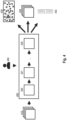
- Figs. 4 and 5 input images I i 410, 510 are input into an image processing workflow 400, 500 comprising a sequence of image processing steps 420-425.
- the workflow then outputs, e.g., for each image I i , an output O i .
- different types of outputs may be provided (e.g., several different at once, or one of them), such an image 430, a vector 433 or coordinates 435.
- the plurality of outputs may each comprise at least one of an image 430, a vector 433 (comprising information on the image, such as an embedding of the image), spatial coordinates 435 (e.g., coordinates of a bounding box or polygon, or coordinates of a central point), and temporal coordinates (e.g., a timestamp).
- the image processing workflow comprises a plurality of image processing steps that are executed sequentially, i.e., at least two image processing steps, with the second image processing step being applied (at least) based on the result of the first image processing steps.
- the image processing workflow may comprise one or several general-purpose image processing steps, such as debayering, denoising, sharpening, contrast adjustment etc.
- some application-specific image processing steps may be applied.
- the fluorescence emissions may be detected in the image (in a first image processing step), used to generate a pseudo-color overlay (in a subsequent second image processing step), and overlaid over the image (in a subsequent third image processing step).
- image segmentation and/or object detection may be used to detect one or more regions of interest within the image (in a first or first and second image processing step), with different types of image transformation being performed on different portions of the image depending on an extent of the image segmentation/object detection (in a subsequent third and/or fourth image processing step).
- the plurality of image processing steps may comprise at least one of one or more image transformation steps and one or more image analysis steps (e.g., the object detection/image segmentation).
- denoising may be performed using a (one-pass) deterministic filter (e.g., removing outliers based on the content of adjacent pixels of the same color/channel), using an iterative and deterministic filter (i.e., multi-pass) deterministic filter (e.g., gradually reducing differences based on the content of adjacent pixels), using a (one-pass) machine-learning-based filter (e.g., passing the image once through a machine-learning model being trained to reduce noise) or using an iterative (multi-pass) machine-learning-based filter (e.g., based on a generative adversarial network or based on reinforcement learning).
- a (one-pass) deterministic filter e.g., removing outliers based on the content of adjacent pixels of the same color/channel
- an iterative and deterministic filter i.e., multi-pass
- multi-pass deterministic filter
- machine-learning-based filter e.g., passing the image once through a machine
- the image processing workflow may comprise at least one of one or more (one-pass or iterative/multi-pass) deterministic image processing steps, one or more (deterministic or machine-learning based) image processing steps with an iterative optimization component, and one or more machine-learning-based (one-pass or iterative/multi-pass) image processing steps.
- the iterative (i.e., multi-pass) filters tend to be computationally expensive and nondeterministic with regards to runtime, which is undesirable in an image processing workflow, which may be an image processing workflow for live-processing of images or imaging sensor data of the optical imaging sensor (e.g., for generating a live image on a display, digital oculars or a head-mounted display of the imaging system).
- the image processing workflow is applied to generate 120 the plurality of outputs (e.g., one or more outputs for each of the images) from the plurality of images, for use as training outputs for training the machine-learning model.
- the plurality of outputs e.g., one or more outputs for each of the images
- the training input images and training outputs are stored in a storage device (316 in Fig. 3 ) of the system, for use in the subsequent training by the system, or they may be provided to a separate system (e.g., to a cloud server), e.g., via the interface of the system or via a removable storage (e.g., a flash drive).
- a storage device 316 in Fig. 3
- a separate system e.g., to a cloud server
- a removable storage e.g., a flash drive
- the image processing workflow can be (manually) adapted to the specific application at hand (by user 450 in Fig. 4 ), by parametrizing the image processing workflow.
- the image processing workflow may be executed based on one or more input parameters.
- Such input parameters may include one or more numerical parameters, such as a numerical parameter controlling the severity of the denoising or a numerical parameter controlling the color of the pseudo-color overlay, and/or one or more enumerated parameters, such as a choice among two or more spectral wavelength bands to show, hide or highlight, a choice among two or more two or more types of objects to be detected by the object detection etc.
- These input parameters can fundamentally affect the output of the image processing workflow.
- the one or more input parameters may be used as further training inputs during training of the machine-learning model (resulting in a corresponding training output). Accordingly, as further shown in Fig. 1b , the method may comprise providing 135 the one or more input parameters as further training input for training the machine-learning model.
- the selection of the one or more input parameters was described as a manual process. However, in some examples of the present disclosure, these one or more input parameters may be tuned during generation of the training corpus.
- a feedback signal can be generated that is to be used to adapt the one or ore more input parameters.
- the method may comprise obtaining 140 the feedback signal (580 in Fig. 5 ). This feedback signal can be produced during training of the machine-learning model, or even during "normal" operation of the imaging system (when a trained machine-learning model is used alongside the image processing workflow or instead of the image processing workflow).
- the feedback signal may be based on the training of the machine-learning model or based on an output of the trained machine-learning model when the machine-learning model is used by the surgical or scientific imaging system.
- This feedback signal may then be used 145 as input to the image processing workflow, e.g., to adapt the one or more input parameters.
- using the feedback signal may comprise adapting one or more (numerical or enumerated) parameters of one or more image processing steps of the image processing workflow.
- the training outputs may be generated again, so the training of the machine-learning model can proceed, or be restarted with, training outputs that are based on improved parameters. Accordingly, as further shown in Fig.
- the method may comprise regenerating 150, using the adapted image processing workflow, the plurality of outputs, and providing 155 the regenerated outputs as training outputs for training the machine-learning model.
- These training outputs may extend or supplant the previously-submitted training outputs. As they are based on the same training input images, the training input images might not be provided again.
- the generated training corpus i.e., the training input images, optional further training input and training outputs can then be used to train the machine-learning model. In many cases, this may be done using a different computer system, e.g., a cloud-based computer system, than the system being part of, or coupled with, the scientific or surgical imaging system.
- generating the plurality of images and the plurality of outputs may be performed by the system of the scientific or surgical imaging system, and the training of the machine-learning model may be performed by a separate computer system, such as a cloud-based computer system.
- both the generation of the training corpus and the training of the machine-learning model may be performed locally by the system of the scientific or surgical image processing system.
- generating the plurality of images and the plurality of outputs and training the machine-learning model may be performed by the system of the scientific or surgical imaging system. Consequently, the method, which may be performed by said system, may further comprising training the machine-learning model, e.g., using the method introduced in connection with Figs. 2a and/or 2b.
- one aim of the proposed concept is to provide an improved concept for processing images generated by a scientific or surgical imaging device, preferably in real time.
- This concept may not only include the training of the machine-learning model, but also the use of the machine-learning model instead of the image-processing workflow.
- the method may comprise obtaining 160 the trained machine-learning model, i.e., the machine-learning model that is trained using the training input images (and further training input) and the training outputs generated by the scientific or surgical imaging system. Once the trained machine-learning model has been obtained, it may be used instead of the image processing workflow.
- the method may comprise replacing 170 the image processing workflow with the machine-learning model that is according to the method of Figs. 2a and/or 2b.
- the aforementioned feedback signal can be generated locally at the scientific or surgical imaging system, by employing the (trained) machine-learning model.
- this locally-generated feedback signal may be used as local feedback signal for the image processing workflow.
- it may be used as local feedback signal for the trained machine-learning model itself.
- the feedback signal may then be used 145 as input to the trained machine-learning model.
- a suitable loss function may be used, or regularization may be applied, to avoid the feedback loop drifting into an undesirable portion of the parameter space.
- the concept may be applied to nested image processing workflows as well.
- the image processing workflow in the following denoted first image-processing workflow
- the second image processing workflow may be similar to the first image processing workflow and includes the trained machine-learning model as one of the processing steps.
- the method may comprise, after replacing the image processing workflow with the machine-learning model, generating 180, using the second image processing workflow, a second plurality of outputs based on a second plurality of images.
- the second plurality of images may correspond to the plurality of images.
- the second plurality of images may be newly obtained images that are based on newly obtained imaging sensor data of the optical imaging sensor.
- the second plurality of images may be provided 185 as training input images and the second plurality of outputs as training outputs for training a second machine-learning model (660 in Fig. 6 ), e.g., according to the method of Figs.
- a feedback signal may be obtained to control the (input) parameter(s) of the second image processing workflow.
- the trained second machine-learning model may be obtained and used to replace the second image processing workflow. This process may be repeated, e.g., if the second image processing workflow is part of another, larger third image processing workflow.
- the method for the scientific or surgical imaging system may comprise one or more additional optional features corresponding to one or more aspects of the proposed concept, or one or more examples described above or below.
- Figs. 2a and 2b show flow charts of example of a method for training a machine-learning model for use in a scientific or surgical imaging system.
- the method of Figs. 2a and/or 2b may be used to train the machine-learning model introduced in connection with Figs. 1a and/or 1b using the training corpus generated using the method of Figs. 1a and/or 1b.
- the method comprises obtaining 210 a plurality of images of a scientific or surgical imaging system, for use as training input images.
- the method comprises obtaining 220 a plurality of training outputs that are based on the plurality of training input images and that are based on an image processing workflow of the scientific or surgical imaging system.
- the image processing workflow comprises a plurality of image processing steps.
- the method comprises training 240 the machine-learning model using the plurality of training input images and the plurality of training outputs.
- the method may be performed by a computer system, e.g., by the system 310 introduced in connection with Fig. 3 or by the computer system 720 introduced in connection with Fig. 7 .
- the method may be performed by a cloud-based computer system.
- Figs. 1a two tasks are to be performed as part of the proposed concept - building a training corpus, and the actual training of the machine-learning model. While the former has been discussed in connection with Figs. 1a and/or 1b, the latter is now discussed with reference to Figs. 2a and/or 2b (a more detailed example of such a training is given in connection with Fig. 5 ). These two tasks are linked - the training corpus is generated for the purpose of training the machine-learning model, and the machine-learning model is trained using the corpus.
- the method starts by obtaining the training corpus, i.e., by obtaining 210 the training input images and by obtaining 220 the plurality of training outputs.
- the method may comprise obtaining 230 one or more input parameters of the image processing workflow as further training input (with the machine-learning model being trained using the one or more input parameters as further training input).
- These components of the training corpus have been described in connection with Figs. 1a and/or 1b. They may be obtained from the (computer) system of the scientific or surgical imaging system, e.g., by receiving the training corpus from the system, by reading the training corpus from a flash drive originating from the system, or by executing the method of Figs. 2a and/or 2b on the system of the scientific or surgical imaging system.
- the training corpus can be used to train the machine-learning model.
- the training corpus can be used to train the machine-learning model.
- a short introduction on machine learning is given, with a focus on the training of the machine-learning model.
- Machine learning refers to algorithms and statistical models that computer systems may use to perform a specific task without using explicit instructions, instead relying on models and inference.
- machine-learning instead of a rule-based transformation of data, a transformation of data may be used that is inferred from an analysis of historical and/or training data.
- the content of images may be analyzed using a machine-learning model or using a machine-learning algorithm.
- the machine-learning model may be trained using training images as input and training content information as output.
- the machine-learning model By training the machine-learning model with a large number (i.e., a training corpus) of training images and/or training sequences (e.g., words or sentences) and associated training content information (e.g., labels or annotations), the machine-learning model "learns" to recognize the content of the images, so the content of images that are not included in the training data can be recognized using the machine-learning model.
- a training corpus a large number (i.e., a training corpus) of training images and/or training sequences (e.g., words or sentences) and associated training content information (e.g., labels or annotations)
- the machine-learning model By training a machine-learning model using training sensor data and a desired output, the machine-learning model "learns" a transformation between the sensor data and the output, which can be used to provide an output based on non-training sensor data provided to the machine-learning model.
- the provided data e.g., sensor data, meta data and/or
- the machine-learning model is trained to imitate the image processing workflow, which accepts images at its input, and which generates outputs based on the images input into the image processing workflow. Accordingly, the machine-learning model is trained to transform an image (or images, if multiple images are input at the same time, which may be the case if multi-spectral imaging or concurrent fluorescence and white-light imaging are used) of the scientific or surgical imaging system into an output.
- the machine-learning model may be trained to output, based on an image (or images) of the scientific or surgical imaging system, at least one of an image, a vector, spatial coordinates, and temporal coordinates, which have been described as potential outputs of the image processing workflow, and thus also the resulting machine-learning model, in connection with Figs. 1a and/or 1b.
- Machine-learning models are trained using training input data.
- the image classification examples specified above use a training method called "supervised learning".
- supervised learning the machine-learning model is trained using a plurality of training samples, wherein each sample may comprise a plurality of input data values, and a plurality of desired output values, i.e., each training sample is associated with a desired output value.
- the machine-learning model "learns" which output value to provide based on an input sample that is similar to the samples provided during the training.
- Supervised learning may also be applied to the presently-trained machine-learning model.
- the machine-learning model may be trained, using supervised learning, to transform an image of the scientific or surgical imaging system into an output, by applying the plurality of training input images at an input of the machine-learning model (as training samples) and using the plurality of training outputs as desired output (as desired output values) during training of the machine-learning model.
- a suitable loss function such as gradient descent, may be chosen, so that the machine-learning model gradually learns to provide the "correct" (or at least similar) output when fed an image of the scientific or surgical imaging system.
- the loss function may be a loss function for reducing, for a given training input image, a difference between the output provided by the machine-learning model and the training output corresponding to the training input image.
- a per-pixel loss function may be used, or a perceptual loss function may be used (which is based on the mean sum square of the errors between all of the pixels, instead of the absolute errors between the pixels).
- Supervised learning may be based on a supervised learning algorithm (e.g., a classification algorithm, a regression algorithm or a similarity learning algorithm.
- Classification algorithms may be used when the outputs are restricted to a limited set of values (categorical variables), i.e., the input is classified to one of the limited set of values.
- Regression algorithms may be used when the outputs may have any numerical value (within a range).
- Similarity learning algorithms may be similar to both classification and regression algorithms but are based on learning from examples using a similarity function that measures how similar or related two objects are.
- semi-supervised learning may be used. In semi-supervised learning, some of the training samples lack a corresponding desired output value.
- unsupervised learning may be used to train the machine-learning model.
- (only) input data might be supplied, and an unsupervised learning algorithm may be used to find structure in the input data (e.g., by grouping or clustering the input data, finding commonalities in the data).
- Clustering is the assignment of input data comprising a plurality of input values into subsets (clusters) so that input values within the same cluster are similar according to one or more (pre-defined) similarity criteria, while being dissimilar to input values that are included in other clusters.
- GAN generative adversarial network
- a generator model is trained to generate a candidate, which is evaluated by a discriminator model. Both the generator model and the discriminator model are trained together, leading to steady improvements in the quality of the candidate generated by the generator model (and the quality of the evaluation performed by the discriminator model).
- the machine-learning model may be trained, as generator model of a pair of generative adversarial networks (a specific implementation of adversarial learning) to transform an image of the scientific or surgical imaging system into an output.
- the discriminator model of the pair of generative adversarial networks is used to evaluate the output of the scientific or surgical imaging system, e.g., by outputting a binary pass / fail evaluation of the generated output, or by grading the output of the scientific or surgical imaging system on a scale.
- the discriminator model may be trained based on the plurality of training outputs, e.g., to enable the discriminator model to distinguish between "good” and "bad” (or "passing" and "failing") outputs.
- supervised learning may be used.
- the discriminator model may be trained to output, based on a training input image and a training output (which is, for example, either the corresponding training output, an output generated by the generator model based on the training input image, or a randomly distorted version of the corresponding training output), a binary value indicating whether the output being input into the discriminator corresponds to the "real" corresponding output.
- a training output which is, for example, either the corresponding training output, an output generated by the generator model based on the training input image, or a randomly distorted version of the corresponding training output
- a binary value indicating whether the output being input into the discriminator corresponds to the "real" corresponding output may be used.
- Reinforcement learning is a third group of machine-learning algorithms.
- reinforcement learning may be used to train the machine-learning model.
- one or more software actors (called “software agents") are trained to take actions in an environment. Based on the taken actions, a reward is calculated.
- Reinforcement learning is based on training the one or more software agents to choose the actions such, that the cumulative reward is increased, leading to software agents that become better at the task they are given (as evidenced by increasing rewards).
- the machine-learning model may be trained, using reinforcement learning, to transform an image of the scientific or surgical imaging system into an output.
- the training output may be used to determine the reward of the respective transformation.
- a difference between the output of the machine-learning model during training and a training output of the plurality of training outputs may be used to determine a reward during the reinforcement learning-based training. Similar to the aforementioned per-pixel and perceptual loss, the reward may be calculated based on the per-pixel difference between the output of the machine-learning model during training and the training output or based on a mean of the difference over all of the pixels.
- Machine-learning algorithms are usually based on a machine-learning model.
- the term “machine-learning algorithm” may denote a set of instructions that may be used to create, train, or use a machine-learning model.
- the term “machine-learning model” may denote a data structure and/or set of rules that represents the learned knowledge (e.g., based on the training performed by the machine-learning algorithm).
- the usage of a machine-learning algorithm may imply the usage of an underlying machine-learning model (or of a plurality of underlying machine-learning models).
- the usage of a machine-learning model may imply that the machine-learning model and/or the data structure/set of rules that is the machine-learning model is trained by a machine-learning algorithm.
- the machine-learning model may be an artificial neural network (ANN).
- ANNs are systems that are inspired by biological neural networks, such as can be found in a retina or a brain.
- ANNs comprise a plurality of interconnected nodes and a plurality of connections, so-called edges, between the nodes.
- Each node may represent an artificial neuron.
- Each edge may transmit information, from one node to another.
- the output of a node may be defined as a (non-linear) function of its inputs (e.g., of the sum of its inputs).
- the inputs of a node may be used in the function based on a "weight" of the edge or of the node that provides the input.
- the weight of nodes and/or of edges may be adjusted in the learning process.
- the training of an artificial neural network may comprise adjusting the weights of the nodes and/or edges of the artificial neural network, i.e., to achieve a desired output for a given input.
- the machine-learning model being trained in the present concept may be an ANN-based machine-learning model, and in particular a Deep Neural Network (DNN), i.e., a neural network having an input layer (comprising input nodes), an output layer (comprising output nodes), and one or more hidden layers (comprising hidden nodes) between the input and output layer.
- DNN Deep Neural Network
- different types of DNNs may be used to implement the machine-learning model, such as an MLP (Multi-Layer Perceptron), a CNN (Convolutional Neural Network), a RNN (Recurrent Neural Network), or a Transformer (a neural network mainly based on attention mechanism).
- the machine-learning model may be a support vector machine, a random forest model or a gradient boosting model.
- Support vector machines i.e., support vector networks
- Support vector machines are supervised learning models with associated learning algorithms that may be used to analyze data (e.g., in classification or regression analysis).
- Support vector machines may be trained by providing an input with a plurality of training input values that belong to one of two categories. The support vector machine may be trained to assign a new input value to one of the two categories.
- the machine-learning model may be a Bayesian network, which is a probabilistic directed acyclic graphical model.
- a Bayesian network may represent a set of random variables and their conditional dependencies using a directed acyclic graph.
- the machine-learning model may be based on a genetic algorithm, which is a search algorithm and heuristic technique that mimics the process of natural selection.
- a feedback path may be introduced between the training of the machine-learning model and the image-processing workflow, to improve the selection of parameters of the various steps of the image-processing workflow. This may either be done by evaluating the output of the machine-learning model during training (e.g., with respect to a quality criterion), or by training the machine-learning model to not only provide the output, but also the feedback signal. Accordingly, as further shown in Fig. 2b , the method may comprise evaluating 250 an output of the machine-learning model according to a quality criterion. The method may comprise providing 255 a feedback signal (580 in Fig.
- the quality criterion may relate to at least one of a brightness, a contrast, a presence of high spatial frequencies, a size of bounding boxes, a delineation between the regions of interest and other regions etc.
- the image output by the machine-learning model may be compared to a desired brightness, contrast, presence of high spatial frequencies, size of bounding boxes etc. during evaluation of the output of the machine-learning model.
- a rulebook comprising a matching between differences between the brightness and the desired brightness, contrast, and desired contrast etc. and corresponding parameters of the image-processing workflow may be used to generate the feedback signal.
- the machine-learning model may be trained to generate the feedback signal.
- the machine-learning model may be trained to generate the feedback signal 580 for adapting one or more parameters of the image processing workflow. More details on such training are given in connection with Fig. 5 .
- an additional loss function or reward function may be defined, such that an improved training corpus is produced which leads to a better performance of the trained machine-learning model.
- the machine-learning model is trained with additional inputs for at least some parameters of the image-processing workflow (e.g., for a vector representing the parameters or for an embedding of the parameters), and with one or more additional outputs for the feedback signal.
- the machine-learning model may then be trained with a loss function or reward function comprising a weighted linear combination of losses/reward for improving the image-to-image (or image-to-output) loss/reward and suitable losses/rewards for the feedback signal, including mean squared error (i.e. L2 norm), mean absolute error (i.e. L1 Norm) or a classification loss such as binary cross-entropy depending on the respective parameter.
- the machine-learning model may have two outputs which predict, both, a desired output as well as the parameter set for the image processing workflow.
- a new parameter set can be predicted on a previously unseen input image, which may also be used during usage of the machine-learning model.
- the feedback signal may be used recurrently, by feeding the feedback signal from an output of the machine-learning model back to an input of the machine-learning model.
- the method for training the machine-learning model may comprise one or more additional optional features corresponding to one or more aspects of the proposed concept, or one or more examples described above or below.
- Fig. 3 shows a schematic diagram of an example of a system 310 for a scientific or surgical imaging system 300.
- Fig. 3 further shows of a scientific or surgical imaging system 300 comprising such a system 310 and a scientific or surgical imaging device 320.
- the proposed concept relates to a scientific or surgical imaging system, which is a system comprising both optical and imaging components (i.e., the scientific or surgical imaging device, such as a microscope, an endoscope or an exoscope) and a (computer) system that is being used to control various aspects of the scientific or surgical imaging system (such as illumination, a robotic arm, a motorized sample stage etc.), but that is also used for performing image processing on the imaging sensor data provided by the scientific or surgical imaging device.
- optical and imaging components i.e., the scientific or surgical imaging device, such as a microscope, an endoscope or an exoscope
- a (computer) system that is being used to control various aspects of the scientific or surgical imaging system (such as illumination, a robotic arm, a motorized sample stage etc.), but that is also used for performing image processing on the imaging sensor data provided by the scientific or surgical imaging device.
- Fig. 3 shows an example of such a system 310 that is suitable for performing such tasks.
- the system 310 comprises one or more processors 314 and one or more storage devices 316.
- the system 310 further comprises one or more interfaces 312.
- the one or more processors 314 are coupled to the one or more storage devices 316 and to the one or more interfaces 312.
- the functionality of the system 310 may be provided by the one or more processors 314, in conjunction with the one or more interfaces 312 (for exchanging data/information with one or more other components of the scientific or surgical imaging system 300 and outside the scientific or surgical imaging system 300, such as one or more optical imaging sensors of the scientific or surgical imaging device 320, another system (e.g., a cloud-based system), or a display device of the scientific or surgical imaging system), and with the one or more storage devices 316 (for storing information, such as machine-readable instructions of a computer program being executed by the one or more processors).
- the functionality of the one or more processors 314 may be implemented by the one or more processors 314 executing machine-readable instructions.
- any feature ascribed to the one or more processors 314 may be defined by one or more instructions of a plurality of machine-readable instructions.
- the system 310 may comprise the machine-readable instructions, e.g., within the one or more storage devices 316.
- Such a system may be used to perform various tasks.
- the system may be configured to perform the method shown in connection with Figs. 1a and/or 1b.
- the system may be configured to perform the method shown in connection with Figs. 1a and/or 1b.
- such a system may be a system that is unable to perform the image processing workflow described in connection with Figs. 1a and/or 1b (at least in real-time), e.g., an embedded system or a mobile system that is temporarily coupled to the scientific or surgical imaging device. While such a system is unable to perform the uncompressed image processing workflow, it may be suitable for processing the images using the trained machine-learning model.
- the system 310 may be configured to obtain an image (or stream of images) based on imaging sensor data of the optical imaging sensor of the scientific or surgical imaging system 300.
- the system may be configured to process the image using a machine-learning model that is trained according to the method of Figs. 2a and/or 2b.
- the system may be configured to use an output of the machine-learning model.
- a system 310 may be an embedded system for use as part of the scientific or surgical imaging system 300.
- a system 310 may be a mobile device that may be suitable for being coupled with the scientific or surgical imaging system 300.
- multiple systems 310 may be used, e.g., a first for performing the method of Figs. 1a and/or 1b, a second for performing the method of Figs. 1a and/or 1b, and an optional third for using the machine-learning model to process the image data, or a first for performing the methods of Figs. 1a-2b and a second for using the machine-learning model to process the image data.
- the optical imaging sensor may be used to provide the aforementioned imaging sensor data.
- the optical imaging sensor which may be part of the proposed scientific or surgical imaging device 320 (e.g., of the microscope) may be configured to generate the imaging sensor data.
- the at least one optical imaging sensor of the proposed scientific or surgical imaging device 320 may comprise or be an APS (Active Pixel Sensor) - or a CCD (Charge-Coupled-Device)-based imaging sensor.
- APS-based imaging sensors light is recorded at each pixel using a photodetector and an active amplifier of the pixel.
- APS-based imaging sensors are often based on CMOS (Complementary Metal-Oxide-Semiconductor) or S-CMOS (Scientific CMOS) technology.
- CMOS Complementary Metal-Oxide-Semiconductor
- S-CMOS Stientific CMOS
- incoming photons are converted into electron charges at a semiconductor-oxide interface, which are subsequently moved between capacitive bins in the imaging sensors by a circuitry of the imaging sensors to perform the imaging.
- the system 310 may be configured to obtain (i.e., receive or read out) the imaging sensor data from the optical imaging sensor.
- the imaging sensor data may be obtained by receiving the imaging sensor data from the optical imaging sensor (e.g., via the interface 312), by reading the imaging sensor data out from a memory of the optical imaging sensor (e.g., via the interface 312), or by reading the imaging sensor data from a storage device 316 of the system 310, e.g., after the imaging sensor data has been written to the storage device 316 by the optical imaging sensor or by another system or processor.
- the one or more interfaces 312 of the system 310 may correspond to one or more inputs and/or outputs for receiving and/or transmitting information, which may be in digital (bit) values according to a specified code, within a module, between modules or between modules of different entities.
- the one or more interfaces 312 may comprise interface circuitry configured to receive and/or transmit information.
- the one or more processors 314 of the system 310 may be implemented using one or more processing units, one or more processing devices, any means for processing, such as a processor, a computer or a programmable hardware component being operable with accordingly adapted software. In other words, the described function of the one or more processors 314 may as well be implemented in software, which is then executed on one or more programmable hardware components.
- Such hardware components may comprise a general-purpose processor, a Digital Signal Processor (DSP), a micro-controller, etc.
- the one or more storage devices 316 of the system 310 may comprise at least one element of the group of a computer readable storage medium, such as a magnetic or optical storage medium, e.g., a hard disk drive, a flash memory, Floppy-Disk, Random Access Memory (RAM), Programmable Read Only Memory (PROM), Erasable Programmable Read Only Memory (EPROM), an Electronically Erasable Programmable Read Only Memory (EEPROM), or a network storage.
- a computer readable storage medium such as a magnetic or optical storage medium, e.g., a hard disk drive, a flash memory, Floppy-Disk, Random Access Memory (RAM), Programmable Read Only Memory (PROM), Erasable Programmable Read Only Memory (EPROM), an Electronically Erasable Programmable Read Only Memory (EEPROM), or a network storage.
- system and of the scientific or surgical imaging system are mentioned in connection with the proposed concept or one or more examples described above or below (e.g., Fig. 1a to 2b , 3 to 7 ).
- the system and of the scientific or surgical imaging system may comprise one or more additional optional features corresponding to one or more aspects of the proposed concept, or one or more examples described above or below.
- DEEPRESSO denoted "DEEPRESSO” for compressing image analysis workflows with arbitrary steps into a deep neural network.
- the proposed concept focuses on facilitating image analysis of images created by microscopes or other biomedical imaging devices.
- Various examples involve running image analysis workflows as part of an analysis software on a computer, an embedded device or in the cloud. Any of these can be attached to a microscope currently acquiring images.
- Various aspects of the proposed concept relates to a system which allows to use the output of an image analysis workflow ( Fig. 4 , 400) comprising multiple processing or analysis steps s j for creating a training set to train a DNN, such that the DNN can be trained end-to-end and replace the workflow.
- the DNN receives the input image of the workflow as input and the output of the workflow as a target to recreate.
- the DNN thus learns a mapping from input image to output and can thereafter replace the entire workflow.
- a deep neural network which produces the output in a single step.
- This replacement also gets referred to as compression of the workflow. Consequently, the application of image analysis might require only a single step after compression.
- This allows to deploy complex image analysis to devices with limited resources (such as mobile or embedded systems).
- reduced storage may be required (in case multiple deep neural networks are part of the image analysis workflow).
- a deep neural network may be trained on the output of an image analysis workflow which may comprise zero to multiple steps involving deep neural networks of arbitrary size (compared to the target neural network) applied sequentially to an input image.
- Fig. 4 shows a schematic overview of an example of an image analysis workflow 400 comprising multiple different steps 420-425 of image processing and / or analysis.
- Images 410 are passed through the workflow and new images may be computed at each step until a final image 430 is output by the workflow.
- the output may also represent a vector 433 or points in the image domain 435 such as bounding boxes or combinations thereof.
- the workflow was created by a user 450 who can configure each step of the workflow or modify an existing one.
- Image analysis can comprise multiple tasks ( Fig. 4 , 420-425), such as image classification (mapping an image to a vector), object detection (classification and box regression to object location), semantic segmentation (pixel classification), instance segmentation (pixel classification and numbering of object instances). Sometimes a single algorithm may be enough to fulfill a complex task. In some cases, however, the combination of multiple steps may be used. These steps can involve preprocessing steps, such as denoising, filtering certain frequencies, transformation into Fourier space and back, applying physical models or passing images through a trained DNN
- an input image I ( Fig. 4 , 410) is converted to an output O, which can be an image 430, a vector 433, spatial or temporal coordinates 455 (points in the same space as the image), text or combinations thereof ( Fig. 4 , 430-335).
- output O can be an image 430, a vector 433, spatial or temporal coordinates 455 (points in the same space as the image), text or combinations thereof ( Fig. 4 , 430-335).
- Fig. 5 shows a schematic overview of an example of a workflow for training a deep neural network.
- a computer such as the system 310 introduced in connection with Fig. 3 or the computer system 720 of Fig. 7 , is configured to run an (existing) image analysis workflow ( Fig. 5 , 500) and has access to a repository with a plurality of input images ( Fig. 5 , 510), which may correspond to the plurality of images of the scientific or surgical imaging system, i.e., the training input images, discussed in connection with Figs. 1a to 2b .
- the workflow can be a nested workflow where one step in can consist of multiple steps s j or recursively multiple workflows itself.
- an output O i is computed ( Fig. 5 , 520), which may correspond to the outputs of the plurality of outputs, i.e., the training outputs, discussed in connection with Figs. 1a to 2b .
- the output in turn may be kept in Random Access Memory (RAM) ( Fig. 5 , 540), cached, or written to a repository ( Fig. 5 , 530).
- RAM Random Access Memory
- a training corpus (or training set) is generated ( Fig. 5 , 560) for training 570 new DNN ( Fig. 5 , 550), which has not been part of the workflow previously.
- the training corpus comprises tuples of input data (i.e., the training input images) and output data (i.e., the training outputs) which was produced by the workflow.
- the training results in a DNN Fig. 5 , 555
- the trained machine-learning model i.e., the trained machine-learning model, which may be used in the method of Figs. 1a to 1b and trained by the method of Fig. 2a to 2b , which is competent to replace the workflow.
- the training of DNN can occur “offline” in the sense that the training corpus gets built first and the training of D occurs strictly afterwards.
- training of DNN can occur “online” in the sense that D gets trained iteratively with producing pairs of (input, output) images or batches thereof which the DNN gets trained on, then the next batch becomes available.
- a feedback loop may be inserted between the DNN being trained and the workflow
- training 570 and generating training data 560 can run in parallel with a feedback loop.
- This feedback loop may relate to parameters H i of the workflow steps s j of workflow i.e., the parameters of the steps of the workflow may be adapted according to the feedback loop.
- the feedback loop may use a loss function and/or other metrics ( Fig. 5 , 580) to reconfigure the parameters H i of one or more steps ( Fig. 5 , 590) in the workflow (thus providing a feedback signal) such that improved or optimal training data is produced which leads to a better performance of the trained DNN.
- the creation of the training set can be improved to result in a trained model with higher performance.
- these parameters may also be considered by the DNN being trained.
- the input to DNN might not only include the image I i , but also some or all the parameters H i used to parameterize each step s j of workflow
- These parameters can be input into individually or as concatenated vectors or as dense vector representations (embeddings).
- DNN D would in this case have a second input node (in addition to the image input) which can be passed through an arbitrary number of computational steps including a sub-network of the whole DNN to process, refine or resize the parameter input to produce computed activations a i . These activations can then be combined, such as added to or concatenated with the computed activations b i from the image input of DNN .
- the desired output can be both, output image O and parameter set H i (to be used for the feedback loop).
- the model may then be trained with a loss function comprising a weighted linear combination of losses for improving the image-to-image loss and suitable losses for H i , including mean squared error (i.e. L2 norm), mean absolute error (i.e. L1 Norm) or a classification loss such as binary cross-entropy depending on the parameter in H i .
- the model may have two outputs which predict, both, a desired output image as well as the parameter set H i for workflow which leads to O i .
- a new parameter set H i ′ can be predicted on a previously unseen input image, which may also be used during usage of DNN .
- the output of the trained model can then be compared to the output of the workflow parameterized with H i ′ . This can help in cases where generalization is poor, or to help with interpreting the result O i obtained from .
- the trained DNN D' can be part of workflow and its parameters can get iteratively improved during training, thus the workflow becomes autoregressive in the sense that both, the outcomes O i and the trained DNN improve in parallel.
- workflow comprising multiple processing or analysis steps gets compressed into a single step realized by a DNN.
- the DNN receives the input image of the workflow as input and the output of the workflow as a target to recreate.
- the DNN thus learns a mapping from input image to output and can thereafter replace the entire workflow.
- the trained DNN D' can be loaded on a mobile device or an embedded system where it executes faster than the original workflow it compresses.
- the mobile or embedded devices can be attached to a microscope or biomedical imaging system.
- a microscope or biomedical imaging system may perform image acquisition in parallel to the image analysis.
- the plurality of input images ( Fig. 4 410) may be taken from the microscope.
- Fig. 6 shows a schematic overview of an example of a first compression workflow 600 for compressing an image analysis workflow that is similar to the one seen in Fig. 5 .
- the training set generated with workflow results in a trained DNN capable of producing an output O' i similar to output O i produced by given input I i .
- the trained trained DNN can be one step 630 of a new image analysis workflow 620 comprising the trained DNN which produces output O' i given input I i .
- a user 633, a machine learning model running on a computer or embedded system 636 or a machine learning model running in a cloud 639 can add, configure, or modify further image analysis steps 640, 645 in This extended workflow can then be compressed again, using a second compression workflow 610, into a newly trained DNN by creating a new training set ( I ' i ; O ' i ).
- the input images I' i of this new training set can be the same or different from the original input I i .
- the newly trained DNN D " can be trained using stochastically initialized model parameters ⁇ i or load those of D ′ as a starting point.
- D " can become a step 660 in a new workflow 650 and the process of creating new training sets, compressing a workflow into a new, shorter one, modifying that workflow can be repeated as many times as necessary.
- each round (e.g., Fig. 6 , 600, 610, 620) can have a feedback loop to reconfigure individual steps in the workflow creating the training set and / or each workflow's individual steps can be reconfigured by a user ( Fig. 6 633) or automatically by a machine learning model independently trained running on a local machine ( Fig. 6 636) or in the cloud ( Fig. 6 639).
- a DNN is a deep neural network, which can involve any algorithm, such as MLP (Multi-Layer Perceptron), CNN (Convolutional Neural Network), RNN (Recurrent Neural Network), or Transformer (a neural network mainly based on attention mechanism).
- MLP Multi-Layer Perceptron
- CNN Convolutional Neural Network
- RNN Recurrent Neural Network
- Transformer a neural network mainly based on attention mechanism.
- a target neural network is a deep neural network being trained using the output of a complex image analysis workflow as described in the present concept.
- An image is a digital image, for example with dimensions XY (i.e., two lateral dimensions X and Y), XYZ (i.e., a depth-dimension Z in addition to the two lateral dimensions X+Y), XY+T (XY + Time), XYZ+C (XYZ + Channel), XYZ+T (XYZ + Time), XYZCT (XYZ + Channel + Time), XYZCT+other modalities.
- a 2D or nD digital image (tensor) with n GN A (image processing) workflow refers to the sequential execution of multiple image processing or image analysis steps where the output of the i-th step is passed to the input of the (i+1)th step.
- compressing (of the workflow) refers to replacing a complex image analysis workflow comprising multiple steps by a single neural network which learned to produce the output of that same workflow.
- the DEEPRESSO concept may comprise one or more additional optional features corresponding to one or more aspects of the proposed concept, or one or more examples described above or below.
- an imaging device and in particular a scientific or surgical imaging device, such as a microscope, an exoscope or an endoscope, comprising a system as described in connection with one or more of the Figs. 1a to 6 .
- an imaging device may be part of or connected to a system as described in connection with one or more of the Figs. 1a to 6 .
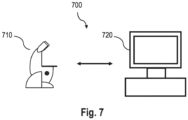
- Fig. 7 shows a schematic illustration of a system 700 configured to perform a method described herein.
- the system 700 comprises an imaging device 710, and in particular a scientific or surgical imaging device, such as a microscope, an exoscope or an endoscope, and a computer system 720.
- the imaging device 710 is configured to take images and is connected to the computer system 720.
- the computer system 720 is configured to execute at least a part of a method described herein.
- the computer system 720 may be configured to execute a machine learning algorithm.
- the computer system 720 and imaging device 710 may be separate entities but can also be integrated together in one common housing.
- the computer system 720 may be part of a central processing system of the imaging device 710 and/or the computer system 720 may be part of a subcomponent of the imaging device 710, such as a sensor, an actor, a camera, or an illumination unit, etc. of the imaging device 710.
- the computer system 720 may be a local computer device (e.g., personal computer, laptop, tablet computer or mobile phone) with one or more processors and one or more storage devices or may be a distributed computer system (e.g., a cloud computing system with one or more processors and one or more storage devices distributed at various locations, for example, at a local client and/or one or more remote server farms and/or data centers).
- the computer system 720 may comprise any circuit or combination of circuits.
- the computer system 720 may include one or more processors which can be of any type.
- processor may mean any type of computational circuit, such as but not limited to a microprocessor, a microcontroller, a complex instruction set computing (CISC) microprocessor, a reduced instruction set computing (RISC) microprocessor, a very long instruction word (VLIW) microprocessor, a graphics processor, a digital signal processor (DSP), multiple core processor, a field programmable gate array (FPGA), for example, of a microscope or a microscope component (e.g., camera) or any other type of processor or processing circuit.
- CISC complex instruction set computing
- RISC reduced instruction set computing
- VLIW very long instruction word
- DSP digital signal processor
- FPGA field programmable gate array
- circuits may be included in the computer system 720 may be a custom circuit, an application-specific integrated circuit (ASIC), or the like, such as, for example, one or more circuits (such as a communication circuit) for use in wireless devices like mobile telephones, tablet computers, laptop computers, two-way radios, and similar electronic systems.
- the computer system 720 may include one or more storage devices, which may include one or more memory elements suitable to the particular application, such as a main memory in the form of random access memory (RAM), one or more hard drives, and/or one or more drives that handle removable media such as compact disks (CD), flash memory cards, digital video disk (DVD), and the like.
- RAM random access memory
- CD compact disks
- DVD digital video disk
- the computer system 720 may also include a display device, one or more speakers, and a keyboard and/or controller, which can include a mouse, trackball, touch screen, voice-recognition device, or any other device that permits a system user to input information into and receive information from the computer system 720.
- a display device one or more speakers
- a keyboard and/or controller which can include a mouse, trackball, touch screen, voice-recognition device, or any other device that permits a system user to input information into and receive information from the computer system 720.
- Some or all of the method steps may be executed by (or using) a hardware apparatus, like for example, a processor, a microprocessor, a programmable computer or an electronic circuit. In some embodiments, some one or more of the most important method steps may be executed by such an apparatus.
- embodiments of the invention can be implemented in hardware or in software.
- the implementation can be performed using a non-transitory storage medium such as a digital storage medium, for example a floppy disc, a DVD, a Blu-Ray, a CD, a ROM, a PROM, and EPROM, an EEPROM or a FLASH memory, having electronically readable control signals stored thereon, which cooperate (or are capable of cooperating) with a programmable computer system such that the respective method is performed. Therefore, the digital storage medium may be computer readable.
- Some embodiments according to the invention comprise a data carrier having electronically readable control signals, which are capable of cooperating with a programmable computer system, such that one of the methods described herein is performed.
- embodiments of the present invention can be implemented as a computer program product with a program code, the program code being operative for performing one of the methods when the computer program product runs on a computer.
- the program code may, for example, be stored on a machine-readable carrier.
- inventions comprise the computer program for performing one of the methods described herein, stored on a machine readable carrier.
- an embodiment of the present invention is, therefore, a computer program having a program code for performing one of the methods described herein, when the computer program runs on a computer.
- a further embodiment of the present invention is, therefore, a storage medium (or a data carrier, or a computer-readable medium) comprising, stored thereon, the computer program for performing one of the methods described herein when it is performed by a processor.
- the data carrier, the digital storage medium or the recorded medium are typically tangible and/or non-transitionary.
- a further embodiment of the present invention is an apparatus as described herein comprising a processor and the storage medium.
- a further embodiment of the invention is, therefore, a data stream or a sequence of signals representing the computer program for performing one of the methods described herein.
- the data stream or the sequence of signals may, for example, be configured to be transferred via a data communication connection, for example, via the internet.
- a further embodiment comprises a processing means, for example, a computer or a programmable logic device, configured to, or adapted to, perform one of the methods described herein.
- a processing means for example, a computer or a programmable logic device, configured to, or adapted to, perform one of the methods described herein.
- a further embodiment comprises a computer having installed thereon the computer program for performing one of the methods described herein.
- a further embodiment according to the invention comprises an apparatus or a system configured to transfer (for example, electronically or optically) a computer program for performing one of the methods described herein to a receiver.
- the receiver may, for example, be a computer, a mobile device, a memory device or the like.
- the apparatus or system may, for example, comprise a file server for transferring the computer program to the receiver.
- a programmable logic device for example, a field programmable gate array
- a field programmable gate array may cooperate with a microprocessor in order to perform one of the methods described herein.
- the methods are preferably performed by any hardware apparatus.
- Embodiments may be based on using a machine-learning model or machine-learning algorithm. Furthermore, some techniques may be applied to some of the machine-learning algorithms. For example, feature learning may be used. In other words, the machine-learning model may at least partially be trained using feature learning, and/or the machine-learning algorithm may comprise a feature learning component. Feature learning algorithms, which may be called representation learning algorithms, may preserve the information in their input but also transform it in a way that makes it useful, often as a pre-processing step before performing classification or predictions. Feature learning may be based on principal components analysis or cluster analysis, for example.
- anomaly detection i.e., outlier detection
- the machine-learning model may at least partially be trained using anomaly detection, and/or the machine-learning algorithm may comprise an anomaly detection component.
- the machine-learning algorithm may use a decision tree as a predictive model.
- the machine-learning model may be based on a decision tree.
- observations about an item e.g., a set of input values
- an output value corresponding to the item may be represented by the leaves of the decision tree.
- Decision trees may support both discrete values and continuous values as output values. If discrete values are used, the decision tree may be denoted a classification tree, if continuous values are used, the decision tree may be denoted a regression tree.
- Association rules are a further technique that may be used in machine-learning algorithms.
- the machine-learning model may be based on one or more association rules.
- Association rules are created by identifying relationships between variables in large amounts of data.
- the machine-learning algorithm may identify and/or utilize one or more relational rules that represent the knowledge that is derived from the data.
- the rules may e.g., be used to store, manipulate, or apply the knowledge.
- aspects have been described in the context of an apparatus, it is clear that these aspects also represent a description of the corresponding method, where a block or device corresponds to a method step or a feature of a method step. Analogously, aspects described in the context of a method step also represent a description of a corresponding block or item or feature of a corresponding apparatus.
Landscapes
- Engineering & Computer Science (AREA)
- Theoretical Computer Science (AREA)
- Physics & Mathematics (AREA)
- General Physics & Mathematics (AREA)
- Evolutionary Computation (AREA)
- Software Systems (AREA)
- Artificial Intelligence (AREA)
- Computing Systems (AREA)
- Health & Medical Sciences (AREA)
- General Health & Medical Sciences (AREA)
- Databases & Information Systems (AREA)
- Multimedia (AREA)
- Medical Informatics (AREA)
- Computer Vision & Pattern Recognition (AREA)
- Data Mining & Analysis (AREA)
- General Engineering & Computer Science (AREA)
- Mathematical Physics (AREA)
- Life Sciences & Earth Sciences (AREA)
- Biomedical Technology (AREA)
- Biophysics (AREA)
- Computational Linguistics (AREA)
- Molecular Biology (AREA)
- Image Analysis (AREA)
- Image Processing (AREA)
Priority Applications (4)
| Application Number | Priority Date | Filing Date | Title |
|---|---|---|---|
| EP22213531.1A EP4386626A1 (fr) | 2022-12-14 | 2022-12-14 | Procédés, systèmes et systèmes informatiques pour entraîner un modèle d'apprentissage automatique, générer un corpus d'apprentissage |
| JP2023210466A JP2024085410A (ja) | 2022-12-14 | 2023-12-13 | 科学用または外科用イメージングシステムにおける使用のために機械学習モデルをトレーニングするための方法、システムおよびコンピュータシステム、ならびに科学用または外科用イメージングシステムにおける使用のためにトレーニングコーパスを生成するための方法、システムおよびコンピュータシステム、ならびに科学用または外科用イメージングシステムにおける使用のために機械学習モデルを使用するための方法、システムおよびコンピュータシステム |
| US18/539,348 US20240203105A1 (en) | 2022-12-14 | 2023-12-14 | Methods, Systems, and Computer Systems for Training a Machine-Learning Model, Generating a Training Corpus, and Using a Machine-Learning Model for Use in a Scientific or Surgical Imaging System |
| CN202311717992.5A CN118195022A (zh) | 2022-12-14 | 2023-12-14 | 用于训练机器学习模型的方法、系统和计算机系统 |
Applications Claiming Priority (1)
| Application Number | Priority Date | Filing Date | Title |
|---|---|---|---|
| EP22213531.1A EP4386626A1 (fr) | 2022-12-14 | 2022-12-14 | Procédés, systèmes et systèmes informatiques pour entraîner un modèle d'apprentissage automatique, générer un corpus d'apprentissage |
Publications (1)
| Publication Number | Publication Date |
|---|---|
| EP4386626A1 true EP4386626A1 (fr) | 2024-06-19 |
Family
ID=84536130
Family Applications (1)
| Application Number | Title | Priority Date | Filing Date |
|---|---|---|---|
| EP22213531.1A Pending EP4386626A1 (fr) | 2022-12-14 | 2022-12-14 | Procédés, systèmes et systèmes informatiques pour entraîner un modèle d'apprentissage automatique, générer un corpus d'apprentissage |
Country Status (4)
| Country | Link |
|---|---|
| US (1) | US20240203105A1 (fr) |
| EP (1) | EP4386626A1 (fr) |
| JP (1) | JP2024085410A (fr) |
| CN (1) | CN118195022A (fr) |
Citations (2)
| Publication number | Priority date | Publication date | Assignee | Title |
|---|---|---|---|---|
| US20180336677A1 (en) * | 2017-05-18 | 2018-11-22 | Toshiba Medical Systems Corporation | Apparatus and method for medical image processing |
| US20190325304A1 (en) * | 2018-04-24 | 2019-10-24 | EMC IP Holding Company LLC | Deep Reinforcement Learning for Workflow Optimization |
Family Cites Families (9)
| Publication number | Priority date | Publication date | Assignee | Title |
|---|---|---|---|---|
| WO2019204520A1 (fr) * | 2018-04-17 | 2019-10-24 | VideaHealth, Inc. | Détection de caractéristique d'image dentaire |
| US10929973B2 (en) * | 2018-10-02 | 2021-02-23 | Siemens Healtcare Gmbh | Medical image pre-processing at the scanner for facilitating joint interpretation by radiologists and artificial intelligence algorithms |
| US11501446B2 (en) * | 2018-10-30 | 2022-11-15 | Allen Institute | Segmenting 3D intracellular structures in microscopy images using an iterative deep learning workflow that incorporates human contributions |
| EP4036211B1 (fr) * | 2019-09-27 | 2026-04-29 | FUJIFILM Corporation | Appareil de traitement de l'information, procédé de fonctionnement de l'appareil de traitement de l'information et programme de fonctionnement de l'appareil de traitement de l'information |
| WO2021086671A1 (fr) * | 2019-10-31 | 2021-05-06 | Ventana Medical Systems, Inc. | Classification d'objets basée sur le traitement d'images utilisant l'amorçage d'annotations de niveau de région |
| KR102313749B1 (ko) * | 2019-12-23 | 2021-10-18 | 주식회사 메가젠임플란트 | 인공지능 기반 자동 구강 ct 색상변환장치 및 그 장치의 구동방법 |
| CN115428038A (zh) * | 2020-11-19 | 2022-12-02 | 索尼集团公司 | 用于灵活的基于图像的颗粒分选的分类工作流 |
| AU2021409967A1 (en) * | 2020-12-22 | 2023-08-03 | Relievant Medsystems, Inc. | Prediction of candidates for spinal neuromodulation |
| JP2023075611A (ja) * | 2021-11-19 | 2023-05-31 | 富士フイルム株式会社 | 医療画像処理装置及びその作動方法 |
-
2022
- 2022-12-14 EP EP22213531.1A patent/EP4386626A1/fr active Pending
-
2023
- 2023-12-13 JP JP2023210466A patent/JP2024085410A/ja active Pending
- 2023-12-14 CN CN202311717992.5A patent/CN118195022A/zh active Pending
- 2023-12-14 US US18/539,348 patent/US20240203105A1/en active Pending
Patent Citations (2)
| Publication number | Priority date | Publication date | Assignee | Title |
|---|---|---|---|---|
| US20180336677A1 (en) * | 2017-05-18 | 2018-11-22 | Toshiba Medical Systems Corporation | Apparatus and method for medical image processing |
| US20190325304A1 (en) * | 2018-04-24 | 2019-10-24 | EMC IP Holding Company LLC | Deep Reinforcement Learning for Workflow Optimization |
Non-Patent Citations (4)
| Title |
|---|
| CHAI SEK ET AL: "Bootstrapping Deep Neural Networks from Approximate Image Processing Pipelines", 2019 2ND WORKSHOP ON ENERGY EFFICIENT MACHINE LEARNING AND COGNITIVE COMPUTING FOR EMBEDDED APPLICATIONS (EMC2), IEEE, 17 February 2019 (2019-02-17), pages 6 - 10, XP033731887, DOI: 10.1109/EMC249363.2019.00009 * |
| ELI SCHWARTZ ET AL: "DeepISP: Learning End-to-End Image Processing Pipeline", ARXIV.ORG, CORNELL UNIVERSITY LIBRARY, 201 OLIN LIBRARY CORNELL UNIVERSITY ITHACA, NY 14853, 3 February 2019 (2019-02-03), XP081405848, DOI: 10.1109/TIP.2018.2872858 * |
| GARCIA SANTA CRUZ BEATRIZ ET AL: "Generalising from conventional pipelines using deep learning in high-throughput screening workflows", SCIENTIFIC REPORTS, vol. 12, no. 1, 6 July 2022 (2022-07-06), XP093048409, DOI: 10.1038/s41598-022-15623-7 * |
| JIANXU CHEN ET AL: "The Allen Cell Structure Segmenter: a new open source toolkit for segmenting 3D intracellular structures in fluorescence microscopy images", BIORXIV, 8 December 2018 (2018-12-08), XP055630983, Retrieved from the Internet <URL:https://www.biorxiv.org/content/biorxiv/early/2018/12/08/491035.full.pdf> [retrieved on 20191011], DOI: 10.1101/491035 * |
Also Published As
| Publication number | Publication date |
|---|---|
| JP2024085410A (ja) | 2024-06-26 |
| US20240203105A1 (en) | 2024-06-20 |
| CN118195022A (zh) | 2024-06-14 |
Similar Documents
| Publication | Publication Date | Title |
|---|---|---|
| Elwirehardja et al. | Oil palm fresh fruit bunch ripeness classification on mobile devices using deep learning approaches | |
| EP3996035B1 (fr) | Procédés et systèmes pour l'entraînement de réseaux neuronaux convolutionnels | |
| US20220138573A1 (en) | Methods and systems for training convolutional neural networks | |
| JP7225731B2 (ja) | 多変数データシーケンスの画像化 | |
| Nimma et al. | Advancements in Deep Learning Architectures for Image Recognition and Semantic Segmentation. | |
| JP7748973B2 (ja) | 画像およびデータの分析モデルの適合性を調整する方法 | |
| US12482074B2 (en) | Systems and methods for training a machine-learning algorithm and application of a machine-learning model for denoising images | |
| WO2023001940A1 (fr) | Procédés et systèmes de génération de modèles pour prédiction de pipeline d'analyse d'image | |
| US20250037485A1 (en) | Image processing system, microscope, trained machine learning algorithm, and corresponding methods to predict nuclear labeling | |
| US20250104819A1 (en) | Systems and methods for digitization of tissue slides based on associations among serial sections | |
| EP4386626A1 (fr) | Procédés, systèmes et systèmes informatiques pour entraîner un modèle d'apprentissage automatique, générer un corpus d'apprentissage | |
| US20210319269A1 (en) | Apparatus for determining a classifier for identifying objects in an image, an apparatus for identifying objects in an image and corresponding methods | |
| US12045153B1 (en) | Apparatus and method of hot-swapping a component of a component unit in a cluster | |
| WO2025049487A1 (fr) | Systèmes et procédés pour améliorer des images ultrasonores à l'aide d'une intelligence artificielle | |
| Chauhan et al. | Modified resnet50 architecture for plant disease detection | |
| US12394032B1 (en) | Apparatus and method for rescan workflow management in automated scanning systems | |
| EP4711833A1 (fr) | Système optique pour microscope à feuille de lumière | |
| EP4174758B1 (fr) | Apprentissage d'un modèle de débruitage pour un microscope | |
| Rüb et al. | DRIP: DRop unImportant data Points-Enhancing Machine Learning Efficiency with Grad-CAM-Based Streaming Data Prioritization for On-Device Training | |
| EP4529828A1 (fr) | Contrôleur et procédé de génération de données d'apprentissage, systèmes et procédés d'apprentissage et d'application d'algorithmes d'apprentissage automatique pour des images | |
| EP4390832A1 (fr) | Procédé de traitement d'image d'élimination de bruit blanc et de bruit structuré | |
| US20250196354A1 (en) | Apparatus and method of hot-swapping a component of a component unit in a cluster | |
| Claudio | COMPUTER VISION TECHNIQUES FOR FOOD SEGMENTATION | |
| Chandrakar et al. | FaceEmo Recognition System Using Voting-Based Ensemble Transfer Learning | |
| MESSAOUD | Une approche basée deep-learning pour la segmentation d'images médicales |
Legal Events
| Date | Code | Title | Description |
|---|---|---|---|
| PUAI | Public reference made under article 153(3) epc to a published international application that has entered the european phase |
Free format text: ORIGINAL CODE: 0009012 |
|
| STAA | Information on the status of an ep patent application or granted ep patent |
Free format text: STATUS: THE APPLICATION HAS BEEN PUBLISHED |
|
| AK | Designated contracting states |
Kind code of ref document: A1 Designated state(s): AL AT BE BG CH CY CZ DE DK EE ES FI FR GB GR HR HU IE IS IT LI LT LU LV MC ME MK MT NL NO PL PT RO RS SE SI SK SM TR |
|
| STAA | Information on the status of an ep patent application or granted ep patent |
Free format text: STATUS: REQUEST FOR EXAMINATION WAS MADE |
|
| 17P | Request for examination filed |
Effective date: 20241219 |