EP4387794B1 - Bindemittelkomponente für eine rohmaterialverbindung zur verwendung in einem formgebungs- und sinterverfahren, teilchenförmige rohmaterialverbindung und formgebungs- und sinterverfahren - Google Patents
Bindemittelkomponente für eine rohmaterialverbindung zur verwendung in einem formgebungs- und sinterverfahren, teilchenförmige rohmaterialverbindung und formgebungs- und sinterverfahren Download PDFInfo
- Publication number
- EP4387794B1 EP4387794B1 EP22768375.2A EP22768375A EP4387794B1 EP 4387794 B1 EP4387794 B1 EP 4387794B1 EP 22768375 A EP22768375 A EP 22768375A EP 4387794 B1 EP4387794 B1 EP 4387794B1
- Authority
- EP
- European Patent Office
- Prior art keywords
- volume
- wax
- feedstock compound
- particles
- compound
- Prior art date
- Legal status (The legal status is an assumption and is not a legal conclusion. Google has not performed a legal analysis and makes no representation as to the accuracy of the status listed.)
- Active
Links
Images

Classifications
-
- B—PERFORMING OPERATIONS; TRANSPORTING
- B22—CASTING; POWDER METALLURGY
- B22F—WORKING METALLIC POWDER; MANUFACTURE OF ARTICLES FROM METALLIC POWDER; MAKING METALLIC POWDER; APPARATUS OR DEVICES SPECIALLY ADAPTED FOR METALLIC POWDER
- B22F1/00—Metallic powder; Treatment of metallic powder, e.g. to facilitate working or to improve properties
- B22F1/10—Metallic powder containing lubricating or binding agents; Metallic powder containing organic material
- B22F1/103—Metallic powder containing lubricating or binding agents; Metallic powder containing organic material containing an organic binding agent comprising a mixture of, or obtained by reaction of, two or more components other than a solvent or a lubricating agent
-
- B—PERFORMING OPERATIONS; TRANSPORTING
- B22—CASTING; POWDER METALLURGY
- B22F—WORKING METALLIC POWDER; MANUFACTURE OF ARTICLES FROM METALLIC POWDER; MAKING METALLIC POWDER; APPARATUS OR DEVICES SPECIALLY ADAPTED FOR METALLIC POWDER
- B22F1/00—Metallic powder; Treatment of metallic powder, e.g. to facilitate working or to improve properties
- B22F1/05—Metallic powder characterised by the size or surface area of the particles
-
- B—PERFORMING OPERATIONS; TRANSPORTING
- B22—CASTING; POWDER METALLURGY
- B22F—WORKING METALLIC POWDER; MANUFACTURE OF ARTICLES FROM METALLIC POWDER; MAKING METALLIC POWDER; APPARATUS OR DEVICES SPECIALLY ADAPTED FOR METALLIC POWDER
- B22F10/00—Additive manufacturing of workpieces or articles from metallic powder
- B22F10/10—Formation of a green body
- B22F10/16—Formation of a green body by embedding the binder within the powder bed
-
- B—PERFORMING OPERATIONS; TRANSPORTING
- B22—CASTING; POWDER METALLURGY
- B22F—WORKING METALLIC POWDER; MANUFACTURE OF ARTICLES FROM METALLIC POWDER; MAKING METALLIC POWDER; APPARATUS OR DEVICES SPECIALLY ADAPTED FOR METALLIC POWDER
- B22F2301/00—Metallic composition of the powder or its coating
- B22F2301/35—Iron
-
- B—PERFORMING OPERATIONS; TRANSPORTING
- B22—CASTING; POWDER METALLURGY
- B22F—WORKING METALLIC POWDER; MANUFACTURE OF ARTICLES FROM METALLIC POWDER; MAKING METALLIC POWDER; APPARATUS OR DEVICES SPECIALLY ADAPTED FOR METALLIC POWDER
- B22F3/00—Manufacture of workpieces or articles from metallic powder characterised by the manner of compacting or sintering; Apparatus specially adapted therefor ; Presses and furnaces
- B22F3/10—Sintering only
- B22F3/1017—Multiple heating or additional steps
- B22F3/1021—Removal of binder or filler
-
- B—PERFORMING OPERATIONS; TRANSPORTING
- B33—ADDITIVE MANUFACTURING TECHNOLOGY
- B33Y—ADDITIVE MANUFACTURING, i.e. MANUFACTURING OF THREE-DIMENSIONAL [3D] OBJECTS BY ADDITIVE DEPOSITION, ADDITIVE AGGLOMERATION OR ADDITIVE LAYERING, e.g. BY 3D PRINTING, STEREOLITHOGRAPHY OR SELECTIVE LASER SINTERING
- B33Y10/00—Processes of additive manufacturing
-
- B—PERFORMING OPERATIONS; TRANSPORTING
- B33—ADDITIVE MANUFACTURING TECHNOLOGY
- B33Y—ADDITIVE MANUFACTURING, i.e. MANUFACTURING OF THREE-DIMENSIONAL [3D] OBJECTS BY ADDITIVE DEPOSITION, ADDITIVE AGGLOMERATION OR ADDITIVE LAYERING, e.g. BY 3D PRINTING, STEREOLITHOGRAPHY OR SELECTIVE LASER SINTERING
- B33Y70/00—Materials specially adapted for additive manufacturing
-
- B—PERFORMING OPERATIONS; TRANSPORTING
- B33—ADDITIVE MANUFACTURING TECHNOLOGY
- B33Y—ADDITIVE MANUFACTURING, i.e. MANUFACTURING OF THREE-DIMENSIONAL [3D] OBJECTS BY ADDITIVE DEPOSITION, ADDITIVE AGGLOMERATION OR ADDITIVE LAYERING, e.g. BY 3D PRINTING, STEREOLITHOGRAPHY OR SELECTIVE LASER SINTERING
- B33Y80/00—Products made by additive manufacturing
-
- Y—GENERAL TAGGING OF NEW TECHNOLOGICAL DEVELOPMENTS; GENERAL TAGGING OF CROSS-SECTIONAL TECHNOLOGIES SPANNING OVER SEVERAL SECTIONS OF THE IPC; TECHNICAL SUBJECTS COVERED BY FORMER USPC CROSS-REFERENCE ART COLLECTIONS [XRACs] AND DIGESTS
- Y02—TECHNOLOGIES OR APPLICATIONS FOR MITIGATION OR ADAPTATION AGAINST CLIMATE CHANGE
- Y02P—CLIMATE CHANGE MITIGATION TECHNOLOGIES IN THE PRODUCTION OR PROCESSING OF GOODS
- Y02P10/00—Technologies related to metal processing
- Y02P10/25—Process efficiency
Definitions
- Additive manufacturing involves material being added together such as powder grains being fused together, typically layer by layer.
- a typical additive manufacturing process comprises the steps of forming a first material-layer, and successively adding further material-layers thereafter, wherein each new material-layer is added on a pre-formed material-layer, until the entire three-dimensional structure (3D object) is materialized.
- L-PBF Laser Beam Powder Bed Fusion
- powdered metal which is free of binder is sintered by the scanning of a high-power laser beam.
- binder-coated metal powders were shaped by additive manufacturing.
- the binder is removed and the metal powder sintered.
- WO 2018/197082 discloses a method for additively manufacturing a metal and/or glass-type and/or ceramic component.
- Feedstock compound particles are prepared from substrate particles and an at least two-phase binder.
- the feedstock compound particles are molten selectively in layers by means of electromagnetic radiation, such that a molded part is additively manufactured.
- the molded part is removed from the unmelted mixture, and the at least two-phase binder is then successively removed. Finally, the debound molded part is sintered.
- one binder phase is extracted by a solvent.
- the residual binder acting as a backbone to retain the shape, is removed simultaneously with and/or before the sintering process.
- WO2016004985 relates to a filament suitable to be used in a 3D printing device, wherein the filament comprises a metal and/or ceramic powder, a thermoplastic binder and additives.
- the invention also relates to a process for producing a shaped body comprising the step of printing a shaped green body using the filament according to the invention.
- a filament according to the invention in a 3D printing device and a green body producible by mixing a metal and/or ceramic powder and a thermoplastic binder.
- the invention also relates to the use of a binder of the invention for the production of a filament for 3D printing devices.
- the invention also relates to a process comprising the steps of merging a plurality of the particulate feedstock compounds, debinding and sintering.
- the term "particulate” denotes that the feedstock compound is composed of a collection (or plurality) of individual particles.
- the individual particles may have arbitrary shape such as irregular, cylindrical, rotational ellipsoid or essentially spherical.
- the particulate feedstock compound has a particle size distribution such that at least 80% by volume, preferably at least 90% by volume, more preferably at least 95% by volume, most preferably at least 99% by volume, of the particulate feedstock compounds have a maximum particle size B max in the range of 0.005 to 0.3 mm, preferably 0.008 to 0.2 mm, more preferably 0.01 to 0.2 mm, most preferably 0.015 to 0.15 mm.
- Each particulate feedstock compound comprises a plurality of sinterable non-organic particles (a) dispersed throughout the particulate feedstock compound within a matrix of the binder component (b) and is held together by the binder component (b).
- a plurality of sinterable non-organic particles (a) per feedstock compound particle makes it possible for the shape of the particulate feedstock compound to be independent of the shape of the sinterable non-organic particles (a).
- substantially spherical particulate feedstock compounds can be produced without the necessity of the sinterable non-organic particles (a) being spherical. This reduces the production costs since sinterable non-organic particles (a) with arbitrary or irregular particle geometry or broader particle size distribution are more readily available than powders having a particular, e.g., spherical, particle geometry.
- the particulate feedstock compounds are, for example, produced by subjecting a suspension of sinterable non-organic particles (a) and a solvent, e.g. an alcoholic solvent, in which the binder component (b) was dissolved, to spray drying.
- a solidified melt of the binder component (b) having dispersed therein the sinterable non-organic particles (a) may be milled.
- Larger particulate feedstock compounds may also be compounded by an extruder with subsequent granulation.
- critical solids loading is referred to as the amount of sinterable non-organic particles by volume in a feedstock compound at a critical limit. Said “critical limit” is reached when the feedstock compound becomes stiff and does not flow due to the relative viscosity becoming infinite upon addition of sinterable non-organic particles to the feedstock compound. Physically, “critical solids loading” defines the maximum packing arrangement of particles while still retaining a continuous material and it is the limit above which it is not possible to continue loading the binder matrix with solid powders.
- the critical solids loading There are several ways to determine the critical solids loading. For example, one can determine the peak in the torque of a kneader when more and more metal powder is added to the binder. After critical solids loading is reached, the torque usually decreases again as the feedstock compound becomes more friable.
- a pycnometer measurement may be used: up to the critical solids loading, the theoretical density is in agreement with the measured density at the pycnometer, above the critical solids loading, the measured density is below the theoretical density due to pores (see also: 1990, R. M. German, Powder Injection Molding, Metal Powder Industries Federation 1990, p.129-130 ).
- metals are selected from iron, stainless steel, steel, copper, bronze, aluminum, tungsten, molybdenum, silver, gold, platinum, titanium, nickel, cobalt, chromium, zinc, niobium, tantalum, yttrium, silicon, magnesium, calcium and combinations thereof.
- the metal particles have a particle size distribution such that at least 85%, preferably at least 90%, more preferably at least 95%, most preferably at least 99% of the particles have a maximum particle size A max in the range of 500 nm to 400 ⁇ m, preferably 1 ⁇ m to 150 ⁇ m, more preferably 3 ⁇ m to 50 ⁇ m, most preferably 5 ⁇ m to 25 ⁇ m.
- vitreous particles are selected from non-oxide glasses such as halogenide glasses, chalcogenide glasses; oxide glasses such as phosphate glasses, borate glasses, silicate glasses such as aluminosilicate glasses, lead silicate glasses, boron silicate glasses, soda lime silicate glasses, quartz glasses, alkaline silicate glasses; and combinations thereof.
- non-oxide glasses such as halogenide glasses, chalcogenide glasses
- oxide glasses such as phosphate glasses, borate glasses
- silicate glasses such as aluminosilicate glasses, lead silicate glasses, boron silicate glasses, soda lime silicate glasses, quartz glasses, alkaline silicate glasses; and combinations thereof.
- the vitreous particles have a particle size distribution such that at least 85%, preferably at least 90%, more preferably at least 95%, most preferably at least 99% of the particles have a maximum particle size A max in the range of 200 nm to 25 ⁇ m, preferably 300 nm to 10 ⁇ m, more preferably 400 nm to 7 ⁇ m, most preferably 500 nm to 3 ⁇ m.
- the binder component (b) comprises 3 to 70% by volume, preferably 5 to 60% by volume, more preferably 7 to 50% by volume, most preferably 10 to 40% by volume, in particular 12 to 35% by volume, in particular 15 to 30% by volume, of a thermoplastic polyamide (b-i), based on the total volume of the binder component (b).
- the DSC curve may comprise a single melt peak.
- the DSC curve may comprise several melt peaks, i.e. several local maxima.
- the melt peak temperature T P is defined as the temperature at the global maximum.
- the thermoplastic polyamide preferably exhibits a single melt peak.
- T P is determined in accordance with DIN EN ISO 11357-3 in the second heating after a first heating/cooling cycle.
- the thermoplastic polyamide has a melt viscosity below 1500 Pa s, preferably below 1300 Pa s, more preferably below 1000 Pa s, most preferably below 800 Pa s, in particular below 600 Pa s, in particular below 500 Pa s, in particular below 400 Pa s, in particular below 300 Pa s, in particular below 200 Pa s, in particular below 100 Pa s, according to ISO 1133 with 2.16 kg at 190 °C.
- the thermoplastic polyamide (b-i) is semi-crystalline.
- semi-crystalline characterizes those polymers which possess high degrees of inter- and intra-molecular order.
- the semi-crystalline nature of a polymer can be verified by a first order transition or crystalline melting point (T m ) as determined by differential scanning calorimetry (DSC).
- T m crystalline melting point
- DSC differential scanning calorimetry
- the thermoplastic polyamide (b-i) is semi-crystalline because it exhibits a sharp transition separating the fluid and solidified states. Further, it is characterized by a strength increase by crystallization upon solidification.
- polyamides can be produced by a reaction of carboxylic acids and amines to amides or by reaction of moieties/derivatives of carboxylic acids and amines.
- Polyamide homopolymers can be produced by reaction of one monomer, i.e. amino acids or lactames having 4 to 25 carbon atoms, such as Polyamide 6 by ring opening polymerization of ⁇ -caprolactam.
- Copolyamides can be produced by polycondensation reaction of different amines with different carboxylic acids, preferably diamines having 4 to 25 carbon atoms such as hexamethylenediamine, preferably dicarboxylic acids having 4 to 25 carbon atoms such as adipic acid, azelaic acid, dodecandioic acid, preferably amino-carboxylic acids having 4 to 25 carbon atoms such as aminoundecanoic acid, or their salts.
- carboxylic acids preferably diamines having 4 to 25 carbon atoms such as hexamethylenediamine, preferably dicarboxylic acids having 4 to 25 carbon atoms such as adipic acid, azelaic acid, dodecandioic acid, preferably amino-carboxylic acids having 4 to 25 carbon atoms such as aminoundecanoic acid, or their salts.
- Griltex 2439 A (available from EMS-CHEMIE HOLDING AG) is a particularly preferred thermoplastic polyamide.
- the binder component (b) further comprises 30 to 97% by volume, preferably 40 to 95% by volume, more preferably 50 to 93% by volume, most preferably 60 to 90% by volume, in particular 65 to 88% by volume, in particular 70 to 85% by volume, of the wax or wax-type material (b-ii), based on the total volume of the binder component (b).
- the drop point within the identified range, together with the DSC melt peak temperature T P of the thermoplastic polyamide ensures a favorable overall melting behavior of the binder.
- the wax has a melt viscosity below 30 Pa s, preferably below 20 Pa.s, more preferably below 10 Pa.s, most preferably below 5 Pa.s, in particular below 3 Pa s, in particular below 1 Pa s, in particular below 700 mPa s, in particular below 300 Pa s, in particular below 100 mPa s, in particular below 50 mPa s, according to DIN EN ISO 3104 at 160 °C.
- the polar wax has a melt viscosity below 40 Pa s, preferably below 30 Pa s, more preferably below 20 Pa s, most preferably below 10 Pa s, in particular below 5 Pa s, in particular below 3 Pa s, in particular below 1 Pa s, in particular below 700 mPa ⁇ s, in particular below 300 Pa ⁇ s, in particular below 100 mPa s, according to DIN EN ISO 3104 at 120 °C.
- wax is a collective technological term for a group of organic substances that can generally be described in terms of their physical and technical properties.
- waxes are characterized by the fact that they are solids with a melting point above ambient temperature (usually between 50 °C and 160 °C), a low melt viscosity (below 10 Pa s at 10 °C above the melting point). Waxes melt without decomposing.
- Waxes can be also divided in natural waxes of fossil origin such as paraffin, montan wax; natural waxes of natural origin such as beeswax, carnauba wax; semi-synthetic waxes (also referred to as chemically modified natural waxes) such as ethylene-bis-stearamide; synthetic waxes such as polyolefin waxes.
- wax-type materials is intended to include waxes as well as wax-type substances such as ester-type waxes, higher or polyhydric alcohols, higher fatty acids showing wax-like properties, and mixtures thereof.
- Suitable wax-type materials include:
- the wax or wax-type material may be a mixture of different waxes or wax-type materials.
- paraffin waxes such as microcrystalline wax are derived from petroleum.
- microcrystalline wax is obtained as a refined mixture of solids mainly containing saturated aliphatic hydrocarbons produced by de-oiling of certain fractions from the petroleum refining process.
- the ester-type waxes may be waxes occurring naturally or produced synthetically.
- naturally occurring ester-type waxes are selected from beeswax, candelilla wax, and carnauba wax; and synthetically produced ester-type waxes are suitably selected from esters of carboxylic acids, preferably of fatty acids having 5 to 34 carbon atoms, more preferably of fatty acids having 10 to 28 carbon atoms, or esters of a hydroxybenzoic acid.
- the ester-type waxes comprise the esters of a hydroxybenzoic acid such as esters of 4-hydroxybenzoic acid.
- Loxiol 2472 (4-hydroxybenzoic behenylester, available from Emery Oleochemicals GmbH) is particularly preferred.
- polyolefin waxes can be produced by thermally decomposing branched high molecular weight polyolefins or directly polymerizing olefins.
- Suitable polyolefin waxes include, for example, homopolymers of propylene or higher 1-olefins, copolymers of propylene with ethylene or with higher 1-olefins or their copolymers with one another.
- the higher 1-olefins are preferably linear or branched olefins having 4 to 20, preferably 4 to 6 carbon atoms. These olefins may have an aromatic substitution conjugated to the olefinic double bond.
- polystyrene examples include 1-butene, 1-hexene, 1-octene or 1-octadecene, and styrene.
- the polyolefin waxes may be oxidized.
- Polyethylene waxes such as Deurex E 06 K (available from Deurex AG) are particularly preferred.
- amide waxes such as amides of sulfonic acids or carboxylic acids, preferably fatty acids can be produced by condensation reactions of amides such as ethylenediamine and sulfonic acids or carboxylic acids , preferably fatty acids having 5 to 34 carbon atoms, preferably 10 to 28 carbon atoms.
- Oleamide such as Deurex A 27 P (available from Deurex AG), erucamide such as Deurex A 26 P (available from Deurex AG), ethylene-bis-stearamide such as Deurex A 20 K (available from Deurex AG) are particularly preferred.
- the wax or wax-type material is preferably selected from polar waxes and polar wax-type materials.
- polar wax or "polar wax-type material” means a wax or wax-type material whose chemical structure is formed essentially from, or even constituted by, carbon and hydrogen atoms, and comprising at least one highly electronegative heteroatom such as an oxygen, nitrogen or sulfur atom.
- the polar wax is selected from oxidized polyolefinic waxes, ester-type waxes, amide waxes, higher organic acids, higher or polyhydric alcohols, polyethylene glycol, and mixtures thereof.
- the ester-type waxes include esters of organic acids.
- the amide waxes include amides of organic acids such as sulfonic acids or carboxylic acids. Representatives of suitable waxes that are commercially available are those mentioned above.
- b-ii) is a wax-type material selected from aromatic esters and aromatic sulfonamides.
- the alcohol of the aromatic ester may be an alcohol having 1 to 40 carbon atoms.
- the aromatic sulfonamides may carry at least one organic moiety having 1 to 40 carbon atoms at the amide nitrogen atom.
- the binder component b-ii) is a plasticized wax or wax-type material.
- "Plasticized wax or wax-type material” means the combination of a wax or wax-type material with a plasticizer.
- a plasticizer is a high-boiling liquid with a boiling point generally above 180 °C which is compatible with the wax or wax-type material to decrease its melt viscosity.
- the skilled person will appreciate that the ternary combination of the thermoplastic polyamide, the wax or wax-type material, and the plasticizer forms a homogeneous phase.
- plasticizers are polar compounds which means that their chemical structure comprises at least one highly electronegative heteroatom such as an oxygen atom or a nitrogen atom.
- the plasticized wax or wax-type material b-ii) comprises the plasticizer in an amount of up to 50 vol.-%, preferably up to 40 vol.-%, more preferably up to 30 vol.-%, most preferably up to 20 vol.-%, in particular up to 15 vol.-%, in particular up to 10 vol.-%, relative to the total volume of b-ii).
- Suitable plasticizers include
- Plasticizers selected from aromatic esters and aromatic sulfonamides are generally preferred.
- the binder component (b) comprises at least two binder component ingredients: the thermoplastic polyamide (b-i) and the wax or wax-type material (b-ii).
- the binder component (b) may comprise further functional additives in view of good processability.
- the binder component (b) may comprise a dispersant.
- One material constituting, for example, the wax or wax-type material (b-ii) may act as a dispersant. Otherwise, an extraneous dispersant may additionally be incorporated.
- the dispersant acts as an adhesion promotor and/or compatibilizer between the binder components (b-i) and/or (b-ii); and/or between the non-organic particles (a) and the binder component (b).
- the dispersant is selected from fatty acids having 10 to 24 carbon atoms such as capric acid, lauric acid, myristic acid, palmitic acid, stearic acid, arachidic acid, behenic acid, lignoceric acid, or oleic acid, preferably stearic acid.
- fatty acids having 10 to 24 carbon atoms such as capric acid, lauric acid, myristic acid, palmitic acid, stearic acid, arachidic acid, behenic acid, lignoceric acid, or oleic acid, preferably stearic acid.
- the extraneous dispersant is selected from metal salts of fatty acids.
- the metal may be selected from alkali metals, alkaline earth metals or transition metals such as lithium, sodium, potassium, magnesium, calcium, strontium, barium, and zinc.
- the fatty acid may be selected from the fatty acids having 5 to 34 carbon atoms, preferably 10 to 28 carbon atoms as described above.
- Preferred metal salts of fatty acids are selected from sodium stearate, magnesium stearate, zinc stearate or magnesium oleate.
- the binder component (b) Due to the viscosity of the binder component (b) in the abovementioned ranges, the latter becomes, in the molten state, uniformly and homogeneously distributed between the sinterable non-organic particles (a) and joins the individual sinterable non-organic particles (a) or the individual particulate feedstock compounds.
- a thinning agent or thickening agent serve to increase the viscosity of the binder component when molten. This enhanced viscosity prevents the sag of the sinterable non-organic particles and facilitates uniform flow of the particles and imparts resistance to segregation and sedimentation. Thinning agents are employed to lower the viscosity of the overall binder component.
- the thinning agent can act as a plasticizer to allow control of the rheological properties and the fluidity of the thermoplastic polyamide (b-i) or the wax or wax-type material (b-ii).
- the thickening or thinning agent is selected from waxes and/or thermoplastic polymers such as polyolefins and polyolefin waxes, polyamides and amide waxes, paraffin waxes, ester-type waxes; vinyl esters such as ethylene vinyl acetate; abietates; adipates; alkyl sulfonates; amines and amides such as formamide, hydroxylalkylformamide, amine, diamine; azelates; benzoates; citrates; chlorinated paraffins; ether-ester plasticizers; glutarates; hydrocarbon oils; isobutyrates; maleates; oleates; phosphates; phthalates; sulfonamides; oily liquids such as peanut oil, fish oil, castor oil; and mixtures thereof.
- waxes and/or thermoplastic polymers such as polyolefins and polyolefin waxes, polyamides and amide waxes
- polyethylene wax Deurex E 09 K having a viscosity of ⁇ 40 mPa ⁇ s at 140 °C can be used as a thinning agent, while Deurex E 25 having a viscosity of 4000 mPa ⁇ s at 140 °C or even higher molecular weight polyolefinic compounds can be used as thickening agent.
- the thickening or thinning agent and/or dispersant may be present in an amount of 0 to 15% by volume, preferably 0.01 to 10% by volume, more preferably 0.02 to 8% by volume, most preferably 0.5 to 6% by volume, based on the total volume of the binder component (b).
- the thermoplastic polyamide (b-i) and the wax or wax-type material (b-ii) differ in their solubility in a solvent.
- the solvent is preferably selected from alcohols such as ethanol, or propanol; aromatic compounds such as benzene, toluene, or xylene; esters such as ethyl acetate; ethers such as diethylether, or tetrahydrofuran; ketones such as acetone; alkanes such as hexane, or heptane; halogenated hydrocarbons such as n-propyl bromide, trichloroethylene, perchloroethylene, n-methyl pyrrolidine; and mixtures thereof; water; and gases in supercritical state.
- one binder component is removed wherein at the same time another binder component remains within the part to be manufactured, holding together the sinterable non-organic particles.
- debinding processes e.g. solvent debinding, are known per se.
- one binder component may be selectively removed from a green part by means of dissolving said binder component in a solvent, wherein a second binder component remains within the green part. Therefore, the binder components need to differ in e.g. molecular weight or polarity in order to exhibit different solubilities in the solvent.
- the invention further relates to a process comprising the steps of:
- the process is selected from a powder bed additive manufacturing process, in particular a sinter-based powder bed additive manufacturing process, such as a selective laser additive manufacturing process or a multi-jet fusion process.
- a powder bed additive manufacturing process in particular a sinter-based powder bed additive manufacturing process, such as a selective laser additive manufacturing process or a multi-jet fusion process.
- the term “merging” refers to “selectively melting and solidifying” in the event that the process is selected from an additive manufacturing process.
- components may be obtained which preferably do not have any cracking. Such cracking occurs, e.g., when debinding is carried out too fast or at harsh conditions.
- the components and process parameters are preferably selected such that harmful conditions are avoided.
- the particulate feedstock compounds are applied layer-wise followed by densification and solidifying, e.g. by cooling.
- the binder component (b) which is comprised in the particulate feedstock compounds is selectively and layer-wise molten by means of electromagnetic radiation, e.g. of a laser.
- the step of merging a plurality of the particulate feedstock compounds comprises the steps of:
- selectively densifying the first and further layer of compound particles involves selectively irradiating at least one of the first or the at least one further layer with electromagnetic radiation, preferably a laser beam.
- a building chamber is configured to receive the particulate feedstock compound.
- the feedstock compound particles are bound to each other in a predefined manner so to produce a first shaped part layer.
- at least one further layer of feedstock compound particles is selectively densified on the first shaped part layer to bind the feedstock compound particles to each other in a predefined manner so to produce at least one further shaped part layer joined to the first shaped part layer.
- the first shaped part layer and the further shaped part layers jointly form an integral part. The integral part may then be removed from the building chamber and freed from unbound particulate feedstock compound.
- the binder component (b) becomes distributed between the sinterable non-organic particles (a) and holds them together after solidification. After the green part was made, it is taken out from the unmelted layers or the mold.
- the partial removal of the temporary organic binder is carried out by solvent treatment.
- the wax or wax-type material (b-ii) is selectively removed, whereas the thermoplastic polyamide (b-i) is not removed.
- the resulting part after the debinding step is referred to as a brown part.
- the brown part comprises sinterable non-organic particles (a) bound to each other by the thermoplastic polyamide (bi) and, optionally, remaining wax or wax-type material (b-ii).
- the remaining binder components retained in the brown part provide a brown part that is stable and sufficiently strong to be handled and transported between the debinding and sintering steps.
- the green part is dipped into a suitable solvent.
- the solvent is selected such that the thermoplastic polyamide (b-i) has a lower solubility than the wax or wax-type material (b-ii) in the solvent or, preferably, the thermoplastic polyamide (b-i) is essentially insoluble in the solvent and the wax or wax-type material (b-ii) is soluble in the solvent.
- Suitable solvents are selected from alcohols such as ethanol or propanol; aromatic compounds such as benzene, toluene or xylenes; esters such as ethyl acetate; ethers such as diethylether or tetrahydrofuran; ketones such as acetone; alkanes such as hexane or heptane; halogenated hydrocarbons such as n-propyl bromide, trichloroethylene, perchloroethylene, n-methyl pyrrolidine; water; gases in supercritical state; and mixtures thereof.
- the solvent is preferably kept at a temperature T L in the range of 20 to 100 °C, preferably 25 to 80 °C, more preferably 30 to 60 °C.
- the partial removal of the binder component (b-ii) results in a porous structure of the brown part.
- the sinterable non-organic particles (a) are held together by the thermoplastic polyamide (b-i).
- the process further comprises the step of sintering the brown part to obtain a sintered part.
- the brown part is suitably subjected to a sintering step after the debinding step.
- the thermoplastic polyamide (b-i) is removed and the debound part (brown part) is sintered to obtain the sintered part.
- shrinkage occurs on further removal of the binder and the subsequent sintering of the brown part.
- the residual binder is driven out at a first temperature T 1 which is in the range of 100 to 750 °C, preferably 150 to 700 °C, more preferably 200 to 650 °C, most preferably 300 to 600 °C.
- a suitable temperature T 1 may also be dependent on the atmosphere.
- the first temperature T 1 is selected as a function of the residual binder components.
- the removal of the thermoplastic polyamide (b-i) at the temperature T 1 is carried out for a period of time ⁇ t 1 which is dependent on the part geometry and in particular is proportional to the square of the wall thickness of the part to be produced.
- the period of time ⁇ t 1 is selected such that at least 95%, preferably at least 99%, more preferably at least 99.9%, most preferably 100% of the binder components (b-i) and (b-ii) are removed.
- Binder which is not removed is not available as polymeric binder in the part but is diffused, e.g. as carbon, into the metal part and increases the carbon content in the metal part.
- Thermal debinding may be carried out at more than one temperature T 1 , e.g.
- thermoplastic polyamide (b-i) at the temperature T 1a is carried out for a period of time ⁇ t 1a and the removal of the rest of the thermoplastic polyamide (b-i) at the temperature T 1b is carried out for a period of time ⁇ t 1b .
- the sinterable non-organic particles (a) partly form sintering necks, so that the part is held together despite removal of the remaining binder components. Owing to the microporous structure of the part, thermal binder removal occurs quickly and uniformly.
- Undesirable chemical reactions during the thermal binder removal may be avoided by means of an inert gas atmosphere or a reducing atmosphere or high vacuum.
- the inert gas atmosphere comprises, in particular, at least one noble gas which noble gas may suitably be selected from, e.g., nitrogen, helium and argon.
- the reducing atmosphere may include gases such as hydrogen, carbon dioxide, and/or carbon monoxide.
- sintering is carried out at a second temperature T 2 which is in the range of 600 to 2000 °C, preferably 800 to 1800 °C, more preferably 900 to 1500 °C.
- the second temperature T 2 is preferably in the range of 600 to 2400 °C, more preferably 800 to 2200 °C, most preferably 1100 to 2000 °C.
- the sintering temperature T 2 is below the melting temperature of the sinterable non-organic particles.
- the sintering at the second temperature T 2 is carried out for a period of time ⁇ t 2 which is dependent on the geometry of the part and the material to be sintered.
- the period of time ⁇ t 2 is so long that no significant change in the porosity of the part can be achieved by subsequent further sintering.
- Sintering may be carried out at more than one temperature T 2 , e.g. a sintering step at the temperature T 2a is carried out for a period of time ⁇ t 2a and another sintering step at the temperature T 2b is carried out for a period of time ⁇ t 2b .
- the molded part will shrink essentially without affecting the shape of the molded part.
- the powder particles will fuse together and the open space between the powder particles disappears.
- the density of the product increases and the product shrinks.
- the sintering step is commonly completed when the product has reached a density of about 90 to 100% by volume of the solid of which the powder is made, depending on the material and later use of the product.
- the part is completely free of binder.
- the part forms an integral structure of high density.
- the DSC measurements were performed using a NETZSCH DSC 214 Polyma device.
- the sample was prepared in an aluminum Concavus pan (crucible) from NETZSCH with perforated lid. For this purpose, a sample is heated in a first heat ramp from -20 °C to 160 °C (in examples 2-B and 3-B: 180 °C), cooled to -20 °C afterwards and finally heated again in a second heat ramp from -20 °C to 160 °C (in examples 2-B and 3-B: 180 °C), each with a heating and cooling rate of 10 K/min. Measurement were performed with nitrogen in quality 5.0 as purging gas with a gas flow of 40 mL/min.
- melt mass-flow rate often also designated as melt index, describes the flow properties of plastics at a defined temperature. This property is measured by extruding a thermoplastic polymer melt through a capillary of known dimensions at a defined temperature and under a pressure determined by a weight. The result is the mass extruded per time unit, expressed in g/10 min. If the melt density is known, it is possible to determine the MFR from the melt volume flow rate, MVR. In this measurement procedure, the weighing of polymer sections is replaced by a continuous measurement of the extrusion volume. The result of the MVR value is expressed in cm 3 /10 min.
- Table 1 DSC melt peak temperature T P , melt volume flow rate MVR, and melt viscosity values of components used as material (b i).
- Binder components 1-B to 6-B were produced according to table 2.
- Feedstock compounds 1-F to 6-F of binder components 1-B to 6-B were produced according to table 3.
- Table 2 Binder components 1-B to 6-B; vol.-% relative the total volume of the binder component (b).
- Binder components 2-B, 3-B, and 6-B are comparative.
- Table 3 Feedstock compounds 1-F to 6-F (vol.-% relative the total volume of the particulate feedstock compound). # metal (a) amount (a) [vol.-%] binder comp. (b) (# in table 2) amount (b) [vol.-%] 1-F stainless steel 316 L [1] 62 1-B 38 2-F stainless steel 316 L [1] 62 2-B 38 3-F stainless steel 316 L [1] 62 3-B 38 4-F stainless steel 316 L [1] 62 4-B 38 5-F stainless steel 316 L [1] 62 5-B 38 6-F* stainless steel 316 L [1] 62 6-B* 38 [1] gas atomized, particle size 90%: 22 ⁇ m. available from Sandvik Osprey Ltd. * comparative example.
- Cylindrical testing specimen were produced by a laser additive manufacturing process using a Formiga P110 (available from EOS GmbH).
- the feedstock compounds 1-F to 3-F of table 3 were used as starting materials.
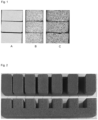
- Figure 1 depicts the cylindrical testing specimen (green parts) obtained from feedstock compounds according to table 3, 1-F (figure 1 A), 2-F (figure 1 B) and 3-F (figure 1 C).
- the laser output was 25 W at a laser speed of 4450 mm/s and the powder bed surface temperature was 60 °C.
- the hatch spacing was varied (0.13 mm vs. 0.07 mm) resulting in a different energy input: A hatch spacing of 0.13 mm resulted in an energy input of 42.3 mJ/mm 2 ; a hatch spacing of 0.07 mm resulted in an energy input of 78.5 mJ/mm 2 .
- notched specimen denotes a rectangular solid which comprises one or more notches, wherein the notches may have different widths. Such notched specimen are depicted in side view and top view in figures 2 to 4 .
- feedstock compound 1-F was used as starting material at a laser output of 25 W, a laser speed of 4450 mm/s and a hatch spacing of 0.13 mm resulting in an energy input of 42.3 mJ/mm 2 .
- feedstock compound 2-F was used as starting material at a laser output of 25 W, a laser speed of 4450 mm/s and a hatch spacing of 0.07 mm resulting in an energy input of 78.5 mJ/mm 2 .
- feedstock compound 3-F was used as starting material at a laser output of 25 W, a laser speed of 4450 mm/s and a hatch spacing of 0.07 mm resulting in an energy input of 78.5 mJ/mm 2 .
- notched specimen aimed at obtaining specimen, i.e. parts, of high density with, at the same time, high representation of the geometry of the aimed part and little caking of the particulate feedstock compound, preferably at low laser energy input.
- the results are depicted in figures 2 to 4 :
- the notched specimen depicted in figure 2 provides high density, high representation of the geometry and little caking at low laser energy input of 42.3 mJ/mm 2 .
- the notched specimens in figures 3 and 4 are less dense and/or the notches are less properly shaped due to caking at an energy input of 78.5 mJ/mm 2 . Nevertheless, the notched specimens in figures 3 and 4 may still be found useful in applications having less stringent requirements.
- Tensile tests according to DIN EN ISO 22068 were performed with tensile test pieces. Said tensile test pieces were additively manufactured using feedstock compound 1-F according to table 3 with a Formiga P110 as described above obtaining a green part. Said green part was then subjected to a solvent debinding step and a sintering step. For solvent debinding, the green part of feedstock compound 1-F was dipped into acetone at a temperature of 40 °C for 16 h.
Landscapes
- Chemical & Material Sciences (AREA)
- Engineering & Computer Science (AREA)
- Manufacturing & Machinery (AREA)
- Materials Engineering (AREA)
- Chemical Kinetics & Catalysis (AREA)
- Compositions Of Macromolecular Compounds (AREA)
- Processes Of Treating Macromolecular Substances (AREA)
Claims (16)
- Partikuläres Feedstock-Compound zur Verwendung in einem additiven Fertigungsverfahren im Pulverbett, umfassend,a) über das Partikel dispergierte, sinterbare nicht-organische Partikel mit einer maximalen Partikelgröße von 200 µm, undb) eine Binder-Komponente umfassend, bezogen auf das Volumen der Binder-Komponenteb-i) 3 bis 70 Vol.-% eines thermoplastischen Polyamids mit einer DSC-Schmelzpeaktemperatur TP unter 140 °C, undb-ii) 30 bis 97 Vol.-% eines Wachses oder wachsartigen Materials mit einem Tropfpunkt im Bereich von 20 bis 160 °C.
- Partikuläres Feedstock-Compound nach Anspruch 1, wobei das thermoplastische Polyamid eine DSC-Schmelzpeaktemperatur TP unter 130 °C, bevorzugt unter 120 °C aufweist.
- Partikuläres Feedstock-Compound nach Anspruch 1 oder 2, wobei das thermoplastische Polyamid einen Schmelzflussindex von mindestens 1 cm3/10 min gemäß ISO 1133 mit 2,16 kg bei 160 °C aufweist.
- Partikuläres Feedstock-Compound nach einem der vorhergehenden Ansprüche, wobei das Wachs oder wachsartige Material ausgewählt ist unter polaren Wachsen und polaren wachsartigen Materialien.
- Partikuläres Feedstock-Compound nach Anspruch 4, wobei das Wachs oder wachsartige Material ausgewählt ist unter aromatischen Estern und aromatischen Sulfonamiden.
- Partikuläres Feedstock-Compound nach einem der vorhergehenden Ansprüche, wobei die Binder-Komponente zusätzlich einen Weichmacher umfasst, bevorzugt einen Weichmacher ausgewählt unter aromatischen Estern und aromatischen Sulfonamiden.
- Partikuläres Feedstock-Compound nach einem der vorhergehenden Ansprüche, wobei die Binder-Komponente zusätzlich ein Dispergiermittel enthält.
- Partikuläres Feedstock-Compound nach Anspruch 7, wobei das Dispergiermittel ausgewählt ist unter Fettsäuren mit 10 bis 24 Kohlenstoffatomen, bevorzugt Stearinsäure.
- Partikuläres Feedstock-Compound nach einem der vorhergehenden Ansprüche, wobei die sinterbaren nicht-organischen Partikel (a) ausgewählt sind unter Metallen, Legierungen, glasartigen Partikeln und Keramikpartikeln.
- Partikuläres Feedstock-Compound nach einem der vorhergehenden Ansprüche, enthaltend die sinterbaren nicht-organischen Partikel (a) in einer Menge von 0,70 bis 0,99 · φr nach Volumen, bevorzugt 0,75 bis 0,98 · φr nach Volumen, stärker bevorzugt 0.80 bis 0,96 · φr nach Volumen, am stärksten bevorzugt 0,82 bis 0,95 · φr nach Volumen, insbesondere 0,84 bis 0,94 · φr nach Volumen, insbesondere 0,86 bis 0,93 · φr nach Volumen, wobei φr für die kritische Feststoffbeladung nach Volumen steht.
- Partikuläres Feedstock-Compound nach einem der Ansprüche 1 bis 9, wobei die Menge der sinterbaren nicht-organischen Partikel a) im Bereich von 20 bis 90 Vol.-%, bevorzugt 30 bis 80 Vol.-%, stärker bevorzugt 40 bis 75 Vol.-%, am stärksten bevorzugt 45 bis 70 Vol.-%, insbesondere 50 bis 65 Vol.-% liegt, und die Menge der Binder-Komponente b) im Bereich von 10 bis 80 Vol.-%, bevorzugt 20 bis 70 Vol.-%, stärker bevorzugt 25 bis 60 Vol.-%, am stärksten bevorzugt 30 bis 55 Vol.-%, insbesondere 35 bis 50 Vol.-% liegt.
- Partikuläres Feedstock-Compound nach einem der vorhergehenden Ansprüche, mit einer Partikelgrößenverteilung, nach der mindestens 80 Vol.-% des partikulären Feedstock-Compounds eine maximale Partikelgröße Bmax im Bereich von 0,005 bis 0,3 mm aufweisen.
- Verfahren, umfassend die folgenden Schritte:- Fusionieren einer Vielzahl von Feedstock-Compound-Partikeln nach einem der Ansprüche 1 bis 12, um ein Grünteil zu erhalten,- teilweises Entbindern des Grünteils durch selektives Entfernen des Wachses oder des wachsartigen Materials b-ii), um ein durch das thermoplastische Polyamid b-i) aneinander gebundene, sinterbare nicht-organische Partikel a) enthaltendes Braunteil zu erhalten, und- Sintern des Braunteils, um ein gesintertes Teil zu erhalten.
- Verfahren nach Anspruch 13, wobei der Schritt des Fusionierens einer Vielzahl von Feedstock-Compound-Partikeln die folgenden Schritte umfasst:- Bereitstellen einer ersten Schicht von Feedstock-Compound-Partikeln;- selektives Verdichten der ersten Schicht von Feedstock-Compound-Partikeln, um die Compound-Partikel in einer vordefinierten Weise aneinander zu binden, um eine erste Formteilschicht herzustellen;- Bereitstellen mindestens einer weiteren Schicht von Feedstock-Compound-Partikeln auf der ersten Formteilschicht; und- selektives Verdichten der weiteren Schicht von Feedstock-Compound-Partikeln, um die Feedstock-Compound-Partikel in einer vordefinierten Weise aneinander zu binden, um mindestens eine weitere Formteilschicht herzustellen, wobei die erste Formteilschicht und die weiteren Formteilschichten ein Grünteil bilden.
- Verfahren nach Anspruch 14, wobei das selektive Verdichten der ersten und weiteren Schicht von Compound-Partikeln selektives Bestrahlen mindestens einer der ersten oder mindestens einen weiteren Schicht mit elektromagnetischer Strahlung, bevorzugt einem Laserstrahl, umfasst.
- Grünteil, erhältlich durch Fusionieren einer Vielzahl von Feedstock-Compound-Partikeln nach einem der Ansprüche 1 bis 12.
Applications Claiming Priority (4)
| Application Number | Priority Date | Filing Date | Title |
|---|---|---|---|
| EP21192103 | 2021-08-19 | ||
| EP21192110 | 2021-08-19 | ||
| EP21192113 | 2021-08-19 | ||
| PCT/EP2022/073244 WO2023021203A1 (en) | 2021-08-19 | 2022-08-19 | Particulate feedstock compound for use in a powder bed additive manufacturing process, and shaping and sintering process |
Publications (3)
| Publication Number | Publication Date |
|---|---|
| EP4387794A1 EP4387794A1 (de) | 2024-06-26 |
| EP4387794C0 EP4387794C0 (de) | 2025-01-29 |
| EP4387794B1 true EP4387794B1 (de) | 2025-01-29 |
Family
ID=83270784
Family Applications (1)
| Application Number | Title | Priority Date | Filing Date |
|---|---|---|---|
| EP22768375.2A Active EP4387794B1 (de) | 2021-08-19 | 2022-08-19 | Bindemittelkomponente für eine rohmaterialverbindung zur verwendung in einem formgebungs- und sinterverfahren, teilchenförmige rohmaterialverbindung und formgebungs- und sinterverfahren |
Country Status (5)
| Country | Link |
|---|---|
| US (1) | US20250065398A1 (de) |
| EP (1) | EP4387794B1 (de) |
| CA (1) | CA3228954A1 (de) |
| MX (1) | MX2024001991A (de) |
| WO (1) | WO2023021203A1 (de) |
Family Cites Families (8)
| Publication number | Priority date | Publication date | Assignee | Title |
|---|---|---|---|---|
| US5338508A (en) * | 1988-07-13 | 1994-08-16 | Kawasaki Steel Corporation | Alloy steel powders for injection molding use, their compounds and a method for making sintered parts from the same |
| US6048954A (en) * | 1994-07-22 | 2000-04-11 | The University Of Texas System Board Of Regents | Binder compositions for laser sintering processes |
| US5641920A (en) * | 1995-09-07 | 1997-06-24 | Thermat Precision Technology, Inc. | Powder and binder systems for use in powder molding |
| EP3167101B1 (de) * | 2014-07-08 | 2019-09-18 | Emery Oleochemicals GmbH | Sinterfähiges rohmaterial zur verwendung in 3d-druck-vorrichtungen |
| JP2017127997A (ja) * | 2016-01-18 | 2017-07-27 | 国立研究開発法人産業技術総合研究所 | 造形用粉末 |
| DE102017207210A1 (de) | 2017-04-28 | 2018-10-31 | Skz-Kfe Ggmbh | Verfahren zur additiven Herstellung eines Bauteils sowie additiv hergestelltes Bauteil |
| FR3101635B1 (fr) * | 2019-10-08 | 2022-03-11 | Arkema France | Composition de polymère thermoplastique pour construction d’articles 3D |
| WO2022073590A1 (en) * | 2020-10-06 | 2022-04-14 | Emery Oleochemicals Gmbh | Non-sintered objects as magnetic and/or electroconductive device |
-
2022
- 2022-08-19 EP EP22768375.2A patent/EP4387794B1/de active Active
- 2022-08-19 CA CA3228954A patent/CA3228954A1/en active Pending
- 2022-08-19 MX MX2024001991A patent/MX2024001991A/es unknown
- 2022-08-19 WO PCT/EP2022/073244 patent/WO2023021203A1/en not_active Ceased
- 2022-08-19 US US18/683,714 patent/US20250065398A1/en active Pending
Also Published As
| Publication number | Publication date |
|---|---|
| US20250065398A1 (en) | 2025-02-27 |
| EP4387794A1 (de) | 2024-06-26 |
| MX2024001991A (es) | 2024-05-17 |
| CA3228954A1 (en) | 2023-02-23 |
| WO2023021203A1 (en) | 2023-02-23 |
| EP4387794C0 (de) | 2025-01-29 |
Similar Documents
| Publication | Publication Date | Title |
|---|---|---|
| Cano et al. | Additive manufacturing of zirconia parts by fused filament fabrication and solvent debinding: Selection of binder formulation | |
| EP0561343B1 (de) | Bindersystem für den Gebrauch beim Spritzgiessen von sinterfähigen Pulvern und dieses Bindersystem enthaltende Formmasse | |
| EP0311407B1 (de) | Verfahren zur Herstellung von Teilen aus pulverförmigem Material | |
| BR112019009407A2 (pt) | matéria-prima para um método de fabricação de aditivo, método de fabricação de aditivo usando a mesma e artigo obtido a partir da mesma | |
| EP3880386B1 (de) | Zusammensetzung zum 3d-drucken | |
| US20240351099A1 (en) | Binder component for a particulate feedstock compound for use in a shaping and sintering process, particulate feedstock compound, and shaping and sintering process | |
| WO2009029993A1 (en) | Metal injection moulding method | |
| WO2023021196A1 (en) | Binder component for a particulate feedstock compound for use in a shaping and sintering process, particulate feedstock compound, and shaping and sintering process | |
| WO2023021193A1 (en) | Binder component for a feedstock compound for use in a shaping and sintering process, particulate feedstock compound, and shaping and sintering process | |
| JP6699824B2 (ja) | 造形用粉末 | |
| EP4387794B1 (de) | Bindemittelkomponente für eine rohmaterialverbindung zur verwendung in einem formgebungs- und sinterverfahren, teilchenförmige rohmaterialverbindung und formgebungs- und sinterverfahren | |
| US20250136814A1 (en) | Binder component for a feedstock compound for use in a shaping and sintering process, particulate feedstock compound, and shaping and sintering process | |
| Adames | Characterization of polymeric binders for metal injection molding (MIM) process | |
| US20240342797A1 (en) | Binder component for a particulate feedstock compound for use in a shaping and sintering process, particulate feedstock compound, and shaping and sintering process | |
| CN117897247A (zh) | 用于粉末床增材制造方法的颗粒原料配混物以及成型和烧结方法 | |
| WO2023021202A1 (en) | Processes for producing a sintered part | |
| US20240351106A1 (en) | Binder component for a feedstock compound for use in a shaping and sintering process, particulate feedstock compound, and shaping and sintering process | |
| EP4554744A1 (de) | Teilchenförmige ausgangsmaterialzusammensetzung zur verwendung in einem form- und sinterverfahren sowie form- und sinterverfahren | |
| US7578964B2 (en) | Powder injection molding composition and method of use | |
| WO2023111037A1 (en) | Process for the manufacture of an element having porous portions and sintered element having non-uniform porosity | |
| EP0456441A1 (de) | Feste Polymerbinderlösung zum Sintern von Metall- oder Keramikpulver | |
| US20130064708A1 (en) | Method for producing cemented carbide products | |
| EP0639417B1 (de) | Verfahren zur herstellung von werkstücken mittels pulverspritzen | |
| JP2017127999A (ja) | 造形物の製造方法 | |
| EP3881956A1 (de) | Zusammensetzung zum 3d-drucken von keramischen und/oder metallischen formkörpern |
Legal Events
| Date | Code | Title | Description |
|---|---|---|---|
| STAA | Information on the status of an ep patent application or granted ep patent |
Free format text: STATUS: UNKNOWN |
|
| STAA | Information on the status of an ep patent application or granted ep patent |
Free format text: STATUS: THE INTERNATIONAL PUBLICATION HAS BEEN MADE |
|
| PUAI | Public reference made under article 153(3) epc to a published international application that has entered the european phase |
Free format text: ORIGINAL CODE: 0009012 |
|
| STAA | Information on the status of an ep patent application or granted ep patent |
Free format text: STATUS: REQUEST FOR EXAMINATION WAS MADE |
|
| 17P | Request for examination filed |
Effective date: 20240318 |
|
| AK | Designated contracting states |
Kind code of ref document: A1 Designated state(s): AL AT BE BG CH CY CZ DE DK EE ES FI FR GB GR HR HU IE IS IT LI LT LU LV MC MK MT NL NO PL PT RO RS SE SI SK SM TR |
|
| GRAP | Despatch of communication of intention to grant a patent |
Free format text: ORIGINAL CODE: EPIDOSNIGR1 |
|
| STAA | Information on the status of an ep patent application or granted ep patent |
Free format text: STATUS: GRANT OF PATENT IS INTENDED |
|
| DAV | Request for validation of the european patent (deleted) | ||
| DAX | Request for extension of the european patent (deleted) | ||
| INTG | Intention to grant announced |
Effective date: 20240913 |
|
| GRAS | Grant fee paid |
Free format text: ORIGINAL CODE: EPIDOSNIGR3 |
|
| GRAA | (expected) grant |
Free format text: ORIGINAL CODE: 0009210 |
|
| STAA | Information on the status of an ep patent application or granted ep patent |
Free format text: STATUS: THE PATENT HAS BEEN GRANTED |
|
| AK | Designated contracting states |
Kind code of ref document: B1 Designated state(s): AL AT BE BG CH CY CZ DE DK EE ES FI FR GB GR HR HU IE IS IT LI LT LU LV MC MK MT NL NO PL PT RO RS SE SI SK SM TR |
|
| REG | Reference to a national code |
Ref country code: GB Ref legal event code: FG4D |
|
| REG | Reference to a national code |
Ref country code: CH Ref legal event code: EP |
|
| REG | Reference to a national code |
Ref country code: DE Ref legal event code: R096 Ref document number: 602022010267 Country of ref document: DE |
|
| REG | Reference to a national code |
Ref country code: IE Ref legal event code: FG4D |
|
| U01 | Request for unitary effect filed |
Effective date: 20250227 |
|
| U07 | Unitary effect registered |
Designated state(s): AT BE BG DE DK EE FI FR IT LT LU LV MT NL PT RO SE SI Effective date: 20250306 |
|
| PG25 | Lapsed in a contracting state [announced via postgrant information from national office to epo] |
Ref country code: RS Free format text: LAPSE BECAUSE OF FAILURE TO SUBMIT A TRANSLATION OF THE DESCRIPTION OR TO PAY THE FEE WITHIN THE PRESCRIBED TIME-LIMIT Effective date: 20250429 |
|
| PG25 | Lapsed in a contracting state [announced via postgrant information from national office to epo] |
Ref country code: PL Free format text: LAPSE BECAUSE OF FAILURE TO SUBMIT A TRANSLATION OF THE DESCRIPTION OR TO PAY THE FEE WITHIN THE PRESCRIBED TIME-LIMIT Effective date: 20250129 |
|
| PG25 | Lapsed in a contracting state [announced via postgrant information from national office to epo] |
Ref country code: ES Free format text: LAPSE BECAUSE OF FAILURE TO SUBMIT A TRANSLATION OF THE DESCRIPTION OR TO PAY THE FEE WITHIN THE PRESCRIBED TIME-LIMIT Effective date: 20250129 |
|
| PG25 | Lapsed in a contracting state [announced via postgrant information from national office to epo] |
Ref country code: IS Free format text: LAPSE BECAUSE OF FAILURE TO SUBMIT A TRANSLATION OF THE DESCRIPTION OR TO PAY THE FEE WITHIN THE PRESCRIBED TIME-LIMIT Effective date: 20250529 Ref country code: NO Free format text: LAPSE BECAUSE OF FAILURE TO SUBMIT A TRANSLATION OF THE DESCRIPTION OR TO PAY THE FEE WITHIN THE PRESCRIBED TIME-LIMIT Effective date: 20250429 |
|
| PG25 | Lapsed in a contracting state [announced via postgrant information from national office to epo] |
Ref country code: HR Free format text: LAPSE BECAUSE OF FAILURE TO SUBMIT A TRANSLATION OF THE DESCRIPTION OR TO PAY THE FEE WITHIN THE PRESCRIBED TIME-LIMIT Effective date: 20250129 |
|
| PG25 | Lapsed in a contracting state [announced via postgrant information from national office to epo] |
Ref country code: GR Free format text: LAPSE BECAUSE OF FAILURE TO SUBMIT A TRANSLATION OF THE DESCRIPTION OR TO PAY THE FEE WITHIN THE PRESCRIBED TIME-LIMIT Effective date: 20250430 |
|
| PG25 | Lapsed in a contracting state [announced via postgrant information from national office to epo] |
Ref country code: SM Free format text: LAPSE BECAUSE OF FAILURE TO SUBMIT A TRANSLATION OF THE DESCRIPTION OR TO PAY THE FEE WITHIN THE PRESCRIBED TIME-LIMIT Effective date: 20250129 |
|
| U20 | Renewal fee for the european patent with unitary effect paid |
Year of fee payment: 4 Effective date: 20250829 |
|
| PG25 | Lapsed in a contracting state [announced via postgrant information from national office to epo] |
Ref country code: CZ Free format text: LAPSE BECAUSE OF FAILURE TO SUBMIT A TRANSLATION OF THE DESCRIPTION OR TO PAY THE FEE WITHIN THE PRESCRIBED TIME-LIMIT Effective date: 20250129 |
|
| PG25 | Lapsed in a contracting state [announced via postgrant information from national office to epo] |
Ref country code: SK Free format text: LAPSE BECAUSE OF FAILURE TO SUBMIT A TRANSLATION OF THE DESCRIPTION OR TO PAY THE FEE WITHIN THE PRESCRIBED TIME-LIMIT Effective date: 20250129 |
|
| PLBE | No opposition filed within time limit |
Free format text: ORIGINAL CODE: 0009261 |
|
| STAA | Information on the status of an ep patent application or granted ep patent |
Free format text: STATUS: NO OPPOSITION FILED WITHIN TIME LIMIT |
|
| REG | Reference to a national code |
Ref country code: CH Ref legal event code: L10 Free format text: ST27 STATUS EVENT CODE: U-0-0-L10-L00 (AS PROVIDED BY THE NATIONAL OFFICE) Effective date: 20251210 |
|
| 26N | No opposition filed |
Effective date: 20251030 |
|
| REG | Reference to a national code |
Ref country code: CH Ref legal event code: H13 Free format text: ST27 STATUS EVENT CODE: U-0-0-H10-H13 (AS PROVIDED BY THE NATIONAL OFFICE) Effective date: 20260324 |
|
| PG25 | Lapsed in a contracting state [announced via postgrant information from national office to epo] |
Ref country code: MC Free format text: LAPSE BECAUSE OF FAILURE TO SUBMIT A TRANSLATION OF THE DESCRIPTION OR TO PAY THE FEE WITHIN THE PRESCRIBED TIME-LIMIT Effective date: 20250129 |
|
| PG25 | Lapsed in a contracting state [announced via postgrant information from national office to epo] |
Ref country code: CH Free format text: LAPSE BECAUSE OF NON-PAYMENT OF DUE FEES Effective date: 20250831 |