EP4389059A2 - Verfahren und system zur wiederverarbeitung wiederverwendbarer medizinischer instrumente - Google Patents
Verfahren und system zur wiederverarbeitung wiederverwendbarer medizinischer instrumente Download PDFInfo
- Publication number
- EP4389059A2 EP4389059A2 EP24161565.7A EP24161565A EP4389059A2 EP 4389059 A2 EP4389059 A2 EP 4389059A2 EP 24161565 A EP24161565 A EP 24161565A EP 4389059 A2 EP4389059 A2 EP 4389059A2
- Authority
- EP
- European Patent Office
- Prior art keywords
- container
- lid
- tray
- opening
- chamber
- Prior art date
- Legal status (The legal status is an assumption and is not a legal conclusion. Google has not performed a legal analysis and makes no representation as to the accuracy of the status listed.)
- Granted
Links
Images





Classifications
-
- B—PERFORMING OPERATIONS; TRANSPORTING
- B65—CONVEYING; PACKING; STORING; HANDLING THIN OR FILAMENTARY MATERIAL
- B65B—MACHINES, APPARATUS OR DEVICES FOR, OR METHODS OF, PACKAGING ARTICLES OR MATERIALS; UNPACKING
- B65B55/00—Preserving, protecting or purifying packages or package contents in association with packaging
- B65B55/02—Sterilising, e.g. of complete packages
- B65B55/027—Packaging in aseptic chambers
-
- A—HUMAN NECESSITIES
- A61—MEDICAL OR VETERINARY SCIENCE; HYGIENE
- A61B—DIAGNOSIS; SURGERY; IDENTIFICATION
- A61B50/00—Containers, covers, furniture or holders specially adapted for surgical or diagnostic appliances or instruments, e.g. sterile covers
- A61B50/30—Containers specially adapted for packaging, protecting, dispensing, collecting or disposing of surgical or diagnostic appliances or instruments
- A61B50/33—Trays
-
- A—HUMAN NECESSITIES
- A61—MEDICAL OR VETERINARY SCIENCE; HYGIENE
- A61L—METHODS OR APPARATUS FOR STERILISING MATERIALS OR OBJECTS IN GENERAL; DISINFECTION, STERILISATION OR DEODORISATION OF AIR; CHEMICAL ASPECTS OF BANDAGES, DRESSINGS, ABSORBENT PADS OR SURGICAL ARTICLES; MATERIALS FOR BANDAGES, DRESSINGS, ABSORBENT PADS OR SURGICAL ARTICLES
- A61L2/00—Disinfection or sterilisation of materials or objects, in general; Accessories therefor
- A61L2/02—Disinfection or sterilisation of materials or objects, in general; Accessories therefor using physical processes
- A61L2/04—Heat
- A61L2/06—Hot gas
- A61L2/07—Steam
-
- A—HUMAN NECESSITIES
- A61—MEDICAL OR VETERINARY SCIENCE; HYGIENE
- A61L—METHODS OR APPARATUS FOR STERILISING MATERIALS OR OBJECTS IN GENERAL; DISINFECTION, STERILISATION OR DEODORISATION OF AIR; CHEMICAL ASPECTS OF BANDAGES, DRESSINGS, ABSORBENT PADS OR SURGICAL ARTICLES; MATERIALS FOR BANDAGES, DRESSINGS, ABSORBENT PADS OR SURGICAL ARTICLES
- A61L2/00—Disinfection or sterilisation of materials or objects, in general; Accessories therefor
- A61L2/16—Disinfection or sterilisation of materials or objects, in general; Accessories therefor using chemical substances
- A61L2/20—Gaseous substances, e.g. vapours
-
- A—HUMAN NECESSITIES
- A61—MEDICAL OR VETERINARY SCIENCE; HYGIENE
- A61L—METHODS OR APPARATUS FOR STERILISING MATERIALS OR OBJECTS IN GENERAL; DISINFECTION, STERILISATION OR DEODORISATION OF AIR; CHEMICAL ASPECTS OF BANDAGES, DRESSINGS, ABSORBENT PADS OR SURGICAL ARTICLES; MATERIALS FOR BANDAGES, DRESSINGS, ABSORBENT PADS OR SURGICAL ARTICLES
- A61L2/00—Disinfection or sterilisation of materials or objects, in general; Accessories therefor
- A61L2/16—Disinfection or sterilisation of materials or objects, in general; Accessories therefor using chemical substances
- A61L2/20—Gaseous substances, e.g. vapours
- A61L2/202—Ozone
-
- A—HUMAN NECESSITIES
- A61—MEDICAL OR VETERINARY SCIENCE; HYGIENE
- A61L—METHODS OR APPARATUS FOR STERILISING MATERIALS OR OBJECTS IN GENERAL; DISINFECTION, STERILISATION OR DEODORISATION OF AIR; CHEMICAL ASPECTS OF BANDAGES, DRESSINGS, ABSORBENT PADS OR SURGICAL ARTICLES; MATERIALS FOR BANDAGES, DRESSINGS, ABSORBENT PADS OR SURGICAL ARTICLES
- A61L2/00—Disinfection or sterilisation of materials or objects, in general; Accessories therefor
- A61L2/26—Accessories
-
- B—PERFORMING OPERATIONS; TRANSPORTING
- B08—CLEANING
- B08B—CLEANING IN GENERAL; PREVENTION OF FOULING IN GENERAL
- B08B3/00—Cleaning by methods involving the use or presence of liquid or steam
- B08B3/04—Cleaning involving contact with liquid
- B08B3/08—Cleaning involving contact with liquid the liquid having chemical or dissolving effect
-
- A—HUMAN NECESSITIES
- A61—MEDICAL OR VETERINARY SCIENCE; HYGIENE
- A61B—DIAGNOSIS; SURGERY; IDENTIFICATION
- A61B50/00—Containers, covers, furniture or holders specially adapted for surgical or diagnostic appliances or instruments, e.g. sterile covers
- A61B2050/005—Containers, covers, furniture or holders specially adapted for surgical or diagnostic appliances or instruments, e.g. sterile covers with a lid or cover
-
- A—HUMAN NECESSITIES
- A61—MEDICAL OR VETERINARY SCIENCE; HYGIENE
- A61B—DIAGNOSIS; SURGERY; IDENTIFICATION
- A61B50/00—Containers, covers, furniture or holders specially adapted for surgical or diagnostic appliances or instruments, e.g. sterile covers
- A61B2050/005—Containers, covers, furniture or holders specially adapted for surgical or diagnostic appliances or instruments, e.g. sterile covers with a lid or cover
- A61B2050/0058—Containers, covers, furniture or holders specially adapted for surgical or diagnostic appliances or instruments, e.g. sterile covers with a lid or cover closable by translation
- A61B2050/006—Containers, covers, furniture or holders specially adapted for surgical or diagnostic appliances or instruments, e.g. sterile covers with a lid or cover closable by translation perpendicular to the lid plane, e.g. by a downward movement
-
- A—HUMAN NECESSITIES
- A61—MEDICAL OR VETERINARY SCIENCE; HYGIENE
- A61B—DIAGNOSIS; SURGERY; IDENTIFICATION
- A61B90/00—Instruments, implements or accessories specially adapted for surgery or diagnosis and not covered by any of the groups A61B1/00 - A61B50/00, e.g. for luxation treatment or for protecting wound edges
- A61B90/70—Cleaning devices specially adapted for surgical instruments
-
- A—HUMAN NECESSITIES
- A61—MEDICAL OR VETERINARY SCIENCE; HYGIENE
- A61B—DIAGNOSIS; SURGERY; IDENTIFICATION
- A61B90/00—Instruments, implements or accessories specially adapted for surgery or diagnosis and not covered by any of the groups A61B1/00 - A61B50/00, e.g. for luxation treatment or for protecting wound edges
- A61B90/90—Identification means for patients or instruments, e.g. tags
- A61B90/92—Identification means for patients or instruments, e.g. tags coded with colour
-
- A—HUMAN NECESSITIES
- A61—MEDICAL OR VETERINARY SCIENCE; HYGIENE
- A61B—DIAGNOSIS; SURGERY; IDENTIFICATION
- A61B90/00—Instruments, implements or accessories specially adapted for surgery or diagnosis and not covered by any of the groups A61B1/00 - A61B50/00, e.g. for luxation treatment or for protecting wound edges
- A61B90/90—Identification means for patients or instruments, e.g. tags
- A61B90/94—Identification means for patients or instruments, e.g. tags coded with symbols, e.g. text
-
- A—HUMAN NECESSITIES
- A61—MEDICAL OR VETERINARY SCIENCE; HYGIENE
- A61B—DIAGNOSIS; SURGERY; IDENTIFICATION
- A61B90/00—Instruments, implements or accessories specially adapted for surgery or diagnosis and not covered by any of the groups A61B1/00 - A61B50/00, e.g. for luxation treatment or for protecting wound edges
- A61B90/90—Identification means for patients or instruments, e.g. tags
- A61B90/98—Identification means for patients or instruments, e.g. tags using electromagnetic means, e.g. transponders
-
- A—HUMAN NECESSITIES
- A61—MEDICAL OR VETERINARY SCIENCE; HYGIENE
- A61L—METHODS OR APPARATUS FOR STERILISING MATERIALS OR OBJECTS IN GENERAL; DISINFECTION, STERILISATION OR DEODORISATION OF AIR; CHEMICAL ASPECTS OF BANDAGES, DRESSINGS, ABSORBENT PADS OR SURGICAL ARTICLES; MATERIALS FOR BANDAGES, DRESSINGS, ABSORBENT PADS OR SURGICAL ARTICLES
- A61L2103/00—Materials or objects being the target of disinfection or sterilisation
- A61L2103/15—Laboratory, medical or dentistry appliances, e.g. catheters or sharps
-
- A—HUMAN NECESSITIES
- A61—MEDICAL OR VETERINARY SCIENCE; HYGIENE
- A61L—METHODS OR APPARATUS FOR STERILISING MATERIALS OR OBJECTS IN GENERAL; DISINFECTION, STERILISATION OR DEODORISATION OF AIR; CHEMICAL ASPECTS OF BANDAGES, DRESSINGS, ABSORBENT PADS OR SURGICAL ARTICLES; MATERIALS FOR BANDAGES, DRESSINGS, ABSORBENT PADS OR SURGICAL ARTICLES
- A61L2202/00—Aspects relating to methods or apparatus for disinfecting or sterilising materials or objects
- A61L2202/10—Apparatus features
- A61L2202/17—Combination with washing or cleaning means
-
- A—HUMAN NECESSITIES
- A61—MEDICAL OR VETERINARY SCIENCE; HYGIENE
- A61L—METHODS OR APPARATUS FOR STERILISING MATERIALS OR OBJECTS IN GENERAL; DISINFECTION, STERILISATION OR DEODORISATION OF AIR; CHEMICAL ASPECTS OF BANDAGES, DRESSINGS, ABSORBENT PADS OR SURGICAL ARTICLES; MATERIALS FOR BANDAGES, DRESSINGS, ABSORBENT PADS OR SURGICAL ARTICLES
- A61L2202/00—Aspects relating to methods or apparatus for disinfecting or sterilising materials or objects
- A61L2202/10—Apparatus features
- A61L2202/18—Aseptic storing means
- A61L2202/182—Rigid packaging means
Definitions
- the invention relates to reprocessing of reusable medical instruments, such as dental instruments.
- Reusable medical instruments are instruments that health care providers can reuse to diagnose and/or treat multiple patients.
- reusable medical instruments include medical instruments used in dental care, such as scalpels, syringes, scopes, mirrors, drills, burs, discs, hand pieces, excavators, turbines, files, reamers, etc..
- reusable instruments When used on patients, reusable instruments become soiled and contaminated with blood, tissue and other biological debris such as microorganisms. To avoid any risk of infection by a contaminated instrument, reusable instruments undergo reprocessing, a process to decontaminate, e.g. clean and disinfect and/or sterilize, them. Reprocessing results in a medical instrument that can be safely used more than once in the same patient, or in more than one patient. Adequate reprocessing of reusable medical instruments is vital to protecting patient safety.
- the container is preferably such that when positioned in a position for normal use (e.g. placed on a table top) the opening extends substantially horizontally.
- the medical instruments are positioned inside the container in a lying down position, when the container is in the position for normal use.
- the medical instruments are positioned (substantially) horizontally in the container when the container is in the position for normal use.
- the method includes maintaining the tray in a position with the opening extending in an upright plane while decontaminating.
- the plane in which the opening extend is upright, e.g. substantially vertical, e.g. vertical.
- the lid(s) can also be maintained extending in such upright plane.
- the lid(s) can e.g. be displaced from the opening(s) in a direction away from the opening(s), e.g. along an axis extending perpendicular through the plane(s) in which the opening(s) extend.
- the lid(s) can be maintained close to the tray, while still allowing good access to the inner space of the tray for decontamination.
- the opening spans substantially the entire cross sectional area in top plan view of the tray.
- the opening can e.g. be larger than 80%, preferably 90%, of the cross sectional area in top plan view of the tray.
- Side walls of the tray such as substantially vertical side walls, can define the opening.
- the further opening spans substantially the entire cross sectional area in top plan view of the tray.
- the further opening can e.g. be larger than 80%, preferably 90%, of the cross sectional area in top plan view of the tray.
- Side walls of the tray such as substantially vertical side walls, can define the further opening.
- the tray can be substantially tubular.
- the tubular tray can have a length (in the direction from the first opening to the second opening) that is smaller than a dimension orthogonal to the length.
- the one or more supports of the tray can be arranged for holding one or more medical instrument between the opening and the further opening.
- the one or more supports can be arranged for locking the instrument(s) in the tray to prevent the instrument(s) from falling out of the tray, e.g. regardless of the orientation of the tray.
- the method includes, inside the decontamination device, removing the lid from the opening, and optionally removing the further lid from the further opening.
- the closed container containing the medical devices to be decontaminated can be inserted into the decontamination device, the decontamination device opening the container for good access to the medical instrument during decontamination.
- the method includes the container handler gripping the container by the tray, by the lid, and optionally by the optional further lid.
- the container handler can effectively open and/or close the container as desired.
- the instrument is a dental instrument.
- the dental instruments can e.g. be scalpels, syringes, scopes , mirrors, drills, burs, discs, handpieces, excavators, turbines, files, reamers, (plastic) re-usables, disposables, prosthetics, implants, 3D printed implants, inserts, measuring devices, spreaders etc..
- the decontamination device stores data representative of the decontamination process of a particular container in a record in a memory.
- the decontamination device stores data representative of the decontamination process of a particular container in a record in a memory.
- it is possible to retrieve the data representative of the decontamination process.
- the decontamination device monitors a decontamination history of a container. It is for instance possible that the decontamination device warns that a certain container has not been decontaminated for a predetermined period of time, e.g. approaching, coinciding with, or exceeding an expiration time of the previous decontamination process. Thus, the decontamination device may e.g. warn that decontamination of a predetermined container has expired, and e.g. request said container to be presented at the decontamination device for renewed decontamination.
- the system includes a decontamination device and a container.
- the container includes a tray and a lid.
- the tray includes one or more supports for supporting one or more medical instruments.
- the tray includes an opening for inserting therethrough the one or more medical instruments into an inner space of the tray.
- the lid is arranged for closing the opening.
- the decontamination device includes an entrance for inserting the container into the decontamination device.
- the decontamination device includes a container handler arranged for holding the container in the decontamination device.
- the decontamination device includes a decontamination unit arranged for decontaminating the tray, the lid and the medical instrument.
- the decontamination device includes an exit for removing the closed container containing the decontaminated medical instrument from the decontamination device.
- the container handler is arranged for holding the lid positioned away from the opening while decontaminating.
- the container handler is arranged for closing the container by closing the lid onto the tray after decontamination.
- the container handler is arranged for maintaining the tray in a position with the opening extending in an upright plane, and optionally the further opening extending in a further upright plane, while decontaminating.
- the container is arranged to be inserted into the decontamination device while the container is in a non-sealed state.
- the decontamination device includes a first chamber and a second chamber.
- the container handler can be arranged for transporting the container from the first chamber to the second chamber.
- the decontamination device can be arranged for performing a first decontaminating, such as washing and/or disinfecting, in the first chamber.
- the decontamination device can be arranged for performing a second decontaminating, such as sterilizing, in the second chamber.
- the container handler can be arranged for closing the container after the first decontaminating, transporting the closed container from the first chamber to the second chamber, and opening the container in the second chamber for performing the second decontaminating. It is also possible that the decontamination device includes more than two chambers.
- first chamber and the second chamber are positioned with their respective main directions of extension substantially parallel.
- the system is arranged for closing the container while moving it from the first chamber to the second chamber.
- the system includes a labelling unit arranged for applying a label to the container.
- a perforation of the lid and/or tray provides an open connection from an inner space of the container to ambient air.
- the labelling unit is arranged for closing the perforation with the label.
- the container includes a further lid.
- the tray can have a further opening, preferably opposite the first opening.
- the container handler can be arranged for holding the further lid positioned away from the further opening while decontaminating.
- the container handler can be arranged for closing the container by closing the further lid onto the tray after decontamination.
- the entrance is arranged for receiving the container while the lid, and the optional further lid, is closed onto the tray.
- the container handler is arranged for removing the lid from the opening, and optionally removing the further lid from the further opening, prior to decontamination.
- the container handler is arranged for gripping the container by the tray, by the lid, and optionally by the optional further lid.
- the lid includes a tab or rim arranged for being gripped by the container handler.
- the further lid includes a tab or rim arranged for being gripped by the container handler.
- the tray includes a tab or rim arranged for being gripped by the container handler.
- one or more of the lid, the further lid, and the tray includes a centering tab for centering the lid, the further lid or the tray, respectively, relative to the container handler.
- the lid includes one or more recesses or protrusions, arranged for cooperating with one or more corresponding protrusions or recesses, respectively, of a tray of another container, for stacking the containers.
- the lid includes one or more recesses or protrusions, arranged for cooperating with one or more corresponding protrusions or recesses, respectively, of a further lid of another container, for stacking the containers.
- the lid includes a geometry arranged for allowing stable positioning on the tray in an upside-down manner.
- a decontaminated workspace can be provided for preparing the decontaminated instrument(s).
- the decontamination unit is arranged for one or more of rinsing, washing, disinfecting, sterilizing, and drying.
- Rinsing can be performed using water, such as cold water for preventing coagulation of blood.
- Washing can be performed using water.
- the washing can include washing at a low temperature, e.g. at about 37 °C, to avoid coagulation of blood.
- the washing can include washing at a high temperature, e.g. at 50-100 °C, e.g. at about 73 °C.
- the washing can include using water, e.g. using a detergent.
- Disinfecting can be performed using a disinfectant.
- Sterilizing can be performed using steam.
- sterilizing is performed using a gaseous sterilizer such as ozone. Drying can be performed using, e.g. hot, air. It is possible that the decontaminating steps are performed in the two chambers, or in more chambers. For example, each decontaminating step can be performed in a dedicated chamber.
- the decontamination device can include one or more of a rinsing chamber, a washing chamber, a disinfecting chamber, a drying chamber, and a sterilizing chamber.
- the decontamination device can include a first washing chamber and a second washing chamber. The first washing chamber can be arranged for washing at the low temperature. The second washing chamber can be arranged for washing at the high temperature.
- the decontamination unit is arranged for ultrasonically cleaning the instruments.
- the decontamination device can include an ultrasonic cleaning chamber.
- the decontamination system is arranged for closing the container such that a microbial barrier is formed preventing microbes from entering the inner space.
- the decontamination system is arranged for hermetically closing the container.
- the system includes a pump for reducing a gas pressure inside the container prior to closing the container.
- the system includes a reader arranged for reading decontamination instructions from a machine readable identification of the container.
- a container of the system According to an aspect is provided a container of the system.
- a container holding at least one reprocessed medical instrument including
- the container holding the sterilized reprocessed instrument in a simple manner provides the sterilized reprocessed instrument to a user.
- a container holding at least one reprocessed medical instrument including:
- the container holding the disinfected but not sterilized reprocessed instrument in a simple manner provides the disinfected but not sterilized reprocessed instrument to a user. It has been found that disinfected but not sterilized reprocessed medical instruments are generally not packaged in the closed container. Hence, contamination of the disinfected but not sterilized medical instruments is a real risk.
- the container holding the disinfected but not sterilized reprocessed instrument is hermetically sealed, e.g. containing a pressure below ambient pressure inside the container. Hence, disinfection quality of the disinfected but not sterilized reprocessed medical instrument can easily be guaranteed.
- a reprocessing container for holding a reusable medical instrument.
- the container includes a tray.
- the tray includes an inner space.
- the tray includes one or more supports for supporting one or more medical instruments.
- the tray includes a first opening at a first side for inserting a medical instrument into the inner space through the first opening.
- the container includes a first lid for closing the first opening.
- the container is such that when positioned in a position for normal use (e.g. placed on a table top) the opening extends substantially horizontally.
- the medical instruments are positioned inside the container in a lying down position, when the container is in the position for normal use.
- the medical instruments are positioned (substantially) horizontally in the container when the container is in the position for normal use.
- the first opening spans substantially the entire cross sectional area in top plan view of the tray.
- the first opening can e.g. be larger than 80%, preferably 90%, of the cross sectional area in top plan view of the tray.
- Side walls of the tray such as substantially vertical side walls, can define the first opening.
- the container further includes a second opening at a second side opposite to the first side, and a second lid for closing the second opening.
- the second opening spans substantially the entire cross sectional area in top plan view of the tray.
- the second opening can e.g. be larger than 80%, preferably 90%, of the cross sectional area in top plan view of the tray.
- Side walls of the tray such as substantially vertical side walls, can define the second opening.
- the tray can be substantially tubular.
- the tubular tray can have a length (in the direction from the first opening to the second opening) that is smaller than a dimension orthogonal to the length.
- the one or more supports of the tray can be arranged for holding one or more medical instrument between the first and second openings.
- the one or more supports can be arranged for locking the instrument(s) in the tray to prevent the instrument(s) from falling out of the tray, e.g. regardless of the orientation of the tray.
- the first lid includes a tab or rim arranged for being gripped.
- the second lid includes a tab or rim arranged for being gripped.
- the tray includes a tab or rim arranged for being gripped.
- the tab or rim of the tray is positioned eccentrally relative to a center plane passing midway between the first and second openings.
- one or more of the first lid, the second lid, and the tray includes a centering tab for centering the first lid, the second lid or the tray, respectively.
- the first lid, the second lid and/or the tray includes a perforation providing an open connection from an inner space of the container to ambient air.
- the container can including a label closing the perforation.
- the first and/or second lid includes a transparent window for allowing visual inspection of the instrument(s) in the container without opening the container.
- the first and/or second lid is transparent.
- the first lid includes one or more recesses or protrusions, arranged for cooperating with one or more corresponding protrusions or recesses, respectively, of a second lid of another container, for stacking the containers.
- the first and/or second lid includes a geometry arranged for allowing stable positioning on the tray in an upside-down manner.
- a decontaminated workspace can be provided for preparing the decontaminated instrument(s).
- the container is arranged to be closed such that a microbial barrier is formed preventing microbes from entering the inner space.
- the container is arranged to be hermetically closed.
- the container is arranged to maintain a reduced gas pressure inside when closed.
- the container includes a tamper evidence feature arranged for being in a first state when the reduced gas pressure is present inside the container, and in a second state when ambient pressure is present inside the container.
- the container includes a machine readable identification.
- a decontamination device of the system According to an aspect is provided a decontamination device of the system.
- a decontamination device for reprocessing a reusable medical instrument in a container.
- the container includes a tray and a lid.
- the tray includes one or more supports for supporting one or more medical instruments.
- the tray includes an opening for inserting therethrough the one or more medical instruments into an inner space of the tray.
- the lid is arranged for closing the opening.
- the decontamination device includes an entrance for receiving the container into the decontamination device.
- the decontamination device includes a container handler arranged for holding the container in the decontamination device.
- the decontamination device includes a decontamination unit arranged for decontaminating the tray, the lid and the medical instrument.
- the decontamination device includes an exit for removing the closed container containing the decontaminated medical instrument from the decontamination device.
- the container handler is arranged for holding the lid positioned away from the opening while decontaminating.
- the container handler is arranged for closing the container by closing the lid onto the tray after decontamination.
- the container is preferably such that when positioned in a position for normal use (e.g. placed on a table top) the opening extends substantially horizontally.
- the medical instruments are positioned inside the container in a lying down position, when the container is in the position for normal use.
- the medical instruments are positioned (substantially) horizontally in the container when the container is in the position for normal use.
- the container handler is arranged for maintaining the tray in a position with the opening extending in an upright plane, and optionally the further opening extending in a further upright plane, while decontaminating.
- the decontamination device is arranged to receive the container while the container is in a non-sealed state.
- the decontamination device includes a first chamber and a second chamber.
- the container handler can be arranged for transporting the container from the first chamber to the second chamber.
- the decontamination device can be arranged for performing a first decontaminating in the first chamber and a second decontaminating in the second chamber.
- first chamber and the second chamber are positioned with their respective main directions of extension substantially parallel.
- the decontamination device is arranged for closing the container while moving it from the first chamber to the second chamber.
- the decontamination device includes a labelling unit arranged for applying a label to the container.
- the labelling unit is arranged for closing a perforation of the container with the label, in the non-sealed state the perforation of the container providing an open connection from an inner space of the container to ambient air.
- the decontamination device is arranged for receiving a container including a further lid, the tray having a further opening, preferably opposite the first opening.
- the container handler can be arranged for holding the further lid positioned away from the further opening while decontaminating.
- the container handler can be arranged for closing the container by closing the further lid onto the tray after decontamination.
- the entrance is arranged for receiving the container while the lid, and the optional further lid, is closed onto the tray.
- the container handler is arranged for removing the lid from the opening, and optionally removing the further lid from the further opening, prior to decontamination.
- the container handler is arranged for gripping the container by the tray, by the lid, and by the optional further lid.
- the container handler is arranged for griping a tab or rim of the lid.
- the container handler is arranged for griping a tab or rim of the further lid.
- the container handler is arranged for griping a tab or rim of the tray.
- the decontamination unit is arranged for one or more of rinsing, washing, disinfecting, sterilizing, and drying.
- the washing can include washing at a low temperature, e.g. at about 37 °C, to avoid coagulation of blood.
- the washing can include washing at a high temperature, e.g. at 50-100 °C, e.g. at about 73 °C.
- the washing can include using water, e.g. using a detergent.
- Disinfecting can be performed using a disinfectant.
- Sterilizing can be performed using steam.
- sterilizing is performed using a gaseous sterilizer such as ozone. Drying can be performed using, e.g. hot, air.
- each decontaminating step can be performed in a dedicated chamber.
- the decontamination device can include one or more of a rinsing chamber, a washing chamber, a disinfecting chamber, a drying chamber, and a sterilizing chamber.
- the decontamination device can include a first washing chamber and a second washing chamber.
- the first washing chamber can be arranged for washing at the low temperature.
- the second washing chamber can be arranged for washing at the high temperature.
- the decontamination device is arranged for closing the container such that a microbial barrier is formed preventing microbes from entering the inner space.
- the decontamination device is arranged for hermetically closing the container.
- the decontamination device includes a pump for reducing a gas pressure inside the container prior to closing the container.
- the decontamination device includes a reader arranged for reading decontamination instructions from a machine readable identification of the container.
- a method for associating one or more reusable medical instruments with a container. It is for instance possible to associate a predetermined set of instruments with a predetermined container.
- a user interface e.g. of a decontamination device, e.g. of a decontamination system, as described above
- a record can be stored in a memory including data representative of the set of instruments and the container.
- the record can also include data representative of a machine readable identification of the container.
- the container can also include a human readable identifier, such as a name, a number, a code, a color, a drawing, or the like.
- the container types can e.g. be recognizable by their human readable identifier, such as a colored label.
- processing instructions (such as which decontamination process steps to follow) can be inserted and/or selected.
- Data representative of the processing instructions can be stored in the record.
- the instrument(s) are intended to remain with that (type of) container.
- the container including the decontaminated instrument(s) can be taken from the decontamination device, or from storage, and brought to a treatment space. There the decontaminated instrument(s) is (are) taken from the container (e.g. after inspection of the tamper evidence) and used for the procedure. After the procedure, the contaminated instrument(s) is (are) repositioned in the container.
- the container is presented at the decontamination device. For example, the reader of the decontamination device can determine the machine readable identification of the holder. From the memory the corresponding record is retrieved. The decontamination of the instrument(s) in the container can be performed using the processing instructions in the record. Hence, there is no need for entering processing instructions for the same instrument(s) each time the instrument(s) is (are) presented at the decontamination device.
- a method for reprocessing reusable medical instruments in a container.
- the container includes a tray and a lid.
- the tray includes one or more supports for supporting one or more medical instruments.
- the tray includes an opening for inserting therethrough the one or more medical instruments into an inner space of the tray.
- the lid is arranged for closing the opening.
- the method includes maintaining the tray in a position with the opening extending in an upright plane while decontaminating.
- the medical instruments to be decontaminated are maintained in an upright position during decontamination.
- the main axis of elongation of the instrument is upright, such as substantially vertical.
- the contact area of the instrument with the supports can be minimized.
- the points of contact will change during decontamination, thus allowing full decontamination of the instrument.
- Figure 1 shows a schematic drawing of an example of a reprocessing container 1 for holding a reusable medical instrument 2.
- the container includes a tray 4.
- the tray includes supports 6 for supporting the medical instrument 2 or a plurality of medical instruments 2.
- the supports 6 include movable supports 6a arranged to be moved in an opened position for inserting the instrument 2 and in a closed position for preventing the medical instrument from falling out of the tray, regardless of the orientation of the tray.
- the movable supports 6a are pivotally mounted to the tray 4 at pivot points 6b.
- the tray includes a first opening 8.
- the first opening 8 extends over the entire area formed by the inner surface of the circumferential wall 10 of the tray 4.
- the first opening 8 spans substantially the entire cross sectional area in top plan view of the tray 4.
- the instrument 2 or instruments 2 can easily be placed in an inner space 12 of the tray through the first opening 8.
- the tray 4 further includes a bottom 15.
- the container 1 When used for inserting medical instruments 2 into the container, and/or taking medical instruments 2 from the container, the container 1 will normally be placed with the bottom 15 resting on a carrier surface, such as a counter top or table top.
- the bottom 15 is integral with the circumferential wall 10.
- the container 1 includes a first lid 14.
- the first lid is arranged for closing the first opening 8.
- the first lid 14 includes a first circumferential seal 16. In normal use, with the bottom 15 facing downwards, opening the first lid 14 allows easy access to the medical instrument(s) 2 inside the container 1 via the first opening 8, which then extends on an upper side of the tray 4.
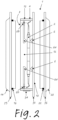
- Figure 2 shows a schematic drawing of an example of a reprocessing container 1 for holding a reusable medical instrument 2.
- Figure 3 shows an isometric exploded view of the container 1 of Figure 2 .
- the container includes a tray 4.
- the tray includes supports 6 for supporting the medical instrument 2 or a plurality of medical instruments 2.
- the supports 6 includes movable supports 6a for preventing the medical instrument from falling out of the tray, regardless of the orientation of the tray.
- the movable supports 6a are pivotally mounted to the tray 4 at pivot points 6b.
- the tray includes a first opening 8.
- the first opening 8 extends over the entire area formed by the inner surface of the circumferential wall 10 of the tray 4.
- the first opening 8 spans substantially the entire cross sectional area in top plan view of the tray 4.
- the instrument 2 or instruments 2 can easily be placed in an inner space 12 of the tray through the first opening 8.
- the container 1 includes a first lid 14.
- the first lid is arranged for closing the first opening 8.
- the first lid 14 includes a first circumferential seal 16.
- the tray 4 includes a second opening 18.
- the second opening 18 extends over the entire area formed by the inner surface of the circumferential wall 10 of the tray 4.
- the second opening 18 spans substantially the entire cross sectional area in top plan view of the tray 4.
- the container 1 includes a second lid 20.
- the second lid 20 is arranged for closing the second opening 18.
- the second lid 20 includes a second circumferential seal 22.
- the container 1 When used for inserting medical instruments 2 into the container, and/or taking medical instruments 2 from the container, the container 1 will normally be placed with the second lid 20 resting on a carrier surface, such as a counter top or table top. The second lid 20 then acts as a bottom of the container 1.
- opening the first lid 14 allows easy access to the medical instrument(s) 2 inside the container 1 via the first opening 8, which then extends on an upper side of the tray 4.
- the container 1 can include a machine readable identification 34, here a radiofrequency identification, RFID.
- the container 1 can also include a human readable identification 36, here a label.
- FIG 4 shows a schematic representation of an example of a decontamination device 24.
- the decontamination device 24 includes an entrance 26.
- the entrance 26 is arranged for inserting a container 1 into the decontamination device 24.
- the decontamination device can be used with a container 1 as described in view of Figure 1 and/or a container 1 as described in view of Figures 2 and 3 . It will be appreciated that the decontamination device 24 in combination with one or more containers 1 forms a system for reprocessing a reusable medical instrument 2.
- the decontamination device 24 includes a container handler 28 arranged for holding the container 1 in the decontamination device.
- the decontamination device 24 includes a decontamination unit 30 arranged for decontaminating the container 1 and the medical instrument 2.
- the decontamination device includes an exit 32 for removing the closed container 1 containing the decontaminated medical instrument 2 from the decontamination device.
- the decontamination device 24 includes a reader 38 for reading the machine readable identification 34.
- the decontamination device 24 includes a processor 40.
- the processor 40 is communicatively connected with a memory 42.
- the processor 40 is communicatively connected with a user interface 44.
- the decontamination unit 30 includes a first chamber 30A and a second chamber 30B.
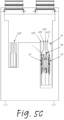
- the decontamination device 24 as described thus far can be used as follows with reference to Figure 4 and Figures 5a-5g .
- a container 1 and a medical instrument 2 to be decontaminated are presented at the decontamination device 24.
- the contaminated medical instrument 2 is included inside the inner space 12.
- the container 1 is closed.
- the container 1 is presented at the entrance 26.
- the reader 38 reads the identification 34 of the container.
- a stack of containers 1 is presented at the entrance 26 (see Figure 4 ). Hence, a next container including an instrument 2 to be decontaminated can be placed on top of the stack and wait to be processed by the decontamination device 24.
- the container 1 at the bottom of the stack is engaged by the container handler 28 (see Figure 5a ).
- the container handler 28 includes a first jaw 48 arranged for engaging the tray 4, here at a rim 50 of the tray 4.
- the container handler 28 also includes a second jaw 52 arranged for engaging the first lid 14, here at a rim 53 of the first lid 14.
- the container handler 28 can include a third jaw 54 arranged for engaging the second lid 20, e.g. at a rim 56 of the second lid. It will be appreciated that if the decontamination device is arranged for solely processing containers as described in view of Figure 1 , the third jaw 54 may be omitted.
- the container 1 is moved to the first chamber 30A while the container 1 is maintained in its closed state.
- the container handler 28 moves the container 1 from the bottom of the stack horizontally to above the second chamber 30A.
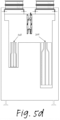
- the container handler 28 tilts the container 1 such that the openings 8, 18 (although still closed by the lids 14, 20) extend in a vertical plane (see Figure 5b ). It will be appreciated that a deviation from exactly vertical is possible.
- the container 1 is lowered into the first chamber 30A. It will be appreciated that the generally elongate medical instruments 2 are positioned in an upright position, with their longitudinal axis substantially vertical.
- walls 58 of the first chamber 30A include guide grooves 60A, 60B, 60C.
- the first guide groove 60A guides the first jaw 48 when entering the first chamber 30A.
- the first guide groove 60A guides the first jaw 48 along a straight line.
- the second guide groove 60B guides the second jaw 52 when entering the first chamber 30A.
- the second guide groove 60B guides the second jaw 52 along a curved line.
- the curved line of the second guide groove 60B moves the first lid 14 away from the first opening 8, effectively opening the first opening 8.
- the third guide groove 60C guides the third jaw 54 when entering the first chamber 30A.
- the third guide groove 60C guides the third jaw 54 along a curved line.
- the curved line of the third guide groove 60C moves the second lid 20 away from the second opening 18, effectively opening the second opening 18.
- the container 1 is in the first chamber 30A in an opened state.
- the internal faces of the container, and the contained instrument(s) can be decontaminated. It will be appreciated that in this example, the external faces of the container can also be decontaminated.
- decontamination includes the following process steps.
- a first process step is rinsing.
- jets of a liquid such as cold water
- the container 1 may be moved up and down relative to the jets to improve rinsing.
- a second process step is washing.
- the first chamber 30A is filled with a washing liquid to a level that is sufficient for submerging the entire container.
- ultrasonic cleaning may be used in the liquid bath in which the container and instruments are submerged.
- a third process step is disinfecting.
- jets of a liquid are directed at the internals of the container 1.
- the container 1 may be moved up and down relative to the jets.
- a fourth process step is drying.
- a drying gas such as hot air, is flown through the opened container.
- the decontamination device can include one or more nozzles for generating jets, rinsing liquid supply means, washing liquid supply means, disinfection liquid supply means, liquid pumps for feeding the nozzles, liquid pumps for filling the chamber, liquid pumps for emptying the chamber, liquid heating means, gas heating means, blowing means, and an ultrasound transducer.
- the nozzles can be placed on a structure extending from a bottom of the first chamber (see Figure 6 ).
- the structure can be arranged such that the tray 4 passes the structure on one side and the first or second lid passes the structure on an opposite side.
- the structure is interposed between the tray and the first or second lid when the container is in its opened state in the first chamber.
- a first such structure can be interposed between the first lid and the tray and a second such structure can be interposed between the second lid and the tray.
- one or more ultrasound transducers are positioned on the structure(s).
- the decontamination process may be modified to suit the decontamination needs of the medical instruments included in the container. For example, one or more process steps may be omitted if desired. It is also possible that process parameters, such as liquid temperature, jet pressure, jet duration, ultrasound intensity, ultrasound duration, movement of the container during rinsing, washing, disinfecting and/or drying, gas temperature, etc. may be varied according to need.
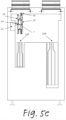
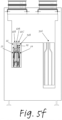
- the container 1 is lowered into the second chamber 30B for performing a further process step (see Figure 5f ).
- the first lid 14 is moved away from the first opening 8 by the second jaw 52 and the second lid 20 is moved away from the second opening 18 by the third jaw 54.
- walls 66 of the second chamber 30B include guide grooves 68A, 68B, 68C.
- the first guide groove 68A guides the first jaw 48 when entering the second chamber 30B.
- the first guide groove 68A guides the first jaw 48 along a straight line.
- the second guide groove 68B guides the second jaw 52 when entering the second chamber 30B.
- the second guide groove 68B guides the second jaw 52 along a curved line.
- the curved line of the second guide groove 68B moves the first lid 14 away from the first opening 8, effectively opening the first opening 8.
- the third guide groove 68C guides the third jaw 54 when entering the second chamber 30B.
- the third guide groove 68C guides the third jaw 54 along a curved line.
- the curved line of the third guide groove 68C moves the second lid 20 away from the second opening 18, effectively opening the second opening 18.
- a fifth process step is performed.
- the fifth process step is sterilizing.
- the second chamber 30B is filled with a sterilizing gas, e.g. containing ozone.
- a sterilizing gas e.g. containing ozone.
- information on sterilization can also be included on the label 64.
- the label may be applied to the container before sterilization or after sterilization.
- a sixth process step is evacuation.
- the second chamber is evacuated, e.g. to a predetermined pressure below ambient pressure.
- the guide grooves 68A, 68B, 68C cause the container 1 to be closed again.
- the container is closed inside the second chamber 30B while evacuated.
- the closed container includes gas, such as air or a protective gas, below ambient pressure.
- the container 1 can include an indicator arranged for indicating whether or not the pressure inside the container is below a predetermined threshold pressure.
- the sterilized closed container is provided at this point.
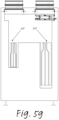
- the container 1 is transported to the exit 32 (see Figure 5g ).
- the container is placed at the bottom of a stack of containers at the exit 32.
- the container can be retrieved from the exit 32, e.g. manually.
- FIG 7 shows a schematic representation of an example of a decontamination device 24.
- the decontamination device 24 includes an entrance 26.
- the entrance 26 is arranged for inserting a container 1 into the decontamination device 24.
- the decontamination device can be used with a container 1 as described in view of Figure 1 and/or a container 1 as described in view of Figures 2 and 3 . It will be appreciated that the decontamination device 24 in combination with one or more containers 1 forms a system for reprocessing a reusable medical instrument 2.
- the decontamination device 24 includes a container handler 28 arranged for holding the container 1 in the decontamination device.
- the decontamination device 24 includes a decontamination unit 30 arranged for decontaminating the container 1 and the medical instrument 2.
- the decontamination device includes an exit 32 for removing the closed container 1 containing the decontaminated medical instrument 2 from the decontamination device.
- the decontamination device 24 can include a reader 38 for reading the machine readable identification 34.
- the decontamination device 24 can include a processor 40.
- the processor 40 can be communicatively connected with a memory 42.
- the processor 40 can be communicatively connected with a user interface 44.
- the decontamination unit 30 includes a first chamber 30A, a second chamber 30B, a third chamber 30C, a fourth chamber 30D and a fifth chamber 30E.
- the first chamber 30A is arranged for washing the medical instrument 2 with a liquid, such as water e.g. including a detergent, at a low temperature, e.g. of 37 °C.
- the first chamber 30A can include ultrasonic means 70 for ultrasonically cleaning the instrument 2.
- the second chamber 30B is arranged for washing the medical instrument 2 with a liquid, such as water e.g. including a detergent, at a high temperature, e.g. of 73 °C.
- the third chamber 30C is arranged for disinfecting the instrument, e.g. at a temperature of 93 °C.
- the fourth chamber 30D is arranged for drying the instrument 2 and the container 1.
- the fourth chamber 30D is provided with drying means such as blowers 72 and/or heaters 74.
- the fifth chamber 30E is arranged for sterilizing the instruments 2.
- the chambers 30A, 30B, 30C, 30D, 30E are positioned with their respective main planes of extension substantially parallel.
- the main plane of extension indicates the directions of the two largest dimensions of the chamber. For example, for a chamber having a length exceeding a width, and the width exceeding a height, the largest dimensions are the length and the width.
- the main plane of extension is the plane defined by the length and the width of said chamber.
- the first through fifth chambers 30A, 30B, 30C, 30D, 30E are positioned with their respective main planes of extension substantially parallel, so that they occupy a compact volume. Hence, a compact build of the decontamination device is possible.
- the decontamination device 24 as described thus far can be used as follows with reference to Figure 7 .
- a container 1 and a medical instrument 2 to be decontaminated are presented at the decontamination device 24.
- the contaminated medical instrument 2 is included inside the inner space 12.
- the container 1 is closed.
- the closed container is in a non-sealed state.
- the lid 14 includes a perforation allowing air to enter or exit the inner space of the container.
- the container 1 is presented at the entrance 26.
- the reader 38 reads the identification 34 of the container.
- a stack of containers 1 is presented at the entrance 26. Hence, a next container including an instrument 2 to be decontaminated can be placed on top of the stack and wait to be processed by the decontamination device 24.
- the processor 40 retrieves from the memory 42 a record associated with the identification 34 of the container 1.
- the record includes data representative of processing instructions for the decontamination of the container 1. It is possible that data representative of the processing instructions is displayed on the user interface 44. For instance, the user interface may display a cleaning cycle as retrieved from the record. It will be appreciated that it is possible that the user interface 44 allows manual manipulation of the processing instructions. It is also possible that the processor 40 does not retrieve processing instructions from the memory 42, and that the user interface 44 prompts the user to enter processing instructions for the container.
- the container 1 at the bottom of the stack is engaged by the container handler 28.
- the container handler 28 rotates the container 1 from the bottom of the stack from a horizontal orientation to a vertical orientation. It will be appreciated that a deviation from exactly vertical is possible.
- the container 1 is moved to above the first chamber 30A while the container 1 is maintained in its closed state.
- the container 1 is lowered into the first chamber 30A. It will be appreciated that the generally elongate medical instruments 2 are positioned in an upright position, with their longitudinal axis substantially vertical.
- the first lid 14 is moved away from the first opening 8 and the second lid 20 is moved away from the second opening 18. Now the container 1 is in the first chamber 30A in an opened state.
- the internal faces of the container, and the contained instrument(s) can be washed. It will be appreciated that in this example, the external faces of the container can also be washed.
- the container 1 is removed from the first chamber 30A.
- the container 1 is be closed again.
- the washed closed container is provided at this point.
- the container 1 is transported to above the second chamber 30B.
- the first lid 14 is moved away from the first opening 8 and the second lid 20 is moved away from the second opening 18.
- the container 1 is in the second chamber 30B in an opened state.
- the internal faces of the container, and the contained instrument(s) can be washed. It will be appreciated that in this example, the external faces of the container can also be washed.
- the container 1 is removed from the second chamber 30B.
- the container 1 is be closed again.
- the washed closed container is provided at this point.
- the container 1 is transported to above the third chamber 30C.
- the first lid 14 is moved away from the first opening 8 and the second lid 20 is moved away from the second opening 18.
- the container 1 is in the third chamber 30C in an opened state.
- the internal faces of the container, and the contained instrument(s) can be disinfected. It will be appreciated that in this example, the external faces of the container can also be disinfected.
- the container 1 is removed from the third chamber 30C.
- the container 1 is be closed again.
- the disinfected closed container is provided at this point.
- the container 1 is transported to above the fourth chamber 30D.
- the first lid 14 is moved away from the first opening 8 and the second lid 20 is moved away from the second opening 18.
- the container 1 is in the fourth chamber 30D in an opened state.
- the internal faces of the container, and the contained instrument(s) can be dried. It will be appreciated that in this example, the external faces of the container can also be dried.
- the container may be moved towards the exit 32 to provide the container containing the medical instruments that have been disinfected but not sterilized.
- the perforation in the lid may be closed with a label as described hereinbelow.
- the container 1 is removed from the fourth chamber 30D.
- the container 1 is be closed again.
- the dried closed container is provided at this point.
- the container 1 is transported to above the fifth chamber 30E.
- the first lid 14 is moved away from the first opening 8 and the second lid 20 is moved away from the second opening 18.
- the container 1 is in the fifth chamber 30E in an opened state.
- the internal faces of the container, and the contained instrument(s) can be sterilized. It will be appreciated that in this example, the external faces of the container can also be sterilized.
- the container 1 is removed from the fifth chamber 30E.
- the container 1 is be closed again.
- the sterilized closed container is provided at this point.
- the container can be moved towards a labelling unit 62.
- the labelling unit 62 is arranged for applying a label 64 to the container 1, here to the first lid 14.
- the label can close the perforation in the lid 14.
- the label 64 can include human readable indications.
- the human readable indications can e.g. include information on the decontamination process performed on the (contents of the) container.
- the information can e.g. include a processing date and/or an expiration date.
- a sixth process step is evacuation.
- the container may be evacuated, e.g. to a predetermined pressure below ambient pressure, at the labelling unit.
- the container is closed while evacuated.
- the sterilized closed container is provided at this point.
- the container 1 is transported to the exit 32.
- the container is placed at the bottom of a stack of containers at the exit 32.
- the container can be retrieved from the exit 32, e.g. manually.
- the decontamination method as described above can be used as follows.
- an association is made of a predetermined set of medical instruments with a predetermined container or a predetermined type of container.
- the predetermined set of instruments can e.g. be a set required for performing a certain procedure on a patient.
- the predetermined container can be an identifiable container, e.g. a container having a predetermined indicator such as a number, a letter, a code, a color, an icon, a drawing, or the like on an external surface.
- the association of the predetermined set of medical instruments with a predetermined container or a predetermined type of container is stored in the memory 42 of the decontamination device, or is stored in a remote memory and is retrievable by the processor 40, e.g. via a communications network, such as an intranet or the internet.
- the association is stored in a record in memory.
- the record can include data representative of the set of instruments and the container.
- the record can also include data representative of a machine readable identification of the container.
- the record can include processing instructions (such as which decontamination process steps to follow, and using which parameters). It is possible that for a new association, such record can be created using the user interface 44. It is also possible that an existing association can be modified using the user interface 44.
- the reader 38 recognizes the container 1
- the record can be retrieved from memory and the processing steps for the instruments in that container are automatically loaded in the processor 40. It will be appreciated that it is possible that the user interface provides the possibility of manually modifying or overriding the retrieved processing steps.
- the instrument(s) are intended to remain with that (type of) container.
- the container including the decontaminated instrument(s) can be taken from the decontamination device, or from storage, and brought to a treatment space. There the decontaminated instrument(s) is (are) taken from the container (e.g after inspection of the tamper evidence) and used for the procedure. After the procedure, the contaminated instrument(s) is (are) repositioned in the container. The container with the contaminated instruments can then be presented at the decontamination device again.
- the process steps rinsing, washing, disinfecting and drying are performed in the first chamber, while sterilizing and evacuating is performed in the second chamber. It will be appreciated that it is also possible that the process steps are assigned to the chambers differently. It will be appreciated that it is also possible that all process steps are performed in one single chamber. It is also possible that more than two chambers are used for performing the process steps. It will be appreciated that one or more of the process steps may be omitted in view of the requirements of the medical instrument to be decontaminated.
- any reference signs placed between parentheses shall not be construed as limiting the claim.
- the word 'comprising' does not exclude the presence of other features or steps than those listed in a claim.
- the words 'a' and 'an' shall not be construed as limited to 'only one', but instead are used to mean ⁇ at least one', and do not exclude a plurality.
- the mere fact that certain measures are recited in mutually different claims does not indicate that a combination of these measures cannot be used to an advantage.
Landscapes
- Health & Medical Sciences (AREA)
- Life Sciences & Earth Sciences (AREA)
- Animal Behavior & Ethology (AREA)
- General Health & Medical Sciences (AREA)
- Public Health (AREA)
- Veterinary Medicine (AREA)
- Surgery (AREA)
- Epidemiology (AREA)
- Engineering & Computer Science (AREA)
- Chemical Kinetics & Catalysis (AREA)
- General Chemical & Material Sciences (AREA)
- Chemical & Material Sciences (AREA)
- Nuclear Medicine, Radiotherapy & Molecular Imaging (AREA)
- Biomedical Technology (AREA)
- Heart & Thoracic Surgery (AREA)
- Medical Informatics (AREA)
- Molecular Biology (AREA)
- Mechanical Engineering (AREA)
- Oral & Maxillofacial Surgery (AREA)
- Pathology (AREA)
- Apparatus For Disinfection Or Sterilisation (AREA)
- Accommodation For Nursing Or Treatment Tables (AREA)
- Refuse Receptacles (AREA)
Applications Claiming Priority (4)
| Application Number | Priority Date | Filing Date | Title |
|---|---|---|---|
| NL2020655A NL2020655B1 (en) | 2018-03-23 | 2018-03-23 | A method and system for reprocessing reusable medical instruments |
| NL2022713 | 2019-03-11 | ||
| EP19720185.8A EP3768190B1 (de) | 2018-03-23 | 2019-03-22 | Verfahren und system zur wiederaufbereitung von wiederverwendbaren medizinischen instrumenten |
| PCT/NL2019/050179 WO2019182449A1 (en) | 2018-03-23 | 2019-03-22 | A method and system for reprocessing reusable medical instruments |
Related Parent Applications (1)
| Application Number | Title | Priority Date | Filing Date |
|---|---|---|---|
| EP19720185.8A Division EP3768190B1 (de) | 2018-03-23 | 2019-03-22 | Verfahren und system zur wiederaufbereitung von wiederverwendbaren medizinischen instrumenten |
Publications (4)
| Publication Number | Publication Date |
|---|---|
| EP4389059A2 true EP4389059A2 (de) | 2024-06-26 |
| EP4389059A3 EP4389059A3 (de) | 2024-08-21 |
| EP4389059B1 EP4389059B1 (de) | 2025-10-29 |
| EP4389059C0 EP4389059C0 (de) | 2025-10-29 |
Family
ID=66323882
Family Applications (2)
| Application Number | Title | Priority Date | Filing Date |
|---|---|---|---|
| EP24161565.7A Active EP4389059B1 (de) | 2018-03-23 | 2019-03-22 | System zur wiederverarbeitung wiederverwendbarer medizinischer instrumente |
| EP19720185.8A Active EP3768190B1 (de) | 2018-03-23 | 2019-03-22 | Verfahren und system zur wiederaufbereitung von wiederverwendbaren medizinischen instrumenten |
Family Applications After (1)
| Application Number | Title | Priority Date | Filing Date |
|---|---|---|---|
| EP19720185.8A Active EP3768190B1 (de) | 2018-03-23 | 2019-03-22 | Verfahren und system zur wiederaufbereitung von wiederverwendbaren medizinischen instrumenten |
Country Status (9)
| Country | Link |
|---|---|
| US (2) | US12129065B2 (de) |
| EP (2) | EP4389059B1 (de) |
| JP (1) | JP7399936B2 (de) |
| CN (1) | CN112188871B (de) |
| AU (1) | AU2019239007B2 (de) |
| CA (1) | CA3094316A1 (de) |
| ES (2) | ES3053478T3 (de) |
| PL (2) | PL3768190T3 (de) |
| WO (1) | WO2019182449A1 (de) |
Families Citing this family (3)
| Publication number | Priority date | Publication date | Assignee | Title |
|---|---|---|---|---|
| CN112122242A (zh) * | 2020-08-12 | 2020-12-25 | 王倩倩 | 一种医疗器械消毒方法 |
| US20260034258A1 (en) * | 2022-07-27 | 2026-02-05 | Steelco S.P.A. | Apparatus, plant and method for the industrial washing of surgical instruments |
| JP2025529025A (ja) * | 2022-09-14 | 2025-09-04 | ビエン - エア ホールディング ソシエテ アノニム | 医療機器を再処理するためのシステム |
Family Cites Families (20)
| Publication number | Priority date | Publication date | Assignee | Title |
|---|---|---|---|---|
| US3247957A (en) | 1964-08-17 | 1966-04-26 | Hospital Supply And Dev Compan | Sterile packaging and the like |
| JPS5223911Y2 (de) | 1973-10-17 | 1977-05-31 | ||
| US4728504A (en) * | 1984-11-05 | 1988-03-01 | Nichols Robert L | Stackable medical instrument sterilizer container |
| JPH11267190A (ja) | 1998-03-20 | 1999-10-05 | Koichi Nishimura | 携帯用コンティナーに封入して滅菌した医療用具、医療材料の長期保存法及びその災害時用保存コンティナー。 |
| CA2268042A1 (en) * | 1999-04-06 | 2000-10-06 | Scican, A Division Of Lux & Zwingenberger Ltd. | Apparatus and method for steam sterilization of medical and dental instruments |
| FR2839497B1 (fr) * | 2002-05-07 | 2005-04-15 | Becton Dickinson France | Emballage destine a etre utilise pour transporter des objets steriles ou a stereliser |
| CA2629267C (en) * | 2004-11-09 | 2016-10-11 | Startbox, Llc | System and method for preventing wrong-site surgeries |
| ES2953838T3 (es) * | 2005-11-16 | 2023-11-16 | Steelco Spa | Aparato de lavado, en particular, para desinfección por calor |
| US20080150722A1 (en) | 2006-12-22 | 2008-06-26 | Jackson Richard A | Instrument tracking container and method |
| US7749330B2 (en) * | 2007-03-30 | 2010-07-06 | Ethicon, Inc. | Washer and decontaminator with lid control |
| ES2384003T3 (es) * | 2008-09-15 | 2012-06-28 | Straumann Holding Ag | Estuche para almacenamiento de instrumental médico |
| US8623289B2 (en) | 2008-12-24 | 2014-01-07 | Kimberly-Clark Worldwide Inc. | Single use sterilization container |
| DE102012200331A1 (de) * | 2012-01-11 | 2013-07-11 | Melag Medizintechnik Ohg | Behälter für medizinische oder zahnmedizinische Instrumente zum Anbringen in einem Autoklaven und Verfahren zur Instrumentenaufbereitung |
| US20140077435A1 (en) * | 2012-09-14 | 2014-03-20 | Andrew Powell | Sterilization Base-Tray with Internal Frame and Integrated Latching and Intrument Retention System |
| CN113230425B (zh) * | 2013-03-13 | 2023-07-14 | 史赛克公司 | 能够提供容器中的被灭菌手术器械是否被正确灭菌的提示的灭菌容器 |
| GB2525846A (en) | 2014-04-02 | 2015-11-11 | Partners For Endoscopy Ltd | A storage container for an endoscope |
| DE102014105787A1 (de) | 2014-04-24 | 2015-10-29 | Schott Ag | Verpackungseinheit für ein pharmazeutisches, medizinisches oder kosmetisches Objekt und Verfahren zum Sterilisieren eines in der Verpackungseinheit anordenbaren pharmazeutischen, medizinischen oder kosmetischen Objekts |
| US9669119B2 (en) | 2014-05-06 | 2017-06-06 | American Sterilizer Company | Sterilizer |
| WO2016039647A2 (en) * | 2014-09-12 | 2016-03-17 | Mercer Technologies Limited | A sterilisation container, method of sterilisation and sterilisation apparatus |
| NL2014837B1 (en) * | 2015-05-21 | 2017-01-31 | Nikinc Holding B V | Decontamination device and method for medical instruments. |
-
2019
- 2019-03-22 EP EP24161565.7A patent/EP4389059B1/de active Active
- 2019-03-22 PL PL19720185.8T patent/PL3768190T3/pl unknown
- 2019-03-22 EP EP19720185.8A patent/EP3768190B1/de active Active
- 2019-03-22 JP JP2021500773A patent/JP7399936B2/ja active Active
- 2019-03-22 PL PL24161565.7T patent/PL4389059T3/pl unknown
- 2019-03-22 US US16/982,731 patent/US12129065B2/en active Active
- 2019-03-22 CN CN201980034507.XA patent/CN112188871B/zh active Active
- 2019-03-22 ES ES24161565T patent/ES3053478T3/es active Active
- 2019-03-22 AU AU2019239007A patent/AU2019239007B2/en active Active
- 2019-03-22 CA CA3094316A patent/CA3094316A1/en active Pending
- 2019-03-22 ES ES19720185T patent/ES2980616T3/es active Active
- 2019-03-22 WO PCT/NL2019/050179 patent/WO2019182449A1/en not_active Ceased
-
2024
- 2024-08-21 US US18/811,298 patent/US20240409262A1/en active Pending
Also Published As
| Publication number | Publication date |
|---|---|
| CN112188871B (zh) | 2025-09-05 |
| WO2019182449A1 (en) | 2019-09-26 |
| AU2019239007B2 (en) | 2024-08-29 |
| PL4389059T3 (pl) | 2026-01-19 |
| AU2019239007A1 (en) | 2020-10-22 |
| PL3768190T3 (pl) | 2024-07-15 |
| JP7399936B2 (ja) | 2023-12-18 |
| ES3053478T3 (en) | 2026-01-22 |
| CA3094316A1 (en) | 2019-09-26 |
| US20210002013A1 (en) | 2021-01-07 |
| CN112188871A (zh) | 2021-01-05 |
| ES2980616T3 (es) | 2024-10-02 |
| US12129065B2 (en) | 2024-10-29 |
| EP3768190B1 (de) | 2024-03-06 |
| EP4389059B1 (de) | 2025-10-29 |
| EP4389059C0 (de) | 2025-10-29 |
| US20240409262A1 (en) | 2024-12-12 |
| EP4389059A3 (de) | 2024-08-21 |
| EP3768190A1 (de) | 2021-01-27 |
| JP2021518798A (ja) | 2021-08-05 |
Similar Documents
| Publication | Publication Date | Title |
|---|---|---|
| US20240409262A1 (en) | Method and system for reprocessing reusable medical instruments | |
| JP5457458B2 (ja) | 医療用器具の保存と移送のためのキット | |
| CA3025121C (en) | Decontamination device and method for medical instruments | |
| US11123448B2 (en) | Device and method for washing, disinfecting and/or sterilizing | |
| HK40109156A (en) | System for reprocessing reusable medical instruments | |
| Savage et al. | The use of autoclaves in the dental surgery | |
| NL2020655B1 (en) | A method and system for reprocessing reusable medical instruments | |
| RU2664949C2 (ru) | Транспортировка медицинских инструментов | |
| JP6570150B2 (ja) | 洗浄し、消毒し、乾燥しかつ/または滅菌するためのデバイス | |
| JP7562880B2 (ja) | 生体サンプル用容器の自動化された衛生化のためのシステムおよびその使用プロセス | |
| US20050029142A1 (en) | Method and system for collecting used medical devices | |
| EP3052143B1 (de) | Verfahren zur leitung eines benutzers zum eingreifen in laufende prozesse bei einer vorrichtung zum waschen, desinfizieren, trocknen und/oder sterilisieren von medizinischen, zahnmedizinischen, labor- und/oder pharmazeutischen artikeln. | |
| US20050011538A1 (en) | Method and system for collecting used medical devices |
Legal Events
| Date | Code | Title | Description |
|---|---|---|---|
| PUAI | Public reference made under article 153(3) epc to a published international application that has entered the european phase |
Free format text: ORIGINAL CODE: 0009012 |
|
| STAA | Information on the status of an ep patent application or granted ep patent |
Free format text: STATUS: REQUEST FOR EXAMINATION WAS MADE |
|
| 17P | Request for examination filed |
Effective date: 20240305 |
|
| AC | Divisional application: reference to earlier application |
Ref document number: 3768190 Country of ref document: EP Kind code of ref document: P |
|
| AK | Designated contracting states |
Kind code of ref document: A2 Designated state(s): AL AT BE BG CH CY CZ DE DK EE ES FI FR GB GR HR HU IE IS IT LI LT LU LV MC MK MT NL NO PL PT RO RS SE SI SK SM TR |
|
| REG | Reference to a national code |
Ipc: A61B0050330000 Ref country code: DE Ref legal event code: R079 Ref document number: 602019077646 Country of ref document: DE Free format text: PREVIOUS MAIN CLASS: A61B0090700000 |
|
| PUAL | Search report despatched |
Free format text: ORIGINAL CODE: 0009013 |
|
| AK | Designated contracting states |
Kind code of ref document: A3 Designated state(s): AL AT BE BG CH CY CZ DE DK EE ES FI FR GB GR HR HU IE IS IT LI LT LU LV MC MK MT NL NO PL PT RO RS SE SI SK SM TR |
|
| RIC1 | Information provided on ipc code assigned before grant |
Ipc: A61B 90/70 20160101ALI20240715BHEP Ipc: A61L 2/20 20060101ALI20240715BHEP Ipc: A61L 2/07 20060101ALI20240715BHEP Ipc: A61B 50/33 20160101AFI20240715BHEP |
|
| REG | Reference to a national code |
Ref country code: HK Ref legal event code: DE Ref document number: 40109156 Country of ref document: HK |
|
| GRAP | Despatch of communication of intention to grant a patent |
Free format text: ORIGINAL CODE: EPIDOSNIGR1 |
|
| STAA | Information on the status of an ep patent application or granted ep patent |
Free format text: STATUS: GRANT OF PATENT IS INTENDED |
|
| INTG | Intention to grant announced |
Effective date: 20250520 |
|
| GRAS | Grant fee paid |
Free format text: ORIGINAL CODE: EPIDOSNIGR3 |
|
| GRAA | (expected) grant |
Free format text: ORIGINAL CODE: 0009210 |
|
| STAA | Information on the status of an ep patent application or granted ep patent |
Free format text: STATUS: THE PATENT HAS BEEN GRANTED |
|
| AC | Divisional application: reference to earlier application |
Ref document number: 3768190 Country of ref document: EP Kind code of ref document: P |
|
| AK | Designated contracting states |
Kind code of ref document: B1 Designated state(s): AL AT BE BG CH CY CZ DE DK EE ES FI FR GB GR HR HU IE IS IT LI LT LU LV MC MK MT NL NO PL PT RO RS SE SI SK SM TR |
|
| REG | Reference to a national code |
Ref country code: CH Ref legal event code: F10 Free format text: ST27 STATUS EVENT CODE: U-0-0-F10-F00 (AS PROVIDED BY THE NATIONAL OFFICE) Effective date: 20251029 Ref country code: GB Ref legal event code: FG4D |
|
| REG | Reference to a national code |
Ref country code: IE Ref legal event code: FG4D |
|
| REG | Reference to a national code |
Ref country code: DE Ref legal event code: R096 Ref document number: 602019077646 Country of ref document: DE |
|
| U01 | Request for unitary effect filed |
Effective date: 20251126 |
|
| U07 | Unitary effect registered |
Designated state(s): AT BE BG DE DK EE FI FR IT LT LU LV MT NL PT RO SE SI Effective date: 20251202 |
|
| REG | Reference to a national code |
Ref country code: ES Ref legal event code: FG2A Ref document number: 3053478 Country of ref document: ES Kind code of ref document: T3 Effective date: 20260122 |
|
| PGFP | Annual fee paid to national office [announced via postgrant information from national office to epo] |
Ref country code: GB Payment date: 20260324 Year of fee payment: 8 |
|
| PG25 | Lapsed in a contracting state [announced via postgrant information from national office to epo] |
Ref country code: NO Free format text: LAPSE BECAUSE OF FAILURE TO SUBMIT A TRANSLATION OF THE DESCRIPTION OR TO PAY THE FEE WITHIN THE PRESCRIBED TIME-LIMIT Effective date: 20260129 |
|
| PG25 | Lapsed in a contracting state [announced via postgrant information from national office to epo] |
Ref country code: HR Free format text: LAPSE BECAUSE OF FAILURE TO SUBMIT A TRANSLATION OF THE DESCRIPTION OR TO PAY THE FEE WITHIN THE PRESCRIBED TIME-LIMIT Effective date: 20251029 |
|
| PG25 | Lapsed in a contracting state [announced via postgrant information from national office to epo] |
Ref country code: RS Free format text: LAPSE BECAUSE OF FAILURE TO SUBMIT A TRANSLATION OF THE DESCRIPTION OR TO PAY THE FEE WITHIN THE PRESCRIBED TIME-LIMIT Effective date: 20260129 |
|
| PG25 | Lapsed in a contracting state [announced via postgrant information from national office to epo] |
Ref country code: IS Free format text: LAPSE BECAUSE OF FAILURE TO SUBMIT A TRANSLATION OF THE DESCRIPTION OR TO PAY THE FEE WITHIN THE PRESCRIBED TIME-LIMIT Effective date: 20260228 |
|
| PGFP | Annual fee paid to national office [announced via postgrant information from national office to epo] |
Ref country code: TR Payment date: 20260317 Year of fee payment: 8 |
|
| PGFP | Annual fee paid to national office [announced via postgrant information from national office to epo] |
Ref country code: PL Payment date: 20260226 Year of fee payment: 8 |
|
| U20 | Renewal fee for the european patent with unitary effect paid |
Year of fee payment: 8 Effective date: 20260326 |