EP4389065A1 - Dispositif, procédé et système de rétroaction instantanée de soins buccaux - Google Patents
Dispositif, procédé et système de rétroaction instantanée de soins buccaux Download PDFInfo
- Publication number
- EP4389065A1 EP4389065A1 EP23159925.9A EP23159925A EP4389065A1 EP 4389065 A1 EP4389065 A1 EP 4389065A1 EP 23159925 A EP23159925 A EP 23159925A EP 4389065 A1 EP4389065 A1 EP 4389065A1
- Authority
- EP
- European Patent Office
- Prior art keywords
- oral care
- user
- care device
- endpoint
- data
- Prior art date
- Legal status (The legal status is an assumption and is not a legal conclusion. Google has not performed a legal analysis and makes no representation as to the accuracy of the status listed.)
- Withdrawn
Links
Images




Classifications
-
- A—HUMAN NECESSITIES
- A61—MEDICAL OR VETERINARY SCIENCE; HYGIENE
- A61C—DENTISTRY; APPARATUS OR METHODS FOR ORAL OR DENTAL HYGIENE
- A61C17/00—Devices for cleaning, polishing, rinsing or drying teeth, teeth cavities or prostheses; Saliva removers; Dental appliances for receiving spittle
- A61C17/16—Power-driven cleaning or polishing devices
- A61C17/22—Power-driven cleaning or polishing devices with brushes, cushions, cups, or the like
- A61C17/221—Control arrangements therefor
-
- A—HUMAN NECESSITIES
- A46—BRUSHWARE
- A46B—BRUSHES
- A46B15/00—Other brushes; Brushes with additional arrangements
- A46B15/0002—Arrangements for enhancing monitoring or controlling the brushing process
- A46B15/0004—Arrangements for enhancing monitoring or controlling the brushing process with a controlling means
- A46B15/0006—Arrangements for enhancing monitoring or controlling the brushing process with a controlling means with a controlling brush technique device, e.g. stroke movement measuring device
-
- A—HUMAN NECESSITIES
- A61—MEDICAL OR VETERINARY SCIENCE; HYGIENE
- A61C—DENTISTRY; APPARATUS OR METHODS FOR ORAL OR DENTAL HYGIENE
- A61C17/00—Devices for cleaning, polishing, rinsing or drying teeth, teeth cavities or prostheses; Saliva removers; Dental appliances for receiving spittle
- A61C17/16—Power-driven cleaning or polishing devices
- A61C17/22—Power-driven cleaning or polishing devices with brushes, cushions, cups, or the like
- A61C17/32—Power-driven cleaning or polishing devices with brushes, cushions, cups, or the like reciprocating or oscillating
- A61C17/34—Power-driven cleaning or polishing devices with brushes, cushions, cups, or the like reciprocating or oscillating driven by electric motor
-
- A—HUMAN NECESSITIES
- A46—BRUSHWARE
- A46B—BRUSHES
- A46B2200/00—Brushes characterized by their functions, uses or applications
- A46B2200/10—For human or animal care
- A46B2200/1066—Toothbrush for cleaning the teeth or dentures
Definitions
- the present disclosure relates generally to devices, systems and methods for oral care, and more particularly relates to user feedback regarding oral care treatments including electronic toothbrushing.
- Providing effective feedback to a user with respect to a user's oral hygiene practices enables efficacious cleaning of the oral cavity. For example, if feedback regarding an oral cleaning within the user's mouth is provided during a toothbrushing session, portions of a group of teeth is provided, a specific tooth, or gum section not yet cleaned may be identified so that the user can focus on those areas. Further, appropriate feedback regarding a user's technique, e.g., cleaning too hard, too soft, or not long enough on a particular section of the mouth, can be provided based on tracking the location and respective brushing pressure and duration of the oral care device within a particular region of the oral cavity during use.
- Some current high-end toothbrushes are capable of providing feedback based on data received from inertial motion sensor(s) including accelerometers, gyroscopes, and magnetic sensor(s) which are utilized to measure the motion of an oral care device.
- inertial motion sensor(s) including accelerometers, gyroscopes, and magnetic sensor(s) which are utilized to measure the motion of an oral care device.
- multiple drawbacks and limitations may be associated with transmission of data and providing feedback through an external electronic device. Due to restrictive bandwidth and associated decimation of data transmitted to an external device such as, for example, a smartphone typically encumbered by low energy Bluetooth connectivity limits, data levels and transmission speeds may be compromised. As a result, lag times and reduction in data transmission to an external device may stymie instantaneous, real-time feedback simultaneously to contemporaneous toothbrushing or other dental treatment. In addition, device and/or user capabilities and limitations may inhibit data transmission.
- the present disclosure is directed to inventive oral care devices, systems and methods for providing instantaneous feedback simultaneously to concurrent coverage and pressure of an oral care device, such as, for example, an electronic toothbrush, such that there is no external data transmission.
- an oral care device such as, for example, an electronic toothbrush
- the present disclosure includes various embodiments of oral care devices, methodologies and systems for providing instantaneous feedback to the user while conducting oral treatment session through a user interface contained within an oral care device such that there is no external communication of user information.
- Embodiments of the inventive subject matter include an oral care device wherein data provided by a plurality of sensors including inertial motion and other sensors is received by a controller and collated by a processor to provide feedback regarding a treatment region during a treatment session, as detailed below.
- the embodiments and implementations disclosed or otherwise envisioned herein can be utilized by or adapted to numerous oral care devices.
- suitable oral care devices include an electronic toothbrush, a flossing device, an oral and/or aerated irrigation tool, a tongue cleaner.
- the disclosure is not limited to these enumerated devices, and thus implementations and embodiments disclosed herein can encompass any oral care device.
- Various embodiments and implementations herein directed to such oral care devices have a device head, a plurality of sensors including an inertial motion and pressure sensors directly connected to a controller comprising a processor and a non-transitory storage medium for storing program code configured to determine the location of the device head in context of calibrated treatment or cleaning regions based on a dental model of a user's oral cavity.
- the controller is thereby configured to track the device head location in context of treatment or cleaning regions of a user's oral cavity and to implement a processor configured to instantaneously collate and communicate feedback to a user interface regarding a concurrent cleaning segment.
- the oral care device is configured to provide feedback relative to previous redundant or overall coverage, in the oral care device user interface.
- Various embodiments of the oral care device and method include an electronic toothbrush having a device head with a plurality of sensors including but not limited to an inertial motion sensor and a handle, a controller configured for (i) processing, based on a dental model of the user's oral cavity and data sensed by the sensors information provided by the device head, when the data complies with programmed criteria including an endpoint of a time period and a motion exerted by the device head within the cleaning segment and (ii) directly communicating instantaneous feedback to a user interface disposed in the electronic toothbrush, wherein the instantaneous feedback at least correlates to the endpoint based on coverage in context of treatment or a cleaning region such that there is no external transmission of data.
- a controller configured for (i) processing, based on a dental model of the user's oral cavity and data sensed by the sensors information provided by the device head, when the data complies with programmed criteria including an endpoint of a time period and a motion exerted by the device head within the cleaning segment and (
- IMU inertial motion sensor or unit
- Sensor data is received by a controller and processor configured for processing coverage of the device head in context of a treatment region whereby feedback is communicated to a user interface when the data complies with the programmed criteria, that may be provided by an algorithm and/or derived from an artificial intelligence module parsing of data such as, for example, device head location, motion and pressure, corresponding to the treatment provided by the oral care device.
- the user interface is disposed in the handle of the electronic toothbrush and can comprise an illuminated portion of the handle corresponding to an endpoint corresponding with data compliance with the programmed criteria and derived intelligence.
- the user interface includes an illuminated portion that projects a first color before the endpoint indicating compliance with data criteria and projects a second color after the endpoint indicating compliance with data criteria for the cleaning segment being brushed.
- Various embodiments further employ a user interface that includes a visual code, haptic indicator, an audible indicator and/or an alphanumeric readout.
- the processor provides feedback to the user interface when the device head is repositioned within a cleaning region that the controller indicates is already in compliance with data criteria corresponding an endpoint during a cleaning session. Implementations of this device and method include providing user feedback when the device head is repositioned within a cleaning region that the processor indicates is in partial compliance with data criteria corresponding an endpoint during a cleaning session.
- Various implementations may further process and provide feedback to the user interface regarding all of the cleaning regions covered in one or more cleaning sessions.
- a dental model of the user's oral cavity employed for determining the location of the device head based on calibrated cleaning or treatment regions within the user's oral cavity that may be utilized independently or combined.
- Some implementations employ an intra oral scan of the user's oral cavity that can be obtained through a smartphone application, dental office plate or model.
- Implementations may also employ a generic statistical model derived from a database of age-based geometric oral cavity configurations and/or a generic template whereon the user's teeth are modeled in accordance with data received from the sensor(s) and/or data stored during one or more cleaning sessions.
- the processor may employ an algorithm that determines the cleaning region where the device head is positioned based on the mathematical analysis of an oral cavity model, gravitational acceleration, and a database of generic user teeth cleaning patterns.
- the various embodiments include a method and system for employing oral care devices that include receiving and collating sensor data regarding coverage within a treatment region, processing based on a dental model of the user's oral cavity, when the device head is located within a cleaning region of the user's oral cavity and when the data complies with programmed criteria including an endpoint of a time period based on coverage and pressure exerted by the device head within the cleaning region, and communicating instantaneous feedback corresponding to the endpoint and the motion data in a user interface disposed in the electronic toothbrush such that there is no external transmission of data outside of the electronic toothbrush.
- Various exemplary embodiments of the personal care appliance may deploy a treatment module in the form of an electronic toothbrush. Such and other embodiments may include a pressure source and/or a driving mechanism capable of activating alternative treatment modules.
- Embodiments include a controller configured for (i) receiving data as to, among other sensed data, (a) inertial motion, (b) pressure, (c) proximity, (d) trajectory, (e) coverage, and (f) time information provided by device head, and (ii) determining an endpoint of a time period based on coverage and pressure of the device head within the cleaning region or segment; and providing feedback via a user interface configured for directly communicating instantaneous feedback corresponding to coverage and endpoint concurrently with the simultaneous user application of the brushing or other treatment application communicated within the oral care device such that there is no external transmission of data.
- the system may implement a user interface disposed in the handle of the electronic toothbrush.
- the step of communicating instantaneous feedback is provided in the handle and may include projecting a first indicator such as, for example, an illuminated portion of a first color before a coverage of a cleaning region or segment endpoint and projecting a second indicator such as, for example, an illuminated portion of a second color after the endpoint is reached.
- a first indicator such as, for example, an illuminated portion of a first color before a coverage of a cleaning region or segment endpoint
- a second indicator such as, for example, an illuminated portion of a second color after the endpoint is reached.
- a further feature of various embodiments communicates feedback when the device head is repositioned within a cleaning region wherein the controller indicates previous full or partial compliance with programmed criteria corresponding with reaching an endpoint.
- a yet further feature of various embodiments provides simultaneous overall feedback of all cleaning regions covered in a cleaning session.
- An aspect of the various embodiments implements a multiple region approach to the oral cavity treatment.
- the controller is configured to provide treatment regions and feedback based on identifying a set of sixteen cleaning segments that include a right sextant, a left sextant and a center sextant in the upper dental arch and a right sextant, a left sextant and a center sextant in a lower dental arch of the user's oral cavity.
- the right and left sextants of the upper dental arch and lower dental arch each have three cleaning segments comprising an outer surface, an inner surface and a transverse surface between the inner surface and outer surface of the cleaning segment
- the center sextants have two cleaning segments comprising an outer surface and an inner surface.
- endpoints are set when the pressure data complies with the data criteria for the device head exerting sufficient pressure in the cleaning segment for a duration of between about 7 seconds and about 8 seconds.
- an oral care system for providing instantaneous feedback when treating or cleaning, e.g., by toothbrushing, a user's oral cavity.
- Such an oral care system includes an oral care device with a device head and a plurality of sensors configured to sense data regarding coverage of a region of the user's oral cavity.
- Embodiments of the system employ a controller including a processor configured for determining and concurrently communicating to a user interface disposed within the oral care device instantaneous feedback corresponding to at least a coverage area and an endpoint such that there is no external transmission of data outside of the oral care device 100.
- the system thus employs a hard-wired connection module in the form of a bus configured to directly communicate instantaneous feedback corresponding to at least a coverage area and an endpoint concurrently with the treating or cleaning activity, wherein the processor directly communicates with the user interface, such as, for example, a handle of the electronic toothbrush such that there is no external transmission of data.
- a hard-wired connection module in the form of a bus configured to directly communicate instantaneous feedback corresponding to at least a coverage area and an endpoint concurrently with the treating or cleaning activity, wherein the processor directly communicates with the user interface, such as, for example, a handle of the electronic toothbrush such that there is no external transmission of data.
- the system or device may utilize various sensors, algorithms and/or AI to provide instantaneous feedback through a hardwired circuit connection to an internal user interface regarding the determined orientation and device head with respect to the user's oral cavity in substantially real time, meaning as soon as the information is generated and available to the user. Due to the unlimited bandwidth and reduced loop length provided by the internal circuitry of the controller and associated microcontrollers, feedback provided in user interface is rapid, instantaneous, and highly accurate and detailed. In contrast to the low data rates of conventional low energy smartphone Bluetooth connections that often hover at 30 hertz (Hz), the exponentially much higher frequency of implementations of controller 40 may exceed 100 kilohertz (KHz), a frequency exceeding low energy Bluetooth frequencies by a multiple of more than 3,000.
- KHz kilohertz
- the user interface is configured to provide feedback, in segment-by-segment or composite format, including cleaning and oral health data the user's mouth.
- Embodiments of this device, method or system may further provide feedback to the user regarding an entire or multiple cleaning session(s).
- the user interface could impart information about individual teeth within a region.
- the system can communicate information to the user about which regions were adequately treated or cleaned and which regions were not adequately treated or cleaned.
- the user interface can take many different forms, but is configured to directly and instantaneously provide information to a user concurrent to the cleaning activity. For example, the information can be concurrently read, viewed, heard, felt, and/or otherwise interpreted during the cleaning session.
- the user interface may be a display, a haptic mechanism, or a speaker to provide sounds or words to the user, or any of a variety of other user interface mechanisms.
- the feedback may be implemented by a visual, audible or haptic indicator in a user interface, among other types of notifications, reports and feedback.
- the method further includes the step of communicating the generated feedback to a user interface configured to provide information within an electronic toothbrush to a user before or after, as well as concurrently during, a cleaning session.
- the user interface provides feedback to the user, such as a guided cleaning session, that includes information about where and how to clean.
- the present disclosure describes various embodiments of an oral care device for providing instantaneous feedback to the user about the oral cleaning session through a user interface contained within an oral care device and thereby is constrained from external communication of the user's data.
- Embodiments of the inventive subject matter include utilizing data provided by a plurality of sensors, such as an accelerometer, gyroscope, pressure, trajectory or magnetic sensor that may be provided in an IMU to track and provide instantaneous feedback through a toothbrush embedded user interface whereby information collated from the data is communicated simultaneously to administering the treatment within a calibrated cleaning segment being treated during a cleaning session.
- Implementations of the methods and systems described or otherwise envisioned herein, of this oral care device combines the tracking of the cleaning segment being treated by the oral care device with motion sensor and pressure data from the oral care device in order to determine and provide instantaneous feedback with regard to current treatment coverage.
- Embodiments further provide instantaneous feedback in context of previous and total coverage in a cleaning session in order to collate instantaneous feedback indicating positioning of the oral care device head is redundant and providing the user with instantaneous feedback regarding overall coverage during and/or at the end of one or more cleaning sessions.
- At least one in reference to a list of one or more elements, should be understood to mean at least one element selected from any one or more of the elements in the list of elements, but not necessarily including at least one of each and every element specifically listed within the list of elements and not excluding any combinations of elements in the list of elements.
- This definition also allows that elements may optionally be present other than the elements specifically identified within the list of elements to which the phrase "at least one" refers, whether related or unrelated to those elements specifically identified.
- artificial intelligence means recognizing and integrating patterns and probabilities in order to analyze data.
- artificial intelligence is applied to analyze spatial relationship data provided by cameras, including light arrays, wherein sensed data identifying relevant objects based on, among other parameters, trajectory angles, acceleration and directional pressure and how much the object contrasts with the surrounding field is parsed in order to determine location and coverage of an oral care device and, in particular, the device head.
- inertial measurement unit and its acronym “IMU” refer to an electronic sensor or device that detects and measures movement, including intensity of acceleration and rotational speed.
- IMU measures a device head's specific force, angular rate and orientation using a combination of accelerometers, gyroscopes, and/or magnetometers.
- Sensor and sensors may include a plurality of inertial motion sensor(s) such as an accelerometer, gyroscope, or magnetic sensor(s) that generates sensor data in response to motion, pressure, coverage and time sensor(s).
- inertial motion sensor(s) such as an accelerometer, gyroscope, or magnetic sensor(s) that generates sensor data in response to motion, pressure, coverage and time sensor(s).
- accelerometer gyroscope
- magnetic sensor(s) that generates sensor data in response to motion, pressure, coverage and time sensor(s).
- the sensor may comprise a plurality of sensors 30 configured to function together as the 6-axis or a 9-axis spatial sensor system - three axes translation and three axes rotation - using, for example a 3-axis gyroscope and a 3-axis accelerometer or, for example, 3-axis gyroscope, a 3-axis accelerometer, and a 3-axis magnetometer.
- Other sensors may be utilized either alone or in conjunction with these sensors, including but not limited to embedded pressure sensor(s), capacitive sensor(s), camera(s), linear light detector array(s), photocell(s), timer(s), and other types of sensors. Many different types of sensors could be utilized, as described or otherwise envisioned herein.
- sensor 30 is configured to generate information indicative of acceleration, pressure, trajectory and angular orientation, timing and location of device head 10 of oral care device 100.
- Controller 40 may include one or multiple microcontrollers that can be embedded with a thermal map, processors configured to store and apply algorithms and/or artificial intelligence modules for processing data received from sensor(s) 30.
- the "dental model of the user's oral cavity” as disclosed and claimed herein, may be provided by one or more sources that are often combined to hone an accurate geometric depiction of the user's oral cavity.
- Dental models may be provided by (a) an intra oral scan of the user's oral cavity that can be uploaded to the oral care device through a smartphone application or a dental office scan or model, (b) a generic age-based statistical model derived from a database of geometric oral cavity configurations and cleaning patterns, (c) a generic template whereon the user's teeth are modeled in accordance with data received from the sensor(s), and (d) a model of the user's oral cavity based on data stored in the electronic toothbrush during one or more cleaning sessions, wherein the processor 50 employs an algorithm that determines the cleaning region to deduce where the device head 10 is positioned based on the mathematical analysis of the dental model of the user's oral cavity derived from one or more of an oral cavity or dental model scan together with algorithms and/or AI parsing and analysis of the sensor data
- controller is used generally to describe various apparatus relating to the operation of a system, or method. Controller 40 can be implemented in numerous ways to perform various functions discussed herein. Such functions may be implemented by dedicated hardware and a processor employing one or more microprocessors that may be programmed using software code. A controller may be implemented with or without employing a processor, and also may be implemented as a combination of dedicated hardware to perform some functions and a processor (e.g., one or more programmed microprocessors and associated circuitry) to perform other functions. Examples of controller components that may be employed in various embodiments of the present disclosure include, but are not limited to, conventional microprocessors, application specific integrated circuits (ASICs), field-programmable gate arrays (FPGAs) and/or artificial intelligence modules.
- ASICs application specific integrated circuits
- FPGAs field-programmable gate arrays
- a “driving mechanism” refers to any mechanical, electrical, electromechanical, vibratory, ultrasonic, pneumatic or computer-enabled power or pressure source suitable for intraoral applications.
- batteries may drive electrical motors for intraoral embodiments.
- the driving mechanism may be activated and deactivated by any off the shelf on/off switch with depressible activator such as,m for example, a push button, rocker or membrane button.
- a processor or controller may be associated with one or more storage media, generically referred to herein as "memory,” e.g., volatile and non-volatile computer memory.
- the storage media may be encoded with one or more programs that, when executed on one or more processors and/or controllers, perform at least some of the functions discussed herein.
- Various storage media may be fixed within a processor or controller or may be transportable, such that the one or more programs stored thereon can be loaded into a processor or controller so as to implement various aspects and functionalities of the present disclosure.
- program or “computer program” are used herein in a generic sense to refer to any type of computer code that can be employed to program one or more processors or controllers.
- user interface refers to an interface between a human user or operator and one or more devices that enables communication between the user and the device(s).
- user interfaces include, but are not limited to, display screens, illuminated portions of a toothbrush, haptic indicators various types of graphical user interfaces (GUIs), alphanumeric readouts, touch screens, audible indicators, microphones switches, potentiometers, buttons, dials, sliders, track balls, and other types of sensors that may receive some form of processed data.
- GUIs graphical user interfaces
- instantaneous feedback refers to data transmission to a user interface via a closed communication loop disposed within a device providing an elevated level of bandwidth and frequency whereby accurate and detailed data is transmitted at speeds devoid of lag times such that the instantaneous feedback is transmitted concurrently in tandem with the sensed treatment action such as toothbrushing.
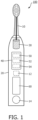
- the inventive subject matter implements user interface 60 disposed in oral care device 100 illustrated as an electronic toothbrush in the depicted embodiment.
- device head 10 includes at its end remote from the body portion tufted bristles shown in the drawings as a toothbrush.
- the handle 20 includes at least a portion of which is hollow, to contain components of the personal care device.
- device head 10 is mounted so as to be able to move relative to the handle 20. The movement can be any of a variety of different movements, including vibrations or rotation, among others.
- the oral care device 100 is depicted as an electronic toothbrush, it will be understood that alternative embodiments of the oral care device are also envisioned.
- handle 20 there may be included within the housing of handle 20, a driving mechanism 12 with a motor and a power source 14 for generating movement, and a transmission component (not shown) for transmitting the generated movements to device head 10.
- handle 20 can include one or more electromagnets and/or a reservoir, among other components.
- the power supply comprises one or more rechargeable batteries, not shown, which can, for example, be electrically charged in a charging holder in which oral care device 10 is placed when not in use.
- device head 10 is mounted to the driving mechanism 12 so as to be able to vibrate relative to body portion 12.
- Device head 10 can be fixedly mounted onto the driving mechanism shaft, or it may alternatively be detachably mounted so that device head 10 can be replaced with a different device head member for different operating features, or when the bristles or another component of the device head are worn out and require replacement.
- Dispose on handle 20 is an on/off mechanism (not shown) to activate and de-activate driving mechanism 12.
- the user input 26 allows a user to operate the oral care device 10, for example to turn the device on and off.
- the on/off mechanism can be a button, touch screen, or switch.
- Oral care device 100 includes sensor(s) 30 comprising a plurality of sensors. Sensor(s) 30 is shown in Fig. 1 just below device head 10, but may be located anywhere within oral care device 100.
- sensor(s) 30 typically comprises multiple sensors including, for example, an inertial motion sensor such as an accelerometer, gyroscope, or magnetic sensor.
- sensor(s) 30 may be configured to sense one or more of (a) inertial motion, (b) pressure, (c) proximity, (d) trajectory, (e) coverage, and (f) time information provided by device head 10 to thereby determine an endpoint of a time period.
- sensors 30 is configured to sense data indicative of the duration within a cleaning segment location, brushing pressure, acceleration and angular orientation of oral care device 10.
- Sensor(s) 30 can be any of the sensors described or otherwise envisioned herein and may send a constant stream of sensor data to controller 40 for storage and/or analysis, or may temporarily store and aggregate or process data prior to sending it to controller 40.
- the various implementations further include a controller 40 configured for: (i) determining, based on a dental model of the user's oral cavity (2) and data sensed by the sensor(s) 30 providing a trajectory calculation for position tracking, a cleaning region in the user's oral cavity wherein the device head 10 is currently positioned; and (ii) a processor 50 configured for processing, based on data sensed by the sensors information, when the data complies with programmed criteria including an endpoint of a time period and a motion exerted by the device head 10 within the treatment or cleaning region.
- processing of the sensor data by processor 50 can generally comprise retrieving stored sensor data from memory 52 based on, for example, a user's dental model or prior treatment sessions, for analysis, analyzing the data to determine the locale of device head 10 in context of calibrated treatment regions such as cleaning segments within oral cavity 2, analyzing the data to determine a coverage area and duration of device head 10 within a relevant treatment region.
- Coverage area determination may include data measuring relative pressure of device head 10 and tracking oral care device 100 during a treatment or cleaning session while instantaneously collating and outputting data to provide directly transmitted session feedback to user interface 60 disposed in handle 20 through hardwired connection module 54.
- Controller 40, processor 50 and user interface 60 are thus configured for directly communicating instantaneous feedback corresponding to at least endpoint and the coverage area data concurrent with brushing motion such that there is no external transmission of data and feedback information outside of oral care device 100.
- controller 40 may be formed of one or multiple modules, and is configured to operate oral care device 100.
- Controller 40 can comprise, for example, a processor 50 including a memory 52.
- Processor 50 may take any suitable form, including but not limited to a microcontroller, multiple microcontrollers, circuitry, a single processor or microprocessors, or plural processors or microprocessors.
- Memory 52 of processor 50 can also take any suitable form, including a non-volatile memory and/or RAM.
- the non-volatile memory may include read only memory (ROM), a hard disk drive (HDD), or a solid state drive (SSD).
- the memory can store, among other things, an operating system as well as sensor data and connectivity module 54.
- the RAM is used by the processor for the temporary storage of data.
- an operating system may contain code which, when executed by controller 40, controls operation of the hardware components of oral care device 100.
- processor 50 transmit collected and collated sensor data to the user interface 60.
- oral care device 100 also has a power source 14 which can be AC power, or can be battery power from a rechargeable battery.
- a power source 14 which can be AC power, or can be battery power from a rechargeable battery.
- Connectivity module 54 is configured and/or programmed to transmit feedback information directly to user interface 60. To protect the privacy of the user information provided and stored in the device, connectivity module 54 restricts transmission to the user interface through a hardwired, embedded system contained within oral care device 100. Thus, there is no transmission of data or feedback information to an external device or network.
- Fig. 2 is a schematic representation of a user's oral cavity depicting exemplary treatment regions configured as sixteen cleaning segments included in 6 sextants.
- the illustrated cleaning segments include respective upper and lower sections of the oral cavity 2 dental arches include left side sextants 1 and 6, upper and lower center sextants 2 and 5 and upper and lower right side sextants 3 and 4.
- the rear portions 1, 3 and 4, 6 of the upper and lower dental arches that include the molar teeth each have three cleaning segments encompassing a respective outside (O) surface, an inside (I) surface and a transverse upper direct (D) surface bridging the inner surface and outer surface.
- the upper and lower center sextants 2, 5 include incisors and canines may include a direct (D) bridge surface.
- the center sextants may in some embodiments include two cleaning segments comprising an outside (O) surface and an inside (I) surface.
- the data criteria for the endpoint is set when the dwell time and pressure data complies with the coverage area criteria in the cleaning segment for a duration of between about 7 seconds and about 8 seconds.
- Instantaneous feedback provided by the various embodiments may be implemented through a calculation module for determining a coverage area which may be defined in factors of dwell time x pressure x location wherein time spent on brushing is calculated via the pressure sensor and the current position of the brush in the mouth such that whereby reduced or lack of pressure on the device head 10 is excluded from the dwell time.
- dwell time only accumulates whenever the pressure and the location parameters are being met. Whenever this has been met, the handle of the brush indicates to the user that the next segment can be cleaned.
- various embodiments include a system and methodology for employing electronic toothbrushes and other oral care devices comprising the steps of activating the aforedescribed oral care device 100 having a device head 10 and handle 20, a plurality of sensors 30 configured to sense a plurality of data regarding coverage of a treatment region of the user's oral cavity, and a controller including a processor 50 having a communication module 54 connected to a user interface 60, determining a location of the device head 10 in relation to the treatment region of the user's oral cavity, receiving the data from the sensors, processing when the plurality of data complies with programmed criteria including at least a coverage area and an endpoint within the treatment region; and communicating instantaneous feedback corresponding to the endpoint and the motion data within the cleaning region in a user interface 60 such that there is no external transmission of data or feedback information outside of oral care device 100.
- the step of determining when the device head 10 is located within a cleaning region may process data derived
- implementations of the oral care system information sensed through the IMU including orientation of the device head 10 during the cleaning session is collated into feedback corresponding to when the data complies with programmed and/or artificial intelligence derived criteria including a coverage area and endpoint of a time period within a treatment region such as a cleaning segment.
- implementations of the system communicate instantaneous feedback in a user interface 60 corresponding to the endpoint and the motion data within the cleaning region concurrent with treatment of the region, such as toothbrushing of a cleaning segment wherein the processor 50 directly communicates with the user interface 60 through wired circuitry of a communication model such that there is no external transmission of data outside of the oral care device 100.
- the step of communicating instantaneous feedback via user interface 60 may be provided in handle 20.
- user interface 60 projects a first indicator before coverage area corresponds criteria prior to reaching an endpoint and projects a second indicator after the endpoint of relevant cleaning segments of oral cavity 2 when data criteria for completing brushing of a corresponding coverage area is reached.
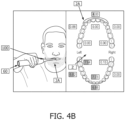
- Some embodiments such as shown in Figs. 3 and 4A - 4C , exemplify providing instantaneous feedback through a user interface 60 including an illuminated portion of a handle and a coverage calculation based on the duration and pressure of device head 10 within a treatment region.
- some embodiments provide instantaneous feedback regarding the status in context of compliance with data criteria for reaching a brushing endpoint corresponding with cleaning segments such as the rear lower inward facing sextant 6A in as shown in Figs. 4A and 4C and front outward facing upper sextant 2A depicted in Fig. 4B through an orange light to indicate further brushing to reach an endpoint and a white-blue light upon compliance with endpoint data criteria.
- Feedback may include numeric or alphanumeric, haptic or audible indicators of the duration of device head 10 in corresponding cleaning segments shown in the numerical dwell time readouts adjacent to the relevant cleaning segments in right frames of Figs. 4A - 4C .
- Figs. 4A and 4B showing instantaneous feedback in a first indicator displays an illuminated portion of an orange light in handle 20 when data sensed by device head 10 indicates that the duration and pressure sensed the coverage area of the outside bottom left cleaning segment, i.e., sextant 6A of Fig. 2 , does not comply with endpoint criteria for that cleaning segment.
- Figs. 4A - 4C exemplify providing dwell time readouts of brushed cleaning segments adjacent to the relevant cleaning segment shown in the right frames of the respective figures wherein the readouts are highlighted to indicate endpoint.
- Embodiments and implementations of the device and method may further include the step of communicating feedback when device head 10 is repositioned within a cleaning region wherein the controller indicates previous compliance with data criteria corresponding with reaching an endpoint.
- a further feature may include the controller providing corresponding feedback to user interface 60 when device head 10 is repositioned within a cleaning region wherein the data criteria indicative of partial compliance.
- a yet further feature of the illustrated embodiments illustrated in Figs. 4A - 4C and pointed out in Fig. 5 includes the step of communicating feedback regarding all treatment or cleaning regions covered in a session.
- oral care device 100 can include a sensor(s) 30 including, for example, an inertial motion sensor having a camera utilized to determine whether the device is located within a cleaning segment of the user's oral cavity.
- sensor(s) 30 could generate sensor data in response to typical cleaning motions and can link this information to a template of specific locations within the mouth.
- a difference in motion between front teeth and molars can be used to determine which time samples are from the molars and which samples are collected at the front teeth.
- the device or system may employ a dental model of the user's oral cavity that is predetermined or based on learned information of AI about where within the user's oral cavity 2 the oral care device 100 is generally first activated.
- the system may determine after several uses that the user always starts on the lower right outer quadrant.
- the device or system may utilize two or more of these approaches simultaneously or sequentially to further refine the localization of the oral care device 10 within the user's oral cavity 2, and, more specifically, whether that locale is a particular cleaning segment. For example, prior knowledge about the likelihood of a typical starting position could be utilized together with an estimate obtained from sensor data to achieve a more accurate read of the oral care device 100 location within the user's oral cavity 2.
- the orientation, duration and/or motion data collected by oral care device 100 when it is located within a cleaning region can be stored for future processing. Since the user may temporarily deviate from expected behavior, additional processing steps can be applied through application of algorithms and/or AI to improve the precision of the estimate.
- oral care device 100 can deduce and therefore track the orientation and/or location of the oral care device 100 as the user moves it throughout the oral cavity 2, adopting new orientations and locations.
- the various implementations enhance and speeds and lowers cost of cleaning or other dental treatment applications.
- Such instantaneous feedback enables the user to simultaneously adapt toothbrushing coverage and pressure.
- the embedded user interface further saves time, effort and inconvenience in coordination of setting up an aptly configured support stand or structure resulting from the user's juggling of a second electronic device such as a smartphone, then coordinating the relative orientation and pressure placed on the oral care device while simultaneously keeping the feedback provided on the smartphone display in sight.
- the embedded user interface 60 provides a display that moves in tandem with the oral care device 100 and thereby imparts advantages of keeping the display in the user's line of view while simultaneously brushing.
- Refraining from external transmissions to electronic devices confers numerous further advantages including substantially shortened and thus much faster feedback loops, as well as, improved accuracy and levels of sensed and processed data reflected in feedback provided in the user interface 60 and maintaining the security of user data by hardwired configuration of sensor(30), controller (40), processor (50) together with memory 52 and connectivity module 54 within a closed feedback loop to thereby eliminating buses or any potential communication mechanism for transmission of data or feedback information to external devices and network.
- Yet further advantages include adaptability of oral care device 100 to oral cavity and dentition geometries deviating from statistical averages by incorporating actual scans and detected toothbrushing trajectories corresponding with varied geometries into user dental models.
- Such irregularities may include dental malocclusion, wide, shallow as well as, deep and narrow dental arches, deviant or irregular positioning of maxillary and mandibular arches such as, for example, boney defect or any combination of naturally or unnaturally missing teeth.
- inventive embodiments are presented by way of example only and that, within the scope of the appended claims and equivalents thereto, inventive embodiments may be practiced otherwise than as specifically described and claimed.
- inventive embodiments of the present disclosure are directed to each individual feature, system, article, material, kit, and/or method described herein.
Landscapes
- Health & Medical Sciences (AREA)
- Life Sciences & Earth Sciences (AREA)
- Dentistry (AREA)
- Epidemiology (AREA)
- Animal Behavior & Ethology (AREA)
- General Health & Medical Sciences (AREA)
- Public Health (AREA)
- Veterinary Medicine (AREA)
- Biophysics (AREA)
- Brushes (AREA)
Priority Applications (1)
| Application Number | Priority Date | Filing Date | Title |
|---|---|---|---|
| PCT/EP2023/086831 WO2024133385A1 (fr) | 2022-12-22 | 2023-12-20 | Dispositif, procédé et système de rétroaction instantanée de soins buccaux |
Applications Claiming Priority (1)
| Application Number | Priority Date | Filing Date | Title |
|---|---|---|---|
| US202263434546P | 2022-12-22 | 2022-12-22 |
Publications (1)
| Publication Number | Publication Date |
|---|---|
| EP4389065A1 true EP4389065A1 (fr) | 2024-06-26 |
Family
ID=85462322
Family Applications (1)
| Application Number | Title | Priority Date | Filing Date |
|---|---|---|---|
| EP23159925.9A Withdrawn EP4389065A1 (fr) | 2022-12-22 | 2023-03-03 | Dispositif, procédé et système de rétroaction instantanée de soins buccaux |
Country Status (1)
| Country | Link |
|---|---|
| EP (1) | EP4389065A1 (fr) |
Citations (5)
| Publication number | Priority date | Publication date | Assignee | Title |
|---|---|---|---|---|
| US20080141478A1 (en) * | 2006-12-13 | 2008-06-19 | Gatzemeyer John J | Interactive oral care implement system |
| WO2016046701A1 (fr) * | 2014-09-24 | 2016-03-31 | Koninklijke Philips N.V. | Systèmes et procédés pour fournir une rétroaction de motivation à un utilisateur avant un brossage |
| US20160343270A1 (en) * | 2013-10-25 | 2016-11-24 | Pogolab Limited | Improvements in training devices for tooth brushing |
| US20190008619A1 (en) * | 2015-12-29 | 2019-01-10 | Koninklijke Philips N.V. | Methods and systems for providing brushing session feedback |
| US20190045916A1 (en) * | 2016-02-25 | 2019-02-14 | Koninklijke Philips N.V. | Method and system for a achieving optimal oral hygiene by means of feedback |
-
2023
- 2023-03-03 EP EP23159925.9A patent/EP4389065A1/fr not_active Withdrawn
Patent Citations (5)
| Publication number | Priority date | Publication date | Assignee | Title |
|---|---|---|---|---|
| US20080141478A1 (en) * | 2006-12-13 | 2008-06-19 | Gatzemeyer John J | Interactive oral care implement system |
| US20160343270A1 (en) * | 2013-10-25 | 2016-11-24 | Pogolab Limited | Improvements in training devices for tooth brushing |
| WO2016046701A1 (fr) * | 2014-09-24 | 2016-03-31 | Koninklijke Philips N.V. | Systèmes et procédés pour fournir une rétroaction de motivation à un utilisateur avant un brossage |
| US20190008619A1 (en) * | 2015-12-29 | 2019-01-10 | Koninklijke Philips N.V. | Methods and systems for providing brushing session feedback |
| US20190045916A1 (en) * | 2016-02-25 | 2019-02-14 | Koninklijke Philips N.V. | Method and system for a achieving optimal oral hygiene by means of feedback |
Similar Documents
| Publication | Publication Date | Title |
|---|---|---|
| CN110419853B (zh) | 牙刷系统 | |
| US10188203B2 (en) | Systems and methods for providing motivation feedback to a user before brushing | |
| US11006742B2 (en) | Method and system for a achieving optimal oral hygiene by means of feedback | |
| CN109803558B (zh) | 智能牙刷 | |
| RU2738074C2 (ru) | Система гигиены ротовой полости с визуальным распознаванием для контроля соблюдения правил чистки зубов | |
| CN109788845B (zh) | 智能牙刷 | |
| US11039907B2 (en) | Methods and systems for providing brushing session feedback | |
| JP7454376B2 (ja) | 歯の清掃中のユーザの頭の向きを特定する方法 | |
| CN109862807B (zh) | 智能牙刷 | |
| CN206238734U (zh) | 刷牙监测设备及刷牙监测系统 | |
| JP2019534094A (ja) | 口腔クリーニング装置の位置特定のための方法およびシステム | |
| JP7394622B2 (ja) | 協調型個人ケア装置のためのネットワーク | |
| CN106333480A (zh) | 刷牙监测设备、刷牙监测方法及刷牙监测系统 | |
| EP3537928B1 (fr) | Dispositif de nettoyage buccal de détermination de conformité à une séance de nettoyage guidée | |
| WO2024133385A1 (fr) | Dispositif, procédé et système de rétroaction instantanée de soins buccaux | |
| EP4389065A1 (fr) | Dispositif, procédé et système de rétroaction instantanée de soins buccaux |
Legal Events
| Date | Code | Title | Description |
|---|---|---|---|
| PUAI | Public reference made under article 153(3) epc to a published international application that has entered the european phase |
Free format text: ORIGINAL CODE: 0009012 |
|
| STAA | Information on the status of an ep patent application or granted ep patent |
Free format text: STATUS: THE APPLICATION HAS BEEN PUBLISHED |
|
| AK | Designated contracting states |
Kind code of ref document: A1 Designated state(s): AL AT BE BG CH CY CZ DE DK EE ES FI FR GB GR HR HU IE IS IT LI LT LU LV MC ME MK MT NL NO PL PT RO RS SE SI SK SM TR |
|
| STAA | Information on the status of an ep patent application or granted ep patent |
Free format text: STATUS: THE APPLICATION IS DEEMED TO BE WITHDRAWN |
|
| 18D | Application deemed to be withdrawn |
Effective date: 20250103 |