EP4389190A1 - Appareil d'entraînement au microblading semi-permanent et stylo utilisant un appareil d'entraînement - Google Patents
Appareil d'entraînement au microblading semi-permanent et stylo utilisant un appareil d'entraînement Download PDFInfo
- Publication number
- EP4389190A1 EP4389190A1 EP22871948.0A EP22871948A EP4389190A1 EP 4389190 A1 EP4389190 A1 EP 4389190A1 EP 22871948 A EP22871948 A EP 22871948A EP 4389190 A1 EP4389190 A1 EP 4389190A1
- Authority
- EP
- European Patent Office
- Prior art keywords
- sleeve
- coloring
- connecting portion
- tattoo
- rod
- Prior art date
- Legal status (The legal status is an assumption and is not a legal conclusion. Google has not performed a legal analysis and makes no representation as to the accuracy of the status listed.)
- Granted
Links
Images






Classifications
-
- A—HUMAN NECESSITIES
- A61—MEDICAL OR VETERINARY SCIENCE; HYGIENE
- A61M—DEVICES FOR INTRODUCING MEDIA INTO, OR ONTO, THE BODY; DEVICES FOR TRANSDUCING BODY MEDIA OR FOR TAKING MEDIA FROM THE BODY; DEVICES FOR PRODUCING OR ENDING SLEEP OR STUPOR
- A61M37/00—Other apparatus for introducing media into the body; Percutany, i.e. introducing medicines into the body by diffusion through the skin
- A61M37/0076—Tattooing apparatus
-
- A—HUMAN NECESSITIES
- A61—MEDICAL OR VETERINARY SCIENCE; HYGIENE
- A61M—DEVICES FOR INTRODUCING MEDIA INTO, OR ONTO, THE BODY; DEVICES FOR TRANSDUCING BODY MEDIA OR FOR TAKING MEDIA FROM THE BODY; DEVICES FOR PRODUCING OR ENDING SLEEP OR STUPOR
- A61M37/00—Other apparatus for introducing media into the body; Percutany, i.e. introducing medicines into the body by diffusion through the skin
-
- B—PERFORMING OPERATIONS; TRANSPORTING
- B41—PRINTING; LINING MACHINES; TYPEWRITERS; STAMPS
- B41J—TYPEWRITERS; SELECTIVE PRINTING MECHANISMS, i.e. MECHANISMS PRINTING OTHERWISE THAN FROM A FORME; CORRECTION OF TYPOGRAPHICAL ERRORS
- B41J2/00—Typewriters or selective printing mechanisms characterised by the printing or marking process for which they are designed
- B41J2/22—Typewriters or selective printing mechanisms characterised by the printing or marking process for which they are designed characterised by selective application of impact or pressure on a printing material or impression-transfer material
- B41J2/31—Typewriters or selective printing mechanisms characterised by the printing or marking process for which they are designed characterised by selective application of impact or pressure on a printing material or impression-transfer material using a print element with projections on its surface impacted or impressed by hammers
-
- G—PHYSICS
- G09—EDUCATION; CRYPTOGRAPHY; DISPLAY; ADVERTISING; SEALS
- G09B—EDUCATIONAL OR DEMONSTRATION APPLIANCES; APPLIANCES FOR TEACHING, OR COMMUNICATING WITH, THE BLIND, DEAF OR MUTE; MODELS; PLANETARIA; GLOBES; MAPS; DIAGRAMS
- G09B19/00—Teaching not covered by other main groups of this subclass
- G09B19/24—Use of tools
Definitions
- the present invention relates to the technical field of teaching and training aids of the tattoo industry, and in particular, to a tattoo practice device applicable to tattoo practice and design and an operation pen using the practice device.
- Tattooing is a skin-breaking and coloring beauty method, in which a tool is used to puncture a body skin or a facial skin and deliver pigment to a specific depth to retain for a period of time. Because an ideal tattoo state is to have less skin damage and more color retention, the operation principle of the mainstream tattoo tool is mostly using the tip of the tool to break a skin and deliver pigment in dots. Whether the pattern is a line pattern or a block pattern, it is formed by arranging several colored points.
- tattooists use common drawing tools such as pencils, brushes, pens, and gel ink pens for tattoo drawing practice.
- a nib (coloring portion) for coloring of ordinary stationery is static relative to the hand during use.
- a nib (coloring portion) for coloring of the tattoo tool (manually operated or electrically operated) performs a striking movement reciprocating up and down relative to the hand during use.
- the tattoo practice device includes a coloring portion, a connecting portion, and a sleeve, wherein the coloring portion includes one or more coloring rods, and the coloring rods are arranged in a dot matrix; one end of the connecting portion is connected to the coloring portion, the connecting portion is linked with the coloring portion, and the sleeve is sleeved on a periphery of the connecting portion; the connecting portion is connected to an external driving member, and the connecting portion is configured to move in a first direction along a central axis of the sleeve, so that the lead core is close to a drawing medium and color the drawing medium; and the connecting portion is configured to move in a second direction opposite to the first direction along the central axis of the sleeve, so that the lead core moves away from the drawing medium.
- the tattoo practice device further comprises an elastic member, wherein one end of the elastic member is connected to the sleeve, an other end of the elastic member is connected to the connecting portion, and when the connecting portion is driven by an external force to move along the central axis of the sleeve to an outlet end of the sleeve close to the coloring portion, the elastic member elastically deforms to pull the connecting portion to restore to an initial position.
- the elastic member comprises a spring, a silicone member, and a rubber band.
- the tattoo practice device further comprises an angle clamping member, wherein the angle clamping member is arranged on the outlet end of the sleeve close to the coloring portion; when the coloring rod is driven with the connecting portion to move to the outlet end of the sleeve, an outer wall of the coloring rod abuts against the angle clamping member, and the angle clamping member limits an inclination angle of the coloring rod relative to the central axis of the sleeve; and the angle clamping member limits a length of the coloring rod protruding out of the angle clamping member.
- the angle clamping member comprises one or more clamping plates, and the clamping plates are arranged on the outlet end of the sleeve; when the coloring rod is driven with the connecting portion to move to the outlet end of the sleeve, the outer wall of the coloring rod abuts against one side of the clamping plates, the clamping plate limits the inclination angle of the coloring rod relative to the central axis of the sleeve, and the clamping plate limits the length of the coloring rod protruding out of the angle clamping member.
- clamping plates are evenly arranged on the outlet end of the sleeve, and when the coloring rod is driven to move to the outlet end of the sleeve, the clamping plates surround a periphery of the coloring rod.
- the angle clamping member comprises a clamping tube, one end of the clamping tube is connected to the outlet end of the sleeve, and an other end of the clamping tube is a free open end; and when the coloring rod is driven with the connecting portion to move to the outlet end of the sleeve, the outer wall of the coloring rod abuts against an inner wall of the clamping tube, the clamping tube limits the inclination angle of the coloring rod relative to the central axis of the sleeve, and the clamping tube limits the length of the coloring rod protruding out of the angle clamping member.
- the coloring portion further comprises a mounting base, and one or more coloring rods are connected to the mounting base.
- a mounting panel and a connecting panel are arranged opposite to each other on the mounting base, the coloring rods are mounted on the mounting panel, a central axis of the coloring rod is perpendicular to the mounting panel, and the connecting panel is connected to the connecting portion.
- the coloring rods are arranged on the mounting panel in a dot matrix to form a bunch, or the coloring rods are arranged on the mounting panel in a dot matrix to form at least one row.
- the coloring rod is an elongated columnar structure, and two end surfaces of the elongated columnar structure have a same shape and a same size; or the two end surfaces of the elongated columnar structure have different shapes and different sizes, and a size of one end surface close to the connecting portion is greater than a size of the other end surface.
- the coloring rod comprises a columnar rod material capable of forming color spots on the drawing medium.
- the coloring rod comprises a rod-shaped lead core and a wooden stick with ink sac.
- coloring portion and the connecting portion are in an integral design or a separate design.
- the connecting portion comprises a connecting rod, one end of the connecting rod is fixedly connected to the connecting panel of the mounting base, and an other end of the connecting rod is detachably connected to the external driving member.
- the external driving member comprises a manual pen and an electric pen.
- the sleeve is a tubular sleeve, the sleeve has a fastening end, a middle connecting tube, and an outlet end, the fastening end, the middle connecting tube, and the outlet end are sequentially connected to form a channel for the connecting portion to reciprocate, and a central axis of the fastening end and a central axis of the middle connecting tube separately coincide with the central axis of the sleeve;
- the fastening end is detachably connected to the external driving member, and an outlet is provided at the outlet end.
- the connecting portion and the coloring portion arranged at the end of the connecting portion are mounted in the middle connecting tube of the sleeve along the central axis of the sleeve, the coloring portion is close to the outlet end, the connecting portion reciprocates in the middle connecting tube, and the connecting portion drives the coloring rod of the coloring portion to extend out of the outlet or retract into the outlet.
- a handheld positioning portion is formed on the sleeve, the handheld positioning portion comprises one or more finger position points arranged on the middle connecting tube of the sleeve, and fingers hold the sleeve in alignment through the finger position points; or an elastic ring is sleeved on the middle connecting tube of the sleeve, and one or more finger position points are arranged on the elastic ring.
- one or more dents are arranged on one finger position point, and the dents are arranged in dots to form one finger position point; or one or more circles of ring belts are arranged on one finger position point, and the ring belts comprise a convex ring belt and a concave ring belt.
- a limiting structure is arranged on the sleeve; the limiting structure is arranged in the middle connecting tube of the sleeve and/or on the fastening end of the sleeve and/or on the outlet end of the sleeve; and when the connecting portion reciprocates along the central axis of the sleeve, the connecting portion abuts against the limiting structure, and the limiting structure limits swinging of the connecting portion in a cross-sectional direction of the sleeve, to cause the connecting portion to drive the coloring rod of the coloring portion to vertically extend out of the sleeve until the coloring rod abuts against a drawing medium, and to cause the connecting portion to drive the coloring rod of the coloring portion to vertically retract from the outside of the outlet into the sleeve.
- the limiting structure comprises a limiting hole and/or a limiting tube.
- the limiting hole is provided with a through hole, and when the connecting portion reciprocates along the central axis of the sleeve, the connecting portion abuts against the through hole, and the through hole limits the swinging of the connecting portion in the cross-sectional direction of the sleeve.
- the limiting tube has a channel, and when the connecting portion reciprocates along the central axis of the sleeve, the connecting portion abuts against the channel, and the channel limits the swinging of the connecting portion in the cross-sectional direction of the sleeve.
- the limiting structure comprises a limiting baffle
- the limiting baffle has a limiting panel
- a plane on which the limiting panel is located forms an angle with or is parallel to a central axis of the connecting portion; and when the connecting portion reciprocates along the central axis of the sleeve, the connecting portion abuts against the limiting panel, and the limiting panel limits the swinging of the connecting portion in the cross-sectional direction of the sleeve.
- the limiting structure comprises a limiting support, the limiting support is arranged at an end of or inside the sleeve, the limiting support comprises one or more sub-supports, one side of the sub-support abuts against the connecting portion, and the sub-support limits the swinging of the connecting portion in the cross-sectional direction of the sleeve; and when the connecting portion reciprocates along the central axis of the sleeve, the connecting portion abuts against one side of the sub-support, and the connecting portion is guided to the outlet of the sleeve under abutment of the sub-support.
- a splitting portion is detachably mounted on the top of the sleeve, and the top of the connecting portion runs through the splitting portion and is arranged above the splitting portion; in a state that the splitting portion is mounted on the sleeve, the splitting portion limits a space for an upward movement of the connecting portion, making the connecting portion and the lead core fail to be separated from the sleeve; and in a state that the splitting portion is detached from the sleeve, the splitting portion releases limitation on the upward movement of the connecting portion, enabling the connecting portion and the lead core to be separated from the sleeve from the top of the sleeve.
- the present invention further provides a tattoo operation pen, including the tattoo practice device; and further includes an operation penholder and a driving member in the operation penholder, wherein one end of the operation penholder is detachably connected to a fastening end of a sleeve of the tattoo practice device, the driving member is connected to a connecting portion of the tattoo practice device, and the driving member drives the connecting portion to reciprocate in the sleeve.
- orientation or position relationships indicated by the terms such as “over”, “below”, “top”, “bottom”, “inner”, and “outer” are based on orientation or position relationships shown in the accompanying drawings, and are used only for ease and brevity of illustration and description for the present invention, rather than indicating or implying that the mentioned apparatus or component need to have a particular orientation or need to be constructed and operated in a particular orientation. Therefore, such terms should not be construed as limiting of the present invention.
- "a plurality of” means two or more, unless otherwise definitely and specifically limited.
- connection should be understood broadly, for example, which may be a fixed connection, a detachable connection, or an integral connection; or the connection may be a mechanical connection or an electrical connection; or the connection may be a direct connection, an indirect connection through an intermediate, for example, a mechanical abutment connection or contact connection through abutment, contact, and the like, or may be internal communication between two elements or an interaction relationship between two elements.
- a person of ordinary skill in the art can understand specific meanings of the foregoing terms in the present invention according to a specific situation.
- the existing tattoo tool is mainly formed by fixing one or more metal needle wires with one end sharpened to a needle handle, putting a spring on the needle handle, and then putting the needle handle in a sleeve.
- This tattoo tool is fixed to a tattoo pen through one end of the sleeve, and under power transmission, the needle handle drives the needle wire to reciprocate along a central axis of the sleeve to complete a skin-breaking and coloring operation.
- the needle wire of the tattoo tool used by a tattooist is always dynamic, with the needle wire reciprocating relative to the sleeve. In this dynamic operating condition, it is difficult for the tattooist to acquire operating experience. Therefore, to perform hands-on tattooing on a human body, the tattooist needs to undergo a lot of training.
- tattooists use common drawing tools such as pencils, brushes, pens, and gel ink pens for tattoo drawing practice. Compared with a professional tattoo tool, a nib (coloring portion) for coloring of ordinary stationery is static relative to the hand during use.
- a nib (coloring portion) for coloring of the tattoo tool performs a striking movement reciprocating up and down relative to the hand during use. Therefore, there is a large difference between the drawing tool used for tattoo needling or tattoo design drawing practice and the professional tool for tattoo hands-on operation.
- the former is static and the latter is dynamic in operation principles during tattoo coloring, they differ in sense of use and the operation precautions, and in the entire drawing process, they differ the way holding gesture, strength control, and speed of handling the pen.
- tattoo drawing experience of using the ordinary stationery to practice drawing mismatches drawing experience required during hands-on operation, making it difficult for a beginner to acquire tattooing experience, and causing a significant discrepancy between a tattoo practice effect and a hands-on operation effect.
- Drawing well during practice does not mean doing well during hands-on operation.
- the existing feel and muscle memory practiced by using static drawing tools cannot adapt to a dynamic movement of a tattoo tool during hands-on coloring.
- the tattoo practice involves much useless work, the practice mismatches the hands-on operation seriously, the learning period is long, and the completion rate is low, causing a low excellent rate of hands-on tattooing on human skin.
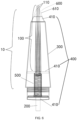
- FIG. 1 is a schematic structural diagram of a tattoo practice device.
- the tattoo practice device 10 includes a coloring portion 100, a connecting portion 200, and a sleeve 300.
- the coloring portion 100 includes one or more coloring rods 110, and the more coloring rods 110 are arranged in a dot matrix (the coloring portion 100 shown in FIG. 1 includes one coloring rod 110).
- One end of the connecting portion 200 is connected to the coloring portion 100, the connecting portion 200 is linked with the coloring portion 100, and the sleeve 300 is sleeved on a periphery of the connecting portion 200.
- the tattoo practice device 10 restores a dynamic operation environment of the tattoo tool in hands-on operation compared with common stationery that the tattooist commonly uses for practice.
- the coloring portion 100 of the tattoo practice device 10 in the present invention may include a mounting base 120 and the coloring rod 110.
- One or more coloring rods 110 are connected to the mounting base 120.
- the coloring rods 110 are arranged on the mounting base 120 in a dot matrix to form a bunch, or the coloring rods 110 are arranged on the mounting base 120 in a dot matrix to form at least one row.
- Dot coloring, line coloring, or block coloring may be involved in practical tattooing. Therefore, there are different types of tattoo tools corresponding to different coloring requirements.
- the practice device provided in the present invention may also be randomly transformed into practice devices corresponding to various types of tattoo tools.
- the coloring portion 100 of the tattoo practice device 10 provided in the present invention has a row of coloring rods 110.
- the coloring portion 100 of the tattoo practice device 10 provided in the present invention has a bunch of coloring rods 110.
- a mounting panel and a connecting panel opposite to each other may be arranged on the mounting base 120.
- the coloring rods 110 are mounted on the mounting panel, a central axis of the coloring rod 110 is perpendicular to the mounting panel, and the connecting panel is connected to the connecting portion 200.
- the coloring rods 110 are perpendicular to the mounting panel to adapt to a needling operation that perpendicularly pierces the skin for breaking and coloring the skin.
- an end surface of one end of the connecting portion 200 connected to the coloring portion 100 may be directly connected to the coloring rod 110.
- the end surface of the connecting portion 200 replaces the function of the mounting base 120. Therefore, the coloring portion 100 and the connecting portion 200 may be in an integral design, or may be in a separate detachable design.
- the coloring rod 110 used in the practice device in the present invention may be any elongated columnar structure.
- two end surfaces of the elongated columnar structure have a same shape and a same size, for example, a columnar body with two ends of a same size.
- the two end surfaces of the elongated column structures have different shapes and different sizes, and a size of one end surface close to the connecting portion 200 is greater than a size of the other end surface, for example, one end is a cone-like body with an end surface close to the connecting portion 200 as a conical bottom.
- the connecting portion 200 may be a connecting rod 210.
- One end of the connecting rod 210 is fixedly connected to the connecting panel of the mounting base 120, and an other end of the connecting rod 210 is detachably connected to an external driving member.
- the external driving member may be a manual pen or an electric pen 700.
- the sleeve 300 in the practice device in the present invention may be a tubular sleeve or a tube-like sleeve.
- the sleeve 300 includes a fastening end 310, a middle connecting tube 320, and an outlet end 330.
- the fastening end 310, the middle connecting tube 320, and the outlet end 330 are sequentially connected to form a channel for the connecting portion 200 to reciprocate, and a central axis of the fastening end 310 and a central axis of the middle connecting tube 320 separately coincide with a central axis of the sleeve 300.
- the fastening end 310 is detachably connected to the external driving member.
- An outlet 331 is provided on the outlet end 330.
- the connecting portion 200 and the coloring portion 100 arranged at the end of the connecting portion 200 are mounted in the middle connecting tube 320 of the sleeve 300 along the central axis of the sleeve 300.
- the coloring portion 100 is close to the outlet end 330, the connecting portion 200 reciprocates in the middle connecting tube 320, and the connecting portion 200 drives the coloring rod 110 of the coloring portion 100 to extend out of the outlet 331 or retract into the outlet 331.
- the external driving member may be an electric pen 700.
- the fastening end 310 of the sleeve 300 of the practice device is connected to one end of an operation penholder 710 of the electric pen 700.
- a pitch adjustment component 720 and a top rod 730 adjusted by the pitch adjustment component 720 are further arranged at the end of the operation penholder 710 connected to the sleeve 300, and the top rod 730 is connected to an end portion of the connecting portion 200 of the practice device.
- the pitch adjustment component 720 is adjusted (the pitch adjustment component 720 is adjusted through rotation along a direction of an arrow A in FIG.
- a length by which the top rod 730 extends out may be changed (referring to FIG. 3 , after the pitch adjustment component 720 is adjusted through rotation along the direction of the arrow A, the end surface of the top rod 730 rises from a plane a to a plane a1), so that the connecting portion 200 abutting against the top rod 730 is controlled, and then a length by which the coloring portion 100 protrudes from the outlet end 330 of the sleeve 300 is adjusted.
- the coloring rod 110 of the tattoo practice device 10 reciprocates in an axial direction of the sleeve 300. Therefore, when the practice device is used to draw a pattern along a direction of an arrow C, a dotted drawing trajectory occurs, which is consistent with a principle of dotted breaking and coloring the skin by using the tip of the tool when the tattoo tool is used for operation on the human skin. This helps an operator practice the feel and the muscle memory in a dynamic environment immersively, thereby facilitating hands-on operation using a formal tattoo tool seamlessly.
- the coloring portion 100 shown in FIG. 4 has a coloring rod 110.
- the coloring rod 110 may be a 2B lead with a thickness of 0.9 mm.
- the sleeve 300 forms a handheld portion of the tattoo practice device 10.
- a handheld positioning portion may be further arranged on the sleeve 300 that is used as the handheld portion of the tattoo practice device 10.
- the handheld positioning portion may include one or more finger position points arranged on the middle connecting tube 320 of the sleeve 300. Fingers of the user hold the sleeve 300 in alignment by using the finger position points. That is, during use, the finger position points on the sleeve 300 can instruct the user to hold the sleeve in alignment, helping the user to develop a correct holding gesture, so that the user can adapt to sense of control of the professional tattoo tool during tattoo hands-on operation.
- an elastic ring may be sleeved on the middle connecting tube 320 of the sleeve 300, and then the finger position points are arranged on the elastic ring.
- the middle connecting tube 320 of the sleeve 300 is a component with a largest area that is held by the user.
- the arrangement of the elastic ring can improve holding comfort, and increase friction force.
- the finger position points are arranged on the elastic ring, so that the elastic ring can be replaced conveniently when the finger position points are abraded.
- one or more dents 321 may be arranged on one finger position point.
- two dents or more dents may be arranged, but only two dents are shown in the visible part of FIG. 11 ) are arranged on the middle connecting tube 320 shown in the figure.
- One dent 321 forms one finger position point, and a shape and an area of the dent may be designed according to a contact area of the finger part at the finger position point when the user holds the sleeve.
- a plurality of small dents may alternatively be arranged in dots to form one finger position point. That is, the plurality of small dents are densely distributed to form a region, the region is one finger position point, and an area and a shape of the finger position point may be designed according to a contact area of the finger part at the finger position point when the user holds the sleeve.
- one or more circles of ring belts may alternatively be arranged on one finger position point, and the ring belt may be a convex ring belt or a concave ring belt. If one circle of convex ring belt encloses one finger position point, a shape and an area enclosed by the convex ring belt may be designed according to a contact area of the finger part at the finger position point when the user holds the sleeve. If a plurality of circles of convex ring belts are distributed in a region, and the region forms one finger position point, the plurality of circles of ring belts may be adjacently distributed densely, or may be sleeved in a form of concentric circles to form a region.
- One or more finger position points arranged in the foregoing embodiments may assist the user to hold at a fixed position and master a standard holding gesture, and the dent or the ring belt arranged on the finger position point may be used to form a positioning mark of the finger position point, and increase friction force between the finger and the sleeve, to ensure that the hand tightly holds the pen and the finger is not easy to move.
- a limiting structure 400 may further be arranged on the sleeve 300.
- the limiting structure 400 is arranged in the middle connecting tube 320 of the sleeve 300, or on the fastening end 310 of the sleeve 300, or on one or more positions on the outlet end 330 of the sleeve 300.
- the connecting portion 200 When the connecting portion 200 reciprocates along the central axis of the sleeve 300, the connecting portion 200 abuts against the limiting structure 400, and the limiting structure 400 limits swinging of the connecting portion 200 in a cross-sectional direction of the sleeve 300, to cause the connecting portion 200 to drive the coloring rod 110 of the coloring portion 100 to vertically extend out of the sleeve 300 until the coloring rod 110 abuts against the drawing medium, and to cause the connecting portion 200 to drive the coloring rod 110 of the coloring portion 100 to vertically retract from the outside of the outlet into the sleeve 300.
- the design of the limiting structure 400 can ensure that the coloring portion 100 in the practice device can better enter and exit the sleeve 300, avoiding bending, breaking, or the like.
- the limiting structure 400 also ensures stability and verticality of the coloring portion 100 entering and exiting the sleeve 300, which can better restore the operation state during practical tattooing.
- the limiting structure 400 may include a limiting hole 410, and the limiting hole 410 is provided with a through hole (it may be seen from FIG. 1 that the connecting rod 210 runs through the through hole, forming a hole-shaped limiting).
- the connecting portion 200 reciprocates along the central axis of the sleeve 300, the connecting portion 200 abuts against the through hole, and the through hole limits the swinging of the connecting portion 200 in the cross-sectional direction of the sleeve 300.
- the limiting structure 400 may include a limiting tube 420, and the limiting tube 420 has a channel (the limiting tube 420 shown in FIG. 1 may be understood as a functional replacement of the outlet end 330 of the sleeve 300, which simplifies the structural design while maintaining the structural functionality).
- the connecting portion 200 reciprocates along the central axis of the sleeve 300, the connecting portion 200 abuts against the channel, and the channel limits the swinging of the connecting portion 200 in the cross-sectional direction of the sleeve 300.
- the limiting structure 400 may alternatively be a limiting baffle, the limiting baffle has a limiting panel, and a plane on which the limiting panel is located forms an angle with or is parallel to a central axis of the connecting portion 200.
- the connecting portion 200 reciprocates along the central axis of the sleeve 300, the connecting portion 200 abuts against the limiting panel, and the limiting panel limits the swinging of the connecting portion 200 in the cross-sectional direction of the sleeve 300.
- the limiting baffle may be arranged at the outlet of the outlet end of the sleeve.
- the limiting baffle extends outward from an end surface at the outlet, a panel of the limiting baffle close to a central position of the outlet forms the limiting panel, and an extension direction of the limiting panel forms an angle with or is parallel to the central axis of the connecting rod. In this way, when the coloring portion is driven to extend out from the outlet, the limiting panel may abut against the coloring rod, to limit swinging of the coloring rod in the cross-sectional direction of the sleeve.
- the limiting structure 400 may alternatively include a limiting support, the limiting support is arranged at an end of or inside the sleeve 300.
- the limiting support includes one or more sub-supports, one side of the sub-support abuts against the connecting portion 200, and the sub-support limits the swinging of the connecting portion 200 in the cross-sectional direction of the sleeve 300.
- an angle clamping member 600 is arranged at the outlet end of the sleeve of the tattoo practice device in FIG. 6 .
- the angle clamping member 600 includes a clamping plate 610 with one end connected to the outlet end and an other end being a free end. Three clamping plates 610 are shown in FIG. 6 , the three clamping plates are distributed at the outlet of the sleeve in a triangle, and one of the clamping plates is blocked due to perspective.
- the clamping plate 610 may also be understood as a limiting support, and this structural functional coverage can simplify the structural design while maintaining the structural functionality of the kit.
- the limiting structure 400 arranged on the sleeve 300 may be one or a combination limiting of a plurality of hole-shaped limiting, tube-shaped limiting, baffle limiting, or support limiting.
- the present invention further provides a tattoo practice device 10.
- the practice device not only includes the structural features of the practice device according to Embodiment 1, but also may include an elastic member 500.
- One end of the elastic member 500 is connected to the sleeve 300, and an other end of the elastic member 500 is connected to the connecting portion 200 (a connection relationship between the elastic member 500 and the connecting portion 200 or the sleeve 300 may be any one of abutment connection, hanging connection, sleeve connection, or contact connection, mainly for elastically pulling back the connecting portion 200).
- FIG. 6 shows a tattoo practice device 10 equipped with an elastic member 500.
- the elastic member 500 elastically deforms to pull the connecting portion 200 back to an initial position.
- the elastic member 500 may be any one of a spring, a silicone member, and a rubber band.
- the practice device provided in this embodiment gives a specific automatic resilient function for the kit through mounting of the elastic member 500, and restores the dynamic operation environment.
- This practice device equipped with the elastic member 500 may be connected to a manual pen.
- the present invention further provides a tattoo practice device 10.
- the practice device may not only include the structural features of the practice device according to Embodiment 1, but also include the angle clamping member 600.
- the angle clamping member 600 is arranged at the outlet end 330 of the sleeve 300 close to the coloring portion 100.
- an outer wall of the coloring rod 110 abuts against the angle clamping member 600.
- the angle clamping member 600 may not only limit an inclination angle of the coloring rod 110 relative to the central axis of the sleeve 300, but also limit a length by which the coloring rod 110 protrudes from the angle clamping member 600.
- the angle clamping member 600 may include one or more clamping plates 610 (three clamping plates 610 are shown in FIG. 6 , the three clamping plates are distributed in a triangle at the outlet of the sleeve, and one of the clamping plates is blocked due to perspective), and the clamping plate 610 is arranged on the outlet end 330 of the sleeve 300.
- the coloring rod 110 When the coloring rod 110 is driven with the connecting portion 200 to move to the outlet end 330 of the sleeve 300, the outer wall of the coloring rod 110 abuts against one side of the clamping plate 610, the clamping plate 610 limits the inclination angle of the coloring rod 110 relative to the central axis of the sleeve 300, and the clamping plate 610 limits the length by which the coloring rod 110 protrudes from the angle clamping member 600.
- the plurality of clamping plates 610 are evenly arranged on the outlet end 330 of the sleeve 300, and when the coloring rod 110 is driven to move to the outlet end 330 of the sleeve 300, the plurality of clamping plates 610 surround a periphery of the coloring rod 110.
- the angle clamping member 600 may alternatively be a clamping tube, one end of the clamping tube is connected to the outlet end 330 of the sleeve 300, and an other end of the clamping tube is a free open end.
- the coloring rod 110 is driven with the connecting portion 200 to move to the outlet end 330 of the sleeve 300, the outer wall of the coloring rod 110 abuts against an inner wall of the clamping tube, the clamping tube limits the inclination angle of the coloring rod 110 relative to the central axis of the sleeve 300, and the clamping tube limits the length by which the coloring rod 110 protrudes from the angle clamping member 600.
- the tattoo practice device according to this embodiment may be combined and mounted with the electric pen or the manual pen, as shown in FIG. 7 .
- the tattoo practice device provided in this embodiment may have the elastic member mentioned in Embodiment 2.
- This embodiment provides a tattoo practice device 10.
- three coloring rods 110 are arranged in the coloring portion 100 of the tattoo practice device 10.
- the three coloring rods 110 are arranged in a dot matrix to form a bunch.
- the three coloring rods 110 may be three soft wooden sticks with ink sac.
- the kit is further provided with three limiting holes 410, a spring, and an angle clamping member 600.
- the angle clamping member 600 is a clamping plate 610.
- the practice device may be mounted on an electric pen 700, which is the same as the electric pen 700 shown in FIG. 2, FIG. 3, and FIG. 4 .
- the electric pen 700 shown in FIG. 7 has a pitch adjustment component 720, and a changeable length of a top rod 730 of the pitch adjustment component 720 extending out is adjusted, to control the connecting portion 200 connected to the top rod 730, thereby adjusting the length by which the coloring rod 110 protrudes from the angle clamping member 600.
- the best coloring technique for tattooing is vertically piercing the skin by using a tattoo tool.
- a higher verticality indicates a better tattoo effect, as shown in FIG. 8 .
- An angle between the coloring rod 110 of a practice device 10 shown in FIG. 8 and a drawing medium E is V1.
- V1 is equal to or infinitely close to 90 degrees
- the verticality is higher, which is closer to the best coloring technique required in the tattoo industry.
- a length L by which the coloring rod 110 protrudes from the angle clamping member 600 is longer, a requirement for the angle between the coloring rod 110 and the drawing medium is lower.
- drawing and coloring may also be performed when an angle V2 between the coloring portion 100 and the drawing medium E is far from 90 degrees.
- a length L2 by which the coloring rod 110 of the practice device in this embodiment protrudes from the angle clamping member 600 is smaller, an angle V3 between the coloring rod 110 and the drawing medium E is more required to be infinitely close to 90 degrees.
- the coloring rod can easily dispense pigment when in contact with the drawing medium E, which is also conducive to high standard training of the trainee for verticality feel.
- the length by which the coloring portion 100 of the tattoo practice device in the figure protrudes from the angle clamping member 600 is small.
- an angle V4 between the coloring portion 100 and the drawing medium E is far from 90 degrees, the coloring portion 100 cannot fully come into contact with the drawing medium E, and drawing practice cannot be performed. This can prompt the operator to adjust a training degree in time, to train the verticality feel of the trainee.
- the practice device includes a coloring portion 100.
- the coloring portion 100 includes three coloring rods 110 arranged in a single row.
- the three coloring rods 110 are HB leads with a thickness of 0.7 mm.
- the practice device further includes a connecting rod 210 connected to the coloring portion and a sleeve 300 sleeved on a periphery of the coloring portion 100 and the connecting rod 210.
- Two limiting holes 410, a spring 500 sleeved on the connecting rod 210 and having an end portion abutting against the structure inside the sleeve, and an angle clamping member 600 arranged at an outlet end 330 of the sleeve 300 are further arranged in the sleeve 300.
- the angle clamping member 600 in FIG. 11 may be actually understood as a clamping tube.
- the clamping tube is sleeved on a periphery of the coloring rod, and may limit an inclination angle of the coloring rod, and limit an extended length of the coloring rod.
- a dent 321 is further provided on the sleeve 300.
- the dent 321 can increase friction force when the sleeve 300 is held.
- the trainee's finger pads and finger joints can fit the dent 321 to prevent affecting practicing a high-verticality technique of the trainee due to tipping and sliding under power of the operation pen.
- corresponding structural design may also be performed according to a handheld gesture, such as arranging protrusions and ring belt strips or sleeving an anti-slip elastic ring at a handheld position.
- the tattoo practice device may be used as an aid for a tattooist to train tattooing feel and obtain a muscle memory.
- the practice device can simulate a movement state of the tattoo tool on a medium other than human skin, so that a user can experience a sense of using the tattoo tool in hands-on operation, and then enter a tattoo hands-on operation state as soon as possible.
- a tattooing feel and a muscle memory obtained in this hands-on operation state are fully matched with tattoo skills in hands-on operation, and have a perfect experience transfer characteristic.
- the tattoo practice device Compared with the existing common stationery drawing, the tattoo practice device provided in the present invention can shorten a skill acquisition time of the tattooist, and simulate a use state of the tattoo tool in the hands-on operation, and then the tattooist can quickly obtain the feel and the muscle memory that can be directly applied to the tattoo hands-on operation.
- the tattoo practice device Compared with static drawing tools such as pencils, brushes, pens, and gel ink pens, which are used in the industry today, the tattoo practice device provided in the present invention is equipped with a structure that can reciprocate, so that the nib (coloring portion) is in a reciprocating state during coloring, and the practice device is designed by simulating a coloring principle of the tattoo tool, helping the trainee adapt to a dynamic operation environment of the tattoo tool more directly and rapidly, thereby adapting to the tattoo tool in the hands-on operation state and increasing the excellent rate of the tattoo drawing.
- the tattoo practice device provided in the present invention is equipped with an end coloring portion that directly dispenses ink or pigment, so that the practice device can be used to directly draw on a non-human skin medium such as paper.
- a non-human skin medium such as paper.
- tattoo tools such as artificial human skins, tattoo needles, tattoo pigment, pigment cups, pigment holders, and skin oil.
- the practice device is clean and hygienic and easy to carry, and it can be used for tattoo practice anytime and anywhere to develop the feel and the muscle memory, shorten the learning process, and increase the completion rate and the excellent rate of the hands-on operation.
- the tattoo practice device provided in the present invention is equipped with the angle clamping member, which can control verticality required by the coloring portion (nib) during coloring by adjusting a position difference between a clamping position and the nib, to assist the tattoo trainee to train the degree of control over the verticality of the tool during tattoo coloring.
- the tattoo practice device provided in the present invention includes a limiting structure for enhancing stability of the coloring portion during coloring, which is easy for a beginner to start.
- the design of the limiting structure makes the degree of swinging of the coloring portion of the practice device during drawing similar to the degree of swinging of a needling portion of the tattoo tool during needling, so that a pen handling feel of the practice device is more close to a pen handling feel of a professional tattoo tool used in the hands-on operation.
- the tattoo practice device provided in the present invention may also be combined and mounted with a tattoo operation pen, to restore a working environment close to the tattooist using the tattoo tool to tattoo the human skin, helping the tattooist adapt to the hands-on operation environment and train to master tattoo skills.
- the former is using the ordinary stationery pens, such as pencils, brushes, pens, and gel ink pens, on the paper for tattoo operation pre-practice in teaching.
- the nib of the ordinary stationery pens is static relative to the human hand during use. After connected to the machine, a coloring tip of the tattoo needle performs a striking movement up and down repeatedly. Therefore, the former is static and the latter is dynamic in coloring principle, and they differ in the holding gesture, angle of handling the pen, and strength control.
- the feel acquired through practice by using ordinary stationery pens mismatches the feel required in hands-on machine tattooing.
- the latter is directly using the tattoo needle to pre-practice on the artificial skin, and also has many defects: First, safety is low. A beginner does not have the feel of using a dynamic tool to draw, and unsafe accidents such as getting hurt often occur because of directly using the tattoo needle.
- the artificial skin is tough and tensile, and does not have stable adhesion for ink
- the tattoo needle needs to be dipped in the pigment and pierce the artificial skin for coloring
- cleaning oil is used to repeatedly scrub the artificial skin for cleaning floating color on the surface, to observe a coloring effect.
- An action of dot piercing or line drawing for coloring takes only a few seconds, but a process of cleaning the floating color on the artificial skin takes a few minutes. In an hour of practice, most of time is spent on cleaning, leading to the high costs and low efficiency.
- a thickness of a conventional tattoo needle is in a range of 0.18 mm to 0.30 mm, whether the needle pierces the artificial skin perpendicularly or aslant, a small colored point is formed on the surface of the artificial skin.
- the needle is inserted by different depths in a same practice stage, forming small colored points on the surface of the artificial skin.
- a difference between shapes of the colored points is not large, and it is difficult to determine whether the practice action is correct from the shapes of the colored points on the surface with the naked eyes.
- the shapes of the colored points on the surface may deform and become smaller due to a contraction force of the surface of the artificial skin.
- an effective tattoo pre-practice tool is not a tattoo hands-on operation tool, but a transition physical object providing an environment close to the hands-on operation environment, effectively accumulating a positive practice effect, thereby ensuring safe and effective hands-on operation after the tattoo tool is replaced.
- the entire tattoo practice device can only be replaced, leading to high costs.
- the coloring portion is worn out, during practice, it is difficult to observe whether pattern drawing is perpendicular to the paper, causing a poor practice effect. Even if the gesture is incorrect, it is difficult to correct, affecting the learning effect.
- this embodiment provides a tattoo practice device.
- a splitting portion 800 is detachably mounted on the top of the sleeve, and the top of the connecting portion runs through the splitting portion and is arranged above the splitting portion.
- the splitting portion limits a space for an upward movement of the connecting portion, making the connecting portion and the lead core fail to be separated from the sleeve; and in a state that the splitting portion is detached from the sleeve, the splitting portion releases limitation on the upward movement of the connecting portion, enabling the connecting portion and the lead core to be separated from the sleeve from the top of the sleeve.
- a resilient anti-splitting member 201 is arranged on an outer surface of a middle portion of the connecting portion, an anti-splitting hole 202 is provided on a middle portion of the splitting portion, and the top of the connecting portion runs through the anti-splitting hole and is arranged right above the splitting portion.
- the resilient anti-splitting member is arranged in the sleeve below the anti-splitting hole, and an outer diameter of the resilient anti-splitting member is greater than a diameter of the anti-splitting hole.
- the bottom of the elastic member abuts against an inner wall of the sleeve, the top of the elastic member abuts against a bottom surface of the resilient anti-splitting member, and the elastic member pushes the resilient anti-splitting member, the connecting portion, and the lead core to move upward, so that a top surface of the resilient anti-splitting member abuts against a bottom surface of the splitting portion.
- the operation penholder and the sleeve or the splitting portion are used for connection, and the connecting portion and the lead core are driven to move up and down by operating the driving member on the handle.
- the lead core moves up and down, and colors the paper, and the operator holds the operation penholder to drive the practice device to move on the paper.
- the lead core draws corresponding figures on the paper.
- each time the lead core comes into contact with the paper one colored point is formed. If the lead core is perpendicular to the paper, the colored point is a circular dot or is approximately a circular dot. If the pen is handled aslant, the lead core draws a long dotted colored point on the paper, which has a large difference from a circular dotted colored point.
- the trainee and the trainer can easily determine whether the angle of the trainee handling the pen is perpendicular from the shape of the colored point on the paper. This is conducive to timely correction of mistakes for the trainee and the trainer, and has a function of checking correctness of practice actions, thereby improving efficiency of effective practice, and further improving the completion rate and excellent rate.
- the splitting portion is detachably connected to the sleeve, after the lead core is abraded for a period of time and can no longer be used, or after the lead core is broken, the splitting portion can be detached from the sleeve, and the lead core and connecting portion can be detached for replacement, or only the lead core is detached from the connecting portion for replacement. In this way, there is no need to replace the entire practice device, which can effectively reduce the learning costs.
- the lead core is directly used in the present invention.
- the lead core does not have piercing function, and is used for dynamic coloring practice on the paper, preventing the beginner from accidental piercing and accidental injuries caused by directly using the needle to practice on the artificial skin, when the beginner does not have a drawing feel in the dynamic environment. This improves safety of the trainee.
- the lead core is used in the present invention, and the elastic member is arranged to weaken a force applied by the lead core on the paper, the lead core does not have piercing function on the paper to be colored, and a diameter of the lead core is greater than a diameter of a conventional tattoo needle. In this way, a surface of the paper is colored clearly, providing a function of checking correctness of practice operations by using the colored points.
- Tattoo practice requires dot piercing practice, which requires a perpendicular needle piercing angle. If the tattoo needle is used for practice, since the needle tip has piercing function, whether the needle pierces the artificial skin perpendicularly or aslant, a colored point less than 1 mm is formed on the surface.
- the lead core in the present invention does not have piercing function, during practice on the paper, if the pen is handled aslant, the lead core draws a long dotted colored point on the paper, which has a large difference from a circular dotted colored point.
- the trainee and the trainer can easily determine whether the angle of the trainee handling the pen is perpendicular from the shape of the colored point on the paper. This is conducive to timely correction of mistakes for the trainee and the trainer, and has a function of checking correctness of practice actions, thereby improving efficiency of effective practice, and further improving the completion rate and excellent rate.
- a detachable splitting portion is arranged on the sleeve in the present invention.
- the splitting portion When detached from the sleeve, the splitting portion can release limiting on the connecting portion and the lead core.
- the lead core or the connecting portion can be directly replaced, which can further reduce practice costs.
- a lead with a proper length is replaced immediately, which further improves stability of the practice, and helps to determine whether the angle of the trainee handling the pen is perpendicular, facilitating timely correction for the trainee and the trainer, improving practice efficiency, and reducing practice costs.
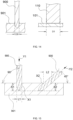
- a lead 110 coloring on paper 101 is compared with a tattoo needle 900 piercing on an artificial skin 901. It is assumed that the lead core and the tattoo needle are both practiced in a perpendicular state, a diameter D1 of the lead core is 1.0 mm, and a diameter D9 of the tattoo needle is 0.25 mm.
- the lead core does not have piercing function for the paper, and the tattoo needle has piercing function for the artificial skin.
- the lead core abuts on the paper to implement dotted coloring, and when the tattoo needle is used to pierce the artificial skin, the tattoo needle pierces a hole on the artificial skin.
- the tattoo needle pierces the artificial skin in a direction Y1.
- Y1 is perpendicular to the artificial skin, and a piercing depth is S1.
- a maximum diameter of a visible colored point X1 on the surface of the artificial skin is L1.
- Y2 is inclined to the artificial skin.
- An angle between the tattoo needle and the artificial skin is 45°, and a piercing depth is S2.
- a maximum diameter of a visible colored point X2 on the surface of the artificial skin is L2.
- the lead core is used to practice coloring on the surface of the paper.
- the lead core pierces the paper in a direction Z1 for the first time, and Z1 is perpendicular to the paper. Because the lead core does not have piercing function for the paper, the lead core strikes the paper in a dot piercing manner to color the paper. The lead core is abraded and colors the paper, leaving a colored point F1. A maximum diameter of the colored point F1 visible on the surface is M1. When the lead core pierces the paper in a direction Z2, an angle between Z2 and the paper is 45°.
- the lead core does not have piercing function, when the lead core strikes the paper in a dot piercing manner, the lead core is abraded and colors the paper, forming a colored point F2 on the paper with a maximum diameter of M2.
- a difference between M1 and M2 is about 0.4 mm, which is easy to distinguish with the naked eyes. Therefore, using the lead core to practice coloring on the paper is compared with using the tattoo needle to practice coloring on the artificial skin.
- a maximum diameter error between an incorrect colored point and a correct colored point is clearer, and it is easier to determine through a difference between the colored points on the paper whether the coloring action is perpendicular. This can improve convenience and quality of the practice, and facilitate correction of an incorrect action.
- a cost of the paper is lower than a cost of the artificial skin, and it is convenient to determine whether the action of the trainee is correct.
- Self-checking accuracy is performed through the following comparison: 20 experimenters, aged 20 to 45, with no experience in tattoo practice or hands-on operation, are divided into two groups, A1 and A2, with 10 participants in each group;
- a tattoo needle is used to practice dot piercing on an artificial skin, adapting to a tattoo machine, which has a weight of 55 g, a motor power of 5 W, and a speed of 3600 RPM (3600 revolutions per minute).
- a tattoo practice device in this application is used to practice dot piercing on paper, adapting to a practice pen that has same parameters as the tattoo machine of group A1, which has a weight of 55 g, a motor power of 5 W, and a speed of 3600 RPM (3600 revolutions per minute).
- the 10 experimenters use the tattoo needles to practice dot piercing on the artificial skin, and each experimenter dot-pierces 100 points, leading to a total of 1,000 points.
- the experimenters perform self-checking according to colored points visible on the surface of the artificial skin, to obtain that the number of non-perpendicular points is 105, and the actual number of non-perpendicular points according to video playback is 543, with an accuracy of 19.3%.
- the 10 experimenters use the tattoo practice device to practice dot piercing on the paper, and each experimenter dot-pierces 100 points, leading to a total of 1,000 points.
- the experimenters perform self-checking according to colored points visible on the surface of the paper, to obtain the number of non-perpendicular points is 355, and the actual number of non-perpendicular points according to video playback is 362, with an accuracy of 98.1%.
- a tattoo needle is used to practice dot piercing on an artificial skin, adapting to a tattoo machine, which has a weight of 55 g, a motor power of 5 W, and a speed of 3600 RPM (3600 revolutions per minute).
- a tattoo practice device in this application is used to practice dot piercing on paper, adapting to a practice pen that has same parameters as the tattoo machine of group A2, which has a weight of 55 g, a motor power of 5 W, and a speed of 3600 RPM (3600 revolutions per minute).
- the 10 experimenters use the tattoo needles to practice dot piercing on the artificial skin, and each experimenter dot-pierces 100 points, leading to a total of 1,000 points.
- the experimenters perform self-checking according to colored points visible on the surface of the artificial skin, to obtain that the number of non-perpendicular points is 42, and the actual number of non-perpendicular points according to video playback is 150, with an accuracy of 28.0%.
- group A1 the 10 experimenters use the tattoo practice device to practice dot piercing on the paper, and each experimenter dot-pierces 100 points, leading to a total of 1,000 points.
- the experimenters perform self-checking according to colored points visible on the surface of the paper, to obtain that the number of non-perpendicular points is 277, and the actual number of non-perpendicular points according to video playback is 294, with an accuracy of 94.2%.
- the tattoo needle is used to pierce the artificial skin.
- the tattoo needle pierces the artificial skin in a direction Y3 with a standard strength, Y3 is perpendicular to the artificial skin, the piercing depth is E3, and a maximum diameter of a colored point X3 visible on the surface of the artificial skin is L3.
- the tattoo needle when used to practice piercing on the artificial skin, strengths are different, and if the strength is excessive, the artificial skin may be pierced through.
- the maximum diameter of the colored point visible on the surface of the artificial skin is substantially the same as the diameter of the colored point piercing the artificial skin with the standard strength, with no difference. Therefore, whether the strength of the tattoo needle piercing the artificial skin is uniform cannot be determined.
- the tattoo needle has piercing function for the artificial skin, in a practical case, similar to perforation coloring, even if the strengths are different, a formed hole depth E3 is not equal to E4, formed ink falls into the hole formed by piercing and forms a thick accumulation, and it is difficult to distinguish from the surface of the artificial skin through a visual concentration.
- the strength is large, and there is much ink accumulated around the colored point formed by piercing the surface of the artificial skin, because the surface of the artificial skin is smooth, and does not have adhesion for the ink, the ink disappears after being wiped with cleaning oil, and a determining basis cannot be formed.
- tattooing hands-on operation requires a uniform strength, to deliver the pigment to a same depth under the skin, avoiding subsequently uneven color retention or contour deformation due to inconsistent metabolic rates. Therefore, in a stage of strength uniformity practice, the trainee cannot perform self-checking and self-correction in time by using the tattoo needle.
- the lead core is used to practice on the paper.
- the lead core strikes the paper in a direction Z3 with the standard strength, and Z3 is perpendicular to the paper.
- the lead core strikes the paper for coloring in a dot piercing manner, the lead core is abraded and leaves a colored point F3.
- the lead core strikes the paper in a direction Z4 with a larger strength, and Z4 is perpendicular to the paper.
- the lead core strikes the paper for coloring in a dot piercing manner, the lead core is abraded in a greater degree than striking with the standard strength, coloring the paper with more carbon powder and larger density.
- a colored point on the paper is F4, the colored point F4 has a deeper color.
- Different strengths indicate different accumulation densities of carbon powder and different visual concentrations at the colored points F3 and F4.
- one side is the colored point F3, and the other side is the colored point F4. Therefore, during strength uniformity practice, when the strength suddenly increases or decreases, the colored points on the paper also suddenly become thicker or lighter, which is easier for distinguishing. In this way, compared with using the tattoo needle to practice on the artificial skin, using the lead core to practice strength on the paper is easier for distinguishing whether the strength is uniform, thereby improving the practice effect.
Landscapes
- Health & Medical Sciences (AREA)
- Engineering & Computer Science (AREA)
- Business, Economics & Management (AREA)
- Hematology (AREA)
- Life Sciences & Earth Sciences (AREA)
- Veterinary Medicine (AREA)
- Public Health (AREA)
- General Health & Medical Sciences (AREA)
- Animal Behavior & Ethology (AREA)
- Heart & Thoracic Surgery (AREA)
- Dermatology (AREA)
- Medical Informatics (AREA)
- Anesthesiology (AREA)
- Biomedical Technology (AREA)
- Virology (AREA)
- Entrepreneurship & Innovation (AREA)
- Educational Administration (AREA)
- Physics & Mathematics (AREA)
- Theoretical Computer Science (AREA)
- General Physics & Mathematics (AREA)
- Educational Technology (AREA)
- Mechanical Pencils And Projecting And Retracting Systems Therefor, And Multi-System Writing Instruments (AREA)
Applications Claiming Priority (3)
| Application Number | Priority Date | Filing Date | Title |
|---|---|---|---|
| CN202111121379.8A CN115862400A (zh) | 2021-09-24 | 2021-09-24 | 一种纹绣练习装置及使用该练习装置的操作笔 |
| CN202222394997.6U CN218447017U (zh) | 2022-09-08 | 2022-09-08 | 一种纹绣练习笔头及使用该纹绣练习笔头的练习笔 |
| PCT/CN2022/119794 WO2023045902A1 (fr) | 2021-09-24 | 2022-09-20 | Appareil d'entraînement au microblading semi-permanent et stylo utilisant un appareil d'entraînement |
Publications (3)
| Publication Number | Publication Date |
|---|---|
| EP4389190A1 true EP4389190A1 (fr) | 2024-06-26 |
| EP4389190A4 EP4389190A4 (fr) | 2024-12-18 |
| EP4389190B1 EP4389190B1 (fr) | 2026-05-06 |
Family
ID=85720062
Family Applications (1)
| Application Number | Title | Priority Date | Filing Date |
|---|---|---|---|
| EP22871948.0A Active EP4389190B1 (fr) | 2021-09-24 | 2022-09-20 | Appareil d'entraînement au microblading semi-permanent et stylo utilisant un appareil d'entraînement |
Country Status (4)
| Country | Link |
|---|---|
| US (2) | US12496437B2 (fr) |
| EP (1) | EP4389190B1 (fr) |
| KR (1) | KR20240049566A (fr) |
| WO (1) | WO2023045902A1 (fr) |
Families Citing this family (2)
| Publication number | Priority date | Publication date | Assignee | Title |
|---|---|---|---|---|
| CA2876720C (fr) * | 2014-01-09 | 2018-04-10 | Covidien Lp | Systemes et procedes de traitement de veines perforantes en cas d'insuffisance veneuse |
| CN116429074A (zh) * | 2023-04-21 | 2023-07-14 | 山东省国土测绘院 | 一种自然资源工程用监测标记装置 |
Family Cites Families (7)
| Publication number | Priority date | Publication date | Assignee | Title |
|---|---|---|---|---|
| CN202682550U (zh) * | 2012-01-16 | 2013-01-23 | 苏承庚 | 一种全抛式隔离美容纹绣针套装及纹绣笔 |
| CN206995603U (zh) * | 2017-01-17 | 2018-02-13 | 樊永朋 | 纹绣笔 |
| CN211461758U (zh) * | 2019-07-19 | 2020-09-11 | 胡伟 | 纹绣笔及其上调节直驱装置 |
| CN211301739U (zh) * | 2019-10-22 | 2020-08-21 | 光哲军 | 纹绣笔机芯及纹绣笔 |
| ES1258354Y (es) * | 2020-10-19 | 2021-03-05 | Cortes Alonso Javier | Dispositivo de práctica de tatuaje |
| US20230069394A1 (en) * | 2021-09-02 | 2023-03-02 | Carlos Romero | Tattoo pen systems and methods |
| CN216053406U (zh) * | 2021-09-24 | 2022-03-15 | 夏婷婷 | 一种纹绣练习装置及使用该练习装置的操作笔 |
-
2022
- 2022-09-20 WO PCT/CN2022/119794 patent/WO2023045902A1/fr not_active Ceased
- 2022-09-20 EP EP22871948.0A patent/EP4389190B1/fr active Active
- 2022-09-20 KR KR1020247006968A patent/KR20240049566A/ko active Pending
-
2024
- 2024-03-14 US US18/604,569 patent/US12496437B2/en active Active
-
2025
- 2025-11-17 US US19/390,717 patent/US20260069845A1/en active Pending
Also Published As
| Publication number | Publication date |
|---|---|
| US12496437B2 (en) | 2025-12-16 |
| KR20240049566A (ko) | 2024-04-16 |
| US20240216660A1 (en) | 2024-07-04 |
| EP4389190B1 (fr) | 2026-05-06 |
| EP4389190A4 (fr) | 2024-12-18 |
| US20260069845A1 (en) | 2026-03-12 |
| WO2023045902A1 (fr) | 2023-03-30 |
Similar Documents
| Publication | Publication Date | Title |
|---|---|---|
| US20260069845A1 (en) | Tattoo practice device and coloring assembly in tattoo practice device | |
| US9072878B2 (en) | Tattoo needle and method for making and using same | |
| US20230069394A1 (en) | Tattoo pen systems and methods | |
| KR20100008769U (ko) | 문신용 니들유닛 및 이를 이용한 문신장치 | |
| EP4180098A1 (fr) | Support de queue de billard pour une partie de billard ayant une meilleure sensation de préhension | |
| US20230414914A1 (en) | Introduction needle and tattoo device | |
| JP2014046475A (ja) | 塗布具 | |
| CN216053406U (zh) | 一种纹绣练习装置及使用该练习装置的操作笔 | |
| CN215691016U (zh) | 一种导入针头及纹绣装置 | |
| CN215875951U (zh) | 一种线雾两用纹绣针头及纹绣装置 | |
| CN218447017U (zh) | 一种纹绣练习笔头及使用该纹绣练习笔头的练习笔 | |
| CN207371071U (zh) | 植毛架供胶装置 | |
| CN215875950U (zh) | 一种通用纹绣针头及纹绣装置 | |
| CN115862400A (zh) | 一种纹绣练习装置及使用该练习装置的操作笔 | |
| CN215875952U (zh) | 一种一体线式单排纹绣针头及纹绣装置 | |
| CN216022667U (zh) | 一种一体式单点纹绣针头及纹绣装置 | |
| EP4321203A1 (fr) | Tête d'aiguille de tatouage et dispositif de tatouage | |
| CN215691015U (zh) | 一种纹绣针及纹绣装置 | |
| CN216022666U (zh) | 一种可持续缓释供墨的多点上色纹绣针头及纹绣装置 | |
| KR20160016370A (ko) | 휴대용 퍼팅연습기구 | |
| US12274849B2 (en) | Introduction needle and tattoo device | |
| CN216535444U (zh) | 祛皮赘工具 | |
| CN213527392U (zh) | 切杆练习器 | |
| JP2006320451A (ja) | ネイルケア練習用具 | |
| DE102022110419B4 (de) | System zur Reinigung von Zähnen |
Legal Events
| Date | Code | Title | Description |
|---|---|---|---|
| STAA | Information on the status of an ep patent application or granted ep patent |
Free format text: STATUS: THE INTERNATIONAL PUBLICATION HAS BEEN MADE |
|
| PUAI | Public reference made under article 153(3) epc to a published international application that has entered the european phase |
Free format text: ORIGINAL CODE: 0009012 |
|
| STAA | Information on the status of an ep patent application or granted ep patent |
Free format text: STATUS: REQUEST FOR EXAMINATION WAS MADE |
|
| 17P | Request for examination filed |
Effective date: 20240319 |
|
| AK | Designated contracting states |
Kind code of ref document: A1 Designated state(s): AL AT BE BG CH CY CZ DE DK EE ES FI FR GB GR HR HU IE IS IT LI LT LU LV MC MK MT NL NO PL PT RO RS SE SI SK SM TR |
|
| A4 | Supplementary search report drawn up and despatched |
Effective date: 20241115 |
|
| RIC1 | Information provided on ipc code assigned before grant |
Ipc: G09B 19/24 20060101ALI20241111BHEP Ipc: A61M 37/00 20060101AFI20241111BHEP |
|
| DAV | Request for validation of the european patent (deleted) | ||
| DAX | Request for extension of the european patent (deleted) | ||
| GRAP | Despatch of communication of intention to grant a patent |
Free format text: ORIGINAL CODE: EPIDOSNIGR1 |
|
| STAA | Information on the status of an ep patent application or granted ep patent |
Free format text: STATUS: GRANT OF PATENT IS INTENDED |
|
| INTG | Intention to grant announced |
Effective date: 20260213 |
|
| GRAS | Grant fee paid |
Free format text: ORIGINAL CODE: EPIDOSNIGR3 |
|
| GRAA | (expected) grant |
Free format text: ORIGINAL CODE: 0009210 |
|
| STAA | Information on the status of an ep patent application or granted ep patent |
Free format text: STATUS: THE PATENT HAS BEEN GRANTED |
|
| AK | Designated contracting states |
Kind code of ref document: B1 Designated state(s): AL AT BE BG CH CY CZ DE DK EE ES FI FR GB GR HR HU IE IS IT LI LT LU LV MC MK MT NL NO PL PT RO RS SE SI SK SM TR |
|
| REG | Reference to a national code |
Ref country code: CH Ref legal event code: F10 Free format text: ST27 STATUS EVENT CODE: U-0-0-F10-F00 (AS PROVIDED BY THE NATIONAL OFFICE) Effective date: 20260506 Ref country code: GB Ref legal event code: FG4D |