EP4389459A1 - Reifen - Google Patents
Reifen Download PDFInfo
- Publication number
- EP4389459A1 EP4389459A1 EP23216381.6A EP23216381A EP4389459A1 EP 4389459 A1 EP4389459 A1 EP 4389459A1 EP 23216381 A EP23216381 A EP 23216381A EP 4389459 A1 EP4389459 A1 EP 4389459A1
- Authority
- EP
- European Patent Office
- Prior art keywords
- tire
- mass
- less
- rubber
- parts
- Prior art date
- Legal status (The legal status is an assumption and is not a legal conclusion. Google has not performed a legal analysis and makes no representation as to the accuracy of the status listed.)
- Granted
Links
Images

Classifications
-
- B—PERFORMING OPERATIONS; TRANSPORTING
- B60—VEHICLES IN GENERAL
- B60C—VEHICLE TYRES; TYRE INFLATION; TYRE CHANGING; CONNECTING VALVES TO INFLATABLE ELASTIC BODIES IN GENERAL; DEVICES OR ARRANGEMENTS RELATED TO TYRES
- B60C1/00—Tyres characterised by the chemical composition or the physical arrangement or mixture of the composition
- B60C1/0016—Compositions of the tread
-
- B—PERFORMING OPERATIONS; TRANSPORTING
- B60—VEHICLES IN GENERAL
- B60C—VEHICLE TYRES; TYRE INFLATION; TYRE CHANGING; CONNECTING VALVES TO INFLATABLE ELASTIC BODIES IN GENERAL; DEVICES OR ARRANGEMENTS RELATED TO TYRES
- B60C11/00—Tyre tread bands; Tread patterns; Anti-skid inserts
- B60C11/0008—Tyre tread bands; Tread patterns; Anti-skid inserts characterised by the tread rubber
-
- B—PERFORMING OPERATIONS; TRANSPORTING
- B60—VEHICLES IN GENERAL
- B60C—VEHICLE TYRES; TYRE INFLATION; TYRE CHANGING; CONNECTING VALVES TO INFLATABLE ELASTIC BODIES IN GENERAL; DEVICES OR ARRANGEMENTS RELATED TO TYRES
- B60C11/00—Tyre tread bands; Tread patterns; Anti-skid inserts
- B60C11/03—Tread patterns
-
- B—PERFORMING OPERATIONS; TRANSPORTING
- B60—VEHICLES IN GENERAL
- B60C—VEHICLE TYRES; TYRE INFLATION; TYRE CHANGING; CONNECTING VALVES TO INFLATABLE ELASTIC BODIES IN GENERAL; DEVICES OR ARRANGEMENTS RELATED TO TYRES
- B60C11/00—Tyre tread bands; Tread patterns; Anti-skid inserts
- B60C11/03—Tread patterns
- B60C11/0306—Patterns comprising block rows or discontinuous ribs
-
- B—PERFORMING OPERATIONS; TRANSPORTING
- B60—VEHICLES IN GENERAL
- B60C—VEHICLE TYRES; TYRE INFLATION; TYRE CHANGING; CONNECTING VALVES TO INFLATABLE ELASTIC BODIES IN GENERAL; DEVICES OR ARRANGEMENTS RELATED TO TYRES
- B60C11/00—Tyre tread bands; Tread patterns; Anti-skid inserts
- B60C11/03—Tread patterns
- B60C11/0327—Tread patterns characterised by special properties of the tread pattern
- B60C11/033—Tread patterns characterised by special properties of the tread pattern by the void or net-to-gross ratios of the patterns
-
- B—PERFORMING OPERATIONS; TRANSPORTING
- B60—VEHICLES IN GENERAL
- B60C—VEHICLE TYRES; TYRE INFLATION; TYRE CHANGING; CONNECTING VALVES TO INFLATABLE ELASTIC BODIES IN GENERAL; DEVICES OR ARRANGEMENTS RELATED TO TYRES
- B60C11/00—Tyre tread bands; Tread patterns; Anti-skid inserts
- B60C11/03—Tread patterns
- B60C11/12—Tread patterns characterised by the use of narrow slits or incisions, e.g. sipes
-
- B—PERFORMING OPERATIONS; TRANSPORTING
- B60—VEHICLES IN GENERAL
- B60C—VEHICLE TYRES; TYRE INFLATION; TYRE CHANGING; CONNECTING VALVES TO INFLATABLE ELASTIC BODIES IN GENERAL; DEVICES OR ARRANGEMENTS RELATED TO TYRES
- B60C3/00—Tyres characterised by the transverse section
- B60C3/04—Tyres characterised by the transverse section characterised by the relative dimensions of the section, e.g. low profile
-
- B—PERFORMING OPERATIONS; TRANSPORTING
- B60—VEHICLES IN GENERAL
- B60C—VEHICLE TYRES; TYRE INFLATION; TYRE CHANGING; CONNECTING VALVES TO INFLATABLE ELASTIC BODIES IN GENERAL; DEVICES OR ARRANGEMENTS RELATED TO TYRES
- B60C11/00—Tyre tread bands; Tread patterns; Anti-skid inserts
- B60C11/0008—Tyre tread bands; Tread patterns; Anti-skid inserts characterised by the tread rubber
- B60C2011/0016—Physical properties or dimensions
-
- B—PERFORMING OPERATIONS; TRANSPORTING
- B60—VEHICLES IN GENERAL
- B60C—VEHICLE TYRES; TYRE INFLATION; TYRE CHANGING; CONNECTING VALVES TO INFLATABLE ELASTIC BODIES IN GENERAL; DEVICES OR ARRANGEMENTS RELATED TO TYRES
- B60C11/00—Tyre tread bands; Tread patterns; Anti-skid inserts
- B60C11/0008—Tyre tread bands; Tread patterns; Anti-skid inserts characterised by the tread rubber
- B60C2011/0016—Physical properties or dimensions
- B60C2011/0025—Modulus or tan delta
-
- B—PERFORMING OPERATIONS; TRANSPORTING
- B60—VEHICLES IN GENERAL
- B60C—VEHICLE TYRES; TYRE INFLATION; TYRE CHANGING; CONNECTING VALVES TO INFLATABLE ELASTIC BODIES IN GENERAL; DEVICES OR ARRANGEMENTS RELATED TO TYRES
- B60C11/00—Tyre tread bands; Tread patterns; Anti-skid inserts
- B60C11/03—Tread patterns
- B60C2011/0337—Tread patterns characterised by particular design features of the pattern
- B60C2011/0339—Grooves
- B60C2011/0341—Circumferential grooves
-
- B—PERFORMING OPERATIONS; TRANSPORTING
- B60—VEHICLES IN GENERAL
- B60C—VEHICLE TYRES; TYRE INFLATION; TYRE CHANGING; CONNECTING VALVES TO INFLATABLE ELASTIC BODIES IN GENERAL; DEVICES OR ARRANGEMENTS RELATED TO TYRES
- B60C2200/00—Tyres specially adapted for particular applications
- B60C2200/06—Tyres specially adapted for particular applications for heavy duty vehicles
-
- Y—GENERAL TAGGING OF NEW TECHNOLOGICAL DEVELOPMENTS; GENERAL TAGGING OF CROSS-SECTIONAL TECHNOLOGIES SPANNING OVER SEVERAL SECTIONS OF THE IPC; TECHNICAL SUBJECTS COVERED BY FORMER USPC CROSS-REFERENCE ART COLLECTIONS [XRACs] AND DIGESTS
- Y02—TECHNOLOGIES OR APPLICATIONS FOR MITIGATION OR ADAPTATION AGAINST CLIMATE CHANGE
- Y02T—CLIMATE CHANGE MITIGATION TECHNOLOGIES RELATED TO TRANSPORTATION
- Y02T10/00—Road transport of goods or passengers
- Y02T10/80—Technologies aiming to reduce greenhouse gasses emissions common to all road transportation technologies
- Y02T10/86—Optimisation of rolling resistance, e.g. weight reduction
Definitions
- the present invention relates to a tire.
- JP 2017-19494 A describes a tire that may improve in comfortability by a cross-sectional width of the tire being reduced.
- the present invention relates to a tire below:
- a tire having improved fuel efficiency during high-load running.
- the tire of the present invention is a tire comprising a tread part, wherein a tire outer diameter Dt is 600 mm or less, wherein the tread part is composed of a rubber composition comprising a rubber component and a filler, and wherein a tire cross-sectional width Wt, in mm, and a tan ⁇ at 30°C (30°C tan ⁇ ) of the rubber composition satisfy the following inequality (1): 30 ° C tan ⁇ ⁇ ⁇ 7.84 ⁇ 10 ⁇ 5 ⁇ Wt ⁇ 195 2 + 0.175
- the Wt, in mm, is preferably 180 or more and 225 or less.
- the Wt, in mm is less than 180, an influence of heat generation in the tread part due to a decrease in deflection in the sidewall part becomes large, so that it is considered that low heat generation becomes less likely to be improved.
- the Wt, in mm is preferably 225 or less.
- the 30°C tan ⁇ of the rubber composition is preferably 0.10 or less.
- the rubber composition further comprises a mercapto-based silane coupling agent.
- the rubber composition comprises a mercapto-based silane coupling agent
- dispersibility of silica can be improved and heat generation due to aggregation of fillers can be suppressed.
- the filler preferably comprises silica having an average primary particle size of 16 nm or less.
- the filler comprises silica having an average primary particle size of 16 nm or less, interaction with the rubber component increases, movement of a molecular chain of the rubber component is suppressed, and heat generation of the rubber composition can be suppressed, so that it is considered that fuel efficiency is further improved.
- a total styrene amount in the rubber component in the rubber composition is preferably less than 20% by mass.
- the total styrene amount in the rubber component is at a certain level or below, heat generation by a styrene group in the rubber component is suppressed, so that it is considered that fuel efficiency is further improved.
- the rubber component preferably comprises an isoprene-based rubber. Since the isoprene-based rubber has a high strength, the rubber composition becomes less likely to be deformed, and heat generation of the rubber composition can be suppressed, so that it is considered that low heat generation is further improved.
- a total content of plasticizing agents based on 100 parts by mass of the rubber component of the rubber composition is preferably 20 parts by mass or less.
- a total content of the filler based on 100 parts by mass of the rubber component of the rubber composition is preferably 60 parts by mass or less.
- the rubber composition preferably comprises a vegetable oil as a plasticizing agent.
- the rubber composition comprises a vegetable oil
- dispersibility of the filler is improved, so that it is considered that heat generation due to aggregation of the fillers can be suppressed.
- a ratio (G/W L ) of a tire weight G, in kg, to a maximum load capacity W L , in kg, of the tire is 0.0150 or less.
- a ratio (Wt/Dt) of the tire cross-sectional width Wt, in mm, to the tire outer diameter Dt, in mm, is preferably 0.30 or more.
- a land ratio of the tread part on a grounding surface is 65% or more.
- a grounding area (volume) of the tread part is increased, heat generation due to deformation of the entire tread part can be suppressed, so that it is considered that fuel efficiency is further improved.
- a “standardized rim” is a rim in a standard system including a standard on which the tire is based, defined for each tire by the standard.
- the "standardized rim” refers to a standard rim of an applicable size described in "JATMA YEAR BOOK” in JATMA (The Japan Automobile Tyre Manufacturers Association, Inc.), “Measuring Rim” described in “STANDARDS MANUAL” in ETRTO (The European Tyre and Rim Technical Organisation), or “Design Rim” described in "YEAR BOOK” in TRA (The Tire and Rim Association, Inc.), to which references are made in this order, and if there is an applicable size at the time of the reference, the rim conforms to its standard.
- the "standardized rim” shall refer to a rim that can be assembled and maintain an internal pressure, that is, one that has the smallest rim diameter and secondly has the narrowest rim width, among rims that do not cause air leakage between the rim and the tire.
- a “standardized internal pressure” is an air pressure in a standard system including a standard on which the tire is based, defined for each tire by the standard, i.e., a "MAXIMUM AIR PRESSURE” in JATMA, "INFLATION PRESSURE” in ETRTO, or a maximum value described in Table "TIRE LOAD LIMITS AT VARIOUS COLD INFLATION PRESSURES" in TRA, to which references are made in this order as in the case of the standardized rim, and if there is an applicable size at the time of the reference, the rim conforms to its standard.
- the standardized internal pressure refers to a standardized internal pressure (250 KPa or more) of another tire size (provided that it is specified in the standard) for which the standardized rim is described as a standard rim.
- the minimum value among them shall be referred.
- a "standardized state” is a state where the tire is rim-assembled on a standardized rim, a standardized internal pressure is filled, and no load is applied. Besides, in the present specification, a dimension of each part of the tire is measured in a standardized state, unless otherwise specified.
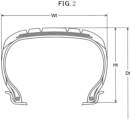
- a "tire outer diameter Dt, in mm” is a tire outer diameter measured in a standardized state.
- a “tire cross-sectional width Wt, in mm” refers to the maximum width between outer surfaces of sidewalls in the standardized state (however, excluding patterns or characters, if they are present on the side surface of the tire).
- a "tire cross-sectional height Ht, in mm” is a length of half a difference between the tire outer diameter and the rim diameter, which is measured in a standardized state where the tire is rim-assembled on a standardized rim, filled with a standardized internal pressure, and applied with no load.
- a “tire weight G, in kg” refers to a weight of a single tire excluding a weight of a rim.
- G, in kg shall be a weight including these weights.
- V (Dt / 2 2 ⁇ Dt / 2 ⁇ Ht 2 ⁇ ⁇ ⁇ Wt .
- a “total styrene amount (S) in a rubber component” is a total content (% by mass) of styrene parts comprised in 100% by mass of the rubber component in the rubber composition and is calculated by ⁇ (styrene content of each styrene-containing rubber (% by mass)) ⁇ content in rubber component of each styrene-containing rubber (% by mass) / 100).
- a styrene amount of a styrene-containing rubber is calculated by a method which will be described later.
- a “land ratio (%)” refers to a ratio of an actual grounding area to a total grounding area on a grounding surface of a tread part. A method of measuring the total grounding area and the actual grounding area will be described later.
- a “plasticizing agent” is a material that gives plasticity to a rubber component and includes a liquid plasticizing agent (a plasticizing agent that is liquid (in a liquid state) at normal temperature (25°C)) and a solid plasticizing agent (a plasticizing agent that is solid at normal temperature (25°C)), which refers to a component extracted from the rubber composition by acetone extraction. Besides, a method of acetone extraction will be described later.
- a "30°C tan ⁇ " is a loss tangent measured under a condition of a temperature at 30°C, a frequency of 10 Hz, an initial strain of 5%, a dynamic strain of ⁇ 1 %, and an extension mode, using EPLEXOR series manufactured by gabo Systemtechnik GmbH.
- a sample for loss tangent measurement is a vulcanized rubber composition of 20 mm in length ⁇ 4 mm in width ⁇ 1 mm in thickness. When it is produced by being cut out from a tire, it is cut out from a tread part so that a tire circumferential direction becomes a long side and a tire radial direction becomes a thickness direction.
- a "grounding shape of a tread part" can be obtained by mounting a tire on a standardized rim, applying a standardized internal pressure, and leaving it to stand at 25°C for 24 hours, followed by painting the tire tread surface with ink, applying the maximum load capacity to press the tread part against a paper at a camber angle of 0°, and transferring it to the paper. The transfer is performed at five sites by rotating the tire in a circumferential direction by 72°. Therefore, the grounding shape is obtained five times.
- a “total grounding area” shall be an average value of five sites of areas obtained by an outer contour in the grounding shape of the tread part.
- An “average primary particle size of silica” is calculated by an arithmetic mean of particle sizes of 400 particles which are photographed with a transmission or scanning electron microscope when, in a case that the particle is in a substantially spherical shape, the diameter of sphere is defined as a particle size, in a case that it is in a needle or rod shape, the minor axis is defined as a particle size, and in a case that it is in an indefinite shape, an average size of the minor axis and the diameter is defined as a particle size.
- a “N 2 SA of silica” is measured by the BET method according to ASTM D3037-93.
- An “average primary particle size of carbon black” is calculated by an arithmetic mean of particle sizes of 400 particles which are photographed with a transmission or scanning electron microscope when, in a case that the particle is in a substantially spherical shape, the diameter of sphere is defined as a particle size, in a case that it is in a needle or rod shape, the minor axis is defined as a particle size, and in a case that it is in an indefinite shape, an average size of the minor axis and the diameter is defined as a particle size.
- a “N 2 SA of carbon black” is measured according to JIS K 6217-2: 2017.
- a "styrene content" is calculated by 1 H-NMR measurement. For example, it is applied to a styrene-containing rubber such as a SBR and the like.
- a "vinyl bond content (1,2-bond butadiene unit amount)" is measured by infrared absorption spectrometry. For example, it is applied to a SBR, a BR, and the like.
- a "cis 1,4 bond content (cis content)" is a value calculated by infrared absorption spectrometry. For example, it is applied to a BR and the like.
- a "glass transition temperature (Tg) of a rubber component” is a value measured by differential scanning calorimetry (DSC) under a condition of a temperature rising rate of 10°C/min according to JIS K 7121, which is applied to, for example, a SBR, a BR, and the like.
- a "weight-average molecular weight” can be calculated in terms of a standard polystyrene based on measurement values obtained by a gel permeation chromatography (GPC) (GPC-8000 Series manufactured by Tosoh Corporation, detector: differential refractometer, column: TSKGEL SUPERMULTIPORE HZ-M manufactured by Tosoh Corporation). For example, it is applied to a SBR, a BR, resin, a liquid polymer, and the like.
- GPC gel permeation chromatography
- a "softening point” is a temperature at which a sphere drops when the softening point specified in JIS K 6220-1: 2001 is measured with a ring and ball softening point measuring device. For example, it is applied to a resin component and the like.
- FIG. 1 is a developed view of a tread part 10 of a tire according to one embodiment of the present invention.
- the tread part has a plurality of circumferential grooves 11.
- the circumferential groove 11 extends linearly along the circumferential direction C, it is not limited to such an embodiment, and may extend in, for example, a wavy shape, a sinusoidal shape, or a zigzag shape along the circumferential direction.
- four circumferential grooves 11 are provided, though the number of circumferential grooves is not particularly limited and may be, for example, two to five.
- the term "circumferential groove” refers to a groove extending continuously in a tire circumferential direction C.
- a shoulder land part 12 is a pair of land parts formed between the circumferential groove 11 and a tread end Te.
- a center land part 13 is a land part formed between a pair of shoulder land parts 12. In FIG. 1 , three center land parts 13 are provided, though the number of center land parts is not particularly limited and may be, for example, one to five.
- the shoulder land part 12 is provided with a width direction groove 14, one end of which communicates with the circumferential groove 11.
- the center land part 13 is provided with a width direction groove 15 crossing the center land part 13, both ends of which communicate with the circumferential grooves, and a width direction groove 16, one end of which communicates with the circumferential groove 11, though it is not limited to such aspects.
- the land ratio of the grounding surface of the tread part is preferably 60% or more, more preferably 65% or more, further preferably 70% or more, particularly preferably 75% or more, from the viewpoint that the grounding area (volume) of the tread part is increased, so that heat generation due to deformation of the entire tread part can be suppressed, further improving fuel efficiency.
- the land ratio is preferably 90% or less, more preferably 85% or less, further preferably 80% or less, from the viewpoint of wet grip performance.
- the land ratio is calculated by the above-described measuring method.
- the tread part is composed of a rubber composition.
- the tread part may be a single rubber layer or may comprise two or more rubber layers.
- it preferably comprises a cap rubber layer constituting a tread surface and a base rubber layer adjacent to an outer side of a belt layer in a tire radial direction.
- One or more intermediate rubber layers may be further present between the cap rubber layer and the base rubber layer.
- each physical property value such as a tan ⁇ at 30°C and the like of the rubber composition of the tread part may satisfy, in a case where the tread part comprises two or more rubber layers, a physical property value in any of the rubber layers, preferably in the cap rubber layer.
- the tire outer diameter Dt is preferably 500 mm or more, more preferably 520 mm or more, further preferably 540 mm or more.
- the tire outer diameter Dt of the tire according to the present invention is 600 mm or less, preferably 595 mm or less, more preferably 590 mm or less, further preferably 550 mm or less.
- the tire cross-sectional width Wt is preferably 160 mm or more, more preferably 170 mm or more, further preferably 180 mm or more, from the viewpoint of making it easier for the tread part to receive deformation, reducing a force per unit area applied to the tread part.
- an upper limit value of the tire cross-sectional width Wt is, but not particularly limited to, preferably less than 300 mm, more preferably less than 250 mm, further preferably less than 240 mm, further preferably 230 mm or less.
- the tire cross-sectional height Ht is preferably less than 130 mm, more preferably less than 120 mm, further preferably less than 100 mm, from the viewpoint of reducing an amount of deformation applied to a sidewall part.
- a lower limit of the Ht is, but not particularly limited to, preferably 60 mm or more, more preferably 70 mm or more, further preferably 80 mm or more.
- the tire volume V (mm 3 ) is preferably 2.00 ⁇ 10 7 mm 3 or more, more preferably 2.10 ⁇ 10 7 mm 3 or more, further preferably 2.20 ⁇ 10 7 mm 3 or more.
- the volume V is preferably less than 3.80 ⁇ 10 7 mm 3 , more preferably less than 3.75 ⁇ 10 7 mm 3 , further preferably less than 3.30 ⁇ 10 7 mm 3 .
- the tire weight G, in kg, of the tire according to the present invention is preferably 8.5 kg or less, more preferably 8.0 kg or less, further preferably 7.5 kg or less, from the viewpoint of reducing an energy applied to the tire during rolling.
- a lower limit value of the tire weight G, in kg is, but not particularly limited to, usually 3.0 kg or more.
- the tire weight G in kg, can be appropriately adjusted by a known method, for example, it can be decreased by reducing a thickness of each rubber layer forming the tire, by reducing a specific gravity of a material constituting the tire, or the like.
- the ratio (G/W L ) of the tire weight, in kg, to the maximum load capacity W L , in kg, of the tire is preferably 0.0150 or less, more preferably 0.0145 or less, further preferably 0.0135 or less, from the viewpoint of reducing an energy applied to the tire during rolling.
- a lower limit value of the G/W L is, but not particularly limited to, preferably 0.0100 or more, more preferably 0.0110 or more, further preferably 0.0115 or more.
- the maximum load capacity W L can be appropriately adjusted by a known method, for example, it can be increased by increasing the outer diameter Dt or the cross-sectional width Wt.
- the ratio (Wt/Dt) of the tire cross-sectional width Wt, in mm, to the tire outer diameter Dt, in mm is preferably 0.30 or more, more preferably 0.32 or more, further preferably 0.33 or more, from the viewpoint of making it easier for the tread part to receive deformation during rolling, dispersing the force applied to the tread part.
- an upper limit is, but not particularly limited to, preferably 0.50 or less, more preferably 0.48 or less, further preferably 0.45 or less.
- the tire according to one embodiment of the present invention is mounted on a vehicle.
- the vehicle include, for example, a four-wheeled vehicle, but the vehicle is not limited to the four-wheeled vehicle, and may be of a three-wheeled, a six-wheeled, or an eight-wheeled configuration, or the like.
- the vehicle can be, for example, an electric vehicle that operates autonomously (level 4 or higher), but it is not limited to this, and may not be operated autonomously, and an operating subject may be a human.
- the vehicle may not be an electric vehicle, and may be a gasoline-powered vehicle or a hybrid electric vehicle.
- the rubber composition of the tread part of the present invention (hereinafter referred to as the rubber composition according to the present invention, unless otherwise specified) will be described in detail below.
- the tire cross-sectional width Wt, in mm, and the tan ⁇ at 30°C (30°C tan ⁇ ) of the rubber composition according to the present invention satisfy the following inequality (1): 30 ° C tan ⁇ ⁇ ⁇ 7.84 ⁇ 10 ⁇ 5 ⁇ Wt ⁇ 195 2 + 0.175
- the tan ⁇ at 30°C (30°C tan ⁇ ) of the rubber composition according to the present invention is preferably 0.20 or less, more preferably 0.19 or less, further preferably 0.18 or less, further preferably 0.16 or less, further preferably 0.15 or less, particularly preferably 0.14 or less, most preferably 0.10 or less, from the viewpoint of suppressing heat generation.
- a lower limit of the tan ⁇ at 30°C is, but not particularly limited to, preferably 0.06 or more, more preferably 0.08 or more, further preferably 0.09 or more, particularly preferably 0.10 or more.
- the tan ⁇ of the rubber composition can be adjusted by a conventional method in the tire industry.
- the tan ⁇ can be increased by using a rubber component having a high glass transition temperature, increasing an amount of a filler, decreasing a particle size, increasing a resin component as a plasticizing agent component, reducing amounts of sulfur and an accelerator, or the like.
- the total styrene amount in the rubber component of the rubber composition according to the present invention is preferably less than 25% by mass, more preferably less than 22% by mass, further preferably less than 20% by mass, from the viewpoint of suppressing heat generation by a styrene group to further improve fuel efficiency.
- a lower limit of the total styrene amount is, but not particularly limited to, preferably greater than 10% by mass, more preferably greater than 15% by mass, further preferably greater than 18% by mass.
- the rubber composition according to the present invention comprises a rubber component.
- the rubber component preferably comprises at least one selected from the group consisting of an isoprene-based rubber, a styrene-butadiene rubber (SBR), and a butadiene rubber (BR), preferably comprises an isoprene-based rubber, more preferably comprises an isoprene-based rubber and a SBR, further preferably comprises an isoprene-based rubber, a SBR, and a BR.
- an extended rubber may be used as any of these components, which was extended in advance with a plasticizing agent component such as oil, a resin component, and the like which will be described later.
- a content of the plasticizing agent component based on 100 parts by mass of a rubber solid content is preferably 10 parts by mass or more and 50 parts by mass or less.
- an isoprene-based rubber for example, those common in the tire industry can be used, such as an isoprene rubber (IR), a natural rubber, and the like.
- the natural rubber include a non-modified natural rubber (NR), as well as a modified natural rubber such as an epoxidized natural rubber (ENR), a hydrogenated natural rubber (HNR), a deproteinized natural rubber (DPNR), an ultra pure natural rubber, a grafted natural rubber, and the like.
- NR non-modified natural rubber
- EMR epoxidized natural rubber
- HNR hydrogenated natural rubber
- DPNR deproteinized natural rubber
- ultra pure natural rubber a grafted natural rubber, and the like.
- the NR is not particularly limited, and those common in the tire industry can be used, examples of which include, for example, SIR20, RSS#3, TSR20, and the like.
- a content of the isoprene-based rubber in the rubber component is preferably 1% by mass or more, more preferably 3% by mass or more, further preferably 4% by mass or more, particularly preferably 5% by mass or more.
- the content of the isoprene-based rubber in the rubber component is preferably 50% by mass or less, more preferably 40% by mass or less, further preferably 30% by mass or less, particularly preferably 25% by mass or less.
- the SBR is not particularly limited, examples of which include a solution-polymerized SBR (S-SBR), an emulsion-polymerized SBR (E-SBR), modified SBRs (a modified S-SBR, a modified E-SBR) thereof, and the like.
- S-SBR solution-polymerized SBR
- E-SBR emulsion-polymerized SBR
- modified SBR include a SBR modified at its terminal and/or main chain, a modified SBR coupled with tin, a silicon compound, etc. (a modified SBR of condensate or having a branched structure, etc.), and the like.
- hydrogenated additives of these SBRs (hydrogenated SBRs) and the like can also be used. Among them, a S-SBR is preferable, and a modified S-SBR is more preferable.
- Examples of the modified SBR include a modified SBR into which a functional group usually used in this field is introduced.
- the above-described functional group include, for example, an amino group (preferably an amino group in which a hydrogen atom of the amino group is substituted with an alkyl group having 1 to 6 carbon atoms), an amide group, a silyl group, an alkoxysilyl group (preferably an alkoxysilyl group having 1 to 6 carbon atoms), an isocyanate group, an imino group, an imidazole group, an urea group, an ether group, a carbonyl group, an oxycarbonyl group, a mercapto group, a sulfide group, a disulfide group, a sulfonyl group, a sulfinyl group, a thiocarbonyl group, an ammonium group, an imide group, a hydrazo group, an azo group, a diazo group, a carboxyl group
- these functional groups may have a substituent.
- substituent include, for example, functional groups such as an amino group, an amide group, an alkoxysilyl group, a carboxyl group, a hydroxyl group, and the like.
- modified SBR include hydrogenated ones, epoxidized ones, tin-modified ones, and the like.
- SBRs listed above may be used alone, or two or more thereof may be used in combination.
- SBRs listed above for example, SBRs manufactured and sold by Sumitomo Chemical Co., Ltd., JSR Corporation, Asahi Kasei Corporation, Zeon Corporation, ZS Elastomer Co., Ltd., etc. can be used.
- a styrene content of the SBR is preferably 5% by mass or more, more preferably 10% by mass or more, further preferably 20% by mass or more, particularly preferably 25% by mass or more, from the viewpoint of securing damping property in the tread part.
- an upper limit value of the styrene content of the SBR is preferably 45% by mass or less, more preferably 40% by mass or less, further preferably 35% by mass or less.
- the styrene content of the SBR is calculated by the above-described measuring method.
- a vinyl bond amount of the SBR is preferably 10 mol% or more, more preferably 20 mol% or more, further preferably 30 mol% or more, from the viewpoints of ensuring reactivity with silica, rubber strength, and abrasion resistance.
- the vinyl bond amount of the SBR is preferably 70 mol% or less, more preferably 65 mol% or less, further preferably 60 mol% or less, from the viewpoints of prevention of increase in temperature dependence, wet grip performance, elongation at break, and abrasion resistance.
- the vinyl bond amount (1 ,2-bonded butadiene unit amount) of the SBR is calculated by the above-described measuring method.
- a glass transition temperature (Tg) of the SBR is preferably -20°C or lower, more preferably -25°C or lower, further preferably -30°C or lower, from the viewpoint of preventing low temperature brittleness.
- a lower limit value of the Tg is, but not particularly limited to, preferably -70°C or higher, more preferably -60°C or higher, further preferably -50°C or higher, from the viewpoint of abrasion resistance.
- the glass transition temperature (Tg) of the SBR is measured by the above-described measuring method.
- a weight-average molecular weight (Mw) of the SBR is preferably 150,000 or more, more preferably 200,000 or more, further preferably 250,000 or more, from the viewpoint of abrasion resistance. Moreover, the Mw is preferably 2,500,000 or less, more preferably 2,000,000 or less, from the viewpoints of cross-linking uniformity, etc. Besides, the Mw is measured by the above-described measuring method.
- a content of the SBR in 100% by mass of the rubber component is preferably 30% by mass or more, more preferably 50% by mass or more, further preferably 70% by mass or more, from the viewpoint of effects of the present invention. Moreover, the content is preferably 95% by mass or less, more preferably 90% by mass or less, further preferably 85% by mass or less, from the viewpoint of suppressing heat generation in the tread part.
- a BR is not particularly limited, and those common in the tire industry can be used such as, for example, a BR having a cis-1,4 bond content (cis content) of 90 mol% or more (a high cis BR), a rare-earth-based butadiene rubber synthesized using a rare-earth element-based catalyst (a rare-earth-based BR), a BR containing a syndiotactic polybutadiene crystal (a SPB-containing BR), and a modified BR (a high cis modified BR, a low cis modified BR), and the like.
- the modified BR include BRs modified with similar functional groups and the like as explained in the above-described SBR.
- the high cis BR examples include, for example, those manufactured by Zeon Corporation, those manufactured by Ube Industries, Ltd., those manufactured by JSR Corporation, and the like. When the high cis BR is compounded, low temperature characteristics and abrasion resistance can be improved.
- the cis content is preferably 95 mol% or more, more preferably 96 mol% or more, further preferably 97 mol% or more.
- the cis content is also preferably 98 mol% or more.
- the cis content is a value calculated by infrared absorption spectrometry.
- rare-earth-based BR those which are synthesized using a rare-earth element-based catalyst, have a vinyl bond amount (1,2-bond butadiene unit amount) of preferably 1.8 mol% or less, more preferably 1.0 mol% or less, further preferably 0.8% mol or less, and a cis content (cis-1,4 bond content) of preferably 95 mol% or more, more preferably 96 mol% or more, further preferably 97 mol% or more, can be used.
- a vinyl bond amount (1,2-bond butadiene unit amount) preferably 1.8 mol% or less, more preferably 1.0 mol% or less, further preferably 0.8% mol or less
- a cis content (cis-1,4 bond content) preferably 95 mol% or more, more preferably 96 mol% or more, further preferably 97 mol% or more
- the rare-earth-based BR for example, those manufactured by LANXESS and the like can be used.
- SPB-containing BR examples include those in which 1,2-syndiotactic polybutadiene crystal is chemically bonded with BR and dispersed, but not those in which the crystal is simply dispersed in the BR.
- SPB-containing BR those manufactured by Ube Industries, Ltd. and the like can be used.
- a modified BR a modified butadiene rubber (a modified BR) modified at its terminal and/or main chain with a functional group comprising at least one element selected from a group consisting of silicon, nitrogen, and oxygen can be appropriately used.
- modified BRs examples include those obtained by adding a tin compound after polymerizing 1,3-butadiene by a lithium initiator, the end of which is further bonded by tin-carbon bond (a tin-modified BR), and the like.
- the modified BR may be either non-hydrogenated or hydrogenated.
- the BRs listed above may be used alone, or two or more thereof may be used in combination.
- a weight-average molecular weight (Mw) of the BR is preferably 300,000 or more, more preferably 350,000 or more, further preferably 400,000 or more, from the viewpoint of abrasion resistance. Moreover, it is preferably 2,000,000 or less, more preferably 1,000,000 or less, from the viewpoints of cross-linking uniformity, etc. Besides, the Mw is measured by the above-described method.
- a content of the BR when compounded in 100% by mass of the rubber component is preferably 3% by mass or more, more preferably 5% by mass or more, further preferably 9% by mass or more, from the viewpoint of the effects of the present invention. Moreover, the content is preferably 50% by mass or less, more preferably 30% by mass or less, further preferably 25% by mass or less, particularly preferably 15% by mass or less.
- rubber components other than the above-described isoprene-based rubbers, SBRs, and BRs may be compounded.
- crosslinkable rubber components commonly used in the rubber industry can be used, such as, for example, a styrene-isoprene-butadiene copolymer rubber (SIBR), a styrene-isobutylene-styrene block copolymer (SIBS), a chloroprene rubber (CR), an acrylonitrile-butadiene rubber (NBR), a hydrogenated nitrile rubber (HNBR), a butyl rubber (IIR), an ethylene propylene rubber, a polynorbornene rubber, a silicone rubber, a polyethylene chloride rubber, a fluororubber (FKM), an acrylic rubber (ACM), a hydrin rubber, and the like.
- SIBR styrene-isoprene-butadiene copolymer rubber
- the rubber composition according to the present invention preferably comprises a filler.
- the rubber composition preferably comprises, as the filler, at least one selected from the group consisting of carbon black and silica, more preferably silica, further preferably carbon black and silica.
- the filler may be a filler consisting of silica and carbon black.
- Silica is not particularly limited, and those common in the tire industry can be used, such as, for example, silica prepared by a dry process (anhydrous silica), silica prepared by a wet process (hydrous silica), and the like. Among them, hydrous silica prepared by a wet process is preferable from the reason that it has many silanol groups. These silica may be used alone, or two or more thereof may be used in combination. Moreover, besides the above-described silica, a biomass silica made from a biomass material such as rice husks and the like may be used appropriately by replacing the above-described silica in an equivalent amount, from the viewpoint of life cycle assessment.
- a nitrogen adsorption specific surface area (N 2 SA) of silica is preferably 140 m 2 /g or more, more preferably 150 m 2 /g or more, further preferably 160 m 2 /g or more, particularly preferably 170 m 2 /g or more, from the viewpoint of securing reinforcing property and damping property at the tread part. Moreover, it is preferably 350 m 2 /g or less, more preferably 300 m 2 /g or less, further preferably 250 m 2 /g or less, from the viewpoints of heat generation and processability.
- the N 2 SA of silica is measured by the above-described measuring method.
- An average primary particle size of silica is preferably 18 nm or less, more preferably 17 nm or less, further preferably 16 nm or less, from the viewpoint of increasing a specific surface area of silica to increase an interaction with the rubber component, suppress movement of a molecular chain, and suppress heat generation.
- a lower limit of the average primary particle size is, but not particularly limited to, preferably 1 nm or more, more preferably 3 nm or more, further preferably 5 nm or more.
- the average primary particle size of silica can be calculated by the above-described measuring method.
- a content of silica when compounded based on 100 parts by mass of the rubber component is preferably greater than 20 parts by mass, more preferably greater than 30 parts by mass, further preferably greater than 50 parts by mass, particularly preferably greater than 55 parts by mass, from the viewpoint of improving flexibility of the rubber composition. Moreover, it is preferably less than 100 parts by mass, more preferably less than 95 parts by mass, further preferably less than 90 parts by mass, further preferably less than 85 parts by mass, from the viewpoint of reducing the specific gravity of the rubber to reduce the weight.
- Carbon black is not particularly limited, and those common in the tire industry can be used such as GPF, FEF, HAF, ISAF, and SAF, and specifically, N110, N115, N120, N125, N134, N135, N219, N220, N231, N234, N293, N299, N326, N330, N339, N343, N347, N351, N356, N358, N375, N539, N550, N582, N630, N642, N650, N660, N683, N754, N762, N765, N772, N774, N787, N907, N908, N990, N991, and the like can be appropriately used, and in-house synthesized products and the like can also be appropriately used.
- carbon black may be used alone, or two or more thereof may be used in combination.
- a biomass-derived carbon black obtained by burning lignin, etc. and a recovered carbon black obtained by pyrolyzing and purifying a rubber product comprising carbon black such as a tire and the like may be used appropriately by replacing the above-described carbon black in equivalent amounts.
- a nitrogen adsorption specific surface area (N 2 SA) of carbon black is preferably 50 m 2 /g or more, more preferably 80 m 2 /g or more, further preferably 100 m 2 /g or more, from the viewpoints of weather resistance and reinforcing property. Moreover, it is preferably 250 m 2 /g or less, more preferably 220 m 2 /g or less, from the viewpoints of dispersibility, fuel efficiency, fracture characteristics, and durability. Besides, the nitrogen adsorption specific surface area (N 2 SA) of carbon black is calculated by the above-described measuring method.
- An average primary particle size of carbon black is preferably 80 nm or less, more preferably 40 nm or less, further preferably 30 nm or less. Moreover, the average primary particle size is preferably 10 nm or more, more preferably 15 nm or more, further preferably 20 nm or more. When the average primary particle size of carbon black is within the above-described ranges, dispersibility of carbon black is improved, and heat generation of the rubber composition is suppressed, so that it is considered that fuel efficiency is further improved.
- the average primary particle size of carbon black can be calculated by the above-described measuring method.
- a content of carbon black when compounded based on 100 parts by mass of the rubber component is preferably greater than 1 parts by mass, more preferably greater than 3 parts by mass, further preferably 5 parts by mass or more, from the viewpoint of reinforcing property. Moreover, the content is preferably less than 30 parts by mass, more preferably less than 20 parts by mass, further preferably less than 10 parts by mass, from the viewpoint of improving fuel efficiency by suppressing heat generation.
- fillers other than silica and carbon black those conventionally and commonly used in the tire industry can be compounded, such as short fiber materials such as aluminum hydroxide, calcium carbonate, alumina, clay, talc, biochar (BIO CHAR), cellulose nanofiber, and the like.
- short fiber materials such as aluminum hydroxide, calcium carbonate, alumina, clay, talc, biochar (BIO CHAR), cellulose nanofiber, and the like.
- a total content of fillers based on 100 parts by mass of the rubber component is preferably less than 150 parts by mass, more preferably less than 120 parts by mass, further preferably less than 100 parts by mass, further preferably less than 90 parts by mass, particularly preferably 60 parts by mass or less, from the viewpoint of improving fuel efficiency by suppressing heat generation. Moreover, it is preferably greater than 40 parts by mass, more preferably greater than 45 parts by mass, further preferably greater than 50 parts by mass, further preferably greater than 55 parts by mass, from the viewpoint of facilitating friction with the rubber component to secure damping property.
- a content of silica based on the total content of fillers is preferably 80% by mass or more, more preferably 85% by mass or more, further preferably 90% by mass or more, particularly preferably 92% by mass or more. Moreover, the content of the silica is preferably 98% by mass or less, more preferably 90% by mass or less, further preferably 85% by mass or less.
- Silica is preferably used in combination with a silane coupling agent.
- the silane coupling agent is not particularly limited, and any silane coupling agent conventionally used in combination with silica in the tire industry can be used, but it is preferable to comprise a mercapto-based silane coupling agent.
- the mercapto-based silane coupling agent refers to a silane coupling agent having a mercapto group and a silane coupling agent having a structure in which the mercapto group is protected with a protecting group.
- the mercapto-based silane coupling agent include, but not particularly limited to, for example, a compound having a mercapto group, represented by the following formula (2), a compound in which a mercapto group is protected with ester, represented by the following formula (3), a compound comprising a bond unit A represented by the following formula (4) and/or a bond unit B represented by the following formula (5), and the like.
- the compound represented by the following formula (3) or the compound comprising a bond unit A represented by the following formula (4) and/or a bond unit B represented by the following formula (5) is preferable, and the compound represented by the following formula (3) is more preferable, from the reason that the effects of the present invention can be better exhibited.
- These mercapto-based silane coupling agents may be used alone, or two or more thereof may be used in combination.
- R 101 , R 102 , and R 103 each independently represents an alkyl having 1 to 12 carbon atoms, an alkoxy having 1 to 12 carbon atoms, or a group represented by -O-(R 111 -O) z -R 112
- z pieces of R 111 each independently represents a divalent hydrocarbon group having 1 to 30 carbon atoms
- R 112 represents an alkyl having 1 to 30 carbon atoms, an alkenyl having 2 to 30 carbon atoms, an aryl having 6 to 30 carbon atoms, or an aralkyl having 7 to 30 carbon atoms
- z represents an integer of 1 to 30
- R 104 represents an alkylene having 1 to 6 carbon atoms
- R 105 represents an alkyl having 1 to 12 carbon atoms.
- x represents an integer of 0 or more
- y represents an integer of 1 or more
- R 201 represents hydrogen atom, an alkyl having 1 to 30 carbon atoms, an alkeny
- Examples of the compound represented by the formula (2) include, for example, 3-mercaptopropyltrimethoxysilane, 3-mercaptopropyltriethoxysilane, 2-mercaptoethyltrimethoxysilane, 2-mercaptoethyltriethoxysilane, a compound represented by the following formula (6) (Si363 manufactured by Evonik Degussa GmbH), and the like, and the compound represented by the following formula (6) can be appropriately used. They may be used alone, or two or more thereof may be used in combination.
- Examples of the compound represented by the formula (3) include, for example, 3-octanoylthio-1-propyltriethoxysilane, 3-hexanoylthio-1-propyltriethoxysilane, 3-octanoylthio-1-propyltrimethoxysilane, and the like.
- a sulfide part of the bond unit A is a C-S-C bond and thus is thermally stable as compared with tetrasulfide or disulfide, thereby resulting in a small increase of Mooney viscosity.
- a content of the bond unit A is preferably 30 to 99 mol%, more preferably 50 to 90 mol%, from the viewpoint of suppressing an increase of viscosity during processing.
- a content of the bond unit B is preferably 1 to 70 mol%, more preferably 5 to 65 mol%, further preferably 10 to 55 mol%.
- a total content of the bond units A and B is preferably 95 mol% or more, more preferably 98 mol% or more, particularly preferably 100 mol%.
- the content of the bond units A and B is an amount including a case where the bond units A and B are located at the terminal of the silane coupling agent.
- a form where the bond units A and B are located at the terminal of the silane coupling agent is not particularly limited, as long as it forms units corresponding to the formula (4) representing the bond unit A and the formula (5) representing the bond unit B.
- a total number of repetitions (x+y) of the number of repetitions of the bond unit A (x) and the number of repetitions of the bond unit B (y) is preferably in a range of 3 to 300. Within this range, mercaptosilane of the bond unit B is covered with -C7H15 of the bond unit A, so that shortening of scorch time can be suppressed, and a good reactivity with silica and rubber components can be secured.
- Examples of the compound comprising the bond unit A represented by the formula (4) and/or the bond unit B represented by the formula (5) include, for example, NXT-Z30, NXT-Z45, NXT-Z60, and NXT-Z100 manufactured by Momentive Performance Materials, and the like. They may be used alone, or two or more thereof may be used in combination.
- the rubber composition according to the present invention may further comprise other silane coupling agents in addition to the mercapto-based silane coupling agent.
- silane coupling agents include, for example, silane coupling agents having a sulfide group such as bis(3-triethoxysilylpropyl)disulfide, bis(3-triethoxysilylpropyl)tetrasulfide, and the like; silane coupling agents having a vinyl group such as vinyltriethoxysilane, vinyltrimethoxysilane, and the like; silane coupling agents having an amino group such as 3-aminopropyltriethoxysilane, 3-aminopropyltrimethoxysilane, 3-(2-aminoethyl)aminopropyltriethoxysilane, and the like; glycidoxy-based silane coupling agents such as ⁇ -glycidoxypropyltriethoxysilane, ⁇ -glycidoxypropy
- silane coupling agents may be used alone, or two or more thereof may be used in combination.
- silane coupling agents listed above for example, silane coupling agents manufactured and sold by Momentive Performance Materials, Evonik Degussa GmbH, etc. can be used.
- a content of the silane coupling agent when compounded based on 100 parts by mass of silica is preferably greater than 1.0 parts by mass, more preferably greater than 3.0 parts by mass, further preferably greater than 5.0 parts by mass, from the viewpoint of enhancing dispersibility of silica. Moreover, it is preferably less than 30 parts by mass, more preferably less than 20 parts by mass, further preferably less than 15 parts by mass, from the viewpoint of preventing deterioration of abrasion resistance.
- the rubber composition according to the present invention preferably comprises a plasticizing agent.
- the plasticizing agent is a material that imparts plasticity to the rubber component, and includes both a liquid plasticizing agent (in a liquid state) at normal temperature (25°C) and a solid plasticizing agent at normal temperature (25°C).
- the plasticizing agent include, for example, oil, a resin component, a liquid polymer, an ester-based plasticizing agent, and the like.
- the plasticizing agent may be used alone, or two or more thereof may be used in combination.
- the plasticizing agent also includes a plasticizing agent contained in an extended rubber.
- Examples of oil include, for example, a process oil, a vegetable oil, an animal oil, and the like.
- examples of the process oil include a paraffin-based process oil, a naphthene-based process oil, an aroma-based process oil, and the like.
- examples of the process oil include a process oil having a low content of a polycyclic aromatic (PCA) compound.
- examples of the process oil having a low content of a PCA include Treated Distillate Aromatic Extract (TDAE) in which an oil aromatic process oil is re-extracted, an aroma substitute oil which is a mixture of asphalt and a naphthenic oil, mild extraction solvates (MES), a heavy naphthenic oil, and the like.
- TDAE Treated Distillate Aromatic Extract
- MES mild extraction solvates
- the rubber composition according to the present invention preferably comprises a vegetable oil.
- examples of the vegetable oil include, for example, a linseed oil, a rapeseed oil, a safflower oil, a soybean oil, a corn oil, a cottonseed oil, a rice oil, a tall oil, a sesame oil, a perilla oil, a castor oil, a tung oil, a pine oil, a pine tar oil, a sunflower oil, a coconut oil, a palm oil, a palm kernel oil, an olive oil, a camellia oil, a jojoba oil, a macadamia nut oil, a peanut oil, a grapeseed oil, a Japan wax, and the like.
- examples of the vegetable oil include a refined oil obtained by refining the above-described oil (a salad oil, etc.), a transesterified oil obtained by transesterifying the above-described oil, a hydrogenated oil obtained by hydrogenating the above-described oil, a thermally polymerized oil obtained by thermally polymerizing the above-described oil, an oxidized polymerized oil obtained by oxidizing the above-described oil, a waste cooking oil obtained by recovering what was utilized as an edible oil, etc., and the like.
- the vegetable oil may be liquid or solid at normal temperature (25°C). They may be used alone, or two or more thereof may be used in combination.
- the vegetable oil according to the present embodiment preferably comprises acylglycerol, more preferably comprises triacylglycerol.
- acylglycerol refers to a compound in which a hydroxy group of glycerin and a fatty acid are ester-bonded.
- Acylglycerol is not particularly limited, and may be 1-monoacylglycerol, 2-monoacylglycerol, 1,2-diacylglycerol, 1,3-diacylglycerol, or triacylglycerol.
- acylglycerol may be a monomer, a dimer, or a multimer that is a trimer or higher.
- acylglycerol that is a dimer or higher can be obtained by thermal polymerization, oxidative polymerization, or the like.
- acylglycerol may be liquid or solid at normal temperature (25°C).
- the confirmation can be performed by, but not particularly limited to, 1 H-NMR measurement.
- a rubber composition comprising triacylglycerol is immersed in a heavy chloroform at normal temperature (25°C) for 24 hours and removed to measure 1 H-NMR at room temperature, and when a signal of tetramethylsilane (TMS) is defined as 0.00 ppm, signals near 5.26 ppm, near 4.28 ppm, and near 4.15 ppm are observed, the signals being presumed to be derived from hydrogen atoms bonded to carbon atoms adjacent to oxygen atoms of an ester group.
- TMS tetramethylsilane
- the above-described fatty acid is not particularly limited, and may be an unsaturated fatty acid or a saturated fatty acid.
- unsaturated fatty acid include a monounsaturated fatty acid such as oleic acid and the like, and a polyunsaturated fatty acid such as linoleic acid, linolenic acid, and the like.
- the vegetable oil for example, those commercially available from Idemitsu Kosan Co., Ltd., Sankyo Yuka Kogyo K.K., ENEOS Corporation, Olisoy, H&R Group, Hokoku Corporation, Fuji Kosan Co., Ltd., The Nisshin OilliO Group, Ltd., etc. can be used.
- a content of the unsaturated fatty acid contained in the constituent fatty acid of the vegetable oil is preferably 50% by mass or more, more preferably 60% by mass or more, further preferably 70% by mass or more, further preferably 75% by mass or more, further preferably 80% by mass or more, particularly preferably 85% by mass or more.
- a content of oil when compounded as a plasticizing agent based on 100 parts by mass of the rubber component is preferably greater than 1 parts by mass, more preferably greater than 2 parts by mass, further preferably greater than 5 parts by mass, from the viewpoint of processability. Moreover, the content is preferably less than 80 parts by mass, more preferably less than 60 parts by mass, further preferably less than 40 parts by mass, from the viewpoint of the effects of the present invention. Besides, in the present specification, the content of oil also includes an amount of oil contained in an extended rubber.
- the resin component is not particularly limited, and may be solid or liquid at normal temperature (25°C), examples of which include a petroleum resin, a terpene-based resin, a rosin-based resin, a phenol-based resin, and the like, which are commonly used in the tire industry. These resin components may be used alone, or two or more thereof may be used in combination.
- the resin component preferably comprises at least one or more selected from the group consisting of a terpene resin and a petroleum resin from the viewpoint of improving durability during high-speed running.
- terpene-based resin examples include a polyterpene resin consisting of at least one selected from terpene compounds such as ⁇ -pinene, ⁇ -pinene, limonene, a dipentene, and the like; an aromatic-modified terpene resin comprising a terpene compound and an aromatic compound as monomer components; a terpene phenol resin comprising a terpene compound and a phenol-based compound as monomer components; and those in which these terpene-based resins are hydrogenated (hydrogenated terpene-based resins).
- terpene resin consisting of at least one selected from terpene compounds such as ⁇ -pinene, ⁇ -pinene, limonene, a dipentene, and the like
- an aromatic-modified terpene resin comprising a terpene compound and an aromatic compound as monomer components
- a terpene phenol resin comprising a terpene compound and a
- Examples of the aromatic compound used as a monomer component for the aromatic-modified terpene resin include, for example, styrene, ⁇ -methylstyrene, vinyltoluene, a divinyltoluene, and the like.
- Examples of the phenol-based compound used as a monomer component for the terpene phenol resin include, for example, phenol, bisphenol A, cresol, xylenol, and the like.
- Examples of the petroleum resin include, for example, a C5-based petroleum resin, an aromatic-based petroleum resin, and a C5-C9-based petroleum resin. These petroleum resins may be used alone, or two or more thereof may be used in combination.
- the C5-based petroleum resin refers to a resin obtained by polymerizing a C5 fraction.
- the C5 fraction include, for example, a petroleum fraction having 4 to 5 carbon atoms such as cyclopentadiene, a pentene, a pentadiene, isoprene, and the like.
- a dicyclopentadiene resin DCPD resin
- DCPD resin dicyclopentadiene resin
- the aromatic-based petroleum resin refers to a resin obtained by polymerizing a C9 fraction, and may be hydrogenated or modified.
- the C9 fraction include, for example, a petroleum fraction having 8 to 10 carbon atoms such as vinyltoluene, an alkylstyrene, indene, a methyl indene, and the like.
- a coumarone indene resin, a coumarone resin, an indene resin, and an aromatic vinyl-based resin are appropriately used.
- aromatic vinyl-based resin a homopolymer of ⁇ -methylstyrene or styrene or a copolymer of ⁇ -methylstyrene and styrene is preferable, and a copolymer of ⁇ -methylstyrene and styrene is more preferable, because it is economical, easy to process, and excellent in heat generation.
- aromatic vinyl-based resin for example, those commercially available from Kraton Corporation, Eastman Chemical Company, etc. can be used.
- the C5-C9-based petroleum resin refers to a resin obtained by copolymerizing a C5 fraction and a C9 fraction, and may be hydrogenated or modified.
- Examples of the C5 fraction and the C9 fraction include the above-described petroleum fractions.
- As the C5-C9-based petroleum resin for example, those commercially available from Tosoh Corporation, Zibo Luhua Hongjin New Material Group Co., Ltd, etc. can be appropriately used.
- Example of the rosin-based resin include, but not particularly limited to, for example, a natural resin rosin and a rosin-modified resin obtained by modifying it by hydrogenation, disproportionation, dimerization, esterification, or the like.
- phenol-based resin examples include, but not particularly limited to, a phenol formaldehyde resin, an alkylphenol formaldehyde resin, an alkylphenol acetylene resin, an oil-modified phenol formaldehyde resin, and the like.
- a softening point of the resin component is preferably 60°C or higher, more preferably 65°C or higher, from the viewpoint of wet grip performance. Moreover, it is preferably 150°C or lower, more preferably 140°C or lower, further preferably 130°C or lower, from the viewpoints of processability and improvement in dispersibility of a rubber component with a filler. Besides, in the present specification, the softening point of the resin component is a value measured by the above-described method.
- a content of the resin component when compounded based on 100 parts by mass of the rubber component is preferably greater than 1 parts by mass, more preferably greater than 2 parts by mass, further preferably greater than 3 parts by mass, from the viewpoint of the effects of the present invention. Moreover, it is preferably less than 30 parts by mass, more preferably less than 20 parts by mass, further preferably less than 15 parts by mass, particularly preferably less than 10 parts by mass, from the viewpoint of reducing heat generation.
- the liquid polymer is not particularly limited as long as it is a polymer in a liquid state at normal temperature (25°C), examples of which include, for example, a liquid butadiene rubber (a liquid BR), a liquid styrene-butadiene rubber (a liquid SBR), a liquid isoprene rubber (a liquid IR), a liquid styrene-isoprene rubber (a liquid SIR), a liquid farnesene rubber, and the like, and it may be one obtained by hydrogenating them, and may be a modified liquid polymer in which a main chain and/or a terminal thereof is modified with a modifying group (preferably a terminal-modified liquid polymer). These liquid polymers may be used alone, or two or more thereof may be used in combination.
- modified liquid polymer examples include, but not particularly limited to, for example, a liquid butadiene polymer modified at one or both ends thereof (terminal-modified liquid BR), a liquid styrene-butadiene polymer modified at one or both ends thereof (terminal-modified liquid SBR), and the like, and it may be one obtained by hydrogenating them.
- the modifying group is not particularly limited, examples of which include, for example, a silyl group, a trialkoxysilyl group, an amino group, an amide group, an isocyanate group, an imino group, an imidazole group, an urea group, an ether group, a carbonyl group, an oxycarbonyl group, a sulfonyl group, a sulfinyl group, a thiocarbonyl group, an ammonium group, an imide group, a hydrazo group, an azo group, a diazo group, a nitrile group, a pyridyl group, an alkoxy group, a hydroxyl group, an oxy group, a carboxyl group, an epoxy group, an acrylic group, a methacrylic group, an acryloyl group, a methacryloyl group, and the like.
- a weight-average molecular weight (Mw) of the liquid polymer is preferably less than 50,000, more preferably 25,000 or less, more preferably 10,000 or less, further preferably 7,000 or less. Moreover, a lower limit of the Mw is, but not particularly limited to, preferably 1000 or more, more preferably 2500 or more, further preferably 3500 or more. Besides, the weight-average molecular weight (Mw) is measured by the above-described measuring method.
- a content of the liquid polymer when compounded based on 100 parts by mass of the rubber component is preferably 0.5 parts by mass or more, more preferably 1 parts by mass or more, further preferably 3 parts by mass or more. Moreover, the content of the liquid rubber is preferably 25 parts by mass or less, more preferably 10 parts by mass or less, further preferably 7 parts by mass or less.
- ester-based plasticizing agent examples include, for example, dibutyl adipate (DBA), diisobutyl adipate (DIBA), dioctyl adipate (DOA), bis(2-ethylhexyl) azelate (DOZ), dibutyl sebacate (DBS), diisononyl adipate (DINA), diethyl phthalate (DEP), dioctyl phthalate (DOP), diundecyl phthalate (DUP), dibutyl phthalate (DBP), dioctyl sebacate (DOS), tributyl phosphate (TBP), trioctyl phosphate (TOP), triethyl phosphate (TEP), trimethyl phosphate (TMP), thymidine triphosphate (TTP), tricresyl phosphate (TCP), trixylenyl phosphate (TXP), and the like.
- DBA di
- a content of the ester-based plasticizing agent when compounded based on 100 parts by mass of the rubber component is preferably 0.5 parts by mass or more, more preferably 1 parts by mass or more, further preferably 3 parts by mass or more. Moreover, the content of the ester-based plasticizing agent is preferably 30 parts by mass or less, more preferably 20 parts by mass or less, further preferably 15 parts by mass or less.
- a total content of plasticizing agents based on 100 parts by mass of the rubber component is preferably greater than 3 parts by mass, more preferably greater than 5 parts by mass, further preferably greater than 10 parts by mass, from the viewpoint of processability. Moreover, it is preferably less than 30 parts by mass, more preferably 20 parts by mass or less, further preferably 15 parts by mass or less, particularly preferably 12 parts by mass or less, from the viewpoint of suppressing heat generation to improve fuel efficiency.
- the rubber composition according to the present invention can appropriately comprise compounding agents conventionally and generally used in the tire industry, for example, wax, processing aid, an antioxidant, stearic acid, zinc oxide, a vulcanizing agent such as sulfur, a vulcanization accelerator, and the like, in addition to the above-described components.
- compounding agents conventionally and generally used in the tire industry, for example, wax, processing aid, an antioxidant, stearic acid, zinc oxide, a vulcanizing agent such as sulfur, a vulcanization accelerator, and the like, in addition to the above-described components.
- the wax is not particularly limited, and any of those commonly used in the tire industry can be appropriately used, examples of which include, for example, a petroleum-based wax, a mineral-based wax, a synthetic wax, and the like. Among them, a petroleum-based wax is preferable. Examples of the petroleum-based wax include, for example, a paraffin wax, a microcrystalline wax, specially selected waxes thereof, and the like. Among them, a paraffin wax is preferable. Besides, the wax according to the present embodiment shall not comprise stearic acid. As the wax, for example, those commercially available from Ouchi Shinko Chemical Industry Co., Ltd., Nippon Seiro Co., Ltd., Paramelt B.V., etc. can be used. These waxes may be used alone, or two or more thereof may be used in combination.
- a content of wax when compounded based on 100 parts by mass of the rubber component is preferably greater than 0.5 parts by mass, more preferably greater than 1 parts by mass, from the viewpoint of weather resistance of a rubber. Moreover, it is preferably less than 20 parts by mass, more preferably less than 15 parts by mass, from the viewpoint of preventing whitening of a tire due to bloom.
- a fatty acid metal salt for the purpose of reducing viscosity of a rubber and securing releasability in an unvulcanized state those widely and commercially available as a compatibilizer from the viewpoint of suppressing micro-layer separation of a rubber component, and the like can be used.
- a content of processing aid when compounded based on 100 parts by mass of the rubber component is preferably greater than 0.5 parts by mass, more preferably greater than 1 parts by mass, from the viewpoint of exhibiting an effect of improving processability. Moreover, it is preferably less than 10 parts by mass, more preferably less than 8 parts by mass, from the viewpoints of abrasion resistance and breaking strength.
- antioxidants examples include, but not particularly limited to, for example, amine-based, quinoline-based, quinone-based, phenol-based, and imidazole-based compounds, a carbamic acid metal salt, and the like. These antioxidants may be used alone, or two or more thereof may be used in combination.
- a total content of antioxidants when compounded based on 100 parts by mass of the rubber component is preferably greater than 0.5 parts by mass, more preferably greater than 1 parts by mass, further preferably greater than 1.5 parts by mass, particularly preferably greater than 2.0 parts by mass, from the viewpoint of ozone crack resistance of a rubber. Moreover, it is preferably less than 10 parts by mass, more preferably less than 5 parts by mass, from the viewpoints of abrasion resistance and wet grip performance.
- a content of stearic acid when compounded based on 100 parts by mass of the rubber component is preferably greater than 0.5 parts by mass, more preferably greater than 1 parts by mass, further preferably greater than 1.5 parts by mass, from the viewpoint of processability. Moreover, it is preferably less than 10 parts by mass, more preferably less than 8 parts by mass, further preferably less than 5 parts by mass, from the viewpoint of vulcanization rate.
- a content of zinc oxide when compounded based on 100 parts by mass of the rubber component is preferably greater than 0.5 parts by mass, more preferably greater than 1.0 part by mass, further preferably greater than 1.5 parts by mass, from the viewpoint of processability. Moreover, it is preferably less than 10.0 parts by mass, more preferably less than 5.0 parts by mass, further preferably less than 3.0 parts by mass, from the viewpoint of abrasion resistance.
- Sulfur is appropriately used as a vulcanizing agent.
- sulfur a powdery sulfur, an oil processing sulfur, a precipitated sulfur, a colloidal sulfur, an insoluble sulfur, a highly dispersible sulfur, and the like can be used.
- a content of sulfur when compounded as a vulcanizing agent based on 100 parts by mass of the rubber component is preferably greater than 0.5 parts by mass, more preferably greater than 1 parts by mass, further preferably greater than 1.5 part by mass, from the viewpoint of securing a sufficient vulcanization reaction. Moreover, it is preferably less than 3.0 parts by mass, more preferably less than 2.5 parts by mass, further preferably 2.0 parts by mass or less, from the viewpoint of preventing deterioration.
- a content of the vulcanizing agent when an oil-containing sulfur is used as the vulcanizing agent shall be a total content of pure sulfur comprised in the oil-containing sulfur.
- vulcanizing agents other than sulfur include, for example, an alkylphenol-sulfur chloride condensate, sodium hexamethylene-1,6-bisthiosulfate dihydrate, 1,6-bis(N,N'-dibenzylthiocarbamoyldithio)hexane, and the like.
- vulcanizing agents other than sulfur those commercially available from Taoka Chemical Co., Ltd., LANXESS, Flexsys, etc. can be used.
- vulcanization accelerator examples include, for example, sulfenamide-based, thiazole-based, thiuram-based, thiourea-based, guanidine-based, dithiocarbamic acid-based, aldehyde-amine-based or aldehyde-ammonia-based, imidazoline-based, and xantate-based vulcanization accelerators, and the like. These vulcanization accelerators may be used alone, or two or more thereof may be used in combination.
- one or more vulcanization accelerators selected from the group consisting of sulfenamide-based, guanidine-based, and thiazole-based vulcanization accelerators are preferable, and sulfenamide-based vulcanization accelerators are more preferable.
- sulfenamide-based vulcanization accelerator examples include, for example, N-tert-butyl-2-benzothiazolylsulfenamide (TBBS), N-cyclohexyl-2-benzothiazolylsulfenamide (CBS), N,N-dicyclohexyl-2-benzothiazolylsulfenamide (DCBS), and the like. Among them, N-cyclohexyl-2-benzothiazolylsulfenamide (CBS) is preferable.
- Examples of the guanidine-based vulcanization accelerator include, for example, 1,3-diphenylguanidine (DPG), 1,3-di-o-tolylguanidine, 1-o-tolylbiguanide, di-o-tolylguanidine salt of dicatecholborate, 1,3-di-o-cumenylguanidine, 1,3-di-o-biphenylguanidine, 1,3-di-o-cumenyl-2-propionylguanidine, and the like.
- DPG 1,3-diphenylguanidine
- DPG 1,3-diphenylguanidine
- Examples of the thiazole-based vulcanization accelerator include, for example, 2-mercaptobenzothiazole, a cyclohexylamine salt of 2-mercaptobenzothiazole, di-2-benzothiazolyl disulfide, and the like. Among them, 2-mercaptobenzothiazole is preferable.
- a content of the vulcanization accelerator when compounded based on 100 parts by mass of the rubber component is preferably greater than 1.0 parts by mass, more preferably 1.25 parts by mass or more. Moreover, the content of the vulcanization accelerator based on 100 parts by mass of the rubber component is preferably less than 8.0 parts by mass, more preferably less than 6.0 parts by mass, further preferably less than 3.0 parts by mass. When the content of the vulcanization accelerator is within the above-described ranges, breaking strength and elongation tend to be secured.
- the rubber composition according to the present invention can be produced by a known method. For example, it can be produced by kneading each of the above-described components using a rubber kneading apparatus such as an open roll, a closed type kneader, and the like (Bunbury mixer, kneader, etc.).
- a rubber kneading apparatus such as an open roll, a closed type kneader, and the like (Bunbury mixer, kneader, etc.).
- the kneading step includes, for example, a base kneading step of kneading compounding agents and additives other than vulcanizing agents and vulcanization accelerators and a final kneading (F kneading) step of adding vulcanizing agents and vulcanization accelerators to the kneaded product obtained by the base kneading step and kneading them.
- the base kneading step can be divided into a plurality of steps, if desired.
- a kneading condition is not particularly limited.
- Examples of kneading include, for example, in the base kneading step, a method of kneading at a discharge temperature of 150 to 170°C for 3 to 10 minutes, and in the final kneading step, a method of kneading at 70 to 110°C for 1 to 5 minutes.
- the tire comprising a tread part formed of the above-described rubber composition can be produced by a usual method. That is, the tire can be produced by extruding an unvulcanized rubber composition compounded from the rubber component and other components as necessary into a shape of a rubber layer formed of a tread part, attaching it together with other tire members on a tire forming machine, and molding them by a usual method to form an unvulcanized tire, followed by heating and pressurizing this unvulcanized tire in a vulcanizing machine.
- a vulcanization condition is not particularly limited. Examples of vulcanization include, for example, a method of vulcanizing at 150 to 200°C for 10 to 30 minutes.
- the tire according to the present invention is a tire comprising a tread part, which may be a pneumatic tire or a non-pneumatic tire, but can be appropriately used as a pneumatic tire.
- the tire of the present invention can be used for various applications such as a tire for a passenger car, a heavy duty tire for a trucks/bus, a motorcycle tire, a tire for a three-wheeled vehicle, and the like.
- an autonomous driving technology has been studied in order to realize a safe and comfortable vehicle operation while reducing a driver's burden, but the tire of the present invention can be appropriately used as such a tire for autonomous driving car.
- a polymerization solution is poured into 4 L of ethanol to collect a precipitate. After blow-drying the obtained precipitate, it is dried under reduced pressure at 80°C/10 Pa or lower until a drying loss becomes 0.1% to obtain a SBR1.
- a polymerization solution is poured into 4 L of ethanol to collect a precipitate. After blow-drying the obtained precipitate, it is dried under reduced pressure at 80°C/10 Pa or lower until a drying loss becomes 0.1% to obtain a SBR2.
- the obtained unvulcanized rubber composition is extruded into a shape of a rubber layer formed of a tread part with an extruder equipped with a mouthpiece having a predetermined shape and attached together with other tire members, forming an unvulcanized tire, and the unvulcanized tire is press-vulcanized under a condition of 170°C for 12 minutes to produce and prepare each test tire.
- each test tire is evaluated as follows. Besides, each of a tire outer diameter Dt, in mm, and a tire cross-sectional width Wt, in mm, is a value measured in a state where each tire is rim-assembled on a standardized rim, filled with a standardized internal pressure, and applied with no load.
- a tan ⁇ is measured under a condition of a frequency of 10 Hz, a temperature at 30°C, an initial strain of 5%, a dynamic strain of ⁇ 1%, and an extension mode.
- Each test tire is incorporated into a standardized rim, filled with air to a standardized internal pressure, and then mounted on a vehicle weighing 1,800 kg, and the vehicle is made run on a test course with a dry road surface by a test driver at a speed of 80 km/h for 15 minutes. After running, the accelerator is released to measure a distance from the release of the accelerator until the vehicle stops.
- fuel efficiency is evaluated by an index with an inverse value of a distance for the reference Comparative example (Comparative example 3 in Tables 1 to 3, Comparative example 6 in Tables 4 and 5, Comparative example 9 in Tables 6 and 7) being as 100. The results show that the larger the index value is, the better the fuel efficiency is.
- Fuel efficiency index at high load distance until vehicle of reference Comparative example stops / distance until vehicle having each compounding stops ⁇ 100 Table 1 Example 1 2 3 4 5 6 7 8 Compounding amount (part by mass) NR 5 5 5 5 5 5 5 5 5 SBR1 25 25 - 25 25 - 25 25 SBR2 60 60 60 60 60 60 60 60 60 SBR3 - - 25 - - 25 - - BR 10 10 10 10 10 10 10 10 10 10 Carbon black 5.0 5.0 5.0 5.0 5.0 5.0 5.0 5.0 5.0 Silica 1 60 60 55 60 - 55 60 - Silica 2 - - - - 55 - - 55 Coupling agent 1 4.8 4.8 4.4 - 3.6 4.4 - 3.6 Coupling agent 2 - - - 4.8 - - 4.8 - Resin component 5.0 5.0 5.0 5.0 5.0 5.0 Oil 1 7.0 7.0 2.0 7.0 2.0 7.0 7.0 Wax 2.0 2.0 2.0 2.0 2.0 2.0 2.0 2.0 2.0 2.0 2.0 2.0 Antioxidant 1 2.0 2.0
Landscapes
- Engineering & Computer Science (AREA)
- Mechanical Engineering (AREA)
- Tires In General (AREA)
- Compositions Of Macromolecular Compounds (AREA)
Applications Claiming Priority (1)
| Application Number | Priority Date | Filing Date | Title |
|---|---|---|---|
| JP2022204678A JP2024089361A (ja) | 2022-12-21 | 2022-12-21 | タイヤ |
Publications (2)
| Publication Number | Publication Date |
|---|---|
| EP4389459A1 true EP4389459A1 (de) | 2024-06-26 |
| EP4389459B1 EP4389459B1 (de) | 2026-03-18 |
Family
ID=89222819
Family Applications (1)
| Application Number | Title | Priority Date | Filing Date |
|---|---|---|---|
| EP23216381.6A Active EP4389459B1 (de) | 2022-12-21 | 2023-12-13 | Reifen |
Country Status (3)
| Country | Link |
|---|---|
| EP (1) | EP4389459B1 (de) |
| JP (1) | JP2024089361A (de) |
| CN (1) | CN118219708A (de) |
Cited By (1)
| Publication number | Priority date | Publication date | Assignee | Title |
|---|---|---|---|---|
| EP4717471A1 (de) * | 2024-09-30 | 2026-04-01 | Sumitomo Rubber Industries, Ltd. | Reifen |
Citations (4)
| Publication number | Priority date | Publication date | Assignee | Title |
|---|---|---|---|---|
| JP2017019494A (ja) | 2011-11-02 | 2017-01-26 | 株式会社ブリヂストン | 乗用車用空気入りラジアルタイヤ及びその使用方法 |
| WO2021215278A1 (ja) * | 2020-04-24 | 2021-10-28 | 住友ゴム工業株式会社 | タイヤ |
| JP2022021503A (ja) * | 2020-07-22 | 2022-02-03 | 住友ゴム工業株式会社 | タイヤ用ゴム組成物及びタイヤ |
| EP4074520A1 (de) * | 2021-04-15 | 2022-10-19 | Sumitomo Rubber Industries, Ltd. | Reifen |
-
2022
- 2022-12-21 JP JP2022204678A patent/JP2024089361A/ja active Pending
-
2023
- 2023-11-10 CN CN202311496396.9A patent/CN118219708A/zh active Pending
- 2023-12-13 EP EP23216381.6A patent/EP4389459B1/de active Active
Patent Citations (4)
| Publication number | Priority date | Publication date | Assignee | Title |
|---|---|---|---|---|
| JP2017019494A (ja) | 2011-11-02 | 2017-01-26 | 株式会社ブリヂストン | 乗用車用空気入りラジアルタイヤ及びその使用方法 |
| WO2021215278A1 (ja) * | 2020-04-24 | 2021-10-28 | 住友ゴム工業株式会社 | タイヤ |
| JP2022021503A (ja) * | 2020-07-22 | 2022-02-03 | 住友ゴム工業株式会社 | タイヤ用ゴム組成物及びタイヤ |
| EP4074520A1 (de) * | 2021-04-15 | 2022-10-19 | Sumitomo Rubber Industries, Ltd. | Reifen |
Cited By (1)
| Publication number | Priority date | Publication date | Assignee | Title |
|---|---|---|---|---|
| EP4717471A1 (de) * | 2024-09-30 | 2026-04-01 | Sumitomo Rubber Industries, Ltd. | Reifen |
Also Published As
| Publication number | Publication date |
|---|---|
| EP4389459B1 (de) | 2026-03-18 |
| JP2024089361A (ja) | 2024-07-03 |
| CN118219708A (zh) | 2024-06-21 |
Similar Documents
| Publication | Publication Date | Title |
|---|---|---|
| EP3950381B1 (de) | Reifen | |
| EP4349617B1 (de) | Reifen | |
| EP4299339B1 (de) | Schwerlastreifen | |
| JP2024032596A (ja) | 重荷重用タイヤ | |
| EP4166349B1 (de) | Reifen | |
| EP4190587B1 (de) | Reifen | |
| EP4389459B1 (de) | Reifen | |
| EP4046820A1 (de) | Kautschukzusammensetzung für reifen sowie reifen | |
| EP4335657B1 (de) | Reifen | |
| EP4265436B1 (de) | Motorradreifen | |
| EP4335658A1 (de) | Reifen | |
| EP4242260B1 (de) | Reifen | |
| JP7485238B2 (ja) | タイヤ | |
| EP3995323B1 (de) | Reifen | |
| EP4151430B1 (de) | Reifen | |
| JP2024032595A (ja) | タイヤ | |
| EP4186711B1 (de) | Luftreifen | |
| EP4349618B1 (de) | Reifen | |
| EP4382313B1 (de) | Reifen | |
| JP7826692B2 (ja) | タイヤ | |
| EP4289633B1 (de) | Reifen | |
| EP4338980A1 (de) | Reifen | |
| US20250034370A1 (en) | Tire |
Legal Events
| Date | Code | Title | Description |
|---|---|---|---|
| PUAI | Public reference made under article 153(3) epc to a published international application that has entered the european phase |
Free format text: ORIGINAL CODE: 0009012 |
|
| STAA | Information on the status of an ep patent application or granted ep patent |
Free format text: STATUS: THE APPLICATION HAS BEEN PUBLISHED |
|
| AK | Designated contracting states |
Kind code of ref document: A1 Designated state(s): AL AT BE BG CH CY CZ DE DK EE ES FI FR GB GR HR HU IE IS IT LI LT LU LV MC ME MK MT NL NO PL PT RO RS SE SI SK SM TR |
|
| STAA | Information on the status of an ep patent application or granted ep patent |
Free format text: STATUS: REQUEST FOR EXAMINATION WAS MADE |
|
| 17P | Request for examination filed |
Effective date: 20241129 |
|
| RBV | Designated contracting states (corrected) |
Designated state(s): AL AT BE BG CH CY CZ DE DK EE ES FI FR GB GR HR HU IE IS IT LI LT LU LV MC ME MK MT NL NO PL PT RO RS SE SI SK SM TR |
|
| P01 | Opt-out of the competence of the unified patent court (upc) registered |
Free format text: CASE NUMBER: APP_12380/2025 Effective date: 20250313 |
|
| GRAP | Despatch of communication of intention to grant a patent |
Free format text: ORIGINAL CODE: EPIDOSNIGR1 |
|
| STAA | Information on the status of an ep patent application or granted ep patent |
Free format text: STATUS: GRANT OF PATENT IS INTENDED |
|
| RIC1 | Information provided on ipc code assigned before grant |
Ipc: B60C 11/03 20060101AFI20251016BHEP Ipc: B60C 3/04 20060101ALI20251016BHEP Ipc: B60C 1/00 20060101ALI20251016BHEP Ipc: B60C 11/00 20060101ALI20251016BHEP |
|
| INTG | Intention to grant announced |
Effective date: 20251112 |
|
| GRAS | Grant fee paid |
Free format text: ORIGINAL CODE: EPIDOSNIGR3 |
|
| GRAA | (expected) grant |
Free format text: ORIGINAL CODE: 0009210 |
|
| STAA | Information on the status of an ep patent application or granted ep patent |
Free format text: STATUS: THE PATENT HAS BEEN GRANTED |
|
| AK | Designated contracting states |
Kind code of ref document: B1 Designated state(s): AL AT BE BG CH CY CZ DE DK EE ES FI FR GB GR HR HU IE IS IT LI LT LU LV MC ME MK MT NL NO PL PT RO RS SE SI SK SM TR |
|
| REG | Reference to a national code |
Ref country code: CH Ref legal event code: F10 Free format text: ST27 STATUS EVENT CODE: U-0-0-F10-F00 (AS PROVIDED BY THE NATIONAL OFFICE) Effective date: 20260318 Ref country code: GB Ref legal event code: FG4D |
|
| REG | Reference to a national code |
Ref country code: IE Ref legal event code: FG4D |
|
| REG | Reference to a national code |
Ref country code: DE Ref legal event code: R096 Ref document number: 602023013670 Country of ref document: DE |