EP4389805A2 - Procédé de production de polytétrafluoroéthylène (ptfe) de faible masse moléculaire, ptfe de faible masse moléculaire et composition - Google Patents
Procédé de production de polytétrafluoroéthylène (ptfe) de faible masse moléculaire, ptfe de faible masse moléculaire et composition Download PDFInfo
- Publication number
- EP4389805A2 EP4389805A2 EP24167317.7A EP24167317A EP4389805A2 EP 4389805 A2 EP4389805 A2 EP 4389805A2 EP 24167317 A EP24167317 A EP 24167317A EP 4389805 A2 EP4389805 A2 EP 4389805A2
- Authority
- EP
- European Patent Office
- Prior art keywords
- molecular weight
- ptfe
- weight ptfe
- low molecular
- irradiation
- Prior art date
- Legal status (The legal status is an assumption and is not a legal conclusion. Google has not performed a legal analysis and makes no representation as to the accuracy of the status listed.)
- Pending
Links
Images


Classifications
-
- C—CHEMISTRY; METALLURGY
- C08—ORGANIC MACROMOLECULAR COMPOUNDS; THEIR PREPARATION OR CHEMICAL WORKING-UP; COMPOSITIONS BASED THEREON
- C08F—MACROMOLECULAR COMPOUNDS OBTAINED BY REACTIONS ONLY INVOLVING CARBON-TO-CARBON UNSATURATED BONDS
- C08F114/00—Homopolymers of compounds having one or more unsaturated aliphatic radicals, each having only one carbon-to-carbon double bond, and at least one being terminated by a halogen
- C08F114/18—Monomers containing fluorine
- C08F114/26—Tetrafluoroethene
-
- C—CHEMISTRY; METALLURGY
- C08—ORGANIC MACROMOLECULAR COMPOUNDS; THEIR PREPARATION OR CHEMICAL WORKING-UP; COMPOSITIONS BASED THEREON
- C08F—MACROMOLECULAR COMPOUNDS OBTAINED BY REACTIONS ONLY INVOLVING CARBON-TO-CARBON UNSATURATED BONDS
- C08F8/00—Chemical modification by after-treatment
- C08F8/50—Partial depolymerisation
-
- C—CHEMISTRY; METALLURGY
- C08—ORGANIC MACROMOLECULAR COMPOUNDS; THEIR PREPARATION OR CHEMICAL WORKING-UP; COMPOSITIONS BASED THEREON
- C08J—WORKING-UP; GENERAL PROCESSES OF COMPOUNDING; AFTER-TREATMENT NOT COVERED BY SUBCLASSES C08B, C08C, C08F, C08G or C08H
- C08J3/00—Processes of treating or compounding macromolecular substances
- C08J3/28—Treatment by wave energy or particle radiation
-
- C—CHEMISTRY; METALLURGY
- C08—ORGANIC MACROMOLECULAR COMPOUNDS; THEIR PREPARATION OR CHEMICAL WORKING-UP; COMPOSITIONS BASED THEREON
- C08J—WORKING-UP; GENERAL PROCESSES OF COMPOUNDING; AFTER-TREATMENT NOT COVERED BY SUBCLASSES C08B, C08C, C08F, C08G or C08H
- C08J2327/00—Characterised by the use of homopolymers or copolymers of compounds having one or more unsaturated aliphatic radicals, each having only one carbon-to-carbon double bond, and at least one being terminated by a halogen; Derivatives of such polymers
- C08J2327/02—Characterised by the use of homopolymers or copolymers of compounds having one or more unsaturated aliphatic radicals, each having only one carbon-to-carbon double bond, and at least one being terminated by a halogen; Derivatives of such polymers not modified by chemical after-treatment
- C08J2327/12—Characterised by the use of homopolymers or copolymers of compounds having one or more unsaturated aliphatic radicals, each having only one carbon-to-carbon double bond, and at least one being terminated by a halogen; Derivatives of such polymers not modified by chemical after-treatment containing fluorine atoms
- C08J2327/18—Homopolymers or copolymers of tetrafluoroethylene
Definitions
- PTFE Low molecular weight polytetrafluoroethylene
- PTFE is a polymer having excellent chemical stability which is used in numerous industries such as automotive, electronics, lubricants, inks, medical industry and the like.
- PTFE is often used as an additive in the plastic and cosmetic industry, for example to improve the surface characteristics of the coatings, and the performance characteristics of the formulations.
- Prior art document EP3388472A1 discloses a method for producing low molecular weight polytetrafluoroethylene comprising a supply of PTFE into a sealed container, in the presence of hydrocarbons, chlorinated hydrocarbons, alcohols and carboxylic acids other than C8-C14 perfluorinated carboxylic acids, oxygen adsorbents and an inert gas, and a subsequent irradiation step to obtain low molecular weight PTFE.
- the sealed container substantially does not contain oxygen, a tolerated amount of oxygen being equal to or less than 0.1% by volume.
- a nylon barrier bag loaded with 100 g of PTFE and an iron-based oxygen adsorbent is used, such bag being subsequently heat-sealed and irradiated.
- compositions containing said low molecular weight PTFE having the characteristics as defined in the attached claims.
- the inventors of the present invention found that it is not possible to obtain PTFE with a sufficiently low molecular weight in the presence of an atmosphere with an oxygen volume content lower than the lower threshold identified herein.
- a possible explanation of this phenomenon could lie in the fact that the perfluoroalkyl radicals formed during irradiation, are more likely to recombine with each other again to obtain further high molecular weight PTFE, instead of reacting with oxygen.
- a further possible explanation could be the decrease in the oxidative phenomena in the presence of a too low amount of oxygen since O 2 reacts with the radio-induced radicals.
- said high molecular weight PTFE is placed in said chamber in the presence of (atmospheric) air, after which said chamber is brought to low pressure (for example by means of a vacuum system communicating with such chamber), and a gas flow or composition corresponding to said controlled atmosphere is subsequently caused to flow into said chamber.
- said gas barrier has an oxygen permeability ⁇ 0.5 cc/m2/24h (determined by means of ASTM D3985-95 (23°C - 0%RH)), preferably ⁇ 0.3 cc/m2/24h, even more preferably ⁇ 0.1 cc/m2/24h, and/or a water vapour permeability ⁇ 2 cc/m2/24h (determined by means of ASTM F1249-90 (38°C - 90%RH)), preferably ⁇ 1 cc/m2/24h, even more preferably ⁇ 0.1 cc/m2/24h.
- said gas barrier comprises at least one metal layer and/or one metalized polymeric layer, even more preferably an aluminium layer and/or a polymeric layer metallised with aluminium.
- said gas barrier may be connected to, or integrated in, a bag, or a container or a chamber wall - preferably flexible - delimiting said chamber.
- the bag, or the container, or the chamber wall may preferably consist of one or more coupled layers (for example, joined together by an adhesive or a sealing) each having a thickness independently comprised from 0.1 ⁇ m and 5000 ⁇ m, preferably from 1 ⁇ m to 2000 ⁇ m, even more preferably from 10 ⁇ m to 1000 ⁇ m.
- said bag, said container or said chamber wall preferably comprises or, alternatively, consists of two layers (for example: polymer layer-barrier layer), or three layers (for example: polymer layer-barrier layer-polymer layer), or four layers (for example: polymer layer-barrier layer-polymer layer-polymer layer).
- said polymer layer is independently selected from the group comprising or, alternatively, consisting of polyethylene (PE), polypropylene, polyethylene terephthalate (PET), polyester, polyamide, oriented polyamide (OPA), linear polyethylene, medium density polyethylene, polyethylene vinyl alcohol, biaxially oriented polypropylene, non-oriented polypropylene (OPP), low density polyethylene (LDPE), linear low-density polyethylene (LLDPE).
- PE polyethylene
- PET polyethylene terephthalate
- OPA oriented polyamide
- linear polyethylene linear polyethylene
- medium density polyethylene polyethylene vinyl alcohol
- OPP non-oriented polypropylene
- LDPE low density polyethylene
- LLDPE linear low-density polyethylene
- said bag, said container or said chamber wall preferably comprises or, alternatively, consists of a coextruded film:
- said bag, said container or said chamber wall preferably comprises or, alternatively, consists of:
- said amount of oxygen is comprised from 0.25% to 15% by volume, more preferably comprised from 0.5% to 10% by volume.
- said amount of oxygen is comprised from 0.005% to 0.5% by volume, preferably comprised from 0.005% to 0.25%, more preferably comprised from 0.005% to 0.2%, even more preferably comprised from 290 ppm to 450 ppm, further preferably comprised from 300 ppm to 380 ppm.
- said controlled atmosphere preferably contains an inert gas (for example nitrogen or helium, more preferably nitrogen).
- an inert gas for example nitrogen or helium, more preferably nitrogen.
- Said controlled atmosphere is preferably free of halogen gases, more preferably free of halogenated polymers, free of oxygen adsorbents, and free of hydrocarbons, chlorinated hydrocarbons, alcohols and carboxylic acids other than C8-C14 perfluorinated carboxylic acids.
- the controlled atmosphere preferably comprises or, alternatively, consists of:
- said chamber is hermetically closed.
- hermetical closure is used to indicate the creation of a substantial impediment to the exchange, gaseous or matter, of said chamber with respect to an environment outside said chamber.
- the closure step comprises a sealing, occlusion, welding, gluing, and/or heat-sealing step. More preferably, in the optional heat-sealing step, the at least one polymer layer of the multilayer film could be heat-sealed, i.e. brought above its softening temperature, and subsequently solidified at contact with another polymer layer of said bag, or of said container or of said chamber wall.
- said high molecular weight PTFE is irradiated to obtain low molecular weight PTFE.
- low molecular weight is used to indicate a PTFE with an average molecular weight comprised from 1 ⁇ 10 2 a 1 ⁇ 10 5 .
- the average molecular weight is determined by means of the indirect method (Suwa formula) mentioned in relation to the high molecular weight.
- the molecular weight of the high molecular weight PTFE is reduced, thus obtaining the low molecular weight PTFE.
- the expression "decrease in the molecular weight” means a decrease in the molecular weight of the starting high molecular weight PTFE from 2 to 3000 times, preferably from 5 to 1500 times.
- said irradiation step is carried out inside said chamber, i.e. with an irradiation source capable of irradiating in said chamber, without the interposition of filters or barriers.
- said step of irradiating said PTFE in said chamber is preferably carried out through said gas barrier, specifically so as to dampen an irradiating incident on said high molecular weight PTFE.
- one or more conventional ionising radiation sources for example electron beams, UV rays, gamma rays, X-rays, neutron beams, and high energy ions, may be used in the irradiation step.
- Gamma rays and electron beams are particularly preferred embodiments respectively for medium-low (lower than 400 kGy) and high (higher than 800 kGy) exposure doses.
- a high molecular weight PTFE exposure dose is preferably comprised from 5 kGy to 2000 kGy, more preferably comprised from 25 kGy to 1600 kGy, even more preferably comprised from 50 kGy to 1000 kGy, further preferably comprised from 75 kGy to 900 kGy, for example 100 kGy, 200 kGy, 400 kGy, 600 kGy, or 800 kGy.
- irradiation rates comprised from 5 kGy/h to 250 kGy/h, preferably comprised from 10 kGy/h to 150 kGy/h, even more preferably comprised from 50 kGy/h to 100 kGy/h, are used.
- doses or irradiation energies of the irradiation source equal to or lesser than 7 MeV, preferably comprised from 0.5 MeV to 7 MeV, more preferably comprised from 1 MeV to 6 MeV, even more preferably comprised from 2 MeV to 4 MeV, are used.
- the irradiation temperature may be any temperature comprised in the range from -20°C to 300°C, preferably comprised from 0°C to 200°C, even more preferably comprised from 10°C to 30°C.
- the specified irradiation temperature should be understood immediately before or at the beginning of the irradiation step given that, as known, irradiation produces a considerable temperature increase in the high molecular weight PTFE.
- the maximum irradiation temperature is comprised from 75°C to 120°C, more preferably comprised from 80°C to 119°C, even more preferably comprised from 105°C to 118°C.
- the specified irradiation temperature shall be understood as a maximum temperature during the irradiation step. Therefore, in the presence of an increase in temperature of the irradiated PTFE, the temperature never exceeds the indicated ranges.
- the process subject of the present invention does not include further thermal treatments, in particular it does not include thermal - post-treatment treatments - of the product of the irradiation step
- "further thermal treatments” means heating at temperatures above the maximum irradiation temperature identified herein.
- a maintenance of the PTFE irradiated at the maximum irradiation temperature or at a temperature lower than the latter is not considered a "further thermal treatment”.
- the step of irradiating said PTFE in said hermetically closed chamber is carried out in pulses, or intermittently, or in irradiation steps alternating with non-irradiation steps.
- the duration of the irradiation step is preferably comprised from 1 hour to 96 hours, more preferably comprised from 6 hours to 72 hours, even more preferably comprised from 12 hours to 60 hours, further preferably comprised from 36 hours to 55 hours, variable according to the irradiation parameters and the decrease in the molecular weight of PTFE.
- the low molecular weight PTFE obtained by means of the method of the present invention has a viscosity comprised from 2 Poise to 2 ⁇ 10 7 Poise, determined at 0.7 MPa, at a temperature of 380°C, extruding the low molecular weight PTFE through a nozzle having a diameter of 2.095 mm using a plastometer of the type described in the ASTM D 1238-13 standard (Ceast MF20, Instron) valid at the priority date of the present patent application, using the formula reported in the patent US3085083 .
- the low molecular weight PTFE contains a number of carboxyl groups equal to or greater than 25, at the ends of the molecular chain every 10 6 carbon atoms on the primary chain.
- said number of carboxyl groups may be determined by means of infrared spectroscopy or 19F-NMR solid layer as reported by Lappan U. in the publication Polymer (2002) "Number-average molecular weight of radiation-degraded poly(tetrafluoroethylene). An end group analysis based on solid-state NMR and IR spectroscope", publisher Elsevier, year 2002 .
- carboxyl groups were determined with a Spectrum one instrument, Perkin Elmer, in transmission, from 2075 cm-1 to 1525 cm-1, using a film obtained by compression moulding, having a thickness of 250 ⁇ m.
- the low molecular weight PTFE of the present invention is in the form of powder or (micro-)particles, preferably with an average particle size distribution comprised from 0.1 ⁇ m to 300 ⁇ m, more preferably comprised from 0.2 ⁇ m to 100 ⁇ m, even more preferably comprised from 0.3 ⁇ m to 50 ⁇ m, determined according to the ISO 13320 standard in force at the priority date of the present patent application.
- the average particle size distribution is a mean volumetric diameter (D50) measured by means of laser scattering, specifically measurable by means of a multi-range Sympatec HELOS/KR instrument, using a RODOS/M dispersion system (6.0 mm-injector, 1.5 - 2.0 bar primary pressure), with an R31 R5 lens and a FREE -1 processing method.
- D50 mean volumetric diameter
- the low molecular weight PTFE in the form of powder or (micro-)particles has a specific surface area comprised from 1.0 m2/g to 15.0 m2/g, measured by means of mercury porosimeter, according to the ISO 15901-1 standard.
- the specific surface area can be measured by means of a Pascal 240 instrument (Thermo-Fisher), at a maximum pressure of 75 MPa, at a temperature of 23°C.
- the low molecular weight PTFE obtained by means of the method of the present invention has a low content, and preferably it is substantially free, of perfluorocarboxylic acids and salts thereof.
- said low molecular weight PTFE contains an amount of perfluorinated alkylated substances (PFAS) lower than 1000 ppb, preferably lower than 500 ppb, even more preferably lower than 100 ppb.
- said low molecular weight PTFE contains an amount of PFOA (perfluorooctanoic acid), or the salts thereof, equal to or lower than 25 ppb, preferably equal to or lower than 20 ppb, even more preferably equal to or lower than 17 ppb.
- PFAS perfluorinated alkylated substances
- said high molecular weight PTFE is in the form of a powder or (micro-)particles with an average particle size distribution comprised from 20 ⁇ m to 700 ⁇ m, more preferably comprised from 50 ⁇ m to 500 ⁇ m, even more preferably comprised from 100 ⁇ m to 300 ⁇ m
- said high molecular weight PTFE is irradiated in a controlled atmosphere containing, besides said amount of oxygen, an inert gas (for example nitrogen or helium), and free of halogenated polymers, at a temperature comprised from -20°C to 300°C and with a high molecular weight PTFE exposure dose comprised from 5 kGy to 2000 kGy, preferably from 25 kGy to 1600 kGy
- said low molecular weight PTFE obtained at the end of the irradiation step is in the form of particles with an average particle size distribution comprised from 0.1 ⁇ m to 300 ⁇ m, more preferably
- composition or a substrate containing said low molecular weight PTFE is a composition or a substrate containing said low molecular weight PTFE.
- said composition or substrate is an ink, a lubricant, an automotive component, an electronic component, a device for medical or cosmetic use or for applications intended to come into contact with food.
- ink a lubricant
- automotive component a lubricant
- electronic component a device for medical or cosmetic use or for applications intended to come into contact with food.
- the air present in the bags was removed by means of a vacuum system. High purity nitrogen was then introduced so as to create the controlled atmosphere. The bag was then sealed by welding.
- the nitrogen purity grade used is: O 2 ⁇ 2 ppm, H 2 O ⁇ 3 ppm, C n H m ⁇ 0.5 ppm.
- the nitrogen content used is 99.999%.
- Example 1, Example 1.A and Example 2 above show that, irrespective of the atmosphere used, in the absence of a gas barrier, the present method is not suitable to reduce the production of undesired fluorinated products (PFOA + PFOS, and PFAS).
- PFOA + PFOS, and PFAS undesired fluorinated products
- the low molecular weight PTFE powder of the experiment of example 3 was pulverised to an average particle size of 5 ⁇ m and once again subjected to tests to determine the PFOA and PFAS content.
- the data are reported in Table 4 below.
- Example 3 and Example 4 above show that, in the presence of protected atmosphere and of the gas barrier, the present method is effective at reducing the generation of undesired fluorinated products (PFOA + PFOS and PFAS).
- the low molecular weight PTFE shows a PFAS content twice as much as the powder not pulverised or ground
- PFOA is formed both on the surface and inside the PTFE particles.
- the pulverisation or grinding therefore makes the PFOA formed internally, and therefore not analysed, accessible in the PTFE of Example 3.
- PTFE is insoluble in solvents.
- Example 5 is slightly worse than Example 3, given that the chamber wall of the bag has a gas barrier (metallised biaxially oriented polypropylene) which is less efficient than that of Example 3. Nevertheless, the amounts of undesired substances formed are acceptable.
- gas barrier metallic biaxially oriented polypropylene
- a sample of 350 g of high molecular weight PTFE was packaged in a bag with three different layers, PET 12 ⁇ m, aluminium 6.35 ⁇ m, polyethylene 90 ⁇ m (PET/AI/PE), under an inert nitrogen atmosphere, as indicated previously.
- the high molecular weight PTFE is in powder form and was pre-treated by heating at 330°C for 6 hours, and subsequently at 200°C for 5 hours with cooling under nitrogen atmosphere, in order to thermally decompose the carboxyl end groups of the PTFE chains (first heating step at 330°C) and removing the moisture present (second heating step at 200°C) under nitrogen atmosphere.
- Example 6 is in line with Examples 3 and 5, given that the amounts of undesired substances formed are acceptable.
- Example 6 We proceed as in Example 6, using a two-layer bag, polypropylene 20 ⁇ m, metallised biaxially oriented polypropylene 20 ⁇ m (OPP/mOPP), under inert nitrogen atmosphere, and subjecting such bag to the two heating cycles (330°C for 6 hours, 200°C for 5 hours).
- OPP/mOPP metallised biaxially oriented polypropylene 20 ⁇ m
- Example 6 and Example 7 above shows that the heating cycles carried out previously on the high molecular weight PTFE have no effects on the formation of undesired substances.
- the estimated oxygen concentration inside the bag is about 300 ppm.
- Table 8 below reports the results of two irradiation tests conducted in air and in controlled atmosphere.
- Table 8 Properties Units Sample 2 (in air) Sample 3 (in nitrogen) Melt flow rate (372°C/21.6Kg) g/10' 2.3 0.2 Viscosity Pa*s 7.0*10 4 6.3*10 5 Particle size D10 ⁇ m 1.6 15.9 D50 ⁇ m 6.9 61.6 D90 ⁇ m 45.8 164.9 D99 ⁇ m 128.3 253.9 Melting temperature °C 331.9 334.3 First melting heat J/g 77.1 78.3 Crystallisation temperature °C 317.1 317.2 Crystallisation heat J/g 71.9 64.8 Thermal stability Loss % 1.5 0.8
- the irradiation process on Sample 3 is less effective than the air-treated sample.
- the average molecular weight (MW) values among the low molecular weight PTFEs of the two samples indicate that Sample 2 of PTFE irradiated in air was reduced by 31.5 times, while the MW of PTFE irradiated under nitrogen (Sample 3) was reduced by 18.6 times.
- obtaining the same result of decrease in the molecular weight under inert atmosphere entails the need for further irradiation steps and/or higher irradiation.
- Example 9 Study of PTFE irradiation as a function of oxygen concentration.
- irradiation was performed with gamma rays at room temperature.
- Table 10 below reports the results of the tests conducted on PTFE of Type POW34 (regenerated PTFE, from suspension): Table 10 Material reference Type of bag Concentration O2 PFOA (ppb) PFAS sum (ppb) POW34 (300 kGy) PET 12my - A 6.35my -PET 12my - PP 140 ppm 42.6 418 POW34 (300 kGy) PET 12my - A 6.35my -PET 12my - PP 180 ppm 38.2 450 POW34 (300 kGy) PET 12my - A 6.35my -PE 100my 340 ppm 33.1 330
- Table 10 above shows that, considering the same irradiated dose at low oxygen concentrations - 140 ppm -180 ppm - the detected amount of PFOA is not lower than that detected at the concentration of 340 ppm. Furthermore, an oxygen concentration comprised from 300 ppm to 380 ppm of oxygen is much easier to obtain industrially with respect to lower concentrations for which more vacuum-nitrogen cycles are required. For oxygen concentrations below 200 ppm - as shown in the table - a 4-layer bag with good oxygen barrier and at the same time more resistant to temperature with respect to the 3-layer bag was adopted.
- FT02A/IRR800PVA5 PTFE from virgin suspension + PFOA-free additive (100% virgin PTFE from suspension with D50 equal to 20.0 ⁇ m)
- PFOA-free additive 100% virgin PTFE from suspension with D50 equal to 20.0 ⁇ m
- Melting points and melt flow rate (MFR), measured according to the ASTM D 1238 standard, with a nozzle diameter of 1.048 mm, at a temperature of 372°C, with an applied load of 2.16 kg of the 2 samples irradiated at 800 kGy are similar thus demonstrating that though the residual oxygen concentration increased, at 16000 ppm there was no decrease in the molecular weight with respect to a lower oxygen concentration, 340 ppm.
- a further confirmation of the residual oxygen value in the range comprised from 300 ppm to 380 ppm can be deduced from the irradiation of a third type of PTFE, referred to as FT02A (PTFE from virgin suspension).
- FT02A PTFE from virgin suspension
- Example 10 Irradiation study as a function of the irradiation rate.
- the irradiation rate to be adopted is as a function of different variables: it depends on the type of PTFE to be irradiated, on the irradiation dose, on the oxygen concentration, on the PFOA specification to be attained and on the productivity required to make the process competitive.
- PFOA formation depends on secondary variables such as source energy. However, this variable is less influential than the irradiation rate.
- high irradiation doses is used to indicate source energies higher than 7 MeV, preferably in the range comprised from 13 MeV to 30 MeV or comprised from 14 MeV to 20 MeV, and irradiation rates higher than 100 kGy/h. Excellent results were obtained by working with source energies lower than 7 MeV (in particular 3 MeV) and, where higher energies are used, satisfactory results were obtained by working in pulses.
- Example 11 Irradiation study as a function of the type of PTFE.
- PTFE samples mixed with varying percentages - comprised from 10% to 20% by weight - of PTFE irradiated at 800 kGy or 1000 kGy with a PFOA content ⁇ 25 ppb, were irradiated.
- Table 14 Material reference Type of bag Concentration O2 PFOA (ppb) PFAS sum (ppb) FT02A (800 kGy) PET 12my - A 6.35my -PE 100my 340 ppm 44.3 464 FT02A/ 20% IRR800PVA5 (800 kGy) PET 12my - A 6.35my -PE 100my 340 ppm 255 2994 POW34 (800 kGy) PET 12my - A 6.35my -PE 100my 340 ppm 60.1 635 POW34/ 20% IRR1000POW34 (800 kGy) PET 12my - A 6.35my -PE 100my 340 ppm 152 1806
- the surface radicals are probably primary, given that the surface is expected to have interrupted PTFE chains. Furthermore, on the surface there will be a higher density of oxygen dissolved in the granule or of oxygen (residual) of the inert atmosphere, given that oxygen spreads slowly deep-wise.
- the PFOA formation has been facilitated by the contact with the "activated" granules, i.e., which already have radicals on the surface.
- the contact between the surface of the activated granules of the pre-irradiated PTFE and the surface of the non-irradiated PTFE facilitates the formation of radicals on the surface of the non-irradiated PTFE, through fluorine transfer mechanisms or other groups from the non-irradiated PTFE to the irradiated PTFE.
- Example 12 Irradiation study as a function of the temperature.
- the temperature must not be too high to avoid crosslinking and damaging the chamber or bag, on the other hand it cannot be too low so as not to prevent a given mobility of the radicals.
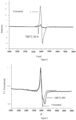
- EPR electron paramagnetic resonance
- a temperature of 115°C will be indicated - by way of example - for all the tests carried out at temperatures comprised from 105°C to 118°C, for the sake of brevity and given that all the other tests not discussed in detail also revealed results in line with the tests at 115°C.
- Table 15 shows the treatment conditions of some samples: Table 15 Sample R (rif) A B C D Temperature - 40°C 80°C 115°C 150°C Duration - 48 h 48 h 48 h 24 h
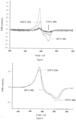
- the CW-EPR spectra of the five samples of PTFE were acquired at room temperature prior to the thermal treatment. The spectra were normalised.
- EPR spectra can be compared with the EPR spectrum of the sample treated at 150°C for 24 h ( Figure 5 ).
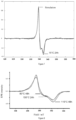
- the spectrum relating to the PTFE irradiated at 150°C for 24 hours was normalised so that the shoulder (indicated by the arrow) has the same intensity as the EPR spectrum of the untreated ( Figure 9 ): the shoulder is a characteristic attributable to the secondary radicals, and thus the signals of the secondary radicals are subtracted from the overall signal (primary radicals + secondary radicals).
- the difference spectrum can be modelled like the EPR spectrum of a 1:2:1 triplet in slow motion. The distance between the lines of the triplet is about 1.4 mT ( Figure 10 ).
- the spectrum is perfectly matches the one attributed to primary radicals of the RCF2O• type.
- the irradiated PTFE showed a PFOA content ⁇ LOQ with LOQ 1 ppb.
- melt flow rate (MFR) analysis of the irradiated materials reveals that in order to have an equivalent PTFE irradiated in air, a greater irradiation quantifiable from 20 to 40% is required depending on the degree of irradiation.
- the signal appears to be decreased in intensity, but not markedly when compared with the sample subjected to heating at 80°C for 48 hours.
- a closer analysis clearly shows that the line width has increased, especially for secondary radicals, and this is the reason for the apparent decrease in intensity. If we suppose that such radicals are distributed in crystalline-type sites, heating at 70°C does not appear to have caused a significant decay but just redistribution to several different sites, resulting in an increase in inhomogeneous line broadening ( Figure 11 ).
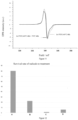
- Table 17 expressed as the number of total radicals in the sample.
- sample C 115°C
- sample D at 150°C
- the method of the present invention allows to obtain low molecular weight PTFE without the need to add further reagents or chain terminators, such as for example halogenated polymers.
- the method of the present invention allows to obtain low molecular weight PTFE without the need to carry out purifications of the low molecular weight PTFE after the irradiation step.
- the method of the present invention allows to obtain low molecular weight PTFE without the need to conduct post-treatment thermal treatments at higher temperatures with respect to the maximum irradiation temperature, given that a control of the temperature during the irradiation step allows to do without additional thermal treatment steps.
- the method of the present invention was elaborated despite and against an experimental evidence that is disadvantageous (lower decrease in MW) to the fragmentation of the high molecular weight PTFE, in the presence of a lower amount of oxygen with respect to the atmospheric value.
- the low molecular weight PTFE obtained by means of the present method has compatibility characteristics, and much more, not different from the low molecular weight PTFE obtainable with the known techniques.
- chambers or chamber walls or bags comprising polyethylene allows to hermetically close the chamber better, and provide a material that is more neutral to irradiation.
- a pulse, intermittent or alternate step operating technique allows to improve the productivity of the present method.
Landscapes
- Chemical & Material Sciences (AREA)
- Health & Medical Sciences (AREA)
- Chemical Kinetics & Catalysis (AREA)
- Medicinal Chemistry (AREA)
- Polymers & Plastics (AREA)
- Organic Chemistry (AREA)
- General Chemical & Material Sciences (AREA)
- Treatments Of Macromolecular Shaped Articles (AREA)
- Processes Of Treating Macromolecular Substances (AREA)
Applications Claiming Priority (3)
| Application Number | Priority Date | Filing Date | Title |
|---|---|---|---|
| IT102019000024871A IT201900024871A1 (it) | 2019-12-19 | 2019-12-19 | Metodo per produrre politetrafluoroetilene (PTFE) a basso peso molecolare, PTFE a basso peso molecolare e composizione |
| PCT/IB2020/062305 WO2021124311A1 (fr) | 2019-12-19 | 2020-12-21 | Procédé de production de polytétrafluoroéthylène (ptfe) de faible masse moléculaire, ptfe de faible masse moléculaire et composition |
| EP20842038.0A EP4103627B8 (fr) | 2019-12-19 | 2020-12-21 | Procédé de préparation d'un polytétrafluoroéthylène (ptfe) à bas poids moléculaire et ptfe à bas poids moléculaire |
Related Parent Applications (2)
| Application Number | Title | Priority Date | Filing Date |
|---|---|---|---|
| EP20842038.0A Division-Into EP4103627B8 (fr) | 2019-12-19 | 2020-12-21 | Procédé de préparation d'un polytétrafluoroéthylène (ptfe) à bas poids moléculaire et ptfe à bas poids moléculaire |
| EP20842038.0A Division EP4103627B8 (fr) | 2019-12-19 | 2020-12-21 | Procédé de préparation d'un polytétrafluoroéthylène (ptfe) à bas poids moléculaire et ptfe à bas poids moléculaire |
Publications (2)
| Publication Number | Publication Date |
|---|---|
| EP4389805A2 true EP4389805A2 (fr) | 2024-06-26 |
| EP4389805A3 EP4389805A3 (fr) | 2024-09-25 |
Family
ID=70155175
Family Applications (2)
| Application Number | Title | Priority Date | Filing Date |
|---|---|---|---|
| EP24167317.7A Pending EP4389805A3 (fr) | 2019-12-19 | 2020-12-21 | Procédé de production de polytétrafluoroéthylène (ptfe) de faible masse moléculaire, ptfe de faible masse moléculaire et composition |
| EP20842038.0A Active EP4103627B8 (fr) | 2019-12-19 | 2020-12-21 | Procédé de préparation d'un polytétrafluoroéthylène (ptfe) à bas poids moléculaire et ptfe à bas poids moléculaire |
Family Applications After (1)
| Application Number | Title | Priority Date | Filing Date |
|---|---|---|---|
| EP20842038.0A Active EP4103627B8 (fr) | 2019-12-19 | 2020-12-21 | Procédé de préparation d'un polytétrafluoroéthylène (ptfe) à bas poids moléculaire et ptfe à bas poids moléculaire |
Country Status (6)
| Country | Link |
|---|---|
| US (2) | US12410268B2 (fr) |
| EP (2) | EP4389805A3 (fr) |
| CN (2) | CN114981322B (fr) |
| IT (1) | IT201900024871A1 (fr) |
| LT (1) | LT4103627T (fr) |
| WO (1) | WO2021124311A1 (fr) |
Citations (6)
| Publication number | Priority date | Publication date | Assignee | Title |
|---|---|---|---|---|
| US3085083A (en) | 1959-05-05 | 1963-04-09 | Du Pont | Stabilized tetrafluoroethylene-fluoro-olefin copolymers having-cf2h end groups |
| EP3385309A1 (fr) | 2016-08-04 | 2018-10-10 | Daikin Industries, Ltd. | Procédé de fabrication de polytétrafluoroéthylène de faible masse moléculaire, polytétrafluoroéthylène de faible masse moléculaire, et poudre |
| EP3388472A1 (fr) | 2016-08-04 | 2018-10-17 | Daikin Industries, Ltd. | Procédé de fabrication de polytétrafluoroéthylène de faible masse moléculaire, polytétrafluoroéthylène de faible masse moléculaire, et poudre |
| WO2019156053A1 (fr) | 2018-02-07 | 2019-08-15 | ダイキン工業株式会社 | Procédé de fabrication de polytétrafluoroéthylène de faible masse moléculaire, et poudre |
| WO2019156039A1 (fr) | 2018-02-07 | 2019-08-15 | ダイキン工業株式会社 | Procédé de fabrication de polytétrafluoroéthylène de faible masse moléculaire |
| WO2019156065A1 (fr) | 2018-02-07 | 2019-08-15 | ダイキン工業株式会社 | Procédé de production d'une composition contenant un polytétrafluoroéthylène à faible masse moléculaire |
Family Cites Families (3)
| Publication number | Priority date | Publication date | Assignee | Title |
|---|---|---|---|---|
| JP5141256B2 (ja) | 2005-10-20 | 2013-02-13 | 旭硝子株式会社 | ポリテトラフルオロエチレン水性分散液およびその製品 |
| JP6433758B2 (ja) * | 2014-10-30 | 2018-12-05 | 三井化学東セロ株式会社 | ガスバリア性積層体 |
| JP7261422B2 (ja) * | 2019-07-12 | 2023-04-20 | ダイキン工業株式会社 | 低分子量ポリテトラフルオロエチレンの製造方法、及び、粉末 |
-
2019
- 2019-12-19 IT IT102019000024871A patent/IT201900024871A1/it unknown
-
2020
- 2020-12-21 LT LTEPPCT/IB2020/062305T patent/LT4103627T/lt unknown
- 2020-12-21 EP EP24167317.7A patent/EP4389805A3/fr active Pending
- 2020-12-21 CN CN202080087602.9A patent/CN114981322B/zh active Active
- 2020-12-21 EP EP20842038.0A patent/EP4103627B8/fr active Active
- 2020-12-21 US US17/783,620 patent/US12410268B2/en active Active
- 2020-12-21 CN CN202410877710.6A patent/CN118791654A/zh active Pending
- 2020-12-21 WO PCT/IB2020/062305 patent/WO2021124311A1/fr not_active Ceased
-
2025
- 2025-07-30 US US19/286,122 patent/US20250361341A1/en active Pending
Patent Citations (6)
| Publication number | Priority date | Publication date | Assignee | Title |
|---|---|---|---|---|
| US3085083A (en) | 1959-05-05 | 1963-04-09 | Du Pont | Stabilized tetrafluoroethylene-fluoro-olefin copolymers having-cf2h end groups |
| EP3385309A1 (fr) | 2016-08-04 | 2018-10-10 | Daikin Industries, Ltd. | Procédé de fabrication de polytétrafluoroéthylène de faible masse moléculaire, polytétrafluoroéthylène de faible masse moléculaire, et poudre |
| EP3388472A1 (fr) | 2016-08-04 | 2018-10-17 | Daikin Industries, Ltd. | Procédé de fabrication de polytétrafluoroéthylène de faible masse moléculaire, polytétrafluoroéthylène de faible masse moléculaire, et poudre |
| WO2019156053A1 (fr) | 2018-02-07 | 2019-08-15 | ダイキン工業株式会社 | Procédé de fabrication de polytétrafluoroéthylène de faible masse moléculaire, et poudre |
| WO2019156039A1 (fr) | 2018-02-07 | 2019-08-15 | ダイキン工業株式会社 | Procédé de fabrication de polytétrafluoroéthylène de faible masse moléculaire |
| WO2019156065A1 (fr) | 2018-02-07 | 2019-08-15 | ダイキン工業株式会社 | Procédé de production d'une composition contenant un polytétrafluoroéthylène à faible masse moléculaire |
Non-Patent Citations (6)
| Title |
|---|
| "An end group analysis based on solid-state NMR and IR spectroscope", 2002, ELSEVIER |
| LAPPAN U: "Polymer", 2002, article "Number-average molecular weight of radiation-degraded poly(tetrafluoroethylene" |
| OSHIMA, A.IKEDA, S.SEGUCHI, T.TABATA, Y: "Improvement of radiation resistance for polytetrafluoroethylene (PTFE) by radiation crosslinkin", RADIATION PHYSICS AND CHEMISTRY, vol. 49, 1997, pages 279 - 284, XP004017181, DOI: 10.1016/S0969-806X(96)00138-7 |
| SIEGEL, SHEDGPETH, H: "Chemistry of Irradiation Induced Polytetrafluoroethylene Radicals: I. Reexamination of the EPR Spectra", THE JOURNAL OF CHEMICAL PHYSICS, vol. 46, no. 10, 1967, pages 3904 |
| SUWA, J. APPL. POLYMER SCI., vol. 17, 1973, pages 3253 |
| T. MATSUGASHITAK. SHINOHARA, J. CHERN. PHYS., vol. 35, 1961, pages 1652 |
Also Published As
| Publication number | Publication date |
|---|---|
| US20220389134A1 (en) | 2022-12-08 |
| IT201900024871A1 (it) | 2021-06-19 |
| EP4103627B8 (fr) | 2024-11-06 |
| CN114981322B (zh) | 2024-08-13 |
| EP4389805A3 (fr) | 2024-09-25 |
| US12410268B2 (en) | 2025-09-09 |
| WO2021124311A1 (fr) | 2021-06-24 |
| LT4103627T (lt) | 2024-07-10 |
| CN114981322A (zh) | 2022-08-30 |
| CN118791654A (zh) | 2024-10-18 |
| EP4103627B1 (fr) | 2024-04-03 |
| US20250361341A1 (en) | 2025-11-27 |
| EP4103627A1 (fr) | 2022-12-21 |
Similar Documents
| Publication | Publication Date | Title |
|---|---|---|
| Haji-Saeid et al. | Radiation treatment for sterilization of packaging materials | |
| EP0759873B1 (fr) | PROCEDE DE STERILISATION PAR RAYONNEMENT $g(g) ET PAR UTILISATION D'UN ABSORBEUR D'OXYGENE, RESERVOIR ET ARTICLE MEDICAL STERILISES AU MOYEN DUDIT PROCEDE | |
| Dole et al. | Irradiation of polyethylene. II. Kinetics of unsaturation effects | |
| Liu et al. | Degradation of vinyl chloride (VC) by the sulfite/UV advanced reduction process (ARP): Effects of process variables and a kinetic model | |
| Dhawan et al. | The impact of microwave‐assisted thermal sterilization on the morphology, free volume, and gas barrier properties of multilayer polymeric films | |
| Dhawan et al. | Pressure-assisted thermal sterilization effects on gas barrier, morphological, and free volume properties of multilayer EVOH films | |
| Tang et al. | Photochemistry of polyundecanamides. 1. Mechanisms of photooxidation at short and long wavelengths | |
| EP1132195A2 (fr) | Traitement de surface ou revêtement de bandes utilisant un plasmatron atmosphérique à arc non transféré | |
| JP2001520946A (ja) | 酸化性有機化合物を含有する物品を処理するための方法及び装置 | |
| US6599487B1 (en) | Apparatus, and system for triggering oxygen scacenging films | |
| Benitez et al. | Removal of selected pharmaceuticals in waters by photochemical processes | |
| ITMI20111921A1 (it) | Processo di preparazione di una composizione polimerica comprendente idrotalciti intercalate con molecole attive, composizione cosi' ottenuta e articoli formati comprendenti la stessa. | |
| EP4103627B1 (fr) | Procédé de préparation d'un polytétrafluoroéthylène (ptfe) à bas poids moléculaire et ptfe à bas poids moléculaire | |
| Said et al. | Physical properties of electron beam irradiated poly (vinyl butyral) composites with carbamate, imidazole, and tetrazolium dye | |
| Arnett et al. | Complete thermodynamic analysis of the hydration of thirteen pyridines and pyridinium ions. The special case of 2, 6-di-tert-butylpyridine | |
| EP1132492A2 (fr) | Matériaux en forme de bandes traitées par plasma | |
| Tang et al. | Photochemistry of polyundecanamides. 2. Titanium dioxide-and zinc oxide-photocatalyzed oxidation | |
| Vasile et al. | Radiation chemistry of organic solids | |
| JP2013224432A (ja) | 酸素を捕捉する組成物及びその製造方法 | |
| Byun et al. | Physical and chemical properties of γ-irradiated EVOH film | |
| US9023931B2 (en) | Oxidation-sensitive, low-peroxide polymer comprising at least one inorganic phosphorus compound | |
| Andersson et al. | Degradation of low density polyethylene during extrusion. IV. Off‐flavor compounds in extruded films of stabilized LDPE | |
| Ramalingam et al. | Effect of pasteurization and retort processing on spectral characteristics, morphological, thermal, Physico‐Mechanical, barrier and optical properties of Nylon‐Based food packaging materials | |
| Dhawan | Polymeric-based multilayer food packaging films for pressure-assisted and microwave-assisted thermal sterilization | |
| Kaci et al. | Study of the effects of gamma irradiation on the structure and physical properties of low density polyethylene films containing hindered amine stabilizers |
Legal Events
| Date | Code | Title | Description |
|---|---|---|---|
| PUAI | Public reference made under article 153(3) epc to a published international application that has entered the european phase |
Free format text: ORIGINAL CODE: 0009012 |
|
| STAA | Information on the status of an ep patent application or granted ep patent |
Free format text: STATUS: THE APPLICATION HAS BEEN PUBLISHED |
|
| AC | Divisional application: reference to earlier application |
Ref document number: 4103627 Country of ref document: EP Kind code of ref document: P |
|
| AK | Designated contracting states |
Kind code of ref document: A2 Designated state(s): AL AT BE BG CH CY CZ DE DK EE ES FI FR GB GR HR HU IE IS IT LI LT LU LV MC MK MT NL NO PL PT RO RS SE SI SK SM TR |
|
| REG | Reference to a national code |
Ref country code: DE Ref legal event code: R079 Free format text: PREVIOUS MAIN CLASS: C08J0003280000 Ipc: C08F0114260000 |
|
| PUAL | Search report despatched |
Free format text: ORIGINAL CODE: 0009013 |
|
| AK | Designated contracting states |
Kind code of ref document: A3 Designated state(s): AL AT BE BG CH CY CZ DE DK EE ES FI FR GB GR HR HU IE IS IT LI LT LU LV MC MK MT NL NO PL PT RO RS SE SI SK SM TR |
|
| RIC1 | Information provided on ipc code assigned before grant |
Ipc: C08J 3/28 20060101ALI20240820BHEP Ipc: C08F 8/50 20060101ALI20240820BHEP Ipc: C08F 114/26 20060101AFI20240820BHEP |
|
| RAP3 | Party data changed (applicant data changed or rights of an application transferred) |
Owner name: GUARNIFLON S.P.A. |
|
| STAA | Information on the status of an ep patent application or granted ep patent |
Free format text: STATUS: REQUEST FOR EXAMINATION WAS MADE |
|
| 17P | Request for examination filed |
Effective date: 20250324 |
|
| STAA | Information on the status of an ep patent application or granted ep patent |
Free format text: STATUS: EXAMINATION IS IN PROGRESS |
|
| 17Q | First examination report despatched |
Effective date: 20250606 |