EP4389970A1 - Substrat recyclable à base de cellulose comprenant des fibres cellulosiques et une matière cellulosique non fibreuse - Google Patents
Substrat recyclable à base de cellulose comprenant des fibres cellulosiques et une matière cellulosique non fibreuse Download PDFInfo
- Publication number
- EP4389970A1 EP4389970A1 EP22216373.5A EP22216373A EP4389970A1 EP 4389970 A1 EP4389970 A1 EP 4389970A1 EP 22216373 A EP22216373 A EP 22216373A EP 4389970 A1 EP4389970 A1 EP 4389970A1
- Authority
- EP
- European Patent Office
- Prior art keywords
- cellulose
- based substrate
- substrate
- article
- precursor material
- Prior art date
- Legal status (The legal status is an assumption and is not a legal conclusion. Google has not performed a legal analysis and makes no representation as to the accuracy of the status listed.)
- Withdrawn
Links
Images




Classifications
-
- D—TEXTILES; PAPER
- D21—PAPER-MAKING; PRODUCTION OF CELLULOSE
- D21H—PULP COMPOSITIONS; PREPARATION THEREOF NOT COVERED BY SUBCLASSES D21C OR D21D; IMPREGNATING OR COATING OF PAPER; TREATMENT OF FINISHED PAPER NOT COVERED BY CLASS B31 OR SUBCLASS D21G; PAPER NOT OTHERWISE PROVIDED FOR
- D21H27/00—Special paper not otherwise provided for, e.g. made by multi-step processes
- D21H27/06—Vegetable or imitation parchment; Glassine paper
-
- D—TEXTILES; PAPER
- D21—PAPER-MAKING; PRODUCTION OF CELLULOSE
- D21H—PULP COMPOSITIONS; PREPARATION THEREOF NOT COVERED BY SUBCLASSES D21C OR D21D; IMPREGNATING OR COATING OF PAPER; TREATMENT OF FINISHED PAPER NOT COVERED BY CLASS B31 OR SUBCLASS D21G; PAPER NOT OTHERWISE PROVIDED FOR
- D21H17/00—Non-fibrous material added to the pulp, characterised by its constitution; Paper-impregnating material characterised by its constitution
- D21H17/63—Inorganic compounds
- D21H17/65—Acid compounds
-
- D—TEXTILES; PAPER
- D21—PAPER-MAKING; PRODUCTION OF CELLULOSE
- D21H—PULP COMPOSITIONS; PREPARATION THEREOF NOT COVERED BY SUBCLASSES D21C OR D21D; IMPREGNATING OR COATING OF PAPER; TREATMENT OF FINISHED PAPER NOT COVERED BY CLASS B31 OR SUBCLASS D21G; PAPER NOT OTHERWISE PROVIDED FOR
- D21H17/00—Non-fibrous material added to the pulp, characterised by its constitution; Paper-impregnating material characterised by its constitution
- D21H17/63—Inorganic compounds
- D21H17/70—Inorganic compounds forming new compounds in situ, e.g. within the pulp or paper, by chemical reaction with other substances added separately
-
- D—TEXTILES; PAPER
- D21—PAPER-MAKING; PRODUCTION OF CELLULOSE
- D21H—PULP COMPOSITIONS; PREPARATION THEREOF NOT COVERED BY SUBCLASSES D21C OR D21D; IMPREGNATING OR COATING OF PAPER; TREATMENT OF FINISHED PAPER NOT COVERED BY CLASS B31 OR SUBCLASS D21G; PAPER NOT OTHERWISE PROVIDED FOR
- D21H27/00—Special paper not otherwise provided for, e.g. made by multi-step processes
- D21H27/10—Packing paper
-
- D—TEXTILES; PAPER
- D21—PAPER-MAKING; PRODUCTION OF CELLULOSE
- D21H—PULP COMPOSITIONS; PREPARATION THEREOF NOT COVERED BY SUBCLASSES D21C OR D21D; IMPREGNATING OR COATING OF PAPER; TREATMENT OF FINISHED PAPER NOT COVERED BY CLASS B31 OR SUBCLASS D21G; PAPER NOT OTHERWISE PROVIDED FOR
- D21H27/00—Special paper not otherwise provided for, e.g. made by multi-step processes
- D21H27/16—Pure paper, i.e. paper lacking or having low content of contaminants
-
- D—TEXTILES; PAPER
- D21—PAPER-MAKING; PRODUCTION OF CELLULOSE
- D21H—PULP COMPOSITIONS; PREPARATION THEREOF NOT COVERED BY SUBCLASSES D21C OR D21D; IMPREGNATING OR COATING OF PAPER; TREATMENT OF FINISHED PAPER NOT COVERED BY CLASS B31 OR SUBCLASS D21G; PAPER NOT OTHERWISE PROVIDED FOR
- D21H27/00—Special paper not otherwise provided for, e.g. made by multi-step processes
- D21H27/30—Multi-ply
-
- Y—GENERAL TAGGING OF NEW TECHNOLOGICAL DEVELOPMENTS; GENERAL TAGGING OF CROSS-SECTIONAL TECHNOLOGIES SPANNING OVER SEVERAL SECTIONS OF THE IPC; TECHNICAL SUBJECTS COVERED BY FORMER USPC CROSS-REFERENCE ART COLLECTIONS [XRACs] AND DIGESTS
- Y02—TECHNOLOGIES OR APPLICATIONS FOR MITIGATION OR ADAPTATION AGAINST CLIMATE CHANGE
- Y02P—CLIMATE CHANGE MITIGATION TECHNOLOGIES IN THE PRODUCTION OR PROCESSING OF GOODS
- Y02P20/00—Technologies relating to chemical industry
- Y02P20/50—Improvements relating to the production of bulk chemicals
- Y02P20/582—Recycling of unreacted starting or intermediate materials
Definitions
- the present invention relates to a recyclable cellulose-based substrate that may be used as a packaging material. Further aspects of the present invention relate to methods for preparing said cellulose-based substrate and products derived from the same.
- Packaging materials cause a large amount of waste, which many countries presently try to reduce by recycling.
- Recyclable materials are advantageous because they extend the lifetime of raw materials.
- cellulose-based materials e.g. by repulping
- this can reduce the need for further growing and harvesting of natural cellulose sources. Accordingly, recycling by repulping promises economic and ecological gains.
- Parchment papers offer several advantages as packaging materials, such as providing grease-proofness and water proofness, providing a gas barrier, and biodegradability and/or compostability. Moreover, parchment-based products are generally considered food contact safe and have been used by consumers for packaging and or preparing food products for a long time. Parchment-based products can also be processed in multiple ways, such as printing labels on the product.
- parchment-based materials Whilst they are generally biodegradable and/or compostable, parchment-based materials are generally not recyclable, because the fibres are bonded together too strongly in an amorphous gel-like state. In other words, the advantageous properties of parchment-based food materials are concomitant with reduced recyclability and lower economic and ecological gains.
- layered products e.g. in which a polymeric film is glued to a cellulose-based substrate require further compounds and processing steps, which also creates negative environmental and economic impact.
- EP 3 819 426 discloses a highly parchmentized cellulose-based paper with very low oxygen transmission rates. Whilst the material is compostable and/or biodegradable, the repulpability of this material may be impacted owing to the fact that the fibres are embedded in a continuous cellulosic fibre matrix comprising non-fibrous cellulosic material.
- US 2,023,711 discloses attempts to prepare a partially parchmentized paper substrate in which some cellulose-fibres are dissolved whereas others are not affected. This is achieved by passing the paper through a solution that protects the fibres from parchmentization first, so that only the uncoated fibres react with the parchmentizing acid. However, the initial coating with the protecting solution would further limit the recyclability and repulpability of the paper substrate.
- the present invention solves the problems of the prior art by the following means.
- the present invention relates to a cellulose-based substrate comprising native cellulosic fibres and non-fibrous cellulosic material, wherein the substrate is recyclable by repulping with at least 50 wt% of the substrate being recoverable according to EN13430.
- the present invention relates to a method of preparing a substrate according to the first aspect, wherein the method comprises the steps of
- the present invention relates to a method for processing the cellulose-based substrate according to the first aspect, wherein the processing comprises any of printing, laminating, coating, painting, spraying, binding, gluing, varnishing, impregnating, soaking, and/or binding.
- the present invention relates to a use of a cellulose-based substrate according to the first aspect for packaging.
- the present invention relates to a substrate comprising native cellulosic fibres and non-fibrous cellulosic material, wherein the substrate is recyclable by repulping with at least 50 wt% of the substrate being recoverable according to EN13430.
- fibre refers to a material form characterized by an extremely high ratio of length to diameter.
- cellulose fibres have a very broad range of diameters and length based on fibre type and source of fibre.
- the average length of a wood pulp fibre as preferably used in the present invention is typically in the range of between from 0.3 mm to 3.5 mm, preferably from 0.3 mm to 3.0 mm, more preferably from 0.8 mm to 2.5 mm and even more preferably from 1.0 mm to 2.0 mm.
- the diameter of a wood pulp fibre is typically in the range of from 10 ⁇ m to 40 pm, preferably from 15 ⁇ m to 35 ⁇ m and more preferably from 20 ⁇ m to 30 ⁇ m.
- the aspect ratio (ratio of fibre length to fibre diameter) of a wood pulp fibre is therefore typically in the range of from 7.5 to 350, preferably from 7.5 to 300, more preferably from 10 to 200 and even more preferably from 20 to 150.
- the terms "fibre” and “filament” can be used interchangeably for the purposes of the present invention unless otherwise specifically indicated.
- cellulose-based describes a substrate and/or material and/or article comprised substantially of cellulose.
- the material may be a fibre or a film.
- Cellulose materials are derived from manmade sources such as regenerated cellulose fibres or films or from natural sources such as fibres or pulp from woody plants or non-woody plants.
- Cellulose-based materials may comprise woven or non-woven cellulose.
- Non-woven cellulose based materials can be formed from many processes such as, for example, spin laying, carding, knitting, air laying and wet laying process.
- Cellulose-based materials may comprise native cellulosic fibres and/or non-fibrous cellulosic material.
- native cellulosic fibres refers to cellulose fibres from natural sources such as woody plants including deciduous and coniferous trees or non-woody plants including cotton, flax, esparto grass, kenaf, sisal, abaca, milkweed, straw, jute, hemp and bagasse.
- the native cellulosic fibres are suitable for being dissolved by the gelatinizing agent. Suitable fibres for dissolution are, for example, hardwood fibres, softwood fibres or annual plant fibres.
- the native cellulosic fibres form a crystalline material comprising a crystallized fraction with the crystalline form of Cellulose I comprising all-parallel-oriented cellulose chains.
- the native cellulosic fibres may have been subjected to a pulping step.
- non-fibrous cellulosic material specifies a material, which is obtained by submitting the native cellulosic fibres to reaction with a gelatinizing agent thereby at least partially dissolving the native cellulosic fibres, wherein the native cellulosic fibres disintegrate and form a gel-like viscous material, and subsequently eliminating the gelatinizing agent by washing with a reprecipitation agent, whereby the gel-like material precipitates to form a solid material.
- One process of dissolving native cellulosic fibres and reprecipitating them is referred to as the parchmentizing process.
- the solid material which is referred to as the non-fibrous cellulosic material herein, is mostly amorphous and may comprise other forms of crystallized fraction such as a crystallized fraction with the crystalline form of Cellulose II comprising anti-parallel cellulose chains.
- the non-fibrous cellulosic material is preferably reprecipitated gelatinized cellulosic material.
- pulping describes a process whereby a material that has previously undergone or been formed by at least one pulping step is subjected to a further pulping step.
- recyclable by repulping describes a material which can be at least partially recovered and converted into a new material or object during a repulping step. Said material may be waste product.
- the term “recyclable” is generally described in line with EN13430.
- the expression “recyclable by repulping with at least 50 wt% being recoverable according to EN13430” therefore describes a material, which has been formed by or otherwise undergone at least one pulping step, and from which, upon subjecting it to a further pulping step, at least 50 wt% of the substrate can be recovered.
- substrate if not further specified refers to a cellulose-based substrate according to the first aspect of the present invention.
- the present invention relates to a cellulose-based substrate comprising native cellulosic fibres and non-fibrous cellulosic material, wherein the substrate is recyclable by repulping with at least 50 wt% of the substrate being recoverable according to EN13430.
- the substrate is recyclable by repulping with at least 55 wt% of the substrate being recoverable according to EN13430, more preferably with at least 60 wt% of the substrate being recoverable according to EN13430, more preferably with at least 65 wt% of the substrate being recoverable according to EN13430, more preferably with at least 70 wt% of the substrate being recoverable according to EN13430, more preferably with at least 75 wt% of the substrate being recoverable according to EN13430, more preferably with at least 80 wt% of the substrate being recoverable according to EN13430, more preferably with at least 85 wt% of the substrate being recoverable according to EN13430, and even more preferably with at least 90 wt% of the substrate being recoverable according to EN13430.
- the native cellulosic fibres contained in the substrate are recycled by repulping.
- the wt% amount of the substrate that is recoverable during recycling by repulping is at most the amount of the native cellulosic fibres in the substrate. That is to say, the entire or most of the non-gelatinized cellulosic fibre material that is recoverable during recycling by repulping can be considered recoverable native cellulosic material in the sense of this invention.
- Native cellulosic material thus also includes fibres that have not or at a best partially undergone reaction with the gelatinizing agent. In this sense, "partial" reaction defines a situation that allows the fibres to essentially maintain its fibrous state.
- the substrate comprises a composite material comprising native cellulosic fibres and non-fibrous cellulosic material.
- the substrate may be an article and/or a material.
- the native cellulosic fibres and the non-fibrous cellulosic material are contained in a continuous cellulosic fibre matrix.
- the term "continuous cellulosic fibre matrix" refers to a cellulose material comprising native cellulosic fibres and non-fibrous cellulosic material, wherein the native cellulosic fibres are embedded in the non-fibrous cellulosic material, whereby the pores of the fibrous skeleton are blocked.
- the continuous cellulosic fibre matrix thus represents a dense material providing a cellulose continuum between the native cellulose fibres and the non-fibrous cellulosic material avoiding any voids at the interface between the native cellulose fibres and the non-fibrous cellulosic material. Therefore, the continuous cellulosic fibre matrix is a continuous, non-porous material.
- the continuous cellulosic fibre matrix may have high gas barrier properties, especially towards oxygen.
- the continuous cellulosic fibre matrix further comprises de-structured cellulosic fibres.
- de-structured cellulosic fibres describes the periphery of a native cellulosic fibre that has been partially dissolved with a gelatinizing agent, whereby a progressive structure change from native cellulose to precipitated cellulose is generated.
- Such a progressive structure change means that the structure of the continuous cellulosic fibre matrix contains a structural gradient, wherein the crystalline structure of the native cellulosic fibre slowly changes into the mostly amorphous structure of the non-fibrous cellulosic material by formation of de-structured cellulosic fibres on the surface of the native cellulosic fibres.
- the de-structured cellulosic fibres thus surround the native cellulosic fibres and are interposed between the native cellulosic fibres and the non-fibrous cellulosic material.
- the continuous cellulosic fibre matrix may consist of native cellulosic fibres, de-structured cellulosic fibres and non-fibrous cellulosic material.
- De-structured cellulosic fibres that substantially retain their fibrous state and have only minimally undergone reaction with the gelatinizing agent may also be considered native cellulosic fibre.
- the substrate may be a substantially 2D-shaped article, e.g. a sheet, or a 3D-shaped article.
- a shaped article is an article that has been at least partially prepared by at least one shaping step.
- a substantially 2D-shaped article is an article having significantly larger length and width dimensions than thickness dimensions. 2D-shaped articles, that encase 3-shaped objects and thereby take the appearance of a 3D-shaped article, e.g. a butter wrapping, or which are otherwise not self-supporting, will also be considered 2D-shaped articles for the purposes of this application.
- the substrate is obtainable by a method comprising the steps of
- a cellulose-based substrate precursor material comprising native cellulosic fibres.
- Said cellulose-based substrate has been formed by or otherwise undergone at least one pulping step.
- the precursor material may comprise at least 50 wt% native cellulosic fibres, preferably at least 55% native cellulosic fibres, more preferably at least 60 wt% native cellulosic fibres, more preferably at least 65 wt% native cellulosic fibres, more preferably at least 70 wt% native cellulosic fibres, more preferably at least 75 wt% native cellulosic fibres, more preferably at least 80 wt% native cellulosic fibres, more preferably at least 85 wt% native cellulosic fibres, more preferably at least 90 wt% native cellulosic fibres, and even more preferably at least 95 wt% native cellulosic fibres.
- the precursor material substantially or fully consists of native cellulosic fibres.
- the precursor material comprises less than 1 wt% non-fibrous cellulosic material.
- the precursor material may be any of cardboard, waterleaf, absorbent paper, filter paper, cellulosic tissue.
- the precursor material is partially infiltrated with a gelatinizing agent.
- “Partially infiltrated” herein means that only part of the native cellulosic fibres in the precursor material provided in step (i) are contacted with the gelatinizing agent, the contacting being carried out by means of infiltration.
- 0.1-99% by mass of the native cellulosic fibres in the precursor material are contacted with the gelatinizing agent, more preferably 0.1-50%, more preferably 0.1-40%, more preferably 0.1-30%, more preferably 0.1-20%, more preferably 0.1-10%, more preferably 0.1-5%, even more preferably, 0.1-2%.
- the gelatinizing agent is provided in liquid form, e.g. in a solution.
- Said gelatinizing agent comprises at least one cellulose solvent selected from the group consisting of inorganic acids comprising sulfuric acid and phosphoric acid, Lewis acids comprising ZnCl 2 and Ca(SCN) 2 , inorganic bases comprising NaOH, organic bases comprising N-methylmorpholine N-oxide, and ionic liquids comprising tetraalkylammonium salts.
- the gelatinizing agent comprises sulfuric acid.
- the precursor material is porous and capable of absorbing the gelatinizing agent, thereby leading to infiltration when the precursor material is contacted with the gelatinizing agent.
- the degree of infiltration may be controlled by means of controlling the porosity of the precursor material, controlling the basis weight of the precursor material, controlling the pressure of contacting gelatinizing agent (e.g. by impression with a roller), controlling the contacting time between the precursor material and the gelatinizing agent (e.g. by dipping the precursor material into the gelatinizing agent for a pre-determined time), the addition of an eliminating reprecipitation agent, etc.
- step (ii) of the preferred embodiment of the first aspect of the present invention the precursor material provided in step (i) is partially infiltrated with a gelatinizing agent, and the precursor material is submitted to a reaction with the gelatinizing agent to dissolve native cellulosic fibres, to give a partially treated cellulose-based substrate precursor material.
- the reaction may be a chemical reaction.
- the degree to which the gelatinizing agent dissolves the native cellulosic fibres depends on the degree of infiltration, because the gelatinizing agent dissolves fibres that it directly contacts. Furthermore, the degree to which the reaction occurs depends on the nature and the concentration of the gelatinizing agent.
- the gelatinizing agent may dissolve 10 wt% or less of the native cellulosic fibres in the precursor material.
- the gelatinizing agent reacts with substantially all of the native cellulosic fibres it directly contacts, thereby dissolving all native cellulosic fibres it directly contacts.
- the reaction with the gelatinizing agent and thus the dissolution of native cellulosic fibres yields a partially treated cellulose-based substrate precursor material.
- Said partially treated cellulose-based substrate precursor material thus comprises native cellulosic fibres and dissolved cellulosic fibres, the dissolved cellulosic fibres being a gel-like viscous material.
- the partially treated cellulose-based substrate precursor material also comprises de-structured cellulosic fibres.
- the partially treated cellulose-based substrate precursor material is submitted to a reprecipitation agent.
- all dissolved cellulosic fibres are submitted to the reprecipitation agent.
- only part of the dissolved cellulosic fibres is submitted to the reprecipitation agent.
- Preferably at least the dissolved cellulosic fibres are submitted to the reprecipitation agent.
- non-fibrous cellulosic material Said non-fibrous cellulosic material may be dry or wet.
- the non-fibrous cellulosic material forms together with de-structured cellulosic fibres and native cellulosic fibres the continuous cellulosic fibre matrix.
- the reprecipitation agent is water.
- "eliminating the gelatinizing agent” means diluting and washing away of the gelatinizing agent.
- Other reprecipitation agents may be used which otherwise eliminate the gelatinizing agent, e.g. by neutralizing it or otherwise rendering it inactive.
- the preferred embodiment of the first aspect of the present invention may comprise a further step (iv), wherein the substrate is consolidated by a drying step.
- the step (iv) may comprise a further separate washing step before the drying step.
- the precursor material provided in step (i) is provided in the form of a substrate precursor article.
- substrate precursor article and “precursor article” are used synonymously herein.
- the precursor article may be a substantially 2D-shaped article, e.g. a sheet, or a 3D-shaped article.
- a shaping step may occur during steps (ii) or (iii), or otherwise before the substrate is consolidated. In another embodiment, a shaping step may occur after the substrate is consolidated.
- the precursor material provided in step (i) is provided in the form of a substrate precursor article having at least one surface region and a core region, and wherein the gelatinizing agent infiltrates the at least one surface region in step (ii).
- the precursor article is submitted to the reprecipitation agent, so that the at least one surface region comprises non-fibrous cellulosic material.
- the at least one surface region comprises the continuous cellulosic fibre matrix.
- the gelatinizing agent does not infiltrate the core region.
- the native cellulosic fibres in the core region remain intact and do not dissolve.
- the at least one surface region is substantially located at the surface of the article and the core region is substantially located in the bulk of the article.
- the surface region penetrates at most 50% relative to the total thickness of the article, more preferably at most 40%, more preferably at most 30%, more preferably at most 20%, more preferably at most 10%, more preferably at most 5%, more preferably at most 3%, and even more preferably at most 1%.
- the surface region penetrates at most 5 cm into the article, more preferably at most 3 cm into the article, more preferably at most 1 cm into the article, more preferably at most 0.1 cm into the article, more preferably at most 1 mm into the article, more preferably at most 100 ⁇ m into the article, more preferably at most 50 ⁇ m into the article, and even more preferably at most 10 ⁇ m into the article.
- the surface region may cover the entire surface of the precursor article or only a portion of it. Parts of the surface not covered by the surface region are herein referred to as "remaining surface".
- the precursor article is a substantially 2D-shaped article such as a sheet, wherein the surface region covers one side only and the other side is the remaining surface.
- the precursor article is a concave 3D-shaped article, wherein the surface region only covers the inner surface of the concave article. The outer surface of the concave article is thus the remaining surface.
- the precursor article is a cube-like article such as a box, and the surface region covers only one face. The other five faces thus constitute the remaining surface.
- Control over the infiltration of the gelatinizing agent into the at least one surface region may be exerted by any suitable method.
- the gelatinizing agent is only contacted with the surface region and the remaining surface is not contacted. This may be achieved for instance by dipping the surface region into a solution containing the gelatinizing agent.
- the gelatinizing agent may be surface applied on one side of a sheet only, e.g. by rolling, spraying, kiss coating, transfer coating and/or metered size pressing.
- the degree of infiltration may be controlled by means of controlling the porosity of the precursor article, controlling the basis weight of the precursor article, controlling the pressure of the contacting gelatinizing agent (e.g. by impression with a roller), controlling the contacting time between the precursor material and the gelatinizing agent (e.g. by dipping the precursor material into the gelatinizing agent for a pre-determined time), the addition of an eliminating reprecipitation agent, etc.
- the precursor material provided in step (i) is provided in the form of a precursor article being a multilayer or a single layer article.
- the multilayer article may be multilayer sheet comprised of several layers being vertically stacked upon one another.
- the multilayer precursor article may comprise a first layer and a second layer, the first layer being positioned at the surface of the article, and wherein the first layer is more permeable to the gelatinizing agent than the second layer.
- at least the first and second layer consist of a cellulose-based material.
- the permeability of the layers may depend, for instance, on the basis weight/density of the layers and/or the Bendtsen porosity of the layers. Consequently, the gelatinizing agent infiltrates deeper into the first layer and reacts with the native cellulosic fibres more strongly.
- the first layer comprises more non-fibrous cellulosic material than the second layer.
- the first layer comprises more continuous cellulosic fibre matrix.
- the second layer is substantially impermeable to the gelatinizing agent. Following step (iii), the second layer therefore does not comprise non-fibrous cellulosic material and/or continuous cellulosic fibre matrix.
- the first layer comprises more than 90 wt% continuous cellulosic fibre matrix whereas the second layer comprises less than 10 wt% continuous cellulosic fibre matrix.
- the second layer is positioned at the surface of the precursor article. In another embodiment, the second layer is positioned below the first layer, substantially in the bulk of the article.
- the precursor article may comprise further layers which may be more permeable, less permeable or equally permeable to gelatinizing agent as the second layer.
- the precursor material provided in step (i) has a basis weight of at least 100 gsm, preferably at least 120 gsm, more preferably at least 140 gsm, more preferably at least 160 gsm, more preferably at least 180 gsm, more preferably at least 200 gsm, more preferably at least 220 gsm, more preferably at least 240 gsm, more preferably at least 260 gsm, and even more preferably at least 270 gsm.
- the precursor material may have a basis weight below 100 gsm, for example 70 gsm, but the barrier properties and/ or the recovery rate might be impacted.
- the precursor material provided in step (i) is provided in the form of a precursor article being a multilayer article, the multilayer article comprising a first layer and a second layer, the first layer being positioned at the surface of the article, and the first layer having at basis weight of at most 270 gsm, more preferably at most 260 gsm, more preferably at most 240 gsm, more preferably at most 220 gsm, more preferably at most 200 gsm, more preferably at most 180 gsm, more preferably at most 160 gsm, more preferably at most 140 gsm, more preferably at most 120 gsm, more preferably at most 100 gsm , more preferably at most 80 gsm, more preferably at most 60 gsm, more preferably at most 40 gsm, and even more preferably at most 20 gsm.
- the basis weight of the first layer may be as low as 6 gsm.
- the precursor material provided in step (i) has a Bendtsen porosity of 1000 ml/min or less, preferably 900 ml/min or less, more preferably 800 ml/min or less, more preferably 700 ml/min or less, more preferably 600 ml/min or less, more preferably 500 ml/min or less, more preferably 400 ml/min or less, more preferably 300 ml/min or less, more preferably 200 ml/min or less, and even more preferably 100 ml/min or less.
- the precursor material provided in step (i) is provided in the form of a precursor article being a multilayer article, the multilayer article comprising a first layer and a second layer, the first layer being positioned at the surface of the article, and the first layer having a Bendtsen porosity of at least 100 ml/min, more preferably at least 200 ml/min, more preferably at least 300 ml/min, more preferably at least 400 ml/min, more preferably at least 500 ml/min, more preferably at least 600 ml/min, more preferably at least 700 ml/min, more preferably at least 800 ml/min, more preferably at least 900 ml/min, and even more preferably at least 1000 ml/min.
- the second layer has a Bendtsen porosity of at most 500 ml/min, more preferably at most 400 ml/min, more preferably at most 300 ml/min, more preferably at most 200 ml/min, more preferably at most 100 ml/min, more preferably at most 50 ml/min, and even more preferably at most 30 ml/min.
- the permeability of the layers correlates with their porosity.
- the porosity of the first and second layers are therefore configured in such a way that the first layer has a higher Bendtsen porosity than the second layer.
- the Bendtsen porosity may be measured according to ISO 5636-3:2013.
- the substrate is at least 90 wt% preferably at least 95 wt% and more preferably 100 wt% compostable according to EN13432 and/or ASTM D6400.
- the expression “compostable” is generally defined in line with the EN13432 standard.
- the term “compostable substrate” designates a substrate for which at least 90% of the materials have to be broken down by biological action within 6 months under the standard test method conditions, thereby meeting EN13432.
- the expression “compostable” when applied to a material or a product means that the material, or the entire product, will both biodegrade and disintegrate.
- biodegrade it is meant that the chemical structure or the material breaks down under the action of micro-organisms, while by “disintegrates” it is meant that the material, or the product made from it, will physically fall apart into fine visually indistinguishable fragments, at the end of a typical composting cycle.
- the polymer chains In order to be considered a compostable polymer material, the polymer chains must break down under the action of the micro-organisms, so that total mineralization is achieved (i.e. conversion of the material into CO 2 , water, inorganic compounds and bio mass under aerobic conditions) at a high rate compatible with the normal composting process of vegetable waste.
- the substrate is fully compostable. In one embodiment, the portion of the substrate that is not recoverable through recycling by repulping is at least 90 wt% compostable according to EN13432 and/or ASTM D6400.
- the 3D-shaped substrate is plastic-free.
- the 3D-shaped substrate is food contact approved according to any of EU 1935/2004, BfR 36, BfR 36-1, BfR 36-2, FDA 21 CFA ⁇ 176-170 & 176-180.
- the substrate is grease-proof according to TAPPI T454.
- the substrate is waterproof as determined according to TAPPI T441 with 30 seconds without water leakage, preferably with 60 seconds without water leakage, more preferably with 180 seconds without water leakage, more preferably with 300 seconds without water leakage, more preferably with 600 seconds without water leakage, and even more preferably with 1800 seconds without water leakage.
- the substrate has an oxygen transmission rate of less than 200 cm 3 /(m 2 ⁇ day), more preferably less than 180 cm 3 /(m 2 ⁇ day), more preferably less than 160 cm 3 /(m 2 ⁇ day), more preferably less than 140 cm 3 /(m 2 ⁇ day), more preferably less than 120 cm 3 /(m 2 ⁇ day), more preferably less than 120 cm 3 /(m 2 ⁇ day), more preferably less than 100 cm 3 /(m 2 ⁇ day), more preferably less than 80 cm 3 /(m 2 ⁇ day), more preferably less than 60 cm 3 /(m 2 ⁇ day), more preferably less than 40 cm 3 /(m 2 ⁇ day), and even more preferably less than 20 cm 3 /(m 2 ⁇ day).
- the substrate only comprises natural polymers.
- natural polymers are naturally occurring, non-petroleum-based polymers, such as rayon and hyaluronic acid, starch or modified starch. Said natural polymers may have been formed by a biological organism and extracted, or they may be chemically or physically modified by a subsequent process to convert them into the desired shape or form.
- the substrate does not comprise petroleum-based synthetic polymer adhesives or glues.
- the substrate is a packaging article.
- a packaging article is an article that is configured for packaging a second article.
- the packaging article is not particularly limited in size and/or shape.
- the substrate is a food packaging article.
- the second article is food or a food ingredient.
- the food packaging is not particularly limited and can be used for preserving food such as, for example, oxygen sensitive food.
- the food packaging article may be a substantially 2D-shaped article, such as a butter wrapping, or 3D-shaped article, such as an egg-box or a soup bowl.
- the packaging article may for example be selected from any of a beverage container, a coffee capsule, a coffee pad, a chocolate packaging and a biscuit packaging.
- the packaging article may be selected from any of a cosmetic packaging article, a medical packaging article, or an electronics packaging article.
- the present invention relates to a method of preparing a substrate according to the first aspect of the present invention, the method comprising the steps of
- any of the steps (i)-(iii) may be further characterised in the embodiments pertaining to the steps (i)-(iii) disclosed above.
- the method of the second aspect of the present invention may comprise a further step (iv), wherein the substrate is consolidated by a drying step.
- the step (iv) may comprise a further separate washing step before the drying step.
- the present invention relates to a method of processing the substrate according to the first aspect of the present invention.
- the processing comprises any of printing, laminating, painting, spraying, binding, gluing, varnishing, impregnating, soaking, and/or binding.
- the substrate is a food packaging article
- the processing comprises printing a label on the food packaging article.
- the present invention relates to the use for packaging of a substrate according to the first aspect of the present invention.
- such a use may be directed to any of shipping, storing, protecting, preserving, and/or presentation of a packaged article (e.g. gift wrapping).
- a packaged article e.g. gift wrapping
- the use for packaging is directed towards packaging food such as single serve beverage capsules, packaging cosmetics, packaging a medical article, and/or packaging electronics.
- Waterleaf layer Highly porous sheet with a thickness of approximately 50 ⁇ m.
- Gelatinizing agent sulfuric acid having a concentration of from 70% to 75%.
- Method of impregnation In one example the cellulosic substrate is dipped in a sulfuric acid bath, and in another example sulfuric acid is deposited at one corner of the sample, and a silicone roll is used to spread the acid on the surface of the sample on the same side.
- Imaging methods Scanning electron microscopy (SEM) and/or digital photography.
- the Bendtsen porosity was measured according to ISO 5636-3:2013.
- the Bekk smoothness was measured according to ISO 5627:1995.
- Recyclability tests were carried out according to EN 13430. A given sample is cut into smaller pieces of around 25cm 2 and is repulped in a disintegrator. The repulped sample screened on a Somerville-type equipment according to test method TAPPI/ANSI T 275 sp-18 using a 0.15 mm slotted plate. The different recovered fractions are used to calculate the recoverable portion.
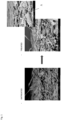
- FIG. 1 shows a scanning-electron micrograph of a cross-sectional view of the sample. As can be seen, only the surface region is parchmentized, whereas the core region remains substantially unchanged.
- the sample was then subjected to a grease resistance test.
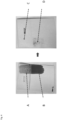
- An oil-based dye was spread on the treated side and the back side was observed. As can be seen in Figure 2 , the dye only penetrated the untreated area.
- a board-type precursor article was dipped in a sulfuric acid bath. The sample was then rinsed under running water and dried. In this process, both sides of the board are treated.
- Figures 3-4 show cross-sectional SEM and oil resistance tests of the sample of Example 2 respectively.
- a two-layer precursor article was prepared by placing a waterleaf layer on one face of the board-type precursor article, so that the waterleaf layer covered roughly only 80% of the board-type precursor article.
- the total thickness of the precursor article was, where covered by the waterleaf, ca 616 ⁇ m, and where not covered 566 ⁇ m.
- Sulfuric acid was deposited on the face of the board-type precursor including the waterleaf layer on the side of the sample including the board only.
- a silicone roll was then used to spread the acid toward the opposite side of the sample by rolling the acid over the waterleaf and pressing the gel at the same time.
- the sample was then rinsed under running water and dried.
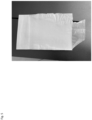
- Figures 5-7 show photography, cross-sectional SEM and oil resistance tests of the sample of Example 3 respectively.
Landscapes
- Chemical & Material Sciences (AREA)
- Inorganic Chemistry (AREA)
- Chemical Kinetics & Catalysis (AREA)
- General Chemical & Material Sciences (AREA)
- Laminated Bodies (AREA)
- Paper (AREA)
Priority Applications (6)
| Application Number | Priority Date | Filing Date | Title |
|---|---|---|---|
| EP22216373.5A EP4389970A1 (fr) | 2022-12-23 | 2022-12-23 | Substrat recyclable à base de cellulose comprenant des fibres cellulosiques et une matière cellulosique non fibreuse |
| PCT/EP2023/087411 WO2024133772A1 (fr) | 2022-12-23 | 2023-12-21 | Substrat à base de cellulose recyclable comprenant des fibres cellulosiques et une matière cellulosique non fibreuse |
| AU2023411463A AU2023411463A1 (en) | 2022-12-23 | 2023-12-21 | Recyclable cellulose-based substrate comprising cellulosic fibres and non-fibrous cellulosic material |
| EP23837644.6A EP4638866A1 (fr) | 2022-12-23 | 2023-12-21 | Substrat à base de cellulose recyclable comprenant des fibres cellulosiques et une matière cellulosique non fibreuse |
| JP2025536266A JP2025541441A (ja) | 2022-12-23 | 2023-12-21 | セルロース系繊維及び非繊維性セルロース系材料を含むリサイクル可能なセルロースベースの基材 |
| CN202380087718.6A CN120390839A (zh) | 2022-12-23 | 2023-12-21 | 包含纤维素纤维和非纤维纤维素材料的可再循环的基于纤维素的基材 |
Applications Claiming Priority (1)
| Application Number | Priority Date | Filing Date | Title |
|---|---|---|---|
| EP22216373.5A EP4389970A1 (fr) | 2022-12-23 | 2022-12-23 | Substrat recyclable à base de cellulose comprenant des fibres cellulosiques et une matière cellulosique non fibreuse |
Publications (1)
| Publication Number | Publication Date |
|---|---|
| EP4389970A1 true EP4389970A1 (fr) | 2024-06-26 |
Family
ID=84602101
Family Applications (2)
| Application Number | Title | Priority Date | Filing Date |
|---|---|---|---|
| EP22216373.5A Withdrawn EP4389970A1 (fr) | 2022-12-23 | 2022-12-23 | Substrat recyclable à base de cellulose comprenant des fibres cellulosiques et une matière cellulosique non fibreuse |
| EP23837644.6A Pending EP4638866A1 (fr) | 2022-12-23 | 2023-12-21 | Substrat à base de cellulose recyclable comprenant des fibres cellulosiques et une matière cellulosique non fibreuse |
Family Applications After (1)
| Application Number | Title | Priority Date | Filing Date |
|---|---|---|---|
| EP23837644.6A Pending EP4638866A1 (fr) | 2022-12-23 | 2023-12-21 | Substrat à base de cellulose recyclable comprenant des fibres cellulosiques et une matière cellulosique non fibreuse |
Country Status (5)
| Country | Link |
|---|---|
| EP (2) | EP4389970A1 (fr) |
| JP (1) | JP2025541441A (fr) |
| CN (1) | CN120390839A (fr) |
| AU (1) | AU2023411463A1 (fr) |
| WO (1) | WO2024133772A1 (fr) |
Citations (6)
| Publication number | Priority date | Publication date | Assignee | Title |
|---|---|---|---|---|
| US2023711A (en) | 1932-07-27 | 1935-12-10 | Paterson Parchment Paper Compa | Material containing parchmentized fiber and method of producing the same |
| GB487403A (en) * | 1936-10-16 | 1938-06-16 | Paterson Parchment Paper Compa | Improvements in or relating to parchment paper and a method of making the same |
| US2195239A (en) * | 1935-04-12 | 1940-03-26 | Champsaur Lucien Marie Charles | Process for the manufacture of artificial leather and parchment and products obtained thereby |
| WO2014207100A1 (fr) * | 2013-06-27 | 2014-12-31 | Basf Se | Procédé de couchage du papier à la cellulose à l'aide d'une solution contenant de la cellulose |
| EP3819426A1 (fr) | 2019-11-07 | 2021-05-12 | Ahlstrom-Munksjö Oyj | Papier cellulosique compostable à base de cellulose pour barrière aux gaz dans les matériaux d'emballage |
| WO2022078869A1 (fr) * | 2020-10-13 | 2022-04-21 | Société des Produits Nestlé S.A. | Gel de cellulose pour objets 3d |
-
2022
- 2022-12-23 EP EP22216373.5A patent/EP4389970A1/fr not_active Withdrawn
-
2023
- 2023-12-21 JP JP2025536266A patent/JP2025541441A/ja active Pending
- 2023-12-21 AU AU2023411463A patent/AU2023411463A1/en active Pending
- 2023-12-21 WO PCT/EP2023/087411 patent/WO2024133772A1/fr not_active Ceased
- 2023-12-21 CN CN202380087718.6A patent/CN120390839A/zh active Pending
- 2023-12-21 EP EP23837644.6A patent/EP4638866A1/fr active Pending
Patent Citations (6)
| Publication number | Priority date | Publication date | Assignee | Title |
|---|---|---|---|---|
| US2023711A (en) | 1932-07-27 | 1935-12-10 | Paterson Parchment Paper Compa | Material containing parchmentized fiber and method of producing the same |
| US2195239A (en) * | 1935-04-12 | 1940-03-26 | Champsaur Lucien Marie Charles | Process for the manufacture of artificial leather and parchment and products obtained thereby |
| GB487403A (en) * | 1936-10-16 | 1938-06-16 | Paterson Parchment Paper Compa | Improvements in or relating to parchment paper and a method of making the same |
| WO2014207100A1 (fr) * | 2013-06-27 | 2014-12-31 | Basf Se | Procédé de couchage du papier à la cellulose à l'aide d'une solution contenant de la cellulose |
| EP3819426A1 (fr) | 2019-11-07 | 2021-05-12 | Ahlstrom-Munksjö Oyj | Papier cellulosique compostable à base de cellulose pour barrière aux gaz dans les matériaux d'emballage |
| WO2022078869A1 (fr) * | 2020-10-13 | 2022-04-21 | Société des Produits Nestlé S.A. | Gel de cellulose pour objets 3d |
Non-Patent Citations (1)
| Title |
|---|
| CARTIER N ET AL: "STRUCTURE AND RECYCLING OF VEGETABLE PARCHMENT", TAPPI JOURNAL, TECHNICAL ASSOCIATION OF THE PULP & PAPER INDUSTRY, ATLANTA US, vol. 77, no. 5, 1 May 1994 (1994-05-01), pages 95 - 100, XP000474614, ISSN: 0734-1415 * |
Also Published As
| Publication number | Publication date |
|---|---|
| JP2025541441A (ja) | 2025-12-18 |
| WO2024133772A1 (fr) | 2024-06-27 |
| EP4638866A1 (fr) | 2025-10-29 |
| CN120390839A (zh) | 2025-07-29 |
| AU2023411463A1 (en) | 2025-06-26 |
Similar Documents
| Publication | Publication Date | Title |
|---|---|---|
| US12146267B2 (en) | Compostable cellulose-based paper for gas barrier in packaging material | |
| EP2956582B1 (fr) | Substrat fibreux contenant des fibres et un polysaccharide nanofibrillaire | |
| EP3607139B1 (fr) | Matériau d'emballage thermoscellable comprenant de la cellulose microfibrillée et produits fabriqués à partir de celui-ci | |
| EP4031710A1 (fr) | Composition, film ou revêtement comprenant de la cellulose microfibrillée et un produit d'extraction provenant d'écorce de bois ou de bois de liège | |
| EP4389975B1 (fr) | Substrat en forme 3d à base de cellulose comprenant des fibres cellulosiques et une matière cellulosique non fibreuse, procédés de préparation de celui-ci et utilisations de celui-ci | |
| WO2024133772A1 (fr) | Substrat à base de cellulose recyclable comprenant des fibres cellulosiques et une matière cellulosique non fibreuse | |
| CN119677911A (zh) | 具有高氧气阻隔特性的阻隔纸 | |
| HK40129849A (zh) | 包含纤维素纤维和非纤维纤维素材料的可再循环的基於纤维素的基材 | |
| CN114901464B (zh) | 用于密封饮料胶囊或饮料粉囊包的可堆肥的盖子以及用其密封的胶囊和粉囊包 | |
| HK40131540A (zh) | 包含纤维素纤维和非纤维纤维素材料的基於纤维素的3d成形的基材、用於制备其的方法以及其用途 | |
| HK40072191A (en) | Compostable cellulose-based paper for gas barrier in packaging material | |
| HK40072191B (zh) | 用於包装材料中的气体阻隔的可堆肥的纤维素基纸材 | |
| HK40072190B (zh) | 用於密封饮料胶囊或饮料粉囊包的可堆肥的盖子以及用其密封的胶囊和粉囊包 | |
| HK40072190A (en) | Compostable lid for sealing a beverage capsule or a beverage pad and capsules and pads sealed therewith |
Legal Events
| Date | Code | Title | Description |
|---|---|---|---|
| PUAI | Public reference made under article 153(3) epc to a published international application that has entered the european phase |
Free format text: ORIGINAL CODE: 0009012 |
|
| STAA | Information on the status of an ep patent application or granted ep patent |
Free format text: STATUS: THE APPLICATION HAS BEEN PUBLISHED |
|
| AK | Designated contracting states |
Kind code of ref document: A1 Designated state(s): AL AT BE BG CH CY CZ DE DK EE ES FI FR GB GR HR HU IE IS IT LI LT LU LV MC ME MK MT NL NO PL PT RO RS SE SI SK SM TR |
|
| STAA | Information on the status of an ep patent application or granted ep patent |
Free format text: STATUS: THE APPLICATION IS DEEMED TO BE WITHDRAWN |
|
| 18D | Application deemed to be withdrawn |
Effective date: 20250103 |