EP4390180A1 - Magnetmodulationsgetriebe und getriebemotor - Google Patents
Magnetmodulationsgetriebe und getriebemotor Download PDFInfo
- Publication number
- EP4390180A1 EP4390180A1 EP22858327.4A EP22858327A EP4390180A1 EP 4390180 A1 EP4390180 A1 EP 4390180A1 EP 22858327 A EP22858327 A EP 22858327A EP 4390180 A1 EP4390180 A1 EP 4390180A1
- Authority
- EP
- European Patent Office
- Prior art keywords
- magnetic
- region
- respect
- pole magnets
- radial direction
- Prior art date
- Legal status (The legal status is an assumption and is not a legal conclusion. Google has not performed a legal analysis and makes no representation as to the accuracy of the status listed.)
- Pending
Links
Images





Classifications
-
- H—ELECTRICITY
- H02—GENERATION; CONVERSION OR DISTRIBUTION OF ELECTRIC POWER
- H02K—DYNAMO-ELECTRIC MACHINES
- H02K7/00—Arrangements for handling mechanical energy structurally associated with dynamo-electric machines, e.g. structural association with mechanical driving motors or auxiliary dynamo-electric machines
- H02K7/08—Structural association with bearings
- H02K7/083—Structural association with bearings radially supporting the rotary shaft at both ends of the rotor
-
- F—MECHANICAL ENGINEERING; LIGHTING; HEATING; WEAPONS; BLASTING
- F16—ENGINEERING ELEMENTS AND UNITS; GENERAL MEASURES FOR PRODUCING AND MAINTAINING EFFECTIVE FUNCTIONING OF MACHINES OR INSTALLATIONS; THERMAL INSULATION IN GENERAL
- F16H—GEARING
- F16H49/00—Other gearings
-
- H—ELECTRICITY
- H02—GENERATION; CONVERSION OR DISTRIBUTION OF ELECTRIC POWER
- H02K—DYNAMO-ELECTRIC MACHINES
- H02K1/00—Details of the magnetic circuit
- H02K1/06—Details of the magnetic circuit characterised by the shape, form or construction
- H02K1/22—Rotating parts of the magnetic circuit
- H02K1/28—Means for mounting or fastening rotating magnetic parts on to, or to, the rotor structures
- H02K1/30—Means for mounting or fastening rotating magnetic parts on to, or to, the rotor structures using intermediate parts, e.g. spiders
-
- H—ELECTRICITY
- H02—GENERATION; CONVERSION OR DISTRIBUTION OF ELECTRIC POWER
- H02K—DYNAMO-ELECTRIC MACHINES
- H02K49/00—Dynamo-electric clutches; Dynamo-electric brakes
- H02K49/10—Dynamo-electric clutches; Dynamo-electric brakes of the permanent-magnet type
- H02K49/102—Magnetic gearings, i.e. assembly of gears, linear or rotary, by which motion is magnetically transferred without physical contact
-
- H—ELECTRICITY
- H02—GENERATION; CONVERSION OR DISTRIBUTION OF ELECTRIC POWER
- H02K—DYNAMO-ELECTRIC MACHINES
- H02K1/00—Details of the magnetic circuit
- H02K1/06—Details of the magnetic circuit characterised by the shape, form or construction
- H02K1/22—Rotating parts of the magnetic circuit
- H02K1/27—Rotor cores with permanent magnets
- H02K1/2706—Inner rotors
- H02K1/272—Inner rotors the magnetisation axis of the magnets being perpendicular to the rotor axis
- H02K1/274—Inner rotors the magnetisation axis of the magnets being perpendicular to the rotor axis the rotor consisting of two or more circumferentially positioned magnets
Definitions
- the present invention relates to a magnetic modulation gear and a gear motor.
- PTL 1 discloses a magnetic modulation gear that includes a plurality of outer pole magnets and a plurality of inner pole magnets arranged in a circumferential direction, and a low speed rotor having a plurality of magnetic pole pieces arranged in the circumferential direction between the outer pole magnets and the inner pole magnets.
- the low speed rotor is supported by a plurality of bearings. Some of the plurality of bearings are disposed so as to overlap the magnetic pole piece when viewed in an axial direction.
- the magnetic modulation gear of the related art described above has a problem in that a magnetic flux leaking in the axial direction from between the outer pole magnet, the magnetic pole piece, and the inner pole magnet is drawn into the bearing, which is a magnetic body, resulting in the occurrence of a loss.
- the loss reduces the torque and efficiency of the magnetic modulation gear.
- the present invention has an object to provide a magnetic modulation gear and a gear motor in which a decrease in torque and efficiency due to a leakage magnetic flux can be suppressed.
- a magnetic modulation gear according to an aspect of the present invention includes
- a magnetic modulation gear according to another aspect of the present invention includes
- a gear motor according to the present invention includes
- Fig. 1 is a sectional view showing a magnetic modulation gear according to an embodiment of the present invention.
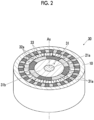
- Fig. 2 is a perspective view showing a cross section of the magnetic modulation gear of Fig. 1 .
- the cross section in Fig. 2 shows a cross section taken along line A-A in Fig. 1 .
- the direction along a center axis Ax will be referred to as an axial direction
- the direction perpendicular to the center axis Ax will be referred to as a radial direction
- the direction of rotation around the center axis Ax will be referred to as a circumferential direction.
- the side where a shaft member 32b protrudes in the axial direction (the left side in the drawings) will be referred to as a load side
- the opposite side the right side in the drawings) will be referred to as a counter load side.
- a magnetic modulation gear 30 includes a high speed rotor 31, a low speed rotor 32, a plurality of outer pole magnets 33, a casing 10, a load-side cover 11, and a counter load-side cover 12.
- the high speed rotor 31 includes a shaft 21a, a rotor yoke 31b, and a plurality of inner pole magnets 31a. Both axial end portions of the shaft 21a extend from the rotor yoke 31b, and these both end portions are supported by bearings 13a and 13b.
- the plurality of inner pole magnets 31a are, for example, permanent magnets such as neodymium magnets, are arranged in the circumferential direction such that the polarity directions are alternately different, and are attached to the outer peripheral surface of the rotor yoke 31b. Further, the plurality of inner pole magnets 31a may be integrated in a ring shape, or may be individually divided.
- the low speed rotor 32 is configured to be stepped and hollow on the counter load side, and is disposed concentrically with the high speed rotor 31.
- the low speed rotor 32 includes a plurality of magnetic pole pieces (pole pieces) 32a disposed on the outer diameter side of the inner pole magnets 31a.
- the magnetic pole piece 32a is made of a laminated steel sheet.
- the plurality of magnetic pole pieces 32a are disposed at predetermined intervals in the circumferential direction.
- the number of magnetic pole pieces 32a is the number of outer pole pairs (the number of pole pairs of the outer pole magnets 33) ⁇ the number of inner pole pairs (the number of pole pairs of the inner pole magnets 31a) and is generally the number of outer pole pairs + the number of inner pole pairs.
- Two magnetic pole pieces 32a adjacent to each other in the circumferential direction may be connected to each other by a thin connection portion or may be connected to each other through a non-magnetic body.
- the low speed rotor 32 further includes the shaft member 32b located on the load side with respect to the magnetic pole pieces 32a. Further, the low speed rotor 32 includes an extension portion 32c1 that extends from the magnetic pole pieces 32a toward the load side, an extension portion 32c2 that extends from the magnetic pole pieces 32a toward the counter load side, and a ring member 32g mounted on an outer peripheral portion of the extension portion 32c2.
- the shaft member 32b, the extension portions 32c1 and 32c2, and the ring member 32g form a shape in which the cross section shown in Fig. 1 is continuous over the entire circumference in the circumferential direction, a cutout may be included in a portion in the circumferential direction.
- the shaft member 32b and the ring member 32g may be made of a non-magnetic body such as stainless steel, or may be made of a steel-based magnetic body.
- the extension portions 32c1 and 32c2 are made of a material (a non-magnetic body and an insulating body) that does not have magnetism or conductivity, and may be made of resin.
- the shaft member 32b is connected to the extension portion 32c1 on the load side, and the extension portion 32c1 on the load side and the extension portion 32c2 on the counter load side are joined to the plurality of magnetic pole pieces 32a.
- the low speed rotor 32 that includes the shaft member 32b, the extension portion 32c1 on the load side, the plurality of magnetic pole pieces 32a, the extension portion 32c2 on the counter load side, and the ring member 32g is integrated, and the low speed rotor 32 rotates integrally.
- a portion on the load side of the shaft member 32b is exposed to the outside from the load-side cover 11 and is connected to a driven member (not shown).
- the plurality of outer pole magnets 33 are concentrically disposed on the side of the outer diameters of the plurality of magnetic pole pieces 32a with a predetermined gap therebetween.
- the plurality of outer pole magnets 33 may be permanent magnets such as neodymium magnets, or may be electromagnets.
- the plurality of outer pole magnets 33 have a larger number of poles than the plurality of inner pole magnets 31a.
- the plurality of outer pole magnets 33 are arranged in the circumferential direction such that the polarity directions are alternately different, and are attached to the inner peripheral surface of the casing 10 through a yoke portion 33a (not shown in Fig. 2 ).
- the plurality of outer pole magnets 33 function as a stator.
- the plurality of outer pole magnets 33 may be integrated in a ring shape, or may be individually divided.
- the axial lengths of the plurality of outer pole magnets 33, the axial lengths of the plurality of magnetic pole pieces 32a, and the axial lengths of the plurality of inner pole magnets 31a are substantially the same, and when viewed from the radial direction, the plurality of outer pole magnets 33, the plurality of magnetic pole pieces 32a, and the plurality of inner pole magnets 31a are disposed so as to substantially overlap.
- the casing 10 covers the radially outer sides of the plurality of outer pole magnets 33, the plurality of magnetic pole pieces 32a, and the plurality of inner pole magnets 31a.
- the load-side cover 11 is connected to the casing 10 and covers the load sides of the plurality of outer pole magnets 33, the plurality of magnetic pole pieces 32a, and the plurality of inner pole magnets 31a.
- the counter load-side cover 12 is connected to the casing 10 and covers the counter load sides of the plurality of outer pole magnets 33, the plurality of magnetic pole pieces 32a, and the plurality of inner pole magnets 31a.
- the magnetic modulation gear 30 further includes the bearings 13a and 13b that rotatably support the high speed rotor 31, and bearings 13a, 13c, and 13d that rotatably support the low speed rotor 32.
- the bearings 13a to 13d are ball bearings. However, various types of bearings such as roller bearings and tapered roller bearings may be applied.
- the bearing 13a is fitted between the low speed rotor 32 and the high speed rotor 31, and rotatably supports the high speed rotor 31 with respect to the low speed rotor 32.
- the bearing 13a rotatably supports the low speed rotor 32 with respect to the high speed rotor 31.
- the bearing 13b is fitted between the counter load-side cover 12 and the high speed rotor 31 (the shaft 21a thereof).
- the bearing 13c is fitted between the load-side cover 11 and the low speed rotor 32 (the shaft member 32b thereof).
- the bearing 13d is fitted between the casing 10 and the low speed rotor 32 (the ring member 32g thereof).
- Each of the bearings 13a to 13d has an outer ring, an inner ring, and rolling elements.
- the material for the outer ring, the inner ring, and the rolling element is a magnetic body (ferromagnetic body) such as steel. With such a material, high durability of the bearings 13a to 13d can be obtained, and a property of drawing in a magnetic flux is generated.
- the plurality of inner pole magnets 31a included in the high speed rotor 31 rotate around the center axis Ax. Then, a rotating magnetic flux of the inner pole magnet 31a passes through the plurality of magnetic pole pieces 32a, thereby being modulated into a spatial magnetic flux containing a waveform component having the same wave number as the number of pole pairs of the outer pole magnets 33 in an outer side in the radial direction of the plurality of magnetic pole pieces 32a (the gap between the magnetic pole piece 32a and the outer pole magnet 33).
- the gear ratio (reduction ratio) at this time is (the number of magnetic pole pieces 32a / the number of pole pairs of the inner pole magnets 31a).
- the plurality of magnetic pole pieces 32a of the low speed rotor 32 rotate around the center axis Ax while drawing in the magnetic flux of the plurality of outer pole magnets 33.
- the magnetic flux of the outer pole magnet 33 is modulated into a spatial magnetic flux containing a waveform component having the same wave number as the number of pole pairs of the inner pole magnets 31a in an inner side in the radial direction of the plurality of magnetic pole pieces 32a (the gap between the magnetic pole piece 32a and the inner pole magnet 31a).
- the gear ratio (speed increase ratio) at this time is (the number of pole pairs of the inner pole magnets 31a / the number of magnetic pole pieces 32a).
- a structure in which the outer pole magnets 33 are fixed is shown.
- a configuration may be adopted in which the low speed rotor 32 having the plurality of magnetic pole pieces 32a is fixed, the plurality of outer pole magnets 33 are rotatably supported, and decelerated rotating motion is output through the plurality of outer pole magnets 33.
- a configuration is made in which the low speed rotor 32 rotates relative to the plurality of outer pole magnets 33 and also rotates relative to the high speed rotor 31.
- Figs. 3A and 3B are graphs showing changes in characteristic according to disposition of a magnetic body, in which Fig. 3A shows a torque characteristic and Fig 3B shows an efficiency characteristic.
- Figs. 4A to 4C are diagrams showing characteristic analysis conditions, and respectively show first disposition to third disposition of a magnetic body 51.
- graph lines for the first disposition to third disposition respectively represent the dispositions in the radial direction of the magnetic body 51 as shown in Figs. 4A to 4C , and show characteristics when an axial distance L is changed.
- Torque is expressed as a ratio with a value when there is no magnetic body as 100%.
- the distance L indicates the distance in the axial direction between the magnetic pole piece 32a and the magnetic body 51.
- Figs. 4A to 4C show a part (above the center axis Ax) of a cross section taken along a vertical plane that includes the center axis Ax with respect to the outer pole magnet 33, the magnetic pole pieces 32a, and an arbitrary magnetic body 51.
- a magnetic flux H passes between the outer pole magnet 33 and the magnetic pole piece 32a.
- a ring-shaped ferromagnetic body centered on the center axis Ax was applied as the magnetic body 51.
- the region Rx1 corresponds to a region between an outer peripheral end E1 and an inner peripheral end of the magnetic pole piece 32a in the radial direction.
- the region Rx2 corresponds to a region between an inner peripheral end E2 of the outer pole magnet 33 and the outer peripheral end E1 of the magnetic pole piece 32a in the radial direction.
- the region Rx3 corresponds to a region outward in the radial direction from the inner peripheral end E2 of the outer pole magnet 33.
- the decrease in torque and efficiency due to the magnetic body 51 is due to a loss caused by the magnetic body 51 drawing in the magnetic flux H in the axial direction. Therefore, in a case where an axial thickness of the magnetic body 51 is as small as, for example, 0.1 mm, even if the magnetic body 51 is close to the magnetic pole piece 32a, a decrease in torque and efficiency does not much occur.
- the magnetic modulation gear 30 of the present embodiment has the following magnetic body disposition structures 1 to 4 in order to suppress a decrease in torque and efficiency.
- the magnetic modulation gear 30 does not have a magnetic body having an axial dimension larger than 0.5 mm in a region R1a.
- the magnetic modulation gear 30 does not need to have a magnetic body having an axial dimension larger than 0.5 mm in a region R1.
- the magnetic body having an axial dimension larger than 0.5 mm is disposed outside the region R1a, or is disposed outside the region R1a.
- magnetic body means a ferromagnetic body, and is, for example, a part containing steel or the like.
- a part include an outer ring, an inner ring, or a rolling element of a bearing, a sensor containing a magnetic body, a stay for a sensor or the like, a fastening member such as a bolt, a reinforcing ring member (ring plate), and the like.
- the region R1a is a region between the inner peripheral ends of the plurality of outer pole magnets 33 and the outer peripheral ends of the plurality of inner pole magnets 31a in the radial direction, and corresponds to a region in which a distance from the magnetic pole pieces 32a in the axial direction is X mm.
- the X mm is preferably 8 mm, and more preferably 3 mm.
- the region R1 corresponds to a region inside the magnetic modulation gear 30 and between the inner peripheral ends of the plurality of outer pole magnets 33 and the outer peripheral ends of the plurality of inner pole magnets 31a in the radial direction.
- the inside of the magnetic modulation gear 30 means an inner side with respect to the outer surface of the magnetic modulation gear 30 (the surfaces exposed to the outside of the casing 10, the load-side cover 11, the counter load-side cover 12, the shaft member 32b, and the shaft 21a).
- the bearing 13c is located within a region outward in the radial direction with respect to the inner peripheral ends of the plurality of outer pole magnets 33 or within a region inward in the radial direction with respect to the outer peripheral ends of the plurality of inner pole magnets 31a.
- the bearing 13c is located within a region inward in the radial direction with respect to the outer peripheral ends of the plurality of inner pole magnets 31a.
- the bearing 13c is fitted to an outer peripheral surface S2 of a second step which is located one step inward from an outer peripheral surface S3 of the magnetic pole piece 32a, among a plurality of steps of outer peripheral surfaces S1 to S4 of the low speed rotor 32.
- the bearing 13c With such a configuration, it is possible to suppress a situation in which on the load side of the magnetic pole piece 32a, the bearing 13c draws in the magnetic flux leaking from between the outer pole magnet 33, the magnetic pole piece 32a, and the inner pole magnet 31a, thereby causing a loss. Further, the bearing 13c can be disposed at a location not far away from the inner pole magnet 31a and the outer pole magnet 33 in the axial direction, and the magnetic modulation gear 30 can be made more compact in the axial direction.
- the bearing 13d is located within a region outward in the radial direction with respect to the inner peripheral ends of the plurality of outer pole magnets 33 or within a region inward in the radial direction with respect to the outer peripheral ends of the plurality of inner pole magnets 31a.
- the bearing 13d is located within a region outward in the radial direction with respect to the inner peripheral ends of the plurality of outer pole magnets 33.
- the bearing 13d is fitted to the outer peripheral surface S4 of a fourth step which is located one step outward from the outer peripheral surface S3 of the magnetic pole piece 32a, among the plurality of steps of outer peripheral surfaces S1 to S4 of the low speed rotor 32.
- the bearing 13d may be disposed at an axial position that overlaps the region R1a when viewed from the radial direction.
- the bearing 13d can be disposed at a location not far away from the magnetic pole piece 32a in the axial direction, and the magnetic modulation gear 30 can be made more compact in the axial direction.
- Only one of the bearing 13c on the load side and the bearing 13d on the counter load side may be disposed so as not to overlap the region R1, and even in that case, the effect capable of suppressing the occurrence of a loss in the one can be exhibited.
- the material of the shaft member 32b of the low speed rotor 32 is a magnetic body such as steel.
- the shaft member 32b, which is a magnetic body is connected to the magnetic pole piece 32a through the extension portion 32c1, which is a non-magnetic body, so that the shaft member 32b, which is a magnetic body, is disposed so as not to overlap the region R1 or the region R1a.
- the ring member 32g of the low speed rotor 32 is a magnetic body such as steel.
- the ring member 32g, which is a magnetic body is fixed to the extension portion 32c2, which is a non-magnetic body, so that the ring member 32g, which is a magnetic body, is disposed so as not to overlap the region R1 or the region R1a.
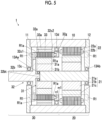
- Fig. 5 is a sectional view showing a gear motor according to the embodiment of the present invention.
- a gear motor 1 of the present embodiment includes a motor (electric motor) 20 that outputs rotational power, the magnetic modulation gear 30 that receives the rotational power of the motor 20, the casing 10 that accommodates the motor 20 and the magnetic modulation gear 30, the load-side cover 11, and the counter load-side cover 12.
- the motor 20 includes a motor rotor 21 and a motor stator 22.
- the magnetic modulation gear 30 includes the high speed rotor 31, the low speed rotor 32, and the plurality of outer pole magnets 33.
- the rotation axis of the motor 20 and the rotation axis of the magnetic modulation gear 30 overlap on the center axis Ax.
- the motor 20 and the magnetic modulation gear 30 are disposed side by side in the axial direction.
- the motor rotor 21 includes the shaft 21a, a rotor yoke 21b, and a rotor magnet 21c.
- the rotor yoke 21b is made of a magnetic body and is fixed to the outer peripheral surface of the shaft 21a.
- the rotor magnet 21c is, for example, a permanent magnet such as a neodymium magnet, and a plurality of rotor magnets 21c corresponding to a predetermined number of poles are attached to the portion located on the inner diameter side of the motor stator 22, of the outer peripheral surface of the rotor yoke 21b.
- the motor stator 22 is configured by winding a coil 22b around a stator core 22a made of laminated steel sheets.
- the motor stator 22 is disposed concentrically on the outer diameter side of the motor rotor 21, and is held in the casing 10 in a state where the stator core 22a is fitted inside the casing 10.
- the magnetic modulation gear 30 is configured in substantially the same manner as that in the embodiment shown in Fig. 1 , except that the bearing structure is partially different.
- the shaft 21a of the magnetic modulation gear 30 and the shaft 21a of the motor rotor 21 are shared, and extend in the axial direction from the motor 20 to the magnetic modulation gear 30.
- the ring member 32g has an annular fitting groove m1 recessed in the axial direction
- the extension portion 32c2 has an annular protrusion portion n1 corresponding to the fitting groove m1. Then, the ring member 32g and the extension portion 32c2 are joined together by fitting the protrusion portion n1 into the fitting groove m1.
- the gear motor 1 further includes bearings 13Aa and 13Ab that rotatably support the high speed rotor 31 of the magnetic modulation gear 30 and the motor rotor 21, and the bearings 13Aa, 13c, 13d that rotatably support the low speed rotor 32 of the magnetic modulation gear 30.
- the bearings 13Aa, 13Ab, 13c, and 13d are ball bearings. However, various types of bearings such as roller bearings and tapered roller bearings may be applied.
- the bearing 13Aa is fitted between the shaft member 32b of the low speed rotor 32 and the high speed rotor 31, and rotatably supports the high speed rotor 31 with respect to the low speed rotor 32, while rotatably supporting the low speed rotor 32 with respect to the high speed rotor 31.
- the shaft member 32b has a protrusion portion 32bt that protrudes toward the counter load side, and a recessed portion that is open in the axial direction is provided in the end portion on the load side of the high speed rotor 31.
- the protrusion portion 32bt extends into the recessed portion of the high speed rotor 31, and the bearing 13Aa is fitted between the outer peripheral surface of the protrusion portion 32bt and the inner peripheral surface of the recessed portion.
- the bearing 13Ab is fitted between the shaft 21a and the counter load-side cover 12 connected to the casing 10, and rotatably supports the shaft 21a with respect to the casing 10.
- the bearing 13c is fitted between the load-side cover 11 connected to the casing 10 and the shaft member 32b of the low speed rotor 32, and rotatably supports the shaft member 32b with respect to the casing 10.
- the bearing 13d is fitted between the casing 10 and the ring member 32g of the low speed rotor 32, and rotatably supports the counter load side of the low speed rotor 32 with respect to the casing 10.
- Each of the bearings 13Aa, 13Ab, 13c, and 13d has an outer ring, an inner ring, and rolling elements.
- the material for the outer ring, the inner ring, and the rolling element is a magnetic body (ferromagnetic body) such as steel. With such a material, high durability of the bearings 13Aa, 13Ab, 13c, and 13d can be obtained, and a property of drawing in a magnetic flux is generated.
- the motor 20 is driven, so that rotational power is output to the motor rotor 21, the rotational power is input to the magnetic modulation gear 30, and the rotating motion is decelerated by the operation of the magnetic modulation gear 30 described above and output through the low speed rotor 32.
- the bearing 13c closest to the magnetic pole pieces 32a on the load side with respect to the magnetic pole pieces 32a, and the bearing 13d closest to the magnetic pole pieces 32a on the counter load side with respect to the magnetic pole pieces 32a are disposed outside the region R1.
- the bearings 13c and 13d are located within a region outward in the radial direction with respect to the inner peripheral ends of the plurality of outer pole magnets 33 or within a region inward in the radial direction with respect to the outer peripheral ends of the plurality of inner pole magnets 31a.
- the bearing 13c is located within a region inward in the radial direction with respect to the outer peripheral ends of the plurality of inner pole magnets 31a. Further, the bearing 13d is located within a region outward in the radial direction with respect to the inner peripheral ends of the plurality of outer pole magnets 33.
- a part made of magnetic body that is included in the gear motor 1 a part having an axial dimension of 5 mm or more is disposed outside the region R1a.
- the region R1a is a region between the inner peripheral ends of the plurality of outer pole magnets 33 and the outer peripheral ends of the plurality of inner pole magnets 31a in the radial direction, and corresponds to a region in which a distance from the magnetic pole pieces 32a in the axial direction is X mm.
- the X mm is preferably 8 mm, and more preferably 3 mm.
- the rotor yoke 21b, the rotor magnet 21c, and the stator core 22a of the motor 20 are magnetic bodies, and are disposed outside the region R1a. Further, the ring member 32g, which is a magnetic body, is disposed outside the region R1a.
- the bearings 13Aa, 13Ab, 13c, and 13d With the disposition of the bearings 13Aa, 13Ab, 13c, and 13d and the disposition of the magnetic body part as described above, it is possible to suppress a situation in which the bearings 13Aa, 13Ab, 13c, and 13d or the magnetic body part draws in the magnetic flux leaking from between the outer pole magnet 33, the magnetic pole piece 32a, and the inner pole magnet 31a, thereby causing a loss. Further, by adopting the above-described structure as the disposition structure of the bearing 13Aa that is interposed between the high speed rotor 31 and the low speed rotor 32, the bearings 13Aa and 13c on the load side in the axial direction can be disposed close to the inner pole magnet 31a and the outer pole magnet 33. With the disposition, the magnetic modulation gear 30 and the gear motor 1 can be made more compact in the axial direction.
- the bearings 13c and 13d may be disposed at axial positions that overlap the region R1a when viewed from the radial direction. With such disposition, the magnetic modulation gear 30 and the gear motor 1 can be made more compact in the axial direction.
- Modification Examples 1 to 8 will be described with reference to Figs. 6A to 8B .
- the outer pole magnet 33, the low speed rotor 32, and the inner pole magnet 31a are mainly shown, and illustration of some other parts is omitted.
- the magnetic modulation gears of Modification Examples 1 to 8 shown in Figs. 6A to 8B may be configured to include other parts, similar to the magnetic modulation gear 30 in Fig. 1 or the gear motor 1 in Fig. 5 .
- Modification Example 1 ( Fig. 6A ) is an example in which the connection portion between the shaft member 32b and the extension portion 32c1 is spaced apart from the magnetic pole piece 32a in the axial direction by lengthening the extension portion 32c1 in the axial direction.
- one end portion (the portion that is connected to the extension portion 32c1) of the shaft member 32b, which is a magnetic body, can be disposed to overlap the region R1 but to be away from the region R1a where a relatively large loss occurs.
- one end portion of the shaft member 32b is disposed outside the region R1a, so that a decrease in the torque and efficiency of the magnetic modulation gear can be suppressed. Further, the shape of the extension portion 32c1 can be simplified, so that the effect that the extension portion 32c1 can be easily formed can be obtained.
- Modification Example 2 ( Fig. 6B ) is an example in which at least a portion of the extension portion 32c1 is shaped to project in the radial direction and the shaft member 32b is connected to the projecting portion. With such a configuration, one end portion (the portion that is connected to the extension portion 32c1) of the shaft member 32b, which is a magnetic body, can be disposed outside the region R1.
- one end portion of the shaft member 32b is disposed outside the region R1, so that a decrease in the torque and efficiency of the magnetic modulation gear can be suppressed. Further, that one end portion of the shaft member 32b can be brought closer to the magnetic pole piece 32a in the axial direction, so that the effect of contributing to making the magnetic modulation gear made more compact in the axial direction can be obtained.
- Modification Example 3 ( Fig. 6C ) is an example in which the maximum outer diameter of the shaft member 32b is larger than the outer diameter of the magnetic pole piece 32a and the shaft member 32b is connected from the outside in the radial direction of the extension portion 32c1. Even in such a configuration, as shown in Fig. 6C , it is possible to configure the extension portion 32c1 to be long in the axial direction, and to separate the connection portion between the shaft member 32b and the extension portion 32c1 from the extension portion 32c1 in the axial direction. With this configuration, one end portion (the portion that is connected to the extension portion 32c1) of the shaft member 32b can be disposed outside the region R1a, so that a decrease in the torque and efficiency of the magnetic modulation gear can be suppressed. Further, the shape of the extension portion 32c1 can be simplified, so that the effect that the extension portion 32c1 can be easily formed can be obtained.
- the extension portion 32c1 may be shaped to project outward in the radial direction and the shaft member 32b may be connected to the projecting portion.
- one end portion (the portion that is connected to the extension portion 32c1) of the shaft member 32b, which is a magnetic body, can be disposed outside the region R1.
- one end portion of the shaft member 32b can be brought closer to the magnetic pole piece 32a in the axial direction while suppressing a decrease in the torque and efficiency of the magnetic modulation gear, so that the effect of contributing to making the magnetic modulation gear more compact in the axial direction can be obtained.
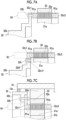
- Figs. 7A to 7C are diagrams showing modification examples of the connection structure of the shaft member, in which Fig. 7A shows Modification Example 4, Fig. 7B shows Modification Example 5, and Fig. 7C shows Modification Example 6.
- the shaft member 32b and the extension portion 32c1 are connected to each other through a connection member 32h such as a bolt.
- the connection member 32h is made of a magnetic body
- the extension portion 32c1 is made of a non-magnetic body.
- the shaft member 32b may be a non-magnetic body or may be a magnetic body.
- Modification Example 4 ( Fig. 7A ) is an example in which the shaft member 32b is connected to an end portion in the axial direction of the extension portion 32c1 through the connection member 32h.
- the connection member 32h By lengthening the extension portion 32c1 in the axial direction, the connection member 32h is spaced apart from the magnetic pole piece 32a in the axial direction.
- the connection member 32h which is a magnetic body, can be disposed to overlap the region R1 but to be away from the region R1a where a relatively large loss occurs.
- connection member 32h is disposed outside the region R1a, so that a decrease in the torque and efficiency of the magnetic modulation gear can be suppressed. Further, the effect can be obtained that the shape of the extension portion 32c1 can be simplified and the shaft member 32b and the extension portion 32c1 can be easily connected.
- Modification Example 5 ( Fig. 7B ) is an example in which at least a portion of the extension portion 32c1 is shaped to project in the radial direction and the shaft member 32b is connected to the projecting portion through the connection member 32h.
- the connection portion of the shaft member 32b has a flange 32bf whose thickness in the axial direction is reduced in a stepwise manner
- the projecting portion of the extension portion 32c1 has a flange 32c1f whose thickness in the axial direction is reduced in a stepwise manner.
- the two flanges 32bf and 32c1f are overlapped and tightened in the axial direction by the connection member 32h.
- the connection member 32h which is a magnetic body, can be disposed outside the region R1.
- connection member 32h is disposed outside the region R1, so that a decrease in the torque and efficiency of the magnetic modulation gear can be suppressed. Further, the connection portion of the shaft member 32b including the connection member 32h can be brought closer to the magnetic pole piece 32a in the axial direction, so that the effect of contributing to making the magnetic modulation gear more compact in the axial direction can be obtained.
- Modification Example 6 ( Fig. 7C ) is an example in which the maximum outer diameter of the shaft member 32b is larger than the outer diameter of the magnetic pole piece 32a and the shaft member 32b is connected to the radially outer side of the extension portion 32c1. Even in such a configuration, it is possible to adopt a configuration in which at least a portion of the extension portion 32c1 is shaped to project outward in the radial direction and the shaft member 32b is connected to the projecting portion through the connection member 32h.
- connection member 32h by disposing the connection member 32h outside the region R1, it is possible to bring the connection portion of the shaft member 32b closer to the magnetic pole piece 32a in the axial direction while suppressing a decrease in the torque and efficiency of the magnetic modulation gear, so that the effect of contributing to making the magnetic modulation gear more compact in the axial direction can be obtained.
- connection portion 32c1 is disposed outside the region R1a, so that a decrease in the torque and efficiency of the magnetic modulation gear can be suppressed.
- the effect can be obtained that the shape of the extension portion 32c1 can be simplified and the shaft member 32b and the extension portion 32c1 can be easily connected.
- Figs. 8A and 8B are diagrams showing modification examples including other magnetic body parts, in which Fig. 8A shows Modification Example 7 and Fig. 8B shows Modification Example 8.
- Modification Example 7 ( Fig. 8A ) is an example in which a sensor 35 that includes a magnetic body is provided in the vicinity of the low speed rotor 32.
- the sensor 35 is, for example, an encoder that detects rotation.
- various sensors such as a temperature sensor may be adopted.
- the sensor 35 can face a detection target, which is a portion that moves at the same speed as the magnetic pole piece 32a, from the axial direction with the extension portion 32c1 interposed therebetween, while being spaced apart from the magnetic pole piece 32a in the axial direction.
- the sensor 35 including a magnetic body can be disposed so as to overlap the region R1 but to be away from the region R1a. Then, a loss and a decrease in the torque of the magnetic modulation gear can be suppressed.
- Modification Example 8 ( Fig. 8B ) is an example in which a plate member 32i, which is a magnetic body, is provided on the extension portion 32c2.
- the plate member 32i may be a member for any purpose, such as a reinforcing member or a non-detection member for magnetically performing rotation detection.
- the plate member 32i may be a member that is fixed to the extension portion 32c2 in a partial range in the circumferential direction, or may be an annular member that is located over the entire circumference in the circumferential direction.
- the plate member 32i can be spaced apart from the magnetic pole piece 32a in the axial direction by being fixed to the extension portion 32c2. With this configuration, the plate member 32i, which is a magnetic body, can be disposed outside the region R1a, so that a loss and a decrease in the torque of the magnetic modulation gear can be suppressed.
- the present invention has been described above.
- the magnetic modulation gear 30 that decelerates or speeds up the rotating motion by rotating the low speed rotor 32 and the high speed rotor 31 has been described.
- a configuration may also be adopted in which a plurality of magnetic pole pieces are fixed, a plurality of inner pole magnets are integrated with a high speed shaft, and a plurality of outer pole magnets are integrated with a low speed shaft. Even in this case, since a configuration integrated with the plurality of magnetic pole pieces rotates relative to the inner pole magnets and the outer pole magnets, the configuration can be regarded as a rotor having a plurality of magnetic pole pieces.
- the number and disposition of bearings shown in the embodiment described above can be changed in various ways, and, for example, the bearing that rotatably supports the low speed rotor may be provided only on one side of the load side and the counter load side with respect to the magnetic pole piece.
- the details shown in the embodiment can be appropriately changed within a scope which does not depart from the concept of the invention.
- the present invention can be suitably applied to various general industrial machines due to the features such as high efficiency, minimal maintenance, quietness (low noise), and cleanliness (oil-free). In particular, it is highly useful for the following applications.
- the present invention can be utilized for a magnetic modulation gear and a gear motor.
Landscapes
- Engineering & Computer Science (AREA)
- Power Engineering (AREA)
- General Engineering & Computer Science (AREA)
- Mechanical Engineering (AREA)
- Connection Of Motors, Electrical Generators, Mechanical Devices, And The Like (AREA)
- Permanent Field Magnets Of Synchronous Machinery (AREA)
Applications Claiming Priority (2)
| Application Number | Priority Date | Filing Date | Title |
|---|---|---|---|
| JP2021132720 | 2021-08-17 | ||
| PCT/JP2022/029936 WO2023022006A1 (ja) | 2021-08-17 | 2022-08-04 | 磁気変調ギヤ及びギヤモータ |
Publications (2)
| Publication Number | Publication Date |
|---|---|
| EP4390180A1 true EP4390180A1 (de) | 2024-06-26 |
| EP4390180A4 EP4390180A4 (de) | 2025-03-05 |
Family
ID=85239525
Family Applications (1)
| Application Number | Title | Priority Date | Filing Date |
|---|---|---|---|
| EP22858327.4A Pending EP4390180A4 (de) | 2021-08-17 | 2022-08-04 | Magnetmodulationsgetriebe und getriebemotor |
Country Status (4)
| Country | Link |
|---|---|
| US (1) | US20240178712A1 (de) |
| EP (1) | EP4390180A4 (de) |
| JP (1) | JPWO2023022006A1 (de) |
| WO (1) | WO2023022006A1 (de) |
Families Citing this family (1)
| Publication number | Priority date | Publication date | Assignee | Title |
|---|---|---|---|---|
| WO2024262571A1 (ja) * | 2023-06-21 | 2024-12-26 | 三菱電機株式会社 | 磁極片モジュール、磁極片モジュールの製造方法および磁気ギアード回転機 |
Family Cites Families (8)
| Publication number | Priority date | Publication date | Assignee | Title |
|---|---|---|---|---|
| JP2012147513A (ja) * | 2011-01-07 | 2012-08-02 | Hitachi Ltd | 磁気ギヤ及びそれを有する回転機 |
| JP5286373B2 (ja) * | 2011-01-28 | 2013-09-11 | 株式会社日立製作所 | 磁気歯車 |
| JP5350438B2 (ja) * | 2011-06-29 | 2013-11-27 | 株式会社日立製作所 | 磁気式歯車機構 |
| JP2016142407A (ja) * | 2015-02-05 | 2016-08-08 | 株式会社Ihi | ターボ圧縮機 |
| JP6561692B2 (ja) * | 2015-08-31 | 2019-08-21 | スズキ株式会社 | 回転電機 |
| EP3261238B1 (de) * | 2016-06-23 | 2020-08-12 | Goodrich Actuation Systems Limited | Magnetgetriebe |
| DE102018110151A1 (de) * | 2018-04-26 | 2019-10-31 | Linz Center Of Mechatronics Gmbh | Elektrische Maschine mit Elektromotor und Magnetgetriebe |
| JP7291341B2 (ja) | 2019-02-21 | 2023-06-15 | 国立大学法人東北大学 | 回転電機 |
-
2022
- 2022-08-04 WO PCT/JP2022/029936 patent/WO2023022006A1/ja not_active Ceased
- 2022-08-04 JP JP2023542325A patent/JPWO2023022006A1/ja active Pending
- 2022-08-04 EP EP22858327.4A patent/EP4390180A4/de active Pending
-
2024
- 2024-02-05 US US18/432,331 patent/US20240178712A1/en active Pending
Also Published As
| Publication number | Publication date |
|---|---|
| WO2023022006A1 (ja) | 2023-02-23 |
| US20240178712A1 (en) | 2024-05-30 |
| EP4390180A4 (de) | 2025-03-05 |
| JPWO2023022006A1 (de) | 2023-02-23 |
Similar Documents
| Publication | Publication Date | Title |
|---|---|---|
| CN111102291B (zh) | 磁悬浮轴承、压缩机、空调器 | |
| JP7731204B2 (ja) | 軸受装置、間座および製造方法 | |
| US20090152959A1 (en) | Secondary part of a linear drive | |
| JPH0543749U (ja) | 回転磁界型電動機の回転子 | |
| JP2019052750A (ja) | 変速機及びアクチュエータ | |
| US20220376583A1 (en) | Gear motor | |
| US12580433B2 (en) | Rotor and motor | |
| EP4390180A1 (de) | Magnetmodulationsgetriebe und getriebemotor | |
| WO2023026804A1 (ja) | 磁極片部材及び磁気変調ギヤ | |
| JP2018133948A (ja) | モータ | |
| KR20150030040A (ko) | 스테이터 코어 및 이를 포함하는 모터 | |
| US20230049968A1 (en) | Magnetic geared rotary electric machine and stator manufacturing method | |
| CN113864338A (zh) | 混合轴径向磁轴承组件及磁悬浮电机 | |
| WO2023199460A1 (ja) | 回転装置 | |
| JPH0742215Y2 (ja) | サーボアクチュエータ | |
| EP4390181A1 (de) | Magnetmodulationsgetriebe und getriebemotor | |
| WO2021149131A1 (ja) | 固定子およびこれを用いた回転電機 | |
| JPH0811035Y2 (ja) | サーボアクチュエータ | |
| JP2012080616A (ja) | 可変磁束モータ | |
| CN211550276U (zh) | 磁悬浮轴承、压缩机、空调器 | |
| JP2014015992A (ja) | 磁気歯車装置 | |
| CN113472169B (zh) | 马达 | |
| JP2018121407A (ja) | アウターロータ型の回転電機 | |
| JP2012244704A (ja) | 外転型の電動機 | |
| JP7796573B2 (ja) | 軸受装置 |
Legal Events
| Date | Code | Title | Description |
|---|---|---|---|
| STAA | Information on the status of an ep patent application or granted ep patent |
Free format text: STATUS: THE INTERNATIONAL PUBLICATION HAS BEEN MADE |
|
| PUAI | Public reference made under article 153(3) epc to a published international application that has entered the european phase |
Free format text: ORIGINAL CODE: 0009012 |
|
| STAA | Information on the status of an ep patent application or granted ep patent |
Free format text: STATUS: REQUEST FOR EXAMINATION WAS MADE |
|
| 17P | Request for examination filed |
Effective date: 20240109 |
|
| AK | Designated contracting states |
Kind code of ref document: A1 Designated state(s): AL AT BE BG CH CY CZ DE DK EE ES FI FR GB GR HR HU IE IS IT LI LT LU LV MC MK MT NL NO PL PT RO RS SE SI SK SM TR |
|
| REG | Reference to a national code |
Ref country code: DE Ref legal event code: R079 Free format text: PREVIOUS MAIN CLASS: F16H0049000000 Ipc: H02K0049100000 |
|
| DAV | Request for validation of the european patent (deleted) | ||
| DAX | Request for extension of the european patent (deleted) | ||
| RIC1 | Information provided on ipc code assigned before grant |
Ipc: H02K 1/274 20220101ALN20241107BHEP Ipc: F16H 49/00 20060101ALI20241107BHEP Ipc: H02K 1/30 20060101ALI20241107BHEP Ipc: H02K 7/08 20060101ALI20241107BHEP Ipc: H02K 49/10 20060101AFI20241107BHEP |
|
| STAA | Information on the status of an ep patent application or granted ep patent |
Free format text: STATUS: EXAMINATION IS IN PROGRESS |
|
| A4 | Supplementary search report drawn up and despatched |
Effective date: 20250204 |
|
| RIC1 | Information provided on ipc code assigned before grant |
Ipc: H02K 1/274 20220101ALN20250129BHEP Ipc: F16H 49/00 20060101ALI20250129BHEP Ipc: H02K 1/30 20060101ALI20250129BHEP Ipc: H02K 7/08 20060101ALI20250129BHEP Ipc: H02K 49/10 20060101AFI20250129BHEP |
|
| 17Q | First examination report despatched |
Effective date: 20250228 |