EP4390376A1 - Procédé amélioré pour effectuer une mesure de fluorescence sur un échantillon - Google Patents
Procédé amélioré pour effectuer une mesure de fluorescence sur un échantillon Download PDFInfo
- Publication number
- EP4390376A1 EP4390376A1 EP22306979.0A EP22306979A EP4390376A1 EP 4390376 A1 EP4390376 A1 EP 4390376A1 EP 22306979 A EP22306979 A EP 22306979A EP 4390376 A1 EP4390376 A1 EP 4390376A1
- Authority
- EP
- European Patent Office
- Prior art keywords
- fluorescence
- sample
- image
- intensity
- interest
- Prior art date
- Legal status (The legal status is an assumption and is not a legal conclusion. Google has not performed a legal analysis and makes no representation as to the accuracy of the status listed.)
- Pending
Links
Images



Classifications
-
- G—PHYSICS
- G01—MEASURING; TESTING
- G01N—INVESTIGATING OR ANALYSING MATERIALS BY DETERMINING THEIR CHEMICAL OR PHYSICAL PROPERTIES
- G01N21/00—Investigating or analysing materials by the use of optical means, i.e. using sub-millimetre waves, infrared, visible or ultraviolet light
- G01N21/62—Systems in which the material investigated is excited whereby it emits light or causes a change in wavelength of the incident light
- G01N21/63—Systems in which the material investigated is excited whereby it emits light or causes a change in wavelength of the incident light optically excited
- G01N21/64—Fluorescence; Phosphorescence
- G01N21/645—Specially adapted constructive features of fluorimeters
- G01N21/6456—Spatial resolved fluorescence measurements; Imaging
-
- G—PHYSICS
- G01—MEASURING; TESTING
- G01N—INVESTIGATING OR ANALYSING MATERIALS BY DETERMINING THEIR CHEMICAL OR PHYSICAL PROPERTIES
- G01N21/00—Investigating or analysing materials by the use of optical means, i.e. using sub-millimetre waves, infrared, visible or ultraviolet light
- G01N21/62—Systems in which the material investigated is excited whereby it emits light or causes a change in wavelength of the incident light
- G01N21/63—Systems in which the material investigated is excited whereby it emits light or causes a change in wavelength of the incident light optically excited
- G01N21/64—Fluorescence; Phosphorescence
-
- G—PHYSICS
- G06—COMPUTING OR CALCULATING; COUNTING
- G06N—COMPUTING ARRANGEMENTS BASED ON SPECIFIC COMPUTATIONAL MODELS
- G06N3/00—Computing arrangements based on biological models
- G06N3/02—Neural networks
- G06N3/04—Architecture, e.g. interconnection topology
- G06N3/045—Combinations of networks
- G06N3/0455—Auto-encoder networks; Encoder-decoder networks
-
- G—PHYSICS
- G06—COMPUTING OR CALCULATING; COUNTING
- G06N—COMPUTING ARRANGEMENTS BASED ON SPECIFIC COMPUTATIONAL MODELS
- G06N3/00—Computing arrangements based on biological models
- G06N3/02—Neural networks
- G06N3/04—Architecture, e.g. interconnection topology
- G06N3/0464—Convolutional networks [CNN, ConvNet]
-
- G—PHYSICS
- G06—COMPUTING OR CALCULATING; COUNTING
- G06N—COMPUTING ARRANGEMENTS BASED ON SPECIFIC COMPUTATIONAL MODELS
- G06N3/00—Computing arrangements based on biological models
- G06N3/02—Neural networks
- G06N3/08—Learning methods
- G06N3/09—Supervised learning
-
- G—PHYSICS
- G01—MEASURING; TESTING
- G01N—INVESTIGATING OR ANALYSING MATERIALS BY DETERMINING THEIR CHEMICAL OR PHYSICAL PROPERTIES
- G01N21/00—Investigating or analysing materials by the use of optical means, i.e. using sub-millimetre waves, infrared, visible or ultraviolet light
- G01N21/01—Arrangements or apparatus for facilitating the optical investigation
- G01N21/03—Cuvette constructions
- G01N2021/0378—Shapes
- G01N2021/0382—Frustoconical, tapered cell
-
- G—PHYSICS
- G01—MEASURING; TESTING
- G01N—INVESTIGATING OR ANALYSING MATERIALS BY DETERMINING THEIR CHEMICAL OR PHYSICAL PROPERTIES
- G01N21/00—Investigating or analysing materials by the use of optical means, i.e. using sub-millimetre waves, infrared, visible or ultraviolet light
- G01N21/62—Systems in which the material investigated is excited whereby it emits light or causes a change in wavelength of the incident light
- G01N21/63—Systems in which the material investigated is excited whereby it emits light or causes a change in wavelength of the incident light optically excited
- G01N21/64—Fluorescence; Phosphorescence
- G01N21/645—Specially adapted constructive features of fluorimeters
- G01N2021/6482—Sample cells, cuvettes
-
- G—PHYSICS
- G01—MEASURING; TESTING
- G01N—INVESTIGATING OR ANALYSING MATERIALS BY DETERMINING THEIR CHEMICAL OR PHYSICAL PROPERTIES
- G01N2201/00—Features of devices classified in G01N21/00
- G01N2201/12—Circuits of general importance; Signal processing
-
- G—PHYSICS
- G01—MEASURING; TESTING
- G01N—INVESTIGATING OR ANALYSING MATERIALS BY DETERMINING THEIR CHEMICAL OR PHYSICAL PROPERTIES
- G01N2201/00—Features of devices classified in G01N21/00
- G01N2201/12—Circuits of general importance; Signal processing
- G01N2201/126—Microprocessor processing
-
- G—PHYSICS
- G01—MEASURING; TESTING
- G01N—INVESTIGATING OR ANALYSING MATERIALS BY DETERMINING THEIR CHEMICAL OR PHYSICAL PROPERTIES
- G01N2201/00—Features of devices classified in G01N21/00
- G01N2201/12—Circuits of general importance; Signal processing
- G01N2201/129—Using chemometrical methods
- G01N2201/1296—Using chemometrical methods using neural networks
Definitions
- the present disclosure relates to a method and system for performing fluorescence measurement on a sample. It may in particular be applied to the determination of the presence of a biological analyte or to the quantification of said analyte.
- Fluorescence is the ability from matter to emit light at a certain wavelength after absorbing electromagnetic radiation. Accordingly, a fluorescence measurement is performed by illuminating the sample, which is contained in a reading cuvette, at a selected excitation wavelength which corresponds to the excitation wavelength of an analyte of interest, and detecting and measuring the fluorescence emission of the sample induced by the excitation.
- the detection and processing of the fluorescence signals must be performed with precision.
- the measurement of the fluorescence emission can be affected by artefacts such as dust, bubbles, or even from the walls of the cuvette, which may have their own fluorescence contribution.
- This method although enabling to remove the fluorescence contribution from the cuvette, does not ensure that the obtained signal is not affected by artefacts such as dust or bubbles.
- the present disclosure aims at improving the prior art.
- an aim of the present disclosure is to improve the precision of a fluorescence signal acquired on a sample.
- Another aim of the present disclosure is to enable correcting the fluorescence measurement from contributions caused by artefacts such as bubbles or dust. Accordingly, it is disclosed a method for performing fluorescence measurement on a sample, comprising:
- the plurality of fluorescence images are acquired under different illumination intensities, and the selected image is the acquired fluorescence image with highest illumination intensity whose number of saturated pixels is below the predetermined threshold.
- determining the fluorescence intensity of the sample comprises measuring an intensity of a fluorescence signal on the selected image, and deriving, from said intensity and the conditions of illumination and exposure of acquisition of the selected image, the fluorescence intensity of the sample.
- the method further comprises extracting, from the fluorescence image, at least one other region corresponding to at least one category of artefact.
- determining the fluorescence intensity of the sample from the extracted region of interest comprises computing an intensity of a fluorescence signal of the regions of the fluorescence image outside the region of interest by extrapolating the intensity of the fluorescence signal of the region of interest to said regions.
- extracting the region of interest from the fluorescence image comprises performing semantic segmentation on the fluorescence image.
- extracting the region of interest comprises applying, to the fluorescence image, a trained classification model configured to classify pixels of the fluorescence image according to a plurality of classes comprising at least:
- the method further comprises a preliminary step of training the classification model by supervised learning on a training database comprising, for each of a plurality of training fluorescence images, an identification of the areas corresponding to artefacts, wherein each trained fluorescence image is rescaled by a randomly selected factor inferior or equal to 1 and cropped to a constant size.
- the trained model is a convolutional neural network.
- the trained model is a Segmentation Multiscale Attention Network, comprising:
- a system for performing a fluorescence measurement on a sample wherein the sample is contained in a cuvette, the system comprising:
- the claimed method enables performing a fluorescence measurement from a region of interest extracted from the fluorescence image, wherein the region of interest is devoid of areas containing artefacts.
- the fluorescence measurement may then be performed more reliably.
- the extraction of the region of interest may be performed by application of a trained model configured for performing semantic segmentation of the image, and classifying each pixel or group of pixels of the image as belonging to a region devoid of artefact or corresponding to a given type of artefact.
- the detection of the artefacts can then be performed automatically, even when the positions of the artefacts vary within the image.
- the precision of the fluorescence intensity measurement is further enhanced by selecting the fluorescence image from which the region of interest is extracted, among a plurality of fluorescence images acquired for different illumination or acquisition conditions.
- the sample may be from various origins, for example of food, environmental, veterinary, clinical, pharmaceutical or cosmetic origin.
- samples of food origin non-exhaustive mention may be made of a sample of dairy products (yogurts, cheeses, ...), meat, fish, egg, fruit, vegetable, water, beverages (milk, fruit juice, soda, etc.).
- dairy products yogurts, cheeses, ...), meat, fish, egg, fruit, vegetable, water, beverages (milk, fruit juice, soda, etc.).
- these samples of food origin may also come from sauces or more complex meals, or from unprocessed or partially processed raw materials.
- a food sample may also be derived from an animal feed, such as oil cakes, animal meals.
- the biological sample may be of environmental origin and may consist, for example, of a surface sample, water sample, etc.
- the sample may also consist of a biological sample, of clinical, human or animal origin, which may correspond to specimens of biological fluid (urine, whole blood or derivatives such as serum, plasma, saliva, pus, cerebrospinal fluid, etc.), of stools (for example cholera-induced diarrhea), of specimens from the nose, throat, skin, wounds, organs, tissues or isolated cells.
- biological fluid urine, whole blood or derivatives such as serum, plasma, saliva, pus, cerebrospinal fluid, etc.
- stools for example cholera-induced diarrhea
- sample refers to a part or a quantity, and more particularly a small part or a small quantity, sampled from one or more entities for the purposes of analysis.
- This sample may possibly have undergone pre-treatment, including for example mixture, dilution or even crushing stages, in particular if the starting entity is solid-state.
- the analysed sample is likely to contain-or is suspected of containing-at least one analyte representative of the presence of microorganisms or of a disease to be detected, characterised or monitored.
- the sample is contained in a cuvette 4.
- the cuvette comprises a bottom wall 40 and lateral walls 41 extending from the bottom wall towards an upper edge 43.
- the upper edge defines an aperture 44 suitable for filling and emptying the cuvette.
- the bottom wall may comprise a bottom portion 401 extending orthogonally to the lateral walls, and oblique walls 402 extending between the bottom portion 401 and the lateral walls 41, the oblique walls forming an angle of 45° with the lateral walls.
- the bottom wall 40 may have the shape of truncated cone.
- the cuvette may be formed of a material suitable for conserving liquids and other materials necessary for performing a biological analysis.
- the cuvette 4 may for instance be formed of a plastic material.
- the cuvette may be transparent to the wavelengths used for illuminating the sample, herein after called illumination wavelengths. It also may be transparent to the wavelengths emitted by the sample due to fluorescence.
- the cuvette may be formed of polypropylene, glass, polymetil metacrilate, polystyrene, polycarbonate and other optical plastics, depending on the illumination and fluorescence wavelength ranges.
- the system 1 for performing fluorescence measurements comprises an illumination device 10, comprising a light source 11 such as a light-emitting diode (LED).
- the light source 11 may comprise any monochromatic source corresponding to the wavelength of the excitation peak of the analyte, i.e. chemical molecule used as a marker, or sought for, within the sample.
- the light source 11 may be able to generate light at a plurality of wavelengths, for instance white light
- the illumination device may further comprise a filter 12 able to select at least one wavelength of interest corresponding to the excitation peak of a desired molecule.
- the illumination device may further comprise an optical element 13 adapted to conform the beam of illumination light according to a suitable shape.
- the optical element may for instance comprise at least one optical lens, such as an aspheric lens.
- the system 1 for performing fluorescence measurements also comprises a detection device 20 configured for acquiring at least one fluorescence image of the sample, the fluorescence image comprise a fluorescence signal emitted by the sample consecutive to its illumination by the light source.
- the detection device comprises a detector 21, such as a camera or high-sensitivity CMOS or CCD or other 2D optical sensor.
- the detection device may further comprise an optical element 23 adapted to conform a beam of light emitted by the sample in response to the illumination towards the detector.
- the optical element 23 may comprise an optical lens, for instance an aspheric lens.
- the detection device may comprise an optical filter 22 adapted to limit the detection to a wavelength of interest or a narrow-band spectrum centered on the wavelength of interest, which may typically the fluorescence wavelength emitted by the analyte.
- the illumination device may be configured to illuminate the cuvette 4 holding the sample with a ray of incident light forming an angle of 90° relative to the wall of the cuvette, in particular the oblique wall 402 of the cuvette forming an angle of 45° relative to the lateral walls 41 of the cuvette.
- the detection device 20 may be configured for collecting light exiting the cuvette from an oblique wall 402 therefrom, and forming an angle of 90° relative to said wall, the axes of illumination device and of the detector thus being positioned at 90° relative to one another.
- the illumination device and the detector may be positioned on the same side of the cuvette (i.e. axes of illumination light and detected light forming a null angle), or they may be positioned on two opposite sides of the cuvette (i.e. axes of illumination light and detected light forming a 180° angle), as the fluorescence is a radiation emitted at 360° from the sample molecule, independently of the illumination direction.
- the walls on which illumination light is incident and through which the fluorescence is measured can be the lateral walls 41.
- the system 1 for performing fluorescence measurements also comprises a computing device 30 comprising at least a computer 31 and a memory 32.
- the computer 31 is adapted to control the operation of the illumination device and the detection device and receive from the latter the acquired fluorescence images acquired by the detection device 20. To this end, the computer 31 is connected to the detection device 20, and illumination device 10 either using a wire connection or wirelessly.
- the computer 31 is further adapted to process the acquired fluorescence images to compute a fluorescence intensity emitted by the sample in response to the illumination. To this end, the computer may execute code instructions stored in the memory 32 for performing the method disclosed below.
- the computer may comprise one or more processors, for instance Central Processing Units CPU or Graphical Processing Units GPU.
- the memory 32 may for instance include a magnetic hard disk, solid-state disk, optical disk, electronic memory or any type of computer-readable storage medium.
- the memory further stores a trained model configured for extracting a region of interest from a fluorescence image, as described in more details below.
- the method comprises the illumination 100 of the sample by the illumination device 10.
- the illumination may be performed at a selected wavelength which corresponds to an excitation wavelength, i.e. a wavelength suitable for inducing fluorescence, for the molecule of interest that the fluorescence measurement aims at detecting, quantifying or analyzing.
- the illumination may be continuous or by a plurality of flashes. The use of flashes may allow reducing the degradation of the sample.
- the illumination is also performed at defined conditions of illumination intensity. When the light source comprises a LED, the excitation intensity may be controlled by driving the input current of the LED.
- the method further comprises the acquisition 200 of at least one fluorescence image of the illuminated sample by the detection device 20.
- the acquisition 200 may be performed while the sample is illuminated since the fluorescence starts almost instantaneously.
- the image acquisition is performed at determined acquisition parameters, including the detector gain and integration time, i.e. the time window inside which the camera collects light for a single image.
- the acquired fluorescence image comprises a plurality of pixels where each pixel corresponds to a respective point of the cuvette, and each pixel is associated to an intensity, which may be expressed for instance as a grey level value or RGB values, said intensity corresponding to an intensity of a fluorescence signal issued from the cuvette.
- the fluorescence image is then processed in order to determine, from the fluorescence signal of the fluorescence image, a fluorescence intensity of the sample.
- the method comprises acquiring 200 a plurality of fluorescence images corresponding to different sets of parameters regarding illumination and acquisition.
- the sets of parameters that may vary in order to vary the exposure may include illumination intensity, sensor's gain, sensor's integration time.
- the method comprises acquiring 200 a plurality of fluorescence images corresponding to different working points, where each working point is defined by illumination intensity and exposure, and exposure is determined by integration time and camera gain of image acquisition.
- the working points may be established in order to provide images with brightness values that are scale by a known multiplying factor. .
- the fluorescence in the cuvette according to the type of sample and the concentration of the analyte, can span over a very wide range (more than four orders of magnitude).
- the brightness i.e.
- the level of light captured by a pixel during the reading performed with a given exposure and illumination intensities may exceed the maximum readable value of the detector, Acquiring a plurality of fluorescence images under different exposures and illumination intensities may thus enable selecting the image with the most adapted brightness and hence providing the most information.
- fluorescence images preferably between 2 and 5 fluorescence images, may be acquired with different exposures and illumination intensities.
- the number of images and the working points may be selected to cover the range of fluorescence mentioned above.
- four images may be acquired with brightness values that are scaled by a multiplying factor of four.
- the inverse ratio between the brightness obtained at each working point and the brightness obtained at the most sensitive one is named "exposure factor"
- the method further comprises a step 300 of selecting a fluorescence image among the plurality of acquired images.
- the selection of a fluorescence image may be based on a condition on the number of saturated pixels in the image. A pixel is saturated if its intensity level is the maximum intensity value that the sensor can acquire.
- the selection of a fluorescence image may comprise:
- a lower threshold may be contemplated. For instance, a pixel may be considered saturated if its intensity value is above 90% of the maximum intensity value that the sensor can acquire.
- the method then comprises processing 400 the fluorescence image to determine a fluorescence intensity of the sample.
- the fluorescence image here relates to the acquired fluorescence image, when one image has been acquired, or to the selected fluorescence image, when a plurality of images has been acquired and one has been selected at step 300.
- Processing 400 the fluorescence image comprises extracting 410, from the fluorescence image, a region of interest ROI which is free from any artefacts, and determining 420 a fluorescence intensity of the sample from the extracted region of interest.
- artefact is meant a signal which does not correspond to the fluorescence of the analyte that is being measured.
- artefact is meant to include any of the following:
- Extracting 410 the region of interest free from artefacts is performed by application of a trained model.
- the trained model is configured for performing semantic segmentation of the image, i.e. to label each pixel of the image with a corresponding class.
- the trained model is configured for labelling the pixels of the image with a corresponding class among at least two classes comprising:
- the model may be configured for labelling the pixels of the image with a corresponding class among a plurality of classes, comprising one class corresponding to regions devoid of artefacts and a plurality of other classes corresponding to respective artefacts.
- the classes may comprise:
- the fluorescence image as acquired by the detection device is represented on figure 3a .
- figure 3b is shown the segmentation map output by the trained model on this image.
- FIG. 4a the acquired image displays the walls of the cuvette.
- the region of interest is located at the center of the image and excludes the walls of the cuvette.
- the model Prior to executing the model on a fluorescence image, the model is trained 90 by supervised learning on a training database of fluorescence images, where each image of the database is annotated according to the desired definition of classes, i.e. the artefacts and regions of interests are indicated as such for each image.
- the fluorescence images of the training database may all have the same dimension.
- the annotation may be performed manually by an operator.
- the training of the model may be performed by the computing device 30 of the system, or by a distinct computing device (not shown).
- model or its training may be designed to process the images at different scales.
- each image may be randomly rescaled by a factor comprised between 0 and 1, to better train the model to handle presence of objects and elements at different scales.
- each training image may be rescaled by a factor randomly selected among the following: 1, 0.8, or 0.6. From the rescaled images, random crops of a constant dimension are extracted and used to train the model. Therefore, the images used to train the model are of constant size but the size of the artefacts may vary.
- the trained model it is preferably a convolutional neural network.
- the convolutional neural network may comprise:
- the neural network may be a Segmentation Multiscale Attention Network (SMANet), which structure is schematically shown in figure 5 , and which is disclosed in details in the article by Simone Bonechi et AL. "Weak supervision for generating pixel-level annotations in scene text segmentation", Pattern Recognition Letters, Volume 138, 2020, Pages 1-7, ISSN 0167-8655 .
- the convolutional encoder part of this network corresponds to a ResNet neural network, for instance ResNet50, in which the convolutions are replaced by dilated (i.e. atrous) convolutions, to enlarge the receptive field of the neural network.
- the multiscale module comprises a pyramid of atrous convolutions at different dilation rate, each one followed by a spatial pyramid pooling, i.e. a plurality of parallel poolings of different patch sizes.
- the decoder section comprises two decoder stages, with skip connections between the encoder section and the decoder section.
- the method comprises determining 420 an intensity signal of the sample from said region of interest.
- Determining an intensity signal of the sample from the region of interest comprises extracting the intensity values of the pixels of the extracted region of interest, said values corresponding to an intensity of the fluorescence signal at each pixel, and inferring from said values an intensity of the fluorescence signal over the whole image from which the region of interest has been extracted by extrapolation or interpolation. According to an embodiment, this is performed by fitting a polynomial function to the intensity values of the pixels of the region of interest, and deducing from the polynomial function an approximation of the intensity values of the pixels that have been removed from the image.
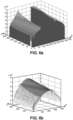
- FIG. 6a With reference to figures 6a and 6b is shown an example of the polynomial approximation performed on a region of interest, shown in three dimensions.
- the z axis corresponds to the measured intensity of the pixels which position on the image is defined by the coordinates (x,y).
- the intensity of the fluorescence signal of the region of interest is represented in figure 6a
- the polynomial function fitted to this intensity is represented by the continuous surface in figure 6b .
- the dots in this figure represent the original intensity values of the pixels of the region of interest.
- figure 7a represents the region of interest extracted from the real fluorescence image (i.e. having removed the artefacts)
- figure 7b representing a reconstructed fluorescence image in which the regions corresponding to artefacts have been replaced by pixels which values are determined according to the fitted polynomial function.
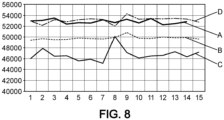
- the line C corresponds to a measurement of the fluorescence intensity of the sample derived only from the region of interest, i.e. without estimating the values of the regions of the image that have been removed.
- the line D then corresponds to a measurement of the fluorescence intensity of the sample where the values of the regions containing defects have been derived from the values of the region of interest.
- the fluorescence intensity of the sample can be computed from:
- the fluorescence intensity of the sample is computed as the mean of intensity values of these pixels contained in the aforesaid regions (the originally recognized region and the regions approximated by the polynomial fitting).
- said value is multiplied by the exposure factor, defined above, corresponding to the acquisition of the image in order to obtain the actual value of the fluorescence intensity.
- the value is multiplied by the exposure factor of the selected image.
Landscapes
- Engineering & Computer Science (AREA)
- Physics & Mathematics (AREA)
- Health & Medical Sciences (AREA)
- Theoretical Computer Science (AREA)
- General Health & Medical Sciences (AREA)
- Life Sciences & Earth Sciences (AREA)
- General Physics & Mathematics (AREA)
- Computing Systems (AREA)
- Software Systems (AREA)
- Evolutionary Computation (AREA)
- Computational Linguistics (AREA)
- Molecular Biology (AREA)
- Biophysics (AREA)
- General Engineering & Computer Science (AREA)
- Biomedical Technology (AREA)
- Mathematical Physics (AREA)
- Data Mining & Analysis (AREA)
- Artificial Intelligence (AREA)
- Nuclear Medicine, Radiotherapy & Molecular Imaging (AREA)
- Chemical & Material Sciences (AREA)
- Analytical Chemistry (AREA)
- Biochemistry (AREA)
- Immunology (AREA)
- Pathology (AREA)
- Investigating, Analyzing Materials By Fluorescence Or Luminescence (AREA)
- Investigating Or Analysing Materials By Optical Means (AREA)
- Image Analysis (AREA)
Priority Applications (7)
| Application Number | Priority Date | Filing Date | Title |
|---|---|---|---|
| EP22306979.0A EP4390376A1 (fr) | 2022-12-21 | 2022-12-21 | Procédé amélioré pour effectuer une mesure de fluorescence sur un échantillon |
| EP23818049.1A EP4639144A1 (fr) | 2022-12-21 | 2023-12-05 | Procédé amélioré poue effectuer une mesure de fluorescence sur un échantillon |
| PCT/EP2023/084383 WO2024132514A1 (fr) | 2022-12-21 | 2023-12-05 | Procédé amélioré poue effectuer une mesure de fluorescence sur un échantillon |
| JP2025535326A JP2025540415A (ja) | 2022-12-21 | 2023-12-05 | 試料に対して蛍光測定を実行するための改善された方法 |
| US19/142,039 US20250383288A1 (en) | 2022-12-21 | 2023-12-05 | An improved method for performing fluorescence measurement on a sample |
| KR1020257023764A KR20250125399A (ko) | 2022-12-21 | 2023-12-05 | 샘플의 형광성 측정을 수행하기 위한 개선된 방법 |
| CN202380087362.6A CN120476304A (zh) | 2022-12-21 | 2023-12-05 | 对样品进行荧光测量的改进方法 |
Applications Claiming Priority (1)
| Application Number | Priority Date | Filing Date | Title |
|---|---|---|---|
| EP22306979.0A EP4390376A1 (fr) | 2022-12-21 | 2022-12-21 | Procédé amélioré pour effectuer une mesure de fluorescence sur un échantillon |
Publications (1)
| Publication Number | Publication Date |
|---|---|
| EP4390376A1 true EP4390376A1 (fr) | 2024-06-26 |
Family
ID=84901542
Family Applications (2)
| Application Number | Title | Priority Date | Filing Date |
|---|---|---|---|
| EP22306979.0A Pending EP4390376A1 (fr) | 2022-12-21 | 2022-12-21 | Procédé amélioré pour effectuer une mesure de fluorescence sur un échantillon |
| EP23818049.1A Pending EP4639144A1 (fr) | 2022-12-21 | 2023-12-05 | Procédé amélioré poue effectuer une mesure de fluorescence sur un échantillon |
Family Applications After (1)
| Application Number | Title | Priority Date | Filing Date |
|---|---|---|---|
| EP23818049.1A Pending EP4639144A1 (fr) | 2022-12-21 | 2023-12-05 | Procédé amélioré poue effectuer une mesure de fluorescence sur un échantillon |
Country Status (6)
| Country | Link |
|---|---|
| US (1) | US20250383288A1 (fr) |
| EP (2) | EP4390376A1 (fr) |
| JP (1) | JP2025540415A (fr) |
| KR (1) | KR20250125399A (fr) |
| CN (1) | CN120476304A (fr) |
| WO (1) | WO2024132514A1 (fr) |
Citations (2)
| Publication number | Priority date | Publication date | Assignee | Title |
|---|---|---|---|---|
| WO2014102502A1 (fr) | 2012-12-26 | 2014-07-03 | bioMérieux | Procede et systeme pour detecter et mesurer des signaux de fluorescence |
| US20220207728A1 (en) * | 2019-04-05 | 2022-06-30 | Oxford University Innovation Limited | Quality assessment in video endoscopy |
-
2022
- 2022-12-21 EP EP22306979.0A patent/EP4390376A1/fr active Pending
-
2023
- 2023-12-05 KR KR1020257023764A patent/KR20250125399A/ko active Pending
- 2023-12-05 EP EP23818049.1A patent/EP4639144A1/fr active Pending
- 2023-12-05 CN CN202380087362.6A patent/CN120476304A/zh active Pending
- 2023-12-05 US US19/142,039 patent/US20250383288A1/en active Pending
- 2023-12-05 WO PCT/EP2023/084383 patent/WO2024132514A1/fr not_active Ceased
- 2023-12-05 JP JP2025535326A patent/JP2025540415A/ja active Pending
Patent Citations (2)
| Publication number | Priority date | Publication date | Assignee | Title |
|---|---|---|---|---|
| WO2014102502A1 (fr) | 2012-12-26 | 2014-07-03 | bioMérieux | Procede et systeme pour detecter et mesurer des signaux de fluorescence |
| US20220207728A1 (en) * | 2019-04-05 | 2022-06-30 | Oxford University Innovation Limited | Quality assessment in video endoscopy |
Non-Patent Citations (2)
| Title |
|---|
| SHARIB ALI ET AL: "A deep learning framework for quality assessment and restoration in video endoscopy", ARXIV.ORG, CORNELL UNIVERSITY LIBRARY, 201 OLIN LIBRARY CORNELL UNIVERSITY ITHACA, NY 14853, 15 April 2019 (2019-04-15), XP081169435 * |
| SIMONE BONECHI ET AL.: "Weak supervision for generating pixel-level annotations in scene text segmentation", PATTERN RECOGNITION LETTERS, vol. 138, 2020, pages 1 - 7, XP086293455, ISSN: 0167-8655, DOI: 10.1016/j.patrec.2020.06.023 |
Also Published As
| Publication number | Publication date |
|---|---|
| CN120476304A (zh) | 2025-08-12 |
| WO2024132514A1 (fr) | 2024-06-27 |
| US20250383288A1 (en) | 2025-12-18 |
| EP4639144A1 (fr) | 2025-10-29 |
| JP2025540415A (ja) | 2025-12-11 |
| KR20250125399A (ko) | 2025-08-21 |
Similar Documents
| Publication | Publication Date | Title |
|---|---|---|
| AU2022200112B2 (en) | Methods and apparatus for detecting an entity in a bodily sample | |
| Kamruzzaman et al. | Non-destructive prediction and visualization of chemical composition in lamb meat using NIR hyperspectral imaging and multivariate regression | |
| US10803290B2 (en) | Classifier construction method and method for determining life or death of cell using same | |
| CN113450383B (zh) | 一种免疫层析试纸定量分析方法、装置、设备和介质 | |
| CN104484876B (zh) | 基于自动阈值分割的水产品寄生虫紫外荧光成像检测方法 | |
| CN117095393A (zh) | 基于显微高光谱成像技术的微生物检测方法、系统、电子设备及存储介质 | |
| Yoon et al. | Hyperspectral reflectance imaging for detecting a foodborne pathogen: Campylobacter | |
| Meunier et al. | An open-access computer image analysis (CIA) method to predict meat and fat content from an android smartphone-derived picture of the bovine 5th-6th rib | |
| Ji et al. | Nondestructive in-ovo sexing of Hy-Line Sonia eggs by EggFormer using hyperspectral imaging | |
| CN111344555B (zh) | 评估泌乳哺乳动物的健康状态的方法和系统 | |
| CN106574224B (zh) | 用于检测生物粒子的存在或缺失的方法 | |
| Chatterjee et al. | An efficient automated biospeckle indexing strategy using morphological and geo-statistical descriptors | |
| PP et al. | Automated quality assessment of cocoons using a smart camera based system | |
| EP4390376A1 (fr) | Procédé amélioré pour effectuer une mesure de fluorescence sur un échantillon | |
| EP4672180A1 (fr) | Traitement amélioré d'image de fluorescence pour la détection de micro-organismes | |
| Hashim et al. | Algae Maturity Detection Using UAV-Based Multispectral Imaging | |
| Cork et al. | Abscess detection on bovine livers with a commercial smart imaging system | |
| WO2025226780A1 (fr) | Analyseur et procédé de détection de sang occulte dans un échantillon | |
| CN115639186A (zh) | 基于拉曼光谱的图像分析方法、装置、设备及介质 | |
| CN116773496A (zh) | 基于三维荧光分析的茶叶检测系统、方法、设备及存储介质 | |
| Abeysekera et al. | Digital pathology: Identifying spongiosis in unstained histopathology specimen |
Legal Events
| Date | Code | Title | Description |
|---|---|---|---|
| PUAI | Public reference made under article 153(3) epc to a published international application that has entered the european phase |
Free format text: ORIGINAL CODE: 0009012 |
|
| STAA | Information on the status of an ep patent application or granted ep patent |
Free format text: STATUS: THE APPLICATION HAS BEEN PUBLISHED |
|
| AK | Designated contracting states |
Kind code of ref document: A1 Designated state(s): AL AT BE BG CH CY CZ DE DK EE ES FI FR GB GR HR HU IE IS IT LI LT LU LV MC ME MK MT NL NO PL PT RO RS SE SI SK SM TR |
|
| STAA | Information on the status of an ep patent application or granted ep patent |
Free format text: STATUS: REQUEST FOR EXAMINATION WAS MADE |
|
| 17P | Request for examination filed |
Effective date: 20241209 |