EP4390680A1 - Dienstsystem sowie speicherverwaltungsverfahren und -vorrichtung - Google Patents
Dienstsystem sowie speicherverwaltungsverfahren und -vorrichtung Download PDFInfo
- Publication number
- EP4390680A1 EP4390680A1 EP22866172.4A EP22866172A EP4390680A1 EP 4390680 A1 EP4390680 A1 EP 4390680A1 EP 22866172 A EP22866172 A EP 22866172A EP 4390680 A1 EP4390680 A1 EP 4390680A1
- Authority
- EP
- European Patent Office
- Prior art keywords
- resource
- data
- memory
- service
- service node
- Prior art date
- Legal status (The legal status is an assumption and is not a legal conclusion. Google has not performed a legal analysis and makes no representation as to the accuracy of the status listed.)
- Pending
Links
Images










Classifications
-
- G—PHYSICS
- G06—COMPUTING OR CALCULATING; COUNTING
- G06F—ELECTRIC DIGITAL DATA PROCESSING
- G06F3/00—Input arrangements for transferring data to be processed into a form capable of being handled by the computer; Output arrangements for transferring data from processing unit to output unit, e.g. interface arrangements
- G06F3/06—Digital input from, or digital output to, record carriers, e.g. RAID, emulated record carriers or networked record carriers
- G06F3/0601—Interfaces specially adapted for storage systems
- G06F3/0602—Interfaces specially adapted for storage systems specifically adapted to achieve a particular effect
- G06F3/061—Improving I/O performance
-
- G—PHYSICS
- G06—COMPUTING OR CALCULATING; COUNTING
- G06F—ELECTRIC DIGITAL DATA PROCESSING
- G06F9/00—Arrangements for program control, e.g. control units
- G06F9/06—Arrangements for program control, e.g. control units using stored programs, i.e. using an internal store of processing equipment to receive or retain programs
- G06F9/46—Multiprogramming arrangements
- G06F9/50—Allocation of resources, e.g. of the central processing unit [CPU]
- G06F9/5005—Allocation of resources, e.g. of the central processing unit [CPU] to service a request
- G06F9/5011—Allocation of resources, e.g. of the central processing unit [CPU] to service a request the resources being hardware resources other than CPUs, Servers and Terminals
- G06F9/5016—Allocation of resources, e.g. of the central processing unit [CPU] to service a request the resources being hardware resources other than CPUs, Servers and Terminals the resource being the memory
-
- G—PHYSICS
- G06—COMPUTING OR CALCULATING; COUNTING
- G06F—ELECTRIC DIGITAL DATA PROCESSING
- G06F12/00—Accessing, addressing or allocating within memory systems or architectures
- G06F12/02—Addressing or allocation; Relocation
- G06F12/08—Addressing or allocation; Relocation in hierarchically structured memory systems, e.g. virtual memory systems
- G06F12/0802—Addressing of a memory level in which the access to the desired data or data block requires associative addressing means, e.g. caches
- G06F12/0806—Multiuser, multiprocessor or multiprocessing cache systems
- G06F12/0815—Cache consistency protocols
-
- G—PHYSICS
- G06—COMPUTING OR CALCULATING; COUNTING
- G06F—ELECTRIC DIGITAL DATA PROCESSING
- G06F12/00—Accessing, addressing or allocating within memory systems or architectures
- G06F12/02—Addressing or allocation; Relocation
- G06F12/08—Addressing or allocation; Relocation in hierarchically structured memory systems, e.g. virtual memory systems
- G06F12/0802—Addressing of a memory level in which the access to the desired data or data block requires associative addressing means, e.g. caches
- G06F12/0866—Addressing of a memory level in which the access to the desired data or data block requires associative addressing means, e.g. caches for peripheral storage systems, e.g. disk cache
- G06F12/0871—Allocation or management of cache space
-
- G—PHYSICS
- G06—COMPUTING OR CALCULATING; COUNTING
- G06F—ELECTRIC DIGITAL DATA PROCESSING
- G06F3/00—Input arrangements for transferring data to be processed into a form capable of being handled by the computer; Output arrangements for transferring data from processing unit to output unit, e.g. interface arrangements
- G06F3/06—Digital input from, or digital output to, record carriers, e.g. RAID, emulated record carriers or networked record carriers
- G06F3/0601—Interfaces specially adapted for storage systems
- G06F3/0628—Interfaces specially adapted for storage systems making use of a particular technique
- G06F3/0629—Configuration or reconfiguration of storage systems
- G06F3/0631—Configuration or reconfiguration of storage systems by allocating resources to storage systems
-
- G—PHYSICS
- G06—COMPUTING OR CALCULATING; COUNTING
- G06F—ELECTRIC DIGITAL DATA PROCESSING
- G06F3/00—Input arrangements for transferring data to be processed into a form capable of being handled by the computer; Output arrangements for transferring data from processing unit to output unit, e.g. interface arrangements
- G06F3/06—Digital input from, or digital output to, record carriers, e.g. RAID, emulated record carriers or networked record carriers
- G06F3/0601—Interfaces specially adapted for storage systems
- G06F3/0668—Interfaces specially adapted for storage systems adopting a particular infrastructure
- G06F3/0671—In-line storage system
- G06F3/0673—Single storage device
-
- G—PHYSICS
- G06—COMPUTING OR CALCULATING; COUNTING
- G06F—ELECTRIC DIGITAL DATA PROCESSING
- G06F9/00—Arrangements for program control, e.g. control units
- G06F9/06—Arrangements for program control, e.g. control units using stored programs, i.e. using an internal store of processing equipment to receive or retain programs
- G06F9/46—Multiprogramming arrangements
- G06F9/50—Allocation of resources, e.g. of the central processing unit [CPU]
- G06F9/5005—Allocation of resources, e.g. of the central processing unit [CPU] to service a request
- G06F9/5011—Allocation of resources, e.g. of the central processing unit [CPU] to service a request the resources being hardware resources other than CPUs, Servers and Terminals
- G06F9/5022—Mechanisms to release resources
-
- G—PHYSICS
- G06—COMPUTING OR CALCULATING; COUNTING
- G06F—ELECTRIC DIGITAL DATA PROCESSING
- G06F9/00—Arrangements for program control, e.g. control units
- G06F9/06—Arrangements for program control, e.g. control units using stored programs, i.e. using an internal store of processing equipment to receive or retain programs
- G06F9/46—Multiprogramming arrangements
- G06F9/50—Allocation of resources, e.g. of the central processing unit [CPU]
- G06F9/5005—Allocation of resources, e.g. of the central processing unit [CPU] to service a request
- G06F9/5027—Allocation of resources, e.g. of the central processing unit [CPU] to service a request the resource being a machine, e.g. CPUs, Servers, Terminals
- G06F9/5033—Allocation of resources, e.g. of the central processing unit [CPU] to service a request the resource being a machine, e.g. CPUs, Servers, Terminals considering data affinity
-
- G—PHYSICS
- G06—COMPUTING OR CALCULATING; COUNTING
- G06F—ELECTRIC DIGITAL DATA PROCESSING
- G06F12/00—Accessing, addressing or allocating within memory systems or architectures
- G06F12/02—Addressing or allocation; Relocation
- G06F12/0223—User address space allocation, e.g. contiguous or non contiguous base addressing
- G06F12/0284—Multiple user address space allocation, e.g. using different base addresses
-
- G—PHYSICS
- G06—COMPUTING OR CALCULATING; COUNTING
- G06F—ELECTRIC DIGITAL DATA PROCESSING
- G06F2209/00—Indexing scheme relating to G06F9/00
- G06F2209/50—Indexing scheme relating to G06F9/50
- G06F2209/5011—Pool
-
- G—PHYSICS
- G06—COMPUTING OR CALCULATING; COUNTING
- G06F—ELECTRIC DIGITAL DATA PROCESSING
- G06F2212/00—Indexing scheme relating to accessing, addressing or allocation within memory systems or architectures
- G06F2212/10—Providing a specific technical effect
- G06F2212/1008—Correctness of operation, e.g. memory ordering
-
- G—PHYSICS
- G06—COMPUTING OR CALCULATING; COUNTING
- G06F—ELECTRIC DIGITAL DATA PROCESSING
- G06F2212/00—Indexing scheme relating to accessing, addressing or allocation within memory systems or architectures
- G06F2212/10—Providing a specific technical effect
- G06F2212/1016—Performance improvement
- G06F2212/1024—Latency reduction
-
- G—PHYSICS
- G06—COMPUTING OR CALCULATING; COUNTING
- G06F—ELECTRIC DIGITAL DATA PROCESSING
- G06F2212/00—Indexing scheme relating to accessing, addressing or allocation within memory systems or architectures
- G06F2212/28—Using a specific disk cache architecture
- G06F2212/283—Plural cache memories
- G06F2212/284—Plural cache memories being distributed
-
- G—PHYSICS
- G06—COMPUTING OR CALCULATING; COUNTING
- G06F—ELECTRIC DIGITAL DATA PROCESSING
- G06F2212/00—Indexing scheme relating to accessing, addressing or allocation within memory systems or architectures
- G06F2212/31—Providing disk cache in a specific location of a storage system
- G06F2212/312—In storage controller
-
- G—PHYSICS
- G06—COMPUTING OR CALCULATING; COUNTING
- G06F—ELECTRIC DIGITAL DATA PROCESSING
- G06F2212/00—Indexing scheme relating to accessing, addressing or allocation within memory systems or architectures
- G06F2212/50—Control mechanisms for virtual memory, cache or TLB
- G06F2212/502—Control mechanisms for virtual memory, cache or TLB using adaptive policy
-
- G—PHYSICS
- G06—COMPUTING OR CALCULATING; COUNTING
- G06F—ELECTRIC DIGITAL DATA PROCESSING
- G06F2212/00—Indexing scheme relating to accessing, addressing or allocation within memory systems or architectures
- G06F2212/60—Details of cache memory
- G06F2212/601—Reconfiguration of cache memory
Definitions
- This application relates to the computer field, and in particular, to a service system, and a memory management method and apparatus.
- memory resources of a plurality of service nodes may be used to construct a global memory resource pool, and the service nodes can share the memory resources in the global memory resource pool.
- the foregoing technical solution for constructing the global memory resource pool can balance load of the memory resources of the service nodes, but still has some problems.
- This application provides a service system, a memory management method and apparatus, to resolve a problem of deterioration in memory performance.
- a service system includes a plurality of service nodes.
- a memory of at least one of the plurality of service nodes is divided into a local resource and a global resource.
- the local resource is used to provide memory storage space for a local service node
- the global resource of the at least one service node forms a memory pool
- the memory pool is used to provide memory storage space for the plurality of service nodes.
- a specific condition is satisfied, at least a part of space in the local resource is transferred to the memory pool, or at least a part of space in the memory pool is transferred to the local resource.
- a name of the memory pool may be arbitrarily set depending on an actual requirement.
- the memory pool may also be referred to as a memory resource pool, a global memory resource pool, or the like. This is not limited in this application.
- the memory pool that can be used by all service nodes in the service system is constructed, to balance load of the service nodes.
- the service node further includes the local resource, and each service node does not conflict with other service nodes when accessing the local resource. Therefore, each service node may load data to the local resource, to avoid a conflict with other service nodes, thereby reducing losses in memory performance and costs. Moreover, because each service node may load data to the local resource, an access speed of accessing the local resource by the service node is not affected by a communication delay between service nodes.
- the service system further includes a memory management apparatus.
- the memory management apparatus is configured to adjust storage space sizes of a local resource and a global resource of each of the at least one service node.
- the memory management apparatus may control the storage space sizes of the local resource and the global resource, so that more memory resources can be allocated to the local resource when a requirement for the local resource is large, and more memory resources can be allocated to the global resource when a requirement for the global resource is large. In this way, memory resources are allocated more properly and system performance is improved.
- the memory management apparatus is configured to adjust storage space sizes of a local resource and a global resource of each of the at least one service node specifically includes at least one of the following:
- the memory management apparatus is configured to: when the global resource of the at least one service node is exhausted and the local resource of the at least one service node has free space, transfer the free space in the local resource of the at least one service node to the global resource of the at least one service node.
- the memory management apparatus is configured to: when the local resource of the at least one service node is exhausted and the global resource of the at least one service node has free space, transfer the free space in the global resource of the at least one service node to the local resource of the at least one service node.
- the memory management apparatus is configured to: when both the global resource and the local resource of the at least one service node are exhausted, reclaim a memory resource of lowest value in the memory of the at least one service node, and transfer the reclaimed memory resource to the global resource or transfer the reclaimed memory resource to the local resource.
- the free space in the local resource is transferred to the global resource
- the free space in the global resource is transferred to the local resource.
- the memory resource of the lowest value in the memory may be reclaimed, and the reclaimed memory resource may be transferred to the global resource or the local resource, to improve system performance.
- the memory management apparatus is further configured to: when adjusting the storage space sizes of the local resource and the global resource of each of the at least one service node, keep the storage space size of the local resource of each of the at least one service node not less than a preset threshold.
- the service node in a running process, usually still needs to load data to the local resource in the memory, so that the local service node quickly accesses the data. Therefore, at least a part of memory resources are retained for the local resource, to ensure that the service node quickly accesses the data.
- the memory management apparatus is further configured to determine, from the local resource or the global resource of the at least one service node based on accessed information of first data, a memory resource for loading the first data.
- the accessed information of the first data may include various types of information used to reflect a quantity of times or a frequency of accessing target data by each service node.
- a proper memory resource may be allocated to the first data based on the accessed information of data (namely, the first data). For example, if it is determined, based on the accessed information of the first data, that the first data has been previously accessed by only one service node, the first data is loaded to a local resource of the service node, so that the service node can quickly access the first data in subsequent processing, and a conflict with other service nodes when the service node accesses the first data is avoided. If it is determined, based on the accessed information of the first data, that the first data has been previously accessed by a plurality of service nodes, the first data may be loaded to the global resource, so that the plurality of service nodes can access the first data in subsequent processing.
- a memory resource for loading the first data includes: The memory management apparatus is configured to determine to load the first data to the global resource of the at least one service node if determining, based on the accessed information of the first data, that the first data has been accessed by m service nodes, where m is a positive integer greater than 1, and the m service nodes are included in the plurality of service nodes.
- the first data when it is determined that the first data has been accessed by a plurality of service nodes, the first data is loaded to the global resource, so that the plurality of service nodes can access the first data by using the global resource in subsequent processing.
- the first data may be loaded to a global resource of a service node that has a closer affinity with the first data, so that usage efficiency of the memory pool is higher.
- a memory resource for loading the first data includes: The memory management apparatus is configured to: if determining, based on the accessed information of the first data, that the first data has been accessed by the at least one service node, determine to load the first data to the local resource of the at least one service node.
- the first data when it is determined that the first data is accessed by a service node, the first data is loaded to a local resource of the service node, so that the service node can quickly access the first data in subsequent running.
- the memory management apparatus is configured to determine, from the local resource or the global resource of the at least one service node based on accessed information of first data, a memory resource for loading the first data includes: The memory management apparatus is configured to: if determining, based on the accessed information of the first data, that the first data has been accessed by m service nodes and an affinity between n service nodes in the m service nodes and the first data is greater than an affinity threshold, determine to load the first data to a local resource of the n service nodes, where m is a positive integer greater than 1, n is a positive integer less than or equal to m, and the m service nodes are included in the plurality of service nodes.
- the first data when it is determined that the affinity between the first data and the n service nodes is close, the first data may be loaded to the local resource of the n service nodes, so that the n service nodes can quickly access the first data in subsequent running.
- the first data has an access parameter, and the access parameter indicates whether data copies of the first data in memories of the plurality of service nodes are available.
- the memory management apparatus is further configured to obtain a read request for the first data; determine the access parameter corresponding to the first data, where the access parameter indicates whether the data copies of the first data in the memories of the plurality of service nodes are available; and obtain the first data from the memories of the plurality of service nodes or storage locations in the plurality of service nodes other than the memories based on the access parameter.
- an access parameter is set, and the access parameter can indicate whether the data copies of the data in the memories are available. For example, when a service node writes new data content into target data, an access parameter of the target data is set to an "unavailable" state, and the access parameter of the target data is set to an "available” state only after invalidation processing is performed on data copies of the target data recorded in the memory of each service node. In this way, when accessing the target data in the memory, the service node may first obtain the access parameter corresponding to the target data, and determine, based on the access parameter, whether the data copies of the target data recorded in the memory are available. If the access parameter indicates an "available” state, the data-copy data of the target data in the memory is read. If the access parameter indicates an "unavailable” state, the memory may be bypassed, and the target data may be read from a hard disk.
- the memory management apparatus is further configured to: when the first data changes, perform a preset operation on the access parameter, so that the access parameter indicates that the data copies that are of the data corresponding to the access parameter and that are in the memories of the plurality of service nodes are unavailable.
- the preset operation may be increasing or decreasing a preset value.
- the memory management apparatus is further configured to: after invalidation processing or reloading performed on the data copies of the first data is completed, perform an inverse operation of the preset operation on the access parameter.
- the preset operation is performed on the access parameter, to change a value of the access parameter, so that the value of the access parameter indicates that the first data in the memories is unavailable.
- the inverse operation is performed on the access parameter, so that the access parameter is restored to a previous state. After the access parameter is restored to the state indicating that the data copies are available, the data-copy data of the first data may be obtained from the memories in a subsequent access process.
- the performing a preset operation on the access parameter includes: performing the preset operation on the access parameter according to a compare-and-swap CAS mechanism.
- performing the preset operation on the access parameter according to the CAS mechanism can ensure atomicity of performing the preset operation on the access parameter each time. For example, when a plurality of service nodes simultaneously modify the access parameter, because the CAS mechanism is used, the service nodes successively modify the access parameter in sequence, and no interference is caused between the service nodes.
- this application provides a memory management method.
- the method is applied to a service system, the service system includes a plurality of service nodes, and the method includes: dividing a memory of at least one of the plurality of service nodes into a local resource and a global resource, where the local resource is used to provide memory storage space for a local service node, the global resource of the at least one service node forms a memory pool, the memory pool is used to provide memory storage space for the plurality of service nodes, and when a specific condition is satisfied, at least a part of space in the local resource is transferred to the memory pool, or at least a part of space in the memory pool is transferred to the local resource; and adjusting storage space sizes of the local resource and the global resource of the at least one service node.
- the adjusting storage space sizes of the local resource and the global resource of the at least one service node specifically includes at least one of the following: when the global resource of the at least one service node is exhausted and the local resource of the at least one service node has free space, transferring the free space in the local resource of the at least one service node to the global resource of the at least one service node; when the local resource of the at least one service node is exhausted and the global resource of the at least one service node has free space, transferring the free space in the global resource of the at least one service node to the local resource of the at least one service node; or when both the global resource and the local resource of the at least one service node are exhausted, reclaiming a memory resource of lowest value in the memory of the at least one service node, and transferring the reclaimed memory resource to the global resource or transferring the reclaimed memory resource to the local resource.
- the method further includes: when storage space sizes of a local resource and a global resource of each of the at least one service node are adjusted, keeping the storage space size of the local resource of each of the at least one service node not less than a preset threshold.
- the method further includes: determining, from the local resource or the global resource of the at least one service node based on accessed information of first data, a memory resource for loading the first data.
- the determining, from the local resource or the global resource of the at least one service node based on accessed information of first data, a memory resource for loading the first data includes: determining to load the first data to the global resource of the at least one service node if determining, based on the accessed information of the first data, that the first data has been accessed by m service nodes, where m is a positive integer greater than 1, and the m service nodes are included in the plurality of service nodes.
- the determining to load the first data to the global resource of the at least one service node if determining, based on the accessed information of the first data, that the first data has been accessed by m service nodes includes: if determining, based on the accessed information of the first data, that the first data has been accessed by the m service nodes, determining, based on an affinity between the first data and each of the m service nodes, to load the first data to the global resource of the at least one service node.
- the determining, from the local resource or the global resource of the at least one service node based on accessed information of first data, a memory resource for loading the first data includes: if determining, based on the accessed information of the first data, that the first data has been accessed by the at least one service node, determining to load the first data to the local resource of the at least one service node.
- the determining, from the local resource or the global resource of the at least one service node based on accessed information of first data, a memory resource for loading the first data includes: if determining, based on the accessed information of the first data, that the first data has been accessed by m service nodes and an affinity between n service nodes in the m service nodes and the first data is greater than an affinity threshold, determining to load the first data to a local resource of the n service nodes, where m is a positive integer greater than 1, n is a positive integer less than or equal to m, and the m service nodes are included in the plurality of service nodes.
- the first data has an access parameter
- the access parameter indicates whether data copies of the first data in memories of the plurality of service nodes are available.
- the method further includes: obtaining a read request for the first data; determining the access parameter corresponding to the first data, where the access parameter indicates whether the data copies of the first data in the memories of the plurality of service nodes are available; and obtaining the first data from the memories of the plurality of service nodes or storage locations in the plurality of service nodes other than the memories based on the access parameter.
- the method further includes: when the first data changes, performing a preset operation on the access parameter, so that the access parameter indicates that the data copies that are of the data corresponding to the access parameter and that are in the memories of the plurality of service nodes are unavailable.
- the method further includes: after invalidation processing or reloading performed on the data copies of the first data is completed, performing an inverse operation of the preset operation on the access parameter.
- the performing a preset operation on the access parameter includes: performing the preset operation on the access parameter according to a compare-and-swap CAS mechanism.
- a memory management apparatus is provided.
- the memory management apparatus is located in a service system, and the service system includes a plurality of service nodes.
- the memory management apparatus includes: a resource division unit, configured to divide a memory of at least one of the plurality of service nodes into a local resource and a global resource, where the local resource is used to provide memory storage space for a local service node, the global resource of the at least one service node forms a memory pool, the memory pool is used to provide memory storage space for the plurality of service nodes, and when a specific condition is satisfied, at least a part of space in the local resource is transferred to the memory pool, or at least a part of space in the memory pool is transferred to the local resource; and a resource adjustment unit, configured to adjust storage space sizes of the local resource and the global resource of the at least one service node.
- the resource adjustment unit is specifically configured to: when the global resource of the at least one service node is exhausted and the local resource of the at least one service node has free space, transfer the free space in the local resource of the at least one service node to the global resource of the at least one service node.
- the resource adjustment unit is specifically configured to: when the local resource of the at least one service node is exhausted and the global resource of the at least one service node has free space, transfer the free space in the global resource of the at least one service node to the local resource of the at least one service node.
- the resource adjustment unit is specifically configured to: when both the global resource and the local resource of the at least one service node are exhausted, reclaim a memory resource of lowest value in the memory of the at least one service node, and transfer the reclaimed memory resource to the global resource or transfer the reclaimed memory resource to the local resource.
- the resource adjustment unit is further configured to: when adjusting storage space sizes of a local resource and a global resource of each of the at least one service node, keep the storage space size of the local resource of each of the at least one service node not less than a preset threshold.
- the memory management apparatus further includes a memory allocation unit.
- the memory allocation unit is configured to determine, from the local resource or the global resource of the at least one service node based on accessed information of first data, a memory resource for loading the first data.
- a memory resource for loading the first data includes: The memory allocation unit is configured to determine to load the first data to the global resource of the at least one service node if determining, based on the accessed information of the first data, that the first data has been accessed by m service nodes, where m is a positive integer greater than 1, and the m service nodes are included in the plurality of service nodes.
- a memory resource for loading the first data includes: The memory allocation unit is configured to: if determining, based on the accessed information of the first data, that the first data has been accessed by the at least one service node, determine to load the first data to the local resource of the at least one service node.
- the memory allocation unit is configured to determine, from the local resource or the global resource of the at least one service node based on accessed information of first data, a memory resource for loading the first data includes: The memory allocation unit is specifically configured to: if determining, based on the accessed information of the first data, that the first data has been accessed by m service nodes and an affinity between n service nodes in the m service nodes and the first data is greater than an affinity threshold, determine to load the first data to a local resource of the n service nodes, where m is a positive integer greater than 1, n is a positive integer less than or equal to m, and the m service nodes are included in the plurality of service nodes.
- the first data has an access parameter, and the access parameter indicates whether data copies of the first data in memories of the plurality of service nodes are available.
- the memory management apparatus further includes a read/write unit.
- the read/write unit is configured to obtain a read request for the first data; the read/write unit is further configured to determine the access parameter corresponding to the first data, where the access parameter indicates whether the data copies that are of the data corresponding to the access parameter and that are in the memories of the plurality of service nodes are available; and the read/write unit is further configured to obtain the first data from the memories of the plurality of service nodes or storage locations in the plurality of service nodes other than the memories based on the access parameter.
- the read/write unit is further configured to: when the first data changes, perform a preset operation on the access parameter, so that the access parameter indicates that the data copies that are of the data corresponding to the access parameter and that are in the memories of the plurality of service nodes are unavailable.
- the read/write unit is further configured to: after invalidation processing or reloading performed on the data copies of the first data is completed, perform an inverse operation of the preset operation on the access parameter.
- the performing a preset operation on the access parameter includes: performing the preset operation on the access parameter according to a compare-and-swap CAS mechanism.
- a memory management apparatus including a processor and a communication interface.
- the processor receives or sends data through the communication interface, and the processor is configured to implement functions of the memory management apparatus in the method according to any one of the second aspect or the designs of the second aspect.
- a computer-readable storage medium stores a computer program.
- the computer program is executed by a processor, functions of the memory management apparatus in the method according to any one of the second aspect or the designs of the second aspect are implemented.
- a computer program product includes instructions. When the instructions are run on a processor, functions of the memory management apparatus in the method according to any one of the second aspect or the designs of the second aspect are implemented.
- a system architecture and a service scenario that are described in embodiments are intended to describe the technical solutions in embodiments more clearly, and do not constitute any limitation on the technical solutions provided in embodiments.
- a person of ordinary skill in the art can be aware that, as the system architecture evolves and a new service scenario emerges, the technical solutions provided in embodiments are also applicable to similar technical issues.
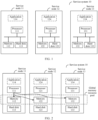
- FIG. 1 is a schematic diagram of a system architecture of a service system according to an embodiment.
- the service system 10 includes one or more service nodes (three service nodes: a service node 11, a service node 12, and a service node 13, are listed in FIG. 1 as an example).
- the service nodes may be specifically various hardware devices having data processing and storage functions, such as a server, a desktop computer, and a controller of a storage array.
- each service node includes a processor, a memory, and a hard disk.
- the service node 11 includes a processor 111, a memory 112, and a hard disk 113
- the service node 12 includes a processor 121, a memory 122, and a hard disk 123
- the service node 13 includes a processor 131, a memory 132, and a hard disk 133.
- the service node 11 is used as an example.
- the processor 111 may be one or more devices, circuits, and/or processing cores for processing data (for example, computer program instructions). Specifically, the processor 111 is configured to execute computer instructions, to process data generated in the service node 11.
- the processor 11 may include a central processing unit (Central Processing Unit, CPU), and the processor 11 may further include a microprocessor, a field programmable gate array (field programmable gate array, FPGA), a digital signal processor (digital signal processing, DSP), an application-specific integrated circuit (application-specific integrated circuit, ASIC), another programmable logic device, a discrete gate, a transistor logic device, a discrete hardware component, and the like.
- CPU Central Processing Unit
- FPGA field programmable gate array
- DSP digital signal processor
- ASIC application-specific integrated circuit
- another programmable logic device a discrete gate, a transistor logic device, a discrete hardware component, and the like.
- each service node may alternatively include a plurality of processors.
- Each processor may be a single-core processor (single-CPU), or may be a multi-core processor (multi-CPU).
- the memory 112 can be understood as storage space for directly exchanging data with the processor 111.
- the memory 112 can read and write data fast at any time, and can be used as a temporary data memory for an operating system or other running programs.
- the memory 112 may include one or more types of memories.
- the memory may be a random access memory or a read-only memory (read only memory, ROM).
- the random access memory may be a dynamic random access memory (dynamic random access memory, DRAM), a storage class memory (storage class memory, SCM), or a static random access memory (static random access memory, SRAM).
- DRAM dynamic random access memory
- SCM storage class memory
- SRAM static random access memory
- the DRAM is a semiconductor memory, and is a volatile memory (volatile memory) device like most random access memories (random access memories, RAMs).
- the SCM uses a composite storage technology that combines features of both a conventional storage apparatus and a memory.
- the storage class memory can provide a faster read/write speed than a hard disk, but has a slower access speed than the DRAM, and has lower costs than the DRAM.
- the read-only memory may be a programmable read-only memory (programmable read only memory, PROM) or an erasable programmable read-only memory (erasable programmable read only memory, EPROM).
- the memory may be a double in-line memory module or a dual in-line memory module (dual In-line memory module, DIMM for short), that is, a module including a dynamic random access memory (DRAM).
- DIMM dual In-line memory module
- the hard disk 113 is a memory configured to persistently store data. Compared with the memory 112, a data read/write speed of the hard disk 113 is slower than that of the memory 112.
- One or more hard disks 113 may be disposed inside the service node 11, or a disk enclosure may be mounted outside the service node 11 and a plurality of hard disks 113 are disposed in the disk enclosure. Regardless of deployment manners, these hard disks may be considered as hard disks included in the service node 11.
- the hard disk 113 may specifically include a solid state disk, a hard disk drive, or another type of hard disk.
- the hard disk 113 may also have a memory interface, so that the processor 111 can directly access the hard disk 113.
- some or all storage resources in the hard disk 113 may also be used as a part of the memory 112.
- the hard disk 113 may be a persistent memory having a byte access interface.
- the processor 111 can directly access storage resources in the hard disk 113 through the byte access interface.
- some or all storage resources in the hard disk 113 may be used as a part of the memory 112, to expand memory storage space of the service node 11.
- an application program for short for implementing a corresponding service function is run on each service node.
- an application 114 is run on the service node 11
- an application 124 is run on the service node 12
- an application 134 is run on the service node 13.
- an application that is run on each service node may be a database application.
- a local hardware resource inside each service node may be used to implement a function of an application.
- these pieces of hardware namely, the processor 111, the memory 112, and the hard disk 113, are used to implement a function of the application 114.
- the service nodes are independent of each other and process respective data. Processed results may be summarized to an upper-layer application or transferred between service nodes.
- a load imbalance problem may exist. As a result, hardware resources of the service nodes cannot be efficiently used.
- data computing resources that is, processors of the service nodes
- memory resources that is, memories of the service nodes
- the service nodes can share resources in the global memory resource pool. In this way, memory load of the services nodes can be balanced.
- memory resources of a service node are divided into two parts. For ease of description, the two parts are referred to as a "local resource” and a "global resource” below.
- a local resource refers to memory storage space that is of a service node and that is dedicated to the service node.
- a global resource refers to memory storage space that is of a service node, that is provided for a global memory resource pool, and that can be shared by the service node or other service nodes.
- the memory 112 of the service node 11 is divided into two parts: a local resource 1121 and a global resource 1122.
- the memory 122 of the service node 12 is divided into a local resource 1221 and a global resource 1222
- the memory 132 of the service node 12 is divided into a local resource 1321 and a global resource 1322.
- a physical division manner may be used.
- a plurality of memories (the memories may be memories of different types or of a same type such as a DRAM, an SCM, or a hard disk) form a memory.
- Storage space of some memories may be used as a local resources, and storage space of the other memories may be used as a global resource.
- a logical division manner may be used. For example, storage space in a memory of a service node may be divided into two parts based on a logical address corresponding to the storage space. One part is used as a local resource, and the other part is used as a global resource. This may not be limited in this embodiment.
- global resources of a plurality of service nodes may form a global memory resource pool.
- the service nodes in the service system can share resources in the global memory resource pool.
- the global resource 1122, the global resource 1222, and the global resource 1322 form a global memory resource pool 14, and the service nodes in the service system 10 share resources in the global memory resource pool 14.
- Unified addressing needs to be performed on storage space included in the global memory resource pool 14. After the unified addressing is performed, each segment of (specific) space of the global memory resource pool 14 has a unique global address.
- a "page (page)" may be used to represent a minimum access granularity of the global memory resource pool 14.
- the global address is a unique address of storage space indicated by the address in the global memory resource pool 14, and each service node can know a meaning of the address.
- a global address of the space has a corresponding physical address.
- the physical address indicates a specific memory of a specific service node on which the space indicated by the global address is actually located and an offset of the space in the memory, that is, a location of the physical space.
- the processor 111 may access, by using a global address of each segment of space in the global memory resource pool 14, data stored in the global memory resource pool 14. Specifically, if the to-be-accessed data is specifically located in the global resource 1222, the processor 111 may implement one-side access to the global resource 1222 by using remote direct memory access (remote direct memory access, RDMA), compute express link (compute express link, CXL), or another technology.
- the one-side access may mean that, when the processor 121 of the service node 12 is unaware of the access, a network adapter (not shown in the figure) of the service node 12 quickly accesses the global resource 1222.
- a local resource of each service node is mainly used to support access of the local service node.
- the local resource 1121 is used to provide storage space for a processor (namely, the processor 111) of a local service node (namely, the service node 11) to process data in the running process of the local service node.
- the local resource does not include the global address described above.
- the processor 111 of the service node 11 may directly access data in the local resource 1121 in a conventional manner of accessing the local memory.
- a remote service node cannot access the local resource 1121 by using a global address. If the remote node needs to access data in the local resource 1121, a remote procedure call (remote procedure call, RPC) manner or the like needs to be used.
- the remote service node sends an access request to a program on the service node 11, and the program on the service node 11 accesses the data in the local resource 1121 and then feeds back the data to the remote node. In this manner, essentially, the local service node (namely, the service node 11) completes access to the local resource 1121.
- memory resources of a service node are divided into two parts.
- a part of memory the resources namely, a global resource, are used to construct a global memory resource pool that can be used by all service nodes in the service system, so that the global resource can be directly accessed by remote service nodes in the service system.
- a remote service node may implement direct access to the global resource of the local service node by using RDMA, CXL, or another technology when the processor of the local service node is unaware of the access.
- the other part of the memory resources namely, a local resource
- a local resource are not used as a part of the global memory resource pool, and are used to support data processing performed by the local service node (for example, provide caches for the processor of the local service node).
- the remote node needs to access the local resource, the remote node needs to invoke the program on the local service node to access the local resource, and then the program feeds back an access result to the remote node.
- the global memory resource pool that can be used by all the service nodes in the service system is constructed, to balance load of the service nodes.
- each service node further includes the local resource, and each service node does not conflict with other service nodes when accessing the local resource. Therefore, each service node may load data to the local resource, to avoid a conflict with other service nodes, thereby reducing losses in memory performance and costs.
- each service node may load data to the local resource, an access speed of accessing the local resource by the service node is not affected by a communication delay between service nodes.
- FIG. 3A merely provides an example system architecture to which this technical solution provided in this embodiment can be applied. In an actual application process, this technical solution provided in this embodiment can also be applied to other system architectures.
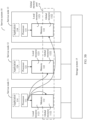
- the service system 10 further includes a storage system 15.
- persistent storage data is stored in the hard disks (namely, the hard disk 113, the hard disk 123, and the hard disk 133 in FIG. 3A ) of the service nodes.
- the storage system 15 may be used to persistently store various types of data needed by the service nodes to run the applications.
- the storage system 15 may be connected to the service nodes through various transmission networks, to implement data exchange between the service nodes and the storage system 15.
- the storage system 15 may be a centralized storage system, that is, the storage system 15 may be a central node including one or more storage devices, and data is jointly stored in the central node.
- the storage system 15 may be a distributed storage system including a plurality of independent storage nodes.
- An architecture of the storage system 15 may not be limited in this embodiment.
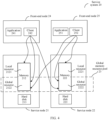
- FIG. 4 is a schematic diagram of a structure of another system architecture according to an embodiment.
- a service system 20 includes one or more front-end nodes (for example, a front-end node 25 and a front-end node 26 in FIG. 4 ) and one or more service nodes (for example, a service node 21 and a service node 22 in FIG. 4 ).
- Each front-end node includes hardware components such as a processor and a memory (not shown in the figure).
- Applications for example, an application 241 and an application 251 in FIG. 4
- service functions for example, a client 242 and a client 252 in FIG. 4
- clients for example, a client 242 and a client 252 in FIG. 4
- the service node 21 and the service node 22 respectively include a memory 212 and a memory 222 that provide memory storage space for the front-end nodes, and a hard disk 213 and a hard disk 223 that are configured to persistently store data.
- the memory 212 and the memory 222 may be divided into local resources (for example, a local resource 2121 and a local resource 2221 in FIG. 4 ) and global resources (for example, a global resource 2122 and a global resource 2222 in FIG. 4 ).
- the local resource is used to specially provide memory storage space for a front-end node
- the global resource is used to construct a global memory resource pool 23 to share memory storage space by a plurality of front-end nodes.
- the service node 21 is used as an example.
- the local resource 2121 is used to specially provide memory storage space for a front-end node 24, and the global resource 2122 may be jointly used by the front-end node 24 and a front-end node 25 as memory storage space.
- the following mainly uses the system architecture shown in FIG. 3A to describe a specific implementation process of technical solutions provided in embodiments. Specifically, the following describes the specific implementation process of the technical solutions provided in embodiments from two aspects.
- an embodiment for how to allocate shares of a local resource and a global resource in memory resources of a service node, provides a memory resource allocation method.
- shares of a local resource and a global resource in memory resources are dynamically adjusted, so that more memory resources are allocated to the local resource when a requirement for the local resource is large, and more memory resources are allocated to the global resource when a requirement for the global resource is large. In this way, memory resources are allocated more properly and system performance is improved.
- an embodiment in a process of loading data to memory resources of a service node, for use of a specific memory resource (a local resource or a global resource) to load the data, provides a data processing method.
- a data processing method when memory resources of a service node are divided into a local resource and a global resource, a proper memory resource can be determined to load data.
- the following describes a specific implementation process of a memory resource allocation method in a scenario in which memory resources of a service node are divided into a local resource and a global resource (that is, the memory resource allocation method provided in the first aspect).
- service nodes in a service system 10 include memory management apparatuses (that is, a memory management apparatus 115 and a memory management apparatus 125 in the figure) capable of managing memory resources of the service nodes.
- the memory management apparatus 115 is used as an example.
- the memory management apparatus 115 can implement, according to the methods provided in embodiments, functions such as dividing a memory 112 into a local resource 1121 and a global resource 1122, adjusting shares occupied by the local resource 1121 and the global resource 1122 in the memory 112, and loading data to the memory 112.
- functions of the memory management apparatus included in each service node may be implemented by using hardware, or may be implemented by using a software program.
- the memory management apparatus stores program code in the memory 112, and a processor 111 runs the program code to divide the memory 112 into the local resource 1121 and the global resource 1122 and adjust the shares of the local resource 1121 and the global resource 1122.
- the memory management apparatus may be a hardware accelerator card, for example, a neural network processing unit (Neural networks process units, NPU), a tensor processing unit (tensor processing unit, TPU), a field programmable gate array (Field Programmable Gate Array, FPGA), or an application-specific integrated circuit (application-specific integrated circuit, ASIC).
- the memory management apparatus is located inside the service node 11, and may access the memory 112 through a bus.
- a structure of the hardware accelerator card is not shown in FIG. 1 , and is described in a subsequent implementation.
- the service system 10 further includes a management node (not shown in the figure) that may communicate with the service nodes, and the management node can manage the service nodes.
- the service nodes report information such as capacities and addresses of global resources to the management node, and the management node performs unified addressing on the reported global resources and then notifies the service nodes.
- the management node may be any service node in the service system 10, or may be a server independent of a plurality of service nodes.
- hardware or software apparatuses such as the memory management apparatus and the management node in the foregoing example
- the functions such as dividing the memory 112 into the local resource 1121 and the global resource 1122, adjusting the shares occupied by the local resource 1121 and the global resource 1122 in the memory 112, and the loading data to the memory 112 are needed.
- Locations at which the hardware or the software apparatuses are deployed in the service system 10 may not be limited in this embodiment.
- the method may include the following steps.
- the memory management apparatus 115 divides the memory 112 into the local resource 1121 and the global resource 1122 based on initial shares.
- initial shares may be preset (for example, the initial shares of both the local resource 1121 and the global resource 1122 occupy 50%), and the initial shares are recorded in configuration information of the service node 11.
- the memory management apparatus 115 loads the configuration information, uses 50% memory resources in the memory 112 as the global resource, and performs unified addressing on the global resource and global resources of other service nodes, to establish a global memory resource pool 14.
- the other 50% memory resources do not undergo unified addressing, but serve as the local resource 1121 that are used only by the local service node.
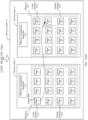
- the memory 112 of the service node 11 has a total of 16 pages (namely, a page 1 to a page 16). Based on the initial shares, the memory management apparatus 115 uses the page 1 to the page 8 as the local resource 1121 and uses the page 9 to the page 16 as the global resource 1122.
- the initial shares may be fixed values preset by a person skilled in the art.
- the initial shares may be values determined based on a current running environment of the service node 11 (for example, a type or an attribute of an application that is run on the service node 11, and information about a hardware type of the service node 11).
- a manner of determining the initial shares may not be limited in this embodiment.
- initial shares may be set.
- all memory resources in the memory 112 may be used as the local resource 1121
- all memory resources in the memory 112 may be used as the global resource 1122
- the local resource 1121 and the global resource 1122 are obtained through random division based on specific shares.
- the shares of the local resource 1121 and the global resource 1122 in the memory resources are dynamically adjusted (that is, S302), to achieve a more proper memory resource share proportion. It can be understood that in this scenario, content of S301 may not be performed.
- the memory management apparatus 115 adjusts the shares of the local resource 1121 and the global resource 1122 in the memory resources based on demanded amounts of the local resource 1121 and the global resource 1122.
- S302 may specifically include the following step.
- the free space in the local resource 1121 is transferred to the global resource 1122, to expand space of the global resource 1122, and load the data page to the global resource 1122.
- the local resource 1121 includes a page 1 to a page 8
- the global resource 1122 includes a page 9 to a page 16.
- the page 3 to the page 8 in the local resource 1121 are free space, and the global resource 1122 is exhausted, that is, the page 9 to the page 16 are all occupied.
- the free space page 8 in the local resource 1121 is transferred to the global resource 1122, and the to-be-loaded data page is loaded to the page 8.
- transferring storage space in a local resource of a service node to a global resource may be specifically represented as changing an access manner of the storage space, so that the storage space is accessed based on an access manner of the global resource, and is no longer accessed based on an access manner of the local resource.
- addresses are allocated to a local resource and a global resource in different addressing manners.
- a local address is allocated to the local resource, so that the local service node accesses the local resource based on the local address.
- a unique address (also referred to as a global address) in the global memory resource pool is allocated to the global resource, and is used by each service node to access the global resource based on the global address.
- transferring storage space in the local resource of the service node to the global resource may be specifically implemented by allocating the unique address (namely, the global address) in the global memory resource pool to the storage space, and deleting or invalidating the local address of the storage space.
- the free space page 8 in the local resource 1121 may be transferred to the global resource 1122 by allocating a global address in a global memory resource pool to the page 8. Then, each service node may access the page 8 based on the global address by using RDMA or another technology.
- a resource is exhausted in this embodiment may mean that the resource has no free space, or a free space in the resource is less than a space size threshold. Similar content in the following can be understood similarly, and is not described again.
- S302 may alternatively include the following step.
- the memory resource may not be transferred to the global resource 1122.
- the memory resource of the page of the lowest value in the memory 112 is reclaimed, and the reclaimed memory resource is transferred to the global resource 1122, to expand free space in the global resource 1122, and load the data page to the global resource 1122.
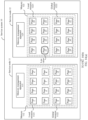
- both the local resource 1121 and the global resource 1122 are occupied, and data loaded to a page 7 is a page of lowest value in the memory 112.
- the service node 11 reclaims a memory resource of the page 7, transfers the page 7 to the global resource 1122, and loads the to-be-loaded data page to the page 7.
- the page of the lowest value may be specifically a page that is in the memory 112 and that is accessed for a minimum quantity of times, a page that is accessed at a longest time interval from a previous time, or the like.
- a standard for evaluating value of a page may not be limited in this embodiment.
- both the local resource 1121 and the global resource 1122 are occupied, and data loaded to a page 15 is a page of lowest value in the memory 112.
- the service node 11 reclaims a memory resource of the page 15 (because the page 15 is originally a resource in the global resource 1122, the page 15 does not need to be transferred to the global resource in this case), and loads the to-be-loaded data page to the page 15.
- a minimum resource threshold may be set for the local resource 1121, so that at least a part of memory resources (that is, a memory resource size indicated by the minimum resource threshold) are retained for the local resource 1121.
- a specific value of the minimum resource threshold may be set depending on an actual requirement. This may not be limited in this embodiment.
- S302 may specifically include the following step.
- the memory management apparatus 115 may transfer the free space in the global resource 1122 to the local resource 1121.
- transferring storage space in a global resource of a service node to a local resource may be specifically represented as changing an access manner of the storage space, so that the storage space is accessed based on an access manner of the local resource, and is no longer accessed based on an access manner of the global resource.
- transferring storage space in the global resource of the service node to the local resource may be specifically implemented by allocating a local address to the storage space, and deleting or invalidating a global address of the storage space. After the local address is allocated to the storage space and the global address of the storage space is deleted or invalidated, each service node cannot access the storage space by using the global address, so that the storage space is specially used to provide memory storage space for the local service node. Similar content in the following can be understood similarly, and is not described below again.
- S302 may further include the following step.
- the memory management apparatus 115 may reclaim a resource of a page of lowest value in the memory 112 (that is, the local resource 1121 and the global resource 1122), and transfers the resource to the local resource 1121.
- the shares of the local resource and the global resource in memory resources are dynamically adjusted, so that more memory resources are allocated to the local resource when a requirement for the local resource is large, and more memory resources are allocated to the global resource when a requirement for the global resource is large. In this way, memory resources are allocated more properly and system performance is improved.
- the following uses the service system 10 as an example to describe the process of loading data to a memory of a service node (that is, the data processing method provided in the second aspect) in a scenario in which memory resources of the service node are divided into a local resource and a global resource. Specifically, as shown in FIG. 10 , the method includes the following steps.
- S401 The service node 11 obtains data processing instructions.
- the data processing instructions may be instructions that instruct the service node 11 to process target data in a hard disk (which may be the hard disk 113, the hard disk 123, or the hard disk 133 in the service system 10).
- the data processing instructions may be instructions that instruct the processor 111 to run program code stored in the hard disk, and the program code is the foregoing target data.
- the data processing instructions may be instructions that instruct the processor 111 to process data such as an image and a text stored in the hard disk, and the image and the text are the foregoing target data.
- S402 The service node 11 loads the target data from the hard disk to a memory resource.
- the memory management apparatus 115 may first temporarily load the target data to the local resource 1121 or the global memory resource pool 14, so that the processor 111 processes the target data. Then, according to the following step S404, the target data is migrated to a proper memory resource based on accessed information of the target data (including information such as which nodes access the target data and frequency of accessing the target data by each node).
- the data loaded by the service node 11 to the memory resources is accessed by at least the service node 11.
- other service nodes may or may not access the data. Therefore, when the data is loaded to the memory resources for the first time, the data may be first loaded to the local resource, so that a local service node (namely, the service node 11) quickly accesses the target data.
- S402 may specifically include the following step.
- S4021 The service node 11 loads the target data from the hard disk to the local resource 1121.
- the service node 11 may alternatively load the target data to the global memory resource pool 14.
- the service node 11 may load the target data to the global resource 1122, or the service node 11 may load the target data to a global resource (for example, the global resource 1222) of another service node.
- the foregoing step S4021 may not be performed. This may not be limited in this embodiment.
- the free space in the global resource 1122 may be transferred to the local resource 1121 by using the foregoing step S3023, to load the target data to the local resource 1121.
- the resource of the page of the lowest value in the memory 112 may be reclaimed by using the foregoing step S3024, to load the target data to the reclaimed memory resource.
- S403 The service node 11 detects the accessed information of the target data.
- the accessed information of the target data may include various types of information used to reflect a quantity of times or frequency of accessing the target data by each service node.
- the accessed information of the target data may specifically include information such as a quantity of times that the target data is accessed by each service node in a period of time, and interval duration between two adjacent times for accessing the target data.
- each service node in the service system 10 may access the target data by accessing the local resource 1121.
- the processor 111 of the service node 11 may access the target data in the local resource 1121 in a conventional access manner.
- Remote service nodes namely, the service node 12, the service node 13, and the like
- the service node 11 may detect the accessed information of the target data by recording a status of accessing the target data by each service node in a period of time.
- S404 The service node 11 reallocates a memory resource to the target data based on the accessed information of the target data.
- S404 may include the following S4041 and S4042:
- the target data may not be loaded again, that is, the step of loading the target data to the local resource 1121 of the service node 11 in S4041 is not performed.
- the target data may be loaded to a memory resource in the global memory resource pool 14 based on an affinity between the target data and each service node.
- the target data may be preferentially loaded to a global resource of a service node having a closest affinity with the target data, so that access efficiency of the target data can be improved.
- an affinity between data and a service node can also be understood as value of the data for the service node. Greater value of the data for the service node indicates a closer affinity, and smaller value indicates a weaker affinity.
- the affinity between data and a service node may be reflected as information such as a quantity of times and frequency of accessing the data by the service node. A larger quantity of times and higher frequency of accessing the data by the service node indicate a closer affinity, and a smaller quantity of times and lower frequency indicate a weaker affinity.
- the target data may be preferentially loaded to a global resource of a service node with a close affinity in this embodiment. Further, when memory resources of the service node with a close affinity are exhausted, a memory resource of low value in the memory resources of the service node with a close affinity may be reclaimed, and then the target data may be loaded by using the reclaimed memory resource. Alternatively, the target data may be loaded to a global resource of a service node with a weaker affinity.
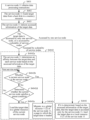
- S4042a Determine the affinity between the target data and each service node based on the accessed information of the target data.
- steps S4042b to S4042e may be separately performed on the service nodes in descending order of the affinities, until the target data is loaded to the global memory resource pool 14.
- S4042b Determine whether a current service node is the service node 11 (that is, a service node that loads the target data for the first time).
- S4042c Migrate, to the global resource 1122 of the service node 11, a page that is in the service node 11 and to which the target data is loaded.
- an address of the page to which the target data is loaded may be modified, to modify the address of the page from an address in the local resource 1121 to an address in the global memory resource pool 14, to migrate the page to the global resource 1122.
- the target data may be loaded to the global resource 1122 of the service node 11 without a need to perform resource reclamation on the page to which the target data is loaded or copy the target data.
- S4042d Determine whether the current service node satisfies a preset condition.
- the target data is loaded to a global resource of the current service node (that is, S4042e in the figure). If the current service node does not satisfy the preset condition, subsequent service nodes are traversed in descending order of the affinities.
- the preset condition may specifically include any one of the following:
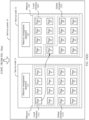
- the service node 11 first loads the target data to the page 1 in the local resource 1121 according to S402. If it is determined, based on the accessed information of the target data, that the target data is accessed by a plurality of service nodes, the service node 12 is determined, based on the affinity between the target data and each service node, as the service node having the closest affinity with the target data.
- the global resource 1222 of the service node 12 has free space (a page 32 in the figure), that is, the service node 12 satisfies the foregoing (1) and has a capability of loading the target data.
- the target data is loaded to the page 32.
- the memory management apparatus 125 in the service node 12 loads the target data from the hard disk to the page 32 of the global resource 1222 by performing a data page loading procedure, to load the target data to the page 32.
- the memory management apparatus 115 in the service node 11 may reclaim the page 1 by performing a data page eviction procedure.
- the service node 11 first loads the target data to the page 1 in the local resource 1121 according to S402. If it is determined, based on the accessed information of the target data, that the target data is accessed by a plurality of service nodes, the service node 12 is determined, based on the affinity between the target data and each service node, as the service node having the closest affinity with the target data.
- the global resource 1222 of the service node 12 has no free space, but the local resource 1221 has free space (a page 23 and a page 24 in the figure), that is, the service node 12 satisfies the foregoing (2) and has a capability of loading the target data.
- the page 24 may be transferred to the global resource 1222, and the target data is loaded to the page 24.
- the service node 11 first loads the target data to the page 1 in the local resource 1121 according to S402. If it is determined, based on the accessed information of the target data, that the target data is accessed by a plurality of service nodes, the service node 12 is determined, based on the affinity between the target data and each service node, as the service node having the closest affinity with the target data. In addition, neither the local resource 1221 nor the global resource 1222 of the service node 12 has free space, but data whose value is less than that of the target data has been loaded to a page 31 of the global resource 1222. As shown in FIG.
- the target data may be loaded to the page 31.
- the target data may be loaded to the page 31.
- the service node 11 first loads the target data to the page 1 in the local resource 1121 according to S402. If it is determined, based on the accessed information of the target data, that the target data is accessed by a plurality of service nodes, the service node 12 is determined, based on the affinity between the target data and each service node, as the service node having the closest affinity with the target data. In addition, neither the local resource 1221 nor the global resource 1222 of the service node 12 has free space, but data whose value is less than that of the target data has been loaded to a page 21 of the global resource 1221. As shown in FIG. 14(b) , after a memory resource of the page 21 is reclaimed and the page 21 is transferred to the global resource 1222, the target data may be loaded to the page 21.
- the method may further include the following steps.
- S4042f Determine n service nodes whose affinity with the target data is greater than an affinity threshold.
- S4042g Load the target data to a local resource of the n service nodes.
- n service nodes are n service nodes whose affinity with the target data is greater than the affinity threshold, and n is a positive integer.
- the target data when the affinity between the n service nodes and the target data is greater than the affinity threshold, the target data may be loaded to the local resource of the n service nodes, so that the n service nodes access the target data, thereby improving running efficiency of the n service nodes.
- each service node may further periodically detect accessed information of each data page in memory resources of the node, and reallocate a memory resource to each data page based on the accessed information of each data page in the foregoing manner described in S404.
- each service node can access a memory of the local node or each remote node. Therefore, when a service node updates data by using a write procedure, if no invalidation processing is performed on data copies of the data in a memory, when the local service node or a remote service node accesses the data again, invalid data may be read from the memory.
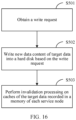
- an embodiment further provides a data writing method. As shown in FIG. 16 , the method includes the following steps.
- S501 A service node 11 obtains a write request.
- the write request is used to update data (referred to as target data below).
- the write request carries a logical address of the target data and updated data of the target data.
- the logical address may be an address identifier that is of the target data and that is used by an upper-layer application.
- the logical address may include a logical unit number (logical unit number, LUN), a logical block address (logical block address, LBA), and a data length that are corresponding to the target data.
- the service node 11 writes the updated data into a hard disk (which may be specifically the hard disk 113, the hard disk 123, or the hard disk 133) based on the write request.
- S503 The service node 11 performs invalidation processing on data copies of the target data recorded in a memory of each service node.
- the invalidation processing may specifically include deleting the data copies in the memory, modifying bitmaps of the data copies in the memory, or the like.
- the service node 11 may perform invalidation processing or reloading processing in a conventional manner, to release an invalid data copy in the memory.
- the service node 11 may trigger, through one-side access by using RDMA, CXL, or another technology, a network adapter of the remote service node to perform invalidation processing or reloading processing on copy data of the target data recorded in a global resource (for example, the global resource 1222 of the service node 12).
- the service node 11 may send a message to the remote service node in an RPC manner or the like, to trigger the remote service node to perform invalidation processing or reloading processing on a data copy of the target data recorded in a local resource (for example, the local resource 1221 of the service node 12).
- data copies of data C are loaded to a page 3, a page 17, and a page 25.
- the memory management apparatus 115 in the service node 11 may perform invalidation processing on the page 3 in a conventional manner, trigger, through one-side access by using RDMA, CXL, or another technology, a network adapter of the service node 12 to perform cache invalidation on the page 25, and send a message to the service node 12 in an RPC manner, to trigger the service node 12 to perform cache invalidation on the page 17.
- an access parameter may be set, and the access parameter can indicate whether the data copies of the data in the memories are available.
- an access parameter of the target data is set to an "unavailable” state, and the access parameter of the target data is set to an "available” state only after invalidation processing is performed on the data copies of the target data recorded in the memory of each service node.
- the service node may first obtain the access parameter corresponding to the target data, and determine, based on the access parameter, whether the data copies of the target data recorded in the memory are available. If the access parameter indicates an "available" state, the data copies of the target data in the memory are read. If the access parameter indicates an "unavailable” state, the memory may be bypassed, and the target data may be read from a hard disk.
- a counting array may be constructed, where each item in the counting array represents an access parameter of corresponding data.
- an access parameter of specific data for example, the target data
- a hash value may be calculated by using an identifier of the target data, and then a corresponding item in the counting array is located by using the hash value, so that the access parameter of the target data can be determined.
- a count auto-increment operation may be performed on the item in the counting array by using a compare-and-swap (remote direct memory access compare and swap, RDMA CAS) mechanism.
- RDMA CAS remote direct memory access compare and swap
- an initial value of each item in the counting array is zero.
- 1 is added to the item in the counting array by using the CAS mechanism, and after invalidation processing or reloading performed on data copies of the data is completed, 1 is subtracted from the item in the counting array by using the CAS mechanism.
- the item corresponding to the data in the counting array is not 0, it indicates that caches that are of the data corresponding to the item and that are in the memory of each service node may be invalid; or if the item corresponding to the data in the counting array is 0, it indicates that caches that are of the data corresponding to the item and that are in the memory of each service node is available.
- the counting array may be stored in each service node in the service system 10, so that when accessing data in the memory, each service node may determine, based on the locally stored counting array, whether caches of the accessed data in the memory are available.
- the counting array may be stored in a management node in the service system 10. When each service node accesses data in the memory, the service node may first access the management node to determine an access parameter corresponding to the accessed data in the counting array, and then determine, based on the access parameter, whether caches of the accessed data in the memory are available.
- a storage location of the counting array may not be limited in this embodiment.
- an embodiment further provides a memory management apparatus.
- the memory management apparatus can be used in a service system, so that the service system implements some or all of the effects in the foregoing embodiments.
- the apparatus may be configured to perform some or all steps in a running process of the service system.
- the memory management apparatus may be configured to perform some or all of the following steps in FIG. 6 , FIG. 10 , FIG. 15 , and FIG. 16 : obtaining a local resource and a global resource through division, adjusting space sizes of the local resource and the global resource, and loading data to a memory, to implement corresponding technical effect.
- the memory management apparatus includes corresponding hardware structures and/or software modules for performing functions.
- a person skill in the art should be easily aware that, in combination with the units and method steps in the examples described in embodiments, the technical solutions provided in embodiments can be implemented by hardware or a combination of hardware and computer software. Whether a function is performed by hardware or by computer software driving hardware depends on particular application scenarios and design constraints of the technical solutions.
- a data access apparatus may be located on a service node in the service system; the data access apparatus may be of a distributed structure, so that functions of the data access apparatus may be jointly implemented by hardware structures and/or software modules of a plurality of service nodes; or functions of the data access apparatus may be implemented by hardware structures and/or software modules that are independent of service nodes in the service system.
- FIG. 19 is a schematic diagram of a structure of a memory management apparatus according to this application.
- the memory management apparatus 60 includes a resource division unit 601 and a resource adjustment unit 602.
- the resource division unit 601 is configured to divide a memory of at least one of a plurality of service nodes into a local resource and a global resource.
- a local resource and a global resource For related content of the local resource and the global resource, refer to the foregoing descriptions of each running process in the service system 10. Details are not described herein again.
- the resource adjustment unit 602 is configured to adjust storage space sizes of the local resource and the global resource of the at least one service node.
- the resource adjustment unit 602 is configured to adjust storage space sizes of the local resource and the global resource of the at least one service node specifically includes at least one of the following:
- the resource adjustment unit 602 is further configured to: when adjusting storage space sizes of a local resource and a global resource of each of the at least one service node, keep the storage space size of the local resource of each of the at least one service node not less than a preset threshold.
- the memory management apparatus 60 further includes a memory allocation unit 603.
- the memory allocation unit 603 is configured to determine, from the local resource or the global resource of the at least one service node based on accessed information of first data, a memory resource for loading the first data.
- a memory resource for loading the first data includes: The memory allocation unit 603 is configured to determine to load the first data to the global resource of the at least one service node if determining, based on the accessed information of the first data, that the first data has been accessed by m service nodes, where m is a positive integer greater than 1, and the m service nodes are included in the plurality of service nodes.
- a memory resource for loading the first data includes: The memory allocation unit 603 is configured to: if determining, based on the accessed information of the first data, that the first data has been accessed by the at least one service node, determine to load the first data to the local resource of the at least one service node.
- a memory resource for loading the first data includes: The memory allocation unit 603 is specifically configured to: if determining, based on the accessed information of the first data, that the first data has been accessed by m service nodes and an affinity between n service nodes in the m service nodes and the first data is greater than an affinity threshold, determine to load the first data to a local resource of the n service nodes, where m is a positive integer greater than 1, n is a positive integer less than or equal to m, and the m service nodes are included in the plurality of service nodes.
- the first data has an access parameter
- the access parameter indicates whether data copies of the first data in memories of the plurality of service nodes are available.
- the memory management apparatus 60 further includes a read/write unit 604.
- the read/write unit 604 is configured to obtain a read request for the first data; the read/write unit 604 is further configured to determine the access parameter corresponding to the first data, where the access parameter indicates whether caches that are of the data corresponding to the access parameter and that are in the memories of the plurality of service nodes are available; and the read/write unit 604 is further configured to obtain the first data from the memories of the plurality of service nodes or storage locations in the plurality of service nodes other than the memories based on the access parameter.
- the read/write unit 604 is further configured to: when the first data changes, perform a preset operation on the access parameter, so that the access parameter indicates that the caches that are of the data corresponding to the access parameter and that are in the memories of the plurality of service nodes are unavailable.
- the read/write unit 604 is further configured to: after cache invalidation or reloading performed on the caches of the first data is completed, perform an inverse operation of the preset operation on the access parameter.
- the performing a preset operation on the access parameter includes: performing the preset operation on the access parameter according to a compare-and-swap CAS mechanism.
- FIG. 20 is a schematic diagram of a structure of another memory management apparatus according to this application.
- the memory management apparatus 70 is located in the service node shown in FIG. 1 , and is configured to implement the methods provided in this application.
- the memory management apparatus 70 may be a chip or a system on chip.
- the memory management apparatus 70 may include a processing unit 701 and at least one communication interface 702.
- the processing unit 701 is configured to perform the methods provided in embodiments.
- the processing unit 701 may include a neural network processing unit (neural networks process units, NPU), a tensor processing unit (tensor processing unit, TPU), a field programmable gate array (field programmable gate array, FPGA), an application-specific integrated circuit (application-specific integrated circuit, ASIC), another programmable logic device, a discrete gate, a transistor logic device, a discrete hardware component, or the like.
- a neural network processing unit neural networks process units, NPU
- tensor processing unit tensor processing unit
- TPU field programmable gate array
- FPGA field programmable gate array
- ASIC application-specific integrated circuit
- another programmable logic device a discrete gate, a transistor logic device, a discrete hardware component, or the like.
- the processing unit 701 when the processing unit 701 includes an NPU, a TPU, or another processor, the processing unit 701 further includes a memory.
- the processor in the processing unit 701 executes computer executable instructions stored in the memory, to perform the methods provided in this application.
- the communication interface 702 is configured to communicate with another apparatus.
- the memory management apparatus 70 may communicate with another hardware apparatus of the service node through the communication interface 702, to perform the methods provided in embodiments.
- the communication interface 702 may be an interface circuit, a transceiver, or the like.
- the computer executable instructions in this embodiment may also be referred to as application program code. This is not specifically limited in this embodiment.
- the memory management apparatus 70 is configured to implement corresponding procedures of the methods in FIG. 6 , FIG. 10 , FIG. 15 , and FIG. 16 .
- FIG. 6 For brevity, details are not described herein again.
- All or some of the foregoing embodiments may be implemented by using software, hardware, firmware, or any combination thereof.
- software is used to implement the foregoing embodiments, all or some of the foregoing embodiments may be implemented in a form of a computer program product.
- the computer program product includes one or more computer programs or instructions. When the computer programs or instructions are loaded and executed on a computer, all or some of the procedures or functions according to embodiments are executed.
- the computer may be a general-purpose computer, a dedicated computer, a computer network, a network device, user equipment, or another programmable apparatus.
- the computer programs or instructions may be stored in a computer-readable storage medium or may be transmitted from a computer-readable storage medium to another computer-readable storage medium.
- the computer programs or instructions may be transmitted from a website, computer, server, or data center to another website, computer, server, or data center in a wired or wireless manner.
- the computer-readable storage medium may be any usable medium accessible to a computer, or a data storage device, for example, a server or a data center, integrating one or more usable media.
- the usable medium may be a magnetic medium, for example, a floppy disk, a hard disk, or a magnetic tape; may be an optical medium, for example, a digital video disc (digital video disc, DVD); or may be a semiconductor medium, for example, an SSD.
- "at least one” means one or more
- "a plurality of” means two or more
- other quantifiers are similar.
- a term “and/or” describes an association relationship for describing associated objects and represents that three relationships may exist.
- a and/or B may represent the following three cases: Only A exists, both A and B exist, and only B exists.
- an element (element) that appears in singular forms “a”, “an”, and “the” does not mean “one or only one” unless otherwise specified in a context, but means “one or more”.
- "a device” means one or more such devices.
- "at least one of (at least one of)" means one or any combination of subsequent associated objects.
- a character “/” generally indicates an “or” relationship between associated objects.
- a character “/” indicates a “division” relationship between associated objects.
Landscapes
- Engineering & Computer Science (AREA)
- Theoretical Computer Science (AREA)
- Physics & Mathematics (AREA)
- General Engineering & Computer Science (AREA)
- General Physics & Mathematics (AREA)
- Software Systems (AREA)
- Human Computer Interaction (AREA)
- Information Retrieval, Db Structures And Fs Structures Therefor (AREA)
Applications Claiming Priority (3)
| Application Number | Priority Date | Filing Date | Title |
|---|---|---|---|
| CN202111064929 | 2021-09-11 | ||
| CN202111165165.0A CN115794368A (zh) | 2021-09-11 | 2021-09-30 | 业务系统、内存管理方法及装置 |
| PCT/CN2022/096400 WO2023035694A1 (zh) | 2021-09-11 | 2022-05-31 | 业务系统、内存管理方法及装置 |
Publications (2)
| Publication Number | Publication Date |
|---|---|
| EP4390680A1 true EP4390680A1 (de) | 2024-06-26 |
| EP4390680A4 EP4390680A4 (de) | 2025-01-01 |
Family
ID=85417275
Family Applications (1)
| Application Number | Title | Priority Date | Filing Date |
|---|---|---|---|
| EP22866172.4A Pending EP4390680A4 (de) | 2021-09-11 | 2022-05-31 | Dienstsystem sowie speicherverwaltungsverfahren und -vorrichtung |
Country Status (4)
| Country | Link |
|---|---|
| US (1) | US12535951B2 (de) |
| EP (1) | EP4390680A4 (de) |
| CN (1) | CN115794368A (de) |
| WO (1) | WO2023035694A1 (de) |
Families Citing this family (3)
| Publication number | Priority date | Publication date | Assignee | Title |
|---|---|---|---|---|
| CN117407042B (zh) * | 2023-11-01 | 2024-04-05 | 广州国测规划信息技术有限公司 | 一种国土空间基础信息平台的扩展设计方法和系统 |
| CN117492967B (zh) * | 2023-12-28 | 2024-03-19 | 苏州元脑智能科技有限公司 | 一种存储系统资源管理的方法、装置、设备及介质 |
| CN121326226A (zh) * | 2024-07-12 | 2026-01-13 | 华为技术有限公司 | 数据处理系统、数据处理方法及相关设备 |
Family Cites Families (8)
| Publication number | Priority date | Publication date | Assignee | Title |
|---|---|---|---|---|
| US5093913A (en) * | 1986-12-22 | 1992-03-03 | At&T Laboratories | Multiprocessor memory management system with the flexible features of a tightly-coupled system in a non-shared memory system |
| US6848033B2 (en) * | 2001-06-07 | 2005-01-25 | Hewlett-Packard Development Company, L.P. | Method of memory management in a multi-threaded environment and program storage device |
| US8203937B2 (en) * | 2008-10-02 | 2012-06-19 | International Business Machines Corporation | Global detection of resource leaks in a multi-node computer system |
| WO2011060366A2 (en) * | 2009-11-13 | 2011-05-19 | Anderson Richard S | Distributed symmetric multiprocessing computing architecture |
| CN103870333B (zh) * | 2012-12-17 | 2017-08-29 | 华为技术有限公司 | 一种全局内存共享方法、装置和一种通信系统 |
| CN105094997B (zh) * | 2015-09-10 | 2018-05-04 | 重庆邮电大学 | 一种云计算主机节点间物理内存共享方法和系统 |
| WO2017070869A1 (zh) * | 2015-10-28 | 2017-05-04 | 华为技术有限公司 | 一种内存配置方法、装置及系统 |
| CN113204407B (zh) * | 2021-04-22 | 2024-01-09 | 新华三大数据技术有限公司 | 一种内存超配管理方法及装置 |
-
2021
- 2021-09-30 CN CN202111165165.0A patent/CN115794368A/zh active Pending
-
2022
- 2022-05-31 WO PCT/CN2022/096400 patent/WO2023035694A1/zh not_active Ceased
- 2022-05-31 EP EP22866172.4A patent/EP4390680A4/de active Pending
-
2024
- 2024-03-08 US US18/600,126 patent/US12535951B2/en active Active
Also Published As
| Publication number | Publication date |
|---|---|
| EP4390680A4 (de) | 2025-01-01 |
| US20240211136A1 (en) | 2024-06-27 |
| CN115794368A (zh) | 2023-03-14 |
| WO2023035694A1 (zh) | 2023-03-16 |
| US12535951B2 (en) | 2026-01-27 |
Similar Documents
| Publication | Publication Date | Title |
|---|---|---|
| CN113674133B (zh) | Gpu集群共享显存系统、方法、装置及设备 | |
| US12535951B2 (en) | Service system and memory management method and apparatus | |
| US11593186B2 (en) | Multi-level caching to deploy local volatile memory, local persistent memory, and remote persistent memory | |
| EP3433737B1 (de) | Gemeinsame speichernutzung für arbeitsdaten unter verwendung von rdma | |
| US10802972B2 (en) | Distributed memory object apparatus and method enabling memory-speed data access for memory and storage semantics | |
| CN101594309B (zh) | 集群系统中内存资源的管理方法、设备及网络系统 | |
| EP4024213B1 (de) | Verfahren und -vorrichtung zur verwaltung eines zwischenspeichers | |
| WO2023000696A1 (zh) | 一种资源分配方法及装置 | |
| WO2020024588A1 (en) | A distributed memory object architecture | |
| EP3249539A1 (de) | Verfahren und vorrichtung zum zugreifen auf ein datenbesucherverzeichnis in einem mehrkernsystem | |
| US10802748B2 (en) | Cost-effective deployments of a PMEM-based DMO system | |
| WO2024244417A1 (zh) | 一种在系统扩容时无数据迁移的哈希分布方法及系统 | |
| US11157191B2 (en) | Intra-device notational data movement system | |
| US11928336B2 (en) | Systems and methods for heterogeneous storage systems | |
| US11281612B2 (en) | Switch-based inter-device notational data movement system | |
| CN116700605A (zh) | 用于异构存储系统的系统和方法 | |
| CN119299450A (zh) | 使用网络附接存储器的集体操作 | |
| CN120653423A (zh) | 数据访问方法、cxl交换设备及计算系统 |
Legal Events
| Date | Code | Title | Description |
|---|---|---|---|
| STAA | Information on the status of an ep patent application or granted ep patent |
Free format text: STATUS: THE INTERNATIONAL PUBLICATION HAS BEEN MADE |
|
| PUAI | Public reference made under article 153(3) epc to a published international application that has entered the european phase |
Free format text: ORIGINAL CODE: 0009012 |
|
| STAA | Information on the status of an ep patent application or granted ep patent |
Free format text: STATUS: REQUEST FOR EXAMINATION WAS MADE |
|
| 17P | Request for examination filed |
Effective date: 20240320 |
|
| AK | Designated contracting states |
Kind code of ref document: A1 Designated state(s): AL AT BE BG CH CY CZ DE DK EE ES FI FR GB GR HR HU IE IS IT LI LT LU LV MC MK MT NL NO PL PT RO RS SE SI SK SM TR |
|
| REG | Reference to a national code |
Ref country code: DE Ref legal event code: R079 Free format text: PREVIOUS MAIN CLASS: G06F0009455000 Ipc: G06F0009500000 |
|
| DAV | Request for validation of the european patent (deleted) | ||
| DAX | Request for extension of the european patent (deleted) | ||
| A4 | Supplementary search report drawn up and despatched |
Effective date: 20241129 |
|
| RIC1 | Information provided on ipc code assigned before grant |
Ipc: G06F 12/02 20060101ALI20241125BHEP Ipc: G06F 9/50 20060101AFI20241125BHEP |