EP4390735A1 - Aktualisierungsmittel mit linearem speicher - Google Patents
Aktualisierungsmittel mit linearem speicher Download PDFInfo
- Publication number
- EP4390735A1 EP4390735A1 EP22383268.4A EP22383268A EP4390735A1 EP 4390735 A1 EP4390735 A1 EP 4390735A1 EP 22383268 A EP22383268 A EP 22383268A EP 4390735 A1 EP4390735 A1 EP 4390735A1
- Authority
- EP
- European Patent Office
- Prior art keywords
- buffer page
- update agent
- page
- memory
- objects
- Prior art date
- Legal status (The legal status is an assumption and is not a legal conclusion. Google has not performed a legal analysis and makes no representation as to the accuracy of the status listed.)
- Pending
Links
Images
Classifications
-
- G—PHYSICS
- G06—COMPUTING OR CALCULATING; COUNTING
- G06F—ELECTRIC DIGITAL DATA PROCESSING
- G06F21/00—Security arrangements for protecting computers, components thereof, programs or data against unauthorised activity
- G06F21/60—Protecting data
- G06F21/62—Protecting access to data via a platform, e.g. using keys or access control rules
- G06F21/6218—Protecting access to data via a platform, e.g. using keys or access control rules to a system of files or objects, e.g. local or distributed file system or database
- G06F21/6281—Protecting access to data via a platform, e.g. using keys or access control rules to a system of files or objects, e.g. local or distributed file system or database at program execution time, where the protection is within the operating system
-
- G—PHYSICS
- G06—COMPUTING OR CALCULATING; COUNTING
- G06F—ELECTRIC DIGITAL DATA PROCESSING
- G06F11/00—Error detection; Error correction; Monitoring
- G06F11/07—Responding to the occurrence of a fault, e.g. fault tolerance
- G06F11/14—Error detection or correction of the data by redundancy in operations
- G06F11/1446—Point-in-time backing up or restoration of persistent data
- G06F11/1448—Management of the data involved in backup or backup restore
- G06F11/1451—Management of the data involved in backup or backup restore by selection of backup contents
-
- G—PHYSICS
- G06—COMPUTING OR CALCULATING; COUNTING
- G06F—ELECTRIC DIGITAL DATA PROCESSING
- G06F11/00—Error detection; Error correction; Monitoring
- G06F11/07—Responding to the occurrence of a fault, e.g. fault tolerance
- G06F11/14—Error detection or correction of the data by redundancy in operations
- G06F11/1479—Generic software techniques for error detection or fault masking
- G06F11/1482—Generic software techniques for error detection or fault masking using middleware or operating system [OS] functionalities
-
- G—PHYSICS
- G06—COMPUTING OR CALCULATING; COUNTING
- G06F—ELECTRIC DIGITAL DATA PROCESSING
- G06F21/00—Security arrangements for protecting computers, components thereof, programs or data against unauthorised activity
- G06F21/50—Monitoring users, programs or devices to maintain the integrity of platforms, e.g. of processors, firmware or operating systems
- G06F21/52—Monitoring users, programs or devices to maintain the integrity of platforms, e.g. of processors, firmware or operating systems during program execution, e.g. stack integrity ; Preventing unwanted data erasure; Buffer overflow
- G06F21/54—Monitoring users, programs or devices to maintain the integrity of platforms, e.g. of processors, firmware or operating systems during program execution, e.g. stack integrity ; Preventing unwanted data erasure; Buffer overflow by adding security routines or objects to programs
-
- G—PHYSICS
- G06—COMPUTING OR CALCULATING; COUNTING
- G06F—ELECTRIC DIGITAL DATA PROCESSING
- G06F11/00—Error detection; Error correction; Monitoring
- G06F11/07—Responding to the occurrence of a fault, e.g. fault tolerance
- G06F11/14—Error detection or correction of the data by redundancy in operations
- G06F11/1402—Saving, restoring, recovering or retrying
- G06F11/1415—Saving, restoring, recovering or retrying at system level
- G06F11/1433—Saving, restoring, recovering or retrying at system level during software upgrading
-
- G—PHYSICS
- G06—COMPUTING OR CALCULATING; COUNTING
- G06F—ELECTRIC DIGITAL DATA PROCESSING
- G06F2201/00—Indexing scheme relating to error detection, to error correction, and to monitoring
- G06F2201/82—Solving problems relating to consistency
Definitions
- the present invention relates to secure elements in general and in particular to a secure element fitted with an update agent with a linear memory structure for optimal memory management during software updates and a corresponding method for securing objects during software updates for data recovery.
- Smart cards are widely used in a variety of systems such as mobile phones, payment cards, access cards, to provide identification, authentication, data storage and application processing.
- a secure element is used to store the data.
- a secure element is a tamper resistant element, TRE, that provides a secure memory and execution environment in which application code and application data can be securely stored and administered.
- the secure element ensures that access to the data stored on the card is provided only when authorized.
- Such a secure element may exist in any form factor such as UICC, embedded SE, smartSD, smart microSD, etc.
- a secure element may include one or more security domains (SDs), each of which includes a collection of data, such as operating system, personalization data, packages, applets, applications, and the like, which are authenticated using security keys.
- SDs security domains
- the operating system and applications are stored within the secure element in volatile and non-volatile memory modules, and are executed in a secured processor of the secure element.
- the specification Global Platform Card Technology Open Firmware Loader for Tamper Resistant Element v1.3 describes a standardized mechanism for loading software (that is, use case dependent data which may contain the operating system and application data) into a secure element.
- an Open Firmware Loader, OFL, or update agent is provided inside the secure element, and configured to receive images of operation system and personalization data, to perform security checks - particularly authentication and integrity checks - on the image, and to trigger installation of the image contents into a memory of the secure element, so as to install in the secure element an operable operating system and personalization data.
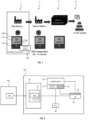
- Fig. 1 shows a schematic representation of the conventional production flow for loading software (e.g., an operating system, OS) into a secure element.
- the upper row shows the entities responsible for the corresponding production phase (I, II, III, IV), while the lower row shows the content of the secure element (i.e., chip).
- the chip manufacturer provides for a secure element 100 to be loaded with trusted software, such as a secure operating system (OS) 30.
- OS secure operating system
- the trusted software is personalized with credentials, which are diversified data including keys or certificates 35a, and which upon personalization, are stored in a personalized software image, e.g., a personalized operating system, OS, 30a referred to as "maxiinit" in Fig. 1 .
- the trusted software or OS may be personalized by specific commands, so called APDUs, that are sent from an external personalization device at the chip production site to the secure element.
- Other personalization processes such as for instance, in-factory personalization, are applicable as well.
- the personalized secure OS image 30 is loaded together with the update agent 10 inside the chip.
- the chip with its personalized software is then, at a device manufacturer's site, embedded in a portable card-like device, such as an (e)UICC or (e)SIM (phase II), or can be delivered to another device manufacturer's site to be included (phase III) in an electronic end device like a smart phone, a computer, a car, a measurement equipment, etc., and finally released to the market (phase IV).
- a portable card-like device such as an (e)UICC or (e)SIM (phase II)
- phase III an electronic end device like a smart phone, a computer, a car, a measurement equipment, etc.
- every chip is produced with its own diversified data.
- the diversified data is loaded in the chip at the chip factory (phase I), because for security reasons certain diversified data, such as the credentials including the keys and certificates, have to be loaded in the certified environment during chip production and stored in a user memory area, such as the memory area on the update agent including Data and ROM.
- a software image or operating system image is loaded from an external image server 200 into the memory area of the SE 100.
- the installed software or the installed operating system is completely deleted from memory area together with all related or associated diversified and personalization data 35a, respectively.
- This deletion is sometimes referred to as "Full Reflash” and is required upon software update, because ROM updates are not possible.
- Full Reflash the memory area is deleted, that is, the complete installed software or complete installed operating system is deleted together with its personalization data 35a, such as private credentials and cryptographic keys, and any specific data required to operate the installed software or operating system.
- the diversified data is not being stored in the "maxiinit" file, the diversified data cannot be recovered after a Full Reflash.
- the diversified data is stored in the OFL or update agent's Data Memory Region during the production process. That is, diversified data is stored once at the update agent, at card completion time, during the first APDU time, and can be recovered after a Full Reflash to be used to achieve operability of the updated software of operating system.
- every object i.e., stored data
- every object occupies at least one OFL memory page, while two or more objects cannot be stored within a single page.
- the remaining page is lost, resulting in a less optimal memory usage at the secure element.
- a method for securing objects at an update agent on a secure element comprising the update agent and an operating system.
- a buffer page is created at the operating system, the buffer page having a pre-defined size.
- Objects to be secured are stored in an iterative step in the buffer page in a sequential order, until the buffer page has been filled up.
- the buffer page is written to a memory of the update agent.
- software refers to any trusted software to be loaded and executed in the secure element. Examples include firmware, an operating system (OS), and any other use-case dependent secure applications.
- software image (or “OS image”) refers to a generic data format encapsulating a software version and cryptographic data to be used by the operating system or an agent of the SE, such as the update agent according to the present invention.
- the objects comprise diversified data of software installed on the secure element, in particular, secure credentials and/or cryptographic keys, which the installed software has been personalized with.
- the buffer page is thus a temporary created page at the OS, which is written to the memory of the update agent every time is being filled.
- the size of the page may be pre-set when the operating system is first loaded onto the secure element, or alternatively, may be (dynamically) set by the update agent, in which case it is communicated to the OS.
- the buffer page is managed by the OS, due to the fact that the update agent does not allow the OS to write/read more than one page at a time.
- Copying the full buffer page to the update agent provides for an efficient memory management at the update agent, since page space at the update agent is optimally used, as more than one object can be stored within one page and thus the page capacity is optimally used, hence reducing the amount of memory for storing diversified data needed for a Full Reflash.
- the method comprises after writing the buffer page to the memory of the update agent, storing new objects in the buffer page, while overwriting previously stored objects. This allows to keep track of all objects at the OS that need to be secured before a Full-Reflash process is started and to store these objects securely at the update agent with optimal memory usage at the update agent.
- content of the buffer page is masked using mask keys before being written to the update agent memory.
- Content of the buffer page is protected by being masked to ensure privacy of the OS objects, which contain personalization and other sensitive data.
- the mask keys are stored at the update agent at a first page of a contiguous address space in the update agent's memory. This allows to unmask the objects when being restored from the update agent memory to the OS after the Full-Reflash process.
- writing the buffer page to the memory of the update agent comprises storing content of the buffer page at subsequent pages after the first page in the contiguous address space.
- each of the subsequent pages is fully written before content of the buffer page is stored in a new subsequent page of the contiguous address space. This ensure that no memory space is lost at the update agent, as memory page is full used, before a new page is being written.
- content of a new buffer page is written in the contiguous address space starting at a first free address of the contiguous address space, indicating a subsequent page not fully written.
- the content of each buffer page is stored in the contiguous address space at the update agent as a sequence of objects, wherein consecutive objects are stored at consecutive addresses in the contiguous address space.
- each object comprising a header for storing object metadata and a data field.
- the header of each object comprises security domain, SD, information.
- This kind of metadata comprises data pertaining to the location of the objects at the operating system, which will be needed upon restoring the objects at the OS after Full Reflash.
- the header of each object comprises object type information indicative of a kind of the stored object, such as but not exclusively, a key type, a certificate type or an identifier, such as, a EID, CIN or IIN card.
- a secure element comprising an update agent and an operating system.
- the update agent comprises a memory to store objects to be secured.
- the secure element is configured to create a buffer page at the operating system, the buffer page having a pre-defined size; repeatedly store to be secured objects sequentially in the buffer page; and upon the buffer page being filled to the pre-defined size, write the buffer page to the memory of the update agent.
- the secure element is configured to perform the method according to the first aspect.
- the objects comprise diversified data of software installed on the secure element, in particular, secure credentials and/or cryptographic keys, which the installed software has been personalized with.
- a computer-program product for use in conjunction with a secure element, preferably the secure element according to the second aspect, in an electronic device, the computer-program product comprising a non-transitory computer-readable storage medium and a computer-program mechanism embedded therein, to load a software into the secure element in the electronic device, the computer-program mechanism including instructions for creating a buffer page at an operating system of the secure element, the buffer page having a pre-defined size; instructions for repeatedly storing to be secured objects sequentially in the buffer page; and instructions for writing the buffer page to a memory of the update agent upon the buffer page being filled to the pre-defined size
- the proposed method, secure element and computer-program product allow for an efficient memory management using a linear memory structure at the update agent for storing objects to be secured before a Full Reflash update at the secure element.
- page space at the update agent is optimally used, as more than one object can be stored within a page and thus the page capacity is optimally used, reducing the amount of empty pages.
- Fig. 2 shows the structure of a SE 100 according to an embodiment.
- Fig. 3 shows the steps of the method according to the invention in connection with Fig. 2 .
- the SE 100 shown in Fig. 2 is a tamper resistant element, containing the update agent 10, an operating system, OS, 30, and a processor, CPU, 40. Both the update agent 10 and the OS 30 may be stored in a memory of the SE 100, such as the non-volatile memory 50.
- the OS 30 and the update agent 10 are independent entities that can communicate with each other, for instance over an Application Programming Interface, API.
- Memory 50 is a non-volatile memory of the SE 100 that comprises a memory area 55 in which software is stored, which is installed on the SE 100 and executable by the CPU 40. Such installed software may be an executable application or program, identified by reference numeral 30a in Fig.
- the OS is a standard operating system of secure elements or smart cards, for example based on the Java Card platform.
- the personalized OS 30a of Fig. 2 is identified in Fig. 1 as "maxinit".
- the update agent 10 may be a functional part of or realized as a functionality of the operating system 30 or a loader entity allowing the provisioning of software (such as, for instance, use case dependent firmware) within the SE 100.
- loader entities are also referred to as Open Firmware Loaders, OFLs, or update agents in the art.
- Update agents are the main entities in charge of loading software or software images into the secure element as well as any other procedure related to it, such as update, restore, rollback or the like.
- reference numerals 30b identifying an arbitrary software image, or an operating system image.
- the update agent 10, regardless of whether it is realized as an independent entity or as functional part of the operating system 30, is also loaded onto the SE 100 during factory production, because it reflects a security critical entity of the SE 100 ( Fig. 1 , phase I).
- the update agent 10 may contain its own reserved memory space in form of a memory structure 12, to store sensible data thereon, for instance personalization data and/or authentication data, the latter being used to authenticate and/or decrypt a software/OS image 30b before it is personalized.
- the memory structure 12 of the update agent 10 may therefore contain personalization data 35b and the operating system 30 may have access to at least part of the memory structure 12.
- an executable software or the operating system 30a is installed on the SE 100 in a personalized way.
- the installed software 30a therefore has personalization data 35a associated therewith, for instance secure credentials and/or cryptographic keys, that ensure that the installed software is an authenticated, trusted and untampered software.
- the installed software 30a and the personalization data 35a are stored together in the memory area 55 of the SE 100. Within the memory area 55, the installed software 30a and the respective personalization data 35a may be stored in an intertwined fashion, because upon installation the software 30a is equipped or enriched with personalization data 35a in various ways.
- the software 30a may have been personalized and installed on the SE 100 during factory production of the SE 100, because personalization is a security-critical operation that conventionally is performed within a certified environment of a production site of the manufacturer of the SE 100.
- the SE 100 in the state as illustrated in Fig. 2 has completed the initial chip production ( Fig. 1 , phase I) and has left the chip manufacturer's certified environment.
- a copy 35b of the personalization data 35a has been secured in the memory structure 12 of the update agent 10 and a software image 30b is provided by an external server 200 to be loaded onto the secure element 100 in order to update and replace the installed software 30a.
- the software image 30b represents a software update of the installed software or operating system 30a.
- the external server 200 may represent an entity which communicates with the SE 100. It can be a LPA (Local Profile Assistant), a terminal, or whatever device it is that the SE may be in connection with.
- the external server 200 is or comprises an image delivery server and provides during a subsequent production phase ( Fig. 1 , phases II, III, IV) the software image or operating system image 30b to the SE through a customized interface.
- the previously installed software or OS 30a is entirely deleted from the memory area 55 together with all corresponding diversified or specific personalization data 35a. That is, the complete installed software or complete installed operating system 30a is deleted together with its diversified or personalization data 35a, such as private credentials and cryptographic keys, and any specific data required to operate the installed software or operating system 30a.
- the diversified data is not contained in the new software image, therefore, the newly updated software or OS image cannot be personalized, rendering thus the secure element useless.
- a linear memory space (identified by reference numeral 60 in Fig. 2 ) is created at the update agent 10 within the SE 100, in which objects to be secured are stored before a Full Reflash update is performed at the SE 100.
- the linear memory space 60 allows to store more than one object (i.e., diversified data, personalization data) within a page and thus to optimally use the update agent's memory capacity by reducing the amount of empty memory pages at the update agent.
- the linear memory space 60 is a contiguous area, or contiguous address space, within the memory structure 12.
- the linear memory space 60 is populated by writing objects needed to be saved from the OS 130 in a page-wise manner. As the memory structure 12 is not deleted or otherwise modified during a Full Reflash, the objects stored therein are recoverable after a new software or OS image has been loaded into the SE.
- the update agent allows the OS to write/read only one page at a time. To achieve an efficient use of memory space at the update agent, it is desired to force the OS to entirely fill up a page before it is written to the update agent, as opposed to the OS writing each object separately. The latter solution would consume a large amount of memory at the update agent, since every single object will have to be stored in a separate memory page at the update agent.
- the SE 100 when an object has to be saved before a software or OS image update, the SE 100 creates a buffer page 20 at the OS 130.
- This buffer page 20 is used by the OS 130 to temporarily store objects to be saved at the update agent.
- the buffer page 20 is being written to the contiguous memory area 60 of the update agent.
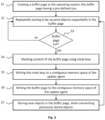
- This method is illustrated by the flow chart of Fig. 3 .
- the flow chart shows steps of the method for securing objects at an update agent, for instance the update agent 10 of Fig. 2 .
- step S1 the secure element 100 creates a buffer page 20 at the OS 130.
- the buffer page has a pre-defined size, which may be set when the initial OS has been loaded onto the SE during factory production (i.e., phase I in Fig. 1 ).
- the update agent 10 may have the capability to dynamically change the buffer page size according to its own memory structure 12.
- Step S2 is performed under the control of the OS 130.
- the OS stores objects to be secured sequentially in the buffer page 20.
- Step S2 is repeated until the buffer page has been filled up (i.e., step S3).
- the last object might be cut, that is, only a part of the object is stored in the buffer page due to the buffer page reaching full size.
- step S6 When the buffer page 20 has been filled to the pre-defined size, it is written in step S6 to a memory 60 of the update agent 10.
- the buffer page 20 After the buffer page has been written to the update agent, new objects (or the remaining part of previously stored last object) are stored in the buffer page, while overwriting previously stored objects (step S7).
- the buffer page 20 may be explicitly emptied before new objects are stored therein.
- the buffer page 20 is a temporary page at the OS, which is created once and which temporarily stores objects before being written to the update agent.
- the full buffer page is written in a single operation to a corresponding page at the update agent, as will be described below with reference to Figs. 4a and 4b .
- content of the buffer page is protected using mask keys (i.e., step S4 in Fig. 3 ) before being written to the update agent memory.
- mask keys i.e., step S4 in Fig. 3
- the mask keys are stored at the update agent 10 in step S5 at a first page of the linear memory space 60 in the update agent's memory 12. This allows to unmask the objects when being restored from the update agent memory to the OS after the Full-Reflash process.
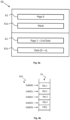
- Fig. 4a shows a schematic representation of the update agent's linear memory space 60 according to the present invention
- Fig. 4b shows a schematic representation of content of the contiguous memory space of Fig. 4a .
- the linear memory space 60 is created as a flat memory model organized in a single contiguous address space.
- the processing unit such as the CPU 40 in Fig. 2 can access the linear memory space 60 directly as well as linearly, through a simple memory management scheme with great flexibility and minimum hardware requirements.
- a linear memory structure provides for an optimal memory usage.
- Objects 63 are stored in the linear memory area 60 beginning at page 1 (reference numeral 62) using as many pages as needed till the last object is stored ("End Data").
- Fig. 4b objects are stored in a sequential order in the data area 62a of Fig. 4a .
- Hexadecimal numbers, 62b are used to denote the exact place of a memory chunk.
- Data denotes the value stored in that memory. For instance, "Obj1" is stored at address 0x8000.
- the first free address is looked up (in the example of Fig. 4b , this is the address 0x8004) indicating the first free memory place the next object can be stored within.
- the first free address is looked up (in the example of Fig. 4b , this is the address 0x8004) indicating the first free memory place the next object can be stored within.
- consecutive objects are stored at consecutive addresses in the contiguous address space. This ensure, that objects are stored at the update agent in the same order they are being saved in the OS. Upon restoring the objects to the OS, the order is thus preserved.
- a further page, 61, directly preceding the data/object page(s) is used for storing the mask keys 61a.
- each object is stored with a header and a data field.
- the header comprises object metadata.
- object metadata include security domain information on the location of the objects at the operating system, which will be needed upon restoring the objects at the OS after Full Reflash, and object type information.
- the methods and apparatus as described through the embodiments above provides for an efficient memory management using a linear memory structure at the update agent for storing objects to be secured before a Full Reflash update is performed.
- a linear memory page space at the update agent is optimally used, as more than one object can be stored within one page and thus the page capacity is optimally used, hence reducing the amount of memory needed for storing diversified data required before the Full Reflash.
- the linear memory structure created using the OS's temporal buffer page allows to store objects at the update agent in the same order they are being saved in the OS. Upon restoring the objects to the OS, the order is thus preserved.
Landscapes
- Engineering & Computer Science (AREA)
- Theoretical Computer Science (AREA)
- Computer Security & Cryptography (AREA)
- General Engineering & Computer Science (AREA)
- General Physics & Mathematics (AREA)
- Physics & Mathematics (AREA)
- Software Systems (AREA)
- Quality & Reliability (AREA)
- Computer Hardware Design (AREA)
- Databases & Information Systems (AREA)
- Health & Medical Sciences (AREA)
- Bioethics (AREA)
- General Health & Medical Sciences (AREA)
- Storage Device Security (AREA)
Priority Applications (1)
| Application Number | Priority Date | Filing Date | Title |
|---|---|---|---|
| EP22383268.4A EP4390735A1 (de) | 2022-12-22 | 2022-12-22 | Aktualisierungsmittel mit linearem speicher |
Applications Claiming Priority (1)
| Application Number | Priority Date | Filing Date | Title |
|---|---|---|---|
| EP22383268.4A EP4390735A1 (de) | 2022-12-22 | 2022-12-22 | Aktualisierungsmittel mit linearem speicher |
Publications (1)
| Publication Number | Publication Date |
|---|---|
| EP4390735A1 true EP4390735A1 (de) | 2024-06-26 |
Family
ID=84602187
Family Applications (1)
| Application Number | Title | Priority Date | Filing Date |
|---|---|---|---|
| EP22383268.4A Pending EP4390735A1 (de) | 2022-12-22 | 2022-12-22 | Aktualisierungsmittel mit linearem speicher |
Country Status (1)
| Country | Link |
|---|---|
| EP (1) | EP4390735A1 (de) |
Citations (5)
| Publication number | Priority date | Publication date | Assignee | Title |
|---|---|---|---|---|
| US20050045717A1 (en) * | 2003-08-29 | 2005-03-03 | Rager Kent D. | Method for provisioning and product |
| EP1679573B1 (de) * | 2005-01-07 | 2007-06-27 | Telefonaktiebolaget LM Ericsson (publ) | Aktualisierung von Speicherinhalt in einem Datenverarbeitungssystem |
| US20140229661A1 (en) * | 2008-03-31 | 2014-08-14 | Spansion Llc | Operating system based dram and flash management |
| US20180089434A1 (en) * | 2016-09-23 | 2018-03-29 | Apple Inc. | Preserving trust data during operating system updates of a secure element of an electronic device |
| WO2018063802A1 (en) * | 2016-09-28 | 2018-04-05 | Intel Corporation | Processor extensions to identify and avoid tracking conflicts between virtual machine monitor and guest virtual machine |
-
2022
- 2022-12-22 EP EP22383268.4A patent/EP4390735A1/de active Pending
Patent Citations (5)
| Publication number | Priority date | Publication date | Assignee | Title |
|---|---|---|---|---|
| US20050045717A1 (en) * | 2003-08-29 | 2005-03-03 | Rager Kent D. | Method for provisioning and product |
| EP1679573B1 (de) * | 2005-01-07 | 2007-06-27 | Telefonaktiebolaget LM Ericsson (publ) | Aktualisierung von Speicherinhalt in einem Datenverarbeitungssystem |
| US20140229661A1 (en) * | 2008-03-31 | 2014-08-14 | Spansion Llc | Operating system based dram and flash management |
| US20180089434A1 (en) * | 2016-09-23 | 2018-03-29 | Apple Inc. | Preserving trust data during operating system updates of a secure element of an electronic device |
| WO2018063802A1 (en) * | 2016-09-28 | 2018-04-05 | Intel Corporation | Processor extensions to identify and avoid tracking conflicts between virtual machine monitor and guest virtual machine |
Similar Documents
| Publication | Publication Date | Title |
|---|---|---|
| US7836444B2 (en) | Mobile communication terminal having embedded system for software download and method for software download | |
| US20050171983A1 (en) | Smart card with volatile memory file subsystem | |
| US20250085956A1 (en) | Software update in a security element | |
| US6928456B2 (en) | Method of tracking objects for application modifications | |
| JP4806639B2 (ja) | セキュアデバイス及びicカード発行システム | |
| CN1134751C (zh) | 用于操作设计成执行可重新装载的功能程序的数据载体的方法 | |
| CN117716361A (zh) | 安全元件中操作系统的更新 | |
| JP2017504112A (ja) | 更新可能なic無線デバイス | |
| EP3286682B1 (de) | Verfahren zur verwaltung von applikationen in einem sicheren element wenn das betriebsystem aktualisiert wird | |
| US12079176B2 (en) | Device, a method of performing a file transaction, and a method of performing an access operation | |
| KR20180077249A (ko) | 보안 요소 내의 패키지를 관리하는 방법 | |
| US20240273206A1 (en) | Personalization of a secure element | |
| EP4390735A1 (de) | Aktualisierungsmittel mit linearem speicher | |
| GB2403303A (en) | Software patch registry | |
| US20240241959A1 (en) | Change and recovery of personalization data in a secure element | |
| EP2898413B1 (de) | Ein sicherheitsmodul und ein verfahren zur optimalen speicherausnutzung | |
| US20260017374A1 (en) | Update agent for multiple operating systems in a secure element | |
| US20080275917A1 (en) | Itso Fvc2 Application Monitor | |
| EP4145271B1 (de) | Verfahren und endgerät zur aktualisierung einer umgewandelten applet-datei und java-kartenvorrichtung | |
| JP6915437B2 (ja) | 電子情報記憶媒体、icカード、電子情報記憶媒体によるアップデート方法及びアップデートプログラム | |
| US20260073070A1 (en) | Method as well as configuration program for configuring a user device and same comprising a system patching dataset for a secure element | |
| JP5853590B2 (ja) | Icチップ、icチップにおける処理方法、icチップ用処理プログラム、及びicカード等 | |
| JP5853559B2 (ja) | Icチップ、icチップにおける処理方法、icチップ用処理プログラム、及びicカード | |
| WO2016015949A1 (en) | Method for managing application packages in an electronic device | |
| EP3185165A1 (de) | Elektronische vorrichtung mit einem mechanismus zur sicheren speicherung von daten im zusammenhang mit einer anwendung |
Legal Events
| Date | Code | Title | Description |
|---|---|---|---|
| PUAI | Public reference made under article 153(3) epc to a published international application that has entered the european phase |
Free format text: ORIGINAL CODE: 0009012 |
|
| STAA | Information on the status of an ep patent application or granted ep patent |
Free format text: STATUS: THE APPLICATION HAS BEEN PUBLISHED |
|
| AK | Designated contracting states |
Kind code of ref document: A1 Designated state(s): AL AT BE BG CH CY CZ DE DK EE ES FI FR GB GR HR HU IE IS IT LI LT LU LV MC ME MK MT NL NO PL PT RO RS SE SI SK SM TR |
|
| STAA | Information on the status of an ep patent application or granted ep patent |
Free format text: STATUS: REQUEST FOR EXAMINATION WAS MADE |
|
| 17P | Request for examination filed |
Effective date: 20250211 |
|
| GRAP | Despatch of communication of intention to grant a patent |
Free format text: ORIGINAL CODE: EPIDOSNIGR1 |
|
| STAA | Information on the status of an ep patent application or granted ep patent |
Free format text: STATUS: GRANT OF PATENT IS INTENDED |