EP4390738A1 - Schutz einer elektronischen vorrichtung - Google Patents
Schutz einer elektronischen vorrichtung Download PDFInfo
- Publication number
- EP4390738A1 EP4390738A1 EP23215958.2A EP23215958A EP4390738A1 EP 4390738 A1 EP4390738 A1 EP 4390738A1 EP 23215958 A EP23215958 A EP 23215958A EP 4390738 A1 EP4390738 A1 EP 4390738A1
- Authority
- EP
- European Patent Office
- Prior art keywords
- application
- operating system
- level operating
- electronic device
- programming interface
- Prior art date
- Legal status (The legal status is an assumption and is not a legal conclusion. Google has not performed a legal analysis and makes no representation as to the accuracy of the status listed.)
- Pending
Links
Images


Classifications
-
- G—PHYSICS
- G06—COMPUTING OR CALCULATING; COUNTING
- G06F—ELECTRIC DIGITAL DATA PROCESSING
- G06F21/00—Security arrangements for protecting computers, components thereof, programs or data against unauthorised activity
- G06F21/50—Monitoring users, programs or devices to maintain the integrity of platforms, e.g. of processors, firmware or operating systems
- G06F21/57—Certifying or maintaining trusted computer platforms, e.g. secure boots or power-downs, version controls, system software checks, secure updates or assessing vulnerabilities
-
- G—PHYSICS
- G06—COMPUTING OR CALCULATING; COUNTING
- G06F—ELECTRIC DIGITAL DATA PROCESSING
- G06F21/00—Security arrangements for protecting computers, components thereof, programs or data against unauthorised activity
- G06F21/30—Authentication, i.e. establishing the identity or authorisation of security principals
- G06F21/44—Program or device authentication
-
- G—PHYSICS
- G06—COMPUTING OR CALCULATING; COUNTING
- G06F—ELECTRIC DIGITAL DATA PROCESSING
- G06F21/00—Security arrangements for protecting computers, components thereof, programs or data against unauthorised activity
- G06F21/60—Protecting data
- G06F21/64—Protecting data integrity, e.g. using checksums, certificates or signatures
-
- G—PHYSICS
- G06—COMPUTING OR CALCULATING; COUNTING
- G06F—ELECTRIC DIGITAL DATA PROCESSING
- G06F21/00—Security arrangements for protecting computers, components thereof, programs or data against unauthorised activity
- G06F21/70—Protecting specific internal or peripheral components, in which the protection of a component leads to protection of the entire computer
- G06F21/71—Protecting specific internal or peripheral components, in which the protection of a component leads to protection of the entire computer to assure secure computing or processing of information
- G06F21/74—Protecting specific internal or peripheral components, in which the protection of a component leads to protection of the entire computer to assure secure computing or processing of information operating in dual or compartmented mode, i.e. at least one secure mode
-
- H—ELECTRICITY
- H04—ELECTRIC COMMUNICATION TECHNIQUE
- H04L—TRANSMISSION OF DIGITAL INFORMATION, e.g. TELEGRAPHIC COMMUNICATION
- H04L63/00—Network architectures or network communication protocols for network security
- H04L63/10—Network architectures or network communication protocols for network security for controlling access to devices or network resources
-
- H—ELECTRICITY
- H04—ELECTRIC COMMUNICATION TECHNIQUE
- H04W—WIRELESS COMMUNICATION NETWORKS
- H04W12/00—Security arrangements; Authentication; Protecting privacy or anonymity
- H04W12/30—Security of mobile devices; Security of mobile applications
- H04W12/37—Managing security policies for mobile devices or for controlling mobile applications
Definitions
- the present description relates generally to electronic devices, and more particularly to electronic devices adapted to process secret data. More particularly, the present description relates to electronic devices adapted to implement wireless communication, such as near field communication (NFC, Near Field Communication) or ultra wideband communication (UWB, Ultra Wideband), and in which at at least part of the data exchanged is secret data and/or part of the data exchanged is sensitive data allowing, for example, a method of identification or authentication of a user, or allowing, for example, the location of 'an user.
- wireless communication such as near field communication (NFC, Near Field Communication) or ultra wideband communication (UWB, Ultra Wideband)
- Complex electronic devices such as mobile phones, electronic tablets, computers, etc., integrate, over time, more and more functionalities and allow the implementation of digital and/or digital services in order to integrate as best as possible into daily life.
- certain mobile phones and more particularly smart phones (smartphones)
- integrate digital services such as a bank payment service, or a service for using public transport tickets or show tickets.
- a dematerialized key service in which user authentication with a remote system (banking, public administration, etc.) is likely to be implemented.
- these devices can integrate electronic components specific to these functionalities, such as for example secure components which make it possible to retain/store identification, reference and authentication information, generally referred to as “credentials", and resources (assets) of the digital service provider, motion sensors, a wireless communication module, such as Near Field Communication (NFC) module or Ultra Wideband (UWB) communication module, etc.
- NFC Near Field Communication
- UWB Ultra Wideband
- a difficulty arising from the addition of new functionalities is that secret data and/or sensitive data are exchanged between different modules and/or software layers of the same electronic device without being protected.
- One embodiment overcomes all or part of the drawbacks of known electronic devices processing sensitive data.
- said at least one second application can refuse, partially accept or fully accept the request from said at least one first application.
- the first low-level operating system when the first low-level operating system performs the verification of the reliability of the first operating system, stores said result.
- the second low-level operating system when the second low-level operating system makes said result accessible to the second application, the second low-level operating system sends said result to said at least one second application.
- the second low-level operating system when the second low-level operating system makes said result accessible to the second application, the second low-level operating system makes said result available to said at least one second application by via a first application programming interface.
- the first high-level operating system is the program known as Trust Platform Module.
- the second low-level operating system is the program known under the name Global Platform and/or the program known under the name Java Card Virtual Machine.
- said first and second low-level operating systems are adapted to communicate via a dedicated communication channel.
- the secure element comprises a first electronic chip implementing said first low-level operating system, and a second electronic chip, different from the first chip, implementing said second low-level operating system. low level.
- the first chip is considered as a first secure element
- the second chip is considered as a second secure element
- the secure element adapted to implement at least one second application programming interface configured to check whether a command received by said at least one second application has been sent reliably.
- said second application programming interface is configured to use several verification means.
- said second application programming interface is configured to check whether the sender of said command is reliable.
- the application programming interface is configured to verify whether said high-level operating system is authentic.
- one embodiment provides an electronic device comprising a secure element adapted to implement at least one first application, and an application programming interface configured to check whether a command received by said at least one first application was sent reliably.
- Another embodiment provides a method of protecting an electronic device comprising a secure element adapted to implement at least one first application, and an application programming interface configured to check whether a command received by said at least one first application was sent reliably.
- the application programming interface is configured to use several verification means.
- said application programming interface transmits said command to said at least one first application, and sends the result of this verification to said first application .
- the application programming interface is configured to check whether the sender of said command is reliable.
- the sender is a second application implemented by a system high-level operation of a processor included in said electronic device.
- the application programming interface is configured to verify whether said high-level operating system is reliable or authentic.
- the secure element implements a first low-level operating system implementing said first application, and a second low-level operating system configured to check whether the high-level operating system level of said processor is reliable or authentic, the application programming interface verifies that said high-level operating system is reliable by communicating with said first low-level operating system of the secure element.
- the sender is an electronic system independent of the electronic device, said electronic system being adapted to be coupled with said electronic device.
- said electronic system being adapted to be coupled with said electronic device using a coupling function.
- the application programming interface is further configured to verify that the communication channel used to transmit the command is a reliable channel.
- the application programming interface is, in addition, configured to validate the authenticity of the verification of said command received by said at least one first application.
- said verification is carried out by implementing verification means configurable by the application programming interface as a function of the coupling function.
- the expressions “approximately”, “approximately”, “substantially”, and “of the order of” mean to the nearest 10%, preferably to the nearest 5%.
- FIG. 1 represents, very schematically and in block form, an example of an electrical device 100 to which the embodiments described in relation to the figures 2 to 5 .
- the device 100 is an electronic device adapted to process data, and which is particularly suitable for processing sensitive data.
- sensitive means data comprising secret or potentially secret information, or information considered private for a natural person such as a user.
- sensitive data is data that is not accessible to everyone and cannot be shared with any electronic device.
- the device 100 includes a processor 101 (CPU) for processing data.
- the device 100 may include several processors each adapted to process different types of data.
- the device 100 may comprise a main processor and one or more secondary processors.
- the device 100 further comprises one or more secure elements 102 (SE) allowing the management of sensitive data, such as the storage or use of this data, or allowing, for example, to implement secure applications.
- a secure element 102 may include its own dedicated processor(s), as well as its own memory(s).
- a secure element 102, and its operating system, is considered, in the remainder of the description, as reliable and inviolable. Furthermore, in the remainder of the description, the expression "secure element” subsequently designates indifferently an embedded secure element or an integrated secure element.
- the device 100 further comprises one or more input/output circuits 103 (I/0) allowing the device 100 to transmit and/or receive data and/or energy with one or more external electronic devices.
- I/0 input/output circuits 103
- circuits making it possible to manage communications with other devices such as circuits, or modules, making it possible to manage communications wired, such as communications using the USB protocol, and/or wireless communications, such as WiFi communications, Bluetooth communications, and/or near field communications (NFC).
- the device comprises, more precisely, at least one NFC module, that is to say a module adapted to near field communication (NFC), and/or a UWB module, that is say a module suitable for ultra wideband communication (Ultra Wideband, UWB).
- the device 100 further comprises one or more circuits 104 (ALIM) responsible for supplying energy to the device 100.
- the circuits 104 may comprise one or more batteries, energy conversion circuits, charging circuits, etc.
- the device 100 further comprises one or more memories 105 (MEM) in which data, for example binary data, are stored.
- MEM memories 105
- the device 100 comprises several types of memory, such as read only memory, volatile memory, and/or non-volatile memory.
- the device 100 further comprises one or more circuits 106 (FCT) implementing one or more functionalities of the device 100.
- the circuits 106 may comprise specific data processing circuits, such as encryption circuits, or circuits allowing measurements to be made, such as sensors.
- the device 100 further comprises one or more communication buses 107 allowing all the circuits of the device 100 to communicate.
- a single bus 105 connecting the processor 101, the memory(s) 102, and the circuits 103 to 106 is shown, but in practice, the device 100 can include several communication buses connecting these different elements.
- the device 100 may comprise several communication buses shared by more than two circuits of the device, and/or one or more communication buses connecting only two circuits together.
- a circuit of the device 100 can be connected to several communication buses.
- FIG 2 represents, schematically and in block form, an embodiment of a software architecture 200 of an electronic device of the type described in relation to the figure 1 .
- the components 211 are the hardware resources of the electronic device.
- the components 211 of the secure element 110 are, for example, one or more processors, for example processor 101 ( figure 1 ), one or more memories, for example memories 105 ( figure 1 ), one or more communication devices, such as input output circuits of the type of circuits 103 ( figure 1 ), such as a near field communication device (NFC), a short distance communication device using, for example, the Bluetooth standard, a device adapted to ultra-wideband technology, also known as Ultra Wideband (UWB), or sensors, such as biometric sensors.
- processors for example processor 101 ( figure 1 )
- memories for example memories 105 ( figure 1 )
- communication devices such as input output circuits of the type of circuits 103 ( figure 1 ), such as a near field communication device (NFC), a short distance communication device using, for example, the Bluetooth standard, a device adapted to ultra-wideband technology, also known as Ultra Wideband (UWB), or sensors, such as biometric sensors.
- the low-level operating systems 213 are software adapted to implement the components 211 to execute commands received from the applications implemented by the secure element.
- the low-level operating systems 213 include all or part of the driver software for the components 211.
- a low-level operating system 213 is composed of execution code (or executable code) and execution data.
- Execution code contains instructions for executing program functions. By definition, instructions are invariable for a given program, with the exception of a program update which then modifies the instructions.
- Execution data is used by the execution code to contextualize the execution and achieve the desired function.
- Application programming interfaces are software that allows multiple applications, described in detail below, to communicate with each other, or to communicate with one or more low-level operating systems. According to one example, interface software makes it possible to convert a command sent by an application into a command executable by low-level operating systems 213.
- Registers are memory spaces linked to a hardware function of the electronic device and used to temporarily store data, for example when a command is sent to the primary platform 210 of the electronic device or during exchanges between processes executed by the primary platform .
- buffer memories are used to store messages before their use by the platform 210 or by applications of the electronic device.
- buffer memories are memory spaces allocated in a memory of element 110 or 100', for example a volatile memory to which element 110 has access, such as memory 114.
- the software architecture 200 comprises at least three applications 231, 232, 233 adapted to be implemented by the primary platform 210.
- the applications 231, 232, 233 are software or computer programs using the resources of the primary platform.
- the electronic device implements a number of applications within the limits of its calculation capacities and its data storage capacities.
- each application 231, 232, 233 is composed of execution code (or executable code) and execution data.
- Execution code contains instructions for executing application functions. By definition, the instructions are invariable for a given application, with the exception of a program update which then modifies the instructions.
- Execution data is used by the execution code to contextualize the execution and achieve the desired function.
- the applications 231, 232, 233 can each be implemented by a different processor. According to one example, certain applications are implemented by the main processor of the electronic device, such as processor 101, and other applications are implemented by the processor of the secure element, such as secure element 102.
- the applications 231, 232, 233 can be adapted to implement all kinds of functionalities. They generally implement digital services from a service provider, for example, an EMV or transport ticket type payment service. These applications can be combined with another application located in the main processor 101 ( figure 1 ), or in another secure environment (Trusted Execution Environment). The processor and the secure environment are better able to interact with the user via a secure user interface (Trusted User Interface).
- the applications 231, 232, 233 are, for example, adapted to process orders coming from communication interfaces, such as, for example, a banking transaction using a near field communication device. These applications can be of different types, for example, a SIM (Subscriber Identity Module) application, a payment application, an application allowing the validation of a public transport ticket, etc.
- SIM Subscriber Identity Module
- the application 231 (App1) is adapted to be implemented directly by the primary platform 210 (VPP).
- the application 231 is, for example, an application allowing payments to be made by communicating with a Near Field Communication (NFC) device.
- NFC Near Field Communication
- the application 232 is a set of instructions 232A (App2) adapted to be executed using a high level operating system 232H (HLOS1).
- a high-level operating system is software adapted to implement different applications by offering them a set of common software functions.
- the operating system 232H is the only part of the application 232 to communicate with the primary platform 210.
- the high-level operating system, as well as all the applications which are attached are a single application adapted to be implemented by the primary platform 210.
- a high-level operating system can be an operating system attached to a processor of the electronic device.
- another application 233 is a set of instructions 233A (App3) using an execution environment 233E (ENV) which itself uses a high-level operating system 233H (HLOS2 ).
- the execution environment is, for example, Java or JavaCard type.
- the 233H operating system and the execution environment 233E are the only parts of the application 233 to communicate with the primary platform 210.
- the high-level operating system, as well as all the applications which it are attached are an application adapted to be implemented by the primary platform 210.
- An example of implementation of the application 231, 232, or 233 is as follows.
- an application 231, 232, or 233 wishes to use a hardware resource of the secure element, that is to say one or more components 211 of the primary platform 210, this means that the current operations executed on the fixed data are considered completed.
- the application can then execute different commands such as, for example, forcing a write to non-volatile memory.
- the application sends a command and/or data to the primary platform 210 via interfaces 215.
- the command is handled by one or more application programming interfaces before being sent to the systems.
- low-level operating mode 213, that is to say the command is divided into several operations. Data is stored in registers or transmitted via inter-process communications (IPC).
- Low-level operating systems 213 respond to requests from the binary-program interfaces by applying the operations requested by the binary-program interfaces to the data stored in the registers. The low-level operating systems 213 then control the components 211 to execute what the application requests.
- FIG. 3 represents, very schematically and in the form of blocks, a first, more precise example of software architecture used in an electronic device, of the type of that described in relation to the figure 1 , constituting an embodiment.
- the embodiment of the electronic device comprises a main processor, or applications processor, and at least one secure element.
- the main processor and the secure element are both adapted to implement one or more applications.
- the main processor implements the following software architecture 300 (CPU_Soft).
- the main processor implements a high-level operating system 301 (OS1) allowing it to implement one or more applications.
- OS1 high-level operating system
- the main processor is adapted to implement, via the high-level operating system 301, two applications 302A (App1) and 302B (App2).
- the main processor is, furthermore, adapted to implement certain software included in the primary platform, namely at least one or more application programming interfaces 303 (API) (Application Programming Interface), at least one filtering layer 304 (OMAPI), and at least one low-level operating system 305 (LLOS).
- the software architecture 300 corresponds to the software architecture of a smart mobile phone designated by the commercial name Android.
- the application programming interfaces 303 are interfaces adapted to receive commands and/or data from the application and to convert them before their transmission to other applications or other software layers of the architecture 301
- an application programming interface is a software layer allowing, among other things, to support external communications of one or more applications.
- the filtering layer 304 is software forming part of the software interfaces 215 and is adapted to authorize, limit or prohibit an application, for example applications 302A and 302B, from using all or part of one or more circuits or components of the device electronic.
- the filtering layer 304 receives the commands sent by the application programming interfaces 303 and decides whether it transmits them or not depending on the application which formulated the initial command.
- the filtering layer 304 can be based on different criteria to authorize or not access to the circuits and components of the device 304 to an application.
- the filtering layer 304 can authorize access to one or part of a circuit or component of the electronic device to a first application, and deny this access to a second application.
- the filtering layer 304 is an OMAPI layer defined by the standard commonly referred to as GlobalPlatform.
- the application may have permanent authorization to Access to all circuits or components, or only to circuits and components chosen by the manufacturer.
- a system application may have limited access, permanent or not, to all or part of one or more circuits or components of the electronic device.
- certain parts of circuits or components, or certain circuits or components of the electronic device may only be accessible to system applications, and an application not meeting this criterion will systematically receive a refusal each time it tries to send a command to these circuit parts or components, or circuits or components.
- the application can be a reliable application having passed various reliability tests with the manufacturer of the electronic device, or with the manufacturer or designer of the interfaces 303, who has therefore permanently authorized it to have access to all or part of the circuits or components of the electronic device.
- a reliable application of this type can be compared to a system application, and therefore have the same characteristics.
- the application may have the possibility of authenticating itself, periodically, with a server external to the electronic device to obtain temporary authorization for access to all or part of the circuits and components of the electronic device.
- a server external to the electronic device to obtain temporary authorization for access to all or part of the circuits and components of the electronic device.
- an application is authorized to have access to such a circuit or to such a component of the electronic device if the filtering layer 304 authorizes it access.
- the temporary authorization of access to the circuits and components of the electronic device can be retained by the interfaces 303, the interfaces 303 being, for example, adapted to implement the authentication of the application with the external server .
- a circuit or component of the electronic device can be adapted to determine which applications have the authorization to implement one or more of its functions.
- a circuit or component of the electronic device can, for example, provide, to the filtering layer 304, a list indicating which application is authorized to implement one or more of its functions.
- this circuit or component can provide temporary authorizations to all or part of an application, for example, by authorizing a certain number of uses of one or many of its functions.
- the filtering layer 304 which applies these authorizations when an application sends orders to use one or more functions of one or more circuits or components of the electronic device.
- it is the secure element of the electronic device which comprises a list of rules, for example stored in a memory, indicating the authorizations of the different applications implemented by the electronic device.
- the secure element of the electronic device provides a list of access rules to applications 302A and 302B to the filtering layer 304.
- the rules are loaded into the filtering layer 304 and applied to each request to the applications 302A and 302B.
- the rule list can be updated directly in the secure element, for example, remotely. After updating the rule list, the secure element provides the list of modified rules to the filtering layer 304. This operation can be carried out during the restart of the electronic device, or during operation of the electronic device.
- the secure element implements the following software architecture 350 (SE_Soft).
- SE_Soft implements a high-level operating system 351 (SE_OS), considered reliable and secure, and allowing the implementation of one or more applications.
- SE_OS high-level operating system 351
- the secure element is adapted to implement, via the high-level operating system 351, two applications 352A (AppSE1) and 352B (AppSE2).
- the secure element also stores the rules 353 of the interfaces 303 of the main processor. According to one embodiment, it is the secure element which sends the rules 353 to the interfaces 303, it can also, for example, carry out updates of these rules 353.
- the secure element can implement several low-level operating systems that are independent of each other.
- the secure element implements two low-level operating systems 354 and 355 which are completely independent of each other.
- the low-level operating system 354 is an operating system having the following characteristics.
- the low-level operating system 354 allows the implementation of communication using a wireless communication system such as a near field communication system (NFC), or an ultra wideband communication system ( UWB, Ultra Wide Band).
- the operating system 354 is configured to implement, more particularly, a transaction in use of this wireless communication system, that is to say a communication in which an exchange of sensitive data, such as identification data , banking data, or others, may take place.
- the applications 352A and 352B are both configured to exchange commands with the low-level operating system 354, for example via rules 353.
- the low-level operating system is the program known as Global Platform (GP) and/or the program known as Java Card Virtual Machine (JCVM).
- GP Global Platform
- JCVM Java Card Virtual Machine
- the low-level operating system 355 is an operating system having the following characteristics.
- the operating system 355 is suitable for checking the reliability of the high-level operating system 301 of the processor main, and/or to verify the authenticity of the high-level operating system 301 of the main processor. More particularly, the operating system 355 is adapted to check whether the high-level operating system 301 still conforms to the version of the high-level operating system 301 produced by the designer of the electronic device. In addition, the operating system 355 is adapted to store the result of this verification. The verification process and its use is described in more detail in relation to the Figure 4 .
- the low-level operating system is the program known as Trust Platform Module (TPM).
- TPM Trust Platform Module
- the low-level operating systems 354 and 355 are adapted to exchange data and commands with each other, for example using a dedicated communication channel.
- this dedicated communication channel can be a communication bus, a shared memory, or a common register.
- the secure element can consist of two separate electronic chips, a first chip implementing the high-level operating system 351, the applications 352A and 352B, the rules 353 and the low-level operating system 354, and a second chip implementing the low-level operating system 355. These two different chips are indicated by dotted blocks in Figure 3 . According to another example, the two chips can be considered as two separate secure elements.
- the high-level operating system 351, the applications 352A and 352B, the rules 353 and the low-level operating system 354, and the low-level operating system 355 can be implemented. implemented by a single electronic chip, this chip being adapted to adapt its operation according to the low-level operating system 354 or 355 implemented.
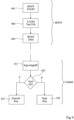
- FIG. 4 is a block diagram representing an embodiment of a device protection method whose software architecture is described in relation to the Figure 3 .
- the method of protecting the electronic device includes two phases.
- a first BOOT phase takes place during the start-up of the electronic device, and a second COMM phase takes place when an application implemented by the main processor requests to communicate with an application implemented by the secure element.
- the electronic device starts in hardware and software.
- the low-level operating system 355, described in relation to the Figure 3 carries out a verification of the software architecture 300, that is to say the high-level operating system 301 and the software layers 303 to 305, described in relation to the Figure 3 , of the main processor of the electronic device.
- the low-level operating system 355 determines whether the software architecture 300 is reliable, or authentic, that is to say allowing exchanges of sensitive or secret data between the high-level operating system. 301 and the applications 302A and 302B that it implements.
- the low-level operating system 355 determines whether the software architecture 300 is authentic, that is to say provided by the manufacturer of the architecture 300 or of the device implementing it. . To do this, the low-level operating system 355 can, for example, check all or part of the programming code of the software architecture 300. In addition, the low-level operating system 355 can determine that a or more parts of the software architecture 300 are reliable, and one or more other parts of the software architecture 300 are unreliable. Once the verification has been carried out, the low-level operating system 355 stores the result.
- the low-level operating system 355 carries out the verification of all operating systems implemented by the main processor.
- the low-level operating system could only carry out the verification of certain high-level operating systems of the software architecture, such as for example, the main high-level operating systems, or the verification of certain software layers of the software architecture 300.
- step 403 the electronic device has completed its startup, and is ready for use.
- an application implemented by the high-level operating system 301 of the main processor requests entry into contact with an application implemented by the high-level operating system 351 of the secure element, for example the application 352A. More particularly, the application 302A sends a request to an interface of application programming 303. This request is verified by the filter interface 304, and if the filter interface 304 validates the request, then the low-level operating system 305 of the main processor transfers the request to the element secure. As the request is intended for the application 352A, it is the low-level operating system 354 which receives the request.
- the low-level operating system 354 receives the request initiated by the application 302A, and does not transmit the request to the recipient application 352A until it has ensured that the high-level operating system 301 implementing the application 302A is reliable. To do this, the operating system 354 queries the low-level operating system 355 about the reliability of the software architecture 300. The low-level operating system 355 transmits the result of the verification carried out during the first BOOT phase to the low-level operating system 354. The low-level operating system 354 can then transmit the request to the recipient application 352A, and make the result of the verification accessible to the application 352A.
- the low-level operating system 354 can send the result of the verification with the request to the application 352A.
- the low-level operating system 354 can make the information accessible via an application programming interface of the same type as the interfaces 303, to the application 352A.
- the application 352A having access to the result of the verification, it can take the information into account. If the software architecture 300 is considered reliable (output Y of step 452), the next step is a step 453 (Execute Req), otherwise (output N of step 452), the next step is a step 454 (Stop Req).
- step 453 the software architecture 300 is considered reliable, the application 352A can process and, where appropriate, respond to the request from the application 302A, for example by using sensitive or secret data.
- the software architecture 300 is considered unreliable, at least in part, the application 352A therefore takes this information into account.
- the application 352A can decide not to process and, where appropriate, not to respond to the request from the application 302A, for example by not returning any data or by returning error data or random data.
- the application 352A can decide to process in part and, where appropriate, to respond only in part to the request from the application 302A, for example by not disclosing any sensitive or secret data.
- the application 352A can decide to still process and, if necessary, respond to the request from the application 302A, for example if the request received does not concern any sensitive or secret data, or for example if the request received does not endanger the 352A application, such as for example a denial of service type attack (Denial of Services).
- a denial of service type attack (Denial of Services).
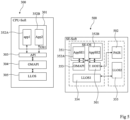
- FIG 5 represents, very schematically and in block form, a second, more precise example of software architecture used in an electronic device, of the type described in relation to the figure 1 , constituting an embodiment.
- This second example may include elements in common with the first example described in relation to the Figure 3 . These common elements are not described again in detail here, and only the differences between these two examples are highlighted.
- the main processor can use the same software architecture 300 as in the first example, or an architecture of the same type.
- the secure element uses a software architecture 500 comprising elements in common with the architecture 350 described in relation to the Figure 3 .
- the software architecture 500 includes the high-level operating system 351 (SE_OS), considered reliable and secure, and allowing the implementation of one or more applications, in the case illustrated in relationship with the Figure 3 , two applications 352A (AppSE1) and 352B (AppSE2). Additionally, the software architecture 500 may include the rules 353 of the main processor interfaces 303. According to one example, the software architecture 500 may include the low-level operating system 354 making it possible to implement the applications 352A and 352B. According to an example, and optionally, the software architecture 500 can also include the low-level operating system 355 described in relation to the Figure 3 .
- the software architecture 500 further comprises an application programming interface 501 (T. HOST) configured to check whether the commands received by the applications implemented by the secure element are that is to say applications 352A and 352B in the case of Figure 5 , were sent reliably.
- the application programming interface 501 (T. HOST) is configured to receive commands intended for applications implemented by the secure element, and to carry out a command verification before transferring these commands to the applications concerned.
- the application programming interface 501 can be configured to implement several different verification means, or different verification rules, some of which are detailed below. Once the verification has been carried out, the result of this verification is transmitted to the application receiving the command, in parallel with the command itself. The application analyzes this result and deduces whether or not it can process, in part or in full, said order. Additionally, the application programming interface 501 is further configured to validate the authenticity of the verification(s) it performs.
- An example of a means of verification may be to verify that the sender of the order is reliable.
- the sender of the command can be, according to a first example, one of the applications implemented by the main processor of the electronic device.
- the application programming interface 501 can verify the reliability of the application in question. If the architecture includes the low-level operating system 355, the application programming interface 501 may communicate with the low-level operating system 355 to use the result of the high-level operating system check. level 301 described in relation to the figures 3 And 4 .
- the sender of the command can be, according to a second example, an electronic system external to the electronic device, and implementing communication with said electronic device.
- the communication may be wired communication or wireless communication such as near field communication (NFC) or ultra wideband (UWB) communication.
- the electronic system may be an electronic system with which the electronic device is adapted to be coupled, for example using a coupling function 502 (PAIR).
- the coupling function 502 can be implemented by the same chip as the low-level operating system 355, by the low-level operating system 354, or even be implemented by an application programming interface implemented by the same chip as the low-level operating system 354.
- Another example of a means of verification can be to verify that the communication channel used to transmit the commands.
Landscapes
- Engineering & Computer Science (AREA)
- Computer Security & Cryptography (AREA)
- Theoretical Computer Science (AREA)
- Computer Hardware Design (AREA)
- General Engineering & Computer Science (AREA)
- Software Systems (AREA)
- Physics & Mathematics (AREA)
- General Physics & Mathematics (AREA)
- Signal Processing (AREA)
- Computer Networks & Wireless Communication (AREA)
- Computing Systems (AREA)
- Health & Medical Sciences (AREA)
- Bioethics (AREA)
- General Health & Medical Sciences (AREA)
- Mathematical Physics (AREA)
- Storage Device Security (AREA)
- Mobile Radio Communication Systems (AREA)
- Credit Cards Or The Like (AREA)
Applications Claiming Priority (1)
| Application Number | Priority Date | Filing Date | Title |
|---|---|---|---|
| FR2214231A FR3144339B1 (fr) | 2022-12-22 | 2022-12-22 | Protection d'un dispositif électronique |
Publications (1)
| Publication Number | Publication Date |
|---|---|
| EP4390738A1 true EP4390738A1 (de) | 2024-06-26 |
Family
ID=86657296
Family Applications (1)
| Application Number | Title | Priority Date | Filing Date |
|---|---|---|---|
| EP23215958.2A Pending EP4390738A1 (de) | 2022-12-22 | 2023-12-12 | Schutz einer elektronischen vorrichtung |
Country Status (3)
| Country | Link |
|---|---|
| US (1) | US12585752B2 (de) |
| EP (1) | EP4390738A1 (de) |
| FR (1) | FR3144339B1 (de) |
Families Citing this family (1)
| Publication number | Priority date | Publication date | Assignee | Title |
|---|---|---|---|---|
| FR3144338B1 (fr) | 2022-12-22 | 2025-06-20 | St Microelectronics Rousset | Protection d'un dispositif électronique |
Citations (4)
| Publication number | Priority date | Publication date | Assignee | Title |
|---|---|---|---|---|
| US20150150127A1 (en) * | 2013-11-22 | 2015-05-28 | Samsung Electronics Co., Ltd. | Method of verifying integrity of electronic device, storage medium, and electronic device |
| US9154479B1 (en) * | 2012-09-14 | 2015-10-06 | Amazon Technologies, Inc. | Secure proxy |
| WO2018162040A1 (en) * | 2017-03-07 | 2018-09-13 | Huawei Technologies Co., Ltd. | Hypervisor measurement agent |
| US20190036688A1 (en) * | 2017-07-17 | 2019-01-31 | Thirdwayv, Inc. | Secure communication for medical devices |
Family Cites Families (14)
| Publication number | Priority date | Publication date | Assignee | Title |
|---|---|---|---|---|
| JP4447977B2 (ja) * | 2004-06-30 | 2010-04-07 | 富士通マイクロエレクトロニクス株式会社 | セキュアプロセッサ、およびセキュアプロセッサ用プログラム。 |
| CN101292274B (zh) * | 2005-10-19 | 2011-01-19 | 松下电器产业株式会社 | 信息安全装置、信息安全方法、计算机程序、计算机可读取的记录媒体及集成电路 |
| US20070283327A1 (en) * | 2006-06-02 | 2007-12-06 | Microsoft Corporation | Hierarchical test verification using an extendable interface |
| WO2012035196A1 (en) * | 2010-09-13 | 2012-03-22 | Nokia Corporation | Cooperation in channel reservation |
| WO2016049558A1 (en) * | 2014-09-25 | 2016-03-31 | Stratio | Peer-to-peer communication based on device identifiers |
| CN104318182B (zh) | 2014-10-29 | 2017-09-12 | 中国科学院信息工程研究所 | 一种基于处理器安全扩展的智能终端隔离系统及方法 |
| WO2016101774A1 (zh) * | 2014-12-26 | 2016-06-30 | 国民技术股份有限公司 | 无线通信方法、装置及其应用系统和设备 |
| KR102434444B1 (ko) * | 2017-11-29 | 2022-08-19 | 한국전자통신연구원 | 가상 트러스트 컴퓨팅 베이스를 이용한 기기 보안성 검증 방법 및 장치 |
| WO2019210461A1 (en) | 2018-05-02 | 2019-11-07 | Apple Inc. | Wireless network service access control with subscriber identity protection |
| US11356845B1 (en) | 2019-07-10 | 2022-06-07 | Sprint Communications Company L.P. | Trusted operating system in an internet of things (IoT) device |
| FR3098614B1 (fr) * | 2019-07-11 | 2022-11-04 | Idemia Identity & Security France | Procédé de contrôle de commandes propres à être traitées par un périphérique tel qu’un actionneur |
| US11132278B2 (en) * | 2019-08-05 | 2021-09-28 | EMC IP Holding Company LLC | Application programming interface security validation for system integration testing |
| FR3119471B1 (fr) | 2021-02-02 | 2023-03-24 | Proton World Int Nv | Démarrage d'une application |
| FR3144338B1 (fr) | 2022-12-22 | 2025-06-20 | St Microelectronics Rousset | Protection d'un dispositif électronique |
-
2022
- 2022-12-22 FR FR2214231A patent/FR3144339B1/fr active Active
-
2023
- 2023-12-12 EP EP23215958.2A patent/EP4390738A1/de active Pending
- 2023-12-20 US US18/391,185 patent/US12585752B2/en active Active
Patent Citations (4)
| Publication number | Priority date | Publication date | Assignee | Title |
|---|---|---|---|---|
| US9154479B1 (en) * | 2012-09-14 | 2015-10-06 | Amazon Technologies, Inc. | Secure proxy |
| US20150150127A1 (en) * | 2013-11-22 | 2015-05-28 | Samsung Electronics Co., Ltd. | Method of verifying integrity of electronic device, storage medium, and electronic device |
| WO2018162040A1 (en) * | 2017-03-07 | 2018-09-13 | Huawei Technologies Co., Ltd. | Hypervisor measurement agent |
| US20190036688A1 (en) * | 2017-07-17 | 2019-01-31 | Thirdwayv, Inc. | Secure communication for medical devices |
Also Published As
| Publication number | Publication date |
|---|---|
| FR3144339B1 (fr) | 2025-06-27 |
| FR3144339A1 (fr) | 2024-06-28 |
| US20240211578A1 (en) | 2024-06-27 |
| US12585752B2 (en) | 2026-03-24 |
Similar Documents
| Publication | Publication Date | Title |
|---|---|---|
| EP2477431B1 (de) | Schutz eines an einen NFC-Schaltkreis gekoppelten Sicherheitselements | |
| EP2463833B1 (de) | Verfahren und Vorrichtung zur Ausführungskontrolle für interne Funktionen und Funktionen von geschützten Anwendungen auf Mikrochipkarten von mobilen Endgeräten | |
| EP2656578B1 (de) | Verwaltung von kommunikationskanälen bei einer an eine nfc-schaltung gekoppelten telekommunikationsvorrichtung | |
| EP2545723B1 (de) | Schutz eines kommunikationskanals zwischen einem sicherheitsmodul und einer nfc-schaltung | |
| FR2989799A1 (fr) | Procede de transfert d'un dispositif a un autre de droits d'acces a un service | |
| EP2612516B1 (de) | Schutz eines kommunikationskanals einer an eine nfc-schaltung angeschlossenen telekommunikationsvorrichtung vor fehlleitungen | |
| EP2545722B1 (de) | Erkennung der umleitung eines kommunikationskanals einer an eine nfc-schaltung angeschlossenen telekommunikationsvorrichtung | |
| EP3221815A1 (de) | Verfahren zur sicherung von zahlungstransaktionstoken | |
| FR2957437A1 (fr) | Protection contre un deroutement d'un canal de communication d'un circuit nfc | |
| FR2957440A1 (fr) | Protection d'un module de securite dans un dispositif de telecommunication couple a un circuit nfc | |
| EP4036717A1 (de) | Starten einer anwendung | |
| WO2001084512A1 (fr) | Carte a puce multi-applicatives | |
| EP4390739A1 (de) | Schutz einer elektronischen vorrichtung | |
| EP3667530B1 (de) | Sicherer zugriff auf geschriebene daten aus einem benutzerklemmen | |
| FR3144339A1 (fr) | Protection d'un dispositif électronique | |
| EP2793498B1 (de) | Sicheres Element für Telekommunikationsendgerät | |
| EP3923169A1 (de) | Gesichertes starten eines elektronischen schaltkreises | |
| EP3992797B1 (de) | Gesichertes element | |
| EP3992798B1 (de) | Gesichertes element und verfahren zur kommunkation zwischen einem gesicherten element und einer dem gesicherten element äusseren umgebung | |
| EP2053532A1 (de) | Gesichertes Öffnungsverfahren einer Chipkarte gegen Zugriff von Dritten | |
| EP4198791B1 (de) | Nfc-transaktion | |
| EP3993325B1 (de) | Gesichertes element und verfahren zur kommunikation zwischen einer elektronischen vorrichtung und einem gesicherten element | |
| EP4198792B1 (de) | Nfc-transaktion | |
| WO2002008897A1 (fr) | Protocole d'echange de messages entre applications implantees sur un systeme embarque, et systeme embarque correspondant | |
| EP2867837B1 (de) | System zum sicheren übertragen von digitalen daten |
Legal Events
| Date | Code | Title | Description |
|---|---|---|---|
| PUAI | Public reference made under article 153(3) epc to a published international application that has entered the european phase |
Free format text: ORIGINAL CODE: 0009012 |
|
| STAA | Information on the status of an ep patent application or granted ep patent |
Free format text: STATUS: REQUEST FOR EXAMINATION WAS MADE |
|
| 17P | Request for examination filed |
Effective date: 20231212 |
|
| AK | Designated contracting states |
Kind code of ref document: A1 Designated state(s): AL AT BE BG CH CY CZ DE DK EE ES FI FR GB GR HR HU IE IS IT LI LT LU LV MC ME MK MT NL NO PL PT RO RS SE SI SK SM TR |
|
| RAP3 | Party data changed (applicant data changed or rights of an application transferred) |
Owner name: STMICROELECTRONICS BELGIUM Owner name: STMICROELECTRONICS (ROUSSET) SAS |