EP4390955A1 - Surveillance automatisée de dispositifs d'exercice - Google Patents
Surveillance automatisée de dispositifs d'exercice Download PDFInfo
- Publication number
- EP4390955A1 EP4390955A1 EP23212554.2A EP23212554A EP4390955A1 EP 4390955 A1 EP4390955 A1 EP 4390955A1 EP 23212554 A EP23212554 A EP 23212554A EP 4390955 A1 EP4390955 A1 EP 4390955A1
- Authority
- EP
- European Patent Office
- Prior art keywords
- exercise
- activity
- data
- measurement device
- monitoring arrangement
- Prior art date
- Legal status (The legal status is an assumption and is not a legal conclusion. Google has not performed a legal analysis and makes no representation as to the accuracy of the status listed.)
- Pending
Links
Images

Classifications
-
- G—PHYSICS
- G16—INFORMATION AND COMMUNICATION TECHNOLOGY [ICT] SPECIALLY ADAPTED FOR SPECIFIC APPLICATION FIELDS
- G16H—HEALTHCARE INFORMATICS, i.e. INFORMATION AND COMMUNICATION TECHNOLOGY [ICT] SPECIALLY ADAPTED FOR THE HANDLING OR PROCESSING OF MEDICAL OR HEALTHCARE DATA
- G16H20/00—ICT specially adapted for therapies or health-improving plans, e.g. for handling prescriptions, for steering therapy or for monitoring patient compliance
- G16H20/30—ICT specially adapted for therapies or health-improving plans, e.g. for handling prescriptions, for steering therapy or for monitoring patient compliance relating to physical therapies or activities, e.g. physiotherapy, acupressure or exercising
-
- A—HUMAN NECESSITIES
- A63—SPORTS; GAMES; AMUSEMENTS
- A63B—APPARATUS FOR PHYSICAL TRAINING, GYMNASTICS, SWIMMING, CLIMBING, OR FENCING; BALL GAMES; TRAINING EQUIPMENT
- A63B24/00—Electric or electronic controls for exercising apparatus of preceding groups; Controlling or monitoring of exercises, sportive games, training or athletic performances
- A63B24/0062—Monitoring athletic performances, e.g. for determining the work of a user on an exercise apparatus, the completed jogging or cycling distance
-
- A—HUMAN NECESSITIES
- A63—SPORTS; GAMES; AMUSEMENTS
- A63B—APPARATUS FOR PHYSICAL TRAINING, GYMNASTICS, SWIMMING, CLIMBING, OR FENCING; BALL GAMES; TRAINING EQUIPMENT
- A63B2220/00—Measuring of physical parameters relating to sporting activity
- A63B2220/40—Acceleration
-
- A—HUMAN NECESSITIES
- A63—SPORTS; GAMES; AMUSEMENTS
- A63B—APPARATUS FOR PHYSICAL TRAINING, GYMNASTICS, SWIMMING, CLIMBING, OR FENCING; BALL GAMES; TRAINING EQUIPMENT
- A63B2220/00—Measuring of physical parameters relating to sporting activity
- A63B2220/80—Special sensors, transducers or devices therefor
- A63B2220/83—Special sensors, transducers or devices therefor characterised by the position of the sensor
- A63B2220/833—Sensors arranged on the exercise apparatus or sports implement
-
- A—HUMAN NECESSITIES
- A63—SPORTS; GAMES; AMUSEMENTS
- A63B—APPARATUS FOR PHYSICAL TRAINING, GYMNASTICS, SWIMMING, CLIMBING, OR FENCING; BALL GAMES; TRAINING EQUIPMENT
- A63B2225/00—Miscellaneous features of sport apparatus, devices or equipment
- A63B2225/50—Wireless data transmission, e.g. by radio transmitters or telemetry
-
- G—PHYSICS
- G16—INFORMATION AND COMMUNICATION TECHNOLOGY [ICT] SPECIALLY ADAPTED FOR SPECIFIC APPLICATION FIELDS
- G16H—HEALTHCARE INFORMATICS, i.e. INFORMATION AND COMMUNICATION TECHNOLOGY [ICT] SPECIALLY ADAPTED FOR THE HANDLING OR PROCESSING OF MEDICAL OR HEALTHCARE DATA
- G16H40/00—ICT specially adapted for the management or administration of healthcare resources or facilities; ICT specially adapted for the management or operation of medical equipment or devices
- G16H40/60—ICT specially adapted for the management or administration of healthcare resources or facilities; ICT specially adapted for the management or operation of medical equipment or devices for the operation of medical equipment or devices
- G16H40/63—ICT specially adapted for the management or administration of healthcare resources or facilities; ICT specially adapted for the management or operation of medical equipment or devices for the operation of medical equipment or devices for local operation
-
- G—PHYSICS
- G16—INFORMATION AND COMMUNICATION TECHNOLOGY [ICT] SPECIALLY ADAPTED FOR SPECIFIC APPLICATION FIELDS
- G16H—HEALTHCARE INFORMATICS, i.e. INFORMATION AND COMMUNICATION TECHNOLOGY [ICT] SPECIALLY ADAPTED FOR THE HANDLING OR PROCESSING OF MEDICAL OR HEALTHCARE DATA
- G16H50/00—ICT specially adapted for medical diagnosis, medical simulation or medical data mining; ICT specially adapted for detecting, monitoring or modelling epidemics or pandemics
- G16H50/30—ICT specially adapted for medical diagnosis, medical simulation or medical data mining; ICT specially adapted for detecting, monitoring or modelling epidemics or pandemics for calculating health indices; for individual health risk assessment
-
- H—ELECTRICITY
- H04—ELECTRIC COMMUNICATION TECHNIQUE
- H04W—WIRELESS COMMUNICATION NETWORKS
- H04W4/00—Services specially adapted for wireless communication networks; Facilities therefor
- H04W4/30—Services specially adapted for particular environments, situations or purposes
- H04W4/38—Services specially adapted for particular environments, situations or purposes for collecting sensor information
Definitions
- the present disclosure relates generally to exercise devices, and, more particularly, to techniques for monitoring exercise activities of exercise devices.
- Exercise devices are often used for physical exercise, for example exercise machines in which stacked weight plates are lifted by the user against the action of gravity. Conventionally, the user has to keep a manual record of the exercises performed on the machines and the outcome of the respective exercise.
- Such automated systems comprise a local detector on the respective exercise machine.
- the local detector is configured to determine exercise data that represents an exercise activity performed by a user of the exercise machine and transfer the exercise data to a local or remote device for storage and/or presentation.
- An example of such a system is described in WO2019/147174 , which is incorporated by reference herein in its entirety.
- the local detector is configured to broadcast exercise data for receipt by an observer unit, which is installed in the facility of the exercise machine and is configured to forward the exercise data to a server, which in turn forwards the exercise data to a user device carried by the user, thereby providing real-time feedback to the user.
- the server since the exercise data from each exercise machine is routed via the server, it is possible for the server to collect usage data for a large number of exercise machines, for example all machines in a gym.
- the observer unit is instead installed in the user device. In this variation, usage data for plural exercise machines cannot be collected in a centralized manner.
- the local detector is typically battery-powered. In a facility with many exercise machines, for example a gym, replacement of batteries may be time consuming, especially since the local detectors on different exercise machines may run low on battery at different times. There is thus a general desire to reduce the power consumption of such automated monitoring systems.
- Objectives of the present disclosure include at least partly overcome one or more limitations of the prior art. Another objective is to reduce the power consumption of a monitoring arrangement for use with an exercise device. A further objective is to enable centralized collection of usage data for a plurality of exercise devices. Yet another objective is to enable the centralized collection of usage data also when the user does not have a user device that is configured or activated to provide exercise feedback.
- the monitoring arrangement comprises a communication device, an inertial measurement device and an activity measurement device.
- the activity measurement device is in a disabled mode by default, whereas the inertial measurement device is active and used for detecting start of the exercise activity.
- the monitoring arrangement is configured to selectively switch the activity measurement device into an active mode to generate measurement data that quantifies the exercise activity, and specifically when there is a mobile device present at the exercise device at the start of the exercise activity.
- the provision of the measurement data results in first exercise data, which is transmitted from the monitoring arrangement to the mobile device, thereby enabling the first exercise data to be presented to user, for example as real-time feedback about the progress of the exercise activity.
- the monitoring arrangement calculates second exercise data by use of a measurement signal from the inertial measurement device. Further, if the mobile device is deemed to be absent, the activity measurement device is either maintained in its default mode, i.e. disabled, or set in an intermediate low-power mode. This results in a significantly reduced power consumption of the monitoring arrangement, since the activity measurement device is only operated in the active mode when a mobile device that is capable of making use of the first exercise data is actually present at the exercise device when the exercise activity is started.
- the second exercise data represents the exercise activity and is not transmitted to a mobile device, which is absent.
- the second exercise data may be stored in the monitoring arrangement or transmitted for receipt by one or more receiving devices that are installed in the facility that houses the exercise device. Thereby, the second exercise data is available for quantifying the usage of the exercise machine. If monitoring arrangements are installed on a plurality of exercise devices, the second exercise data may be collected, via the receiving device(s), for centralized analysis of the usage of the exercise devices, for example to identify a need for maintenance.
- the already-present inertial measurement device to quantify the usage of the exercise machine whenever the exercise device is operated by users that do not have a mobile device that is configured for use with the monitoring arrangement.
- the additional use of the inertial measurement device does not significantly increase power consumption, given that inertial measurement devices are generally power efficient and typically active at all times anyway to enable the monitoring arrangement to detect the start of an exercise activity.
- the monitoring arrangement includes an inertial measurement device configured to detect an exercise activity of the exercise device, and an activity measurement device separate from the inertial measurement device.
- the activity measurement device has an active mode and a disabled mode.
- the activity measurement device is operable to quantify the exercise activity of the exercise device when in the active mode.
- the activity measurement device uses less power when in the disabled mode than in the active mode.
- a control unit is configured to detect, via the inertial measurement device, a start of the exercise activity, to cause the activity measurement device to operate in the active mode upon detecting the start of the exercise activity, and to operate the activity measurement device to generate measurement data that represents the exercise activity when in the active mode.
- the activity measurement device is defaulted to the disabled mode to save power.
- the monitoring arrangement further includes a communication device, where the control unit is further configured to transmit first exercise data that represents the measurement data from the activity measurement device via the communication device.
- the communication device is configured to communicate wirelessly.
- the control unit is further configured to determine a presence or absence of a mobile device and, when the mobile device is present, to transmit the first exercise data to the mobile device.
- the control unit is further configured to determine a presence or absence of a mobile device and, when the mobile device is absent, to calculate second exercise data that represents the exercise activity using a measurement signal from the inertial measurement device, the second exercise data being different than the first exercise data.
- the first exercise data is real-time data and the second exercise data is non-real-time data.
- control unit is further configured to transmit the second exercise data to a receiver device via the communication device, the receiver device being different from the mobile device.
- control unit is further configured to detect a termination of the exercise activity and to transmit the second exercise data when the termination of the exercise activity is detected.
- the termination is detected using the measurement signal from the inertial measurement device.
- control unit causes the activity measurement device to operate in an intermediate mode when the mobile device is absent, the activity measurement device using less power when in the intermediate mode than in the active mode and more power when in the intermediate mode than in the disabled mode.
- control unit is further configured to detect a termination of the exercise activity based at least in part on the measurement data from the activity measurement device when operated in the intermediate mode, and to transmit the second exercise data when the termination of the exercise activity is detected.
- control unit is further configured to calculate second exercise data that represents the exercise activity also using the measurement data from the activity measurement device when operated in the intermediate mode.
- second exercise data is indicative of a count of exercise movements performed during the exercise activity.
- the first exercise data that represents the measurement data from the activity measurement device is transmitted in time synchronization with the exercise activity.
- the activity measurement device is operable to determine a momentary position of one of the exercise device and a weight of the exercise device.
- the activity measurement device has a communication device and the control unit is further configured to transmit first exercise data that represents the measurement data from the activity measurement device via the communication device, where the first exercise data represents a movement trajectory of the one of the exercise device and the weight of the exercise device.
- the first exercise data includes at least one of: an indication of a start of an exercise movement performed as part of the exercise activity, an indication of a completion of the exercise movement performed as part of the exercise activity, a count of repetitive exercise movements performed during the exercise activity, and an indication of a load being lifted during an exercise movement.
- the method includes detecting the exercise activity via an inertial measurement device, and detecting, via a control unit, a start of the exercise activity from the inertial measurement device.
- the method further includes causing an activity measurement device to operate in an active mode when the start of exercise activity is detected, where the activity measurement device being defaulted to a disabled mode that uses less power than the active mode when the start of exercise activity is undetected.
- the method further includes generating, via the activity measurement device when in the active mode, measurement data that quantifies the exercise activity, and communicating a first exercise data that represents the measurement data from the activity measurement device when the activity measurement device is in the active mode.
- any of the advantages, features, functions, devices, and/or operational aspects of any of the embodiments described and/or contemplated herein may be included in any of the other embodiments described and/or contemplated herein, and/or vice versa.
- any terms expressed in the singular form herein are meant to also include the plural form and/or vice versa, unless explicitly stated otherwise.
- “at least one” shall mean “one or more” and these phrases are intended to be interchangeable. Accordingly, the terms “a” and/or “an” shall mean “at least one” or “one or more”, even though the phrase “one or more” or “at least one” is also used herein.
- the terms “multiple”, “plural” and “plurality” are intended to imply provision of two or more elements.
- the term “and/or” includes any and all combinations of one or more of the associated listed elements.
- first, second, etc. may be used herein to describe various elements, these elements should not be limited by these terms. These terms are only used to distinguish one element from another. For example, a first element could be termed a second element, and, similarly, a second element could be termed a first element, without departing the scope of the present disclosure.
- exercise device to include both exercise machines and so-called free weights.
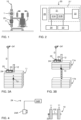
- An exercise machine is any type of stationary device that allows a user to perform an exercise activity that involves moving a moveable element of the exercise machine (cf. stacked weights 11 in FIG. 1 ).
- Free weights include dumbbells, barbells, medicine balls, kettlebells, etc. Any type of exercise device may be equipped with or associated with an MA20.
- COMM 22 is not restricted to communication by Bluetooth but may use any wireless communication technique, including but not limited to Bluetooth, Wi-Fi, ANT, Zigbee, Z-wave, UWB, LR-WPAN, LoRa, ambient backscatter communication (ABC), etc., either singly or in any combination.
- wireless communication technique including but not limited to Bluetooth, Wi-Fi, ANT, Zigbee, Z-wave, UWB, LR-WPAN, LoRa, ambient backscatter communication (ABC), etc., either singly or in any combination.
- control unit 21 and COMM 22 are located in a single package 21', for example an integrated circuit or chip. Embodiments involving such a single package 21' are described below with reference to FIGS 8A-8B .
- the refined data may be indicative of one or more of acceleration, velocity, angular rate, specific force, relative position, or orientation.
- the IMD 23 may be a commercially available device or a customized device. For example, there are commercially available IMUs, for use in wearable devices, with an operative current in the range of 30-300 ⁇ A or even less.
- the power consumption of the AMD 24 in the active mode is in the range of at least 10-1,000 times the power consumption of the IMD 23.
- the AMD 24 further has an intermediate mode, in which the AMD 24 also operates to generate measurement data but at a lower power consumption than in the active mode.
- the AMD 24 may generate the measurement data at a lower rate and/or accuracy in the intermediate mode.
- the power consumption is reduced by at least 50%, and preferably at least 75%, in the intermediate mode compared to the active mode.
- the IMD 23 and the AMD 24, respectively, may be connected by wire or wirelessly to the control unit 21.
- the system further comprises at least one observer device 40, abbreviated OD, which is configured to receive incoming data from the MAs 20 and relay the incoming data, or part thereof, to a back-end device 50, for example a server.
- the OD 40 may be connected to the back-end device 50 over a network, such as a WAN, LAN, PAN or any combination thereof.
- the RTD represents an on-going exercise activity and is transferred so as to allow the UD 30 to provide real-time feedback to the user of the exercise device 10.
- the MA 20 is configured to broadcast a data packet containing RTD for receipt by the UD 30, and optionally by the OD 40.
- the MA 20 is configured to establish an end-to-end connection with the UD 30 and transfer RTD over the end-to end connection.
- the SUD summarizes the usage of the exercise device 10 during the exercise activity and may be transferred when the exercise activity is terminated.
- SUD comprises a count of the total number of repetitions that have been performed by the user during the exercise activity, including all sets performed.
- the SUD is transferred to the back-end device 50 via the OD 40 so as to allow the back-end device 50 to evaluate the usage of the different exercise devices in the facility.
- the back-end device 50 may store SUD in a database and/or evaluate SUD for detection or prediction of a need for maintenance of an exercise device.
- the MA 20 is configured to determine SUD and broadcast a data packet containing the SUD for receipt by the OD 40.
- the OD 40 may comprise a communication interface for monitoring communication signals transmitted by the MAs 20 that are installed in the facility. Specifically, the OD 40 is operable to determine whether an incoming data package comprises SUD, and forward the SUD to the back-end device 50.
- the respective MA 20 stores an identifier (MAID) which is unique within the system and which is included in outgoing transmissions to identify the origin of the RTD and the SUD.
- the respective exercise device 10 has an electronic tag 1, which may be attached to or arranged nearby the exercise device 10.
- the tag 1 enables a user to associate its UD 30 with the exercise device 10, by executing a "docking operation", before initiating an exercise activity on the exercise device 10.
- the UD 30 is brought close to the tag 1, whereby a tag identifier is wirelessly transferred from the tag 1 to the UD 30, which is thereby capable of identifying the exercise device 10, for example by querying a server (not shown).
- the server may return metadata describing the exercise device 10 to the UD 30.
- the UD 30 is capable of presenting the RTD to the user together with the metadata.
- the server may also return the MAID of the MA 20.
- the UD 30 is capable of detecting transmissions originating from a specific MA 20, if the MA 20 includes its MAID in the transmissions.
- FIG. 6 is a block diagram of an example UD 30.
- a control unit 31 (“control circuitry") is configured to implement logic for controlling the user device 30.
- the control unit 31 comprises a combination of a processor 31A and a memory 31B.
- the memory 31B may store program instructions for execution by the processor 31A for implementing the operation of the control unit 31.
- the program instructions may be supplied to the processor 31A on a computer-readable medium.
- the processor 31A may be a generic processor (CPU, etc.), a specialized processor (ASIC, etc.), or any combination thereof.
- the memory 31B may include volatile and/or non-volatile memory such as read only memory (ROM), random access memory (RAM) or flash memory.
- the UD 30 further comprises a communication device 32 (denoted COMM in the following), which is at least partly configured in correspondence with COMM 22 of the MA 20 ( FIG. 2 ).
- COMM 32 is configured to implement the same communication technique and protocol as COMM 22.
- COMM 32 is operable in a first mode, in which it intercepts broadcasts, and a second mode, in which it establishes an end-to-end connection to the MA 20 and receives a stream of data on the end-to-end connection.
- COMM 32 may also be operable to communicate with a server, for example by wireless data transfer over a network, such as a WAN, LAN, PAN or any combination thereof.
- the UD 30 further comprises a feedback device 33 for providing one or more of audible, visible or tactile feedback to the user.
- a feedback device 33 may comprise one or more of a speaker, a buzzer, a vibrator, a display, a touch screen, an indicator lamp, etc.
- the feedback device 33 may be operated, by the control unit 31 to provide feedback representing RTD as received by COMM 32 from an MA 20.
- the UD 30 also comprises a power source 34 for supplying power to the electrical components of the UD 30.
- the power source 34 may include a battery, a fuel cell, etc.
- the UD 30 may be a customized electronic device for use in the system of FIG. 5 or a generic device, such as a mobile phone, smartphone, tablet computer, etc. Such a generic device may be configured for use as a UD 30 in the system of FIG. 5 by a dedicated application program ("app") that is installed and executed by the control unit 31.
- apps application program
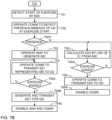
- FIG. 7A is a flow chart of an example method 700 performed by an MA 20 in the system of FIG. 5 .
- the method 700 will be described with reference to the MA 20 in FIG. 2 and assuming that the steps are performed by the control unit 21.
- step 701 the start of an exercise activity is detected by use of the IMD 23.
- step 701 may involve detecting a characteristic change in the signal from the IMU 23 or in one or more parameters derived from the signal.
- the characteristic change may correspond to a change in acceleration, velocity, orientation or position.
- step 701 involves receiving a wake-up (WU) signal from the IMD 23, which is thus configured to detect the characteristic change and transmit the WU signal.
- WU wake-up
- step 702 After detecting the start of an exercise activity in step 701, step 702 is performed.
- COMM 22 is operated to detect if a UD is present or absent at the exercise device 10 when the exercise activity is started.
- COMM 22 transmits a query signal for receipt by a nearby UD and listens for a reply signal transmitted by the UD in response to the query signal. If a reply signal is received, presence of a UD is inferred, otherwise absence of a UD is inferred.
- COMM 22 listens for a beacon signal that is transmitted (broadcast) by a UD. If a beacon signal is received, presence of a UD is inferred, otherwise absence of a UD is inferred.
- the UD 30 may, for example, be configured to start listening for the query signal or transmitting the beacon signal when the user has performed a docking operation.
- COMM 22 may be in a low-power state by default and switched into a communication state in step 702, when the start of an exercise activity has been detected in step 701.
- Steps 703 and 704 are performed if presence of a UD is detected in step 702.
- the AMD 24 is operated to generate measurement data, MD, that represents the exercise activity.
- MD measurement data
- the AMD 24 is in the sleep mode by default.
- the AMD 24 is selectively switched into the active mode, in which it generates and outputs MD.
- COMM 22 is operated to transmit first exercise data, ED1, which represents MD, for receipt by the UD 30.
- ED1 corresponds to the real-time data, RTD.
- step 704 is performed repeatedly to generate and transmit ED1 to represent the on-going exercise activity so as to allow the UD to provide real-time feedback to the user of the exercise device.
- ED1 is streamed over an end-to-end connection to the UD, for example in the form of a time sequence of momentary positions, to represent a movement trajectory of the exercise device or a moveable element in the exercise device.
- the UD is enabled to operate its feedback device 33 ( FIG. 6 ) to present the movement trajectory in real-time to the user.
- ED1 is broadcast for receipt by the UD, for example in the form of an indication that an exercise movement (“repetition”) has been started or completed.
- the UD is enabled to operate its feedback device 33 ( FIG. 6 ) to present in real-time the current number of repetitions performed by the user within a set during the exercise activity.
- ED1 may be repeatedly transmitted to include a current count of repetitions. It is also conceivable, whether ED1 is streamed or broadcast, that ED1 designates the load that is lifted during the repetitions.
- Step 705 is performed if absence of a UD is determined in step 702.
- the absence may be the result of an erroneous start detection in step 701, for example caused by vibrations being transferred to the exercise device from the surroundings or an unintentional displacement of the exercise device by a user.
- Another cause may be that an exercise activity is started by a user that does not have a UD configured for use in the data management system.
- second exercise data, ED2 that represents the exercise activity is calculated by use of a measurement signal, S 1, from the IMD.
- the AMD is in its default sleep mode and is thus disabled during step 705. This means that ED2 is generated in a power-efficient way, based only on S1 from the IMD.
- the AMD is in the intermediate mode during step 705.
- Such fusion of sensor data from the IMD and the AMD may increase the accuracy of ED2, for example if the performance of the IMD is limited.
- ED2 cannot be calculated based solely on MD as generated by the AMD in the intermediate mode, but can be calculated when such MD is combined with S 1.
- ED2 corresponds to the summary usage data, SUD.
- ED2 contains a summary of the exercise activity, for example a count of the total number of repetitions performed during the exercise activity.
- a repetition may be detected in different ways in the measurement signal S1 from the IMD, for example depending on exercise device.
- relative positions derived from accelerometer data may be tracked to detect when the selected weights 11a leave and return to the rest state, respectively, and/or based on velocity values derived from the accelerometer data.
- ED2 is stored in internal memory of the MA 20 (cf. 21B in FIG. 2 ), for later retrieval.
- COMM 22 is operated to transmit ED2 for receipt by the OD 40.
- the example method 700 will save considerable power in the MA 20 by avoiding unnecessary power consumption by the AMD 24.
- the MA 20 is capable of determining and providing summary usage data (ED2), should the exercise device be used by someone that does not have a UD for use in the data management system.
- ED2 is determined by the MA 20 in a power-efficient way, by use of the IMD 23, which is anyway present in the MA 20 and used for detecting the start of exercise activities.
- the method 700 does not provide summary usage data for exercise activities performed in the presence of a UD.
- the OD 40 may autonomously determine such usage data based on intercepted transmissions of ED1 from the MA 20. This presumes that step 703 involves transmitting ED1 by broadcast, instead of or in addition to transmitting ED1 to the UD over an end-to-end connection.
- the MA 20 may generate summary usage data (ED1') based on ED1 and transmit ED1' for receipt of the OD 40.
- the method 710 in FIG. 7B is an expanded version of the method 700 in FIG. 7A .
- the method 710 includes that same steps 701-706 as the method 700.
- step 702A proceeds to operate the AMD in the active mode to generate MD (step 703) and to operate COMM 22 to generate and transmit ED1 for receipt by the UD (step 704).
- the AMD when activated in step 703, generates MD as a stream (time sequence) of values, for example position or distance values.
- step 704 is repeated to generate and transmit ED1 until termination of the exercise activity is detected in step 704A.
- step 704A involves processing MD for detection of the termination.
- the termination may be detected in different ways depending on exercise device and AMD.
- a termination may be detected if the exercise device is in a rest state for a predefined time period (cf. FIG. 3A ).
- the user may signal the termination to the MA 20, for example by pressing a dedicated switch or button on the MA 20.
- step 704B which is performed when a termination is detected, COMM 22 is operated to transmit summary data, ED1', for receipt by the OD 40.
- ED1' contains a summary of the exercise activity and is thus summary usage data, similar to ED2 as described above.
- the AMD is switched to the sleep mode in step 704C and is thus disabled.
- COMM 22 may also set in its low-power state.
- step 702A proceeds to determine ED2 by use of S1 from the IMD, optionally in combination with MD from the AMD in the intermediate mode (step 705).
- S1 from the IMD
- step 705 is performed to determine ED2 until a termination of the exercise activity is detected in step 705A.
- step 705A involves processing S1, and optionally MD from the AMD in intermediate mode, for detection of the termination.
- a termination may be detected if one or more inertial parameters indicate that the exercise device 10 is in a rest state for a predefined time period (cf. FIG. 3A ).
- the user may signal the termination to the MA 20, for example by pressing a dedicated switch or button on the MA 20.
- COMM 22 is operated to transmit ED2 for receipt by the OD 40 (step 706). Further, if the AMD is in the intermediate mode, the AMD is switched into sleep mode. After step 706, COMM 22 may be set in its low-power state in step 706A.
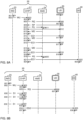
- FIG. 8A is a sequence diagram of example operations performed in the system of FIG. 5 when a UD 30 is present at the exercise device 10.
- the MA 20 is represented by an IMD 23, an AMD 24 and a chip 21' that includes the control unit 21 and COMM 22 (cf. FIG. 2 ).
- a docking operation is performed to associate the UD with the exercise device, for example as described hereinabove.
- the IMD operates to detect start of an exercise activity.
- the IMD detects such a start and outputs a wake-up (WU) signal.
- the chip 21' receives the WU signal and thereby detect the start.
- Step 803 corresponds to step 701.
- step 804 the chip 21' leaves the low-power state, thereby causing COMM 22 to be in the communication state.
- the chip 21' broadcasts a connection request (query signal), RQ.
- the UD receives RQ.
- step 807 the UD generates a response message (reply signal), RP.
- the UD will only generate RP if an identifier (MAID) in RQ matches an identifier that the UD received from a server as part of the docking operation.
- the UD broadcasts RP.
- step 809 the chip 21' receives RP. Steps 805, 809 correspond to step 702 and result in a detection of UD presence.
- step 810 provided that RP is received, the chip 21' transmits a power-up (PU) signal to the AMD, causing the AMD to switch from sleep mode to active mode in step 811.
- Step 810 corresponds to step 703.
- step 812 the chip 21' and the UD establish an end-to-end connection.
- RQ includes a request for establishment of an end-to-end connection with the UD.
- RP comprises an acceptance to establish the end-to-end-connection.
- step 813 the AMD provides MD to the chip 21', which processes MD for generation of ED1 in step 814.
- step 815 the chip 21' transmits the resulting ED1 on the end-to-end connection. Steps 813-815 correspond to step 704.
- the UD receives ED1 in step 816 and operates its feedback device to present ED1 (or data derived therefrom) in step 817. As shown, steps 813-817 are repeated during the course of the exercise activity. Each ED1 is generated based on the latest MD. Thus, ED1 will differ between different executions of step 815. In accordance with examples given above, each ED1 may include one or more momentary positions/distances, an indication of a start or completion of a repetition, a count of the number of repetitions performed so far within a set, etc.
- the chip 21' and the UD detect that the exercise activity is terminated. The chip 21' may detect the termination as described above with reference to step 704A.
- the UD may detect the termination by processing of ED1 or be informed of the termination by the chip 21'.
- the chip 21' and the UD then terminates the end-to-end connection.
- step 819 which corresponds to step 704C
- the chip 21' transmits a power-down (PD) signal to the AMD, causing the AMD to switch from active mode to sleep mode in step 820.
- step 821 which corresponds to step 704B
- the chip 21' generates and broadcasts ED1'.
- OD 40 receives ED1'.
- OD 40 forwards ED 1', or part thereof, to the back-end device (not shown).
- step 824 the chip 21' enters its low-power state (cf. step 704C).
- step 821 may be omitted.
- the OD may instead listen for ED1 as transmitted by the chip 21' in step 815 and then compile all the received instances of ED1 into ED 1'.
- FIG. 8B is a sequence diagram of example operations performed in the system of FIG. 5 when a UD 30 is not present at the exercise device 10. Steps 801-805 are performed as described for FIG. 8A and will not be repeated.
- RQ is received by a UD which is not configured for use in the data management system.
- the UD will decide not to send an RP.
- the UD will not generate RP if an identifier (MAID) in RQ does not match an identifier that the UD received from a server as part of the docking operation (cf. step 800 in FIG. 8A ).
- no UD is present to receive RQ.
- the IMD is providing a measurement signal S1 to the chip 21'.
- the chip 21' may transmit a power-up signal to the AMD, causing the AMD to switch from sleep mode into intermediate mode, if no RQ is received.
- the chip 21' receives (step 831) and operates (step 832) on S 1, and optionally MD from the AMD in intermediate mode, for generation of summary usage data, ED2.
- S1 is processed, optionally together with MD (if present), for detection of repetitions during the exercise activity, for example as described with reference to step 705.
- the chip 21' detects that the exercise activity is terminated.
- the chip 21' may detect the termination as described with reference to step 705A.
- step 834 which corresponds to step 706, the chip 21' broadcasts ED2.
- step 835 the OD receives ED2.
- step 836 the OD forwards ED2, or part thereof, to the back-end device (not shown).
- step 837 the chip 21' enters its low-power state (cf. step 706A), optionally after setting the AMD in the sleep mode.
- the monitoring arrangement of C1 which is further configured to, upon determining the absence of the mobile device (30), operate the communication device (22) to transmit the second exercise data (ED2) for receipt by one or more receiving devices (40) installed in a facility that houses the exercise device (10).
- the monitoring arrangement of C2 which is configured to transmit the second exercise data (ED2) upon detecting a termination of the exercise activity, wherein the monitoring arrangement is configured to detect the termination by processing the measurement signal (S1) from the inertial measurement device (23), optionally in combination with measurement data (MD) generated by the activity measurement device in the intermediate mode.
- the monitoring arrangement of C3, which is configured to calculate the second exercise data (ED2) based on the measurement signal (S1) from the inertial measurement device (23) and the measurement data (MD) from the activity measurement device (32) in the intermediate mode.
- ED1 comprises at least one of: an indication of a start or completion of an exercise movement performed as part of the exercise activity, a count of repetitive exercise movements performed during the exercise activity, or a load lifted during an exercise movement.
- the monitoring arrangement of any preceding clause which is configured to, upon detection of the start of the exercise activity, operate the communication device (22) to broadcast a connection request (RQ), detect the presence of the mobile device (30) when a response message (RP) from the mobile device (30) is received by the communication device (22), and otherwise detect the absence of the mobile device (30).
- RQ connection request
- RP response message
- connection request comprises a request for establishment of an end-to-end connection with the mobile device (30).
- the monitoring arrangement of C12 which is configured to, upon receipt of the response message (RP), establish the end-to-end connection with the mobile device (30), and transmit the first exercise data (ED1) in real-time to the mobile device (30) on the end-to-end connection.
- the communication device (22) has a default low-power state and a communication state, and wherein the monitoring arrangement is configured to set the communication device (22) in the communication state upon detection of the presence of the mobile device (30) at the start of the exercise activity.
- An exercise device configured to be used in an exercise activity, said exercise device comprising the monitoring arrangement of any preceding clause.
- a computer-implemented method of operating a monitoring arrangement comprising a communication device for wireless communication; an inertial measurement device, which is responsive to an exercise activity of an exercise device; and an activity measurement device, which is disabled by default and is operable to quantify the exercise activity, said method comprising: detecting (701), by use of the inertial measurement device, a start of the exercise activity; operating (702), upon detecting the start of the exercise activity, the communication device to determine a presence or an absence of a mobile device at the exercise device at the start of the exercise activity; operating (703), upon determining the presence of the mobile device at the start of the exercise activity, the activity measurement device in an active mode to generate first exercise data that represents the exercise activity, and operating (704) the communication device to transmit the first exercise data for receipt by the mobile device; and calculating (705), upon determining the absence of the mobile device at the start of the exercise activity, second exercise data that represents the exercise activity by use of a measurement signal from the inertial measurement device while the activity measurement device is disabled or in
- a computer-readable medium comprising computer instructions which, when executed by processor circuitry (21A), cause the processor circuitry (21A) to perform the method of C20.
- the monitoring arrangement according to C22 further comprising a communication device (22), wherein the control unit (21) is further configured to transmit first exercise data that represents the measurement data from the activity measurement device (24) via the communication device (22).
- control unit (21) is further configured to determine a presence or absence of a mobile device (30) and, when the mobile device (30) is present, to transmit the first exercise data to the mobile device (30).
- control unit (21) is further configured to determine a presence or absence of a mobile device (30) and, when the mobile device (30) is absent, to calculate second exercise data that represents the exercise activity using a measurement signal from the inertial measurement device (23), the second exercise data being different than the first exercise data.
- control unit (21) is further configured to transmit the second exercise data to a receiver device (40) via the communication device (22), the receiver device (40) being different from the mobile device (30).
- control unit (21) is further configured to detect a termination of the exercise activity and to transmit the second exercise data when the termination of the exercise activity is detected.
- control unit (21) causes the activity measurement device (24) to operate in an intermediate mode when the mobile device (30) is absent, the activity measurement device (24) using less power when in the intermediate mode than in the active mode and more power when in the intermediate mode than in the disabled mode.
- control unit (21) is further configured to detect a termination of the exercise activity based at least in part on the measurement data from the activity measurement device (24) when operated in the intermediate mode, and to transmit the second exercise data when the termination of the exercise activity is detected.
- control unit (21) is further configured to calculate second exercise data that represents the exercise activity also using the measurement data from the activity measurement device (24) when operated in the intermediate mode.
- C36 The monitoring arrangement according to any one of C22-C35, wherein the activity measurement device (24) is operable to determine a momentary position of one of the exercise device (10) and a weight of the exercise device (10).
- the method according to C39 further comprising determining whether a mobile device (30) separate from the exercise device (10) is present or absent and, when the mobile device (30) is absent, calculating and communicating a second exercise data that represents the exercise activity using a measurement signal from the inertial measurement device (23), the second exercise data being different than the first exercise data.
Landscapes
- Health & Medical Sciences (AREA)
- General Health & Medical Sciences (AREA)
- Physical Education & Sports Medicine (AREA)
- Life Sciences & Earth Sciences (AREA)
- Biophysics (AREA)
- Engineering & Computer Science (AREA)
- Epidemiology (AREA)
- Medical Informatics (AREA)
- Primary Health Care (AREA)
- Public Health (AREA)
- Measurement Of The Respiration, Hearing Ability, Form, And Blood Characteristics Of Living Organisms (AREA)
Applications Claiming Priority (1)
| Application Number | Priority Date | Filing Date | Title |
|---|---|---|---|
| SE2251408A SE2251408A1 (en) | 2022-12-02 | 2022-12-02 | Automated monitoring of exercise devices |
Publications (1)
| Publication Number | Publication Date |
|---|---|
| EP4390955A1 true EP4390955A1 (fr) | 2024-06-26 |
Family
ID=88978235
Family Applications (1)
| Application Number | Title | Priority Date | Filing Date |
|---|---|---|---|
| EP23212554.2A Pending EP4390955A1 (fr) | 2022-12-02 | 2023-11-28 | Surveillance automatisée de dispositifs d'exercice |
Country Status (3)
| Country | Link |
|---|---|
| US (1) | US20240181293A1 (fr) |
| EP (1) | EP4390955A1 (fr) |
| SE (1) | SE2251408A1 (fr) |
Citations (7)
| Publication number | Priority date | Publication date | Assignee | Title |
|---|---|---|---|---|
| JP2001204715A (ja) * | 2000-01-25 | 2001-07-31 | Ya Man Ltd | 体脂肪測定機能付き運動量測定装置 |
| US20130274040A1 (en) * | 2012-04-13 | 2013-10-17 | Adidas Ag | Sport Ball Athletic Activity Monitoring Methods And Systems |
| WO2015195155A1 (fr) * | 2014-06-20 | 2015-12-23 | Moran Thomas H | Poids libre comprenant un système permettant de mesurer et d'évaluer des répétitions |
| US20190015694A1 (en) * | 2016-01-21 | 2019-01-17 | Sony Mobile Communications Inc. | Deciding weight and repetitions in a gym machine with no mechanical impact |
| WO2019147174A1 (fr) | 2018-01-24 | 2019-08-01 | Sony Corporation | Système de surveillance d'appareils d'exercice pour surveiller un ou plusieurs appareils d'exercice |
| CA2973229C (fr) * | 2015-01-09 | 2021-07-20 | Nolan Orfield | Detecteur d'activite physique |
| CN114157812A (zh) * | 2017-01-03 | 2022-03-08 | 高通股份有限公司 | 由无人自主交通工具捕捉比赛的图像 |
Family Cites Families (4)
| Publication number | Priority date | Publication date | Assignee | Title |
|---|---|---|---|---|
| EP3099386A1 (fr) * | 2014-01-30 | 2016-12-07 | Gymtrack Inc. | Systèmes, procédés et dispositifs pour suivi d'informations liées à des séances d'exercices |
| EP3373190B1 (fr) * | 2017-03-10 | 2021-08-18 | Sony Group Corporation | Étiquette électronique |
| EP3788629A1 (fr) * | 2018-05-04 | 2021-03-10 | Sony Corporation | Déconnexion automatique d'une machine d'exercice dans un système de surveillance de machine d'exercice |
| US11426632B2 (en) * | 2019-04-02 | 2022-08-30 | Sony Corporation | Device and method for enhancing user operation of an exercise machine |
-
2022
- 2022-12-02 SE SE2251408A patent/SE2251408A1/en not_active Application Discontinuation
-
2023
- 2023-11-28 EP EP23212554.2A patent/EP4390955A1/fr active Pending
- 2023-11-28 US US18/521,780 patent/US20240181293A1/en active Pending
Patent Citations (7)
| Publication number | Priority date | Publication date | Assignee | Title |
|---|---|---|---|---|
| JP2001204715A (ja) * | 2000-01-25 | 2001-07-31 | Ya Man Ltd | 体脂肪測定機能付き運動量測定装置 |
| US20130274040A1 (en) * | 2012-04-13 | 2013-10-17 | Adidas Ag | Sport Ball Athletic Activity Monitoring Methods And Systems |
| WO2015195155A1 (fr) * | 2014-06-20 | 2015-12-23 | Moran Thomas H | Poids libre comprenant un système permettant de mesurer et d'évaluer des répétitions |
| CA2973229C (fr) * | 2015-01-09 | 2021-07-20 | Nolan Orfield | Detecteur d'activite physique |
| US20190015694A1 (en) * | 2016-01-21 | 2019-01-17 | Sony Mobile Communications Inc. | Deciding weight and repetitions in a gym machine with no mechanical impact |
| CN114157812A (zh) * | 2017-01-03 | 2022-03-08 | 高通股份有限公司 | 由无人自主交通工具捕捉比赛的图像 |
| WO2019147174A1 (fr) | 2018-01-24 | 2019-08-01 | Sony Corporation | Système de surveillance d'appareils d'exercice pour surveiller un ou plusieurs appareils d'exercice |
Also Published As
| Publication number | Publication date |
|---|---|
| SE2251408A1 (en) | 2024-06-03 |
| US20240181293A1 (en) | 2024-06-06 |
Similar Documents
| Publication | Publication Date | Title |
|---|---|---|
| JP6020174B2 (ja) | 移動通信装置及び通信方法 | |
| CN103558906B (zh) | 具有持久低电能信标的传感器装置 | |
| CN107643509B (zh) | 定位方法、定位系统及终端设备 | |
| CN104641720B (zh) | 通信设备和通信方法 | |
| CN105744420A (zh) | 智能运动耳机及智能运动系统 | |
| US9747781B2 (en) | Shoe-based wearable interaction system | |
| US10699177B2 (en) | Electronic tag | |
| CN109922402A (zh) | 一种耳机防丢方法、真无线耳机、充电盒及耳机成套产品 | |
| CN103191006A (zh) | 一种室内无线全方位定位导盲系统 | |
| JP2007019857A (ja) | 無線通信装置 | |
| US9959721B1 (en) | Anti-theft system and operating method thereof | |
| CN104822132B (zh) | 一种位置分享方法 | |
| CN108871315A (zh) | 一种基于可穿戴设备的导航监控方法、系统及可穿戴设备 | |
| CN106951209A (zh) | 一种控制方法、装置及电子设备 | |
| US10713452B2 (en) | Sensor data correlation system | |
| KR102315893B1 (ko) | 단말의 협력 센싱 방법 및 협력 센싱을 수행하는 단말 | |
| EP4390955A1 (fr) | Surveillance automatisée de dispositifs d'exercice | |
| KR101950093B1 (ko) | 비콘을 이용한 화재 재난 조기 경보 시스템 | |
| EP2781922A1 (fr) | Appareil électronique, terminal portable et procédé de mesure de vitesse | |
| WO2015186218A1 (fr) | Système de communication sans fil | |
| JP2019020170A (ja) | 位置探索システム、サーバ、位置探索方法および位置探索プログラム | |
| JP2015103905A (ja) | 情報処理装置及び情報処理方法 | |
| KR20110042596A (ko) | 미아 추적 시스템 및 위치 추적 방법 | |
| CN209573464U (zh) | 一种基于nb-iot通讯技术的智能定位手环 | |
| US20150078132A1 (en) | Sonar Type Object Detection System and its Implementing Method |
Legal Events
| Date | Code | Title | Description |
|---|---|---|---|
| PUAI | Public reference made under article 153(3) epc to a published international application that has entered the european phase |
Free format text: ORIGINAL CODE: 0009012 |
|
| STAA | Information on the status of an ep patent application or granted ep patent |
Free format text: STATUS: THE APPLICATION HAS BEEN PUBLISHED |
|
| AK | Designated contracting states |
Kind code of ref document: A1 Designated state(s): AL AT BE BG CH CY CZ DE DK EE ES FI FR GB GR HR HU IE IS IT LI LT LU LV MC ME MK MT NL NO PL PT RO RS SE SI SK SM TR |
|
| RAP3 | Party data changed (applicant data changed or rights of an application transferred) |
Owner name: LUMOS HOLDINGS US ACQUISITION CO. |
|
| STAA | Information on the status of an ep patent application or granted ep patent |
Free format text: STATUS: REQUEST FOR EXAMINATION WAS MADE |
|
| 17P | Request for examination filed |
Effective date: 20241212 |