EP4391982B1 - Systèmes de support de patient avec architecture de transfert d'énergie - Google Patents
Systèmes de support de patient avec architecture de transfert d'énergie Download PDFInfo
- Publication number
- EP4391982B1 EP4391982B1 EP22717988.4A EP22717988A EP4391982B1 EP 4391982 B1 EP4391982 B1 EP 4391982B1 EP 22717988 A EP22717988 A EP 22717988A EP 4391982 B1 EP4391982 B1 EP 4391982B1
- Authority
- EP
- European Patent Office
- Prior art keywords
- energy storage
- storage unit
- power
- powered
- controller
- Prior art date
- Legal status (The legal status is an assumption and is not a legal conclusion. Google has not performed a legal analysis and makes no representation as to the accuracy of the status listed.)
- Active
Links
Images










Classifications
-
- A—HUMAN NECESSITIES
- A61—MEDICAL OR VETERINARY SCIENCE; HYGIENE
- A61G—TRANSPORT, PERSONAL CONVEYANCES, OR ACCOMMODATION SPECIALLY ADAPTED FOR PATIENTS OR DISABLED PERSONS; OPERATING TABLES OR CHAIRS; CHAIRS FOR DENTISTRY; FUNERAL DEVICES
- A61G7/00—Beds specially adapted for nursing; Devices for lifting patients or disabled persons
- A61G7/002—Beds specially adapted for nursing; Devices for lifting patients or disabled persons having adjustable mattress frame
- A61G7/018—Control or drive mechanisms
-
- A—HUMAN NECESSITIES
- A61—MEDICAL OR VETERINARY SCIENCE; HYGIENE
- A61G—TRANSPORT, PERSONAL CONVEYANCES, OR ACCOMMODATION SPECIALLY ADAPTED FOR PATIENTS OR DISABLED PERSONS; OPERATING TABLES OR CHAIRS; CHAIRS FOR DENTISTRY; FUNERAL DEVICES
- A61G1/00—Stretchers
- A61G1/017—Stretchers convertible into chairs
-
- A—HUMAN NECESSITIES
- A61—MEDICAL OR VETERINARY SCIENCE; HYGIENE
- A61G—TRANSPORT, PERSONAL CONVEYANCES, OR ACCOMMODATION SPECIALLY ADAPTED FOR PATIENTS OR DISABLED PERSONS; OPERATING TABLES OR CHAIRS; CHAIRS FOR DENTISTRY; FUNERAL DEVICES
- A61G1/00—Stretchers
- A61G1/02—Stretchers with wheels
- A61G1/0275—Stretchers with wheels having driven wheels, e.g. motorised
-
- A—HUMAN NECESSITIES
- A61—MEDICAL OR VETERINARY SCIENCE; HYGIENE
- A61G—TRANSPORT, PERSONAL CONVEYANCES, OR ACCOMMODATION SPECIALLY ADAPTED FOR PATIENTS OR DISABLED PERSONS; OPERATING TABLES OR CHAIRS; CHAIRS FOR DENTISTRY; FUNERAL DEVICES
- A61G1/00—Stretchers
- A61G1/02—Stretchers with wheels
- A61G1/0293—Stretchers with wheels stretcher supports with wheels, e.g. used for stretchers without wheels
-
- A—HUMAN NECESSITIES
- A61—MEDICAL OR VETERINARY SCIENCE; HYGIENE
- A61G—TRANSPORT, PERSONAL CONVEYANCES, OR ACCOMMODATION SPECIALLY ADAPTED FOR PATIENTS OR DISABLED PERSONS; OPERATING TABLES OR CHAIRS; CHAIRS FOR DENTISTRY; FUNERAL DEVICES
- A61G3/00—Ambulance aspects of vehicles; Vehicles with special provisions for transporting patients or disabled persons, or their personal conveyances, e.g. for facilitating access of, or for loading, wheelchairs
- A61G3/02—Loading or unloading personal conveyances; Facilitating access of patients or disabled persons to, or exit from, vehicles
- A61G3/0218—Loading or unloading stretchers
- A61G3/0254—Loading or unloading stretchers by moving the stretcher on a horizontal path, e.g. sliding or rolling
-
- A—HUMAN NECESSITIES
- A61—MEDICAL OR VETERINARY SCIENCE; HYGIENE
- A61G—TRANSPORT, PERSONAL CONVEYANCES, OR ACCOMMODATION SPECIALLY ADAPTED FOR PATIENTS OR DISABLED PERSONS; OPERATING TABLES OR CHAIRS; CHAIRS FOR DENTISTRY; FUNERAL DEVICES
- A61G3/00—Ambulance aspects of vehicles; Vehicles with special provisions for transporting patients or disabled persons, or their personal conveyances, e.g. for facilitating access of, or for loading, wheelchairs
- A61G3/02—Loading or unloading personal conveyances; Facilitating access of patients or disabled persons to, or exit from, vehicles
- A61G3/0218—Loading or unloading stretchers
- A61G3/0272—Loading or unloading stretchers by support protruding from the vehicle
-
- A—HUMAN NECESSITIES
- A61—MEDICAL OR VETERINARY SCIENCE; HYGIENE
- A61G—TRANSPORT, PERSONAL CONVEYANCES, OR ACCOMMODATION SPECIALLY ADAPTED FOR PATIENTS OR DISABLED PERSONS; OPERATING TABLES OR CHAIRS; CHAIRS FOR DENTISTRY; FUNERAL DEVICES
- A61G5/00—Chairs or personal conveyances specially adapted for patients or disabled persons, e.g. wheelchairs
- A61G5/06—Chairs or personal conveyances specially adapted for patients or disabled persons, e.g. wheelchairs with obstacle mounting facilities, e.g. for climbing stairs, kerbs or steps
- A61G5/066—Chairs or personal conveyances specially adapted for patients or disabled persons, e.g. wheelchairs with obstacle mounting facilities, e.g. for climbing stairs, kerbs or steps with endless belts
-
- A—HUMAN NECESSITIES
- A61—MEDICAL OR VETERINARY SCIENCE; HYGIENE
- A61G—TRANSPORT, PERSONAL CONVEYANCES, OR ACCOMMODATION SPECIALLY ADAPTED FOR PATIENTS OR DISABLED PERSONS; OPERATING TABLES OR CHAIRS; CHAIRS FOR DENTISTRY; FUNERAL DEVICES
- A61G7/00—Beds specially adapted for nursing; Devices for lifting patients or disabled persons
- A61G7/002—Beds specially adapted for nursing; Devices for lifting patients or disabled persons having adjustable mattress frame
- A61G7/012—Beds specially adapted for nursing; Devices for lifting patients or disabled persons having adjustable mattress frame raising or lowering of the whole mattress frame
-
- A—HUMAN NECESSITIES
- A61—MEDICAL OR VETERINARY SCIENCE; HYGIENE
- A61G—TRANSPORT, PERSONAL CONVEYANCES, OR ACCOMMODATION SPECIALLY ADAPTED FOR PATIENTS OR DISABLED PERSONS; OPERATING TABLES OR CHAIRS; CHAIRS FOR DENTISTRY; FUNERAL DEVICES
- A61G7/00—Beds specially adapted for nursing; Devices for lifting patients or disabled persons
- A61G7/002—Beds specially adapted for nursing; Devices for lifting patients or disabled persons having adjustable mattress frame
- A61G7/015—Beds specially adapted for nursing; Devices for lifting patients or disabled persons having adjustable mattress frame divided into different adjustable sections, e.g. for Gatch position
-
- A—HUMAN NECESSITIES
- A61—MEDICAL OR VETERINARY SCIENCE; HYGIENE
- A61G—TRANSPORT, PERSONAL CONVEYANCES, OR ACCOMMODATION SPECIALLY ADAPTED FOR PATIENTS OR DISABLED PERSONS; OPERATING TABLES OR CHAIRS; CHAIRS FOR DENTISTRY; FUNERAL DEVICES
- A61G7/00—Beds specially adapted for nursing; Devices for lifting patients or disabled persons
- A61G7/10—Devices for lifting patients or disabled persons, e.g. special adaptations of hoists thereto
- A61G7/1001—Devices for lifting patients or disabled persons, e.g. special adaptations of hoists thereto specially adapted for specific applications
-
- A—HUMAN NECESSITIES
- A61—MEDICAL OR VETERINARY SCIENCE; HYGIENE
- A61G—TRANSPORT, PERSONAL CONVEYANCES, OR ACCOMMODATION SPECIALLY ADAPTED FOR PATIENTS OR DISABLED PERSONS; OPERATING TABLES OR CHAIRS; CHAIRS FOR DENTISTRY; FUNERAL DEVICES
- A61G7/00—Beds specially adapted for nursing; Devices for lifting patients or disabled persons
- A61G7/10—Devices for lifting patients or disabled persons, e.g. special adaptations of hoists thereto
- A61G7/1049—Attachment, suspending or supporting means for patients
- A61G7/1059—Seats
-
- A—HUMAN NECESSITIES
- A61—MEDICAL OR VETERINARY SCIENCE; HYGIENE
- A61G—TRANSPORT, PERSONAL CONVEYANCES, OR ACCOMMODATION SPECIALLY ADAPTED FOR PATIENTS OR DISABLED PERSONS; OPERATING TABLES OR CHAIRS; CHAIRS FOR DENTISTRY; FUNERAL DEVICES
- A61G2203/00—General characteristics of devices
- A61G2203/10—General characteristics of devices characterised by specific control means, e.g. for adjustment or steering
-
- A—HUMAN NECESSITIES
- A61—MEDICAL OR VETERINARY SCIENCE; HYGIENE
- A61G—TRANSPORT, PERSONAL CONVEYANCES, OR ACCOMMODATION SPECIALLY ADAPTED FOR PATIENTS OR DISABLED PERSONS; OPERATING TABLES OR CHAIRS; CHAIRS FOR DENTISTRY; FUNERAL DEVICES
- A61G2203/00—General characteristics of devices
- A61G2203/10—General characteristics of devices characterised by specific control means, e.g. for adjustment or steering
- A61G2203/16—Touchpads
-
- A—HUMAN NECESSITIES
- A61—MEDICAL OR VETERINARY SCIENCE; HYGIENE
- A61G—TRANSPORT, PERSONAL CONVEYANCES, OR ACCOMMODATION SPECIALLY ADAPTED FOR PATIENTS OR DISABLED PERSONS; OPERATING TABLES OR CHAIRS; CHAIRS FOR DENTISTRY; FUNERAL DEVICES
- A61G2203/00—General characteristics of devices
- A61G2203/30—General characteristics of devices characterised by sensor means
Definitions
- Patient support systems facilitate care of patients in a health care setting.
- Patient support systems comprise patient transport apparatuses such as, for example, hospital beds, stretchers, cots, tables, wheelchairs, chairs, stair chairs, and the like.
- Many conventional patient transport apparatuses such as for example cots, generally include a base arranged for movement about floor surfaces, and a litter upon which a patient can be positioned or otherwise supported.
- one or types of lift mechanisms may be employed to facilitate adjusting a vertical position of the litter relative to the base to, among other things, promote patient care, load the patient transport apparatus into an ambulance, and the like.
- stair chairs are configured to facilitate transporting a seated patient up or down a flight of stairs, such as by employing tracks that allow for controlled descent down a staircase.
- stair chairs are typically realized as separate patient transport apparatuses from cots.
- many conventional ambulances are configured to facilitate loading, securing, and transporting cots, but typically only employ storage space for stair chairs.
- Certain types of patient transport apparatus employ may employ or be configured to cooperate with various types of powered devices, modules, and the like, which may be used to assist caregivers in lifting/lowering the patient, moving the patient, or otherwise treating the patient.
- accessory devices, equipment, and the like also may utilize different powered devices, modules, and the like.
- rechargeable batteries are frequently employed to ensure that the powered devices perform as expected.
- battery charge can become depleted relatively quickly, which can complicate the process of carrying out patient care if, for example, certain powered devices need additional charging.
- the present disclosure is directed towards a patient support system with a patient transport apparatus which is defined by the features of claim 1. Further, optional features are defined in the dependent claims.
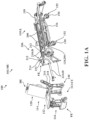
- a patient transport apparatus 102 for supporting a patient in a health care setting according to aspects of the present disclosure.
- the patient transport apparatus 102 is configured to be loaded into a cargo area 104 of an ambulance 106, such as via a power load device 108 (see Figures 4A-4C ).
- the patient transport apparatus 102 may comprise a hospital bed, a stretcher, a table, a wheelchair, a chair, or a similar apparatus utilized in the care of a patient.
- the version of the patient transport apparatus 102 shown in Figures 1A-1B generally comprises a base 110 and a litter 112.
- the litter 112 defines or otherwise comprises a patient support surface 114 to support a patient.
- Caregiver interfaces 148 such as handles, help facilitate movement of the patient transport apparatus 102 over floor surfaces.
- caregiver interfaces 148 may be coupled to the fowler assembly 128, the front assembly 134 (not shown), the intermediate frame 118, and the like. Additional caregiver interfaces 148 may be integrated into other components of the patient transport apparatus 102.
- the caregiver interfaces 148 are graspable by the caregiver to manipulate the patient transport apparatus 102 for movement.
- the patient transport apparatus 102 may comprise four non-powered, non-steerable wheels, along with one or more powered wheels. In some cases, the patient transport apparatus 102 may not include any wheels. In other configurations, one or more auxiliary wheels (powered or non-powered), which are movable between stowed positions and deployed positions, may be coupled to the base frame 116. In some cases, when these auxiliary wheels are located between caster assemblies and contact the floor surface FS in the deployed position, they cause two of the base caster assemblies 152 to be lifted off the floor surface thereby shortening a wheel base 110 of the patient transport apparatus 102. A fifth wheel may also be arranged substantially in a center of the base 110. Other configurations are contemplated.
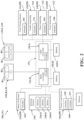
- the control system 154 generally comprises one or more powered devices PD each having one or more modules M to perform powered functions, with the powered devices PD being configured for operated via one or more controllers 156.
- the patient transport apparatus 102 employs a base controller 156B and/or a litter controller 156L (collectively referred to herein as "controller 156" and/or “apparatus controller 156A") in response to actuation of one or more user interfaces 158.
- the patient transport apparatus 102 includes a base user interface 158B and/or a litter user interface 158L (collectively referred to herein as “user interface 158" and/or “apparatus user interface 158A") in response to state signals received from a sensing system 160.
- a base user interface 158B and/or a litter user interface 158L (collectively referred to herein as “user interface 158" and/or “apparatus user interface 158A”) in response to state signals received from a sensing system 160.
- each of the one or more powered devices PD of the control system 154 is configured to perform one or more predetermined functions.
- the powered devices PD employ one or more components that utilize electricity in order to perform functions. Additionally, or alternatively, the powered devices PD employ one or more modules configured to perform one or more powered functions.
- One or more powered devices PD of the patient support system 100 may include portions of the ambulance 106, the power load device 108, the patient transport apparatus 102, or other powered devices.
- the term "powered device PD" may also be utilized herein to refer to portions of the patient transport apparatus 102, such as the base 110 (e.g., the base lift device 120) and/or the litter 112 (e.g., a litter lift device 162, a track driving device 164, and a fowler section adjustment device 166 as described in greater detail below).
- the base 110 e.g., the base lift device 120
- the litter 112 e.g., a litter lift device 162, a track driving device 164, and a fowler section adjustment device 166 as described in greater detail below.
- various components, systems, and the like may utilize one or more energy storage units 168, such as batteries, capacitors, and the like.
- the base 110 employs a base energy storage unit 168B and the litter 112 employs a litter energy storage unit 168L.
- the energy storage unit 168 (also referred to herein as a "battery”) provides power to components of the patient support system 100.
- the energy storage unit 168 in combination with at least one of the base controller 156B and the litter controller 156L, can utilize power management technologies, supply regulation technologies, and charging system technologies for supplying energy to the components of the patient support system 100. Such technologies will be discussed in greater detail below. Other powered devices PD are also contemplated.
- the powered devices PD may have many possible configurations for performing the predetermined functions of the patient transport apparatus 102. As will be appreciated from the subsequent description below, powered devices PD may cooperate with or otherwise form a part of the patient transport apparatus 102 in certain versions. Exemplary configurations of some of the powered devices PD are described in greater detail below. One or more actuators may be used to effectuate functions of each powered device PD. It should be understood that numerous configurations of the powered devices PD, other than those specifically described herein, are contemplated. Exemplary scenarios of how certain powered devices PD may be utilized are also described below. However, numerous other scenarios not described herein are also contemplated.
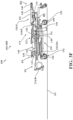
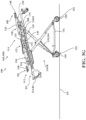
- the litter 112 of the present disclosure is configured to be removably attached to the intermediate frame 118 of the base 110, as noted above and as is described in greater detail below, and is generally operable between: an undocked mode MU (see Figure 1A ) where the litter 112 supports the patient for movement independent of the base 110, and a docked mode MD (see Figure 1B ) where the litter 112 support the patient for movement concurrent with the base 110.
- an undocked mode MU see Figure 1A
- MD the docked mode MD
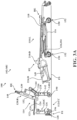
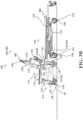
- the process of moving between the undocked mode MU and the docked mode MD is described in greater detail below in connection with Figures 3A-3G .
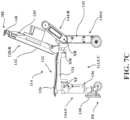
- the litter 112 While operating in the undocked mode MU, the litter 112 is operable between a loft configuration CL (see Figure 7A ), a chair configuration CC (see Figure 7C ), and a stair configuration CS (see Figures 7D-8 ). While operating in the docked mode MD, portions of the litter 112 may be articulable to adjust the patient support surface 114, such as by moving the fowler assembly 128. Other configurations are contemplated.
- the litter 112 when operating in and between the chair and stair configurations CC, CS, the litter 112 is configured to serve as a mobile chair to transport the patient along floor surfaces FS as well as up and down stairs ST.
- Mobile chairs (sometimes called "stair chairs") are used to evacuate patients from buildings where patient accessibility is limited, such as buildings having more than one floor.
- the patient support surface 114 of the litter 112 of the illustrated patient transport apparatus 102 is generally defined by the fowler section 132, the seat section 126, and the front section 138.
- the seat section 126 is supported by the seat frame 124
- the fowler section 132 is supported by the fowler frame 130 that is coupled to the seat frame 124 such that the fowler frame 130 may pivot or otherwise articulate relative to the seat frame 124.
- the front section 138 is supported by the front frame 136 which is coupled to the seat frame 124 such that the front frame 136 may pivot or otherwise articulate relative to the seat frame 124.
- the rear assembly 140 is coupled to the seat frame 124 such that the rear frame 142 may pivot or otherwise articulate relative to the seat frame 124.
- the seat frame 124 may include seat frame members 170 spaced laterally apart from and fixed relative to each other.
- the fowler frame 130 may include fowler frame members 172 spaced laterally apart and fixed relative to each other.
- the front frame 136 may include front legs 174 spaced laterally apart and fixed relative to each other, and the rear frame 142 may include rear legs 176 spaced laterally apart and fixed relative to each other.
- the litter 112 comprises a fowler actuator 178, a front actuator 180, and a rear actuator 182 which are each driven by the controller 156 (e.g., by the litter controller 156L) and are operatively attached to the seat assembly 122 to facilitate respectively pivoting or otherwise articulating the fowler assembly 128, the front assembly 134, and the rear assembly 140 relative to the seat assembly 122.
- the fowler assembly 128 is movable via the fowler actuator 178 between a fowler raised position 128R (see Figures 7D-7E), a fowler lowered position 128L (see Figure 7A ), and one or more intermediate fowler positions 128I (see Figure 7B ) between the fowler raised position 128R and the fowler lowered position 128L.
- the illustrated patient transport apparatus 102 employs the track driving device 164, which is configured to assist users in traversing a flight of stairs ST by mitigating the load users (e.g., caregivers) would otherwise be required to lift via caregiver interfaces 148 (see Figure 8 ; not shown in detail).
- the track driving device 164 may be configured to move the litter 112 across the floor surface FS (not shown).
- the track driving device 164 is formed as a part of the rear legs 176 of the rear assembly 140.
- each rear leg 176 includes a respective track frame member 184 coupled to the seat frame 124 for pivoting movement about the rear axis XR.
- the components of the track driving device 164 are arranged such that the leg track frame members 184, the leg tracks 188, and the rear wheels 190 move together with the rear assembly 140 which, as noted above, is arranged to selectively pivot about the rear axis XR to facilitate changing between the various configurations of the litter 112 as well as to facilitate docking and undocking from the base 110.
- the rear assembly 140 is movable via the rear actuator 182 between a rear assembly loft position 140L (see Figure 7A ), a rear assembly chair position 140C (see Figure 7C ), a rear assembly stair position 140S (see Figures 7D-8 ), a rear assembly dock position 140D (see Figure 3D ), and one or more intermediate rear assembly positions 140I (see Figure 7B ) between the rear assembly loft position 140L and the rear assembly dock position 140D.
- the ski assemblies 144 serve as extensions to the track driving device 164 and likewise help facilitate engagement with stairs ST.
- the ski assemblies 144 each include respective ski track frame members 192 operatively attached to the seat frame 124 for pivoting movement about the rear axis XR (or another axis).
- the track actuators 186 drive continuous ski tracks 194 rotatably coupled to the respective ski track frame members 192.
- the ski assemblies 144 are arranged for pivoting movement between a plurality of ski positions, including a raised ski position 144R (see Figures 7C-7D ), a lowered ski position 144L (see Figure 7A ), and one or more intermediate ski positions 144I between the raised ski position 144R and the lowered ski position 144L (see Figure 7B ).
- abutment with the fowler assembly 128 moves the ski assemblies 144.
- other configurations are contemplated.
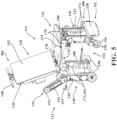
- the front legs 174 of the front assembly 134 support respective front wheels 196, which are realized as part of respective front caster assemblies 198 arranged to facilitate movement of the litter 112 in the chair configuration CC (see Figures 5-6 and 7C ), as well as to facilitate transitioning between the chair configuration CC and the stair configuration CS (compare Figures 7C-7D ).
- the front wheels 196 are freely rotatable, but could be motorized, braked, and the like in some versions.
- the front section 138 may be translatable along the front frame 136, such as when the litter 112 moves between the loft configuration CL and the chair configuration CC (compare Figures 7A-7D ), and/or when the litter 112 operates in the docked mode MD (see Figure 4A ).
- the front assembly 134 may include an extension mechanism, generally indicated at 200, configured to longitudinally position the front section 138 relative to the front legs 174. While not depicted in detail herein, the extension mechanism 200 may be similar to as is described in U.S. Patent Application No. 16/705,878 .
- the base 110 of the patient transport apparatus 102 also generally includes a docking subassembly 206 operatively coupled to the intermediate frame 118.
- the docking subassembly 206 includes intermediate rails 208 which support a trolley 210 for translation between a trolley forward position 210F where the trolley 210 is arranged at the head end HE of the base 110, and a trolley docking position 210D where the trolley 210 is arranged at the foot end FE of the base 110.
- the trolley 210 includes or otherwise defines upper and lower pin stops 212, 214 which are arranged to engage against respective upper and lower pins 216, 218 of the litter 112 in order to support the litter 112 in a cantilevered position CP during the process of docking the litter 112 to the base 110, as well as to support the litter 112 to the base 110 when operating in the docked mode MD.
- the power load device 108 When the rail trolley 228 is coupled to at least one of the litter 112 and the base 110, the power load device 108 is coupled to or otherwise disposed in communication with the controller 156 to be controlled by the controller 156.
- the power load device 108 may be powered by a power source supplied by the ambulance 106 and/or by a power source on the patient transport apparatus 102.
- the power load device 108 of the patient support system 100 is configured as described in U.S. Patent No. 8,439,416 .
- the controller 156 may comprise one or more subcontrollers configured to control the one or more powered devices PD, and/or one or more subcontrollers for each of the one or more powered devices PD. In some cases, one subcontroller may be attached to the litter 112 and another subcontroller may be attached to the base 110. Power to the one or more powered devices PD and/or the controller 156 may be provided by the energy storage unit 168. In alternative configurations, the one or more powered devices PD and/or the controller 156 may be provided by an external power source.
- the controller 156 is coupled to the one or more powered devices PD in a manner that allows the controller to control the powered devices PD (e.g., via electrical communication).
- the controller 156 may communicate with the one or more powered devices PD via wired or wireless connections.
- the controller 156 may generate and transmit control signals to the one or more powered devices PD, or components thereof, to drive or otherwise facilitate operating their associated actuators or to cause the one or more powered devices PD to perform one or more of their respective functions.
- the sensing system 160 comprises a state detection device 236 that is coupled to the litter 112 and the controller 156 and monitors the state of the litter 112 directly, or indirectly.
- the state detection device 236 comprises one or more sensors S configured to monitor the litter 112, the base 110, and/or the one or more powered devices PD. To this end, the state detection device generates a state signal corresponding to the state of the litter 112 and sends the state signal to the controller, such as when the litter 112 is mounted to the base 110.
- the state detection device and/or other aspects of the sensing system 160 may be used by the controller for various purposes.
- the sensing system 160 may comprise one or more sensors S, including force sensors (e.g., load cells), timers, switches, optical sensors, electromagnetic sensors, motion sensors, accelerometers, potentiometers, infrared sensors, ultrasonic sensors, mechanical limit switches, membrane switches, encoders, and/or cameras.
- the sensing system 160 may further comprise one or more sensors S to detect mechanical, electrical, and/or electromagnetic coupling between components of the patient transport apparatus 102. Other types of sensors S are also contemplated. Some of the sensors S may monitor thresholds movement relative to discrete reference points.
- the sensors S can be located anywhere on the patient transport apparatus 102, or remote from the patient transport apparatus 102. For example, the sensors S may be located on or in the patient support surface 114, the base frame 116, the intermediate frame 118, or other suitable locations.
- the sensing system 160 may act as an input device used to provide input signals to the controller 156 to cause or continue operation of the one or more powered devices PD. Numerous scenarios exist in which the one or more powered devices PD can be operated based on input signals provided by the sensing system 160 and/or the user interface 158.
- the sensing system 160 may include a state input device 238 to enable a user (e.g., a caregiver) to select a state such that actuation of the state input device 238 generates the state signal.
- a user instead of the controller 156 automatically detecting the current state SC of the litter 112, a user can manually enter the current state SC (or, in some versions, a desired state) of the litter 112 (e.g., "litter-on-base,” “litter-off-base,” etc.).
- the state input device 238 is spaced from at least one of the user interfaces 158. In other configurations, the state input device 238 is connected to at least one of the user interfaces 158.
- One or more user interfaces 158 are coupled to the controller 156 and may be actuated by the user (e.g., a caregiver) to transmit corresponding input signals to the controller 156, and the controller 156 controls operation of the one or more powered devices PD based on the input signals and the state signals. Operation of the one or more powered devices PD may continue until the user discontinues actuation of the user interface 158, (e.g., until the corresponding input signal is terminated). Other configurations are contemplated.
- the user interface 158 may comprise devices capable of being actuated by the user, and may be configured to be actuated in a variety of different ways, including but not limited to, mechanical actuation (hand, foot, finger, etc.), hands-free actuation (voice, foot, etc.), and the like.
- the user interface 158 may comprise one or more of a load cell, a push button, a touch screen, a joystick, a twistable control handle, a dial, a knob, a gesture sensing device for monitoring motion of hands, feet, face, or other body parts of the user (such as through a camera), a microphone for receiving voice activation commands, a foot pedal, and a sensor (e.g., infrared sensor such as a light bar or light beam to sense a user's body part, ultrasonic sensor, etc.).
- buttons/pedals may be physical buttons/pedals, or may be virtually-implemented buttons/pedals such as through optical projection or forming part of a graphical user interface presented on a touchscreen.
- Buttons/pedals may also be mechanically-implemented in some versions, or may drive-by-wire type buttons/pedals where a user-applied force actuates a sensor S such as a switch or potentiometer.
- User interfaces 158 may be provided in one or more locations on the base 110 and/or the litter 112. Other configurations are contemplated.
- the user interface 158 may comprises two buttons B1, B2 that may be actuated to generate the input signal used by the controller 156 to drive the one or more powered devices PD. In other versions, the user interface 158 may comprise three or more buttons. In some versions, the user interface 158 may comprise a single button. Other configurations are contemplated.
- buttons B, B may be used to control functions of or associated with more than one powered device PD.
- the user interfaces 158 generate input signals corresponding to each individual button B1, B2 of the user interface, when actuated.
- the input signal received by the controller 156 may not change when the same button B1, B2 is actuated; rather, the state signals generated by the state detection device 236 may change according to the current state SC of the litter 112 and/or the base 110 such that the controller 156 determines which of the powered devices PD to actuate base 110d on the current state SC detected using the input signal from the same button B1, B2.
- the same button B1, B2 can be used to control different powered devices PD depending on the state determined by the controller 156 via the sensing system 160, the state detection device 236, and/or the state input device 238.
- the user may actuate a button B1 on the user interface to operate the base lift device 120 when the litter 112 is in a first state, and the same button B1 may be actuated to operate the track driving device 164 when the litter 112 is in a second state.
- Other configurations are contemplated.
- the sensing system 160 comprises a load detection device 240 coupled to the base 110.
- the load detection device 240 is configured to detect when the intermediate frame 118 is subjected to a load, such as load created by the litter 112 or load created by the litter 112 and the patient. More specifically, the load detection device 240 detects when a load has exceeded a load threshold.
- the base lift actuator 204 raises and lowers the intermediate frame 118 relative to the base frame 116 in response to actuation of the user interface 158 at a first rate.
- the base lift actuator 204 raises and lowers the intermediate frame 118 relative to the base frame 116 in response to actuation of the user interface 158, at a second rate slower than the first rate.
- the base lift actuator 204 comprises a linear actuator.
- the state detection device 236 comprises a sensor S to detect the litter 112 being coupled to and supported by the base 110.
- the current state SC of the litter 112 is considered to be a "litter-on-base" state.
- the state detection device 236 In response to detection via the sensor S, the state detection device 236 generates a corresponding state signal that is received by the controller 156; here in the "litter-on-base” state, when a user actuates the first button B1 of one of the user interfaces 158, the controller 156 is configured to operate the base lift actuator 204 to raise the litter 112 and the intermediate frame 118 relative to the floor surface and the base frame 116. Conversely, in the "litter-on-base” state, when the user actuates the second button B2 of the user interface 158, the controller 156 is configured to operate the base lift actuator 204 to lower the litter 112 and the intermediate frame 118 relative to the floor surface and the base frame 116. It will be appreciated that the forgoing represents examples of operation of the state detection device 236 and the state input device 238, and that other configurations are contemplated.
- the litter 112 is operable in the docked mode MD (see Figure 1B ) and in the undocked mode MU (see Figure 1A ).
- the litter 112 when in the undocked mode MU the litter 112 may be disposed adjacent to the base 110, with the litter 112 placed in the chair configuration CC.
- the chair configuration CC is defined by the fowler assembly 128 being in the fowler raised position 128R, the front assembly 134 being in the front assembly chair position 134C, and with the rear assembly 140 being in the rear assembly chair position 140C.
- the litter 112 is shown having been positioned longitudinally closer to the base 110, bringing the upper and lower pins 216, 218 into proximity of the trolley 210.
- the sensing system 160 determines the relative positioning of the litter 112, and the controller 156 can be used to begin the process of docking by first actuating the rear actuator 182 to move the rear assembly 140 from the rear assembly chair position 140C towards the rear assembly dock position 140D in order to lower the upper and lower pins 216, 218 into engagement with the upper and lower pin stops 212, 214 of the trolley 210.
- the arrangement of the rear assembly 140 as shown in Figure 3C is such that the pivoting of the rear assembly 140 about the rear axis XR has moved the rear wheel 190 closer towards the front assembly 134 and has resulted in the seat assembly 122 having "tilted" backwards, which facilitates the process of transferring weight to the base 110.
- the rear assembly 140 is arranged for movement from the rear assembly chair position 140C (see also Figure 7C ) towards the rear assembly dock position 140D, as well as from the rear assembly chair position 140C towards the a rear assembly stair position 140S (see also Figure 7D ) when pivoting about the rear axis XR to move the rear wheel 190 closer towards the front assembly 134.
- the rear assembly 140 is also arranged for movement from the rear assembly chair position 140C (see also Figure 7C ) towards the rear assembly loft position 140L (see Figure 7A ) when pivoting about the rear axis XR to move the rear wheel 190 further away from the front assembly 134.
- the controller 156 drives the rear actuator 182 to pivot the rear assembly 140 about the rear axis XR until it reaches the a rear assembly dock position 140D and, at the same time, drives the front actuator 180 to pivot the front assembly 134 about the front axis XF from the front assembly chair position 134C to the front assembly loft position 134L as shown in Figure 3D .
- the rear actuator 182 and the front actuator 180 may be driven simultaneously by the controller 156.
- the litter 112 is shown disposed in the cantilevered position CP with the trolley 210 disposed in the trolley docking position 210D arranged at the foot end FE of the base 110.
- the front assembly 134 and the rear assembly 140 are arranged generally parallel to each other and to the seat assembly 122.
- the dock trolley lock mechanism 222 can be disengaged by the user, and the trolley 210 can be moved to the trolley forward position 210F arranged at the head end HE of the base 110, as shown in Figure 3E .
- the dock trolley lock mechanism 222 retains the trolley 210 in the trolley forward position 210F which places the patient transport apparatus 102 in the docked mode MD.
- the stabilizer can be moved to the retracted configuration 224R out of contact with the floor surface FS, and other portions of the patient transport apparatus 102 may be moved if needed, such as to move the fowler assembly 128 to the fowler lowered position 128L as shown in Figure 3F and/or to raise the intermediate frame 118 to position the base 110 in the maximum raised configuration 110R as shown in Figure 3G .
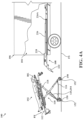
- Figure 4A shows the patient transport apparatus 102 in the docked mode MD and positioned adjacent to the cargo area 104 of the ambulance 106 for loading via the power load device 108.
- the base 110 is arranged with the intermediate frame 118 raised relative to the base frame 116 near or slightly below the maximum raised configuration 110R in order to facilitate loading the patient transport apparatus 102 into the ambulance 106.
- the patient transport apparatus 102 has been loaded onto the power load device 108 at the first rail end 226A of the rail 226.
- the base lift device 120 of the base 110 has been utilized to position the base 110 in the maximum lowered configuration 110L, which results in the base wheels 150 coming out of contact with the floor surface FS after weight from the patient transport apparatus 102 has been transferred to the power load device 108 via the load arms 232.
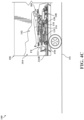
- the rail trolley 228 may be moved towards the second rail end 226B of the rail 226 as shown in Figure 4C in order to load the patient transport apparatus 102 fully into the cargo area 104 of the ambulance 106.
- the litter 112 can be moved into the chair configuration CC depicted in Figure 7C by moving the front assembly 134 to the front assembly chair position 134C while also moving the rear assembly 140 to the rear assembly chair position 140C and the fowler assembly 128 to the fowler raised position 128R.
- Figure 7B depicts intermediate positions of the front assembly 134, the rear assembly 140, and the fowler assembly.
- the rear assembly 140 and the front assembly 134 are each arranged parallel to each other and generally perpendicular to the seat assembly 122. From the chair configuration CC, the rear assembly 140 and the front assembly 134 can be moved simultaneously to bring the litter 112 into the stair configuration CS as depicted in Figure 7D by placing the rear assembly 140 in the rear assembly stair position 140S and by placing the front assembly 134 in the front assembly stair position 134S.
- the front assembly 134 and the rear assembly 140 are arranged substantially parallel to each other, but are now arranged an oblique angle relative to the seat assembly 122 in order to, among other things, position the leg tracks 188 for engagement with stairs ST as shown in Figure 8 .
- the track driving device 164 can be used to move the litter 112 along stairs ST via engagement with the leg tracks 188 (as well as the ski tracks 194). It will be appreciated that the litter 112 can be moved between the configurations CL, CC, CS in various ways to facilitate patient care, and can be docked to and/or undocked from the base 110 as noted above.
- the patient support system 100 employs the control system 154, one or more controllers 156, one or more user interfaces 158, one or more sensing systems 160, one or more energy storage units 168, and the like to facilitate controlling one or more powered devices PD, such as the power load device 108, the base lift device 120, the litter lift device 162, the track driving device 164, the fowler section adjustment device 166, and the like.
- the power utilized to facilitate operation of the powered devices PD is transferred to a vehicle energy storage unit 168B of the ambulance 106, such as from an internal combustion engine alternator 242, a mains power supply 244, and the like.
- the vehicle energy storage unit 168B of the ambulance 106 provides power that is used to operate other powered devices PD of the patient support system 100.
- one or more power connections 246 are employed to transfer power between different energy storage units 168 of different powered devices PD.
- power from the vehicle energy storage unit 168V is transferred to the base energy storage unit 168B and/or the litter energy storage unit 168L across an apparatus power connection 246A to facilitate charging or otherwise powering, among other things, the base lift device 120.
- power from the vehicle energy storage unit 168V is transferred to a power load energy storage unit 168P used to power the power load device 108 (e.g., the arm actuator 234 described above) across a power load power connection 246P.
- Similar types of power connections 246 are described, for example, in U.S. Patent No. 7,887,113 However, other configurations are contemplated.
- power connections 246 may be employed to facilitate physical electrical connections (e.g., electrical terminals which physically contact), wireless electrical connections (e.g., wireless power transfer), and the like with powered devices PD in order to facilitate power transfer, electrical communication, or combinations thereof.
- power connections 246 may form a part of or otherwise include interlocking components configured to secure different components together physically (e.g., to secure the litter 112 to the base 110), to secure the patient transport apparatus 102 to the ambulance 106, and the like, to secure powered devices PD to each other or to other components or systems, and the like.
- Other configurations are contemplated.
- the vehicle energy storage unit 168 may also be configured to facilitate providing power to or otherwise charging one or more powered devices PD realized as accessory devices 248 across one or more device power connections 246D.
- accessory devices 248 may include Automated External Defibrillators, radios, portable electronic devices (e.g., cell phones, tablets, and the like), flashlights, heart monitors, pumps, and/or other types of powered devices PD that may be utilized by caregivers or other users during the course of patient treatment, transport, and/or care.
- Each powered device PD realized as an accessory device 248 may include a respective device energy storage unit 168D used to power a device controller 158D based on power received across one or more device power connections 246D.
- a litter power connection 246L facilitates transferring power to the litter energy storage unit 168L from the base energy storage unit 168B.
- the litter 112 is a powered device PD, it may be considered an accessory device 248 that is charged via the base energy storage unit 168B.
- the litter 112 of the patient transport apparatus 102 illustrated throughout the drawings is removable from the base 110, it will be appreciated that other configurations are contemplated, such as where the litter 112 is not removably attached to the intermediate frame 118. Accordingly, in portions of the description below, the term "apparatus energy storage unit 168A" may be used to refer to the base energy storage unit 168B and/or the litter energy storage unit 168L.
- Apparatus generally refers to the patient transport apparatus 102 in this exemplary version, it will be appreciated that the term “apparatus” could also be substituted for terms referring defining whichever component, device, system, and/or portion of the patient support system 100 is supplying power to a particular powered device PD (e.g., an accessory device 248).
- a particular powered device PD e.g., an accessory device 248
- the term "apparatus” may generally refer to the base 110 of the patient transport apparatus 102, but other configurations are contemplated, and it will be appreciated that powered devices PD which are not necessarily supplied with power from the base energy storage unit 168B (either directly or indirectly) such as the power load device 108, and/or other components, devices, systems, and/or portions of the patient support system 100 which are "downstream" of the base 110 (e.g., accessory devices 248 coupled to the litter 112) may nevertheless be in communication with the base 110 or other controllers 156 of the patient support system 100.
- powered devices PD which are not necessarily supplied with power from the base energy storage unit 168B (either directly or indirectly) such as the power load device 108, and/or other components, devices, systems, and/or portions of the patient support system 100 which are "downstream" of the base 110 (e.g., accessory devices 248 coupled to the litter 112) may nevertheless be in communication with the base 110 or other controllers 156 of the patient support system 100.
- each powered device PD may include a respective interface 250 in communication with its controller 156 and/or energy storage unit 168 to facilitate power transfer across one of the power connections 246.
- the interfaces 250 may include or otherwise define a transmit element 252 and/or a receive element 254; in instances where power is being transmitted by one powered device PD to another, the term "transmit element 252" is used herein to refer to whichever powered device PD is supplying power across the power connection 246, and the term “receive element 254" is used herein to review to refer to whichever powered device PD is receiving power across the power connection 246 from the transmit element 252.
- the patient transport apparatus 102 includes an apparatus interface 250A in communication with the apparatus controller 156A, and the powered device PD (e.g., an accessory device 248) includes a device interface 250D in communication with the device controller 156D.
- the powered device PD further includes a device communication system 256D having a device wireless subsystem 258D in electrical communication with the device controller 156D, and a device wireless communication module 260D operable to wirelessly transfer data and to provide, through the wireless communication module 260D, wireless communication between the device controller 156D and the apparatus controller 156A.
- the patient transport apparatus 102 further includes an apparatus communication system 256A having an apparatus wireless subsystem 258A in electrical communication with the apparatus controller 156A, and an apparatus wireless communication module 260A operable to wirelessly transfer data and to provide, through the wireless communication module 260A, wireless communication between the apparatus controller 156A and the device controller 156D (and/or with other controllers 156 between the base controller 156B and/or the litter controller 156L).
- an apparatus communication system 256A having an apparatus wireless subsystem 258A in electrical communication with the apparatus controller 156A, and an apparatus wireless communication module 260A operable to wirelessly transfer data and to provide, through the wireless communication module 260A, wireless communication between the apparatus controller 156A and the device controller 156D (and/or with other controllers 156 between the base controller 156B and/or the litter controller 156L).
- the wireless subsystems 258 may be defined as (or otherwise configured to operate according to protocols associated with) a controller area network CAN system, and the wireless communication modules 260 may be defined as (or be configured to operate according to protocols associated with) a Bluetooth device, such as a Bluetooth low energy BLE device.
- a Bluetooth device such as a Bluetooth low energy BLE device.
- Such configurations may relate to or otherwise utilize a CAN-BLE network bridge, generally indicated at 262, for connecting a CAN bus and Bluetooth devices.
- the CAN-BLE network bridge 262 may be utilized to transfer data between the base 110 and the litter 112 (and/or to other powered devices PD of the patient support system 100), as well as to help facilitate power transfer between the base 110 and the litter 112. Furthermore, the CAN-BLE network bridge 262 may also be utilized to facilitate transferring power and/or data between the patient transport apparatus 102 and/or other powered devices PD of the patient support system 100 (e.g., the ambulance 106, the power load device 108, the accessory devices 248, and the like).
- the wireless subsystem 258 is realized as a CAN subsystem in the illustrated versions, those having ordinary skill in the art will appreciate that other types of subsystem, networks, and the like may be utilized.
- the wireless subsystem 258 may also be realized as one or more of a CANOpen network, a DeviceNet network, other networks having a CAN physical and data link layer, a local interconnect network LIN, or any other known subsystem and/or network for communicating messages between electronic structures of the patient support system 100, either via wireless communication and/or wired communication (e.g., with variously configured wired and wireless communication systems 256).
- wireless communication module 260 is configured to operate according to the BLE protocol in some versions, those having ordinary skill in the art will appreciate that other types of protocols are contemplated by the present disclosure (e.g., WiFi networking, near field communication NFC, radio frequency identification RFID, Qi standard communication, infrared communication, cellular networking, and the like).
- WiFi networking near field communication NFC
- radio frequency identification RFID radio frequency identification RFID
- Qi standard communication Qi standard communication
- infrared communication cellular networking, and the like.
- aspects of the wireless communication module 260, the wireless subsystem 258, and/or the communication system 256 may cooperate with or otherwise be realized as a part of the interfaces 250 and/or power connections 246 described herein (e.g., via transmit and receive elements 252, 254).
- the wireless subsystems 258 and/or the wireless communication modules 260 of the communication systems 256 may use various methods, protocols, and/or standards including, but not limited to, Ethernet, Bluetooth, short message service SMS, multimedia messaging service MMS, and Web Services.
- the transferring of data may be done using a variety of security measures including, but not limited to, transport layer security TSL, secure sockets layer SSL, and virtual private network VPN.
- messages and/or data may be encrypted (e.g., via the use of certificates, public key infrastructure PKI, and the like).
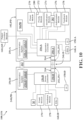
- exemplary power transfer from the patient transport apparatus 102 to a powered device PD realized as an accessory device 248 is represented schematically.
- the components, structural features, configurations, and the like described herein and illustrated in connection with Figure 10 could instead represent power transfer between other powered devices PD as noted above (e.g., between the base 110 and the litter 112, between the litter 112 and an accessory device 248, between the ambulance 106 and the patient transport apparatus 102, between the ambulance and an accessory device 248, and the like).
- Other configurations are contemplated.
- the apparatus interface 250A is shown in communication with the apparatus controller 156A
- the device interface 250D is shown in communication with the device controller 156D of the accessory device 248.
- the device interface 250D is adapted to cooperate with the apparatus interface 250A to facilitate power transfer from the apparatus energy storage unit 168A to the device energy storage unit 168D across the device power connection 246D.
- the apparatus interface 250A includes a transmit element 252 and the device interface 250D includes a receive element 254 to facilitate power transfer between the patient transport apparatus 102 and the accessory device 248 (or to some other powered device PD).
- power transfer is implemented using electrically-driven power transfer between the patient transport apparatus 102 and one or more powered devices PD.
- electrically-driven power transfer may be implemented using inductive power transfer and/or capacitive power transfer.
- the accessory device 248 (or some other powered devices PD) is moved towards the patient transport apparatus 102 such that the device interface 250D is proximate to the apparatus interface 250A. Power may then be transferred to the accessory device 248 in response to inductive and/or capacitive interaction, as is described in greater detail below.
- the transmit element 252 is further defined as a transmit coil 252 and the receive element 254 is further defined as a receive coil 254.
- Inductive power transfer occurs from the transmit coil 252 to the receive coil 254.
- the transmit and receive coils 252, 254 are each electrical inductors and are operable together to form a transformer.
- alternating current AC passes through the transmit coil 252
- an electromagnetic field B is generated and passes through the receive coil 254.
- the receive coil 254 induces alternating current AC.
- one or more of the powered devices PD may include a receive circuit 264 for receiving the AC current induced via the receive coil 254.
- the receive circuit 264 may be realized as a rectifier circuit for converting the alternating current AC into direct current DC suitable for utilization by the powered device PD and/or suitable to be stored in the energy storage unit 168. It will be appreciated that in configurations with coils, the transmit coil 252 generates the electromagnetic field B, while in other configurations, other types of fields are contemplated.
- inductive refers to the transferring power via coils.
- the coils may be replaced with capacitive plates and/or other components to facilitate capacitive or other types of wireless power transfer.
- capacitive power transfer is fully contemplated for each of the versions described herein.
- specific integration of the coils and/or specific geometries of the transmit and receive elements 252, 254 may differ between specific geometries and/or integration of the coils and plates. This is due to the nature of inductive power transfer requiring coils for proper operation and capacitive power transfer requiring plates for proper operation.
- transmit elements 252 and receive elements 254 are contextual and are used to describe the direction in which power transfer occurs under certain operating conditions, such as to charge the litter energy storage unit 168L via power from the base energy storage unit 168B.
- each power connection 246 could have a respective transmit element 252 and a respective receive element 254, or could otherwise employ a single element that can both transmit power and receive power across the power connection 246.
- Other configurations are contemplated.
- power transfer across some or all of the power connections 246 may also be accomplished via wired electrical communication, whereby electrical terminals, contacts, and the like would then define the transmit and receive elements 252, 254.
- some or all of the power connections 246 described herein may be configured for wired and/or wireless power transmission.
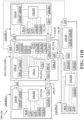
- certain components of the patient support system 100 may be configured to provide power to multiple powered devices PD, such as where the ambulance 106 can provide power across the apparatus power connection 246A, the power load power connection 246P, the device power connection 246D; where the base 110 can provide power across the litter power connection 246L and/or multiple device power connections 246D, and the like.
- the base 110 of the patient transport apparatus 102 is schematically depicted with a device power connection 246D to transfer power to a first powered device PD1 realized as an accessory device 248, and with a litter power connection 246L to transfer power to a second powered device PD2 realized as the litter 112.
- the patient transport apparatus 102 is schematically depicted with three separate device power connections 246D to respectively transfer power to first, second, and third powered devices PD1, PD2, PD3 realized as separate accessory devices 248.
Landscapes
- Health & Medical Sciences (AREA)
- Public Health (AREA)
- Life Sciences & Earth Sciences (AREA)
- Animal Behavior & Ethology (AREA)
- General Health & Medical Sciences (AREA)
- Veterinary Medicine (AREA)
- Nursing (AREA)
- Invalid Beds And Related Equipment (AREA)
- Charge And Discharge Circuits For Batteries Or The Like (AREA)
Claims (15)
- Système de support de patient (100) comprenant:
un appareil de transport de patient (102) comprenantun cadre de base (116) conçu pour se déplacer sur les surfaces au sol,un cadre intermédiaire (118) pour soutenir le patient,un dispositif de réglage électrique (PD),une unité de stockage d'énergie d'appareil (168A),une interface utilisateur d'appareil (158A) conçue pour être utilisée par l'utilisateur afin de faire fonctionner de manière sélective le dispositif de réglage électrique par l'unité de stockage d'énergie d'appareil (168A),un organe de commande d'appareil (156A) en communication électrique avec le dispositif de réglage électrique (PD), l'unité de stockage d'énergie d'appareil (168A) et l'interface utilisateur d'appareil (158A), etune interface d'appareil (250A) en communication avec le dispositif de commande d'appareil (156A); etle système de support de patient (100) comprenant:
un premier dispositif électrique (PD) comprenant:un premier module pour exécuter une fonction électrique,une première unité de stockage d'énergie de dispositif (168D),une interface utilisateur de premier dispositif (158D) conçue pour être utilisée par l'utilisateur afin de faire fonctionner sélectivement le premier module (270) grâce à l'énergie fournie par l'unité de stockage d'énergie de premier dispositif (168D),une interface de premier appareil (250D) en communication avec un dispositif de commande de premier dispositif (156D), l'interface de premier dispositif (250D) étant adaptée pour coopérer avec l'interface d'appareil (250A) afin de faciliter le transfert d'énergie de l'unité de stockage d'énergie d'appareil (168A) à l'unité de stockage d'énergie de premier appareil (168D), etle dispositif de commande de premier appareil (156D) en communication électrique avec le premier module (270), l'unité de stockage d'énergie de premier appareil (168D) et l'interface utilisateur de premier appareil (158D),caractérisé en ce quele dispositif de commande de premier appareil (156D) comprend un premier module d'alimentation (270) conçu pour déterminer un niveau de charge de l'unité de stockage d'énergie de premier appareil (168D) sur la base d'un état actuel de l'unité de stockage d'énergie d'appareil (168A), et pour prélever de l'énergie de l'unité de stockage d'énergie d'appareil (168A) par l'intermédiaire de l'interface d'appareil (250A) et dans toute l'interface de premier dispositif (250D) pour charger l'unité de stockage d'énergie de premier dispositif (168D) au niveau de charge, l'état actuel de l'unité de stockage d'énergie d'appareil (168A) comprenant un niveau de sortie, une condition de charge ou un état d'alimentation de l'unité de stockage d'énergie d'appareil (168A). - Système de support de patient (100) selon la revendication 1, dans lequel l'interface d'appareil (250A) comprend un élément de transmission (252) et l'interface de premier dispositif (250D) comprend un élément de réception (254) pour faciliter le transfert d'énergie entre l'appareil de transport de patient (102) et le premier dispositif électrique (PD), et, éventuellement, dans lequel l'élément de transfert (152) est en outre défini comme une bobine de réception (152) et l'élément de réception (154) est en outre défini comme une bobine de réception (154), la bobine de transfert (152) et la bobine de réception (154) sont adaptées pour coopérer afin de faciliter l'alimentation en énergie à partir de l'appareil de transport de patient (102) vers le premier dispositif électrique (PD).
- Système de support de patient (100) selon l'une quelconque des revendications 1 à 2, dans lequel l'état actuel de l'unité de stockage d'énergie d'appareil (168A) comprend un niveau de sortie actuel; et
dans lequel le premier module d'alimentation (270) est en outre conçu pour:déterminer un niveau de sortie maximal de l'unité de stockage d'énergie d'appareil (168A),calculer un niveau de sortie disponible sur la base de la différence entre le niveau de sortie maximal et le niveau de sortie actuel, etrégler la puissance prélevée de l'unité de stockage d'énergie d'appareil (168A) à partir de l'interface d'appareil (250A) en fonction du niveau de sortie disponible de l'unité de stockage d'énergie d'appareil (168A). - Système de support de patient (100) selon l'une quelconque des revendications 1 à 3, dans lequel le dispositif de commande d'appareil (156A) est en communication électrique avec le dispositif de commande de premier dispositif (156D); et
dans lequel le dispositif de commande d'appareil (156A) est en outre conçu pour surveiller l'état actuel de l'unité de stockage d'énergie d'appareil (168A) et pour transmettre l'état actuel au premier module d'alimentation (270) du dispositif de commande de premier appareil (156D). - Système de support de patient (100) selon l'une quelconque des revendications 1 à 4, dans lequel le premier dispositif motorisé (PD) est en outre défini comme un dispositif accessoire (248) conçu pour s'accoupler de manière amovible à l'appareil de transport de patient (102).
- Système de support de patient (100) selon l'une quelconque des revendications 1 à 5, dans lequel le dispositif de réglage motorisé (PD) est en outre défini comme un dispositif de levage de base (120) conçu pour régler la hauteur du cadre intermédiaire (118) par rapport au cadre de base (116).
- Système de support de patient (100) selon la revendication 5, dans lequel l'interface d'appareil (250A) comprend un élément de transmission (252) et l'interface de premier dispositif (250D) comprend un élément de réception (254) pour faciliter le transfert d'énergie entre l'appareil de transport de patient (102) et le dispositif accessoire (248).
- Système de support de patient (100) selon l'une quelconque des revendications 1 à 4, dans lequel le premier dispositif motorisé (PD) est en outre défini comme une civière (112) adaptée pour être fixée de manière amovible au cadre intermédiaire (118) de l'appareil de transport de patient (102), la civière (112) comprenant une pluralité d'ensembles articulés définissant une surface de support de patient (114).
- Système de support de patient (100) selon la revendication 8, dans lequel l'interface d'appareil (250A) comprend un élément de transmission (252) et l'interface de premier dispositif (250D) de la civière (112) comprend un élément de réception (254) pour faciliter le transfert d'énergie entre l'appareil de transport de patient (102) et la civière (112).
- Système de support de patient (100) selon la revendication 9, dans lequel l'élément de transmission (252) est fixé fonctionnellement au cadre intermédiaire (118) et est disposé de manière à être aligné avec l'élément de réception (254); et
dans lequel l'élément de transmission (252) est en outre défini comme une bobine de transmission (252) et l'élément de réception (254) est en outre défini comme une bobine de réception (254), la bobine de transmission (252) et la bobine de réception (254) sont adaptées pour coopérer de manière à ce que l'énergie puisse être fournie par l'appareil de transport de patient (102) au premier dispositif électrique (PD). - Système de support de patient (100) selon l'une quelconque des revendications 1 à 10, dans lequel le dispositif de commande d'appareil (156A) est en communication électrique avec le dispositif de commande de premier dispositif (156D); et
dans lequel le premier dispositif électrique (PD) comprend en outre:un sous-système sans fil (258) en communication électrique avec le premier dispositif de commande de dispositif (156D), etun module de communication sans fil (260) pouvant servir à transférer des données sans fil et d'assurer, par l'intermédiaire du module de communication sans fil (260), la communication sans fil entre le dispositif de commande de premier dispositif (156D) et le dispositif de commande d'appareil (156A),et dans lequel, éventuellement, le sous-système sans fil (258) est en outre défini comme un sous-système d'information électronique (CAN),et dans lequel, éventuellement, le module de communication sans fil (260) est conçu pour fonctionner selon un protocole Bluetooth faible énergie, BLE. - Système de support de patient (100) selon la revendication 1, comprenant un second dispositif électrique (PD) comprenant:un second module pour exécuter une fonction électrique,une seconde unité de stockage d'énergie de dispositif (168L),une interface utilisateur de second dispositif (158L) conçue pour être utilisée par l'utilisateur afin de faire fonctionner sélectivement le second module (270) grâce à l'énergie fournie par l'unité de stockage d'énergie de second dispositif (168L),une interface de second appareil (250L) en communication avec un dispositif de commande de second dispositif (156L), l'interface de second dispositif (250L) étant adaptée pour coopérer avec l'interface d'appareil (250A) afin de faciliter le transfert d'énergie de l'unité de stockage d'énergie d'appareil (168A) à l'unité de stockage d'énergie de second appareil (168L), etle dispositif de commande de second appareil (156L) en communication électrique avec le second module (270), l'unité de stockage d'énergie de second dispositif (168L) et l'interface utilisateur de second dispositif (158L),dans lequel le dispositif de commande de second dispositif (156L) comprend un second module d'alimentation (270) conçu pour déterminer un second niveau de charge pour le second dispositif électrique (PD) sur la base de l'état actuel de l'unité de stockage d'énergie d'appareil (168A), et pour prélever de l'énergie de l'unité de stockage d'énergie d'appareil (168A) par l'intermédiaire de l'interface d'appareil (250A) et dans toute l'interface du second dispositif (250L) pour charger l'unité de stockage d'énergie de second dispositif (168L) au second niveau de charge.
- Système de support de patient (100) selon la revendication 12, dans lequel l'interface d'appareil (250A) comprend un élément de transmission (252), l'interface de premier dispositif (250D) comprend un premier élément de réception (254), et l'interface de second dispositif (250L) comprend un second élément de réception (254), dans lequel l'élément de transmission (252) et les premier et second éléments de réception (254) sont conçus pour faciliter le transfert d'énergie entre l'appareil de transport de patient (102) et les premier et second dispositifs électriques (PD), respectivement, et dans lequel, éventuellement, l'élément de transmission (252) et au moins l'un parmi le premier élément de réception (254) et le second élément de réception (254) sont adaptés pour coopérer de manière à ce que l'énergie puisse être fournie par l'appareil de transport de patient (102) aux premier et second dispositifs électriques (PD), ou dans lequel, éventuellement, l'interface d'appareil (250A) comprend un second élément de transmission (252), différent du premier élément de transmission (252), pour transférer l'énergie indépendamment du premier élément de transmission (252).
- Système de support de patient (100) selon la revendication 12, dans lequel l'état actuel de l'unité de stockage d'énergie d'appareil (168A) comprend un niveau de sortie actuel; et
dans lequel les premier et second modules d'alimentation (PD) sont en outre conçus pour:déterminer un niveau de sortie maximal de l'unité de stockage d'énergie d'appareil (168A),calculer un niveau de sortie disponible sur la base de la différence entre le niveau de sortie maximal et le niveau de sortie actuel,régler la puissance prélevée de l'unité de stockage d'énergie d'appareil (168A) à partir de l'interface d'appareil (250A) en fonction du niveau de sortie disponible de l'unité de stockage d'énergie d'appareil (168A), etdans lequel éventuellement, le dispositif de commande d'appareil (156A) est conçu pour distribuer l'énergie entre les premier et second dispositifs électriques (PD) en fonction du niveau de sortie disponible de l'unité de stockage d'énergie d'appareil (168A). - Système de support de patient (100) selon la revendication 12, dans lequel le dispositif de commande d'appareil (156A) est en communication électrique avec le dispositif de commande de premier (156L) et de second dispositif (156L); et
dans lequel le dispositif de commande d'appareil (156A) est en outre conçu pour surveiller l'état actuel de l'unité de stockage d'énergie d'appareil (168A) et pour transmettre l'état actuel aux premier et second modules d'alimentation (PD) des dispositifs de commande de premier (156D) et second (156L) dispositifs.
Priority Applications (1)
| Application Number | Priority Date | Filing Date | Title |
|---|---|---|---|
| EP25185786.8A EP4599813A3 (fr) | 2021-08-26 | 2022-03-30 | Systèmes de support de patient avec architecture de transfert d'énergie |
Applications Claiming Priority (4)
| Application Number | Priority Date | Filing Date | Title |
|---|---|---|---|
| US202163237298P | 2021-08-26 | 2021-08-26 | |
| US202163237296P | 2021-08-26 | 2021-08-26 | |
| US202163237292P | 2021-08-26 | 2021-08-26 | |
| PCT/US2022/022440 WO2023027767A1 (fr) | 2021-08-26 | 2022-03-30 | Systèmes de support de patient avec architecture de transfert d'énergie |
Related Child Applications (1)
| Application Number | Title | Priority Date | Filing Date |
|---|---|---|---|
| EP25185786.8A Division EP4599813A3 (fr) | 2021-08-26 | 2022-03-30 | Systèmes de support de patient avec architecture de transfert d'énergie |
Publications (2)
| Publication Number | Publication Date |
|---|---|
| EP4391982A1 EP4391982A1 (fr) | 2024-07-03 |
| EP4391982B1 true EP4391982B1 (fr) | 2025-07-02 |
Family
ID=81346457
Family Applications (2)
| Application Number | Title | Priority Date | Filing Date |
|---|---|---|---|
| EP22717988.4A Active EP4391982B1 (fr) | 2021-08-26 | 2022-03-30 | Systèmes de support de patient avec architecture de transfert d'énergie |
| EP25185786.8A Pending EP4599813A3 (fr) | 2021-08-26 | 2022-03-30 | Systèmes de support de patient avec architecture de transfert d'énergie |
Family Applications After (1)
| Application Number | Title | Priority Date | Filing Date |
|---|---|---|---|
| EP25185786.8A Pending EP4599813A3 (fr) | 2021-08-26 | 2022-03-30 | Systèmes de support de patient avec architecture de transfert d'énergie |
Country Status (5)
| Country | Link |
|---|---|
| US (1) | US20240269024A1 (fr) |
| EP (2) | EP4391982B1 (fr) |
| AU (1) | AU2022332009A1 (fr) |
| DK (1) | DK4391982T3 (fr) |
| WO (1) | WO2023027767A1 (fr) |
Families Citing this family (1)
| Publication number | Priority date | Publication date | Assignee | Title |
|---|---|---|---|---|
| WO2025250723A1 (fr) | 2024-05-31 | 2025-12-04 | Stryker Corporation | Systèmes de surveillance de bouteilles d'oxygène utilisées avec des appareils de support de patient |
Family Cites Families (14)
| Publication number | Priority date | Publication date | Assignee | Title |
|---|---|---|---|---|
| US5149030A (en) * | 1988-12-23 | 1992-09-22 | Summa A.N.T.S. | Advanced neonatal transport system |
| US5975081A (en) * | 1996-06-21 | 1999-11-02 | Northrop Grumman Corporation | Self-contained transportable life support system |
| US7398571B2 (en) | 2004-09-24 | 2008-07-15 | Stryker Corporation | Ambulance cot and hydraulic elevating mechanism therefor |
| US7887113B2 (en) * | 2007-07-11 | 2011-02-15 | Stryker Corporation | Powered patient support and fastening system with inductive based power system |
| CA2714365A1 (fr) * | 2007-12-31 | 2009-07-09 | Monster Medic, Inc. | Civiere d'ambulance pourvue d'un mecanisme elevateur |
| WO2011041170A2 (fr) | 2009-10-02 | 2011-04-07 | Stryker Corporation | Civière d'ambulance et système de chargement et de déchargement |
| US9486373B2 (en) | 2013-03-14 | 2016-11-08 | Stryker Corporation | Reconfigurable patient support |
| US9510981B2 (en) | 2013-03-14 | 2016-12-06 | Stryker Corporation | Reconfigurable transport apparatus |
| US11147726B2 (en) | 2016-08-01 | 2021-10-19 | Stryker Corporation | Person support apparatus system |
| US11304865B2 (en) * | 2017-06-27 | 2022-04-19 | Stryker Corporation | Patient support apparatus with adaptive user interface |
| US10561549B2 (en) * | 2017-07-28 | 2020-02-18 | Hill-Rom Services, Inc. | Bed-based safety protocol control |
| US10940068B2 (en) * | 2017-12-21 | 2021-03-09 | Stryker Corporation | Patient support apparatus with portable charging device |
| US12090103B2 (en) * | 2019-03-25 | 2024-09-17 | Stryker Corporation | Patient care system with power management |
| US11806296B2 (en) * | 2019-12-30 | 2023-11-07 | Stryker Corporation | Patient transport apparatus with controlled auxiliary wheel speed |
-
2022
- 2022-03-30 EP EP22717988.4A patent/EP4391982B1/fr active Active
- 2022-03-30 EP EP25185786.8A patent/EP4599813A3/fr active Pending
- 2022-03-30 WO PCT/US2022/022440 patent/WO2023027767A1/fr not_active Ceased
- 2022-03-30 US US18/569,863 patent/US20240269024A1/en active Pending
- 2022-03-30 AU AU2022332009A patent/AU2022332009A1/en active Pending
- 2022-03-30 DK DK22717988.4T patent/DK4391982T3/da active
Also Published As
| Publication number | Publication date |
|---|---|
| WO2023027767A1 (fr) | 2023-03-02 |
| EP4599813A3 (fr) | 2025-11-05 |
| US20240269024A1 (en) | 2024-08-15 |
| EP4599813A2 (fr) | 2025-08-13 |
| EP4391982A1 (fr) | 2024-07-03 |
| DK4391982T3 (da) | 2025-08-18 |
| AU2022332009A1 (en) | 2024-01-04 |
Similar Documents
| Publication | Publication Date | Title |
|---|---|---|
| US12383450B2 (en) | Patient support with energy transfer | |
| US10735052B2 (en) | Communication systems for patient support apparatuses | |
| US20230094664A1 (en) | Patient Support Apparatus With An Accessory Support | |
| US12261462B2 (en) | Power transfer system with patient transport apparatus and power transfer device to transfer power to the patient transport apparatus | |
| EP2851051B1 (fr) | Lit avec système de contrôle pour lève-patient accouplé au lit | |
| US11641135B2 (en) | Techniques for power transfer through wheels of a patient support apparatus | |
| US11096851B2 (en) | Automated adjustments for patient support apparatus | |
| EP3703074B1 (fr) | Lit du patient avec interface pour la saisie manuelle de son emplacement | |
| EP4391982B1 (fr) | Systèmes de support de patient avec architecture de transfert d'énergie | |
| US20240277535A1 (en) | Patient Transport Apparatus Base with Trolley for Removable Litter | |
| WO2024035620A1 (fr) | Appareil de support de patient pour fixer de manière amovible une bouteille d'oxygène | |
| US11957632B2 (en) | Wirelessly charged patient support apparatus system | |
| US20240277537A1 (en) | Patient Transport Apparatus With Base Stabilizers For Loading And Unloading Removable Litters | |
| US20240277536A1 (en) | Patient Transport Apparatus with Articulable Powered Litter |
Legal Events
| Date | Code | Title | Description |
|---|---|---|---|
| STAA | Information on the status of an ep patent application or granted ep patent |
Free format text: STATUS: UNKNOWN |
|
| STAA | Information on the status of an ep patent application or granted ep patent |
Free format text: STATUS: THE INTERNATIONAL PUBLICATION HAS BEEN MADE |
|
| PUAI | Public reference made under article 153(3) epc to a published international application that has entered the european phase |
Free format text: ORIGINAL CODE: 0009012 |
|
| STAA | Information on the status of an ep patent application or granted ep patent |
Free format text: STATUS: REQUEST FOR EXAMINATION WAS MADE |
|
| 17P | Request for examination filed |
Effective date: 20231220 |
|
| AK | Designated contracting states |
Kind code of ref document: A1 Designated state(s): AL AT BE BG CH CY CZ DE DK EE ES FI FR GB GR HR HU IE IS IT LI LT LU LV MC MK MT NL NO PL PT RO RS SE SI SK SM TR |
|
| DAV | Request for validation of the european patent (deleted) | ||
| DAX | Request for extension of the european patent (deleted) | ||
| RAP3 | Party data changed (applicant data changed or rights of an application transferred) |
Owner name: STRYKER CORPORATION |
|
| GRAP | Despatch of communication of intention to grant a patent |
Free format text: ORIGINAL CODE: EPIDOSNIGR1 |
|
| STAA | Information on the status of an ep patent application or granted ep patent |
Free format text: STATUS: GRANT OF PATENT IS INTENDED |
|
| INTG | Intention to grant announced |
Effective date: 20250211 |
|
| GRAS | Grant fee paid |
Free format text: ORIGINAL CODE: EPIDOSNIGR3 |
|
| GRAA | (expected) grant |
Free format text: ORIGINAL CODE: 0009210 |
|
| STAA | Information on the status of an ep patent application or granted ep patent |
Free format text: STATUS: THE PATENT HAS BEEN GRANTED |
|
| AK | Designated contracting states |
Kind code of ref document: B1 Designated state(s): AL AT BE BG CH CY CZ DE DK EE ES FI FR GB GR HR HU IE IS IT LI LT LU LV MC MK MT NL NO PL PT RO RS SE SI SK SM TR |
|
| P01 | Opt-out of the competence of the unified patent court (upc) registered |
Free format text: CASE NUMBER: APP_24992/2025 Effective date: 20250526 |
|
| REG | Reference to a national code |
Ref country code: GB Ref legal event code: FG4D |
|
| REG | Reference to a national code |
Ref country code: CH Ref legal event code: EP |
|
| REG | Reference to a national code |
Ref country code: DE Ref legal event code: R096 Ref document number: 602022016882 Country of ref document: DE |
|
| REG | Reference to a national code |
Ref country code: IE Ref legal event code: FG4D |
|
| REG | Reference to a national code |
Ref country code: NL Ref legal event code: FP |
|
| REG | Reference to a national code |
Ref country code: DK Ref legal event code: T3 Effective date: 20250806 |
|
| PG25 | Lapsed in a contracting state [announced via postgrant information from national office to epo] |
Ref country code: PT Free format text: LAPSE BECAUSE OF FAILURE TO SUBMIT A TRANSLATION OF THE DESCRIPTION OR TO PAY THE FEE WITHIN THE PRESCRIBED TIME-LIMIT Effective date: 20251103 |
|
| REG | Reference to a national code |
Ref country code: AT Ref legal event code: MK05 Ref document number: 1808439 Country of ref document: AT Kind code of ref document: T Effective date: 20250702 |
|
| PG25 | Lapsed in a contracting state [announced via postgrant information from national office to epo] |
Ref country code: IS Free format text: LAPSE BECAUSE OF FAILURE TO SUBMIT A TRANSLATION OF THE DESCRIPTION OR TO PAY THE FEE WITHIN THE PRESCRIBED TIME-LIMIT Effective date: 20251102 |
|
| PG25 | Lapsed in a contracting state [announced via postgrant information from national office to epo] |
Ref country code: NO Free format text: LAPSE BECAUSE OF FAILURE TO SUBMIT A TRANSLATION OF THE DESCRIPTION OR TO PAY THE FEE WITHIN THE PRESCRIBED TIME-LIMIT Effective date: 20251002 |
|
| REG | Reference to a national code |
Ref country code: LT Ref legal event code: MG9D |
|
| PG25 | Lapsed in a contracting state [announced via postgrant information from national office to epo] |
Ref country code: AT Free format text: LAPSE BECAUSE OF FAILURE TO SUBMIT A TRANSLATION OF THE DESCRIPTION OR TO PAY THE FEE WITHIN THE PRESCRIBED TIME-LIMIT Effective date: 20250702 |
|
| PG25 | Lapsed in a contracting state [announced via postgrant information from national office to epo] |
Ref country code: FI Free format text: LAPSE BECAUSE OF FAILURE TO SUBMIT A TRANSLATION OF THE DESCRIPTION OR TO PAY THE FEE WITHIN THE PRESCRIBED TIME-LIMIT Effective date: 20250702 |
|
| PG25 | Lapsed in a contracting state [announced via postgrant information from national office to epo] |
Ref country code: HR Free format text: LAPSE BECAUSE OF FAILURE TO SUBMIT A TRANSLATION OF THE DESCRIPTION OR TO PAY THE FEE WITHIN THE PRESCRIBED TIME-LIMIT Effective date: 20250702 |
|
| PGFP | Annual fee paid to national office [announced via postgrant information from national office to epo] |
Ref country code: FR Payment date: 20251231 Year of fee payment: 5 |
|
| PG25 | Lapsed in a contracting state [announced via postgrant information from national office to epo] |
Ref country code: GR Free format text: LAPSE BECAUSE OF FAILURE TO SUBMIT A TRANSLATION OF THE DESCRIPTION OR TO PAY THE FEE WITHIN THE PRESCRIBED TIME-LIMIT Effective date: 20251003 |
|
| PG25 | Lapsed in a contracting state [announced via postgrant information from national office to epo] |
Ref country code: SE Free format text: LAPSE BECAUSE OF FAILURE TO SUBMIT A TRANSLATION OF THE DESCRIPTION OR TO PAY THE FEE WITHIN THE PRESCRIBED TIME-LIMIT Effective date: 20250702 Ref country code: CZ Free format text: LAPSE BECAUSE OF FAILURE TO SUBMIT A TRANSLATION OF THE DESCRIPTION OR TO PAY THE FEE WITHIN THE PRESCRIBED TIME-LIMIT Effective date: 20250702 |
|
| PG25 | Lapsed in a contracting state [announced via postgrant information from national office to epo] |
Ref country code: LV Free format text: LAPSE BECAUSE OF FAILURE TO SUBMIT A TRANSLATION OF THE DESCRIPTION OR TO PAY THE FEE WITHIN THE PRESCRIBED TIME-LIMIT Effective date: 20250702 |
|
| PG25 | Lapsed in a contracting state [announced via postgrant information from national office to epo] |
Ref country code: PL Free format text: LAPSE BECAUSE OF FAILURE TO SUBMIT A TRANSLATION OF THE DESCRIPTION OR TO PAY THE FEE WITHIN THE PRESCRIBED TIME-LIMIT Effective date: 20250702 Ref country code: BG Free format text: LAPSE BECAUSE OF FAILURE TO SUBMIT A TRANSLATION OF THE DESCRIPTION OR TO PAY THE FEE WITHIN THE PRESCRIBED TIME-LIMIT Effective date: 20250702 |
|
| PG25 | Lapsed in a contracting state [announced via postgrant information from national office to epo] |
Ref country code: RS Free format text: LAPSE BECAUSE OF FAILURE TO SUBMIT A TRANSLATION OF THE DESCRIPTION OR TO PAY THE FEE WITHIN THE PRESCRIBED TIME-LIMIT Effective date: 20251002 |
|
| PG25 | Lapsed in a contracting state [announced via postgrant information from national office to epo] |
Ref country code: ES Free format text: LAPSE BECAUSE OF FAILURE TO SUBMIT A TRANSLATION OF THE DESCRIPTION OR TO PAY THE FEE WITHIN THE PRESCRIBED TIME-LIMIT Effective date: 20250702 |
|
| PGFP | Annual fee paid to national office [announced via postgrant information from national office to epo] |
Ref country code: NL Payment date: 20260106 Year of fee payment: 5 |
|
| PG25 | Lapsed in a contracting state [announced via postgrant information from national office to epo] |
Ref country code: SM Free format text: LAPSE BECAUSE OF FAILURE TO SUBMIT A TRANSLATION OF THE DESCRIPTION OR TO PAY THE FEE WITHIN THE PRESCRIBED TIME-LIMIT Effective date: 20250702 |
|
| PGFP | Annual fee paid to national office [announced via postgrant information from national office to epo] |
Ref country code: GB Payment date: 20260106 Year of fee payment: 5 |
|
| PGFP | Annual fee paid to national office [announced via postgrant information from national office to epo] |
Ref country code: DK Payment date: 20260313 Year of fee payment: 5 Ref country code: DE Payment date: 20260102 Year of fee payment: 5 |
|
| PG25 | Lapsed in a contracting state [announced via postgrant information from national office to epo] |
Ref country code: IT Free format text: LAPSE BECAUSE OF FAILURE TO SUBMIT A TRANSLATION OF THE DESCRIPTION OR TO PAY THE FEE WITHIN THE PRESCRIBED TIME-LIMIT Effective date: 20250702 |
|
| PG25 | Lapsed in a contracting state [announced via postgrant information from national office to epo] |
Ref country code: SK Free format text: LAPSE BECAUSE OF FAILURE TO SUBMIT A TRANSLATION OF THE DESCRIPTION OR TO PAY THE FEE WITHIN THE PRESCRIBED TIME-LIMIT Effective date: 20250702 Ref country code: EE Free format text: LAPSE BECAUSE OF FAILURE TO SUBMIT A TRANSLATION OF THE DESCRIPTION OR TO PAY THE FEE WITHIN THE PRESCRIBED TIME-LIMIT Effective date: 20250702 |