EP4393307A1 - Système et procédé de séparation de la poitrine de carcasses de volaille - Google Patents
Système et procédé de séparation de la poitrine de carcasses de volaille Download PDFInfo
- Publication number
- EP4393307A1 EP4393307A1 EP23217170.2A EP23217170A EP4393307A1 EP 4393307 A1 EP4393307 A1 EP 4393307A1 EP 23217170 A EP23217170 A EP 23217170A EP 4393307 A1 EP4393307 A1 EP 4393307A1
- Authority
- EP
- European Patent Office
- Prior art keywords
- carcass
- poultry carcass
- assembly
- blade
- poultry
- Prior art date
- Legal status (The legal status is an assumption and is not a legal conclusion. Google has not performed a legal analysis and makes no representation as to the accuracy of the status listed.)
- Pending
Links
Images












Classifications
-
- A—HUMAN NECESSITIES
- A22—BUTCHERING; MEAT TREATMENT; PROCESSING POULTRY OR FISH
- A22C—PROCESSING MEAT, POULTRY, OR FISH
- A22C21/00—Processing poultry
- A22C21/0023—Dividing poultry
- A22C21/003—Filleting poultry, i.e. extracting, cutting or shaping poultry fillets
-
- A—HUMAN NECESSITIES
- A22—BUTCHERING; MEAT TREATMENT; PROCESSING POULTRY OR FISH
- A22C—PROCESSING MEAT, POULTRY, OR FISH
- A22C21/00—Processing poultry
- A22C21/0023—Dividing poultry
-
- A—HUMAN NECESSITIES
- A22—BUTCHERING; MEAT TREATMENT; PROCESSING POULTRY OR FISH
- A22C—PROCESSING MEAT, POULTRY, OR FISH
- A22C21/00—Processing poultry
- A22C21/0053—Transferring or conveying devices for poultry
-
- A—HUMAN NECESSITIES
- A22—BUTCHERING; MEAT TREATMENT; PROCESSING POULTRY OR FISH
- A22C—PROCESSING MEAT, POULTRY, OR FISH
- A22C21/00—Processing poultry
- A22C21/0069—Deboning poultry or parts of poultry
-
- G—PHYSICS
- G06—COMPUTING OR CALCULATING; COUNTING
- G06V—IMAGE OR VIDEO RECOGNITION OR UNDERSTANDING
- G06V40/00—Recognition of biometric, human-related or animal-related patterns in image or video data
- G06V40/10—Human or animal bodies, e.g. vehicle occupants or pedestrians; Body parts, e.g. hands
-
- H—ELECTRICITY
- H04—ELECTRIC COMMUNICATION TECHNIQUE
- H04N—PICTORIAL COMMUNICATION, e.g. TELEVISION
- H04N23/00—Cameras or camera modules comprising electronic image sensors; Control thereof
- H04N23/50—Constructional details
-
- H—ELECTRICITY
- H04—ELECTRIC COMMUNICATION TECHNIQUE
- H04N—PICTORIAL COMMUNICATION, e.g. TELEVISION
- H04N23/00—Cameras or camera modules comprising electronic image sensors; Control thereof
- H04N23/50—Constructional details
- H04N23/51—Housings
Definitions
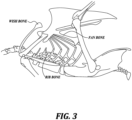
- First and second sets of ribs extend generally rearwardly, outwardly, and downwardly from a bottom forward portion of the sternum/keel on each side of the sternum/keel (only one set of ribs shown in FIG. 3 ).
- a first fan bone extends generally axially and outwardly from the bottom forward portion of the sternum/keel above a first set of ribs.
- a second fan bone extends generally axially and outwardly from the bottom forward portion of the sternum/keel above a second set of ribs (not shown in FIG. 3 ).
- the fan bone has a thin, elongated, generally flattened shape with a flared or enlarged portion located at its end distally from the sternum. The thin end of the fan bone is integrally formed with the bottom forward portion of the sternum/keel.
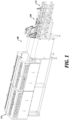
- the tensioning assembly 128 is configured to optimally position and support the wings of the carcass relative to the body of the poultry carcass during separation.
- the tensioning assembly 128 pulls the wings outwardly and upwardly from the carcass body to support the wings of the carcass in a spaced apart relationship relative to the breast muscles as the carcass moves downstream passed the first and second blade assemblies 120 and 122.
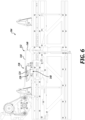
- the first guide bar portion 140 may extend generally vertically or diagonally upwardly (in the downstream direction) from the frame, and the second guide bar portion 144 may extend generally horizontally along a length of the processing line from the first guide bar portion 140.
- the first guide bar portion 140 may extend vertically a predefined distance to position the second guide bar portion 144 to engage an underside portion of each respective wing.
- the overall length or height of the first guide bar portion 140 may be adapted for the size of the poultry carcass being processed.
- the second guide bar portion 144 of the first and second guide bars 132 and 136 are spaced apart a predefined distance to accommodate the size of the poultry carcass being processed.
- the second guide bar portion 144 may extend gradually away from a horizontal conveyance plane of the processing line as it extends in the downstream direction. At the same time, the second guide bar portion 144 may extend gradually toward a center longitudinal axis of the processing line as it extends in the downstream direction. Such a configuration causes each respective wing, when supported by the second guide bar portion 144, to be held in tension relative to the corresponding breast muscle as the poultry carcass moves downstream passed the first and second blade assemblies 120 and 122.
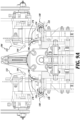
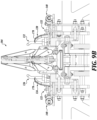
- the first and second blade assemblies 120 and 122 will now be described in detail.
- the first and second blade assemblies 120 and 122 are identical; and therefore, only the first blade assembly 120 will be described.
- the first blade assembly 120 includes a blade 124 that is moveable into and out of engagement with a poultry carcass as it moves past the first blade assembly 120.
- the blade 124 that is moveable into and out of engagement with a poultry carcass with an actuator assembly 148.
- the actuator assembly 148 may include a linear actuator 152 having a cylinder 154 and a piston 156, with the closed end of the cylinder 154 pivotally secured to the frame or another portion of the poultry processing machine 100/carcass separation assembly 104.
- the piston 156 which selectively extends from the cylinder 154 when the linear actuator 152 is activated, is pivotally coupled a blade support frame 158, which is pivotally secured to the poultry processing frame at a pivot point 162.
- the piston 156 moves the blade 124 into or out of engagement with the side of the carcass.
- the piston 156 retracts into the cylinder 154 to pivot the blade support frame 158 clockwise about its pivot point 162.
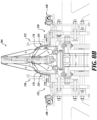
- the blade 124 moves into engagement with the side of the carcass, as shown in FIG. 7B .
- the piston 156 retracts into the cylinder 154 a specified length, as determined by the position of the side of the carcass, to locate the blade 124 in an engagement position with the carcass.
- the piston 156 extends from the cylinder 154 to pivot the blade support frame 158 counterclockwise about its pivot point 162.
- the blade 124 moves out of engagement with the side of the carcass (a "disengaged position"), as shown in FIG. 7A .
- the disengaged position may be defined as being spaced from the exterior of the carcass (including the separated breast) after breast separation. In this manner, the blade 124 does not interfere with any trailing portions of the carcass as it moves past the blade 124.
- the engaged and disengaged positions of the blade 124 may be defined at least in part by considering known size values of a poultry carcass before and/or after breast separation. For instance, width values of different portions of a poultry carcass may be used to determine optimal engaged and disengaged positions of the blade 124 for that poultry type.
- the width values may include the average width of the entire carcass across the carcass rib cage area (e.g., from the skin outer surface on a first side of the carcass at the rib cage to the skin outer surface on a second side of the carcass at the rib cage) and the average width of the skeletal frame across the carcass rib cage area (e.g., from the outermost rib bones on a first side of the carcass to the outermost rib bones on a second side of the carcass). Other values may also be used.
- each blade 124 may be just outside the outermost rib bones on each side of the carcass (to facilitate insertion near the breast muscle attachment to the rib cage area), and the disengaged position of each blade 124 may be a position that is spaced from the outermost portion of the carcass tissue (e.g., the skin exterior surface) at the rib cage area (such that the blade 124 does not interfere with any trailing portions of the carcass as it moves past the blade 124).
- the outermost portion of the carcass tissue e.g., the skin exterior surface
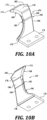
- the blade 124 includes a body 166 that may be made of stainless steel or any other suitably rigid and food-safe material.
- the body 166 includes a first end 170 opposite a second end 172, wherein the first end 170 extends from the blade support frame 158 of the actuator assembly 148.
- the body 166 may extend upwardly from a substantially transverse mounting portion 176 that attaches to the blade support frame 158.
- the blade 124 separates the breast muscle from the carcass with a shearing force as the carcass moves past the blade in a downstream direction.
- the blade 124 includes a shearing edge portion 198 defined along at least a portion of the curved upstream edge 182, such as along the upper portion 178 of the body 166.
- the shearing edge portion 198 is generally configured to separate the breast muscle from the carcass with a shearing force rather than a cutting or tearing force as the carcass moves past the blade in a downstream direction.
- the shearing edge portion 198 is defined as a tapered edge of the curved upstream edge 182.
- the shearing edge portion 198 is generally configured to separate the breast muscle from the carcass with a shearing force rather than a cutting or tearing force.
- the tapered edge of the shearing edge portion 198 defines a shearing edge that is that is sufficiently sharp to penetrate tissue of the poultry carcass but sufficiently dull to substantially prevent the shearing edge from cutting the tissue of the poultry carcass.
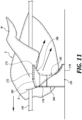
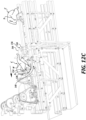
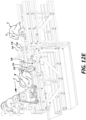
- the blade 124 is engaged with the carcass C with the wing W of the carcass held outwardly and upwardly from the carcass body by the second guide bar portion 144 of the tensioning assembly 128. As the carcass C is moved downstream past the blade 124, the blade 124 shears a top of the breast muscle from the carcass C before shearing lower portions of the breast muscle. In effect, the curved shape of the shearing edge portion 198 generally shears the top of breast muscle from the carcass C diagonally downwardly across the carcass body.
- the shearing edge portion 198 between a center of the blade body 166 and the second end 172 may have a suitable radius of curvature.
- Such a configuration allows a top of the shearing edge portion 198 (i.e., near the second end 172 of the blade 124) to initiate a shearing force near a shoulder attachment area of the breast muscle. After initiation of the shearing force, the top of the shearing edge portion 198 shears the breast muscle away from the carcass bones as the carcass C moves downstream past the blade 124.
- the shearing edge portion 198 As the carcass C continues to move downstream past the blade 124, lower portions of the shearing edge portion 198 start shearing the breast muscle away from the carcass bones. In other words, the shearing edge portion 198 gradually shears the breast muscle away from the carcass bones as the shearing edge portion 198 engages the carcass along its arced length.
- the blade 124 continues to shear the breast muscle away from the carcass bones in this manner, with the top of the shearing edge portion 198 shearing an upper portion of the breast muscle away from the carcass bones before a lower portion of the shearing edge portion 198 shears a corresponding lower portion of the breast muscle away from the carcass. In effect, the blade 124 generally shears the breast muscle away from the bones of the carcass C in a diagonally downwardly fashion across the carcass body as noted above.
- the bottom portion of the curved upstream edge 182 of the blade 124 may have substantially the same radius of curvature as the upper shearing edge portion 198.
- the bottom portion of the curved upstream edge 182 of the blade 124 need not include a tapered shearing edge as defined on the shearing edge portion 198. Rather, the bottom portion of the curved upstream edge 182 of the blade 124 may be curved to reduce any shearing or tearing effects of the bottom portion of the curved upstream edge 182 of the blade 124.
- the curved nature of the bottom portion of the curved upstream edge 182 of the blade 124 may help facilitate separation of the carcass skin during breast muscle separation. In this manner, the breast muscle can be easily removed downstream at the breast muscle removal station/area.
- the actuator assembly 148 is activated to move the corresponding blade 124 into an engaged position.
- the actuator assembly 148 may be activated when the cone carrying the carcass C reaches a designated linear position along the conveyance path. For instance, the actuator assembly 148 may be activated to move the corresponding blade 124 into an engaged position just before the carcass C reaches the blade.
- the conveyance path location for actuator activation may be determined by any suitable means, such as by using one or more sensors (e.g., a linear encoder) to detect the location of at least one cone moving along the poultry processing machine 100 in relation to a blade-engaging position.
- the sensor such as a linear encoder, may output one or more signals to a controller of the carcass separation assembly 104 and/or the actuator assembly 148 for activating the linear actuator 152 to engage or disengage the blade 124.
- the blade 124 starts to shear a top of the breast muscle from the bones of the carcass C, as described above.
- the blade 124 continues to shear the breast muscle from the carcass C in a generally diagonally downward manner, e.g., with the top portion of the shearing edge portion 198 shearing the top portion of the breast muscle away from the carcass before the lower portions of the breast muscle are sheared away.
- the carcass C moves past the blade 124 until the entire breast muscle is substantially sheared away from the carcass C.
- the cone carrying the carcass C may be moved back into a substantially vertical orientation (if needed for the next steps of the processing line, such as breast removal).
- the actuator assembly 148 may be activated to move the corresponding blade 124 into a disengaged position.
- the actuator assembly 148 may be activated when the cone carrying the carcass C reaches a designated linear position along the conveyance path past the blade 124. For instance, the actuator assembly 148 may be activated to move the corresponding blade 124 into a disengaged position just after the carcass C passes the blade.
- the conveyance path location for actuator activation may be determined by any suitable means as discussed above (e.g., a linear encoder). It should be appreciated that in some embodiments, the blade 124 is continuously maintained in an engaged position and moves into an out of engagement with a carcass as it moves past the blade.
- the breast muscle is separated from each side of the carcass with substantially no bones attached to the breast muscle, without leaving substantial muscle tissue attached to the carcass bones, and without significantly damaging the breast muscle (such as by separating with tearing).
- the inventors found that the breast muscle is separated from each side of the carcass without any bones attached to the breast muscle about 95% of the time. Furthermore, in most instances, the breast muscle is separated from the carcass without leaving substantial muscle tissue attached to the carcass bones.
- the blade 124 (together with the tensioning assembly 128) is configured to shear the breast muscle away from the carcass skeleton by essentially facilitating a peeling effect of the breast muscle away from the carcass. More specifically, as the carcass C moves past the blade 124 with the wings W supported/held up by the tensioning assembly 128, the blade 124 separates the connective tissue between the breast muscle and the carcass bones, such as the fan bone. In other words, the blade 124 breaks up or otherwise relieves the surface tension in the adhesions (e.g., facia, membranes, etc.) between the breast muscle and the carcass bones. In effect, the breast muscle, which is slightly pulled upwardly and outwardly by the wings W supported/held up by the tensioning assembly 128, peels/shears off the carcass bones.
- the adhesions e.g., facia, membranes, etc.
- the blade 124 shears the breast muscle from the carcass C in a generally diagonally downward manner.
- the fan bone extends generally diagonally downward from the sternum/keel along the poultry carcass.
- each breast muscle is peeled/sheared away from the corresponding fan bone generally along its length, substantially from the thin end of the fan bone to the enlarged end of the fan bone. Peeling/shearing the breast muscle from the carcass C in a generally diagonally downward manner helps minimize any pulling forces on the fan bone, which therefore minimizes the possibility of the fan bone breaking off or otherwise being pulled off with the breast muscle during breast muscle separation.
- FIG. 13 depicts an image of a carcass C having the breast muscle separated from a side of the carcass using the system and methods described herein.
- the breast muscle was separated from the carcass with no bones attached to the breast muscle and without significant damage to the breast muscle tissue.
- the muscle M left attached to the bones of the carcass C was minimal, as can be seen by comparing to the muscle M left attached to the bones of the carcass C of FIG. 4 . Accordingly, it can be appreciated that by using the system and methods described herein, the breast muscle can be optimally separated from a poultry carcass for later removal from the carcass.
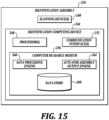
- the blade actuator assembly 232 may be activated to move the blade 124 into an optimal engaging position to separate the breast muscles of a carcass as well as into an optimal disengaged position that minimizes interference of the blade 124 with a trailing portion of the carcass as it moves past the blade after breast separation.
- the data processing engine 260 may then retrieve known values for that type of poultry carcass from the one or more data stores 268. Based on the processing of those known values, the data processing engine 260 may output one or more signals to the blade actuator assembly 232 for activating the linear actuator to move the blade 124 into the desired engaged or disengaged position.
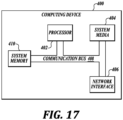
- computer-readable medium refers to a removable or nonremovable device that implements any technology capable of storing information in a volatile or nonvolatile manner to be read by a processor of a computing device, including but not limited to: a hard drive; a flash memory; a solid state drive; random-access memory (RAM); read-only memory (ROM); a CD-ROM, a DVD, or other disk storage; a magnetic cassette; a magnetic tape; and a magnetic disk storage.
- engine refers to logic embodied in hardware or software instructions, which can be written in one or more programming languages, including but not limited to C, C++, C#, COBOL, JAVA TM , PHP, Perl, HTML, CSS, JavaScript, VBScript, ASPX, Go, and Python.
- An engine may be compiled into executable programs or written in interpreted programming languages.
- Software engines may be callable from other engines or from themselves.
- the engines described herein refer to logical modules that can be merged with other engines or can be divided into sub-engines.
- the method 300 may proceed to block 320, where a computing device (such as the identification computing device 244 of the identification assembly 224) identifies at least one of a size, shape, contour, and type of the poultry carcass.
- a computing device such as the identification computing device 244 of the identification assembly 224.
- the data processing engine 260 of the identification computing device 244 may retrieve known size values (e.g., width values of different portions of a poultry carcass) of a type of poultry carcass or other data associated with a type of poultry carcass from the one or more data stores 268 or another source.
- the data processing engine 260 may process that data to determine an optimal engaged and disengaged position of the blade 124 for the poultry type associated with the processed values, as discussed above.
- the method 300 may include: scanning, with at least one scanning device, the poultry carcass; sending, with the at least one scanning device, scan image data to the computing device; processing, with the computing device, the scan image data to identify at least one the size, shape, contour, and type of the poultry carcass; and sending, with the computing device, at least one output signal to the actuator assembly of the blade assemblies to move the blade a selected distance toward the corresponding side of the poultry carcass based on the identification.
- references in the specification to "one embodiment,” “an embodiment,” “an exemplary embodiment,” etc., indicate that the embodiment described may include a particular feature, structure, or characteristic, but every embodiment may or may not necessarily include that particular feature, structure, or characteristic. Moreover, such phrases are not necessarily referring to the same embodiment. Further, when a particular feature, structure, or characteristic is described in connection with an embodiment, it is submitted that it is within the knowledge of one skilled in the art to affect such feature, structure, or characteristic in connection with other embodiments whether or not explicitly described. Additionally, it should be appreciated that items included in a list in the form of "at least one A, B, and C” can mean (A); (B); (C); (A and B); (B and C); (A and C); or (A, B, and C). Similarly, items listed in the form of "at least one of A, B, or C” can mean (A); (B); (C); (A and B); (B and C); (A and C); or (A, B, and C).
- carcass means a portion of a dressed bird from which the internal organs, head, neck, pelvis, and optionally the thighs and legs have been removed.
- Downstream is the longitudinal direction in which the product moves; "upstream” is the opposite.
- the "leading” edge of a component is the edge facing the downstream direction; “trailing” is the opposite.
- the “distal” end of an elongate member is its free end; “proximal” is the opposite.
Landscapes
- Engineering & Computer Science (AREA)
- Life Sciences & Earth Sciences (AREA)
- Wood Science & Technology (AREA)
- Zoology (AREA)
- Food Science & Technology (AREA)
- Multimedia (AREA)
- Signal Processing (AREA)
- Human Computer Interaction (AREA)
- Physics & Mathematics (AREA)
- General Physics & Mathematics (AREA)
- Theoretical Computer Science (AREA)
- Processing Of Meat And Fish (AREA)
Applications Claiming Priority (1)
| Application Number | Priority Date | Filing Date | Title |
|---|---|---|---|
| US18/069,849 US12185731B2 (en) | 2022-12-21 | 2022-12-21 | System and method for separating breast from poultry carcass |
Publications (1)
| Publication Number | Publication Date |
|---|---|
| EP4393307A1 true EP4393307A1 (fr) | 2024-07-03 |
Family
ID=89223675
Family Applications (1)
| Application Number | Title | Priority Date | Filing Date |
|---|---|---|---|
| EP23217170.2A Pending EP4393307A1 (fr) | 2022-12-21 | 2023-12-15 | Système et procédé de séparation de la poitrine de carcasses de volaille |
Country Status (3)
| Country | Link |
|---|---|
| US (2) | US12185731B2 (fr) |
| EP (1) | EP4393307A1 (fr) |
| CN (1) | CN118216550A (fr) |
Citations (7)
| Publication number | Priority date | Publication date | Assignee | Title |
|---|---|---|---|---|
| US4586215A (en) * | 1982-09-24 | 1986-05-06 | Pieter Meyn | Apparatus for removing the breast from the eviscerated carcass of chickens or the like |
| US5466185A (en) | 1994-08-08 | 1995-11-14 | Foodcraft Equipment Company | Removing breast meat from poultry |
| US5585605A (en) | 1993-11-05 | 1996-12-17 | Microfield Graphics, Inc. | Optical-scanning system employing laser and laser safety control |
| EP1956919A2 (fr) * | 2005-12-09 | 2008-08-20 | Stork Pmt B.V. | Procede et dispositif de traitement d'une carcasse de volaille abattue |
| US10595539B2 (en) | 2018-01-03 | 2020-03-24 | Prime Equipment Group, Llc | Apparatus and method for deboning poultry breasts |
| US10654185B2 (en) | 2016-07-29 | 2020-05-19 | John Bean Technologies Corporation | Cutting/portioning using combined X-ray and optical scanning |
| US10721947B2 (en) | 2016-07-29 | 2020-07-28 | John Bean Technologies Corporation | Apparatus for acquiring and analysing product-specific data for products of the food processing industry as well as a system comprising such an apparatus and a method for processing products of the food processing industry |
Family Cites Families (14)
| Publication number | Priority date | Publication date | Assignee | Title |
|---|---|---|---|---|
| US3533130A (en) * | 1969-04-30 | 1970-10-13 | Prince Mfg Co | Means for removing patella |
| GB1513243A (en) * | 1974-05-14 | 1978-06-07 | Unilever Ltd | Method and apparatus for filleting fish |
| NL8800004A (nl) * | 1988-01-05 | 1989-08-01 | Meyn Maschf | Inrichting voor het in delen snijden van de vleugels van gevogelte. |
| NL9200037A (nl) * | 1992-01-10 | 1993-08-02 | Stork Pmt | Werkwijze en inrichting voor het fileren van de romp van een geslachte vogel. |
| DE19500014A1 (de) * | 1995-01-03 | 1996-07-04 | Nordischer Maschinenbau | Einrichtung zum Zerlegen der Flügel von Geflügelkörper |
| US5569069A (en) * | 1995-01-18 | 1996-10-29 | Foodcraft Equipment Company | Apparatus for cutting wings from poultry |
| GB9712015D0 (en) * | 1997-06-11 | 1997-08-06 | Filar Limited | Procedure and apparatus for deboning poultry |
| US5954574A (en) * | 1997-08-12 | 1999-09-21 | Verrijp; Bastiaan | Wing remover |
| NL2001534C2 (nl) * | 2008-04-29 | 2009-10-30 | Stork Pmt | Inrichting, systeem en werkwijze voor het schoonmaken van een karkas of karkasdeel van geslacht gevogelte. |
| DE102010018057A1 (de) * | 2010-04-21 | 2011-10-27 | Nordischer Maschinenbau Rud. Baader Gmbh + Co Kg | Vorrichtung und Verfahren zum Filetieren von geköpften und entweideten Fischen |
| US8430728B2 (en) * | 2011-02-14 | 2013-04-30 | Foodmate Bv | Special cut poultry wing cutter |
| NL2008021C2 (en) * | 2011-12-22 | 2013-06-26 | Meyn Food Proc Technology Bv | Method and device for processing a carcass part of slaughtered poultry. |
| US9215880B2 (en) * | 2012-04-23 | 2015-12-22 | Baader Linco, Inc. | Combination automated and hand deboning apparatus and method with single unit processing |
| WO2017070701A1 (fr) * | 2015-10-22 | 2017-04-27 | Baader Linco, Inc. | Outil de séparation |
-
2022
- 2022-12-21 US US18/069,849 patent/US12185731B2/en active Active
-
2023
- 2023-12-15 EP EP23217170.2A patent/EP4393307A1/fr active Pending
- 2023-12-21 CN CN202311771036.5A patent/CN118216550A/zh active Pending
-
2024
- 2024-12-13 US US18/980,882 patent/US20250176569A1/en not_active Abandoned
Patent Citations (7)
| Publication number | Priority date | Publication date | Assignee | Title |
|---|---|---|---|---|
| US4586215A (en) * | 1982-09-24 | 1986-05-06 | Pieter Meyn | Apparatus for removing the breast from the eviscerated carcass of chickens or the like |
| US5585605A (en) | 1993-11-05 | 1996-12-17 | Microfield Graphics, Inc. | Optical-scanning system employing laser and laser safety control |
| US5466185A (en) | 1994-08-08 | 1995-11-14 | Foodcraft Equipment Company | Removing breast meat from poultry |
| EP1956919A2 (fr) * | 2005-12-09 | 2008-08-20 | Stork Pmt B.V. | Procede et dispositif de traitement d'une carcasse de volaille abattue |
| US10654185B2 (en) | 2016-07-29 | 2020-05-19 | John Bean Technologies Corporation | Cutting/portioning using combined X-ray and optical scanning |
| US10721947B2 (en) | 2016-07-29 | 2020-07-28 | John Bean Technologies Corporation | Apparatus for acquiring and analysing product-specific data for products of the food processing industry as well as a system comprising such an apparatus and a method for processing products of the food processing industry |
| US10595539B2 (en) | 2018-01-03 | 2020-03-24 | Prime Equipment Group, Llc | Apparatus and method for deboning poultry breasts |
Also Published As
| Publication number | Publication date |
|---|---|
| CN118216550A (zh) | 2024-06-21 |
| US20250176569A1 (en) | 2025-06-05 |
| US20240206483A1 (en) | 2024-06-27 |
| US12185731B2 (en) | 2025-01-07 |
Similar Documents
| Publication | Publication Date | Title |
|---|---|---|
| US20220132872A1 (en) | Portioning/trimming of rib primal cuts | |
| AU2012338938B2 (en) | Method and installation for handling poultry | |
| US5147240A (en) | Thigh joint separator and carcass halving apparatus | |
| KR102941949B1 (ko) | 매달려 있는 반쪽 돼지 도체로부터 앞쪽 끝 절단 | |
| DK182110B1 (en) | Apparatus, system and method for filleting and pinbone removal | |
| EP3920708B1 (fr) | Découpe de portions sur la base d'imagerie | |
| EP3550982B1 (fr) | Procédé de traitement d'un objet alimentaire | |
| US5026317A (en) | Viscera excision for poultry and the like | |
| EP4393307A1 (fr) | Système et procédé de séparation de la poitrine de carcasses de volaille | |
| US10477872B1 (en) | Method and apparatus for removing wings from a poultry carcass | |
| JP2022536284A (ja) | 家禽の内臓除去方法、前内臓除去装置、内臓除去システム、及び回収装置 | |
| BR102023027050A2 (pt) | Sistema e método para separar peito a partir de carcaça de ave | |
| US20240081355A1 (en) | Sub-primal cut identification and packaging optimization system and method | |
| US20250113836A1 (en) | System and method for processing workpieces | |
| CA3168747C (fr) | Dispositif et procede de decoupe en filets et de retrait d'aretes centrales | |
| CN110583743A (zh) | 一种用于甲鱼的快速宰杀装置 |
Legal Events
| Date | Code | Title | Description |
|---|---|---|---|
| PUAI | Public reference made under article 153(3) epc to a published international application that has entered the european phase |
Free format text: ORIGINAL CODE: 0009012 |
|
| STAA | Information on the status of an ep patent application or granted ep patent |
Free format text: STATUS: THE APPLICATION HAS BEEN PUBLISHED |
|
| AK | Designated contracting states |
Kind code of ref document: A1 Designated state(s): AL AT BE BG CH CY CZ DE DK EE ES FI FR GB GR HR HU IE IS IT LI LT LU LV MC ME MK MT NL NO PL PT RO RS SE SI SK SM TR |
|
| RAP1 | Party data changed (applicant data changed or rights of an application transferred) |
Owner name: JOHN BEAN TECHNOLOGIES CORPORATION |
|
| STAA | Information on the status of an ep patent application or granted ep patent |
Free format text: STATUS: REQUEST FOR EXAMINATION WAS MADE |
|
| 17P | Request for examination filed |
Effective date: 20241219 |
|
| STAA | Information on the status of an ep patent application or granted ep patent |
Free format text: STATUS: EXAMINATION IS IN PROGRESS |
|
| 17Q | First examination report despatched |
Effective date: 20250829 |
|
| RIN1 | Information on inventor provided before grant (corrected) |
Inventor name: MARTIN, STEVEN Inventor name: MROZ, CEZARY Inventor name: REIS, RICHARD K. Inventor name: JONES, BARRY K. Inventor name: LOGAN, CAMERON |