EP4393401A2 - Procédé et système d'affichage de signaux ecg à partir de multiples canaux - Google Patents
Procédé et système d'affichage de signaux ecg à partir de multiples canaux Download PDFInfo
- Publication number
- EP4393401A2 EP4393401A2 EP23220285.3A EP23220285A EP4393401A2 EP 4393401 A2 EP4393401 A2 EP 4393401A2 EP 23220285 A EP23220285 A EP 23220285A EP 4393401 A2 EP4393401 A2 EP 4393401A2
- Authority
- EP
- European Patent Office
- Prior art keywords
- electrodes
- electrode
- locations
- heart
- electrograms
- Prior art date
- Legal status (The legal status is an assumption and is not a legal conclusion. Google has not performed a legal analysis and makes no representation as to the accuracy of the status listed.)
- Pending
Links
Images




Classifications
-
- A—HUMAN NECESSITIES
- A61—MEDICAL OR VETERINARY SCIENCE; HYGIENE
- A61B—DIAGNOSIS; SURGERY; IDENTIFICATION
- A61B5/00—Measuring for diagnostic purposes; Identification of persons
- A61B5/24—Detecting, measuring or recording bioelectric or biomagnetic signals of the body or parts thereof
- A61B5/25—Bioelectric electrodes therefor
-
- A—HUMAN NECESSITIES
- A61—MEDICAL OR VETERINARY SCIENCE; HYGIENE
- A61B—DIAGNOSIS; SURGERY; IDENTIFICATION
- A61B5/00—Measuring for diagnostic purposes; Identification of persons
- A61B5/24—Detecting, measuring or recording bioelectric or biomagnetic signals of the body or parts thereof
- A61B5/316—Modalities, i.e. specific diagnostic methods
- A61B5/318—Heart-related electrical modalities, e.g. electrocardiography [ECG]
- A61B5/339—Displays specially adapted therefor
- A61B5/343—Potential distribution indication
-
- A—HUMAN NECESSITIES
- A61—MEDICAL OR VETERINARY SCIENCE; HYGIENE
- A61B—DIAGNOSIS; SURGERY; IDENTIFICATION
- A61B5/00—Measuring for diagnostic purposes; Identification of persons
- A61B5/24—Detecting, measuring or recording bioelectric or biomagnetic signals of the body or parts thereof
- A61B5/316—Modalities, i.e. specific diagnostic methods
- A61B5/318—Heart-related electrical modalities, e.g. electrocardiography [ECG]
- A61B5/339—Displays specially adapted therefor
-
- A—HUMAN NECESSITIES
- A61—MEDICAL OR VETERINARY SCIENCE; HYGIENE
- A61B—DIAGNOSIS; SURGERY; IDENTIFICATION
- A61B18/00—Surgical instruments, devices or methods for transferring non-mechanical forms of energy to or from the body
-
- A—HUMAN NECESSITIES
- A61—MEDICAL OR VETERINARY SCIENCE; HYGIENE
- A61B—DIAGNOSIS; SURGERY; IDENTIFICATION
- A61B18/00—Surgical instruments, devices or methods for transferring non-mechanical forms of energy to or from the body
- A61B18/04—Surgical instruments, devices or methods for transferring non-mechanical forms of energy to or from the body by heating
- A61B18/12—Surgical instruments, devices or methods for transferring non-mechanical forms of energy to or from the body by heating by passing a current through the tissue to be heated, e.g. high-frequency current
- A61B18/1206—Generators therefor
-
- A—HUMAN NECESSITIES
- A61—MEDICAL OR VETERINARY SCIENCE; HYGIENE
- A61B—DIAGNOSIS; SURGERY; IDENTIFICATION
- A61B18/00—Surgical instruments, devices or methods for transferring non-mechanical forms of energy to or from the body
- A61B18/04—Surgical instruments, devices or methods for transferring non-mechanical forms of energy to or from the body by heating
- A61B18/12—Surgical instruments, devices or methods for transferring non-mechanical forms of energy to or from the body by heating by passing a current through the tissue to be heated, e.g. high-frequency current
- A61B18/14—Probes or electrodes therefor
-
- A—HUMAN NECESSITIES
- A61—MEDICAL OR VETERINARY SCIENCE; HYGIENE
- A61B—DIAGNOSIS; SURGERY; IDENTIFICATION
- A61B5/00—Measuring for diagnostic purposes; Identification of persons
- A61B5/24—Detecting, measuring or recording bioelectric or biomagnetic signals of the body or parts thereof
- A61B5/25—Bioelectric electrodes therefor
- A61B5/279—Bioelectric electrodes therefor specially adapted for particular uses
- A61B5/28—Bioelectric electrodes therefor specially adapted for particular uses for electrocardiography [ECG]
- A61B5/283—Invasive
-
- A—HUMAN NECESSITIES
- A61—MEDICAL OR VETERINARY SCIENCE; HYGIENE
- A61B—DIAGNOSIS; SURGERY; IDENTIFICATION
- A61B5/00—Measuring for diagnostic purposes; Identification of persons
- A61B5/24—Detecting, measuring or recording bioelectric or biomagnetic signals of the body or parts thereof
- A61B5/25—Bioelectric electrodes therefor
- A61B5/279—Bioelectric electrodes therefor specially adapted for particular uses
- A61B5/28—Bioelectric electrodes therefor specially adapted for particular uses for electrocardiography [ECG]
- A61B5/283—Invasive
- A61B5/287—Holders for multiple electrodes, e.g. electrode catheters for electrophysiological study [EPS]
-
- A—HUMAN NECESSITIES
- A61—MEDICAL OR VETERINARY SCIENCE; HYGIENE
- A61B—DIAGNOSIS; SURGERY; IDENTIFICATION
- A61B5/00—Measuring for diagnostic purposes; Identification of persons
- A61B5/74—Details of notification to user or communication with user or patient; User input means
- A61B5/742—Details of notification to user or communication with user or patient; User input means using visual displays
- A61B5/743—Displaying an image simultaneously with additional graphical information, e.g. symbols, charts, function plots
-
- A—HUMAN NECESSITIES
- A61—MEDICAL OR VETERINARY SCIENCE; HYGIENE
- A61B—DIAGNOSIS; SURGERY; IDENTIFICATION
- A61B18/00—Surgical instruments, devices or methods for transferring non-mechanical forms of energy to or from the body
- A61B2018/00315—Surgical instruments, devices or methods for transferring non-mechanical forms of energy to or from the body for treatment of particular body parts
- A61B2018/00345—Vascular system
- A61B2018/00351—Heart
-
- A—HUMAN NECESSITIES
- A61—MEDICAL OR VETERINARY SCIENCE; HYGIENE
- A61B—DIAGNOSIS; SURGERY; IDENTIFICATION
- A61B18/00—Surgical instruments, devices or methods for transferring non-mechanical forms of energy to or from the body
- A61B2018/00315—Surgical instruments, devices or methods for transferring non-mechanical forms of energy to or from the body for treatment of particular body parts
- A61B2018/00434—Neural system
-
- A—HUMAN NECESSITIES
- A61—MEDICAL OR VETERINARY SCIENCE; HYGIENE
- A61B—DIAGNOSIS; SURGERY; IDENTIFICATION
- A61B18/00—Surgical instruments, devices or methods for transferring non-mechanical forms of energy to or from the body
- A61B2018/00571—Surgical instruments, devices or methods for transferring non-mechanical forms of energy to or from the body for achieving a particular surgical effect
- A61B2018/00577—Ablation
-
- A—HUMAN NECESSITIES
- A61—MEDICAL OR VETERINARY SCIENCE; HYGIENE
- A61B—DIAGNOSIS; SURGERY; IDENTIFICATION
- A61B18/00—Surgical instruments, devices or methods for transferring non-mechanical forms of energy to or from the body
- A61B2018/00571—Surgical instruments, devices or methods for transferring non-mechanical forms of energy to or from the body for achieving a particular surgical effect
- A61B2018/00613—Irreversible electroporation
-
- A—HUMAN NECESSITIES
- A61—MEDICAL OR VETERINARY SCIENCE; HYGIENE
- A61B—DIAGNOSIS; SURGERY; IDENTIFICATION
- A61B18/00—Surgical instruments, devices or methods for transferring non-mechanical forms of energy to or from the body
- A61B2018/00964—Features of probes
-
- A—HUMAN NECESSITIES
- A61—MEDICAL OR VETERINARY SCIENCE; HYGIENE
- A61B—DIAGNOSIS; SURGERY; IDENTIFICATION
- A61B18/00—Surgical instruments, devices or methods for transferring non-mechanical forms of energy to or from the body
- A61B18/04—Surgical instruments, devices or methods for transferring non-mechanical forms of energy to or from the body by heating
- A61B18/12—Surgical instruments, devices or methods for transferring non-mechanical forms of energy to or from the body by heating by passing a current through the tissue to be heated, e.g. high-frequency current
- A61B18/1206—Generators therefor
- A61B2018/1273—Generators therefor including multiple generators in one device
-
- A—HUMAN NECESSITIES
- A61—MEDICAL OR VETERINARY SCIENCE; HYGIENE
- A61B—DIAGNOSIS; SURGERY; IDENTIFICATION
- A61B18/00—Surgical instruments, devices or methods for transferring non-mechanical forms of energy to or from the body
- A61B18/04—Surgical instruments, devices or methods for transferring non-mechanical forms of energy to or from the body by heating
- A61B18/12—Surgical instruments, devices or methods for transferring non-mechanical forms of energy to or from the body by heating by passing a current through the tissue to be heated, e.g. high-frequency current
- A61B18/14—Probes or electrodes therefor
- A61B2018/1467—Probes or electrodes therefor using more than two electrodes on a single probe
-
- A—HUMAN NECESSITIES
- A61—MEDICAL OR VETERINARY SCIENCE; HYGIENE
- A61B—DIAGNOSIS; SURGERY; IDENTIFICATION
- A61B5/00—Measuring for diagnostic purposes; Identification of persons
- A61B5/06—Devices, other than using radiation, for detecting or locating foreign bodies ; Determining position of diagnostic devices within or on the body of the patient
- A61B5/061—Determining position of a probe within the body employing means separate from the probe, e.g. sensing internal probe position employing impedance electrodes on the surface of the body
- A61B5/062—Determining position of a probe within the body employing means separate from the probe, e.g. sensing internal probe position employing impedance electrodes on the surface of the body using magnetic field
-
- A—HUMAN NECESSITIES
- A61—MEDICAL OR VETERINARY SCIENCE; HYGIENE
- A61B—DIAGNOSIS; SURGERY; IDENTIFICATION
- A61B5/00—Measuring for diagnostic purposes; Identification of persons
- A61B5/24—Detecting, measuring or recording bioelectric or biomagnetic signals of the body or parts thereof
- A61B5/316—Modalities, i.e. specific diagnostic methods
- A61B5/318—Heart-related electrical modalities, e.g. electrocardiography [ECG]
- A61B5/346—Analysis of electrocardiograms
- A61B5/349—Detecting specific parameters of the electrocardiograph cycle
- A61B5/361—Detecting fibrillation
-
- A—HUMAN NECESSITIES
- A61—MEDICAL OR VETERINARY SCIENCE; HYGIENE
- A61B—DIAGNOSIS; SURGERY; IDENTIFICATION
- A61B5/00—Measuring for diagnostic purposes; Identification of persons
- A61B5/68—Arrangements of detecting, measuring or recording means, e.g. sensors, in relation to patient
- A61B5/6846—Arrangements of detecting, measuring or recording means, e.g. sensors, in relation to patient specially adapted to be brought in contact with an internal body part, i.e. invasive
- A61B5/6847—Arrangements of detecting, measuring or recording means, e.g. sensors, in relation to patient specially adapted to be brought in contact with an internal body part, i.e. invasive mounted on an invasive device
- A61B5/6852—Catheters
- A61B5/6858—Catheters with a distal basket, e.g. expandable basket
Definitions
- This disclosure relates generally to a method for relaying information obtained from multiple ECG channels to a user, and specifically to a method for selectively providing a dynamic display of ECG signals captured from multiple ECG channels.
- This activity may be obtained from a plurality of electrodes positioned on a distal tip of an intracardiac catheter inserted into one or more chambers of the heart.
- a plurality of the obtained signals may be displayed to a user, such as a physician performing the operation.
- Modern catheters have a plurality of electrodes distributed over a plurality of splines of the catheter, Where at any given time, each electrode samples the electrical activity at a location. For example, some catheters may have dozens or even hundreds of electrodes.
- system 10 may include one or more electrode patches 38 positioned for skin contact on patient 23 to establish location reference for location pad 25 as well as impedance-based tracking of electrodes 26.
- impedance-based tracking electrical current is directed to electrodes 26 and sensed at electrode skin patches 38 so that the location of each electrode can be triangulated via the electrode patches 38. Details of the impedance-based location tracking technology are described in US Patent Nos. 7,536,218 ; 7,756,576 ; 7,848,787 ; 7,869,865 ; and 8,456,182 .
- System 10 displays over display device 27 a plurality of electrograms 21 captured with electrodes 26 of catheter 14 and/or body surface ECG electrodes 18 and.
- Recorder 11 may include pacing capability for pacing the heart rhythm and/or may be electrically connected to a standalone pacer.
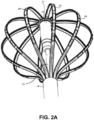
- FIG. 2A showing a more detailed view of the basket-shaped electrode assembly 28 of Fig. 1 .
- Electrode assembly 28 may be mounted on a distal end of catheter 14. Electrode assembly 28 may comprise electrode-carrying splines 22 which may be made of flexible polymer circuit strips, each carrying a plurality of electrodes 26, e.g., 10 arms carrying ten electrodes 26 each, providing a total of 100 electrodes. In other embodiments, electrode assembly 28 may carry between about five and about ten splines, for example about eight splines. In some embodiments, electrodes 26 may not be disposed, or may be disposed more sparsely, on the proximal portions of splines 22.
- electrograms are obtained which are taken by a plurality of electrodes distally disposed on a catheter inserted into one or more chambers of a heart of a patient.
- Each of at least some of the electrodes obtains electrograms at a plurality of locations within the one or more chambers, such that different electrodes contribute for the assessment of electrical activity at different numbers of locations.
- An electrogram may be accepted, e.g., a data point may be selectively stored and used in the EA map based, for example, on its stability and impedance. Stability may relate to the electrode location being fixed throughout the time window for capturing the electrogram, for example the location does not change in more than a predetermined distance. Impedance may indicate whether the electrode makes contact with the heart wall, wherein only locations on the heart wall are accepted.
- the status of the respective location is determined based upon the electrogram, for example the local activation time (LAT) that is determined based on a selected reference activation timing.
- LAT local activation time
- Each location for which an accepted electrogram has been obtained may be stored and associated with the respective electrode.
- steps 300 and 304 may be performed continuously throughout the operation.
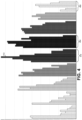
- FIG. 4 illustrating an exemplary electrode histogram, in accordance with some embodiments of the disclosure.
- Fig. 4 shows histogram 400, wherein the columns are divided into bins.
- Each bin contains columns representing the number of locations collected from each the electrodes located on one spline.
- bin 404 relates to the spline having the most useful electrodes
- bin 408 relates to the spline having the least useful electrodes.
- each bin there may be electrodes which are more or less useful.
- column 412 of bin 416 may be associated with the most useful electrode of all, while bin 416 as a whole is less useful than bin 404.
- the usefulness of a bin may be evaluated as the sum of the usefulness values of the electrodes associated with the bin.
- the division into bins is for visual clarity and is not particularly necessary. Furthermore, the visual representation of the histogram, whether the columns are grouped into bins or not, may not be relevant for a user and thus usually not displayed.
- step 312 it may be determined which electrodes are the most useful ones, i.e., the status of the largest number of locations is determined upon electrograms obtained by these electrodes, represented for example by the tallest columns of the histogram.
- the number of the most useful electrodes may be predefined, determined by the user, determined as a predefined percentage of the total number of electrodes, or the like.
- the contributing electrodes may change according to the conditions of the specific patient, physician and operation.
- different electrodes may be more or less contributing and their measurements may be used for assessing the activity in fewer or in more locations for patients having different anatomies, and even for different heart chambers of the same patient.
- the location of the electrode within the chamber may affect its contribution, as well as the way the physician uses the catheter at the relevant instant, for example in a straight or deflected manner.
- step 316 it may be determined, after a predetermined period of time, for example between about one minute and about 10 minutes whether the most useful electrodes form a stable collection, or vary substantially. For example, if at least a pre-defined number of the channels displayed remain the same over a defined period of time, 1-10 minutes, then the sub-group of channels selected may be regarded as stable. Optionally, the pre-defined number is 5-50 channels. Alternatively or additionally, if a pre-defined criteria of convergence is met, sub-group of channels selected may be regarded as stable.
- execution may continue on step 300 by collecting further electrograms.
- step 320 If the collection is stable, execution may continue on step 320.
- the electrograms obtained by the selected electrodes may be displayed to a user over a display device, while the other electrograms are not displayed, thereby keeping a concise and uncluttered display.
- electrograms 504 are dynamic and display the signals as currently obtained by the electrodes.
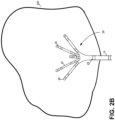
- the locations assessed according to the electrodes associated with the displayed electrograms may be marked, for example as locations 508 on the heart map.
- a user may select to see output from all electrodes positioned on a certain spline or portion of the catheter, such as a spline or portion containing the electrodes that are identified as providing the greatest number of data points on the EA map.
- step 324 it may be determined whether a predefined period of time has elapsed since the electrograms to be displayed has been selected. If the time has not elapsed, the electrograms of the selected electrodes may be continuously displayed. After the time has elapsed, the process may continue by re-assessing the count and selecting the contributing electrodes.
- the electrodes may be selected in an ongoing manner, and the display may be updated accordingly.
- the display may be updated only if there is significant change in the selected electrodes.
- FIG. 6 showing a block diagram of a computing platform 600 for determining and displaying electrograms obtained by selected electrodes, in accordance with some exemplary embodiments of the disclosure.
- computing platform 600 may be embedded within workstation 55, but may also be a standalone computing platform or embedded elsewhere and be in operative communication with workstation 55.
- Computing platform 600 may be implemented as one or more computing platforms which may be operatively connected to each other.
- one or more remote computing platforms which may be implemented for example on a cloud computer.
- Other computing platforms may be a part of a computer network of the associated organization.
- all the functionality may be provided by one or more computing platforms all being a part of the organization network.
- Computing platform 600 may comprise one or more processors 604 located on the same computing platform or not, which may be one or more Central Processing Units (CPU), microprocessors, electronic circuits, Integrated Circuits (IC) or the like.
- processors 604 may be configured to provide the required functionality, for example by loading to memory and activating the software modules stored on storage device 612 detailed below.
- Computing platform 600 may comprise a communication device 608 for communicating with other devices or other computing platforms as necessary, for example obtaining information from the catheterization controller indicating locations and electrical measurements, storing data on remote storage devices, or the like.
- Communication module 608 may be adapted to interface with any communication channel such as Local Area Network (LAN), Wide Area Network (WAN), cellular network or the like, and use any relevant communication protocol.
- LAN Local Area Network
- WAN Wide Area Network
- cellular network or the like
- Computing platform 600 may comprise a storage device 612, such as a hard disk drive, a Flash disk, a Random Access Memory (RAM), a memory chip, or the like.
- storage device 612 may retain program code operative to cause processor 604 to perform acts associated with any of the modules listed below, or steps of the method of Fig. 3 above.
- the program code may comprise one or more executable units, such as functions, libraries, standalone programs or the like, adapted to execute instructions as detailed below.
- the provided instructions may be stored on non-transitory tangible computer-readable media, such as magnetic, optical, or electronic memory.
- Storage device 612 may comprise display and I/O module 616, for rendering a display to the user to be displayed over display device 27, such as a map of the heart, plots of selected electrograms, or the like.
- Display and I/O module 616 may also be operative in receiving instructions and operation parameters from the user, for example highlighting locations assessed by any of the displayed electrograms, displaying a group of electrograms, or the like.
- Storage device 612 may comprise communication module 620 for transmitting and receiving data to and from other parts of the system or other systems through communication device 608, such as catheter locations, associated electrograms, user preferences, histograms, or the like.
- Storage device 612 may comprise electrogram acceptance/rejection module 624 for assessing the electrograms, for example, based on a sliding-time window determining whether it is to be accepted or rejected, for example whether its location is stable enough, not too noisy e.g., below a predetermined noise level or noise signal to noise ratio, captured when the electrode is in contact with a heart wall, or the like.
- the rejected electrograms may be abandoned, while the accepted ones may be used for assessing the status of the associated locations, for example their local activation status, and additional processing.
- Storage device 612 may comprise histogram management module 628 for maintaining the count of locations for which each electrode provided acceptable electrograms, selecting the most contributing electrodes, or the like. Despite the name, histogram management module 628 may keep and process the counts without generating a specific data structure such as a histogram.
- Storage device 612 may comprise data and control flow management module 632, for activating the modules above in the correct order and timing, and with the required input, for example detecting the most contributing electrodes, determining whether the count of the most contributing electrodes is stable, or the like.
- the computer readable storage medium can be a tangible device that can retain and store instructions for use by an instruction execution device.
- the computer readable storage medium may be, for example, but is not limited to, an electronic storage device, a magnetic storage device, an optical storage device, an electromagnetic storage device, a semiconductor storage device, or any suitable combination of the foregoing.
- a non-exhaustive list of more specific examples of the computer readable storage medium includes the following: a portable computer diskette, a hard disk, a random access memory (RAM), a read-only memory (ROM), an erasable programmable read-only memory (EPROM or Flash memory), a static random access memory (SRAM), a portable compact disc read-only memory (CD-ROM), a digital versatile disk (DVD), a memory stick, a floppy disk, a mechanically encoded device such as punch-cards or raised structures in a groove having instructions recorded thereon, and any suitable combination of the foregoing.
- RAM random access memory
- ROM read-only memory
- EPROM or Flash memory erasable programmable read-only memory
- SRAM static random access memory
- CD-ROM compact disc read-only memory
- DVD digital versatile disk
- memory stick a floppy disk
- a mechanically encoded device such as punch-cards or raised structures in a groove having instructions recorded thereon
- a computer readable storage medium is not to be construed as being transitory signals per se, such as radio waves or other freely propagating electromagnetic waves, electromagnetic waves propagating through a waveguide or other transmission media (e.g., light pulses passing through a fiber-optic cable), or electrical signals transmitted through a wire.
- Computer readable program instructions described herein can be downloaded to respective computing/processing devices from a computer readable storage medium or to an external computer or external storage device via a network, for example, the Internet, a local area network, a wide area network and/or a wireless network.
- the network may comprise copper transmission cables, optical transmission fibers, wireless transmission, routers, firewalls, switches, gateway computers and/or edge servers.
- a network adapter card or network interface in each computing/processing device receives computer readable program instructions from the network and forwards the computer readable program instructions for storage in a computer readable storage medium within the respective computing/processing device.
- Computer readable program instructions for carrying out operations of the present invention may be assembler instructions, instruction-set-architecture instructions, machine instructions, machine dependent instructions, microcode, firmware instructions, state-setting data, or either source code or object code written in any combination of one or more programming languages, programming languages such as Java, C, C++, Python, or others.
- the computer readable program instructions may execute entirely on the user's computer, partly on the user's computer, as a stand-alone software package, partly on the user's computer and partly on a remote computer or entirely on the remote computer or server.
- the remote computer may be connected to the user's computer through any type of network, including a local area network (LAN) or a wide area network (WAN), or the connection may be made to an external computer (for example, through the Internet using an Internet Service Provider).
- electronic circuitry including, for example, programmable logic circuitry, field-programmable gate arrays (FPGA), or programmable logic arrays (PLA) may execute the computer readable program instructions by utilizing state information of the computer readable program instructions to personalize the electronic circuitry, in order to perform aspects of the present invention.
- These computer readable program instructions may be provided to a processor of a general-purpose computer, special purpose computer, or other programmable data processing apparatus to produce a machine, such that the instructions, which execute via the processor of the computer or other programmable data processing apparatus, create means for implementing the functions/acts specified in the flowchart and/or block diagram block or blocks.
- These computer readable program instructions may also be stored in a computer readable storage medium that can direct a computer, a programmable data processing apparatus, and/or other devices to function in a particular manner, such that the computer readable storage medium having instructions stored therein comprises an article of manufacture including instructions which implement aspects of the function/act specified in the flowchart and/or block diagram block or blocks.
- the computer readable program instructions may also be loaded onto a computer, other programmable data processing apparatus, or other device to cause a series of operational steps to be performed on the computer, other programmable apparatus or other device to produce a computer implemented process, such that the instructions which execute on the computer, other programmable apparatus, or other device implement the functions/acts specified in the flowchart and/or block diagram block or blocks.
- each block in the flowchart or block diagrams may represent a module, segment, or portion of instructions, which comprises one or more executable instructions for implementing the specified logical function(s).
- the functions noted in the block may occur out of the order noted in the figures.
- two blocks shown in succession may, in fact, be executed substantially concurrently, or the blocks may sometimes be executed in the reverse order, depending upon the functionality involved.
- a method comprising: obtaining a plurality of electrical signals from a plurality of electrodes distally disposed on a catheter inserted into one or more chambers of a heart of a patient, wherein each electrode from at least some of the plurality of electrodes obtains electrical activity at a plurality of locations; selectively accepting a portion of the plurality of electrical signals obtained; associating each electrode with a number of locations for which an electrical signal obtained by the electrode has been accepted; determining a selected part of the plurality of electrodes for which the number of locations is highest; and causing display of electrograms obtained by the selected part of the plurality of electrodes.
- an electrical signal obtained by an electrode of the plurality of electrodes is accepted or rejected based on at least one item selected from the group consisting of: an amount of time the electrode was within a predetermined distance from the location; and proximity of the location to a wall of a heart chamber in which the electrode is positioned.
- a computerized apparatus having a processor coupled with a memory unit, the processor being adapted to perform the steps of: obtaining a plurality of electrical signals from a plurality of electrodes distally disposed on a catheter inserted into one or more chambers of a heart of a patient, wherein each electrode from at least some of the plurality of electrodes obtains electrical activity at a plurality of locations; selectively accepting a portion of the plurality of electrical signals obtained; associating each electrode with a number of locations for which an electrical signal obtained by the electrode has been accepted; determining a selected part of the plurality of electrodes for which the number of locations is highest; and causing display of electrograms obtained by the selected part of the plurality of electrodes.
- an electrical signal obtained by an electrode of the plurality of electrodes is accepted or rejected based on at least one item selected from the group consisting of: an amount of time the electrode was within a predetermined distance from the location; and proximity of the location to a wall of a heart chamber in which the electrode is positioned.
- the processor is further adapted to perform the steps of: displaying a map of at least a part of the heart; receiving a user selection of an area of the heart displayed in the map; and determining the selected part of the plurality of electrodes from among electrodes that obtained signals at points in the vicinity of the area.
- the processor is further adapted to perform the steps of: receiving a user selection of a displayed electrogram obtained by an electrode; and displaying electrograms obtained by other electrodes positioned in a same spline as the electrode.
- the processor is further adapted to perform the steps of: receiving a user selection of a displayed electrogram obtained by an electrode; and displaying electrograms obtained by other electrodes positioned in a same spline as the electrode.
- a computer program product comprising a non-transitory computer readable medium retaining program instructions, which instructions when read by a processor, cause the processor to perform: obtaining a plurality of electrical signals from a plurality of electrodes distally disposed on a catheter inserted into one or more chambers of a heart of a patient, wherein each electrode from at least some of the plurality of electrodes obtains electrical activity at a plurality of locations; selectively accepting a portion of the plurality of electrical signals obtained; associating each electrode with a number of locations for which an electrical signal obtained by the electrode has been accepted; determining a selected part of the plurality of electrodes for which the number of locations is highest; and causing display of electrograms obtained by the selected part of the plurality of electrodes.
Landscapes
- Health & Medical Sciences (AREA)
- Life Sciences & Earth Sciences (AREA)
- Surgery (AREA)
- Engineering & Computer Science (AREA)
- Animal Behavior & Ethology (AREA)
- Veterinary Medicine (AREA)
- Biomedical Technology (AREA)
- Heart & Thoracic Surgery (AREA)
- Medical Informatics (AREA)
- Molecular Biology (AREA)
- Public Health (AREA)
- General Health & Medical Sciences (AREA)
- Physics & Mathematics (AREA)
- Biophysics (AREA)
- Pathology (AREA)
- Cardiology (AREA)
- Nuclear Medicine, Radiotherapy & Molecular Imaging (AREA)
- Otolaryngology (AREA)
- Physiology (AREA)
- Plasma & Fusion (AREA)
- Radiology & Medical Imaging (AREA)
- Measurement And Recording Of Electrical Phenomena And Electrical Characteristics Of The Living Body (AREA)
Applications Claiming Priority (1)
| Application Number | Priority Date | Filing Date | Title |
|---|---|---|---|
| US18/089,685 US20240215897A1 (en) | 2022-12-28 | 2022-12-28 | Method and system for displaying ecg signals from multiple channels |
Publications (2)
| Publication Number | Publication Date |
|---|---|
| EP4393401A2 true EP4393401A2 (fr) | 2024-07-03 |
| EP4393401A3 EP4393401A3 (fr) | 2024-07-17 |
Family
ID=89386251
Family Applications (1)
| Application Number | Title | Priority Date | Filing Date |
|---|---|---|---|
| EP23220285.3A Pending EP4393401A3 (fr) | 2022-12-28 | 2023-12-27 | Procédé et système d'affichage de signaux ecg à partir de multiples canaux |
Country Status (5)
| Country | Link |
|---|---|
| US (1) | US20240215897A1 (fr) |
| EP (1) | EP4393401A3 (fr) |
| JP (1) | JP2024095617A (fr) |
| CN (1) | CN118252504A (fr) |
| IL (1) | IL309725A (fr) |
Citations (16)
| Publication number | Priority date | Publication date | Assignee | Title |
|---|---|---|---|---|
| US5443489A (en) | 1993-07-20 | 1995-08-22 | Biosense, Inc. | Apparatus and method for ablation |
| US5558091A (en) | 1993-10-06 | 1996-09-24 | Biosense, Inc. | Magnetic determination of position and orientation |
| US6172499B1 (en) | 1999-10-29 | 2001-01-09 | Ascension Technology Corporation | Eddy current error-reduced AC magnetic position measurement system |
| US6239724B1 (en) | 1997-12-30 | 2001-05-29 | Remon Medical Technologies, Ltd. | System and method for telemetrically providing intrabody spatial position |
| US6332089B1 (en) | 1996-02-15 | 2001-12-18 | Biosense, Inc. | Medical procedures and apparatus using intrabody probes |
| US6484118B1 (en) | 2000-07-20 | 2002-11-19 | Biosense, Inc. | Electromagnetic position single axis system |
| US6618612B1 (en) | 1996-02-15 | 2003-09-09 | Biosense, Inc. | Independently positionable transducers for location system |
| US6690963B2 (en) | 1995-01-24 | 2004-02-10 | Biosense, Inc. | System for determining the location and orientation of an invasive medical instrument |
| US6892091B1 (en) | 2000-02-18 | 2005-05-10 | Biosense, Inc. | Catheter, method and apparatus for generating an electrical map of a chamber of the heart |
| US7536218B2 (en) | 2005-07-15 | 2009-05-19 | Biosense Webster, Inc. | Hybrid magnetic-based and impedance-based position sensing |
| US7756576B2 (en) | 2005-08-26 | 2010-07-13 | Biosense Webster, Inc. | Position sensing and detection of skin impedance |
| US7848787B2 (en) | 2005-07-08 | 2010-12-07 | Biosense Webster, Inc. | Relative impedance measurement |
| US7869865B2 (en) | 2005-01-07 | 2011-01-11 | Biosense Webster, Inc. | Current-based position sensing |
| US8456182B2 (en) | 2008-09-30 | 2013-06-04 | Biosense Webster, Inc. | Current localization tracker |
| US8676305B2 (en) | 2012-03-21 | 2014-03-18 | Biosense Webster (Israel) Ltd. | Automated analysis of complex fractionated electrograms |
| US9629567B2 (en) | 2006-01-12 | 2017-04-25 | Biosense Webster, Inc. | Mapping of complex fractionated atrial electrogram |
Family Cites Families (5)
| Publication number | Priority date | Publication date | Assignee | Title |
|---|---|---|---|---|
| EP2934288A1 (fr) * | 2012-12-20 | 2015-10-28 | Boston Scientific Scimed, Inc. | Rétroaction en temps réel pour contact d'électrode en cours de cartographie |
| US9924884B2 (en) * | 2013-04-30 | 2018-03-27 | Medtronic, Inc. | Systems, methods, and interfaces for identifying effective electrodes |
| US10542888B2 (en) * | 2017-10-02 | 2020-01-28 | Biosense Webster (Israel) Ltd. | Interactive display of selected ECG channels |
| EP4069066B1 (fr) * | 2019-12-02 | 2026-01-07 | Medtronic, Inc. | Génération d'informations cardiaques représentatives |
| WO2022072453A1 (fr) * | 2020-09-30 | 2022-04-07 | Boston Scientific Scimed Inc | Système d'électrophysiologie et procédé pour identifier des électrocardiogrammes pertinents |
-
2022
- 2022-12-28 US US18/089,685 patent/US20240215897A1/en active Pending
-
2023
- 2023-12-25 IL IL309725A patent/IL309725A/en unknown
- 2023-12-27 EP EP23220285.3A patent/EP4393401A3/fr active Pending
- 2023-12-27 JP JP2023220664A patent/JP2024095617A/ja active Pending
- 2023-12-28 CN CN202311834154.6A patent/CN118252504A/zh active Pending
Patent Citations (17)
| Publication number | Priority date | Publication date | Assignee | Title |
|---|---|---|---|---|
| US5443489A (en) | 1993-07-20 | 1995-08-22 | Biosense, Inc. | Apparatus and method for ablation |
| US5558091A (en) | 1993-10-06 | 1996-09-24 | Biosense, Inc. | Magnetic determination of position and orientation |
| US6690963B2 (en) | 1995-01-24 | 2004-02-10 | Biosense, Inc. | System for determining the location and orientation of an invasive medical instrument |
| US6618612B1 (en) | 1996-02-15 | 2003-09-09 | Biosense, Inc. | Independently positionable transducers for location system |
| US6332089B1 (en) | 1996-02-15 | 2001-12-18 | Biosense, Inc. | Medical procedures and apparatus using intrabody probes |
| US6788967B2 (en) | 1997-05-14 | 2004-09-07 | Biosense, Inc. | Medical diagnosis, treatment and imaging systems |
| US6239724B1 (en) | 1997-12-30 | 2001-05-29 | Remon Medical Technologies, Ltd. | System and method for telemetrically providing intrabody spatial position |
| US6172499B1 (en) | 1999-10-29 | 2001-01-09 | Ascension Technology Corporation | Eddy current error-reduced AC magnetic position measurement system |
| US6892091B1 (en) | 2000-02-18 | 2005-05-10 | Biosense, Inc. | Catheter, method and apparatus for generating an electrical map of a chamber of the heart |
| US6484118B1 (en) | 2000-07-20 | 2002-11-19 | Biosense, Inc. | Electromagnetic position single axis system |
| US7869865B2 (en) | 2005-01-07 | 2011-01-11 | Biosense Webster, Inc. | Current-based position sensing |
| US7848787B2 (en) | 2005-07-08 | 2010-12-07 | Biosense Webster, Inc. | Relative impedance measurement |
| US7536218B2 (en) | 2005-07-15 | 2009-05-19 | Biosense Webster, Inc. | Hybrid magnetic-based and impedance-based position sensing |
| US7756576B2 (en) | 2005-08-26 | 2010-07-13 | Biosense Webster, Inc. | Position sensing and detection of skin impedance |
| US9629567B2 (en) | 2006-01-12 | 2017-04-25 | Biosense Webster, Inc. | Mapping of complex fractionated atrial electrogram |
| US8456182B2 (en) | 2008-09-30 | 2013-06-04 | Biosense Webster, Inc. | Current localization tracker |
| US8676305B2 (en) | 2012-03-21 | 2014-03-18 | Biosense Webster (Israel) Ltd. | Automated analysis of complex fractionated electrograms |
Also Published As
| Publication number | Publication date |
|---|---|
| IL309725A (en) | 2024-07-01 |
| CN118252504A (zh) | 2024-06-28 |
| EP4393401A3 (fr) | 2024-07-17 |
| US20240215897A1 (en) | 2024-07-04 |
| JP2024095617A (ja) | 2024-07-10 |
Similar Documents
| Publication | Publication Date | Title |
|---|---|---|
| EP2848191A1 (fr) | Dispositif pour le mappage des contractions prématurées auriculaires et ventriculaires au cours du rythme sinusal | |
| EP3139828B1 (fr) | Détection de l'isolation de la veine pulmonaire | |
| EP4666978A2 (fr) | Procédé et système d'analyse et de présentation de connexions entre des points d'ablation | |
| WO2023089494A1 (fr) | Algorithme pour sélection de battements optimaux | |
| US20240215897A1 (en) | Method and system for displaying ecg signals from multiple channels | |
| US12588854B2 (en) | Algorithm for optimal beat selection | |
| EP4574045A1 (fr) | Procede et systeme d'affichage d'informations pendant une operation cardiaque | |
| US20250090068A1 (en) | Method and system for identifying disconnected catheter electrode | |
| EP4311490A1 (fr) | Procédé et système d'identification de signaux fractionnés | |
| CN114681039A (zh) | 经由视觉信号进行消融后验证 | |
| EP4652932A1 (fr) | Système pour aider un utilisateur à guider un cathéter pendant une opération cardiale | |
| EP4591795A1 (fr) | Interface utilisateur graphique (gui) pour afficher des emplacements de temps d'activation locale (lat) précoces et tardifs dans une carte lat et corriger la carte | |
| EP4480431A1 (fr) | Procédé et système de calcul et d'utilisation d'indice d'ablation de pfa | |
| EP4578388A1 (fr) | Systèmes et procédés de mesure d'électrogramme intracardiaque | |
| EP4714353A1 (fr) | Création de multiples couches de cartographies électro-anatomiques de tissu cardiaque à différentes profondeurs à l'aide de signaux multi-polaires | |
| EP4714357A1 (fr) | Analyse pondérée d'électrodes sur différents côtés d'un cathéter à électrodes multiples | |
| EP4599768A1 (fr) | Visualisation d'annotations d'ecg local | |
| CN117462142A (zh) | 用于识别碎裂信号的方法和系统 |
Legal Events
| Date | Code | Title | Description |
|---|---|---|---|
| PUAI | Public reference made under article 153(3) epc to a published international application that has entered the european phase |
Free format text: ORIGINAL CODE: 0009012 |
|
| STAA | Information on the status of an ep patent application or granted ep patent |
Free format text: STATUS: THE APPLICATION HAS BEEN PUBLISHED |
|
| PUAL | Search report despatched |
Free format text: ORIGINAL CODE: 0009013 |
|
| AK | Designated contracting states |
Kind code of ref document: A2 Designated state(s): AL AT BE BG CH CY CZ DE DK EE ES FI FR GB GR HR HU IE IS IT LI LT LU LV MC ME MK MT NL NO PL PT RO RS SE SI SK SM TR |
|
| AK | Designated contracting states |
Kind code of ref document: A3 Designated state(s): AL AT BE BG CH CY CZ DE DK EE ES FI FR GB GR HR HU IE IS IT LI LT LU LV MC ME MK MT NL NO PL PT RO RS SE SI SK SM TR |
|
| RIC1 | Information provided on ipc code assigned before grant |
Ipc: A61B 5/06 20060101ALN20240612BHEP Ipc: A61B 5/00 20060101ALI20240612BHEP Ipc: A61B 5/339 20210101AFI20240612BHEP |
|
| STAA | Information on the status of an ep patent application or granted ep patent |
Free format text: STATUS: REQUEST FOR EXAMINATION WAS MADE |
|
| 17P | Request for examination filed |
Effective date: 20241202 |
|
| RBV | Designated contracting states (corrected) |
Designated state(s): AL AT BE BG CH CY CZ DE DK EE ES FI FR GB GR HR HU IE IS IT LI LT LU LV MC ME MK MT NL NO PL PT RO RS SE SI SK SM TR |
|
| STAA | Information on the status of an ep patent application or granted ep patent |
Free format text: STATUS: EXAMINATION IS IN PROGRESS |
|
| 17Q | First examination report despatched |
Effective date: 20251219 |