EP4393449A1 - Verfahren und system zur zahnverschleisserkennung - Google Patents
Verfahren und system zur zahnverschleisserkennung Download PDFInfo
- Publication number
- EP4393449A1 EP4393449A1 EP23150054.7A EP23150054A EP4393449A1 EP 4393449 A1 EP4393449 A1 EP 4393449A1 EP 23150054 A EP23150054 A EP 23150054A EP 4393449 A1 EP4393449 A1 EP 4393449A1
- Authority
- EP
- European Patent Office
- Prior art keywords
- virtual
- model
- tooth
- tooth wear
- input
- Prior art date
- Legal status (The legal status is an assumption and is not a legal conclusion. Google has not performed a legal analysis and makes no representation as to the accuracy of the status listed.)
- Withdrawn
Links
Images




Classifications
-
- A—HUMAN NECESSITIES
- A61—MEDICAL OR VETERINARY SCIENCE; HYGIENE
- A61C—DENTISTRY; APPARATUS OR METHODS FOR ORAL OR DENTAL HYGIENE
- A61C19/00—Dental auxiliary appliances
- A61C19/04—Measuring instruments specially adapted for dentistry
-
- A—HUMAN NECESSITIES
- A61—MEDICAL OR VETERINARY SCIENCE; HYGIENE
- A61B—DIAGNOSIS; SURGERY; IDENTIFICATION
- A61B5/00—Measuring for diagnostic purposes; Identification of persons
- A61B5/45—For evaluating or diagnosing the musculoskeletal system or teeth
- A61B5/4538—Evaluating a particular part of the muscoloskeletal system or a particular medical condition
- A61B5/4542—Evaluating the mouth, e.g. the jaw
- A61B5/4547—Evaluating teeth
-
- A—HUMAN NECESSITIES
- A61—MEDICAL OR VETERINARY SCIENCE; HYGIENE
- A61B—DIAGNOSIS; SURGERY; IDENTIFICATION
- A61B5/00—Measuring for diagnostic purposes; Identification of persons
- A61B5/72—Signal processing specially adapted for physiological signals or for diagnostic purposes
- A61B5/7235—Details of waveform analysis
- A61B5/7264—Classification of physiological signals or data, e.g. using neural networks, statistical classifiers, expert systems or fuzzy systems
- A61B5/7267—Classification of physiological signals or data, e.g. using neural networks, statistical classifiers, expert systems or fuzzy systems involving training the classification device
-
- G—PHYSICS
- G16—INFORMATION AND COMMUNICATION TECHNOLOGY [ICT] SPECIALLY ADAPTED FOR SPECIFIC APPLICATION FIELDS
- G16H—HEALTHCARE INFORMATICS, i.e. INFORMATION AND COMMUNICATION TECHNOLOGY [ICT] SPECIALLY ADAPTED FOR THE HANDLING OR PROCESSING OF MEDICAL OR HEALTHCARE DATA
- G16H30/00—ICT specially adapted for the handling or processing of medical images
- G16H30/40—ICT specially adapted for the handling or processing of medical images for processing medical images, e.g. editing
-
- G—PHYSICS
- G16—INFORMATION AND COMMUNICATION TECHNOLOGY [ICT] SPECIALLY ADAPTED FOR SPECIFIC APPLICATION FIELDS
- G16H—HEALTHCARE INFORMATICS, i.e. INFORMATION AND COMMUNICATION TECHNOLOGY [ICT] SPECIALLY ADAPTED FOR THE HANDLING OR PROCESSING OF MEDICAL OR HEALTHCARE DATA
- G16H40/00—ICT specially adapted for the management or administration of healthcare resources or facilities; ICT specially adapted for the management or operation of medical equipment or devices
- G16H40/60—ICT specially adapted for the management or administration of healthcare resources or facilities; ICT specially adapted for the management or operation of medical equipment or devices for the operation of medical equipment or devices
- G16H40/63—ICT specially adapted for the management or administration of healthcare resources or facilities; ICT specially adapted for the management or operation of medical equipment or devices for the operation of medical equipment or devices for local operation
-
- G—PHYSICS
- G16—INFORMATION AND COMMUNICATION TECHNOLOGY [ICT] SPECIALLY ADAPTED FOR SPECIFIC APPLICATION FIELDS
- G16H—HEALTHCARE INFORMATICS, i.e. INFORMATION AND COMMUNICATION TECHNOLOGY [ICT] SPECIALLY ADAPTED FOR THE HANDLING OR PROCESSING OF MEDICAL OR HEALTHCARE DATA
- G16H50/00—ICT specially adapted for medical diagnosis, medical simulation or medical data mining; ICT specially adapted for detecting, monitoring or modelling epidemics or pandemics
- G16H50/20—ICT specially adapted for medical diagnosis, medical simulation or medical data mining; ICT specially adapted for detecting, monitoring or modelling epidemics or pandemics for computer-aided diagnosis, e.g. based on medical expert systems
-
- G—PHYSICS
- G16—INFORMATION AND COMMUNICATION TECHNOLOGY [ICT] SPECIALLY ADAPTED FOR SPECIFIC APPLICATION FIELDS
- G16H—HEALTHCARE INFORMATICS, i.e. INFORMATION AND COMMUNICATION TECHNOLOGY [ICT] SPECIALLY ADAPTED FOR THE HANDLING OR PROCESSING OF MEDICAL OR HEALTHCARE DATA
- G16H50/00—ICT specially adapted for medical diagnosis, medical simulation or medical data mining; ICT specially adapted for detecting, monitoring or modelling epidemics or pandemics
- G16H50/30—ICT specially adapted for medical diagnosis, medical simulation or medical data mining; ICT specially adapted for detecting, monitoring or modelling epidemics or pandemics for calculating health indices; for individual health risk assessment
-
- G—PHYSICS
- G16—INFORMATION AND COMMUNICATION TECHNOLOGY [ICT] SPECIALLY ADAPTED FOR SPECIFIC APPLICATION FIELDS
- G16H—HEALTHCARE INFORMATICS, i.e. INFORMATION AND COMMUNICATION TECHNOLOGY [ICT] SPECIALLY ADAPTED FOR THE HANDLING OR PROCESSING OF MEDICAL OR HEALTHCARE DATA
- G16H50/00—ICT specially adapted for medical diagnosis, medical simulation or medical data mining; ICT specially adapted for detecting, monitoring or modelling epidemics or pandemics
- G16H50/50—ICT specially adapted for medical diagnosis, medical simulation or medical data mining; ICT specially adapted for detecting, monitoring or modelling epidemics or pandemics for simulation or modelling of medical disorders
-
- A—HUMAN NECESSITIES
- A61—MEDICAL OR VETERINARY SCIENCE; HYGIENE
- A61C—DENTISTRY; APPARATUS OR METHODS FOR ORAL OR DENTAL HYGIENE
- A61C2204/00—Features not otherwise provided for
- A61C2204/007—Features not otherwise provided for using wear indicators
Definitions
- the present disclosure relates to a computer-implemented method and system for detecting tooth wear on a virtual 3D model of a dental situation.
- Digital dentistry and use of intraoral scanners enabled more accurate dental condition detection methods to be developed, thereby reducing, or completely removing, practitioner's subjectivity. For example, it is now possible to acquire two intraoral scans of a patient's dental situation at different time periods. It is then possible to detect tooth wear by comparing the geometries of the two scans and identifying quantifiable geometric differences. The drawback of this method is that tooth wear cannot be determined from only a single scan but instead two scans of the dental situation at different time points are needed.
- a computer-implemented method for detecting tooth wear on a virtual 3D model of a dental situation comprising:
- the method according to an embodiment may comprise receiving, by the processor, the virtual 3D model of the dental situation.
- the virtual 3D model can be received or accessed by the processor.
- the virtual 3D model may usually be displayed on a display screen in a form of a 3D mesh, a point cloud, a volumetric representation, or any other suitable 3D representation form.
- the method may make use of the trained neural network to detect presence of tooth wear on the virtual 3D model.
- the input for the trained neural network may be generated from the virtual 3D model.
- the input may be in 3D format or in 2D format.
- one type of the trained neural network may be capable of processing 2D images of the virtual 3D model while another type of the trained neural network may be capable of processing the virtual 3D model in form of the point cloud.
- the effect of generating step is that the virtual 3D model is adapted for processing by the trained neural network.
- the input may be in 3D format.
- An example of the input in 3D format may be a point cloud, a 3D mesh, a volumetric representation or a graph representation of the virtual 3D model. It may be possible to transform the input from one 3D representation type, for example from the mesh representation, into another 3D representation type, for example the point cloud representation.
- a type of the trained neural network capable of processing the input in 3D format may be a trained PointNet network, or a PointNet-type network. These neural networks may be capable of processing the virtual 3D model, or the at least part of the virtual 3D model, in the point cloud form.
- the at least one input element may be a point from the point cloud representation of the virtual 3D model.
- the at least one input element may be a facet from the mesh representation of the virtual 3D model or a voxel from the volumetric representation of the virtual 3D.
- At least one of these input elements may be comprised in the input for the trained neural network. It may also be possible to provide all of the input elements corresponding to the virtual 3D model into the trained neural network as the input. For example, it may be possible to provide all points from the point cloud representation of the virtual 3D model into the trained neural network.
- Generating the input may comprise sampling the at least one input element or converting the at least one input element into a numerical form. For example, one or more points from the point cloud representation of the virtual 3D model may be converted into numerical form, for example a matrix of input values. The matrix may then form the input for the trained neural network.
- the virtual 3D model is in the 3D mesh representation, it may be possible to convert the virtual 3D model into the point cloud representation, by collapsing all vertices from the 3D mesh representation so that only points remain, thus forming the point cloud.
- the remaining point cloud may then be processed by the PointNet network, or the PointNet-type network.
- the input may be in 2D format such as a 2D image or a plurality of 2D images of at least one tooth surface of at least one tooth in the virtual 3D model.
- a suitable neural network architecture may be a PointNet network or a variation of it.
- the PointNet network is capable of processing input in the 3D format, such as a point cloud.
- the tooth wear lesion may be the area worn down due to tooth wear.
- the trained neural network may be capable of performing the semantic segmentation task to indicate the area worn down due to tooth wear. This may be achieved by generating the segmentation mask indicating where specific structures of interest are located within the input, for example within the 2D image. In this way the trained neural network can detect where the tooth wear is present within the input.
- obtaining the output from the trained neural network may comprise obtaining a probability matrix, wherein the probability matrix allows assignment of the tooth wear class for the at least one input element of the virtual 3D model.
- the disclosure comprises a non-transitory computer readable medium.
- the non-transitory computer readable medium may comprise instructions which, when executed by a computer, cause the computer to carry out the method of any one or more of presented embodiments.
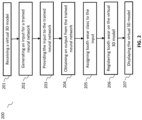
- Figure 2 shows a flowchart illustrating a method 200 according to an embodiment.
- Step 202 of the method 200 illustrates generating an input, from the virtual 3D model 101, for a trained neural network for tooth wear detection.
- the input may comprise at least one input element corresponding to at least a part of the virtual 3D model 101.
- the at least one input element may comprise geometric information of the at least part of the virtual 3D model 101.
- Every input element may correspond to a part of the virtual 3D model 101, and this correspondence may be defined by input element identifiers.
- the one or more points of the point cloud representing the virtual 3D model 101 may have an identifier defining the location of the one or more points in the point cloud.
- the individual tooth 102 may be identified by segmenting the virtual 3D model 101 into a plurality of individual teeth 102 and gingiva 103. Each tooth 102 from the plurality of individual teeth may comprise a plurality of tooth surfaces.
- Step 206 of the method 200 illustrates registering tooth wear on the at least part of the virtual 3D model 101 based on the assigned tooth wear class to the at least one input element.
- tooth wear may be associated with the at least part of the virtual 3D model 101.
- Correspondence of the at least one input element and the at least part of the virtual 3D model 101 may be established by means of an identifier.
- the at least one input element may be a point with the identifier which defines position of the point in the virtual 3D model 101.
- the same principle may be applicable to other type of input elements.
- the identifier associated with the at least one input element allows for allocation of tooth wear to the at least part of the virtual 3D model 101 corresponding to a part of the dental situation affected by tooth wear.
- the output 305 may comprise the at least one probability value representing the likelihood that the at least one input element corresponds to the tooth wear class.
- a training process for the classification task of the trained neural network 300 may be described as follows.
- the overall aim of a non-trained neural network may be to develop the trained neural network 300 capable of classifying the input according to a desired tooth wear class.
- the tooth wear class may be the indication of tooth wear presence, the tooth wear severity value and/or the tooth wear type.
- the training process may be referred to as "supervised training" due to use of a training dataset that has been labeled.
- the training dataset may be in 2D format, i.e. it may comprise a plurality of 2D training images of teeth or parts of teeth. Additionally, the training dataset may comprise associated labels where the labels correspond to the tooth wear class. The labeling may be performed for example by a qualified dental practitioner.
- the training dataset may be labeled according to the indication of tooth wear presence, for example with "Yes" or "No” labels indicating tooth wear presence or absence, respectively. Additionally or alternatively, the training dataset may be labeled with tooth wear severity labels and/or tooth wear type labels associated with corresponding tooth wear state.
- the labels may be regarded as a target or a ground truth for a given training data set.
- the training dataset may be fed into the non-trained neural network.
- Output of the non-trained neural network may be a probability value indicating which output class the input, or an input element, belongs to.
- An error may be determined between the ground truth and the output. This error may also be regarded as a loss function.
- One example of such a loss function may be a mean-squared-error function. In order to train the non-trained neural network, this loss function should be minimized. The minimization of the loss function may be achieved for example by using a stochastic gradient descent algorithm. Through this process of minimizing the loss function, weights of the non-trained neural network may be updated.
- the training process may be an iterative process in which the same training data set may be fed, iteratively, into the non-trained neural network until a stopping criterion is reached.
- the stopping criterion may be a specific threshold value for the loss function.
- the stopping criterion may be a number of epochs (training cycles) after which performance metrics cease to increase.
- the training dataset may alternatively be in 3D format comprising a plurality of teeth represented as 3D meshes, 3D graphs or point clouds.
- the tooth wear class may be the indication of tooth wear presence, the tooth wear severity value and/or the tooth wear type.
- the training dataset may comprise geometric information associated with teeth within, or parts of teeth within. Similar to the input element of the input to the trained neural network, the geometric information of the training dataset may comprise a curvature information, a facet normal information, a depth information relating to a virtual camera position and/or an angle between a facet normal and a virtual camera direction relating to the teeth within, or parts of teeth within.
- the curvature information of the training dataset may be relevant for successful training process of the non-trained neural network.
- an abrupt change of relative curvature between areas in teeth surfaces in the training dataset may represent tooth wear.
- the depth information of the training dataset may be relevant for the training process because information on tooth surface topology, of teeth from the training dataset, may be comprised within.
- the facet normal information of the training dataset may be relevant for the training process. Neighboring facets of a tooth from the training dataset may have a pronounced difference between their facet normals, indicating tooth wear due to abrupt topological change.
- the training dataset may optionally comprise semantic information associated with the teeth or parts of teeth within. This type of information aids the training process because the non-trained neural network may learn how to process visual geometric information in an improved manner, by having semantic context added to the geometric information.
- Training process for the segmentation task may the same as the training process for the classification task.
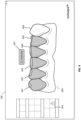
- Figure 4 illustrates the displayed part 400 of the virtual 3D model 101 with highlighted multiple teeth 401-405 affected by tooth wear, according to an embodiment of invention.
- the part 400 of the virtual 3D model 101 may be a part of the virtual 3D model 101, for example a part of a lower jaw of the virtual 3D model 101.
- the tooth wear class in case of FIG. 4 , may be the indication of tooth wear presence.
- the tooth wear presence may be in form of a visual notification 407. Additionally, the tooth wear presence may be signaled by displaying teeth 401-405, affected by tooth wear, in a different color compared to tooth 406 not affected by tooth wear.
- the indication of tooth wear presence may additionally comprise an audio signal.
- FIG. 5 illustrates a displayed part of the virtual 3D model with highlighted tooth wear on two tooth surfaces of a single tooth according to an embodiment of invention.
- Figure 5 illustrates a displayed part 500 of the virtual 3D model 101 with highlighted tooth wear on two tooth surfaces 502, 503 of the tooth 501, according to an embodiment of invention.
- the tooth wear class in case of FIG. 5 , may be the indication of tooth wear presence on tooth surfaces 502, 503 of the tooth 501 belonging to the part 500 of the virtual 3D model 101. As visible in FIG. 5 , the cervical surface 503 and the occlusal surface 502 are affected by tooth wear. These surfaces may be displayed in a different color compared to teeth not affected by tooth wear.
- the indication on tooth wear presence may additionally comprise the visual notification 507.
- Figure 6 illustrates a displayed part 600 of the virtual 3D model 101 with highlighted tooth wear lesions 602, 603 on multiple teeth according to an embodiment of invention.
- Tooth wear in case of FIG. 6 , may show specific tooth wear lesions 602, 603 on the part 600 of the virtual 3D model 101.
- FIG. 4 and FIG. 5 show highlighted entire tooth or tooth surface(s) affected by tooth wear.
- the tooth wear class in the case of FIG. 6 , may additionally comprise the tooth wear severity value 607.
- the three tooth wear severity values may be "No tooth wear", “Moderate tooth wear", "Severe tooth wear” that may be associated to teeth or tooth wear lesions on the teeth.
- Teeth or tooth wear lesions associated with one value of tooth wear severity values may be colored differently compared to teeth or tooth wear lesions associated with another tooth wear severity value.
- Figure 7 illustrates a dental scanning system 700 which may comprise a computer 710 capable of carrying out the method according to any one or more embodiments of invention, for example according to the method 200.
- the computer may comprise a wired or a wireless interface to a server 715, a cloud server 720 and an intraoral scanner 725.
- the intraoral scanner 725 may be capable of recording scan data of the patient's dentition.
- the dental scanning system 700 may comprise a processor configured to carry out the method according to one or more embodiments of the disclosure.
- the processor may be a part of the computer 710, the server 715 or the cloud server 720.
- a non-transitory computer-readable storage medium may be comprised in the dental scanning system 700.
- the non-transitory computer-readable medium can carry instructions which, when executed by a computer, cause the computer to carry out the method according to one or more embodiments of the disclosure.
- a computer program product may be embodied in the non-transitory computer-readable storage medium.
- the computer program product may comprise instructions which, when executed by the computer, cause the computer to perform the method according to any of the embodiments presented herein.
Landscapes
- Health & Medical Sciences (AREA)
- Engineering & Computer Science (AREA)
- Public Health (AREA)
- Medical Informatics (AREA)
- Biomedical Technology (AREA)
- Life Sciences & Earth Sciences (AREA)
- General Health & Medical Sciences (AREA)
- Epidemiology (AREA)
- Primary Health Care (AREA)
- Pathology (AREA)
- Animal Behavior & Ethology (AREA)
- Databases & Information Systems (AREA)
- Artificial Intelligence (AREA)
- Physics & Mathematics (AREA)
- Veterinary Medicine (AREA)
- Data Mining & Analysis (AREA)
- Biophysics (AREA)
- Oral & Maxillofacial Surgery (AREA)
- Dentistry (AREA)
- Surgery (AREA)
- Molecular Biology (AREA)
- Heart & Thoracic Surgery (AREA)
- Mathematical Physics (AREA)
- Physical Education & Sports Medicine (AREA)
- Psychiatry (AREA)
- Physiology (AREA)
- Computer Vision & Pattern Recognition (AREA)
- Nuclear Medicine, Radiotherapy & Molecular Imaging (AREA)
- Fuzzy Systems (AREA)
- Signal Processing (AREA)
- Evolutionary Computation (AREA)
- Radiology & Medical Imaging (AREA)
- Orthopedic Medicine & Surgery (AREA)
- Rheumatology (AREA)
- Business, Economics & Management (AREA)
- General Business, Economics & Management (AREA)
- Image Analysis (AREA)
- Dental Tools And Instruments Or Auxiliary Dental Instruments (AREA)
Priority Applications (4)
| Application Number | Priority Date | Filing Date | Title |
|---|---|---|---|
| EP23150054.7A EP4393449A1 (de) | 2023-01-02 | 2023-01-02 | Verfahren und system zur zahnverschleisserkennung |
| CN202380089905.8A CN120500306A (zh) | 2023-01-02 | 2023-12-28 | 用于牙齿磨损检测的方法和系统 |
| PCT/EP2023/087920 WO2024146859A1 (en) | 2023-01-02 | 2023-12-28 | Method and system for tooth wear detection |
| EP23840996.5A EP4646171A1 (de) | 2023-01-02 | 2023-12-28 | Verfahren und system zur zahnverschleisserkennung |
Applications Claiming Priority (1)
| Application Number | Priority Date | Filing Date | Title |
|---|---|---|---|
| EP23150054.7A EP4393449A1 (de) | 2023-01-02 | 2023-01-02 | Verfahren und system zur zahnverschleisserkennung |
Publications (1)
| Publication Number | Publication Date |
|---|---|
| EP4393449A1 true EP4393449A1 (de) | 2024-07-03 |
Family
ID=84785246
Family Applications (2)
| Application Number | Title | Priority Date | Filing Date |
|---|---|---|---|
| EP23150054.7A Withdrawn EP4393449A1 (de) | 2023-01-02 | 2023-01-02 | Verfahren und system zur zahnverschleisserkennung |
| EP23840996.5A Pending EP4646171A1 (de) | 2023-01-02 | 2023-12-28 | Verfahren und system zur zahnverschleisserkennung |
Family Applications After (1)
| Application Number | Title | Priority Date | Filing Date |
|---|---|---|---|
| EP23840996.5A Pending EP4646171A1 (de) | 2023-01-02 | 2023-12-28 | Verfahren und system zur zahnverschleisserkennung |
Country Status (3)
| Country | Link |
|---|---|
| EP (2) | EP4393449A1 (de) |
| CN (1) | CN120500306A (de) |
| WO (1) | WO2024146859A1 (de) |
Citations (2)
| Publication number | Priority date | Publication date | Assignee | Title |
|---|---|---|---|---|
| WO2022147160A1 (en) * | 2020-12-30 | 2022-07-07 | Align Technology, Inc. | Dental diagnostics hub |
| US20220351500A1 (en) * | 2019-10-04 | 2022-11-03 | Adent Aps | Method for assessing oral health using a mobile device |
-
2023
- 2023-01-02 EP EP23150054.7A patent/EP4393449A1/de not_active Withdrawn
- 2023-12-28 CN CN202380089905.8A patent/CN120500306A/zh active Pending
- 2023-12-28 WO PCT/EP2023/087920 patent/WO2024146859A1/en not_active Ceased
- 2023-12-28 EP EP23840996.5A patent/EP4646171A1/de active Pending
Patent Citations (2)
| Publication number | Priority date | Publication date | Assignee | Title |
|---|---|---|---|---|
| US20220351500A1 (en) * | 2019-10-04 | 2022-11-03 | Adent Aps | Method for assessing oral health using a mobile device |
| WO2022147160A1 (en) * | 2020-12-30 | 2022-07-07 | Align Technology, Inc. | Dental diagnostics hub |
Also Published As
| Publication number | Publication date |
|---|---|
| WO2024146859A1 (en) | 2024-07-11 |
| EP4646171A1 (de) | 2025-11-12 |
| CN120500306A (zh) | 2025-08-15 |
Similar Documents
| Publication | Publication Date | Title |
|---|---|---|
| CN114730466B (zh) | 数字模型中牙齿特征的自动检测、生成和/或校正 | |
| US20260017891A1 (en) | System and method for generating digital three-dimensional dental models | |
| US10410346B2 (en) | Detecting tooth wear using intra-oral 3D scans | |
| US12249031B2 (en) | Method for generating objects using an hourglass predictor | |
| TW202031208A (zh) | 自動牙齒分割方法 | |
| US20250017704A1 (en) | System and Method for Visualizing a Dental Condition as a Gradient Color Map | |
| US20230309800A1 (en) | System and method of scanning teeth for restorative dentistry | |
| US20250302376A1 (en) | Method and system for identifying islands of interest | |
| CN118799859A (zh) | 牙齿异常区域识别方法、训练方法、装置、设备及介质 | |
| EP4477136A1 (de) | Verfahren und system zur erkennung von zahnbelag | |
| EP4646171A1 (de) | Verfahren und system zur zahnverschleisserkennung | |
| EP4478283A1 (de) | Verfahren und system zur erkennung von zahnbelag | |
| CN116113984A (zh) | 皮肤表面分析装置及皮肤表面分析方法 | |
| US20250322521A1 (en) | System and method for determining a dental condition based on the alignment of different image formats | |
| CN121582276B (zh) | 一种用于口腔诊疗的口腔图像分割方法 | |
| CN120898225A (zh) | 用于在牙齿的虚拟模型上估计牙齿磨损类型的方法和系统 | |
| EP4681160A1 (de) | Verfahren und system zur zahnverschleisserkennung auf einem virtuellen zahnmodell | |
| WO2025067852A1 (en) | Automatic assesment of soft tissue recession in an oral cavity | |
| CN121937351A (zh) | 用于在牙齿数字3d模型中检测牙齿裂纹的方法和系统 |
Legal Events
| Date | Code | Title | Description |
|---|---|---|---|
| PUAI | Public reference made under article 153(3) epc to a published international application that has entered the european phase |
Free format text: ORIGINAL CODE: 0009012 |
|
| STAA | Information on the status of an ep patent application or granted ep patent |
Free format text: STATUS: THE APPLICATION HAS BEEN PUBLISHED |
|
| AK | Designated contracting states |
Kind code of ref document: A1 Designated state(s): AL AT BE BG CH CY CZ DE DK EE ES FI FR GB GR HR HU IE IS IT LI LT LU LV MC ME MK MT NL NO PL PT RO RS SE SI SK SM TR |
|
| STAA | Information on the status of an ep patent application or granted ep patent |
Free format text: STATUS: THE APPLICATION IS DEEMED TO BE WITHDRAWN |
|
| 18D | Application deemed to be withdrawn |
Effective date: 20250104 |