EP4394017A1 - Verfahren und anlage zur entschwefelung einer rohen kohlenwasserstoffzusammensetzung wie diesel oder kerosin - Google Patents
Verfahren und anlage zur entschwefelung einer rohen kohlenwasserstoffzusammensetzung wie diesel oder kerosin Download PDFInfo
- Publication number
- EP4394017A1 EP4394017A1 EP22216725.6A EP22216725A EP4394017A1 EP 4394017 A1 EP4394017 A1 EP 4394017A1 EP 22216725 A EP22216725 A EP 22216725A EP 4394017 A1 EP4394017 A1 EP 4394017A1
- Authority
- EP
- European Patent Office
- Prior art keywords
- evaporation
- liquid
- outlet line
- agent
- washing
- Prior art date
- Legal status (The legal status is an assumption and is not a legal conclusion. Google has not performed a legal analysis and makes no representation as to the accuracy of the status listed.)
- Withdrawn
Links
Images


Classifications
-
- C—CHEMISTRY; METALLURGY
- C10—PETROLEUM, GAS OR COKE INDUSTRIES; TECHNICAL GASES CONTAINING CARBON MONOXIDE; FUELS; LUBRICANTS; PEAT
- C10G—CRACKING HYDROCARBON OILS; PRODUCTION OF LIQUID HYDROCARBON MIXTURES, e.g. BY DESTRUCTIVE HYDROGENATION, OLIGOMERISATION, POLYMERISATION; RECOVERY OF HYDROCARBON OILS FROM OIL-SHALE, OIL-SAND, OR GASES; REFINING MIXTURES MAINLY CONSISTING OF HYDROCARBONS; REFORMING OF NAPHTHA; MINERAL WAXES
- C10G21/00—Refining of hydrocarbon oils, in the absence of hydrogen, by extraction with selective solvents
- C10G21/06—Refining of hydrocarbon oils, in the absence of hydrogen, by extraction with selective solvents characterised by the solvent used
- C10G21/12—Organic compounds only
-
- B—PERFORMING OPERATIONS; TRANSPORTING
- B01—PHYSICAL OR CHEMICAL PROCESSES OR APPARATUS IN GENERAL
- B01D—SEPARATION
- B01D11/00—Solvent extraction
- B01D11/04—Solvent extraction of solutions which are liquid
- B01D11/0426—Counter-current multistage extraction towers in a vertical or sloping position
- B01D11/0434—Counter-current multistage extraction towers in a vertical or sloping position comprising rotating mechanisms, e.g. mixers, rotational oscillating motion, mixing pumps
-
- B—PERFORMING OPERATIONS; TRANSPORTING
- B01—PHYSICAL OR CHEMICAL PROCESSES OR APPARATUS IN GENERAL
- B01D—SEPARATION
- B01D11/00—Solvent extraction
- B01D11/04—Solvent extraction of solutions which are liquid
- B01D11/0488—Flow sheets
-
- B—PERFORMING OPERATIONS; TRANSPORTING
- B01—PHYSICAL OR CHEMICAL PROCESSES OR APPARATUS IN GENERAL
- B01D—SEPARATION
- B01D11/00—Solvent extraction
- B01D11/04—Solvent extraction of solutions which are liquid
- B01D11/0492—Applications, solvents used
-
- C—CHEMISTRY; METALLURGY
- C10—PETROLEUM, GAS OR COKE INDUSTRIES; TECHNICAL GASES CONTAINING CARBON MONOXIDE; FUELS; LUBRICANTS; PEAT
- C10G—CRACKING HYDROCARBON OILS; PRODUCTION OF LIQUID HYDROCARBON MIXTURES, e.g. BY DESTRUCTIVE HYDROGENATION, OLIGOMERISATION, POLYMERISATION; RECOVERY OF HYDROCARBON OILS FROM OIL-SHALE, OIL-SAND, OR GASES; REFINING MIXTURES MAINLY CONSISTING OF HYDROCARBONS; REFORMING OF NAPHTHA; MINERAL WAXES
- C10G21/00—Refining of hydrocarbon oils, in the absence of hydrogen, by extraction with selective solvents
- C10G21/28—Recovery of used solvent
-
- C—CHEMISTRY; METALLURGY
- C10—PETROLEUM, GAS OR COKE INDUSTRIES; TECHNICAL GASES CONTAINING CARBON MONOXIDE; FUELS; LUBRICANTS; PEAT
- C10G—CRACKING HYDROCARBON OILS; PRODUCTION OF LIQUID HYDROCARBON MIXTURES, e.g. BY DESTRUCTIVE HYDROGENATION, OLIGOMERISATION, POLYMERISATION; RECOVERY OF HYDROCARBON OILS FROM OIL-SHALE, OIL-SAND, OR GASES; REFINING MIXTURES MAINLY CONSISTING OF HYDROCARBONS; REFORMING OF NAPHTHA; MINERAL WAXES
- C10G31/00—Refining of hydrocarbon oils, in the absence of hydrogen, by methods not otherwise provided for
- C10G31/08—Refining of hydrocarbon oils, in the absence of hydrogen, by methods not otherwise provided for by treating with water
-
- C—CHEMISTRY; METALLURGY
- C10—PETROLEUM, GAS OR COKE INDUSTRIES; TECHNICAL GASES CONTAINING CARBON MONOXIDE; FUELS; LUBRICANTS; PEAT
- C10G—CRACKING HYDROCARBON OILS; PRODUCTION OF LIQUID HYDROCARBON MIXTURES, e.g. BY DESTRUCTIVE HYDROGENATION, OLIGOMERISATION, POLYMERISATION; RECOVERY OF HYDROCARBON OILS FROM OIL-SHALE, OIL-SAND, OR GASES; REFINING MIXTURES MAINLY CONSISTING OF HYDROCARBONS; REFORMING OF NAPHTHA; MINERAL WAXES
- C10G2300/00—Aspects relating to hydrocarbon processing covered by groups C10G1/00 - C10G99/00
- C10G2300/20—Characteristics of the feedstock or the products
- C10G2300/201—Impurities
- C10G2300/202—Heteroatoms content, i.e. S, N, O, P
Definitions
- the present invention relates to a process and to a plant for desulfurizing a crude hydrocarbon composition, such as diesel or kerosine.
- the object underlying the present invention is to provide a process and a plant for desulfurizing a crude hydrocarbon composition containing at least one sulfur containing compound in an industrial scale, wherein the process combines a particular low energy consumption and a particular low consumption of extracting agent, but which nevertheless leads to a purified hydrocarbon composition having a particular low sulfur content of as low as 10 ppm or even less.
- the oxidized crude hydrocarbon composition provided in step a) is preferably the oxidization product of a composition being selected from the group consisting of diesel, kerosine, gasoline, naphtha, vacuum gas oil, light cycle oil, heavy cycle oil, marine gas oil, marine diesel oil, marine fuel oil, residual fuel oil, lube oil and arbitrary combinations of two or more of the aforementioned compositions.
- the present invention is not particularly restricted. Good results are for example achieved, if the crude hydrocarbon composition comprises 10 to 50,000 ppm and preferably 10 to 10,000 ppm of sulfur containing compound(s).
- the oxidized crude hydrocarbon composition provided in step a) comprises 10 to 50,000 ppm and preferably 10 to 10,000 ppm of oxidized sulfur containing compound(s).
- a particular advantage of the process in accordance with the present invention is that it is suitable to remove virtually all sulfur containing compounds from a crude hydrocarbon composition, namely all sulfur containing compounds being - at least when using a suitable catalyst and appropriate reaction conditions - oxidizable.
- the process in accordance with the present invention is suitable to remove mercaptans, sulfides, disulfides, thiophenes, benzothiophenes, dibenzothiophenes, such as 4,6-dimethyldibenzothiophene, tetrahydrodibenzothiophene, tetrahydrodibenzonaphthothiophene and octahydrodinaphthothiophene, and arbitrary combinations of two or more of the aforementioned sulfur containing compounds from a crude hydrocarbon composition, so that it is preferred that the at least one sulfur containing compound being contained in the crude hydrocarbon composition is selected from the group consisting of mercaptans, sulfides, disulfides, thiophenes, benzothiophenes, dibenzothiophenes, such as 4,6-dimethyldibenzothiophene, tetrahydrodibenzothiophene,
- any oxidizing agent may be used, which is able to oxidize the sulfur containing compound(s) being contained in the crude hydrocarbon composition. Good results are in particular obtained, when the oxidizing agent used in step a) is selected from the group consisting of hydrogen peroxide, metal peroxides, metal permanganates, metal hypochlorites, metal perchlorates, metal perborates, fluorine, chlorine and arbitrary combinations of two or more of the aforementioned compounds.
- the oxidizing agent oxidizes the sulfur containing compound(s) to sulfones, such as butyl methyl sulfone, methyl phenyl sulfone, thiophene sulfone, benzothiophene sulfone, dibenzothiophene sulfone or 2-methyl-benzothiophene sulfone.
- sulfones such as butyl methyl sulfone, methyl phenyl sulfone, thiophene sulfone, benzothiophene sulfone, dibenzothiophene sulfone or 2-methyl-benzothiophene sulfone.
- Methanol is an example for a protic, polar extracting agent
- dimethylformamide, acetonitrile, N-methyl-2-pyrrolidone, dimethyl sulfoxide and furfural are examples for aprotic, polar extracting agents.
- the extracting agent is an aprotic extracting agent and most preferably an extracting agent being selected from the group consisting of methanol, acetonitrile, N-methyl-2-pyrrolidone, dimethylformamide, dimethyl sulfoxide, furfural, sulfolane and arbitrary combinations of two or more of the aforementioned compounds.
- Aprotic compound means in accordance with the present invention any compound, which does neither accept nor donate hydrogen ions, whereas protic compounds do.
- a polar compound means in accordance with the present invention any compound, which has an electric dipole moment of at least 1.5 debye and preferably of at least 3.2 debye, wherein 1 debye corresponds to 3.33564 ⁇ 10 -30 C ⁇ m.
- the weight ratio of the amount of extracting agent divided by the amount of oxidized crude hydrocarbon composition in step b) is 0.01 to 3 and more preferably 0.1 to 1.
- the liquid-liquid extraction in step b) is performed in an agitated extraction column. Particular good results are obtained, when the liquid-liquid extraction in step b) is performed in an agitated countercurrent extraction column. Performing the liquid-liquid extraction in step b) in an agitated extraction column leads to an increased efficiency of the liquid-liquid extraction, thus allowing to minimize the amount of extracting agent being necessary for the liquid-liquid extraction.
- the agitated extraction column comprises at least one and preferably a plurality, such as 2 to 80 and more preferably 5 to 40, agitated internals being disposed within the extraction column.
- each of the agitated internals comprises one or more rotating shafts, each of which being connected with one or more agitators being preferably selected from the group consisting of discs, blades, paddles, turbine impellers, fins and arbitrary combinations of two or more of the aforementioned agitators.
- the agitated extraction column preferably comprises an inlet line for extracting agent, an inlet line for oxidized crude hydrocarbon composition, an outlet line for extract and an outlet line for raffinate.
- the agitated extraction column comprises two or more compartments, which are separated from each other by static partition plates, wherein at least some and preferably all of the compartments comprise a rotating shaft comprising one or more agitators being preferably selected from the group consisting of discs, blades, paddles, turbine impellers, fins and arbitrary combinations of two or more of the aforementioned agitators.
- the extraction column in which the agitated liquid-liquid extraction is performed, may be embodied as a Kühni column and the like.
- the extraction in step b) is performed as multiple stage extraction.
- the multiple stage extraction comprises 6 to 12 stages.
- Stage means in this connection a theoretical stage, which is a thermodynamical model for stage wise mass transfer meaning that the streams leaving such a theoretical stage are in thermodynamic equilibrium. Any of these theoretical stages preferably comprises several agitated compartments of the column.
- a two-phase system is processed, wherein one phase is the extracting agent and the other phase is the oxidized crude hydrocarbon composition to be extracted.
- the phase of the extracting agent will form the continuous phase, in which droplets of the oxidized crude hydrocarbon composition are dispersed.
- the oxidized crude hydrocarbon composition will form the continuous phase, in which droplets of the phase of the extracting agent are dispersed.
- step b) In order to obtain a particular high efficiency of the liquid-liquid extraction being performed in step b) so as to minimize the energy demand and the required amount of extracting agent therefore, it is particularly preferred that, if an agitated extraction column is used in step b), the agitated extraction column is operated so that the size of the droplets dispersed in the continuous phase is 0.5 to 10 mm and more preferably 1 to 3 mm.
- step b) an extracting agent is used so that the difference between the density of the extracting agent and the density of the oxidized crude hydrocarbon composition is 15 to 400 kg/m 3 . Also this assists in obtaining a particular high efficiency of the liquid-liquid extraction being performed in step b) so that the energy demand and the required amount of extracting agent therefore is minimized.
- step b) Good results are in particular obtained in terms of high efficiency of the liquid-liquid extraction being performed in step b) and in terms of minimization of the energy demand and the required amount of extracting agent therefore, when in step b) an extracting agent is used so that the interfacial tension of the extracting agent and the oxidized crude hydrocarbon composition is 0.0005 to 0.07 N/m as measured with the drop volume method using a drop volume tensiometer-DVT50
- washing agent in step c) any compound may be used, which has a higher solubility for extracting agent than for hydrocarbons. Good results are in particular obtained, when the washing agent used in step c) is an aqueous solution comprising at least 50% by weight of water, preferably least 80% by weight of water, more preferably least 95% by weight of water and most preferably 100% by weight of water.
- the desulfurized hydrocarbon composition obtained in step c) has a content of sulfur containing compounds of at most 20 ppm and more preferably of at most 10 ppm, a content of washing agent of at most 20,000 ppm and more preferably of at most 10,000 ppm and a content of extracting agent of at most 25,000 ppm and more preferably of at most 11,000 ppm.
- a multi-step evaporation comprising at least two subsequent evaporation steps may be used in step d) as the at least one purification step.
- the multi-step evaporation used for step d) is preferably performed so as the multi-step evaporation used in step e) as described above and below.
- the at least one purification step of this embodiment may further comprise one or more, such as two, distillation steps.
- step e) the mixture of washing agent and extracting agent obtained in step c) is subjected to a multi-step evaporation for separating the extracting agent from the washing agent so as to obtain purified washing agent, wherein the multi-step evaporation comprises at least two subsequent evaporation steps, wherein the first evaporation step is performed at a higher pressure than the at least one subsequent evaporation step.
- Good results are in particular preferred, when the pressure difference between the pressure, at which the first evaporation step is performed, and the pressure, at which the second evaporation step is performed, is 30 to 150 kPa and more preferably 45 to 55 kPa.
- the multi-step evaporation performed in step e) comprises a first evaporation step and at least a subsequent second evaporation step, wherein the mixture of washing agent and extracting agent obtained in step c) is introduced into the first evaporation step and separated therein into a first vapor phase and a first liquid phase.
- the first liquid phase is introduced into the second evaporation step and separated therein into a second vapor phase and a second liquid phase, wherein the first vapor phase is used in the second evaporation step as heat source.
- the evaporator in which the second evaporation step is performed, comprises a heat exchanger, which is fed with the first vapor phase as heat source to heat the first liquid phase being introduced into the second evaporator.
- the evaporator, in which the first evaporation step is performed preferably comprises a heat exchanger, which is fed and operated with an external heating medium.
- the heat may be provided by the vapor phase of the last column, which is recompressed by mechanical vapor recompression (MVR).
- the first vapor phase is compressed, before it is used as heat source in the second evaporation step, i.e. before it is fed into the heat exchanger of the evaporator, in which the second evaporation step is performed.
- any kind of compression may be used, wherein preferably a mechanical vapor recompression (MVR) is performed.
- the multi-step evaporation performed in step e) further comprises at least a subsequent third evaporation step, wherein the second liquid phase is introduced into the third evaporation step and separated therein into a third vapor phase and a third liquid phase, wherein the second vapor phase is used in the third evaporation step as heat source.
- the evaporator, in which the third evaporation step is performed comprises a heat exchanger, which is fed with the second vapor phase as heat source to heat the second liquid phase being introduced into the third evaporator.
- the third evaporation step is performed at an absolute pressure of 50 to 150 kPa and more preferably at an absolute pressure of 70 to 130 kPa, such as at about 80 kPa. Good results are in particular preferred, when the pressure difference between the pressure, at which the second evaporation step is performed, and the pressure, at which the third evaporation step is performed, is 50 to 150 kPa and preferably 90 to 100 kPa.
- the temperature of the liquid during the third evaporation step is preferably 90 to 130°C.
- the multi-step evaporation performed in step e) further comprises at least a subsequent fourth evaporation step, wherein the third liquid phase is introduced into the fourth evaporation step and separated therein into a fourth vapor phase and a fourth liquid phase, wherein the third vapor phase is used in the fourth evaporation step as heat source.
- the evaporator, in which the fourth evaporation step is performed comprises a heat exchanger, which is fed with the third vapor phase as heat source to heat the third liquid phase being introduced into the fourth evaporator.
- the fourth evaporation step is performed at an absolute pressure of 10 to 30 kPa and more preferably at an absolute pressure of 15 to 25 kPa, such as at about 20 kPa. Good results are in particular preferred, when the pressure difference between the pressure, at which the third evaporation step is performed, and the pressure, at which the fourth evaporation step is performed, is 30 to 80 kPa and preferably 50 to 60 kPa.
- the temperature of the liquid during the fourth evaporation step is preferably 60 to 80°C.
- the fourth evaporation step is the last evaporation step of the multi-step evaporation performed in step e)
- at least a portion of the fourth liquid phase is recycled as washing agent into step c) or used as heat source in the first evaporation step.
- the third vapor phase is compressed, before it is used as heat source in the fourth evaporation step, i.e. before it is fed into the heat exchanger of the evaporator, in which the fourth evaporation step is performed.
- any kind of compression may be used, wherein preferably a mechanical vapor recompression (MVR) is performed.
- the present invention is related to a plant for desulfurizing a crude hydrocarbon composition, such as diesel or kerosine, wherein the plant comprises:
- the inlet line for oxidized crude hydrocarbon composition of the liquid-liquid extraction unit is connected with the outlet line for oxidized crude hydrocarbon composition of a reactor, wherein the reactor further comprises an inlet line for crude hydrocarbon composition as well as an inlet line for oxidizing agent.
- the liquid-liquid extraction unit a) and the washing unit b) may be two separate units.
- the agitated extraction column comprises two or more compartments, which are separated from each other by static partition plates, wherein at least some and preferably all of the compartments comprise a rotating shaft comprising one or more agitators being preferably selected from the group consisting of discs, blades, paddles, turbine impellers, fins and arbitrary combinations of two or more of the aforementioned agitators.
- the multi-step evaporation unit d) further comprises at least a subsequent third evaporator, wherein the third evaporator comprises an line being connected with the outlet line for a liquid phase of the second evaporator, a heat exchanger being connected with the outlet line for a vapor phase of the second evaporator, an outlet line for a liquid phase and an outlet line for a vapor phase, wherein, if the multi-step evaporation unit does not comprise any further subsequent evaporator, the outlet line for a liquid phase (which is then the outlet line for purified washing agent of the multi-step evaporation unit) of the third evaporator is connected with the inlet line for washing agent of the washing unit b).
- a compressor is arranged between the second evaporator and the subsequent third evaporator, wherein the inlet line of the compressor is connected with the outlet line for a vapor phase of the second evaporator and the outlet line of the compressor is connected with the inlet line of the heat exchanger of the third evaporator, so that the vapor phase leaving the second evaporator is compressed, before it is fed into the heat exchanger of the third evaporator.
- the heat exchanger of each evaporator of the multi-step evaporation unit d) comprises an inlet line for the vapor phase and an outlet line for the vapor and/or liquid phase, whereas the outlet lines for the vapor and/or liquid phase of all heat exchangers of the multi-step evaporation unit d) are combined to the outlet line for washing agent of the multi-step evaporation unit.
- the outlet line for extracting agent of the multi-step evaporation unit is connected with the inlet line of a distillation column, which further comprises an outlet line being connected with an inlet line of the extracting agent recovering unit c) and an outlet line being connected with the inlet line for washing agent of the washing unit b).
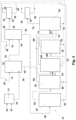
- the plant 10 for desulfurizing a crude hydrocarbon composition shown in figure 1 comprises a reactor 12 for reacting a crude hydrocarbon composition containing at least one sulfur containing compound with an oxidizing agent, a liquid-liquid extraction unit 14 for subjecting the oxidized crude hydrocarbon composition obtained in the reactor 12 to a liquid-liquid extraction with an extracting agent, a washing unit 16 for washing the raffinate obtained in the liquid-liquid extraction unit 14, an extracting agent recovering unit 18 comprising two distillation columns 20, 20' for recovering the extracting agent from the extract obtained in liquid-liquid extraction unit 14 and a multi-step evaporation unit 22 for separating extracting agent from washing agent.
- the plant 10 comprises two liquid-liquid separators 24, 26 and a distillation column 28 for recovering washing agent.
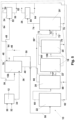
- the second evaporator 92' comprises an inlet line 106 being connected with the outlet line 96 for liquid phase of the first evaporator 92, a heat exchanger 108 comprising an inlet line 110 being connected with the outlet line 98 for vapor phase of the first evaporator and an outlet line 112, wherein the second evaporator 92' further comprises an outlet line 114 for liquid phase and an outlet line 116 for vapor phase.
Landscapes
- Chemical & Material Sciences (AREA)
- Oil, Petroleum & Natural Gas (AREA)
- Chemical Kinetics & Catalysis (AREA)
- Engineering & Computer Science (AREA)
- General Chemical & Material Sciences (AREA)
- Organic Chemistry (AREA)
- Production Of Liquid Hydrocarbon Mixture For Refining Petroleum (AREA)
Priority Applications (6)
| Application Number | Priority Date | Filing Date | Title |
|---|---|---|---|
| EP22216725.6A EP4394017A1 (de) | 2022-12-27 | 2022-12-27 | Verfahren und anlage zur entschwefelung einer rohen kohlenwasserstoffzusammensetzung wie diesel oder kerosin |
| KR1020257022813A KR20250129002A (ko) | 2022-12-27 | 2023-10-23 | 디젤 또는 등유와 같은 조질 탄화수소 조성물을 탈황시키기 위한 공정 및 플랜트 |
| EP23797729.3A EP4642875A1 (de) | 2022-12-27 | 2023-10-23 | Verfahren und anlage zur entschwefelung einer rohen kohlenwasserstoffzusammensetzung wie diesel oder kerosin |
| CN202380086122.4A CN120359283A (zh) | 2022-12-27 | 2023-10-23 | 一种用于对例如柴油或煤油的粗烃组合物进行脱硫的方法和装置 |
| PCT/EP2023/079499 WO2024141193A1 (en) | 2022-12-27 | 2023-10-23 | A process and plant for desulfurizing a crude hydrocarbon composition, such as diesel or kerosine |
| TW112149654A TW202436603A (zh) | 2022-12-27 | 2023-12-20 | 用於將粗製烴組成物諸如柴油或煤油脫硫的方法和設備 |
Applications Claiming Priority (1)
| Application Number | Priority Date | Filing Date | Title |
|---|---|---|---|
| EP22216725.6A EP4394017A1 (de) | 2022-12-27 | 2022-12-27 | Verfahren und anlage zur entschwefelung einer rohen kohlenwasserstoffzusammensetzung wie diesel oder kerosin |
Publications (1)
| Publication Number | Publication Date |
|---|---|
| EP4394017A1 true EP4394017A1 (de) | 2024-07-03 |
Family
ID=84604114
Family Applications (2)
| Application Number | Title | Priority Date | Filing Date |
|---|---|---|---|
| EP22216725.6A Withdrawn EP4394017A1 (de) | 2022-12-27 | 2022-12-27 | Verfahren und anlage zur entschwefelung einer rohen kohlenwasserstoffzusammensetzung wie diesel oder kerosin |
| EP23797729.3A Pending EP4642875A1 (de) | 2022-12-27 | 2023-10-23 | Verfahren und anlage zur entschwefelung einer rohen kohlenwasserstoffzusammensetzung wie diesel oder kerosin |
Family Applications After (1)
| Application Number | Title | Priority Date | Filing Date |
|---|---|---|---|
| EP23797729.3A Pending EP4642875A1 (de) | 2022-12-27 | 2023-10-23 | Verfahren und anlage zur entschwefelung einer rohen kohlenwasserstoffzusammensetzung wie diesel oder kerosin |
Country Status (5)
| Country | Link |
|---|---|
| EP (2) | EP4394017A1 (de) |
| KR (1) | KR20250129002A (de) |
| CN (1) | CN120359283A (de) |
| TW (1) | TW202436603A (de) |
| WO (1) | WO2024141193A1 (de) |
Citations (3)
| Publication number | Priority date | Publication date | Assignee | Title |
|---|---|---|---|---|
| US20060108263A1 (en) * | 2004-11-23 | 2006-05-25 | Chinese Petroleum Corporation | Oxidative desulfurization and denitrogenation of petroleum oils |
| US20070221538A1 (en) * | 2004-10-20 | 2007-09-27 | Degussa Corporation | Method and Apparatus for Converting and Removing Organosulfur and Other Oxidizable Compounds from Distillate Fuels, and Compositions Obtained Thereby |
| WO2022079012A1 (en) * | 2020-10-16 | 2022-04-21 | Shell Internationale Research Maatschappij B.V. | Recovery of aliphatic hydrocarbons |
-
2022
- 2022-12-27 EP EP22216725.6A patent/EP4394017A1/de not_active Withdrawn
-
2023
- 2023-10-23 CN CN202380086122.4A patent/CN120359283A/zh active Pending
- 2023-10-23 EP EP23797729.3A patent/EP4642875A1/de active Pending
- 2023-10-23 KR KR1020257022813A patent/KR20250129002A/ko active Pending
- 2023-10-23 WO PCT/EP2023/079499 patent/WO2024141193A1/en not_active Ceased
- 2023-12-20 TW TW112149654A patent/TW202436603A/zh unknown
Patent Citations (3)
| Publication number | Priority date | Publication date | Assignee | Title |
|---|---|---|---|---|
| US20070221538A1 (en) * | 2004-10-20 | 2007-09-27 | Degussa Corporation | Method and Apparatus for Converting and Removing Organosulfur and Other Oxidizable Compounds from Distillate Fuels, and Compositions Obtained Thereby |
| US20060108263A1 (en) * | 2004-11-23 | 2006-05-25 | Chinese Petroleum Corporation | Oxidative desulfurization and denitrogenation of petroleum oils |
| WO2022079012A1 (en) * | 2020-10-16 | 2022-04-21 | Shell Internationale Research Maatschappij B.V. | Recovery of aliphatic hydrocarbons |
Also Published As
| Publication number | Publication date |
|---|---|
| WO2024141193A1 (en) | 2024-07-04 |
| TW202436603A (zh) | 2024-09-16 |
| KR20250129002A (ko) | 2025-08-28 |
| EP4642875A1 (de) | 2025-11-05 |
| CN120359283A (zh) | 2025-07-22 |
Similar Documents
| Publication | Publication Date | Title |
|---|---|---|
| US8308957B2 (en) | Process for separating mercaptans from caustic | |
| US8080156B2 (en) | Mercury removal from crude oil | |
| CN101815565B (zh) | 改进的分离方法 | |
| CN113046121A (zh) | 同时进行的原油脱水、脱盐、脱硫和稳定化 | |
| EP2376374B1 (de) | Verfahren zur gasentschwefelung | |
| WO2005075056A1 (en) | Methods and configurations for acid gas enrichment | |
| US7820031B2 (en) | Method and apparatus for converting and removing organosulfur and other oxidizable compounds from distillate fuels, and compositions obtained thereby | |
| US9068130B2 (en) | Processing of dehydrated and salty hydrocarbon feeds | |
| CN106433778A (zh) | 烃的脱金属 | |
| WO2024141193A1 (en) | A process and plant for desulfurizing a crude hydrocarbon composition, such as diesel or kerosine | |
| CN119013376A (zh) | 无卤化物烃的生产 | |
| CN108473391A (zh) | 用于改进fcc回收单元的丙烯回收率的方法 | |
| CA2543367C (en) | Method and apparatus for converting and removing organosulfur and other oxidizable compounds from distillate fuels, and compositions obtained thereby | |
| US9315740B2 (en) | Methods of separating mixtures of miscible fluids | |
| JPS6345851B2 (de) | ||
| CN108865246B (zh) | 混烃中易挥发硫化物的脱除方法 | |
| US9738837B2 (en) | Process and system for treating oil sands produced gases and liquids | |
| US20210214621A1 (en) | Process of removing metal contaminants from light hydrocarbons | |
| Achaw et al. | Industrial Gases | |
| US20240034940A1 (en) | Enhanced hydrocarbon recovery | |
| CN211189718U (zh) | 一种脱除低压气体中硫化氢的装置 | |
| Norouzi et al. | Modeling of the Hydrodesulfurization process of natural gas condensates | |
| AU2010239065B2 (en) | Processing of dehydrated and salty hydrocarbon feeds | |
| EA039870B1 (ru) | Деметаллизация углеводородов | |
| TH60200A (th) | กระบวนการสำหรับการเพิ่มความดันย่อยไฮโดรเจนในกระบวนการซึ่งดำเนินการตามกระบวนการด้วยไฮโดรเจน |
Legal Events
| Date | Code | Title | Description |
|---|---|---|---|
| PUAI | Public reference made under article 153(3) epc to a published international application that has entered the european phase |
Free format text: ORIGINAL CODE: 0009012 |
|
| STAA | Information on the status of an ep patent application or granted ep patent |
Free format text: STATUS: THE APPLICATION HAS BEEN PUBLISHED |
|
| AK | Designated contracting states |
Kind code of ref document: A1 Designated state(s): AL AT BE BG CH CY CZ DE DK EE ES FI FR GB GR HR HU IE IS IT LI LT LU LV MC ME MK MT NL NO PL PT RO RS SE SI SK SM TR |
|
| STAA | Information on the status of an ep patent application or granted ep patent |
Free format text: STATUS: THE APPLICATION IS DEEMED TO BE WITHDRAWN |
|
| 18D | Application deemed to be withdrawn |
Effective date: 20250104 |