EP4394531A1 - Verfahren zur herstellung einer steuerung für einen roboter, bewegungssteuerungsverfahren und -vorrichtung für einen roboter und roboter - Google Patents
Verfahren zur herstellung einer steuerung für einen roboter, bewegungssteuerungsverfahren und -vorrichtung für einen roboter und roboter Download PDFInfo
- Publication number
- EP4394531A1 EP4394531A1 EP22929602.5A EP22929602A EP4394531A1 EP 4394531 A1 EP4394531 A1 EP 4394531A1 EP 22929602 A EP22929602 A EP 22929602A EP 4394531 A1 EP4394531 A1 EP 4394531A1
- Authority
- EP
- European Patent Office
- Prior art keywords
- robot
- motion
- control
- data
- controller
- Prior art date
- Legal status (The legal status is an assumption and is not a legal conclusion. Google has not performed a legal analysis and makes no representation as to the accuracy of the status listed.)
- Pending
Links
Images





Classifications
-
- G—PHYSICS
- G05—CONTROLLING; REGULATING
- G05B—CONTROL OR REGULATING SYSTEMS IN GENERAL; FUNCTIONAL ELEMENTS OF SUCH SYSTEMS; MONITORING OR TESTING ARRANGEMENTS FOR SUCH SYSTEMS OR ELEMENTS
- G05B19/00—Program-control systems
- G05B19/02—Program-control systems electric
- G05B19/04—Program control other than numerical control, i.e. in sequence controllers or logic controllers
- G05B19/042—Program control other than numerical control, i.e. in sequence controllers or logic controllers using digital processors
- G05B19/0423—Input/output
-
- G—PHYSICS
- G05—CONTROLLING; REGULATING
- G05D—SYSTEMS FOR CONTROLLING OR REGULATING NON-ELECTRIC VARIABLES
- G05D1/00—Control of position, course, altitude or attitude of land, water, air or space vehicles, e.g. using automatic pilots
- G05D1/40—Control within particular dimensions
- G05D1/49—Control of attitude, i.e. control of roll, pitch or yaw
- G05D1/495—Control of attitude, i.e. control of roll, pitch or yaw to ensure stability
-
- G—PHYSICS
- G05—CONTROLLING; REGULATING
- G05D—SYSTEMS FOR CONTROLLING OR REGULATING NON-ELECTRIC VARIABLES
- G05D1/00—Control of position, course, altitude or attitude of land, water, air or space vehicles, e.g. using automatic pilots
- G05D1/02—Control of position or course in two dimensions
- G05D1/021—Control of position or course in two dimensions specially adapted to land vehicles
- G05D1/0212—Control of position or course in two dimensions specially adapted to land vehicles with means for defining a desired trajectory
- G05D1/0221—Control of position or course in two dimensions specially adapted to land vehicles with means for defining a desired trajectory involving a learning process
-
- B—PERFORMING OPERATIONS; TRANSPORTING
- B62—LAND VEHICLES FOR TRAVELLING OTHERWISE THAN ON RAILS
- B62D—MOTOR VEHICLES; TRAILERS
- B62D57/00—Vehicles characterised by having other propulsion or other ground- engaging means than wheels or endless track, alone or in addition to wheels or endless track
- B62D57/02—Vehicles characterised by having other propulsion or other ground- engaging means than wheels or endless track, alone or in addition to wheels or endless track with ground-engaging propulsion means, e.g. walking members
- B62D57/028—Vehicles characterised by having other propulsion or other ground- engaging means than wheels or endless track, alone or in addition to wheels or endless track with ground-engaging propulsion means, e.g. walking members having wheels and mechanical legs
-
- G—PHYSICS
- G05—CONTROLLING; REGULATING
- G05B—CONTROL OR REGULATING SYSTEMS IN GENERAL; FUNCTIONAL ELEMENTS OF SUCH SYSTEMS; MONITORING OR TESTING ARRANGEMENTS FOR SUCH SYSTEMS OR ELEMENTS
- G05B19/00—Program-control systems
- G05B19/02—Program-control systems electric
- G05B19/04—Program control other than numerical control, i.e. in sequence controllers or logic controllers
- G05B19/042—Program control other than numerical control, i.e. in sequence controllers or logic controllers using digital processors
-
- G—PHYSICS
- G05—CONTROLLING; REGULATING
- G05D—SYSTEMS FOR CONTROLLING OR REGULATING NON-ELECTRIC VARIABLES
- G05D1/00—Control of position, course, altitude or attitude of land, water, air or space vehicles, e.g. using automatic pilots
- G05D1/02—Control of position or course in two dimensions
- G05D1/021—Control of position or course in two dimensions specially adapted to land vehicles
- G05D1/0212—Control of position or course in two dimensions specially adapted to land vehicles with means for defining a desired trajectory
- G05D1/0214—Control of position or course in two dimensions specially adapted to land vehicles with means for defining a desired trajectory in accordance with safety or protection criteria, e.g. avoiding hazardous areas
-
- G—PHYSICS
- G05—CONTROLLING; REGULATING
- G05D—SYSTEMS FOR CONTROLLING OR REGULATING NON-ELECTRIC VARIABLES
- G05D1/00—Control of position, course, altitude or attitude of land, water, air or space vehicles, e.g. using automatic pilots
- G05D1/08—Control of attitude, i.e. control of roll, pitch, or yaw
- G05D1/0891—Control of attitude, i.e. control of roll, pitch, or yaw specially adapted for land vehicles
-
- G—PHYSICS
- G05—CONTROLLING; REGULATING
- G05D—SYSTEMS FOR CONTROLLING OR REGULATING NON-ELECTRIC VARIABLES
- G05D1/00—Control of position, course, altitude or attitude of land, water, air or space vehicles, e.g. using automatic pilots
- G05D1/20—Control system inputs
- G05D1/22—Command input arrangements
- G05D1/221—Remote-control arrangements
- G05D1/222—Remote-control arrangements operated by humans
- G05D1/2235—Remote-control arrangements operated by humans involving the operator tracking the vehicle by direct line of sight
-
- G—PHYSICS
- G05—CONTROLLING; REGULATING
- G05B—CONTROL OR REGULATING SYSTEMS IN GENERAL; FUNCTIONAL ELEMENTS OF SUCH SYSTEMS; MONITORING OR TESTING ARRANGEMENTS FOR SUCH SYSTEMS OR ELEMENTS
- G05B2219/00—Program-control systems
- G05B2219/20—Pc systems
- G05B2219/25—Pc structure of the system
- G05B2219/25257—Microcontroller
-
- G—PHYSICS
- G05—CONTROLLING; REGULATING
- G05D—SYSTEMS FOR CONTROLLING OR REGULATING NON-ELECTRIC VARIABLES
- G05D2101/00—Details of software or hardware architectures used for the control of position
- G05D2101/10—Details of software or hardware architectures used for the control of position using artificial intelligence [AI] techniques
- G05D2101/15—Details of software or hardware architectures used for the control of position using artificial intelligence [AI] techniques using machine learning, e.g. neural networks
-
- G—PHYSICS
- G05—CONTROLLING; REGULATING
- G05D—SYSTEMS FOR CONTROLLING OR REGULATING NON-ELECTRIC VARIABLES
- G05D2109/00—Types of controlled vehicles
- G05D2109/10—Land vehicles
- G05D2109/13—Land vehicles with only one or two wheels, e.g. motor bikes or inverted pendulums
Definitions
- the present disclosure relates to the field of artificial intelligence and robots, and more particularly to a method and device for building a controller for a robot, a method and device for controlling motion of the robot, a robot, a computer readable storage medium, and a computer program product.
- robots based on artificial intelligence and robot technologies play an increasingly important role in intelligent transportation, smart home and other fields, and also face higher requirements.
- a robot including: a data collection device configured to: obtain motion state data of the robot; a data processing device configured to: obtain control data corresponding to the motion state data; calculating a linear equilibrium parameter matrix by using a value iteration manner based on the motion state data and the control data, where diversity measures of the motion state data and the control data are higher than a predetermined threshold; and building a controller meeting dynamic characteristics of the robot based on the linear equilibrium parameter matrix.
- a device for controlling motion of a robot including:
- a computer readable storage medium storing computer readable instructions thereon is provided according to the present disclosure, the computer readable instructions, when executed by one or more processors, performing steps of any above method.
- any quantity of different modules may be used and run on a user terminal and/or a server.
- the modules are merely illustrative, and different aspects of the system and method may use different modules.
- Flow diagrams are used in the present disclosure for illustrating operations performed by systems according to embodiments of the present disclosure. It is to be understood that, the foregoing or following operations are not necessarily strictly performed according to an order. On the contrary, various steps may be performed in a reverse order or simultaneously according to needs. Meanwhile, other operations may be added to the processes, or one or more operations may be deleted from the processes.
- the robot to which the present disclosure relates may be an under-actuated robot.
- Under-actuation is a kind of nonlinear control object with the number of independent control variables less than the number of degrees of freedom.
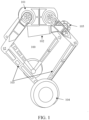
- the under-actuated robot may be a wheel-legged robot as illustrated in FIG. 1 .
- FIG. 1 illustrates a schematic structural diagram of a robot with left and right wheel legs in a single wheel-legged configuration according to an embodiment of the present disclosure.
- the wheel-legged robot 100 may include wheel legs 103; the wheel legs 103 include driving wheels 104 (also referring to as feet).
- the wheel-legged robot 100 may further include a base portion 101, the base portion 101 refers to a main body part of the robot and may be, for example, a trunk portion of the robot, and the base portion may be, for example, a planar platelike member or a rectangular parallelepiped-shaped member that is connected to the wheel legs of the robot.
- one end of the wheel legs 103 is connected to the base portion 101, and the other end is connected to the driving wheels 104.
- the base portion 101 is equipped with a power output device (for example, a motor), which can be used for providing power to the driving wheels for driving the wheel legs 103.
- a power output device for example, a motor
- the robot may further include a base portion connected to the wheel legs or an additional member arranged on the base portion according to actual needs. It is to be understood that merely one structure example of the robot is given above, and embodiments of the present disclosure are not limited by the specific members of the robot and connection manners thereof.
- the driving wheels 104 in the wheel legs 103 may enable the wheel-legged robot 100 to perform both walking and wheel motion.
- the wheel-legged robot 100 may further include a controllable additional member (for example, a tail) and the tail may be used for equilibrating the wheel-legged robot and may also assist in motion of the wheel-legged robot.
- the tail may assist the wheel-legged robot in maintaining equilibrium during motion.
- the wheel-legged robot may further include a controllable robotic arm and the robotic arm may be used to perform operation tasks such as handling, picking, and the like.
- the wheel-legged robot may further include a multi-foot wheel-legged robot, such as a two-foot wheel-legged robot and a four-foot wheel-legged robot, and embodiments of the present disclosure are not limited herein.
- the number of driving wheels may be one, two, four, or other, and the motion of each driving wheel may be controlled by two legs in parallel or multiple legs in series. It is to be understood that embodiments of the present disclosure are not limited by the specific composition types of the left wheel leg and the right wheel leg and the number of driving wheels thereof. In some embodiments, both the left wheel leg and the right wheel leg are of a single wheel leg configuration.
- a single wheel leg configuration means that the wheel leg comprises merely a single driving wheel.
- a numerical iteration method based on adaptive dynamic programming may not require any initial controller, but the amount of data required is relatively large, and it is more suitable for an offline iteration controller.
- the policy iteration method based on the adaptive dynamic programming requires the initial controller, but the required data size is far less than that of the value iteration method based on the adaptive dynamic programming.
- the policy iteration method based on the adaptive dynamic programming has shorter iteration time, which makes an iterative controller possible.
- x ⁇ R n , vecv x x 1 2 , x 1 x 2 , ⁇ , x 1 x n , x 2 2 , ⁇ , x n 2 T .
- the method for building a controller for a robot may optionally be applied to any robot that includes wheel legs, and the wheel legs include driving wheels.
- the method for building a controller for a robot is further described next by taking the robot 100 shown in FIG. 1 as an example.
- the robot 100 of FIG. 1 is further labeled with reference to FIG. 3 in order to describe various characteristic quantities involved in the method for building a controller for a robot.
- the mechanical structure of the robot 100 is more complex, so the accurate dynamic characteristics corresponding to the robot 100 are hard to obtain.
- step S201 motion of the robot is controlled, and motion state data and control data of the robot during motion is obtained, and diversity measures pf the motion state data and the control data are higher than a predetermined threshold;
- Control of motion of the robot may be implemented by determining control torque for controlling each joint of the wheel legs of the robot.
- adaptively determining the control information for controlling rotation of the driving wheels based on the historical motion information of the robot further includes: determining the control information for controlling rotation of the driving wheels in the policy iteration manner based on the historical motion information of the robot, or determining the control information for controlling rotation of the driving wheels in the value iteration manner based on the motion information of the robot during the motion.
- FIG. 4 shows another example, in which the motion state of the robot is estimated by using a measuring value, and the estimated state value is input to a data processing module that adaptively determines the control information for controlling rotation of the driving wheels, so that the data module can learn the measuring value corresponding to each torque more quickly, and the control information for controlling rotation of the driving wheels can be calculated more efficiently.
- the diversity measures may be represented by information entropy, and both the represented motion state data and the control data exist enough non-repetitive/non-similar values.
- the diversity measures may also be represented by a data characteristic quantity.
- the robot may be controlled to move along a predetermined trajectory by an arbitrary controller.
- the robot may be manually controlled to move linearly in different accelerations, regardless of whether the robot is in a state of equilibrium stability motion.
- the robot illustrated in FIGS. 1 to 4 if the driving wheel 104 provides an excessive large acceleration, the robot 100 will quickly topple backward. If the driving wheel 104 provides a too small acceleration, the robot may not reach the destination quickly and may topple forward.
- the matrix is built to be used as the training data by collecting the motion state data and the control data of the robot with unknown dynamic characteristics before losing equilibrium (falling) and performing integral operation on these data. Therefore, in all embodiments of the present disclosure, the quantity of the training data is far less than that required by a traditional reinforcement learning algorithm.
- An embodiment of the present disclosure also correspondingly builds an iterative relationship function to gradually converge the target iteration term as the learning step size increases.
- the trained controller gradually converges to a controller corresponding to the optimal solution to the linear quadratic regulation problem as the learning step increases, so that stability of a close-loop system can be ensured, the training process is greatly simplified, and additional limitations on training data are not required, so as to simplify the design process of a controller for a wheel-legged robot.
- the data is collected from real robots, and the control policy obtained based on the data of the real robots is directly applied to the robot, so that the application effect of the controller on the real robots is improved without considering the difference between the simulated control and the real control.
- the converged target iteration term may obtain a controller, the controller converges to a controller corresponding to the optimal solution to the linear quadratic regulation problem, so that the stability of the close-loop system may be guaranteed, and the training process is greatly simplified.
- the whole process does not require additional limitations on the training data, to simplify the design process of the controller of the robot.
- Equation (4) shows an example of the nonholonomic constraint for the robot in FIG. 3 . It is to be understood by a person skilled in the art that the nonholonomic constraint may also be illustrated in other ways. The present disclosure is not limited thereto.
- J w 1,3 B q ⁇ B + J ⁇ w 1,3 q ⁇ 0
- J w 1,3 B are the x-axis and z-axis of Jacobian matrix of the driving wheel-ground contact point relative to the base portion.
- the desired acceleration q ⁇ fb of the base portion may be calculated by a PD control law (Proportional Derivative Controller).
- a PD control law Proportional Derivative Controller
- at least part of the PD control law is derived based on an input reference for a posture and an input reference for a velocity .
- the amount of training data of the embodiment of the present disclosure is much smaller than the amount of data required by a conventional reinforcement learning algorithm.
- the trained controller gradually converges to a controller corresponding to the optimal solution to the linear quadratic regulation problem as the learning step increases, so that stability of a close-loop system can be ensured, the training process is greatly simplified, and additional limitations on training data are not required, so as to simplify the design process of a controller for a wheel-legged robot.
- an embodiment of the present disclosure may perform data collection directly on the real robot, and the controller, obtained by training, is directly applied to the real robot.
- An embodiment of the present disclosure is not necessary to perform data collection in a simulator based on a physical engine, so some problems, caused by the migration of the data from a virtual world to a real work are omitted.
- the scheme for updating the linear equilibrium parameter matrix of the controller by the value iteration may be exemplarily determined.
- the embodiment of the present disclosure optionallydefines the following three matrices as example elements in the training data set, a first matrix ⁇ xx , a second matrix ⁇ xx , and a third matrix ⁇ xu in equation (14).
- the first matrix ⁇ xx ⁇ R r ⁇ n 2 the second matrix ⁇ xx ⁇ R r ⁇ n 2 and ⁇ xu ⁇ R r ⁇ n .
- Each matrix corresponds to a nonlinear combination of the motion state data and the control data in multiple time intervals, for example, involving integral operation and product calculation.
- FIG. 6 illustrates another structural view of the robot 100.
- FIG. 7A illustrates motion state data and control data in a motion of using the first controller to control the robot.
- FIG. 7B illustrates a convergence process of a linear equilibrium parameter matrix in a process of building a controller according to the dynamic characteristics of the robot, the base portion heights of the robot being 0.5 m and 0.6 m respectively.
- FIG. 7C illustrates motion state data of the robot controlled to walk straight with the base portion height of 0.6 m.
- the motion of the robot 100 may be mathematically viewed as a continuous-time linear system. It is assumed that a controller corresponding to the optimal solution to a linear quadratic regulation problem exists for the robot 100, the controller is capable of minimizing the cost functional corresponding to the motion of the robot. For example, the controller corresponding to the optimal solution to the linear quadratic regulation problem may minimize the cost of the robot being near the equilibrium point and the robot may travel along the target trajectory with minimum energy consumption.
- equation (7) and equation (8) have been set forth. If the precise dynamic characteristics of the robot 100 are known, then matrices A and B in equation (7) and equation (8) are known. In a case that the matrices A and B in equation (7) and equation (8) are known, u *( t ) may be correspondingly solved.
- step S202 is described respectively by the examples described in FIG. 1 to FIG. 4 .
- the motion state data for training and the control data for training may be obtained.
- the motion state data for training and the control data for training are the motion data and the control data at the moment that the robot does not fall (for example, the front end/rear end or tail of the base portion do not contact with the ground). That is, at least in this period of motion, the equation (19) is established based on the equation (18).
- the motion state data is collected by a sensor at a certain time interval over a period of time and respectively corresponds to the motion state of the robot at each discrete moment over a period of time. Therefore, the motion state data and the control data of the first controller may correspond to a plurality of time intervals in [ t 0 , t r ] . Any time interval t i to t i +1 in the plurality of time intervals may be marked as [ t, t + ⁇ t ], and the duration ⁇ t may be determined according to a data collection time interval that may be achieved by the robot sensor.
- the integral operation may be respectively performed on the motion state data and the control data, corresponding to a plurality of time intervals, so as to build the iteration relationship function.
- the motion state data and the control data after the integral operation are used as the training data, which participates in the process that the value iteration is performed on the iteration target item to approximate to obtain the linear equilibrium parameter matrix meeting the dynamic characteristics of the robot.
- the following description is merely an exemplary integral operation and the present disclosure is not limited thereto.
- the expressions for ⁇ xx , ⁇ xx and ⁇ xu has been given in equation (14).
- a linear equilibrium parameter matrix K* may be generated by value iterations, provided that a rank condition is satisfied and there is a unique pair of (H(s),P(s)), and the whole process is no longer dependent on model information (A, B). That is, the value iteration may be stopped when the iteration target item converges in the value iteration process; the linear equilibrium parameter matrix meeting the dynamic characteristics of the robot is rebuilt according to the converged iteration target item.
- the converged target iteration term may obtain a controller, the controller converges to a controller corresponding to the optimal solution to the linear quadratic regulation problem, so that the stability of the close-loop system may be guaranteed, and the training process is greatly simplified.
- the whole process does not require additional limitations on the training data, to simplify the design process of the controller of the robot.
- the robot 100 further includes the data collection device, the data processing device and the drive motor showed in FIG. 6 .
- the data collection device may be configured to: obtain the motion state data of the robot.
- the data processing device may be further configured to further process the data collected by the data collection device.
- the present disclosure only gives the example of controlling the driving wheel 104, and those skilled in the art should understand that the scheme of the present disclosure may also be used for controlling other components of the robot.
- the data processing device sets the control data for training based on the given target trajectory.
- the present disclosure is not limited to the specific control laws of the controller used for training. In order to explain the non-limitation of the present disclosure on the controller used for training, an experimenter later manually controls the motion of the robot to extract motion state data and control data as an example for explanation. More further, a control frequency of the data processing device is 1,000Hz.
- the motion data and the control data will be used to calculate ⁇ xx , ⁇ xx and ⁇ xu . These data require the continuous signals of x and u.
- the collected motion state data may be further processed so as to obtain the controller meeting the dynamic characteristics of the robot as quickly as possible.
- the motion state data during the motion may be collected by using the at least one motion data collector or the motion data collection thread; the repeated motion state data is removed based on the collection time of the motion state data.
- the frequencies of the different motion data collectors/threads imu frequency, control frequency, storage data frequency
- the frequencies of the different motion data collectors/threads will exist in the situation of storing the same data. Therefore, when the data is processed offline in combination with the value iteration scheme, it is necessary to judge whether there is the same data based on the time, and the repeated data is eliminated. Therefore, the error of the host computer on the robot in the multi-thread collection data may be further amended.
- the motion state data of the tilt angle of the base portion of the robot in a predetermined range may be obtained during the motion of the robot.
- the data of the linear part (with a tilt angle within +-15 degrees) can only be concatenated and used after multiple data collections.
- the motion state data and the control data of the tilt angle within +-15 degrees may be concatenated again.
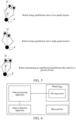
- the example experiment for calculating the controller meeting the dynamic characteristics of the robot by the value iteration scheme is shown below. As shown in FIG. 8 , a minimum height of the robot is 0.33m.
- the motion instruction is manually and directly given by the remote controller, to indicate the torque of the driving wheel.
- the robot moves (shown in state B and state C) by using the driving wheel from the initial state (shown in state A), and finally falls (state D). Finally, the robot loses equilibrium, and the remote controller is not the equilibrium-like controller in this case.
- the similar process is repeated for three times, and the data collected in three times is drawn in FIG. 9 , where the torque is the total torque of the two driving wheel motors.
- the data in the linear area approaching the simplified model is used, that is, -20 degrees ⁇ tilt angle ⁇ 20 degrees.
- the process duration for collecting the data for three times is respectively 0.515 s, 0.155 s and 0.586 s, and a total of 1.256 s. Any non-professional person may collect these short-time data easily in a manner that the torque is manually input by the remote controller.
- the value iteration scheme may be carried out offline, so as to easily regulate various parameters and converge the iteration term.
- the controller meeting dynamic characteristics of the robot is built.
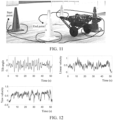
- the controller is used to control a real robot to travel in the path illustrated in FIG. 11 , and the test data of a tilt angle (which is approximately within plus or minus 2 deg), a linear velocity, and a yaw velocity illustrated in FIG. 12 are collected. It may be seen that a controller with strong enough robustness and stability may be obtained by using the iteration scheme.
- the embodiment of the present disclosure solves the problem of optimal equilibrium control of a robot without knowledge of the dynamic characteristics of the robot using a value iteration scheme based on reinforcement learning and ADP technologies in artificial intelligence.
- the process of building the controller of the embodiment of the present disclosure merely requires that the wheel-legged robot travels for a period of time or a section of trajectory under the control of a non-optimal controller or an arbitrary controller, and collects motion state data and control data corresponding to the period of time or the section of trajectory as training data.
- the amount of training data of the embodiment of the present disclosure is much smaller than the amount of data required by a conventional reinforcement learning algorithm.
- this application provides a device for building a controller for a robot, the device including:
- the motion control module is configured to: adaptively determine the control information for controlling rotation of the driving wheels based on the historical motion information of the robot; determine first control information for controlling multiple joints of the robot based on the control information for controlling the rotation of the driving wheels, the first control information is configured to control the robot to maintain equilibrium; determine second control information for controlling the multiple joints based on the target trajectory of the robot, the second control information is configured to control the robot to move along the target trajectory; determine the control torque of each joint in the wheel legs of the robot based on the motion constraint conditions of the robot, the first control information, and the second control information; and drive each joint based on the control torque, so as to control the motion of the robot.
- the center of mass of the base portion of the robot is first raised and then lowered in a case that the drive motor is controlled to output the first torque, and a front end of the base portion is in contact with the ground when the robot loses the equilibrium;
- the controller meeting dynamic characteristics of the robot is a linear controller; and for each moment during the motion, the control torque, provided by the linear controller, is negatively correlated to a product of the linear equilibrium parameter matrix and the motion state data of the robot.
- the motion control module is also configured to control motion of the robot by using a remote controller, and obtain the motion state data and the control data during the motion; wherein the robot under control of the controller meeting the dynamic characteristics of the robot has a better control effect during the motion compared to the robot under control of the remote controller.
- the motion state data and the control data correspond to a plurality of time intervals
- the data processing module is further configured to determine an iteration target item, and respectively perform integral operation on the motion state data and the control data according to a time interval, so as to build an iteration relationship function; and the value iteration is performed on the iteration target item according to the iteration relationship function to approximate to obtain the linear equilibrium parameter matrix meeting the dynamic characteristics of the robot.
- the motion control module is further configured to collect the motion state data during the motion by using at least one motion data collector or at least one motion data collection thread; remove the repeated motion state data based on the collection time of the motion state data.
- This application provides a computer-readable storage medium, storing computer-readable instructions, and the computer-readable instructions, when executed by one or more processors, perform the method of any above embodiment.
- the robot may also include, for example, a bus, a memory, a sensor component, a communication module, and an input-output device, according to actual needs.
- a bus for example, a bus, a memory, a sensor component, a communication module, and an input-output device.
- the embodiment of the present disclosure is not limited by the specific components of the robot.
- the bus may be a circuit that interconnects the components of the robot and communicates communication information (for example, control messages or data) among the components.
- the input-output device may transmit, for example, a command or data inputted from the user or any other external device to one or more other components of the robot, or may output a command or data received from one or more other components of the robot to the user or other external device.
- Multiple robots may constitute a robot system to cooperatively complete a task, the multiple robots being communicatively connected to a server and receiving a cooperative robot instruction from the server.
- a tangible and permanent storage medium may include any memory or storage for a computer, a processor, or a similar device or a related module, for example, a semiconductor memory, a tape drive, a disk drive, or any device capable of providing a storage function for software.
- All or part of the software may sometimes communicate over a network, such as the Internet or other communication networks. Such communication may load software from one computer device or a processor to another. Therefore, another medium capable of transmitting software elements can also be used as a physical connection between local devices, for example, light waves, electric waves, and electromagnetic waves are transmitted through cables, optical cables, or the air.
- a physical medium over which a carrier wave travels such as a cable, a wireless link, an optical cable, or a similar device, may also be thought of as the medium on which the software is carried.
- other terms representing a computer- or machine-readable “medium” refer to media that participate during execution of any instructions by a processor.
Landscapes
- Engineering & Computer Science (AREA)
- Physics & Mathematics (AREA)
- General Physics & Mathematics (AREA)
- Automation & Control Theory (AREA)
- Aviation & Aerospace Engineering (AREA)
- Radar, Positioning & Navigation (AREA)
- Remote Sensing (AREA)
- Chemical & Material Sciences (AREA)
- Combustion & Propulsion (AREA)
- Transportation (AREA)
- Mechanical Engineering (AREA)
- Manipulator (AREA)
Applications Claiming Priority (2)
| Application Number | Priority Date | Filing Date | Title |
|---|---|---|---|
| CN202210193884.1A CN116736748B (zh) | 2022-03-01 | 2022-03-01 | 构建机器人的控制器的方法和机器人 |
| PCT/CN2022/133757 WO2023165174A1 (zh) | 2022-03-01 | 2022-11-23 | 构建机器人的控制器的方法、机器人的运动控制方法、装置以及机器人 |
Publications (2)
| Publication Number | Publication Date |
|---|---|
| EP4394531A1 true EP4394531A1 (de) | 2024-07-03 |
| EP4394531A4 EP4394531A4 (de) | 2025-07-02 |
Family
ID=87882902
Family Applications (1)
| Application Number | Title | Priority Date | Filing Date |
|---|---|---|---|
| EP22929602.5A Pending EP4394531A4 (de) | 2022-03-01 | 2022-11-23 | Verfahren zur herstellung einer steuerung für einen roboter, bewegungssteuerungsverfahren und -vorrichtung für einen roboter und roboter |
Country Status (4)
| Country | Link |
|---|---|
| US (1) | US12578729B2 (de) |
| EP (1) | EP4394531A4 (de) |
| CN (1) | CN116736748B (de) |
| WO (1) | WO2023165174A1 (de) |
Families Citing this family (3)
| Publication number | Priority date | Publication date | Assignee | Title |
|---|---|---|---|---|
| US20240385619A1 (en) * | 2023-05-17 | 2024-11-21 | Scythe Robotics, Inc. | Motion planning with caster constraints |
| CN117100517B (zh) * | 2023-10-23 | 2023-12-19 | 河北普康医疗设备有限公司 | 一种基于5g通信的电动医疗床远程控制系统 |
| CN120143717B (zh) * | 2025-05-13 | 2025-07-29 | 江苏智慧工场技术研究院有限公司 | 一种两轮腿式陆空两栖机器人运行控制方法及系统 |
Family Cites Families (19)
| Publication number | Priority date | Publication date | Assignee | Title |
|---|---|---|---|---|
| US6874591B2 (en) * | 1994-05-27 | 2005-04-05 | Deka Products Limited Partnership | Speed limiting for a balancing transporter |
| US8781624B2 (en) * | 2009-03-24 | 2014-07-15 | Disney Enterprises, Inc. | Systems and methods for tracking and balancing robots for imitating motion capture data |
| CN103381826B (zh) * | 2013-07-31 | 2016-03-09 | 中国人民解放军国防科学技术大学 | 基于近似策略迭代的自适应巡航控制方法 |
| CN105487376B (zh) * | 2015-12-30 | 2018-05-08 | 南京航空航天大学 | 一种基于数据驱动单网络结构的最优控制方法 |
| US9568915B1 (en) * | 2016-02-11 | 2017-02-14 | Mitsubishi Electric Research Laboratories, Inc. | System and method for controlling autonomous or semi-autonomous vehicle |
| EP3612356B1 (de) * | 2017-09-22 | 2021-06-16 | Google LLC | Bestimmung von steuerrichtlinien für roboter mit geräuschtoleranter strukturierter exploration |
| US11106189B2 (en) | 2019-03-06 | 2021-08-31 | Mitsubishi Electric Research Laboratories, Inc. | System and method for data-driven control of constrained system |
| US20200306998A1 (en) * | 2019-03-25 | 2020-10-01 | Boston Dynamics, Inc. | Multi-Body Controller |
| US10895854B1 (en) * | 2019-07-03 | 2021-01-19 | Mitsubishi Electric Research Laboratories, Inc. | System and method for control constrained operation of machine with partially unmodeled dynamics using Lipschitz constant |
| WO2021041223A1 (en) * | 2019-08-23 | 2021-03-04 | Realtime Robotics, Inc. | Motion planning for robots to optimize velocity while maintaining limits on acceleration and jerk |
| US11465281B2 (en) * | 2019-10-14 | 2022-10-11 | Boston Dynamics, Inc. | Dynamic planning controller |
| WO2020233050A1 (zh) * | 2019-11-26 | 2020-11-26 | 浙江大学 | 一种双足机器人不平整路面动态跑步步态实现方法 |
| CN111340415B (zh) * | 2020-02-14 | 2024-01-09 | 北京航空航天大学 | 一种基于货运轨迹数据的车辆自发编队模式挖掘方法 |
| JP2021146491A (ja) * | 2020-03-23 | 2021-09-27 | ソニーグループ株式会社 | 制御装置及び制御方法、並びにコンピュータプログラム |
| CN112632803A (zh) | 2021-01-12 | 2021-04-09 | 四川大学 | 跟踪控制方法和装置、电子设备及存储介质 |
| CN112947430B (zh) * | 2021-02-03 | 2022-07-15 | 浙江工业大学 | 一种移动机器人的智能轨迹跟踪控制方法 |
| CN112775976B (zh) * | 2021-02-05 | 2022-05-10 | 深圳市优必选科技股份有限公司 | 任务执行控制方法、装置、控制设备及可读存储介质 |
| CN113752250B (zh) * | 2021-05-31 | 2024-08-02 | 腾讯科技(深圳)有限公司 | 机器人关节的控制方法、装置、机器人及存储介质 |
| CN113753150B (zh) * | 2021-05-31 | 2024-01-12 | 腾讯科技(深圳)有限公司 | 轮腿式机器人的控制方法、装置、设备及可读存储介质 |
-
2022
- 2022-03-01 CN CN202210193884.1A patent/CN116736748B/zh active Active
- 2022-11-23 EP EP22929602.5A patent/EP4394531A4/de active Pending
- 2022-11-23 WO PCT/CN2022/133757 patent/WO2023165174A1/zh not_active Ceased
-
2023
- 2023-08-25 US US18/456,267 patent/US12578729B2/en active Active
Also Published As
| Publication number | Publication date |
|---|---|
| US20230409035A1 (en) | 2023-12-21 |
| CN116736748A (zh) | 2023-09-12 |
| CN116736748B (zh) | 2024-09-17 |
| EP4394531A4 (de) | 2025-07-02 |
| US12578729B2 (en) | 2026-03-17 |
| WO2023165174A1 (zh) | 2023-09-07 |
Similar Documents
| Publication | Publication Date | Title |
|---|---|---|
| EP4394531A1 (de) | Verfahren zur herstellung einer steuerung für einen roboter, bewegungssteuerungsverfahren und -vorrichtung für einen roboter und roboter | |
| EP4488773A1 (de) | Verfahren zur herstellung einer steuerung eines roboters, bewegungssteuerungsverfahren für roboter und vorrichtungen und roboter | |
| CN113848905B (zh) | 基于神经网络和自适应控制的移动机器人轨迹跟踪方法 | |
| Ali et al. | Controlling of an under-actuated quadrotor UAV equipped with a manipulator | |
| US20260010164A1 (en) | Balance control method and apparatus for wheel-legged robot, device, and storage medium | |
| WO2024021767A1 (zh) | 控制足式机器人的方法、装置、设备、足式机器人、计算机可读存储介质和计算机程序产品 | |
| Park et al. | Pose and posture estimation of aerial skeleton systems for outdoor flying | |
| Li et al. | Research on gait trajectory planning of wall-climbing robot based on improved PSO algorithm | |
| Xue et al. | Stewart-inspired vibration isolation control for a wheel-legged robot via variable target force impedance control | |
| EP4480792A1 (de) | Robotersteuerungsverfahren und -vorrichtung sowie roboter und computerlesbares speichermedium | |
| Zeini et al. | Design and construction of a unicycle robot controlled by its center of gravity | |
| Wang et al. | Bionic jumping of humanoid robot via online centroid trajectory optimization and high dynamic motion controller | |
| CN113954063A (zh) | 移动平台的参数确定方法以及移动平台 | |
| CN115781658B (zh) | 构建机器人的控制器的方法和机器人 | |
| US12619234B2 (en) | Robot control method and apparatus, robot and computer-readable storage medium | |
| CN110244703A (zh) | 一种具有外部干扰和数据异常的移动机器人预测控制方法 | |
| Zhong et al. | Theoretical and experimental study on remote dynamic balance control for a suspended wheeled mobile manipulator | |
| Murmu et al. | Trajectory tracking control for a nano quadcopter employing stochastically optimal PID control | |
| Zhou et al. | Stabilization and trajectory control of a quadrotor with uncertain suspended load | |
| HK40092323B (zh) | 构建机器人的控制器的方法和机器人 | |
| HK40092323A (zh) | 构建机器人的控制器的方法和机器人 | |
| HK40091967A (zh) | 机器人控制方法和机器人 | |
| CN119882455B (zh) | 一种轮式双足机器人动态鲁棒运动控制方法及系统 | |
| HK40091967B (zh) | 机器人控制方法和机器人 | |
| HK40092282B (zh) | 构建机器人的控制器的方法和机器人 |
Legal Events
| Date | Code | Title | Description |
|---|---|---|---|
| STAA | Information on the status of an ep patent application or granted ep patent |
Free format text: STATUS: THE INTERNATIONAL PUBLICATION HAS BEEN MADE |
|
| PUAI | Public reference made under article 153(3) epc to a published international application that has entered the european phase |
Free format text: ORIGINAL CODE: 0009012 |
|
| STAA | Information on the status of an ep patent application or granted ep patent |
Free format text: STATUS: REQUEST FOR EXAMINATION WAS MADE |
|
| 17P | Request for examination filed |
Effective date: 20240328 |
|
| AK | Designated contracting states |
Kind code of ref document: A1 Designated state(s): AL AT BE BG CH CY CZ DE DK EE ES FI FR GB GR HR HU IE IS IT LI LT LU LV MC ME MK MT NL NO PL PT RO RS SE SI SK SM TR |
|
| DAV | Request for validation of the european patent (deleted) | ||
| DAX | Request for extension of the european patent (deleted) | ||
| A4 | Supplementary search report drawn up and despatched |
Effective date: 20250603 |
|
| RIC1 | Information provided on ipc code assigned before grant |
Ipc: G05D 101/15 20240101ALI20250527BHEP Ipc: G05D 109/10 20240101ALI20250527BHEP Ipc: G05D 109/15 20240101ALI20250527BHEP Ipc: G05D 1/495 20240101ALI20250527BHEP Ipc: G05D 1/222 20240101ALI20250527BHEP Ipc: G05B 19/042 20060101AFI20250527BHEP |