EP4394706A1 - Procédé et appareil de positionnement spatial - Google Patents
Procédé et appareil de positionnement spatial Download PDFInfo
- Publication number
- EP4394706A1 EP4394706A1 EP22860521.8A EP22860521A EP4394706A1 EP 4394706 A1 EP4394706 A1 EP 4394706A1 EP 22860521 A EP22860521 A EP 22860521A EP 4394706 A1 EP4394706 A1 EP 4394706A1
- Authority
- EP
- European Patent Office
- Prior art keywords
- points
- model
- coordinate system
- world coordinate
- image
- Prior art date
- Legal status (The legal status is an assumption and is not a legal conclusion. Google has not performed a legal analysis and makes no representation as to the accuracy of the status listed.)
- Pending
Links
Images



Classifications
-
- G—PHYSICS
- G06—COMPUTING OR CALCULATING; COUNTING
- G06T—IMAGE DATA PROCESSING OR GENERATION, IN GENERAL
- G06T7/00—Image analysis
- G06T7/50—Depth or shape recovery
- G06T7/55—Depth or shape recovery from multiple images
- G06T7/593—Depth or shape recovery from multiple images from stereo images
-
- G—PHYSICS
- G06—COMPUTING OR CALCULATING; COUNTING
- G06T—IMAGE DATA PROCESSING OR GENERATION, IN GENERAL
- G06T7/00—Image analysis
- G06T7/70—Determining position or orientation of objects or cameras
-
- G—PHYSICS
- G06—COMPUTING OR CALCULATING; COUNTING
- G06T—IMAGE DATA PROCESSING OR GENERATION, IN GENERAL
- G06T17/00—Three-dimensional [3D] modelling for computer graphics
-
- G—PHYSICS
- G06—COMPUTING OR CALCULATING; COUNTING
- G06T—IMAGE DATA PROCESSING OR GENERATION, IN GENERAL
- G06T19/00—Manipulating three-dimensional [3D] models or images for computer graphics
-
- G—PHYSICS
- G06—COMPUTING OR CALCULATING; COUNTING
- G06T—IMAGE DATA PROCESSING OR GENERATION, IN GENERAL
- G06T7/00—Image analysis
- G06T7/20—Analysis of motion
-
- G—PHYSICS
- G06—COMPUTING OR CALCULATING; COUNTING
- G06T—IMAGE DATA PROCESSING OR GENERATION, IN GENERAL
- G06T7/00—Image analysis
- G06T7/70—Determining position or orientation of objects or cameras
- G06T7/73—Determining position or orientation of objects or cameras using feature-based methods
- G06T7/75—Determining position or orientation of objects or cameras using feature-based methods involving models
-
- G—PHYSICS
- G06—COMPUTING OR CALCULATING; COUNTING
- G06T—IMAGE DATA PROCESSING OR GENERATION, IN GENERAL
- G06T7/00—Image analysis
- G06T7/80—Analysis of captured images to determine intrinsic or extrinsic camera parameters, i.e. camera calibration
- G06T7/85—Stereo camera calibration
-
- G—PHYSICS
- G06—COMPUTING OR CALCULATING; COUNTING
- G06V—IMAGE OR VIDEO RECOGNITION OR UNDERSTANDING
- G06V10/00—Arrangements for image or video recognition or understanding
- G06V10/70—Arrangements for image or video recognition or understanding using pattern recognition or machine learning
- G06V10/74—Image or video pattern matching; Proximity measures in feature spaces
- G06V10/75—Organisation of the matching processes, e.g. simultaneous or sequential comparisons of image or video features; Coarse-fine approaches, e.g. multi-scale approaches; using context analysis; Selection of dictionaries
- G06V10/751—Comparing pixel values or logical combinations thereof, or feature values having positional relevance, e.g. template matching
-
- G—PHYSICS
- G06—COMPUTING OR CALCULATING; COUNTING
- G06T—IMAGE DATA PROCESSING OR GENERATION, IN GENERAL
- G06T2207/00—Indexing scheme for image analysis or image enhancement
- G06T2207/10—Image acquisition modality
- G06T2207/10004—Still image; Photographic image
- G06T2207/10012—Stereo images
-
- G—PHYSICS
- G06—COMPUTING OR CALCULATING; COUNTING
- G06T—IMAGE DATA PROCESSING OR GENERATION, IN GENERAL
- G06T2207/00—Indexing scheme for image analysis or image enhancement
- G06T2207/30—Subject of image; Context of image processing
- G06T2207/30244—Camera pose
Definitions
- the present disclosure relates to the field of information technology, specifically, to a method and apparatus for spatial localization.
- AR augmented reality
- computer technology can be used to apply virtual information to the real world, that is, to superimpose a real scene and a virtual image (e.g., a virtual object, a virtual scene, etc.) in the same screen in real time, so that human eyes see a mixed image of the real scene and the virtual image simultaneously, thereby achieving an augmented reality effect.
- a virtual image e.g., a virtual object, a virtual scene, etc.
- the present disclosure provides a method and apparatus for spatial localization.
- a method for spatial localization is provided, the method is executed by a first device, and the method includes: capturing a device image of a second device, the device image includes 2D points of the second device and descriptors corresponding to the 2D points; performing feature point matching between the 2D points of the second device and 3D points on a 3D model of the second device using descriptors corresponding to the 3D points on the 3D model of the second device and the descriptors corresponding to the 2D points, to obtain a first correspondence between at least three non-collinear 2D points of the second device and the 3D points on the 3D model of the second device, the 3D model of the second device includes 3D points and descriptors corresponding to the 3D points; determining a localization of the 3D model of the second device in a world coordinate system according to a localization of the second device in the world coordinate system and a second correspondence between the second device and the 3D model; and determining a pose of the first device
- a nonvolatile machine-readable storage medium which stores executable instructions which, when executed, cause the machine to perform the above method for spatial localization.
- a terminal device e.g., a mobile terminal such as a mobile phone, a personal computer, a tablet computer, etc.
- the terminal device can serve as a handle for controlling the virtual objects displayed through the AR glasses.
- the terminal device can be moved in space to perform corresponding operation on virtual objects displayed in the AR glasses, such as positional movement, posture changes, interface switching, selection, deselection, entering, exiting, and more. Based on this, the spatial localization of the terminal device is crucial in an AR scene, directly impacting the interaction with virtual objects within the AR scene.
- the application scene of the method for spatial localization includes at least a second device and a first device.
- the second device may be communicatively connected to the first device.
- the second device is capable of determining its own spatial localization in a global coordinate system, which may be a position or a pose.
- the second device may acquire its spatial localization by means of SLAM (simultaneous localization and mapping), Motion Capture System, or Outside-in Tracking.
- SLAM simultaneous localization and mapping
- Motion Capture System Motion Capture System
- the second device may include at least one camera and at least one IMU.
- the second device may include a head-mounted device, which is configured to display the virtual objects provided by the first device.
- the second device may include smart glasses, e.g., AR glasses, virtual reality (VR) glasses, etc.
- the first device may be a terminal device provided with a photographic device for capturing images.
- the first device may include a handheld device, e.g., a mobile phone, or a personal computer, a tablet computer, etc.
- the handheld device may be configured to control the virtual objects displayed by the head-mounted device and includes a photographic device for capturing a first image.
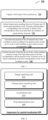
- FIG. 2 shows a flow diagram of an example 200 of a method for spatial localization according to the present disclosure.
- the method for spatial localization shown in FIG. 2 may be performed by the first device.
- the 3D model may include 3D points and descriptors corresponding to the 3D points.
- the descriptors are descriptive information of the individual feature points and may be used to distinguish the individual feature points, thereby determining corresponding feature points according to the individual descriptors.
- the descriptors may be 3D descriptors or 2D descriptors.
- the 3D model of the second device may consist of individual 3D points, and the 3D model consists of all the 3D points may be used to characterize the second device.
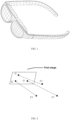
- FIG. 3 shows a schematic diagram of an example of the 3D model of the second device according to the present disclosure.
- the second device is AR glasses
- the formed 3D model is as shown in FIG. 3 , which characterizes the AR glasses.
- the 3D model of the second device may respond to a 3D model coordinate system, which may be used for determining the relative position of the individual 3D points on the 3D model.
- the 3D model coordinate system may be created based on a 3D model, and the 3D model coordinate system may be a space rectangular coordinate system.
- the 3D model of the second device may be created from the second device, and the 3D model may be created for the second device in real time.
- a fixed position point on the second device may be determined first as a position point in the 3D model coordinate system.
- the camera on the second device may be designated as the origin of the 3D model coordinate system.
- a 3D model coordinate system is established based on the determined position point, and a 3D model of the second device is created in the 3D model coordinate system by using the sensor on the second device.
- step 210 of acquiring a second correspondence between the second device and the 3D model of the second device may not be a fixed step for performing the method of the present application.
- a first image of the second device is captured.
- the first image of the second device and the 3D model of the second device are both used to represent the same object (i.e., the second device), then the 2D points on the second device in the first image may respond to the 3D points on the 3D model.
- the corresponding 2D point and 3D point represent the same position point on the second device.
- the preceding frames of image of the first image and the first image may be consecutive frames of image, and each preceding frame of image may also include the second device.
- the consecutive frames of image may record the change in the position of the second device continuously, which continuously changes in the consecutive frames of image. Based on this, the current position of the 2D points of the second device in the first image may be determined by searching in the first image according to the position of the second device in the preceding frames of image of the first image.
- the current position of the 2D points of the second device in the first image can be determined by searching within the estimated moving range in the first image. For example, both the position of the second device in the preceding frame of image and the relative position of that position in the first image can be determined. For example, if the second device is located at the middle position in the preceding frame of image, then the relative position of the second device in the preceding frame of image in the first image is also at the middle position. Then, the current position of the 2D points of the second device in the first image is determined by searching within the estimated moving range in the first image with the determined relative position as the center.
- the planar photographing range of the plane within which the second device lies can be determined according to the relative distance between the second device and the first device and the photographing range of the camera.
- the position of the second device in the planar photographing range can be determined according to the determined planar photographing range and the position of the second device in space.
- the range determined by the position of the second device in the planar range and the specified distance with that position as the center can be determined as the estimated range of the 2D points of the second device in the first image.
- feature point matching can be performed according to the descriptors of the feature points.
- the descriptors of the individual 2D points on the second device in the first image can be used to determine the descriptors of the 3D points of the 3D model that match those descriptors.
- the 2D point and 3D point corresponding to the two descriptors that match each other, respectively, are matched to each other, and the 2D point and 3D point that match each other constitute a first correspondence.
- Two descriptors that are identical or similar may be considered mutually matched.
- the methods for feature point matching may include fast-orb, sift, etc.
- the localization of the second device in the world coordinate system may be a pose. Accordingly, the determined localization of the 3D model in the world coordinate system is a pose. It will be illustrated in detail below in conjunction with FIG. 5 .
- the localization of the second device in the world coordinate system may also be a position. Accordingly, the determined localization of the 3D model in the world coordinate system is a position. It will be illustrated in detail below in conjunction with FIG. 7 .
- the pose of the first device in the world coordinate system is determined according to the localization of the 3D model of the second device in the world coordinate system and the first correspondence.
- the position of the second device in the world coordinate system may include three degrees of freedom of forward/backward, up/down, left/right.
- the position of the second device may be represented by the values on the X axis, Y axis, and the Z axis.
- the first device may be provided with an IMU, by which the first device can capture the IMU data in real time.
- the first device can calculate the pose of the first device in the world coordinate system (hereinafter referred to as pose a) in real time by using the captured IMU data.
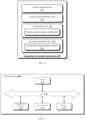
- FIG. 8 shows a block diagram of an example of the apparatus for spatial localization 800 according to the present disclosure.
- the apparatus for spatial localization 800 may be applied to the first device.
- the remote computer can be connected to a user's computer via any form of network, such as a local area network (LAN) or a wide area network (WAN), or connected to an external computer (e.g., via the Internet), or in a cloud computing environment, or used as a service, such as Software as a Service (SaaS).
- LAN local area network
- WAN wide area network
- SaaS Software as a Service
Landscapes
- Engineering & Computer Science (AREA)
- Physics & Mathematics (AREA)
- Theoretical Computer Science (AREA)
- General Physics & Mathematics (AREA)
- Computer Vision & Pattern Recognition (AREA)
- Software Systems (AREA)
- Multimedia (AREA)
- Computer Graphics (AREA)
- Artificial Intelligence (AREA)
- Health & Medical Sciences (AREA)
- Geometry (AREA)
- Computing Systems (AREA)
- Databases & Information Systems (AREA)
- Evolutionary Computation (AREA)
- General Health & Medical Sciences (AREA)
- Medical Informatics (AREA)
- Computer Hardware Design (AREA)
- General Engineering & Computer Science (AREA)
- Image Analysis (AREA)
- Length Measuring Devices By Optical Means (AREA)
- Processing Or Creating Images (AREA)
Applications Claiming Priority (2)
| Application Number | Priority Date | Filing Date | Title |
|---|---|---|---|
| CN202110980667.2A CN113658278B (zh) | 2021-08-25 | 2021-08-25 | 用于空间定位的方法及装置 |
| PCT/CN2022/114388 WO2023025175A1 (fr) | 2021-08-25 | 2022-08-24 | Procédé et appareil de positionnement spatial |
Publications (2)
| Publication Number | Publication Date |
|---|---|
| EP4394706A1 true EP4394706A1 (fr) | 2024-07-03 |
| EP4394706A4 EP4394706A4 (fr) | 2024-12-18 |
Family
ID=78492824
Family Applications (1)
| Application Number | Title | Priority Date | Filing Date |
|---|---|---|---|
| EP22860521.8A Pending EP4394706A4 (fr) | 2021-08-25 | 2022-08-24 | Procédé et appareil de positionnement spatial |
Country Status (4)
| Country | Link |
|---|---|
| US (1) | US20250182314A1 (fr) |
| EP (1) | EP4394706A4 (fr) |
| CN (1) | CN113658278B (fr) |
| WO (1) | WO2023025175A1 (fr) |
Cited By (1)
| Publication number | Priority date | Publication date | Assignee | Title |
|---|---|---|---|---|
| US20240328787A1 (en) * | 2023-03-27 | 2024-10-03 | Samsung Electronics Co., Ltd. | Method and apparatus for navigation with gnss-ins-eo sensor fusion |
Families Citing this family (3)
| Publication number | Priority date | Publication date | Assignee | Title |
|---|---|---|---|---|
| CN113658278B (zh) * | 2021-08-25 | 2025-06-06 | 优奈柯恩(北京)科技有限公司 | 用于空间定位的方法及装置 |
| CN114332423B (zh) * | 2021-12-30 | 2025-07-11 | 深圳创维新世界科技有限公司 | 虚拟现实手柄追踪方法、终端及计算可读存储介质 |
| CN120742230B (zh) * | 2025-09-05 | 2026-01-06 | 中数元宇数字科技(上海)有限公司 | 基于外向内技术的目标设备位姿计算方法和空间定位系统 |
Family Cites Families (15)
| Publication number | Priority date | Publication date | Assignee | Title |
|---|---|---|---|---|
| US20150254861A1 (en) * | 2012-10-18 | 2015-09-10 | T. Eric Chornenky | Apparatus and method for determining spatial information about environment |
| CN103793705B (zh) * | 2014-03-11 | 2018-03-30 | 哈尔滨工业大学 | 基于迭代随机抽样一致性算法和局部掌纹描述符的非接触掌纹认证方法 |
| US10503247B2 (en) * | 2017-05-09 | 2019-12-10 | Microsoft Technology Licensing, Llc | Calibration of stereo cameras and handheld object |
| CN109214980B (zh) * | 2017-07-04 | 2023-06-23 | 阿波罗智能技术(北京)有限公司 | 一种三维姿态估计方法、装置、设备和计算机存储介质 |
| US10636198B2 (en) * | 2017-12-28 | 2020-04-28 | Beijing Jingdong Shangke Information Technology Co., Ltd. | System and method for monocular simultaneous localization and mapping |
| WO2019152617A1 (fr) * | 2018-02-03 | 2019-08-08 | The Johns Hopkins University | Système et procédé d'étalonnage pour aligner une scène virtuelle en 3d et un monde réel en 3d pour un visiocasque stéréoscopique |
| CN110298877A (zh) * | 2018-03-21 | 2019-10-01 | 北京猎户星空科技有限公司 | 一种物体三维位姿的确定方法、装置及电子设备 |
| US10311833B1 (en) * | 2018-03-27 | 2019-06-04 | Seiko Epson Corporation | Head-mounted display device and method of operating a display apparatus tracking an object |
| CN110555880B (zh) * | 2019-08-26 | 2022-05-10 | 桂林电子科技大学 | 一种焦距未知的p6p相机位姿估计方法 |
| CN110738143B (zh) * | 2019-09-27 | 2023-06-02 | Oppo广东移动通信有限公司 | 定位方法及装置、设备、存储介质 |
| CN111179427A (zh) * | 2019-12-24 | 2020-05-19 | 深圳市优必选科技股份有限公司 | 自主移动设备及其控制方法、计算机可读存储介质 |
| WO2021163289A1 (fr) * | 2020-02-13 | 2021-08-19 | Magic Leap, Inc. | Système de réalité mélangée pour environnements à grande échelle |
| CN115552356A (zh) * | 2020-06-05 | 2022-12-30 | Oppo广东移动通信有限公司 | 头戴式显示装置的跟踪方法和头戴式显示系统 |
| EP4233005A1 (fr) * | 2021-02-19 | 2023-08-30 | Huawei Technologies Co., Ltd. | Procédé et agencement de traitement d'image pour estimer une pose probable par rapport à une région spatiale |
| CN113658278B (zh) * | 2021-08-25 | 2025-06-06 | 优奈柯恩(北京)科技有限公司 | 用于空间定位的方法及装置 |
-
2021
- 2021-08-25 CN CN202110980667.2A patent/CN113658278B/zh active Active
-
2022
- 2022-08-24 WO PCT/CN2022/114388 patent/WO2023025175A1/fr not_active Ceased
- 2022-08-24 EP EP22860521.8A patent/EP4394706A4/fr active Pending
- 2022-08-24 US US18/685,907 patent/US20250182314A1/en active Pending
Cited By (1)
| Publication number | Priority date | Publication date | Assignee | Title |
|---|---|---|---|---|
| US20240328787A1 (en) * | 2023-03-27 | 2024-10-03 | Samsung Electronics Co., Ltd. | Method and apparatus for navigation with gnss-ins-eo sensor fusion |
Also Published As
| Publication number | Publication date |
|---|---|
| EP4394706A4 (fr) | 2024-12-18 |
| CN113658278B (zh) | 2025-06-06 |
| WO2023025175A1 (fr) | 2023-03-02 |
| CN113658278A (zh) | 2021-11-16 |
| US20250182314A1 (en) | 2025-06-05 |
Similar Documents
| Publication | Publication Date | Title |
|---|---|---|
| EP4394706A1 (fr) | Procédé et appareil de positionnement spatial | |
| Memo et al. | Head-mounted gesture controlled interface for human-computer interaction | |
| US10674142B2 (en) | Optimized object scanning using sensor fusion | |
| CN111710036B (zh) | 三维人脸模型的构建方法、装置、设备及存储介质 | |
| US9953461B2 (en) | Navigation system applying augmented reality | |
| CN113874870A (zh) | 基于图像的定位 | |
| WO2019242262A1 (fr) | Procédé et dispositif de guidage à distance basé sur la réalité augmentée, terminal et support de stockage | |
| WO2023071790A1 (fr) | Procédé et appareil de détection de pose pour un objet cible, dispositif et support de stockage | |
| CN110458122A (zh) | 一种视线标校方法、显示装置的播放方法和视线标校系统 | |
| JP2021527877A (ja) | 3次元人体姿勢情報の検出方法および装置、電子機器、記憶媒体 | |
| CN114185427A (zh) | 用于并发测距和建图的系统和方法 | |
| CN108933902B (zh) | 全景图像采集装置、建图方法及移动机器人 | |
| CN103577789B (zh) | 检测方法和装置 | |
| CN113228117B (zh) | 创作装置、创作方法和记录有创作程序的记录介质 | |
| CN110276774A (zh) | 物体的绘图方法、装置、终端和计算机可读存储介质 | |
| CN112766027A (zh) | 图像处理方法、装置、设备及存储介质 | |
| JP7103354B2 (ja) | 情報処理装置、情報処理方法、及びプログラム | |
| US20260118969A1 (en) | Low-power hand-tracking system for wearable device | |
| US20240029295A1 (en) | Method and apparatus for determining pose of tracked object in image tracking process | |
| CN108804161B (zh) | 应用的初始化方法、装置、终端和存储介质 | |
| US20180197273A1 (en) | System and Method for Displaying Graphical Effects Based on Determined Facial Positions | |
| Afif et al. | Orientation control for indoor virtual landmarks based on hybrid-based markerless augmented reality | |
| TWI779332B (zh) | 擴增實境系統與其錨定顯示虛擬物件的方法 | |
| US20240242441A1 (en) | Fit prediction based on detection of metric features in image data | |
| CN111489376A (zh) | 跟踪交互设备的方法、装置、终端设备及存储介质 |
Legal Events
| Date | Code | Title | Description |
|---|---|---|---|
| STAA | Information on the status of an ep patent application or granted ep patent |
Free format text: STATUS: THE INTERNATIONAL PUBLICATION HAS BEEN MADE |
|
| PUAI | Public reference made under article 153(3) epc to a published international application that has entered the european phase |
Free format text: ORIGINAL CODE: 0009012 |
|
| STAA | Information on the status of an ep patent application or granted ep patent |
Free format text: STATUS: REQUEST FOR EXAMINATION WAS MADE |
|
| 17P | Request for examination filed |
Effective date: 20240229 |
|
| AK | Designated contracting states |
Kind code of ref document: A1 Designated state(s): AL AT BE BG CH CY CZ DE DK EE ES FI FR GB GR HR HU IE IS IT LI LT LU LV MC MK MT NL NO PL PT RO RS SE SI SK SM TR |
|
| REG | Reference to a national code |
Ref country code: DE Ref legal event code: R079 Free format text: PREVIOUS MAIN CLASS: G06T0007800000 Ipc: G06T0007730000 |
|
| DAV | Request for validation of the european patent (deleted) | ||
| DAX | Request for extension of the european patent (deleted) | ||
| A4 | Supplementary search report drawn up and despatched |
Effective date: 20241115 |
|
| RIC1 | Information provided on ipc code assigned before grant |
Ipc: G06T 7/73 20170101AFI20241111BHEP |