EP4394796A1 - Multimodale kardiologische vorhersage des krankheitszustandes mit kombination von elektrokardiogramm, echokardiogramm, klinischen und demographischen informationen im zusammenhang mit einem patienten - Google Patents
Multimodale kardiologische vorhersage des krankheitszustandes mit kombination von elektrokardiogramm, echokardiogramm, klinischen und demographischen informationen im zusammenhang mit einem patienten Download PDFInfo
- Publication number
- EP4394796A1 EP4394796A1 EP23220790.2A EP23220790A EP4394796A1 EP 4394796 A1 EP4394796 A1 EP 4394796A1 EP 23220790 A EP23220790 A EP 23220790A EP 4394796 A1 EP4394796 A1 EP 4394796A1
- Authority
- EP
- European Patent Office
- Prior art keywords
- layers
- preprocessing
- output
- features
- data
- Prior art date
- Legal status (The legal status is an assumption and is not a legal conclusion. Google has not performed a legal analysis and makes no representation as to the accuracy of the status listed.)
- Pending
Links
Images



Classifications
-
- G—PHYSICS
- G16—INFORMATION AND COMMUNICATION TECHNOLOGY [ICT] SPECIALLY ADAPTED FOR SPECIFIC APPLICATION FIELDS
- G16H—HEALTHCARE INFORMATICS, i.e. INFORMATION AND COMMUNICATION TECHNOLOGY [ICT] SPECIALLY ADAPTED FOR THE HANDLING OR PROCESSING OF MEDICAL OR HEALTHCARE DATA
- G16H50/00—ICT specially adapted for medical diagnosis, medical simulation or medical data mining; ICT specially adapted for detecting, monitoring or modelling epidemics or pandemics
- G16H50/20—ICT specially adapted for medical diagnosis, medical simulation or medical data mining; ICT specially adapted for detecting, monitoring or modelling epidemics or pandemics for computer-aided diagnosis, e.g. based on medical expert systems
-
- G—PHYSICS
- G16—INFORMATION AND COMMUNICATION TECHNOLOGY [ICT] SPECIALLY ADAPTED FOR SPECIFIC APPLICATION FIELDS
- G16H—HEALTHCARE INFORMATICS, i.e. INFORMATION AND COMMUNICATION TECHNOLOGY [ICT] SPECIALLY ADAPTED FOR THE HANDLING OR PROCESSING OF MEDICAL OR HEALTHCARE DATA
- G16H30/00—ICT specially adapted for the handling or processing of medical images
- G16H30/40—ICT specially adapted for the handling or processing of medical images for processing medical images, e.g. editing
-
- G—PHYSICS
- G16—INFORMATION AND COMMUNICATION TECHNOLOGY [ICT] SPECIALLY ADAPTED FOR SPECIFIC APPLICATION FIELDS
- G16H—HEALTHCARE INFORMATICS, i.e. INFORMATION AND COMMUNICATION TECHNOLOGY [ICT] SPECIALLY ADAPTED FOR THE HANDLING OR PROCESSING OF MEDICAL OR HEALTHCARE DATA
- G16H50/00—ICT specially adapted for medical diagnosis, medical simulation or medical data mining; ICT specially adapted for detecting, monitoring or modelling epidemics or pandemics
- G16H50/70—ICT specially adapted for medical diagnosis, medical simulation or medical data mining; ICT specially adapted for detecting, monitoring or modelling epidemics or pandemics for mining of medical data, e.g. analysing previous cases of other patients
Definitions
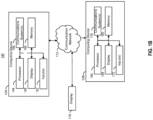
- the computing device 104 may receive ECG data, such as 12-lead ECG data, which may be used for example, to generate a cardiac risk score (e.g., AF, AS, CA, and/or SP) based on the ECG data using one or more single architecture models.
- a cardiac risk score e.g., AF, AS, CA, and/or SP
- the risk score can indicate a predicted risk of a patient developing the cardiac event within a predetermined time period from when the ECG was taken (e.g., three months, six months, one year, five years, ten years, etc.).
- the computing device 104 can execute at least a portion of an ECG analysis application 132 to automatically generate the risk score.
- the training data database 124 may include a number of ECGs and clinical data.
- the clinical data may include outcome data, such as whether or not a patient developed AF in a time period following the day that the ECG was taken. Exemplary time periods may include 1 month, 2 months, 3 months, 4 months, 5 months, 6 months, 7 months, 8 months, 9 months, 10 months, 11 months 12 months, 1 year, 2 years, 3 years, 4 years, 5 years, 6 years, 7 years, 8 years, 9 years, or 10 years.
- the ECGs and clinical data can be used for training a model to generate AF risk scores.
- the training data database 124 may include multi-lead ECGs taken over a period of time (such as ten seconds) and corresponding clinical data.
- the trained models database 128 may include a number of trained models that can receive raw ECGs and output AF risk scores.
- a digital image or digital map generated from signals from one or more lead for an ECG e.g., ECG imaging
- trained models 136 can be stored in the computing device 104.
- the memory 160 may include any suitable storage device or devices that can be used to store instructions, values, etc., that can be used, for example, by the processor 144 to present content using display 148, to communicate with the secondary computing device 108 via communications system(s) 156, etc.
- the memory 160 may include any suitable volatile memory, non-volatile memory, storage, or any suitable combination thereof.
- the memory 160 may include RAM, ROM, EEPROM, one or more flash drives, one or more hard disks, one or more solid state drives, one or more optical drives, etc.
- the memory 160 can have encoded thereon a computer program for controlling operation of computing device 104 (or secondary computing device 108).
- the term “layer” or “layers” may refer to one or more tiers of weights established during the training of one or more machine learning models (e.g., one or more neural networks).
- machine learning models e.g., one or more neural networks.
- modeling approaches may be deployed that do not use explicit weights. For example regression networks and other non-neural network approaches maybe employed that do not involve the training of weights.
- the fully-connected layers may receive as input the output of the combined layers 304.
- the fully-connected layers perform the function of connecting previous layers to the final output layers.
- the fully-connected layers may have a number of nodes, each having a respective activation function.
- Example activation functions include ReLU, Sigmoid, Softmax, etc.
- an activation function may be omitted.
- Each of the nodes may correspond to a respective input node of the previous layers, and each node may generate respective outputs.
- the outputs of the nodes may be provided as inputs to one or more layers, such as the final output layers 308, which may include additional activation functions and/or the loss functions 310.
- loss functions include binary cross-entropy, categorical cross-entropy, mean squared error (MSE), L2 loss, etc.
- MSE mean squared error
- the present techniques enable the respective isolated layers to standardize outputs in such a way that such outputs are compatible with other(s) of the isolated layers, at the combination layers.
- an additional component is used to reconcile outputs of the respective isolated layers.
- various techniques may be used to combine outputs at the combination layers 304.
- the computing device 104 may add preprocessing layers (as optionally selected by the user, and/or based on pre-configuration), one or more ML models (e.g., the ML models 324), one or more concatenation layers, one or more fully connected layers and final output layers with one or more loss function to the new architecture.
- preprocessing layers as optionally selected by the user, and/or based on pre-configuration
- ML models e.g., the ML models 324
- concatenation layers e.g., the ML models 324
- the computing device 104 may then operate the new architecture, including the trained models therein, for example using information received via the communication network (e.g., information included in the ECG database 120, information received directly from an ECG machine, EHR information, imaging information, etc.). The received information may be provided to the appropriate segment of the new architecture (e.g., the respective segments 302) based on the source of the information.
- the computing device 104 may receive the modeling output 312, and may process the output further. For example, the computing device 104 may transmit the output 312, store the output 312, perform a computation using the output 312, etc. Additional examples of parameterizing, constructing, training and operating the architecture 300 are discussed below.
- the single architecture machine learning model 400 may include segments 402a, 402b and 402c that correspond, respectively, to a customizable imaging/video artificial neural network, a customizable time series artificial neural network, and a customizable EHR data artificial neural network.
- the segments 402a-402c may correspond, respectively, to the segments 302a-302c of FIG. 3 .
- the configurable single architecture machine learning model 400 may further include one or more fully-connected layers 404 and a modeling output 406.
- the segments 402a-402c each include respective input modalities 420a-420c.
- the respective input modalities may correspond to the input modalities 320a-310c, respectively, in some aspects.
- the input modality 420a may be an image/video data input modality
- the input modality 420b may be a time series input modality (e.g., an ECG input modality having a shape of (5000,8))
- the input modality 420c may include one or more EHR sequence inputs including patient age and other demographic/diagnostic information.
- the segments 402a and 402b may lack any preprocessing layers.
- the segment 402c may include one or more preprocessing layers 422c that perform input embedding.
- the input embedding may include either pre-trained or learned pre-processing, in some aspects.
- the preprocessing layers 422c may include positional encoding, in some aspects.
- the input modalities 420a-420c may be input into respective sets of isolated layers 424a-424c, respectively, across the segments 402a-402c.
- the isolated layers 424a of the segment 402a may be an echo convolutional neural network model that is configured to process video/image data modalities 420a.
- the set of isolated layers 424b may be an ECG convolutional neural network model that is configured to process time series input modalities 420b.
- the set of isolated layers 424c may be a transformer machine learning model configured to process the EHR input modalities 420c.
- the transformer model 424c may include an encoder mechanism, an attention mechanism, and a feed-forward artificial neural network.
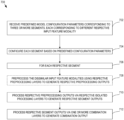
- FIG. 7 depicts an exemplary computer-implemented method 700, according to some aspects.
- the method 700 may be performed by the architecture 300 of FIG. 3 , in some aspects.
- the architecture 400 of FIG. 4 , the loss function 500 of FIG. 5 and/or the architecture 600 of FIG. 6 may also be used, respectively, to perform the method 700, in aspects.
- the method 700 may be executed by yet further architectures that while not depicted, are envisioned using the principles described by present techniques.
- the method 700 may receive parameters selected via a touch screen of the display 116 of FIG. 1A , via the display 116 of FIG. 1B , etc.
- the predefined model configuration parameters may be represented as a nested data structure, such as XML, JSON, etc.
- the nested data structure may include parameters defining one or more respective input modalities (e.g., a customizable imaging/video neural network, a customizable time series neural network, a customizable EHR data neural network etc.).
- the nested configuration data may further include an indication of one or more preprocessing layers, such as the preprocessing 322a-c of FIG. 3 .
- the method 700 may include configuring each model segment based on the predefined model configuration parameters (block 704).
- the method 700 may execute computer-executable instructions that create/load and configure one or more single architecture machine learning model (e.g., the single architecture machine learning model 400 of FIG. 4 ).
- instructions included in one or more computing devices e.g., the computing device 104 may set the number and characteristics of one or more segments of an ML model (e.g., the segments 402 of the single architecture machine learning model 400 of FIG. 4 ).
- the method 700 may further include configuring one or more trained machine learning models (e.g., via loading one or more models via the training database 124).
- dissimilar features may include ECG features and/or EHR features, and modeling outputs may relate to patient risk.
- the dissimilar input feature modalities may electrocardiogram features and electronic health record features; and the modeling output is a probability from 0 and 1 representing a future risk to a patient.
- the dissimilar input feature modalities may electrocardiogram features, echocardiogram features and electronic health record features; and the modeling output may be a probability from 0 and 1 representing a future risk to a patient.
- the dissimilar input feature modalities may include retinal scan image features and electronic healthcare record features; and the modeling output may be a probability from 0 and 1 representing a patient's future risk of onset diabetes.
- the method 700 may include normalizing the outputs of each of the respective sets of isolated processing layers in the one or more segments. In this way, the output of those layers can be combined and joined together for processing by loss function(s0 in the combination layers.
- the binary classification function may be a sigmoid activation function included in one or more neurons of a dense output layer.
- the binary classification function may include: i) a binary cross entropy loss function; ii) a Kullback-Leibler divergence loss function; iii) a Hinge function loss function; iv) a squared Hinge loss function; and/or v) a focal loss function.
- the method 700 may be used to perform multi-class classification, as depicted for example in FIG. 6 .
- the multi-class classification function may be a softmax activation function included in one or more neurons of a dense output layer.
- the multi-class classification function may include i) a categorical cross entropy loss function; ii) Kullback-Leibler divergence loss function; iii) a sparse multiclass cross-entropy loss function; iv) a focal loss function; and/or v) a negative log-likelihood function.
- the machine learning models may include a multiclass classification model; the loss functions may include a multiclass classification loss function; and the final output layers may include a multiclass classification output layer.
- the machine learning models may include a binary classification model
- the loss functions may include a binary classification loss function
- the final output layers include a binary classification output layer.
- the dissimilar input feature modalities include electrocardiogram features and electronic health record features; and the modeling output is a probability from 0 and 1 representing a future risk to a patient.
- the machine learning models of method 700 may include at least one of i) an artificial neural network; ii) a convolutional neural network; or iii) a sequence neural network.
- the ML model 324c is an artificial neural network.
- One or more ML models using ML modeling techniques now known or later developed may be substituted for one or more of the ML models 324, in aspects.
- receiving predefined model configuration parameters may include receiving one or more of any of the following i) a digital image or a digital video input; ii) a time series input; iii) an electronic health records data input; iv) an electrocardiogram input; v) an echocardiogram input; vi) a computed tomography input; vii) a magnetic resonance imaging input; viii) a tabular data input; or ix) a natural language string input.
- the dissimilar input feature modalities may include ECG time series data.
- preprocessing the plurality of dissimilar input feature modalities via respective preprocessing layers to generate the respective preprocessing outputs includes preprocessing at least one of the model inputs via i) an electrocardiogram lead recalibration; ii) an electrocardiogram lead amplitude standardization; iii) an electrocardiogram lead augmentation; iv) an electrocardiogram data restructuring; v) an electrocardiogram lead rescaling; or vi) a Fourier space transformation.
- the method 700 may include preprocessing the model inputs via one or more respective preprocessing layers to generate the respective preprocessing outputs, including preprocessing at least one of the model inputs via categorical feature processing; ii) numerical feature processing; or iii) feature censoring.
- Such techniques may be used when at least one of the model inputs includes tabular data, and/or for other input types.
- the method 700 may include receiving image and/or video data.
- preprocessing the model inputs via the one or more respective preprocessing layers to generate the respective preprocessing outputs may include preprocessing at least one of the model inputs via: i) image size normalization; ii) image augmentation; or iii) a Fourier space transformation. It is envisioned that other image-based techniques may be applicable, in some circumstances.
- preprocessing is optional, both with respect to overall architectures and each segment within a given architecture. While it is true that in reality, almost all datasets need at least some cleaning performed to place them in the best possible condition for modeling, it is also true that in some aspects, preprocessing may not need to be performed because the data is already in a clean format.
- data is examined for discrepancies against an expected format and preprocessed to match the format if any are identified.
- the method 700 includes receiving an expected format; and preprocessing the model inputs via the one or more respective preprocessing layers to generate the respective preprocessing outputs based on the expected format.
- formatting may be parameterized, in some aspects. For example, using patient age as an example, a downstream recipient may desire raw age, whereas another recipient desires to receive age in buckets (e.g., 40-50, 50-60, etc.). Yet another recipient may desire to see age as a Boolean value representing whether the patient age exceeds a given value (e.g., 65 years).
- one or more parameters describing expected format(s) may be included in the predefined model configuration parameters at block 702 of FIG. 7 . As noted, such parameters may be stored preferences, and/or set ad hoc by a user.
- the expected formats may include, for example, single numeric values, numeric ranges and/or Boolean values, as well as any other suitable data formats.
- the plurality of dissimilar input feature modalities includes a structured data set and a time series data set
- preprocessing the dissimilar input feature modalities using the respective preprocessing layers to generate respective preprocessing outputs at block 708 of the method 700 may include preprocessing the structured data set using at least one of (i) categorical feature processing, (ii) numerical feature processing, or (iii) feature censoring.
- the structured data set may be a tabular data set, in some aspects.
- the present multi-modal techniques may include processing genomics data, including inputs as large as whole genome sequencing (WGS) to more targeted panels such as an assay for tumors (such as a 596 gene panel).
- WGS whole genome sequencing
- These types of inputs may be analyzed by a variety of methods including deep learning (e.g., CNNs, RNNs, transformers) and machine learning (e.g., SVM, gradient boosted models, logistic regression) algorithms.
- These outputs may be 1-dimensional.
- These non-linear interaction outputs from each feature set type may be merged into a single encompassing neural network architecture.
- the architectures discussed herein may be configured to receive a plurality of input data types, each having a respective data shape and respective data features.
- the model may be configured to receive an input data type.
- the input data type may have a particular data shape (e.g., 3 frames each having height and width of 256 pixels x 256 pixels, respectively) and particular data features (e.g., echocardiogram image features).
- the model may be configured to interpret the input data type using one or more imaging features neural network layers.
- TR Prediction of tricuspid regurgitation (1 year future incidence or active disease)
- EF Prediction of reduced left ventricular ejection fraction (EF) (1 year future incidence or active disease)
- IVS Prediction of reduced increased interventricular septal (IVS) thickness (1 year future incidence or active disease)
- CA Cardiac Amyloidosis prediction uses unknown machine learning model (not CNN); one feature is interventricular septal thickness (IVSD) determined from ECG Stroke Stroke prediction from ECG, Age, Sex, uses same CNN as previous filings Stroke
- the model may include four branches, and can be trained to generate a risk score based in response to receiving voltage data spanning subsequent 2.5 second periods from four different leads.
- Certain organizations such as hospitals may use a standardized ECG configuration (e.g., voltage data spanning subsequent one second periods from ten different leads).
- the model may include an appropriate number of branches and be trained to generate a risk score for the standardized ECG configuration.
- the model 40 can be tailored to whatever ECG configuration is used by a given organization.
- the model may include a convolutional component, inception blocks, and a fully-connected dense layer component. These components may be enabled or disabled, and their various properties defined, depending on the configuration parameters received by the system 100. In some aspects, the configuration parameters may be default parameters.
- Concatenating the ECG information with the separately generated demographic information can allow the model to individually disseminate the voltage data from the first branch, the second branch, and the third branch, as well as the demographic data, which may improve performance over other models that provide the voltage data and the demographic data to the model at the same channel.
- Bayesian-based layers may be included in the model. These layers may deliver non-deterministic results alongside or instead of deterministic results such as numeric and/or Boolean outputs. This may represent a further advantageous improvement over conventional modeling techniques, which output deterministic answers even in the presence of faulty inputs (e.g., noisy/missing ECGs, artifacts in EHR (e.g., missing sex, negative age, smoking history blank, etc.), speckle or noise in images, etc.).
- the model may be trained to include a confidence interval along with a deterministic prediction, which may be used to accord weight to the prediction of the model.
- the first convolutional block, the second convolutional block, and the third convolutional block can be 1D convolutional blocks.
- Results from each of the convolutional blocks can be concatenated by combining the results (e.g., arrays), and inputting the concatenated results to a MaxPool layer included in the sub-block.
- the MaxPool layer can extract positive values for each moving 1D convolutional filter window, and allows for another form of regularization, model generalization, and prevent overfitting.
- GAP global average pooling
- extraction may include records from electronic health records having additional patient data such as patient status (alive / dead) which may be generated by combining each patient's most recent clinical encounters from the EHR and a regularly-updated death index registry.
- additional variables may be added into a predictive model for purposes of both improving the prediction accuracy of the endpoints and identifying treatments which can positively impact the predicted bad outcome.
- laboratory values blood cholesterol measurements such as LDL / HDL / total cholesterol, blood counts such as hemoglobin / hematocrit / white blood cell count, blood chemistries such as glucose / sodium / potassium / liver and kidney function labs, and additional cardiovascular markers such as troponins and natriuretic peptides), vital signs (blood pressures, heart rate, respiratory rate, oxygen saturation), imaging metrics (such as cardiac ejection fractions, cardiac chamber volumes, heart muscle thickness, heart valve function), patient diagnoses (such as diabetes, chronic kidney disease, congenital heart defects, cancer, etc.) and treatments (including procedures, medications, referrals for services such as cardiac rehabilitation, dietary counseling, etc.), a model's accuracy may be improved.
- variables are "modifiable" risk factors that can then be used as inputs to the models to demonstrate the benefit of using a particular therapy. For example, a prediction may identify a patient as a 40% likelihood of developing atrial fibrillation in the next year, however, if the model was able to identify that the patient was taking a beta blocker, the predicted risk would drop to 20% based on the increased data available to the predictive model. In one example, demographic data and patient data may be supplemented with these additional variables, such as the extracted laboratory values or modifiable risk factors.
- Machine learning models for implementing a predictive model may include a convolutional neural network having a plurality of branches processing a plurality of channels each.
- the model may include five branches from which an input of three leads as channels concurrent in time, e.g., (Branch 1: [I, II, III]; Branch 2: [aVR, aVL, aVF]; Branch 3: [V1, V2, V3]; Branch 4: [V4, V5, V6] and Branch 5: [V1-long, II-long, V5-long]) may be utilized to generate predictions.
- each branch can represent the 3 leads as they were acquired at the same time, or during the same heartbeats.
- Branch 5 which may include the "long leads”
- the leads can be sampled for a duration of 10 seconds.
- the leads can be sampled for a duration of 2.5 seconds.
- An example may include predicting that a patient has a 40% chance of a-fib in the next year; however, if the patient is prescribed (and takes) a beta blocker, that same patient may instead have a reduced, 20% chance of developing a-fib in the next year.
- Incorporating precision medicine at the earliest stages in treatment, such as when the patient incurs a first ECG allows treating physicians to make recommendations that may improve the patient's overall quality of life and prevent unfavorable outcomes before the patient's health deteriorates to the point where they seek advanced medical treatment.
- the models will learn how certain treatments / interventions can positively impact patient outcomes that is reduce the chance of the adverse clinical outcome of interest.
- Example 19 The computer-implemented method of example 1,
- Example 22 The computer-implemented method of example 1,
Landscapes
- Health & Medical Sciences (AREA)
- Engineering & Computer Science (AREA)
- Medical Informatics (AREA)
- Public Health (AREA)
- Biomedical Technology (AREA)
- Epidemiology (AREA)
- General Health & Medical Sciences (AREA)
- Primary Health Care (AREA)
- Data Mining & Analysis (AREA)
- Databases & Information Systems (AREA)
- Pathology (AREA)
- Radiology & Medical Imaging (AREA)
- Nuclear Medicine, Radiotherapy & Molecular Imaging (AREA)
- Measuring And Recording Apparatus For Diagnosis (AREA)
- Measurement And Recording Of Electrical Phenomena And Electrical Characteristics Of The Living Body (AREA)
Applications Claiming Priority (1)
| Application Number | Priority Date | Filing Date | Title |
|---|---|---|---|
| US18/091,320 US20240221936A1 (en) | 2022-12-29 | 2022-12-29 | Multimodal cardio disease state predictions combining electrocardiogram, echocardiogram, clinical and demographical information relating to a patient |
Publications (1)
| Publication Number | Publication Date |
|---|---|
| EP4394796A1 true EP4394796A1 (de) | 2024-07-03 |
Family
ID=89474597
Family Applications (1)
| Application Number | Title | Priority Date | Filing Date |
|---|---|---|---|
| EP23220790.2A Pending EP4394796A1 (de) | 2022-12-29 | 2023-12-29 | Multimodale kardiologische vorhersage des krankheitszustandes mit kombination von elektrokardiogramm, echokardiogramm, klinischen und demographischen informationen im zusammenhang mit einem patienten |
Country Status (4)
| Country | Link |
|---|---|
| US (1) | US20240221936A1 (de) |
| EP (1) | EP4394796A1 (de) |
| AU (1) | AU2023285762A1 (de) |
| CA (1) | CA3225294A1 (de) |
Families Citing this family (5)
| Publication number | Priority date | Publication date | Assignee | Title |
|---|---|---|---|---|
| US12381008B1 (en) * | 2024-08-13 | 2025-08-05 | Anumana, Inc. | System and methods for observing medical conditions |
| US20260058013A1 (en) * | 2024-08-22 | 2026-02-26 | GE Precision Healthcare LLC | Systems and methods for ecg interpretation based on longitudinal criteria |
| CN121117916A (zh) * | 2025-08-14 | 2025-12-12 | 北京晓珑科技有限公司 | 一种多协议融合的动态数据处理方法及系统 |
| CN121489484B (zh) * | 2026-01-13 | 2026-03-13 | 长三角国智(上海)智能医疗科技有限公司 | 一种基于脑电信号的抑郁症识别系统 |
| CN121661455A (zh) * | 2026-02-04 | 2026-03-13 | 上海交通大学医学院附属上海儿童医学中心 | 一种肺动脉瓣狭窄超声心动图智能识别的特征融合方法 |
Citations (2)
| Publication number | Priority date | Publication date | Assignee | Title |
|---|---|---|---|---|
| CN112102385A (zh) * | 2020-08-20 | 2020-12-18 | 复旦大学 | 一种基于深度学习的多模态肝脏磁共振影像配准系统 |
| KR20220110466A (ko) * | 2020-10-06 | 2022-08-08 | 연세대학교 산학협력단 | 뇌경색 볼륨 계산 기반의 뇌경색 예측 방법 및 그를 위한 장치 |
-
2022
- 2022-12-29 US US18/091,320 patent/US20240221936A1/en active Pending
-
2023
- 2023-12-19 AU AU2023285762A patent/AU2023285762A1/en active Pending
- 2023-12-29 EP EP23220790.2A patent/EP4394796A1/de active Pending
- 2023-12-29 CA CA3225294A patent/CA3225294A1/en active Pending
Patent Citations (2)
| Publication number | Priority date | Publication date | Assignee | Title |
|---|---|---|---|---|
| CN112102385A (zh) * | 2020-08-20 | 2020-12-18 | 复旦大学 | 一种基于深度学习的多模态肝脏磁共振影像配准系统 |
| KR20220110466A (ko) * | 2020-10-06 | 2022-08-08 | 연세대학교 산학협력단 | 뇌경색 볼륨 계산 기반의 뇌경색 예측 방법 및 그를 위한 장치 |
Non-Patent Citations (1)
| Title |
|---|
| ANONYMOUS: "U-Net - Wikipedia", 16 January 2022 (2022-01-16), XP093123661, Retrieved from the Internet <URL:https://en.wikipedia.org/w/index.php?title=U-Net&oldid=1066085220> [retrieved on 20240125] * |
Also Published As
| Publication number | Publication date |
|---|---|
| CA3225294A1 (en) | 2024-06-29 |
| US20240221936A1 (en) | 2024-07-04 |
| AU2023285762A1 (en) | 2024-07-18 |
Similar Documents
| Publication | Publication Date | Title |
|---|---|---|
| US11957507B2 (en) | Systems and methods for a deep neural network to enhance prediction of patient endpoints using videos of the heart | |
| US11756688B2 (en) | ECG-based cardiovascular disease detection systems and related methods | |
| US11657921B2 (en) | Artificial intelligence based cardiac event predictor systems and methods | |
| EP4394796A1 (de) | Multimodale kardiologische vorhersage des krankheitszustandes mit kombination von elektrokardiogramm, echokardiogramm, klinischen und demographischen informationen im zusammenhang mit einem patienten | |
| US10984905B2 (en) | Artificial intelligence for physiological quantification in medical imaging | |
| US10192640B2 (en) | Fractional flow reserve decision support system | |
| Franklin et al. | Arrhythmia and disease classification based on deep learning techniques | |
| Chandrasekar et al. | ANALYSIS FOR HEART DISEASE PREDICTION USING DEEP NEURAL NETWORK AND VGG_19 CONVOLUTION NEURAL NETWORK. | |
| Hong et al. | Gated temporal convolutional neural network and expert features for diagnosing and explaining physiological time series: a case study on heart rates | |
| de Souza-Filho et al. | Deep learning and artificial intelligence in nuclear cardiology | |
| Lalli et al. | Applications of deep learning and machine learning in healthcare domain-A literature review | |
| Tang | Improving Deep Learning for Medical Time Series Data by Modeling Multidimensional Dependencies | |
| US20260096783A1 (en) | Apparatus and method for subject monitoring and diagnosing with non-invasive measures | |
| WO2024249863A2 (en) | Systems and methods for modelling for 2d echocardiography-based prediction of right ventricular volume | |
| Wassan et al. | Role of Deep Learning in Predicting Aging-Related Diseases: A Scoping Review. Cells 2021, 10, 2924 | |
| Huang | Cardiovascular Disease Prediction through Retinal Graph Representations and Multimodal Self-supervised Learning | |
| Ogundokun et al. | Prediction Based on Machine Learning Algorithms | |
| Zheng et al. | Integration of PCG spectrogram texture and deep features for the diagnosis of heart failure with preserved ejection fraction using heterogeneous stacking ensemble learning | |
| Awan | Machine Learning with Applications to Heart Failure Data Analysis and Processing | |
| Agrohi et al. | and Deep Learning Algorithm |
Legal Events
| Date | Code | Title | Description |
|---|---|---|---|
| PUAI | Public reference made under article 153(3) epc to a published international application that has entered the european phase |
Free format text: ORIGINAL CODE: 0009012 |
|
| STAA | Information on the status of an ep patent application or granted ep patent |
Free format text: STATUS: THE APPLICATION HAS BEEN PUBLISHED |
|
| AK | Designated contracting states |
Kind code of ref document: A1 Designated state(s): AL AT BE BG CH CY CZ DE DK EE ES FI FR GB GR HR HU IE IS IT LI LT LU LV MC ME MK MT NL NO PL PT RO RS SE SI SK SM TR |
|
| STAA | Information on the status of an ep patent application or granted ep patent |
Free format text: STATUS: REQUEST FOR EXAMINATION WAS MADE |
|
| 17P | Request for examination filed |
Effective date: 20250103 |