EP4394895A1 - Photovoltaik-sandwichplatte, insbesondere pv-fahrzeugverkleidungs-sandwichplatte, mit wabenkörperrückenstruktur und herstellungsverfahren - Google Patents
Photovoltaik-sandwichplatte, insbesondere pv-fahrzeugverkleidungs-sandwichplatte, mit wabenkörperrückenstruktur und herstellungsverfahren Download PDFInfo
- Publication number
- EP4394895A1 EP4394895A1 EP22217406.2A EP22217406A EP4394895A1 EP 4394895 A1 EP4394895 A1 EP 4394895A1 EP 22217406 A EP22217406 A EP 22217406A EP 4394895 A1 EP4394895 A1 EP 4394895A1
- Authority
- EP
- European Patent Office
- Prior art keywords
- photovoltaic
- label
- sandwich panel
- honeycomb
- solar cell
- Prior art date
- Legal status (The legal status is an assumption and is not a legal conclusion. Google has not performed a legal analysis and makes no representation as to the accuracy of the status listed.)
- Withdrawn
Links
Images

Classifications
-
- H—ELECTRICITY
- H10—SEMICONDUCTOR DEVICES; ELECTRIC SOLID-STATE DEVICES NOT OTHERWISE PROVIDED FOR
- H10F—INORGANIC SEMICONDUCTOR DEVICES SENSITIVE TO INFRARED RADIATION, LIGHT, ELECTROMAGNETIC RADIATION OF SHORTER WAVELENGTH OR CORPUSCULAR RADIATION
- H10F19/00—Integrated devices, or assemblies of multiple devices, comprising at least one photovoltaic cell covered by group H10F10/00, e.g. photovoltaic modules
-
- H—ELECTRICITY
- H02—GENERATION; CONVERSION OR DISTRIBUTION OF ELECTRIC POWER
- H02S—GENERATION OF ELECTRIC POWER BY CONVERSION OF INFRARED RADIATION, VISIBLE LIGHT OR ULTRAVIOLET LIGHT, e.g. USING PHOTOVOLTAIC [PV] MODULES
- H02S30/00—Structural details of PV modules other than those related to light conversion
- H02S30/10—Frame structures
Definitions
- the present invention relates to a sandwich panel, particularly to a vehicle cladding sandwich panel, and to a method for manufacturing such sandwich panels.
- PV panels are produced with rigid wafer-based solar cells that are embedded in a polymer encapsulation which is covered at its front side by a glass sheet and at its rear side by a support structure. Such PV panels are generally heavy and relatively cost-intensive. Furthermore, such PV panels are generally planar.
- PV cells are provided at a body of a car, for generating electricity to be supplied to the car.
- Such electricity may be used for example for charging batteries of an electric car.
- PV sandwich panels particularly PV integrated vehicle cladding sandwich panels
- the panel should allow for some flexibility to a certain extent e.g. during bending, thermal expansion, etc.
- structural characteristics of the PV sandwich panel may have to be adapted such as to pass e.g. pedestrian protection requirements.
- enough free space for positioning tolerances of e.g. connection boxes for electrical connection and indicating its orientation should be provided.
- interface surfaces such as for gluing other parts to the back structure may have to be created.
- the PV sandwich panel should be producible on an industrial scale, at low costs and/or with high reliability.
- PV sandwich panel particularly a PV integrated vehicle cladding sandwich panel, and a method for manufacturing the same are disclosed, which may achieve at least some of the above mentioned desired characteristics.
- a photovoltaic sandwich panel comprising at least one sheet-like photovoltaic label and a back structure.
- the at least one photovoltaic label comprises at least a front side polymeric lamination foil, a rear side polymeric lamination foil and a solar cell arrangement interposed between the front and rear side lamination foils.
- the at least one photovoltaic label is fixed with its rear side to a front side of the back structure.
- the back structure comprises a honeycomb structure and a frame structure in one piece. The frame structure predominantly frames an outer edge of the honeycomb structure.
- a method for manufacturing a photovoltaic sandwich panel, particularly a photovoltaic car body panel is presented.
- the method includes at least the following steps, preferably in the indicated order:
- the pocket stamps and the resulting pocket structure are arranged at locations of the PV label outside the solar cell arrangement, i.e. close to the circumferential edge of the PV label where the PV label comprises only the polymeric foils but with no solar cells being locally interposed between these foils.
- the width of the frame structure and the size, arrangement and design of the pocket structure achieves a save fixation of the PV label to the back structure, even at e.g. highly 3-D curved car body panels.
- the term back structure comprises any kind of supporting structure suitable to physically stabilise the photovoltaic label and give the photovoltaic sandwich panel its needed structural characteristics and shape.
- the PV label is bendable and does not offer all the needed structural characteristics, like stiffness, self-supporting properties, etc. Therefore, the back structure is an essential part of the photovoltaic sandwich panel which ensures the needed structural performances in various application fields such as crash-characteristics or pedestrian protection for PV vehicle body panels.
- the back structure is made as a single unitary component.
- the back structure including its honeycomb structure and its frame structure are made with the same polymer material and may generally be formed in a common injection moulding process.
- such injection moulding process may be embodied as reaction injection moulding (RIM) process using thermosetting polymer material.
- RIM reaction injection moulding
- the back structure is fixed to the PV label preferably via a positive substance jointing connection.
- the PV label and the back structure comprise a same polymer or are made with polymer mixtures sharing at least one common polymer component.
- the back structure abuts directly to a surface of the PV label, i.e. with no intermediate layer (such as a primer layer) being interposed there between.
- honeycomb structure relates to structures that have the geometry of a honeycomb to allow the minimization of the amount of used material to reach minimal weight and minimal material cost.
- the geometry of honeycomb structures can vary widely but the common feature of all such structures is an array of hollow cells formed between thin vertical side walls. The cells are often columnar and may be hexagonal or quasi-hexagonal in shape.
- the honeycomb structure may be provided with a mesh size corresponding to an inner dimension or diameter of each honeycomb, a rib width corresponding to a thickness of the honeycomb's side walls and a rip height corresponding to a height of the honeycomb's side walls.
- Such interface layer may increase an adhesion between the honeycomb structure and the back side surface of the PV label.
- the geometry i.e. the mesh size, rib height and/or rib width may vary along the honeycomb structure throughout the extension of the PV label.
- Front side is defined as the side of components which is dedicated to be directed towards the sun when the PV integrated car body panel is in action of producing energy.
- Back side is the opposite direction to this front side.
- the length of the pockets is preferably at least double the size of its width.
- the pockets are designed to surround an entire portion of the PV label incorporating the solar cell arrangement in a ring like manner.
- the pockets have a length of approximately 30 mm and the distance between two neighboured pockets in the frame is approximately 3mm.
- This 3mm stage between neighbouring pockets may be referred to as "runner" and may be needed to ensure a sufficient flow of moulding polymer during the manufacturing process. Depending on the integration technology this stage width or runner width may be increased accordingly.
- the term “predominantly” as used herein may indicate that at least 50%, preferably at least 70%, 80% or even 90%, of the related feature is formed like described.
- the term “approximately” as used herein may indicate that up to +/-10 or even up to +/-20 percent of the related feature is formed like described.
- each PV label comprises its one frame and pocket structure each arranged circumferential to the outer edge of the related PV label.
- the photovoltaic sandwich panel comprises a honeycomb structure designed with a mesh size of approximately 30 mm diameter, approximately 3.0 mm rib width and approximately 3.7 mm rib height. This dimension was found as a trade-off between several desired part properties. It is a trade-off between minimizing the parameter mesh size, maximising the rib width and rib height, to increase adhesion contact between back structure PV label. A high stiffness of the car body panel is achieved with decreased weight and sufficient flexibility.
- the photovoltaic sandwich panel comprises a honeycomb structure designed with a mesh size of approximately 40 mm diameter, approximately 3.0 mm rib width and approximately 3.0 mm rib height.
- the parameters of the aforementioned embodiment might not be suitable for a PV vehicle cladding sandwich panel which shall serve e.g. as hood of a vehicle and which shall therefore satisfy pedestrian protection requirements, especially because it might be too stiff and excessively injure a pedestrian in case of an accident.
- the pedestrian protection requirements would be met according to simulations with the mesh dimensions of this alternative embodiment. These dimensions could not be applied to body parts of the vehicle other than the hood, as they might then not meet the specific stiffness requirements.
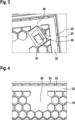
- the photovoltaic sandwich panel comprises a honeycomb structure with at least one cut-out in a honeycomb mesh.
- a cut-out may be necessary to install an electric connection to the solar cell arrangement at this place.
- electrical connection boxes need to be glued and soldered to contact points at the PV label.
- the cut-out in the honeycomb structure basically offer the same outer shape as the related connection box, to ensure that assembly workers cannot attach the connection box in a wrong orientation.
- a lateral extension or size of the cut-out may be slightly larger than dimensions of the connection box to be arranged therein in order to e.g. allow predefined positioning tolerances.
- the photovoltaic sandwich panel comprises at least one honeycomb cell which is filled up and thereby is one piece with the back structure.
- brackets or other parts or components may need to be glued to the back structure in a place where the honeycomb mesh would hinder it.
- the locally filled-up honeycomb mesh may provide a proper connection surface.
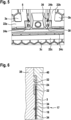
- the PV label Due to the increased height of the pocket-stamps, the PV label is locally compressed between the pocket-stamps and a counterpart surface, wherein such compression should be limited to only elastically deforming the PV label but not plastically deforming or even damaging the PV label. It is important, that the high pressure of the pocket-stamps is only applied to the PV label in an area which is arranged predominantly abutting to a circumferential outer edge of the photovoltaic label outside the solar cell arrangement. Otherwise, the pocket-stamp pressure could break the sensible solar cells. Whereas the honeycomb structure is produced predominantly abutting to an area of the photovoltaic label which comprises a solar cell arrangement. By this, the flexible PV label is strengthened to achieve desired structural characteristic for the PV sandwich panel.
- the honeycomb-stamps generally are adapted such as to apply a significantly lower pressure to the PV label as compared to the pocket-stamps in order to avoid breaking the cells.
- the PV sandwich panel 1 comprises a sheet-like PV label 3 and a back structure 5 in one piece.
- the PV label 3 comprises a multiple wafer-based solar cells 15 being interconnected to form a solar cell arrangement 17, this solar cell arrangement 17 being embedded in a stack including polymeric lamination foils and, optionally, polymeric stabilisation foils.
- the back structure 5 comprises a honeycomb structure 18 and a frame structure 22 with a pocket structure 24 included therein.
Landscapes
- Photovoltaic Devices (AREA)
Priority Applications (2)
| Application Number | Priority Date | Filing Date | Title |
|---|---|---|---|
| EP22217406.2A EP4394895A1 (de) | 2022-12-30 | 2022-12-30 | Photovoltaik-sandwichplatte, insbesondere pv-fahrzeugverkleidungs-sandwichplatte, mit wabenkörperrückenstruktur und herstellungsverfahren |
| PCT/EP2023/086411 WO2024141313A1 (en) | 2022-12-30 | 2023-12-18 | Photovoltaic sandwich panel, particularly pv vehicle cladding sandwich panel, with honeycomb-frame back structure and manufacturing method |
Applications Claiming Priority (1)
| Application Number | Priority Date | Filing Date | Title |
|---|---|---|---|
| EP22217406.2A EP4394895A1 (de) | 2022-12-30 | 2022-12-30 | Photovoltaik-sandwichplatte, insbesondere pv-fahrzeugverkleidungs-sandwichplatte, mit wabenkörperrückenstruktur und herstellungsverfahren |
Publications (1)
| Publication Number | Publication Date |
|---|---|
| EP4394895A1 true EP4394895A1 (de) | 2024-07-03 |
Family
ID=84767247
Family Applications (1)
| Application Number | Title | Priority Date | Filing Date |
|---|---|---|---|
| EP22217406.2A Withdrawn EP4394895A1 (de) | 2022-12-30 | 2022-12-30 | Photovoltaik-sandwichplatte, insbesondere pv-fahrzeugverkleidungs-sandwichplatte, mit wabenkörperrückenstruktur und herstellungsverfahren |
Country Status (2)
| Country | Link |
|---|---|
| EP (1) | EP4394895A1 (de) |
| WO (1) | WO2024141313A1 (de) |
Citations (7)
| Publication number | Priority date | Publication date | Assignee | Title |
|---|---|---|---|---|
| US20110226312A1 (en) * | 2008-08-12 | 2011-09-22 | Webasto Ag | Vehicle surface component having a solar cell arrangement |
| US20120174967A1 (en) * | 2011-01-10 | 2012-07-12 | NuvoSun, Inc. | Photovoltaic modules and mounting systems |
| WO2020187792A1 (en) | 2019-03-20 | 2020-09-24 | Sono Motors Gmbh | Method for manufacturing of a photovoltaic module |
| FR3104818A1 (fr) * | 2019-12-16 | 2021-06-18 | Commissariat A L'energie Atomique Et Aux Energies Alternatives | Procédé de fabrication et d’inspection d’un assemblage photovoltaïque avec réticulation partielle |
| WO2021260024A1 (en) | 2020-06-24 | 2021-12-30 | Sono Motors Gmbh | Method for fabricating a curved photovoltaic module including adapted positioning of photovoltaic cells |
| WO2021260021A1 (en) | 2020-06-24 | 2021-12-30 | Sono Motors Gmbh | Method for fabricating a photovoltaic module including laser cutting of a photovoltaic label |
| WO2022122507A1 (en) | 2020-12-11 | 2022-06-16 | Sono Motors Gmbh | Car body panel including a solar cell arrangement and method for producing same |
Family Cites Families (2)
| Publication number | Priority date | Publication date | Assignee | Title |
|---|---|---|---|---|
| DE102022101935A1 (de) | 2022-01-27 | 2023-07-27 | Sono Motors Gmbh | Verfahren zur Herstellung eines photovoltaischen Panels, wie z.B. eines in die Fahrzeugkarosserie integrierten PV-Panels, unter Verwendung eines wärmehärtenden Polymers |
| DE102022108014A1 (de) | 2022-04-04 | 2023-10-05 | Sono Motors Gmbh | Verfahren zur Herstellung eines photovoltaischen Moduls durch In-Mould-Labeling mit spezifischem Temperaturmanagement |
-
2022
- 2022-12-30 EP EP22217406.2A patent/EP4394895A1/de not_active Withdrawn
-
2023
- 2023-12-18 WO PCT/EP2023/086411 patent/WO2024141313A1/en not_active Ceased
Patent Citations (8)
| Publication number | Priority date | Publication date | Assignee | Title |
|---|---|---|---|---|
| US20110226312A1 (en) * | 2008-08-12 | 2011-09-22 | Webasto Ag | Vehicle surface component having a solar cell arrangement |
| US20120174967A1 (en) * | 2011-01-10 | 2012-07-12 | NuvoSun, Inc. | Photovoltaic modules and mounting systems |
| WO2020187792A1 (en) | 2019-03-20 | 2020-09-24 | Sono Motors Gmbh | Method for manufacturing of a photovoltaic module |
| US20220278245A1 (en) * | 2019-03-20 | 2022-09-01 | Sono Motors Gmbh | Method For Manufacturing Of A Photovoltaic Module |
| FR3104818A1 (fr) * | 2019-12-16 | 2021-06-18 | Commissariat A L'energie Atomique Et Aux Energies Alternatives | Procédé de fabrication et d’inspection d’un assemblage photovoltaïque avec réticulation partielle |
| WO2021260024A1 (en) | 2020-06-24 | 2021-12-30 | Sono Motors Gmbh | Method for fabricating a curved photovoltaic module including adapted positioning of photovoltaic cells |
| WO2021260021A1 (en) | 2020-06-24 | 2021-12-30 | Sono Motors Gmbh | Method for fabricating a photovoltaic module including laser cutting of a photovoltaic label |
| WO2022122507A1 (en) | 2020-12-11 | 2022-06-16 | Sono Motors Gmbh | Car body panel including a solar cell arrangement and method for producing same |
Also Published As
| Publication number | Publication date |
|---|---|
| WO2024141313A1 (en) | 2024-07-04 |
Similar Documents
| Publication | Publication Date | Title |
|---|---|---|
| EP4252348B1 (de) | Karosseriepaneel mit solarzellenanordnung und verfahren zu dessen herstellung | |
| JP7334334B2 (ja) | バッテリ筐体のための構造用複合体 | |
| ES2936339T3 (es) | Caja de batería | |
| EP3712964A1 (de) | Verfahren zur herstellung eines fotovoltaikmoduls | |
| CN101875291B (zh) | 构造面板组件的方法和面板组件 | |
| JP5907150B2 (ja) | 車両ルーフ構造および車両、ならびに車両ルーフユニットの製造方法 | |
| US9419163B2 (en) | Solar panel and method for manufacturing the same | |
| KR101597852B1 (ko) | 강화 조립체 | |
| JP3131188B2 (ja) | 車両用サンシャインルーフパネル | |
| JP5494334B2 (ja) | 車載太陽電池パネルの取付構造 | |
| CN103635336A (zh) | 具有用于模块化构成的壳体部件的外覆板的外部模块、该模块化构成的壳体部件自身以及用来制造该外部模块的方法 | |
| EP4470039A1 (de) | Verfahren zur herstellung eines pv-integrierten fahrzeugkarosserieblechs unter verwendung eines reaktionsspritzguss-spritzguss-spritzguss-thermohärtungspolymers | |
| JP2011500406A (ja) | 車両用パネル部品及びパネル部品の製造方法 | |
| CN107852845A (zh) | 用于制造具有防电辐射和/或磁辐射的屏蔽并且具有环境密封功能的壳体构件的方法以及壳体构件 | |
| EP4280288A1 (de) | Photovoltaisches sandwichpaneel, insbesondere ein photovoltaisches sandwichpaneel zur verkleidung von fahrzeugen sowie wärmeisolierter ladekasten und ein fahrzeug mit einem solchen paneel und herstellungsverfahren | |
| JP2017092067A (ja) | 太陽電池モジュール、その実装構造、これを含む車両、および、太陽電池モジュールの製造方法 | |
| EP4394895A1 (de) | Photovoltaik-sandwichplatte, insbesondere pv-fahrzeugverkleidungs-sandwichplatte, mit wabenkörperrückenstruktur und herstellungsverfahren | |
| CN102264594B (zh) | 后备箱衬层的方法和装置 | |
| KR20240101608A (ko) | 비평면의 대체로 강성인 차량 구성품에 통합된 플렉시블한 태양광 패널 | |
| JP2023008967A (ja) | 2軸曲率を有する表面に適用される太陽光発電モジュールを製造する方法 | |
| EP4322401A1 (de) | Verfahren zur herstellung einer photovoltaischen platte für eine fahrzeugkarosserie mit einem durch umspritzen angebrachten verbinder | |
| JP2026507684A (ja) | 自動車のためのアンダーボディ保護部、駆動バッテリのためのバッテリハウジング、自動車のための駆動バッテリ及びアンダーボディ保護部を備えた自動車 | |
| EP4394897A1 (de) | Verfahren und vorrichtung zur herstellung einer pv-platte mit einer geformten tragstruktur unter verwendung von vorfixierung in einer formvorrichtung | |
| US20220344527A1 (en) | Adhesively bonded, decorative solar panel and method of manufacture thereof | |
| EP4673980A1 (de) | Verfahren zur herstellung eines pv-paneels wie pv-integriertes karosseriepaneel mit hinterer formstruktur und direkt beschichteter vorderformabdeckungsstruktur |
Legal Events
| Date | Code | Title | Description |
|---|---|---|---|
| PUAI | Public reference made under article 153(3) epc to a published international application that has entered the european phase |
Free format text: ORIGINAL CODE: 0009012 |
|
| STAA | Information on the status of an ep patent application or granted ep patent |
Free format text: STATUS: THE APPLICATION HAS BEEN PUBLISHED |
|
| AK | Designated contracting states |
Kind code of ref document: A1 Designated state(s): AL AT BE BG CH CY CZ DE DK EE ES FI FR GB GR HR HU IE IS IT LI LT LU LV MC ME MK MT NL NO PL PT RO RS SE SI SK SM TR |
|
| STAA | Information on the status of an ep patent application or granted ep patent |
Free format text: STATUS: THE APPLICATION IS DEEMED TO BE WITHDRAWN |
|
| 18D | Application deemed to be withdrawn |
Effective date: 20250104 |