EP4394934A1 - Negativelektrodenaktivsubstanz und lithium-ionen-batterie - Google Patents
Negativelektrodenaktivsubstanz und lithium-ionen-batterie Download PDFInfo
- Publication number
- EP4394934A1 EP4394934A1 EP22860929.3A EP22860929A EP4394934A1 EP 4394934 A1 EP4394934 A1 EP 4394934A1 EP 22860929 A EP22860929 A EP 22860929A EP 4394934 A1 EP4394934 A1 EP 4394934A1
- Authority
- EP
- European Patent Office
- Prior art keywords
- negative electrode
- lithium
- electrode active
- active material
- ion battery
- Prior art date
- Legal status (The legal status is an assumption and is not a legal conclusion. Google has not performed a legal analysis and makes no representation as to the accuracy of the status listed.)
- Pending
Links
Images
Classifications
-
- H—ELECTRICITY
- H01—ELECTRIC ELEMENTS
- H01M—PROCESSES OR MEANS, e.g. BATTERIES, FOR THE DIRECT CONVERSION OF CHEMICAL ENERGY INTO ELECTRICAL ENERGY
- H01M4/00—Electrodes
- H01M4/02—Electrodes composed of, or comprising, active material
- H01M4/36—Selection of substances as active materials, active masses, active liquids
- H01M4/38—Selection of substances as active materials, active masses, active liquids of elements or alloys
-
- H—ELECTRICITY
- H01—ELECTRIC ELEMENTS
- H01M—PROCESSES OR MEANS, e.g. BATTERIES, FOR THE DIRECT CONVERSION OF CHEMICAL ENERGY INTO ELECTRICAL ENERGY
- H01M4/00—Electrodes
- H01M4/02—Electrodes composed of, or comprising, active material
- H01M4/36—Selection of substances as active materials, active masses, active liquids
- H01M4/38—Selection of substances as active materials, active masses, active liquids of elements or alloys
- H01M4/387—Tin or alloys based on tin
-
- H—ELECTRICITY
- H01—ELECTRIC ELEMENTS
- H01M—PROCESSES OR MEANS, e.g. BATTERIES, FOR THE DIRECT CONVERSION OF CHEMICAL ENERGY INTO ELECTRICAL ENERGY
- H01M10/00—Secondary cells; Manufacture thereof
- H01M10/05—Accumulators with non-aqueous electrolyte
- H01M10/052—Li-accumulators
-
- H—ELECTRICITY
- H01—ELECTRIC ELEMENTS
- H01M—PROCESSES OR MEANS, e.g. BATTERIES, FOR THE DIRECT CONVERSION OF CHEMICAL ENERGY INTO ELECTRICAL ENERGY
- H01M10/00—Secondary cells; Manufacture thereof
- H01M10/05—Accumulators with non-aqueous electrolyte
- H01M10/052—Li-accumulators
- H01M10/0525—Rocking-chair batteries, i.e. batteries with lithium insertion or intercalation in both electrodes; Lithium-ion batteries
-
- H—ELECTRICITY
- H01—ELECTRIC ELEMENTS
- H01M—PROCESSES OR MEANS, e.g. BATTERIES, FOR THE DIRECT CONVERSION OF CHEMICAL ENERGY INTO ELECTRICAL ENERGY
- H01M10/00—Secondary cells; Manufacture thereof
- H01M10/05—Accumulators with non-aqueous electrolyte
- H01M10/056—Accumulators with non-aqueous electrolyte characterised by the materials used as electrolytes, e.g. mixed inorganic/organic electrolytes
- H01M10/0561—Accumulators with non-aqueous electrolyte characterised by the materials used as electrolytes, e.g. mixed inorganic/organic electrolytes the electrolyte being constituted of inorganic materials only
- H01M10/0562—Solid materials
-
- H—ELECTRICITY
- H01—ELECTRIC ELEMENTS
- H01M—PROCESSES OR MEANS, e.g. BATTERIES, FOR THE DIRECT CONVERSION OF CHEMICAL ENERGY INTO ELECTRICAL ENERGY
- H01M4/00—Electrodes
- H01M4/02—Electrodes composed of, or comprising, active material
- H01M4/13—Electrodes for accumulators with non-aqueous electrolyte, e.g. for lithium-accumulators; Processes of manufacture thereof
- H01M4/134—Electrodes based on metals, Si or alloys
-
- H—ELECTRICITY
- H01—ELECTRIC ELEMENTS
- H01M—PROCESSES OR MEANS, e.g. BATTERIES, FOR THE DIRECT CONVERSION OF CHEMICAL ENERGY INTO ELECTRICAL ENERGY
- H01M4/00—Electrodes
- H01M4/02—Electrodes composed of, or comprising, active material
- H01M4/36—Selection of substances as active materials, active masses, active liquids
- H01M4/38—Selection of substances as active materials, active masses, active liquids of elements or alloys
- H01M4/386—Silicon or alloys based on silicon
-
- H—ELECTRICITY
- H01—ELECTRIC ELEMENTS
- H01M—PROCESSES OR MEANS, e.g. BATTERIES, FOR THE DIRECT CONVERSION OF CHEMICAL ENERGY INTO ELECTRICAL ENERGY
- H01M4/00—Electrodes
- H01M4/02—Electrodes composed of, or comprising, active material
- H01M4/36—Selection of substances as active materials, active masses, active liquids
- H01M4/48—Selection of substances as active materials, active masses, active liquids of inorganic oxides or hydroxides
- H01M4/50—Selection of substances as active materials, active masses, active liquids of inorganic oxides or hydroxides of manganese
- H01M4/505—Selection of substances as active materials, active masses, active liquids of inorganic oxides or hydroxides of manganese of mixed oxides or hydroxides containing manganese for inserting or intercalating light metals, e.g. LiMn2O4 or LiMn2OxFy
-
- H—ELECTRICITY
- H01—ELECTRIC ELEMENTS
- H01M—PROCESSES OR MEANS, e.g. BATTERIES, FOR THE DIRECT CONVERSION OF CHEMICAL ENERGY INTO ELECTRICAL ENERGY
- H01M4/00—Electrodes
- H01M4/02—Electrodes composed of, or comprising, active material
- H01M4/36—Selection of substances as active materials, active masses, active liquids
- H01M4/48—Selection of substances as active materials, active masses, active liquids of inorganic oxides or hydroxides
- H01M4/52—Selection of substances as active materials, active masses, active liquids of inorganic oxides or hydroxides of nickel, cobalt or iron
- H01M4/525—Selection of substances as active materials, active masses, active liquids of inorganic oxides or hydroxides of nickel, cobalt or iron of mixed oxides or hydroxides containing iron, cobalt or nickel for inserting or intercalating light metals, e.g. LiNiO2, LiCoO2 or LiCoOxFy
-
- H—ELECTRICITY
- H01—ELECTRIC ELEMENTS
- H01M—PROCESSES OR MEANS, e.g. BATTERIES, FOR THE DIRECT CONVERSION OF CHEMICAL ENERGY INTO ELECTRICAL ENERGY
- H01M4/00—Electrodes
- H01M4/02—Electrodes composed of, or comprising, active material
- H01M2004/026—Electrodes composed of, or comprising, active material characterised by the polarity
- H01M2004/027—Negative electrodes
-
- Y—GENERAL TAGGING OF NEW TECHNOLOGICAL DEVELOPMENTS; GENERAL TAGGING OF CROSS-SECTIONAL TECHNOLOGIES SPANNING OVER SEVERAL SECTIONS OF THE IPC; TECHNICAL SUBJECTS COVERED BY FORMER USPC CROSS-REFERENCE ART COLLECTIONS [XRACs] AND DIGESTS
- Y02—TECHNOLOGIES OR APPLICATIONS FOR MITIGATION OR ADAPTATION AGAINST CLIMATE CHANGE
- Y02E—REDUCTION OF GREENHOUSE GAS [GHG] EMISSIONS, RELATED TO ENERGY GENERATION, TRANSMISSION OR DISTRIBUTION
- Y02E60/00—Enabling technologies; Technologies with a potential or indirect contribution to GHG emissions mitigation
- Y02E60/10—Energy storage using batteries
Definitions
- the present disclosure relates to a negative electrode active material and a lithium-ion battery.
- Lithium-ion batteries in which charge and discharge are performed by transfer of lithium ions (Li ions) between a positive electrode and a negative electrode have been widespread.
- Si which has a higher capacity than graphite, has been used in addition to graphite in recent years.
- Si has a problem of large volumetric change during charge and discharge, which easily decreases a battery capacity due to repeated charge and discharge.
- Patent Literature 1 describes that an alloy having a La 3 Ni 2 Sn 7 -type crystal structure is used as the negative electrode active material.
- NON PATENT LITERATURE 1 Shinsuke Matsuno et al, La3Ni2Sn7 Ternary Intermetallic Phase for Lithium Insertion and Deinsertion, Electrochemical and Solid-State Letters, volume 8 (4), A234-A236, (2005 ).
- an alloy having the La 3 Ni 2 Sn 7 -type crystal structure described in Non Patent Literature 1 has a higher volume energy density but a lower weight energy density than graphite.
- a negative electrode active material of an aspect of the present disclosure is a negative electrode active material included in a negative electrode of a lithium-ion battery, wherein the negative electrode active material is represented by the general formula M 3 Me 2 X 7 , wherein M includes at least one of the group consisting of La and Ca, Me includes at least one element selected from the group consisting of Mn, Ni, Fe, and Co, and X includes at least one element selected from the group consisting of Ge, Si, Sn, and Al, and a dislocation density of the negative electrode active material is greater than or equal to 1 ⁇ 10 15 cm -2 .
- a lithium-ion battery of an aspect of the present disclosure comprises: a negative electrode including the above negative electrode active material; a positive electrode; and a non-aqueous electrolyte.
- the weight energy density may be increased.
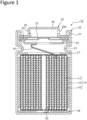
- FIG. 1 is a vertical cross-sectional view of a cylindrical lithium-ion battery of an example of an embodiment.
- Patent Literature 1 discloses an alloy having a La 3 Ni 2 Sn 7 -type crystal structure as a negative electrode active material of a lithium-ion battery having a high capacity.
- the alloy disclosed in Patent Literature 1 has a higher volume energy density but a lower weight energy density than graphite.
- the weight energy density may be increased by setting a dislocation density of a negative electrode active material to greater than or equal to 1 ⁇ 10 15 cm -2 . Since the dislocation is formed from defects, voids, and the like, it is presumed that defects, voids, and the like are formed in the large crystal structure having a dislocation density of greater than or equal to 1 ⁇ 10 15 cm -2 , and Li ions are inserted into these defects, voids, and the like.
- lithium ions are transferred between a positive electrode and a negative electrode to perform charge and discharge.
- a cylindrical battery in which a wound electrode assembly is housed in a bottomed cylindrical exterior housing can will be exemplified, but the exterior is not limited to the cylindrical exterior housing can, and may be, for example, a rectangular exterior housing can, or may also be an exterior composed of laminated sheets including a metal layer and a resin layer.
- the electrode assembly may be a stacked electrode assembly in which a plurality of positive electrodes and a plurality of negative electrodes are alternately stacked via separators.
- a liquid non-aqueous electrolyte will be exemplified hereinafter, but the non-aqueous electrolyte is not limited to liquid, and may be solid.
- FIG. 1 is a vertical cross-sectional view of a cylindrical lithium-ion battery 10 of an example of an embodiment.
- an electrode assembly 14 and a non-aqueous electrolyte (not illustrated) are housed in an exterior 15.
- the electrode assembly 14 has a wound structure in which a positive electrode 11 and a negative electrode 12 are wound via a separator 13.
- a solvent organic solvent
- carbonates, lactones, ethers, ketones, esters, and the like may be used, and two or more of these solvents may be mixed for use.
- a mixed solvent including a cyclic carbonate and a chain carbonate is preferably used.
- ethylene carbonate (EC), propylene carbonate (PC), butylene carbonate (BC), or the like may be used as the cyclic carbonate
- dimethyl carbonate (DMC), ethyl methyl carbonate (EMC), diethyl carbonate (DEC), or the like may be used as the chain carbonate.
- electrolyte salt of the non-aqueous electrolyte LiPF 6 , LiBF 4 , LiCF 3 SO 3 , or the like, and a mixture thereof may be used.
- An amount of the electrolyte salt to be dissolved in the solvent may be, for example, greater than or equal to 0.5 mol/L and less than or equal to 2.0 mol/L.
- the side of a sealing assembly 16 will be described as the "upper side”
- the bottom side of the exterior 15 will be described as the "lower side”.
- the opening end of the exterior 15 is capped with the sealing assembly 16 to seal an inside of the lithium-ion battery 10.
- Insulating plates 17 and 18 are provided on the upper and lower sides of the electrode assembly 14, respectively.
- a positive electrode lead 19 extends upward through a through hole of the insulating plate 17, and is welded with the lower face of a filter 22, which is a bottom plate of the sealing assembly 16.
- a cap 26 which is a top plate of the sealing assembly 16 electrically connected to the filter 22, becomes a positive electrode terminal.
- a negative electrode lead 20 extends through a through hole of the insulating plate 18 toward the bottom side of the exterior 15, and is welded with a bottom inner face of the exterior 15.
- the exterior 15 becomes a negative electrode terminal.
- the negative electrode lead 20 is provided on the end, the negative electrode lead 20 extends through an outside of the insulating plate 18 toward the bottom side of the exterior 15, and is welded with the bottom inner face of the exterior 15.
- the exterior 15 is, for example, a bottomed cylindrical metallic exterior housing can.
- a gasket 27 is provided between the exterior 15 and the sealing assembly 16 to achieve sealability inside the lithium-ion battery 10.
- the exterior 15 has a grooved portion 21 formed by, for example, pressing the side wall thereof from the outside to support the sealing assembly 16.
- the grooved portion 21 is preferably formed in a circular shape along a circumferential direction of the exterior 15, and supports the sealing assembly 16 via the gasket 27 with the upper face thereof.
- the sealing assembly 16 has the filter 22, a lower vent member 23, an insulating member 24, an upper vent member 25, and the cap 26, which are stacked in this order from the electrode assembly 14 side.
- Respective members constituting the sealing assembly 16 have, for example, a disk shape or a ring shape, and the members except for the insulating member 24 are electrically connected to each other.
- the lower vent member 23 and the upper vent member 25 are connected to each other at each of the centers, and the insulating member 24 is interposed between the circumferences. If the internal pressure of the battery increases due to abnormal heat generation, for example, the lower vent member 23 breaks and thereby the upper vent member 25 expands toward the cap 26 side to be separated from the lower vent member 23, resulting in breakage of electrical connection between both the members. If the internal pressure further increases, the upper vent member 25 breaks, and gas is discharged through an opening 26a of the cap 26.
- the positive electrode 11, the negative electrode 12, and the separator 13, which constitute the electrode assembly 14, particularly a negative electrode active material to constitute the negative electrode 12, will be described in detail.
- the positive electrode 11 has, for example, a positive electrode core and a positive electrode mixture layer provided on a surface of the positive electrode core.
- a foil of a metal stable within a potential range of the positive electrode 11, such as aluminum, a film in which such a metal is disposed on a surface layer thereof, and the like may be used.
- a thickness of the positive electrode core is, for example, greater than or equal to 10 ⁇ m and less than or equal to 30 ⁇ m.
- the positive electrode mixture layer includes a positive electrode active material, a binder, and a conductive agent, and is preferably provided on both surfaces of the positive electrode core except for a portion to which the positive electrode lead 19 is to be connected.
- the positive electrode 11 may be produced by, for example, applying a positive electrode mixture slurry including the positive electrode active material, the binder, the conductive agent, and the like on the surface of the positive electrode core, and drying and subsequently compressing the applied film to form the positive electrode mixture layers on both the surfaces of the positive electrode core.
- the positive electrode active material includes a lithium-transition metal oxide as a main component.
- the positive electrode active material may be composed of substantially only the lithium-transition metal oxide, and particles of an inorganic compound, such as aluminum oxide and a lanthanoid-containing compound, may adhere to particle surfaces of the lithium-transition metal oxide.
- the lithium-transition metal oxide may be used singly, or may be used in combination of two or more thereof.
- Examples of a metal element contained in the lithium-transition metal oxide include nickel (Ni), cobalt (Co), manganese (Mn), aluminum (Al), boron (B), magnesium (Mg), titanium (Ti), vanadium (V), chromium (Cr), iron (Fe), copper (Cu), zinc (Zn), gallium (Ga), strontium (Sr), zirconium (Zr), niobium (Nb), indium (In), tin (Sn), tantalum (Ta), and tungsten (W).
- a preferable example of the lithium-transition metal oxide is a composite oxide represented by the general formula: Li ⁇ Ni x M (1-x) O 2 (0.1 ⁇ 1.2, 0.3 ⁇ x ⁇ 1, and M includes at least one selected from the group consisting of Co, Mn, and Al).
- Examples of the conductive agent included in the positive electrode mixture layer may include a carbon material such as carbon black, acetylene black, Ketjenblack, carbon nanotube, carbon nanofiber, and graphite.
- Examples of the binder included in the positive electrode mixture layer may include a fluororesin such as polytetrafluoroethylene (PTFE) and polyvinylidene fluoride (PVDF), polyacrylonitrile (PAN), a polyimide resin, an acrylic resin, and a polyolefin resin. With these resins, cellulose derivatives such as carboxymethylcellulose (CMC) or a salt thereof, polyethylene oxide (PEO), and the like may be used in combination.
- the negative electrode 12 has, for example, a negative electrode core and a negative electrode mixture layer provided on a surface of the negative electrode core.
- a foil of a metal stable within a potential range of the negative electrode 12, such as copper, a film in which such a metal is disposed on a surface layer thereof, and the like may be used.
- a thickness of the negative electrode core is, for example, greater than or equal to 5 ⁇ m and less than or equal to 15 ⁇ m.
- the negative electrode mixture layer includes a negative electrode active material and a binder, and is preferably provided on, for example, both surfaces of the negative electrode core except for a portion to which the negative electrode lead 20 is to be connected.
- the negative electrode 12 may be produced by, for example, applying a negative electrode mixture slurry including the negative electrode active material, the binder, the conductive agent, and the like on the surface of the negative electrode core, and drying and subsequently compressing the applied film to form the negative electrode mixture layers on both the surfaces of the negative electrode core.
- the negative electrode active material and a cupper powder may be mixed and then compressed to form a pellet.
- the negative electrode active material included in the negative electrode 12 includes an alloy represented by the general formula M 3 Me 2 X 7 , wherein M includes at least one of the group consisting of La and Ca, Me includes at least one element selected from the group consisting of Mn, Ni, Fe, and Co, and X includes at least one element selected from the group consisting of Ge, Si, Sn, and Al (hereinafter, which may be referred to as the M 3 Me 2 X 7 -type alloy).
- the M 3 Me 2 X 7 -type alloy is La 3 Ni 2 Sn 7 , for example.
- the negative electrode 12 may include a negative electrode active material other than the M 3 Me 2 X 7 -type alloy.
- the negative electrode active material other than the M 3 Me 2 X 7 -type alloy is not particularly limited as long as it may reversibly occlude and release lithium ions, and for example, graphite (natural graphite or artificial graphite), a metal to form an alloy with lithium, such as silicon (Si) and tin (Sn), or an oxide including a metal element such as Si and Sn may be used.
- a dislocation density of the M 3 Me 2 X 7 -type alloy is, for example, greater than or equal to 1 ⁇ 10 15 cm -2 . According to this, a weight energy density of the M 3 Me 2 X 7 -type alloy may be increased.
- the dislocation density of the M 3 Me 2 X 7 -type alloy is preferably greater than or equal to 1 ⁇ 10 17 cm -2 , and more preferably greater than or equal to 1 ⁇ 10 19 cm -2 .
- the dislocation density may be calculated by, for example, observing a cross section of the M 3 Me 2 X 7 -type alloy by using a transmission electron microscope (TEM).
- a dislocation density of a common M 3 Me 2 X 7 -type alloy is approximately greater than or equal to 1 ⁇ 10 6 and less than or equal to 1 ⁇ 10 8 , and the dislocation density of the M 3 Me 2 X 7 -type alloy according to the present disclosure is higher than the dislocation density of the common M 3 Me 2 X 7 -type alloy.
- a median diameter (D50) on a volumetric basis of the M 3 Me 2 X 7 -type alloy may be, for example, greater than or equal to 0.1 ⁇ m and less than or equal to 50 ⁇ m, or may be greater than or equal to 1 ⁇ m and less than or equal to 10 ⁇ m.
- the D50 of the M 3 Me 2 X 7 -type alloy may be reduced by crushing with a ball mill, for example, and may be regulated with the crushing conditions.
- the D50 means a particle diameter at which a cumulative frequency is 50% from a smaller particle diameter side in a particle size distribution on a volumetric basis.
- the M 3 Me 2 X 7 -type alloy produced by the above producing method has a dislocation density of greater than or equal to 1 ⁇ 10 15 cm -2 . It is considered that the crushing forms defects, voids, and the like in the crystal structure of the M 3 Me 2 X 7 -type alloy to increase the dislocation density of the M 3 Me 2 X 7 -type alloy.
- a fluororesin, PAN, a polyimide resin, an acrylic resin, a polyolefin resin, and the like may be used as in the case of the positive electrode 11.
- a fluororesin, PAN, a polyimide resin, an acrylic resin, a polyolefin resin, and the like may be used as in the case of the positive electrode 11.
- the mixture slurry is prepared by using an aqueous solvent, CMC or a salt thereof, styrene-butadiene rubber (SBR), polyacrylic acid (PAA) or a salt thereof, polyvinyl alcohol, and the like are preferably used.
- a porous sheet having an ion permeation property and an insulation property is used.
- the porous sheet include a fine porous thin film, a woven fabric, and a nonwoven fabric.
- a olefin resin such as polyethylene and polypropylene, cellulose, and the like are preferable.
- the separator 13 may have any of a single-layered structure and a multilayered structure.
- a heat-resistant layer including a heat-resistance material may be formed on a surface of the separator 13, a heat-resistant layer including a heat-resistance material may be formed.
- the heat-resistant material may include: polyamide resins, such as an aliphatic polyamide and an aromatic polyamide (aramid); and polyimide resins, such as a polyamideimide and a polyimide.
- the lump of the annealed alloy was manually crushed with a mortar for 1 hour, then fed into a zirconia chamber together with zirconia balls, and a ball-mill treatment was performed by using a planetary ball mill at a predetermined rotation rate for a predetermined time.
- the ball-mill treatment was performed with operations for 5 minutes and intervals for 5 minutes.
- the powder after the ball-mill treatment was classified with a mesh with 45 ⁇ m to remove coarse particles.
- the produced negative electrode active material (La 3 Ni 2 Sn 7 powder) had a median diameter (D50) on a volumetric basis of 6.8 ⁇ m.
- lithium metal (Li), not the above positive electrode, was used as a counter electrode.
- a lithium-transition metal oxide commonly including a transition metal such as Co, Mn, and Ni
- LiNiO 2 is commonly used as a positive electrode active material.
- a lithium metal foil was cut to ⁇ 17 mm for use here as the counter electrode, not the positive electrode active material commonly used for an electrode. Such a method is commonly used for evaluating an active material.
- the above negative electrode and the positive electrode made of the lithium metal foil were disposed opposite to each other across a separator to constitute an electrode assembly, and the electrode assembly was housed in a coin-shaped exterior housing can.
- the non-aqueous electrolyte was injected into the exterior housing can, and then the exterior housing can was sealed to obtain a coin-shaped test cell (non-aqueous electrolyte secondary battery).
- a test cell was produced in the same manner as in Example 1 except that, in the production of the negative electrode active material, the time of the ball-mill treatment using the planetary ball mill was lengthened.
- Battery capacities (a charge capacity and a discharge capacity) of each of the test cells of Examples and Comparative Example were evaluated by the following method. Table 1 shows the evaluation results. Table 1 also shows a dislocation density of the negative electrode active material and charge-discharge efficiency.
- the discharge in this evaluation refers to discharge of a battery having a combination of the negative electrode active materials of Examples and Comparative Example and a commonly used positive electrode exemplified by LiNiO 2 and the like.
- the above discharge which generally should be referred to as charge because the coin-shaped battery has the negative electrode as a working electrode and the lithium metal (Li) as the counter electrode, is represented with a reverse charge-discharge direction for consisting with charge-discharge behavior of a negative electrode of a battery having a combination of commonly used positive electrode and negative electrode. That is, the charge refers to applying a current for decreasing a potential of a negative electrode being a working electrode, and the discharge refers to applying a current for increasing the potential of the negative electrode being the working electrode.
Landscapes
- Chemical & Material Sciences (AREA)
- Chemical Kinetics & Catalysis (AREA)
- Electrochemistry (AREA)
- General Chemical & Material Sciences (AREA)
- Engineering & Computer Science (AREA)
- Manufacturing & Machinery (AREA)
- Materials Engineering (AREA)
- Inorganic Chemistry (AREA)
- Physics & Mathematics (AREA)
- Condensed Matter Physics & Semiconductors (AREA)
- General Physics & Mathematics (AREA)
- Battery Electrode And Active Subsutance (AREA)
Applications Claiming Priority (2)
| Application Number | Priority Date | Filing Date | Title |
|---|---|---|---|
| JP2021138760 | 2021-08-27 | ||
| PCT/JP2022/023408 WO2023026635A1 (ja) | 2021-08-27 | 2022-06-10 | 負極活物質、及びリチウムイオン電池 |
Publications (2)
| Publication Number | Publication Date |
|---|---|
| EP4394934A1 true EP4394934A1 (de) | 2024-07-03 |
| EP4394934A4 EP4394934A4 (de) | 2025-01-29 |
Family
ID=85321743
Family Applications (1)
| Application Number | Title | Priority Date | Filing Date |
|---|---|---|---|
| EP22860929.3A Pending EP4394934A4 (de) | 2021-08-27 | 2022-06-10 | Negativelektrodenaktivsubstanz und lithium-ionen-batterie |
Country Status (5)
| Country | Link |
|---|---|
| US (1) | US20250140820A1 (de) |
| EP (1) | EP4394934A4 (de) |
| JP (1) | JP7814016B2 (de) |
| CN (1) | CN117836979A (de) |
| WO (1) | WO2023026635A1 (de) |
Family Cites Families (5)
| Publication number | Priority date | Publication date | Assignee | Title |
|---|---|---|---|---|
| JP4127692B2 (ja) * | 2004-03-23 | 2008-07-30 | 株式会社東芝 | 非水電解質二次電池 |
| JP4202350B2 (ja) * | 2005-09-05 | 2008-12-24 | 株式会社東芝 | 非水電解質電池 |
| JP2010218855A (ja) * | 2009-03-17 | 2010-09-30 | Sanyo Electric Co Ltd | 非水電解質二次電池用負極及び非水電解質二次電池 |
| KR102729770B1 (ko) * | 2016-12-21 | 2024-11-14 | 일진전기 주식회사 | 이차전지용 음극활물질 및 이를 포함한 이차전지 |
| CN119674171A (zh) * | 2017-11-24 | 2025-03-21 | 株式会社半导体能源研究所 | 二次电池及二次电池的制造方法 |
-
2022
- 2022-06-10 CN CN202280056719.XA patent/CN117836979A/zh active Pending
- 2022-06-10 US US18/681,201 patent/US20250140820A1/en active Pending
- 2022-06-10 JP JP2023543705A patent/JP7814016B2/ja active Active
- 2022-06-10 WO PCT/JP2022/023408 patent/WO2023026635A1/ja not_active Ceased
- 2022-06-10 EP EP22860929.3A patent/EP4394934A4/de active Pending
Also Published As
| Publication number | Publication date |
|---|---|
| CN117836979A (zh) | 2024-04-05 |
| JP7814016B2 (ja) | 2026-02-16 |
| WO2023026635A1 (ja) | 2023-03-02 |
| US20250140820A1 (en) | 2025-05-01 |
| JPWO2023026635A1 (de) | 2023-03-02 |
| EP4394934A4 (de) | 2025-01-29 |
Similar Documents
| Publication | Publication Date | Title |
|---|---|---|
| US20250293241A1 (en) | Non-aqueous electrolyte secondary battery | |
| US12597604B2 (en) | Nonaqueous electrolyte secondary battery | |
| US20250015338A1 (en) | Lithium ion secondary battery | |
| EP3933968B1 (de) | Sekundärbatterie mit gewickeltem nichtwässrigem elektrolyten | |
| WO2024181333A1 (ja) | 二次電池 | |
| CN112655103B (zh) | 非水电解质二次电池用正极活性物质、非水电解质二次电池和非水电解质二次电池用正极活性物质的制造方法 | |
| US12531239B2 (en) | Positive electrode active material for non-aqueous electrolyte secondary battery, and non-aqueous electrolyte secondary battery | |
| US12347855B2 (en) | Negative electrode active material for nonaqueous electrolyte secondary batteries, and nonaqueous electrolyte secondary battery | |
| US20220271284A1 (en) | Positive electrode active material for nonaqueous electrolyte secondary batteries, and nonaqueous electrolyte secondary battery | |
| US20220278323A1 (en) | Non-aqueous electrolyte secondary battery | |
| WO2021200529A1 (ja) | 非水電解質二次電池用負極、及び非水電解質二次電池 | |
| EP4394934A1 (de) | Negativelektrodenaktivsubstanz und lithium-ionen-batterie | |
| US20230100030A1 (en) | Lithium ion battery | |
| EP4099433A1 (de) | Lithium-ionen-batterie | |
| CN118044020A (zh) | 锂离子二次电池 | |
| US20230197948A1 (en) | Positive electrode active material for nonaqueous electrolyte secondary batteries, and nonaqueous electrolyte secondary battery | |
| US20240282946A1 (en) | Negative electrode active material and lithium ion battery | |
| EP4475214A1 (de) | Lithiumionenbatterie | |
| US12362353B2 (en) | Negative electrode active material for nonaqueous electrolyte secondary batteries, and nonaqueous electrolyte secondary battery | |
| US20250015267A1 (en) | Nonaqueous electrolyte secondary battery positive electrode and nonaqueous electrolyte secondary battery | |
| US20240421282A1 (en) | Nonaqueous electrolyte secondary battery | |
| EP4513594A1 (de) | Positivelektrodenaktivmaterial für sekundärbatterien mit wasserfreiem elektrolyt und sekundärbatterie mit wasserfreiem elektrolyt | |
| EP4593116A1 (de) | Positivelektrodenaktivmaterial für sekundärbatterie und sekundärbatterie | |
| US12300815B2 (en) | Positive electrode active material for nonaqueous electrolyte secondary batteries, and nonaqueous electrolyte secondary battery | |
| CN117836980A (zh) | 负极活性物质以及锂离子电池 |
Legal Events
| Date | Code | Title | Description |
|---|---|---|---|
| STAA | Information on the status of an ep patent application or granted ep patent |
Free format text: STATUS: THE INTERNATIONAL PUBLICATION HAS BEEN MADE |
|
| PUAI | Public reference made under article 153(3) epc to a published international application that has entered the european phase |
Free format text: ORIGINAL CODE: 0009012 |
|
| STAA | Information on the status of an ep patent application or granted ep patent |
Free format text: STATUS: REQUEST FOR EXAMINATION WAS MADE |
|
| 17P | Request for examination filed |
Effective date: 20240130 |
|
| AK | Designated contracting states |
Kind code of ref document: A1 Designated state(s): AL AT BE BG CH CY CZ DE DK EE ES FI FR GB GR HR HU IE IS IT LI LT LU LV MC MK MT NL NO PL PT RO RS SE SI SK SM TR |
|
| DAV | Request for validation of the european patent (deleted) | ||
| DAX | Request for extension of the european patent (deleted) | ||
| A4 | Supplementary search report drawn up and despatched |
Effective date: 20250108 |
|
| RIC1 | Information provided on ipc code assigned before grant |
Ipc: H01M 10/0525 20100101ALI20241223BHEP Ipc: H01M 10/052 20100101ALI20241223BHEP Ipc: H01M 4/525 20100101ALI20241223BHEP Ipc: H01M 4/505 20100101ALI20241223BHEP Ipc: H01M 10/0562 20100101ALI20241223BHEP Ipc: H01M 4/38 20060101AFI20241223BHEP |
|
| STAA | Information on the status of an ep patent application or granted ep patent |
Free format text: STATUS: EXAMINATION IS IN PROGRESS |
|
| 17Q | First examination report despatched |
Effective date: 20260303 |