EP4395445A2 - Écoute avant de parler directionnelle à faisceau unique asynchrone - Google Patents
Écoute avant de parler directionnelle à faisceau unique asynchrone Download PDFInfo
- Publication number
- EP4395445A2 EP4395445A2 EP24175593.3A EP24175593A EP4395445A2 EP 4395445 A2 EP4395445 A2 EP 4395445A2 EP 24175593 A EP24175593 A EP 24175593A EP 4395445 A2 EP4395445 A2 EP 4395445A2
- Authority
- EP
- European Patent Office
- Prior art keywords
- base station
- channel access
- beam configuration
- access procedure
- rrq
- Prior art date
- Legal status (The legal status is an assumption and is not a legal conclusion. Google has not performed a legal analysis and makes no representation as to the accuracy of the status listed.)
- Pending
Links
Images








Classifications
-
- H—ELECTRICITY
- H04—ELECTRIC COMMUNICATION TECHNIQUE
- H04W—WIRELESS COMMUNICATION NETWORKS
- H04W74/00—Wireless channel access
- H04W74/002—Transmission of channel access control information
-
- H—ELECTRICITY
- H04—ELECTRIC COMMUNICATION TECHNIQUE
- H04B—TRANSMISSION
- H04B7/00—Radio transmission systems, i.e. using radiation field
- H04B7/02—Diversity systems; Multi-antenna system, i.e. transmission or reception using multiple antennas
- H04B7/04—Diversity systems; Multi-antenna system, i.e. transmission or reception using multiple antennas using two or more spaced independent antennas
- H04B7/0408—Diversity systems; Multi-antenna system, i.e. transmission or reception using multiple antennas using two or more spaced independent antennas using two or more beams, i.e. beam diversity
-
- H—ELECTRICITY
- H04—ELECTRIC COMMUNICATION TECHNIQUE
- H04B—TRANSMISSION
- H04B7/00—Radio transmission systems, i.e. using radiation field
- H04B7/02—Diversity systems; Multi-antenna system, i.e. transmission or reception using multiple antennas
- H04B7/04—Diversity systems; Multi-antenna system, i.e. transmission or reception using multiple antennas using two or more spaced independent antennas
- H04B7/06—Diversity systems; Multi-antenna system, i.e. transmission or reception using multiple antennas using two or more spaced independent antennas at the transmitting station
- H04B7/0613—Diversity systems; Multi-antenna system, i.e. transmission or reception using multiple antennas using two or more spaced independent antennas at the transmitting station using simultaneous transmission
- H04B7/0615—Diversity systems; Multi-antenna system, i.e. transmission or reception using multiple antennas using two or more spaced independent antennas at the transmitting station using simultaneous transmission of weighted versions of same signal
- H04B7/0617—Diversity systems; Multi-antenna system, i.e. transmission or reception using multiple antennas using two or more spaced independent antennas at the transmitting station using simultaneous transmission of weighted versions of same signal for beam forming
-
- H—ELECTRICITY
- H04—ELECTRIC COMMUNICATION TECHNIQUE
- H04W—WIRELESS COMMUNICATION NETWORKS
- H04W72/00—Local resource management
- H04W72/04—Wireless resource allocation
- H04W72/044—Wireless resource allocation based on the type of the allocated resource
- H04W72/046—Wireless resource allocation based on the type of the allocated resource the resource being in the space domain, e.g. beams
-
- H—ELECTRICITY
- H04—ELECTRIC COMMUNICATION TECHNIQUE
- H04W—WIRELESS COMMUNICATION NETWORKS
- H04W74/00—Wireless channel access
- H04W74/08—Non-scheduled access, e.g. ALOHA
- H04W74/0808—Non-scheduled access, e.g. ALOHA using carrier sensing, e.g. carrier sense multiple access [CSMA]
-
- H—ELECTRICITY
- H04—ELECTRIC COMMUNICATION TECHNIQUE
- H04W—WIRELESS COMMUNICATION NETWORKS
- H04W74/00—Wireless channel access
- H04W74/002—Transmission of channel access control information
- H04W74/006—Transmission of channel access control information in the downlink, i.e. towards the terminal
-
- H—ELECTRICITY
- H04—ELECTRIC COMMUNICATION TECHNIQUE
- H04W—WIRELESS COMMUNICATION NETWORKS
- H04W88/00—Devices specially adapted for wireless communication networks, e.g. terminals, base stations or access point devices
- H04W88/02—Terminal devices
Definitions
- the following relates generally to wireless communication, and more specifically to asynchronous single beam directional listen-before-talk (LBT).
- LBT listen-before-talk
- Wireless communications systems are widely deployed to provide various types of communication content such as voice, video, packet data, messaging, broadcast, and so on. These systems may be capable of supporting communication with multiple users by sharing the available system resources (e.g., time, frequency, and power).
- Examples of such multiple-access systems include fourth generation (4G) systems such as a Long Term Evolution (LTE) systems or LTE-Advanced (LTE-A) systems, and fifth generation (5G) systems which may be referred to as New Radio (NR) systems.
- 4G systems such as a Long Term Evolution (LTE) systems or LTE-Advanced (LTE-A) systems
- 5G systems which may be referred to as New Radio (NR) systems.
- LTE Long Term Evolution
- LTE-A LTE-Advanced
- 5G systems which may be referred to as New Radio (NR) systems.
- LTE Long Term Evolution
- LTE-A LTE-Advanced
- NR New Radio
- technologies such as code division multiple access (CDMA),
- Wireless communications systems may operate in millimeter wave (mmW) frequency ranges (e.g., 28 GHz, 40 GHz, or 60 GHz) Wireless communications at these frequencies may be associated with increased signal attenuation (e.g., path loss), which may be influenced by various factors, such as temperature, barometric pressure, and diffraction.
- signal processing techniques such as beamforming, may be used to coherently combine energy and overcome the path losses at these frequencies. Due to the increased amount of path loss in mmW communication systems, transmissions from the base station and/or the UE may be beamformed.
- a receiving device may use beamforming techniques to configure antenna(s) and/or antenna array(s) such that transmissions are received in a directional manner.
- mmW wireless communications systems while promising, present new challenges to old questions.
- Conventional considerations in developing wireless communications systems focus primarily on avoiding interference between communication devices, often at the expense of reuse. Thus, devices would elect to avoid transmitting out of concerns for interfering with neighboring devices, and the associated transmission opportunity would be wasted.
- Interference in a mmW wireless communications system is different than in a non-mmW wireless communications system (e.g., such as within a conventional cell coverage area of a base station).
- beamformed transmissions may have varying beam configurations such that each beam may have a different beam width or a different beam direction.
- a narrow beam width may have a relative deep, but narrow coverage area whereas a wider beam width may have a relative shallow, but wide coverage area.
- the described techniques provide for an efficient mechanism for improving channel access in a millimeter wave (mmW) wireless communications system.
- the described techniques provide for improved channel access techniques in a mmW wireless communications system with a focus on robustness with minimal reuse loss.
- a base station may be configured to use a beam configuration-based protocol for a listen-before-talk (LBT) procedure in a mmW network to capture the medium.
- LBT listen-before-talk
- the base station may use a beam configuration during a channel access procedure.
- the beam configuration may include the use of a beamformed transmission having a certain beam width.
- the beam configuration may be referred to as beam "X.”
- the base station may transmit a reservation request message (RRQ) to a user equipment (UE).
- the RRQ message may be transmitted using the same beam configuration (e.g., beam X) or a beam configuration having a narrower beam (e.g., a beam corresponding to a higher antenna gain than the antenna gain corresponding to the beam configuration associated with the RRQ message) width (e.g., beam X').
- the base station may receive a reservation response message (RRS) from the UE in response to the RRQ.
- the RRS may be received on a beam configuration based on the beam configuration used to transmit the RRQ (e.g., beam X').
- the base station may additionally or alternatively transmit a medium sensing trigger to a UE before scheduling the UE for communications. For example, the base station may determine that data is available to communicate to the UE and transmit an indication of a time period that the UE is to monitor the channel for reservation signaling (e.g., an RRQ, an RRS, a preamble message, and the like). The UE may receive the indication of the time period and monitor the channel for the reservation signaling during the time period. The base station may transmit (and the UE may receive) the reservation signaling on the channel during the indicated time period.
- a medium sensing trigger e.g., a time period that the UE is to monitor the channel for reservation signaling (e.g., an RRQ, an RRS, a preamble message, and the like).
- the UE may receive the indication of the time period and monitor the channel for the reservation signaling during the time period.
- the base station may transmit (and the UE may receive) the reservation signaling on the channel during the indicated
- the base station may additionally or alternatively transmit an additional RRS message in an uplink scenario.
- the base station may perform the channel access procedure using the beam configuration (e.g., beam X) and transmit the RRQ message to the UE when the channel access procedure is successful.
- the base station may then transmit an RRS message to the UE (e.g., without expecting a response signal from the UE) after the RRQ to confirm the uplink resources are allocated for the uplink data communications.
- a UE may additionally or alternatively sense the medium on the channel using the beam configuration associated with the beam configuration used for the data communication. For example, the UE may receive the RRQ and respond with an RRS, as discussed above. The UE may then identify a beam configuration based on an inter-frame spacing (IFS) between a downlink and uplink portions of the transmission opportunity and perform a channel access procedure using the beam configuration.
- IFS inter-frame spacing
- the apparatus may include means for performing a channel access procedure on a shared radio frequency spectrum band using a first beam configuration, means for transmitting, based at least in part on successful completion of the channel access procedure, an RRQ to a UE using a second beam configuration, the second beam configuration comprising a beam width that is equal to or narrower than a beam width of the first beam configuration, and means for receiving an RRS from the UE in response to the RRQ, the RRS comprising a third beam configuration that is based at least in part on the second beam configuration.
- the apparatus may include a processor, memory in electronic communication with the processor, and instructions stored in the memory.
- the instructions may be operable to cause the processor to perform a channel access procedure on a shared radio frequency spectrum band using a first beam configuration, transmit, based at least in part on successful completion of the channel access procedure, an RRQ to a UE using a second beam configuration, the second beam configuration comprising a beam width that is equal to or narrower than a beam width of the first beam configuration, and receive an RRS from the UE in response to the RRQ, the RRS comprising a third beam configuration that is based at least in part on the second beam configuration.
- a non-transitory computer-readable medium for wireless communication may include instructions operable to cause a processor to perform a channel access procedure on a shared radio frequency spectrum band using a first beam configuration, transmit, based at least in part on successful completion of the channel access procedure, an RRQ to a UE using a second beam configuration, the second beam configuration comprising a beam width that is equal to or narrower than a beam width of the first beam configuration, and receive an RRS from the UE in response to the RRQ, the RRS comprising a third beam configuration that is based at least in part on the second beam configuration.
- Some examples of the method, apparatus, and non-transitory computer-readable medium described above may further include processes, features, means, or instructions for performing the sequence of channel access procedures comprises, for beam direction: detecting an energy level in each direction over a predetermined number of contention slots, or monitoring for RRSs over the predetermined number of contention slots.
- Some examples of the method, apparatus, and non-transitory computer-readable medium described above may further include processes, features, means, or instructions for selecting an energy or preamble detection threshold for the channel access procedure based at least in part on a width of the first beam width.
- Some examples of the method, apparatus, and non-transitory computer-readable medium described above may further include processes, features, means, or instructions for selecting an energy or preamble detection threshold for the channel access procedure based at least in part on a difference between the first beam width and the second beam width.
- Some examples of the method, apparatus, and non-transitory computer-readable medium described above may further include processes, features, means, or instructions for selecting an energy or preamble detection threshold for the channel access procedure based at least in part on whether the first beam width comprises a P1 beam, a P2 beam, or a P3 beam.
- Some examples of the method, apparatus, and non-transitory computer-readable medium described above may further include processes, features, means, or instructions for selecting a first beam width for the first beam configuration and the second beam configuration.
- Some examples of the method, apparatus, and non-transitory computer-readable medium described above may further include processes, features, means, or instructions for configuring each UE of a plurality of UEs for which downlink data may be available with orthogonal resources for receiving the corresponding RRSs.
- a non-transitory computer-readable medium for wireless communication may include instructions operable to cause a processor to receive, from a base station, an indication of a time period during which UE is to monitor a shared radio frequency spectrum band for one or more of a reservation request message, a reservation response message, or a preamble message from the base station, monitor the shared radio frequency spectrum band during the time period to receive at least one of the reservation request message, the reservation response message, or the preamble message from the base station, and receive downlink data from the base station based at least in part on the received reservation request message, reservation response message, or preamble message from the base station.
- the base station may additionally or alternatively transmit data to the UE based on an energy detection based LBT procedure.
- the base station may use multiple beam configurations and/or over multiple slots perform the energy detection based LBT procedures on the channel and determine that the channel is available for data communications using a first beam configuration based on the LBT procedures.
- the base station may transmit the data communications to the UE using the identified first beam configuration.
- the base station may additionally or alternatively in an uplink scenario transmit the RRS to the UE to confirm that the uplink resources are allocated. For example, the base station may perform the channel access procedure on the channel and transmit the RRQ if the channel access procedure is successful, as is discussed above. The base station may transmit an RRS to the UE without expecting a response from the UE.
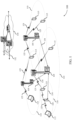
- a UE 115 may also be able to communicate directly with other UEs 115 (e.g., using a peer-to-peer (P2P) or device-to-device (D2D) protocol).
- P2P peer-to-peer
- D2D device-to-device
- One or more of a group of UEs 115 utilizing D2D communications may be within the geographic coverage area 110 of a base station 105.
- Other UEs 115 in such a group may be outside the geographic coverage area 110 of a base station 105, or be otherwise unable to receive transmissions from a base station 105.
- groups of UEs 115 communicating via D2D communications may utilize a one-to-many (1:M) system in which each UE 115 transmits to every other UE 115 in the group.
- a base station 105 facilitates the scheduling of resources for D2D communications.
- D2D communications are carried out between UEs 115 without the involvement of a base station
- the core network 130 may provide user authentication, access authorization, tracking, Internet Protocol (IP) connectivity, and other access, routing, or mobility functions.
- the core network 130 may be an evolved packet core (EPC), which may include at least one mobility management entity (MME), at least one serving gateway (S-GW), and at least one Packet Data Network (PDN) gateway (P-GW).
- the MME may manage non-access stratum (e.g., control plane) functions such as mobility, authentication, and bearer management for UEs 115 served by base stations 105 associated with the EPC.
- User IP packets may be transferred through the S-GW, which itself may be connected to the P-GW.
- the P-GW may provide IP address allocation as well as other functions.
- the P-GW may be connected to the network operators IP services.
- the operators IP services may include access to the Internet, Intranet(s), an IP Multimedia Subsystem (IMS), or a Packet-Switched (PS) Streaming Service.
- IMS IP Multimedia Subsystem
- Wireless communications system 100 may also operate in a super high frequency (SHF) region using frequency bands from 3 GHz to 30 GHz, also known as the centimeter band.
- SHF region includes bands such as the 5 GHz industrial, scientific, and medical (ISM) bands, which may be used opportunistically by devices that can tolerate interference from other users.
- ISM bands 5 GHz industrial, scientific, and medical bands
- wireless communications system 100 may utilize both licensed and unlicensed radio frequency spectrum bands.
- wireless communications system 100 may employ License Assisted Access (LAA), LTE-Unlicensed (LTE-U) radio access technology, or NR technology in an unlicensed band such as the 5 GHz ISM band.
- LAA License Assisted Access
- LTE-U LTE-Unlicensed
- NR NR technology
- an unlicensed band such as the 5 GHz ISM band.
- wireless devices such as base stations 105 and UEs 115 may employ LBT procedures to ensure a frequency channel is clear before transmitting data.
- operations in unlicensed bands may be based on a CA configuration in conjunction with CCs operating in a licensed band (e.g., LAA).
- Operations in unlicensed spectrum may include downlink transmissions, uplink transmissions, peer-to-peer transmissions, or a combination of these.
- Duplexing in unlicensed spectrum may be based on frequency division duplexing (FDD), time division duplexing (TDD),
- UEs 115 and base stations 105 may support retransmissions of data to increase the likelihood that data is received successfully.
- HARQ feedback is one technique of increasing the likelihood that data is received correctly over a communication link 125.
- HARQ may include a combination of error detection (e.g., using a cyclic redundancy check (CRC)), forward error correction (FEC), and retransmission (e.g., automatic repeat request (ARQ)).
- FEC forward error correction
- ARQ automatic repeat request
- HARQ may improve throughput at the MAC layer in poor radio conditions (e.g., signal-to-noise conditions).
- a wireless device may support same-slot HARQ feedback, where the device may provide HARQ feedback in a specific slot for data received in a previous symbol in the slot. In other cases, the device may provide HARQ feedback in a subsequent slot, or according to some other time interval.
- Physical channels may be multiplexed on a carrier according to various techniques.
- a physical control channel and a physical data channel may be multiplexed on a downlink carrier, for example, using time division multiplexing (TDM) techniques, frequency division multiplexing (FDM) techniques, or hybrid TDM-FDM techniques.
- control information transmitted in a physical control channel may be distributed between different control regions in a cascaded manner (e.g., between a common control region or common search space and one or more UE-specific control regions or UE-specific search spaces).
- a carrier may be associated with a particular bandwidth of the radio frequency spectrum, and in some examples the carrier bandwidth may be referred to as a "system bandwidth" of the carrier or the wireless communications system 100.
- the carrier bandwidth may be one of a number of predetermined bandwidths for carriers of a particular radio access technology (e.g., 1.4, 3, 5, 10, 15, 20, 40, or 80 MHz).
- each served UE 115 may be configured for operating over portions or all of the carrier bandwidth.
- some UEs 115 may be configured for operation using a narrowband protocol type that is associated with a predefined portion or range (e.g., set of subcarriers or RBs) within a carrier (e.g., "in-band" deployment of a narrowband protocol type).
- a resource element may consist of one symbol period (e.g., a duration of one modulation symbol) and one subcarrier, where the symbol period and subcarrier spacing are inversely related.
- the number of bits carried by each resource element may depend on the modulation scheme (e.g., the order of the modulation scheme).
- the more resource elements that a UE 115 receives and the higher the order of the modulation scheme the higher the data rate may be for the UE 115.
- a wireless communications resource may refer to a combination of a radio frequency spectrum resource, a time resource, and a spatial resource (e.g., spatial layers), and the use of multiple spatial layers may further increase the data rate for communications with a UE 115.
- Wireless communications systems such as an NR system may utilize any combination of licensed, shared, and unlicensed spectrum bands, among others.
- the flexibility of eCC symbol duration and subcarrier spacing may allow for the use of eCC across multiple spectrums.
- NR shared spectrum may increase spectrum utilization and spectral efficiency, specifically through dynamic vertical (e.g., across frequency) and horizontal (e.g., across time) sharing of resources.
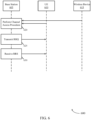
- a base station 105 may perform a channel access procedure on a shared radio frequency spectrum band using a first beam configuration.
- the base station 105 may transmit, based at least in part on successful completion of the channel access procedure, an RRQ to a UE 115 using a second beam configuration, the second beam configuration comprising a beam width that is equal to or narrower (e.g., corresponding to a higher antenna gain than the antenna gain of the first beam configuration) than a beam width of the first beam configuration.
- the base station 105 may receive an RRS from the UE 115 in response to the RRQ, the RRS comprising a third beam configuration that is based at least in part on the second beam configuration.
- a base station 105 may perform a sequential energy detection-based LBT channel access procedure on a shared radio frequency spectrum band using a plurality of beam configurations.
- the base station 105 may determine, based at least in part on successful completion of the channel access procedure for a first beam configuration of the plurality of beam configurations, that the shared radio frequency spectrum band is available for data communications using the first beam configuration.
- the base station 105 may transmit the data communications on the shared radio frequency spectrum band using the first beam configuration.
- a base station 105 may perform a channel access procedure on a shared radio frequency spectrum band using a first beam configuration.
- the base station 105 may transmit, based at least in part on successful completion of the channel access procedure, an RRQ to a UE 115 using a second beam configuration, the second beam configuration comprising a beam width that is equal to or narrower than a beam width of the first beam configuration.
- the base station 105 may transmit an RRS to the UE 115 in response to the RRQ, the RRS comprising a third beam configuration that is based at least in part on the second beam configuration.
- a UE 115 may receive an RRQ for a transmission opportunity from a base station 105 over a shared radio frequency spectrum band.
- the UE 115 may transmit an RRS to the base station 105 over the shared radio frequency spectrum band in response to the RRQ.
- the UE 115 may identify a beam configuration based at least in part on an inter-frame spacing between a downlink portion of the transmission opportunity and an uplink opportunity of the transmission opportunity.
- the UE 115 may perform a channel access procedure using the second beam configuration.
- FIG. 2 illustrates an example of a timing diagram 200 that supports asynchronous single beam directional LBT in accordance with various aspects of the present disclosure.
- timing diagram 200 may implement aspects of wireless communications system 100. Aspects of timing diagram 200 may be implemented by a UE or a base station, which may be examples of the corresponding devices described herein.
- timing diagram 200 illustrates one example technique for a single beam asynchronous LBT procedure in a downlink scenario.
- timing diagram 200 illustrates one example technique for an LBT procedure on a designated beam direction.
- the timing diagram 200 may include a channel access procedure 205 that occurs during a period 210, the period 210 occurring between time T0 and time T2.
- a second data packet may arrive for transmission to the UE or to a different UE.
- a base station may receive a packet for transmission to a UE and begin performing the channel access procedure 205 on a shared radio frequency spectrum band in response.
- the base station may use a first beam configuration for the channel access procedure 205.
- the base station may select the first beam configuration, which may be beam X in some examples, that has a first beam width.
- the first beam configuration may be a P1 beam (e.g., a layer 1 beam).
- the channel access procedure 205 may be an energy detection LBT procedure, a preamble based LBT procedure, and the like.
- the base station may select thresholds for energy detection and/or preamble detection to use during the channel access procedure 205.
- the channel access procedure 205 may include energy detection over N contention slots (countdown from N to 0).
- the channel access procedure 205 may include the base station monitoring for RRS or RRQ over M slots.
- the channel access procedure 205 may be considered successful if the channel is determined available for communicating the downlink data and unsuccessful if the base station detects an energy level/preamble above the threshold and/or other RRQ/RRS exchanges on the channel during the channel access procedure.
- the channel access procedure may be considered successful when there are no active RRQ or RRS exchanges detected during the channel access procedure.
- An active RRQ or RRS exchange may include the base station detecting a corresponding preamble message in conjunction with the RRQ or RRS.
- the channel access procedure 205 may be operator-based.
- the base station may determine that an active RRQ or RRS is received from other devices during the channel access procedure 205 and perform a backoff procedure based on the active RRQ or RRS for the operator of the base station (e.g., first operator) and/or for a different operator (second operator).
- the base station may transmit an RRQ 215 to the UE.
- the RRQ 215 may include a reservation request for a particular direction.
- direction may refer to a transmit-receive beam pair, with uplink and downlink representing different directions.
- the RRQ 215 may be transmitted using a second beam configuration that uses the same beam width as the first beam configuration (e.g., beam X) or a narrower beam configuration (e.g., beam X').
- the second beam configuration has a narrower beam width as the first beam configuration and the base station may select the energy/preamble detection threshold for the channel access procedure 205 based on the beam width of the first beam configuration.
- the base station may select the energy/preamble detection threshold for the channel access procedure 205 based on the difference in the beam width between the first and second beam configurations.
- the base station may select the energy/preamble detection threshold for the channel access procedure 205 based on wither the beam width of the first beam configuration is a P1 beam, a P2 beam (e.g., a layer 2 beam), or a P3 beam (e.g., a layer 3 beam).
- the second beam configuration have the same beam width as the first beam configuration and the base station may select the energy/preamble detection threshold for the channel access procedure 205 based on the beam width.
- the base station may configure each UE with orthogonal resources to use for the RRSs. the base station may select the energy/preamble detection threshold for the channel access procedure 205 based on the third beam configuration.
- the base station may receive an RRS 220 from the UE.
- the RRS 220 may be for a particular direction.
- the RRS 220 may have a third beam configuration that is based at least in part on the second beam configuration.
- the RRS 220 may be received on a beam pair link (BPL) that is based on the second beam configuration (e.g., the UE may transmit the RRS 220 using a beam configuration that is selected based on the second beam configuration (e.g., beam X')).
- BPL beam pair link
- the UE may monitor for the RRQ from the base station. For example, the UE may perform continuous listening of preambles on its receive beam. This solution may include the UE exceeding a power usage threshold as the UE is monitoring for preambles all the time, regardless of being scheduled or not. In another example, the UE may not listen for preambles continuously due to power consumption considerations. However, this solution may lead to UE missing preambles that were transmitted when the UE was not listening. In another example, the UE may optionally perform a K slot energy detection prior to reservation response. In some aspects, a UE that does not listen to preambles continuously may use a different energy/preamble detection threshold.
- the UE may monitor for the RRQ (or any reservation signaling) based on a medium sensing trigger received from the base station. For example, at T ms prior to potentially scheduling a UE, the base station may send a trigger signal to UE to start monitoring the medium for preambles and reservation messages to avoid the deafness issue from the UE side as well as limit the power consumption.
- T may be the nominal TxOP length as specified for the medium.
- the base station may determine that downlink data is pending for the UE and transmit an indication of a time period during which the UE is to monitor a shared radio frequency spectrum band for reservation signaling (e.g., any one of a reservation request message, a reservation response message, or a preamble message from the base station).
- the base station may perform a channel access procedure with the UE and transmit the reservation message to the UE within the predefined time period.
- the UE may receive the indication of the time period during which UE is to monitor the shared radio frequency spectrum band for one or more reservation signaling and monitor the shared radio frequency spectrum band during the time period to receive the reservation signaling from the base station.
- the UE may receive downlink data from the base station based at least in part on the received reservation signaling.
- the UE may use a non-continuous monitoring configuration to monitor the shared radio frequency spectrum band.
- the base station may transmit a preamble 225 in response to the RRS 220 using the second beam configuration.
- the preamble 225 may be configured to confirm a reservation for uplink communications from the UE (when applicable) in the particular direction.
- the base station may then transmit a control signal indicating one or more resources to be used for data communications 235 with the UE.
- the base station may transmit the data communication 235 using the one or more resources.
- the UE may respond with an acknowledgement 240 acknowledging (ACK) or negative acknowledging (NACK) successful receipt of the data communications 235.
- ACK acknowledgement 240 acknowledging
- NACK negative acknowledging
- the timing diagram 200 may also include a deferment period 245, a first inter-frame spacing (IFS) 250, and a second IFS 255.
- the base station may make scheduling decisions (e.g., with regards to the particular channel access procedure 205, whether to or how to configure the RRQ 215 transmission, and/or whether to and how to configure the preamble 225 transmission) at each of the deferment period 245, the first IFS 250, and the second IFS 255, respectively.
- the base station may determine whether to perform the channel access procedure 205 based on data arriving at time T0.
- the base station may determine whether to transmit (and how to configure) the RRQ 215 based on the success or failure of the channel access procedure 205.
- the base station may determine whether to transmit (and how to configure) the preamble 225 based on receiving the RRS 220 from the UE.
- the base station may transmit RRQ 215 on a contention beam if no other RRQs or RRSs are heard on the contention beam (e.g., the first beam configuration and/or using a P1 or P2 beam approach). In some aspects, the base station may transmit RRQ 215 on any P2 beam, which is a subset of the P1 beam on which contention was performed (e.g., channel access procedure 205). In some aspects, the base station may transmit the RRQ 215 when no other "active" RRQs or RRSs are heard on the contention beam (e.g., the first beam configuration used for the channel access procedure 205).
- An active RRQ may be defined as one which is confirmed with a preamble message subsequent to the reception of an RRS and a scheduling decision on that beam direction.
- the same P1 or P2 subset of P1 beam rule may be used.
- the base station may transmit RRQ 215 if no other RRS is heard (e.g., a receiver centric LBT procedure) on the contention beam.
- the same P1 or P2 subset of P1 beam rule may be applied.
- an RRQ 215 may be considered “active” if a preamble follows the RRS within a pre-determined time "T.”
- the base station may perform a backoff only to other operator's reservation message (RRQ or RRS).
- the base station may backoff its own operator preamble in addition to other operator's preamble.
- timing diagram 200 illustrates one example of an RRQ/RRS/preamble exchange that may be used by a base station for data communications
- the base station may simply perform the channel access procedure 205 and, if the channel is clear, transmit the data communications 235 to the UE using the first beam configuration. That is, the RRQ 215, RRS 220, and preamble 225 may be omitted.
- the base station may also transmit the control signaling 330 prior to the data communications 235.
- a base station may perform a sequential energy detection-based LBT channel access procedure 205 on a shared radio frequency spectrum band using a plurality of beam configurations.
- the base station may determine, based at least in part on successful completion of the channel access procedure and for a first beam configuration of a plurality of beam configurations, that the shared radio frequency spectrum band is available for data communications using the first beam configuration.
- the base station may transmit the data communications 235 on the shared radio frequency spectrum band using the first beam configuration.
- FIG. 3 illustrates an example of a wireless communications system 300 that supports asynchronous single beam directional LBT in accordance with various aspects of the present disclosure.
- wireless communications system 300 may implement aspects of wireless communications system 100 and/or timing diagram 200.
- Wireless communications system 300 may include a base station 305, a UE 310, and a UE 315, which may be examples of the corresponding devices described herein.
- the base station 305 contends for the channel in the direction of the respective UE to be scheduled and sequentially for each direction.
- contention e.g., the channel access procedure 205 of FIG. 2
- contention slots counting down from N to 0
- monitoring reservation messages over M slots.
- the base station 305 may contend for the channel for on each UE beam sequentially. This may provide an improved probability of medium capture due to directionality of the channel access procedure with no mismatches between contention directions and interference directions.
- the scheduling decision may be made prior to medium sensing (e.g., if contention failed, a new direction may begin all over again). However, instead the scheduler decision may be deferred to the post-contention phase.
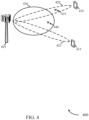
- FIG. 4 illustrates an example of a wireless communications system 400 that supports asynchronous single beam directional LBT in accordance with various aspects of the present disclosure.
- wireless communications system 400 may implement aspects of wireless communications systems 100/300 and/or timing diagram 200.
- Wireless communications system 400 may include a base station 405, a UE 410, and a UE 415, which may be examples of the corresponding devices described herein.
- the energy/preamble detection threshold may be a function of the beam width used for contention. In another example, the energy/preamble detection threshold may be a function of the relative difference in beamwidths of the contention beam and RRQ transmission beam. In yet another example, the energy/preamble detection threshold may be based on whether the beams used for sensing are P1, P2, or P3 beams.
- base station 405 may use a first beam configuration 430 to perform a channel access procedure with each of UEs 410 and 415.
- the first beam configuration 430 may have a wide beam width.
- the base station 405 may then transmit, based on the channel access procedures being successful, RRQ to each of UEs 410 and 415 using second beam configurations 420 and 425.
- Each of the second beam configurations 420 and 425 may have a narrower beam width than the first beam configuration 430.
- the base station 305 may receive an RRS in response to the RRQ from the respective UEs 410 and 415.
- the UE located at position 440 may not be a victim of interference from more directional transmissions from UE 415 and/or base station 405, but may unnecessarily block the channel access procedure.
- the modified contention criteria may be used.
- the base station 405 may use the first beam configuration 430 for contention and RRQ (e.g., as both the first and second beam configuration).
- One outcome to such an approach may include one of multiple UEs responding with RRS which the base station 405 may schedule the one of multiple UEs based on RRS response.
- RRS from multiple UEs could result on over silencing.
- the UEs may be configured with designated orthogonal resources for the RRS transmission.
- Another approach may include the UEs being configured with overlapping resources for the RRS transmissions with different threshold for detection to compensate for colliding RRS messages at the base station 405.
- FIG. 5 illustrates an example of a timing diagram 500 that supports asynchronous single beam directional LBT in accordance with various aspects of the present disclosure.
- timing diagram 500 may implement aspects of wireless communications system 100/300/400, and/or timing diagram 200. Aspects of timing diagram 500 may be implemented by a UE or a base station, which may be examples of the corresponding devices described herein.
- timing diagram 500 illustrates one example technique for a single beam asynchronous LBT procedure in an uplink scenario.
- the channel access procedure 505 may be an energy detection LBT procedure, a preamble based LBT procedure, and the like.
- the base station may select thresholds for energy detection and/or preamble detection to use during the channel access procedure 505.
- the channel access procedure 505 may include energy detection over N contention slots (countdown from N to 0).
- the channel access procedure 505 may include the base station monitoring for RRS or RRQ over M slots.
- the base station may transmit an RRS 520 to the UE.
- the RRS 520 may be for a particular direction.
- the RRS 520 may have a third beam configuration that is based at least in part on the second beam configuration.
- the RRQ 515 from the base station may be followed by the RRS 520.
- the RRS may be sent by the receiver. Additional transaction involving UE is thus eliminated.
- the reservation by base stations RRS may be unused and reduce reuse.
- the RRQ 515 from the base station may be followed by the RRS 520 transmitted from the UE (not shown).
- the base station may follow by transmitting the preamble 525 which acts or otherwise serves the same purpose as an "RRS" from the base station, i.e., the preamble confirms reservation of the medium.
- the base station may optionally transmit the preamble message 525 following the RRS 520 using the second beam configuration.
- the preamble 525 may be configured to confirm a reservation for uplink communications from the UE in the particular direction.
- the base station may then transmit a control signal 530 indicating one or more uplink resources to be used for data communications 535 from the UE.
- the UE may transmit the data communication 535 using the one or more resources.
- the UE may transmit UCI 540 following the data communications 535.
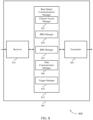
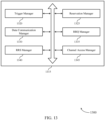
- RRQ manager 1240 may receive an RRQ for a transmission opportunity from a base station over a shared radio frequency spectrum band.
- RRS manager 1245 may transmit an RRS to the base station over the shared radio frequency spectrum band in response to the RRQ.
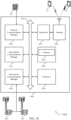
- FIG. 14 shows a diagram of a system 1400 including a device 1405 that supports asynchronous single beam directional LBT in accordance with aspects of the present disclosure.
- Device 1405 may be an example of or include the components of UE 115 as described above, for example, with reference to FIG. 1 .
- Device 1405 may include components for bi-directional voice and data communications including components for transmitting and receiving communications, including UE communications manager 1415, processor 1420, memory 1425, software 1430, transceiver 1435, antenna 1440, and I/O controller 1445. These components may be in electronic communication via one or more buses (e.g., bus 1410).
- Device 1405 may communicate wirelessly with one or more base stations 105.
- Processor 1420 may include an intelligent hardware device, (e.g., a general-purpose processor, a DSP, a CPU, a microcontroller, an ASIC, an FPGA, a programmable logic device, a discrete gate or transistor logic component, a discrete hardware component, or any combination thereof).
- processor 1420 may be configured to operate a memory array using a memory controller.
- a memory controller may be integrated into processor 1420.
- Processor 1420 may be configured to execute computer-readable instructions stored in a memory to perform various functions (e.g., functions or tasks supporting asynchronous single beam directional LBT).
- Transceiver 1435 may communicate bi-directionally, via one or more antennas, wired, or wireless links as described above.
- the transceiver 1435 may represent a wireless transceiver and may communicate bi-directionally with another wireless transceiver.
- the transceiver 1435 may also include a modem to modulate the packets and provide the modulated packets to the antennas for transmission, and to demodulate packets received from the antennas.
- the base station 105 may transmit, based at least in part on successful completion of the channel access procedure, an RRQ to a UE using a second beam configuration, the second beam configuration comprising a beam width that is equal to or narrower than a beam width of the first beam configuration.
- the operations of 1510 may be performed according to the methods described herein. In certain examples, aspects of the operations of 1510 may be performed by an RRQ manager as described with reference to FIGs. 7 through 10 .
- the base station 105 may transmit, based at least in part on successful completion of the channel access procedure, an RRQ to a UE using a second beam configuration, the second beam configuration comprising a beam width that is equal to or narrower than a beam width of the first beam configuration.
- the operations of 1610 may be performed according to the methods described herein. In certain examples, aspects of the operations of 1610 may be performed by an RRQ manager as described with reference to FIGs. 7 through 10 .
- the base station 105 may transmit a preamble message in response to the RRS using the second beam configuration.
- the operations of 1620 may be performed according to the methods described herein. In certain examples, aspects of the operations of 1620 may be performed by a preamble manager as described with reference to FIGs. 7 through 10 .
- the base station 105 may transmit a data communication using the one or more resources.
- the operations of 1630 may be performed according to the methods described herein. In certain examples, aspects of the operations of 1630 may be performed by a preamble manager as described with reference to FIGs. 7 through 10 .
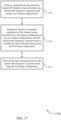
- the base station 105 may perform a sequential energy detection-based LBT channel access procedure on a shared radio frequency spectrum band using a plurality of beam configurations.
- the operations of 1705 may be performed according to the methods described herein. In certain examples, aspects of the operations of 1705 may be performed by a channel access manager as described with reference to FIGs. 7 through 10 .
- the base station 105 may determine, based at least in part on successful completion of the channel access procedure for a first beam configuration of the plurality of beam configurations, that the shared radio frequency spectrum band is available for data communications using the first beam configuration.
- the operations of 1710 may be performed according to the methods described herein. In certain examples, aspects of the operations of 1710 may be performed by a channel access manager as described with reference to FIGs. 7 through 10 .
- the base station 105 may transmit the data communications on the shared radio frequency spectrum band using the first beam configuration.
- the operations of 1715 may be performed according to the methods described herein. In certain examples, aspects of the operations of 1715 may be performed by a data communication manager as described with reference to FIGs. 7 through 10 .
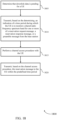
- FIG. 18 shows a flowchart illustrating a method 1800 for asynchronous single beam directional LBT in accordance with aspects of the present disclosure.
- the operations of method 1800 may be implemented by a base station 105 or its components as described herein.
- the operations of method 1800 may be performed by a base station communications manager as described with reference to FIGs. 7 through 10 .
- a base station 105 may execute a set of codes to control the functional elements of the device to perform the functions described below. Additionally or alternatively, the base station 105 may perform aspects of the functions described below using special-purpose hardware.
- the base station 105 may determine that downlink data is pending for a UE.
- the operations of 1805 may be performed according to the methods described herein. In certain examples, aspects of the operations of 1805 may be performed by a data communication manager as described with reference to FIGs. 7 through 10 .
- the base station 105 may transmit, based at least in part on the channel access procedure, the reservation message to the UE within the predefined time period.
- the operations of 1820 may be performed according to the methods described herein. In certain examples, aspects of the operations of 1820 may be performed by a data communication manager as described with reference to FIGs. 7 through 10 .
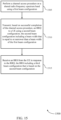
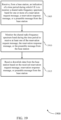
- the UE 115 may receive, from a base station, an indication of a time period during which UE is to monitor a shared radio frequency spectrum band for one or more of a reservation request message, a reservation response message, or a preamble message from the base station.
- the operations of 1905 may be performed according to the methods described herein. In certain examples, aspects of the operations of 1905 may be performed by a trigger manager as described with reference to FIGs. 11 through 14 .
- the UE 115 may monitor the shared radio frequency spectrum band during the time period to receive at least one of the reservation request message, the reservation response message, or the preamble message from the base station.
- the operations of 1910 may be performed according to the methods described herein. In certain examples, aspects of the operations of 1910 may be performed by a reservation manager as described with reference to FIGs. 11 through 14 .
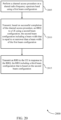
- FIG. 20 shows a flowchart illustrating a method 2000 for asynchronous single beam directional LBT in accordance with aspects of the present disclosure.
- the operations of method 2000 may be implemented by a base station 105 or its components as described herein.
- the operations of method 2000 may be performed by a base station communications manager as described with reference to FIGs. 7 through 10 .
- a base station 105 may execute a set of codes to control the functional elements of the device to perform the functions described below. Additionally or alternatively, the base station 105 may perform aspects of the functions described below using special-purpose hardware.
- the base station 105 may perform a channel access procedure on a shared radio frequency spectrum band using a first beam configuration.
- the operations of 2005 may be performed according to the methods described herein. In certain examples, aspects of the operations of 2005 may be performed by a channel access manager as described with reference to FIGs. 7 through 10 .
- the base station 105 may transmit, based at least in part on successful completion of the channel access procedure, an RRQ to a UE using a second beam configuration, the second beam configuration comprising a beam width that is equal to or narrower than a beam width of the first beam configuration.
- the operations of 2010 may be performed according to the methods described herein. In certain examples, aspects of the operations of 2010 may be performed by an RRQ manager as described with reference to FIGs. 7 through 10 .
- the base station 105 may transmit an RRS to the UE in response to the RRQ, the RRS comprising a third beam configuration that is based at least in part on the second beam configuration.
- the operations of 2015 may be performed according to the methods described herein. In certain examples, aspects of the operations of 2015 may be performed by an RRS manager as described with reference to FIGs. 7 through 10 .
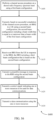
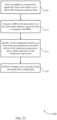
- FIG. 21 shows a flowchart illustrating a method 2100 for asynchronous single beam directional LBT in accordance with aspects of the present disclosure.
- the operations of method 2100 may be implemented by a UE 115 or its components as described herein.
- the operations of method 2100 may be performed by a UE communications manager as described with reference to FIGs. 11 through 14 .
- a UE 115 may execute a set of codes to control the functional elements of the device to perform the functions described below. Additionally or alternatively, the UE 115 may perform aspects of the functions described below using special-purpose hardware.
- the UE 115 may receive an RRQ for a transmission opportunity from a base station over a shared radio frequency spectrum band.
- the operations of 2105 may be performed according to the methods described herein. In certain examples, aspects of the operations of 2105 may be performed by an RRQ manager as described with reference to FIGs. 11 through 14 .
- the UE 115 may transmit an RRS to the base station over the shared radio frequency spectrum band in response to the RRQ.
- the operations of 2110 may be performed according to the methods described herein. In certain examples, aspects of the operations of 2110 may be performed by an RRS manager as described with reference to FIGs. 11 through 14 .
- the UE 115 may identify a beam configuration based at least in part on an inter-frame spacing between a downlink portion of the transmission opportunity and an uplink opportunity of the transmission opportunity.
- the operations of 2115 may be performed according to the methods described herein. In certain examples, aspects of the operations of 2115 may be performed by a data communication manager as described with reference to FIGs. 11 through 14 .
- CDMA code division multiple access
- TDMA time division multiple access
- FDMA frequency division multiple access
- OFDMA orthogonal frequency division multiple access
- SC-FDMA single carrier frequency division multiple access
- a CDMA system may implement a radio technology such as CDMA2000, Universal Terrestrial Radio Access (UTRA), etc.
- CDMA2000 covers IS-2000, IS-95, and IS-856 standards.
- IS-2000 Releases may be commonly referred to as CDMA2000 1X, 1X, etc.
- IS-856 TIA-856) is commonly referred to as CDMA2000 1xEV-DO, High Rate Packet Data (HRPD), etc.
- UTRA includes Wideband CDMA (WCDMA) and other variants of CDMA.
- a TDMA system may implement a radio technology such as Global System for Mobile Communications (GSM).
- GSM Global System for Mobile Communications
- LTE or NR may be described for purposes of example, and LTE or NR terminology may be used in much of the description, the techniques described herein are applicable beyond LTE or NR applications.
- a macro cell generally covers a relatively large geographic area (e.g., several kilometers in radius) and may allow unrestricted access by UEs 115 with service subscriptions with the network provider.
- a small cell may be associated with a lower-powered base station 105, as compared with a macro cell, and a small cell may operate in the same or different (e.g., licensed or unlicensed) frequency bands as macro cells.
- Small cells may include pico cells, femto cells, and micro cells according to various examples.
- a pico cell for example, may cover a small geographic area and may allow unrestricted access by UEs 115 with service subscriptions with the network provider.
- a femto cell may also cover a small geographic area (e.g., a home) and may provide restricted access by UEs 115 having an association with the femto cell (e.g., UEs 115 in a closed subscriber group (CSG), UEs 115 for users in the home, and the like).
- An eNB for a macro cell may be referred to as a macro eNB.
- An eNB for a small cell may be referred to as a small cell eNB, a pico eNB, a femto eNB, or a home eNB.
- An eNB may support one or multiple (e.g., two, three, four, and the like) cells, and may also support communications using one or multiple component carriers.
- the wireless communications system 100 or systems described herein may support synchronous or asynchronous operation.
- the base stations 105 may have similar frame timing, and transmissions from different base stations 105 may be approximately aligned in time.
- the base stations 105 may have different frame timing, and transmissions from different base stations 105 may not be aligned in time.
- the techniques described herein may be used for either synchronous or asynchronous operations.
- Information and signals described herein may be represented using any of a variety of different technologies and techniques.
- data, instructions, commands, information, signals, bits, symbols, and chips that may be referenced throughout the above description may be represented by voltages, currents, electromagnetic waves, magnetic fields or particles, optical fields or particles, or any combination thereof.
- a general-purpose processor may be a microprocessor, but in the alternative, the processor may be any conventional processor, controller, microcontroller, or state machine.
- a processor may also be implemented as a combination of computing devices (e.g., a combination of a DSP and a microprocessor, multiple microprocessors, one or more microprocessors in conjunction with a DSP core, or any other such configuration).
- the functions described herein may be implemented in hardware, software executed by a processor, firmware, or any combination thereof. If implemented in software executed by a processor, the functions may be stored on or transmitted over as one or more instructions or code on a computer-readable medium. Other examples and implementations are within the scope of the disclosure and appended claims. For example, due to the nature of software, functions described above can be implemented using software executed by a processor, hardware, firmware, hardwiring, or combinations of any of these. Features implementing functions may also be physically located at various positions, including being distributed such that portions of functions are implemented at different physical locations.
- Computer-readable media includes both non-transitory computer storage media and communication media including any medium that facilitates transfer of a computer program from one place to another.
- a non-transitory storage medium may be any available medium that can be accessed by a general purpose or special purpose computer.
- non-transitory computer-readable media may comprise RAM, ROM, electrically erasable programmable read only memory (EEPROM), flash memory, compact disk (CD) ROM or other optical disk storage, magnetic disk storage or other magnetic storage devices, or any other non-transitory medium that can be used to carry or store desired program code means in the form of instructions or data structures and that can be accessed by a general-purpose or special-purpose computer, or a general-purpose or special-purpose processor.
- any connection is properly termed a computer-readable medium.
- the software is transmitted from a website, server, or other remote source using a coaxial cable, fiber optic cable, twisted pair, digital subscriber line (DSL), or wireless technologies such as infrared, radio, and microwave
- the coaxial cable, fiber optic cable, twisted pair, DSL, or wireless technologies such as infrared, radio, and microwave are included in the definition of medium.
- Disk and disc include CD, laser disc, optical disc, digital versatile disc (DVD), floppy disk and Blu-ray disc where disks usually reproduce data magnetically, while discs reproduce data optically with lasers. Combinations of the above are also included within the scope of computer-readable media.
Landscapes
- Engineering & Computer Science (AREA)
- Computer Networks & Wireless Communication (AREA)
- Signal Processing (AREA)
- Mobile Radio Communication Systems (AREA)
Applications Claiming Priority (4)
| Application Number | Priority Date | Filing Date | Title |
|---|---|---|---|
| US201762566068P | 2017-09-29 | 2017-09-29 | |
| US16/135,500 US11064518B2 (en) | 2017-09-29 | 2018-09-19 | Asynchronous single beam directional listen-before-talk |
| PCT/US2018/051926 WO2019067297A1 (fr) | 2017-09-29 | 2018-09-20 | Technique écouter avant de parler directionnelle à faisceau unique asynchrone |
| EP18789728.5A EP3689081B1 (fr) | 2017-09-29 | 2018-09-20 | Technique écouter avant de parler directionnelle à faisceau unique asynchrone |
Related Parent Applications (1)
| Application Number | Title | Priority Date | Filing Date |
|---|---|---|---|
| EP18789728.5A Division EP3689081B1 (fr) | 2017-09-29 | 2018-09-20 | Technique écouter avant de parler directionnelle à faisceau unique asynchrone |
Publications (2)
| Publication Number | Publication Date |
|---|---|
| EP4395445A2 true EP4395445A2 (fr) | 2024-07-03 |
| EP4395445A3 EP4395445A3 (fr) | 2024-08-28 |
Family
ID=65898207
Family Applications (2)
| Application Number | Title | Priority Date | Filing Date |
|---|---|---|---|
| EP24175593.3A Pending EP4395445A3 (fr) | 2017-09-29 | 2018-09-20 | Écoute avant de parler directionnelle à faisceau unique asynchrone |
| EP18789728.5A Active EP3689081B1 (fr) | 2017-09-29 | 2018-09-20 | Technique écouter avant de parler directionnelle à faisceau unique asynchrone |
Family Applications After (1)
| Application Number | Title | Priority Date | Filing Date |
|---|---|---|---|
| EP18789728.5A Active EP3689081B1 (fr) | 2017-09-29 | 2018-09-20 | Technique écouter avant de parler directionnelle à faisceau unique asynchrone |
Country Status (4)
| Country | Link |
|---|---|
| US (1) | US11064518B2 (fr) |
| EP (2) | EP4395445A3 (fr) |
| CN (1) | CN111165057B (fr) |
| WO (1) | WO2019067297A1 (fr) |
Families Citing this family (24)
| Publication number | Priority date | Publication date | Assignee | Title |
|---|---|---|---|---|
| WO2018133706A1 (fr) * | 2017-01-20 | 2018-07-26 | Guangdong Oppo Mobile Telecommunications Corp., Ltd. | Procédés pour commander à un équipement d'utilisateur de surveiller un message de recherche, équipements d'utilisateur, stations de base, et support de stockage |
| US11064518B2 (en) * | 2017-09-29 | 2021-07-13 | Qualcomm Incorporated | Asynchronous single beam directional listen-before-talk |
| EP3831156A4 (fr) * | 2018-09-13 | 2022-05-04 | Sony Group Corporation | Procédé et dispositif de procédure d'accès multiple avec écoute de porteuse permettant un seuil d'énergie plus grand |
| KR20210087089A (ko) | 2018-11-27 | 2021-07-09 | 엑스콤 랩스 인코퍼레이티드 | 넌-코히어런트 협력 다중 입출력 통신 |
| US10892814B2 (en) * | 2018-12-07 | 2021-01-12 | Charter Communications Operating, Llc | Performing receive beamforming in a fifth generation millimeter wave system |
| US11582618B2 (en) * | 2019-06-28 | 2023-02-14 | Qualcomm Incorporated | Listen-before-talk beam overlap measurement procedures |
| US11411778B2 (en) | 2019-07-12 | 2022-08-09 | XCOM Labs, Inc. | Time-division duplex multiple input multiple output calibration |
| US11510243B2 (en) * | 2019-07-24 | 2022-11-22 | Qualcomm Incorporated | Transmission countdown and improvements for a beam based channel access procedure |
| BR112022009652A2 (pt) * | 2019-11-18 | 2022-08-16 | Guangdong Oppo Mobile Telecommunications Corp Ltd | Métodos de determinação de limite de detecção de energia e aparelhos de determinação de limite de detecção de energia |
| CN115211218A (zh) * | 2020-02-12 | 2022-10-18 | Idac控股公司 | 未许可频谱中的信道接入 |
| US11672006B2 (en) * | 2020-02-21 | 2023-06-06 | Qualcomm Incorporated | Message 3 repetition with receive beam sweep and associated beam refinement for message 4 |
| US11411779B2 (en) | 2020-03-31 | 2022-08-09 | XCOM Labs, Inc. | Reference signal channel estimation |
| US12088499B2 (en) | 2020-04-15 | 2024-09-10 | Virewirx, Inc. | System and method for reducing data packet processing false alarms |
| KR20230015932A (ko) | 2020-05-26 | 2023-01-31 | 엑스콤 랩스 인코퍼레이티드 | 간섭-인식 빔포밍 |
| US12022366B2 (en) * | 2020-06-11 | 2024-06-25 | Qualcomm Incorporated | Use-case-specific wireless communications-based radar reference signals |
| US12058688B2 (en) * | 2020-07-15 | 2024-08-06 | Qualcomm Incorporated | Uplink sensing with multiple beams in a shared spectrum |
| US11929803B2 (en) * | 2020-07-29 | 2024-03-12 | Qualcomm Incorporated | Connected mode beam management for narrowband systems |
| CA3195885A1 (fr) | 2020-10-19 | 2022-04-28 | XCOM Labs, Inc. | Signal de reference pour systemes de communication sans fil |
| WO2022093988A1 (fr) | 2020-10-30 | 2022-05-05 | XCOM Labs, Inc. | Groupement et/ou sélection de débit dans des systèmes de communication à entrées et sorties multiples |
| CN116648867A (zh) | 2020-12-16 | 2023-08-25 | 艾斯康实验室公司 | 具有准全向波束和定向波束的无线通信 |
| WO2022241436A1 (fr) | 2021-05-14 | 2022-11-17 | XCOM Labs, Inc. | Identifiants de brouillage pour systèmes de communication sans fil |
| US20240340064A1 (en) * | 2021-08-06 | 2024-10-10 | Qualcomm Incorporated | Criterion and conformance test for eligibility of sensing beams for channel access |
| US11342973B1 (en) * | 2021-10-19 | 2022-05-24 | King Faisal University | System and method for maintaining link communications in millimeter wave cellular networks |
| WO2024182991A1 (fr) * | 2023-03-07 | 2024-09-12 | Qualcomm Incorporated | Fonctionnement de dispositif passif dans un spectre partagé |
Family Cites Families (16)
| Publication number | Priority date | Publication date | Assignee | Title |
|---|---|---|---|---|
| US7826431B2 (en) * | 2004-05-14 | 2010-11-02 | Interdigital Technology Corporation | Method of selectively adjusting the configuration of an access point antenna to enhance mobile station coverage |
| EP3225070A1 (fr) | 2014-11-26 | 2017-10-04 | IDAC Holdings, Inc. | Accès initial dans des systèmes sans fil haute fréquence |
| US10085283B2 (en) * | 2014-12-31 | 2018-09-25 | Qualcomm Incorporated | Antenna subset and directional channel access in a shared radio frequency spectrum band |
| US10021573B2 (en) * | 2015-04-13 | 2018-07-10 | Industrial Technology Research Institute | Method and device for uplink transmission by using unlicensed spectrum |
| US10028303B2 (en) * | 2015-10-26 | 2018-07-17 | Intel IP Corporation | Clear channel assessment (CCA) in wireless networks |
| US10595322B2 (en) * | 2015-11-23 | 2020-03-17 | Qualcomm Incorporated | Beamforming and user equipment grouping |
| US10439743B2 (en) * | 2016-01-12 | 2019-10-08 | Telefonaktiebolaget Lm Ericsson (Publ) | System, method and apparatus for managing co-channel interference |
| WO2018028838A1 (fr) * | 2016-08-12 | 2018-02-15 | Telefonaktiebolaget Lm Ericsson (Publ) | Technique permettant de déterminer la largeur de canal d'un canal utilisé dans un réseau de communications sans fil |
| CN107888256B (zh) * | 2016-09-30 | 2022-12-02 | 中兴通讯股份有限公司 | 数据传输、接收方法、装置、基站及终端 |
| US10681727B2 (en) * | 2016-12-19 | 2020-06-09 | Qualcomm Incorporated | Uplink transmission parameter selection during random access message transmission and retransmission |
| EP3585123B1 (fr) * | 2017-02-16 | 2023-02-01 | LG Electronics Inc. | Procédé d'émission/réception de signal entre une station de base et un terminal dans un système de communication sans fil prenant en charge une bande sans licence et appareil prenant en charge ledit procédé |
| EP3527009B1 (fr) * | 2017-05-04 | 2020-04-29 | Ofinno, LLC | Décalage de puissance de rach |
| US10568050B2 (en) * | 2017-05-04 | 2020-02-18 | Ofinno, Llc | RACH power adjustment |
| US11950287B2 (en) * | 2017-08-10 | 2024-04-02 | Comcast Cable Communications, Llc | Resource configuration of beam failure recovery request transmission |
| US10651913B2 (en) * | 2017-08-10 | 2020-05-12 | Ofinno, Llc | Beam refinement during RACH |
| US11064518B2 (en) * | 2017-09-29 | 2021-07-13 | Qualcomm Incorporated | Asynchronous single beam directional listen-before-talk |
-
2018
- 2018-09-19 US US16/135,500 patent/US11064518B2/en active Active
- 2018-09-20 WO PCT/US2018/051926 patent/WO2019067297A1/fr not_active Ceased
- 2018-09-20 EP EP24175593.3A patent/EP4395445A3/fr active Pending
- 2018-09-20 EP EP18789728.5A patent/EP3689081B1/fr active Active
- 2018-09-20 CN CN201880062780.9A patent/CN111165057B/zh active Active
Also Published As
| Publication number | Publication date |
|---|---|
| US11064518B2 (en) | 2021-07-13 |
| EP3689081A1 (fr) | 2020-08-05 |
| WO2019067297A1 (fr) | 2019-04-04 |
| CN111165057A (zh) | 2020-05-15 |
| EP4395445A3 (fr) | 2024-08-28 |
| US20190104542A1 (en) | 2019-04-04 |
| EP3689081B1 (fr) | 2024-05-15 |
| CN111165057B (zh) | 2024-03-19 |
Similar Documents
| Publication | Publication Date | Title |
|---|---|---|
| US11064518B2 (en) | Asynchronous single beam directional listen-before-talk | |
| US10841953B2 (en) | Receiver-based listen before talk techniques in shared millimeter wave radio frequency spectrum | |
| EP3704804B1 (fr) | Technique "écouter avant de parler" pour des communications à entrées multiples et sorties multiples multiutilisateur à ondes millimétriques | |
| US10925090B2 (en) | On-demand listen-before-talk | |
| US10841950B2 (en) | Listen before talk techniques in shared millimeter wave radio frequency spectrum | |
| US11019605B2 (en) | Reservation repetition for deafness avoidance | |
| US10945288B2 (en) | Reservation and challenge schemes for listen-before-talk | |
| US11259320B2 (en) | Multiple-beam uplink random access channel messages | |
| US10785799B2 (en) | Adaptive medium sensing thresholds | |
| US11765776B2 (en) | Feedback for message B of a two-step random access channel procedure | |
| US12256230B2 (en) | Enhanced clear channel assessment for shared radio frequency spectrum band | |
| WO2021057841A1 (fr) | Configuration d'accès aléatoire inter-porteuses | |
| US11463301B2 (en) | On-demand beam failure recovery resources |
Legal Events
| Date | Code | Title | Description |
|---|---|---|---|
| PUAI | Public reference made under article 153(3) epc to a published international application that has entered the european phase |
Free format text: ORIGINAL CODE: 0009012 |
|
| STAA | Information on the status of an ep patent application or granted ep patent |
Free format text: STATUS: REQUEST FOR EXAMINATION WAS MADE |
|
| 17P | Request for examination filed |
Effective date: 20240514 |
|
| AC | Divisional application: reference to earlier application |
Ref document number: 3689081 Country of ref document: EP Kind code of ref document: P |
|
| AK | Designated contracting states |
Kind code of ref document: A2 Designated state(s): AL AT BE BG CH CY CZ DE DK EE ES FI FR GB GR HR HU IE IS IT LI LT LU LV MC MK MT NL NO PL PT RO RS SE SI SK SM TR |
|
| REG | Reference to a national code |
Ref country code: DE Ref legal event code: R079 Free format text: PREVIOUS MAIN CLASS: H04W0074080000 Ipc: H04B0007040800 |
|
| PUAL | Search report despatched |
Free format text: ORIGINAL CODE: 0009013 |
|
| AK | Designated contracting states |
Kind code of ref document: A3 Designated state(s): AL AT BE BG CH CY CZ DE DK EE ES FI FR GB GR HR HU IE IS IT LI LT LU LV MC MK MT NL NO PL PT RO RS SE SI SK SM TR |
|
| RIC1 | Information provided on ipc code assigned before grant |
Ipc: H04W 74/00 20090101ALN20240724BHEP Ipc: H04B 7/06 20060101ALI20240724BHEP Ipc: H04W 74/0808 20240101ALI20240724BHEP Ipc: H04B 7/0408 20170101AFI20240724BHEP |
|
| STAA | Information on the status of an ep patent application or granted ep patent |
Free format text: STATUS: EXAMINATION IS IN PROGRESS |
|
| 17Q | First examination report despatched |
Effective date: 20260310 |