EP4397335A2 - Dispositif de piège à bulles - Google Patents
Dispositif de piège à bulles Download PDFInfo
- Publication number
- EP4397335A2 EP4397335A2 EP24178297.8A EP24178297A EP4397335A2 EP 4397335 A2 EP4397335 A2 EP 4397335A2 EP 24178297 A EP24178297 A EP 24178297A EP 4397335 A2 EP4397335 A2 EP 4397335A2
- Authority
- EP
- European Patent Office
- Prior art keywords
- chamber
- gas
- diverter
- bubbles
- diffuser
- Prior art date
- Legal status (The legal status is an assumption and is not a legal conclusion. Google has not performed a legal analysis and makes no representation as to the accuracy of the status listed.)
- Pending
Links
Images









Classifications
-
- A—HUMAN NECESSITIES
- A61—MEDICAL OR VETERINARY SCIENCE; HYGIENE
- A61M—DEVICES FOR INTRODUCING MEDIA INTO, OR ONTO, THE BODY; DEVICES FOR TRANSDUCING BODY MEDIA OR FOR TAKING MEDIA FROM THE BODY; DEVICES FOR PRODUCING OR ENDING SLEEP OR STUPOR
- A61M5/00—Devices for bringing media into the body in a subcutaneous, intra-vascular or intramuscular way; Accessories therefor, e.g. filling or cleaning devices, arm-rests
- A61M5/36—Devices for bringing media into the body in a subcutaneous, intra-vascular or intramuscular way; Accessories therefor, e.g. filling or cleaning devices, arm-rests with means for eliminating or preventing injection or infusion of air into body
-
- A—HUMAN NECESSITIES
- A61—MEDICAL OR VETERINARY SCIENCE; HYGIENE
- A61M—DEVICES FOR INTRODUCING MEDIA INTO, OR ONTO, THE BODY; DEVICES FOR TRANSDUCING BODY MEDIA OR FOR TAKING MEDIA FROM THE BODY; DEVICES FOR PRODUCING OR ENDING SLEEP OR STUPOR
- A61M1/00—Suction or pumping devices for medical purposes; Devices for carrying-off, for treatment of, or for carrying-over, body-liquids; Drainage systems
- A61M1/36—Other treatment of blood in a by-pass of the natural circulatory system, e.g. temperature adaptation, irradiation ; Extra-corporeal blood circuits
- A61M1/3621—Extra-corporeal blood circuits
- A61M1/3627—Degassing devices; Buffer reservoirs; Drip chambers; Blood filters
- A61M1/3633—Blood component filters, e.g. leukocyte filters
-
- A—HUMAN NECESSITIES
- A61—MEDICAL OR VETERINARY SCIENCE; HYGIENE
- A61M—DEVICES FOR INTRODUCING MEDIA INTO, OR ONTO, THE BODY; DEVICES FOR TRANSDUCING BODY MEDIA OR FOR TAKING MEDIA FROM THE BODY; DEVICES FOR PRODUCING OR ENDING SLEEP OR STUPOR
- A61M1/00—Suction or pumping devices for medical purposes; Devices for carrying-off, for treatment of, or for carrying-over, body-liquids; Drainage systems
- A61M1/36—Other treatment of blood in a by-pass of the natural circulatory system, e.g. temperature adaptation, irradiation ; Extra-corporeal blood circuits
- A61M1/3621—Extra-corporeal blood circuits
- A61M1/3627—Degassing devices; Buffer reservoirs; Drip chambers; Blood filters
-
- A—HUMAN NECESSITIES
- A61—MEDICAL OR VETERINARY SCIENCE; HYGIENE
- A61M—DEVICES FOR INTRODUCING MEDIA INTO, OR ONTO, THE BODY; DEVICES FOR TRANSDUCING BODY MEDIA OR FOR TAKING MEDIA FROM THE BODY; DEVICES FOR PRODUCING OR ENDING SLEEP OR STUPOR
- A61M5/00—Devices for bringing media into the body in a subcutaneous, intra-vascular or intramuscular way; Accessories therefor, e.g. filling or cleaning devices, arm-rests
- A61M5/14—Infusion devices, e.g. infusing by gravity; Blood infusion; Accessories therefor
- A61M5/1411—Drip chambers
-
- A—HUMAN NECESSITIES
- A61—MEDICAL OR VETERINARY SCIENCE; HYGIENE
- A61M—DEVICES FOR INTRODUCING MEDIA INTO, OR ONTO, THE BODY; DEVICES FOR TRANSDUCING BODY MEDIA OR FOR TAKING MEDIA FROM THE BODY; DEVICES FOR PRODUCING OR ENDING SLEEP OR STUPOR
- A61M5/00—Devices for bringing media into the body in a subcutaneous, intra-vascular or intramuscular way; Accessories therefor, e.g. filling or cleaning devices, arm-rests
- A61M5/14—Infusion devices, e.g. infusing by gravity; Blood infusion; Accessories therefor
- A61M5/165—Filtering accessories, e.g. blood filters, filters for infusion liquids
-
- A—HUMAN NECESSITIES
- A61—MEDICAL OR VETERINARY SCIENCE; HYGIENE
- A61M—DEVICES FOR INTRODUCING MEDIA INTO, OR ONTO, THE BODY; DEVICES FOR TRANSDUCING BODY MEDIA OR FOR TAKING MEDIA FROM THE BODY; DEVICES FOR PRODUCING OR ENDING SLEEP OR STUPOR
- A61M5/00—Devices for bringing media into the body in a subcutaneous, intra-vascular or intramuscular way; Accessories therefor, e.g. filling or cleaning devices, arm-rests
- A61M5/36—Devices for bringing media into the body in a subcutaneous, intra-vascular or intramuscular way; Accessories therefor, e.g. filling or cleaning devices, arm-rests with means for eliminating or preventing injection or infusion of air into body
- A61M5/38—Devices for bringing media into the body in a subcutaneous, intra-vascular or intramuscular way; Accessories therefor, e.g. filling or cleaning devices, arm-rests with means for eliminating or preventing injection or infusion of air into body using hydrophilic or hydrophobic filters
-
- A—HUMAN NECESSITIES
- A61—MEDICAL OR VETERINARY SCIENCE; HYGIENE
- A61M—DEVICES FOR INTRODUCING MEDIA INTO, OR ONTO, THE BODY; DEVICES FOR TRANSDUCING BODY MEDIA OR FOR TAKING MEDIA FROM THE BODY; DEVICES FOR PRODUCING OR ENDING SLEEP OR STUPOR
- A61M5/00—Devices for bringing media into the body in a subcutaneous, intra-vascular or intramuscular way; Accessories therefor, e.g. filling or cleaning devices, arm-rests
- A61M5/36—Devices for bringing media into the body in a subcutaneous, intra-vascular or intramuscular way; Accessories therefor, e.g. filling or cleaning devices, arm-rests with means for eliminating or preventing injection or infusion of air into body
- A61M5/38—Devices for bringing media into the body in a subcutaneous, intra-vascular or intramuscular way; Accessories therefor, e.g. filling or cleaning devices, arm-rests with means for eliminating or preventing injection or infusion of air into body using hydrophilic or hydrophobic filters
- A61M5/385—Devices for bringing media into the body in a subcutaneous, intra-vascular or intramuscular way; Accessories therefor, e.g. filling or cleaning devices, arm-rests with means for eliminating or preventing injection or infusion of air into body using hydrophilic or hydrophobic filters using hydrophobic filters
-
- B—PERFORMING OPERATIONS; TRANSPORTING
- B01—PHYSICAL OR CHEMICAL PROCESSES OR APPARATUS IN GENERAL
- B01D—SEPARATION
- B01D19/00—Degasification of liquids
- B01D19/0031—Degasification of liquids by filtration
-
- B—PERFORMING OPERATIONS; TRANSPORTING
- B01—PHYSICAL OR CHEMICAL PROCESSES OR APPARATUS IN GENERAL
- B01D—SEPARATION
- B01D19/00—Degasification of liquids
- B01D19/0042—Degasification of liquids modifying the liquid flow
Definitions
- Gases are naturally present in fluids. Such gases entrained in a fluid tend to be unstable due to various environmental factors such as flow rate, temperature, chemical reactions, turbulence, motion and friction. Unstable gases tend to degas from a liquid solution, meaning that they separate from the liquid fraction resulting in the formation of gas bubbles. Bubbles of various sizes may form as a result of the degassing phenomenon and flow freely within the fluid such that they may be carried, under force, in the direction of the fluid flow. Gas bubbles naturally float upwards and have a propensity to coalesce such that, where provided with the opportunity, the gas will come together to form essentially one large gas bubble.
- Bubbles of gas are fluid in that they flow and deform. Gas bubbles maintain structure due to the combination of the internal pressure of the gas pushing outwards on the gas bubble membrane and the external liquid pressures pushing inward on the gas bubble membrane. Low external liquid pressure is experienced on the uppermost portion of the bubble membrane while higher external liquid pressure is exerted on the bottommost portion of the bubble membrane. As such, gas bubbles tend to rise in response to this external liquid pressure profile.
- fluid shall be understood to encompass both a liquid phase and a gas phase, wherein the gas is entrained or introduced to the liquid phase.
- a drip chamber 114 In IV drip set-ups it is common to include a drip chamber 114, sometimes referred to as a ⁇ Murphy Dropper' device.
- a Murphy Dropper 114 has dual functionality in that it first enables observation of the fluid flow rate and secondly to remove risk of air or gas that may have formed in the bag from entering the flexible tubing.
- Such drip chambers 114 may have a ball that floats on the fluid, the purpose of which is to block the entrance to the flexible tube should the bag 104, 134 empty of fluids, a situation which could cause an excess of air to become entrained in the line. This air would present a serious complication to a patient if the line was placed in the vein and the entrained air was not observed.
- a further advantage of the apparatus of the present invention is that the design combining the features of a diverter and an elongated exit tube captures the build-up of gas within the chamber such that the number and frequency of pump alarms in the set-up, within which the present invention is intended to be used, is reduced, thereby lowering alarm alerts and subsequent alarm fatigue, a leading challenge among medical staff.
- One advantage of positioning the rim of the diverter beyond the intake end of the elongated exit tube is that any bubbles that do become dislodged will still be diverted away from the intake end of the elongated exit tube.
- the bubbles are prevented from commuting directly past the intake end of the elongated exit tube, thus reducing the possibility of bubbles entering the elongated exit tube, via the intake end, and traversing towards the patient and into the patient's bloodstream.
- Textured, rough and/or inhomogeneous surfaces comprise a plurality of dimples, within which attached bubbles may sit.
- a portion of the inflow tube abuts a portion of the first diverter.
- the portion of the inflow tube abuts the base portion of the first diverter.
- the bubbles In use, the bubbles, under fluid flow parameters, move through the at least one hole of said diffuser and into the chamber. The bubbles are then guided by the diverter towards the outer portions of the chamber and away from the intake end of the elongated exit tube.
- the at least one hole of said diffuser imparts an alternative direction of movement on the fluid entering the chamber, along with any gas bubbles entrained in the fluid.
- the location of the at least one hole encourages gas bubbles to enter the chamber in a generally upward moving motion towards the uppermost outer portion of the chamber.
- the diffuser comprises a plurality of holes in a preferred embodiment the diffuser comprises 4 holes. In a most preferred embodiment each hole is about 0.25mm in diameter.
- One advantage of having a plurality of holes is the reduction in the occurrence of air-locking. As such fluid flow and fluid pressure entering the chamber is maintained.
- a further advantage of having a plurality of holes is that sticking, or attachment of bubbles is limited.
- the diffuser is positioned between the inlet port and the outlet port. In a further embodiment, the diffuser is positioned between the inlet port and the first diverter. In a further embodiment, the diffuser is positioned at the export end of the inflow tube. In a further embodiment, the diffuser is positioned at any point along the length of the inflow tube.
- the diffuser is formed of the inflow tube.
- One advantage to extending the length of the inflow tube is to improve structural stability where a plurality of holes is present.
- the inflow tube forms a plurality of inflow tubes, wherein each inflow tube extends radially towards the outer portions of the chamber.
- the plurality of holes of the diffuser are smaller relative to the size of the bubbles arriving at the diffuser from the inlet port.
- the larger bubbles are forced, under fluid flow parameters, through the plurality of small holes of said diffuser, such that the larger bubble arriving at the diffuser becomes a plurality of smaller bubbles once it has passed through the plurality of small holes of said diffuser.
- the plurality of smaller bubbles present in the chamber is then guided towards the outer portions of the chamber by the first diverter.
- the diffuser comprising a plurality of smaller holes relative to the size of the bubbles arriving at the diffuser from the inlet port is that larger bubbles entrained in the incoming fluid are broken up, by the diffuser, into several smaller bubbles prior to entering the chamber. These smaller bubbles are of optimal size having less surface area subjected to drag and as such travel faster through the liquid.
- the optimal bubble size is determined by flow rate, bubble size and other environmental conditions, but an optimal bubble is one that exhibits optimal buoyancy characteristics, i.e.
- the bubble is not restricted by turbulence, drag, friction, collisions, coalescence and other limiting factors, as well as having a volume of gas sufficient to overcome the liquid retention properties enabling them to travel much more quickly to the outer portions of the chamber and thus are more quickly diverted away from the intake end of the elongated exit tube.
- Another advantage of the diffuser is that the resulting smaller bubbles have a reduced overall volume of gas per bubble. Particularly small bubbles can remain suspended in the liquid. These particularly smaller gas bubbles are thought to be more readily absorbed by the body. In the unlikely event that a bubble should find its way out of the chamber via the exit tube and into the circulatory system of a patient using the apparatus the associated risks of air present in the vasculature is greatly reduced.
- the second diverter is formed of a container with a base portion and a rim.
- the base portion of the second diverter abuts the intake end of the elongated exit tube
- the apparatus comprises an occluder suitable for blocking the intake end of the elongated exit tube.
- the occluder floats in the volume of liquid contained in the chamber of the apparatus, as the liquid level drops the occluder abuts the intake end of the elongated exit tube such that gas is prevented from exiting the chamber into the elongated exit tube.
- gas impermeable-liquid permeable membrane is located at the intake end of the elongated exit tube.
- liquid in the chamber can exit from the chamber through the gas impermeable-liquid permeable membrane into the elongated exit tube, while the gas bubbles remain in the chamber.
- the selectively permeable membrane comprises a gas permeable-liquid impermeable membrane.
- gas permeable-liquid impermeable membrane is positioned at the venting port.
- An advantage of a filter membrane is to capture bacteria and particulates and prevent them from exiting the chamber of the apparatus into the elongated exit tube and therefore to prevent them from entering the patient blood stream.
- the filter membrane abuts the intake end of the elongated exit tube.
- the release means is automated.
- An advantage of automating the release means, and thus the purging of air from within the bubble trap, is that reduced monitoring of the trap is required by hospital staff, freeing up their time to be spent on other important duties.
- An advantage of a sensor is to detect the entry of gas bubbles into the chamber of the apparatus and measure the amount of gas present to a pre-determined acceptable level.
- the apparatus comprises an alerting means.
- an alerting means is to indicate that the amount of gas present in the chamber has exceeded the pre-determined acceptable level so that venting is initiated.
- the chamber is spherical. In a further embodiment, the chamber is square. In a further embodiment, the chamber is oblong. In a further embodiment, the chamber is triangular.
- the advantage of the device being spherical is that it enables the trapped gas to collect away from the elongated exit tube in any orientation.
- the apparatus comprises a display.
- the display provides a readable indication of the measurement taken pertaining the amount or level of trapped air or collected gas bubbles in the chamber.
- One advantage of a display is the clear communication of the volume of gas present in the chamber of the apparatus.
- the size and dimensions of the apparatus may be modified depending on the set-ups with which it is required to be used.
- the size and dimensions of the apparatus could be reduced for use in blood transfusion set-ups.
- An advantage of a reduced size bubble trap is a minimisation of fluid loss in the apparatus.
- the injection port is positioned between the outlet port of the apparatus and the point of entry via a cannula in the direction of the patient.
- the advantage of the injection port being positioned between the exit port of the apparatus and the point of entry via a cannula in the direction of the patient is that a reliable concentration of medication is administered.
- Another advantage of the injection port being positioned between the exit port of the apparatus and the point of entry via a cannula in the direction of the patient is that the whole bolus injection is ensured as entering the patient blood stream.
- the operator is automated.
- the apparatus comprises a locking mechanism having an open position and a closed position.
- the locking mechanism is positioned adjacent the inlet port. In use, when the locking mechanism is in an open position, liquid and any entrained gas flows into the chamber of the apparatus. When the locking mechanism is in a closed position, liquid and any entrained gas is prevented from leaving the chamber of the apparatus.
- the apparatus is manufactured by means of 3D-printing. In another embodiment the apparatus is manufactured by means of injection moulding.
- the bubble attaches to, or dislodges from, said portion of the surface of the chamber comprises the surface treatment.
- the selectively permeable membrane comprises a gas impermeable-liquid permeable membrane.
- the selectively permeable membrane comprises a gas permeable-liquid impermeable membrane.
- liquid in the chamber can exit from the chamber through the gas impermeable-liquid permeable membrane, while the gas bubbles remain in the chamber of the apparatus.
- gas permeable-liquid impermeable membrane One advantage of a gas permeable-liquid impermeable membrane is that no release means is needed an as such no monitoring or toggling of said release means is necessary. Gas is automatically purged from the chamber without the need for additional action or automation.
- gas permeable-liquid impermeable located between the chamber and the venting port Another advantage of the gas permeable-liquid impermeable located between the chamber and the venting port is that liquid in the chamber is prevented from exiting the chamber through the venting port, thus minimising lost fluids, reducing waste and cost of use.
- the apparatus is suitable for use in an IV drip set-up.
- the filter membrane is positioned between the inlet port and the exit port.
- Bacteria and solid particulate material can find their way into liquids to be administered to a patient.
- particulate materials include for example glass particles from opening glass ampoules, particles from rubber stoppers or conglomerates of the parenteral nutrition components, drug incompatibility reactions, incomplete reconstitution during preparation of liquid solutions and other drug formulation issues.
- Bacterial and particulate contamination of the liquid solutions for delivery to the patient can result in patient care complications if such contaminations end up in the blood stream of the patient.
- the filter membrane abuts the outlet port.
- the apparatus is suitable for separating and collecting gas bubbles entrained in a fluid.
- the apparatus is suitable for use in an IV drip set-up.
- an apparatus as hereinbefore described wherein the apparatus is arranged in a circuit.
- a blood transfusion set-up would typically be arranged in a circuit. It is to be appreciated that while the bubble trap as hereinbefore described, has been described in context of an IV drip, which generally does not form a circuit, it may be adapted for use in a blood transfusion set-up.
- the advantage of providing a plurality of chambers arranged in a series is that bubble trapping and removal can be repeated several times, meaning that the risk of a bubble entering the patient's blood stream is further reduced.
- the bubble trap comprises the apparatus of the present invention as hereinbefore described.
- the apparatus of the present invention may be suitable for use within an IV drip set up.
- the apparatus may be incorporated at any point along the length of the primary IV tubing, secondary tubing or extension tubing.
- the preferred position for the apparatus of the present invention is directly before the cannula in an IV drip set-up.
- the position for the apparatus of the present invention is before a bubble monitoring device, such as an IV pump alarm system.
- an intravenous line kit comprising at least one intravenous drip bag; at least one drip chamber; at least one supply tube having a proximal end and a distal end; a bubble trap; a flow control means; at least one clamp; and, a cannula; wherein the bubble trap comprises a diffuser.
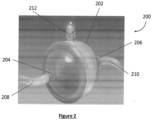
- the apparatus 200 comprises a housing 202, an inlet port 204 and an outlet port 206.
- Inlet tubing 208 is shown to be connected to the inlet port 204 and outlet tubing 210 is shown to be connected to the outlet port 206.
- a venting port 212 is shown.
- Fluid comprising gas bubbles travels along the inlet tubing 208 and through the inlet port 204 into the apparatus 200.
- the bubbles entrained in the fluid then rise to the top outermost portion of the device.
- the trapped air may then be expelled from the system via the venting port 212.
- venting port 212 While a venting port 212 is present in this embodiment it is to be appreciated that such a feature is not essential for the purpose of separating and collecting gas bubbles entrained in a fluid. Presence of a venting port 212 is a preferred feature but an apparatus 200 of the present invention may operate without it for a period of time. As such it is not intended that the invention be limited to the inclusion of a venting port 212
- inlet tubing 208 and outlet tubing 210 is shown, in this embodiment such tubing is not necessarily an integral part of the apparatus 200 per se but refers to typical tubing that may be found in an IV drip set-up or similar, thus provides context as to how the apparatus 200 may be used. While the inlet tubing 208 and outlet tubing 210 are described as not being part of the apparatus 200, it is to be appreciated that in alternative embodiments the inlet tubing 208 and outlet tubing 210 is integrated into the apparatus, forming part of the apparatus 200 as a whole.
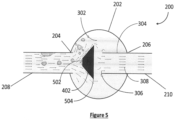
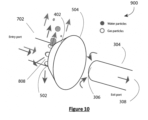
- the apparatus 200 comprises a housing 202 that, when constructed, forms a chamber 302.
- the apparatus 200 also comprises an inlet port 204, an outlet port 206, an elongated exit tube 304, wherein the elongated exit tube 304 has an intake end 306 and an export end 308 and a diverter 402.
- the intake end 306 of the elongated exit tube 304 when constructed, being centrally located within the chamber 302 with the export end 308 of the elongated exit tube 304 being connected to the outlet port 206.
- the apparatus 200 comprises housing 202 that defines a chamber 302, an inlet port 204, an exit port 206 and an elongated exit tube 304 with an intake end 306 and an export end 308.
- inlet tubing 208 connected to the inlet port 204 and outlet tubing 210 connected to the exit port 206.
- the diverter 402 is shown to comprise a base portion 502 and a rim 504, In this embodiment the diverter 402 and the inlet port 204 are spaced apart, such that the diverter 402 is suspended centrally within the chamber 302 of the apparatus 200. In this embodiment the diverter 402 and the intake end 306 of the elongated exit tube 304 are spaced apart, such that no part of the diverter 402 extends beyond the intake end 306 of the elongated exit tube 304.
- inlet tubing 208 or outlet tubing 210 may be present.
- fluid arrives via the inlet port 204 into the chamber 302 of the apparatus 200.
- Bubbles are diverted, by the diverter 402, away from the elongated exit tube 304 and towards the outer portions of the chamber 302 of the apparatus 200,
- the fluid arriving into the chamber 302 has a first direction of fluid flow; on contact with the diverter 402 a different direction on fluid flow is imparted.
- the different direction of fluid flow generally follows the contours of the diverter 402, resulting in the fluid being pushed towards the outer portion of the chamber 302, along with any entrained gas therein.
- the fluid velocity is slowed.
- Fluid that is now substantially free from bubbles, collects between the diverter 402 and the intake end 306 of the elongated exit tube 304.
- the fluid substantially free from bubbles locates centrally within the chamber 302 and may be understood to be slower moving than fluid moving along the outer portions of the chamber 302. Fluid, substantially free from bubbles, exits the apparatus 200 via the outlet port 206 and moves along the outlet tubing 210 away from the apparatus 200.
- the apparatus comprises a housing 202 forming a chamber 302 with an inlet port 204, inlet tubing 208 connected to the inlet port 204, a diverter 402, the diverter 402 having a base portion 502 and a rim 504, an elongated exit tube 304, wherein the intake end 306 of the elongated exit tube 304 is centrally located within the chamber 302 and outlet tubing 210 connected to the exit port 206. Fluid, substantially free from bubbles, exits the apparatus 200 via the outlet port 206 and moves along the outlet tubing 210 away from the apparatus 200.
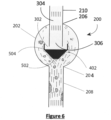
- the apparatus 200 is held in a substantially vertical plane, such that the inlet port 204 and the inlet tubing 208 are positioned at the lowermost portion of the apparatus 200,
- fluid and entrained gas travel upwards together through the inlet tubing 208 and arrives at the chamber 302 via the inlet port 204 positioned at the bottom of the chamber 302.
- the diverter 402 obstructs the first direction of flow of the fluid and entrained gas and causes a change in direction of the fluid and entrained gas, diverting it away from its original path (or first direction of flow) and towards the outer portions of the chamber 302.
- the diverter 402 By obstructing the first direction of flow of the fluid and entrained gas the diverter 402 causes the fluid velocity to slow and thus the entrained gas bubbles also slow. This has the effect of causing a change to the external forces applied to the membrane of the gas bubble, such that buoyancy becomes the dominant force. As buoyancy becomes the dominant force the entrained gas bubbles move towards the uppermost outer portions of the chamber 302.
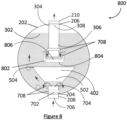
- At least a portion of the base portion 502 of the diverter 402 is connected to the export end 704 of the inflow tube 702 by a tether 708 and at least a portion of the rim 504 of the diverter 402 is connected to the intake end 306 of the elongated exit tube 304 by a tether 708.
- the apparatus 800 comprises a housing 202 forming a chamber 302, with an inlet port 204 and an outlet port 206, an inflow tube 702 with an export end 704 being centrally located within the chamber 302 and an intake end 706 of the inflow tube 702 being connected to the inlet port 204, an elongated exit tube 304 with the intake end 306 of the elongated exit tube 304 being centrally located within the chamber 302 and the export end 308 of the elongated exit tube 304 being connected to the outlet port 206, and a diverter, namely a first diverter 402 having a base portion 502 and a rim 504 and a second diverter 802 having a base portion 804 and a rim 806.
- the apparatus comprises a housing 202 forming a chamber 302, with an inlet port 204 and an outlet port 206, an inflow tube 702 with an export end 704 being centrally located within the chamber 302 and an intake end 706 of the inflow tube 702 being connected to the inlet port 204, an elongated exit tube 304 with the intake end 306 of the elongated exit tube 304 being centrally located within the chamber 302 and the export end 308 of the elongated exit tube 304 being connected to the outlet port 206, and a diverter, namely a first diverter 402.
- the diffuser 902 comprises at least three holes 904 906 908, the first hole 904 exiting upwards into the chamber 302, the second hole 906 exiting downwards into the chamber 302 and the third hole 908 exiting face on into the chamber 302. While in this embodiment three holes 904 906 908 are shown, it should not be read as limiting the present invention in any way. It is to be appreciated that other variations on the invention may comprise of any number of holes.
- the diverter 402 and the intake end 306 of the elongated exit tube 304 are spaced apart, such that the rim 504 of the diverter 402 does not extend beyond the intake end 306 of the elongated exit tube 304.
- the apparatus comprises an inflow tube 702, which extends into the chamber and abuts the diffuser 902, the diffuser 902 then abuts the base portion 502 of the diverter 402.
- fluid arrives via the inlet port 204 and enters the chamber 302 of the apparatus 900 via the diffuser 902, through the plurality of holes 904 906 908.
- the bubbles are then diverted, by the first diverter 402, away from the elongated exit tube 304 and towards the outer portions of the chamber 302 of the apparatus 200.
- the fluid arriving at the diffuser 902 from the inlet port 204 has a first direction of flow; on passing through the diffuser 902 a different direct of flow is imparted.
- the post diffuser 902 fluid within the chamber 302 has a first direction of fluid flow; on contact with the first diverter 402 a different direction on fluid flow is imparted.
- Entrained gas in the form of bubbles pass through a volume of fluid within the chamber 302 and friction exerted on the outer surface of the bubble increases resulting in the trajectory being altered, such that buoyancy becomes the dominant force moving the bubble towards the uppermost outer portion of the chamber 302.
- Fluid that is now substantially free from bubbles, collects between the diverter 402 and the intake end 306 of the elongated exit tube 304.
- the fluid substantially free from bubbles locates centrally within the chamber 302 and may be understood to be slower moving than fluid moving along the outer portions of the chamber 302.
- the fluid substantially free from bubbles is then drawn into the intake end 306 of the elongated exit tube 304 and exits the chamber 302 via the outlet port 206 and away from the apparatus 900.
- the apparatus 900 comprises an inflow tube 702, the inflow tube 702 having an export end 704 being centrally located in the chamber 302 and an intake end 706 of the inflow tube 702 being connected to the inlet port 204, a diffuser 902, a diverter 402, the diverter 402 having a base portion 502 and a rim 504, and an elongated exit tube 304, the elongated exit tube 304 having an intake end 306 and an export end 308.
- the inflow tube 702 is positioned such that it abuts a portion of the diffuser 902 and the diffuser 902 is positioned such that it abuts a portion of the diverter 402.
- the diffuser 902 is formed of a plurality of holes spaced apart and positioned in a generally radial arrangement about the circumference of the diffuser 902.
- fluid and entrained gas therein arrives at the diffuser 902 via the inflow tube 702.
- Fluid and entrained gas pass through the plurality of holes of the diffuser 902.
- Gas bubbles entrained in the fluid generally pass through the uppermost facing holes of the diffuser 902, due to an inherent tendency to rise in an upwards direction, while the remaining fluid passes through any one or more of the holes of the diffuser 902.
- the diverter 402 obstructs the first direction of flow of the fluid and entrained gas and causes a change in direction of the fluid and entrained gas, diverting it away from its original path (or first direction of flow) in a generally outward direction and away from the intake end 306 of the elongated exit tube 304.
- the diverter 402 causes the fluid velocity to slow and thus the entrained gas bubbles also slow. This has the effect of causing a change to the external forces applied to the membrane of the gas bubble, such that buoyancy becomes the dominant force. As buoyancy becomes the dominant force the entrained gas bubbles move in a generally outward and upward direction and away from the intake end 306 of the elongated exit tube 304.
- the apparatus 1000 comprises an inflow tube 702, a diffuser 902, a diverter 402, the diverter 402 having a base portion 502 and a rim 504, and an elongated exit tube 304, the elongated exit tube 304 having an intake end 306 and an export end 308.
- the inflow tube 702 is positioned such that it connected to a portion of the diverter 402 by a tether 708 forming a diffuser 902 comprising at least one hole.
- inflow tube 702, diffuser 902 and diverter 402 are integrated forming at least one hole.
- inflow tube 702, diffuser 902 and diverter 402 are integrated forming a plurality of holes. In this embodiment three holes can be seen.
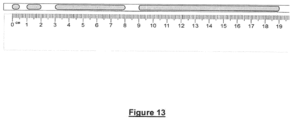
- a short questionnaire was devised geared towards identifying fear levels and any eventual interest in a solution. Each questionnaire comprised often questions, where staff are asked to select the most appropriate statement from a selection. A scale was provided ( Figure 13 ) and a free-text comment section was also provided.
- Bubble formation patterns were observed, such as coalescence and pocketing, in response to line placement, height, direction and volume of gas developed. Temperate and flow rate were adjusted to identify the role that each play in the formation of bubbles in an IV line.
- Figure 14 shows a typical bubble formation pattern in an IV tube and observable characteristics.
- the smaller bubbles (B)(C) are collected by the larger bubble (A) and pushed along under force at the front end of the larger bubble (A) [pane 2], The structure of the bubbles (B)(C) is maintained initially.
- the Flow Rate vs Gas Volume line of Figure 15 (diamond) graphically forms a very irregular shape due to the erratic scatter of the values.
- the trendline for this graph shows a rise and fall hill shape, an order 2 polynomial.
- Figure 15 shows gas volume in response to temperature (square points) and flow rate (diamond points).
- Figure 16 shows the correlation of gas volume (dark grey; spotted) versus bag temperature (light grey; diagonal lines).
- the maximum level was determined from testing where a maximum reading of 2.4ml/1000ml was taken with a built-in factor of 5X an average reading was calculated to allow at least a 15ml gas capacity, for safety reasons.
- the apparatus can collect up to 15mls of gas before gas levels reach a level where the apparatus will no longer function effectively and before the gas level reaches the elongated exit tube. This means that up to 5 bags of fluids could be infused concurrently at maximum degassing levels.
- the recommended gas level can vary from zero (e.g. no gas is preferred in Paediatrics due to reduced blood volume and natural ⁇ hole-in-the-heart' present in infants) to 3ml/kg of body weight in healthy adults (tests conducted on animals) with adverse effects possible from 1ml/kg of air injected.
- the body can tolerate some gas (if there are no underlying conditions) in ideal conditions but it is preferable to have no gas enter any patient, if possible.
- Recent studies cite damage to the Endothelial Glycocalyx layer of the vasculature as a reason to prevent gas bubbles from entering the venous system.
- the tap on the IV line is closed and the hotline L1 remains off throughout the whole experiment so as to avoid unwanted gas production that would otherwise hinder the experiment.
- the IV drip bag is hung from the top of the IV stand and connected to the IV line.
- the prototype undergoing testing is connected to the end of the lumen line closest to the patient and the extension line is connected to the other end of the prototype.
- the clave connector is then attached to the gas extraction port. Lines are drawn on a piece of paper with angles of 45, 90, 180, 225, 270, 315 and 360 degrees and the piece of paper is attached to a flat vertical surface.
- a plastic container is filled with water.
- a small graduated cylinder is filled with water, making sure that the graduated cylinder is connected to the plastic container using an attachment.
- the end of the extension line is placed into the graduated cylinder, before the graduated cylinder is rapidly turned upside down into the plastic container so that no liquid escapes the cylinder and the graduated cylinder attachment rests perfectly on the rim of the container ensuring that the cylinder remains vertical during the experiment.
- the initial reading (zero) of gas on the upside down graduated cylinder is read and recorded.
- the tap is then turned on to allow liquid to flow from the bag ensuring that it is at the maximum possible flow rate.
- Gas trapped in the chamber of the prototype undergoing testing is removed using a syringe inserted via the clave connector. Once all the gas has been extracted the prototype section of the line is attached to the flat vertical surface so that it is parallel to the 45 degree angle line previously drawn on the paper.
- the syringe is filled with 1ml of air and injected into the IV line next to the hotline L1 so that the gas flows towards the prototype. Gas passing through the prototype into the extension line is observed and the value of gas gathered in the graduated cylinder is recorded. If no gas is observed, then the value is recorded as 0. The experiment is repeated for volumes of air up to 20ml going up in increments of 1ml and then for each of the following angles: 90, 180, 225, 270, 315 and 380 degrees.
- a device of the present invention may be adapted for use in other applications, such as but not limited to, use in blood transfusion apparatus and any other fluid treatment set-up where entrained gas requires removing, capturing or expelling.
Landscapes
- Health & Medical Sciences (AREA)
- Heart & Thoracic Surgery (AREA)
- Vascular Medicine (AREA)
- General Health & Medical Sciences (AREA)
- Veterinary Medicine (AREA)
- Biomedical Technology (AREA)
- Engineering & Computer Science (AREA)
- Hematology (AREA)
- Life Sciences & Earth Sciences (AREA)
- Animal Behavior & Ethology (AREA)
- Anesthesiology (AREA)
- Public Health (AREA)
- Emergency Medicine (AREA)
- Cardiology (AREA)
- Chemical & Material Sciences (AREA)
- Chemical Kinetics & Catalysis (AREA)
- External Artificial Organs (AREA)
- Infusion, Injection, And Reservoir Apparatuses (AREA)
- Degasification And Air Bubble Elimination (AREA)
- Gas Separation By Absorption (AREA)
Priority Applications (1)
| Application Number | Priority Date | Filing Date | Title |
|---|---|---|---|
| EP24178297.8A EP4397335A3 (fr) | 2019-01-30 | 2019-01-30 | Dispositif de piège à bulles |
Applications Claiming Priority (3)
| Application Number | Priority Date | Filing Date | Title |
|---|---|---|---|
| PCT/EP2019/052299 WO2020156666A1 (fr) | 2019-01-30 | 2019-01-30 | Dispositif à piéger des bulles |
| EP24178297.8A EP4397335A3 (fr) | 2019-01-30 | 2019-01-30 | Dispositif de piège à bulles |
| EP19706387.8A EP3917643B1 (fr) | 2019-01-30 | 2019-01-30 | Dispositif de piège à bulle |
Related Parent Applications (2)
| Application Number | Title | Priority Date | Filing Date |
|---|---|---|---|
| EP19706387.8A Division-Into EP3917643B1 (fr) | 2019-01-30 | 2019-01-30 | Dispositif de piège à bulle |
| EP19706387.8A Division EP3917643B1 (fr) | 2019-01-30 | 2019-01-30 | Dispositif de piège à bulle |
Publications (2)
| Publication Number | Publication Date |
|---|---|
| EP4397335A2 true EP4397335A2 (fr) | 2024-07-10 |
| EP4397335A3 EP4397335A3 (fr) | 2024-09-25 |
Family
ID=65516463
Family Applications (2)
| Application Number | Title | Priority Date | Filing Date |
|---|---|---|---|
| EP19706387.8A Active EP3917643B1 (fr) | 2019-01-30 | 2019-01-30 | Dispositif de piège à bulle |
| EP24178297.8A Pending EP4397335A3 (fr) | 2019-01-30 | 2019-01-30 | Dispositif de piège à bulles |
Family Applications Before (1)
| Application Number | Title | Priority Date | Filing Date |
|---|---|---|---|
| EP19706387.8A Active EP3917643B1 (fr) | 2019-01-30 | 2019-01-30 | Dispositif de piège à bulle |
Country Status (5)
| Country | Link |
|---|---|
| US (2) | US12239773B2 (fr) |
| EP (2) | EP3917643B1 (fr) |
| JP (2) | JP7321276B2 (fr) |
| CN (1) | CN113365712B (fr) |
| WO (1) | WO2020156666A1 (fr) |
Families Citing this family (11)
| Publication number | Priority date | Publication date | Assignee | Title |
|---|---|---|---|---|
| EP3917643B1 (fr) | 2019-01-30 | 2024-07-03 | Tessen Solutions Limited | Dispositif de piège à bulle |
| WO2023044416A1 (fr) * | 2021-09-17 | 2023-03-23 | Life Technologies Corporation | Pièges à bulles imprimés 3d et procédés de fabrication |
| AU2022252836A1 (en) * | 2021-10-25 | 2023-05-11 | Fresenius Kabi Usa, Llc | Pressure-assisted air elimination |
| WO2023148100A1 (fr) | 2022-02-02 | 2023-08-10 | Tessen Solutions Limited | Dispositif de piège à gaz |
| CN119278380A (zh) * | 2022-03-11 | 2025-01-07 | W.L.戈尔及同仁股份有限公司 | 气体分离装置 |
| USD1104257S1 (en) | 2022-09-16 | 2025-12-02 | Life Technologies Corporation | Bubble trap |
| US20240110886A1 (en) * | 2022-09-29 | 2024-04-04 | Rosemount Inc. | Amperometric sensor with bubble shedding clip |
| WO2024156823A1 (fr) | 2023-01-27 | 2024-08-02 | Tessen Solutions Limited | Régulation de gaz dans des filtres à fluide médicaux |
| WO2024223789A1 (fr) | 2023-04-27 | 2024-10-31 | Tessen Solutions Limited | Ensemble de distribution pré-amorcé et appareil et procédés de mélange |
| CN116459412B (zh) * | 2023-05-06 | 2025-01-24 | 中国人民解放军联勤保障部队第九六〇医院 | 一种直升机救援护理用输液装置 |
| WO2025202381A1 (fr) | 2024-03-28 | 2025-10-02 | Tessen Solutions Limited | Dispositif de piège à gaz |
Citations (5)
| Publication number | Priority date | Publication date | Assignee | Title |
|---|---|---|---|---|
| US5674199A (en) | 1993-11-29 | 1997-10-07 | Cobe Laboratories, Inc. | Top flow bubble trap method |
| US6508859B1 (en) | 2000-11-13 | 2003-01-21 | Porous Media Corporation | Method and apparatus for removing air or gas from fluid |
| US6537356B1 (en) | 1999-08-06 | 2003-03-25 | Nathaniel M. Soriano | Gas and solid trap for an intravenous line |
| US7141097B2 (en) | 2003-01-15 | 2006-11-28 | Filtertek Inc. | Bacterial retentive, air venting, intravenous filter |
| US9533109B2 (en) | 2009-12-22 | 2017-01-03 | Cork Institute Of Technology | Bubble entrapment device |
Family Cites Families (26)
| Publication number | Priority date | Publication date | Assignee | Title |
|---|---|---|---|---|
| US3803810A (en) * | 1972-05-01 | 1974-04-16 | Pall Corp | Liquid-gas separator and filter |
| US3827561A (en) | 1972-09-20 | 1974-08-06 | Milton Roy Co | Deaerator for dialysis system |
| US4048995A (en) | 1975-08-15 | 1977-09-20 | Baxter Travenol Laboratories, Inc. | Injection site |
| JPS589606Y2 (ja) * | 1978-06-27 | 1983-02-22 | 株式会社荏原製作所 | 圧力タンク |
| AU6249180A (en) | 1979-09-18 | 1981-04-09 | Millipore Corp. | Automatic dual rate i.v. administration |
| DE3176446D1 (en) * | 1980-09-01 | 1987-10-22 | Ici Plc | Centrifugal gas-liquid contact apparatus |
| JPS60186002U (ja) * | 1984-05-21 | 1985-12-10 | 本間 慶蔵 | 抜気消音装置 |
| US4795457A (en) | 1987-05-08 | 1989-01-03 | C. R. Bard, Inc. | Venous reservoir |
| DE4039824C1 (fr) * | 1990-12-13 | 1991-12-19 | Ieg - Industrie-Engineering Gmbh, 7410 Reutlingen, De | |
| US20060173395A1 (en) | 2002-02-12 | 2006-08-03 | Brugger James M | Set for blood processing |
| JP2004122066A (ja) * | 2002-10-07 | 2004-04-22 | Dainippon Screen Mfg Co Ltd | 脱気装置 |
| CA2544612C (fr) | 2003-11-24 | 2011-12-20 | Gambro Lundia Ab | Dispositif de degazage et ensemble de bouchons d'extremite pour un filtre comprenant ledit dispositif de degazage |
| US7279031B1 (en) * | 2003-11-25 | 2007-10-09 | Wright David W | Emboli elimination apparatus |
| US20050247198A1 (en) * | 2004-05-07 | 2005-11-10 | Kent Fraser C | Method and apparatus for removing gas bubbles from a liquid |
| US8613725B2 (en) * | 2007-04-30 | 2013-12-24 | Medtronic Minimed, Inc. | Reservoir systems and methods |
| JP2010064007A (ja) | 2008-09-11 | 2010-03-25 | Ricoh Co Ltd | 粘性液体の脱気方法及び脱気装置、感熱記録体塗料の作製方法、並びに感熱記録媒体 |
| US9457158B2 (en) | 2010-04-12 | 2016-10-04 | Q-Core Medical Ltd. | Air trap for intravenous pump |
| EP2463004B1 (fr) | 2010-12-08 | 2013-11-20 | AFRISO-Euro-Index GmbH | Séparateur de gaz |
| JP2012249781A (ja) * | 2011-06-02 | 2012-12-20 | Nagasaki Institute Of Applied Science | 気泡除去装置 |
| US8632624B2 (en) * | 2011-10-13 | 2014-01-21 | General Electric Company | Fluid trap and method of separating fluids |
| US10279126B2 (en) * | 2014-10-07 | 2019-05-07 | Medtronic Minimed, Inc. | Fluid conduit assembly with gas trapping filter in the fluid flow path |
| US20160346485A1 (en) | 2015-05-27 | 2016-12-01 | Vital Signs, Inc. | Apparatus and methods for intravenous gas elimination |
| CA3025620A1 (fr) * | 2016-05-27 | 2017-11-30 | Vital Signs, Inc. | Appareil et procedes pour l'elimination de gaz dans un systeme pour intraveineuse |
| WO2020095309A1 (fr) * | 2018-11-10 | 2020-05-14 | Ezmems Ltd. | Dispositifs capteurs détachables |
| EP3917643B1 (fr) | 2019-01-30 | 2024-07-03 | Tessen Solutions Limited | Dispositif de piège à bulle |
| US20230321363A1 (en) | 2020-07-29 | 2023-10-12 | Tessen Solutions Limited | Infusion apparatus |
-
2019
- 2019-01-30 EP EP19706387.8A patent/EP3917643B1/fr active Active
- 2019-01-30 WO PCT/EP2019/052299 patent/WO2020156666A1/fr not_active Ceased
- 2019-01-30 CN CN201980090735.9A patent/CN113365712B/zh active Active
- 2019-01-30 EP EP24178297.8A patent/EP4397335A3/fr active Pending
- 2019-01-30 JP JP2021544800A patent/JP7321276B2/ja active Active
- 2019-01-30 US US17/421,524 patent/US12239773B2/en active Active
-
2023
- 2023-07-25 JP JP2023120441A patent/JP7760177B2/ja active Active
-
2024
- 2024-12-05 US US18/970,287 patent/US20250170318A1/en active Pending
Patent Citations (5)
| Publication number | Priority date | Publication date | Assignee | Title |
|---|---|---|---|---|
| US5674199A (en) | 1993-11-29 | 1997-10-07 | Cobe Laboratories, Inc. | Top flow bubble trap method |
| US6537356B1 (en) | 1999-08-06 | 2003-03-25 | Nathaniel M. Soriano | Gas and solid trap for an intravenous line |
| US6508859B1 (en) | 2000-11-13 | 2003-01-21 | Porous Media Corporation | Method and apparatus for removing air or gas from fluid |
| US7141097B2 (en) | 2003-01-15 | 2006-11-28 | Filtertek Inc. | Bacterial retentive, air venting, intravenous filter |
| US9533109B2 (en) | 2009-12-22 | 2017-01-03 | Cork Institute Of Technology | Bubble entrapment device |
Also Published As
| Publication number | Publication date |
|---|---|
| US20220088282A1 (en) | 2022-03-24 |
| CN113365712B (zh) | 2023-07-25 |
| EP3917643B1 (fr) | 2024-07-03 |
| JP2022525839A (ja) | 2022-05-20 |
| JP2023139190A (ja) | 2023-10-03 |
| JP7321276B2 (ja) | 2023-08-04 |
| WO2020156666A1 (fr) | 2020-08-06 |
| US12239773B2 (en) | 2025-03-04 |
| CN113365712A (zh) | 2021-09-07 |
| JP7760177B2 (ja) | 2025-10-27 |
| EP4397335A3 (fr) | 2024-09-25 |
| EP3917643A1 (fr) | 2021-12-08 |
| US20250170318A1 (en) | 2025-05-29 |
Similar Documents
| Publication | Publication Date | Title |
|---|---|---|
| US20250170318A1 (en) | Bubble trap device | |
| JP6893540B2 (ja) | 経腸栄養とともに使用するための胃システム、装置及び方法 | |
| CN105944182B (zh) | 一种滴式输液控制系统 | |
| KR101645050B1 (ko) | 주입 라인의 프라이밍 표시 장치 | |
| KR102537181B1 (ko) | 환자 라인의 음향 주파수 인식 | |
| CA2900356C (fr) | Chambre compte-gouttes iv dotee d'un filtre et d'un reservoir inferieur | |
| EP3250256B2 (fr) | Membrane pour éviter l'entree de l'air et conservation d'une colonne de liquide dans une ensemble d'infusion | |
| AU2011363009A1 (en) | Intravenous pumping air management systems and methods | |
| JP2019024757A (ja) | 着脱装置、及び複数回注入装置 | |
| US20240050664A1 (en) | Anti-run dry membrane | |
| JP2022031449A (ja) | ガス除去装置 | |
| CN201959341U (zh) | 一种精密药液过滤器 | |
| CN209475276U (zh) | 一种输液器 | |
| US10874806B2 (en) | Gas removal apparatus and related methods | |
| CN209679177U (zh) | 一种带过滤装置的输液袋 | |
| CN208243850U (zh) | 一种安全型输液器 | |
| CN213076924U (zh) | 一种具有冲洗功能的防药液混合的输液装置 | |
| KR102891721B1 (ko) | 공기차단과 유량측정기능을 갖는 점적챔버 및 이를 포함한 수액세트 | |
| CN204563089U (zh) | 一种无肝素透析过程中用于静脉壶冲洗的推注系统 | |
| CN213312406U (zh) | 一种一次性使用自动排气止液输液器 | |
| CN200948269Y (zh) | 输液网套 | |
| CN207856021U (zh) | 一种儿科护理输液装置 | |
| CN206924214U (zh) | 一种智能型避光输液器 | |
| CN202113407U (zh) | 防空气输液器 | |
| JPH057244U (ja) | 輸液停止機能付の輸液セツト |
Legal Events
| Date | Code | Title | Description |
|---|---|---|---|
| PUAI | Public reference made under article 153(3) epc to a published international application that has entered the european phase |
Free format text: ORIGINAL CODE: 0009012 |
|
| STAA | Information on the status of an ep patent application or granted ep patent |
Free format text: STATUS: THE APPLICATION HAS BEEN PUBLISHED |
|
| AC | Divisional application: reference to earlier application |
Ref document number: 3917643 Country of ref document: EP Kind code of ref document: P |
|
| AK | Designated contracting states |
Kind code of ref document: A2 Designated state(s): AL AT BE BG CH CY CZ DE DK EE ES FI FR GB GR HR HU IE IS IT LI LT LU LV MC MK MT NL NO PL PT RO RS SE SI SK SM TR |
|
| REG | Reference to a national code |
Ref country code: DE Ref legal event code: R079 Free format text: PREVIOUS MAIN CLASS: A61M0001360000 Ipc: B01D0019000000 |
|
| PUAL | Search report despatched |
Free format text: ORIGINAL CODE: 0009013 |
|
| AK | Designated contracting states |
Kind code of ref document: A3 Designated state(s): AL AT BE BG CH CY CZ DE DK EE ES FI FR GB GR HR HU IE IS IT LI LT LU LV MC MK MT NL NO PL PT RO RS SE SI SK SM TR |
|
| RIC1 | Information provided on ipc code assigned before grant |
Ipc: A61M 5/165 20060101ALI20240817BHEP Ipc: A61M 5/36 20060101ALI20240817BHEP Ipc: A61M 5/14 20060101ALI20240817BHEP Ipc: A61M 5/38 20060101ALI20240817BHEP Ipc: A61M 1/36 20060101ALI20240817BHEP Ipc: B01D 19/00 20060101AFI20240817BHEP |
|
| STAA | Information on the status of an ep patent application or granted ep patent |
Free format text: STATUS: REQUEST FOR EXAMINATION WAS MADE |
|
| 17P | Request for examination filed |
Effective date: 20250306 |