EP4397491A1 - Stratifié, corps d'emballage et article d'emballage - Google Patents
Stratifié, corps d'emballage et article d'emballage Download PDFInfo
- Publication number
- EP4397491A1 EP4397491A1 EP22864740.0A EP22864740A EP4397491A1 EP 4397491 A1 EP4397491 A1 EP 4397491A1 EP 22864740 A EP22864740 A EP 22864740A EP 4397491 A1 EP4397491 A1 EP 4397491A1
- Authority
- EP
- European Patent Office
- Prior art keywords
- layer
- laminate
- crystallinity
- thickness
- substrate layer
- Prior art date
- Legal status (The legal status is an assumption and is not a legal conclusion. Google has not performed a legal analysis and makes no representation as to the accuracy of the status listed.)
- Pending
Links
Images




Classifications
-
- B—PERFORMING OPERATIONS; TRANSPORTING
- B32—LAYERED PRODUCTS
- B32B—LAYERED PRODUCTS, i.e. PRODUCTS BUILT-UP OF STRATA OF FLAT OR NON-FLAT, e.g. CELLULAR OR HONEYCOMB, FORM
- B32B27/00—Layered products comprising a layer of synthetic resin
-
- B—PERFORMING OPERATIONS; TRANSPORTING
- B32—LAYERED PRODUCTS
- B32B—LAYERED PRODUCTS, i.e. PRODUCTS BUILT-UP OF STRATA OF FLAT OR NON-FLAT, e.g. CELLULAR OR HONEYCOMB, FORM
- B32B27/00—Layered products comprising a layer of synthetic resin
- B32B27/06—Layered products comprising a layer of synthetic resin as the main or only constituent of a layer, which is next to another layer of the same or of a different material
- B32B27/08—Layered products comprising a layer of synthetic resin as the main or only constituent of a layer, which is next to another layer of the same or of a different material of synthetic resin
-
- B—PERFORMING OPERATIONS; TRANSPORTING
- B32—LAYERED PRODUCTS
- B32B—LAYERED PRODUCTS, i.e. PRODUCTS BUILT-UP OF STRATA OF FLAT OR NON-FLAT, e.g. CELLULAR OR HONEYCOMB, FORM
- B32B27/00—Layered products comprising a layer of synthetic resin
- B32B27/16—Layered products comprising a layer of synthetic resin specially treated, e.g. irradiated
-
- B—PERFORMING OPERATIONS; TRANSPORTING
- B32—LAYERED PRODUCTS
- B32B—LAYERED PRODUCTS, i.e. PRODUCTS BUILT-UP OF STRATA OF FLAT OR NON-FLAT, e.g. CELLULAR OR HONEYCOMB, FORM
- B32B27/00—Layered products comprising a layer of synthetic resin
- B32B27/18—Layered products comprising a layer of synthetic resin characterised by the use of special additives
-
- B—PERFORMING OPERATIONS; TRANSPORTING
- B32—LAYERED PRODUCTS
- B32B—LAYERED PRODUCTS, i.e. PRODUCTS BUILT-UP OF STRATA OF FLAT OR NON-FLAT, e.g. CELLULAR OR HONEYCOMB, FORM
- B32B27/00—Layered products comprising a layer of synthetic resin
- B32B27/18—Layered products comprising a layer of synthetic resin characterised by the use of special additives
- B32B27/20—Layered products comprising a layer of synthetic resin characterised by the use of special additives using fillers, pigments, thixotroping agents
-
- B—PERFORMING OPERATIONS; TRANSPORTING
- B32—LAYERED PRODUCTS
- B32B—LAYERED PRODUCTS, i.e. PRODUCTS BUILT-UP OF STRATA OF FLAT OR NON-FLAT, e.g. CELLULAR OR HONEYCOMB, FORM
- B32B27/00—Layered products comprising a layer of synthetic resin
- B32B27/18—Layered products comprising a layer of synthetic resin characterised by the use of special additives
- B32B27/22—Layered products comprising a layer of synthetic resin characterised by the use of special additives using plasticisers
-
- B—PERFORMING OPERATIONS; TRANSPORTING
- B32—LAYERED PRODUCTS
- B32B—LAYERED PRODUCTS, i.e. PRODUCTS BUILT-UP OF STRATA OF FLAT OR NON-FLAT, e.g. CELLULAR OR HONEYCOMB, FORM
- B32B27/00—Layered products comprising a layer of synthetic resin
- B32B27/18—Layered products comprising a layer of synthetic resin characterised by the use of special additives
- B32B27/26—Layered products comprising a layer of synthetic resin characterised by the use of special additives using curing agents
-
- B—PERFORMING OPERATIONS; TRANSPORTING
- B32—LAYERED PRODUCTS
- B32B—LAYERED PRODUCTS, i.e. PRODUCTS BUILT-UP OF STRATA OF FLAT OR NON-FLAT, e.g. CELLULAR OR HONEYCOMB, FORM
- B32B27/00—Layered products comprising a layer of synthetic resin
- B32B27/30—Layered products comprising a layer of synthetic resin comprising vinyl (co)polymers; comprising acrylic (co)polymers
-
- B—PERFORMING OPERATIONS; TRANSPORTING
- B32—LAYERED PRODUCTS
- B32B—LAYERED PRODUCTS, i.e. PRODUCTS BUILT-UP OF STRATA OF FLAT OR NON-FLAT, e.g. CELLULAR OR HONEYCOMB, FORM
- B32B27/00—Layered products comprising a layer of synthetic resin
- B32B27/30—Layered products comprising a layer of synthetic resin comprising vinyl (co)polymers; comprising acrylic (co)polymers
- B32B27/306—Layered products comprising a layer of synthetic resin comprising vinyl (co)polymers; comprising acrylic (co)polymers comprising vinyl acetate or vinyl alcohol (co)polymers
-
- B—PERFORMING OPERATIONS; TRANSPORTING
- B32—LAYERED PRODUCTS
- B32B—LAYERED PRODUCTS, i.e. PRODUCTS BUILT-UP OF STRATA OF FLAT OR NON-FLAT, e.g. CELLULAR OR HONEYCOMB, FORM
- B32B27/00—Layered products comprising a layer of synthetic resin
- B32B27/30—Layered products comprising a layer of synthetic resin comprising vinyl (co)polymers; comprising acrylic (co)polymers
- B32B27/308—Layered products comprising a layer of synthetic resin comprising vinyl (co)polymers; comprising acrylic (co)polymers comprising acrylic (co)polymers
-
- B—PERFORMING OPERATIONS; TRANSPORTING
- B32—LAYERED PRODUCTS
- B32B—LAYERED PRODUCTS, i.e. PRODUCTS BUILT-UP OF STRATA OF FLAT OR NON-FLAT, e.g. CELLULAR OR HONEYCOMB, FORM
- B32B27/00—Layered products comprising a layer of synthetic resin
- B32B27/32—Layered products comprising a layer of synthetic resin comprising polyolefins
-
- B—PERFORMING OPERATIONS; TRANSPORTING
- B32—LAYERED PRODUCTS
- B32B—LAYERED PRODUCTS, i.e. PRODUCTS BUILT-UP OF STRATA OF FLAT OR NON-FLAT, e.g. CELLULAR OR HONEYCOMB, FORM
- B32B27/00—Layered products comprising a layer of synthetic resin
- B32B27/32—Layered products comprising a layer of synthetic resin comprising polyolefins
- B32B27/327—Layered products comprising a layer of synthetic resin comprising polyolefins comprising polyolefins obtained by a metallocene or single-site catalyst
-
- B—PERFORMING OPERATIONS; TRANSPORTING
- B32—LAYERED PRODUCTS
- B32B—LAYERED PRODUCTS, i.e. PRODUCTS BUILT-UP OF STRATA OF FLAT OR NON-FLAT, e.g. CELLULAR OR HONEYCOMB, FORM
- B32B27/00—Layered products comprising a layer of synthetic resin
- B32B27/34—Layered products comprising a layer of synthetic resin comprising polyamides
-
- B—PERFORMING OPERATIONS; TRANSPORTING
- B32—LAYERED PRODUCTS
- B32B—LAYERED PRODUCTS, i.e. PRODUCTS BUILT-UP OF STRATA OF FLAT OR NON-FLAT, e.g. CELLULAR OR HONEYCOMB, FORM
- B32B27/00—Layered products comprising a layer of synthetic resin
- B32B27/36—Layered products comprising a layer of synthetic resin comprising polyesters
-
- B—PERFORMING OPERATIONS; TRANSPORTING
- B32—LAYERED PRODUCTS
- B32B—LAYERED PRODUCTS, i.e. PRODUCTS BUILT-UP OF STRATA OF FLAT OR NON-FLAT, e.g. CELLULAR OR HONEYCOMB, FORM
- B32B7/00—Layered products characterised by the relation between layers; Layered products characterised by the relative orientation of features between layers, or by the relative values of a measurable parameter between layers, i.e. products comprising layers having different physical, chemical or physicochemical properties; Layered products characterised by the interconnection of layers
- B32B7/04—Interconnection of layers
- B32B7/12—Interconnection of layers using interposed adhesives or interposed materials with bonding properties
-
- B—PERFORMING OPERATIONS; TRANSPORTING
- B32—LAYERED PRODUCTS
- B32B—LAYERED PRODUCTS, i.e. PRODUCTS BUILT-UP OF STRATA OF FLAT OR NON-FLAT, e.g. CELLULAR OR HONEYCOMB, FORM
- B32B9/00—Layered products comprising a layer of a particular substance not covered by groups B32B11/00 - B32B29/00
-
- C—CHEMISTRY; METALLURGY
- C08—ORGANIC MACROMOLECULAR COMPOUNDS; THEIR PREPARATION OR CHEMICAL WORKING-UP; COMPOSITIONS BASED THEREON
- C08J—WORKING-UP; GENERAL PROCESSES OF COMPOUNDING; AFTER-TREATMENT NOT COVERED BY SUBCLASSES C08B, C08C, C08F, C08G or C08H
- C08J5/00—Manufacture of articles or shaped materials containing macromolecular substances
- C08J5/18—Manufacture of films or sheets
-
- B—PERFORMING OPERATIONS; TRANSPORTING
- B32—LAYERED PRODUCTS
- B32B—LAYERED PRODUCTS, i.e. PRODUCTS BUILT-UP OF STRATA OF FLAT OR NON-FLAT, e.g. CELLULAR OR HONEYCOMB, FORM
- B32B2250/00—Layers arrangement
- B32B2250/03—3 layers
-
- B—PERFORMING OPERATIONS; TRANSPORTING
- B32—LAYERED PRODUCTS
- B32B—LAYERED PRODUCTS, i.e. PRODUCTS BUILT-UP OF STRATA OF FLAT OR NON-FLAT, e.g. CELLULAR OR HONEYCOMB, FORM
- B32B2250/00—Layers arrangement
- B32B2250/24—All layers being polymeric
-
- B—PERFORMING OPERATIONS; TRANSPORTING
- B32—LAYERED PRODUCTS
- B32B—LAYERED PRODUCTS, i.e. PRODUCTS BUILT-UP OF STRATA OF FLAT OR NON-FLAT, e.g. CELLULAR OR HONEYCOMB, FORM
- B32B2250/00—Layers arrangement
- B32B2250/24—All layers being polymeric
- B32B2250/242—All polymers belonging to those covered by group B32B27/32
-
- B—PERFORMING OPERATIONS; TRANSPORTING
- B32—LAYERED PRODUCTS
- B32B—LAYERED PRODUCTS, i.e. PRODUCTS BUILT-UP OF STRATA OF FLAT OR NON-FLAT, e.g. CELLULAR OR HONEYCOMB, FORM
- B32B2255/00—Coating on the layer surface
- B32B2255/10—Coating on the layer surface on synthetic resin layer or on natural or synthetic rubber layer
-
- B—PERFORMING OPERATIONS; TRANSPORTING
- B32—LAYERED PRODUCTS
- B32B—LAYERED PRODUCTS, i.e. PRODUCTS BUILT-UP OF STRATA OF FLAT OR NON-FLAT, e.g. CELLULAR OR HONEYCOMB, FORM
- B32B2255/00—Coating on the layer surface
- B32B2255/20—Inorganic coating
-
- B—PERFORMING OPERATIONS; TRANSPORTING
- B32—LAYERED PRODUCTS
- B32B—LAYERED PRODUCTS, i.e. PRODUCTS BUILT-UP OF STRATA OF FLAT OR NON-FLAT, e.g. CELLULAR OR HONEYCOMB, FORM
- B32B2255/00—Coating on the layer surface
- B32B2255/20—Inorganic coating
- B32B2255/205—Metallic coating
-
- B—PERFORMING OPERATIONS; TRANSPORTING
- B32—LAYERED PRODUCTS
- B32B—LAYERED PRODUCTS, i.e. PRODUCTS BUILT-UP OF STRATA OF FLAT OR NON-FLAT, e.g. CELLULAR OR HONEYCOMB, FORM
- B32B2255/00—Coating on the layer surface
- B32B2255/26—Polymeric coating
-
- B—PERFORMING OPERATIONS; TRANSPORTING
- B32—LAYERED PRODUCTS
- B32B—LAYERED PRODUCTS, i.e. PRODUCTS BUILT-UP OF STRATA OF FLAT OR NON-FLAT, e.g. CELLULAR OR HONEYCOMB, FORM
- B32B2272/00—Resin or rubber layer comprising scrap, waste or recycling material
-
- B—PERFORMING OPERATIONS; TRANSPORTING
- B32—LAYERED PRODUCTS
- B32B—LAYERED PRODUCTS, i.e. PRODUCTS BUILT-UP OF STRATA OF FLAT OR NON-FLAT, e.g. CELLULAR OR HONEYCOMB, FORM
- B32B2307/00—Properties of the layers or laminate
- B32B2307/30—Properties of the layers or laminate having particular thermal properties
-
- B—PERFORMING OPERATIONS; TRANSPORTING
- B32—LAYERED PRODUCTS
- B32B—LAYERED PRODUCTS, i.e. PRODUCTS BUILT-UP OF STRATA OF FLAT OR NON-FLAT, e.g. CELLULAR OR HONEYCOMB, FORM
- B32B2307/00—Properties of the layers or laminate
- B32B2307/30—Properties of the layers or laminate having particular thermal properties
- B32B2307/308—Heat stability
-
- B—PERFORMING OPERATIONS; TRANSPORTING
- B32—LAYERED PRODUCTS
- B32B—LAYERED PRODUCTS, i.e. PRODUCTS BUILT-UP OF STRATA OF FLAT OR NON-FLAT, e.g. CELLULAR OR HONEYCOMB, FORM
- B32B2307/00—Properties of the layers or laminate
- B32B2307/30—Properties of the layers or laminate having particular thermal properties
- B32B2307/31—Heat sealable
-
- B—PERFORMING OPERATIONS; TRANSPORTING
- B32—LAYERED PRODUCTS
- B32B—LAYERED PRODUCTS, i.e. PRODUCTS BUILT-UP OF STRATA OF FLAT OR NON-FLAT, e.g. CELLULAR OR HONEYCOMB, FORM
- B32B2307/00—Properties of the layers or laminate
- B32B2307/40—Properties of the layers or laminate having particular optical properties
- B32B2307/402—Coloured
-
- B—PERFORMING OPERATIONS; TRANSPORTING
- B32—LAYERED PRODUCTS
- B32B—LAYERED PRODUCTS, i.e. PRODUCTS BUILT-UP OF STRATA OF FLAT OR NON-FLAT, e.g. CELLULAR OR HONEYCOMB, FORM
- B32B2307/00—Properties of the layers or laminate
- B32B2307/40—Properties of the layers or laminate having particular optical properties
- B32B2307/408—Matt, dull surface
-
- B—PERFORMING OPERATIONS; TRANSPORTING
- B32—LAYERED PRODUCTS
- B32B—LAYERED PRODUCTS, i.e. PRODUCTS BUILT-UP OF STRATA OF FLAT OR NON-FLAT, e.g. CELLULAR OR HONEYCOMB, FORM
- B32B2307/00—Properties of the layers or laminate
- B32B2307/40—Properties of the layers or laminate having particular optical properties
- B32B2307/41—Opaque
-
- B—PERFORMING OPERATIONS; TRANSPORTING
- B32—LAYERED PRODUCTS
- B32B—LAYERED PRODUCTS, i.e. PRODUCTS BUILT-UP OF STRATA OF FLAT OR NON-FLAT, e.g. CELLULAR OR HONEYCOMB, FORM
- B32B2307/00—Properties of the layers or laminate
- B32B2307/40—Properties of the layers or laminate having particular optical properties
- B32B2307/412—Transparent
-
- B—PERFORMING OPERATIONS; TRANSPORTING
- B32—LAYERED PRODUCTS
- B32B—LAYERED PRODUCTS, i.e. PRODUCTS BUILT-UP OF STRATA OF FLAT OR NON-FLAT, e.g. CELLULAR OR HONEYCOMB, FORM
- B32B2307/00—Properties of the layers or laminate
- B32B2307/50—Properties of the layers or laminate having particular mechanical properties
- B32B2307/514—Oriented
-
- B—PERFORMING OPERATIONS; TRANSPORTING
- B32—LAYERED PRODUCTS
- B32B—LAYERED PRODUCTS, i.e. PRODUCTS BUILT-UP OF STRATA OF FLAT OR NON-FLAT, e.g. CELLULAR OR HONEYCOMB, FORM
- B32B2307/00—Properties of the layers or laminate
- B32B2307/50—Properties of the layers or laminate having particular mechanical properties
- B32B2307/514—Oriented
- B32B2307/516—Oriented mono-axially
-
- B—PERFORMING OPERATIONS; TRANSPORTING
- B32—LAYERED PRODUCTS
- B32B—LAYERED PRODUCTS, i.e. PRODUCTS BUILT-UP OF STRATA OF FLAT OR NON-FLAT, e.g. CELLULAR OR HONEYCOMB, FORM
- B32B2307/00—Properties of the layers or laminate
- B32B2307/50—Properties of the layers or laminate having particular mechanical properties
- B32B2307/514—Oriented
- B32B2307/518—Oriented bi-axially
-
- B—PERFORMING OPERATIONS; TRANSPORTING
- B32—LAYERED PRODUCTS
- B32B—LAYERED PRODUCTS, i.e. PRODUCTS BUILT-UP OF STRATA OF FLAT OR NON-FLAT, e.g. CELLULAR OR HONEYCOMB, FORM
- B32B2307/00—Properties of the layers or laminate
- B32B2307/50—Properties of the layers or laminate having particular mechanical properties
- B32B2307/58—Cuttability
- B32B2307/581—Resistant to cut
-
- B—PERFORMING OPERATIONS; TRANSPORTING
- B32—LAYERED PRODUCTS
- B32B—LAYERED PRODUCTS, i.e. PRODUCTS BUILT-UP OF STRATA OF FLAT OR NON-FLAT, e.g. CELLULAR OR HONEYCOMB, FORM
- B32B2307/00—Properties of the layers or laminate
- B32B2307/70—Other properties
- B32B2307/704—Crystalline
-
- B—PERFORMING OPERATIONS; TRANSPORTING
- B32—LAYERED PRODUCTS
- B32B—LAYERED PRODUCTS, i.e. PRODUCTS BUILT-UP OF STRATA OF FLAT OR NON-FLAT, e.g. CELLULAR OR HONEYCOMB, FORM
- B32B2307/00—Properties of the layers or laminate
- B32B2307/70—Other properties
- B32B2307/724—Permeability to gases, adsorption
- B32B2307/7242—Non-permeable
-
- B—PERFORMING OPERATIONS; TRANSPORTING
- B32—LAYERED PRODUCTS
- B32B—LAYERED PRODUCTS, i.e. PRODUCTS BUILT-UP OF STRATA OF FLAT OR NON-FLAT, e.g. CELLULAR OR HONEYCOMB, FORM
- B32B2307/00—Properties of the layers or laminate
- B32B2307/70—Other properties
- B32B2307/732—Dimensional properties
- B32B2307/737—Dimensions, e.g. volume or area
- B32B2307/7375—Linear, e.g. length, distance or width
- B32B2307/7376—Thickness
-
- B—PERFORMING OPERATIONS; TRANSPORTING
- B32—LAYERED PRODUCTS
- B32B—LAYERED PRODUCTS, i.e. PRODUCTS BUILT-UP OF STRATA OF FLAT OR NON-FLAT, e.g. CELLULAR OR HONEYCOMB, FORM
- B32B2307/00—Properties of the layers or laminate
- B32B2307/70—Other properties
- B32B2307/75—Printability
-
- B—PERFORMING OPERATIONS; TRANSPORTING
- B32—LAYERED PRODUCTS
- B32B—LAYERED PRODUCTS, i.e. PRODUCTS BUILT-UP OF STRATA OF FLAT OR NON-FLAT, e.g. CELLULAR OR HONEYCOMB, FORM
- B32B2439/00—Containers; Receptacles
-
- B—PERFORMING OPERATIONS; TRANSPORTING
- B32—LAYERED PRODUCTS
- B32B—LAYERED PRODUCTS, i.e. PRODUCTS BUILT-UP OF STRATA OF FLAT OR NON-FLAT, e.g. CELLULAR OR HONEYCOMB, FORM
- B32B2439/00—Containers; Receptacles
- B32B2439/02—Open containers
- B32B2439/06—Bags, sacks, sachets
-
- B—PERFORMING OPERATIONS; TRANSPORTING
- B32—LAYERED PRODUCTS
- B32B—LAYERED PRODUCTS, i.e. PRODUCTS BUILT-UP OF STRATA OF FLAT OR NON-FLAT, e.g. CELLULAR OR HONEYCOMB, FORM
- B32B2439/00—Containers; Receptacles
- B32B2439/40—Closed containers
- B32B2439/46—Bags
-
- B—PERFORMING OPERATIONS; TRANSPORTING
- B65—CONVEYING; PACKING; STORING; HANDLING THIN OR FILAMENTARY MATERIAL
- B65D—CONTAINERS FOR STORAGE OR TRANSPORT OF ARTICLES OR MATERIALS, e.g. BAGS, BARRELS, BOTTLES, BOXES, CANS, CARTONS, CRATES, DRUMS, JARS, TANKS, HOPPERS, FORWARDING CONTAINERS; ACCESSORIES, CLOSURES, OR FITTINGS THEREFOR; PACKAGING ELEMENTS; PACKAGES
- B65D75/00—Packages comprising articles or materials partially or wholly enclosed in strips, sheets, blanks, tubes or webs of flexible sheet material, e.g. in folded wrappers
- B65D75/008—Standing pouches, i.e. "Standbeutel"
-
- B—PERFORMING OPERATIONS; TRANSPORTING
- B65—CONVEYING; PACKING; STORING; HANDLING THIN OR FILAMENTARY MATERIAL
- B65D—CONTAINERS FOR STORAGE OR TRANSPORT OF ARTICLES OR MATERIALS, e.g. BAGS, BARRELS, BOTTLES, BOXES, CANS, CARTONS, CRATES, DRUMS, JARS, TANKS, HOPPERS, FORWARDING CONTAINERS; ACCESSORIES, CLOSURES, OR FITTINGS THEREFOR; PACKAGING ELEMENTS; PACKAGES
- B65D75/00—Packages comprising articles or materials partially or wholly enclosed in strips, sheets, blanks, tubes or webs of flexible sheet material, e.g. in folded wrappers
- B65D75/52—Details
- B65D75/58—Opening or contents-removing devices added or incorporated during package manufacture
-
- B—PERFORMING OPERATIONS; TRANSPORTING
- B65—CONVEYING; PACKING; STORING; HANDLING THIN OR FILAMENTARY MATERIAL
- B65D—CONTAINERS FOR STORAGE OR TRANSPORT OF ARTICLES OR MATERIALS, e.g. BAGS, BARRELS, BOTTLES, BOXES, CANS, CARTONS, CRATES, DRUMS, JARS, TANKS, HOPPERS, FORWARDING CONTAINERS; ACCESSORIES, CLOSURES, OR FITTINGS THEREFOR; PACKAGING ELEMENTS; PACKAGES
- B65D75/00—Packages comprising articles or materials partially or wholly enclosed in strips, sheets, blanks, tubes or webs of flexible sheet material, e.g. in folded wrappers
- B65D75/52—Details
- B65D75/58—Opening or contents-removing devices added or incorporated during package manufacture
- B65D75/5805—Opening or contents-removing devices added or incorporated during package manufacture for tearing a side strip parallel and next to the edge, e.g. by means of a line of weakness
-
- B—PERFORMING OPERATIONS; TRANSPORTING
- B65—CONVEYING; PACKING; STORING; HANDLING THIN OR FILAMENTARY MATERIAL
- B65D—CONTAINERS FOR STORAGE OR TRANSPORT OF ARTICLES OR MATERIALS, e.g. BAGS, BARRELS, BOTTLES, BOXES, CANS, CARTONS, CRATES, DRUMS, JARS, TANKS, HOPPERS, FORWARDING CONTAINERS; ACCESSORIES, CLOSURES, OR FITTINGS THEREFOR; PACKAGING ELEMENTS; PACKAGES
- B65D75/00—Packages comprising articles or materials partially or wholly enclosed in strips, sheets, blanks, tubes or webs of flexible sheet material, e.g. in folded wrappers
- B65D75/52—Details
- B65D75/58—Opening or contents-removing devices added or incorporated during package manufacture
- B65D75/5861—Spouts
- B65D75/5872—Non-integral spouts
- B65D75/5883—Non-integral spouts connected to the package at the sealed junction of two package walls
-
- Y—GENERAL TAGGING OF NEW TECHNOLOGICAL DEVELOPMENTS; GENERAL TAGGING OF CROSS-SECTIONAL TECHNOLOGIES SPANNING OVER SEVERAL SECTIONS OF THE IPC; TECHNICAL SUBJECTS COVERED BY FORMER USPC CROSS-REFERENCE ART COLLECTIONS [XRACs] AND DIGESTS
- Y02—TECHNOLOGIES OR APPLICATIONS FOR MITIGATION OR ADAPTATION AGAINST CLIMATE CHANGE
- Y02W—CLIMATE CHANGE MITIGATION TECHNOLOGIES RELATED TO WASTEWATER TREATMENT OR WASTE MANAGEMENT
- Y02W30/00—Technologies for solid waste management
- Y02W30/50—Reuse, recycling or recovery technologies
- Y02W30/80—Packaging reuse or recycling, e.g. of multilayer packaging
Definitions
- the present invention relates to a laminate, a package, and a packaged article.
- An object of the present invention is to provide a laminate containing polyethylene and having recyclability, the laminate having excellent heat resistance or strength, and a package and a packaged article including the laminate.
- the laminate according to the above aspect in which the intermediate layer has a crystallinity of less than 35%, the crystallinity being a ratio of a crystal peak area to a total peak area, the crystallinity being measured at a diffraction angle in a range of 10° to 30° by the parallel beam method of X-ray diffraction.
- the laminate according to the above aspect in which the protective layer contains a thermosetting resin.
- the laminate according to any one of the above aspects further including a gas barrier layer placed between the substrate layer and the sealant layer.
- the crystallinity of any one of the outermost surfaces of the substrate layer 1 is measured.
- the adhesive agent layer 3 contains at least one type of adhesive.
- the adhesive may be a one-component curable adhesive, a two-component curable adhesive, or a non-curable adhesive.
- the adhesive may be a solventless type adhesive or a solvent type adhesive.
- the adhesive agent layer 3 may be a cured product of a resin composition containing a polyester polyol, an isocyanate compound, and a phosphoric acid-modified compound. Such an adhesive agent layer 3 can further improve the oxygen barrier properties and the water vapor barrier properties of the laminate 10A1.
- the inventors of the present invention have found that when the crystallinity of the substrate layer 1 is 35% or more, the substrate layer 1 exhibits excellent heat resistance, and therefore the laminate 10A1 also exhibits excellent heat resistance, and in particular, it is found that excellent heat sealing suitability is achieved.
- polyethylene which is generally said to have poor heat resistance, is used as the substrate layer 1.
- the temperature range of heat sealing performed for bag production is expanded, so that productivity is not deteriorated, and furthermore, appearance defects due to shrinkage of a seal portion are not caused, and a package can be produced.
- the laminate 10A1 can be modified in various ways.
- the evaporated film made of a metal oxide has transparency, there is an advantage that a user who holds a packaging material made of the laminate is less likely to erroneously recognize that a metal foil is used as compared with an evaporated film made of a metal.
- the thickness of the evaporated film made of aluminum oxide is preferably 5 nm or more and 30 nm or less.
- the film thickness is 5 nm or more, sufficient gas barrier property can be obtained.
- the film thickness is 30 nm or less, it is possible to suppress generation of cracks caused by deformation of the thin film due to internal stress and to suppress deterioration of gas barrier property. If the film thickness exceeds 30 nm, the cost tends to increase due to an increase in the amount of material used, an increase in the film formation time, and the like, which is not preferable from the economic viewpoint.
- the thickness of the evaporated film made of aluminum oxide is more preferably 7 nm or more and 15 nm or less.
- the inorganic compound layer 5 can be formed, for example, by vacuum film formation.
- a physical vapor deposition method or a chemical vapor deposition method can be used.
- the physical vapor deposition method include a vacuum evaporation method, a sputtering method, an ion plating method, and the like, but are not limited thereto.
- the chemical vapor deposition method include a thermal chemical vapor deposition (CVD) method, a plasma CVD method, a photo CVD method, and the like, but are not limited thereto.
- a resistance heating vacuum evaporation method In the vacuum film formation, a resistance heating vacuum evaporation method, an electron beam (EB) heating vacuum evaporation deposition method, an induction heating vacuum evaporation deposition method, a sputtering method, a reactive sputtering method, a dual magnetron sputtering method, a plasma-enhanced chemical vapor deposition method (PECVD method), and the like are particularly preferably used.
- the vacuum evaporation method is the most excellent at the present time.
- a heating means of the vacuum evaporation method it is preferable to use any one of an electron beam heating method, a resistance heating method, and an induction heating method.
- the laminate 10A2 may further include an anchor coat layer (not illustrated) .
- the anchor coat layer can be formed on the surface of the substrate layer 1 on the side on which the inorganic compound layer 5 is formed using a known anchor coat agent. Thereby, the adhesion of the inorganic compound layer 5 made of a metal oxide can be improved.
- the anchor coat agent include a polyester-based polyurethane resin, a polyether-based polyurethane resin, and the like. From the viewpoint of heat resistance and interlayer adhesion strength, the anchor coat agent is preferably a polyester-based polyurethane resin.
- the laminate 10A2 may further include a coating layer (not illustrated) between the inorganic compound layer 5 and the printed layer 4.
- the combination of the inorganic compound layer 5 and the coating layer can also function as a gas barrier layer.
- the inorganic compound layer 5 may be referred to as a gas barrier layer
- a combination of the inorganic compound layer 5 and the coating layer may be referred to as a gas barrier layer.
- the sealant layer 2 may be opaque as described above, the substrate layer 1 may also be opaque.
- the substrate layer 1 may be white.
- the intermediate layer may be opaque.
- the intermediate layer may be white.
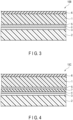
- FIG. 3 is a cross-sectional view schematically illustrating a laminate according to the second embodiment of the present invention.
- the water-soluble polymer examples include polysaccharide such as a polyvinyl alcohol-based, a starch methylcellulose carboxymethylcellulose, and the like and a hydroxyl group-containing polymer such as an acrylic polyol-based, and the like.
- the protective layer 6 preferably contains a polyvinyl alcohol-based hydroxyl group-containing polymer that can be contained in the coating layer as the gas barrier layer 5 described later.
- the protective layer 6 preferably contains, as the organometallic compound, at least one of a metal alkoxide, a hydrolysate of the metal alkoxide, and a reaction product of the metal alkoxide or the hydrolysate thereof.
- a metal alkoxide examples include those represented by general formula M(OR) n such as tetraethoxysilane [Si(OC 2 H 5 ) 4 ], triisopropoxy aluminum [Al(OC 3 H 7 ) 3 ] and the like.
- the protective layer 6 preferably further contains, as the organometallic compound, at least one of a silane coupling agent, a hydrolysate of the silane coupling agent, and a reaction product of the silane coupling agent or a hydrolysate of the silane coupling agent.
- the protective layer 6 reduces thermal damage at the time of heat sealing on the surface of the laminate. Since the laminate 10B includes the protective layer 6 having excellent heat resistance as the outermost layer, heat-sealing property and productivity are secured even though a polyethylene resin having poor heat resistance is used as a base material.
- the thickness of the protective layer 6 is preferably in the range of 0.3 um to 3 ⁇ m. When the protective layer 6 is too thin, it tends to be difficult to achieve high heat resistance. If the protective layer 6 is too thick, it tends to be difficult to sufficiently dry the resin cured film in the process of manufacturing the laminate 10B.
- the gas barrier layer 5 improves, for example, oxygen barrier properties and water vapor barrier properties of the laminate 10B.
- the gas barrier layer 5 includes an inorganic compound layer, or an inorganic compound layer and a coating layer.
- the inorganic compound layer and the coating layer are preferably laminated in this order from the substrate layer 1 side.
- the gas barrier layer 5 may be formed by coating, or may be formed by vapor depositing an inorganic compound.
- the inorganic compound layer is the same as the inorganic compound layer described in the modification of the first embodiment.
- the coating layer can be formed, for example, by coating.
- a coating liquid containing a resin such as polyvinyl alcohol (PVA), an ethylene-vinyl alcohol copolymer, an ethylene-vinyl acetate copolymer, polyvinylidene chloride, polyacrylonitrile, an epoxy resin, and the like can be used.
- Additives such as organic or inorganic particles, a layered compound, and a curing agent may be added to this coating liquid.
- the coating layer may be, for example, an organic-inorganic composite layer containing at least one of a metal alkoxide, a hydrolysate of a metal alkoxide, and a reaction product of a metal alkoxide or a hydrolysate of a metal alkoxide, and a water-soluble polymer.
- the organic-inorganic composite layer may further contain at least one of a silane coupling agent, a hydrolysate of the silane coupling agent, and a reaction product of the silane coupling agent or the hydrolysate of the silane coupling agent.
- Examples of the metal alkoxide and the hydrolysate thereof contained in the organic-inorganic composite layer include those represented by the general formula M(OR) n such as tetraethoxysilane [Si (OC 2 H 5 )4], triisopropoxy aluminum [Al(OC 3 H 7 ) 3 ], and the like, and the hydrolysate thereof.
- M(OR) n such as tetraethoxysilane [Si (OC 2 H 5 )4], triisopropoxy aluminum [Al(OC 3 H 7 ) 3 ], and the like, and the hydrolysate thereof.
- Si (OC 2 H 5 )4 tetraethoxysilane
- Al(OC 3 H 7 ) 3 triisopropoxy aluminum
- the total content of the metal alkoxide, the hydrolysate thereof, or the reaction product thereof in the coating liquid used for forming the organic-inorganic composite layer may be, for example, 40 mass% or more, 50 mass% or more, or 65 mass% or more from the viewpoint of oxygen barrier properties. Further, the total content of the metal alkoxide, the hydrolysate thereof, or the reaction product thereof in the coating solution may be, for example, 70 mass% or less.
- the water-soluble polymer contained in the organic-inorganic composite layer is not particularly limited, and examples thereof include polysaccharide such as a polyvinyl alcohol-based, a starch methylcellulose carboxymethylcellulose, and the like and a hydroxyl group-containing polymer such as an acrylic polyol-based, and the like. From the viewpoint of further improving the oxygen gas barrier property, the water-soluble polymer preferably contains a polyvinyl alcohol-based water-soluble polymer. The number average molecular weight of the water-soluble polymer is, for example, from 40000 to 180000.
- the polyvinyl alcohol-based water-soluble polymer contained in the organic-inorganic composite layer can be obtained, for example, by saponifying (including partial saponification) polyvinyl acetate.
- saponifying including partial saponification
- polyvinyl acetate a water-soluble polymer
- several tens% of acetic acid groups may remain, or only several% of acetic acid groups may remain.
- the content ratio of the water-soluble polymer in the coating liquid used for forming the organic-inorganic composite layer may be, for example, 15 mass% or more or 20 mass% or more from the viewpoint of oxygen barrier properties.
- the content ratio of the water-soluble polymer in the coating liquid may be, for example, 50 mass% or less or 45 mass% or less from the viewpoint of oxygen barrier properties.
- silane coupling agent used for the organic-inorganic composite layer examples include silane coupling agents having an organic functional group.
- examples of the silane coupling agent include ethyltrimethoxysilane, vinyltrimethoxysilane, ⁇ -chloropropylmethyldimethoxysilane, ⁇ -chloropropyltrimethoxysilane, glycidoxypropyltrimethoxysilane, ⁇ -methacryloxypropyltrimethoxysilane, ⁇ -methacryloxypropylmethyldimethoxysilane, and the like.
- One of a silane coupling agent selected from these, a hydrolysate thereof, and a reaction product thereof can be used alone, or two or more thereof can be used in combination.
- silane coupling agent one having an epoxy group as an organic functional group is preferably used.
- examples of the silane coupling agent having an epoxy group include ⁇ -glycidoxypropyltrimethoxysilane and ⁇ - (3,4-epoxycyclohexyl) ethyltrimethoxysilane.
- the silane coupling agent having an epoxy group may have an organic functional group different from the epoxy group, such as a vinyl group, an amino group, a methacrylic group, or a ureyl group.
- One of a silane coupling agent selected from these, a hydrolysate thereof, and a reaction product thereof can be used alone, or two or more thereof can be used in combination.
- the silane coupling agent having an organic functional group, a hydrolysate thereof, or a reaction product thereof can further improve the oxygen barrier properties of the coating layer and the adhesion between the coating layer and the adjacent layer by the interaction between the organic functional group and the hydroxyl group of the water-soluble polymer.
- the silane coupling agent, a hydrolysate thereof, or a reaction product thereof has an epoxy group
- the water-soluble polymer is polyvinyl alcohol (PVA)
- PVA polyvinyl alcohol
- the gas barrier layer 5 is preferably subjected to the above-mentioned surface treatment. Accordingly, adhesion between the gas barrier layer 5 and the adjacent layer can be improved.
- a nanocomposite may be used as the material of the gas barrier layer 5.
- the printed layer 4 is interposed between the gas barrier layer 5 and the adhesive agent layer 3, but the printed layer 4 may be provided at any position between the protective layer 6 and the sealant layer 2. Since the substrate layer 1 is transparent, for example, even when the printed layer 4 is included at any position between the substrate layer 1 and the sealant layer 2, the pattern displayed on the printed layer 4 can be clearly viewed when the laminate 10B is observed from the protective layer 6 side.
- the laminate 10B may further include an anchor coat layer (not illustrated) on a main surface facing the gas barrier layer 5 among main surfaces of the substrate layer 1. Accordingly, adhesion of the gas barrier layer 5 can be improved.
- the anchor coat agent include a polyester-based polyurethane resin, a polyether-based polyurethane resin, and the like. From the viewpoint of heat resistance and interlayer adhesion strength, the anchor coat agent is preferably a polyester-based polyurethane resin.
- the laminate 10B is excellent in heat resistance and recyclability.
- FIG. 4 is a cross-sectional view schematically illustrating a laminate according to the third embodiment of the present invention.
- a laminate 10C illustrated in FIG. 4 includes a protective layer 6, a substrate layer 1, an inorganic compound layer 5, a coating layer 7, a printed layer 4, an adhesive agent layer 3, and a sealant layer 2 in this order.
- the ratio of polyethylene in the laminate 10C is 90 mass% or more.
- the laminate 10C has a layer configuration similar to that of the laminate 10B according to the second embodiment described above, including an inorganic compound layer and a coating layer as the gas barrier layer 5 from the substrate layer 1 side.
- the protective layer 6, the substrate layer 1, the inorganic compound layer 5, the coating layer 7, the printed layer 4, the adhesive agent layer 3, and the sealant layer 2 included in the laminate 10C those described in the second embodiment can be used.
- the inorganic compound layer 5, the coating layer 7, and the printed layer 4 can be omitted.
- the laminate 10C has the same layer configuration as that of the laminate 10B, the same effect as that of the laminate 10B is obtained.
- FIG. 5 is a cross-sectional view schematically illustrating a laminate according to the fourth embodiment of the present invention.
- a laminate 10D illustrated in FIG. 5 includes a substrate layer 1, a first adhesive agent layer 3A, a gas barrier layer 5, an intermediate layer 8, a printed layer 4, a second adhesive agent layer 3B, and a sealant layer 2 in this order.
- the laminate 10D is the same as the laminate 10B except for the following matters. In other words, the laminate 10D further includes the intermediate layer 8. Further, the laminate 10D includes the first adhesive agent layer 3A and the second adhesive agent layer 3B instead of the adhesive agent layer 3.
- the substrate layer 1, the printed layer 4, and the sealant layer 2 included in the laminate 10D those described in the first embodiment can be used.
- the gas barrier layer 5 is preferably subjected to the above-mentioned surface treatment. Accordingly, adhesion between the gas barrier layer 5 and the adjacent layer can be improved.
- the intermediate layer 8 contains polyethylene.
- the polyethylene for example, those described above for the polyethylene contained in the substrate layer 1 can be used.
- the thickness of the intermediate layer 8 is preferably in a range of 10 um to 200 ⁇ m, and more preferably in a range of 15 um to 50 ⁇ m.
- the intermediate layer 8 can be manufactured by a known method such as a casting method or an inflation method. It is also possible to use, as the intermediate layer 8, a polyethylene film having a multilayer structure obtained by extruding polyethylene having different densities by a co-extrusion method.
- the stretched film is obtained, for example, by stretching a film obtained by forming a film of polyethylene by a T-die method, an inflation method, or the like.
- the adhesive may be a one-component curable adhesive, a two-component curable adhesive, or a non-curable adhesive.
- the adhesive may be a solventless type adhesive or a solvent type adhesive.
- the gas barrier layer 5 includes an inorganic compound layer, or an inorganic compound layer and a coating layer.
- the inorganic compound layer and the coating layer are preferably laminated in this order from the intermediate layer 8 side.
- the gas barrier layer 5 may be formed by coating, or may be formed by vapor depositing an inorganic compound.
- the film thickness of the evaporated film made of silicon oxide is preferably 10 nm or more and 50 nm or less.
- the film thickness is 10 nm or more, sufficient gas barrier property can be obtained.
- the film thickness is 50 nm or less, it is possible to suppress generation of cracks caused by deformation of the thin film due to internal stress and to suppress deterioration of gas barrier property. If the film thickness exceeds 50 nm, the cost tends to increase due to an increase in the amount of material used, an increase in the film formation time, and the like, which is not preferable from the economic viewpoint.
- the thickness of the evaporated film made of silicon oxide is more preferably 20 nm or more and 40 nm or less.
- a resistance heating vacuum evaporation method In the vacuum film formation, a resistance heating vacuum evaporation method, an electron beam (EB) heating vacuum evaporation deposition method, an induction heating vacuum evaporation deposition method, a sputtering method, a reactive sputtering method, a dual magnetron sputtering method, a plasma-enhanced chemical vapor deposition method (PECVD method), and the like are particularly preferably used.
- the vacuum evaporation method is the most excellent at the present time.
- a heating means of the vacuum evaporation method it is preferable to use any one of an electron beam heating method, a resistance heating method, and an induction heating method.
- the water-soluble polymer contained in the organic-inorganic composite layer is not particularly limited, and examples thereof include polysaccharide such as a polyvinyl alcohol-based, a starch methylcellulose carboxymethylcellulose, and the like and a hydroxyl group-containing polymer such as an acrylic polyol-based, and the like. From the viewpoint of further improving the oxygen gas barrier property, the water-soluble polymer preferably contains a polyvinyl alcohol-based water-soluble polymer. The number average molecular weight of the water-soluble polymer is, for example, from 40000 to 180000.
- the total content ratio of the silane coupling agent, the hydrolysate thereof, and the reaction product thereof in the coating liquid used for forming the organic-inorganic composite layer may be, for example, 1 mass% or more, or 2 mass% or more from the viewpoint of oxygen barrier properties. Further, the total content of the silane coupling agent, the hydrolysate thereof, and the reaction product thereof in the coating solution may be, for example, 15 mass% or less, or 12 mass% or less from the viewpoint of oxygen barrier properties.
- the thickness of the coating layer is preferably 50 nm or more and 1000 nm or less, and more preferably 100 nm or more and 500 nm or less. In a case where the thickness of the gas barrier coating layer is 50 nm or more, more sufficient gas barrier property tend to be obtained, and when the thickness is 1000 nm or less, sufficient flexibility tends to be maintained.
- the laminate 10E may further include an anchor coat layer (not illustrated) on the surface of the intermediate layer 8 on the side where the gas barrier layer 5 is formed.
- the laminate 10E may further include an anchor coat layer (not illustrated) on a surface of the main surface of the substrate layer 1 facing the first adhesive agent layer 3A.
- the anchor coat layer can be formed using a known anchor coat agent. Thereby, the adhesion of the inorganic compound layer made of a metal oxide can be improved.
- the anchor coat agent include a polyester-based polyurethane resin, a polyether-based polyurethane resin, and the like. From the viewpoint of heat resistance and interlayer adhesion strength, the anchor coat agent is preferably a polyester-based polyurethane resin.
- the laminate 10E illustrated in FIG. 6 includes the printed layer 4 between the substrate layer 1 and the first adhesive agent layer 3A
- the printed layer 4 may be included at any position between the protective layer 6 and the sealant layer 2. Since the substrate layer 1 and the intermediate layer 8 included in the laminate 10E are transparent, the pattern displayed on the printed layer 4 can be clearly viewed when the laminate 10E is observed from the protective layer 6 side even if the printed layer 4 is included at any position. According to one example, it is preferable that the printed layer 4 is included between the intermediate layer 8 and the protective layer 6 so that the pattern displayed on the printed layer 4 can be more clearly seen.
- the laminate 10E includes the gas barrier layer 5 on the surface of the intermediate layer 8 facing the sealant layer 2, but the laminate 10E may include the gas barrier layer 5 on the surface of the intermediate layer 8 facing the substrate layer 1.
- the ratio of polyethylene in the laminate 10E is, for example, 90 mass% or more.
- the laminate 10E is configured as a mono-material having high recyclability.
- the laminate 10E described above includes, as the substrate layer 1, a polyethylene-containing layer having a crystallinity in the above range. Therefore, the laminate 10E is excellent in heat resistance similarly to the laminate 10A1.
- the laminate 10E includes the protective layer 6.
- the protective layer 6 reduces thermal damage at the time of heat sealing on the surface of the laminate. Therefore, the laminate 10E can achieve further excellent heat resistance, particularly better heat-sealing suitability. Therefore, when the above-described configuration is adopted for the laminate 10E, the temperature range of the heat sealing performed for bag production is widened, and the deterioration in productivity is further less likely to occur.
- the laminate 10E includes the intermediate layer 8 having a crystallinity within the above range.
- the intermediate layer 8 increases the strength of the laminate 10E, particularly the puncture resistance. Therefore, the laminate 10E is excellent in strength, particularly puncture resistance.
- a laminate having a high ratio of polyethylene has weaker stiffness than other laminates, and therefore is often folded when used as a packaging material.
- the number of times of bending increases, the possibility that pinholes are generated increases, but the laminate 10E having excellent puncture resistance hardly generates pinholes.
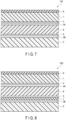
- FIG. 7 is a cross-sectional view schematically illustrating a laminate according to a sixth embodiment of the present invention.
- the polyethylene contained in the intermediate layer 8 may be the same as or different from the polyethylene contained in the substrate layer 1.
- the intermediate layer 8 may further contain the above-described additive.
- the intermediate layer 8 having a crystallinity of less than 35% can increase the strength of the laminate 10F, particularly the drop resistance.
- Such intermediate layer 8 is preferably an unstretched film. From the viewpoint of drop resistance, it is preferable that the intermediate layer 8 is an unstretched film having a crystallinity of less than 35%, and the substrate layer 1 is a stretched film having a crystallinity of 35% or more.
- the thickness of the intermediate layer 8 is preferably in a range of 10 ⁇ m to 200 ⁇ m, and more preferably in a range of 15 ⁇ m to 50 ⁇ m.
- the intermediate layer 8 can be produced by a known method such as the casting method or the inflation method described above. And a polyethylene film having a multilayer structure obtained by extruding polyethylene having different densities by a co-extrusion method can also be used as the intermediate layer 8.
- the laminate 10F may further include an anchor coat layer (not illustrated) on the surface of the intermediate layer 8 on the side where the gas barrier layer 5 is formed.
- the laminate 10F may further include an anchor coat layer (not illustrated) on a surface of the main surface of the substrate layer 1 facing the first adhesive agent layer 3A.
- the anchor coat layer those described in the fifth embodiment can be used.
- the laminate 10F includes the gas barrier layer 5 between the intermediate layer 8 and the second adhesive agent layer 3B, but the laminate 10F may include the gas barrier layer 5 between the first adhesive agent layer 3A and the intermediate layer 8.
- the printed layer 4 is provided between the substrate layer 1 and the first adhesive agent layer 3A.
- the printed layer 4 is preferably provided between the protective layer 6 and the first adhesive agent layer 3A. In this case, when the laminate 10F is observed from the protective layer 6 side, the pattern displayed on the printed layer 4 is easily seen clearly.
- the ratio of polyethylene in the laminate 10F is, for example, 90 mass% or more.
- the laminate 10F is configured as a mono-material having high recyclability.
- the crystallinity of the substrate layer 1 is within the above range. Therefore, the laminate 10F is excellent in heat resistance similarly to the laminate 10A1.
- the laminate 10F includes the protective layer 6.
- the protective layer 6 reduces thermal damage at the time of heat sealing on the surface of the laminate. Therefore, the laminate 10F can achieve further excellent heat resistance, particularly better heat-sealing suitability. Therefore, when the above-described configuration is adopted for the laminate 10F, the temperature range of the heat sealing performed for bag production is widened, and the deterioration in productivity is further less likely to occur.
- the laminate 10F includes the intermediate layer 8 having a crystallinity in the above range.
- the intermediate layer 8 increases the strength of the laminate 10F, particularly the drop resistance.
- the intermediate layer 8 located inside the substrate layer 1 is softer than the substrate layer 1.
- This structure is suitable for absorbing an impact generated when a packaged article using the laminate 10F as a packaging material is dropped. Therefore, a packaged article using the laminate 10F as a packaging material is less likely to be damaged (bag breakage) due to dropping. Therefore, the laminate 10F is excellent in strength, particularly drop resistance.
- FIG. 8 is a cross-sectional view schematically illustrating a laminate according to a seventh embodiment of the present invention.
- a laminate 10G illustrated in FIG. 8 includes a protective layer 6, a substrate layer 1, a printed layer 4, a first adhesive agent layer 3A, an intermediate layer 8, an inorganic compound layer 5, a coating layer 7, a second adhesive agent layer 3B, and a sealant layer 2 in this order.
- the ratio of polyethylene in the laminate 10G is 90 mass% or more.
- the laminate 10G is the same as that in the case where the gas barrier layer 5 included in the laminate 10E according to the fifth embodiment is formed of an inorganic compound layer and a coating layer.
- the protective layer 6 the substrate layer 1, the printed layer 4, the first adhesive agent layer 3A, the intermediate layer 8, the inorganic compound layer 5, the coating layer 7, the second adhesive agent layer 3B, and the sealant layer 2 included in the laminate 10G, those described in the fifth embodiment can be used.
- the laminate 10G includes, as the substrate layer 1, a polyethylene-containing layer having a crystallinity in the above range. Therefore, the laminate 10G is excellent in heat resistance similarly to the laminate 10A1.
- the laminate 10G includes the protective layer 6.
- the protective layer 6 reduces thermal damage at the time of heat sealing on the surface of the laminate. Therefore, the laminate 10G can achieve further excellent heat resistance, particularly better heat-sealing suitability. Therefore, when the above-described configuration is adopted for the laminate 10G, the temperature range of the heat sealing performed for bag production is widened, and the deterioration in productivity is further less likely to occur.
- the laminate 10G includes the intermediate layer 8 having a crystallinity within the above range.
- the intermediate layer 8 increases the strength of the laminate 10G, particularly the puncture resistance. Therefore, the laminate 10G is excellent in strength, particularly puncture resistance.
- each of the substrate layer 1, the intermediate layer 8 and the sealant layer 2 contains polyethylene, and the ratio of polyethylene is 90 mass% or more. This laminate is excellent in recyclability.
- a laminate having a high ratio of polyethylene has weaker stiffness than other laminates, and therefore is often folded when used as a packaging material.
- the number of times of bending increases, the possibility that pinholes are generated increases, but the laminate 10G having excellent puncture resistance hardly generates pinholes.
- the substrate layer 1 and the intermediate layer 8 are transparent in the laminate 10G, for example, even when the printed layer 4 is included at any position between the substrate layer 1 and the sealant layer 2, the pattern displayed on the printed layer 4 is clearly viewed when the printed layer 4 is observed from the protective layer 6 side. In addition, in the packaged article including the laminate 10G described above, the visibility of the contents is high.
- FIG. 9 is a cross-sectional view schematically illustrating a laminate according to an eighth embodiment of the present invention.
- a laminate 10H illustrated in FIG. 9 includes a protective layer 6, a substrate layer 1, a printed layer 4, a first adhesive agent layer 3A, an intermediate layer 8, an inorganic compound layer 5, a coating layer 7, a second adhesive agent layer 3B, and a sealant layer 2 in this order.
- the ratio of polyethylene in the laminate 10H is 90 mass% or more.
- the laminate 10H is the same as that in the case where the gas barrier layer 5 included in the laminate 10F according to the sixth embodiment is formed of an inorganic compound layer and a coating layer.
- the protective layer 6 the substrate layer 1, the printed layer 4, the first adhesive agent layer 3A, the intermediate layer 8, the inorganic compound layer 5, the coating layer 7, the second adhesive agent layer 3B, and the sealant layer 2 included in the laminate 10H, those described in the sixth embodiment can be used.
- the crystallinity of the substrate layer 1 is within the above range. Therefore, the laminate 10H is excellent in heat resistance similarly to the laminate 10A1.
- the laminate 10H includes the protective layer 6.
- the protective layer 6 reduces thermal damage at the time of heat sealing on the surface of the laminate. Therefore, the laminate 10H can achieve further excellent heat resistance, particularly better heat-sealing suitability. Therefore, when the above-described configuration is adopted for the laminate 10H, the temperature range of the heat sealing performed for bag production is widened, and the deterioration in productivity is further less likely to occur.
- the laminate 10H includes the intermediate layer 8 having a crystallinity in the above range.
- the intermediate layer 8 increases the strength of the laminate 10H, particularly the drop resistance.
- the intermediate layer 8 located inside the substrate layer 1 is softer than the substrate layer 1.
- This structure is suitable for absorbing an impact generated when a packaged article using the laminate 10H as a packaging material is dropped. Therefore, a packaged article using the laminate 10H as a packaging material is less likely to be damaged (bag breakage) due to dropping. Therefore, the laminate 10H is excellent in strength, particularly drop resistance.
- the ratio of polyethylene in the laminate 10H is 90 mass% or more. Therefore, the laminate 10H is also excellent in recyclability.
- the printed layer 4 may be provided on the front surface of the substrate layer 1, on the front surface of the intermediate layer 8, or on the back surface of the intermediate layer 8. In any of the above cases, an image such as a pattern or text displayed on the printed layer 4 can be visually recognized with good visibility. Note that the printed layer 4 may be omitted.
- FIG. 10 is a view schematically illustrating a packaged article according to a ninth embodiment of the present invention.
- a packaged article 100A illustrated in FIG. 10 includes a package 110A and contents contained therein.
- the package 110A is a flat pouch.
- the package 110A includes a pair of main body films.
- Each of the main body films is any one of the laminates described in the first to eighth embodiments, or is cut out from the laminate.
- the main body films are stacked such that the sealant layers face each other, and peripheral edges thereof are heat-sealed to each other.
- a notch is provided as an easily openable structure in the heat-sealed portion.
- the content may be any of a liquid, a solid, and a mixture thereof.
- the content is, for example, a food or a drug.
- a packaged article 100B illustrated in FIG. 11 includes a package 110B and contents contained therein.
- the contents are, for example, the same as those described for the packaged article 100A.
- the package 110B is a standing pouch.
- the package 110B includes a pair of main body films and a bottom film. Each of these films is any one of the laminates described in the first to eighth embodiments, or is cut out from the laminate.
- the pair of main body films are superimposed on each other such that the sealant layers face each other, and peripheral edges thereof are heat-sealed to each other except for one end and a region in the vicinity thereof.
- the bottom film is folded in two so as to be mountain folded when viewed from the sealant layer side, and is placed between the pair of main body films so that the mountain folded portion is oriented toward the other end of the main body film at the position of the one end.
- a portion of the bottom film excluding a central portion thereof is heat-sealed to the pair of main body films.
- outer surfaces of the bottom film are bonded to each other at positions on both sides of the bottom portion of the package 110B.
- a notch is provided as an easily openable structure at a portion where the main body films are heat-sealed to each other.
- the easy-to-open structure may be provided so that, when the packaged article 100B is opened, a corner portion above the packaged article can be used as an opening portion.
- the packaged article 100B may further include a spout member and a lid body described in an eleventh embodiment later.
- FIG. 12 is a view schematically illustrating a packaged article according to the eleventh embodiment of the present invention.
- the package 110C is a gusset type pouch.
- the package 110C includes a container body 110C1, a spout member 110C2, and a lid body 110C3.
- the container body 110C1 includes a pair of main body films and a pair of side films.
- the pair of main body films is overlapped such that the sealant layers face each other and a part of the spout member 110C2 is placed therebetween at one end.
- Peripheral edge portions of these main body films are heat-sealed to the spout member 110C2 at the one end and are heat-sealed to each other in the vicinity thereof. Further, the peripheral edge portions of these main body films are heat-sealed to each other at opposite ends except for regions on both sides.
- Each of the side films is folded in two so as to be mountain folded when viewed from the sealant layer side. These side films are placed between the pair of main body films so that the mountain folded portions face each other on both sides of the main body films.
- a part of the peripheral edge portion is heat-sealed to one of the main body films, and the remaining portion of the peripheral edge portion is heat-sealed to the other of the main body films.
- outer surfaces of the side films are bonded to each other at respective positions of an upper portion and a lower portion of the package 110C.
- the container body 110C1 may further include a bottom film.
- the spout member 110C2 includes a portion to be placed between the main body films and heat-sealed.
- the spout member 110C2 further includes an opening portion protruding outward from the container body 110C1.
- the opening portion has a substantially cylindrical shape, and a male screw is provided on an outer surface of the side wall.
- the lid body 110C3 has a bottomed cylindrical shape.
- the lid body 110C3 is provided with a female screw on the inner surface of the side wall and is screwed with the opening portion of the spout member 110C2.
- the laminate 10A2 illustrated in FIG. 2 was produced by the following method.
- a polyethylene film having a thickness of 25 ⁇ m and a crystallinity of 58.5% was prepared as the substrate layer.
- the crystallinity shown in the present example and the examples and comparative examples described below was measured by the measurement method described above.
- a silicon oxide (SiO x ) evaporated film was formed as the inorganic compound layer on one surface of the substrate layer. Thereafter, a printed layer was formed on the inorganic compound layer.
- an adhesive for dry lamination (urethane-based adhesive) was applied to the surface of the substrate layer on which the printed layer was formed.
- a linear low-density polyethylene resin (LLDPE) film (thickness of 60 ⁇ m) as the sealant layer was bonded to the substrate layer with the adhesive agent layer interposed therebetween.
- the laminate was prepared as described above.
- the laminate 10A2 illustrated in FIG. 2 was produced by the same method as in Example 1A except that the inorganic compound layer was not provided.
- the laminate 10A2 illustrated in FIG. 2 was produced by the same method as in Example 1A except that a polyethylene film having a thickness of 25 ⁇ m and a crystallinity of 71.8% was used instead of using a polyethylene film having a thickness of 25 ⁇ m and a crystallinity of 58.5% as the substrate layer.
- the laminate 10A2 illustrated in FIG. 2 was produced by the same method as in Example 1A except that a polyethylene film having a thickness of 25 ⁇ m and a crystallinity of 55.9% was used instead of using a polyethylene film having a thickness of 25 ⁇ m and a crystallinity of 58.5% as the substrate layer.
- the laminate 10A2 illustrated in FIG. 2 was produced by the same method as in Example 1A except that a polyethylene film having a thickness of 20 ⁇ m and a crystallinity of 54.1% was used instead of using a polyethylene film having a thickness of 25 ⁇ m and a crystallinity of 58.5% as the substrate layer.
- the laminate 10A2 illustrated in FIG. 2 was produced by the same method as in Example 1A except that a polyethylene film having a thickness of 30 ⁇ m and a crystallinity of 55.9% was used instead of using a polyethylene film having a thickness of 25 ⁇ m and a crystallinity of 58.5% as the substrate layer.
- the laminate 10A2 illustrated in FIG. 2 was produced by the same method as in Example 1A except that a linear low-density polyethylene resin (LLDPE) film having a thickness of 40 ⁇ m was used as the sealant layer in place of the 60 ⁇ m-thick linear low-density polyethylene resin (LLDPE) film.
- LLDPE linear low-density polyethylene resin
- the laminate 10A2 illustrated in FIG. 2 was produced by the same method as in Example 1A except that a linear low density polyethylene resin (LLDPE) film having a thickness of 120 ⁇ m was used as the sealant layer in place of the 60 pm-thick linear low-density polyethylene resin (LLDPE) film.
- LLDPE linear low density polyethylene resin
- the laminate 10A2 illustrated in FIG. 2 was produced by the same method as in Example 1A except that the inorganic compound layer was not provided, and a polyamine-based gas barrier adhesive was used instead of using an adhesive for dry lamination (urethane-based adhesive) as the adhesive.
- the laminate 10A2 illustrated in FIG. 2 was produced by the same method as in Example 1A except that the inorganic compound layer was not provided, and a urethane-based gas barrier adhesive was used instead of using an adhesive for dry lamination (urethane-based adhesive) as the adhesive.
- a laminate was produced by the same method as in Example 1A except that a polyethylene film having a thickness of 32 ⁇ m and a crystallinity of 14.8% was used instead of using a polyethylene film having a thickness of 25 ⁇ m and a crystallinity of 58.5% as the substrate layer.
- a laminate was produced by the same method as in Example 1A except that a polyethylene film having a thickness of 25 ⁇ m and a crystallinity of 20.6% was used instead of using a polyethylene film having a thickness of 25 ⁇ m and a crystallinity of 58.5% as the substrate layer.
- the substrate layer used in the production of the laminate was subjected to in-plane measurement by the wide-angle X-ray diffraction method described above. Then, it was examined whether the diffraction pattern obtained by this measurement had a sharp diffraction peak corresponding to the (110) plane.
- the sealing property, heat resistance, visibility, and gas barrier property of the laminate were evaluated. Methods for evaluating the sealing property, heat resistance, visibility, and gas barrier property will be described below.
- Samples obtained by cutting the laminates into a 10 cm square were folded in two so that the sealant layer was on the inner side, and heat-sealed using a heat seal tester. Specifically, first, the lower surface seal temperature was set to 100°C, the upper surface seal temperature was set to 120°C, and a pressure of 0.1 MPa was applied for one second. Then, the presence or absence of melting of the sealing surface was confirmed, and the region where the heat seal bar was applied on the upper surface of the sample folded in two was observed.
- the sealing property was evaluated according to the following criteria.
- the pattern displayed on the printed layer was visually observed from the substrate layer side, and the visibility was evaluated according to the following criteria.
- the laminate was subjected to a boiling treatment, and then the oxygen transmission rate (OTR) at 30°C and a relative humidity of 70% was measured. This measurement was performed in accordance with JIS K-7126, Method B. Then, the gas barrier property was evaluated with reference to the following criteria for the oxygen transmission rate.
- OTR oxygen transmission rate
- the laminates in which the crystallinity of the substrate layer was 35% or more had good sealing property, heat resistance, and visibility.
- the laminates in which the crystallinity of the substrate layer was less than 35% had insufficient sealing property, heat resistance, and visibility.
- the laminate 10B illustrated in FIG. 3 was produced by the following method. Note that, in this example, an anchor coat layer was further provided between the substrate layer 1 and the gas barrier layer 5, and an inorganic compound layer and a coating layer were provided as the gas barrier layer 5.
- an anchor coat agent and a coating liquid for forming a protective layer and a coating layer were prepared by the following method.
- the protective layer and the coating layer were formed using the same coating liquid.
- the acrylic polyol and the tolylenediisocyanate were mixed so that the number of NCO groups of the tolylenediisocyanate was equal to the number of OH groups of the acrylic polyol, and the mixture was diluted with ethyl acetate so that the total solid content (the total amount of the acrylic polyol and the tolylenediisocyanate) was 5% by mass.
- ⁇ - (3,4-epoxycyclohexyl) trimethoxysilane was further added to the diluted mixed liquid in an amount of 5 parts by mass with respect to 100 parts by mass of the total amount of the acrylic polyol and the tolylenediisocyanate, and these were mixed to prepare an anchor coat agent.
- a coating liquid for forming a protective layer and a coating layer (hereinafter, also simply referred to as "coating liquid") containing an organic-inorganic mixture were prepared by mixing the following liquids A, B, and C at a mass ratio of 70/20/10, respectively.
- Solution A A hydrolysis solution of 5 mass% (in terms of SiO 2 ) of a solid content obtained by adding 72.1 g of 0.1 N hydrochloric acid to 17.9 g of tetraethoxysilane (Si(OC 2 H 5 ) 4 ) and 10 g of methanol, followed by hydrolysis by stirring for 30 minutes.
- Liquid B 5 mass% water/methanol solution of polyvinyl alcohol (mass ratio of water and methanol is 95:5).
- Liquid C a hydrolysis solution prepared by diluting 1,3,5-tris (3-trialkoxysilyl propyl) isocyanurate to a solid content of 5 mass% with a mixed liquid of water/isopropyl alcohol (the mass ratio of water and isopropyl alcohol is 1 : 1).
- a polyethylene film having a thickness of 25 ⁇ m, a crystallinity of 58.5%, a haze of 1.6%, and a density of 0.94 g/cm 3 was prepared.
- the crystallinity shown in the present example and the examples and comparative examples described below was measured by the measurement method described above.
- one surface of the substrate layer was subjected to a corona treatment.
- the coating liquid prepared as described above was applied to the corona-treated surface of the substrate layer by a gravure coating method and dried to form a protective layer composed of an organic-inorganic mixture and having a thickness of 0.5 um (dry state).
- the other surface of the substrate layer was subjected to a corona treatment.
- the anchor coat agent described above was applied to the corona-treated surface of the substrate layer by a gravure coating method to form an anchor coat layer having a thickness of 0.1 um (dry state).
- a silicon oxide (SiO x ) evaporated film was formed as an inorganic compound layer with a thickness of 40 nm using an electron beam heating vacuum deposition apparatus.
- the coating liquid prepared as described above was applied to the inorganic compound layer to form a coating layer composed of an organic-inorganic mixture and having a thickness of 0.3 ⁇ m (dry state).
- the coating layer was pattern-printed with an aqueous flexo ink to form a printed layer.
- an adhesive for dry lamination (urethane-based adhesive) was applied to the surface of the substrate layer on which the printed layer was formed.
- a linear low-density polyethylene resin (LLDPE) film (thickness of 60 ⁇ m) as the sealant layer was bonded to the substrate layer with the adhesive agent layer interposed therebetween.
- the laminate was prepared as described above.
- the laminate 10B illustrated in FIG. 3 was produced by the same method as in Example 1B except that a polyethylene film having a thickness of 25 ⁇ m, a crystallinity of 55.9%, a haze of 5.9%, and a density of 0.95 g/cm 3 was used as a substrate layer instead of the above-mentioned polyethylene film having a crystallinity of 58.5%.
- This polyethylene film is a biaxially stretched film, and is subjected to corona treatment on one side.
- the laminate 10B illustrated in FIG. 3 was produced by the same method as in Example 2B except that a protective layer was not provided.
- the laminate 10B illustrated in FIG. 3 was produced by the same method as in Example 1B except that a protective layer made of a urethane-based resin and having a thickness of 0.5 ⁇ m was formed instead of forming a protective layer having a thickness of 0.5 ⁇ m by applying a polyamideimide resin.
- the laminate 10B illustrated in FIG. 3 was produced by the same method as in Example 1B except that a protective layer made of an ethylene-vinyl alcohol copolymer (EVOH) and having a thickness of 1 ⁇ m was formed instead of forming a protective layer having a thickness of 0.5 ⁇ m by applying a polyamideimide resin.
- EVOH ethylene-vinyl alcohol copolymer
- the laminate 10B illustrated in FIG. 3 was produced by the same method as in Example 1B except that a protective layer made of an acrylic resin and having a thickness of 1 ⁇ m was formed instead of forming a protective layer having a thickness of 0.5 ⁇ m by applying a polyamideimide resin.
- the laminate 10B illustrated in FIG. 3 was produced in the same manner as in Example 1B except for the following. That is, the protective layer was not provided. Further, as the substrate layer, a polyethylene film having a thickness of 25 ⁇ m, a crystallinity of 27.5%, a haze of 21.5%, and a density of 0.950 g/cm 3 was used instead of the above-mentioned polyethylene film having a crystallinity of 58.5%. This polyethylene film is subjected to corona treatment on one side.
- the substrate layer used in the production of the laminate was subjected to in-plane measurement by the wide-angle X-ray diffraction method described above. Then, it was examined whether the diffraction pattern obtained by this measurement had a sharp diffraction peak corresponding to the (110) plane.
- sealing property, heat resistance, visibility, and recyclability of the laminate were evaluated. Methods for evaluating sealing property, heat resistance, visibility, and recyclability will be described below.
- Samples obtained by cutting the laminates into a 10 cm square were folded in two so that the sealant layer was on the inner side, and heat-sealed using a heat seal tester. Specifically, a heat of 140°C and a pressure of 0.1 MPa were applied to the sample folded in two for one second. Then, a region of the surface of the sample to which the heat seal bar was applied was observed, and the sealing property was evaluated according to the following criteria.
- heat resistance was further evaluated in the same manner as described above except that the upper surface seal temperature was set to 190°C.
- the laminates in which the substrate layer had a crystallinity of 35% or more were all satisfactory in heat resistance and visibility while having recyclability.
- the laminate in which the crystallinity of the substrate layer was 35% or more and the protective layer was provided also had excellent sealing property.
- the laminate having the substrate layer with the crystallinity of less than 35% and having no protective layer is insufficient in sealing property, heat resistance, and visibility.
- the laminate 10C illustrated in FIG. 4 was produced by the following method. Note that, in this example, an anchor coat layer was further provided between the substrate layer 1 and the inorganic compound layer 5.
- an anchor coat agent and a coating liquid for forming the coating layer were prepared by the same method as in Example 1B.
- a coating liquid for forming a protective layer an organic solvent solution of a polyamideimide resin (nonvolatile component concentration: 5% by mass) was prepared.
- a polyethylene film having a thickness of 25 ⁇ m, a crystallinity of 58.5%, a haze of 1.6%, and a density of 0.950 g/cm 3 was prepared.
- This polyethylene film is subjected to a corona treatment on both sides.
- the crystallinity shown in the present example and the examples and comparative examples described below was measured by the measurement method described above.
- the anchor coat agent described above was applied to the other corona-treated surface of the substrate layer by a gravure coating method to form an anchor coat layer having a thickness of 0.1 ⁇ m (dry state).
- the laminate was prepared as described above.
- the laminate 10C illustrated in FIG. 4 was produced by the same method as in Example 1C except that the thickness of the protective layer was changed from 0.5 ⁇ m to 1 ⁇ m and a coating layer was not provided.
- the laminate 10C illustrated in FIG. 4 was produced by the same method as in Example 1C except that a protective layer was not provided.
- the substrate layer used in the production of the laminate was subjected to in-plane measurement by the wide-angle X-ray diffraction method described above. Then, it was examined whether the diffraction pattern obtained by this measurement had a sharp diffraction peak corresponding to the (110) plane.
- sealing property, heat resistance, visibility, and recyclability of the laminate were evaluated. Methods for evaluating sealing property, heat resistance, visibility, and recyclability will be described below.
- the heat resistance was evaluated by the method described in (2.2.2).
- the laminates in which the substrate layer had a crystallinity of 35% or more were all satisfactory in heat resistance and visibility while having recyclability.
- the laminate in which the crystallinity of the substrate layer was 35% or more and the protective layer was provided also had excellent sealing property.
- the laminate having the substrate layer with the crystallinity of less than 35% and having no protective layer is insufficient in sealing property, heat resistance, and visibility.
- a silicon oxide (SiO x ) evaporated film was formed as an inorganic compound layer on the intermediate layer so as to have a thickness of 50 nm.
- An adhesive agent for dry lamination (urethane-based adhesive agent) was applied onto the substrate layer to form a first adhesive agent layer.
- the substrate layer and the intermediate layer were bonded to each other such that the substrate layer and the inorganic compound layer faced each other with the first adhesive agent layer interposed therebetween.
- a printed layer was formed on the back surface of the surface of the intermediate layer on which the inorganic compound layer was formed.
- the laminate was prepared as described above.
- the laminate 10D illustrated in FIG. 5 was produced by the same method as in Example 1D except that a polyamine-based adhesive having a gas barrier property was used instead of the urethane-based adhesive as an adhesive used for the first adhesive agent layer and the second adhesive agent layer.
- the laminate 10D illustrated in FIG. 5 was produced by the same method as in Example 1D except that a polyethylene film having a thickness of 25 ⁇ m, a crystallinity of 71.8%, a haze of 4.1%, and a density of 0.95 g/cm 3 was used as a substrate layer instead of the above-mentioned polyethylene film having a crystallinity of 58.5%.
- This polyethylene film is a longitudinally uniaxially stretched film, and is subjected to a single-sided corona treatment.
- the laminate 10D illustrated in FIG. 5 was produced in the same manner as in Example 1D except for the following.
- a polyethylene film having a crystallinity of 58.5% a polyethylene film having a thickness of 25 ⁇ m, a crystallinity of 55.9%, a haze of 5.9, and a density of 0.95 g/cm 3 was used as the substrate layer.
- This polyethylene film is a biaxially stretched film, and is subjected to corona treatment on one side.
- a high-density polyethylene film having a thickness of 25 ⁇ m, a crystallinity of 71.8%, a haze of 4.1, and a density of 0.95 g/cm 3 was used as the intermediate layer.
- This polyethylene film is a longitudinally uniaxially stretched film, and is subjected to a single-sided corona treatment.
- the laminate 10D illustrated in FIG. 5 was produced by the same method as in Example 1D except that the gas barrier layer was not provided.
- the laminate 10D illustrated in FIG. 5 was produced by the same method as in Example 1D except that a polyethylene film having a thickness of 25 ⁇ m, a crystallinity of 14.8%, a haze of 21.5%, and a density of 0.950 g/cm 3 was used as the substrate layer and the intermediate layer instead of using the above-mentioned polyethylene film having a crystallinity of 58.5%.
- This polyethylene film is subjected to corona treatment on one side.
- a needle having a radius of 0.5 mm and a hemispherical tip is pressed against the laminate at a speed of 50 mm/min from the substrate layer side, and the maximum force until the needle penetrates is measured. This measurement was performed multiple times, and the arithmetic average of the maximum forces was obtained as the puncture resistance.
- the laminate in which the crystallinity of the substrate layer was 35% or more had good sealing property and heat resistance.
- the laminate in which the crystallinity of the substrate layer and the intermediate layer was 35% or more was also excellent in visibility and puncture resistance.
- the laminates in which the cristallinity of the substrate layer was less than 35% had insufficient sealing property, heat resistance, and visibility.
- the other surface of the substrate layer was subjected to a corona treatment. Subsequently, the surface of the substrate layer subjected to the corona treatment was pattern-printed with an aqueous flexo ink to form a printed layer.
- sealing property heat resistance, visibility, puncture resistance, and recyclability of the laminate were evaluated. Methods for evaluating sealing property, heat resistance, visibility, puncture resistance, and recyclability will be described below.
- the sealing property (heat resistance) were evaluated by the method described in (2.2.1).
- the heat resistance was evaluated by the method described in (2.2.2).
- the puncture resistance was evaluated by the method described in (4.2.4).
- the heat resistance, visibility, and puncture resistance of the laminate in which the crystallinity of the substrate layer was 35% or more were all good.
- the laminate in which the crystallinity of the substrate layer and the intermediate layer was 35% or more and the protective layer was provided also had excellent sealing property, and the puncture resistance was further improved.
- the crystallinity of the substrate layer was less than 35%, and the laminate including no protective layer was insufficient in sealing property, heat resistance, visibility, and puncture resistance.
- the laminate 10F illustrated in FIG. 7 was produced by the following method. Note that, in this example, an anchor coat layer was further provided between the intermediate layer 8 and the gas barrier layer 5, and an inorganic compound layer and a coating layer were provided as the gas barrier layer 5.
- an anchor coat agent, a coating liquid for forming a coating layer, and a coating solution for forming a protective layer were prepared by the same method as in Example 1B.
- the protective layer and the coating layer were formed using the same coating liquid.
- a polyethylene film having a thickness of 25 ⁇ m, a crystallinity of 58.5%, and a density of 0.950 g/cm 3 was prepared. This polyethylene film is subjected to corona treatment on one side. The crystallinity shown in the present example and the examples and comparative examples described below was measured by the measurement method described above.
- the coating liquid for forming a protective layer prepared as described above was applied to the corona-treated surface of the substrate layer by a gravure coating method and dried to form a protective layer including an organic-inorganic mixture and having a thickness of 0.5 um.
- a polyethylene film having a thickness of 25 pm, a crystallinity of 27.5%, and a density of 0.950 g/cm 3 was prepared as the intermediate layer. This polyethylene film is subjected to corona treatment on one side.
- the anchor coat agent described above was applied by a gravure coating method to form an anchor coat layer having a thickness of 0.1 ⁇ m (dry state).
- a silicon oxide (SiO x ) evaporated film was formed on the anchor coat layer so as to have a thickness of 40 nm.
- the coating liquid for forming a coating layer prepared as described above was applied to the inorganic compound layer to form a coating layer composed of an organic-inorganic mixture and having a thickness of 0.3 ⁇ m (dry state).
- an adhesive for dry lamination (urethane-based adhesive) was applied to the surface of the intermediate layer opposite to the surface on which the inorganic compound layer was formed to form a first adhesive agent layer.
- the substrate layer and the intermediate layer were bonded to each other such that the printed layer and the intermediate layer faced each other with the first adhesive agent layer interposed therebetween.
- LLDPE linear low-density polyethylene resin
- Thickness: 60 ⁇ m was prepared as a sealant layer.
- An adhesive for dry lamination (urethane-based adhesive) was applied onto the sealant layer to form a second adhesive agent layer.
- the substrate layer and the sealant layer were bonded to each other such that the sealant layer and the coating layer faced each other with the second adhesive agent layer interposed therebetween.
- the laminate was prepared as described above.
- the laminate 10F illustrated in FIG. 7 was produced in the same manner as in Example 1F except for the following.
- a polyethylene film having a crystallinity of 58.5% a polyethylene film having a thickness of 25 ⁇ m, a crystallinity of 55.9%, a haze of 21.5%, and a density of 0.95 g/cm 3 was used as the substrate layer.
- This polyethylene film is subjected to corona treatment on one side.
- the laminate 10F illustrated in FIG. 7 was produced in the same manner as in Example 1F except for the following. That is, the protective layer was not provided. Further, instead of using the above-mentioned polyethylene film having a crystallinity of 58.5% as the substrate layer and the above-mentioned polyethylene film having a crystallinity of 27.5% as the intermediate layer, a polyethylene film having a thickness of 25 ⁇ m, a crystallinity of 55.9%, and a density of 0.95 g/cm 3 was used. This polyethylene film is subjected to corona treatment on one side.
- the laminate 10F illustrated in FIG. 7 was produced in the same manner as in Example 1F except for the following. That is, the protective layer was not provided. Furthermore, instead of using the above-mentioned polyethylene film having a crystallinity of 58.5%, a polyethylene film having a thickness of 25 ⁇ m, a crystallinity of 27.5%, and a density of 0.950 g/cm 3 was used as the substrate layer. This polyethylene film is subjected to corona treatment on one side.
- a polyethylene film having a crystallinity of 27.5% instead of using the above-mentioned polyethylene film having a crystallinity of 27.5%, a polyethylene film having a thickness of 25 ⁇ m, a crystallinity of 55.9%, and a density of 0.95 g/cm 3 was used as the intermediate layer. This polyethylene film is subjected to corona treatment on one side.
- the substrate layer and the intermediate layer used in the production of the laminate were subjected to in-plane measurement by the wide-angle X-ray diffraction method described above. Then, it was examined whether the diffraction pattern obtained by this measurement had a sharp diffraction peak corresponding to the (110) plane.
- the laminate was evaluated for sealing property, heat resistance, drop resistance, and recyclability. Methods for evaluating sealing property, heat resistance, drop resistance, and recyclability will be described below.
- the sealing property was evaluated by the method described in (2.2.1).
- the heat resistance was evaluated by the method described in (2.2.2).
- the laminate was cut into a predetermined size, and the peripheral edge portion was heat-sealed to produce ten bags. These bags were provided with openings for containing contents. The bags had a size of 100 mm ⁇ 150 mm. Next, each bag was filled with 200 mL of tap water, and the opening was heat-sealed to obtain a packaged article. Next, each packaged article was stored at 5°C for one day, and then dropped 50 times from a height of 1.5 m. The ratio of the number of packaged articles whose bags were broken within 50 times to the total number of packaged articles (10) was determined as the drop resistance.
- the anchor coat agent described above was applied to one surface of the intermediate layer subjected to the corona treatment by a gravure coating method to form an anchor coat layer having a thickness of 0.1 ⁇ m (dry state).
- the coating liquid for forming a coating layer prepared as described above was applied to the inorganic compound layer to form a coating layer composed of an organic-inorganic mixture and having a thickness of 0.3 ⁇ m (dry state).
- the laminate 10G illustrated in FIG. 8 was produced by the same method as in Example 1G except that the thickness of the protective layer was changed from 0.5 um to 3 ⁇ m.
- the heat resistance was evaluated by the method described in (2.2.2).
- a polyethylene film having a thickness of 25 ⁇ m, a crystallinity of 58.5%, and a haze of 1.6% was prepared.
- This polyethylene film is subjected to a corona treatment on both sides.
- the crystallinity shown in the present example and the examples and comparative examples described below was measured by the measurement method described above.
- the coating liquid for forming a protective layer prepared as described above was applied to one surface of the substrate layer subjected to the corona treatment by a gravure coating method and dried to form a protective layer having a thickness of 0.5 ⁇ m. Subsequently, the other corona-treated surface of the substrate layer was pattern-printed with an aqueous flexo ink to form a printed layer.
- a polyethylene film having a thickness of 25 ⁇ m, a crystallinity of 27.6%, and a haze of 21.5% was prepared.
- This polyethylene film is subjected to a corona treatment on both sides.
- the anchor coat agent described above was applied to one surface of the intermediate layer subjected to the corona treatment by a gravure coating method to form an anchor coat layer having a thickness of 0.1 ⁇ m (dry state).
- an adhesive for dry lamination (urethane-based adhesive) was applied to the surface of the intermediate layer opposite to the surface on which the inorganic compound layer was formed to form a first adhesive agent layer.
- the substrate layer and the intermediate layer were bonded to each other such that the printed layer and the intermediate layer faced each other with the first adhesive agent layer interposed therebetween.
- LLDPE linear low-density polyethylene resin
- Thickness: 60 ⁇ m was prepared as a sealant layer.
- An adhesive for dry lamination (urethane-based adhesive) was applied onto the sealant layer to form a second adhesive agent layer.
- the substrate layer and the sealant layer were bonded to each other such that the sealant layer and the coating layer faced each other with the second adhesive agent layer interposed therebetween.
- the laminate was prepared as described above.
- the laminate 10H illustrated in FIG. 9 was produced by the same method as in Example 1H except that the thickness of the protective layer was changed from 0.5 ⁇ m to 1 ⁇ m and a coating layer was not provided.
- the laminate 10H illustrated in FIG. 9 was produced by the same method as in Example 1H except that the thickness of the protective layer was changed from 0.5 ⁇ m to 3 ⁇ m.
- the laminate 10H illustrated in FIG. 9 was produced in the same manner as in Example 1H, except for the following. That is, the protective layer was not provided. Further, as the intermediate layer, a polyethylene film having a thickness of 25 ⁇ m, a crystallinity of 58.5%, and a haze of 1.6% was used instead of the polyethylene film having a crystallinity of 27.6%. This polyethylene film is subjected to a corona treatment on both sides.
- the laminate 10H illustrated in FIG. 9 was produced in the same manner as in Example 1H, except for the following. That is, the protective layer was not provided. Further, as the substrate layer, a polyethylene film having a thickness of 25 ⁇ m, a crystallinity of 27.6%, and a haze of 21.5% was used instead of the polyethylene film having a crystallinity of 58.5% described above. This polyethylene film is subjected to a corona treatment on both sides. Further, as the intermediate layer, a polyethylene film having a thickness of 25 um, a crystallinity of 58.5%, and a haze of 1.6% was used instead of the polyethylene film having a crystallinity of 27.6%. This polyethylene film is subjected to a corona treatment on both sides.
- the substrate layer and the intermediate layer used in the production of the laminate were subjected to in-plane measurement by the wide-angle X-ray diffraction method described above. Then, it was examined whether the diffraction pattern obtained by this measurement had a sharp diffraction peak corresponding to the (110) plane.
- the sealing property was evaluated by the method described in (1.2.1).
Landscapes
- Chemical & Material Sciences (AREA)
- Engineering & Computer Science (AREA)
- Manufacturing & Machinery (AREA)
- Chemical Kinetics & Catalysis (AREA)
- Materials Engineering (AREA)
- Health & Medical Sciences (AREA)
- Medicinal Chemistry (AREA)
- Polymers & Plastics (AREA)
- Organic Chemistry (AREA)
- Laminated Bodies (AREA)
- Wrappers (AREA)
- Bag Frames (AREA)
Applications Claiming Priority (9)
| Application Number | Priority Date | Filing Date | Title |
|---|---|---|---|
| JP2021143861 | 2021-09-03 | ||
| JP2021144686 | 2021-09-06 | ||
| JP2021144684 | 2021-09-06 | ||
| JP2021144685 | 2021-09-06 | ||
| JP2021153039 | 2021-09-21 | ||
| JP2021192353 | 2021-11-26 | ||
| JP2021192356 | 2021-11-26 | ||
| JP2021194423 | 2021-11-30 | ||
| PCT/JP2022/033184 WO2023033158A1 (fr) | 2021-09-03 | 2022-09-02 | Stratifié, corps d'emballage et article d'emballage |
Publications (2)
| Publication Number | Publication Date |
|---|---|
| EP4397491A1 true EP4397491A1 (fr) | 2024-07-10 |
| EP4397491A4 EP4397491A4 (fr) | 2024-12-18 |
Family
ID=85412389
Family Applications (1)
| Application Number | Title | Priority Date | Filing Date |
|---|---|---|---|
| EP22864740.0A Pending EP4397491A4 (fr) | 2021-09-03 | 2022-09-02 | Stratifié, corps d'emballage et article d'emballage |
Country Status (4)
| Country | Link |
|---|---|
| US (1) | US20240198644A1 (fr) |
| EP (1) | EP4397491A4 (fr) |
| JP (14) | JP7343062B2 (fr) |
| WO (1) | WO2023033158A1 (fr) |
Families Citing this family (4)
| Publication number | Priority date | Publication date | Assignee | Title |
|---|---|---|---|---|
| MX2021004204A (es) | 2018-10-12 | 2021-08-11 | Berry Global Inc | Película polimérica orientada en la direccion de la máquina, y procedimiento para fabricar la película polimérica orientada en la direccion de la máquina. |
| JP7343062B2 (ja) * | 2021-09-03 | 2023-09-12 | 凸版印刷株式会社 | 積層体、包装体及び包装物品 |
| JP2024160675A (ja) | 2023-05-01 | 2024-11-14 | Toppanホールディングス株式会社 | 包装材用積層体、包装袋及び包装物品 |
| JP7677509B1 (ja) * | 2024-06-27 | 2025-05-15 | Toppanホールディングス株式会社 | 包装フィルム、包装袋及び包装製品 |
Citations (3)
| Publication number | Priority date | Publication date | Assignee | Title |
|---|---|---|---|---|
| JP2013203441A (ja) | 2012-03-28 | 2013-10-07 | Toppan Printing Co Ltd | 積層体及びその製造方法 |
| JP2020055158A (ja) | 2018-09-28 | 2020-04-09 | 大日本印刷株式会社 | 積層体、包装材料、包装袋およびスタンドパウチ |
| JP2020203971A (ja) | 2019-06-14 | 2020-12-24 | 大日本印刷株式会社 | フィルム、該フィルムから構成される包装袋、該フィルムを備える積層体及び該積層体から構成される包装袋 |
Family Cites Families (22)
| Publication number | Priority date | Publication date | Assignee | Title |
|---|---|---|---|---|
| JPH0667358A (ja) * | 1992-06-19 | 1994-03-11 | Fuji Photo Film Co Ltd | 写真感光材料用包装材料及びそれを用いた遮光袋 |
| JPH11179859A (ja) * | 1997-12-22 | 1999-07-06 | Sekisui Chem Co Ltd | ポリオレフィンフィルム |
| JP4722264B2 (ja) * | 2000-08-07 | 2011-07-13 | 日本ポリオレフィン株式会社 | パウチ |
| JP2007056922A (ja) * | 2005-08-23 | 2007-03-08 | Matsushita Electric Ind Co Ltd | 真空断熱材 |
| JP2009241359A (ja) | 2008-03-31 | 2009-10-22 | Unitika Ltd | 多層フィルムおよび同フィルムを用いた包装用袋 |
| KR101757035B1 (ko) * | 2012-03-29 | 2017-07-11 | 스미또모 가가꾸 가부시키가이샤 | 적층 필름, 및 편광성 적층 필름의 제조 방법 및 편광판의 제조 방법 |
| WO2016090633A1 (fr) * | 2014-12-12 | 2016-06-16 | Dow Global Technologies Llc | Structure multicouche, stratifié la comprenant et articles comprenant le stratifié |
| PL3261838T3 (pl) * | 2015-02-27 | 2019-07-31 | Borealis Ag | Laminowana struktura folii wyłącznie na bazie polietylenu |
| JP7003550B2 (ja) * | 2016-10-11 | 2022-01-20 | 凸版印刷株式会社 | 滑性および耐ブロッキング性の良好な積層フィルム、および、これを用いた包装材、包装体 |
| JP2020055157A (ja) | 2018-09-28 | 2020-04-09 | 大日本印刷株式会社 | 積層体、包装材料、包装袋およびスタンドパウチ |
| JP7375268B2 (ja) * | 2018-07-25 | 2023-11-08 | Toppanホールディングス株式会社 | シーラントフィルム、包装材及び包装体 |
| JP7324986B2 (ja) * | 2018-09-28 | 2023-08-14 | 大日本印刷株式会社 | 積層体、包装材料、包装袋およびスタンドパウチ |
| JP7324413B2 (ja) * | 2018-09-28 | 2023-08-10 | 大日本印刷株式会社 | 積層体、包装材料、包装袋およびスタンドパウチ |
| JP2020090307A (ja) * | 2018-12-06 | 2020-06-11 | 凸版印刷株式会社 | 包装材用シーラントフィルム、包装材および包装体 |
| JP7818346B2 (ja) | 2019-05-31 | 2026-02-20 | アールエム東セロ株式会社 | 包装用フィルムおよび包装体 |
| JP2020203405A (ja) * | 2019-06-14 | 2020-12-24 | 大日本印刷株式会社 | 積層体および包装袋 |
| CN210526002U (zh) * | 2019-08-23 | 2020-05-15 | 上海紫江彩印包装有限公司 | 一种耐高温高阻隔聚烯烃复合膜 |
| AR120210A1 (es) * | 2019-10-15 | 2022-02-02 | Dow Global Technologies Llc | Películas de polietileno multicapa orientadas en la dirección de la máquina y artículos que las comprenden |
| JP6933242B2 (ja) * | 2019-12-18 | 2021-09-08 | 住友ベークライト株式会社 | 多層フィルム |
| JP7786036B2 (ja) * | 2020-12-17 | 2025-12-16 | Toppanホールディングス株式会社 | 積層体および包装材料 |
| WO2022154053A1 (fr) * | 2021-01-18 | 2022-07-21 | 藤森工業株式会社 | Corps stratifié et sac d'emballage |
| JP7343062B2 (ja) * | 2021-09-03 | 2023-09-12 | 凸版印刷株式会社 | 積層体、包装体及び包装物品 |
-
2022
- 2022-09-02 JP JP2022577735A patent/JP7343062B2/ja active Active
- 2022-09-02 EP EP22864740.0A patent/EP4397491A4/fr active Pending
- 2022-09-02 WO PCT/JP2022/033184 patent/WO2023033158A1/fr not_active Ceased
-
2023
- 2023-01-19 JP JP2023006784A patent/JP7343066B2/ja active Active
- 2023-01-19 JP JP2023006777A patent/JP7343065B2/ja active Active
- 2023-01-19 JP JP2023006769A patent/JP7343064B2/ja active Active
- 2023-01-23 JP JP2023008310A patent/JP7343067B2/ja active Active
- 2023-01-27 JP JP2023010918A patent/JP2023041780A/ja active Pending
-
2024
- 2024-01-04 JP JP2024000328A patent/JP7563638B2/ja active Active
- 2024-01-04 JP JP2024000334A patent/JP7563640B2/ja active Active
- 2024-01-04 JP JP2024000331A patent/JP7563639B2/ja active Active
- 2024-01-04 JP JP2024000322A patent/JP7563636B2/ja active Active
- 2024-01-04 JP JP2024000327A patent/JP7563637B2/ja active Active
- 2024-02-29 US US18/591,509 patent/US20240198644A1/en active Pending
-
2025
- 2025-02-17 JP JP2025023732A patent/JP7848907B2/ja active Active
- 2025-07-07 JP JP2025114748A patent/JP7848924B2/ja active Active
- 2025-07-07 JP JP2025114752A patent/JP7848925B2/ja active Active
Patent Citations (3)
| Publication number | Priority date | Publication date | Assignee | Title |
|---|---|---|---|---|
| JP2013203441A (ja) | 2012-03-28 | 2013-10-07 | Toppan Printing Co Ltd | 積層体及びその製造方法 |
| JP2020055158A (ja) | 2018-09-28 | 2020-04-09 | 大日本印刷株式会社 | 積層体、包装材料、包装袋およびスタンドパウチ |
| JP2020203971A (ja) | 2019-06-14 | 2020-12-24 | 大日本印刷株式会社 | フィルム、該フィルムから構成される包装袋、該フィルムを備える積層体及び該積層体から構成される包装袋 |
Non-Patent Citations (3)
| Title |
|---|
| "Plastics Materials Engineering for Engineers", 1 January 1996, CARL HANSER VERLAG, article OSSWALD TIM A,, MENGES.H.G.L.: "Plastics Materials Engineering for Engineers-Passage", pages: 33 - 37, XP093312163 |
| NITTA, ISAMU; TADOKORO, HIROYUKI: "Crystallinity of Polymer Substances. II", HIGH POLYMERS, vol. 5, no. 7, 20 June 1956 (1956-06-20), JP , pages 345 - 352, XP009535363, ISSN: 0454-1138, DOI: 10.1295/kobunshi.5.7_345 |
| See also references of WO2023033158A1 |
Also Published As
| Publication number | Publication date |
|---|---|
| JP2023037649A (ja) | 2023-03-15 |
| JP2025076504A (ja) | 2025-05-15 |
| JP7563636B2 (ja) | 2024-10-08 |
| JP2024027164A (ja) | 2024-02-29 |
| JP7343065B2 (ja) | 2023-09-12 |
| JP2023042595A (ja) | 2023-03-27 |
| EP4397491A4 (fr) | 2024-12-18 |
| JP2024027162A (ja) | 2024-02-29 |
| JP7848907B2 (ja) | 2026-04-21 |
| JPWO2023033158A1 (fr) | 2023-03-09 |
| JP2023041780A (ja) | 2023-03-24 |
| JP7563637B2 (ja) | 2024-10-08 |
| JP2024027163A (ja) | 2024-02-29 |
| JP7343064B2 (ja) | 2023-09-12 |
| JP7343067B2 (ja) | 2023-09-12 |
| JP2025129403A (ja) | 2025-09-04 |
| WO2023033158A1 (fr) | 2023-03-09 |
| JP7563640B2 (ja) | 2024-10-08 |
| JP7343066B2 (ja) | 2023-09-12 |
| JP7848924B2 (ja) | 2026-04-21 |
| JP7343062B2 (ja) | 2023-09-12 |
| JP2025133902A (ja) | 2025-09-11 |
| JP2024027165A (ja) | 2024-02-29 |
| JP7563639B2 (ja) | 2024-10-08 |
| JP2023037650A (ja) | 2023-03-15 |
| JP2024027166A (ja) | 2024-02-29 |
| JP7563638B2 (ja) | 2024-10-08 |
| JP2023037648A (ja) | 2023-03-15 |
| US20240198644A1 (en) | 2024-06-20 |
| JP7848925B2 (ja) | 2026-04-21 |
Similar Documents
| Publication | Publication Date | Title |
|---|---|---|
| US20240198644A1 (en) | Laminate, package, and packaged article | |
| CN114728512B (zh) | 阻气膜 | |
| WO2021205812A1 (fr) | Film composite, et film stratifié et corps stratifié l'utilisant | |
| US20240262090A1 (en) | Laminate, package, and packaged article | |
| EP4265416A1 (fr) | Corps multicouche et matériau d'emballage | |
| WO2023033159A1 (fr) | Stratifié, emballage et article emballé | |
| WO2023062963A1 (fr) | Stratifié, matériau d'emballage et article emballé | |
| JP7830375B2 (ja) | スタンディングパウチ及び包装物品 | |
| JP7473040B1 (ja) | スタンディングパウチ及び包装物品 | |
| JP7830374B2 (ja) | スタンディングパウチ及び包装物品 | |
| CN117940283A (zh) | 层叠体、包装体及包装物品 | |
| JP2025025282A (ja) | 積層体および包装袋 | |
| WO2021205813A1 (fr) | Film composite, et film stratifié et stratifié dans lesquels un film composite est utilisé |
Legal Events
| Date | Code | Title | Description |
|---|---|---|---|
| STAA | Information on the status of an ep patent application or granted ep patent |
Free format text: STATUS: THE INTERNATIONAL PUBLICATION HAS BEEN MADE |
|
| PUAI | Public reference made under article 153(3) epc to a published international application that has entered the european phase |
Free format text: ORIGINAL CODE: 0009012 |
|
| STAA | Information on the status of an ep patent application or granted ep patent |
Free format text: STATUS: REQUEST FOR EXAMINATION WAS MADE |
|
| 17P | Request for examination filed |
Effective date: 20240402 |
|
| AK | Designated contracting states |
Kind code of ref document: A1 Designated state(s): AL AT BE BG CH CY CZ DE DK EE ES FI FR GB GR HR HU IE IS IT LI LT LU LV MC MK MT NL NO PL PT RO RS SE SI SK SM TR |
|
| DAV | Request for validation of the european patent (deleted) | ||
| DAX | Request for extension of the european patent (deleted) | ||
| A4 | Supplementary search report drawn up and despatched |
Effective date: 20241114 |
|
| RIC1 | Information provided on ipc code assigned before grant |
Ipc: C08L 23/04 20060101ALI20241108BHEP Ipc: C08J 5/18 20060101ALI20241108BHEP Ipc: B32B 27/30 20060101ALI20241108BHEP Ipc: B32B 27/26 20060101ALI20241108BHEP Ipc: B32B 27/22 20060101ALI20241108BHEP Ipc: B32B 27/18 20060101ALI20241108BHEP Ipc: B65D 65/40 20060101ALI20241108BHEP Ipc: B32B 27/32 20060101AFI20241108BHEP |
|
| TPAC | Observations filed by third parties |
Free format text: ORIGINAL CODE: EPIDOSNTIPA |