EP4397620A1 - Negativelektrodenaktivmaterial, sekundärbatterie mit wasserfreiem elektrolyt und verfahren zur herstellung eines negativelektrodenaktivmaterials - Google Patents
Negativelektrodenaktivmaterial, sekundärbatterie mit wasserfreiem elektrolyt und verfahren zur herstellung eines negativelektrodenaktivmaterials Download PDFInfo
- Publication number
- EP4397620A1 EP4397620A1 EP23211314.2A EP23211314A EP4397620A1 EP 4397620 A1 EP4397620 A1 EP 4397620A1 EP 23211314 A EP23211314 A EP 23211314A EP 4397620 A1 EP4397620 A1 EP 4397620A1
- Authority
- EP
- European Patent Office
- Prior art keywords
- active material
- electrode active
- negative electrode
- secondary particle
- carbon black
- Prior art date
- Legal status (The legal status is an assumption and is not a legal conclusion. Google has not performed a legal analysis and makes no representation as to the accuracy of the status listed.)
- Pending
Links
Images



Classifications
-
- H—ELECTRICITY
- H01—ELECTRIC ELEMENTS
- H01M—PROCESSES OR MEANS, e.g. BATTERIES, FOR THE DIRECT CONVERSION OF CHEMICAL ENERGY INTO ELECTRICAL ENERGY
- H01M4/00—Electrodes
- H01M4/02—Electrodes composed of, or comprising, active material
- H01M4/36—Selection of substances as active materials, active masses, active liquids
- H01M4/362—Composites
- H01M4/366—Composites as layered products
-
- H—ELECTRICITY
- H01—ELECTRIC ELEMENTS
- H01M—PROCESSES OR MEANS, e.g. BATTERIES, FOR THE DIRECT CONVERSION OF CHEMICAL ENERGY INTO ELECTRICAL ENERGY
- H01M4/00—Electrodes
- H01M4/02—Electrodes composed of, or comprising, active material
- H01M4/36—Selection of substances as active materials, active masses, active liquids
- H01M4/58—Selection of substances as active materials, active masses, active liquids of inorganic compounds other than oxides or hydroxides, e.g. sulfides, selenides, tellurides, halogenides or LiCoFy; of polyanionic structures, e.g. phosphates, silicates or borates
- H01M4/583—Carbonaceous material, e.g. graphite-intercalation compounds or CFx
- H01M4/587—Carbonaceous material, e.g. graphite-intercalation compounds or CFx for inserting or intercalating light metals
-
- C—CHEMISTRY; METALLURGY
- C01—INORGANIC CHEMISTRY
- C01B—NON-METALLIC ELEMENTS; COMPOUNDS THEREOF; METALLOIDS OR COMPOUNDS THEREOF NOT COVERED BY SUBCLASS C01C
- C01B32/00—Carbon; Compounds thereof
- C01B32/05—Preparation or purification of carbon not covered by groups C01B32/15, C01B32/20, C01B32/25, C01B32/30
-
- C—CHEMISTRY; METALLURGY
- C01—INORGANIC CHEMISTRY
- C01B—NON-METALLIC ELEMENTS; COMPOUNDS THEREOF; METALLOIDS OR COMPOUNDS THEREOF NOT COVERED BY SUBCLASS C01C
- C01B32/00—Carbon; Compounds thereof
- C01B32/20—Graphite
-
- C—CHEMISTRY; METALLURGY
- C01—INORGANIC CHEMISTRY
- C01B—NON-METALLIC ELEMENTS; COMPOUNDS THEREOF; METALLOIDS OR COMPOUNDS THEREOF NOT COVERED BY SUBCLASS C01C
- C01B32/00—Carbon; Compounds thereof
- C01B32/20—Graphite
- C01B32/21—After-treatment
-
- H—ELECTRICITY
- H01—ELECTRIC ELEMENTS
- H01M—PROCESSES OR MEANS, e.g. BATTERIES, FOR THE DIRECT CONVERSION OF CHEMICAL ENERGY INTO ELECTRICAL ENERGY
- H01M10/00—Secondary cells; Manufacture thereof
- H01M10/05—Accumulators with non-aqueous electrolyte
-
- H—ELECTRICITY
- H01—ELECTRIC ELEMENTS
- H01M—PROCESSES OR MEANS, e.g. BATTERIES, FOR THE DIRECT CONVERSION OF CHEMICAL ENERGY INTO ELECTRICAL ENERGY
- H01M10/00—Secondary cells; Manufacture thereof
- H01M10/05—Accumulators with non-aqueous electrolyte
- H01M10/052—Li-accumulators
-
- H—ELECTRICITY
- H01—ELECTRIC ELEMENTS
- H01M—PROCESSES OR MEANS, e.g. BATTERIES, FOR THE DIRECT CONVERSION OF CHEMICAL ENERGY INTO ELECTRICAL ENERGY
- H01M10/00—Secondary cells; Manufacture thereof
- H01M10/05—Accumulators with non-aqueous electrolyte
- H01M10/052—Li-accumulators
- H01M10/0525—Rocking-chair batteries, i.e. batteries with lithium insertion or intercalation in both electrodes; Lithium-ion batteries
-
- H—ELECTRICITY
- H01—ELECTRIC ELEMENTS
- H01M—PROCESSES OR MEANS, e.g. BATTERIES, FOR THE DIRECT CONVERSION OF CHEMICAL ENERGY INTO ELECTRICAL ENERGY
- H01M4/00—Electrodes
- H01M4/02—Electrodes composed of, or comprising, active material
- H01M4/13—Electrodes for accumulators with non-aqueous electrolyte, e.g. for lithium-accumulators; Processes of manufacture thereof
- H01M4/133—Electrodes based on carbonaceous material, e.g. graphite-intercalation compounds or CFx
-
- H—ELECTRICITY
- H01—ELECTRIC ELEMENTS
- H01M—PROCESSES OR MEANS, e.g. BATTERIES, FOR THE DIRECT CONVERSION OF CHEMICAL ENERGY INTO ELECTRICAL ENERGY
- H01M4/00—Electrodes
- H01M4/02—Electrodes composed of, or comprising, active material
- H01M4/36—Selection of substances as active materials, active masses, active liquids
- H01M4/362—Composites
- H01M4/364—Composites as mixtures
-
- H—ELECTRICITY
- H01—ELECTRIC ELEMENTS
- H01M—PROCESSES OR MEANS, e.g. BATTERIES, FOR THE DIRECT CONVERSION OF CHEMICAL ENERGY INTO ELECTRICAL ENERGY
- H01M4/00—Electrodes
- H01M4/02—Electrodes composed of, or comprising, active material
- H01M4/36—Selection of substances as active materials, active masses, active liquids
- H01M4/58—Selection of substances as active materials, active masses, active liquids of inorganic compounds other than oxides or hydroxides, e.g. sulfides, selenides, tellurides, halogenides or LiCoFy; of polyanionic structures, e.g. phosphates, silicates or borates
- H01M4/583—Carbonaceous material, e.g. graphite-intercalation compounds or CFx
-
- H—ELECTRICITY
- H01—ELECTRIC ELEMENTS
- H01M—PROCESSES OR MEANS, e.g. BATTERIES, FOR THE DIRECT CONVERSION OF CHEMICAL ENERGY INTO ELECTRICAL ENERGY
- H01M4/00—Electrodes
- H01M4/02—Electrodes composed of, or comprising, active material
- H01M4/62—Selection of inactive substances as ingredients for active masses, e.g. binders, fillers
- H01M4/624—Electric conductive fillers
- H01M4/625—Carbon or graphite
-
- H—ELECTRICITY
- H01—ELECTRIC ELEMENTS
- H01M—PROCESSES OR MEANS, e.g. BATTERIES, FOR THE DIRECT CONVERSION OF CHEMICAL ENERGY INTO ELECTRICAL ENERGY
- H01M4/00—Electrodes
- H01M4/86—Inert electrodes with catalytic activity, e.g. for fuel cells
- H01M4/88—Processes of manufacture
- H01M4/8878—Treatment steps after deposition of the catalytic active composition or after shaping of the electrode being free-standing body
- H01M4/8882—Heat treatment, e.g. drying, baking
-
- H—ELECTRICITY
- H01—ELECTRIC ELEMENTS
- H01M—PROCESSES OR MEANS, e.g. BATTERIES, FOR THE DIRECT CONVERSION OF CHEMICAL ENERGY INTO ELECTRICAL ENERGY
- H01M4/00—Electrodes
- H01M4/02—Electrodes composed of, or comprising, active material
- H01M2004/026—Electrodes composed of, or comprising, active material characterised by the polarity
- H01M2004/027—Negative electrodes
-
- Y—GENERAL TAGGING OF NEW TECHNOLOGICAL DEVELOPMENTS; GENERAL TAGGING OF CROSS-SECTIONAL TECHNOLOGIES SPANNING OVER SEVERAL SECTIONS OF THE IPC; TECHNICAL SUBJECTS COVERED BY FORMER USPC CROSS-REFERENCE ART COLLECTIONS [XRACs] AND DIGESTS
- Y02—TECHNOLOGIES OR APPLICATIONS FOR MITIGATION OR ADAPTATION AGAINST CLIMATE CHANGE
- Y02E—REDUCTION OF GREENHOUSE GAS [GHG] EMISSIONS, RELATED TO ENERGY GENERATION, TRANSMISSION OR DISTRIBUTION
- Y02E60/00—Enabling technologies; Technologies with a potential or indirect contribution to GHG emissions mitigation
- Y02E60/10—Energy storage using batteries
Definitions
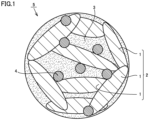
- the negative electrode active material according to "1" above includes a secondary particle.
- the secondary particle In a cross-sectional image of the secondary particle, the secondary particle consists of a central region and a surface layer region.
- the surface layer region surrounds the central region.
- the surface layer region extends 0.25D max from a surface of the secondary particle in a depth direction of the secondary particle.
- the 0.25D max refers to 0.25 times a maximum diameter.
- the maximum diameter refers to a distance between two points located farthest apart from each other on an outline of the secondary particle.
- a closed pore may be formed in at least one of central region 2c and surface layer region 2s.
- the closed pore may be formed so as to belong to both the central region 2c and the surface layer region 2s.
- carbon black 4 may be present in the closed pore.
- the closed pore may be filled with low-crystalline carbon 3.
- the closed pore may be filled with carbon black 4 and low-crystalline carbon 3.
- a closed pore in surface layer region 2s may be filled with carbon black 4 and low-crystalline carbon 3.
- a closed pore in central region 2c may be filled with carbon black 4 and low-crystalline carbon 3.
- Another type of material may be adhered.
- the outer surface of secondary particle 2 may be covered with another type of material.
- This another type of material may include, for example, at least one selected from the group consisting of P, W, Al, and O.
- the another type of material may include, for example, at least one selected from the group consisting of Al(OH) 3 , AlOOH, Al 2 O 3 , WO 3 , Li 2 CO 3 , LiHCO 3 , and Li 3 PO 4 .
- the second negative electrode active material may include a carbon-based active material.
- the second negative electrode active material may include, for example, at least one selected from the group consisting of soft carbon and hard carbon.
- x may satisfy 0.5 ⁇ x ⁇ 1.5 or 0.8 ⁇ x ⁇ 1.2, for example.
- Li silicate may include, for example, at least one selected from the group consisting of Li 4 SiO 4 , Li 2 SiO 3 , Li 2 Si 2 O 5 , and LisSiOe.
- the second negative electrode active material may include a mixture of Si and Li silicate, for example.
- the second negative electrode active material may include a composite material of the carbon-based active material (such as graphite) and the alloy-based active material (such as Si), for example.
- a composite material including Si and carbon may also be called "a Si-C composite material".
- Si microparticles may be dispersed inside carbon particles.
- Si microparticles may be dispersed inside graphite particles.
- Li silicate particles may be covered with a carbon material (such as amorphous carbon).
- the positive electrode active material may be in particle form, for example.
- the positive electrode active material may have a D50 from 1 to 30 ⁇ m, or from 10 to 20 ⁇ m, or from 1 to 10 ⁇ m, for example.
- the positive electrode active material may include any component.
- the positive electrode active material may include a transition metal oxide, a polyanion compound, and/or the like, for example.
- the composition may be uniform, or may be non-uniform. For example, there may be a gradient in the composition from the surface of the particle toward the center.
- the composition may change contiguously, or may change non-contiguously (in steps).
- Transition Metal Oxide (Space Group R-3m)
- the transition metal oxide may have any crystal structure.
- the transition metal oxide may include a crystal structure that belongs to a space group R-3m and/or the like.
- a compound represented by the general formula "LiMO 2 " may have a crystal structure that belongs to a space group R-3m.
- the transition metal oxide may be represented by the following formula (C-1), for example. Li 1-a Ni x M 1-x O 2 ... (C-1)
- x may satisfy the relationship of 0 ⁇ x ⁇ 0.1, 0.1 ⁇ x ⁇ 0.2, 0.2 ⁇ x ⁇ 0.3, 0.3 ⁇ x ⁇ 0.4, 0.4 ⁇ x ⁇ 0.5, 0.5 ⁇ x ⁇ 0.6, 0.6 ⁇ x ⁇ 0.7, 0.7 ⁇ x ⁇ 0.8, 0.8 ⁇ x ⁇ 0.9, or 0.9 ⁇ x ⁇ 1, for example.
- a may satisfy the relationship of -0.4 ⁇ a ⁇ 0.4, - 0.3 ⁇ a ⁇ 0.3, -0.2 ⁇ a ⁇ 0.2, or -0.1 ⁇ a ⁇ 0.1, for example.
- the transition metal oxide may include, for example, at least one selected from the group consisting of LiCoO 2 , LiMnO 2 , LiNi 0.9 Co 0.1 O 2 , LiNi 0.9 Mn 0.1 O 2 , and LiNiO 2 .
- the transition metal oxide may be represented by the following formula (C-2), for example.
- a compound represented by the following formula (C-2) may also be called "NCM”. Li 1-a Ni x Co y Mn 2 O 2 ... (C-2)
- x may satisfy the relationship of 0 ⁇ x ⁇ 0.1, 0.1 ⁇ x ⁇ 0.2, 0.2 ⁇ x ⁇ 0.3, 0.3 ⁇ x ⁇ 0.4, 0.4 ⁇ x ⁇ 0.5, 0.5 ⁇ x ⁇ 0.6, 0.6 ⁇ x ⁇ 0.7, 0.7 ⁇ x ⁇ 0.8, 0.8 ⁇ x ⁇ 0.9, or 0.9 ⁇ x ⁇ 1, for example.
- y may satisfy the relationship of 0 ⁇ y ⁇ 0.1, 0.1 ⁇ y ⁇ 0.2, 0.2 ⁇ y ⁇ 0.3, 0.3 ⁇ y ⁇ 0.4, 0.4 ⁇ y ⁇ 0.5, 0.5 ⁇ y ⁇ 0.6, 0.6 ⁇ y ⁇ 0.7, 0.7 ⁇ y ⁇ 0.8, 0.8 ⁇ y ⁇ 0.9, or 0.9 ⁇ y ⁇ 1, for example.
- z may satisfy the relationship of 0 ⁇ z ⁇ 0.1, 0.1 ⁇ z ⁇ 0.2, 0.2 ⁇ z ⁇ 0.3, 0.3 ⁇ z ⁇ 0.4, 0.4 ⁇ z ⁇ 0.5, 0.5 ⁇ z ⁇ 0.6, 0.6 ⁇ z ⁇ 0.7, 0.7 ⁇ z ⁇ 0.8, 0.8 ⁇ z ⁇ 0.9, or 0.9 ⁇ z ⁇ 1, for example.
- NCM may include, for example, at least one selected from the group consisting of LiNi 1/3 Co 1/3 Mn 1/3 O 2 , LiNi 0.4 Co 0.3 Mn 0.3 O 2 , LiNi 0.3 Co 0.4 Mn 0.3 O 2 , LiNi 0.3 Co 0.3 Mn 0.4 O 2 , LiNi 0.5 Co 0.2 Mn 0.3 O 2 , LiNi 0.5 Co 0.3 Mn 0.2 O 2 , LiNi 0.5 Co 0.4 Mn 0.1 O 2 , LiNi 0.5 Co 0.1 Mn 0.4 O 2 , LiNi 0.6 Co 0.2 Mn 0.2 O 2 , LiNi 0.6 Co 0.3 Mn 0.1 O 2 , LiNi 0.6 Co 0.1 Mn 0.3 O 2 , LiNi 0.6 Co 0.1 Mn 0.3 O 2 , LiNi 0.7 Co 0.1 Mn 0.2 O 2 , LiNi 0.7 Co 0.2 Mn 0.1 O 2 , LiNi 0.8 Co 0.1 Mn 0.1 O 2
- the transition metal oxide may be represented by the following formula (C-3), for example.
- a compound represented by the following formula (C-3) may also be called "NCA”. Li 1-a Ni x Co y Al z O 2 ... (C-3)
- x may satisfy the relationship of 0 ⁇ x ⁇ 0.1, 0.1 ⁇ x ⁇ 0.2, 0.2 ⁇ x ⁇ 0.3, 0.3 ⁇ x ⁇ 0.4, 0.4 ⁇ x ⁇ 0.5, 0.5 ⁇ x ⁇ 0.6, 0.6 ⁇ x ⁇ 0.7, 0.7 ⁇ x ⁇ 0.8, 0.8 ⁇ x ⁇ 0.9, or 0.9 ⁇ x ⁇ 1, for example.
- y may satisfy the relationship of 0 ⁇ y ⁇ 0.1, 0.1 ⁇ y ⁇ 0.2, 0.2 ⁇ y ⁇ 0.3, 0.3 ⁇ y ⁇ 0.4, 0.4 ⁇ y ⁇ 0.5, 0.5 ⁇ y ⁇ 0.6, 0.6 ⁇ y ⁇ 0.7, 0.7 ⁇ y ⁇ 0.8, 0.8 ⁇ y ⁇ 0.9, or 0.9 ⁇ y ⁇ 1, for example.
- z may satisfy the relationship of 0 ⁇ z ⁇ 0.1, 0.1 ⁇ z ⁇ 0.2, 0.2 ⁇ z ⁇ 0.3, 0.3 ⁇ z ⁇ 0.4, 0.4 ⁇ z ⁇ 0.5, 0.5 ⁇ z ⁇ 0.6, 0.6 ⁇ z ⁇ 0.7, 0.7 ⁇ z ⁇ 0.8, 0.8 ⁇ z ⁇ 0.9, or 0.9 ⁇ z ⁇ 1, for example.
- NCA may include, for example, at least one selected from the group consisting of LiNi 0.7 Co 0.1 Al 0.2 O 2 , LiNi 0.7 Co 0.2 Al 0.1 O 2 , LiNi 0.8 Co 0.1 Al 0.1 O 2 , LiNi 0.8 Co 0.17 Al 0.03 O 2 , LiNi 0.8 Co 0.15 Al 0.05 O 2 , and LiNi 0.9 Co 0.05 Al 0.05 O 2 .
- the positive electrode active material may include two or more NCMs and/or the like, for example.
- the positive electrode active material may include NCM (0.6 ⁇ x) and NCM (x ⁇ 0.6), for example.
- NCM (0.6 ⁇ x) refers to a compound in which x (Ni ratio) in the above formula (C-2) is 0.6 or more.
- NCM (0.6 ⁇ x) may also be called “a high-nickel material", for example.
- NCM (0.6 ⁇ x) includes LiNi 0.8 Co 0.1 Mn 0.1 O 2 and/or the like, for example.
- NCM(x ⁇ 0.6) refers to a compound in which x (Ni ratio) in the above formula (C-2) is less than 0.6.
- NCM (x ⁇ 0.6) includes LiNi 1/3 Co 1/3 Mn 1/3 O 2 and/or the like, for example.
- the positive electrode active material may include NCA and NCM, for example.
- the Ni ratio may be the same or may be different.
- the Ni ratio of NCA may be more than the Ni ratio of NCM.
- the Ni ratio of NCA may be less than the Ni ratio of NCM.
- Transition Metal Oxide (Space Group C2/m)
- the positive electrode active material may include a mixture of LiMO 2 (space group R-3m) and Li 2 MO 3 (space group C2/m), for example.
- the positive electrode active material may include a solid solution that is formed of LiMO 2 and Li 2 MO 3 (Li 2 MO 3 -LiMO 2 ), and/or the like, for example.
- the transition metal oxide may include a crystal structure that belongs to a space group Fd-3m, and/or the like, for example.
- the transition metal oxide may be represented by, for example, the following formula (C-5): LiMn 2-x M x O 4 ... (C-5) where the relationship of 0 ⁇ x ⁇ 2 is satisfied.
- M may include, for example, at least one selected from the group consisting of Ni, Fe, and Zn.
- LiM 2 O 4 (space group Fd-3m) may include, for example, at least one selected from the group consisting of LiMn 2 O 4 and LiMn 1.5 Ni 0.5 C 4 .
- the positive electrode active material may include a mixture of LiMO 2 (space group R-3m) and LiM 2 O 4 (space group Fd-3m), for example.
- the polyanion compound may include a phosphoric acid salt (such as LiFePO 4 for example), a silicic acid salt, a boric acid salt, and/or the like, for example.
- the polyanion compound may be represented by the following formulae (C-6) to (C-9), for example.
- LiMPO 4 ... (C-6) Li 2-x MPO 4 F ... (C-7)
- M may include, for example, at least one selected from the group consisting of Fe, Mn, and Co.
- the relationship of 0 ⁇ x ⁇ 2 may be satisfied, for example.
- the positive electrode active material may include a mixture of LiMO 2 (space group R-3m) and the polyanion compound, for example.
- the dopant may include, for example, at least one selected from the group consisting of B, C, N, a halogen, Si, Na, Mg, Al, Mn, Co, Cr, Sc, Ti, V, Cu, Zn, Ga, Ge, Se, Sr, Y, Zr, Nb, Mo, In, Pb, Bi, Sb, Sn, W, La, Ce, Pr, Nd, Pm, Sm, Eu, Gd, Tb, Dy, Ho, Er, Tm, Yb, Lu, and an actinoid.
- NCA a combination of "Zr, Mg, W, Sm", a combination of "Ti, Mn, Nb, Si, Mo", or a combination of "Er, Mg” may be added.
- Ti may be added.
- a combination of "Zr, W", a combination of "Si, W”, or a combination of "Zr, W, Al, Ti, Co" may be added.
- Positive electrode 10 may include a composite particle.
- the composite particle includes a core particle and a covering layer.
- the core particle includes a positive electrode active material.
- the covering layer covers at least part of the surface of the core particle.
- the covering layer may have a thickness from 1 to 3000 nm, or from 5 to 2000 nm, or from 10 to 1000 nm, or from 10 to 100 nm, or from 10 to 50 nm, for example.
- the thickness of the covering layer may be measured in an SEM image of a cross section of the particle, and/or the like, for example.
- the composite particle is embedded in a resin material to prepare a sample. With the use of an ion milling apparatus, a cross section of the sample is exposed.
- an ion milling apparatus with the trade name "ArBlade (registered trademark) 5000" manufactured by Hitachi High-Technologies (or a similar product) may be used.
- the cross section of the sample is examined by an SEM.
- an SEM apparatus with the trade name "SU8030” manufactured by Hitachi High-Technologies (or a similar product) may be used.
- the thickness of the covering layer is measured in twenty fields of view. The arithmetic mean of a total of 200 thickness measurements is used.
- the ratio of the part of the surface of the core particle covered by the covering layer is also called "a covering rate".
- the covering rate may be 1% or more, or 10% or more, or 30% or more, or 50% or more, or 70% or more, for example.
- the covering rate may be 100% or less, or 90% or less, or 80% or less, for example.
- the covering rate may be measured by XPS (X-ray Photoelectron Spectroscopy).
- XPS X-ray Photoelectron Spectroscopy
- an XPS apparatus with the trade name "PHI X-tool" manufactured by ULVAC-PHI (or a similar product) may be used.
- a sample powder consisting of the composite particle is loaded in the XPS apparatus.
- Narrow scan analysis is carried out.
- the measurement data is processed with an analysis software.
- an analysis software with the trade name "MulTiPak” manufactured by ULVAC-PHI (or a similar product) may be used.
- the measurement data is analyzed to detect a plurality of types of elements. From the area of each peak, the ratio of the detected element is determined.
- I 0 represents the total ratio of the elements "Ni, Co, Mn".
- I 0 represents the total ratio of the elements "Ni, Co, Al”.
- I 1 represents the total ratio of the elements "P, B”.
- the covering layer may include any component.
- the covering layer may include an elementary substance, organic matter, an inorganic acid salt, an organic acid salt, a hydroxide, an oxide, a carbide, a nitride, a sulfide, a halide, and/or the like, for example.
- the covering layer may include, for example, at least one selected from the group consisting of B, Al, W, Zr, Ti, Co, F, lithium compound (such as Li 2 CO 3 , LiHCO 3 , LiOH, Li 2 O, for example), tungsten oxide (such as WO 3 , for example), titanium oxide (such as TiO 2 , for example), zirconium oxide (such as ZrO 2 , for example), boron oxide, boron phosphate (such as BPO 4 , for example), aluminum oxide (such as Al 2 O 3 , for example), boehmite, aluminum hydroxide, phosphoric acid salt [such as Li 3 PO 4 , (NH 4 ) 3 PO 4 , AlPO 4 , for example], boric acid salt (such as Li 2 B 4 O 7 , LiBO 3 , for example), polyacrylic acid salt (such as Li salt, Na salt, NH 4 salt), acetic acid salt (such as Li salt, for example), CMC (such as CMC-Na, CMC
- “Hollow particle” refers to a secondary particle in which, in a cross-sectional image thereof, the proportion of the area of the central cavity is 30% or more of the entire cross-sectional area of the particle.
- the proportion of the cavity in a hollow particle may be 40% or more, or 50% or more, or 60% or more, for example.
- Solid particle refers to a secondary particle in which, in a cross-sectional image of the particle, the proportion of the area of the central cavity is less than 30% of the entire cross-sectional area of the particle.
- the proportion of the cavity in a solid particle may be 20% or less, or 10% or less, or 5% or less, for example.
- the positive electrode active material may be hollow particles, or may be solid particles. A mixture of hollow particles and solid particles may be used.
- Electrode active material collectively refers to a positive electrode active material and a negative electrode active material.
- the electrode active material may have a unimodal particle size distribution (based on the number), for example.
- the electrode active material may have a multimodal particle size distribution, for example.
- the electrode active material may have a bimodal particle size distribution, for example. That is, the electrode active material may include large particles and small particles.
- the particle size distribution is bimodal, the particle size corresponding to the peak top of the larger particle size is regarded as the particle size of the large particles (d L ).
- the particle size corresponding to the peak top of the smaller particle size is regarded as the particle size of the small particles (ds).
- the particle size ratio (d L /d S ) may be from 2 to 10, or from 2 to 5, or from 2 to 4, for example.
- d L may be from 8 to 20 ⁇ m, or from 8 to 15 ⁇ m, for example.
- d S may be from 1 to 10 ⁇ m, or from 1 to 5 ⁇ m, for example.
- peak separating processing may be carried out for the particle size distribution.
- the ratio of the D50 of the large particles to the D50 of the small particles may be from 2 to 10, or from 2 to 5, or from 2 to 4, for example.
- the electrolyte is a Li-ion conductor.
- the electrolyte may be a liquid electrolyte, a gelled electrolyte, or a solid electrolyte.
- the concentration of the solute may be from 0.5 to 1 mol/L, or from 1 to 1.5 mol/L, or from 1.5 to 2 mol/L, or from 2 to 2.5 mol/L, or from 2.5 to 3 mol/L, for example.
- the solute includes a supporting salt (a Li salt).
- the solute may include an inorganic acid salt, an imide salt, an oxalato complex, a halide, and/or the like, for example.
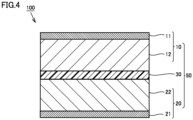
- Separator 30 may include an organic particle layer, for example. Separator 30 may include an organic particle layer instead of the resin film, for example. Separator 30 may include an organic particle layer instead of the inorganic particle layer, for example. Separator 30 may include both the resin film and an organic particle layer. Separator 30 may include both the inorganic particle layer and an organic particle layer. Separator 30 may include the resin film, the inorganic particle layer, and an organic particle layer.
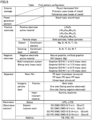
- Fig. 8 is a table showing sample configuration and evaluation results.
- negative electrode active materials according to Nos. 1 to 10 as well as batteries were produced.
- the negative electrode active material according to No. 1 may be simply referred to as "No. 1", for example.
- the resulting secondary particle was subjected to heat treatment in an argon atmosphere, and thereby the precursor was converted into low-crystalline carbon.
- the treatment temperature was 1000°C, and the treatment duration was 1 hour.
- the resulting negative electrode active material was produced.
- the resulting negative electrode active material contained 0.1% carbon black and 3% low-crystalline carbon in mass fraction, with the remainder being made up of graphite.
- a negative electrode active material was produced in the same manner as in the case of No. 1 except that the amount of carbon black was changed so as to achieve the carbon black mass fraction in the negative electrode active material specified in Fig. 8 .
- a negative electrode active material was produced in the same manner as in the case of No. 1 except that the amount of the precursor was changed so as to achieve the low-crystalline carbon mass fraction in the negative electrode active material specified in Fig. 8 .
- a negative electrode active material was produced in the same manner as in the case of No. 1 except that a precursor having the softening point specified in Fig. 8 was used.
- the resulting secondary particle and carbon black were mixed to form a mixture.
- the resulting mixture was subjected to heat treatment in an argon atmosphere, and thereby the precursor was converted into low-crystalline carbon.
- the treatment temperature was 1000°C, and the treatment duration was 1 hour.
- the resulting negative electrode active material was produced.
- the resulting negative electrode active material contained 2% carbon black and 3% low-crystalline carbon in mass fraction, with the remainder being made up of graphite. It is conceivable that carbon black was adhered to the outer surface of the secondary particle.
- Batteries for evaluation purposes that included the negative electrode active materials according to Nos. 1 to 10 were produced. Charge-discharge cycle testing was carried out to evaluate capacity degradation.
- the configuration of the evaluation batteries were as described below.
- Electrolyte (Electrolyte Solution)
- a positive electrode paste is applied to the surface of the positive electrode current collector to form a positive electrode active material layer.
- the resulting positive electrode active material layer is pressed, and thereby a positive electrode is produced.
- a negative electrode paste is applied to the surface of the negative electrode current collector to form a negative electrode active material layer.
- the resulting negative electrode active material layer is pressed, and thereby a negative electrode is produced.
- the positive electrode, the separator, and the negative electrode are stacked in this order to form a stack.
- the resulting stack is spirally wound to form a power generation element (an electrode group).
- a prismatic case is prepared. Within the exterior package, the power generation element is placed. The power generation element is electrically connected to a terminal.
- the electrolyte solution is injected into the exterior package. After the electrolyte solution is injected, the exterior package is hermetically sealed.
- the battery After impregnation with the electrolyte solution, the battery is charged to a predetermined capacity. After charging, in an environment at 60°C, the battery is stored for a predetermined period of time.
- discharged capacity was measured.
- the discharged capacity before the charge-discharge cycle testing is the initial capacity.
- the discharged capacity after the charge-discharge cycle testing is the post-cycle capacity.
- the post-cycle capacity was divided by the initial capacity to determine capacity retention. The capacity retention is expressed in percentage. The higher the capacity retention is, the more reduced the capacity degradation is considered to be.
- Nos. 1 to 8 exhibited higher capacity retention than No. 9 (see Fig. 8 ).
- No. 9 does not include carbon black.
- Nos. 1 to 8 exhibited higher capacity retention than No. 10 (see Fig. 8 ). It is conceivable that carbon black is not present inside the secondary particle in No. 10.
Landscapes
- Chemical & Material Sciences (AREA)
- Electrochemistry (AREA)
- General Chemical & Material Sciences (AREA)
- Chemical Kinetics & Catalysis (AREA)
- Composite Materials (AREA)
- Inorganic Chemistry (AREA)
- Engineering & Computer Science (AREA)
- Organic Chemistry (AREA)
- Manufacturing & Machinery (AREA)
- Life Sciences & Earth Sciences (AREA)
- General Life Sciences & Earth Sciences (AREA)
- Geology (AREA)
- Materials Engineering (AREA)
- Physics & Mathematics (AREA)
- Thermal Sciences (AREA)
- Battery Electrode And Active Subsutance (AREA)
- Carbon And Carbon Compounds (AREA)
Applications Claiming Priority (1)
| Application Number | Priority Date | Filing Date | Title |
|---|---|---|---|
| JP2022206304A JP7831275B2 (ja) | 2022-12-23 | 2022-12-23 | 負極活物質、非水電解質二次電池、および負極活物質の製造方法 |
Publications (1)
| Publication Number | Publication Date |
|---|---|
| EP4397620A1 true EP4397620A1 (de) | 2024-07-10 |
Family
ID=88920860
Family Applications (1)
| Application Number | Title | Priority Date | Filing Date |
|---|---|---|---|
| EP23211314.2A Pending EP4397620A1 (de) | 2022-12-23 | 2023-11-21 | Negativelektrodenaktivmaterial, sekundärbatterie mit wasserfreiem elektrolyt und verfahren zur herstellung eines negativelektrodenaktivmaterials |
Country Status (5)
| Country | Link |
|---|---|
| US (1) | US20240222627A1 (de) |
| EP (1) | EP4397620A1 (de) |
| JP (1) | JP7831275B2 (de) |
| KR (1) | KR20240101486A (de) |
| CN (1) | CN118248848A (de) |
Families Citing this family (1)
| Publication number | Priority date | Publication date | Assignee | Title |
|---|---|---|---|---|
| CN119890410B (zh) * | 2025-01-06 | 2025-09-16 | 宁德时代新能源科技股份有限公司 | 锂离子二次电池、用电装置 |
Citations (5)
| Publication number | Priority date | Publication date | Assignee | Title |
|---|---|---|---|---|
| JP2020043069A (ja) | 2018-09-07 | 2020-03-19 | 三星エスディアイ株式会社Samsung SDI Co., Ltd. | リチウム二次電池用負極活物質、その製造方法、これを含む負極およびこれを含むリチウム二次電池 |
| US20210028441A1 (en) * | 2018-03-28 | 2021-01-28 | Hitachi Chemical Company, Ltd. | Negative electrode material for lithium ion secondary battery, negative electrode material slurry for lithium ion secondary battery, negative electrode for lithium ion secondary battery, and lithium ion secondary battery |
| EP4007015A1 (de) * | 2019-07-31 | 2022-06-01 | Showa Denko Materials Co., Ltd. | Verfahren zur herstellung von negativenm elektrodenmaterial für lithium-ionen-sekundärbatterie und verfahren zur herstellung einer lithium-ionen-sekundärbatterie |
| EP4007016A1 (de) * | 2019-07-31 | 2022-06-01 | Showa Denko Materials Co., Ltd. | Verfahren zur herstellung von negativem elektrodenmaterial für lithium-ionen-sekundärbatterien und verfahren zur herstellung einer lithium-ionen-sekundärbatterie |
| US20220285684A1 (en) * | 2019-07-31 | 2022-09-08 | Showa Denko Materials Co., Ltd. | Negative electrode material for lithium ion secondary battery, negative electrode for lithium ion secondary battery, and lithium ion secondary battery |
Family Cites Families (2)
| Publication number | Priority date | Publication date | Assignee | Title |
|---|---|---|---|---|
| JP4040381B2 (ja) | 2002-07-30 | 2008-01-30 | Jfeケミカル株式会社 | 複合黒鉛質粒子およびその製造方法ならびにリチウムイオン二次電池用負極およびリチウムイオン二次電池 |
| JP6655352B2 (ja) | 2015-10-29 | 2020-02-26 | イビデン株式会社 | 蓄電デバイスの負極用炭素材料の製造方法及び蓄電デバイスの負極用炭素材料 |
-
2022
- 2022-12-23 JP JP2022206304A patent/JP7831275B2/ja active Active
-
2023
- 2023-11-17 US US18/512,326 patent/US20240222627A1/en active Pending
- 2023-11-21 EP EP23211314.2A patent/EP4397620A1/de active Pending
- 2023-12-21 CN CN202311776123.XA patent/CN118248848A/zh active Pending
- 2023-12-22 KR KR1020230190132A patent/KR20240101486A/ko active Pending
Patent Citations (5)
| Publication number | Priority date | Publication date | Assignee | Title |
|---|---|---|---|---|
| US20210028441A1 (en) * | 2018-03-28 | 2021-01-28 | Hitachi Chemical Company, Ltd. | Negative electrode material for lithium ion secondary battery, negative electrode material slurry for lithium ion secondary battery, negative electrode for lithium ion secondary battery, and lithium ion secondary battery |
| JP2020043069A (ja) | 2018-09-07 | 2020-03-19 | 三星エスディアイ株式会社Samsung SDI Co., Ltd. | リチウム二次電池用負極活物質、その製造方法、これを含む負極およびこれを含むリチウム二次電池 |
| EP4007015A1 (de) * | 2019-07-31 | 2022-06-01 | Showa Denko Materials Co., Ltd. | Verfahren zur herstellung von negativenm elektrodenmaterial für lithium-ionen-sekundärbatterie und verfahren zur herstellung einer lithium-ionen-sekundärbatterie |
| EP4007016A1 (de) * | 2019-07-31 | 2022-06-01 | Showa Denko Materials Co., Ltd. | Verfahren zur herstellung von negativem elektrodenmaterial für lithium-ionen-sekundärbatterien und verfahren zur herstellung einer lithium-ionen-sekundärbatterie |
| US20220285684A1 (en) * | 2019-07-31 | 2022-09-08 | Showa Denko Materials Co., Ltd. | Negative electrode material for lithium ion secondary battery, negative electrode for lithium ion secondary battery, and lithium ion secondary battery |
Also Published As
| Publication number | Publication date |
|---|---|
| JP7831275B2 (ja) | 2026-03-17 |
| CN118248848A (zh) | 2024-06-25 |
| JP2024090408A (ja) | 2024-07-04 |
| KR20240101486A (ko) | 2024-07-02 |
| US20240222627A1 (en) | 2024-07-04 |
Similar Documents
| Publication | Publication Date | Title |
|---|---|---|
| JP7232353B2 (ja) | 再充電可能なバッテリーセル | |
| KR101618371B1 (ko) | 비수계 전해액 및 그것을 사용한 비수계 전해액 이차 전지 | |
| EP2958181B1 (de) | Nichtwässrige elektrolytlösung und sekundärbatterie mit nichtwässrigem elektrolyten | |
| JP2024510336A (ja) | 正極活物質並びにそれを用いた電気化学装置及び電子装置 | |
| JP2020087690A (ja) | 非水電解液電池用電解液及びそれを用いた非水電解液電池 | |
| EP4397620A1 (de) | Negativelektrodenaktivmaterial, sekundärbatterie mit wasserfreiem elektrolyt und verfahren zur herstellung eines negativelektrodenaktivmaterials | |
| WO2019111958A1 (ja) | 非水電解液電池用電解液及びそれを用いた非水電解液電池 | |
| EP4428937A1 (de) | Lithium-metall-negativelektroden-sekundärbatterie | |
| CN103828117A (zh) | 用于锂二次电池的电解质和包含所述电解质的锂二次电池 | |
| CN103828118A (zh) | 用于锂二次电池的电解质和包含所述电解质的锂二次电池 | |
| EP4365974A2 (de) | Lithium-metall-sekundärbatterie und verfahren zum laden und entladen davon | |
| EP4418342A1 (de) | Sekundärbatterie mit nichtwässrigem elektrolyten | |
| US20250046804A1 (en) | Positive electrode active material particle, positive electrode, and lithium-ion battery | |
| US20250140853A1 (en) | Electrode for Battery and Battery | |
| EP4428939A1 (de) | Negativelektrode und sekundärbatterie mit nichtwässrigem elektrolyt | |
| EP4418391A1 (de) | Lithium-metall-negativelektroden-sekundärbatterie | |
| KR102865143B1 (ko) | 리튬 이온 전지 | |
| US20250125343A1 (en) | Electrode for battery, battery, and method of producing electrode for battery | |
| US20250372642A1 (en) | Positive Electrode Active Material, Secondary Battery, and Method of Producing Positive Electrode Active Material | |
| EP4391096A2 (de) | Elektrodenstromkollektor, bipolare batterie, festkörperbatterie und verfahren zur herstellung des elektrodenstromkollektors | |
| US20250174708A1 (en) | Lithium secondary battery | |
| EP4418343A1 (de) | Lithium-metall-negativelektroden-sekundärbatterie | |
| US20240405256A1 (en) | Lithium Metal Secondary Battery | |
| EP4428950A1 (de) | Negativ-aktivmaterial-verbundstoff für eine wiederaufladbare lithiumbatterie, herstellungsverfahren dafür, negativelektrode damit und wiederaufladbare lithiumbatterie damit | |
| US20250372641A1 (en) | Positive Electrode Active Material, Secondary Battery, and Method of Producing Positive Electrode Active Material |
Legal Events
| Date | Code | Title | Description |
|---|---|---|---|
| PUAI | Public reference made under article 153(3) epc to a published international application that has entered the european phase |
Free format text: ORIGINAL CODE: 0009012 |
|
| STAA | Information on the status of an ep patent application or granted ep patent |
Free format text: STATUS: REQUEST FOR EXAMINATION WAS MADE |
|
| 17P | Request for examination filed |
Effective date: 20231207 |
|
| AK | Designated contracting states |
Kind code of ref document: A1 Designated state(s): AL AT BE BG CH CY CZ DE DK EE ES FI FR GB GR HR HU IE IS IT LI LT LU LV MC ME MK MT NL NO PL PT RO RS SE SI SK SM TR |