EP4397712A1 - Composition moussante, mousse biodégradable et son procédé de préparation - Google Patents
Composition moussante, mousse biodégradable et son procédé de préparation Download PDFInfo
- Publication number
- EP4397712A1 EP4397712A1 EP22865049.5A EP22865049A EP4397712A1 EP 4397712 A1 EP4397712 A1 EP 4397712A1 EP 22865049 A EP22865049 A EP 22865049A EP 4397712 A1 EP4397712 A1 EP 4397712A1
- Authority
- EP
- European Patent Office
- Prior art keywords
- resin
- weight
- pha
- foaming
- biodegradable
- Prior art date
- Legal status (The legal status is an assumption and is not a legal conclusion. Google has not performed a legal analysis and makes no representation as to the accuracy of the status listed.)
- Pending
Links
Images



Classifications
-
- C—CHEMISTRY; METALLURGY
- C08—ORGANIC MACROMOLECULAR COMPOUNDS; THEIR PREPARATION OR CHEMICAL WORKING-UP; COMPOSITIONS BASED THEREON
- C08J—WORKING-UP; GENERAL PROCESSES OF COMPOUNDING; AFTER-TREATMENT NOT COVERED BY SUBCLASSES C08B, C08C, C08F, C08G or C08H
- C08J9/00—Working-up of macromolecular substances to porous or cellular articles or materials; After-treatment thereof
- C08J9/04—Working-up of macromolecular substances to porous or cellular articles or materials; After-treatment thereof using blowing gases generated by a previously added blowing agent
- C08J9/12—Working-up of macromolecular substances to porous or cellular articles or materials; After-treatment thereof using blowing gases generated by a previously added blowing agent by a physical blowing agent
-
- C—CHEMISTRY; METALLURGY
- C08—ORGANIC MACROMOLECULAR COMPOUNDS; THEIR PREPARATION OR CHEMICAL WORKING-UP; COMPOSITIONS BASED THEREON
- C08J—WORKING-UP; GENERAL PROCESSES OF COMPOUNDING; AFTER-TREATMENT NOT COVERED BY SUBCLASSES C08B, C08C, C08F, C08G or C08H
- C08J9/00—Working-up of macromolecular substances to porous or cellular articles or materials; After-treatment thereof
- C08J9/04—Working-up of macromolecular substances to porous or cellular articles or materials; After-treatment thereof using blowing gases generated by a previously added blowing agent
- C08J9/12—Working-up of macromolecular substances to porous or cellular articles or materials; After-treatment thereof using blowing gases generated by a previously added blowing agent by a physical blowing agent
- C08J9/122—Hydrogen, oxygen, CO2, nitrogen or noble gases
-
- C—CHEMISTRY; METALLURGY
- C08—ORGANIC MACROMOLECULAR COMPOUNDS; THEIR PREPARATION OR CHEMICAL WORKING-UP; COMPOSITIONS BASED THEREON
- C08J—WORKING-UP; GENERAL PROCESSES OF COMPOUNDING; AFTER-TREATMENT NOT COVERED BY SUBCLASSES C08B, C08C, C08F, C08G or C08H
- C08J9/00—Working-up of macromolecular substances to porous or cellular articles or materials; After-treatment thereof
-
- C—CHEMISTRY; METALLURGY
- C08—ORGANIC MACROMOLECULAR COMPOUNDS; THEIR PREPARATION OR CHEMICAL WORKING-UP; COMPOSITIONS BASED THEREON
- C08J—WORKING-UP; GENERAL PROCESSES OF COMPOUNDING; AFTER-TREATMENT NOT COVERED BY SUBCLASSES C08B, C08C, C08F, C08G or C08H
- C08J9/00—Working-up of macromolecular substances to porous or cellular articles or materials; After-treatment thereof
- C08J9/0014—Use of organic additives
- C08J9/0023—Use of organic additives containing oxygen
-
- C—CHEMISTRY; METALLURGY
- C08—ORGANIC MACROMOLECULAR COMPOUNDS; THEIR PREPARATION OR CHEMICAL WORKING-UP; COMPOSITIONS BASED THEREON
- C08J—WORKING-UP; GENERAL PROCESSES OF COMPOUNDING; AFTER-TREATMENT NOT COVERED BY SUBCLASSES C08B, C08C, C08F, C08G or C08H
- C08J9/00—Working-up of macromolecular substances to porous or cellular articles or materials; After-treatment thereof
- C08J9/0061—Working-up of macromolecular substances to porous or cellular articles or materials; After-treatment thereof characterized by the use of several polymeric components
-
- C—CHEMISTRY; METALLURGY
- C08—ORGANIC MACROMOLECULAR COMPOUNDS; THEIR PREPARATION OR CHEMICAL WORKING-UP; COMPOSITIONS BASED THEREON
- C08J—WORKING-UP; GENERAL PROCESSES OF COMPOUNDING; AFTER-TREATMENT NOT COVERED BY SUBCLASSES C08B, C08C, C08F, C08G or C08H
- C08J9/00—Working-up of macromolecular substances to porous or cellular articles or materials; After-treatment thereof
- C08J9/04—Working-up of macromolecular substances to porous or cellular articles or materials; After-treatment thereof using blowing gases generated by a previously added blowing agent
-
- C—CHEMISTRY; METALLURGY
- C08—ORGANIC MACROMOLECULAR COMPOUNDS; THEIR PREPARATION OR CHEMICAL WORKING-UP; COMPOSITIONS BASED THEREON
- C08L—COMPOSITIONS OF MACROMOLECULAR COMPOUNDS
- C08L51/00—Compositions of graft polymers in which the grafted component is obtained by reactions only involving carbon-to-carbon unsaturated bonds; Compositions of derivatives of such polymers
- C08L51/06—Compositions of graft polymers in which the grafted component is obtained by reactions only involving carbon-to-carbon unsaturated bonds; Compositions of derivatives of such polymers grafted on to homopolymers or copolymers of aliphatic hydrocarbons containing only one carbon-to-carbon double bond
-
- C—CHEMISTRY; METALLURGY
- C08—ORGANIC MACROMOLECULAR COMPOUNDS; THEIR PREPARATION OR CHEMICAL WORKING-UP; COMPOSITIONS BASED THEREON
- C08L—COMPOSITIONS OF MACROMOLECULAR COMPOUNDS
- C08L67/00—Compositions of polyesters obtained by reactions forming a carboxylic ester link in the main chain; Compositions of derivatives of such polymers
- C08L67/04—Polyesters derived from hydroxycarboxylic acids, e.g. lactones
-
- C—CHEMISTRY; METALLURGY
- C08—ORGANIC MACROMOLECULAR COMPOUNDS; THEIR PREPARATION OR CHEMICAL WORKING-UP; COMPOSITIONS BASED THEREON
- C08J—WORKING-UP; GENERAL PROCESSES OF COMPOUNDING; AFTER-TREATMENT NOT COVERED BY SUBCLASSES C08B, C08C, C08F, C08G or C08H
- C08J2203/00—Foams characterized by the expanding agent
- C08J2203/06—CO2, N2 or noble gases
-
- C—CHEMISTRY; METALLURGY
- C08—ORGANIC MACROMOLECULAR COMPOUNDS; THEIR PREPARATION OR CHEMICAL WORKING-UP; COMPOSITIONS BASED THEREON
- C08J—WORKING-UP; GENERAL PROCESSES OF COMPOUNDING; AFTER-TREATMENT NOT COVERED BY SUBCLASSES C08B, C08C, C08F, C08G or C08H
- C08J2203/00—Foams characterized by the expanding agent
- C08J2203/08—Supercritical fluid
-
- C—CHEMISTRY; METALLURGY
- C08—ORGANIC MACROMOLECULAR COMPOUNDS; THEIR PREPARATION OR CHEMICAL WORKING-UP; COMPOSITIONS BASED THEREON
- C08J—WORKING-UP; GENERAL PROCESSES OF COMPOUNDING; AFTER-TREATMENT NOT COVERED BY SUBCLASSES C08B, C08C, C08F, C08G or C08H
- C08J2205/00—Foams characterised by their properties
- C08J2205/04—Foams characterised by their properties characterised by the foam pores
- C08J2205/044—Micropores, i.e. average diameter being between 0,1 micrometer and 0,1 millimeter
-
- C—CHEMISTRY; METALLURGY
- C08—ORGANIC MACROMOLECULAR COMPOUNDS; THEIR PREPARATION OR CHEMICAL WORKING-UP; COMPOSITIONS BASED THEREON
- C08J—WORKING-UP; GENERAL PROCESSES OF COMPOUNDING; AFTER-TREATMENT NOT COVERED BY SUBCLASSES C08B, C08C, C08F, C08G or C08H
- C08J2367/00—Characterised by the use of polyesters obtained by reactions forming a carboxylic ester link in the main chain; Derivatives of such polymers
- C08J2367/06—Unsaturated polyesters
-
- C—CHEMISTRY; METALLURGY
- C08—ORGANIC MACROMOLECULAR COMPOUNDS; THEIR PREPARATION OR CHEMICAL WORKING-UP; COMPOSITIONS BASED THEREON
- C08J—WORKING-UP; GENERAL PROCESSES OF COMPOUNDING; AFTER-TREATMENT NOT COVERED BY SUBCLASSES C08B, C08C, C08F, C08G or C08H
- C08J2423/00—Characterised by the use of homopolymers or copolymers of unsaturated aliphatic hydrocarbons having only one carbon-to-carbon double bond; Derivatives of such polymers
- C08J2423/02—Characterised by the use of homopolymers or copolymers of unsaturated aliphatic hydrocarbons having only one carbon-to-carbon double bond; Derivatives of such polymers not modified by chemical after treatment
- C08J2423/10—Homopolymers or copolymers of propene
- C08J2423/12—Polypropene
-
- C—CHEMISTRY; METALLURGY
- C08—ORGANIC MACROMOLECULAR COMPOUNDS; THEIR PREPARATION OR CHEMICAL WORKING-UP; COMPOSITIONS BASED THEREON
- C08J—WORKING-UP; GENERAL PROCESSES OF COMPOUNDING; AFTER-TREATMENT NOT COVERED BY SUBCLASSES C08B, C08C, C08F, C08G or C08H
- C08J2467/00—Characterised by the use of polyesters obtained by reactions forming a carboxylic ester link in the main chain; Derivatives of such polymers
- C08J2467/02—Polyesters derived from dicarboxylic acids and dihydroxy compounds
- C08J2467/03—Polyesters derived from dicarboxylic acids and dihydroxy compounds the dicarboxylic acids and dihydroxy compounds having the hydroxy and the carboxyl groups directly linked to aromatic rings
-
- Y—GENERAL TAGGING OF NEW TECHNOLOGICAL DEVELOPMENTS; GENERAL TAGGING OF CROSS-SECTIONAL TECHNOLOGIES SPANNING OVER SEVERAL SECTIONS OF THE IPC; TECHNICAL SUBJECTS COVERED BY FORMER USPC CROSS-REFERENCE ART COLLECTIONS [XRACs] AND DIGESTS
- Y02—TECHNOLOGIES OR APPLICATIONS FOR MITIGATION OR ADAPTATION AGAINST CLIMATE CHANGE
- Y02W—CLIMATE CHANGE MITIGATION TECHNOLOGIES RELATED TO WASTEWATER TREATMENT OR WASTE MANAGEMENT
- Y02W90/00—Enabling technologies or technologies with a potential or indirect contribution to greenhouse gas [GHG] emissions mitigation
- Y02W90/10—Bio-packaging, e.g. packing containers made from renewable resources or bio-plastics
Definitions
- the present invention relates to a foaming composition, to a biodegradable foam, and to a process for preparing the same.
- Foams are widely used as a cushioning material in the storage or distribution process of various products, including home appliances, and refrigerated/frozen fresh foods.
- plastic foams such as polystyrene or polyvinyl chloride, which have been mainly used in the past, are hardly biodegradable by microorganisms when landfilled, and hazardous substances are emitted when incinerated, thereby causing environmental problems.
- some plastic foams are recycled through separate collection when discarded; however, if part of a cushioning material breaks during the handling process, it flows into rivers and the ocean due to the lightweight nature of the foam, causing various environmental problems.
- biodegradable materials such as aliphatic polyester, starch-based polymer, cellulose acetate, polylactic acid, polycaprolactone, and polybutylene succinate into foamed cushioning materials.
- foams containing a polylactic acid resin as a representative biodegradable material are known.
- a polylactic acid resin may be easily broken due to its lack of moldability, mechanical strength, and thermal resistance and that it has low resistance to temperature, causing deformation in its shape when the external temperature rises to 60°C or higher.
- most biodegradable materials have low biodegradability in the ocean. Thus, the development of biodegradable foams that can resolve these problems is urgently needed.
- an object of the present invention is to provide a foaming composition that is biodegradable and has excellent mechanical, thermal, and processing properties, a biodegradable foam, and a process for preparing the same.
- the present invention provides a foaming composition that comprises a biodegradable resin, wherein the biodegradable resin comprises a polyhydroxyalkanoate (PHA) resin, and the polyhydroxyalkanoate (PHA) resin comprises a 4-hydroxybutyrate (4-HB) repeat unit.
- the biodegradable resin comprises a polyhydroxyalkanoate (PHA) resin
- the polyhydroxyalkanoate (PHA) resin comprises a 4-hydroxybutyrate (4-HB) repeat unit.
- the present invention provides a process for preparing a biodegradable foam that comprises preparing a foaming composition comprising a biodegradable resin; and adding a foaming agent to the foaming composition and performing foaming, wherein the biodegradable resin comprises a polyhydroxyalkanoate (PHA) resin, and the polyhydroxyalkanoate (PHA) resin comprises a 4-hydroxybutyrate (4-HB) repeat unit.
- the biodegradable resin comprises a polyhydroxyalkanoate (PHA) resin
- PHA polyhydroxyalkanoate
- PHA 4-hydroxybutyrate
- the foaming composition according to the present invention comprises a biodegradable polymer comprising a polyhydroxyalkanoate (PHA) resin, whose crystallinity has been adjusted, a foam prepared therefrom has excellent mechanical, thermal, and processing properties and is biodegradable in the ocean.
- PHA polyhydroxyalkanoate
- 10 foaming composition
- 20 biodegradable foam
- 30 temperature controller
- 40 pressure gauge
- 50 pressure controller
- 60 carbon dioxide tank
- the term "comprising" is intended to specify a particular characteristic, region, step, process, element, and/or component. It does not exclude the presence or addition of any other characteristic, region, step, process, element and/or component, unless specifically stated to the contrary.
- the foaming composition according to an embodiment of the present invention comprises a biodegradable resin, wherein the biodegradable resin comprises a polyhydroxyalkanoate (PHA) resin, and the polyhydroxyalkanoate (PHA) resin comprises a 4-hydroxybutyrate (4-HB) repeat unit.
- the biodegradable resin comprises a polyhydroxyalkanoate (PHA) resin
- the polyhydroxyalkanoate (PHA) resin comprises a 4-hydroxybutyrate (4-HB) repeat unit.
- the foaming composition comprises a polyhydroxyalkanoate (PHA) resin as a biodegradable resin.
- PHA polyhydroxyalkanoate
- it may comprise 10% by weight or more, 20% by weight or more, 30% by weight or more, 50% by weight or more, 70% by weight or more, 80% by weight or more, 85% by weight or more, 90% by weight or more, or 95% by weight or more of a PHA resin as a biodegradable resin.
- the foaming composition may comprise 100% by weight of a polyhydroxyalkanoate (PHA) resin as a biodegradable resin.
- the polyhydroxyalkanoate (PHA) resin has physical properties similar to those of conventional petroleum-derived synthetic polymers such as polybutylene adipate terephthalate (PBAT), polybutylene succinate (PBS), polybutylene succinate terephthalate (PBST), and polybutylene succinate adipate (PBSA), exhibits complete biodegradability, and is excellent in biocompatibility.
- PBAT polybutylene adipate terephthalate
- PBS polybutylene succinate
- PBST polybutylene succinate terephthalate
- PBSA polybutylene succinate adipate
- the PHA resin is a natural thermoplastic polyester polymer that accumulates in microbial cells. Since it is a biodegradable material, it can be composted and finally decomposed into carbon dioxide, water, and organic waste without generating toxic waste.
- the PHA resin is biodegradable in soil and sea.
- the biodegradable resin comprises the PHA resin, it is biodegradable under any environmental conditions, such as soil and sea, and has environmentally friendly characteristics.
- an article formed using the biodegradable resin comprising the PHA resin can be used in various fields as an environmentally friendly article.
- the PHA resin may be formed by an enzyme-catalyzed polymerization of one or more monomer repeat units in living cells.
- the PHA resin may be a polyhydroxyalkanoate (PHA) copolymer resin, specifically, a copolymer comprising two or more different repeat units with the different repeat units randomly distributed in the polymer chain.
- PHA polyhydroxyalkanoate
- repeat units that may be contained in the PHA resin include 2-hydroxybutyrate, lactic acid, glycolic acid, 3-hydroxybutyrate (3-HB), 3-hydroxypropionate (3-HP), 3-hydroxyvalerate (3-HV), 3-hydroxyhexanoate (3-HH), 3-hydroxyheptanoate (3-HHep), 3-hydroxyoctanoate (3-HO), 3-hydroxynonanoate (3-HN), 3-hydroxydecanoate (3-HD), 3-hydroxydodecanoate (3-HDd), 4-hydroxybutyrate (4-HB), 4-hydroxyvalerate (4-HV), 5-hydroxyvalerate (5-HV), and 6-hydroxyhexanoate (6-HH).
- the PHA resin may comprise one or more repeat units selected from the above.
- the PHA resin may comprise one or more repeat units selected from the group consisting of 3-HB, 4-HB, 3-HP, 3-HH, 3-HV, 4-HV, 5-HV, and 6-HH.
- the PHA resin comprises a 4-HB repeat unit. That is, the PHA resin may be a PHA copolymer comprising a 4-HB repeat unit.
- the PHA resin may comprise a 4-HB repeat unit and further comprises one or more repeat units selected from the group consisting of a 3-HB repeat unit, a 3-HP repeat unit, a 3-HH repeat unit, a 3-HV repeat unit, a 4-HV repeat unit, a 5-HV repeat unit, and a 6-HH repeat unit.
- the PHA resin may comprise a PHA copolymer resin that comprises one or more repeat units selected from the group consisting of 3-HB, 3-HP, 3-HH, 3-HV, 4-HV, 5-HV, and 6-HH, and a 4-HB repeat unit.
- the PHA resin may be a PHA copolymer resin comprising a 3-HB repeat unit and a 4-HB repeat unit.
- the content of the 4-HB repeat unit in the PHA copolymer may be important.
- the PHA copolymer resin may comprise a 4-HB repeat unit in an amount of 0.1% by weight to 60% by weight based on the total weight of the PHA copolymer resin.
- the content of the 4-HB repeat unit may be 0.1% by weight to 55% by weight, 0.5% by weight to 60% by weight, 0.5% by weight to 55% by weight, 1% by weight to 60% by weight, 1% by weight to 55% by weight, 1% by weight to 50% by weight, 2% by weight to 55% by weight, 3% by weight to 55% by weight, 3% by weight to 50% by weight, 5% by weight to 55% by weight, 5% by weight to 50% by weight, 10% by weight to 55% by weight, 10% by weight to 50% by weight, 1% by weight to 40% by weight, 1% by weight to 30% by weight, 1% by weight to 29% by weight, 1% by weight to 25% by weight, 1% by weight to 24% by weight, 2% by weight to 20% by weight, 2% by weight to 23% by weight, 3% by weight to 20% by weight,
- the PHA copolymer resin may comprise a 4-HB repeat unit in an amount of 0.1% by weight or more, 5% by weight or more, 10% by weight or more, 12% by weight or more, 13% by weight or more, 15% by weight or more, 17% by weight or more, 18% by weight or more, 20% by weight or more, or 25% by weight or more, and 60% by weight or less, 55% by weight or less, 50% by weight or less, 45% by weight or less, 43% by weight or less, 42% by weight or less, 40% by weight or less, or 35% by weight or less, based on the total weight of the PHA copolymer resin, but it is not limited thereto.
- the PHA resin may be a PHA copolymer resin comprising a 4-HB repeat unit in an amount of 0.1 to 60% by weight.
- the content of the 4-HB repeat unit satisfies the above range, the biodegradability in soil and sea may be increased, excellent optical properties may be maintained, the thermal properties of a material may be improved, and mechanical properties such as flexibility and strength may be further enhanced.
- the PHA resin whose crystallinity is adjusted may be one in which its crystallinity and amorphousness are adjusted as the irregularities are increased in its molecular structure. Specifically, the types and ratios of the monomers or the types and/or contents of the isomers may be adjusted.
- the PHA resin may comprise a combination of two or more PHA resins having different crystallinities. That is, the PHA resin may be adjusted to have the content of a 4-HB repeat unit in the specific range by mixing two or more types of PHA resins having different crystallinities.
- the PHA copolymer resin may comprise a 3-HB repeat unit in an amount of 20% by weight or more, 35% by weight or more, 40% by weight or more, 50% by weight or more, 60% by weight or more, 70% by weight or more, or 75% by weight or more, and 99% by weight or less, 98% by weight or less, 97% by weight or less, 96% by weight or less, 95% by weight or less, 93% by weight or less, 91% by weight or less, 90% by weight or less, 80% by weight or less, 70% by weight or less, 60% by weight or less, or 55% by weight or less, based on the total weight of the PHA copolymer resin.
- the PHA resin may have a glass transition temperature (Tg) of, for example, -45°C to 80°C, -35°C to 80°C, -30°C to 80°C, -25°C to 75°C, -20°C to 70°C, - 35°C to 5°C, -25°C to 5°C, -35°C to 0°C, -25°C to 0°C, -30°C to -10°C, -35°C to -15°C, - 35°C to -20°C, -20°C to 0°C, -15°C to 0°C, or -15°C to -5°C.
- Tg glass transition temperature
- the melting temperature (Tm) of the PHA resin may not be measured or may be, for example, 100°C to 170°C, for example, 110°C to 150°C, or, for example, 120°C to 140°C.
- the PHA resin may have a weight average molecular weight (Mw) of, for example, 10,000 g/mole to 1,200,000 g/mole.
- Mw weight average molecular weight
- the weight average molecular weight of the PHA resin may be 50,000 g/mole to 1,200,000 g/mole, 100,000 g/mole to 1,200,000 g/mole, 50,000 g/mole to 1,000,000 g/mole, 100,000 g/mole to 1,000,000 g/mole, 100,000 g/mole to 900,000 g/mole, 200,000 g/mole to 1,200,000 g/mole, 250,000 g/mole to 1,150,000 g/mole, 300,000 g/mole to 1,100,000 g/mole, 350,000 g/mole to 1,000,000 g/mole, 350,000 g/mole to 950,000 g/mole, 100,000 g/mole to 900,000 g/mole, 200,000 g/mole to 800,
- the PHA resin may comprise a first PHA resin, a second PHA resin, or a mixed resin of the first PHA resin and the second PHA resin.
- the first PHA resin and the second PHA resin may be distinguished in terms of the content of a 4-HB repeat unit, glass transition temperature (Tg), crystallization temperature (Tc), and melting temperature (Tm).
- the first PHA may comprise a 4-HB repeat unit in an amount of, for example, 15% by weight to 60% by weight, 15% by weight to 55% by weight, 20% by weight to 55% by weight, 25% by weight to 55% by weight, 30% by weight to 55% by weight, 35% by weight to 55% by weight, 20% by weight to 50% by weight, 25% by weight to 50% by weight, 30% by weight to 50% by weight, 35% by weight to 50% by weight, or 20% by weight to 40% by weight.
- the first PHA resin is mixed with the second PHA resin to be used, the first PHA resin is employed in an amount of, for example, 1 to 50% by weight, for example, 10 to 40% by weight, or, for example, 20 to 40% by weight.
- the chain extender may be employed in an amount of 0.01 to 20% by weight, 0.01 to 15% by weight, 0.01 to 12% by weight, 0.01 to 10% by weight, 0.01 to 8% by weight, 0.01 to 5% by weight, 0.2 to 4.5% by weight, 0.2 to 4% by weight, or 0.5 to 3% by weight, based on the total weight of the foaming composition.
- the foaming composition may comprise additives such as antioxidants, nucleating agents, stabilizers, and compatibilizers.
- the average diameter of cells contained in the biodegradable foam may be 1 ⁇ m or more, 3 ⁇ m or more, 5 ⁇ m or more, 10 ⁇ m or more, 20 ⁇ m or more, 30 ⁇ m or more, 35 ⁇ m or more, 40 ⁇ m or more, or 50 ⁇ m or more, and 250 ⁇ m or less, 230 ⁇ m or less, 220 ⁇ m or less, 190 ⁇ m or less, 120 ⁇ m or less, 100 ⁇ m or less, 90 ⁇ m or less, 80 ⁇ m or less, 70 ⁇ m or less, or 60 ⁇ m or less.
- the average diameter of cells contained in the biodegradable foam may be 3 ⁇ m to 250 ⁇ m.
- the process for preparing a biodegradable foam comprises preparing a foaming composition comprising a biodegradable resin; and adding a foaming agent to the foaming composition and performing foaming, wherein the biodegradable resin comprises a polyhydroxyalkanoate (PHA) resin, and the polyhydroxyalkanoate (PHA) resin comprises a 4-hydroxybutyrate (4-HB) repeat unit.
- the biodegradable resin comprises a polyhydroxyalkanoate (PHA) resin
- PHA polyhydroxyalkanoate
- PHA 4-hydroxybutyrate
- the supercritical foaming may be carried out at a temperature of 90°C to 200°C and a pressure of 50 bar to 150 bar.
- the supercritical foaming may be carried out at a temperature of 110°C to 150°C and a pressure of 70 bar to 120 bar.
- a foam with enhanced expansion ratio, density, and cell size may be obtained.
- the crosslinking agent may be employed in an amount of 0.01 to 20% by weight, 0.01 to 15% by weight, 0.01 to 12% by weight, 0.01 to 10% by weight, 0.01 to 8% by weight, 0.01 to 5% by weight, for example, 0.2 to 4.5% by weight, for example, 0.2 to 4% by weight, or, for example, 0.5 to 3% by weight, based on the total solids weight of the biodegradable resin composition.
- the hindered phenol-based antioxidant may comprise, for example, at least one selected from the group consisting of 4,4'-methylene-bis(2,6-di-t-butylphenol), octadecyl-3-(3,5-di-t-butyl-4-hydroxyphenyl)propionate, pentaerythritol tetrakis[3-(3,5-di-t-butyl-4-hydroxyphenyl)propionate), and 3, 9-bis[2-[3-(3-tert-butyl-4-hydroxy-5 - methylphenyl)propionyloxy]-1,1-dimethylethyl]-2,4,8,10-tetraoxaspiro[5.5]undecane.
- 4,4'-methylene-bis(2,6-di-t-butylphenol) octadecyl-3-(3,5-di-t-butyl-4-hydroxyphenyl)propionate
- the nucleating agent is an additive for supplementing or changing the crystallization morphology of a polymer and for enhancing the crystallization (solidification) rate when a melt of the polymer is cooled.
- the PHA resin used in the present invention has a low crystallization rate, the process may not be readily carried out since stickiness is maintained for a long period of time. If the nucleating agent is used to solve this problem, the crystallization rate can be increased to further enhance the processability, moldability, and productivity, and it is possible to effectively achieve the desired physical properties.
- the nucleating agent may be an elemental substance (pure substance), a metal compound comprising a complex oxide, such as carbon black, calcium carbonate, synthetic silicic acid and salts, silica, zinc white, clay, kaolin, basic magnesium carbonate, mica, talc, quartz powder, diatomite, dolomite powder, titanium oxide, zinc oxide, antimony oxide, barium sulfate, calcium sulfate, alumina, calcium silicate, metal salts of organic phosphorus, and boron nitride; a low molecular weight organic compound having a metal carboxylate group, such as a metal salt of octylic acid, toluic acid, heptanoic acid, pelargonic acid, lauric acid, myristic acid, palmitic acid, stearic acid, behenic acid, cerotic acid, montanic acid, melissic acid,
- a metal carboxylate group such as a metal salt of octylic acid,
- the stabilizer may be employed in an amount of 0.01 to 20% by weight, 0.01 to 15% by weight, 0.01 to 12% by weight, 0.01 to 10% by weight, 0.01 to 8% by weight, 0.01 to 5% by weight, for example, 0.2 to 4.5% by weight, for example, 0.2 to 4% by weight, or, for example, 0.5 to 3% by weight, based on the total solids weight of the biodegradable resin composition. If the content of the stabilizer satisfies the above range, it may be more advantageous for achieving the desired effects of the present invention.
- the compatibilizer is an additive for imparting compatibility by removing heterogeneity between resins. Any commonly used compatibilizer may be used as the compatibilizer as long as the effects of the present invention are not impaired.
- the compatibilizer may comprise at least one selected from the group consisting of polyvinyl acetates (PVAc), isocyanates, polypropylene carbonates, glycidyl methacrylates, ethylene vinyl alcohols, polyvinyl alcohols (PVA), ethylene vinyl acetates, and maleic anhydrides.
- the compatibilizer may be employed in an amount of 0.01 to 20% by weight, 0.01 to 15% by weight, 0.01 to 12% by weight, 0.01 to 10% by weight, 0.01 to 8% by weight, 0.01 to 5% by weight, for example, 0.2 to 4.5% by weight, for example, 0.2 to 4% by weight, or, for example, 0.5 to 3% by weight, based on the total solids weight of the biodegradable resin composition. If the content of the compatibilizer satisfies the above range, the physical properties may be enhanced by increasing the compatibility between the resins used, and it may be more advantageous for achieving the desired effects of the present invention.
- CO 2 gas was injected into the biodegradable resin composition at a temperature of 130°C and a pressure of 90 bar using an autoclave device for CO 2 supercritical foaming, and it was stirred for 30 minutes to diffuse the CO 2 gas.
- the CO 2 gas diffused in the biodegradable resin composition was rapidly lowered to atmospheric pressure to cause the resin composition to expand to obtain a foam.
- Example 2 Preparation of a PLA/PHA blended resin foam
- the biodegradable resin composition was preheated at 180°C for 2 minutes, heat-pressed for 2 minutes using a compression molding machine, and then rapidly cooled in water to produce a film with a thickness of 1 T.
- the film was cut into a square with a size of 5 mm ⁇ 5 mm to prepare a foam sample.
- CO 2 gas was injected into the biodegradable resin composition at a temperature of 130°C and a pressure of 90 bar using an autoclave device for CO 2 supercritical foaming, and it was maintained for 30 minutes to diffuse the CO 2 gas.
- the CO 2 gas diffused in the biodegradable resin composition was rapidly lowered to atmospheric pressure to cause the resin composition to expand to obtain a foam.
- Example 3 Preparation of a PP/PHA blended resin foam
- the biodegradable resin composition was preheated at 180°C for 2 minutes, heat-pressed for 2 minutes using a compression molding machine, and then rapidly cooled in water to produce a film with a thickness of 1 T.
- the film was cut into a square with a size of 5 mm ⁇ 5 mm to prepare a foam sample.
- Test Example 1 Complex viscosity and tan ⁇ of the biodegradable resin composition
- biodegradable resin compositions prepared above were each measured for complex viscosity using the following test equipment, procedures, and conditions.
- Example Complex viscosity (Pa ⁇ s) (at 140°C, 0.1 rad/s)
- Example Complex viscosity (Pa ⁇ s) (at 180°C, 0.1 rad/s) 1-1 945,000 2-1 3,745 1-2 731,200 2-2 1,808 1-3 487,900 2-3 13,180 1-4 556,000 2-4 1,331 1-5 259,600 2-5 5,365 1-6 241,200 2-6 848.1 1-7 164,200 2-7 1,946 1-8 48_340 2-8 7,249
- Example tan ⁇ (at 140°C, 0.1 rad/s)
- Example tan ⁇ (at 180°C, 0.1 rad/s) 1-1 0.8184 2-1 35.38 1-2 0.4346 2-2 3.723 1-3 1.214 2-3 2.341 1-4 0.7061 2-4 4.08 1-5 0.8928 2-5 4.724 1-6 1.363 2-6 4.65 1-7 1.339 2-7 9.719 1-8 6.6
- Test Example 2 Thermal properties of the biodegradable resin composition
- the biodegradable resin compositions prepared above were each measured for glass transition temperature (Tg) and crystallization temperature (Tc) using the following test equipment, procedures, and conditions.
- Example Glass transition temperature (°C) Example Crystallization temperature (°C) 1-1 1.56 1-1 85.36 1-2 -1.31 1-2 85.66 1-3 -3.05 1-3 81.45 1-4 -5.28 1-4 84.09 1-5 -7.70 1-5 92.14 1-6 -9.84 1-6 93.93 1-7 -12.81 1-7 95.06 1-8 -20.70 1-8 -
- Example 2 Each foam was prepared according to the procedure of Example 1 while a PHA10 resin (poly(3-HB-co-4-HB), about 10% by weight of 4-HB, scPHA, CJ CheilJedang) alone was used as a biodegradable resin, and the supercritical foaming temperature was changed to 110°C, 120°C, or 130°C and the pressure to 80 bar, 90 bar, or 100 bar.
- a PHA10 resin poly(3-HB-co-4-HB), about 10% by weight of 4-HB, scPHA, CJ CheilJedang
- the cell shape of the foam thus prepared was observed using the following test equipment.
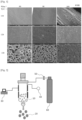
- Fig. 1 The results are shown in Fig. 1 .
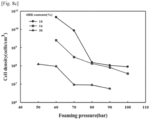
- the foaming temperature during the production of the PHA 10 resin foam was 130°C and the pressure was 90 bar, it was confirmed that the shape of cells in the foam was uniform, and the density of the foam cells was excellent.
- Test Example 5 Evaluation of the foam - density, expansion ratio, and cell diameter
- Example Foam density (g/cm 3 ) Example Foam density (g/cm 3 ) 1-1 0.224333 2-1 0.1303 1-2 0.161233 2-2 0.237633 1-3 0.2472167 2-3 0.096433 1-4 0.1182 2-4 0.8352 1-5 0.441933 2-5 0.865633 1-6 0.563867 1-7 0.761733
- Example Foam expansion ratio (fold) Example Foam expansion ratio (fold) 1-1 5.816267 2-1 9.997 1-2 8.121867 2-2 5.499833 1-3 5.369167 2-3 13.68443 1-4 11.0125 2-4 1.5657 1-5 3.014733 2-5 1.5019 1-6 2.382633 1-7 1.718533
- Example Average diameter of cells ( ⁇ m) Example Average diameter of cells ( ⁇ m) 1-1 52.85716 3-1 50.125 1-2 50.71428 3-2 40.75 1-3 50.5357 3-3 - 1-4 69.42858 3-4
- the PHA copolymer resins used in the tests were purchased from CJ CheilJedang.
- a multifunctional styrene-acrylic oligomer (Joncryl ADR 4370) was used as a chain extender to control the viscoelasticity of the PHA copolymer resin in the supercritical CO 2 foaming process.
- copolymer with a 4-HB content of 10% or 16% was confirmed to be crystalline, and the copolymer with a 4-HB content of 30% or 53.7% was confirmed to be amorphous.
- melt properties and crystal properties changed depending on the content of 4-HB in the PHA copolymer resin and the addition of a chain extender (ADR).
- PHA copolymer resins with different 4-HB contents were each melted at 140°C and 20 rpm for 10 minutes using an internal mixer (Haake, Reomix600, Germany). As a result, samples with identical thermal histories were prepared with minimal thermal degradation. When a chain extender was added at a concentration of 5 phr, melt processing was performed at 180°C, which is a temperature at which the chain extender can react.
- composition sample was heated at 140°C for 2 minutes and then compression molded for 2 minutes with the pressure raised to 8 MPa using a compression molding machine (QMESYS, QM900, Korea). Thereafter, it was cooled with water to obtain a sheet of 150 mm ⁇ 150 mm with a thickness of 1 T. The sheet was cut into pieces of 5 mm ⁇ 5 mm for charging as beads into a foaming reactor.
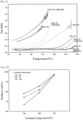
- the tan ⁇ of the PHA copolymer resin was measured for a sheet of 1 mm ⁇ 2.5 mm at 30-140°C and an oscillation frequency of 1 MHz using a dynamic mechanical thermal analyzer (TA, DMA Q800/2980, USA).
- the structure of the PHA copolymer resin foam was evaluated by SEM photographs taken with a scanning electron microscope (SEM S-5200, Hitachi).
- SEM S-5200 a scanning electron microscope
- the density of the composition before foaming (p p ) and the density of the foam after foaming (p f ) were measured, and the expansion ratio ( ⁇ ) was calculated according to the following Equation (1).
- T 0 The thickness of the foam was first measured. It was compressed for 30 minutes to reach 50% of the thickness, and the pressure was released to measure the thickness (T).
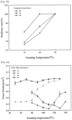
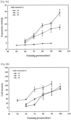
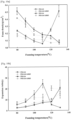
- Figs. 6a and 6b each show the foam density and expansion ratio of PHA copolymer resin foam beads with respect to foaming temperature (foaming pressure of 90 bar). It is understood from Figs. 6a and 6b that the density and expansion of the PHA copolymer resin foam change depending on the foaming temperature, and the temperature for the lowest density and highest expansion ratio differs depending on the 4-HB content.
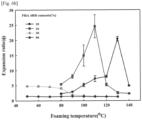
- Figs. 10a and 10b each show the density and expansion ratio of PHA copolymer resin foams with or without the addition of a chain extender.
- foam density and expansion ratio vary depending on whether or not a chain extender is added and also vary depending on the content of 4-HB.
Landscapes
- Chemical & Material Sciences (AREA)
- Health & Medical Sciences (AREA)
- Chemical Kinetics & Catalysis (AREA)
- Medicinal Chemistry (AREA)
- Polymers & Plastics (AREA)
- Organic Chemistry (AREA)
- Engineering & Computer Science (AREA)
- Materials Engineering (AREA)
- Emergency Medicine (AREA)
- Compositions Of Macromolecular Compounds (AREA)
- Biological Depolymerization Polymers (AREA)
- Manufacture Of Porous Articles, And Recovery And Treatment Of Waste Products (AREA)
Applications Claiming Priority (2)
| Application Number | Priority Date | Filing Date | Title |
|---|---|---|---|
| KR20210115994 | 2021-08-31 | ||
| PCT/KR2022/013050 WO2023033547A1 (fr) | 2021-08-31 | 2022-08-31 | Composition moussante, mousse biodégradable et son procédé de préparation |
Publications (2)
| Publication Number | Publication Date |
|---|---|
| EP4397712A1 true EP4397712A1 (fr) | 2024-07-10 |
| EP4397712A4 EP4397712A4 (fr) | 2025-08-06 |
Family
ID=85411382
Family Applications (1)
| Application Number | Title | Priority Date | Filing Date |
|---|---|---|---|
| EP22865049.5A Pending EP4397712A4 (fr) | 2021-08-31 | 2022-08-31 | Composition moussante, mousse biodégradable et son procédé de préparation |
Country Status (7)
| Country | Link |
|---|---|
| US (1) | US20240352211A1 (fr) |
| EP (1) | EP4397712A4 (fr) |
| JP (1) | JP2024532095A (fr) |
| KR (1) | KR20230032981A (fr) |
| CN (1) | CN118215711A (fr) |
| CA (1) | CA3230359A1 (fr) |
| WO (1) | WO2023033547A1 (fr) |
Families Citing this family (6)
| Publication number | Priority date | Publication date | Assignee | Title |
|---|---|---|---|---|
| JP2024121495A (ja) * | 2023-02-27 | 2024-09-06 | 住友化学株式会社 | 発泡用樹脂組成物 |
| CN116144067A (zh) * | 2023-03-14 | 2023-05-23 | 山西省化工研究所(有限公司) | 一种可降解pbat发泡材料的制备方法 |
| CN120225610A (zh) * | 2023-07-28 | 2025-06-27 | 株式会社Lg化学 | 共混树脂组合物及包含该共混树脂组合物的共混膜 |
| WO2025095732A1 (fr) * | 2023-11-03 | 2025-05-08 | 씨제이제일제당(주) | Composition de revêtement et matériau d'emballage fabriqué à l'aide de celle-ci |
| KR20260004794A (ko) | 2024-07-02 | 2026-01-09 | 주식회사 동성케미컬 | 생분해성 발포용 조성물, 이의 생분해성 발포체 및 발포 성형체 |
| CN119775739A (zh) * | 2024-11-28 | 2025-04-08 | 中船鹏力(南京)塑造科技有限公司 | 一种超临界发泡pha/pbat复合材料及其制备方法与应用 |
Family Cites Families (12)
| Publication number | Priority date | Publication date | Assignee | Title |
|---|---|---|---|---|
| AU2006229153A1 (en) * | 2005-03-28 | 2006-10-05 | Toray Industries, Inc. | Polylactic acid foam |
| CN102093683B (zh) * | 2006-08-29 | 2012-07-04 | 天津国韵生物材料有限公司 | 用于发泡材料的含聚羟基丁酸酯共聚物和聚乳酸的组合物 |
| CN1923890A (zh) * | 2006-08-29 | 2007-03-07 | 天津国韵生物科技有限公司 | 用于发泡材料的含聚羟基丁酸酯共聚物和聚乳酸的组合物 |
| AR072204A1 (es) * | 2008-12-02 | 2010-08-11 | Metabolix Inc | Produccion de espuma de polihidroxialcanoato |
| US9505896B2 (en) * | 2011-06-08 | 2016-11-29 | Arkema Inc. | Foaming of thermoplastic materials with organic peroxides |
| CN104379671A (zh) * | 2012-06-05 | 2015-02-25 | 梅塔玻利克斯公司 | 生物基橡胶改性的可生物降解的聚合物共混物 |
| ES2878122T3 (es) * | 2013-08-20 | 2021-11-18 | Tepha Inc | Espumas de celda cerrada que incluyen poli-4-hidroxibutirato y copolímeros del mismo |
| KR101711252B1 (ko) * | 2014-04-15 | 2017-03-02 | (주)엘지하우시스 | 생분해성 고분자 발포체 및 이의 제조방법 |
| CN104448745A (zh) * | 2014-12-23 | 2015-03-25 | 大连工业大学 | 聚(3-羟基丁酸酯-co-4-羟基丁酸酯)发泡材料及其制备方法 |
| CN117844202A (zh) * | 2015-11-17 | 2024-04-09 | Cj第一制糖株式会社 | 具有可控生物降解速率的聚合物共混物 |
| KR102056838B1 (ko) | 2016-09-12 | 2019-12-17 | (주)엘지하우시스 | 생분해성 고분자 발포체 및 그 제조 방법 |
| CN111361079A (zh) * | 2020-04-22 | 2020-07-03 | 江苏聚核高分子功能材料研究院有限公司 | Pla发泡材料的工艺和设备 |
-
2022
- 2022-08-30 KR KR1020220109123A patent/KR20230032981A/ko not_active Withdrawn
- 2022-08-31 EP EP22865049.5A patent/EP4397712A4/fr active Pending
- 2022-08-31 JP JP2024508027A patent/JP2024532095A/ja not_active Withdrawn
- 2022-08-31 WO PCT/KR2022/013050 patent/WO2023033547A1/fr not_active Ceased
- 2022-08-31 CA CA3230359A patent/CA3230359A1/fr active Pending
- 2022-08-31 CN CN202280058660.8A patent/CN118215711A/zh active Pending
- 2022-08-31 US US18/687,739 patent/US20240352211A1/en active Pending
Also Published As
| Publication number | Publication date |
|---|---|
| WO2023033547A1 (fr) | 2023-03-09 |
| EP4397712A4 (fr) | 2025-08-06 |
| KR20230032981A (ko) | 2023-03-07 |
| CA3230359A1 (fr) | 2023-03-09 |
| JP2024532095A (ja) | 2024-09-05 |
| US20240352211A1 (en) | 2024-10-24 |
| CN118215711A (zh) | 2024-06-18 |
Similar Documents
| Publication | Publication Date | Title |
|---|---|---|
| EP4397712A1 (fr) | Composition moussante, mousse biodégradable et son procédé de préparation | |
| KR102740704B1 (ko) | 성형체, 시트 및 용기, 그리고 관상체, 스트로, 면봉 및 풍선용 스틱 | |
| EP2470605B1 (fr) | Compositions durcies de polyhydroxyalcanoate | |
| AU751757B2 (en) | Biodegradable lactone copolymers | |
| KR20110038642A (ko) | 분지형 pha 조성물, 그의 생성 방법 및 적용분야에서의 용도 | |
| CN115803381A (zh) | 脂肪族聚酯系树脂组合物及其应用 | |
| US11859081B2 (en) | Biobased additive for thermoplastic polyesters | |
| EP4397794A1 (fr) | Composition pour fibre biodégradable et fibre biodégradable fabriquée à l'aide de celle-ci | |
| EP4219628A1 (fr) | Composition de résine pour moulage par injection, et corps moulé par injection | |
| EP4628539A1 (fr) | Composition pour film biodégradable, film biodégradable la comprenant, et procédé de fabrication de film biodégradable | |
| KR20230032861A (ko) | 생분해성 섬유용 조성물, 및 이를 이용하여 제조된 생분해성 섬유 | |
| CN114080425A (zh) | 包含ppgdge的高pla含量塑料材料 | |
| EP4606859A1 (fr) | Composition de résine biodégradable pour revêtement par extrusion | |
| US20240239953A1 (en) | Biodegradable films comprising polyhydroxyalkanoates | |
| CN120158050A (zh) | 一种可生物降解组合物及其制备方法 | |
| WO2012025907A1 (fr) | Copolymères à base de polyester et de polycarbonate aromatique | |
| Ali et al. | Characterization of Isotactic Polypropylene and Hydrogenated Oligocyclopentadiene Blends |
Legal Events
| Date | Code | Title | Description |
|---|---|---|---|
| STAA | Information on the status of an ep patent application or granted ep patent |
Free format text: STATUS: THE INTERNATIONAL PUBLICATION HAS BEEN MADE |
|
| PUAI | Public reference made under article 153(3) epc to a published international application that has entered the european phase |
Free format text: ORIGINAL CODE: 0009012 |
|
| STAA | Information on the status of an ep patent application or granted ep patent |
Free format text: STATUS: REQUEST FOR EXAMINATION WAS MADE |
|
| 17P | Request for examination filed |
Effective date: 20240326 |
|
| AK | Designated contracting states |
Kind code of ref document: A1 Designated state(s): AL AT BE BG CH CY CZ DE DK EE ES FI FR GB GR HR HU IE IS IT LI LT LU LV MC MK MT NL NO PL PT RO RS SE SI SK SM TR |
|
| DAV | Request for validation of the european patent (deleted) | ||
| DAX | Request for extension of the european patent (deleted) | ||
| A4 | Supplementary search report drawn up and despatched |
Effective date: 20250709 |
|
| RIC1 | Information provided on ipc code assigned before grant |
Ipc: C08L 67/04 20060101AFI20250703BHEP Ipc: C08L 23/12 20060101ALI20250703BHEP Ipc: C08J 9/00 20060101ALI20250703BHEP Ipc: C08J 9/12 20060101ALI20250703BHEP Ipc: C08J 9/04 20060101ALI20250703BHEP Ipc: C08L 51/06 20060101ALI20250703BHEP |