EP4397877A1 - Joint homocinétique de type tripode - Google Patents
Joint homocinétique de type tripode Download PDFInfo
- Publication number
- EP4397877A1 EP4397877A1 EP22864219.5A EP22864219A EP4397877A1 EP 4397877 A1 EP4397877 A1 EP 4397877A1 EP 22864219 A EP22864219 A EP 22864219A EP 4397877 A1 EP4397877 A1 EP 4397877A1
- Authority
- EP
- European Patent Office
- Prior art keywords
- leg shaft
- axial line
- projection
- peripheral surface
- inner ring
- Prior art date
- Legal status (The legal status is an assumption and is not a legal conclusion. Google has not performed a legal analysis and makes no representation as to the accuracy of the status listed.)
- Pending
Links
Images



Classifications
-
- F—MECHANICAL ENGINEERING; LIGHTING; HEATING; WEAPONS; BLASTING
- F16—ENGINEERING ELEMENTS AND UNITS; GENERAL MEASURES FOR PRODUCING AND MAINTAINING EFFECTIVE FUNCTIONING OF MACHINES OR INSTALLATIONS; THERMAL INSULATION IN GENERAL
- F16D—COUPLINGS FOR TRANSMITTING ROTATION; CLUTCHES; BRAKES
- F16D3/00—Yielding couplings, i.e. with means permitting movement between the connected parts during the drive
- F16D3/16—Universal joints in which flexibility is produced by means of pivots or sliding or rolling connecting parts
- F16D3/20—Universal joints in which flexibility is produced by means of pivots or sliding or rolling connecting parts one coupling part entering a sleeve of the other coupling part and connected thereto by sliding or rolling members
- F16D3/202—Universal joints in which flexibility is produced by means of pivots or sliding or rolling connecting parts one coupling part entering a sleeve of the other coupling part and connected thereto by sliding or rolling members one coupling part having radially projecting pins, e.g. tripod joints
- F16D3/205—Universal joints in which flexibility is produced by means of pivots or sliding or rolling connecting parts one coupling part entering a sleeve of the other coupling part and connected thereto by sliding or rolling members one coupling part having radially projecting pins, e.g. tripod joints the pins extending radially outwardly from the coupling part
- F16D3/2055—Universal joints in which flexibility is produced by means of pivots or sliding or rolling connecting parts one coupling part entering a sleeve of the other coupling part and connected thereto by sliding or rolling members one coupling part having radially projecting pins, e.g. tripod joints the pins extending radially outwardly from the coupling part having three pins, i.e. true tripod joints
-
- Y—GENERAL TAGGING OF NEW TECHNOLOGICAL DEVELOPMENTS; GENERAL TAGGING OF CROSS-SECTIONAL TECHNOLOGIES SPANNING OVER SEVERAL SECTIONS OF THE IPC; TECHNICAL SUBJECTS COVERED BY FORMER USPC CROSS-REFERENCE ART COLLECTIONS [XRACs] AND DIGESTS
- Y10—TECHNICAL SUBJECTS COVERED BY FORMER USPC
- Y10S—TECHNICAL SUBJECTS COVERED BY FORMER USPC CROSS-REFERENCE ART COLLECTIONS [XRACs] AND DIGESTS
- Y10S464/00—Rotary shafts, gudgeons, housings, and flexible couplings for rotary shafts
- Y10S464/904—Homokinetic coupling
- Y10S464/905—Torque transmitted via radially extending pin
Definitions
- the present invention relates to a tripod type constant velocity universal joint used for power transmission of automobiles and various industrial machines.
- a plunging type constant velocity universal joint is coupled to an inboard side (a differential side) of an intermediate shaft, and a fixed type constant velocity universal joint is coupled to an outboard side (a wheel side) in many cases.
- the plunging type constant velocity universal joint herein allows both angular displacement and relative movement in an axial direction between two shafts, and the fixed type constant velocity universal joint allows the angular displacement between two shafts but does not allow the relative movement in the axial direction between the two shafts.
- a tripod type constant velocity universal joint is known as a plunging type constant velocity universal joint.
- the tripod type constant velocity universal joint there are a single roller type and a double roller type.
- a roller inserted into a track groove of an outer joint member is rotatably attached to a leg shaft of a tripod member via a plurality of needle rollers.
- the double roller type includes a roller inserted into a track groove of an outer joint member, and an inner ring externally fitted to a leg shaft of a tripod member to rotatably support the roller (for example, see Patent Literature 1 below).
- the double roller type allows the roller to swing with respect to the leg shaft, and thus, has an advantage that induced thrust (axial force induced by friction between parts inside the joint) and slide resistance can be reduced as compared with the single roller type.
- the inner ring is assembled to the inner periphery of the roller to form a roller unit, and then, the roller unit is externally inserted to the respective leg shafts of the tripod member and assembled to the inner periphery of the outer joint member.
- a functionally necessary gap is provided between the roller unit and the leg shaft. Therefore, there is a possibility that the roller unit may come off the leg shaft when the roller unit and the tripod member are attached to or detached from the outer joint member or when the drive shaft is attached to or detached from the vehicle for assembly or repair.
- a dimension (circumferential width) of a projection in a joint axial line direction is extended up to a region that is conventionally considered not to interfere with the inner ring, and this region interferes with the inner ring when the roller unit is removed from the leg shaft in the state of tilting with respect to the leg shaft. Since the dimension of the projection in the joint axial line direction is increased in consideration of the tilting states of the roller unit and the leg shaft at the time of assembly or repair, or at the time of attaching or detaching the drive shaft to or from the vehicle as described above, an interference region between the projection and the inner ring increases, and a function of preventing the roller unit from coming off the leg shaft is enhanced.
- a projecting amount of the projection is preferably 0.015 to 0.15 mm in the entire area of the projection in the joint axial line direction. Further, a width of the projection in a leg shaft axial line direction is preferably 0.1 to 0.5 mm in the entire area of the projection in the joint axial line direction.
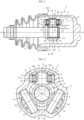
- the tripod member 3 integrally includes a body portion 31 having a central hole 30 and three leg shafts 32 projecting in the radial direction from trisection positions in the circumferential direction of the body portion 31.
- the tripod member 3 is coupled to a shaft 8 as an axis, by fitting a male spline 81 formed on the shaft 8 to a female spline 34 formed in the central hole 30 of the body portion 31 such that a torque can be transmitted.
- One end surface of the tripod member 3 is engaged with a shoulder portion 82 provided on the shaft 8, and a retaining ring 10 mounted on a distal end of the shaft 8 is engaged with another end surface of the tripod member 3, whereby the tripod member 3 is fixed to the shaft 8 in the axial direction.
- the convex curved surface is provided as the inner peripheral surface 12a of the inner ring 12, the cross-sectional shape of the leg shaft 32 is substantially elliptical as described above, and the gap m in the joint axial line O direction is provided between the leg shaft 32 and the inner ring 12, the inner ring 12 can swing with respect to the leg shaft 32. Since the inner ring 12 and the roller 11 are assembled to be relatively rotatable via the needle rollers 13 as described above, the roller 11 can swing with respect to the leg shaft 32 integrally with the inner ring 12. That is, in a plane including the axial line of the leg shaft 32, the axial lines of the roller 11 and the inner ring 12 can tilt with respect to the axial line of the leg shaft 32 (see FIG. 4 ).
- the transverse cross section of the leg shaft 32 is substantially elliptical and the longitudinal cross section of the inner peripheral surface 12a of the inner ring 12 is the arc-shaped convex cross section as described above, the outer peripheral surface of the leg shaft 32 on the torque load side and the inner peripheral surface 12a of the inner ring 12 come into contact with each other in a narrow area close to point contact. Thus, a force to tilt the roller unit 4 is decreased, and stability of a posture of the roller 11 is improved.
- the tripod member 3 is manufactured by using a steel material through main processes such as forging (cold forging) ⁇ machining (turning) ⁇ broaching of the spline 34 ⁇ a heat treatment ⁇ grinding.
- main processes such as forging (cold forging) ⁇ machining (turning) ⁇ broaching of the spline 34 ⁇ a heat treatment ⁇ grinding.
- regions including both end portions in the major axis direction in contact with the inner ring 12 on the outer peripheral surface of the leg shaft 32 are ground.
- both the end portions in the major axis direction of the outer peripheral surface of the leg shaft 32 and the vicinity thereof are ground, and regions therebetween in the circumferential direction are not ground. That is, as illustrated in FIG.
- ground surfaces 32a are formed at both the end portions in the major axis direction of the outer peripheral surface of the leg shaft 32, and the regions therebetween in the circumferential direction are non-ground regions that are not ground.
- the ground surfaces 32a are provided up to a distal end of the outer peripheral surface of the leg shaft 32. The ground surfaces 32a come into contact with the inner peripheral surface 12a of the inner ring 12.
- the projection 40 extends along the circumferential direction of the leg shaft 32.
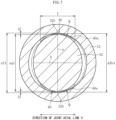
- a ratio T/ag1 between a dimension T of the projection 40 in the joint axial line O direction and a dimension ag1 (that is, a major diameter of the transverse cross section of the leg shaft 32) of the leg shaft 32 in a direction orthogonal to the joint axial line O is 0.3 or more.
- the major diameter ag1 of the leg shaft 32 is 20 mm
- the dimension T of the projection 40 in the joint axial line O direction is 6 mm or more.
- the major diameter ag1 of the leg shaft 32 is measured in a region (the ground surface 32a) in contact with the inner ring 12. Further, the gap between the leg shaft 32 and the inner ring 12 and a projecting amount of the projection 40 are exaggerated in FIG. 7 .
- a projecting amount ⁇ of the projection 40 with respect to a region (the ground surface 32a in the illustrated example) adjacent in the leg shaft axial line P direction is constant in the circumferential direction and is set within a range of 0.015 to 0.15 mm.
- a difference (af1 - ⁇ Ds1) between a circumscribed circle diameter af1 of the projection 40 and a minimum inner diameter ⁇ Ds1 of the inner ring 12 is 0.02 to 0.20 mm.
- a width h (see FIG. 6 ) of the projection 40 in the leg shaft axial line P direction is constant in the circumferential direction and is set within a range of 0. 1 to 0.5 mm.
- the tripod type constant velocity universal joint 1 When the tripod type constant velocity universal joint 1 is assembled or repaired, when the tripod member 3 and the roller unit 4 are attached to or detached from the outer joint member 2, or when a drive shaft is attached to or detached from a vehicle, the inner ring 12 and the projection 40 of the leg shaft 32 interfere with each other, so that the removal of the roller unit 4 from the leg shaft 32 of the tripod member 3 is restricted.
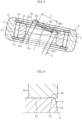
- the leg shaft 32 and the roller unit 4 are hardly disposed coaxially, and are often brought into a state of tilting with respect to each other as illustrated in FIG. 8 .
- a region 40a in the vicinity of one end portion in the circumferential direction of the projection 40 provided on the leg shaft 32 first interferes with the inner periphery of the inner ring 12.
- a cross section (a cross section taken along line Y-Y in FIG.
- the interference region between the projection 40 and the inner ring 12 spreads toward the circumferential central portion of the projection 40. Since the dimension T of the projection 40 in the joint axial line O direction is set to be larger than a conventional one in consideration of the tilting states of the leg shaft 32 and the inner ring 12 as described above, it is possible to widen the interference region between the projection 40 and the inner ring 12 and enhance a retaining force of the roller unit 4 from the leg shaft 32.
- the inner ring 12 is elastically deformed to climb over the projections 40 by pushing the roller unit 4 from the shaft end side of the leg shaft 32.
- the inner ring 12 and the leg shaft 32 are assembled in the state of being disposed coaxially, only the circumferential central portion of the projection 40 of the leg shaft 32 interferes with the inner ring 12, so that it is sufficient that a pushing force of the roller unit 4 is similar with a conventional one. Therefore, the assemblability of the roller unit 4 with respect to the leg shaft 32 is not deteriorated even if a circumferential width of the projection 40 is increased.
- the projection 40 is ground simultaneously with the ground surface 32a as described above, manufacturing cost is reduced as compared with a case where the projection 40 is formed in a separate process. In this case, the projection 40 is provided in the entire circumferential area of the ground surface 32a of the leg shaft 32.
Landscapes
- Engineering & Computer Science (AREA)
- General Engineering & Computer Science (AREA)
- Mechanical Engineering (AREA)
- Shafts, Cranks, Connecting Bars, And Related Bearings (AREA)
- Rolling Contact Bearings (AREA)
Applications Claiming Priority (2)
| Application Number | Priority Date | Filing Date | Title |
|---|---|---|---|
| JP2021143955A JP7233497B1 (ja) | 2021-09-03 | 2021-09-03 | トリポード型等速自在継手 |
| PCT/JP2022/030649 WO2023032634A1 (fr) | 2021-09-03 | 2022-08-10 | Joint homocinétique de type tripode |
Publications (2)
| Publication Number | Publication Date |
|---|---|
| EP4397877A1 true EP4397877A1 (fr) | 2024-07-10 |
| EP4397877A4 EP4397877A4 (fr) | 2024-11-06 |
Family
ID=85412198
Family Applications (1)
| Application Number | Title | Priority Date | Filing Date |
|---|---|---|---|
| EP22864219.5A Pending EP4397877A4 (fr) | 2021-09-03 | 2022-08-10 | Joint homocinétique de type tripode |
Country Status (5)
| Country | Link |
|---|---|
| US (1) | US20250146536A1 (fr) |
| EP (1) | EP4397877A4 (fr) |
| JP (1) | JP7233497B1 (fr) |
| CN (1) | CN117836531A (fr) |
| WO (1) | WO2023032634A1 (fr) |
Family Cites Families (6)
| Publication number | Priority date | Publication date | Assignee | Title |
|---|---|---|---|---|
| JP3599618B2 (ja) | 1999-03-05 | 2004-12-08 | Ntn株式会社 | 等速自在継手 |
| JP3894760B2 (ja) * | 2001-09-26 | 2007-03-22 | Ntn株式会社 | 等速自在継手 |
| TWI298767B (en) * | 2002-10-25 | 2008-07-11 | Ntn Toyo Bearing Co Ltd | Tripod type constant velocity joint |
| JP2008240907A (ja) * | 2007-03-27 | 2008-10-09 | Ntn Corp | 自在継手 |
| JP5020750B2 (ja) * | 2007-09-10 | 2012-09-05 | Ntn株式会社 | トリポード型等速自在継手 |
| JP7088865B2 (ja) * | 2019-02-25 | 2022-06-21 | Ntn株式会社 | トリポード型等速自在継手 |
-
2021
- 2021-09-03 JP JP2021143955A patent/JP7233497B1/ja active Active
-
2022
- 2022-08-10 WO PCT/JP2022/030649 patent/WO2023032634A1/fr not_active Ceased
- 2022-08-10 EP EP22864219.5A patent/EP4397877A4/fr active Pending
- 2022-08-10 CN CN202280057460.0A patent/CN117836531A/zh active Pending
- 2022-08-10 US US18/685,730 patent/US20250146536A1/en active Pending
Also Published As
| Publication number | Publication date |
|---|---|
| EP4397877A4 (fr) | 2024-11-06 |
| WO2023032634A1 (fr) | 2023-03-09 |
| US20250146536A1 (en) | 2025-05-08 |
| CN117836531A (zh) | 2024-04-05 |
| JP2023037302A (ja) | 2023-03-15 |
| JP7233497B1 (ja) | 2023-03-06 |
Similar Documents
| Publication | Publication Date | Title |
|---|---|---|
| US8221249B2 (en) | Universal joint | |
| EP2299134B1 (fr) | Joint homocinétique du type fixe | |
| EP1394430B2 (fr) | Accouplement croise | |
| EP1505308B1 (fr) | Joint homocinétique | |
| EP3904716B1 (fr) | Accouplement homocinétique du type tripode | |
| EP4397877A1 (fr) | Joint homocinétique de type tripode | |
| US20250243909A1 (en) | Tripod-type constant-velocity universal joint | |
| EP4397876B1 (fr) | Joint homocinétique de type tripode | |
| WO2024127915A1 (fr) | Joint universel de type fixe | |
| EP4317732A1 (fr) | Joint homocinétique de type tripode | |
| JPH11336783A (ja) | 等速自在継手 | |
| KR20070025956A (ko) | 트라이포드형 등속 유니버셜 조인트 | |
| JP7750784B2 (ja) | トリポード型等速自在継手 | |
| US20080064509A1 (en) | Fixed Type Constant Velocity Universal Joint | |
| JP2025139922A (ja) | トリポード型等速自在継手 | |
| EP4160031B1 (fr) | Joint homocinétique de type tripode | |
| JP2026053014A (ja) | トリポード型等速自在継手 | |
| JP2025136408A (ja) | 摺動式等速自在継手 | |
| WO2023189289A1 (fr) | Joint homocinétique universel de type tripode | |
| WO2025187210A1 (fr) | Joint tripode homocinétique universel | |
| WO2026058632A1 (fr) | Joint universel homocinétique de type tripode | |
| JP5154199B2 (ja) | トリポード型等速自在継手 | |
| CN118208500A (zh) | 三球销型等速万向联轴器 | |
| JP2025136409A (ja) | 摺動式等速自在継手 | |
| WO2023136094A1 (fr) | Joint homocinétique universel de type tripode |
Legal Events
| Date | Code | Title | Description |
|---|---|---|---|
| STAA | Information on the status of an ep patent application or granted ep patent |
Free format text: STATUS: THE INTERNATIONAL PUBLICATION HAS BEEN MADE |
|
| PUAI | Public reference made under article 153(3) epc to a published international application that has entered the european phase |
Free format text: ORIGINAL CODE: 0009012 |
|
| STAA | Information on the status of an ep patent application or granted ep patent |
Free format text: STATUS: REQUEST FOR EXAMINATION WAS MADE |
|
| 17P | Request for examination filed |
Effective date: 20240322 |
|
| AK | Designated contracting states |
Kind code of ref document: A1 Designated state(s): AL AT BE BG CH CY CZ DE DK EE ES FI FR GB GR HR HU IE IS IT LI LT LU LV MC MK MT NL NO PL PT RO RS SE SI SK SM TR |
|
| A4 | Supplementary search report drawn up and despatched |
Effective date: 20241008 |
|
| RIC1 | Information provided on ipc code assigned before grant |
Ipc: F16D 3/20 20060101ALI20241001BHEP Ipc: F16D 3/205 20060101AFI20241001BHEP |
|
| DAV | Request for validation of the european patent (deleted) | ||
| DAX | Request for extension of the european patent (deleted) |