EP4398034A1 - Schmierung einer substratklemme - Google Patents
Schmierung einer substratklemme Download PDFInfo
- Publication number
- EP4398034A1 EP4398034A1 EP23150754.2A EP23150754A EP4398034A1 EP 4398034 A1 EP4398034 A1 EP 4398034A1 EP 23150754 A EP23150754 A EP 23150754A EP 4398034 A1 EP4398034 A1 EP 4398034A1
- Authority
- EP
- European Patent Office
- Prior art keywords
- substrate
- lubricant
- handling system
- burls
- gas
- Prior art date
- Legal status (The legal status is an assumption and is not a legal conclusion. Google has not performed a legal analysis and makes no representation as to the accuracy of the status listed.)
- Withdrawn
Links
Images

Classifications
-
- G—PHYSICS
- G03—PHOTOGRAPHY; CINEMATOGRAPHY; ANALOGOUS TECHNIQUES USING WAVES OTHER THAN OPTICAL WAVES; ELECTROGRAPHY; HOLOGRAPHY
- G03F—PHOTOMECHANICAL PRODUCTION OF TEXTURED OR PATTERNED SURFACES, e.g. FOR PRINTING, FOR PROCESSING OF SEMICONDUCTOR DEVICES; MATERIALS THEREFOR; ORIGINALS THEREFOR; APPARATUS SPECIALLY ADAPTED THEREFOR
- G03F7/00—Photomechanical, e.g. photolithographic, production of textured or patterned surfaces, e.g. printing surfaces; Materials therefor, e.g. comprising photoresists; Apparatus specially adapted therefor
- G03F7/70—Microphotolithographic exposure; Apparatus therefor
- G03F7/70691—Handling of masks or workpieces
- G03F7/707—Chucks, e.g. chucking or un-chucking operations or structural details
-
- G—PHYSICS
- G03—PHOTOGRAPHY; CINEMATOGRAPHY; ANALOGOUS TECHNIQUES USING WAVES OTHER THAN OPTICAL WAVES; ELECTROGRAPHY; HOLOGRAPHY
- G03F—PHOTOMECHANICAL PRODUCTION OF TEXTURED OR PATTERNED SURFACES, e.g. FOR PRINTING, FOR PROCESSING OF SEMICONDUCTOR DEVICES; MATERIALS THEREFOR; ORIGINALS THEREFOR; APPARATUS SPECIALLY ADAPTED THEREFOR
- G03F7/00—Photomechanical, e.g. photolithographic, production of textured or patterned surfaces, e.g. printing surfaces; Materials therefor, e.g. comprising photoresists; Apparatus specially adapted therefor
- G03F7/70—Microphotolithographic exposure; Apparatus therefor
- G03F7/708—Construction of apparatus, e.g. environment aspects, hygiene aspects or materials
- G03F7/70908—Hygiene, e.g. preventing apparatus pollution, mitigating effect of pollution or removing pollutants from apparatus
- G03F7/70916—Pollution mitigation, i.e. mitigating effect of contamination or debris, e.g. foil traps
-
- H—ELECTRICITY
- H10—SEMICONDUCTOR DEVICES; ELECTRIC SOLID-STATE DEVICES NOT OTHERWISE PROVIDED FOR
- H10P—GENERIC PROCESSES OR APPARATUS FOR THE MANUFACTURE OR TREATMENT OF DEVICES COVERED BY CLASS H10
- H10P72/00—Handling or holding of wafers, substrates or devices during manufacture or treatment thereof
- H10P72/70—Handling or holding of wafers, substrates or devices during manufacture or treatment thereof for supporting or gripping
- H10P72/72—Handling or holding of wafers, substrates or devices during manufacture or treatment thereof for supporting or gripping using electrostatic chucks
-
- H—ELECTRICITY
- H10—SEMICONDUCTOR DEVICES; ELECTRIC SOLID-STATE DEVICES NOT OTHERWISE PROVIDED FOR
- H10P—GENERIC PROCESSES OR APPARATUS FOR THE MANUFACTURE OR TREATMENT OF DEVICES COVERED BY CLASS H10
- H10P72/00—Handling or holding of wafers, substrates or devices during manufacture or treatment thereof
- H10P72/70—Handling or holding of wafers, substrates or devices during manufacture or treatment thereof for supporting or gripping
- H10P72/76—Handling or holding of wafers, substrates or devices during manufacture or treatment thereof for supporting or gripping using mechanical means, e.g. clamps or pinches
- H10P72/7604—Handling or holding of wafers, substrates or devices during manufacture or treatment thereof for supporting or gripping using mechanical means, e.g. clamps or pinches the wafers being placed on a susceptor, stage or support
- H10P72/7612—Handling or holding of wafers, substrates or devices during manufacture or treatment thereof for supporting or gripping using mechanical means, e.g. clamps or pinches the wafers being placed on a susceptor, stage or support characterised by lifting arrangements, e.g. lift pins
-
- H—ELECTRICITY
- H10—SEMICONDUCTOR DEVICES; ELECTRIC SOLID-STATE DEVICES NOT OTHERWISE PROVIDED FOR
- H10P—GENERIC PROCESSES OR APPARATUS FOR THE MANUFACTURE OR TREATMENT OF DEVICES COVERED BY CLASS H10
- H10P72/00—Handling or holding of wafers, substrates or devices during manufacture or treatment thereof
- H10P72/70—Handling or holding of wafers, substrates or devices during manufacture or treatment thereof for supporting or gripping
- H10P72/76—Handling or holding of wafers, substrates or devices during manufacture or treatment thereof for supporting or gripping using mechanical means, e.g. clamps or pinches
- H10P72/7604—Handling or holding of wafers, substrates or devices during manufacture or treatment thereof for supporting or gripping using mechanical means, e.g. clamps or pinches the wafers being placed on a susceptor, stage or support
- H10P72/7614—Handling or holding of wafers, substrates or devices during manufacture or treatment thereof for supporting or gripping using mechanical means, e.g. clamps or pinches the wafers being placed on a susceptor, stage or support characterised by a plurality of individual support members, e.g. support posts or protrusions
Definitions
- the present invention relates to a substrate handling system, to a lithographic apparatus comprising such as substrate handling system and to a method of clamping a substrate.
- a lithographic apparatus is a machine constructed to apply a desired pattern onto a substrate.
- a lithographic apparatus can be used, for example, in the manufacture of integrated circuits (ICs).
- a lithographic apparatus may, for example, project a pattern at a patterning device (e.g., a mask) onto a layer of radiation-sensitive material (resist) provided on a substrate.
- a patterning device e.g., a mask
- resist radiation-sensitive material
- a lithographic apparatus may use electromagnetic radiation.
- the wavelength of this radiation determines the minimum size of features which can be formed on the substrate.
- a lithographic apparatus which uses extreme ultraviolet (EUV) radiation, having a wavelength within the range 4-20 nm, for example 6.7 nm or 13.5 nm, may be used to form smaller features on a substrate than a lithographic apparatus which uses, for example, radiation with a wavelength of 193 nm.
- EUV extreme ultraviolet
- the substrate is held by a substrate table, which may be provided with a plurality of burls which form protrusions. Top surfaces of the burls form a substrate carrying surface on which the substrate may be carried.
- An electrostatic clamp may hold the substate on the burls as the substrate table accelerates, decelerates, etc. High acceleration and deceleration, and a aim to reduce line width of the pattern on the substrate, tends to increase requirements.
- An object of the present invention is to improve an accuracy of holding of the substrate by the substrate table.
- substrate handling system configured to clamp a substrate, comprising:
- a lithographic apparatus comprising the substrate handling system according to the present invention.
- a method of clamping a substrate comprising:
- Figure 1 shows a lithographic system comprising a radiation source SO and a lithographic apparatus LA.
- the radiation source SO is configured to generate an EUV radiation beam B and to supply the EUV radiation beam B to the lithographic apparatus LA.
- the lithographic apparatus LA comprises an illumination system IL, a support structure MT configured to support a patterning device MA (e.g., a mask), a projection system PS and a substrate table WT configured to support a substrate W.
- a patterning device MA e.g., a mask
- the illumination system IL is configured to condition the EUV radiation beam B before the EUV radiation beam B is incident upon the patterning device MA.
- the illumination system IL may include a facetted field mirror device 10 and a facetted pupil mirror device 11.
- the faceted field mirror device 10 and faceted pupil mirror device 11 together provide the EUV radiation beam B with a desired cross-sectional shape and a desired intensity distribution.
- the illumination system IL may include other mirrors or devices in addition to, or instead of, the faceted field mirror device 10 and faceted pupil mirror device 11.
- the EUV radiation beam B interacts with the patterning device MA. As a result of this interaction, a patterned EUV radiation beam B' is generated.
- the projection system PS is configured to project the patterned EUV radiation beam B' onto the substrate W.
- the projection system PS may comprise a plurality of mirrors 13,14 which are configured to project the patterned EUV radiation beam B' onto the substrate W held by the substrate table WT.
- the projection system PS may apply a reduction factor to the patterned EUV radiation beam B', thus forming an image with features that are smaller than corresponding features on the patterning device MA. For example, a reduction factor of 4 or 8 may be applied.
- the projection system PS is illustrated as having only two mirrors 13,14 in Figure 1 , the projection system PS may include a different number of mirrors (e.g. six or eight mirrors).
- the substrate W may include previously formed patterns. Where this is the case, the lithographic apparatus LA aligns the image, formed by the patterned EUV radiation beam B', with a pattern previously formed on the substrate W.
- a relative vacuum i.e. a small amount of gas (e.g. hydrogen) at a pressure well below atmospheric pressure, may be provided in the radiation source SO, in the illumination system IL, and/or in the projection system PS.
- gas e.g. hydrogen
- the radiation source SO may be a laser produced plasma (LPP) source, a discharge produced plasma (DPP) source, a free electron laser (FEL) or any other radiation source that is capable of generating EUV radiation.
- LPP laser produced plasma
- DPP discharge produced plasma
- FEL free electron laser
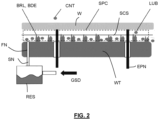
- Figure 2 depicts a highly schematic side view of a substrate handling system.
- the substrate handling system comprises a substrate table WT comprising a plurality of burls BRL. Distal ends BDE of the burls form a substrate carrying surface SCS on which a substrate W may be held.
- Figure 2 further depicts so called e-pins EPN, forming vertically movable pins actuated by a suitable actuator, in order to load the substrate W on the substrate table and to lift the substrate W from the substrate table for unloading.
- Figure 2 further depicts a first nozzle FN which is configured to output a gas in a space SPC surrounding the burls.
- the e-pins carry a substrate, therefore the space SPC being confined by a lower surface of the substrate.
- the gas supplied by the first nozzle may for example comprise hydrogen gas, H 2 .
- the first nozzle may comprise a gas supply duct which discharges the gas into the space.
- the substrate table may comprise a clamping device in order to clamp the substrate held by the distal ends of the burls.
- the clamping device may comprise an electrostatic sheet, to electrostatically clamp the substrate.
- the substrate table WT may also be identified as a substrate clamp WT.
- the substrate may be heated as a result of the exposure, e.g. as a result of energy absorbed by the substrate during the exposure by Deep Ultra Violet or Extreme Ultra Violet radiation.
- the (localized) heating may provide for a (localized) thermal expansion of the substrate, which may result in forces on the burls, e.g. lateral forces.
- an initial warpage of the substrate may cause for example during loading of the substrate that a center of the lower surface of the substrate contacts the burls first, following which the outside of the lower surface contacts the burls. Lateral forces may occur during the loading.
- edge wear of the burls may occur, while the burls may be heated due to friction effects as may occur during loading, exposure, etc.
- the substrate handling system comprises a second nozzle SN configured to dispense a lubricant.
- the second nozzle is configured to dispense the lubricant into the gas, such as the H 2 , supplied by the first nozzle.
- the second nozzle is the first nozzle, which nozzle correspondingly dispenses a mixture of the gas and the lubricant.
- reservoir RES may be provided in a gas supply duct GSD of the first nozzle, which reservoir is partially filled with lubricant, in order to mix some lubricant into the gas supplied via the gas supply duct.
- the first nozzle and second nozzle may e.g.
- the second nozzle may dispense the lubricant into a duct of the first nozzle, to enable the first nozzle to output the gas with lubricant.
- the second nozzle may be downstream of the first nozzle, to dispense lubricant into a stream of gas output by the first nozzle.
- the lubricant may be carried by the gas to the burls, as the gas output by the first nozzle flows into the space between the burls. Accordingly, the lubricant may be distributed with the gas towards the burls, so as to be able to distribute the lubricant over the burls.
- the acid of the lubricant (such as an acid group of the hydro carbon) may be attracted by the metal comprised in the burls.
- an interaction between diploes of the acid and an oxide of the metal comprised in the burls may interact to absorb the lubricant on the burls. Due to the interaction between the dipoles, the lubricant may remain on the metal oxide of the burls for a relatively long time, thereby at least partly preventing loss of the lubricant from the burls during the loading of the substrate.
- the fatty acids will to a much lesser extent interact with a dielectric material of the electrostatic clamp, hence being released from the electrostatic clamp within a relatively short time.
- the lubricant may have released from the electrostatic clamp to a large extent. Furthermore, the relatively short time during which the lubricant remains on the electrostatic clamp, may promote to remove trapped charge in the dielectric material: This is expected to drastically reduce residual charges. Due to lower adoption energy of the acid on the dielectric the monolayer hence surface conductivity of the dielectric may be away at the moment the dielectric clamp is switched on..
- the lubricant may form a thin lubrication layer specifically on the burls, as the acid of the lubricant may interact with the metal of the burls, enabling the hydrocarbon of the lubricant to extend from the surface of the burls to provide lubricating properties during the loading of the substrate.
- the lubricant may interact with the dielectric material of the electrostatic clamp to a lesser extent, retaining of the lubricant on the electrostatic clamp may be low, which may reduce or prevent a surface conductivity on the electrostatic clamp due to the acid of the lubricant.
- the second nozzle is configured to dispense the lubricant in the first nozzle.
- the first nozzle may provide for a flow of the gas into the space surrounding the burls.
- the second nozzle may for example dispense the lubricant in a gas supply duct of the first nozzle, enabling the lubricant to be discharged into the space surrounding the burls by the flow of the gas, providing for a relatively even distribution of the lubricant to the burls within a relatively short time frame.
- the first and second nozzles are combined into a single nozzle, thus the second nozzle being the first nozzle to provide a compact implementation to dispense the lubricant with the gas.
- the substrate handling system is configured to dispense the lubricant when the substrate is held above the substrate support surface.
- the substrate may thereby create an at least partially confined space, at least partially confined by the substrate table with the burls at the lower side of the space and the substrate table at the upper side of the space, enabling to confine the gas supplied by the gas supply system in the at least partly confined space, thereby discharging the lubricant, with the gas, locally at the burls.
- a contamination of a remainder of the substrate handing system by particles of the lubricant, as symbolically indicated in Figure 2 by contamination CNT formed by a small droplet of the lubricant, may be avoided, or may be reduced, as the lubricant, symbolically indicated in Figure 2 by a small droplet of lubricant LUB , is confined or at least partly confined below the substrate held above the substate support surface.
- the substrate handling system may be configured to dispense the lubricant when the substrate is held between 1 mm and 3 mm above the substrate support surface, thereby providing sufficient volume of space for the lubricant to distribute among the burls.
- the substrate handling system is configured to dispense the lubricant in a space under the substrate support surface.
- the lubricant may be dispensed into the space SPC in which the burls extend, i.e. in the space surrounding the burls.
- a distribution of the lubricant may be confined, to a large extent, to the burls, thereby preventing a contamination of a remainder of the substrate handling system and/or a top surface of the substrate, by the lubricant..
- the substrate handling system is configured to dispense the lubricant during less than 1 seconds, preferably less than 0,6 seconds, more preferably 0.5 seconds.
- the lubricant may for example be dispensed each time a substrate is loaded onto the substrate clamp.
- the substrate handling system is configured to supply the lubricant at a pressure below 10 mPa, preferably below 2 mPa, more preferably 1 mPa.
- a relatively minor amount of the lubricant may be provided, which on the one hand may be sufficient to lubricate the burls, however on the other hand may prevent a spread of the lubricant causing excessive contamination.
- the substrate handling system is configured to pause a loading of the substrate during dispensing of the lubricant.
- the pausing is performed when the substrate is held above the burls, to form an at least partly confined space.
- the gas with the lubricant may hence flow through the space at least partially confined by the substrate, so as to enable the burls to be covered by the lubricant before supporting the substrate on the burls.
- the substrate handling system is configured to dispense the lubricant before applying an electrostatic clamping voltage to electrostatically clamp the substrate.
- the acid may provide a low interaction with a dielectric material of the electrostatic clamp
- the lubricant may be released from the electrostatic clamp within a relatively short time.
- the lubricant may have released from the electrostatic clamp to a large extent, hence surface conductivity of the dielectric may be away at the moment the dielectric clamp is switched on.
- the lubricant comprises a fatty acid.
- the acid group of the fatty acid may interact with the metal so as to bond to the metal of the burls, while the hydrocarbon structure of the fatty acid may provide for lubricating interaction with the lower surface of the substrate.
- suitable hydrocarbons include a straight hydrocarbon chain, typically longer that 8 , ranging from aspelargonic acid with 9 carbons and 17 hydrogen molecules. to C18 stearic acid. Hydrocarbon chains with a length in excess of 18 may become non-beneficial as they may e.g. cause more carbon contamination with the same residence time on the surface of the burls governed by the acid group and the metal oxide.
- the substrate handling system is configured to provide boundary lubrication at the substrate support surface of the burls.
- the boundary lubrication may provide for a very thin layer of lubrication on the burls, thereby at least partly preventing an atomic contact between the burls and the lower surface of the substrate.
- wear of the burls may at least be reduced, while applying only a small amount of the lubricant, hence reducing contamination by the lubricant to a large extent.
- a method of clamping a substrate comprising:
- the distal ends of the burls may be lubricated by a thin layer of the lubricant, whereby the acid, such as the acid group, of the lubricant interacts with the metal enabling the hydrocarbon of the lubricant to interact with the lower surface of the substrate.
- the first nozzle may provide for a flow of the gas into the space surrounding the burls, enabling the lubricant to be discharged into the space surrounding the burls by the flow of the gas, providing for a relatively even distribution of the lubricant to the burls within a relatively short time frame.
- the method comprises dispensing the lubricant when the substrate is held above the substrate support surface.
- the substrate may be lowered to be carried by the burls after the lubricant has been dispensed.
- embodiments of the invention may be implemented in hardware, firmware, software, or any combination thereof. Embodiments of the invention may also be implemented as instructions stored on a machine-readable medium, which may be read and executed by one or more processors.
- a machine-readable medium may include any mechanism for storing or transmitting information in a form readable by a machine (e.g., a computing device).
- a machine-readable medium may include read only memory (ROM); random access memory (RAM); magnetic storage media; optical storage media; flash memory devices; electrical, optical, acoustical or other forms of propagated signals (e.g. carrier waves, infrared signals, digital signals, etc.), and others.
- firmware, software, routines, instructions may be described herein as performing certain actions.
Landscapes
- Physics & Mathematics (AREA)
- Atmospheric Sciences (AREA)
- Health & Medical Sciences (AREA)
- Epidemiology (AREA)
- Public Health (AREA)
- General Physics & Mathematics (AREA)
- Life Sciences & Earth Sciences (AREA)
- Environmental & Geological Engineering (AREA)
- Engineering & Computer Science (AREA)
- Exposure And Positioning Against Photoresist Photosensitive Materials (AREA)
- Jigs For Machine Tools (AREA)
- Container, Conveyance, Adherence, Positioning, Of Wafer (AREA)
- Nozzles (AREA)
Priority Applications (4)
| Application Number | Priority Date | Filing Date | Title |
|---|---|---|---|
| EP23150754.2A EP4398034A1 (de) | 2023-01-09 | 2023-01-09 | Schmierung einer substratklemme |
| PCT/EP2023/082744 WO2024149504A1 (en) | 2023-01-09 | 2023-11-22 | Substrate clamp lubrication |
| CN202380090729.XA CN120435691A (zh) | 2023-01-09 | 2023-11-22 | 衬底夹具润滑 |
| TW112149004A TW202433658A (zh) | 2023-01-09 | 2023-12-15 | 基板夾具潤滑 |
Applications Claiming Priority (1)
| Application Number | Priority Date | Filing Date | Title |
|---|---|---|---|
| EP23150754.2A EP4398034A1 (de) | 2023-01-09 | 2023-01-09 | Schmierung einer substratklemme |
Publications (1)
| Publication Number | Publication Date |
|---|---|
| EP4398034A1 true EP4398034A1 (de) | 2024-07-10 |
Family
ID=84888592
Family Applications (1)
| Application Number | Title | Priority Date | Filing Date |
|---|---|---|---|
| EP23150754.2A Withdrawn EP4398034A1 (de) | 2023-01-09 | 2023-01-09 | Schmierung einer substratklemme |
Country Status (4)
| Country | Link |
|---|---|
| EP (1) | EP4398034A1 (de) |
| CN (1) | CN120435691A (de) |
| TW (1) | TW202433658A (de) |
| WO (1) | WO2024149504A1 (de) |
Citations (2)
| Publication number | Priority date | Publication date | Assignee | Title |
|---|---|---|---|---|
| JPS6124017A (ja) * | 1984-07-13 | 1986-02-01 | Matsushita Electric Ind Co Ltd | 磁気記録媒体 |
| WO2021115765A1 (en) * | 2019-12-09 | 2021-06-17 | Asml Netherlands B.V. | Method of manufacturing a substrate support for a ithographic apparatus, substrate table, lithographic apparatus, device manufacturing method, method of use |
-
2023
- 2023-01-09 EP EP23150754.2A patent/EP4398034A1/de not_active Withdrawn
- 2023-11-22 CN CN202380090729.XA patent/CN120435691A/zh active Pending
- 2023-11-22 WO PCT/EP2023/082744 patent/WO2024149504A1/en not_active Ceased
- 2023-12-15 TW TW112149004A patent/TW202433658A/zh unknown
Patent Citations (2)
| Publication number | Priority date | Publication date | Assignee | Title |
|---|---|---|---|---|
| JPS6124017A (ja) * | 1984-07-13 | 1986-02-01 | Matsushita Electric Ind Co Ltd | 磁気記録媒体 |
| WO2021115765A1 (en) * | 2019-12-09 | 2021-06-17 | Asml Netherlands B.V. | Method of manufacturing a substrate support for a ithographic apparatus, substrate table, lithographic apparatus, device manufacturing method, method of use |
Also Published As
| Publication number | Publication date |
|---|---|
| TW202433658A (zh) | 2024-08-16 |
| WO2024149504A1 (en) | 2024-07-18 |
| CN120435691A (zh) | 2025-08-05 |
Similar Documents
| Publication | Publication Date | Title |
|---|---|---|
| JP5065517B2 (ja) | 基板テーブル、および基板リリース特性を向上させる方法 | |
| JP5535194B2 (ja) | リソグラフィ装置、デバイス製造方法、クリーニングシステム、およびパターニングデバイスをクリーニングする方法 | |
| JP5882922B2 (ja) | インプリント方法、およびインプリント装置 | |
| US11016402B2 (en) | Particle removal apparatus and associated system | |
| JP2021103332A (ja) | 基板、基板ホルダ、基板コーティング装置、基板をコーティングするための方法、及びコーティングを除去するための方法 | |
| JP2011233914A (ja) | リソグラフィ装置及びリソグラフィ装置において液体を除去する方法 | |
| JP2022010193A (ja) | リソグラフィ装置用基板テーブル、および基板の装填方法 | |
| JP6551795B2 (ja) | インプリント装置、インプリント方法およびインプリント装置の制御方法 | |
| EP4398034A1 (de) | Schmierung einer substratklemme | |
| JP2013098551A (ja) | リソグラフィ装置および基板ハンドリング方法 | |
| JP2011171760A (ja) | リソグラフィ装置およびデバイス製造方法 | |
| KR20090018916A (ko) | 레티클 및 다른 평면형 바디용 척 | |
| US12189309B2 (en) | Clamp assembly | |
| WO2024056552A1 (en) | A patterning device voltage biasing system for use in euv lithography | |
| CN118215888A (zh) | 用于保持物体的夹具和方法 | |
| JP6788125B2 (ja) | レチクルクランプデバイス | |
| WO2016052345A1 (ja) | インプリント装置、インプリント方法およびインプリント装置の制御方法 | |
| US20250201579A1 (en) | Planarization apparatus and article manufacturing method | |
| US12374577B2 (en) | Substrate restraining system | |
| KR102869655B1 (ko) | 리소그래피 장치 | |
| Hasan et al. | Nanolithography: Status and challenges | |
| JP6642671B2 (ja) | インプリント装置 | |
| WO2024132381A1 (en) | Lithographic apparatus and device manufacturing method | |
| JP2007258703A (ja) | リソグラフィ装置、デバイス製造方法および基板 | |
| WO2026082527A1 (en) | An electrostatic wafer clamp and a method of unloading a wafer therefrom |
Legal Events
| Date | Code | Title | Description |
|---|---|---|---|
| PUAI | Public reference made under article 153(3) epc to a published international application that has entered the european phase |
Free format text: ORIGINAL CODE: 0009012 |
|
| STAA | Information on the status of an ep patent application or granted ep patent |
Free format text: STATUS: THE APPLICATION HAS BEEN PUBLISHED |
|
| AK | Designated contracting states |
Kind code of ref document: A1 Designated state(s): AL AT BE BG CH CY CZ DE DK EE ES FI FR GB GR HR HU IE IS IT LI LT LU LV MC ME MK MT NL NO PL PT RO RS SE SI SK SM TR |
|
| STAA | Information on the status of an ep patent application or granted ep patent |
Free format text: STATUS: THE APPLICATION IS DEEMED TO BE WITHDRAWN |
|
| 18D | Application deemed to be withdrawn |
Effective date: 20250111 |