EP4398331A1 - Électrode positive pour batteries rechargeables et batterie rechargeable - Google Patents
Électrode positive pour batteries rechargeables et batterie rechargeable Download PDFInfo
- Publication number
- EP4398331A1 EP4398331A1 EP22864088.4A EP22864088A EP4398331A1 EP 4398331 A1 EP4398331 A1 EP 4398331A1 EP 22864088 A EP22864088 A EP 22864088A EP 4398331 A1 EP4398331 A1 EP 4398331A1
- Authority
- EP
- European Patent Office
- Prior art keywords
- positive electrode
- active material
- electrode active
- material particles
- layer
- Prior art date
- Legal status (The legal status is an assumption and is not a legal conclusion. Google has not performed a legal analysis and makes no representation as to the accuracy of the status listed.)
- Pending
Links
Images


Classifications
-
- H—ELECTRICITY
- H01—ELECTRIC ELEMENTS
- H01M—PROCESSES OR MEANS, e.g. BATTERIES, FOR THE DIRECT CONVERSION OF CHEMICAL ENERGY INTO ELECTRICAL ENERGY
- H01M4/00—Electrodes
- H01M4/02—Electrodes composed of, or comprising, active material
- H01M4/36—Selection of substances as active materials, active masses, active liquids
- H01M4/48—Selection of substances as active materials, active masses, active liquids of inorganic oxides or hydroxides
- H01M4/52—Selection of substances as active materials, active masses, active liquids of inorganic oxides or hydroxides of nickel, cobalt or iron
- H01M4/525—Selection of substances as active materials, active masses, active liquids of inorganic oxides or hydroxides of nickel, cobalt or iron of mixed oxides or hydroxides containing iron, cobalt or nickel for inserting or intercalating light metals, e.g. LiNiO2, LiCoO2 or LiCoOxFy
-
- H—ELECTRICITY
- H01—ELECTRIC ELEMENTS
- H01M—PROCESSES OR MEANS, e.g. BATTERIES, FOR THE DIRECT CONVERSION OF CHEMICAL ENERGY INTO ELECTRICAL ENERGY
- H01M10/00—Secondary cells; Manufacture thereof
- H01M10/05—Accumulators with non-aqueous electrolyte
- H01M10/052—Li-accumulators
-
- H—ELECTRICITY
- H01—ELECTRIC ELEMENTS
- H01M—PROCESSES OR MEANS, e.g. BATTERIES, FOR THE DIRECT CONVERSION OF CHEMICAL ENERGY INTO ELECTRICAL ENERGY
- H01M4/00—Electrodes
- H01M4/02—Electrodes composed of, or comprising, active material
- H01M4/13—Electrodes for accumulators with non-aqueous electrolyte, e.g. for lithium-accumulators; Processes of manufacture thereof
- H01M4/131—Electrodes based on mixed oxides or hydroxides, or on mixtures of oxides or hydroxides, e.g. LiCoOx
-
- H—ELECTRICITY
- H01—ELECTRIC ELEMENTS
- H01M—PROCESSES OR MEANS, e.g. BATTERIES, FOR THE DIRECT CONVERSION OF CHEMICAL ENERGY INTO ELECTRICAL ENERGY
- H01M4/00—Electrodes
- H01M4/02—Electrodes composed of, or comprising, active material
- H01M4/36—Selection of substances as active materials, active masses, active liquids
- H01M4/362—Composites
- H01M4/366—Composites as layered products
-
- H—ELECTRICITY
- H01—ELECTRIC ELEMENTS
- H01M—PROCESSES OR MEANS, e.g. BATTERIES, FOR THE DIRECT CONVERSION OF CHEMICAL ENERGY INTO ELECTRICAL ENERGY
- H01M4/00—Electrodes
- H01M4/02—Electrodes composed of, or comprising, active material
- H01M4/36—Selection of substances as active materials, active masses, active liquids
- H01M4/48—Selection of substances as active materials, active masses, active liquids of inorganic oxides or hydroxides
- H01M4/50—Selection of substances as active materials, active masses, active liquids of inorganic oxides or hydroxides of manganese
- H01M4/505—Selection of substances as active materials, active masses, active liquids of inorganic oxides or hydroxides of manganese of mixed oxides or hydroxides containing manganese for inserting or intercalating light metals, e.g. LiMn2O4 or LiMn2OxFy
-
- H—ELECTRICITY
- H01—ELECTRIC ELEMENTS
- H01M—PROCESSES OR MEANS, e.g. BATTERIES, FOR THE DIRECT CONVERSION OF CHEMICAL ENERGY INTO ELECTRICAL ENERGY
- H01M4/00—Electrodes
- H01M4/02—Electrodes composed of, or comprising, active material
- H01M4/64—Carriers or collectors
- H01M4/66—Selection of materials
- H01M4/661—Metal or alloys, e.g. alloy coatings
-
- H—ELECTRICITY
- H01—ELECTRIC ELEMENTS
- H01M—PROCESSES OR MEANS, e.g. BATTERIES, FOR THE DIRECT CONVERSION OF CHEMICAL ENERGY INTO ELECTRICAL ENERGY
- H01M4/00—Electrodes
- H01M4/02—Electrodes composed of, or comprising, active material
- H01M2004/026—Electrodes composed of, or comprising, active material characterised by the polarity
- H01M2004/028—Positive electrodes
-
- Y—GENERAL TAGGING OF NEW TECHNOLOGICAL DEVELOPMENTS; GENERAL TAGGING OF CROSS-SECTIONAL TECHNOLOGIES SPANNING OVER SEVERAL SECTIONS OF THE IPC; TECHNICAL SUBJECTS COVERED BY FORMER USPC CROSS-REFERENCE ART COLLECTIONS [XRACs] AND DIGESTS
- Y02—TECHNOLOGIES OR APPLICATIONS FOR MITIGATION OR ADAPTATION AGAINST CLIMATE CHANGE
- Y02E—REDUCTION OF GREENHOUSE GAS [GHG] EMISSIONS, RELATED TO ENERGY GENERATION, TRANSMISSION OR DISTRIBUTION
- Y02E60/00—Enabling technologies; Technologies with a potential or indirect contribution to GHG emissions mitigation
- Y02E60/10—Energy storage using batteries
Definitions
- Secondary batteries particularly lithium ion secondary batteries, are expected as a power source for small consumer applications, power storage devices, and electric vehicles, because of their high output and high energy density.
- Patent Literature 1 proposes, in a positive electrode for a lithium secondary battery including a positive electrode mixture layer including a lithium transition metal composite oxide as a positive electrode active material and a current collecting foil, the positive electrode mixture layer is composed of two or more layers of: a layer having a ⁇ -NaFeO 2 structure and including a lithium-rich transition metal composite oxide, wherein the transition metal (Me) includes Co, Ni, and Mn, and the molar ratio Li/Me of lithium (Li) to the transition metal is larger than 1.2, and the molar ratio Mn/Me is Mn/Me ⁇ 0.5; and a layer making contact with the current collecting foil, and including a lithium transition metal composite oxide, wherein the transition metal (Me') includes one or more selected from Co, Ni, and Mn, the molar ratio Li/Me' of lithium (Li) to the transition metal is 1.2 or less, and the molar ratio Mn/Me' is 0 ⁇ Mn/Me' ⁇ 0.4
- lithium transition metal composite oxide with a low cobalt (Co) content ratio or a cobalt free lithium transition metal composite oxide not including cobalt has been demanded.
- a lithium-nickel-manganese composite oxide LiNi 1-x Mn x O 2 (x ⁇ 0.2) including Ni and Mn has been expected as promising because of its large charge and discharge capacity.
- the particle diameter R of the second positive electrode active material particles being larger than the particle diameter L of the first positive electrode active material particles (R > L), it is considered that a thick conductive path is easily formed, and the resistance between the first layer and the second layer becomes low.
- the third positive electrode active material particles are not present at the interface between the positive electrode current collector and the first layer means that, when cross sections of the positive electrode are observed, the third positive electrode active material particles are not present in a space formed between the surface of the positive electrode current collector, one first positive electrode active material particle that is in contact with the surface of the positive electrode current collector, and other first positive electrode active material particle that are adjacent thereto (this particle is also in contact with the positive electrode current collector), or no more than three third positive electrode active material particles are present in the space.
- the second lithium transition metal composite oxide composing the second positive electrode active material particles, and the third lithium transition metal composite oxide composing the third positive electrode active material particles may be a lithium-nickel-manganese composite oxide (in the following, referred to as "composite oxide NM") including Ni and Mn.
- composite oxide NM lithium-nickel-manganese composite oxide
- the ratio of total of Ni and Mn in metal element atoms other than Li included in the composite oxide NM may be 98 atom% or more.
- the composite oxide NM may be a composite oxide represented by Li ⁇ Ni 1-x Mn x O 2 (where 0.95 ⁇ ⁇ ⁇ 1.05, 0 ⁇ x ⁇ 0.2).
- FIG. 1 is a cross sectional view schematically illustrating a structure of a positive electrode for a secondary battery of this embodiment.
- a positive electrode 10 includes a positive electrode current collector 11, and a positive electrode mixture layer 12 provided on the surface of the positive electrode current collector 11.
- FIG. 1 shows a part of a cross section in the thickness direction obtained by cutting the positive electrode mixture layer 12 and the positive electrode current collector 11 together.
- the positive electrode mixture layer 12 may be formed on both of main surfaces of the positive electrode current collector 11. In FIG. 1 , a portion of the positive electrode current collector 11 on one main surface side, and a portion of the positive electrode mixture layer 12 formed on the main surface are shown, and the other main surface side of the positive electrode current collector 11 is not shown.
- the positive electrode current collector 11 is an aluminum foil.
- the first positive electrode active material particles P1 are a lithium-nickel-cobalt-aluminum composite oxide (composite oxide NCA), and the first positive electrode active material particles P1 are in contact with the positive electrode current collector 11 so that a part thereof enters into the aluminum foil as the positive electrode current collector 11. In this manner, the first positive electrode active material particles P1 make surface contact with the positive electrode current collector 11, which allows for decrease in the resistance between the positive electrode current collector 11 and the first layer 12A.
- the positive electrode has a positive electrode current collector and a positive electrode mixture layer formed on a surface of the positive electrode current collector and having a positive electrode active material.
- the positive electrode active material layer includes the positive electrode active material as an essential component, and may include a binder, a conductive agent, and the like as optional components.
- the binder, the conductive agent, and the thickener known materials can be used.
- the ratio of the second positive electrode active material particles relative to the total of the second positive electrode active material particles and the third positive electrode active material particles may be, on mass basis, 50% to 90%, or 65% to 85%.
- the carbon phase may be composed of, for example, an amorphous carbon with less crystallinity.
- the amorphous carbon may be, for example, hard carbon, soft carbon, or something else.
- the electrolyte includes a solvent and a solute dissolved in the solvent.
- the solute is an electrolytic salt that goes through ion dissociation in electrolytes.
- the solute may include, for example, a lithium salt.
- the component of the electrolyte other than the solvent and solute is additives.
- the electrolyte may contain various additives.
- the battery includes a bottomed rectangular battery case 4 and an electrode group 1 and an electrolyte (not shown) accommodated in the battery case 4.
- the electrode group 1 has a negative electrode in the form of a long strip, a positive electrode in the form of a long strip, and a separator interposed therebetween.
- a negative electrode current collector of the negative electrode is electrically connected to a negative electrode terminal 6 provided in a sealing plate 5 through a negative electrode lead 3.
- the negative electrode terminal 6 is insulated from the sealing plate 5 with a resin-made gasket 7.
- a positive electrode current collector of the positive electrode is electrically connected to a rear face of the sealing plate 5 through a positive electrode lead 2. That is, the positive electrode is electrically connected to the battery case 4 also serving as a positive electrode terminal.
- the periphery of the sealing plate 5 is fitted to the open end of the battery case 4, and the fitting portion is laser welded.
- the sealing plate 5 has an injection port for a nonaqueous electrolyte, and is sealed with a sealing
- lithium-nickel-manganese composite oxides having different average particle diameters (LiNi 0.8 Mn 0.2 O 2 ) were prepared.
- the second and third positive electrode active material particles had a particle diameter R and a particle diameter r of 15 ⁇ m and 1 ⁇ m, respectively, as a D80 diameter in a volume-based particle size distribution measured by a laser diffraction scattering method.
- first positive electrode active material particles 1 part by mass of acetylene black (AB), 1 part by mass of polyvinylidene fluoride (PVDF), and an appropriate amount of N-methyl-2-pyrrolidone (NMP) were mixed, thereby preparing a first positive electrode slurry.
- AB acetylene black
- PVDF polyvinylidene fluoride
- NMP N-methyl-2-pyrrolidone
- the first positive electrode slurry was applied to a surface of an aluminum foil as the positive electrode current collector, and the film was dried. Thereafter, the second positive electrode slurry was applied so as to cover the film of the first positive electrode slurry, and the film was dried. Thereafter, the film was dried and rolled, thereby forming a positive electrode mixture layer with a thickness of 100 ⁇ m on the aluminum foil.
- the positive electrode was cut into a predetermined shape to obtain a positive electrode for evaluation.
- the positive electrode had a region of 20 mm ⁇ 20 mm that works as the positive electrode, and a connection region of 5 mm ⁇ 5 mm for connection with a tab lead. Thereafter, the positive electrode mixture layer formed on the above-described connecting region was scraped to expose the positive electrode current collector. Afterwards, the exposed portion of the positive electrode current collector was connected to the positive electrode tab lead and a predetermined region of the outer periphery of the positive electrode tab lead was covered with an insulating tab film.
- a negative electrode was produced by attaching a lithium metal foil (thickness 300 ⁇ m) on one side of an electrolytic copper foil as the negative electrode current collector.
- the negative electrode was cut into the same form as the positive electrode, and a negative electrode for evaluation was obtained.
- the lithium metal foil formed on the connecting region formed in the same manner as the positive electrode was peeled off to expose the negative electrode current collector. Afterwards, the exposed portion of the negative electrode current collector was connected to the negative electrode tab lead in the same manner as the positive electrode, and a predetermined region of the outer periphery of the negative electrode tab lead was covered with an insulating tab film.
- LiPF 6 was added as a lithium salt, thereby preparing an electrolyte.
- concentration of LiPF 6 in the electrolyte was set to 1.3 mol/liter.
- a battery for evaluation was produced using the positive electrode and negative electrode for evaluation.
- the positive electrode and negative electrode were allowed to face each other with a separator interposed therebetween so that the positive electrode mixture layer overlapped with the negative electrode mixture layer, thereby producing an electrode group.
- an Al laminate film (thickness 100 ⁇ m) cut into a size of 60 ⁇ 90 mm rectangle was folded into half, and the long side end of 60 mm was heat sealed at 230°C, to make it into an envelope of 60 ⁇ 45 mm.
- the produced electrode group was put into the envelope, and the end face of the Al laminate film and the position of the insulating tab film of the tab lead were aligned and heat sealed at 230°C.
- 0.3 cm 3 of the nonaqueous electrolyte was injected from the not heat-sealed portion of the short side of the Al laminate film, and after the injection, they were allowed to stand for 5 minutes under a reduced pressure of 0.06 MPa to impregnate the electrode mixture layers with the electrolyte.
- the end face of the injected side of the Al laminate film was heat sealed at 230°C, thereby producing a battery A1 for evaluation.
- the evaluation cell was prepared in a dry air atmosphere having a dew point of -50°C or less.
- Example 1 In the positive electrode production, only the second positive electrode slurry of Example 1 was applied on a surface of an aluminum foil as the positive electrode current collector. Except for this, a positive electrode having the same theoretical capacity as that in Example 1, and having the positive electrode mixture layer with a thickness of 100 ⁇ m was produced. Using this positive electrode, a battery B1 for evaluation was produced in the same manner as in Example 1.
- the completed battery was sandwiched by a pair of 80 ⁇ 80 cm stainless steel (thickness 2 mm) clamps to be pressurized and fixed at 0.2 MPa.
- the batteries were charged and discharged under a 25°C environment.
- the charging was performed by applying a constant current at an electric current of 0.7C until the voltage reached 4.3 V, and then kept to 4.3 V until the electric current value reached 0.07C or less.
- the discharging was performed at a constant current of 0.15C until the battery voltage reached 2.5 V. Then, the relation of the battery voltage relative to an integral of electric current flowed (charge-discharge curve) was determined.
- the batteries were allowed to stand for 20 minutes between the charging and discharging, and the charging and discharging were repeated for 10 cycles under the above-described charge and discharge conditions under a 25°C environment.
- the batteries were put under a 25°C environment, and the charging voltage was set to 4.5 V. Except for this, the same charge and discharge cycles as that of Evaluation 1 was performed.
- the batteries were allowed to stand for 20 minutes between the charging and discharging, and the charging and discharging were repeated for 10 cycles under the above-described charge and discharge conditions under a 25°C environment.
- the discharge capacity C n relative to the charge capacity C 0 of the 1st cycle was determined, and C n /C 0 ⁇ 100 was evaluated as capacity retention rate.
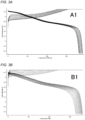
- FIG. 3A shows measurement results of a charge-discharge curve of the battery A1.
- FIG. 3B shows measurement results of a charge-discharge curve of the battery B1.
- the increase in the charging voltage along with repetitive charge and discharge cycles is suppressed, and polarization is reduced.
- reduction in the discharge capacity with repetitive charge and discharge cycles is suppressed.
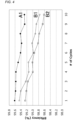
- FIG. 4 shows changes in the capacity retention rate of the batteries A1, B1, and B2 for every charge and discharge cycle.
- charging was performed at a high voltage of 4.5 V until an excessively charged state, and under the environment where Mn in the lithium-nickel-manganese composite oxide is easily eluted.
- the battery A1 even under such high voltage charging conditions, compared with the batteries B1 and B2, the decrease in discharge capacity along with repetitive charge and discharge cycles is suppressed.
- the particle diameter of the first to third positive electrode active material particles was changed in accordance with Table 1.
- batteries A2 to A6, and B3 for evaluation were made in the same manner as in Example 1, and discharge rate characteristics were evaluated by the method shown below.
- Table 1 shows the evaluation results of discharge rate characteristics of the batteries A1 to A6, and B3, along with the particle diameter of the first to third positive electrode active material particles.
- discharge rate characteristics were kept high.
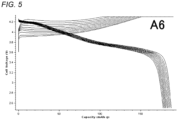
- the charge-discharge curve of the battery A6 is shown in FIG. 5 .
- the battery A6 satisfied R > L > r, and therefore, increase in charging voltage with repetitive charge and discharge cycles was suppressed, and decrease in discharge capacity along with repetitive charge and discharge cycles was suppressed, although they were inferior compared with the battery A1.
- r > 0.155L is not satisfied, discharge rate characteristics are reduced compared with the batteries A1 to A5.
- the battery B3 does not satisfy R > L > r and therefore increase in the charging voltage and decrease in discharge capacity along with repetitive charge and discharge cycles were not suppressed, and discharge rate characteristics decreased more than the batteries A1 to A6.
- Table 1 Battery First positive electrode active material particle diameter L/[ ⁇ m] Second positive electrode active material particle diameter R/[ ⁇ m] Third positive electrode active material particle diameter r/[ ⁇ m] 1C/0.1C discharge rate characteristics A1 6 15 1 97 A2 3 10 1 98 A3 6 10 5 97 A4 12 20 5 96 A5 17 25 5 95 A6 12 30 1 92 B3 17 10 5 88
Landscapes
- Chemical & Material Sciences (AREA)
- Chemical Kinetics & Catalysis (AREA)
- Electrochemistry (AREA)
- General Chemical & Material Sciences (AREA)
- Engineering & Computer Science (AREA)
- Materials Engineering (AREA)
- Inorganic Chemistry (AREA)
- Manufacturing & Machinery (AREA)
- Composite Materials (AREA)
- Battery Electrode And Active Subsutance (AREA)
- Secondary Cells (AREA)
Applications Claiming Priority (2)
| Application Number | Priority Date | Filing Date | Title |
|---|---|---|---|
| JP2021141538 | 2021-08-31 | ||
| PCT/JP2022/028225 WO2023032500A1 (fr) | 2021-08-31 | 2022-07-20 | Électrode positive pour batteries rechargeables et batterie rechargeable |
Publications (2)
| Publication Number | Publication Date |
|---|---|
| EP4398331A1 true EP4398331A1 (fr) | 2024-07-10 |
| EP4398331A4 EP4398331A4 (fr) | 2025-07-16 |
Family
ID=85412096
Family Applications (1)
| Application Number | Title | Priority Date | Filing Date |
|---|---|---|---|
| EP22864088.4A Pending EP4398331A4 (fr) | 2021-08-31 | 2022-07-20 | Électrode positive pour batteries rechargeables et batterie rechargeable |
Country Status (5)
| Country | Link |
|---|---|
| US (1) | US20250132325A1 (fr) |
| EP (1) | EP4398331A4 (fr) |
| JP (1) | JPWO2023032500A1 (fr) |
| CN (1) | CN117836967A (fr) |
| WO (1) | WO2023032500A1 (fr) |
Families Citing this family (2)
| Publication number | Priority date | Publication date | Assignee | Title |
|---|---|---|---|---|
| CN119993978B (zh) * | 2025-04-11 | 2025-09-02 | 宁德时代新能源科技股份有限公司 | 电池单体、电池装置、用电装置及储能装置 |
| CN119993999B (zh) * | 2025-04-11 | 2025-10-10 | 宁德时代新能源科技股份有限公司 | 电池单体、电池装置、用电装置及储能装置 |
Family Cites Families (10)
| Publication number | Priority date | Publication date | Assignee | Title |
|---|---|---|---|---|
| JP2009026599A (ja) * | 2007-07-19 | 2009-02-05 | Toyota Motor Corp | 正電極板、リチウムイオン二次電池、車両、および、電池搭載機器 |
| JP2010033924A (ja) * | 2008-07-30 | 2010-02-12 | Nec Tokin Corp | リチウムイオン二次電池用正極、およびそれを用いたリチウムイオン二次電池 |
| WO2012044132A2 (fr) * | 2010-09-30 | 2012-04-05 | 주식회사 엘지화학 | Électrode positive pour batterie au lithium, et batterie au lithium la comprenant |
| KR101411226B1 (ko) * | 2012-04-03 | 2014-06-23 | 삼성정밀화학 주식회사 | 리튬이온 이차전지용 리튬망간산화물 양극활물질 및 그것을 포함하는 리튬이온 이차전지 |
| JP2015115244A (ja) | 2013-12-13 | 2015-06-22 | 株式会社Gsユアサ | リチウム二次電池用正極、リチウム二次電池、バッテリーモジュール、及びバッテリーモジュールを搭載した自動車 |
| JP6469450B2 (ja) * | 2014-02-27 | 2019-02-13 | パナソニック株式会社 | 非水電解質二次電池用正極及び非水電解質二次電池 |
| CN110660961B (zh) * | 2018-06-28 | 2021-09-21 | 宁德时代新能源科技股份有限公司 | 正极片及锂离子电池 |
| CN111554965A (zh) * | 2020-05-13 | 2020-08-18 | 金妍 | 一种锂离子电池正极的制备方法 |
| CN112259723A (zh) * | 2020-10-29 | 2021-01-22 | 苏州彼欧智能科技有限公司 | 一种锂离子电池正极的制备方法 |
| CN112382737A (zh) * | 2020-11-12 | 2021-02-19 | 苏州酷卡环保科技有限公司 | 一种锂离子电池阴极的制备方法 |
-
2022
- 2022-07-20 WO PCT/JP2022/028225 patent/WO2023032500A1/fr not_active Ceased
- 2022-07-20 US US18/687,449 patent/US20250132325A1/en active Pending
- 2022-07-20 EP EP22864088.4A patent/EP4398331A4/fr active Pending
- 2022-07-20 JP JP2023545147A patent/JPWO2023032500A1/ja active Pending
- 2022-07-20 CN CN202280057592.3A patent/CN117836967A/zh active Pending
Also Published As
| Publication number | Publication date |
|---|---|
| CN117836967A (zh) | 2024-04-05 |
| US20250132325A1 (en) | 2025-04-24 |
| JPWO2023032500A1 (fr) | 2023-03-09 |
| EP4398331A4 (fr) | 2025-07-16 |
| WO2023032500A1 (fr) | 2023-03-09 |
Similar Documents
| Publication | Publication Date | Title |
|---|---|---|
| EP4099422B1 (fr) | Électrode positive pour batterie secondaire et batterie secondaire | |
| KR102093971B1 (ko) | 리튬 이차전지 | |
| US10693123B2 (en) | Positive electrode and secondary battery using same | |
| EP3734719B1 (fr) | Matériau actif d'électrode positive pour accumulateur ayant un électrolyte non aqueux, électrode positive pour accumulateur ayant un électrolyte non aqueux, et accumulateur ayant un électrolyte non aqueux | |
| EP2991137A1 (fr) | Électrode positive et batterie à électrolyte non aqueux | |
| US20140011083A1 (en) | Electrode for non-aqueous electrolyte secondary batteries and non-aqueous electrolyte secondary battery including the same | |
| EP4489131A1 (fr) | Batterie secondaire | |
| EP4145567A1 (fr) | Batterie secondaire à électrolyte non aqueux | |
| US20240356074A1 (en) | Nonaqueous electrolyte battery and nonaqueous electrolyte used in same | |
| JP2021157925A (ja) | リチウムイオン二次電池 | |
| EP4398331A1 (fr) | Électrode positive pour batteries rechargeables et batterie rechargeable | |
| CN110265629B (zh) | 负极及锂离子二次电池 | |
| JP2014035922A (ja) | 非水電解質二次電池 | |
| US20240405192A1 (en) | Positive electrode for secondary battery, and secondary battery | |
| EP3745501B1 (fr) | Électrode positive pour batteries secondaires à électrolyte non aqueux, et batterie secondaire à électrolyte non aqueux | |
| EP4270521A1 (fr) | Électrode positive pour batterie rechargeable et batterie rechargeable | |
| EP4379846A1 (fr) | Électrode positive pour batteries rechargeables et batterie rechargeable | |
| EP4207381A1 (fr) | Matériau actif d'électrode positive pour batteries secondaires et batterie secondaire | |
| JP2019160781A (ja) | 正極及びリチウムイオン二次電池 | |
| JP2007080583A (ja) | 二次電池用電極と二次電池 | |
| JP4878690B2 (ja) | リチウム二次電池 | |
| US12431530B2 (en) | Nonaqueous electrolyte secondary battery | |
| JP6222389B1 (ja) | 非水電解液およびそれを用いた非水電解液電池 | |
| JP2021150065A (ja) | 活物質層、電極及びリチウムイオン二次電池 | |
| US20240396000A1 (en) | Positive electrode for secondary battery, method for producing same, and secondary battery |
Legal Events
| Date | Code | Title | Description |
|---|---|---|---|
| STAA | Information on the status of an ep patent application or granted ep patent |
Free format text: STATUS: THE INTERNATIONAL PUBLICATION HAS BEEN MADE |
|
| PUAI | Public reference made under article 153(3) epc to a published international application that has entered the european phase |
Free format text: ORIGINAL CODE: 0009012 |
|
| STAA | Information on the status of an ep patent application or granted ep patent |
Free format text: STATUS: REQUEST FOR EXAMINATION WAS MADE |
|
| 17P | Request for examination filed |
Effective date: 20240305 |
|
| AK | Designated contracting states |
Kind code of ref document: A1 Designated state(s): AL AT BE BG CH CY CZ DE DK EE ES FI FR GB GR HR HU IE IS IT LI LT LU LV MC MK MT NL NO PL PT RO RS SE SI SK SM TR |
|
| DAV | Request for validation of the european patent (deleted) | ||
| DAX | Request for extension of the european patent (deleted) | ||
| REG | Reference to a national code |
Ref country code: DE Ref legal event code: R079 Free format text: PREVIOUS MAIN CLASS: H01M0004131000 Ipc: H01M0004360000 |
|
| A4 | Supplementary search report drawn up and despatched |
Effective date: 20250617 |
|
| RIC1 | Information provided on ipc code assigned before grant |
Ipc: H01M 4/36 20060101AFI20250611BHEP Ipc: H01M 4/131 20100101ALI20250611BHEP Ipc: H01M 4/505 20100101ALI20250611BHEP Ipc: H01M 4/525 20100101ALI20250611BHEP Ipc: H01M 4/66 20060101ALI20250611BHEP Ipc: H01M 10/052 20100101ALI20250611BHEP Ipc: H01M 10/0566 20100101ALI20250611BHEP Ipc: H01M 4/02 20060101ALI20250611BHEP |