EP4398335A1 - Électrode négative pour batterie au lithium rechargeable et batterie au lithium rechargeable la comprenant - Google Patents
Électrode négative pour batterie au lithium rechargeable et batterie au lithium rechargeable la comprenant Download PDFInfo
- Publication number
- EP4398335A1 EP4398335A1 EP23207295.9A EP23207295A EP4398335A1 EP 4398335 A1 EP4398335 A1 EP 4398335A1 EP 23207295 A EP23207295 A EP 23207295A EP 4398335 A1 EP4398335 A1 EP 4398335A1
- Authority
- EP
- European Patent Office
- Prior art keywords
- active material
- negative active
- lithium battery
- rechargeable lithium
- silicon
- Prior art date
- Legal status (The legal status is an assumption and is not a legal conclusion. Google has not performed a legal analysis and makes no representation as to the accuracy of the status listed.)
- Pending
Links
Images


Classifications
-
- H—ELECTRICITY
- H01—ELECTRIC ELEMENTS
- H01M—PROCESSES OR MEANS, e.g. BATTERIES, FOR THE DIRECT CONVERSION OF CHEMICAL ENERGY INTO ELECTRICAL ENERGY
- H01M4/00—Electrodes
- H01M4/02—Electrodes composed of, or comprising, active material
- H01M4/13—Electrodes for accumulators with non-aqueous electrolyte, e.g. for lithium-accumulators; Processes of manufacture thereof
- H01M4/139—Processes of manufacture
- H01M4/1395—Processes of manufacture of electrodes based on metals, Si or alloys
-
- H—ELECTRICITY
- H01—ELECTRIC ELEMENTS
- H01M—PROCESSES OR MEANS, e.g. BATTERIES, FOR THE DIRECT CONVERSION OF CHEMICAL ENERGY INTO ELECTRICAL ENERGY
- H01M4/00—Electrodes
- H01M4/02—Electrodes composed of, or comprising, active material
- H01M4/36—Selection of substances as active materials, active masses, active liquids
- H01M4/362—Composites
- H01M4/364—Composites as mixtures
-
- H—ELECTRICITY
- H01—ELECTRIC ELEMENTS
- H01M—PROCESSES OR MEANS, e.g. BATTERIES, FOR THE DIRECT CONVERSION OF CHEMICAL ENERGY INTO ELECTRICAL ENERGY
- H01M10/00—Secondary cells; Manufacture thereof
- H01M10/05—Accumulators with non-aqueous electrolyte
- H01M10/052—Li-accumulators
-
- H—ELECTRICITY
- H01—ELECTRIC ELEMENTS
- H01M—PROCESSES OR MEANS, e.g. BATTERIES, FOR THE DIRECT CONVERSION OF CHEMICAL ENERGY INTO ELECTRICAL ENERGY
- H01M10/00—Secondary cells; Manufacture thereof
- H01M10/05—Accumulators with non-aqueous electrolyte
- H01M10/052—Li-accumulators
- H01M10/0525—Rocking-chair batteries, i.e. batteries with lithium insertion or intercalation in both electrodes; Lithium-ion batteries
-
- H—ELECTRICITY
- H01—ELECTRIC ELEMENTS
- H01M—PROCESSES OR MEANS, e.g. BATTERIES, FOR THE DIRECT CONVERSION OF CHEMICAL ENERGY INTO ELECTRICAL ENERGY
- H01M4/00—Electrodes
- H01M4/02—Electrodes composed of, or comprising, active material
- H01M4/13—Electrodes for accumulators with non-aqueous electrolyte, e.g. for lithium-accumulators; Processes of manufacture thereof
- H01M4/133—Electrodes based on carbonaceous material, e.g. graphite-intercalation compounds or CFx
-
- H—ELECTRICITY
- H01—ELECTRIC ELEMENTS
- H01M—PROCESSES OR MEANS, e.g. BATTERIES, FOR THE DIRECT CONVERSION OF CHEMICAL ENERGY INTO ELECTRICAL ENERGY
- H01M4/00—Electrodes
- H01M4/02—Electrodes composed of, or comprising, active material
- H01M4/13—Electrodes for accumulators with non-aqueous electrolyte, e.g. for lithium-accumulators; Processes of manufacture thereof
- H01M4/134—Electrodes based on metals, Si or alloys
-
- H—ELECTRICITY
- H01—ELECTRIC ELEMENTS
- H01M—PROCESSES OR MEANS, e.g. BATTERIES, FOR THE DIRECT CONVERSION OF CHEMICAL ENERGY INTO ELECTRICAL ENERGY
- H01M4/00—Electrodes
- H01M4/02—Electrodes composed of, or comprising, active material
- H01M4/36—Selection of substances as active materials, active masses, active liquids
- H01M4/362—Composites
-
- H—ELECTRICITY
- H01—ELECTRIC ELEMENTS
- H01M—PROCESSES OR MEANS, e.g. BATTERIES, FOR THE DIRECT CONVERSION OF CHEMICAL ENERGY INTO ELECTRICAL ENERGY
- H01M4/00—Electrodes
- H01M4/02—Electrodes composed of, or comprising, active material
- H01M4/36—Selection of substances as active materials, active masses, active liquids
- H01M4/362—Composites
- H01M4/366—Composites as layered products
-
- H—ELECTRICITY
- H01—ELECTRIC ELEMENTS
- H01M—PROCESSES OR MEANS, e.g. BATTERIES, FOR THE DIRECT CONVERSION OF CHEMICAL ENERGY INTO ELECTRICAL ENERGY
- H01M4/00—Electrodes
- H01M4/02—Electrodes composed of, or comprising, active material
- H01M4/36—Selection of substances as active materials, active masses, active liquids
- H01M4/38—Selection of substances as active materials, active masses, active liquids of elements or alloys
- H01M4/386—Silicon or alloys based on silicon
-
- H—ELECTRICITY
- H01—ELECTRIC ELEMENTS
- H01M—PROCESSES OR MEANS, e.g. BATTERIES, FOR THE DIRECT CONVERSION OF CHEMICAL ENERGY INTO ELECTRICAL ENERGY
- H01M4/00—Electrodes
- H01M4/02—Electrodes composed of, or comprising, active material
- H01M4/36—Selection of substances as active materials, active masses, active liquids
- H01M4/58—Selection of substances as active materials, active masses, active liquids of inorganic compounds other than oxides or hydroxides, e.g. sulfides, selenides, tellurides, halogenides or LiCoFy; of polyanionic structures, e.g. phosphates, silicates or borates
- H01M4/583—Carbonaceous material, e.g. graphite-intercalation compounds or CFx
- H01M4/587—Carbonaceous material, e.g. graphite-intercalation compounds or CFx for inserting or intercalating light metals
-
- H—ELECTRICITY
- H01—ELECTRIC ELEMENTS
- H01M—PROCESSES OR MEANS, e.g. BATTERIES, FOR THE DIRECT CONVERSION OF CHEMICAL ENERGY INTO ELECTRICAL ENERGY
- H01M4/00—Electrodes
- H01M4/02—Electrodes composed of, or comprising, active material
- H01M4/62—Selection of inactive substances as ingredients for active masses, e.g. binders, fillers
- H01M4/628—Inhibitors, e.g. gassing inhibitors, corrosion inhibitors
-
- H—ELECTRICITY
- H01—ELECTRIC ELEMENTS
- H01M—PROCESSES OR MEANS, e.g. BATTERIES, FOR THE DIRECT CONVERSION OF CHEMICAL ENERGY INTO ELECTRICAL ENERGY
- H01M4/00—Electrodes
- H01M4/02—Electrodes composed of, or comprising, active material
- H01M2004/026—Electrodes composed of, or comprising, active material characterised by the polarity
- H01M2004/027—Negative electrodes
-
- Y—GENERAL TAGGING OF NEW TECHNOLOGICAL DEVELOPMENTS; GENERAL TAGGING OF CROSS-SECTIONAL TECHNOLOGIES SPANNING OVER SEVERAL SECTIONS OF THE IPC; TECHNICAL SUBJECTS COVERED BY FORMER USPC CROSS-REFERENCE ART COLLECTIONS [XRACs] AND DIGESTS
- Y02—TECHNOLOGIES OR APPLICATIONS FOR MITIGATION OR ADAPTATION AGAINST CLIMATE CHANGE
- Y02E—REDUCTION OF GREENHOUSE GAS [GHG] EMISSIONS, RELATED TO ENERGY GENERATION, TRANSMISSION OR DISTRIBUTION
- Y02E60/00—Enabling technologies; Technologies with a potential or indirect contribution to GHG emissions mitigation
- Y02E60/10—Energy storage using batteries
Definitions
- the negative active material for the rechargeable lithium battery may be prepared by adding a Na source to a nano silicon liquid to prepare a mixed liquid; drying the mixed liquid to prepare a dried product; mixing the dried product with an amorphous carbon precursor to prepare a mixture; and heat-treating the mixture.
- Sodium silicate has no reactivity with lithium, which helps reduce the possibility of or prevents an irreversible reaction with lithium during charging and discharging, and thus, the irreversible capacity may be suppressed.
- a mixing ratio of the nano silicon and the amorphous carbon may be about 10:90 to about 95:5 by weight, e.g., about 20:80 to about 90: 10 by weight.
- the silicon-carbon composite may further include a crystalline carbon. If the silicon-carbon composite further includes the crystalline carbon, the conductivity may be improved, and thus, rate capability may be increased.
- a Na source may be added to a nano silicon liquid to prepare a mixed liquid.
- the nano silicon liquid may be prepared by mixing silicon particles with micrometer sizes to an organic solvent.
- the mixing may be performed by milling so that the size of the silicon particles may be reduced from micrometers to nanometers, and thus becoming nano silicon, thereby preparing the nano silicon liquid.
- the milling may be performed by using a bead mill or a ball mill.
- nano silicon primary particles on the surface of which the Na source is positioned may be agglomerated to prepare a secondary particle.
- the Na source may also be on the surface of the crystalline carbon.
- the obtained mixture may be heat-treated to prepare a heat-treated product.
- the heat treatment may be performed at about 400 °C to about 1,200 °C for about 1 hour to about 5 hours.
- the heat treatment may be carried out under an N 2 atmosphere or an argon atmosphere. If the heat treatment is performed under the atmospheres described above, the oxidation of silicon and the production of SiC may be suppressed and the amorphous carbon may be effectively prepared, thereby reducing resistance of the active material. If the heat treatment is performed under the above conditions, the resulting nano silicon primary particles may have a suitable full width at a half maximum, FWHM(111) of about 0.3 degree (°) to about 7 degree (°).
- the heat treatment may facilitate the conversion of the amorphous carbon precursor to the amorphous carbon, which may surround the surface of the secondary particle.
- the amorphous carbon may be between the primary particles.
- the amount of the negative active material may be about 95 wt% to about 98 wt%, based on the total weight of the negative active material layer.
- the aqueous binder may include, e.g., a styrene-butadiene rubber, an acrylated styrene-butadiene rubber (ABR), an acrylonitrile-butadiene rubber, an acrylic rubber, a butyl rubber, a fluorine rubber, an ethylene oxide-containing polymer, polyvinyl pyrrolidone, polypropylene, polyepichlorohydrin, polyphosphazene, an ethylene propylene diene copolymer, polyvinyl pyridine, chlorosulfonated polyethylene, latex, a polyester resin, an acrylic resin, a phenolic resin, an epoxy resin, polyvinyl alcohol, or combinations thereof.
- ABR acrylated styrene-butadiene rubber
- ABR acrylated styrene-butadiene rubber
- an acrylonitrile-butadiene rubber an acrylic rubber, a butyl rubber, a flu
- Li a A 1-b X b D 1 2 (0.90 ⁇ a ⁇ 1.8, 0 ⁇ b ⁇ 0.5); Li a A 1-b X b O 2-c1 D 1 c1 (0.90 ⁇ a ⁇ 1.8, 0 ⁇ b ⁇ 0.5, 0 ⁇ c1 ⁇ 0.05); Li a E 1-b X b O 2-c1 D 1 c1 (0.90 ⁇ a ⁇ 1.8, 0 ⁇ b ⁇ 0.5, 0 ⁇ c1 ⁇ 0.05); Li a E 2-b X b O 4-c1 D 1 c1 (0.90 ⁇ a ⁇ 1.8, 0 ⁇ b ⁇ 0.5, 0 ⁇ c1 ⁇ 0.05); Li a Ni 1-b-c Co b X c D 1 ⁇ (0.90 ⁇ a ⁇ 1.8, 0 ⁇ b ⁇ 0.5, 0 ⁇ c ⁇ 0.5, 0 ⁇ 2); Li a Ni 1-b-c Co b X c O 2- ⁇ T ⁇ (0.90 ⁇ a ⁇ 1.8, 0 ⁇ b ⁇ 0.5, 0 ⁇ c ⁇ 0.5, 0 ⁇ 2); Li a Ni 1-b
- the ether solvent may include, e.g., dibutyl ether, tetraglyme, diglyme, dimethoxyethane, 2-methyltetrahydrofuran, tetrahydrofuran, or the like.
- the ketone solvent may include, e.g., cyclohexanone, or the like.
- the alcohol solvent may include, e.g., ethyl alcohol, isopropyl alcohol, or the like.
- a rechargeable lithium battery 100 may include an electrode assembly 40 manufactured by winding a separator 30 disposed between a positive electrode 10 and a negative electrode 20 and a case 50 housing the electrode assembly 40.
- An electrolyte may be impregnated in the positive electrode 10, the negative electrode 20 and the separator 30.
- the nano silicon liquid was mixed with NaOH to obtain a mixing ratio of nano silicon and NaOH to be 80:20 by weight ratio, and then the resulting mixed liquid was spray-dried at 120 °C using a spray drier to prepare a dried product.
- the dried product and meso pitch were mixed at 70:30 by weight ratio and the mixture was heat-treated at 1,000 °C under an N 2 atmosphere for 4 hours to prepare a negative active material.
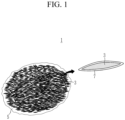
- the prepared negative active material included an agglomerated product, secondary particles in which nano silicon primary particles with sodium silicate on the surface were agglomerated, and a soft carbon coating layer on the surface of the agglomerated product.
- An amount of the nano silicon primary particles was 70 wt%
- an amount of the soft carbon amorphous carbon was 20 wt%
- an amount of sodium silicate was balanced.
- the soft carbon coating layer had a thickness of 2 nm to 500 nm.
- the agglomerate product had an average particle diameter D50 of 10 ⁇ m.
- the negative active material slurry was coated on a Cu foil current collector, dried, and pressurized to prepare a negative electrode including the current collector and a negative active material layer formed on the current collector.
- a negative active material was prepared by the same procedure as in Example 1, except that Na 2 CO 3 was used instead of NaOH and the nano silicon liquid was mixed with Na 2 CO 3 to obtain a mixing ratio of nano silicon and Na 2 CO 3 to be 80:20 by weight ratio.
- the negative active material was used to fabricate a negative electrode and a half-cell by the same procedure as in Example 1.
- the nano silicon liquid was spray-dried at 120 °C using a spray drier to prepare a dried product.
- the dried product and meso pitch were mixed at 70:30 by weight ratio and the mixture was heat-treated at 1,000 °C under an N 2 atmosphere for 4 hours to prepare a negative active material.
- the prepared negative active material included an agglomerated product, secondary particles in which nano silicon primary particles were agglomerated, and a soft carbon coating layer positioned on the surface of the agglomerated product.
- An amount of the nano silicon primary particles was 80 wt%
- an amount of the soft carbon amorphous carbon was 20 wt%.
- the soft carbon coating layer had a thickness of 2 nm to 500 nm.
- the obtained mixture and meso pitch were mixed at 70:30 by weight ratio and the resulting mixture was heat-treated at 1,000 °C under an N 2 atmosphere for 4 hours to prepare a negative active material.
- the negative active material was used to fabricate a negative electrode and a half-cell by the same procedure as in Example 1.
- the X-ray diffraction for the nano silicon primary particles prepared by using the nano silicon liquid according to Examples 1 and 2 was carried out by using a CuK ⁇ to measure a full width at a half maximum, FWHM (111) at a (111) plane.
- Table 1 Full width at a half maximum, FWHM (111)
- Example 1 0.636 degree (°)
- Example 2 0.625 degree (°)
- the X-ray diffraction analysis of the negative active materials of Example 1 and Comparative Example 1 was measured by using a CuK ⁇ ray. The results are shown in FIG. 3 .
- crystalline carbon such as graphite may be used, and research using it has been undertaken enough to obtain performance approaching a theoretical energy density There are still demands for higher energy density and, as alternatives, a silicon active material has been considered.
Landscapes
- Chemical & Material Sciences (AREA)
- Chemical Kinetics & Catalysis (AREA)
- Electrochemistry (AREA)
- General Chemical & Material Sciences (AREA)
- Composite Materials (AREA)
- Engineering & Computer Science (AREA)
- Materials Engineering (AREA)
- Manufacturing & Machinery (AREA)
- Inorganic Chemistry (AREA)
- Battery Electrode And Active Subsutance (AREA)
Applications Claiming Priority (1)
| Application Number | Priority Date | Filing Date | Title |
|---|---|---|---|
| KR1020230001357A KR20240109492A (ko) | 2023-01-04 | 2023-01-04 | 리튬 이차 전지용 음극 활물질 및 이를 포함하는 리튬 이차 전지 |
Publications (1)
| Publication Number | Publication Date |
|---|---|
| EP4398335A1 true EP4398335A1 (fr) | 2024-07-10 |
Family
ID=88647471
Family Applications (1)
| Application Number | Title | Priority Date | Filing Date |
|---|---|---|---|
| EP23207295.9A Pending EP4398335A1 (fr) | 2023-01-04 | 2023-11-01 | Électrode négative pour batterie au lithium rechargeable et batterie au lithium rechargeable la comprenant |
Country Status (3)
| Country | Link |
|---|---|
| US (1) | US20240222604A1 (fr) |
| EP (1) | EP4398335A1 (fr) |
| KR (1) | KR20240109492A (fr) |
Citations (3)
| Publication number | Priority date | Publication date | Assignee | Title |
|---|---|---|---|---|
| CN108110228A (zh) * | 2017-11-23 | 2018-06-01 | 合肥国轩高科动力能源有限公司 | 一种锂离子电池硅基负极材料及其制备方法 |
| JP2020087910A (ja) * | 2018-11-16 | 2020-06-04 | 國家中山科學研究院 | 多層グラフェンをキャリアとするナノシリコンが亜酸化シリコン及びアモルファス炭素層によって被覆された負極材料、及びその製造方法 |
| CN111566847A (zh) * | 2018-01-16 | 2020-08-21 | 伊利诺斯理工学院 | 用于可充电锂电池的硅微反应器 |
-
2023
- 2023-01-04 KR KR1020230001357A patent/KR20240109492A/ko active Pending
- 2023-10-30 US US18/385,008 patent/US20240222604A1/en active Pending
- 2023-11-01 EP EP23207295.9A patent/EP4398335A1/fr active Pending
Patent Citations (3)
| Publication number | Priority date | Publication date | Assignee | Title |
|---|---|---|---|---|
| CN108110228A (zh) * | 2017-11-23 | 2018-06-01 | 合肥国轩高科动力能源有限公司 | 一种锂离子电池硅基负极材料及其制备方法 |
| CN111566847A (zh) * | 2018-01-16 | 2020-08-21 | 伊利诺斯理工学院 | 用于可充电锂电池的硅微反应器 |
| JP2020087910A (ja) * | 2018-11-16 | 2020-06-04 | 國家中山科學研究院 | 多層グラフェンをキャリアとするナノシリコンが亜酸化シリコン及びアモルファス炭素層によって被覆された負極材料、及びその製造方法 |
Also Published As
| Publication number | Publication date |
|---|---|
| US20240222604A1 (en) | 2024-07-04 |
| KR20240109492A (ko) | 2024-07-11 |
Similar Documents
| Publication | Publication Date | Title |
|---|---|---|
| EP3249721A1 (fr) | Électrode positive pour batterie au lithium rechargeable et batterie au lithium rechargeable la comprenant | |
| EP4057386A1 (fr) | Matériau actif positif pour batterie au lithium rechargeable, son procédé de préparation et batterie au lithium rechargeable le comprenant | |
| EP4036064A1 (fr) | Matériau actif positif pour batterie au lithium rechargeable, son procédé de préparation et batterie au lithium rechargeable le comprenant | |
| US20080118846A1 (en) | Rechargeable lithium battery | |
| EP4002518A1 (fr) | Électrode négative pour batterie rechargeable au lithium et batterie rechargeable au lithium comprenant celle-ci | |
| EP3930046A1 (fr) | Électrode négative pour batterie rechargeable au lithium et batterie rechargeable au lithium comprenant celle-ci | |
| EP4228025A1 (fr) | Électrode négative pour batterie au lithium rechargeable et batterie au lithium rechargeable la comprenant | |
| US20240332512A1 (en) | Negative active material for rechargeable lithium battery and rechargeable lithium battery comprising same | |
| US20230268512A1 (en) | Positive electrode for rechargeable lithium battery and rechargeable lithium battery including the same | |
| EP4231386A1 (fr) | Matériau actif négatif pour batterie au lithium rechargeable et batterie au lithium rechargeable le comprenant | |
| EP4199147A1 (fr) | Matériau actif d'anode pour batterie secondaire au lithium, anode pour batterie secondaire au lithium, comprenant celui-ci, et batterie secondaire au lithium le comprenant | |
| US20250079448A1 (en) | Negative electrode active material and rechargeable lithium battery including same | |
| EP4401165A1 (fr) | Matériau actif négatif pour batterie au lithium rechargeable et batterie au lithium rechargeable le comprenant | |
| US12355084B2 (en) | Negative active material and rechargeable lithium battery including same | |
| EP3940813B1 (fr) | Matériau actif négatif pour batterie au lithium rechargeable et batterie au lithium rechargeable le comprenant | |
| EP4398335A1 (fr) | Électrode négative pour batterie au lithium rechargeable et batterie au lithium rechargeable la comprenant | |
| EP4475221B1 (fr) | Électrode négative pour batterie au lithium rechargeable et batterie au lithium rechargeable la comprenant | |
| US20240250243A1 (en) | Negative active material for rechargeable lithium battery and rechargeable lithium battery including same | |
| US12609302B2 (en) | Negative electrode and rechargeable lithium battery including the same | |
| EP4401168A1 (fr) | Matériau actif négatif pour batterie au lithium rechargeable et batterie au lithium rechargeable le comprenant | |
| US12176540B2 (en) | Negative active material and rechargeable lithium battery including same | |
| US20250125354A1 (en) | Negative active material for rechargeable lithium battery and rechargeable lithium battery including same | |
| US20250132313A1 (en) | Negative electrode active material, method of preparing same, and rechargeable lithium battery including same | |
| EP4546445A1 (fr) | Électrode négative pour batterie au lithium rechargeable et batterie au lithium rechargeable la comprenant | |
| EP4365978A2 (fr) | Électrode négative pour batterie au lithium rechargeable et batterie au lithium rechargeable la comprenant |
Legal Events
| Date | Code | Title | Description |
|---|---|---|---|
| PUAI | Public reference made under article 153(3) epc to a published international application that has entered the european phase |
Free format text: ORIGINAL CODE: 0009012 |
|
| STAA | Information on the status of an ep patent application or granted ep patent |
Free format text: STATUS: REQUEST FOR EXAMINATION WAS MADE |
|
| 17P | Request for examination filed |
Effective date: 20231101 |
|
| AK | Designated contracting states |
Kind code of ref document: A1 Designated state(s): AL AT BE BG CH CY CZ DE DK EE ES FI FR GB GR HR HU IE IS IT LI LT LU LV MC ME MK MT NL NO PL PT RO RS SE SI SK SM TR |