EP4398570A2 - Bildcodierung mit unterstützung von block merging und skip mode - Google Patents
Bildcodierung mit unterstützung von block merging und skip mode Download PDFInfo
- Publication number
- EP4398570A2 EP4398570A2 EP24163025.0A EP24163025A EP4398570A2 EP 4398570 A2 EP4398570 A2 EP 4398570A2 EP 24163025 A EP24163025 A EP 24163025A EP 4398570 A2 EP4398570 A2 EP 4398570A2
- Authority
- EP
- European Patent Office
- Prior art keywords
- sample set
- bitstream
- current sample
- picture
- coding parameters
- Prior art date
- Legal status (The legal status is an assumption and is not a legal conclusion. Google has not performed a legal analysis and makes no representation as to the accuracy of the status listed.)
- Granted
Links
Images





Classifications
-
- H—ELECTRICITY
- H04—ELECTRIC COMMUNICATION TECHNIQUE
- H04N—PICTORIAL COMMUNICATION, e.g. TELEVISION
- H04N19/00—Methods or arrangements for coding, decoding, compressing or decompressing digital video signals
- H04N19/10—Methods or arrangements for coding, decoding, compressing or decompressing digital video signals using adaptive coding
- H04N19/134—Methods or arrangements for coding, decoding, compressing or decompressing digital video signals using adaptive coding characterised by the element, parameter or criterion affecting or controlling the adaptive coding
- H04N19/157—Assigned coding mode, i.e. the coding mode being predefined or preselected to be further used for selection of another element or parameter
-
- H—ELECTRICITY
- H04—ELECTRIC COMMUNICATION TECHNIQUE
- H04N—PICTORIAL COMMUNICATION, e.g. TELEVISION
- H04N19/00—Methods or arrangements for coding, decoding, compressing or decompressing digital video signals
- H04N19/50—Methods or arrangements for coding, decoding, compressing or decompressing digital video signals using predictive coding
- H04N19/503—Methods or arrangements for coding, decoding, compressing or decompressing digital video signals using predictive coding involving temporal prediction
- H04N19/51—Motion estimation or motion compensation
- H04N19/513—Processing of motion vectors
- H04N19/517—Processing of motion vectors by encoding
- H04N19/52—Processing of motion vectors by encoding by predictive encoding
-
- H—ELECTRICITY
- H04—ELECTRIC COMMUNICATION TECHNIQUE
- H04N—PICTORIAL COMMUNICATION, e.g. TELEVISION
- H04N19/00—Methods or arrangements for coding, decoding, compressing or decompressing digital video signals
- H04N19/10—Methods or arrangements for coding, decoding, compressing or decompressing digital video signals using adaptive coding
- H04N19/102—Methods or arrangements for coding, decoding, compressing or decompressing digital video signals using adaptive coding characterised by the element, parameter or selection affected or controlled by the adaptive coding
- H04N19/103—Selection of coding mode or of prediction mode
-
- H—ELECTRICITY
- H04—ELECTRIC COMMUNICATION TECHNIQUE
- H04N—PICTORIAL COMMUNICATION, e.g. TELEVISION
- H04N19/00—Methods or arrangements for coding, decoding, compressing or decompressing digital video signals
- H04N19/10—Methods or arrangements for coding, decoding, compressing or decompressing digital video signals using adaptive coding
- H04N19/102—Methods or arrangements for coding, decoding, compressing or decompressing digital video signals using adaptive coding characterised by the element, parameter or selection affected or controlled by the adaptive coding
- H04N19/119—Adaptive subdivision aspects, e.g. subdivision of a picture into rectangular or non-rectangular coding blocks
-
- H—ELECTRICITY
- H04—ELECTRIC COMMUNICATION TECHNIQUE
- H04N—PICTORIAL COMMUNICATION, e.g. TELEVISION
- H04N19/00—Methods or arrangements for coding, decoding, compressing or decompressing digital video signals
- H04N19/10—Methods or arrangements for coding, decoding, compressing or decompressing digital video signals using adaptive coding
- H04N19/102—Methods or arrangements for coding, decoding, compressing or decompressing digital video signals using adaptive coding characterised by the element, parameter or selection affected or controlled by the adaptive coding
- H04N19/13—Adaptive entropy coding, e.g. adaptive variable length coding [AVLC] or context adaptive binary arithmetic coding [CABAC]
-
- H—ELECTRICITY
- H04—ELECTRIC COMMUNICATION TECHNIQUE
- H04N—PICTORIAL COMMUNICATION, e.g. TELEVISION
- H04N19/00—Methods or arrangements for coding, decoding, compressing or decompressing digital video signals
- H04N19/10—Methods or arrangements for coding, decoding, compressing or decompressing digital video signals using adaptive coding
- H04N19/134—Methods or arrangements for coding, decoding, compressing or decompressing digital video signals using adaptive coding characterised by the element, parameter or criterion affecting or controlling the adaptive coding
- H04N19/157—Assigned coding mode, i.e. the coding mode being predefined or preselected to be further used for selection of another element or parameter
- H04N19/159—Prediction type, e.g. intra-frame, inter-frame or bidirectional frame prediction
-
- H—ELECTRICITY
- H04—ELECTRIC COMMUNICATION TECHNIQUE
- H04N—PICTORIAL COMMUNICATION, e.g. TELEVISION
- H04N19/00—Methods or arrangements for coding, decoding, compressing or decompressing digital video signals
- H04N19/10—Methods or arrangements for coding, decoding, compressing or decompressing digital video signals using adaptive coding
- H04N19/169—Methods or arrangements for coding, decoding, compressing or decompressing digital video signals using adaptive coding characterised by the coding unit, i.e. the structural portion or semantic portion of the video signal being the object or the subject of the adaptive coding
- H04N19/17—Methods or arrangements for coding, decoding, compressing or decompressing digital video signals using adaptive coding characterised by the coding unit, i.e. the structural portion or semantic portion of the video signal being the object or the subject of the adaptive coding the unit being an image region, e.g. an object
- H04N19/172—Methods or arrangements for coding, decoding, compressing or decompressing digital video signals using adaptive coding characterised by the coding unit, i.e. the structural portion or semantic portion of the video signal being the object or the subject of the adaptive coding the unit being an image region, e.g. an object the region being a picture, frame or field
-
- H—ELECTRICITY
- H04—ELECTRIC COMMUNICATION TECHNIQUE
- H04N—PICTORIAL COMMUNICATION, e.g. TELEVISION
- H04N19/00—Methods or arrangements for coding, decoding, compressing or decompressing digital video signals
- H04N19/10—Methods or arrangements for coding, decoding, compressing or decompressing digital video signals using adaptive coding
- H04N19/169—Methods or arrangements for coding, decoding, compressing or decompressing digital video signals using adaptive coding characterised by the coding unit, i.e. the structural portion or semantic portion of the video signal being the object or the subject of the adaptive coding
- H04N19/17—Methods or arrangements for coding, decoding, compressing or decompressing digital video signals using adaptive coding characterised by the coding unit, i.e. the structural portion or semantic portion of the video signal being the object or the subject of the adaptive coding the unit being an image region, e.g. an object
- H04N19/176—Methods or arrangements for coding, decoding, compressing or decompressing digital video signals using adaptive coding characterised by the coding unit, i.e. the structural portion or semantic portion of the video signal being the object or the subject of the adaptive coding the unit being an image region, e.g. an object the region being a block, e.g. a macroblock
-
- H—ELECTRICITY
- H04—ELECTRIC COMMUNICATION TECHNIQUE
- H04N—PICTORIAL COMMUNICATION, e.g. TELEVISION
- H04N19/00—Methods or arrangements for coding, decoding, compressing or decompressing digital video signals
- H04N19/10—Methods or arrangements for coding, decoding, compressing or decompressing digital video signals using adaptive coding
- H04N19/169—Methods or arrangements for coding, decoding, compressing or decompressing digital video signals using adaptive coding characterised by the coding unit, i.e. the structural portion or semantic portion of the video signal being the object or the subject of the adaptive coding
- H04N19/184—Methods or arrangements for coding, decoding, compressing or decompressing digital video signals using adaptive coding characterised by the coding unit, i.e. the structural portion or semantic portion of the video signal being the object or the subject of the adaptive coding the unit being bits, e.g. of the compressed video stream
-
- H—ELECTRICITY
- H04—ELECTRIC COMMUNICATION TECHNIQUE
- H04N—PICTORIAL COMMUNICATION, e.g. TELEVISION
- H04N19/00—Methods or arrangements for coding, decoding, compressing or decompressing digital video signals
- H04N19/10—Methods or arrangements for coding, decoding, compressing or decompressing digital video signals using adaptive coding
- H04N19/169—Methods or arrangements for coding, decoding, compressing or decompressing digital video signals using adaptive coding characterised by the coding unit, i.e. the structural portion or semantic portion of the video signal being the object or the subject of the adaptive coding
- H04N19/186—Methods or arrangements for coding, decoding, compressing or decompressing digital video signals using adaptive coding characterised by the coding unit, i.e. the structural portion or semantic portion of the video signal being the object or the subject of the adaptive coding the unit being a colour or a chrominance component
-
- H—ELECTRICITY
- H04—ELECTRIC COMMUNICATION TECHNIQUE
- H04N—PICTORIAL COMMUNICATION, e.g. TELEVISION
- H04N19/00—Methods or arrangements for coding, decoding, compressing or decompressing digital video signals
- H04N19/50—Methods or arrangements for coding, decoding, compressing or decompressing digital video signals using predictive coding
-
- H—ELECTRICITY
- H04—ELECTRIC COMMUNICATION TECHNIQUE
- H04N—PICTORIAL COMMUNICATION, e.g. TELEVISION
- H04N19/00—Methods or arrangements for coding, decoding, compressing or decompressing digital video signals
- H04N19/70—Methods or arrangements for coding, decoding, compressing or decompressing digital video signals characterised by syntax aspects related to video coding, e.g. related to compression standards
Definitions
- the present application concerns picture and/or video coding and in particular codecs supporting block partitioning and skip mode.
- merging of blocks may be used in order to increase the number of possible picture subdivisionings at a reasonable amount of additional data necessary in order to signalize the merging information.
- the coding parameters need to be transmitted within the bitstream in full merely once, similarly as if the resulting merged group of blocks was a directly subdivided portion of the picture.
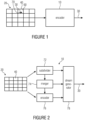
- Fig. 1 shows an apparatus 10 for encoding a picture 20 into a bitstream 30.
- picture 20 could be part of a video, in which case the encoder 10 would be a video encoder.
- a multi-tree subdivision such as a quad-tree subdivision may be applied to picture 20 or to a regular pre-subdivisioning of picture 20 into regularly arranged tree-root blocks so as to obtain blocks 40 which, in this case, form the leaf blocks of the multi-tree subdivision of the tree-root blocks.
- the encoder 10 is configured to encode, for current sample set 40, a flag into the bitstream 30 commonly signaling, if assuming a first state, that the coding parameters associated with the current sample set 40 are to be set according to a merge candidate rather than to be retrieved from the bitstream 30, and that the current sample set of the picture 20 is to be reconstructed merely based on a prediction signal depending on the coding parameters associated with the current sample set, without any residual data, and if assuming any other state that the coding parameters associated with the current sample set 40 are to be retrieved from the bitstream 30, or that the current sample set of the picture 20 is to be reconstructed by refining the prediction signal depending on the coding parameters associated with the current sample set 40 by means of a residual data within the bitstream 30.
- encoder 10 derives at least a portion of the set or list of merge candidates by adopting the coding parameters associated with locally and/or temporally neighboring blocks 40 which have been previously encoded in accordance with the encoding order applied by encoder 10.
- Temporal neighborhood denotes, for example, blocks of previously encoded pictures of a video to which picture 20 belongs, with the temporally neighboring blocks thereof being spatially located so as to spatially overlap the current block 40 of the current picture 20. Accordingly, for this portion of the set or list of merge candidates, there is a one to one association between each merge candidate and the spatially and/or temporally neighboring blocks.
- Each merge candidate has coding parameters associated therewith.
- encoder 10 sets the coding parameters of the current block 40 in accordance with the merge candidate. For example, encoder 10 may set the coding parameters of the current block 40 to be equal to the respective merge candidate, i.e. encoder 10 may copy the coding parameters of the current block 40 from the respective merge candidate.
- the coding parameters of a merge candidate are directly adopted from a spatially and/or temporally neighboring block, or the coding parameters of the respective merge candidate is obtained from the coding parameters of such a spatially and/or temporally neighboring block by adopting same, i.e.
- Some blocks are coupled to each other via merging, but use different coding parameters correlated among each other via respective scaling adaptations and/or combinational functions. Some blocks 40 are not subject to merging, and accordingly encoder 10 encodes the coding parameters into bitstream 30 directly.
- encoder 10 decides for blocks 40 whether skip mode shall be applied to the respective block or not. If skip mode is applied, the encoder 10 encodes picture 20 within the current portion 40 merely in the form of the prediction signal derived from, or depending on, the coding parameters associated with the respective block 40, and in case of the skip mode being deselected, encoder 10 encodes the picture 20 into bitstream 30 within block 40 using both, the prediction signal as well as the residual data.
- the signalization state may be determined by the state of one bit of bitstream 30.
- encoder 10 may be configured to entropy encode bitstream 30, and accordingly the correspondence between the signalization state of the flag and the bitstream 30 may be more complicated. In that case, the state could correspond to one bit of bitstream 30 in the entropy-decoded domain.
- the signalization state may correspond to one of the two states of the flag for which code words are assigned in accordance with the variable length coding scheme.
- the signalization state commonly signaling the activation of merging and skip mode, may correspond to one of the symbols of the symbol alphabet underlying the arithmetic encoding scheme.
- the aforementioned common state commonly signaling the activation of the merging and the skip mode may additionally concurrently signal the non-partitioning pattern among the supported partitioning patterns for the current block 40 so that in case of the flag or the syntax element assuming this state, no further transmission of partitioning information for the current block is necessary.
- any other partitioning pattern among the supported partitioning pattern could alternatively be indicated concurrently in addition to the activation of the merging and the skip mode.
- the encoder 10 may be configured to signalize within the bitstream 30 the coding mode to be used for the respective portion or block 40 of picture 20 at the granularity defined by block 40 while the encoder 10 may be configured to vary the coding parameters of the respective coding mode within the respective block 40 at an increased (finer) granularity defined by the respective partitioning pattern chosen for the respective block 40.
- the coding mode signaled at the granularity of blocks 40 may distinguish between intra prediction mode, inter prediction mode and the like, such as temporal inter prediction mode, inter-view prediction mode etc.
- the sort of coding parameters associated with the one or more sub-blocks (partitions) resulting from the partitioning of the respective block 40 then depends on the coding mode assigned to the respective block 40.
- the coding parameters may comprise a spatial direction along which picture content of previously decoded portions of picture 20 are used to fill the respective block 40.
- the coding parameters may comprise, inter alia, a motion vector for motion-compensated prediction.
- Fig. 1 exemplarily shows the current block 40 as being subdivided into two sub-blocks 50 and 60.
- a vertically partitioning mode is exemplarily shown.
- the smaller blocks 50 and 60 may also be called sub-blocks 50 and 60 or partitions 50 and 60 or prediction units 50 and 60.
- the encoder 10 may be configured to remove, in such cases where the signaled one of the supported partitioning patterns specifies a subdivision of the current block 40 into two or more further blocks 50 and 60, for all further blocks except a first sub-block of the sub-blocks 50 and 60 in a coding order, from a set of coding parameter candidates for the respective sub-block, coding parameter candidates having coding parameters which are the same as coding parameters associated with any of the sub-blocks which would, when being merged with the respective sub-blocks, result in one of the supported partitioning patterns.
- a coding order is defined among the resulting one or more partitions 50 and 60. In the case of Fig.
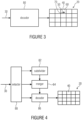
- the merge decision by merger 74 and the skip mode decision performed by encoder 76 is, as outlined above, commonly encoded into bitstream 30 by stream generator 78 such that one of the possible states of the one or more syntax elements of a current block 40 signalizes that the respective block is to be merged into one of the groups of blocks along with another block of picture 20 and has no prediction residual encoded and inserted into bitstream 30.
- the stream generator 78 may, for example, use entropy coding in order to perform the insertion.
- the subdivider 72 may be responsible for the subdivision of the picture 20 into the blocks 40 as well as the optional further partitioning into partitions 50 and 60, respectively.
- the merger 74 is responsible for the above-outlined merge decision while the encoder 76 may, for example, decide on the skip mode for the blocks 40. Naturally, all of these decisions influence the rate/distortion measure in combination, and accordingly apparatus 10 may be configured to try out several decision options in order to ascertain which option is to be preferred.
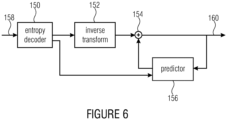
- the decoder 86 is also configured to decode the picture 20 by predicting the picture 20, decoding a prediction residual for predetermined blocks 40 and combining the prediction residual and a prediction resulting from predicting the picture 20, for the predetermined blocks 40, i.e. those having the skip mode switched off.
- the extractor 88 is configured to extract the prediction residual and the coding parameters from the bitstream 30, along with one or more syntax elements for each of at least a subset of the blocks 40, signaling whether the respective block 40 is to be merged into one of the groups along with another block 40 or not, wherein the merger 84 is configured to perform the merging responsive to the one or more syntax elements, wherein one of the possible states of the one or more syntax elements signalizes that the respective block 40 is to be merged into one of the groups of blocks along with another block 40 and has no prediction residual encoded and inserted into the bitstream 30.
- the subdivider 82 acts like subdivider 72 in order to restore the subdivision generated by subdivider 72.
- Subdivider 82 knows about the subdivision of picture 20 either by default or extracts subdivision information from bitstream 30 via extractor 88.
- merger 84 forms the merging of the blocks 40 and is activated with regard to blocks 40 and block portions via the above-outlined signaling within bitstream 30.
- Decoder 86 performs the generation of the prediction signal of picture 20 using the coding parameters within bitstream 30. In case of merging, decoder 86 copies the coding parameters of a current block 40 or a current block partition from neighboring blocks/partitions or otherwise sets the coding parameters thereof according to the merge candidate.
- the decoder 80 may be configured to determine the set of coding parameter candidates for the respective non-first partition 60 out of an initial set of previously decoded partitions, excluding ones being coded in an intra prediction mode.
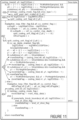
- Predictor 106 predicts portions of picture 20 with the result of the prediction, i.e., the prediction signal, being applied to the inverting input of subtracter 108.
- the output of subtractor 108 represents the difference between the prediction signal and the respective portion of picture 20, i.e. a residual signal.
- the residual signal is subject to transform coding in transformer 100. That is, transformer 100 may perform a transformation, such as a DCT or the like, and a subsequent quantization on the transformed residual signal, i.e. the transform coefficients, so as to obtain transform coefficient levels.
- the inverse transformer 104 reconstructs the final residual signal output by transformer 100 to obtain a reconstructed residual signal which corresponds to the residual signal input into transformer 100 except for the information loss due to the quantization in transformer 100.
- the addition of the reconstructed residual signal and the prediction signal as output by predictor 106 results in a reconstruction of the respective portion of picture 20 and is forwarded from the output of adder 110 to the input of predictor 106.
- Predictor 106 operates in different modes as described above, such as an intra prediction mode, inter prediction mode and the like. Prediction mode and the corresponding coding or prediction parameters applied by predictor 106 in order to obtain the prediction signal, are forwarded by predictor 106 to entropy encoder 102 for insertion into the bitstream.
- the decoder 80 may comprise a bitstream extractor 150 which may, as shown in Fig. 6 , be implemented as an entropy decoder, an inverse transformer 152 and an adder 154, which are, in the order mentioned, connected between an input 158 and an output 160 of the decoder.
- the decoder of Fig. 6 comprises a predictor 156 connected between an output of adder 154 and a further input thereof.
- the entropy decoder 150 is connected to a parameter input of predictor 156.
- the size of the tree-root blocks 200 may be selected by the encoder and signaled to the decoder by bitstream 30. Alternatively, the size of these tree-root blocks 200 may be fixed by default.
- the tree-root blocks 200 are subdivided by use of quad-tree partitioning in order to yield the above-identified blocks 40 which may be called coding blocks or coding units. These coding blocks or coding units are drawn with thin solid lines in Fig. 7a .
- the encoder accompanies each tree-root block 200 with subdivision information and inserts the subdivision information into the bitstream. This subdivision information indicates as to how the tree-root block 200 is to be subdivided into blocks 40.
- each block 40 - or each block having a certain prediction mode such as inter prediction mode - is accompanied by partitioning information as to which supported partitioning pattern is used for the respective block 40.
- the aforementioned flag/syntax element may, when assuming the commonly signaling state, concurrently also signal one of the supported partitioning modes for the respective block 40 so that the explicit transmission of another partitioning information for this block 40 may be suppressed at the encoder side and not be expected, accordingly, at the decoder side.
- the non-partitioning mode has been chosen so that the coding block 40 spatially coincides with the corresponding partition.
- the coding block 40 is, concurrently, a partition having a respective set of prediction parameters associated therewith.
- the sort of prediction parameters depends on the mode associated with the respective coding block 40.
- Other coding blocks are exemplarily shown to be further partitioned.
- the coding block 40 at the top right-hand corner of the tree-root block 200 for example, is shown to be partitioned into four partitions, whereas the coding block at the bottom right-hand corner of the tree-root block 200 is exemplarily shown to be vertically subdivided into two partitions.
- Fig. 7a also shows the coding order among the partitions thus defined. As shown, a depth-first traversal order is used. Across the tree-root block borders, the coding order may be continued in a scan order according to which the rows of tree-root blocks 200 are scanned row-wise from top to bottom of picture 20. By this measure, it is possible to have a maximum chance that a certain partition has a previously coded partition adjacent to its top border and left-hand border.
- Each block 40 - or each block having a certain prediction mode such as inter prediction mode - may have a merge switch indicator within the bitstream indicating as to whether merging is activated for the corresponding partitions therein or not.
- partitioning of the blocks into partitions/prediction units could be restricted to a partitioning of maximally two partitions, with merely an exception of this rule being only made for the smallest possible block size of blocks 40. This could, in case of using quad-tree subdivision in order to obtain blocks 40, avoid redundancy between subdivision information for subdividing picture 20 into block 40 and partitioning information for subdividing block 40 into partitions. Alternatively, merely partitionings into one or two partitions could be allowed, including or not including asymmetric ones.
- Fig. 7b shows a subdivision tree. With solid lines, the subdivision of tree-root block 200 is illustrated, whereas dotted lines symbolize the partitioning of the leaf blocks of the quad-tree subdivisioning, which are the coding blocks 40. That is, the partitioning of the coding blocks represents a kind of extension of the quad-subdivision.
- each coding block 40 may be parallely subdivided into transform blocks so that transform blocks may represent a different subdivision of the respective coding block 40.
- transform blocks which are not shown in Figs. 7a and 7b , a transformation in order to transform the residual signal of the coding blocks may be performed separately.
- embodiments of the present application describe methods for reducing the side information rate in image and video coding applications by combined signaling of merging and the absence of residual data for sets of samples.
- the side information rate in image and video coding applications is reduced by combining syntax elements indicating the usage of merging schemes and syntax elements indicating the absence of residual data.
- the sample sets are associated with particular coding parameters, which may specify prediction information or residual coding modes, etc.
- a partitioning is often done for the purpose of motion representation. All samples of a block (inside a partitioning pattern) are associated with the same set of motion parameters, which may include parameters specifying the type of prediction (e.g., list 0, list 1, or bi-prediction; and/or translational or affine prediction or a prediction with a different motion model), parameters specifying the employed reference pictures, parameters specifying the motion with respect to the reference pictures (e.g., displacement vectors, affine motion parameter vectors, or motion parameter vectors for any other motion model), which are usually transmitted as a difference to a predictor, parameters specifying the accuracy of motion parameters (e.g., half-sample or quarter-sample accuracy), parameters specifying the weighting of the reference sample signal (e.g., for the purpose of illumination compensation), or parameters specifying the interpolation filter that is employed for deriving the motion compensated prediction signal of the current block
- the same pattern can also be signaled by sending a syntax element that specifies that this block is, for example, subdivided into two vertically (or horizontally) aligned rectangular blocks 50, 60. Then we can transmit merging information that specify that the second of these rectangular blocks is merged with the first rectangular block, which results in exactly the same partitioning as when we signal that the block is not further divided.
- the same can also be achieved by first specifying that the block is subdivided in four square sub-blocks and then transmit merging information that effectively merges all these four blocks. This concept is clearly suboptimal (since we have different codewords for signaling the same thing).
- Some embodiments of the present invention reduce the side information rate and thus increase the coding efficiency for a combination of the concept of merging with the concept of providing different partitioning patterns for a block. If we look at the example partitioning patterns in Fig. 8 , the "simulation" of the not further divided block by any of the partitioning patterns with two rectangular blocks can be avoided when we forbid (i.e., exclude from the bitstream syntax specification) the case that a rectangular block is merged with a first rectangular block.
- the merging concept is in some sense similar to the SKIP or DIRECT modes that are found in video coding designs.
- SKIP/DIRECT modes basically no motion parameters are transmitted for a current block, but are inferred from a spatial and/or temporal neighborhood.
- a list of motion parameter candidates reference frame indices, displacement vectors, etc.
- an index into this list is transmitted that specifies which of the candidate parameters is chosen.
- a separate candidate can be signaled for each reference list.
- Possible candidates may include the block to the top of the current block, the block to the left of the current block, the block to the top-left of the current block, the block to the top-right of the current block, the median predictor of various of these candidates, the co-located block in one or more previous reference frames (or any other already coded block, or a combination obtained from already coded blocks).
- Combining SKIP/DIRECT with the merge concept means that a block can be coded using either a SKIP/DIRECT or a merging mode.
- SKIP/DIRECT and merging concepts are similar there are differences between the two concepts which are explained in more detail in section 1.
- the main difference between SKIP and DIRECT is that the SKIP mode further signals that no residual signal is transmitted.
- a flag is transmitted that signals whether a block contains non-zero transform coefficient levels.
- the embodiments described above and below combine the signaling whether a sample set uses the coding parameters of another sample set and the signaling whether no residual signal is transmitted for the block.
- the combined flag indicates that a sample set uses coding parameters of another sample set and that no residual data is transmitted. For this case only one flag, instead of two, needs to be transmitted.
- the pictures or particular sets of sample arrays for the pictures may be decomposed into blocks, which are associated with particular coding parameters.
- the pictures usually consist of multiple sample arrays.
- a picture may also be associated with additional auxiliary samples arrays, which may, for example, specify transparency information or depth maps.
- the sample arrays of a picture can be grouped into one or more so-called plane groups, where each plane group consists of one or more sample arrays.
- Fig. 8 An example of possible partitioning patterns is shown in Fig. 8 .
- the decoding of the associated coding parameters is specified in a certain way.
- all samples in a block are predicted using the same set of prediction parameters, such as reference indices (identifying a reference picture in the set of already coded pictures), motion parameters (specifying a measure for the movement of a blocks between a reference picture and the current picture), parameters for specifying the interpolation filter, intra prediction modes, etc.
- the motion parameters can be represented by displacement vectors with a horizontal and vertical component or by higher order motion parameters such as affine motion parameters consisting of six components.
- merely refinement information may be conveyed for the merged current block 40.
- a determination of a candidate set and the reduction thereof as well as the merging and so forth is also performed for the other coding blocks 40 of picture 20.
- the coding blocks somehow form groups of coding blocks along a coding chain, wherein the coding parameters for these groups are transmitted within the bitstream in full merely once.
- the prediction parameters associated with the new group of blocks can be re-estimated (e.g., by performing a new motion search) or the prediction parameters that have already been determined for the current block and the neighboring block or group of blocks could be evaluated for the new group of blocks.
- An encoder can also directly check (a subset of) the patterns that are provided by a combination of splitting and merging; i.e., the motion estimation and mode decision can be done with the resulting shapes as already mentioned above.
- the merging information can be signaled on a block basis. Effectively, the merging could also be interpreted as inference of the prediction parameters for a current block, where the inferred prediction parameters are set equal to the prediction parameters of one of the neighboring blocks.
- the temporal DIRECT mode uses the motion vector from the temporal collocated block and scales the motion vector according to the temporal distance between the current and the collocated block.
- the reference indexes and motion vectors for both reference picture lists are basically inferred based on the motion data in a spatial neighborhood.
- the reference indexes are chosen as the minimum of the corresponding reference indexes in the spatial neighborhood and each motion vector component is set equal to the median of the corresponding motion vector components in the spatial neighborhood.
- the SKIP mode can only be used for coding 16x16 macroblocks in H.264 (in P and B pictures) and the DIRECT mode can be used for coding 16x16 macroblocks or 8x8 sub-macroblocks.
- the basic idea of the embodiments outlined above and below is to reduce the bit rate that is required for transmitting the CBF flags by combining the merge and CBF flags. If a sample set uses merging and no residual data is transmitted, one flag is transmitted signaling both.
- particular sets of samples (which may represent rectangular or quadratic blocks or arbitrarily shaped regions or any other collection of samples) are usually associated with a particular set of coding parameters.
- the coding parameters are included in the bitstream.
- the coding parameters may represent prediction parameters, which specify how the corresponding set of samples is predicted using already coded samples.
- the partitioning of the sample arrays of a picture into sample sets may be fixed by the syntax or may be signaled by corresponding subdivision information inside the bitstream. Multiple partitioning patterns for a block may be allowed.
- the coding parameters for the sample sets are transmitted in a predefined order, which is given by the syntax.
- the subsidiary merging activating flag is called mrg whereas later on, with respect to Fig. 11 to 13 , same is called merge _flag.
- merge index is now called mrg_idx whereas later merge _idx is used.
- the first syntax element which is called mrg_cbf in the following, specifies whether the current set of samples is merged with another sample set and whether all corresponding CBFs are equal to 0.
- the mrg_cbf syntax element may only be coded if a derived set of candidate sample sets is not empty (after the potential removal of the candidates that would produce a partitioning that could be signaled by different partitioning pattern without merging). However, it may be guaranteed by default that the list of merge candidates never vanishes, that there is at least one or even at least two merge candidates available.
- the mrg_cbf syntax element is coded as follows.
- the merging information for a set of samples is coded after a subset of the prediction parameters (or, more generally, the particular coding parameters that are associated with the sample sets) has been transmitted.
- the subset of prediction parameters may consist of one or more reference picture indices or one or more components of a motion parameter vector or a reference picture index and one or more components of a motion parameter vector, etc.
- the mrg_cbf syntax element of the merging information is coded only for a reduced set of partitioning modes.
- a possible set of partitioning modes is presented in Fig. 8 .
- this reduced set of partitioning modes is limited to one and corresponds to the first partitioning mode (the top-left of the list in Fig. 8 ).
- the mrg_cbf is coded only if a block is not further partitioned.
- the mrg_cfb may be coded only for square blocks.
- the mrg_cbf syntax element of the merging information is coded only for one block of a partitioning where this partitioning is one of the possible partitioning modes shown in Fig. 8 , e.g. the partitioning mode with four blocks bottom left.
- the merging information of the first merged block contains the mrg_cbf syntax element for the complete partition.
- the merging information only contains the mrg syntax element specifying whether the current set of samples is merged with another sample set or not. The information whether residual data are present or not is inferred from the mrg_cbf syntax element coded in the first block.
- the SKIP mode related parameters are coded before the merging information containing the mrg_cbf syntax element.
- the one or more syntax elements for each of at least a subset of the sample sets may also signal with which of a set of predetermined candidate sample sets neighboring the respective sample set, the respective sample set is to be merged, if the respective sample set is to be merged into any one of the disjoint sets along with another sample set.
- partitioning option PART_N ⁇ N is not available, but the others.
- the association between the names for the partitioning modes used in Fig. 12 to the partitioning options shown in Fig. 8 is indicated in Fig. 8 by respective subscripts below the individual partitioning options.
- the prediction type syntax element pred_type not only signals the prediction mode, i.e. intra or inter coded, but also the partitioning in case of inter coding mode.
- the inter-coding mode case is discussed further.
- the function prediction _unit is called for each partition, such as partitions 50 and 60 in the coding order mentioned above.
- the function prediction _unit starts with checking the skip_flag at 414. If the skip_flag is set, a merge_idx inevitably follows at 416.
- skip_flag 1 concurrently signals that no residual data is to be transmitted. This is derivable from the fact that the transmission of the residual data at 426 in Fig. 12 for the current coding unit merely takes place in case of skip_flag being equal to 0, as derivable from the fact that this residual data transmission in within the else option of if-clause 428 which checks the state of skip_flag immediately after its transmission.
- the decoder is configured to if the signaled supported partitioning patterns specifies a subdivision of the current sample set into two or more sample subsets, remove for all sample subsets except a first sample subset of the sample subsets in a coding order, from a set of merge candidates for the respective sample subset, merge candidates having coding parameters which are the same as coding parameters associated with any of the sample subsets, which would, when being merged with the respective sample subset result in one of the supported partitioning patterns.
- the extractor is also configured to extract subdivision information from the bitstream, and the subdivider is configured to subdivide the picture into sample sets responsive to the subdivision information.
Landscapes
- Engineering & Computer Science (AREA)
- Multimedia (AREA)
- Signal Processing (AREA)
- Compression Or Coding Systems Of Tv Signals (AREA)
Applications Claiming Priority (5)
| Application Number | Priority Date | Filing Date | Title |
|---|---|---|---|
| US41024610P | 2010-11-04 | 2010-11-04 | |
| PCT/EP2011/069408 WO2012059577A1 (en) | 2010-11-04 | 2011-11-04 | Picture coding supporting block merging and skip mode |
| EP21182527.8A EP3962088B1 (de) | 2010-11-04 | 2011-11-04 | Bildcodierung mit unterstützung von block merging und skip mode |
| EP11781501.9A EP2636218B1 (de) | 2010-11-04 | 2011-11-04 | Bildcodierung mit unterstützung von block merging und skip mode |
| EP23179369.6A EP4270957B1 (de) | 2010-11-04 | 2011-11-04 | Bildcodierung mit unterstützung von block merging und skip mode |
Related Parent Applications (4)
| Application Number | Title | Priority Date | Filing Date |
|---|---|---|---|
| EP21182527.8A Division EP3962088B1 (de) | 2010-11-04 | 2011-11-04 | Bildcodierung mit unterstützung von block merging und skip mode |
| EP11781501.9A Division EP2636218B1 (de) | 2010-11-04 | 2011-11-04 | Bildcodierung mit unterstützung von block merging und skip mode |
| EP23179369.6A Division EP4270957B1 (de) | 2010-11-04 | 2011-11-04 | Bildcodierung mit unterstützung von block merging und skip mode |
| EP23179369.6A Division-Into EP4270957B1 (de) | 2010-11-04 | 2011-11-04 | Bildcodierung mit unterstützung von block merging und skip mode |
Publications (4)
| Publication Number | Publication Date |
|---|---|
| EP4398570A2 true EP4398570A2 (de) | 2024-07-10 |
| EP4398570A3 EP4398570A3 (de) | 2024-09-04 |
| EP4398570C0 EP4398570C0 (de) | 2025-06-18 |
| EP4398570B1 EP4398570B1 (de) | 2025-06-18 |
Family
ID=44925528
Family Applications (7)
| Application Number | Title | Priority Date | Filing Date |
|---|---|---|---|
| EP24163026.8A Active EP4398571B1 (de) | 2010-11-04 | 2011-11-04 | Bildcodierung mit unterstützung von block merging und skip mode |
| EP11781501.9A Active EP2636218B1 (de) | 2010-11-04 | 2011-11-04 | Bildcodierung mit unterstützung von block merging und skip mode |
| EP24163024.3A Active EP4398569B1 (de) | 2010-11-04 | 2011-11-04 | Bildcodierung mit unterstützung von block merging und skip mode |
| EP21182527.8A Active EP3962088B1 (de) | 2010-11-04 | 2011-11-04 | Bildcodierung mit unterstützung von block merging und skip mode |
| EP23179369.6A Active EP4270957B1 (de) | 2010-11-04 | 2011-11-04 | Bildcodierung mit unterstützung von block merging und skip mode |
| EP26154821.8A Pending EP4712475A2 (de) | 2010-11-04 | 2011-11-04 | Bildcodierung mit unterstützung von block merging und skip mode |
| EP24163025.0A Active EP4398570B1 (de) | 2010-11-04 | 2011-11-04 | Bildcodierung mit unterstützung von block merging und skip mode |
Family Applications Before (6)
| Application Number | Title | Priority Date | Filing Date |
|---|---|---|---|
| EP24163026.8A Active EP4398571B1 (de) | 2010-11-04 | 2011-11-04 | Bildcodierung mit unterstützung von block merging und skip mode |
| EP11781501.9A Active EP2636218B1 (de) | 2010-11-04 | 2011-11-04 | Bildcodierung mit unterstützung von block merging und skip mode |
| EP24163024.3A Active EP4398569B1 (de) | 2010-11-04 | 2011-11-04 | Bildcodierung mit unterstützung von block merging und skip mode |
| EP21182527.8A Active EP3962088B1 (de) | 2010-11-04 | 2011-11-04 | Bildcodierung mit unterstützung von block merging und skip mode |
| EP23179369.6A Active EP4270957B1 (de) | 2010-11-04 | 2011-11-04 | Bildcodierung mit unterstützung von block merging und skip mode |
| EP26154821.8A Pending EP4712475A2 (de) | 2010-11-04 | 2011-11-04 | Bildcodierung mit unterstützung von block merging und skip mode |
Country Status (16)
| Country | Link |
|---|---|
| US (11) | US9924193B2 (de) |
| EP (7) | EP4398571B1 (de) |
| JP (8) | JP6258704B2 (de) |
| KR (10) | KR102648076B1 (de) |
| CN (11) | CN107105304B (de) |
| DK (2) | DK2636218T3 (de) |
| ES (5) | ES2891598T3 (de) |
| FI (1) | FI3962088T3 (de) |
| HU (5) | HUE072362T2 (de) |
| LT (2) | LT3962088T (de) |
| PL (5) | PL3962088T3 (de) |
| PT (2) | PT2636218T (de) |
| RS (2) | RS64610B1 (de) |
| SI (2) | SI2636218T1 (de) |
| TW (7) | TWI799816B (de) |
| WO (1) | WO2012059577A1 (de) |
Families Citing this family (129)
| Publication number | Priority date | Publication date | Assignee | Title |
|---|---|---|---|---|
| KR20110068792A (ko) * | 2009-12-16 | 2011-06-22 | 한국전자통신연구원 | 적응적 영상 부호화 장치 및 방법 |
| BR122020007923B1 (pt) * | 2010-04-13 | 2021-08-03 | Ge Video Compression, Llc | Predição interplano |
| KR101626688B1 (ko) | 2010-04-13 | 2016-06-01 | 지이 비디오 컴프레션, 엘엘씨 | 샘플 영역 병합 |
| TWI575887B (zh) | 2010-04-13 | 2017-03-21 | Ge影像壓縮有限公司 | 在樣本陣列多元樹細分中之繼承技術 |
| RS63059B1 (sr) | 2010-04-13 | 2022-04-29 | Ge Video Compression Llc | Kodiranje videa primenom podele sa više stabala na slikama |
| HUE072362T2 (hu) | 2010-11-04 | 2025-11-28 | Ge Video Compression Llc | Blokkegyesítési és kihagyási módot támogató képkódolás |
| KR20120100836A (ko) * | 2011-03-03 | 2012-09-12 | 한국전자통신연구원 | 변환 계수 스캔 방법 및 그 장치 |
| WO2012118358A2 (ko) * | 2011-03-03 | 2012-09-07 | 한국전자통신연구원 | 변환 계수 스캔 방법 및 그 장치 |
| US9066110B2 (en) | 2011-03-08 | 2015-06-23 | Texas Instruments Incorporated | Parsing friendly and error resilient merge flag coding in video coding |
| JP5982734B2 (ja) * | 2011-03-11 | 2016-08-31 | ソニー株式会社 | 画像処理装置および方法 |
| US9313494B2 (en) * | 2011-06-20 | 2016-04-12 | Qualcomm Incorporated | Parallelization friendly merge candidates for video coding |
| KR20120140181A (ko) | 2011-06-20 | 2012-12-28 | 한국전자통신연구원 | 화면내 예측 블록 경계 필터링을 이용한 부호화/복호화 방법 및 그 장치 |
| PL2725791T3 (pl) | 2011-06-23 | 2024-02-26 | Sun Patent Trust | Sposób dekodowania obrazów, sposób kodowania obrazów |
| WO2012176464A1 (ja) | 2011-06-24 | 2012-12-27 | パナソニック株式会社 | 画像復号方法、画像符号化方法、画像復号装置、画像符号化装置及び画像符号化復号装置 |
| KR102062283B1 (ko) * | 2011-06-24 | 2020-01-03 | 선 페이턴트 트러스트 | 화상 복호 방법, 화상 부호화 방법, 화상 복호 장치, 화상 부호화 장치 및 화상 부호화 복호 장치 |
| BR112013030347B1 (pt) | 2011-06-27 | 2022-06-28 | Sun Patent Trust | Método de decodificação de imagem, método de codificação de imagem, aparelho de decodificação de imagem, aparelho de codificação de imagem e aparelho de codificação e de decodificação de imagem |
| MY165469A (en) | 2011-06-28 | 2018-03-23 | Sun Patent Trust | Image decoding method, image coding method, image decoding apparatus, image coding apparatus, and image coding and decoding apparatus |
| MX2013010892A (es) | 2011-06-29 | 2013-12-06 | Panasonic Corp | Metodo de decodificacion de imagenes, metodo de codificacion de imagenes, aparato de decodificacion de imagenes, aparato de codificacion de imagenes y aparato de codificacion y decodificacion de imagenes. |
| PL2728869T3 (pl) | 2011-06-30 | 2022-02-28 | Sun Patent Trust | Sposób dekodowania obrazów |
| KR102060619B1 (ko) | 2011-06-30 | 2019-12-30 | 선 페이턴트 트러스트 | 화상 복호 방법, 화상 부호화 방법, 화상 복호 장치, 화상 부호화 장치 및 화상 부호화 복호 장치 |
| KR102404121B1 (ko) | 2011-07-11 | 2022-05-31 | 선 페이턴트 트러스트 | 화상 복호 방법, 화상 부호화 방법, 화상 복호 장치, 화상 부호화 장치 및 화상 부호화 복호 장치 |
| US9300975B2 (en) | 2011-09-11 | 2016-03-29 | Texas Instruments Incorporated | Concurrent access shared buffer in a video encoder |
| US9756353B2 (en) | 2012-01-09 | 2017-09-05 | Dolby Laboratories Licensing Corporation | Hybrid reference picture reconstruction method for single and multiple layered video coding systems |
| US9749645B2 (en) * | 2012-06-22 | 2017-08-29 | Microsoft Technology Licensing, Llc | Coded-block-flag coding and derivation |
| US10230956B2 (en) | 2012-09-26 | 2019-03-12 | Integrated Device Technology, Inc. | Apparatuses and methods for optimizing rate-distortion of syntax elements |
| EP4593395A3 (de) | 2012-10-01 | 2025-10-01 | GE Video Compression, LLC | Skalierbare videocodierung über zwischenschichtvorhersagebeitrag zur erweiterungsschichtvorhersage |
| US9699450B2 (en) | 2012-10-04 | 2017-07-04 | Qualcomm Incorporated | Inter-view predicted motion vector for 3D video |
| CN110545421B (zh) * | 2012-10-12 | 2022-11-22 | 韩国电子通信研究院 | 图像编码/解码方法和使用其的装置 |
| US20150256845A1 (en) * | 2012-10-22 | 2015-09-10 | Humax Holding Co., Ltd. | Method for predicting inter-view motion and method for determining interview merge candidates in 3d video |
| US20140219331A1 (en) * | 2013-02-06 | 2014-08-07 | Magnum Semiconductor, Inc. | Apparatuses and methods for performing joint rate-distortion optimization of prediction mode |
| US9300906B2 (en) * | 2013-03-29 | 2016-03-29 | Google Inc. | Pull frame interpolation |
| TW201507443A (zh) * | 2013-05-15 | 2015-02-16 | Vid Scale Inc | 基於單迴路解碼之多層視訊編碼 |
| WO2015000108A1 (en) * | 2013-07-01 | 2015-01-08 | Mediatek Singapore Pte. Ltd. | An improved texture merging candidate in 3dvc |
| JP6359101B2 (ja) | 2013-10-14 | 2018-07-18 | マイクロソフト テクノロジー ライセンシング,エルエルシー | ビデオ及び画像の符号化及び復号のためのイントラブロックコピー予測モードの特徴 |
| CN105659602B (zh) | 2013-10-14 | 2019-10-08 | 微软技术许可有限责任公司 | 用于视频和图像编码的帧内块复制预测模式的编码器侧选项 |
| US10506254B2 (en) | 2013-10-14 | 2019-12-10 | Microsoft Technology Licensing, Llc | Features of base color index map mode for video and image coding and decoding |
| CN105684441B (zh) | 2013-10-25 | 2018-09-21 | 微软技术许可有限责任公司 | 视频和图像编码中的基于散列的块匹配 |
| KR102197505B1 (ko) | 2013-10-25 | 2020-12-31 | 마이크로소프트 테크놀로지 라이센싱, 엘엘씨 | 비디오 및 이미지 코딩 및 디코딩에서의 해시 값을 갖는 블록의 표현 |
| US10390034B2 (en) | 2014-01-03 | 2019-08-20 | Microsoft Technology Licensing, Llc | Innovations in block vector prediction and estimation of reconstructed sample values within an overlap area |
| CN105917650B (zh) | 2014-01-03 | 2019-12-24 | 微软技术许可有限责任公司 | 视频和图像编/解码的方法、计算设备及计算机可读介质 |
| US11284103B2 (en) | 2014-01-17 | 2022-03-22 | Microsoft Technology Licensing, Llc | Intra block copy prediction with asymmetric partitions and encoder-side search patterns, search ranges and approaches to partitioning |
| US10542274B2 (en) | 2014-02-21 | 2020-01-21 | Microsoft Technology Licensing, Llc | Dictionary encoding and decoding of screen content |
| US10567754B2 (en) | 2014-03-04 | 2020-02-18 | Microsoft Technology Licensing, Llc | Hash table construction and availability checking for hash-based block matching |
| US10368092B2 (en) | 2014-03-04 | 2019-07-30 | Microsoft Technology Licensing, Llc | Encoder-side decisions for block flipping and skip mode in intra block copy prediction |
| MX361228B (es) | 2014-03-04 | 2018-11-29 | Microsoft Technology Licensing Llc | Inversión de bloque y modo de omisión en predicción de intracopia de bloque. |
| US10250895B2 (en) * | 2014-03-14 | 2019-04-02 | Sharp Kabushiki Kaisha | DPB capacity limits |
| CN105493505B (zh) | 2014-06-19 | 2019-08-06 | 微软技术许可有限责任公司 | 统一的帧内块复制和帧间预测模式 |
| CN105706450B (zh) | 2014-06-23 | 2019-07-16 | 微软技术许可有限责任公司 | 根据基于散列的块匹配的结果的编码器决定 |
| EP2975008B1 (de) | 2014-07-16 | 2017-03-01 | Saint-Gobain Glass France | Transparentes OLED-Diffusionssubstrat und Verfahren zur Herstellung solch eines Substrats |
| CA2959682C (en) | 2014-09-30 | 2022-12-06 | Microsoft Technology Licensing, Llc | Rules for intra-picture prediction modes when wavefront parallel processing is enabled |
| CN105981382B (zh) | 2014-09-30 | 2019-05-28 | 微软技术许可有限责任公司 | 用于视频编码的基于散列的编码器判定 |
| EP3028999B1 (de) | 2014-12-01 | 2017-05-24 | Saint-Gobain Glass France | Transparentes oled-diffusionssubstrat und verfahren zur herstellung solch eines substrats |
| US9936201B2 (en) * | 2015-01-27 | 2018-04-03 | Qualcomm Incorporated | Contexts for large coding tree units |
| US9591325B2 (en) | 2015-01-27 | 2017-03-07 | Microsoft Technology Licensing, Llc | Special case handling for merged chroma blocks in intra block copy prediction mode |
| EP3308540B1 (de) | 2015-06-09 | 2020-04-15 | Microsoft Technology Licensing, LLC | Robuste kodierung/dekodierung von escape-kodierten pixeln im palettenmodus |
| EP3310055A4 (de) * | 2015-06-09 | 2018-06-20 | Huawei Technologies Co. Ltd. | Bildcodierungs-/-decodierungsverfahren und -vorrichtung |
| US10091506B2 (en) * | 2015-06-11 | 2018-10-02 | Sony Corporation | Data-charge phase data compression architecture |
| CN109274974B (zh) | 2015-09-29 | 2022-02-11 | 华为技术有限公司 | 图像预测的方法及装置 |
| CN116489350B (zh) | 2015-11-20 | 2026-01-06 | 韩国电子通信研究院 | 对图像进行编/解码的方法和装置 |
| US11695958B2 (en) * | 2016-02-01 | 2023-07-04 | Lg Electronics Inc. | Method and apparatus for encoding/decoding video signal by using edge-adaptive graph-based transform |
| US10390015B2 (en) * | 2016-08-26 | 2019-08-20 | Qualcomm Incorporated | Unification of parameters derivation procedures for local illumination compensation and cross-component linear model prediction |
| US10390039B2 (en) | 2016-08-31 | 2019-08-20 | Microsoft Technology Licensing, Llc | Motion estimation for screen remoting scenarios |
| CN109952761B (zh) * | 2016-09-20 | 2022-04-15 | 株式会社Kt | 用于处理视频信号的方法和装置 |
| US10880552B2 (en) | 2016-09-28 | 2020-12-29 | Lg Electronics Inc. | Method and apparatus for performing optimal prediction based on weight index |
| US20200045305A1 (en) * | 2016-09-30 | 2020-02-06 | Lg Electronics Inc. | Picture processing method and apparatus for same |
| KR20190052128A (ko) | 2016-10-04 | 2019-05-15 | 김기백 | 영상 데이터 부호화/복호화 방법 및 장치 |
| US10785477B2 (en) * | 2016-10-06 | 2020-09-22 | Lg Electronics Inc. | Method for processing video on basis of inter prediction mode and apparatus therefor |
| KR20180045530A (ko) | 2016-10-26 | 2018-05-04 | 디지털인사이트 주식회사 | 임의의 블록 분할을 사용하는 비디오 코딩 방법 및 장치 |
| CN117119179A (zh) * | 2016-11-18 | 2023-11-24 | 株式会社Kt | 视频解码方法、视频编码方法和压缩视频数据发送设备 |
| CN116744022A (zh) | 2016-11-25 | 2023-09-12 | 株式会社Kt | 用于对视频进行编码和解码的方法 |
| US11095877B2 (en) | 2016-11-30 | 2021-08-17 | Microsoft Technology Licensing, Llc | Local hash-based motion estimation for screen remoting scenarios |
| US10715827B2 (en) * | 2017-01-06 | 2020-07-14 | Mediatek Inc. | Multi-hypotheses merge mode |
| US10943100B2 (en) | 2017-01-19 | 2021-03-09 | Mindmaze Holding Sa | Systems, methods, devices and apparatuses for detecting facial expression |
| WO2018142228A2 (en) | 2017-01-19 | 2018-08-09 | Mindmaze Holding Sa | Systems, methods, apparatuses and devices for detecting facial expression and for tracking movement and location including for at least one of a virtual and augmented reality system |
| CN110892408A (zh) * | 2017-02-07 | 2020-03-17 | 迈恩德玛泽控股股份有限公司 | 用于立体视觉和跟踪的系统、方法和装置 |
| KR20230143626A (ko) | 2017-03-22 | 2023-10-12 | 한양대학교 산학협력단 | 영상을 구성하는 화소값 범위를 이용한 영상 부호화/복호화 방법 |
| KR102774043B1 (ko) * | 2017-03-31 | 2025-02-27 | 파나소닉 인텔렉츄얼 프로퍼티 코포레이션 오브 아메리카 | 화상 부호화 장치, 화상 복호 장치, 화상 부호화 방법 및 화상 복호 방법 |
| US10630978B2 (en) * | 2017-05-12 | 2020-04-21 | Blackberry Limited | Methods and devices for intra-coding in video compression |
| JP7147145B2 (ja) * | 2017-09-26 | 2022-10-05 | 富士通株式会社 | 動画像符号化装置、動画像符号化方法、及び動画像符号化プログラム |
| US10986349B2 (en) | 2017-12-29 | 2021-04-20 | Microsoft Technology Licensing, Llc | Constraints on locations of reference blocks for intra block copy prediction |
| KR102524628B1 (ko) | 2018-01-05 | 2023-04-21 | 에스케이텔레콤 주식회사 | 영상을 부호화 또는 복호화하는 방법 및 장치 |
| CN115002459B (zh) * | 2018-01-05 | 2025-09-09 | Sk电信有限公司 | 视频解码设备、视频编码设备和非暂时性计算机可读介质 |
| US11328533B1 (en) | 2018-01-09 | 2022-05-10 | Mindmaze Holding Sa | System, method and apparatus for detecting facial expression for motion capture |
| CN118264797A (zh) * | 2018-02-28 | 2024-06-28 | 弗劳恩霍夫应用研究促进协会 | 合成式预测及限制性合并 |
| CN114697653B (zh) * | 2018-03-05 | 2023-11-14 | 松下电器(美国)知识产权公司 | 编码装置、解码装置和存储介质 |
| KR20240169129A (ko) * | 2018-03-27 | 2024-12-02 | (주)휴맥스 | 모션 보상을 이용하는 비디오 신호 처리 방법 및 장치 |
| NZ769114A (en) * | 2018-04-01 | 2022-04-29 | B1 Institute Image Technology Inc | Method and apparatus for encoding/decoding image |
| US10659781B2 (en) * | 2018-04-02 | 2020-05-19 | Tencent America LLC | Concatenated coding units in flexible tree structure |
| CN110505482B (zh) * | 2018-05-16 | 2021-10-26 | 华为技术有限公司 | 一种编解码方法及装置 |
| TWI764015B (zh) * | 2018-07-13 | 2022-05-11 | 弗勞恩霍夫爾協會 | 分區框內寫碼技術 |
| US11051025B2 (en) * | 2018-07-13 | 2021-06-29 | Tencent America LLC | Method and apparatus for video coding |
| TWI840401B (zh) | 2018-08-26 | 2024-05-01 | 大陸商北京字節跳動網絡技術有限公司 | 基於多運動模型的跳過和直接模式編碼的視頻塊中的修剪 |
| FR3086485A1 (fr) * | 2018-09-21 | 2020-03-27 | Orange | Procedes et dispositifs de codage et de decodage d'un flux de donnees representatif d'au moins une image. |
| WO2020060374A1 (ko) * | 2018-09-21 | 2020-03-26 | 엘지전자 주식회사 | 어파인 예측을 이용하여 비디오 신호를 처리하기 위한 방법 및 장치 |
| KR102795463B1 (ko) * | 2018-09-24 | 2025-04-15 | 프라운호퍼-게젤샤프트 추르 푀르데룽 데어 안제반텐 포르슝 에 파우 | 종속 스칼라 양자화를 사용하거나 이와 조합하는 데에 적합한 변환 계수의 효율적인 코딩 |
| CN110944171B (zh) * | 2018-09-25 | 2023-05-09 | 华为技术有限公司 | 一种图像预测方法和设备 |
| WO2020067835A1 (ko) * | 2018-09-28 | 2020-04-02 | 엘지전자 주식회사 | 어파인 예측을 이용하여 비디오 신호를 처리하기 위한 방법 및 장치 |
| JP7230189B2 (ja) | 2018-10-08 | 2023-02-28 | エルジー エレクトロニクス インコーポレイティド | シンタックスデザイン方法及びシンタックスを用いてコーディングを行う装置 |
| CN112913247B (zh) * | 2018-10-23 | 2023-04-28 | 北京字节跳动网络技术有限公司 | 使用局部照明补偿的视频处理 |
| CN112868238B (zh) | 2018-10-23 | 2023-04-21 | 北京字节跳动网络技术有限公司 | 局部照明补偿和帧间预测编解码之间的并置 |
| CN119743590A (zh) | 2018-10-29 | 2025-04-01 | 华为技术有限公司 | 一种视频图像预测方法及装置 |
| US10931958B2 (en) | 2018-11-02 | 2021-02-23 | Fungible, Inc. | JPEG accelerator using last-non-zero (LNZ) syntax element |
| US10827191B2 (en) | 2018-11-02 | 2020-11-03 | Fungible, Inc. | Parallel coding of syntax elements for JPEG accelerator |
| US10848775B2 (en) | 2018-11-02 | 2020-11-24 | Fungible, Inc. | Memory layout for JPEG accelerator |
| US10827192B2 (en) * | 2018-11-02 | 2020-11-03 | Fungible, Inc. | Work allocation for JPEG accelerator |
| CN113273198B (zh) | 2018-11-06 | 2024-10-18 | 交互数字Vc控股公司 | 用于视频编码和解码的多个编解码单元之间的参数分组 |
| US20220014778A1 (en) * | 2018-11-30 | 2022-01-13 | Interdigital Vc Holdings, Inc. | Unified process and syntax for generalized prediction in video coding/decoding |
| US11115652B2 (en) | 2018-12-07 | 2021-09-07 | Tencent America LLC | Method and apparatus for further improved context design for prediction mode and coded block flag (CBF) |
| CN118741098A (zh) | 2018-12-12 | 2024-10-01 | 数码士有限公司 | 使用当前图片参考的视频信号处理方法和设备 |
| US10893298B2 (en) | 2018-12-12 | 2021-01-12 | Tencent America LLC | Method and apparatus for video coding |
| US10904549B2 (en) | 2018-12-13 | 2021-01-26 | Tencent America LLC | Method and apparatus for signaling of multi-hypothesis for skip and merge mode and signaling of distance offset table in merge with motion vector difference |
| KR102625145B1 (ko) * | 2018-12-17 | 2024-01-16 | 삼성전자주식회사 | 예측 모드를 시그널링하는 비디오 신호 처리 방법 및 장치 |
| CN118945342A (zh) | 2018-12-20 | 2024-11-12 | 瑞典爱立信有限公司 | 视频编码和解码中改进的片地址信令 |
| WO2020127811A2 (en) * | 2018-12-20 | 2020-06-25 | Fraunhofer-Gesellschaft zur Förderung der angewandten Forschung e.V. | Intra predictions using linear or affine transforms with neighbouring sample reduction |
| CN113302918B (zh) | 2019-01-15 | 2025-01-17 | 北京字节跳动网络技术有限公司 | 视频编解码中的加权预测 |
| JP7277590B2 (ja) * | 2019-01-18 | 2023-05-19 | ウィルス インスティテュート オブ スタンダーズ アンド テクノロジー インコーポレイティド | モーション補償を用いたビデオ信号処理方法及び装置 |
| KR102874728B1 (ko) * | 2019-02-19 | 2025-10-22 | (주)휴맥스 | 인트라 예측 기반 비디오 신호 처리 방법 및 장치 |
| WO2020180102A1 (ko) | 2019-03-04 | 2020-09-10 | 엘지전자 주식회사 | 영상 코딩 시스템에서 컨텍스트 코딩된 사인 플래그를 사용하는 영상 디코딩 방법 및 그 장치 |
| US12120289B2 (en) | 2019-08-21 | 2024-10-15 | Lg Electronics Inc. | Image encoding/decoding method and device for performing prediction on basis of HMVP candidate, and method for transmitting bitstream |
| CN111050165B (zh) * | 2019-11-29 | 2022-02-22 | 苏州浪潮智能科技有限公司 | 一种视频解码的方法、设备及介质 |
| CN119545020A (zh) * | 2020-02-25 | 2025-02-28 | Lg电子株式会社 | 图像解码和编码设备及发送用于图像信息的数据的设备 |
| US11405628B2 (en) * | 2020-04-06 | 2022-08-02 | Tencent America LLC | Method and apparatus for video coding |
| US11202085B1 (en) | 2020-06-12 | 2021-12-14 | Microsoft Technology Licensing, Llc | Low-cost hash table construction and hash-based block matching for variable-size blocks |
| US12225205B2 (en) * | 2021-06-18 | 2025-02-11 | Tencent America LLC | Block-wise entropy coding method in neural image compression |
| WO2023135518A1 (en) * | 2022-01-12 | 2023-07-20 | Nokia Technologies Oy | High-level syntax of predictive residual encoding in neural network compression |
| US12340485B1 (en) | 2022-09-20 | 2025-06-24 | Apple Inc. | Graphics geometry processing with segmented and non-segmented sets of work |
| CN116405182A (zh) * | 2023-04-12 | 2023-07-07 | 东北大学 | 基于递归结构和分块思想的可逆信息隐藏方法 |
| WO2025038308A1 (en) * | 2023-08-14 | 2025-02-20 | Google Llc | Direct frame prediction with residual coding |
| US20250104284A1 (en) * | 2023-09-27 | 2025-03-27 | Sony Interactive Entertainment LLC | High quality transcode-efficient texture format |
Family Cites Families (39)
| Publication number | Priority date | Publication date | Assignee | Title |
|---|---|---|---|---|
| JP3353968B2 (ja) | 1992-09-25 | 2002-12-09 | オリンパス光学工業株式会社 | 画像処理装置 |
| JPH08298665A (ja) | 1994-04-21 | 1996-11-12 | Sanyo Electric Co Ltd | 動きベクトル検出回路、検出方法、及び動画像圧縮回路 |
| US6026232A (en) | 1995-07-13 | 2000-02-15 | Kabushiki Kaisha Toshiba | Method and system to replace sections of an encoded video bitstream |
| KR100287868B1 (ko) | 1998-06-17 | 2001-05-02 | 구자홍 | 디지털 저장 매체의 신호 기록재생장치 |
| JP3561485B2 (ja) * | 2000-08-18 | 2004-09-02 | 株式会社メディアグルー | 符号化信号分離・合成装置、差分符号化信号生成装置、符号化信号分離・合成方法、差分符号化信号生成方法、符号化信号分離・合成プログラムを記録した媒体および差分符号化信号生成プログラムを記録した媒体 |
| EP2262269B1 (de) | 2001-12-17 | 2018-01-24 | Microsoft Technology Licensing, LLC | Überspringen von Makroblock-Codierung |
| JP4088205B2 (ja) | 2002-06-11 | 2008-05-21 | 松下電器産業株式会社 | 符号化装置、コンピュータ読取可能なプログラム、符号化方法。 |
| WO2004073312A1 (en) * | 2003-02-17 | 2004-08-26 | Koninklijke Philips Electronics N.V. | Video coding |
| US20060047522A1 (en) | 2004-08-26 | 2006-03-02 | Nokia Corporation | Method, apparatus and computer program to provide predictor adaptation for advanced audio coding (AAC) system |
| US8948266B2 (en) | 2004-10-12 | 2015-02-03 | Qualcomm Incorporated | Adaptive intra-refresh for digital video encoding |
| EP1647937A1 (de) * | 2004-10-15 | 2006-04-19 | Sony Deutschland GmbH | Verfahren zur Bewegungsschätzung |
| US7551772B2 (en) * | 2004-11-30 | 2009-06-23 | Hewlett-Packard Development Company, L.P. | Blur estimation in a digital image |
| KR101246915B1 (ko) * | 2005-04-18 | 2013-03-25 | 삼성전자주식회사 | 동영상 부호화 또는 복호화 방법 및 장치 |
| CN101375605A (zh) * | 2006-01-31 | 2009-02-25 | 汤姆森许可贸易公司 | 用于实现降低分辨率更新模式的限制预测以及视频编码器和解码器中的复杂度可分级的方法和装置 |
| KR20090005001A (ko) | 2006-04-21 | 2009-01-12 | 가부시끼가이샤 도시바 | 엔트로피 부호화 방법 및 장치와, 엔트로피 복호화 방법 및장치 |
| US20080025390A1 (en) * | 2006-07-25 | 2008-01-31 | Fang Shi | Adaptive video frame interpolation |
| JP4956304B2 (ja) | 2006-08-08 | 2012-06-20 | キヤノン株式会社 | 画像符号化装置及びその制御方法、並びに、コンピュータプログラム及びコンピュータ可読記憶媒体 |
| CN101168276A (zh) | 2006-10-23 | 2008-04-30 | 乔小刚 | 一种可回收压铸成型的家具支柱或底座的制作方法 |
| EP2140684B1 (de) * | 2007-04-12 | 2018-08-15 | Thomson Licensing DTV | Verfahren und vorrichtung zur zusammenführung der skip-direct kodierungsmodus für videokodierung und dekodierung |
| JP4774382B2 (ja) * | 2007-05-08 | 2011-09-14 | 株式会社リコー | 画像処理装置、画像処理回路、及び、画像処理方法 |
| JP5801054B2 (ja) * | 2007-06-12 | 2015-10-28 | トムソン ライセンシングThomson Licensing | スライスデータ用のマルチパスビデオのシンタックス構造をサポートする方法及び装置 |
| KR101568708B1 (ko) * | 2007-09-02 | 2015-11-12 | 엘지전자 주식회사 | 비디오 신호처리 방법 및 장치 |
| US7710296B2 (en) * | 2007-09-19 | 2010-05-04 | Texas Instruments Incorporated | N-bin arithmetic coding for context adaptive binary arithmetic coding |
| CN101415115B (zh) * | 2007-10-15 | 2011-02-02 | 华为技术有限公司 | 基于运动跳跃模式的视频编解码方法及其编解码器 |
| US20090162973A1 (en) | 2007-12-21 | 2009-06-25 | Julien Gatineau | Germanium precursors for gst film deposition |
| EP2232875A2 (de) | 2008-01-11 | 2010-09-29 | Thomson Licensing | Video- und tiefencodierung |
| JP5071721B2 (ja) | 2008-02-27 | 2012-11-14 | ソニー株式会社 | 画像処理装置および方法、並びにプログラム |
| US8699562B2 (en) * | 2008-10-06 | 2014-04-15 | Lg Electronics Inc. | Method and an apparatus for processing a video signal with blocks in direct or skip mode |
| TWI370410B (en) * | 2008-12-30 | 2012-08-11 | Ind Tech Res Inst | Image processing method for providing depth information |
| US8873626B2 (en) | 2009-07-02 | 2014-10-28 | Qualcomm Incorporated | Template matching for video coding |
| US20110090954A1 (en) * | 2009-10-21 | 2011-04-21 | Cohen Robert A | Video Codes with Directional Transforms |
| CN101835044B (zh) * | 2010-04-23 | 2012-04-11 | 南京邮电大学 | 一种频率域分布式视频编码中的分类组合方法 |
| EP2858366B1 (de) * | 2010-07-09 | 2017-02-01 | Samsung Electronics Co., Ltd | Verfahren zur Videodecodierung durch Verwendung von Blockzusammenführung |
| KR101484281B1 (ko) * | 2010-07-09 | 2015-01-21 | 삼성전자주식회사 | 블록 병합을 이용한 비디오 부호화 방법 및 그 장치, 블록 병합을 이용한 비디오 복호화 방법 및 그 장치 |
| HUE072362T2 (hu) * | 2010-11-04 | 2025-11-28 | Ge Video Compression Llc | Blokkegyesítési és kihagyási módot támogató képkódolás |
| KR102257335B1 (ko) * | 2010-11-25 | 2021-05-27 | 엘지전자 주식회사 | 영상 정보의 시그널링 방법 및 이를 이용한 영상 정보의 복호화 방법 |
| US20120189052A1 (en) * | 2011-01-24 | 2012-07-26 | Qualcomm Incorporated | Signaling quantization parameter changes for coded units in high efficiency video coding (hevc) |
| US20120195366A1 (en) | 2011-02-01 | 2012-08-02 | Mediatek Singapore Pte. Ltd. | Method and Apparatus of Adaptive Inter Mode Coding Using Variable Length Codes |
| US9648334B2 (en) * | 2011-03-21 | 2017-05-09 | Qualcomm Incorporated | Bi-predictive merge mode based on uni-predictive neighbors in video coding |
-
2011
- 2011-11-04 HU HUE24163024A patent/HUE072362T2/hu unknown
- 2011-11-04 CN CN201710067934.0A patent/CN107105304B/zh active Active
- 2011-11-04 CN CN201710067802.8A patent/CN107071488B/zh active Active
- 2011-11-04 KR KR1020227018195A patent/KR102648076B1/ko active Active
- 2011-11-04 ES ES11781501T patent/ES2891598T3/es active Active
- 2011-11-04 SI SI201132004T patent/SI2636218T1/sl unknown
- 2011-11-04 KR KR1020217024268A patent/KR102405537B1/ko active Active
- 2011-11-04 PL PL21182527.8T patent/PL3962088T3/pl unknown
- 2011-11-04 TW TW110110237A patent/TWI799816B/zh active
- 2011-11-04 TW TW112112476A patent/TWI833626B/zh active
- 2011-11-04 EP EP24163026.8A patent/EP4398571B1/de active Active
- 2011-11-04 TW TW105131691A patent/TWI644561B/zh active
- 2011-11-04 KR KR1020187024669A patent/KR102024178B1/ko active Active
- 2011-11-04 RS RS20230823A patent/RS64610B1/sr unknown
- 2011-11-04 EP EP11781501.9A patent/EP2636218B1/de active Active
- 2011-11-04 CN CN201710067876.1A patent/CN107071490B/zh active Active
- 2011-11-04 ES ES24163024T patent/ES3038310T3/es active Active
- 2011-11-04 DK DK11781501.9T patent/DK2636218T3/da active
- 2011-11-04 CN CN201710067975.XA patent/CN106851320B/zh active Active
- 2011-11-04 DK DK21182527.8T patent/DK3962088T3/da active
- 2011-11-04 CN CN201710067801.3A patent/CN107071487B/zh active Active
- 2011-11-04 CN CN201710067799.XA patent/CN107071486B/zh active Active
- 2011-11-04 SI SI201132092T patent/SI3962088T1/sl unknown
- 2011-11-04 FI FIEP21182527.8T patent/FI3962088T3/fi active
- 2011-11-04 KR KR1020197013440A patent/KR102126374B1/ko active Active
- 2011-11-04 PT PT11781501T patent/PT2636218T/pt unknown
- 2011-11-04 HU HUE24163025A patent/HUE072351T2/hu unknown
- 2011-11-04 EP EP24163024.3A patent/EP4398569B1/de active Active
- 2011-11-04 PL PL24163026.8T patent/PL4398571T3/pl unknown
- 2011-11-04 CN CN201180064204.6A patent/CN103299623B/zh active Active
- 2011-11-04 CN CN201710067793.2A patent/CN107105303B/zh active Active
- 2011-11-04 KR KR1020147030835A patent/KR101607426B1/ko active Active
- 2011-11-04 EP EP21182527.8A patent/EP3962088B1/de active Active
- 2011-11-04 CN CN201710067804.7A patent/CN107071489B/zh active Active
- 2011-11-04 ES ES24163025T patent/ES3038304T3/es active Active
- 2011-11-04 EP EP23179369.6A patent/EP4270957B1/de active Active
- 2011-11-04 EP EP26154821.8A patent/EP4712475A2/de active Pending
- 2011-11-04 KR KR1020167007532A patent/KR101894355B1/ko active Active
- 2011-11-04 CN CN201710067972.6A patent/CN107071492B/zh active Active
- 2011-11-04 JP JP2013537146A patent/JP6258704B2/ja active Active
- 2011-11-04 HU HUE24163026A patent/HUE072408T2/hu unknown
- 2011-11-04 LT LTEP21182527.8T patent/LT3962088T/lt unknown
- 2011-11-04 PL PL11781501T patent/PL2636218T3/pl unknown
- 2011-11-04 ES ES21182527T patent/ES2955542T3/es active Active
- 2011-11-04 HU HUE21182527A patent/HUE063103T2/hu unknown
- 2011-11-04 KR KR1020207017633A patent/KR102286294B1/ko active Active
- 2011-11-04 KR KR1020147030834A patent/KR101603860B1/ko active Active
- 2011-11-04 TW TW107137593A patent/TWI725348B/zh active
- 2011-11-04 KR KR1020137014189A patent/KR101527666B1/ko active Active
- 2011-11-04 EP EP24163025.0A patent/EP4398570B1/de active Active
- 2011-11-04 KR KR1020247008039A patent/KR20240038124A/ko active Pending
- 2011-11-04 CN CN201710067883.1A patent/CN107071491B/zh active Active
- 2011-11-04 WO PCT/EP2011/069408 patent/WO2012059577A1/en not_active Ceased
- 2011-11-04 TW TW100140313A patent/TWI513277B/zh active
- 2011-11-04 PL PL24163025.0T patent/PL4398570T3/pl unknown
- 2011-11-04 PL PL24163024.3T patent/PL4398569T3/pl unknown
- 2011-11-04 TW TW112112474A patent/TWI832743B/zh active
- 2011-11-04 PT PT211825278T patent/PT3962088T/pt unknown
- 2011-11-04 HU HUE11781501A patent/HUE056453T2/hu unknown
- 2011-11-04 LT LTEPPCT/EP2011/069408T patent/LT2636218T/lt unknown
- 2011-11-04 TW TW104135588A patent/TWI559740B/zh active
- 2011-11-04 ES ES24163026T patent/ES3038305T3/es active Active
- 2011-11-04 RS RS20211216A patent/RS62555B1/sr unknown
-
2013
- 2013-05-02 US US13/875,779 patent/US9924193B2/en active Active
-
2015
- 2015-10-09 JP JP2015201551A patent/JP6659299B2/ja active Active
- 2015-10-09 JP JP2015201550A patent/JP6659298B2/ja active Active
-
2016
- 2016-06-28 US US15/195,609 patent/US9788009B2/en active Active
-
2017
- 2017-09-05 US US15/695,433 patent/US10027976B2/en active Active
-
2018
- 2018-01-04 JP JP2018000341A patent/JP6856554B2/ja active Active
- 2018-01-04 JP JP2018000340A patent/JP6727238B2/ja active Active
- 2018-02-06 US US15/890,168 patent/US10382776B2/en active Active
- 2018-06-13 US US16/007,084 patent/US10382777B2/en active Active
-
2019
- 2019-01-18 US US16/251,785 patent/US10785500B2/en active Active
- 2019-04-17 US US16/386,403 patent/US10602182B2/en active Active
-
2020
- 2020-02-14 US US16/790,892 patent/US10841608B2/en active Active
- 2020-09-21 US US17/027,168 patent/US11785246B2/en active Active
-
2021
- 2021-03-18 JP JP2021044196A patent/JP7381513B2/ja active Active
-
2023
- 2023-08-01 US US18/363,057 patent/US12137242B2/en active Active
- 2023-11-02 JP JP2023188257A patent/JP7791149B2/ja active Active
-
2024
- 2024-09-25 US US18/895,939 patent/US20250097453A1/en active Pending
-
2025
- 2025-12-11 JP JP2025245267A patent/JP2026053421A/ja active Pending
Also Published As
Similar Documents
| Publication | Publication Date | Title |
|---|---|---|
| US12137242B2 (en) | Picture coding supporting block merging and skip mode | |
| EP3833025B1 (de) | Bildcodierung wobei blockpartitionierung und blockzusammenführung unterstützt werden | |
| HK40102379A (en) | Picture coding supporting block merging and skip mode | |
| HK40069342A (en) | Picture coding supporting block merging and skip mode | |
| HK40069342B (en) | Picture coding supporting block merging and skip mode |
Legal Events
| Date | Code | Title | Description |
|---|---|---|---|
| PUAI | Public reference made under article 153(3) epc to a published international application that has entered the european phase |
Free format text: ORIGINAL CODE: 0009012 |
|
| STAA | Information on the status of an ep patent application or granted ep patent |
Free format text: STATUS: REQUEST FOR EXAMINATION WAS MADE |
|
| 17P | Request for examination filed |
Effective date: 20240527 |
|
| AC | Divisional application: reference to earlier application |
Ref document number: 2636218 Country of ref document: EP Kind code of ref document: P Ref document number: 3962088 Country of ref document: EP Kind code of ref document: P Ref document number: 4270957 Country of ref document: EP Kind code of ref document: P |
|
| AK | Designated contracting states |
Kind code of ref document: A2 Designated state(s): AL AT BE BG CH CY CZ DE DK EE ES FI FR GB GR HR HU IE IS IT LI LT LU LV MC MK MT NL NO PL PT RO RS SE SI SK SM TR |
|
| REG | Reference to a national code |
Ref country code: DE Ref legal event code: R079 Free format text: PREVIOUS MAIN CLASS: H04N0019176000 Ipc: H04N0019700000 Ref country code: DE Ref legal event code: R079 Ref document number: 602011075375 Country of ref document: DE Free format text: PREVIOUS MAIN CLASS: H04N0019176000 Ipc: H04N0019700000 |
|
| PUAL | Search report despatched |
Free format text: ORIGINAL CODE: 0009013 |
|
| P01 | Opt-out of the competence of the unified patent court (upc) registered |
Free format text: CASE NUMBER: APP_40932/2024 Effective date: 20240710 |
|
| STAA | Information on the status of an ep patent application or granted ep patent |
Free format text: STATUS: EXAMINATION IS IN PROGRESS |
|
| AK | Designated contracting states |
Kind code of ref document: A3 Designated state(s): AL AT BE BG CH CY CZ DE DK EE ES FI FR GB GR HR HU IE IS IT LI LT LU LV MC MK MT NL NO PL PT RO RS SE SI SK SM TR |
|
| RIC1 | Information provided on ipc code assigned before grant |
Ipc: H04N 19/176 20140101ALI20240731BHEP Ipc: H04N 19/159 20140101ALI20240731BHEP Ipc: H04N 19/13 20140101ALI20240731BHEP Ipc: H04N 19/103 20140101ALI20240731BHEP Ipc: H04N 19/70 20140101AFI20240731BHEP |
|
| 17Q | First examination report despatched |
Effective date: 20240819 |
|
| GRAP | Despatch of communication of intention to grant a patent |
Free format text: ORIGINAL CODE: EPIDOSNIGR1 |
|
| STAA | Information on the status of an ep patent application or granted ep patent |
Free format text: STATUS: GRANT OF PATENT IS INTENDED |
|
| RIC1 | Information provided on ipc code assigned before grant |
Ipc: H04N 19/176 20140101ALI20241219BHEP Ipc: H04N 19/159 20140101ALI20241219BHEP Ipc: H04N 19/13 20140101ALI20241219BHEP Ipc: H04N 19/103 20140101ALI20241219BHEP Ipc: H04N 19/70 20140101AFI20241219BHEP |
|
| INTG | Intention to grant announced |
Effective date: 20250113 |
|
| GRAS | Grant fee paid |
Free format text: ORIGINAL CODE: EPIDOSNIGR3 |
|
| GRAA | (expected) grant |
Free format text: ORIGINAL CODE: 0009210 |
|
| STAA | Information on the status of an ep patent application or granted ep patent |
Free format text: STATUS: THE PATENT HAS BEEN GRANTED |
|
| AC | Divisional application: reference to earlier application |
Ref document number: 2636218 Country of ref document: EP Kind code of ref document: P Ref document number: 3962088 Country of ref document: EP Kind code of ref document: P Ref document number: 4270957 Country of ref document: EP Kind code of ref document: P |
|
| AK | Designated contracting states |
Kind code of ref document: B1 Designated state(s): AL AT BE BG CH CY CZ DE DK EE ES FI FR GB GR HR HU IE IS IT LI LT LU LV MC MK MT NL NO PL PT RO RS SE SI SK SM TR |
|
| REG | Reference to a national code |
Ref country code: GB Ref legal event code: FG4D |
|
| REG | Reference to a national code |
Ref country code: CH Ref legal event code: EP |
|
| REG | Reference to a national code |
Ref country code: DE Ref legal event code: R096 Ref document number: 602011075375 Country of ref document: DE |
|
| REG | Reference to a national code |
Ref country code: CH Ref legal event code: EP |
|
| REG | Reference to a national code |
Ref country code: IE Ref legal event code: FG4D |
|
| U01 | Request for unitary effect filed |
Effective date: 20250710 |
|
| U07 | Unitary effect registered |
Designated state(s): AT BE BG DE DK EE FI FR IT LT LU LV MT NL PT RO SE SI Effective date: 20250717 |
|
| REG | Reference to a national code |
Ref country code: ES Ref legal event code: FG2A Ref document number: 3038304 Country of ref document: ES Kind code of ref document: T3 Effective date: 20251010 |
|
| PG25 | Lapsed in a contracting state [announced via postgrant information from national office to epo] |
Ref country code: NO Free format text: LAPSE BECAUSE OF FAILURE TO SUBMIT A TRANSLATION OF THE DESCRIPTION OR TO PAY THE FEE WITHIN THE PRESCRIBED TIME-LIMIT Effective date: 20250918 |
|
| REG | Reference to a national code |
Ref country code: SK Ref legal event code: T3 Ref document number: E 46847 Country of ref document: SK |
|
| PG25 | Lapsed in a contracting state [announced via postgrant information from national office to epo] |
Ref country code: HR Free format text: LAPSE BECAUSE OF FAILURE TO SUBMIT A TRANSLATION OF THE DESCRIPTION OR TO PAY THE FEE WITHIN THE PRESCRIBED TIME-LIMIT Effective date: 20250618 |
|
| PG25 | Lapsed in a contracting state [announced via postgrant information from national office to epo] |
Ref country code: RS Free format text: LAPSE BECAUSE OF FAILURE TO SUBMIT A TRANSLATION OF THE DESCRIPTION OR TO PAY THE FEE WITHIN THE PRESCRIBED TIME-LIMIT Effective date: 20250918 |
|
| REG | Reference to a national code |
Ref country code: GR Ref legal event code: EP Ref document number: 20250401854 Country of ref document: GR Effective date: 20251009 |
|
| U20 | Renewal fee for the european patent with unitary effect paid |
Year of fee payment: 15 Effective date: 20251022 |
|
| REG | Reference to a national code |
Ref country code: HU Ref legal event code: AG4A Ref document number: E072351 Country of ref document: HU |
|
| REG | Reference to a national code |
Ref country code: CH Ref legal event code: U11 Free format text: ST27 STATUS EVENT CODE: U-0-0-U10-U11 (AS PROVIDED BY THE NATIONAL OFFICE) Effective date: 20251201 |
|
| PGFP | Annual fee paid to national office [announced via postgrant information from national office to epo] |
Ref country code: HU Payment date: 20251117 Year of fee payment: 15 |
|
| PG25 | Lapsed in a contracting state [announced via postgrant information from national office to epo] |
Ref country code: IS Free format text: LAPSE BECAUSE OF FAILURE TO SUBMIT A TRANSLATION OF THE DESCRIPTION OR TO PAY THE FEE WITHIN THE PRESCRIBED TIME-LIMIT Effective date: 20251018 |
|
| PGFP | Annual fee paid to national office [announced via postgrant information from national office to epo] |
Ref country code: GB Payment date: 20251023 Year of fee payment: 15 |
|
| PG25 | Lapsed in a contracting state [announced via postgrant information from national office to epo] |
Ref country code: SM Free format text: LAPSE BECAUSE OF FAILURE TO SUBMIT A TRANSLATION OF THE DESCRIPTION OR TO PAY THE FEE WITHIN THE PRESCRIBED TIME-LIMIT Effective date: 20250618 |
|
| PGFP | Annual fee paid to national office [announced via postgrant information from national office to epo] |
Ref country code: TR Payment date: 20251031 Year of fee payment: 15 Ref country code: GR Payment date: 20251024 Year of fee payment: 15 |
|
| PGFP | Annual fee paid to national office [announced via postgrant information from national office to epo] |
Ref country code: CH Payment date: 20251201 Year of fee payment: 15 |
|
| PGFP | Annual fee paid to national office [announced via postgrant information from national office to epo] |
Ref country code: CZ Payment date: 20251029 Year of fee payment: 15 |
|
| PGFP | Annual fee paid to national office [announced via postgrant information from national office to epo] |
Ref country code: PL Payment date: 20251024 Year of fee payment: 15 |
|
| PGFP | Annual fee paid to national office [announced via postgrant information from national office to epo] |
Ref country code: SK Payment date: 20251029 Year of fee payment: 15 |
|
| PGFP | Annual fee paid to national office [announced via postgrant information from national office to epo] |
Ref country code: ES Payment date: 20251201 Year of fee payment: 15 |
|
| PLAA | Information modified related to event that no opposition was filed |
Free format text: ORIGINAL CODE: 0009299DELT |
|
| PLBE | No opposition filed within time limit |
Free format text: ORIGINAL CODE: 0009261 |
|
| STAA | Information on the status of an ep patent application or granted ep patent |
Free format text: STATUS: NO OPPOSITION FILED WITHIN TIME LIMIT |
|
| REG | Reference to a national code |
Ref country code: CH Ref legal event code: L10 Free format text: ST27 STATUS EVENT CODE: U-0-0-L10-L00 (AS PROVIDED BY THE NATIONAL OFFICE) Effective date: 20260430 |