EP4398617A1 - Verfahren und vorrichtung zur informationsübertragung - Google Patents
Verfahren und vorrichtung zur informationsübertragung Download PDFInfo
- Publication number
- EP4398617A1 EP4398617A1 EP22874814.1A EP22874814A EP4398617A1 EP 4398617 A1 EP4398617 A1 EP 4398617A1 EP 22874814 A EP22874814 A EP 22874814A EP 4398617 A1 EP4398617 A1 EP 4398617A1
- Authority
- EP
- European Patent Office
- Prior art keywords
- network element
- session management
- management network
- application server
- edge application
- Prior art date
- Legal status (The legal status is an assumption and is not a legal conclusion. Google has not performed a legal analysis and makes no representation as to the accuracy of the status listed.)
- Pending
Links
Images



Classifications
-
- H—ELECTRICITY
- H04—ELECTRIC COMMUNICATION TECHNIQUE
- H04W—WIRELESS COMMUNICATION NETWORKS
- H04W8/00—Network data management
- H04W8/02—Processing of mobility data, e.g. registration information at HLR [Home Location Register] or VLR [Visitor Location Register]; Transfer of mobility data, e.g. between HLR, VLR or external networks
- H04W8/08—Mobility data transfer
- H04W8/12—Mobility data transfer between location registers or mobility servers
-
- H—ELECTRICITY
- H04—ELECTRIC COMMUNICATION TECHNIQUE
- H04W—WIRELESS COMMUNICATION NETWORKS
- H04W48/00—Access restriction; Network selection; Access point selection
- H04W48/08—Access restriction or access information delivery, e.g. discovery data delivery
-
- H—ELECTRICITY
- H04—ELECTRIC COMMUNICATION TECHNIQUE
- H04W—WIRELESS COMMUNICATION NETWORKS
- H04W48/00—Access restriction; Network selection; Access point selection
- H04W48/16—Discovering, processing access restriction or access information
-
- H—ELECTRICITY
- H04—ELECTRIC COMMUNICATION TECHNIQUE
- H04W—WIRELESS COMMUNICATION NETWORKS
- H04W48/00—Access restriction; Network selection; Access point selection
- H04W48/18—Selecting a network or a communication service
-
- H—ELECTRICITY
- H04—ELECTRIC COMMUNICATION TECHNIQUE
- H04W—WIRELESS COMMUNICATION NETWORKS
- H04W8/00—Network data management
- H04W8/26—Network addressing or numbering for mobility support
-
- H—ELECTRICITY
- H04—ELECTRIC COMMUNICATION TECHNIQUE
- H04L—TRANSMISSION OF DIGITAL INFORMATION, e.g. TELEGRAPHIC COMMUNICATION
- H04L61/00—Network arrangements, protocols or services for addressing or naming
- H04L61/45—Network directories; Name-to-address mapping
- H04L61/4505—Network directories; Name-to-address mapping using standardised directories; using standardised directory access protocols
- H04L61/4511—Network directories; Name-to-address mapping using standardised directories; using standardised directory access protocols using domain name system [DNS]
-
- H—ELECTRICITY
- H04—ELECTRIC COMMUNICATION TECHNIQUE
- H04W—WIRELESS COMMUNICATION NETWORKS
- H04W8/00—Network data management
- H04W8/02—Processing of mobility data, e.g. registration information at HLR [Home Location Register] or VLR [Visitor Location Register]; Transfer of mobility data, e.g. between HLR, VLR or external networks
- H04W8/08—Mobility data transfer
- H04W8/082—Mobility data transfer for traffic bypassing of mobility servers, e.g. location registers, home PLMNs or home agents
-
- H—ELECTRICITY
- H04—ELECTRIC COMMUNICATION TECHNIQUE
- H04W—WIRELESS COMMUNICATION NETWORKS
- H04W84/00—Network topologies
- H04W84/02—Hierarchically pre-organised networks, e.g. paging networks, cellular networks, WLAN [Wireless Local Area Network] or WLL [Wireless Local Loop]
- H04W84/04—Large scale networks; Deep hierarchical networks
- H04W84/042—Public Land Mobile systems, e.g. cellular systems
Definitions
- the first session management network element directly sends the address information of the selected edge application server discovery network element to the terminal device, so that the local traffic routing can be performed in the visited network, and signaling overheads caused by the first session management network element sending the address information of the selected edge application server discovery network element to another core network element, and then the another core network element sending the address information of the selected edge application server discovery network element to the terminal device can be reduced.
- the first session management network element sends address information of the edge application server discovery network element includes: The first session management network element sends the address information of the edge application server discovery network element to a second session management network element, where the second session management network element is the network element deployed in the home network.
- the first session management network element sends the address information of the selected edge application server discovery network element to the second session management network element, so that the local traffic routing can be performed in the visited network, and it may be further convenient for the second session management network element to process the address information of the edge application server discovery network element.
- the method further includes: The first session management network element receives request information from the second session management network element, where the request information is used to request an address of the edge application server discovery network element, and the second session management network element is the network element deployed in the home network. That a first session management network element selects an edge application server discovery network element includes: In response to the request information, the first session management network element selects the edge application server discovery network element.
- the second session management network element deployed in the home network may obtain the edge application server discovery network element deployed in the visited network, and send the address information of the edge application server discovery network element to the terminal device.
- the terminal device may access a service in the visited network by using the edge application server discovery network element.
- the edge application server discovery network element may be configured to assist in discovering an edge application server. Therefore, by using the edge application server discovery network element obtained by the second session management network element in the visited network, local traffic routing can be performed in the visited network.
- an address of the edge application server discovery network element may be used as a termination point of a DNS message.
- the edge application server discovery network element processes the DNS message, to implement the local traffic routing in the visited network, so that roaming UE can access an edge application service in the visited network.
- the second session management network element may receive the address information of the edge application server discovery network element from the first session management network element.
- this application provides a processor, configured to perform the methods provided in the foregoing aspects.
- the SMF in the HPLMN may receive a subscription permanent identifier (subscription permanent identifier, SUPI) of a terminal device from the SMF in the VPLMN.
- a subscription permanent identifier subscription permanent identifier, SUPI
- SUPI subscription permanent identifier
- the non-3GPP access technology may include an air interface technology represented by an access point (access point, AP) in wireless fidelity (wireless fidelity, Wi-Fi), worldwide interoperability for microwave access (worldwide interoperability for microwave access, WiMAX), code division multiple access (code division multiple access, CDMA), and the like.
- the AN device may allow interconnection and interworking between the terminal device and a 3GPP core network by using the non-3GPP access technology.
- the SMF is mainly configured for user plane network element selection, user plane network element redirection, internet protocol (internet protocol, IP) address assignment of the terminal device, and session management in a mobile network, for example, session establishment, modification, and release, and quality of service (quality of service, QoS) control.
- IP internet protocol
- the PCF is mainly configured to: guide a unified policy framework of network behavior, and provide policy rule information and the like for a control plane network element (for example, the AMF or the SMF)
- a control plane network element for example, the AMF or the SMF
- a PCF in the HPLMN is denoted as a home PCF (home PCF, H-PCF).
- the AF is mainly configured to provide a service for the 3GPP network, for example, interact with the PCF to perform policy control.
- the network slice selection function (network slice selection function, NSSF) is mainly configured to select a network slice.
- the UDM is mainly configured for subscription data management of the UE, including storage and management of a UE identifier, access authorization of the UE, and the like.
- the DN is mainly an operator network that provides a data service for the UE, for example, an internet (internet), a third-party service network, or an IP multimedia service (IP multimedia service, IMS) network.
- IP multimedia service IP multimedia service, IMS
- the AUSF is mainly configured for user authentication, and the like.
- FIG. 2 is a schematic diagram of another network architecture.
- the network architecture may be understood as an enhancement of the HR roaming architecture shown in FIG. 1 .
- the network architecture may include but is not limited to the SMF (such as the V-SMF and the H-SMF), the UE, the UPF (such as the V-UPF and the H-UPF), the PSA (such as the L-PSA), the DN, the PCF (such as the H-PCF), an edge application server discovery network element (edge application server discovery function, EASDF) (for example, an EASDF in the HPLMN, denoted as a home EASDF (home SMF, H-EASDF), and an EASDF in the VPLMN, denoted as a visited EASDF (visited EASDF, V-EASDF)).
- a domain name system (domain name system, DNS) message may be terminated at the EASDF in the VPLMN.
- the network elements may communicate with each other through interfaces.
- the UE is connected to the AN device by using a radio resource control (radio resource control, RRC) protocol, and the UE communicates with the AN device through a Uu interface.
- RRC radio resource control
- functions or network elements such as the AMF, the SMF, the UPF, the PCF, the UDM, the NSSF, and the AUSF shown in FIG. 1 or FIG. 2 may be understood as network elements configured to implement different functions, for example, may be combined into a network slice as required.
- These network elements may be independent devices, may be integrated into a same device to implement different functions, may be network elements in a hardware device, may be software functions running on dedicated hardware, or may be virtualization functions instantiated on a platform (for example, a cloud platform). Specific forms of the foregoing network elements are not limited in this application.
- edge computing edge computing
- some services may be provided by a plurality of edge application servers (edge application servers, EASs) deployed in a network edge.
- the plurality of EASs may provide a same service and same content, and most of the EASs have different IP addresses.
- the EC scenario when UE accesses the service, the UE is requested to access an available EAS that is close to the UE. Therefore, it is important to obtain an IP address of an appropriate EAS.
- this application may be used to resolve edge service discovery in the roaming scenario (for example, in the HR roaming scenario).
- Embodiments provided in this application may be applied to the network architecture shown in FIG. 1 or FIG. 2 . This is not limited.
- FIG. 3 is a schematic diagram of an information transmission method 300 according to an embodiment of this application.
- the method 300 may include the following steps.
- a first session management network element selects an edge application server discovery network element, where the first session management network element and the edge application server discovery network element are network elements deployed in a visited network.
- the visited network is a network accessed by a terminal device after the terminal device leaves a home network.
- the visited network is, for example, a VPLMN.
- the first session management network element is a network element deployed in the VPLMN.
- the first session management network element is a V-SMF.
- the edge application server discovery network element is a network element deployed in the VPLMN.
- the edge application server discovery network element is a V-EASDF.
- the first session management network element sends address information of the edge application server discovery network element.
- the first session management network element deployed in the visited network may select the edge application server discovery network element (for example, the V-EASDF), and send the address information of the edge application server discovery network element.
- the terminal device may access a service in the visited network by using the edge application server discovery network element selected by the first session management network element.
- the edge application server discovery network element may be configured to assist in discovering an EAS. Therefore, the first session management network element selects the edge application server discovery network element, and local traffic routing can be performed in the visited network.
- an address of the edge application server discovery network element selected by the first session management network element may be used as a termination point of a DNS message.
- the edge application server discovery network element processes the DNS message, so that the first session management network element is enabled to obtain address information of a local EAS, to implement local traffic routing in the visited network, so that roaming UE can access an edge application service in the visited network.
- That "an address of the edge application server discovery network element is used as a termination point of a DNS message" may indicate, for example, that the address of the edge application server discovery network element is used as a destination address of the DNS message, or that the DNS message is sent to the edge application server discovery network element, or that the edge application server discovery network element processes the DNS message. This is not described below.
- the first session management network element may select the V-EASDF in at least any one of the following manners.
- Manner 1 The first session management network element selects the V-EASDF based on indication information (denoted as indication information #A for differentiation).
- the indication information #A indicates that the traffic routing is allowed in the VPLMN. That "the traffic routing in the VPLMN is allowed” may be understood as that the EASDF (that is, the V-EASDF) in the VPLMN is allowed to be used, or that a user plane in the VPLMN is allowed to be used, to process a service flow.
- the EASDF that is, the V-EASDF
- the indication information #A may be used to trigger the first session management network element to select the V-EASDF. Specifically, if the first session management network element learns, based on the indication information #A, that the traffic routing is allowed in the VPLMN, the first session management network element may select the V-EASDF.
- that local traffic routing is allowed in the VPLMN may indicate that an HPLMN allows local traffic routing in the VPLMN.
- that the indication information #A indicates that local traffic routing is allowed in the VPLMN may be replaced with the following description: The indication information #A indicates that the V-EASDF is allowed (or authorized) to be used.
- that local traffic routing is allowed in the VPLMN may indicate that the VPLMN is allowed to select the V-EASDF.
- that the indication information #A indicates that local traffic routing is allowed in the VPLMN may be replaced with the following description: The indication information #A indicates that the V-EASDF is allowed (or authorized) to be selected.
- this application is mainly described by using an example in which local traffic routing is allowed in the VPLMN, and that local traffic routing in the VPLMN in all cases is not limited. In other words, in some cases, local traffic routing in the VPLMN may be prohibited (or not allowed). In this case, local traffic routing may not be performed in the VPLMN.
- the indication information #A is not limited in this application.
- the indication information #A may be an information element, a parameter, or text content recorded in a protocol.
- the first session management network element selects the V-EASDF based on request information (denoted as request information #1 for differentiation) from a second session management network element.
- the second session management network element is a network element deployed in the home network.
- the second session management network element is an H-SMF.
- the second session management network element sends the request information #1 to the first session management network element, and in response to the request information #1, the first session management network element selects the V-EASDF.
- the request information #1 may be used to trigger the first session management network element to select the V-EASDF. Specifically, if the first session management network element receives the request information #1, in response to the request information #1, the first session management network element selects the V-EASDF. In this case, the request information #1 may also be the indication information #A.
- the request information #1 may be implemented by using one or more bits. For example, it is assumed that one bit indicates whether the first session management network element selects the V-EASDF. If the bit is set to "0", it indicates that the first session management network element selects the V-EASDF. If the bit is set to " 1", it indicates that the first session management network element does not need to select the V-EASDF. For example, if the first session management network element receives signaling, the signaling includes the request information #1, and a bit corresponding to the request information #1 is set to "0", in response to the request information #1, the first session management network element selects the V-EASDF. It should be understood that the foregoing description is merely an example. This is not limited.
- the internal logic of the first session management network element indicates that the V-EASDF is selected after the first session management network element receives a session establishment request message. In this example, if the first session management network element receives the session establishment request message, the first session management network element selects the V-EASDF.
- the session establishment request message may be an Nsmf interface PDU session establishment session context request (Nsmf_PDUSession_CreateSMContext Request) message sent by an AMF to the first session management network element.
- Nsmf_PDUSession_CreateSMContext Request Nsmf interface PDU session establishment session context request
- Manner 1 The first session management network element receives the indication information #A from the second session management network element.
- Table 1 is merely an example for description. This is not limited. Any variation that belongs to Table 1 is applicable to this application.
- the PLMN ID in Table 1 may alternatively be replaced with an SMF ID.
- the PLMN #1 may be replaced with one or more SMF IDs (namely, an ID of one or more SMFs corresponding to the PLMN #1).
- step 320 that the first session management network element sends the address information of the V-EASDF may include at least the following implementations.
- the first session management network element sends the address of the V-EASDF to the terminal device based on the request information #1 from the second session management network element.
- the second session management network element sends the request information #1 to the first session management network element, to request the address of the V-EASDF.
- the first session management network element selects the V-EASDF, and sends a response of the request information #1 to the second session management network element, where the response carries the address of the V-EASDF.
- a second session management network element obtains address information of an edge application server discovery network element, where the second session management network element is a network element deployed in a home network, and the edge application server discovery network element is a network element deployed in a visited network.
- the visited network is, for example, a VPLMN.
- the home network is a network to which a terminal device subscribes, for example, an HPLMN.
- HPLMN The following mainly uses the HPLMN as an example for description.
- the edge application server discovery network element is a network element deployed in the VPLMN, for example, a V-EASDF.
- the second session management network element sends the address information of the edge application server discovery network element to the terminal device.
- the second session management network element deployed in the home network may obtain the edge application server discovery network element (for example, the V-EASDF) deployed in the visited network, and send the address information of the edge application server discovery network element to the terminal device.
- the terminal device may access a service in the visited network by using the edge application server discovery network element.
- the edge application server discovery network element may be configured to assist in discovering an EAS. Therefore, by using the edge application server discovery network element obtained by the second session management network element in the visited network, local traffic routing can be performed in the visited network.
- an address of the edge application server discovery network element may be used as a termination point of a DNS message.
- the edge application server discovery network element processes the DNS message, to implement local traffic routing in the visited network, so that roaming UE can access an edge application service in the visited network.
- the second session management network element may obtain the address information of the V-EASDF in at least any one of the following manners.
- the second session management network element obtains the address information of the V-EASDF from a first session management network element.
- the first session management network element is a network element deployed in the visited network.
- the first session management network element is a V-SMF.
- the method 400 may further include: The second session management network element sends request information #1 to the first session management network element, where the request information #1 is used to request an address of the V-EASDF.
- the first session management network element sends a response of the request information #1 to the second session management network element, where the response carries the address information of the V-EASDF.
- the second session management network element receives the address information of the V-EASDF from a network repository network element.
- the method 400 may further include: The second session management network element sends request information #2 to the network repository network element, where the request information #2 is used to request the address of the V-EASDF.
- the network repository network element sends a response of the request information #2 to the second session management network element, where the response carries the address information of the V-EASDF.
- a manner in which the network repository network element obtains the address of the V-EASDF is not limited.
- the network repository network element locally configures the V-EASDF.
- the network repository network element after receiving the request information #2 from the second session management network element, the network repository network element locally reads the address information of the V-EASDF, and sends the address information of the V-EASDF to the second session management network element.
- the network repository network element requests the V-EASDF from another core network element (for example, a V-NRF).
- the method 400 further includes: The second session management network element obtains indication information #A.
- the second session management network element may obtain the indication information #A in at least any one of the following manners.
- Manner 1 The second session management network element receives the indication information #A.
- the second session management network element receives the information #A from a policy control network element, where the policy control network element is a network element deployed in the home network.
- the second session management network element is an H-SMF
- the policy control network element is an H-PCF.
- the H-PCF sends the indication information #A to the H-SMF.
- the H-SMF receives the indication information #A from the H-PCF.
- a condition for triggering the H-PCF to send the indication information #A to the H-SMF is not limited.
- the trigger condition may be that the H-SMF sends an identifier of the VPLMN to the H-PCF.
- the second session management network element receives the information #A from the network repository network element, where the network repository network element is the network element deployed in the home network.
- the second session management network element is an H-SMF
- the policy control network element is an H-NRF.
- the H-NRF sends the indication information #A to the H-SMF.
- the H-SMF receives the indication information #A from the H-NRF.
- a condition for triggering the H-NRF to send the indication information #A to the H-SMF is not limited.
- the trigger condition may be that the H-SMF sends the identifier of the VPLMN to the H-NRF. The following provides examples with reference to FIG. 5 to FIG. 8 .
- Manner 2 The second session management network element locally configures the indication information #A.
- the locally configured roaming protocol includes one or more pieces of indication information #A
- the second session management network element obtains the indication information #A according to the locally configured roaming protocol.
- the one or more pieces of indication information #A may be indication information #A corresponding to one or more PLMNs.
- the second session management network element may first determine the VPLMN, and then obtain the corresponding indication information #A based on the VPLMN. It should be noted that the second session management network element may determine the indication information #Abased on a message received from the first session management network element and local configuration.
- the message may be an Nsmf_PDUSession_Create Request message, an Nsmf_PDUSession_Update Request message, or the like. This is not limited in this application.
- the second session management network element receives the identifier of the VPLMN from the first session management network element. In still another possible manner, the second session management network element receives a message from the first session management network element, and determines the identifier of the VPLMN based on the message.
- the message may be an Nsmf_PDUSession_Create Request message, an Nsmf_PDUSession _Update Request message, or the like. This is not limited in this application.
- that the second session management network element obtains the address information of the V-EASDF in step 410 may include: The second session management network element obtains the address information of the V-EASDF based on the indication information #A.
- that the second session management network element sends the address information of the V-EASDF to the terminal device in step 420 may include: The second session management network element sends the address information of the V-EASDF to the terminal device based on the indication information #A.
- a first session management network element is a V-SMF
- a second session management network element is an H-SMF
- a network repository network element is an H-NRF
- a policy control network element is an H-PCF
- indication information #A is an authorization policy.
- the HR session establishment procedure is reused, and the V-SMF sends an Nsmf interface PDU session establishment request (Nsmf_PDUSession_Create Request) message to the H-SMF.
- Nsmf_PDUSession_Create Request Nsmf interface PDU session establishment request
- the V-EASDF may report the EAS IP according to the DNS processing rule received from the V-SMF.
- the DNS processing rule includes an EAS IP range.
- the V-EASDF receives the DNS response, if the EAS IP included in the DNS response matches the EAS IP range in the DNS processing rule, the V-EASDF sends the EAS IP to the V-SMF, for example, sends the EAS IP by using the Neasdf_DNSContext_Notify Request message.
- the V-SMF dynamically inserts the UL CL or the BP, and the L-PSAbased on the received EAS IP address.
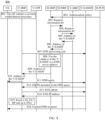
- the V-SMF selects the V-EASDF, and directly sends the address of the V-EASDF to the UE, to implement local traffic routing in the VPLMN in the HR roaming scenario.
- FIG. 6 is a schematic flowchart of another information transmission method 600 according to an embodiment of this application.
- the method 600 may be used in a scenario in which an H-SMF sends an address of a V-EASDF to UE.
- the method 600 may include the following steps.
- Step 601 is similar to step 501. Details are not described herein again.
- the H-SMF sends the address of the V-EASDF to the V-SMF.
- the V-SMF sends the address of the V-EASDF to the UE.
- the V-SMF may not need to parse the address, that is, forward the address of the V-EASDF to the UE.
- the UE sends the DNS query to the V-EASDF.
- V-EASDF reports, to the V-SMF, an FQDN included in the DNS query.
- V-SMF sends an ECS option to the V-EASDF.
- the V-SMF inserts a UL CL/BP and an L-PSA.
- the V-EASDF sends a cached DNS response to the UE.
- FIG. 7 is a schematic flowchart of another information transmission method 700 according to an embodiment of this application.
- the method 700 may be used in a scenario in which an H-SMF sends an address of a V-EASDF to UE.
- the method 700 may include the following steps.
- the UE initiates a session establishment procedure.
- V-SMF selects the V-EASDF
- V-EASDF For a manner in which the V-SMF selects the V-EASDF, refer to the descriptions of step 506 in the method 500. Details are not described herein again.
- the V-SMF sends the address of the V-EASDF to the H-SMF.
- That is, that the second session management network element obtains the address information of the V-EASDF in step 410 in the foregoing method 400 may include: The second session management network element receives the address information of the V-EASDF from the V-SMF.
- the authorization policy indicates that local traffic routing is allowed in a VPLMN.
- the H-SMF does not select an H-EASDF.
- the H-SMF may send the address of the V-EASDF as a DNS server address to the UE, and thus may not select the H-EASDF.
- the H-SMF sends the address of the V-EASDF to the V-SMF.
- the H-SMF may send the address of the V-EASDF to the UE by using the V-SMF. That is, in step 420 in the foregoing method 400, that the second session management network element sends the address information of the V-EASDF to the terminal device may include: The second session management network element sends the address information of the V-EASDF to the terminal device by using the V-SMF.
- Step 707 is similar to step 608. Details are not described herein again.
- the V-SMF inserts a UL CL/BP and an L-PSA.
- the H-NRF sends request information #3 to the V-NRF.
- the address of the V-EASDF that is sent by the H-NRF to the H-SMF in step 806 is the address of the V-EASDF that is received by the H-NRF from the V-NRF in step 805.
- V-EASDF reports, to the V-SMF, an FQDN included in the DNS query.
- Steps 807 to 816 are similar to steps 605 to 614. Details are not described herein again.
- FIG. 5 to FIG. 8 in embodiments of this application are provided merely to help a person skilled in the art understand embodiments of this application, instead of limiting embodiments of this application to specific scenarios shown in the examples. It is clear that, a person skilled in the art can make various equivalent modifications or changes based on the examples in FIG. 5 to FIG. 8 , and such modifications or changes also fall within the scope of embodiments of this application.
- the session establishment procedure in FIG. 5 to FIG. 8 may alternatively be replaced with a session modification procedure.
- the ECS option in FIG. 5 to FIG. 8 may alternatively be replaced with an L-DNS server address.
- methods and operations implemented by a device may alternatively be implemented by a component (for example, a chip or a circuit) of the device.
- the apparatus 900 may further include a storage unit.
- the storage unit may be configured to store instructions and/or data.
- the processing unit 920 may read the instructions and/or the data in the storage unit, so that the apparatus implements actions of the devices or network elements in the foregoing method embodiments.
- the apparatus 900 may be the first session management network element in the foregoing embodiments, or may be a component (for example, a chip) of the first session management network element.
- the apparatus 900 may implement steps or procedures performed by the first session management network element in the foregoing method embodiments.
- the transceiver unit 910 may be configured to perform sending and receiving operations of the first session management network element in the foregoing method embodiments.
- the processing unit 920 may be configured to perform operations related to processing of the first session management network element in the foregoing method embodiments.
- the transceiver unit 910 is further configured to receive the indication information from a second session management network element, where the second session management network element is a network element deployed in a home network.
- the first session management network element locally configures the indication information.
- the transceiver unit 910 is configured to send the address information of the edge application server discovery network element to the second session management network element, where the second session management network element is the network element deployed in the home network.
- the transceiver unit 910 is further configured to receive request information from the second session management network element, where the request information is used to request an address of the edge application server discovery network element, and the second session management network element is the network element deployed in the home network.
- the processing unit 920 is used by the first session management network element to: in response to the request information, select the edge application server discovery network element.
- the transceiver unit 910 is further configured to obtain indication information, where the indication information indicates that traffic routing is allowed in the visited network.
- the transceiver unit 910 is configured to obtain the address information of the edge application server discovery network element based on the indication information.
- the apparatus 900 in each of the foregoing solutions has a function of implementing corresponding steps performed by a core network element (for example, the first session management network element or the second session management network element) in the foregoing methods.
- the function may be implemented by hardware, or may be implemented by hardware executing corresponding software.
- the hardware or software includes one or more modules corresponding to the foregoing functions.
- an embodiment of this application provides another information transmission apparatus 1000.
- the apparatus 1000 includes a processor 1010.
- the processor 1010 is configured to: execute a computer program or instructions stored in the memory 1020, or read data/signaling stored in the memory 1020, to perform the methods in the foregoing method embodiments.
- the apparatus 1000 is configured to implement operations performed by the core network element in the foregoing method embodiments.
- the processor 1010 is configured to execute the computer program or the instructions stored in the memory 1020, to implement related operations of the second session management network element in the foregoing method embodiments.
- the method performed by the second session management network element in the embodiment shown in FIG. 3 or FIG. 4 is implemented, or the method performed by the H-SMF in any one of embodiments shown in FIG. 5 to FIG. 8 is implemented.
- the computer instructions may be transmitted from a website, computer, server, or data center to another website, computer, server, or data center in a wired (for example, a coaxial cable, an optical fiber, or a digital subscriber line (DSL)) or wireless (for example, infrared, radio, or microwave) manner.
- the computer-readable storage medium may be any usable medium that can be accessed by the computer, or a data storage device such as a server or a data center that integrates one or more usable media.
Landscapes
- Engineering & Computer Science (AREA)
- Computer Networks & Wireless Communication (AREA)
- Signal Processing (AREA)
- Computer Security & Cryptography (AREA)
- Databases & Information Systems (AREA)
- Mobile Radio Communication Systems (AREA)
Applications Claiming Priority (2)
| Application Number | Priority Date | Filing Date | Title |
|---|---|---|---|
| CN202111163293.1A CN115884155B (zh) | 2021-09-30 | 2021-09-30 | 信息传输的方法和装置 |
| PCT/CN2022/121186 WO2023051428A1 (zh) | 2021-09-30 | 2022-09-26 | 信息传输的方法和装置 |
Publications (2)
| Publication Number | Publication Date |
|---|---|
| EP4398617A1 true EP4398617A1 (de) | 2024-07-10 |
| EP4398617A4 EP4398617A4 (de) | 2025-01-01 |
Family
ID=85756708
Family Applications (1)
| Application Number | Title | Priority Date | Filing Date |
|---|---|---|---|
| EP22874814.1A Pending EP4398617A4 (de) | 2021-09-30 | 2022-09-26 | Verfahren und vorrichtung zur informationsübertragung |
Country Status (6)
| Country | Link |
|---|---|
| US (1) | US20240236840A1 (de) |
| EP (1) | EP4398617A4 (de) |
| CN (1) | CN115884155B (de) |
| AU (1) | AU2022355896B2 (de) |
| CA (1) | CA3233649A1 (de) |
| WO (1) | WO2023051428A1 (de) |
Cited By (1)
| Publication number | Priority date | Publication date | Assignee | Title |
|---|---|---|---|---|
| EP4503681A4 (de) * | 2022-03-29 | 2025-07-09 | China Mobile Comm Co Ltd Res Inst | Offload-verarbeitungsverfahren sowie vorrichtung und speichermedium |
Families Citing this family (5)
| Publication number | Priority date | Publication date | Assignee | Title |
|---|---|---|---|---|
| KR20230050048A (ko) * | 2021-10-07 | 2023-04-14 | 삼성전자주식회사 | 무선 통신 시스템에서 Home Routed 세션의 Visited 사업자 망에서 세션 분기 방법 및 장치 |
| US12348512B2 (en) * | 2023-04-27 | 2025-07-01 | Verizon Patent And Licensing Inc. | Method and system for EASDF secure service |
| CN118945886A (zh) * | 2023-05-12 | 2024-11-12 | 华为技术有限公司 | 通信方法、装置、系统及存储介质 |
| KR20250027135A (ko) * | 2023-08-18 | 2025-02-25 | 삼성전자주식회사 | 에지 컴퓨팅 서비스를 위한 로밍 세션을 관리하는 방법 및 장치 |
| CN120302288A (zh) * | 2024-01-11 | 2025-07-11 | 维沃移动通信有限公司 | 信息处理方法、装置、通信设备及存储介质 |
Family Cites Families (12)
| Publication number | Priority date | Publication date | Assignee | Title |
|---|---|---|---|---|
| CN109246769B (zh) * | 2017-05-05 | 2020-10-09 | 华为技术有限公司 | 一种pdu会话建立方法及装置 |
| US11019668B2 (en) * | 2018-04-09 | 2021-05-25 | Ofinno, Llc | PDU session establishment for cellular IoT |
| EP4216493A1 (de) * | 2018-06-26 | 2023-07-26 | Huawei Technologies Co., Ltd. | Sitzungsverarbeitungsverfahren und -vorrichtung |
| WO2021029513A1 (ko) * | 2019-08-09 | 2021-02-18 | 엘지전자 주식회사 | 어플리케이션 서버의 변경에 관련된 동작 |
| CN112422701B (zh) * | 2019-08-20 | 2022-05-24 | 华为技术有限公司 | 域名系统查询的方法和通信装置 |
| CN112929868A (zh) * | 2019-12-05 | 2021-06-08 | 中兴通讯股份有限公司 | 跨区漫游通信方法、装置、电子设备及计算机可读介质 |
| US20230199595A1 (en) * | 2020-04-01 | 2023-06-22 | Telefonaktiebolaget Lm Ericsson (Publ) | Methods and apparatuses for establishment of pdu session |
| US11924163B2 (en) * | 2020-04-08 | 2024-03-05 | Intel Corporation | Initiation of domain name system (DNS) resolution in 5G systems |
| CN111565404B (zh) * | 2020-04-15 | 2022-10-25 | 中国联合网络通信集团有限公司 | 一种数据分流方法和装置 |
| CN111586114B (zh) * | 2020-04-24 | 2025-07-25 | 腾讯科技(深圳)有限公司 | 业务协同处理方法及相关设备 |
| US11729137B2 (en) * | 2021-02-18 | 2023-08-15 | Samsung Electronics Co., Ltd. | Method and device for edge application server discovery |
| CN115915091B (zh) * | 2021-09-30 | 2025-09-12 | 华为技术有限公司 | 通信的方法和装置 |
-
2021
- 2021-09-30 CN CN202111163293.1A patent/CN115884155B/zh active Active
-
2022
- 2022-09-26 WO PCT/CN2022/121186 patent/WO2023051428A1/zh not_active Ceased
- 2022-09-26 EP EP22874814.1A patent/EP4398617A4/de active Pending
- 2022-09-26 AU AU2022355896A patent/AU2022355896B2/en active Active
- 2022-09-26 CA CA3233649A patent/CA3233649A1/en active Pending
-
2024
- 2024-03-27 US US18/618,096 patent/US20240236840A1/en active Pending
Cited By (1)
| Publication number | Priority date | Publication date | Assignee | Title |
|---|---|---|---|---|
| EP4503681A4 (de) * | 2022-03-29 | 2025-07-09 | China Mobile Comm Co Ltd Res Inst | Offload-verarbeitungsverfahren sowie vorrichtung und speichermedium |
Also Published As
| Publication number | Publication date |
|---|---|
| CA3233649A1 (en) | 2023-04-06 |
| AU2022355896B2 (en) | 2025-04-03 |
| AU2022355896A1 (en) | 2024-04-11 |
| CN115884155A (zh) | 2023-03-31 |
| CN115884155B (zh) | 2025-07-11 |
| US20240236840A1 (en) | 2024-07-11 |
| EP4398617A4 (de) | 2025-01-01 |
| WO2023051428A1 (zh) | 2023-04-06 |
Similar Documents
| Publication | Publication Date | Title |
|---|---|---|
| EP4398615A1 (de) | Kommunikationsverfahren und -vorrichtung | |
| EP4398617A1 (de) | Verfahren und vorrichtung zur informationsübertragung | |
| EP4391648A1 (de) | Kommunikationsverfahren und -vorrichtung | |
| US20240244497A1 (en) | Communication method and apparatus | |
| US20250056382A1 (en) | Policy transmission method, and communication apparatus and system | |
| WO2021233340A1 (zh) | 网络注册的方法和装置 | |
| US20240388991A1 (en) | Method and apparatus for determining user equipment route selection policy | |
| WO2020217224A1 (en) | Amf and scp behavior in delegated discovery of pcf | |
| WO2023124457A1 (zh) | 选择网络的方法和装置 | |
| WO2023160394A1 (zh) | 通信的方法和装置 | |
| US20240155325A1 (en) | Information obtaining method and apparatus, and system | |
| EP4447577A1 (de) | Rundfunkkommunikationsverfahren und -vorrichtung | |
| US20250338123A1 (en) | Communication method and communication apparatus | |
| WO2023116556A1 (zh) | 会话切换的方法和装置 | |
| US20250184810A1 (en) | Communication method and communication apparatus | |
| US20240214455A1 (en) | Communication method and apparatus | |
| EP4550853A1 (de) | Kommunikationsverfahren und -vorrichtung sowie speichermedium | |
| EP4668819A1 (de) | Sicherheitseinrichtungsverfahren und zugehörige vorrichtung | |
| US20250274493A1 (en) | Communication method and apparatus | |
| CN120456174A (zh) | 一种通信方法和通信装置 |
Legal Events
| Date | Code | Title | Description |
|---|---|---|---|
| STAA | Information on the status of an ep patent application or granted ep patent |
Free format text: STATUS: THE INTERNATIONAL PUBLICATION HAS BEEN MADE |
|
| PUAI | Public reference made under article 153(3) epc to a published international application that has entered the european phase |
Free format text: ORIGINAL CODE: 0009012 |
|
| STAA | Information on the status of an ep patent application or granted ep patent |
Free format text: STATUS: REQUEST FOR EXAMINATION WAS MADE |
|
| 17P | Request for examination filed |
Effective date: 20240405 |
|
| AK | Designated contracting states |
Kind code of ref document: A1 Designated state(s): AL AT BE BG CH CY CZ DE DK EE ES FI FR GB GR HR HU IE IS IT LI LT LU LV MC MK MT NL NO PL PT RO RS SE SI SK SM TR |
|
| A4 | Supplementary search report drawn up and despatched |
Effective date: 20241202 |
|
| RIC1 | Information provided on ipc code assigned before grant |
Ipc: H04W 48/18 20090101ALI20241126BHEP Ipc: H04W 48/16 20090101ALI20241126BHEP Ipc: H04W 48/08 20090101ALI20241126BHEP Ipc: H04W 8/12 20090101ALI20241126BHEP Ipc: H04W 8/08 20090101AFI20241126BHEP |
|
| DAV | Request for validation of the european patent (deleted) | ||
| DAX | Request for extension of the european patent (deleted) | ||
| STAA | Information on the status of an ep patent application or granted ep patent |
Free format text: STATUS: EXAMINATION IS IN PROGRESS |
|
| 17Q | First examination report despatched |
Effective date: 20251219 |